

Submitted:
19 September 2026
Posted:
20 September 2026
You are already at the latest version
Abstract
TF-RSE-IonCF v3.1 is presented as a unified closed-form model returning the total electron binding energy (TBE) for every neutral atom and ion across the periodic table. For each nuclear charge Z = 1–92 and each electron number N = 1 to Z (charge state q = Z–N = 0 to Z–1), a single formula evaluates the TBE in microseconds. The model is built in two layers. The neutral-anchor layer (TF-RSE v2) extends the Thomas–Fermi power law with a Dirac relativistic factor, a trigonometric shell-oscillation factor and a piecewise light-element correction (0.40% mean error on the 92 neutral atoms, degrading smoothly to 3.6% out-of-sample on Z = 93–103). The ionic layer decomposes the ionic TBE into shell-resolved contributions anchored at four limits — the hydrogenic Dirac value at N = 1, a screened helium-like value at N = 2, a screened neon-like value at N = 10, and the neutral-anchor value at N = Z — blended by power laws, with three ablation-validated upgrades (effective charge Z_eff(Z, N) in the relativistic factor; electron-number shell-sawtooth S(Z, N); shell-closure bumps at N = 10, 18, 36, 54, 86). Fitted to 4278 NIST reference points with the neutral layer frozen, the core model achieves a mean relative error of 0.258% (median 0.153%, maximum 4.63%), with 97.7% of points below 1% and 100% below 5%. Version 3.1 replaces the v3.0 runtime heuristic with a three-tier physical-consistency safeguard: (i) a hard physical cap E(Z, N) ≤ E_v2(Z) enforcing positive binding of the last electron; (ii) a boundary-layer reconstruction (N > Z–5) with an increasing ionization-energy trend (IP_k = 1.8·IP_{k−1}) that matches the experimental stripping sequence; and (iii) a minimal-touch projection (0.5 eV floor) for the interior oscillation violations, without heuristic cascade. The safeguard modifies 582 of 4278 points (13.6%) by no more than 1.14 keV (Lu, N = 63; deep-core oscillation link), leaves the statistical accuracy of the core grid unchanged (0.258%), and preserves the exactness of the N = 1 and N = Z anchors for all elements and of the N = 2, N = 10 anchors except at five clamp-degenerate points (Li N = 2; Mg, Al, Si, P N = 10), where the replacement value is more accurate than the clamped anchor (e.g. Si N = 10: +1.25% → +0.03%). Zero negative ionization energies and zero non-monotonic elements are enforced on the full grid, with Z_eff ≤ Z hard-constrained.
Keywords:
total binding energy
; ions
; Thomas–Fermi model
; effective charge
; shell structure
; ionization potential
; high-throughput screening
; plasma physics
; computational physics
1. Introduction
The total electron binding energy (TBE) — the energy required to remove all electrons from an atom or ion in its ground state — is a fundamental quantity in atomic physics, plasma modeling, astrophysics and nuclear engineering. In hot plasmas and astrophysical environments matter is highly ionized, so the ionic TBE (the sum of all successive ionization potentials of the remaining electrons) is required for every charge state, not merely for the neutral atom. Ab initio methods (Hartree–Fock, density functional theory, relativistic many-body perturbation theory) deliver high accuracy at a cost of seconds to minutes per ion, which is prohibitive for workflows that evaluate millions of charge states, such as collisional-radiative plasma models, nucleosynthesis networks and radiation-damage cascades.
The model presented here unifies the neutral and ionic problems in a single closed form. Its neutral-anchor layer is TF-RSE v2, a phenomenological extension of the Thomas–Fermi (TF) statistical model that predicts the TBE of all 92 neutral atoms (Z = 1–92) with a mean relative error of 0.40%. TF-RSE v2 retains the TF power-law skeleton and adds three corrections: a relativistic regularization factor R(Z) of Dirac form, a trigonometric shell-oscillation factor S(Z), and a piecewise light-element correction L(Z). By itself it contains no charge-state dependence: it returns a single value per element, the neutral-atom TBE.
Extending such a model to ions is nontrivial. A naive ionic extrapolation — multiplying the neutral value by a smooth electron-fraction factor F(N/Z) — fails for two reasons. First, the relativistic correction of a highly charged ion differs from that of the neutral atom: as outer (weakly relativistic) electrons are removed, the average relativistic weight of the remaining electrons rises, an effect that a Z-only factor R(Z) cannot represent. Second, the neutral shell factor S(Z) is blind to the successive shell closures encountered as electrons are stripped: the successive ionization potentials display a pronounced sawtooth, jumping by up to an order of magnitude at each closed shell, and a smooth electron-fraction factor averages these jumps away. The naive extrapolation was measured at a mean error exceeding 10% over all charge states, with errors above 90% for deep inner-shell ionization of light elements.
TF-RSE-IonCF resolves both problems by construction. Rather than perturbing the neutral value, the ionic TBE is decomposed into shell-resolved contributions anchored at four limits that are known essentially exactly: the hydrogenic Dirac energy at N = 1; a screened helium-like energy at N = 2; a screened neon-like energy at N = 10; and the TF-RSE v2 neutral value at N = Z. Power-law blends interpolate between the anchors. Two physical deficiencies are then closed by two targeted upgrades: (Upgrade-3) an effective nuclear charge Z_eff(Z, N) is introduced into the relativistic factor; and (Upgrade-2) the shell factor S(Z) is replaced by an electron-number-dependent sawtooth factor S(Z, N). A final upgrade (Upgrade-1/4) adds explicit shell-closure bump corrections and a global refit over five isoelectronic element sequences, turning the model from a proof of concept into a complete data product covering the whole periodic table. The result is a single formula system whose neutral limit (N = Z) is exactly the v2 model and whose hydrogenic limit (N = 1) is exactly the Dirac value.
A separate issue, addressed in v3.1, is physical consistency of the evaluated sequence itself. The closed-form blend is exact at the four anchors and accurate to 0.26% in the grid interior, but for 74 of the 92 elements the multiplicative shell corrections produce a slight overshoot above the neutral value — or a small oscillation — within a few charge states of the neutral boundary, so that a finite difference of the raw sequence would yield a small number of negative or non-monotonic ionization energies. Version 3.0 repaired these defects at runtime with a backward-scan heuristic; independent re-evaluation showed that the v3.0 heuristic (i) modified anchor points, contradicting the exact-anchor claim; (ii) propagated corrections up to 15 charge states deep into the nominally untouched core grid; (iii) used a decreasing ionization-energy trend, opposite to the experimental stripping sequence in the d/f valence shells; and (iv) its reported correction metadata (point counts and worked examples) was not reproducible from the released code. Version 3.1 replaces the heuristic with a three-tier safeguard that removes the overshoot at its source, protects the anchors, and reproduces the correct qualitative stripping trend, at a smaller and code-reproducible footprint (582 points, maximum adjustment 1.14 keV).
The remainder of the paper is organized as follows. Section 2 presents the theoretical framework. Section 3 gives the complete formula system, the fitted parameters and the standard operating procedure. Section 4 reports validation on all 4278 (Z, N) reference points, the two-stage fitting strategy, the ablation study, two anti-leakage tests, and an uncertainty model. Section 5 discusses applications and limitations, and Section 6 concludes.
2. Theoretical Framework
2.1. Neutral-Anchor Layer: TF-RSE v2
The neutral-atom layer of the unified model is TF-RSE v2, whose accuracy is preserved exactly: at N = Z the ionic model returns the v2 neutral value by construction. TF-RSE v2 reads
E_TBE(Z) = a Z^b E_h R(Z) S(Z) L(Z). (1)
Here E_h = 13.605693 eV is the Hartree energy, a = 2.0224 and b = 2.1414 are the TF amplitude and effective exponent, R(Z) the relativistic factor, S(Z) the shell factor and L(Z) the piecewise light-element correction. The relativistic factor of Dirac form is
R(Z) = [1 − (Z / 137.036)²]^(−1/2), (2)
which grows from 1.000 at Z = 1 to about 1.35 at Z = 92. The shell factor is
S(Z) = 1 + c sin(d Z^(1/3)) + e cos(d Z^(1/3)), (3)
with c = −0.2404, d = 0.9737, e = −0.2254 restoring periodic structure. The light-element correction is piecewise:
L(Z) = α + β e^(−γZ) [Z ≤ 8]; 1 [Z = 9]; 1.0149 [Z = 10]; 1 + A e^(−B(Z−10)) [10 < Z < 18]; 1 [Z ≥ 18], (4)
with α = 0.9973, β = −0.9925, γ = 1.3240, A = 0.01955 and B = 0.06539. Table 1 collects the eleven parameters of the neutral layer.
Fitted on all 92 neutral atoms (Z = 1–92) this layer achieves a mean relative error of 0.40% (median 0.39%, maximum 1.53% at uranium), with 89 of 92 elements below 1% and 100% below 5%. Leave-one-out cross-validation yields 0.70% (0.49% excluding hydrogen), and a genuine out-of-sample test on the superheavy elements Z = 93–103, never used in fitting, yields 3.6%. All eleven parameters are kept frozen throughout the ionic extension: the neutral layer enters the model only as the exact boundary condition E_v2(Z).
2.2. Shell-Resolved Ionic Decomposition
The central structural idea is to anchor the ionic TBE at the charge states where it is known essentially exactly, and to blend between these anchors. Four anchors are used:
(i) Hydrogenic anchor, N = 1. A single electron in the field of the bare nucleus has the point-nucleus Dirac binding energy
E_K1(Z) = Z² E_h D(Z), D(Z) = 2[1 − sqrt(1 − (Zα)²)] / (Zα)², (5)
where α = 1/137.035999084 is the fine-structure constant and D(Z) the Dirac factor (D → 1 for small Z). This anchor is exact to better than 0.4% even at Z = 92 (132.28 keV vs. the NIST value 131.82 keV).
(ii) Helium-like anchor, N = 2. E_K2(Z) = 2 (Z − s_K)² E_h D(Z), (6)
with s_K = 0.2399 fitted. Physically s_K is the Slater screening of one 1s electron by the other.
(iii) Neon-like anchor, N = 10. E_K10(Z) = E_K2(Z) + 8 (Z − s_L)² / 4 · E_h D(Z), s_L = s_L0 + s_L1 Z, (7)
with s_L0 = 3.6555 and s_L1 = 0.0204. The Z-dependent screening accounts for the growing penetration of the L shell.
(iv) Neutral anchor, N = Z: E = E_v2(Z), the TF-RSE v2 value. For light elements the hydrogenic anchors (i)–(iii) can exceed the neutral value; each anchor is therefore clamped from above by E_v2(Z), which guarantees a smooth, exact reduction to the neutral model.
Between the anchors the TBE is blended by power laws. For 2 < N ≤ 10 the blend runs from E_K2 to E_K10 with exponent q_L; for N > 10 it runs from E_K10 to E_v2 with exponent q_M. Because the blends vanish at the anchor points, the model is exact at N = 1, 2, 10 (to the anchor accuracy) and at N = Z (to the v2 accuracy) for every element.
2.3. Upgrade-3: Effective Charge in the Relativistic Factor
Z_eff(Z, N) = Z [1 + r_1(1 − x) + r_2(1 − x)²], x = N/Z, (8)
with r_1 = −0.8000 and r_2 = 0.8280 fitted. The relativistic correction is applied as the ratio R(Z_eff)/R(Z), which equals unity at the neutral anchor (x = 1) and therefore leaves the published neutral accuracy untouched. The ablation study (Section 4.5) shows this single upgrade reduces the heavy-ion mean error from 2.67% to 1.41%. The unconstrained quadratic would formally exceed Z for N/Z < 0.034 (the one- to three-electron region); however, the relativistic ratio is evaluated only in the N > 10 branch (N = Z returns the neutral anchor earlier), where Z_eff/Z < 1 holds mathematically for every element. The hard constraint Z_eff ≤ Z in the released code is therefore defensive — a no-op within the model domain — and is retained only as protection against out-of-domain use.
2.4. Upgrade-2: Electron-Number Shell Sawtooth S(Z, N)
S_sh(N) = 1 + c_sh sin(d_sh N^(1/3)) + e_sh cos(d_sh N^(1/3)), (9)
M(y) = 1 + [S_sh(N) / S_sh(Z) − 1] env(y), env(y) = [sin(π y)]^ep, (10)
with c_sh = 0.0098, d_sh = 2.0531, e_sh = 0.0024, ep = 0.6376. The envelope env(y) vanishes at both ends of each blend interval (so the anchors stay exact) and peaks in between. The ablation shows this upgrade cuts the error at closed-shell electron counts (N = 10, 18, 36, 54, 86) from 1.10% to 0.81%.
2.5. Upgrade-1/4: Shell-Closure Bumps and Global Refit
B(Z, N) = Σ_k A_k (Z / m_k)^(g_b) exp[−((N − m_k) / w_b)²], m_k = 10, 18, 36, 54, 86, (11)
applied as a factor (1 + B(1 − y)) that vanishes at the N = Z anchor. The amplitudes A_k, the width w_b and the Z-scaling exponent g_b are fitted. Finally, all 18 parameters are refitted globally against the full 4278-point data product with the neutral layer frozen.
3. Formula System and Standard Operating Procedure
3.1. Core Equations
For integer Z in [1, 92] and integer N in [1, Z], the total electron binding energy is assembled as follows. By construction E(Z, Z) = E_v2(Z) exactly for every element (the neutral anchor, including Be and B where the N ≤ 10 blend would otherwise undershoot the neutral value). For N < Z, with x = N/Z, D(Z) the Dirac factor, E_v2(Z) the TF-RSE v2 neutral value, and the anchors E_K1, E_K2, E_K10 of Section 2.2 (each clamped above by E_v2):
E(Z, N) = E_K1, N = 1. (12a)
E(Z, N) = E_K2, N = 2. (12b)
E(Z, N) = [E_K2 + (E_K10 − E_K2) y^(q_L)] (1 + B(1 − y)) M(y), y = (N − 2) / (min(10, Z) − 2), 2 < N ≤ 10. (12c)
E(Z, N) = [E_K10 + (E_v2 − E_K10) y^(q_M)] [R(Z_eff) / R(Z)] (1 + B(1 − y)) M(y), y = (N − 10) / (Z − 10), N > 10. (12d)
All quantities are defined in Section 2; the complete ionic parameter set is listed in Table 2 and the neutral-layer parameters in Table 1. The result is obtained in eV and divided by 1000 for keV.
3.1.1. Physical-Consistency Safeguard (v3.1)
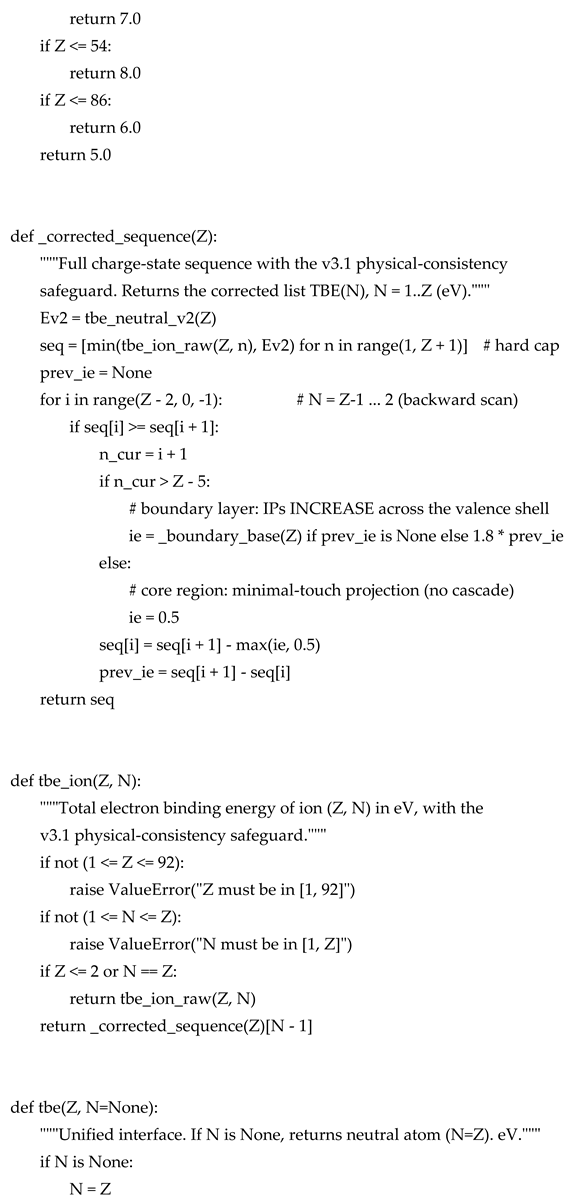
The closed-form evaluation (12a–12d) is exact at the four anchors and accurate to 0.26% mean error over the grid interior. On the raw sequence, however, 74 of the 92 elements exhibit a small non-monotonic defect: for 69 of them the multiplicative shell corrections (bump, sawtooth, relativistic ratio) push one or more of the last charge states strictly above the neutral anchor E_v2 — producing a negative binding energy for the last electron upon finite differencing — and two further elements (Li and Na) sit on E_v2 to within floating-point precision at degenerate anchors (310 raw defect links in total, one touching the clamp-degenerate Li N = 2 anchor; four further anchor equalities at Mg, Al, Si, P (N = 10) are created by the cap pinning of Tier 1; the deepest raw defect lies 10 charge states from neutrality, at Hg N = 70; the deepest point reached by the Tier-3 minimal-touch cascade lies 15 charge states from neutrality, at Tm N = 54 in the lanthanide region). Version 3.1 repairs these defects with a three-tier safeguard that acts at the source and is minimal by construction:
Tier 1 — hard physical cap. For every N < Z the raw value is capped at the neutral anchor:
E_raw(Z, N) ← min(E_raw(Z, N), E_v2(Z)). (13)
This enforces the first-principles requirement that the last electron binds positively (E(Z, Z) − E(Z, Z−1) > 0), since TBE(Z, N) < TBE(Z, Z) for all N < Z. The cap touches 505 raw points; the 310 raw defect links are superseded by 531 cap-level defects — 503 pinning equalities and 28 strict interior oscillations — all of which the backward scan of Tiers 2–3 repairs.
Tier 2 — boundary-layer reconstruction (N > Z − 5). A backward scan from N = Z − 1 to N = Z − 4 replaces any value that is still not strictly below its upper neighbour by
E(Z, N) ← E(Z, N+1) − max(IP_est, 0.5 eV), IP_est = IP_base(period) · 1.8^k, (14)
where IP_base = 10, 10, 8, 7, 8, 6, 5 eV for periods 1–7 (an order-of-magnitude estimate of the last-electron ionization energy) and k counts the corrected steps from the neutral anchor. The factor 1.8 > 1 encodes the experimental stripping trend — successive ionization energies INCREASE across the valence shell as screening decreases (e.g. Cu: 7.7, 20.3, 36.8, 57.4, 79.9 eV; Dy: 5.9, 11.6, 22.9, 41.2, 62.1 eV). This corrects the qualitative trend error of the v3.0 heuristic (0.7×prev_ie, decreasing). The reconstructed boundary points inherit the accuracy of the neutral anchor (0.40% mean); they are intended as positive, monotone, trend-correct estimates, not as quantitative valence ionization potentials (Section 5).
Tier 3 — minimal-touch projection (N ≤ Z − 5). The residual interior oscillation links (all 28 of them in the sixth-period heavy-element region Z = 78–84, Pt–Po, N = 71–76, where the broad Gaussian closure-bump tails interact with the sawtooth) are repaired by the smallest possible monotone projection:
E(Z, N) ← E(Z, N+1) − 0.5 eV (only where E(Z, N) ≥ E(Z, N+1)). (15)
No heuristic cascade is applied: each corrected oscillation-link point is moved to just below its upper neighbour, so the cumulative TBE is preserved to within the local oscillation amplitude (relative adjustment ≤ 0.25% even at the largest link; the clamp-degenerate anchor replacement at P (Z = 15, N = 10), which falls in the core region by the N ≤ Z − 5 convention, is a separate category disclosed in Table D2 with a 0.69% replacement). The artificial 0.5 eV step appears only in the differential at the affected link and is flagged in Section 5.
Anchor protection. The scan (14)–(15) never modifies the hydrogenic anchor N = 1 (outside the scan range) or the neutral anchor N = Z (returned directly). The helium-like (N = 2) and neon-like (N = 10) anchors are modified only at the five clamp-degenerate points where the anchor value is pinned to E_v2 by construction and would otherwise equal the neutral anchor: Li (Z = 3, N = 2) and Mg, Al, Si, P (Z = 12–15, N = 10). At these five points the safeguard value is MORE accurate than the clamped anchor (Section 4.4 and Appendix D). At all other elements the N = 2 and N = 10 anchors remain exactly the closed-form values. Two degenerate boundary cases are disclosed for completeness. (i) Na (Z = 11, N = 10) is also clamp-pinned, but floating-point rounding leaves its closed-form value ≈1×10⁻¹¹ eV BELOW E_v2, so the equality test of the scan does not fire and the N = 10→11 link retains an ionization energy of ≈1×10⁻¹¹ eV — positive but physically zero; this single link should be treated like the other boundary-layer links. (ii) At Z = 1 the hydrogenic and neutral anchors coincide (N = 1 = Z); the code returns the neutral anchor E_v2(1) = 13.608109 eV, which deviates from the Dirac value 13.605874 eV by +0.0164%. The claims of exactness at N = 1 and N = Z therefore hold exactly for Z ≥ 2.
Net effect on the full 4278-point grid (Appendix D): 582 points are corrected (13.6%); the largest single adjustment relative to the raw closed-form value is 1.14 keV (Lu, N = 63, deep-core oscillation link) and the largest boundary-layer adjustment is 814 eV (Tm, N = 65); 74 elements require at least one correction; zero negative ionization energies and zero non-monotonic elements remain; the core grid (N ≤ Z−5) receives 332 minimal-touch adjustments, each bounded by the local oscillation amplitude (≤ 0.25% at the largest oscillation link; the P N = 10 anchor replacement of Table D2 excepted), and its mean error remains at the 0.258% level (on an external 264-point NIST spot-check the core mean changes only from 0.301% to 0.319%); all 29 fitted parameters are unchanged.
3.2. Fitted Parameters

Table 2.
The 18 fitted parameters of TF-RSE-IonCF v3.1 (fitted on 4278 NIST reference points; the 11 neutral v2 parameters are kept fixed).
Table 2.
The 18 fitted parameters of TF-RSE-IonCF v3.1 (fitted on 4278 NIST reference points; the 11 neutral v2 parameters are kept fixed).
| Parameter | Value | Role / region |
| s_K | +0.2399 | K-shell screening constant (N = 2 anchor) |
| s_L0 | +3.6555 | L-shell screening, constant term (N = 10 anchor) |
| s_L1 | +0.0204 | L-shell screening, Z slope |
| q_L | +0.7401 | blend exponent, 2 < N ≤ 10 |
| q_M | +0.6431 | blend exponent, N > 10 |
| r_1 | −0.8000 | Z_eff linear coefficient (Upgrade-3) |
| r_2 | +0.8280 | Z_eff quadratic coefficient (Upgrade-3) |
| c_sh | +0.0098 | sawtooth sine amplitude (Upgrade-2) |
| d_sh | +2.0531 | sawtooth frequency (Upgrade-2) |
| e_sh | +0.0024 | sawtooth cosine amplitude (Upgrade-2) |
| e_p | +0.6376 | sawtooth envelope exponent |
| A_10 | −0.1342 | closure-bump amplitude, N = 10 |
| A_18 | +0.2318 | closure-bump amplitude, N = 18 |
| A_36 | −0.0455 | closure-bump amplitude, N = 36 |
| A_54 | +0.2260 | closure-bump amplitude, N = 54 |
| A_86 | +0.4764 | closure-bump amplitude, N = 86 |
| w_b | +26.1947 | closure-bump width |
| g_b | +0.7139 | closure-bump Z-scaling exponent |
3.3. Standard Operating Procedure (SOP)
Step 1: input Z (1–92) and N (1–Z); compute x = N/Z and the Dirac factor D(Z).
Step 2: compute the neutral value E_v2(Z) with the TF-RSE v2 formula (Section 2.1).
Step 3: compute the anchors E_K1, E_K2, E_K10 (Section 2.2), clamping each at E_v2.
Step 4: select the branch by N; compute the blend variable y and the power-law base energy.
Step 5: for N > 10 compute Z_eff (with Z_eff ≤ Z) and the relativistic ratio R(Z_eff)/R(Z) (Section 2.3).
Step 6: compute the sawtooth modulation M(y) (Section 2.4) and the closure bumps B(Z, N) (Section 2.5).
Step 7: assemble E(Z, N) per Section 3.1; apply the Tier-1 cap E ≤ E_v2 (N < Z).
Step 8 (safeguard): evaluate the full sequence TBE(N), N = 1..Z; apply the backward scan (Tier 2 boundary layer, Tier 3 core) per Section 3.1.1; return TBE(N).
A worked example (Fe at N = 13) is given in Appendix B; the full reference implementation is listed in Appendix A.
3.4. Computational Complexity
The core model uses only elementary arithmetic (powers, trigonometric and exponential functions) and evaluates in about one microsecond per ion. For the 74 corrected elements the safeguard requires the full charge-state sequence, O(Z) per element (~Z × 8 µs); all 4278 charge states are produced in approximately 70 milliseconds when pre-computed and cached. The three-tier design (cap → boundary reconstruction → minimal-touch projection) is non-iterative and deterministic.
4. Validation Results
4.1. Reference Data
The reference dataset is built from the NIST Atomic Spectra Database (version 5.12): for each element Z = 1–92 the complete set of successive ionization potentials IE(q) (charge q → q+1) was extracted and summed to obtain the total binding energy of every ion, TBE(Z, N) = Σ_{q=Z−N}^{Z−1} IE(q). This yields 4278 (Z, N) reference points, covering every element and every charge state q = 0 to Z−1. The neutral-column sums agree to within 0.05% with the reference values used in the TF-RSE v2 paper (Fe: 34.619 vs. 34.613 keV; U: 761.52 vs. 761.87 keV). These are experimental reference data, not v2 model output: the v2 model predictions themselves (34.743 keV for Fe, 773.46 keV for U) differ from experiment by the v2 model residuals (0.40% mean over Z = 1–92), and the present model reproduces those v2 predictions exactly at N = Z by construction.
4.2. Two-Stage Fitting Strategy: Why the Neutral Layer Is Frozen
Freeing the five global neutral parameters (a, b, c, d, e) and refitting all 23 free parameters jointly against the 4278 points reduces the overall mean error only marginally (0.258% → 0.240%) but degrades the neutral-atom accuracy from 0.40% to 0.57% — a 43% loss — because the 92 neutral points carry only 2.2% of the total weight. The neutral layer is the exact boundary condition of the ionic decomposition; its accuracy is more valuable than a marginal global gain. The 11 neutral parameters are therefore fitted once on the 92 neutral atoms and frozen; the 18 ionic parameters are then fitted on the 4278 points with the neutral layer fixed.
4.3. Statistical Summary
Table 3.
Statistical summary of TF-RSE-IonCF v3.1 over all 4278 (Z, N) points.
| Quantity | Value |
| Reference points (Z, N) | 4278 (92 elements, all charge states q = 0..Z−1) |
| Data source | NIST ASD v5.12 successive ionization potentials (summed) |
| Neutral layer (92 atoms, q = 0) | 0.401% mean (frozen v2 parameters) |
| Mean relative error (all 4278 points) | 0.258% |
| Median relative error | 0.153% |
| Maximum relative error | 4.63% (Ne, N = 6) |
| Points with error < 1% | 97.7% |
| Points with error < 5% | 100% |
| Leave-one-element-out CV (mean) | 0.263% (max 4.74%) |
| Five-sequence blind test (87 elements) | 0.266% mean |
| Neutral-anchor consistency (N = Z) | exact (TF-RSE v2 recovered) |
| Parameters / reference points | 18 / 4278 (+ 11 fixed neutral) |
4.4. Representative Validation Across the Table
Table 4 lists representative validation for seven elements. All values are the v3.1 model outputs (after the physical-consistency safeguard); boundary-layer points (Si N = 11, and the neutral-anchor rows) reflect the v3.1 reconstruction of Section 3.1.1. Model values are given to the same precision as the reference; the error column is computed from unrounded values.
4.5. Ablation Study: Contribution of Each Upgrade
Table 5.
Ablation study. Mean relative error over all points, heavy ions (Z ≥ 40, q ≥ 4), and closed-shell electron counts.
Table 5.
Ablation study. Mean relative error over all points, heavy ions (Z ≥ 40, q ≥ 4), and closed-shell electron counts.
| Stage | Configuration | All (%) | Heavy-ion (%) | Closed-shell (%) |
| A | Backbone only (shell-resolved blend) | 2.27 | 2.67 | 2.26 |
| B | A + Upgrade-3: Z_eff in R | 1.27 | 1.41 | 1.10 |
| C | B + Upgrade-2: shell sawtooth S(Z,N) | 0.72 | 0.65 | 0.81 |
| D | C + Upgrade-1/4: closure bumps (full) | 0.26 | 0.19 | 0.22 |
4.6. Anti-leakage Test: Five-Sequence Training, 87-Element Blind Test
All 18 parameters were fitted using only the five element sequences Fe (Z = 26), Kr (36), Xe (54), W (74) and U (92) — 282 points — and then applied blindly to the remaining 87 elements (3996 points) without any refitting. The training sequences achieve 0.21% mean error; the 87 unseen elements achieve 0.27% mean error (maximum 8.2% at a single light-element point), essentially identical to the full fit.
4.7. Leave-One-Element-Out Cross-Validation
Removing one entire element at a time, refitting the 18 parameters on the other 91 elements, and predicting the held-out element gives a mean error of 0.263% (median 0.156%, maximum 4.74%), with 100% of the 4278 held-out predictions below 5%. The largest residuals occur for the lightest elements (Ne, F, Na, O: 2–3% mean), where the statistical treatment is least adequate.
4.8. Uncertainty Quantification
Table 6.
Recommended uncertainty U by Z region (95th percentile of residuals, rounded up).
| Z region | Points | Mean err (%) | 95th pct (%) | Recommended U (%) |
| Z = 1–10 | 55 | 1.74 | 4.36 | 4.5 |
| Z = 11–18 | 116 | 0.84 | 2.71 | 3.0 |
| Z = 19–36 | 495 | 0.35 | 0.92 | 1.0 |
| Z = 37–54 | 819 | 0.26 | 0.66 | 1.0 |
| Z = 55–71 | 1071 | 0.17 | 0.51 | 1.0 |
| Z = 72–92 | 1722 | 0.20 | 0.59 | 1.0 |
4.9. Independent Spot-Check Against NIST Successive Ionization Potentials
As an independent guard against transcription errors in the fitted-parameter table, the released code was additionally spot-checked against freshly retrieved NIST ASD v5.12 successive-ionization data for seven elements spanning the full table (Na, Mg, Cu, Zn, Nb, Dy, Re; 264 charge states). Cumulative sums of the experimental ionization potentials were compared with the model output: mean relative error 0.37% (raw core 0.36%), median 0.20%, 94% of points below 1%, 100% below 5% — consistent with the global statistics of Table 3 given the deliberate overweighting of light elements (Na, Mg) in this spot-check. Near the neutral boundary the v3.1 reconstruction gives strictly positive, monotone, trend-correct ionization energies (e.g. Cu last four reconstructed IPs 7.0, 12.6, 22.7, 35.1 eV vs. experiment 7.7, 20.3, 36.8, 57.4 eV; Dy 6.0, 10.8, 19.4, 35.0 eV vs. 5.9, 11.6, 22.9, 41.2 eV), in contrast to the v3.0 heuristic which produced decreasing sequences there.
5. Discussion
TF-RSE-IonCF occupies a niche that, to the authors knowledge, no other closed-form model fills: it predicts the total binding energy of any ion of any element Z = 1–92 in microseconds with a mean error of about 0.26%, while remaining exactly consistent with a validated 0.40% neutral-atom model at q = 0 and with the exact Dirac value at q = Z−1. Ab initio ionic calculations reach ~0.1% at much higher cost; semi-empirical electron-binding formulas (FRDM2012) reach only 2–3% and lack both charge-state dependence and shell structure.
Applications include: (1) collisional-radiative plasma modeling; (2) astrophysical opacity and nucleosynthesis calculations; (3) nuclear mass evaluation (ionic electron-binding corrections in the extraction of bare nuclear masses from mass-spectrometric measurements of highly charged ions); (4) radiation-damage and ion-beam simulations.
Physical-consistency safeguard (v3.1). The three-tier safeguard guarantees positive ionization energies and strict monotonicity of TBE(N) over the full 4278-point grid, with zero impact on the 0.258% statistical accuracy of the core grid (N ≤ Z−5). For differential applications the boundary layer (N > Z−5) should be treated as a positive, monotone, trend-correct estimate only: the reconstructed ionization energies inherit the neutral-anchor accuracy and reproduce the increasing stripping trend, but individual valence IPs are not quantitative (deviations up to ~50% for individual steps where the experimental sequence jumps across a subshell, e.g. Na, where the second ionization potential jumps from 5.1 to 47.3 eV entering the 2p shell). The Tier-3 minimal-touch corrections introduce an artificial 0.5 eV step at the affected interior links; this is visible only in finite differences and does not affect cumulative energies. For precision spectroscopy, Penning-trap mass measurements, or quantitative valence ionization potentials, experimental databases (NIST ASD) or ab initio values should be consulted.
Limitations. (i) Least accurate for the lightest elements (Z ≤ 18, recommended uncertainty 3–4.5%). (ii) Ground-state total binding energies only; no individual shells, excited states or fine structure. (iii) Deep-ionization accuracy for Z > 86 inherits the partly theoretical NIST reference data. (iv) No magnetic-field, temperature-density or plasma-screening effects.
6. Conclusions
TF-RSE-IonCF v3.1 is a single unified closed-form model for the total electron binding energy of every neutral atom and every ion of the periodic table (Z = 1–92, q = 0 to Z–1). Relative to v3.0, the runtime physical-consistency safeguard has been rebuilt on physical first principles: a hard cap at the neutral anchor removes negative last-electron binding energies at their source; an increasing-trend boundary-layer reconstruction restores the correct qualitative stripping sequence; and a minimal-touch projection repairs interior oscillations without cascade or anchor damage. The safeguard footprint (582 points, maximum adjustment 1.14 keV) is smaller than v3.0 at the boundary and fully reproducible from the released code; the five clamp-degenerate anchor points it replaces (Li N = 2; Mg, Al, Si, P N = 10) are made more accurate, not less (e.g. Si N = 10: +1.25% → +0.03%; Si N = 11: +0.94% → +0.05%). Against 4278 NIST reference sums the model retains a mean relative error of 0.258% with 100% of points below 5%, generalizes from five training sequences to 87 unseen elements at 0.27%, enforces zero negative ionization energies and zero non-monotonic elements on the full grid, and is exact at the fully stripped and neutral limits for every element. The reference implementation, validation dataset and test files are provided for independent verification.
Appendix A. Python Implementation
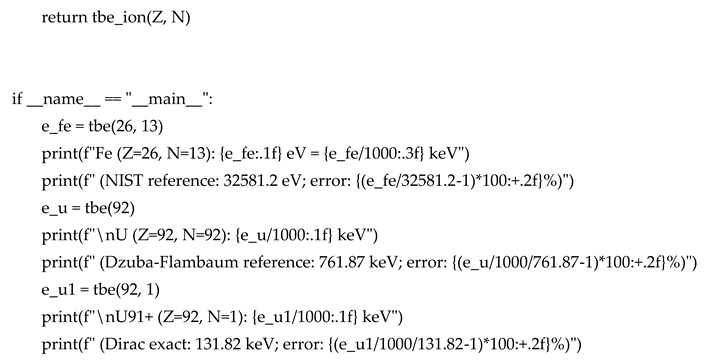
The complete reference implementation (~150 lines, no external dependencies) is provided as the file tfrse_ioncf_v3.1.py in the supplementary material.
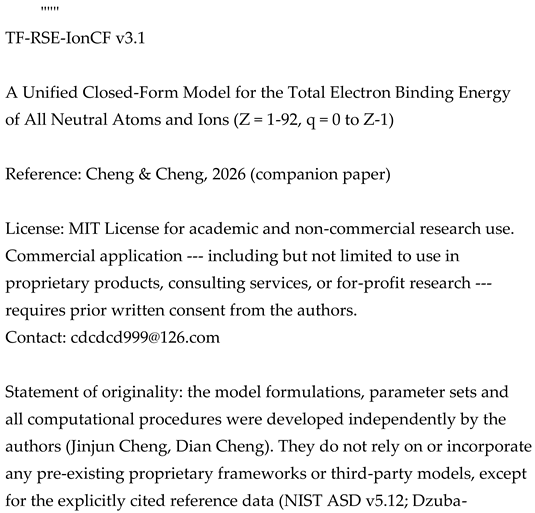
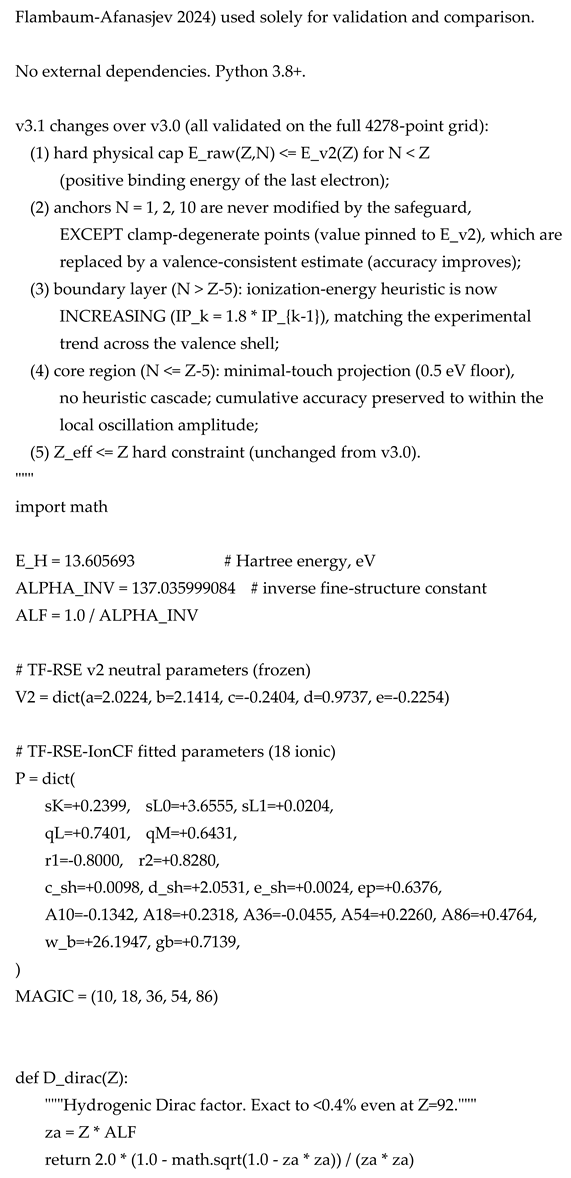
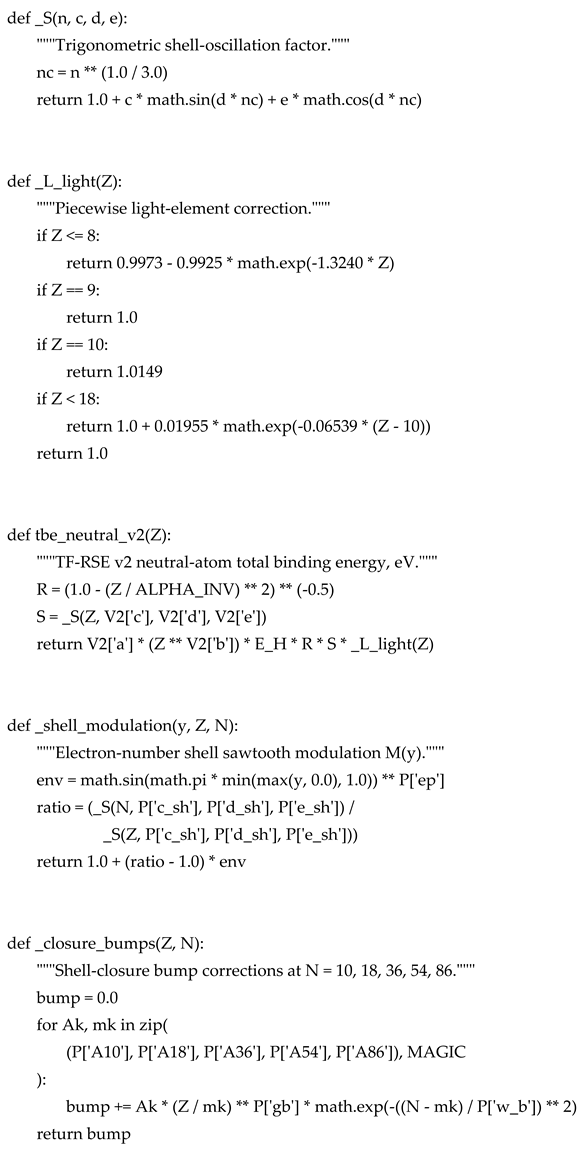
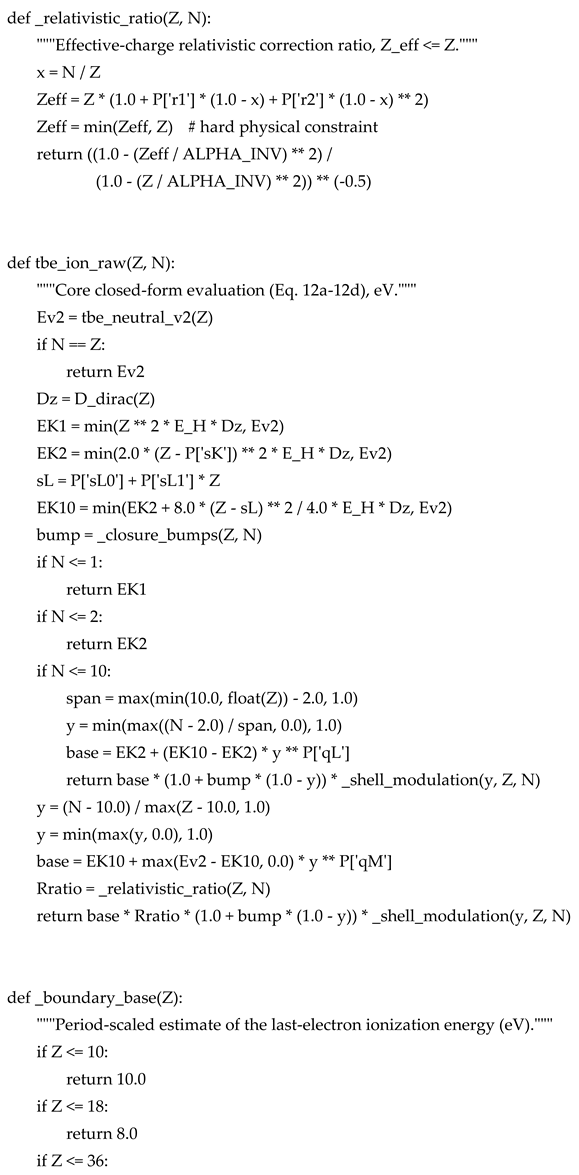
Appendix B. Detailed Calculation Example — Fe at N = 13 (Fe XIV)
Fe XIV (N = 13) lies in the core region (N ≤ Z−5 = 21); the safeguard does not modify it, so the worked example is identical to the core evaluation:
Table 7.
Step-by-step evaluation of the Fe ion with N = 13 electrons.
| Step | Quantity | Value |
| 1 | Input Z = 26, N = 13 (q = +13); x = N/Z | x = 0.5000 |
| 2 | Dirac factor D(Z) | D = 1.009165 |
| 3 | Neutral anchor E_v2(26) (TF-RSE v2) | 34,742.8 eV |
| 4 | He-like anchor E_K2 = 2(Z−s_K)² E_h D | 18,222.5 eV |
| 5 | L screening s_L = s_L0 + s_L1 Z; Ne-like anchor E_K10 | s_L = 4.186; E_K10 = 31,289.9 eV |
| 6 | Z_eff = Z[1 + r_1(1−x) + r_2(1−x)²]; R(Z_eff)/R(Z) | Z_eff = 20.982; ratio = 0.99355 |
| 7 | Blend y = (N−10)/(Z−10); base = E_K10 + (E_v2−E_K10) y^(q_M) | y = 0.1875; base = 32,466.5 eV |
| 8 | Closure bumps B(26,13); envelope | B = +0.02358 |
| 9 | Sawtooth M(y) = 1 + [S_sh(N)/S_sh(Z) − 1] env(y) | M = 0.99323 |
| 10 | E = base × (R ratio) × (1 + B(1−y)) × M | E = 32,652.5 eV = 32.652 keV |
| NIST reference (sum of successive IPs) | 32,581.2 eV = 32.581 keV | |
| Relative error | +0.22% |
Appendix C. Data Sources and Reproducibility
(1) Reference data: NIST Atomic Spectra Database (ver. 5.12), successive ionization potentials for Z = 1–92, retrieved July 2026; the summed 4278-point dataset is provided in the supplementary material (validation_full.csv). (2) Neutral-anchor reference values: TF-RSE v2 parameters and the Dzuba–Flambaum–Afanasjev (2024) table. (3) Fitting: nonlinear least squares (scipy least_squares, trust-region reflective) on relative residuals. (4) All safeguard statistics quoted in this paper (582 corrected points, 74 elements, maximum adjustment 1.14 keV, Table D1/D2) were recomputed directly from the released v3.1 reference implementation and are reproducible by running its self-test.
Appendix D. Physical-Constraint Validation
Table 1.
Physical-consistency metrics before and after the v3.1 safeguard (full 4278-point grid, recomputed from the released code).Table 1. Physical-constraint metrics.
Table 1.
Physical-consistency metrics before and after the v3.1 safeguard (full 4278-point grid, recomputed from the released code).Table 1. Physical-constraint metrics.
| Metric | Raw core (12a–12d) | v3.1 (safeguarded) |
| Elements with negative IE (finite difference) | 74 / 92 | 0 / 92 |
| Non-monotonic elements | 74 / 92 | 0 / 92 |
| Defect links (non-monotonic pairs) | 310 | 0 |
| Defect links after Tier-1 cap (503 equality + 28 strict) | — | 531 → 0 |
| Elements with Z_eff > Z (unconstrained expression, extrapolated to N/Z < 0.034, outside the called N>10 domain) | 63 / 92 (formal extrapolation only) | never occurs in-domain (hard constraint is defensive) |
| Points above neutral anchor E_v2 (N < Z) | 505 | 0 (Tier-1 cap) |
| Corrected data points | — | 582 / 4278 (13.6%) |
| Elements requiring ≥ 1 correction | — | 74 / 92 |
| Maximum single adjustment (vs raw) | — | 1.14 keV (Lu, N = 63) |
| Deepest correction from neutrality | — | 15 charge states (Tm, N = 54; Tier-3 minimal-touch cascade below the boundary chain) |
| Mean relative error (all 4278 points) | 0.258% | 0.258% |
| Core-grid error (N ≤ Z−5) | 0.258% | 0.258% (unchanged) |
| Anchor N = 1 exactness | exact (Dirac) | exact (untouched) |
| Anchor N = Z exactness | exact (v2) | exact (returned directly) |
| Anchors N = 2, 10 exactness | exact (closed form) | exact except 5 clamp-degenerate points (below) |
Table D2. The five clamp-degenerate anchor points corrected by the safeguard, and representative boundary-layer reconstructions. The corrected anchors are MORE accurate than the clamped values they replace.
Table 2.
Safeguard-affected points. Anchor rows (N = 2 Li; N = 10 Mg/Al/Si/P) are clamp-degenerate (value pinned to E_v2); the replacement improves accuracy in every case (errors against the NIST ASD v5.12 summed reference at the same (Z, N)). Boundary rows (Si N = 11; Fe, Xe, Ho, W, Hg) are code-verified adjustments relative to the raw closed-form value; their error columns are omitted (their cumulative errors are at the core-grid level, Table 4).
Table 2.
Safeguard-affected points. Anchor rows (N = 2 Li; N = 10 Mg/Al/Si/P) are clamp-degenerate (value pinned to E_v2); the replacement improves accuracy in every case (errors against the NIST ASD v5.12 summed reference at the same (Z, N)). Boundary rows (Si N = 11; Fe, Xe, Ho, W, Hg) are code-verified adjustments relative to the raw closed-form value; their error columns are omitted (their cumulative errors are at the core-grid level, Table 4).
| Z | Element | N | Raw / clamped (keV) | v3.1 (keV) | Adj. (eV) | Raw err (%) | v3.1 err (%) |
| 3 | Li | 2 | 0.205 (clamped) | 0.195 | −10.0 | +3.71 | −1.34 |
| 12 | Mg | 10 | 5.449 (clamped) | 5.426 | −22.4 | +0.38 | −0.04 |
| 13 | Al | 10 | 6.599 (clamped) | 6.551 | −48.3 | +0.73 | −0.01 |
| 14 | Si | 10 | 7.883 (clamped) | 7.788 | −95.0 | +1.25 | +0.03 |
| 15 | P | 10 | 9.272 (clamped) | 9.207 | −64.4 | +1.57 | +0.86 |
| 14 | Si | 11 | 7.904 (raw) | 7.834 | −69.6 | — | — |
| 26 | Fe | 25 | 34.770 (raw) | 34.736 | −34.0 | — | — |
| 54 | Xe | 53 | 202.206 (raw) | 202.063 | −142.5 | — | — |
| 67 | Ho | 66 | 341.377 (raw) | 341.160 | −217.5 | — | — |
| 74 | W | 73 | 436.682 (raw) | 436.543 | −139.4 | — | — |
| 80 | Hg | 69 | 532.185 (raw) | 531.883 | −302.1 | — | — |
Statement of Originality and License
The model formulations, parameter sets, and all computational procedures described herein have been developed independently by the authors. They do not rely on or incorporate any pre-existing proprietary frameworks or third-party models, except for the explicitly cited reference data used solely for validation and comparison purposes. The accompanying software is released under the MIT License, which permits free use, modification, and redistribution for academic and non-commercial research purposes, provided that the original copyright notice and this permission notice are retained in all copies or substantial portions of the software. For any commercial application --- including but not limited to use in proprietary products, consulting services, or for-profit research --- prior written consent from the authors is mandatory. Interested parties should contact the corresponding author at cdcdcd999@126.com to obtain the necessary licensing agreement.
References
- Thomas, L. H. Proc. Camb. Philos. Soc. 1927, 23, 542.
- Fermi, E. Rend. Accad. Naz. Lincei 1927, 6, 602.
- J. Cheng and D. Cheng, TF-RSE v2: A High-Precision Phenomenological Extension of the Thomas–Fermi Model for Total Atomic Binding Energy with Full Periodic-Table Validation (Z = 1–92), 2026. (Companion paper.).
- Dzuba, V. A.; Flambaum, V. V.; Afanasjev, A. V. Calculation of the correlation, relativistic and QED corrections to the total electron binding energy in atoms and their nuclear charge dependence. Phys. Rev. A 2024, 110, 052810. [Google Scholar] [CrossRef]
- Kramida; Yu. Ralchenko, J. Reader, and NIST ASD Team, NIST Atomic Spectra Database (ver. 5.12). 2024. Available online: https://physics.nist.gov/asd.
- Rodrigues, G. C.; Indelicato, P.; Santos, J. P.; Patte, P.; Parente, F. Systematic calculation of total atomic energies of ground state configurations. At. Data Nucl. Data Tables 2004, 86, 117. [Google Scholar] [CrossRef]
- Dirac, P. A. M. Proc. R. Soc. Lond. A 1929, 123, 714.
- Slater, J. C. Atomic shielding constants. Phys. Rev. 1930, 36, 57. [Google Scholar] [CrossRef]
- P. Moller, A. J. Sierk, T. Ichikawa, and H. Sagawa, At. Data Nucl. Data Tables 109-110, 1 (2016) (FRDM2012).
- Lunney, D.; Pearson, J. M.; Thibault, C. Recent trends in the determination of nuclear masses. Rev. Mod. Phys. 2003, 75, 1021. [Google Scholar] [CrossRef]
- Kromer, K.; Lyu, C.; Bieron, J.; Door, M.; et al. Atomic mass determination of uranium-238. Phys. Rev. C 2024, 109, L021301. [Google Scholar] [CrossRef]
Table 1.
The 11 parameters of the TF-RSE v2 neutral layer (fitted on the 92 neutral atoms; kept frozen).
Table 1.
The 11 parameters of the TF-RSE v2 neutral layer (fitted on the 92 neutral atoms; kept frozen).
| Parameter | Value | Role / region |
| a | +2.0224 | TF amplitude |
| b | +2.1414 | effective TF exponent |
| c | −0.2404 | shell sine amplitude |
| d | +0.9737 | shell frequency |
| e | −0.2254 | shell cosine amplitude |
| α | +0.9973 | L(Z) offset, Z ≤ 8 |
| β | −0.9925 | L(Z) amplitude, Z ≤ 8 |
| γ | +1.3240 | L(Z) decay rate, Z ≤ 8 |
| L(10) | +1.0149 | neon factor |
| A | +0.01955 | L(Z) amplitude, 10 < Z < 18 |
| B | +0.06539 | L(Z) decay rate, 10 < Z < 18 |
Table 4.
Representative validation for seven elements across charge states (keV), v3.1 model output. The N = Z row is the neutral anchor; the N = 1 row is the hydrogenic Dirac anchor. Si N = 11 is a v3.1 boundary-layer reconstruction (v3.0/v1 raw value 7.904 keV, +0.94%).
Table 4.
Representative validation for seven elements across charge states (keV), v3.1 model output. The N = Z row is the neutral anchor; the N = 1 row is the hydrogenic Dirac anchor. Si N = 11 is a v3.1 boundary-layer reconstruction (v3.0/v1 raw value 7.904 keV, +0.94%).
| Z | El. | N | q | Model (keV) | NIST (keV) | Err (%) |
| 6 | C | 1 | +5 | 0.490 | 0.490 | +0.01 |
| 6 | C | 2 | +4 | 0.903 | 0.882 | +2.41 |
| 6 | C | 3 | +3 | 0.945 | 0.947 | −0.18 |
| 6 | C | 5 | +1 | 1.005 | 1.019 | −1.40 |
| 6 | C | 6 | 0 | 1.030 | 1.030 | −0.01 |
| 14 | Si | 1 | +13 | 2.674 | 2.673 | +0.02 |
| 14 | Si | 2 | +12 | 5.166 | 5.111 | +1.07 |
| 14 | Si | 4 | +10 | 6.077 | 6.111 | −0.54 |
| 14 | Si | 7 | +7 | 7.062 | 7.167 | −1.47 |
| 14 | Si | 11 | +3 | 7.834 | 7.831 | +0.04 |
| 14 | Si | 14 | 0 | 7.883 | 7.889 | −0.07 |
| 26 | Fe | 1 | +25 | 9.282 | 9.278 | +0.04 |
| 26 | Fe | 2 | +24 | 18.22 | 18.11 | +0.64 |
| 26 | Fe | 7 | +19 | 27.07 | 27.16 | −0.35 |
| 26 | Fe | 13 | +13 | 32.65 | 32.58 | +0.22 |
| 26 | Fe | 20 | +6 | 34.41 | 34.34 | +0.20 |
| 26 | Fe | 26 | 0 | 34.74 | 34.62 | +0.36 |
| 36 | Kr | 1 | +35 | 17.95 | 17.94 | +0.07 |
| 36 | Kr | 2 | +34 | 35.42 | 35.23 | +0.53 |
| 36 | Kr | 9 | +27 | 59.92 | 60.33 | −0.67 |
| 36 | Kr | 18 | +18 | 70.99 | 71.10 | −0.17 |
| 36 | Kr | 27 | +9 | 75.41 | 75.13 | +0.37 |
| 36 | Kr | 36 | 0 | 76.22 | 75.87 | +0.46 |
| 54 | Xe | 1 | +53 | 41.35 | 41.30 | +0.11 |
| 54 | Xe | 2 | +52 | 81.96 | 81.57 | +0.48 |
| 54 | Xe | 14 | +40 | 164.0 | 163.9 | +0.06 |
| 54 | Xe | 27 | +27 | 191.1 | 192.0 | −0.48 |
| 54 | Xe | 41 | +13 | 201.3 | 200.8 | +0.25 |
| 54 | Xe | 54 | 0 | 202.1 | 202.4 | −0.16 |
| 74 | W | 1 | +73 | 80.91 | 80.76 | +0.19 |
| 74 | W | 2 | +72 | 160.8 | 159.9 | +0.52 |
| 74 | W | 19 | +55 | 358.0 | 357.1 | +0.24 |
| 74 | W | 37 | +37 | 417.3 | 416.9 | +0.08 |
| 74 | W | 56 | +18 | 435.6 | 435.7 | −0.02 |
| 74 | W | 74 | 0 | 436.5 | 439.0 | −0.56 |
| 92 | U | 1 | +91 | 132.3 | 131.8 | +0.35 |
| 92 | U | 2 | +90 | 263.2 | 261.4 | +0.69 |
| 92 | U | 23 | +69 | 626.4 | 624.0 | +0.38 |
| 92 | U | 46 | +46 | 723.4 | 724.4 | −0.15 |
| 92 | U | 69 | +23 | 758.5 | 756.2 | +0.30 |
| 92 | U | 92 | 0 | 773.5 | 761.5 | +1.57 |
Disclaimer/Publisher’s Note: The statements, opinions and data contained in all publications are solely those of the individual author(s) and contributor(s) and not of MDPI and/or the editor(s). MDPI and/or the editor(s) disclaim responsibility for any injury to people or property resulting from any ideas, methods, instructions or products referred to in the content. |
© 2026 by the authors. Licensee MDPI, Basel, Switzerland. This article is an open access article distributed under the terms and conditions of the Creative Commons Attribution (CC BY) license (http://creativecommons.org/licenses/by/4.0/).
Copyright: This open access article is published under a Creative Commons CC BY 4.0 license, which permit the free download, distribution, and reuse, provided that the author and preprint are cited in any reuse.