
Submitted:
18 September 2026
Posted:
20 September 2026
You are already at the latest version
Abstract
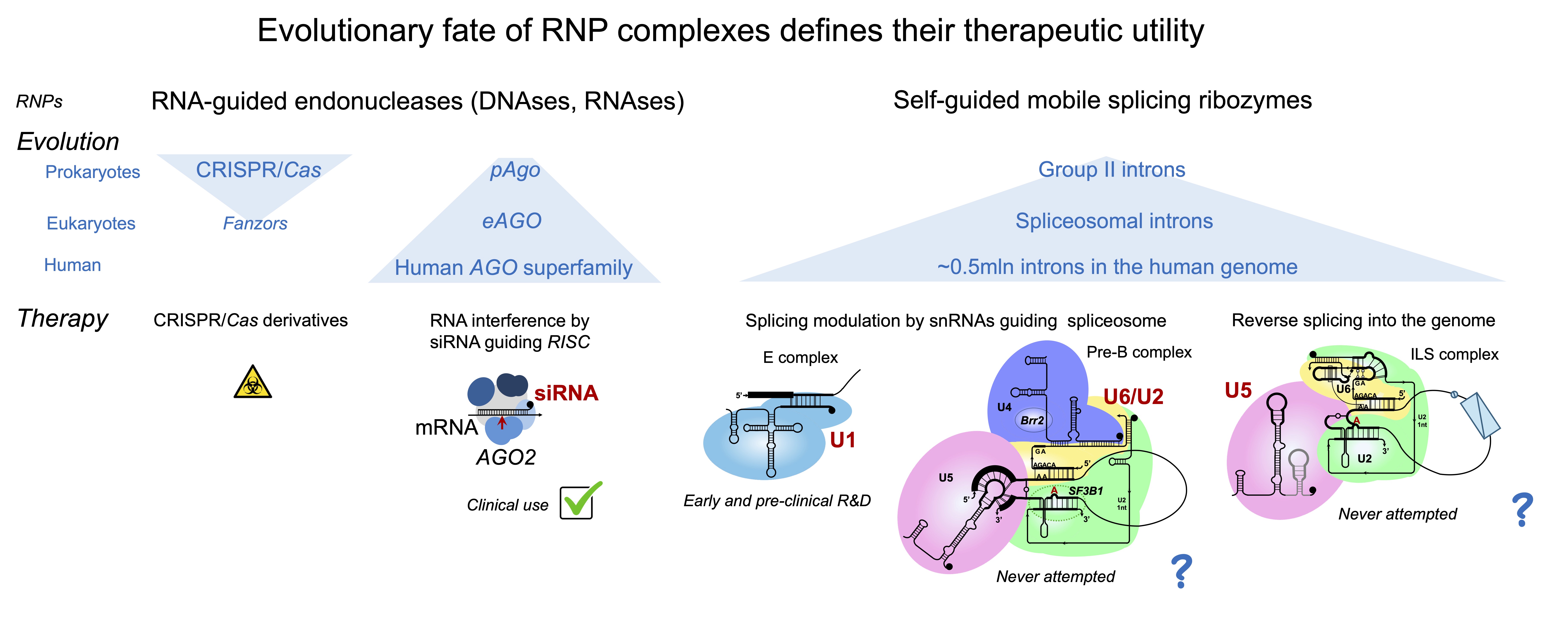
U2, U6 and U5 are the components of spliceosomal ribozymes that descend from mobile self-splicing introns. The fragmentation of ancestral introns in eukaryogenesis led to the evolution of the ribozyme assembly in trans using common snRNAs and protein-chaperones. This stepwise process provides opportunities to target distinct stages of ribozyme folding. Reviewing successive spliceosomal complexes, we will discuss how to adapt them for therapy, both splicing modulation and permanent gene therapy. Adapting U2 and U6 snRNAs can overcome the limitations of U1 and U7, currently used to target early spliceosome complexes. U2 can select alternative 3’ss, such as VEGFA switch between pro- and anti-angiogenic isoforms. U6 and U2 can be used together in the pre-catalytic complex, taking advantage of the U6/U2 Helix II that can be modified to prevent intermixing with WT U6 and U2 molecules. Extending 5’ss and BP helices with adapted U6 and U2 can create specific spliceosome species for individual introns. U5 snRNA, responsible for exon recognition, is the last to pair with pre-mRNA at pre-catalytic stage, but in reverse splicing, the exon recognition loop initiates intron insertion. Completed forward splicing produces an RNA-protein complex of an intron lariat paired with U6 and U2, the active ribozyme centre and U5 snRNA associated by protein interactions – the Intron Lariat Spliceosome. ILS is homologous to the mobile Group IIA intron particle capable of invading genomic loci by reverse splicing. Group II introns are used for microbial genome engineering. Can human ILS be adapted for specific genome insertions? Group IIA introns possess a second exon-recognition loop, which adds 6bp to the interaction with the 5’exon. Engineering an additional exon-recognition loop for spliceosomal U5 snRNA is the way to bring back reverse splicing. The field of genome engineering is dominated by CRISPR/Cas derivatives, so why do we need to develop reverse splicing? It is increasingly apparent that the evolutionary fate of RNPs defines their therapeutic utility: CRISPR/Cas are prokaryotic RNPs. Targeting human RNPs is the best solution, as the therapeutic success of RNAi using RISC complex indicates. The spliceosome is a human RNP worth exploring for splicing and gene therapy.
Keywords:
U2 snRNA
; U6 snRNA
; pre-catalytic spliceosome
; U5 snRNA
; reverse splicing
; intron lariat spliceosome
; Duchenne muscular dystrophy
; CRISPR/Cas
; RNA interference
; virus-like particles
Copyright: This open access article is published under a Creative Commons CC BY 4.0 license, which permit the free download, distribution, and reuse, provided that the author and preprint are cited in any reuse.