
Submitted:
18 September 2026
Posted:
20 September 2026
You are already at the latest version
Abstract
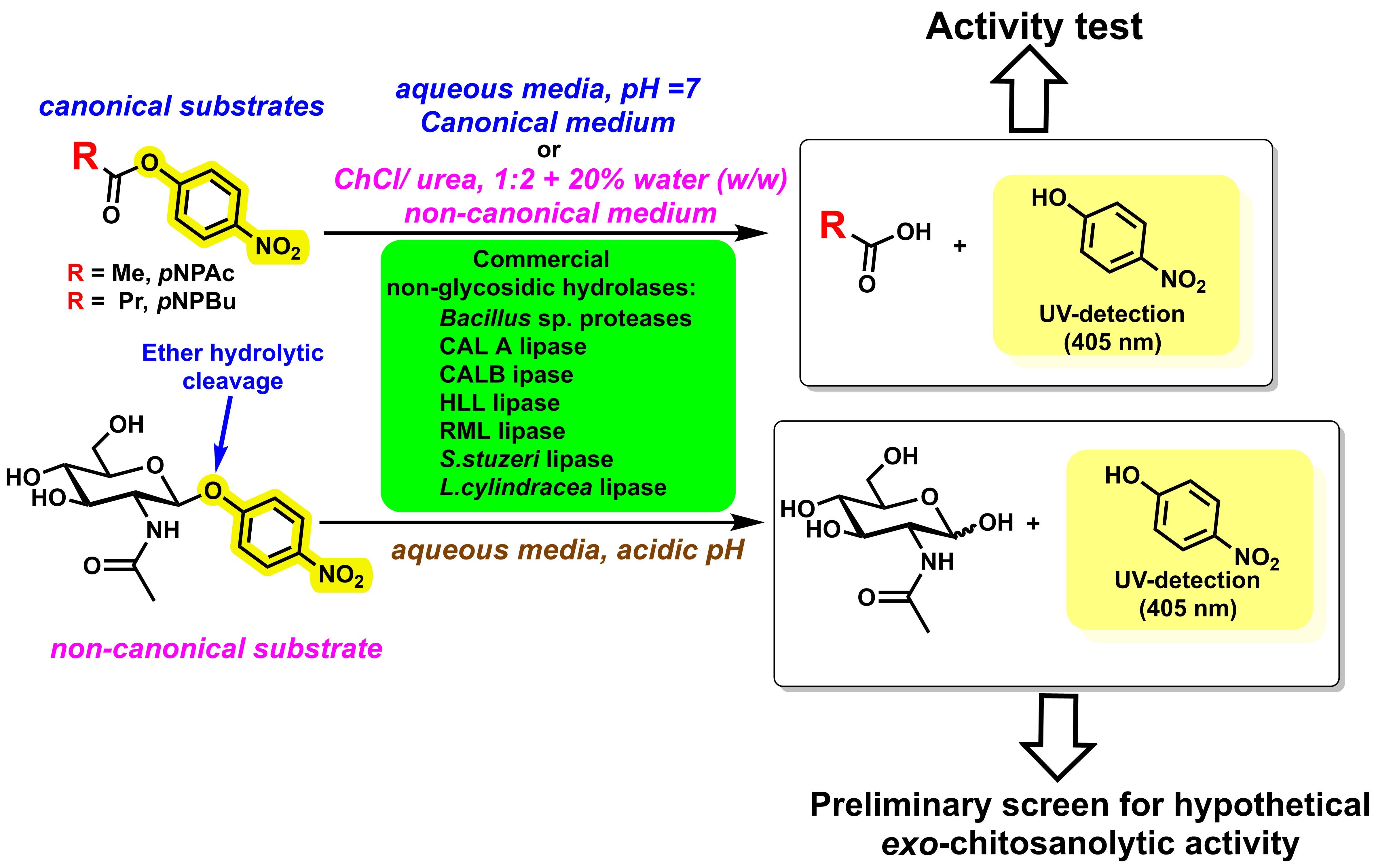
Several commercial hydrolases were screened to assess substrate-dependent activity and the influence of hydrated deep eutectic solvents on canonical and non-canonical hydrolysis. Liquid formulations from Novozymes, comprising proteases from Bacillus species and lipases from Candida antarctica, Rhizomucor miehei, and Thermomyces lanuginosus, and solid lipases from Meito Sangyo derived from Stutzerimonas stutzeri and Limtongozyma cylindracea, were evaluated in aqueous buffer and 20 wt% hydrated reline, composed of choline chloride and urea at a 1:2 molar ratio. Hydrolysis of p-nitrophenyl acetate, p-nitrophenyl butyrate, and p-nitrophenyl N-acetyl-β-D-glucosaminide was monitored spectrophotometrically, and activities were normalized to protein content determined by the bicinchoninic acid assay. SDS-PAGE supported the presence of the principal lipase components in selected liquid formulations. In aqueous buffer, activity profiles depended strongly on substrate structure. Hydrated reline selectively enhanced or suppressed activity, depending on the enzyme–substrate pair, and in some cases abolished measurable activity. Selected liquid lipases and purified CALB hydrolyzed p-nitrophenyl N-acetyl-β-D-glucosaminide under acidic conditions, whereas the solid lipases showed no detectable activity under the tested conditions. These results indicate that this substrate may serve as a preliminary screen for selecting preparations for subsequent chitosan-hydrolysis studies, although its predictive value requires validation by direct analysis of chitosan depolymerization.
Keywords:
enzyme promiscuity
; commercial hydrolases
; lipase activity
; p-Nitrophenyl substrates
; hydrated deep eutectic solvents
; reline
; pNPGlcNAc hydrolysis
Copyright: This open access article is published under a Creative Commons CC BY 4.0 license, which permit the free download, distribution, and reuse, provided that the author and preprint are cited in any reuse.