

Submitted:
18 September 2026
Posted:
18 September 2026
You are already at the latest version
Abstract
Endometrial-like tissue can establish persistent lesions outside its usual environment, but anatomical explanations for its arrival leave a second question unresolved: what permits survival during establishment? We evaluated a pre-existing selective redox-survival hypothesis using 27 historical transcriptomic comparisons across six accessions and an external donor-level analysis of proliferative eutopic endometrium from 12 endometriosis cases and 11 clinical controls. TXN reduction and ovarian ferritin/metabolic changes recurred across specified historical lesion cohorts. Historical mean survival-module shifts were null after across-test correction. The conservative expanded nondirectional sensitivity family retained eight historical but no external survival-associated sets. No external primary panel gene or population interaction met its declared threshold; limited overlapping HIF-set signals did not pass external-only correction. A later secondary test of paired peritoneal/eutopic responses found that held-out donors resembled their own cellular context more than other contexts: similarity margin 0.298, permutation P=0.0001, with 69.0% classification accuracy versus 16.7% chance. This used seven donors, six non-overlapping populations and 43 shared frozen-panel genes. Convergence varied by population and did not clearly exceed expression-matched background sets (empirical P=0.0939). The results support partial context constraint with substantial patient flexibility, while narrowing extrapolation to a common eutopic survival state. They do not establish redox-specific protection, early survival advantage, intercellular rescue or a receptor/proteoform mechanism. The central causal proposition remains unresolved.
Keywords:
endometriosis
; redox regulation
; oxidative stress
; ferroptosis
; transcriptomics
; single-cell RNA sequencing
; pseudobulk analysis
; eutopic endometrium
Introduction
An established endometriotic lesion has already solved several biological problems. It has persisted in an abnormal location, acquired support from surrounding tissue and maintained itself despite injury and immune pressure. Angiogenesis, inflammation, steroid signaling and matrix remodeling explain much of what the lesion then does. They leave open the earlier question that motivates this study: why can an endometriosis-forming cell survive outside its expected endometrial environment long enough to establish pathological tissue?
Retrograde menstruation and dissemination provide routes by which cells can reach an ectopic site. Progenitor-cell, Müllerian-remnant and metaplastic theories describe other possible sources. Direct invasion creates a different anatomical route, particularly relevant to adenomyosis. None specifies, by itself, the cellular capacity or host conditions needed for persistence. A locally emerging cell may face niche adaptation without detachment; a multicellular fragment may retain support that an isolated cell loses. We therefore distinguish the origin of candidate tissue from the survival challenge associated with its establishment.
Normal endometrium is already equipped for repeated injury and repair. Clonogenic epithelial and stromal populations and hypoxia-dependent menstrual repair provide a physiological basis for considerable regenerative capacity (Chan et al., 2004, Maybin et al., 2018). The disease question is whether susceptible cells deploy part of that capacity differently: early enough to survive displacement, strongly enough to resist a defined injury, or persistently enough to sustain an abnormal state after the initial challenge subsides.
Redox regulation offers a specific way to examine this possibility. Protection against lipid peroxidation, mitochondrial injury and peroxide-dependent signaling involves different substrates, compartments and reducing systems. A cell could retain one protective function while another becomes insufficient or dysregulated. Its survival would then coexist with continuing stress signals. This is more specific than saying that oxidative stress is elevated, and it does not require every lesion to increase the same antioxidant gene.
We used public transcriptomic data to ask whether this proposed separation leaves a recurring molecular pattern across independent human cohorts and within lesion cell populations. The analysis serves as a feasibility benchmark for a mechanistic hypothesis. Its value lies both in the patterns that recur and in the observations that restrict the explanation.
Previous computational work integrated multiple GEO datasets to examine ferroptosis-resistance-associated genes in endometriosis (Li et al., 2021). Ferroptosis resistance is therefore not a new hypothesis introduced by this study. The present analysis addresses a broader predefined redox framework, retains tissue and cell-population context, reports negative and contradictory evidence, and examines cross-donor reproducibility of lesion-associated response patterns.
Methods
Dataset Identification and Prioritization
The historical public-data analysis was designed as a hypothesis-directed benchmark rather than an exhaustive systematic review. Datasets were prioritized to provide complementary biological tests of the selective redox-survival model across paired eutopic/ectopic tissue, ovarian and peritoneal lesions, disease-associated eutopic endometrium, adenomyosis and donor-resolved cell populations. Prioritization emphasized phenotype coverage, true-lesion representation, paired designs where available, sufficient clinical and tissue metadata, public accessibility and relevance to the predefined redox framework. This strategy favored biological complementarity across contexts rather than maximizing dataset number. The retained historical records do not constitute a complete systematic search and disposition log for every potentially eligible public dataset; exhaustive coverage of the public literature is therefore not claimed.
The historical analysis used public microarray and RNA-sequencing data from GSE5108, GSE23339, GSE7305, GSE51981, GSE190580 and GSE179640. Comparisons distinguished paired ectopic and eutopic tissues, disease-associated and control endometrium, ovarian and peritoneal lesions, and adenomyosis endometrium and myometrium. The external follow-up analyzed GSE266265 proliferative eutopic endometrium using independently recruited donors. GSE74373 supplied exploratory probe-level results without defensible gene mapping; GSE193928 contributed technical assessment only. Supplementary Methods and Tables identify all populations, actual denominators, unavailable tests and exclusions. The external cohort was analyzed independently of historical effect estimation; historical gene-level models were separately regenerated as an implementation check.
The biological selective redox-survival hypothesis preceded the public transcriptomic analysis. The original analysis panel comprised 78 unique genes with 79 memberships across seven modules: survival/ferroptosis, mitochondrial survival, peroxide control, ROS generation, NADPH-associated metabolism, oxygen sensing, and epigenetic/identity regulation. These modules operationalized measurable components of the pre-existing model. The model already allowed different molecular implementations according to tissue, cell lineage and environmental context rather than requiring uniform regulation of individual genes. Mean-module-score analyses were secondary, and the subsequent 100-gene examination was exploratory. Secondary analyses were subsequently undertaken to examine questions arising from the initial results. The original 78-gene panel was retained for these analyses where applicable. Oxidative DNA/RNA/protein damage and receptor/proteoform-state mechanisms are mechanistic extensions of the broader redox framework and were not endpoints of the transcriptomic analysis.
Microarray comparisons used limma with platform-appropriate normalized log expression. Donor blocking was retained for paired samples. The GSE51981 primary comparison included 75 endometriosis cases and 34 controls without reported pelvic or uterine pathology, with adjustment for menstrual phase and separate phase-stratified sensitivity analyses. RNA-sequencing comparisons used DESeq2 count-based models, with donor terms for paired lesion/eutopic designs (Love et al., 2014, Ritchie et al., 2015). Positive log2 fold change denotes higher expression in the named numerator tissue or condition.
For GSE179640 single-cell data, we matched the authors’ annotations to original integer UMI counts and summed by donor, tissue and cell population. Inferential replication was at donor level. Paired peritoneal analyses generally included eight donors, with seven for mural cells; disease/control eutopic comparisons used nine cases and three controls. Ovarian cell-type comparisons with only two eligible pairs were not tested. Broad stromal, fibroblast and mural views overlap, and bulk and single-cell measurements from this accession represent one cohort (Tan et al., 2022).
Gene-level significance was defined as genome-wide Benjamini–Hochberg false-discovery rate (FDR) below 0.05 within each contrast. Mean gene-z-score module tests used donor-level linear models and were additionally corrected across all 188 estimable tests. These score tests summarize coordinated average expression, not biochemical capacity. Descriptive functional recurrence required independent cohorts with their tissue differences retained; no combined architecture P value or causal model-ranking statistic was calculated. All 2,700 outcomes of the exploratory gene extension were retained, including missing and nonsignificant results.
Targeted regeneration re-executed all 27 gene-level models from retained processed inputs. An independent barcode-level summation checked all 184 retained GSE179640 pseudobulks from 23 source matrices. Historical mean-score model fits were replayed from retained scores, rather than represented as an independent reconstruction of every score. Numerical regeneration is an implementation check, not independent biological replication.
Supplementary nondirectional mroast tests used the original seven sets, inter-gene correlation and the corresponding full-rank design, with 9,999 rotations and the mean-square statistic (Wu et al., 2010). Count inputs used unrounded TMM/voom modeling, separately from DESeq2; arrays retained log expression. Eligibility required at least three genes and half the set. The historical 178-test family is preserved. A post hoc conservative expanded-family sensitivity correction contains those 178 raw P values and 143 estimable external set-context tests. Every member was removed once in a 1,999-rotation sensitivity analysis; deletion P values are descriptive, with no selected optimal subset. No sufficiently specified joint transcript endpoint could demonstrate both effective protection and persistent signaling, so no post hoc architecture score was constructed.
Formal disease-by-phase interaction used a two-degree-of-freedom test in GSE51981. Historical peritoneal lesion-by-population interactions compared five nonoverlapping populations with fibroblasts using donor-blocked voom/limma and seven or eight complete donors. The original 319-test panel family is preserved. External disease-by-population models used donor blocking and population-specific capture-batch effects, with at least four cases and four controls. Four population pairs were estimable; lymphoid design was not. A separate post hoc conservative expanded-family sensitivity correction covers 598 measured historical and external panel interactions. This does not treat their anatomically different contrasts as pooled effects.
For GSE266265, a validated streaming reader recovered the original RNA assay and author metadata without deserializing the complete Seurat object. Counts were independently summed by donor and author-defined population; normalized SCT and integrated assays were not substituted. The source contains fractional Alevin UMI estimates. DESeq2 therefore used estimates rounded only after donor/gene aggregation, while the companion TMM/voom sensitivity analysis retained the unrounded sums; no frozen-panel significance decision changed between approaches. The primary model was capture batch plus disease, restricted to the 23 author-eligible proliferative donors, at least 50 cells per donor/population, four donors per group and three residual degrees of freedom. Gene significance used genome-wide BH FDR below 0.05 with DESeq2 alpha=0.05. Complete original-count provenance, coverage, cell-label reconstruction, outlier checks and numerical handling are documented in Supplementary Methods (Duempelmann et al., 2026).
The external follow-up evaluated all recoverable eligible author populations, not only published positive leads. Exact duplicate cell-membership views were collapsed. Bounded sensitivities addressed 100-cell coverage, age, shared capture batches, the source cell-wise DEG flag and donor deletion.
The external follow-up applied the original 78-gene panel to an independently recruited eutopic cohort. Because the atlas publication and its published results were already available, this analysis is reported as a secondary external follow-up rather than as a prospectively preregistered validation. Eligibility rules, donor-level models and bounded sensitivity analyses were specified before the reconstructed donor-level outcomes were calculated.
After the primary analyses demonstrated substantial cell-context-dependent heterogeneity, a secondary analysis examined an additional question not specified in the original hypothesis: whether donors within matched cellular contexts nevertheless showed reproducible lesion-associated response configurations. The analysis plan and primary similarity endpoint were fixed before the convergence outcomes were calculated. Seven complete donors contributed six non-overlapping populations: epithelial, endothelial, fibroblast, mural, myeloid and lymphoid. Broad stromal was reserved for an eight-donor five-population sensitivity because it contains fibroblast and mural cells. Pairwise full-background TMM log2 CPM differences avoided borrowing another donor during normalization. Cosine similarity used training-only gene scaling and population consensuses, with the held donor excluded from every context. Whole response vectors were permuted among populations within each donor 9,999 times. The primary endpoint was the donor-averaged own-minus-other-context similarity. Classification, seven-module convergence, donor deletion and expression-matched control sets assessed scope and specificity; none measures protective function.
AI Assistance
AI-assisted tools were used to support computational workflow execution, code generation and checking, organization of analytical outputs, and editorial refinement of the manuscript. The author developed the scientific hypothesis, directed the analyses, evaluated the resulting evidence, determined the interpretations and conclusions, and takes full responsibility for the work.
Results
Recurring Redox Changes in Lesion Tissue
TXN expression was reduced in three independent lesion cohorts: GSE5108 paired ectopic/eutopic tissue (log2FC −0.861, FDR 0.00634), GSE23339 endometrioma cyst wall versus control endometrium (−0.650, 0.02173), and GSE179640 paired peritoneal/eutopic bulk tissue (−1.620, 1.612e-5). The recurrence spans different lesion settings and comparison designs. In particular, the cyst-wall comparison includes a substantial tissue-composition difference. Figure 1 shows these effects and the ovarian FTL/ME1 comparisons with uncertainty.
The accompanying increases differed among studies. GSE5108, with 11 donor pairs, showed increased AIFM2, SLC3A2, SOD2, TXNRD2 and TXNRD1 alongside decreased GCLC and GSS. AIFM2 increased by log2FC +0.413 (FDR 0.01128) and SOD2 by +1.190 (0.002332). GSE23339, with 10 cyst-wall samples and nine controls, instead showed increased FTL, GCLM and ME1. FTL increased by +0.821 (0.0001618).
FTL and ME1 also increased in the independent GSE179640 ovarian/eutopic comparison, which contained four complete donor pairs. Their log2FC values were +2.620 and +2.189, with FDRs of 0.0009427 and 1.57e-6, respectively. The three-pair peritoneal bulk comparison showed increased FTL but decreased SLC7A11. Ovarian bulk had no significant predefined peroxide-control gene result. Thus ferritin/metabolic recurrence was stronger than replication of the full proposed survival-plus-peroxide-control configuration.
Genome-wide significant gene counts were 4,304 for GSE5108, 2,035 for GSE23339, and 3,364 and 2,792 for the ovarian and peritoneal GSE179640 bulk comparisons. Corresponding significant predefined-panel counts were 22, 11, 16 and 13. These counts describe different contrasts and were not combined as independent votes for the hypothesis.
Distinct Configurations Within the Peritoneal Lesion
Donor-level pseudobulk resolved patterns that were not represented by a single bulk direction. Broad stromal cells showed increases in GPX3, PINK1, EPAS1, VEGFA and SLC2A4. Fibroblasts combined increased GPX3 with reduced CAT. Mural cells showed increases in GPX3, CAT and PINK1 together with decreases in PRDX4, GCLM, IDH2 and PGD. Epithelial cells increased PRDX6 and TXNRD1 while decreasing CAT, GSR and IDH1. Endothelial cells increased SLC3A2 and EPAS1 but decreased PINK1, IDH2 and PGD.
CAT decreased in epithelial cells (log2FC −0.441, FDR 0.03784) but increased in mural cells (+0.538, 0.01831). PINK1 decreased in endothelial cells (−0.506, 0.03701) and increased in stromal cells (+0.449, 0.0281). Epithelial GSR decreased by −0.871 (0.0003422). These are lesion-versus-eutopic responses within populations, rather than tests of baseline expression differences between cell types.
Historical interaction testing detected 13 panel gene–population differences in its original 319-test family. Under the conservative expanded sensitivity family of 598 historical and external tests, three historical differences remained significant: epithelial DUOX1/DUOX2 and endothelial TET1 responses relative to fibroblasts (FDR 0.0357). The CAT mural–fibroblast response difference remained +0.950 log2 units, but its original-family FDR was 0.0316 and its conservative expanded-family sensitivity FDR was 0.0592. It is not significant under the latter correction. Highlighted PINK1 point-estimate differences likewise do not establish a formal interaction (Figure 3).
GATA6 increased in stromal, fibroblast and epithelial comparisons, with reductions in GATA2, PGR or ESR1 in relevant compartments. The paired myeloid comparison yielded only PGR among significant predefined-panel genes and no significant redox-arm result. The paired lymphoid comparison had no significant panel findings. The distinct nonimmune configurations therefore did not extend to a demonstrable induced redox program in every compartment.
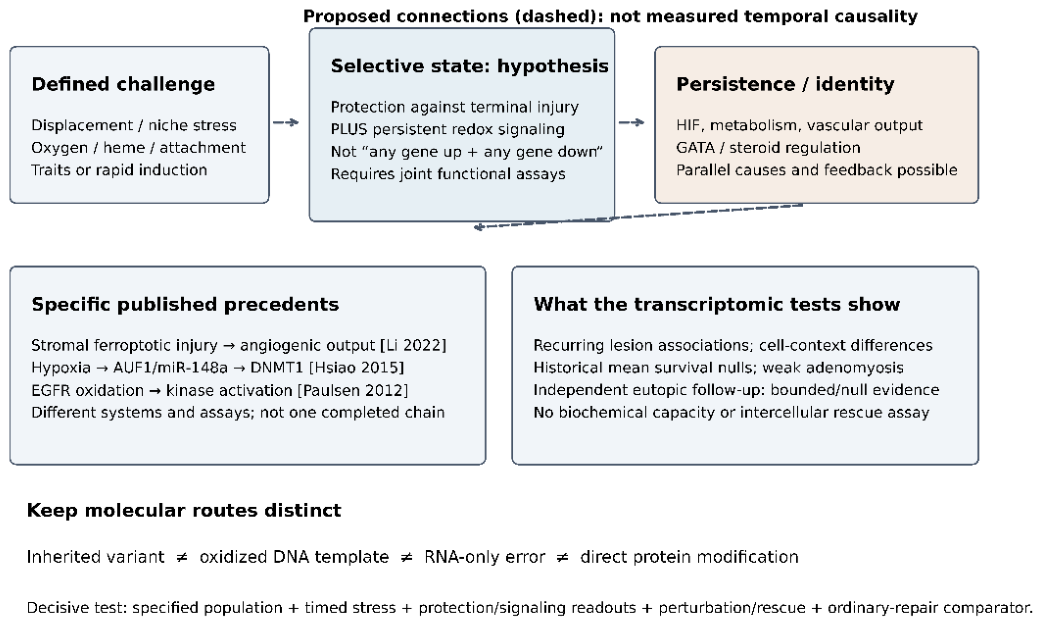
Figure 4.
A testable selective-redox mechanism, not a measured causal chain. The diagram separates the hypothesized challenge, selective protection with disturbed signaling, and candidate persistence/identity feedback. Dashed arrows are proposed connections, not measured temporal causality. The precedent panel names specified published relationships in their own systems: injury-associated paracrine output, hypoxia–AUF1/DNMT1 and direct EGFR oxidation. DNA-template, RNA and direct-protein changes remain distinct; no arrow implies an inherited variant arose by oxidation. The observation panel includes the completed bounded/null external follow-up. No quantitative survival probability, synthetic microscopy or clinical effect is depicted.
Figure 4.
A testable selective-redox mechanism, not a measured causal chain. The diagram separates the hypothesized challenge, selective protection with disturbed signaling, and candidate persistence/identity feedback. Dashed arrows are proposed connections, not measured temporal causality. The precedent panel names specified published relationships in their own systems: injury-associated paracrine output, hypoxia–AUF1/DNMT1 and direct EGFR oxidation. DNA-template, RNA and direct-protein changes remain distinct; no arrow implies an inherited variant arose by oxidation. The observation panel includes the completed bounded/null external follow-up. No quantitative survival probability, synthetic microscopy or clinical effect is depicted.
Donor Convergence Within Cellular Contexts
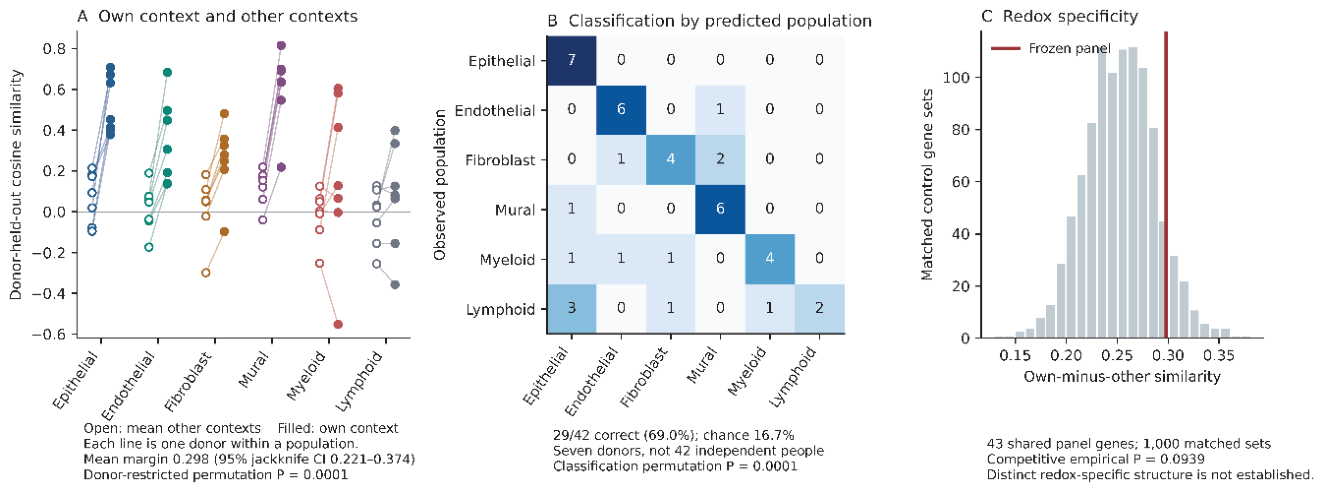
Different donors retained reproducible information about cellular context (Figure 6). Across 43 genes shared by all six populations, mean held-out own-context similarity was 0.3293 versus 0.03145 for other contexts. The margin was 0.2979 (95% delete-one-donor jackknife interval 0.2214–0.3743, donor-restricted permutation P=0.0001). Context classification was correct for 29/42 profiles (69.0%), compared with 16.7% chance (P=0.0001). These profiles represent seven people. Epithelial, endothelial and mural classification was 7/7, 6/7 and 6/7; fibroblast and myeloid classification was 4/7 each and lymphoid 2/7. The eight-donor broad-population sensitivity retained a margin of 0.2522 (P=0.0001), with 27/40 correct classifications versus 20% chance.
Within-population gene directions nevertheless varied (Supplementary Figure S4–S5). CAT decreased beyond a ±0.10 log2 CPM tolerance in all eight fibroblast donors and seven epithelial donors, but increased in six of seven mural donors. Mural PINK1 and GPX3 increased in all seven donors, whereas fibroblast GPX3 increased in six and decreased in two. Among the six non-overlapping populations, all 49 originally genome-wide significant panel estimates retained their direction in every donor-deletion model, but only 30 retained FDR<0.05 in every deletion. Across all 359 available panel gene–population estimates, 273 retained their model direction in every deletion and only 27 had every donor beyond the descriptive tolerance in that direction. Directional stability of a group effect does not imply identical donors or stable significance.
Five adequately covered module vectors showed context convergence after seven-module-family correction: mitochondrial, peroxide, HIF/oxygen, survival/ferroptosis and NADPH/PPP (FDR 0.000175–0.00028). Shared ROS-generation coverage was zero; identity coverage was seven of 17, below the half-set criterion. Neither was evaluable. No single shared gene explained the overall margin: the smallest margin after any gene deletion was 0.2820. Context accounted for 26.6% of observed standardized sums of squares, donor for 20.9%, and donor-by-context/residual for 52.5% (Supplementary Figure S6). The residual also includes measurement error. Crucially, the panel did not clearly exceed 1,000 expression/detectability-matched gene sets: matched median margin 0.2531, competitive empirical P=0.0939. Context-associated transcription is therefore evident, but a special redox-specific organization is not established.
Eutopic Tissue and Adenomyosis Constrain Generalization
Phase-adjusted GSE51981 showed 13,950 genome-wide significant genes and 58 significant panel genes. GPX4 increased (log2FC +0.695, FDR 7.992e-5), whereas CAT decreased (−1.269, 7.181e-11). Selected glutathione and mitochondrial components increased while others, including SOD2, decreased. The phase-stratified panel counts differed markedly: 60 in proliferative, seven in early-secretory and none in mid-secretory endometrium. These analyses share subjects.
Regeneration confirmed the reported disease/phase labels, rank and 13,950-gene count. The depositor used joint GCRMA normalization; the retained matrix was already log-scale, with no exact duplicate expression profiles. PC1 was strongly associated with phase. The formal disease-by-phase test detected 137 genome-wide interactions, but not CAT, GPX4, SOD2 or TXN after correction. Stratified significance counts therefore do not establish phase modification for those anchors. Unmeasured clinical or technical batch effects remain possible; no adjustment was selected to suppress the large signal.
GSE179640 disease/control eutopic bulk tissue, with seven cases and five controls, had two genome-wide significant genes and no panel findings. Disease/control cell-population results were also uneven. Epithelial SLC7A11 increased, whereas broad stromal, fibroblast and endothelial panel comparisons were null. Eutopic association was therefore not reproduced as a uniform disease signature.
In GSE190580, separate adenomyosis comparisons each included six cases and five controls. Endometrium yielded 344 genome-wide significant genes, with only DUOX1 reduction in the panel. Myometrium yielded 31 genome-wide significant genes and no panel findings. GSE7305 had 40 significant panel genes but remained sensitivity-only because its disease group mixed endometrial and ovarian tissue. GSE74373 lacked gene mapping, and GSE193928 did not yield an accepted biological contrast. No deep-infiltrating endometriosis expression conclusion was drawn.
Historical bulk DESeq2 analyses used the default independent-filtering target alpha=0.10 while declaring significance at FDR<0.05. An alpha=0.05 sensitivity retained 335 rather than 344 endometrial significant genes, with unchanged raw P values and unchanged DUOX1 panel interpretation. The historical result is retained with its actual filtering setting; the sensitivity is not silently substituted.
Module Results and Exploratory Observations
Seven of 188 mean-module-score tests remained significant after across-test correction. They involved peroxide control or identity in GSE51981, identity in GSE7305 and mural cells, and a reduced ROS-generation score in peritoneal epithelium. No mean survival-module score survived this correction. The significant phase-related results were not independent cohort replications.
The historical nondirectional family contained 64 significant results among 178 eligible tests, including 10 survival/ferroptosis sets; 11 of 189 planned contexts lacked adequate coverage. In the conservative expanded 321-test sensitivity family, 48 historical sets remain significant, including eight survival-associated sets (Figure 2). Original P values and original-family FDRs are retained alongside the conservative expanded-family sensitivity correction. Overlapping cell and phase views are not independent cohorts. Historical survival tests were nonsignificant in ovarian bulk, disease-associated eutopic bulk, both adenomyosis tissues and paired myeloid/lymphoid populations. The later mixed tests do not reverse the historical mean-score null.
Leave-one-gene-out results temper a distributed-network interpretation. GSE5108 and GSE23339 survival tests retained nominal P<0.05 after every deletion (maximum P=0.001 and 0.013). Peritoneal bulk rose from P=0.0072 to P=0.143 after FTL removal; the endothelial eutopic/control test rose from P=0.0154 to P=0.2095 after SLC3A2 removal. These sensitivities were reported for all genes, not used to select favorable sets. Mixed-direction significance means change within a set; it neither requires both directions nor reverses the historical mean-score null.
The exploratory extension identified increased HMOX1 in GSE5108, GSE23339 and ovarian GSE179640 bulk tissue. It also identified repeated HSPA5 reductions across those comparisons, XBP1 reductions in GSE5108 and both GSE179640 lesion comparisons, and BIRC5 reductions in the latter three lesion contrasts. DDIT3 increased in selected contexts. These findings did not describe a uniformly protective unfolded-protein or anti-apoptotic response. Additional PDK4, GLS and CPT1A changes varied by compartment; the complete exploratory results are provided separately from the predefined panel.
External Eutopic Follow-Up Was Predominantly Null
GSE266265 yielded 177,351 author-QC-retained cells from all 23 primary proliferative donors: 12 endometriosis cases and 11 clinical non-endometriosis controls. Of 78 distinct main, refined, united and derived population definitions, 23 met coverage and model criteria; 55 were not testable. Primary gene-model denominators ranged from 5–12 cases and 6–11 controls, depending on population. Seventy-seven frozen-panel genes were represented in the RNA feature universe and 74 were tested somewhere. No primary panel gene met genome-wide FDR below 0.05. NR5A1 was absent; CYP19A1, NOX1 and TKTL1 failed expression or coverage criteria. Missing tests were not encoded as nulls (Duempelmann et al., 2026).
The eF2 published-screen directions persisted: AIFM2 +0.284 log2FC (SE 0.152, P=0.0609), SLC7A11 +0.595 (0.428, P=0.164) and TXN −0.175 (0.143, P=0.220). All three genome-wide FDRs were approximately 1.00. Epithelial CAT +0.141 (SE 0.237, FDR 0.951) and TXN +0.225 (0.242, FDR 0.941) were also nonsignificant (Figure 5A). The same five leads remained nonsignificant in all four bounded gene-model sensitivities. This is a robustness check of the published results within the same external cohort, not another independent cohort.
Two overlapping myeloid/macrophage HIF/oxygen sets passed the conservative expanded-family sensitivity correction for mixed tests (P=0.0046 and 0.0045, FDR 0.0336), but neither passed external-only correction (FDR 0.329). SLC2A1/LDHA-associated increases, additional oxygen/metabolic components and negative ARNT/EGLN2/HIF1AN point effects supplied a coherent but limited transcriptional pattern; individual genes were not genome-wide significant in the primary model. Every single-member deletion retained nominal P<0.05 (maximum 0.013 and 0.017). This is set perturbation, not HIF protein activation, compensation or survival protection. The populations overlap and cannot be counted as independent replications.
None of 23 external survival/ferroptosis sets passed the conservative expanded-family sensitivity threshold; the smallest FDR was 0.0531. Mitochondrial, peroxide-control, NADPH, identity and adequately covered ROS-generation tests were also nonsignificant. No external panel population interaction passed the conservative expanded sensitivity family. Sensitivity-only LDHA increases occurred in shared-batch myeloid, eF2 and fibroblast comparisons; LDHA and SOD2 increased in overlapping C7 views under the 100-cell threshold. These seven rows represent two genes and selected sensitivity settings, not seven independent replications or replacement primary findings. The complete population, module and sensitivity results retain all negative and unavailable outcomes (Figure 5B; Supplementary Figure S2–S3).
Discussion
The recurring historical feature was nonuniform redox-associated transcription, not a common antioxidant direction. Lower TXN recurred across independent lesion cohorts, with accompanying mitochondrial, lipid-peroxide-associated, ferritin or reducing-equivalent changes. Nondirectional tests show that some sets change without a significant average shift; they do not establish a joint functional state. Selected historical interactions support population-dependent responses, but the CAT interaction does not pass the conservative expanded-family sensitivity correction. The independent eutopic follow-up is predominantly null and supplies no primary gene-level replication or survival-set confirmation. Limited HIF-associated immune-cell compatibility therefore narrows, rather than validates, a generalized disease-associated eutopic survival architecture.
This pattern makes biological sense only if the functions remain distinct. GPX4-mediated lipid-peroxide control, SOD2-mediated superoxide dismutation and PINK1-associated mitochondrial quality control address different injuries. SLC3A2 is a shared transporter heavy chain whose effect depends on its light-chain partner; GSR depends on a supply of reducing equivalents. An increase in any one component cannot automatically replace a decrease in another. The toolbox analogy is useful in this limited sense: different tools may contribute to a common objective without being interchangeable.
The mechanistic question follows from that distinction. Could a cell retain enough protection against a lethal injury while losing the control needed to terminate an adaptive signal? Experimental endometriosis studies implicate SOD2 in mitochondrial function and an ADAMTS9-AS1/miR-6516-5p/GPX4 axis in stromal-cell ferroptosis regulation (Chen et al., 2019, Wan et al., 2022). Outside endometriosis, FSP1/AIFM2 supplies a CoQ-linked ferroptosis-defense route parallel to GPX4 (Bersuker et al., 2019). These precedents identify plausible protective mechanisms behind selected transcript observations. The reductions in GCLC, GSS, SLC7A11 and epithelial GSR make their substrate requirements especially important: the missing experiment is whether protection actually persists under the relevant stress.
Iron handling creates a similar tension. Recurrent FTL and exploratory HMOX1 increases are consistent with a response to iron or heme exposure. Yet heme turnover can increase available iron as well as produce potentially protective products. HMOX1 has accelerated ferroptosis in an experimental context (Kwon et al., 2015). The observed response could therefore reflect an effective defense, continuing injury, or both. Measuring labile iron and lipid damage alongside survival would distinguish those possibilities.
These local findings do not establish that lesions deplete systemic iron by permanently sequestering it. Local bleeding and heme turnover, uptake/storage/export, inflammatory iron restriction and external menstrual blood loss are distinct processes. No systemic iron balance or anemia mechanism was measured here; that extrapolation is excluded from the conclusion.
From Cellular Protection to Persistent Signaling
HIF regulation illustrates why redox control could connect survival to several later lesion behaviors. Changes in oxygen, iron/cofactor chemistry and cellular redox conditions can alter hydroxylase-dependent regulation and thereby affect angiogenic and metabolic output (Jaakkola et al., 2001, Pan et al., 2007). The relevant proposal is reduced effective degradation pressure or altered transcriptional competence under defined conditions, rather than an obligatory HIF mutation.
Those two effects should be separated experimentally. FIH-mediated asparaginyl hydroxylation regulates coactivator engagement, and FIH can be more sensitive to peroxide than the prolyl hydroxylases (Masson et al., 2012). Redox-dependent HIF output need not imply proportionate HIF stabilization. The observed EPAS1/VEGFA increases in stromal, fibroblast and mural populations and CA9 increase in epithelium nominate particular compartments for this test. Reduced HIF1A or SLC2A1 in some bulk lesions and reduced LDHA/PDK1 in disease-associated endometrium argue against a uniform transcriptional glycolytic program.
The same distinction applies to metabolism. Recurrent ME1 regulation connects the hypothesis to reducing-equivalent supply, while the exploratory substrate-associated changes suggest several possible responses to nutrient conditions. Independent single-cell work has also described cell-dependent metabolic transcription in paired lesions and eutopic endometrium (Sarsenova et al., 2024). The resulting question is which substrates support survival in each compartment, not whether every lesion has permanently disabled oxidative metabolism. PDK-dependent inhibition of pyruvate dehydrogenase and mitochondrial pyruvate transport are separate processes.
An adaptive state could become persistent through regulatory feedback. Relevant lesion comparisons showed GATA/steroid-identity remodeling, and independent experiments link GATA regulation to DNA methylation (Dyson et al., 2014). Hypoxia can promote AUF1/miR-148a-associated DNMT1 destabilization and increased GATA6 expression (Hsiao et al., 2015). This provides a route by which an environmental challenge could alter cellular identity. Whether the resulting state outlasts that challenge is a separate, testable step. Receptor regulation could also precede redox change rather than follow it.
Relevant integrated mechanisms precede this reanalysis. ATF4-xCT has been experimentally linked to resistance against iron-associated ferroptosis in ovarian endometriosis (Dong et al., 2023), and histone lactylation, METTL3 and HIF1A/HMOX1 have been linked to ferroptosis resistance in ectopic stromal cells (Liang et al., 2025). Reduced PRX1/2/3 expression has also been reported in ovarian lesions without the same eutopic/control difference (Yu et al., 2020). These studies go beyond isolated gene associations. The present contribution is a constrained cross-cohort evaluation, explicit nulls and population interactions, not first discovery of a redox–metabolic–epigenetic connection. A bounded primary-source search did not establish priority for the complete proposed chain.
Oxidative Damage and Receptor State
One candidate molecular bridge between latent susceptibility and a challenge-induced pathological state is redox-dependent alteration of DNA, RNA or signaling-protein state. An 8-oxoG lesion does not necessarily create a permanent DNA mutation; depending on its location, persistence and repair, it may affect transcriptional fidelity or regulatory activity, while oxidized RNA and direct protein modification provide separate routes to altered signaling. The present transcriptomic analysis did not directly measure these mechanisms.
An 8-oxoG lesion on the DNA template can permit transcriptional mutagenesis without a fixed coding mutation. A site-specific Ras reporter produced altered signaling in repair-deficient mouse fibroblasts, with wild-type repair constraining the effect (Saxowsky et al., 2008). Oxidation and repair of regulatory DNA can instead influence transcription without changing protein sequence, as illustrated by hypoxia-related VEGF-promoter experiments in pulmonary endothelial cells (Pastukh et al., 2015).
RNA oxidation introduces another branch. Oxidized nucleotide supply altered reporter/protein output in an experimental mammalian system, while separate work found translational stalling and RNA quality-control responses (Dai et al., 2018, Simms et al., 2014). Damage need not generate an advantageous proteoform; it may reduce protein synthesis or injure the cell. Direct cysteine oxidation can act without any DNA or RNA error. EGFR Cys797 sulfenylation, for example, enhanced kinase activity in an experimental system (Paulsen et al., 2012). Altered splice-isoform abundance, chromatin accessibility and cofactor supply provide additional ways to bias signaling.
Endometriosis-associated oxidative damage and repair findings make these branches relevant to investigate. Follicular-fluid 8-OHdG was increased in an infertility-associated study, and a separate investigation found phase-dependent DNA-damage-response changes in endometrium (Da Broi et al., 2016, Bane et al., 2021). Neither locates an initiating oxidative lesion in a receptor gene. The transcriptomic repair results also resist a simple loss-of-repair account: phase-adjusted GSE51981 showed increased OGG1 and MUTYH but reduced APEX1, with APEX1 direction differing among GSE179640 contexts.
The resulting hypothesis is a redox-dependent bias in receptor or proteoform state, not a claim that 8-oxoG necessarily misfolds receptors. A convincing demonstration would connect a specified molecular alteration to altered signaling and excess survival in the same cells, then reverse those effects through the relevant repair or redox intervention.
Mechanistic Model
We propose that dysregulated redox control may create a survival-permissive but pathological state in susceptible endometrial-like cells. During displacement, injury or adaptation to an abnormal niche, selected protective functions may prevent a defined terminal injury while insufficient or redistributed redox control permits pathological signaling to persist. The molecular configuration need not be universal and may depend on cell lineage, anatomical environment, oxygen and nutrient availability, attachment state, iron/heme exposure and host immune conditions.
The predominantly null external eutopic follow-up argues against a universal constitutively expressed redox transcriptomic state under resting conditions. It does not exclude a latent susceptibility in which the relevant phenotype becomes apparent only after an appropriate cellular or environmental challenge.
The public-data analysis further showed that, within established peritoneal lesions, matched cellular contexts retain partially reproducible response configurations across donors. This cross-donor convergence was a secondary empirical finding not specified in the original hypothesis.
The hypothesis requires evidence of both effective protection and abnormal redox regulation within a specified survival challenge. Mere viability, a mixture of increased and decreased genes, or a late lesion stress response is insufficient. Context-dependent transcription nominates molecular configurations for functional testing; it does not establish protective capacity.
Persistent HIF-associated signaling, metabolic adaptation and regulatory identity changes are candidate consequences or feedback mechanisms. Oxidative damage/proteoform effects may reinforce the state through a separate branch. These routes could help different anatomical sources converge on persistence, but locally emerging cells and invasive tissue require their own matched challenges rather than an assumed common detachment mechanism.
Adenomyosis remains a tentative extension. The myometrial environment could select a different configuration, but the current weak panel evidence supplies no basis for declaring that configuration present. Deep-infiltrating disease also remains unassessed biologically in these data.
Alternative Explanations
Hormone/receptor-first is a strong competitor. ERβ-dependent experiments link receptor signaling to apoptosis and inflammasome biology in endometriosis (Han et al., 2015), and receptor-identity changes recur in the transcriptomic comparisons. Immune-first and inflammation-first mechanisms could provide the survival advantage through a permissive niche. Hypoxia-first could induce adaptation without an initiating redox-control defect; metabolism-first could make redox remodeling a consequence of substrate use.
Gabbay and Schonman (2026) propose that transient peritoneal hypoxia and the restoration of oxygen availability determine whether refluxed menstrual tissue is cleared or persists. This hypoxia-first model addresses the same early survival bottleneck considered here but places oxygen regulation more centrally in the initiating hierarchy. The selective-redox model treats oxygen sensing/HIF as one interacting branch within a broader stress-survival framework. The present transcriptomic data do not adjudicate between these causal orderings.
A progenitor-first explanation emphasizes the initiating population’s normal regenerative capacity. Anoikis/apoptosis-first emphasizes attachment and death thresholds, and injury/repair-first emphasizes repeated tissue damage and reconstruction. Somatic epithelial mutations supply another source of signaling variation, including mutations reported in benign endometriosis and KRAS-associated adenomyosis (Anglesio et al., 2017, Inoue et al., 2019). These are distinct from germline predisposition and from transient oxidative molecular changes.
An integrated stress-survival model accommodates these observations descriptively, but flexibility has a cost. It can explain almost any result unless causal branches and endpoints are specified in advance. Redox deserves priority as a testable organizing mechanism because it links distinct protective and signaling functions; it has not won a causal comparison. Parsimony will favor it only if a limited redox disturbance explains outcomes that otherwise require additional independent assumptions, and if correcting that disturbance changes early survival.
Limitations
The cohorts differ in tissue composition, clinical setting, menstrual phase, treatment exposure and platform coverage. Some paired comparisons are small. GSE23339 confounds cyst-wall and endometrial tissue; GSE7305 mixes disease tissues; GSE5108 has incomplete platform mapping. GSE51981 retains possible residual clinical or technical confounding. Historical lesion cell-type findings derive from one cohort, while GSE266265 adds an independently recruited eutopic cohort with a different biological contrast. Both have overlapping population views and recovery/composition uncertainty. The external authors used a Tan-related reference for label transfer, so independent donor recruitment does not establish independent cell-annotation training.
The samples were collected after disease establishment. Mature lesions are selected survivors, and disease-associated eutopic tissue can reflect treatment, systemic effects or established disease. Neither establishes pre-onset priming. The predominantly null external eutopic analysis constrains a model in which the proposed architecture is constitutively expressed at rest, but it does not test a latent susceptibility that becomes apparent only after a defined stress or niche challenge. RNA abundance does not measure enzyme activity, peroxide concentration, redox potential, metabolic flux, receptor conformation, oxidative DNA or RNA damage, repair efficiency or cell death. Nonsignificance does not demonstrate preservation, and no spatial rescue, controlled challenge, oxidative-lesion mapping or causal survival assay was performed.
Secondary and exploratory analyses were informed by questions raised during the broader investigation and are reported separately from the predefined gene-panel analysis. Complete panel, module and exploratory outcomes are provided so that supportive, null and contradictory findings remain visible. There is no independently replicated cell-resolved test of the full functional architecture, no significant mean survival-module result after across-test correction, and little redox support in adenomyosis. GSE193928 remains outside biological inference because no adequate correction was demonstrated for its unresolved library/provenance and yield differences. These limits constrain generalization rather than negate the transcript patterns actually observed. No clinical efficacy or treatment recommendation follows from this study.
The external cohort has nine capture batches, only four containing both disease groups. Its additive model is full rank, but common disease support is limited to six cases and seven controls in shared batches. Covariate adjustment does not remove unmeasured confounding or validate a common disease effect. Source clinical-control, histological-phase and cell-wise DEG-flag inconsistencies are disclosed, with the original disease/consensus-phase assignments retained. The processed RNA assay lacks mitochondrial genes and inferential quantification uncertainty; original mitochondrial filtering and raw mapping cannot be independently reconstructed. Fractional-count and sensitivity-convergence handling are documented. These limits make null results informative about the declared analysis, not proof of functional equivalence.
The convergence test uses 43 of 78 frozen genes, favoring shared detectability and omitting cell-restricted components. Original gene-wise results retain broader coverage. Pairwise TMM and author population definitions are assumption-dependent; recovery and subtype composition can contribute context information. The classification null asks whether response patterns identify population across donors, not whether redox causes disease. Small-sample jackknife intervals are approximate, and the sums-of-squares shares are descriptive rather than population variance estimates. A nonsignificant competitive test is not proof that the panel equals background. No new stress, ordinary-repair, spatial or pre-disease measurement was added.
Testable Predictions and Future Directions
A direct test of latent susceptibility would compare eutopic endometrial cells from women with and without endometriosis at baseline and after the same prespecified challenge. Candidate challenges should be chosen mechanistically and could include heme/iron exposure, peroxide stress, hypoxia-reoxygenation or detachment/anoikis. The challenge-unmasked model predicts that baseline separation may be weak or absent while disease-associated cells diverge reproducibly after challenge in redox handling, molecular damage, signaling or viable recovery. Measurements should include compartmental peroxide, lipid oxidation, GSH/GSSG, relevant antioxidant activity, HIF protein/hydroxylation, oxidative DNA/RNA damage where appropriate, signaling output and early viable recovery at fixed times.
A complementary lesion-focused experiment would compare donor-matched peritoneal-lesion and eutopic fibroblasts, with independently sampled control endometrial and ordinary-repair fibroblasts, under a fixed oxygen condition and a prespecified heme/peroxide challenge. The repeated CAT response motivates direct measurement of peroxide clearance alongside lipid-peroxide injury and early survival. Restore CAT activity with verified target engagement, perturb GPX4-dependent defense orthogonally, and use mechanism-specific rescue controls. The selective model would be weakened if protection is absent, if correction of the specified redox disturbance does not alter sustained signaling or viable recovery despite target engagement, or if the response is indistinguishable from ordinary repair.
Redox dependence requires perturbation with verified target engagement and mechanism-specific rescue. A defined imbalance should alter the excess survival phenotype, not simply produce general toxicity. Lipid-peroxide control requires lipid-damage and death measurements; glutathione recycling requires reducing-pool measurements; mitochondrial quality control and autophagy require functional readouts. For the HIF branch, oxygen must be held constant while hydroxylation, protein turnover or coactivator engagement is measured. If a simpler hormone, immune or attachment intervention fully explains early survival and redox changes occur only later, the redox-first explanation should be rejected.
Co-culture experiments can then test whether a particular partner population or secreted product protects another population. Spatial proximity alone is insufficient. The oxidative damage branch requires matched DNA, RNA and protein assays, extraction-oxidation controls, error-corrected sequence measurements, and confirmation of the relevant protein state. Correcting a molecular lesion without changing signaling or survival would weaken that branch. Adequately sensitive negative lesion/proteoform measurements would also count against it, rather than trigger retrospective substitution of a different damage route.
Inherited susceptibility is a separate possible upstream influence, supported in general by large endometriosis association studies (Rahmioglu et al., 2023, Koller et al., 2026), but not tested by this reanalysis. In the specifically cited candidate study, the HIF1A rs11549465 association lost significance after multiple-testing correction (Vodolazkaia et al., 2016). The annotated missense C/T variant is not a transient oxidized DNA base, an RNA-only error or a direct protein modification. Neither its nominal association nor its corrected null supports a claim that redox generated inherited susceptibility. No variant calling, GWAS or TWAS analysis was performed.
Polygenic variation could alter susceptibility thresholds, tissue preference or which response is easiest to deploy. It need not encode one universal antioxidant signature. A well-powered negative genetic result would weaken inherited convergence without proving an acquired redox/proteoform mechanism by default. Conversely, genetic association would prioritize experiments rather than establish the biochemical survival chain. Across both genetic and functional studies, failure to reproduce a specified architecture in matched cohorts, or its equal prevalence in ordinary repair, would narrow the disease-specific claim.
Conclusions
Independent human lesion datasets show recurring but nonidentical redox-associated transcriptional remodeling. Within paired peritoneal lesions, donor-held-out response profiles retained substantial information about cellular context, supporting a constrained range of context-dependent molecular implementations rather than one universal antioxidant program. The independently analyzed eutopic cohort did not reproduce a primary gene-level or survival-set architecture, arguing against a broadly constitutive resting redox transcriptomic state under the conditions tested.
These findings narrow rather than establish the selective redox-survival hypothesis. They support context-dependent implementation in established lesions but do not demonstrate effective protection, persistent pathological oxidant signaling, early survival advantage or redox-specific organization relative to the broader transcriptome. The original model anticipated context-dependent implementation; the public-data analysis additionally showed that matched cellular contexts retain partial cross-donor reproducibility, a secondary empirical finding not specified in the original hypothesis.
A latent or challenge-unmasked susceptibility remains a testable upstream possibility: susceptible cells may differ primarily in how they respond to an appropriate stress or niche rather than in their resting transcriptional state. Oxidative DNA/RNA damage, altered repair and direct redox modification of signaling proteins provide candidate molecular bridges for such a transition, but none was measured here. The decisive next experiment is a controlled challenge with direct measurement of redox state, molecular damage, signaling and survival together with mechanism-specific perturbation and rescue. The present reanalysis establishes where the proposed architecture appears, where it does not, and which causal questions now require functional testing.
Supplementary Materials
The following supporting information can be downloaded at the website of this paper posted on Preprints.org.
Funding
This research received no external or commercial funding and was conducted independently by the author. No new participants, company-derived clinical data or supplement-outcome data were collected.
Data and Code Availability
The complete research package supporting this study, including historical and external numerical results, processed inputs, sample and annotation manifests, analytical scripts, dated analysis plans, package versions, figures, and supplementary source materials, is publicly archived on the Open Science Framework (OSF) at DOI: 10.17605/OSF.IO/YJM7H. GSE266265 was analyzed from original author-processed RNA estimates; no raw sequencing was reconstructed. The original public datasets remain available through their respective GEO accessions.
Competing interests
Jonathon Castillo is the owner of ENDOLLS, a commercial company offering nutritional supplements for endometriosis support. ENDOLLS did not fund, sponsor, provide data for, or participate in the conduct of this study. The research was conducted independently using publicly available datasets. No ENDOLLS product efficacy was evaluated.
References
- Anglesio, M.S.; Papadopoulos, N.; Ayhan, A.; Nazeran, T.M.; Noë, M.; Horlings, H.M.; et al. Cancer-Associated Mutations in Endometriosis without Cancer. N. Engl. J. Med. 2017, 376, 1835–1848. [Google Scholar] [CrossRef] [PubMed]
- Bacci, M.; Capobianco, A.; Monno, A.; Cottone, L.; Di Puppo, F.; Camisa, B.; et al. Macrophages are alternatively activated in patients with endometriosis and required for growth and vascularization of lesions in a mouse model of disease. Am. J. Pathol. 2009, 175, 547–556. [Google Scholar] [CrossRef] [PubMed]
- Bane, K.; Desouza, J.; Shetty, D.; Choudhary, P.; Kadam, S.; Katkam, R.R.; et al. Endometrial DNA damage response is modulated in endometriosis. Hum. Reprod. 2021, 36, 160–174. [Google Scholar] [CrossRef] [PubMed]
- Bersuker, K.; Hendricks, J.M.; Li, Z.; Magtanong, L.; Ford, B.; Tang, P.H.; et al. The CoQ oxidoreductase FSP1 acts parallel to GPX4 to inhibit ferroptosis. Nature 2019, 575, 688–692. [Google Scholar] [CrossRef] [PubMed]
- Chan, R.W.; Schwab, K.E.; Gargett, C.E. Clonogenicity of human endometrial epithelial and stromal cells. Biol. Reprod. 2004, 70, 1738–1750. [Google Scholar] [CrossRef] [PubMed]
- Chen, C.; Zhou, Y.; Hu, C.; Wang, Y.; Yan, Z.; Li, Z.; et al. Mitochondria and oxidative stress in ovarian endometriosis. Free Radic. Biol. Med. 2019, 136, 22–34. [Google Scholar] [CrossRef] [PubMed]
- Da Broi, M.G.; de Albuquerque, F.O.; de Andrade, A.Z.; Cardoso, R.L.; Jordão Junior, A.A.; Navarro, P.A. Increased concentration of 8-hydroxy-2′-deoxyguanosine in follicular fluid of infertile women with endometriosis. Cell Tissue Res. 2016, 366, 231–242. [Google Scholar] [CrossRef] [PubMed]
- Dai, D.P.; Gan, W.; Hayakawa, H.; Zhu, J.L.; Zhang, X.Q.; Hu, G.X.; et al. Transcriptional mutagenesis mediated by 8-oxoG induces translational errors in mammalian cells. Proc. Natl. Acad. Sci. USA 2018, 115, 4218–4222. [Google Scholar] [CrossRef] [PubMed]
- Du, Y.; Liu, X.; Guo, S.W. Platelets impair natural killer cell reactivity and function in endometriosis through multiple mechanisms. Hum. Reprod. 2017, 32, 794–810. [Google Scholar] [CrossRef] [PubMed]
- Dyson, M.T.; Roqueiro, D.; Monsivais, D.; Ercan, C.M.; Pavone, M.E.; Brooks, D.C.; et al. Genome-wide DNA methylation analysis predicts an epigenetic switch for GATA factor expression in endometriosis. PLoS Genet. 2014, 10, e1004158. [Google Scholar] [CrossRef] [PubMed]
- Gabbay, U.; Schonman, R. Peritoneal hypoxia as a gatekeeper between physiologic retrograde menstruation and pathologic persistence in endometriosis. Reproduction 2026, 171, xaag056. [Google Scholar] [CrossRef] [PubMed]
- Han, S.J.; Jung, S.Y.; Wu, S.P.; Hawkins, S.M.; Park, M.J.; Kyo, S.; et al. Estrogen Receptor β Modulates Apoptosis Complexes and the Inflammasome to Drive the Pathogenesis of Endometriosis. Cell 2015, 163, 960–974. [Google Scholar] [CrossRef] [PubMed]
- Hsiao, K.Y.; Wu, M.H.; Chang, N.; Yang, S.H.; Wu, C.W.; Sun, H.S.; et al. Coordination of AUF1 and miR-148a destabilizes DNA methyltransferase 1 mRNA under hypoxia in endometriosis. Mol. Hum. Reprod. 2015, 21, 894–904. [Google Scholar] [CrossRef] [PubMed]
- Inoue, S.; Hirota, Y.; Ueno, T.; Fukui, Y.; Yoshida, E.; Hayashi, T.; et al. Uterine adenomyosis is an oligoclonal disorder associated with KRAS mutations. Nat. Commun. 2019, 10, 5785. [Google Scholar] [CrossRef] [PubMed]
- Jaakkola, P.; Mole, D.R.; Tian, Y.M.; Wilson, M.I.; Gielbert, J.; Gaskell, S.J.; et al. Targeting of HIF-alpha to the von Hippel-Lindau ubiquitylation complex by O2-regulated prolyl hydroxylation. Science 2001, 292, 468–472. [Google Scholar] [CrossRef] [PubMed]
- Koller, D.; He, J.; Løkhammer, S.; Aranda, S.; Qiu, D.; Davtian, D.; et al. Multi-ancestry genome-wide association and integrated multi-omics analyses of endometriosis and its clinical manifestations. Nat. Genet. 2026, 58, 1051–1061. [Google Scholar] [CrossRef] [PubMed]
- Kwon, M.Y.; Park, E.; Lee, S.J.; Chung, S.W. Heme oxygenase-1 accelerates erastin-induced ferroptotic cell death. Oncotarget 2015, 6, 24393–24403. [Google Scholar] [CrossRef] [PubMed]
- Li, B.; Duan, H.; Wang, S.; Li, Y. Ferroptosis resistance mechanisms in endometriosis for diagnostic model establishment. Reprod. Biomed. Online 2021, 43, 127–138. [Google Scholar] [CrossRef] [PubMed]
- Liu, H.; Zhang, Z.; Xiong, W.; Zhang, L.; Xiong, Y.; Li, N.; et al. Hypoxia-inducible factor-1α promotes endometrial stromal cells migration and invasion by upregulating autophagy in endometriosis. Reproduction 2017, 153, 809–820. [Google Scholar] [CrossRef] [PubMed]
- Love, M.I.; Huber, W.; Anders, S. Moderated estimation of fold change and dispersion for RNA-seq data with DESeq2. Genome Biol. 2014, 15, 550. [Google Scholar] [CrossRef] [PubMed]
- Luo, X.; Cheng, W.; Wang, S.; Chen, Z.; Tan, J. Autophagy Suppresses Invasiveness of Endometrial Cells through Reduction of Fascin-1. BioMed Res. Int. 2018, 2018, 8615435. [Google Scholar] [CrossRef] [PubMed]
- Mao, Y.; Qiao, J.D.; Chen, S.; Zhou, X.; Wang, Z.; Cai, S.; et al. Kallistatin Inhibits Anoikis Resistance and Metastasis of Ectopic Endometrium Cells by Modulating MnSOD and Caspase 3 Signaling; Reproductive sciences: Thousand Oaks, Calif., 2021; Volume 28, pp. 1012–1019. [Google Scholar] [CrossRef] [PubMed]
- Masson, N.; Singleton, R.S.; Sekirnik, R.; Trudgian, D.C.; Ambrose, L.J.; Miranda, M.X.; et al. The FIH hydroxylase is a cellular peroxide sensor that modulates HIF transcriptional activity. EMBO Rep. 2012, 13, 251–257. [Google Scholar] [CrossRef] [PubMed]
- Maybin, J.A.; Murray, A.A.; Saunders, P.T.K.; Hirani, N.; Carmeliet, P.; Critchley, H.O.D. Hypoxia and hypoxia inducible factor-1α are required for normal endometrial repair during menstruation. Nat. Commun. 2018, 9, 295. [Google Scholar] [CrossRef] [PubMed]
- Pan, Y.; Mansfield, K.D.; Bertozzi, C.C.; Rudenko, V.; Chan, D.A.; Giaccia, A.J.; et al. Multiple factors affecting cellular redox status and energy metabolism modulate hypoxia-inducible factor prolyl hydroxylase activity in vivo and in vitro. Mol. Cell. Biol. 2007, 27, 912–925. [Google Scholar] [CrossRef] [PubMed]
- Pastukh, V.; Roberts, J.T.; Clark, D.W.; Bardwell, G.C.; Patel, M.; Al-Mehdi, A.B.; et al. An oxidative DNA “damage” and repair mechanism localized in the VEGF promoter is important for hypoxia-induced VEGF mRNA expression. Am. J. Physiol. Lung Cell. Mol. Physiol. 2015, 309, L1367–75. [Google Scholar] [CrossRef] [PubMed]
- Paulsen, C.E.; Truong, T.H.; Garcia, F.J.; Homann, A.; Gupta, V.; Leonard, S.E.; et al. Peroxide-dependent sulfenylation of the EGFR catalytic site enhances kinase activity. Nat. Chem. Biol. 2012, 8, 57–64. [Google Scholar] [CrossRef] [PubMed]
- Rahmioglu, N.; Mortlock, S.; Ghiasi, M.; Møller, P.L.; Stefansdottir, L.; Galarneau, G.; et al. The genetic basis of endometriosis and comorbidity with other pain and inflammatory conditions. Nat. Genet. 2023, 55, 423–436. [Google Scholar] [CrossRef] [PubMed]
- Ritchie, M.E.; Phipson, B.; Wu, D.; Hu, Y.; Law, C.W.; Shi, W.; et al. limma powers differential expression analyses for RNA-sequencing and microarray studies. Nucleic Acids Res. 2015, 43, e47. [Google Scholar] [CrossRef] [PubMed]
- Sarsenova, M.; Lawarde, A.; Pathare, A.D.S.; Saare, M.; Modhukur, V.; Soplepmann, P.; et al. Endometriotic lesions exhibit distinct metabolic signature compared to paired eutopic endometrium at the single-cell level. Commun. Biol. 2024, 7, 1026. [Google Scholar] [CrossRef] [PubMed]
- Saxowsky, T.T.; Meadows, K.L.; Klungland, A.; Doetsch, P.W. 8-Oxoguanine-mediated transcriptional mutagenesis causes Ras activation in mammalian cells. Proc. Natl. Acad. Sci. USA 2008, 105, 18877–18882. [Google Scholar] [CrossRef] [PubMed]
- Simms, C.L.; Hudson, B.H.; Mosior, J.W.; Rangwala, A.S.; Zaher, H.S. An active role for the ribosome in determining the fate of oxidized mRNA. Cell Rep. 2014, 9, 1256–1264. [Google Scholar] [CrossRef] [PubMed]
- Tan, Y.; Flynn, W.F.; Sivajothi, S.; Luo, D.; Bozal, S.B.; Davé, M.; et al. Single-cell analysis of endometriosis reveals a coordinated transcriptional programme driving immunotolerance and angiogenesis across eutopic and ectopic tissues. Nat. Cell Biol. 2022, 24, 1306–1318. [Google Scholar] [CrossRef] [PubMed]
- Wan, Y.; Gu, C.; Kong, J.; Sui, J.; Zuo, L.; Song, Y.; et al. Long noncoding RNA ADAMTS9-AS1 represses ferroptosis of endometrial stromal cells by regulating the miR-6516-5p/GPX4 axis in endometriosis. Sci. Rep. 2022, 12, 2618. [Google Scholar] [CrossRef] [PubMed]
- Wang, H.; Gou, Y.; Zhang, H.; Wang, H.; Wang, B.; Liu, J.; et al. NET-DNA Activates the ANXA2/TMEM215/BiP Axis to Promote Mitophagy-Mediated Anoikis Resistance in Endometriosis. Adv. Sci. 2026, 13, e75442. [Google Scholar] [CrossRef] [PubMed]
- Li, G.; Lin, Y.; Zhang, Y.; Gu, N.; Yang, B.; Shan, S.; Liu, N.; Ouyang, J.; Yang, Y.; Sun, F.; Xu, H. Endometrial stromal cell ferroptosis promotes angiogenesis in endometriosis. Cell Death Discov. 2022. [Google Scholar] [CrossRef] [PubMed]
- Vodolazkaia, A.; Yesilyurt, B.T.; Kyama, C.M.; Bokor, A.; Schols, D.; Huskens, D.; Meuleman, C.; Peeraer, K.; Tomassetti, C.; Bossuyt, X.; Lambrechts, D.; D’Hooghe, T.; Fassbender, A. Vascular endothelial growth factor pathway in endometriosis: genetic variants and plasma biomarkers. Fertil. Steril. 2016. [Google Scholar] [CrossRef] [PubMed]
- Duempelmann, L.; Sheppard, S.; McKinnon, B.; Duo, A.; Skrabalova, J.; Andrieu, T.; Lusby, R.; Solass, W.; Goehlsdorf, D.; Muzumdar, S.; Donato, C.; Bösmüller, H.; Carl, S.; Nestorov, P.; Mueller, M.D. Endometriosis-related alterations in the endometrium revealed by integrated single-cell and AI-powered approaches. Nat. Commun. 2026. [Google Scholar] [CrossRef] [PubMed]
- Yu, H.; Hao, J.M.; Li, X.; Li, F.; Li, J.; Li, L. Decreased Expression of Peroxiredoxin in Patients with Ovarian Endometriosis Cysts. Arch. Med. Res. 2020. [Google Scholar] [CrossRef] [PubMed]
- Dong, X.; Xu, L.; Wang, S.; Jiao, X.; Yan, S.; Huang, Y.; Yuan, M.; Wang, G. Endometrial stromal cell autophagy-dependent ferroptosis caused by iron overload in ovarian endometriosis is inhibited by the ATF4-xCT pathway. Mol. Hum. Reprod. 2023. [Google Scholar] [CrossRef] [PubMed]
- Liang, Z.; Liu, J.; Gou, Y.; Wang, H.; Li, Z.; Cao, Y.; Zhang, H.; Bai, R.; Zhang, Z. Elevated Histone Lactylation Mediates Ferroptosis Resistance in Endometriosis Through the METTL3-Regulated HIF1A/HMOX1 Signaling Pathway. In Advanced science (Weinheim, Baden-Wurttemberg, Germany); 2025. [Google Scholar] [CrossRef] [PubMed]
- Wu, D.; Lim, E.; Vaillant, F.; Asselin-Labat, M.L.; Visvader, J.E.; Smyth, G.K. ROAST: rotation gene set tests for complex microarray experiments. Bioinformatics 2010, 26, 2176–2182. [Google Scholar] [CrossRef] [PubMed]
Figure 1.
Recurrence with tissue and donor boundaries. Selected TXN, FTL and ME1 effects from the historical contrasts regenerated in this extension. Points are log2 fold changes; bars are approximate normal 95% intervals (effect±1.96SE), not multiplicity-adjusted. Gene-level significance is genome-wide BH FDR<.05 within each contrast; symbols identify significant estimates. Each label reports the actual comparison and sample denominator. GSE23339 cyst wall versus control endometrium is tissue-confounded. GSE179640 ovarian and peritoneal contrasts share one cohort and are not independent replications. No pooled estimate is calculated.
Figure 1.
Recurrence with tissue and donor boundaries. Selected TXN, FTL and ME1 effects from the historical contrasts regenerated in this extension. Points are log2 fold changes; bars are approximate normal 95% intervals (effect±1.96SE), not multiplicity-adjusted. Gene-level significance is genome-wide BH FDR<.05 within each contrast; symbols identify significant estimates. Each label reports the actual comparison and sample denominator. GSE23339 cyst wall versus control endometrium is tissue-confounded. GSE179640 ovarian and peritoneal contrasts share one cohort and are not independent replications. No pooled estimate is calculated.
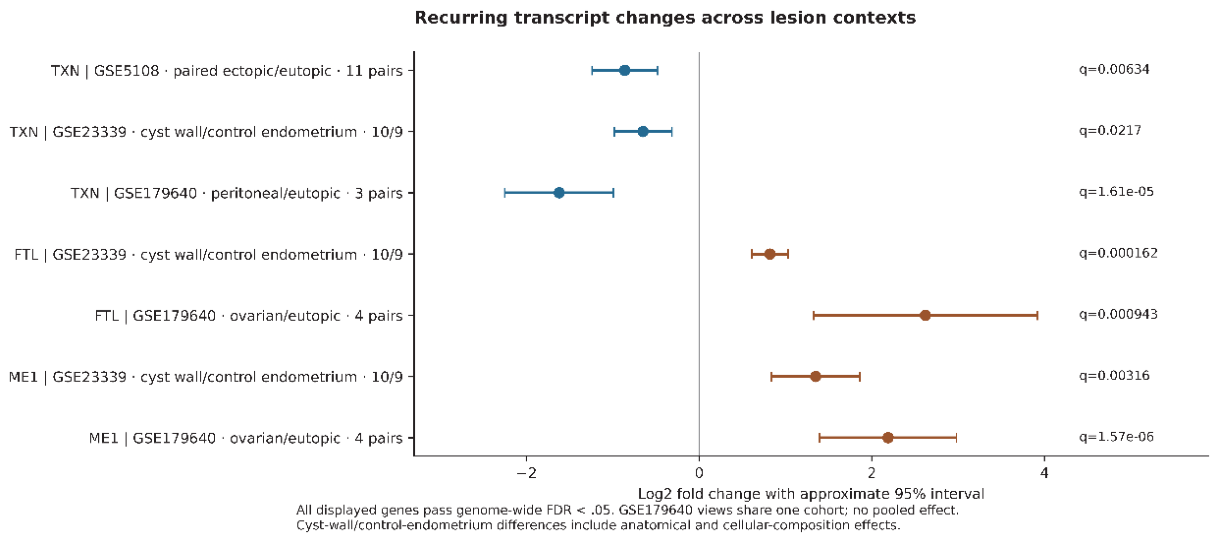
Figure 2.
Correlation-aware nondirectional module resultsใ The 27×7 historical map displays −log10 expanded-family conservative sensitivity mixed-test FDR, capped at 3; stars mark FDR<.05 and grey NT cells fail coverage. The post hoc conservative sensitivity BH correction covers 321 eligible tests (178 historical+143 external). Historical raw P values and original 178-test FDRs are unchanged and supplied separately. Repeated phases/cell views are not independent cohorts; GSE7305 is sensitivity-only. Significance means set perturbation, not protective capacity or necessarily opposing directions. Full values, components and every member-deletion result are retained. Historical mean-score results remain separate.
Figure 2.
Correlation-aware nondirectional module resultsใ The 27×7 historical map displays −log10 expanded-family conservative sensitivity mixed-test FDR, capped at 3; stars mark FDR<.05 and grey NT cells fail coverage. The post hoc conservative sensitivity BH correction covers 321 eligible tests (178 historical+143 external). Historical raw P values and original 178-test FDRs are unchanged and supplied separately. Repeated phases/cell views are not independent cohorts; GSE7305 is sensitivity-only. Significance means set perturbation, not protective capacity or necessarily opposing directions. Full values, components and every member-deletion result are retained. Historical mean-score results remain separate.
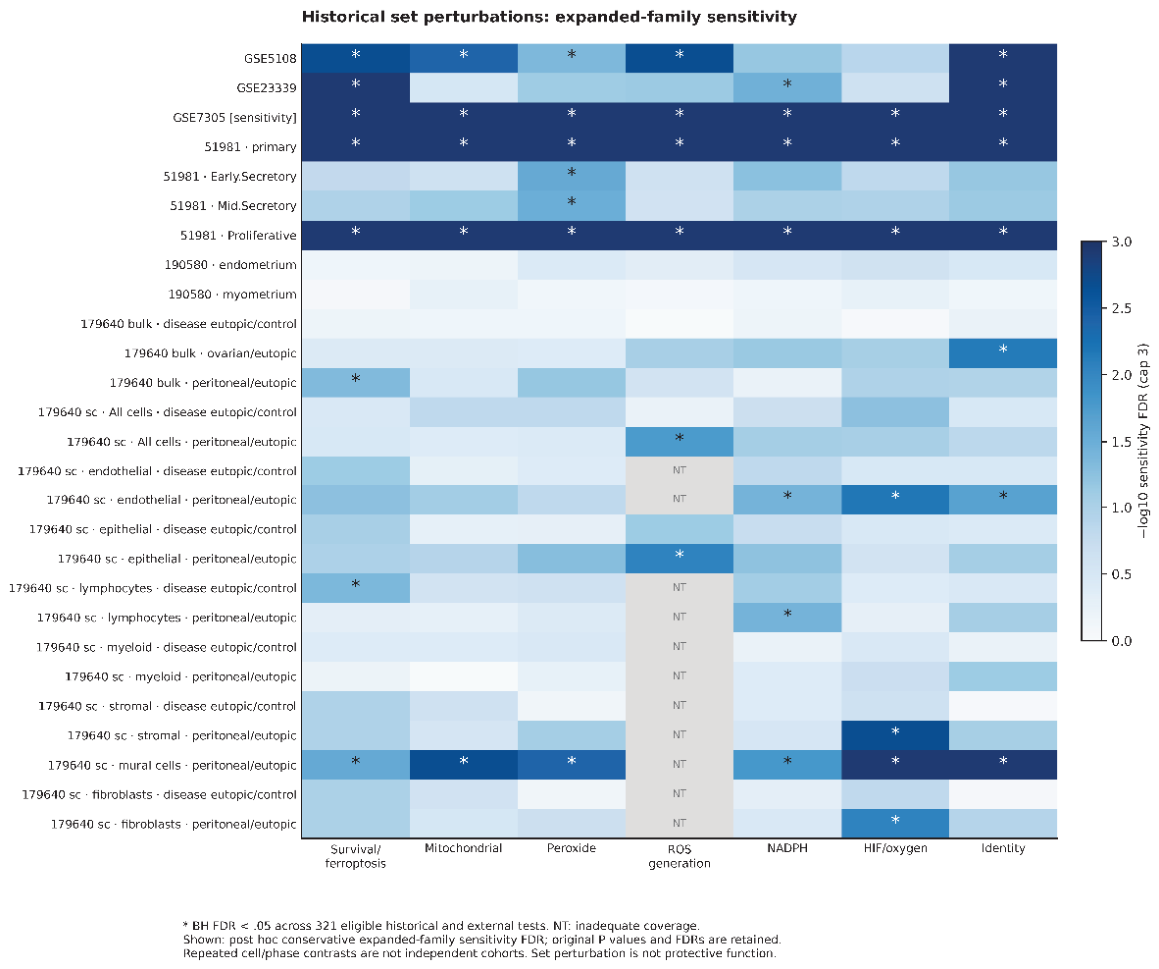
Figure 3.
Population-specific effects and formal interactions. The left/middle panels show CAT/PINK1 lesion/eutopic effects across six nonoverlapping GSE179640 populations, with approximate 95% intervals and unchanged historical genome-wide gene significance. The right panel shows formal CAT lesion-by-population responses relative to fibroblasts, with donor blocking: seven mural donors and eight for other pairs. Filled points require expanded-family conservative sensitivity FDR<.05 across 598 panel interactions. CAT mural/fibroblast has original FDR .0316 but expanded-family conservative sensitivity FDR .0592 and is shown open. PINK1 point differences alone are not interaction evidence. External disease/control interactions have a different biological contrast and are supplied separately.
Figure 3.
Population-specific effects and formal interactions. The left/middle panels show CAT/PINK1 lesion/eutopic effects across six nonoverlapping GSE179640 populations, with approximate 95% intervals and unchanged historical genome-wide gene significance. The right panel shows formal CAT lesion-by-population responses relative to fibroblasts, with donor blocking: seven mural donors and eight for other pairs. Filled points require expanded-family conservative sensitivity FDR<.05 across 598 panel interactions. CAT mural/fibroblast has original FDR .0316 but expanded-family conservative sensitivity FDR .0592 and is shown open. PINK1 point differences alone are not interaction evidence. External disease/control interactions have a different biological contrast and are supplied separately.
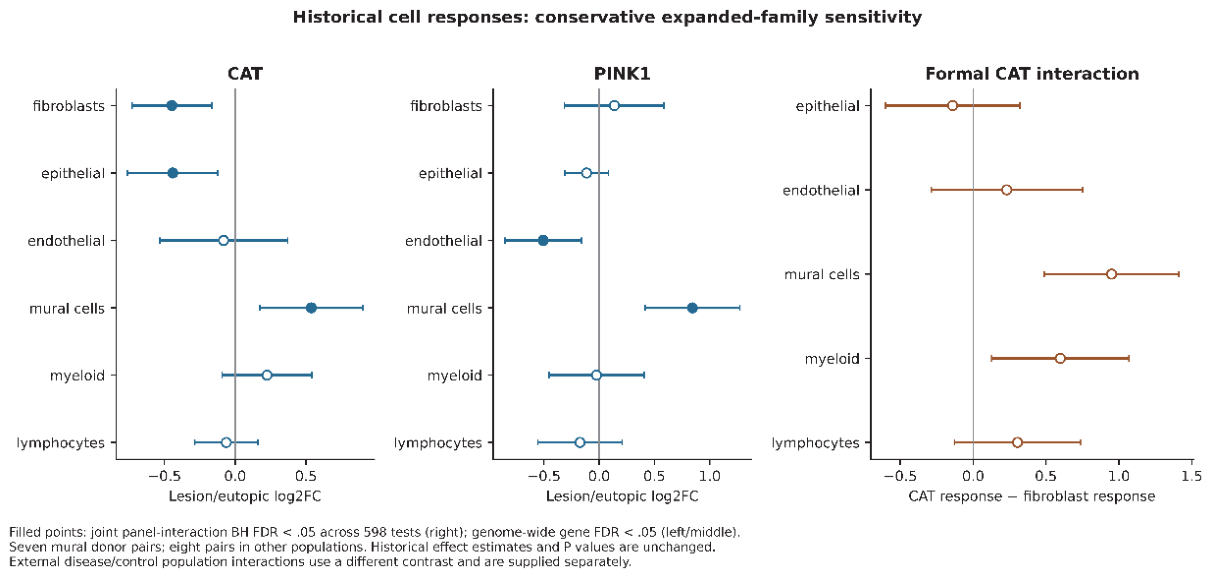
Figure 5.
External donor-aware findings and functional context. Panel A shows the five published-screen leads in the new donor-aggregated DESeq2 analysis, with ENDO/control donor counts, log2FC and approximate 95% Wald intervals. Genome-wide BH FDRs are printed; open points fail FDR<.05. All leads retain their point directions without significance. Panel B shows the original seven mixed-set tests in selected external contexts. Stars denote expanded-family conservative sensitivity BH FDR<.05 across 321 tests; NT denotes coverage/model ineligibility. Two overlapping myeloid/macrophage HIF sets pass that family but not external-only correction. Populations belong to one independent proliferative eutopic cohort; set perturbation is not biochemical protection. Complete values and missingness are supplied in source CSVs.
Figure 5.
External donor-aware findings and functional context. Panel A shows the five published-screen leads in the new donor-aggregated DESeq2 analysis, with ENDO/control donor counts, log2FC and approximate 95% Wald intervals. Genome-wide BH FDRs are printed; open points fail FDR<.05. All leads retain their point directions without significance. Panel B shows the original seven mixed-set tests in selected external contexts. Stars denote expanded-family conservative sensitivity BH FDR<.05 across 321 tests; NT denotes coverage/model ineligibility. Two overlapping myeloid/macrophage HIF sets pass that family but not external-only correction. Populations belong to one independent proliferative eutopic cohort; set perturbation is not biochemical protection. Complete values and missingness are supplied in source CSVs.
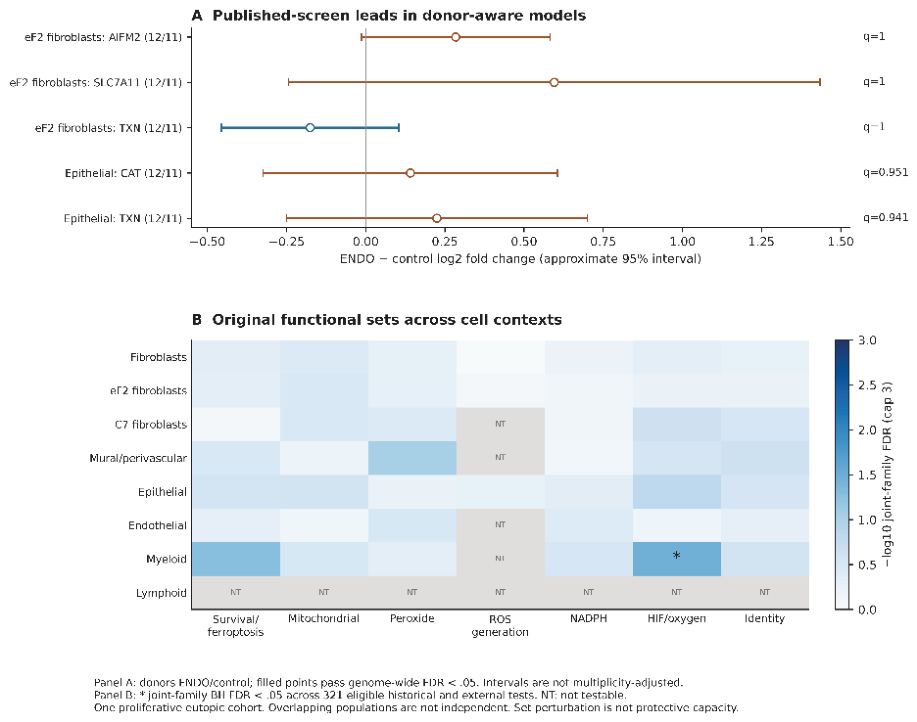
Figure 6.
Donor held out context convergence. A: Each line compares one held donor/population profile with its own consensus (filled) and the mean other-context consensus (open). All consensuses and gene scales exclude that donor entirely. Seven donors and six non-overlapping populations contribute 42 vectors on 43 shared panel genes. The mean margin is 0.2979, the interval is donor jackknife and the P value comes from 9,999 within-donor whole-vector label permutations. B: Counts of predicted versus observed contexts show 29/42 correct classifications, not 42 independent people. C: The panel margin is compared with 1,000 expression/detectability-matched 43-gene sets. Empirical P=0.0939 does not establish exceptional redox specificity. The cross-donor convergence property was not specified in the original biological hypothesis; it emerged as a secondary empirical finding after context-dependent lesion responses were identified.
Figure 6.
Donor held out context convergence. A: Each line compares one held donor/population profile with its own consensus (filled) and the mean other-context consensus (open). All consensuses and gene scales exclude that donor entirely. Seven donors and six non-overlapping populations contribute 42 vectors on 43 shared panel genes. The mean margin is 0.2979, the interval is donor jackknife and the P value comes from 9,999 within-donor whole-vector label permutations. B: Counts of predicted versus observed contexts show 29/42 correct classifications, not 42 independent people. C: The panel margin is compared with 1,000 expression/detectability-matched 43-gene sets. Empirical P=0.0939 does not establish exceptional redox specificity. The cross-donor convergence property was not specified in the original biological hypothesis; it emerged as a secondary empirical finding after context-dependent lesion responses were identified.
Disclaimer/Publisher’s Note: The statements, opinions and data contained in all publications are solely those of the individual author(s) and contributor(s) and not of MDPI and/or the editor(s). MDPI and/or the editor(s) disclaim responsibility for any injury to people or property resulting from any ideas, methods, instructions or products referred to in the content. |
© 2026 by the authors. Licensee MDPI, Basel, Switzerland. This article is an open access article distributed under the terms and conditions of the Creative Commons Attribution (CC BY) license (http://creativecommons.org/licenses/by/4.0/).
Copyright: This open access article is published under a Creative Commons CC BY 4.0 license, which permit the free download, distribution, and reuse, provided that the author and preprint are cited in any reuse.