
Submitted:
17 September 2026
Posted:
18 September 2026
You are already at the latest version
Abstract
Aedes aegypti, the primary vector of dengue, chikungunya, Zika, and yellow fever viruses, is widely distributed globally and has become a major public health concern. This study assessed the density, spatiotemporal distribution, and breeding habitat characteristics of Ae. aegypti in Dar es Salaam, Tanzania. A two-year longitudinal survey was conducted in Ilala, Kinondoni, and Temeke districts. Immature and adult mosquitoes were sampled using larval dipping, Prokopack aspiration, ovitraps, and BG-Sentinel traps in four wards per district, 20 households per ward and all other potential breeding habitats in a selected ward. 220,947 mosquitoes were collected, and 8,496 (3.8%) were Ae. aegypti. Temeke district had significantly higher Ae. aegypti density than the other districts (IRR=2.13, 95%CI:1.75–2.59;p<0.001), accounting for approximately 50% of all specimens collected. Mosquito density was nearly twice as high during the wet season as during the dry season (IRR=1.85, 95%CI:1.54–2.05;p<0.001). The highest Container Index (CI), House Index (HI) and Breteau Index (BI) of 14%, 3.4% and 11.9 respectively were recorded in Kinondoni district. Water storage containers exhibited the highest larval positivity rate. Aedes aegypti is widely distributed across Dar es Salaam. Water storage containers likely sustain year-round populations and represent important targets for surveillance and vector control interventions.
Keywords:
Aedes aegypti
; spatiotemporal distribution
; dengue
; traps
; longitudinal survey
; Dar es Salaam
; Tanzania
1. Introduction
Mosquito vectors of arthropod-borne viruses, particularly Aedes aegypti, have gained increasing public health attention due to their role in recurrent and severe outbreaks of arboviral diseases worldwide [1,2]. These species transmit pathogens responsible for dengue fever, chikungunya, Zika, and yellow fever, which are among the most important arboviral infections globally. Aedes aegypti is considered the most efficient vector, largely due to its ability to thrive in or near human domestic environments and its strongly anthropophilic behaviour [3,4]. This species is believed to have originated in Africa and later spread globally, mainly during the transatlantic slave trade era [5]. Two distinct subspecies of Ae. aegypti have been described: Aedes aegypti aegypti (Aaa), a light-colored domestic form, and Aedes aegypti formosus (Aaf), a darker, ancestral forest-dwelling form [6]. While Aaf is primarily associated with a sylvatic transmission cycle of viruses, Aaa predominates in urban environments, where it plays a central role in urban virus transmission [7]. However, despite these ecological differences, increasing evidence indicates that the two subspecies are becoming sympatric, resulting in interbreeding [6,8,9,10,11]. Land-use changes, particularly the conversion of forested areas into human settlements, are thought to drive this shift by increasing contact between sylvatic and domestic populations, potentially promoting sympatry and genetic exchange between the two forms.
Beyond its evolutionary history and ecological adaptation, Ae. aegypti is now widely distributed across all continents except Antarctica [12,13]. Its global spread has largely been facilitated by international trade, particularly through global shipping networks involving used tires and other water-holding containers [12,14] which can harbor eggs and larvae and thereby enhance passive dispersal. The ability of Ae. aegypti eggs to resist desiccation for up to six months facilitates long-distance dispersal, as shipping durations are often shorter than the egg survival time [15]. In addition, rapid urbanization, driven by rural-to-urban migration and poor settlement planning, often characterized by inadequate water supply and sanitation infrastructure, has further facilitated vector expansion [12]. Climate change has also been identified as an important driver of mosquito species distribution [14,16,17]. The species is currently present in over 167 countries worldwide [18], including many that previously did not harbor the vector. Projections suggest that global temperatures may increase by 1.8 to 4.0 °C by the end of the 21st century [17]. The increase in global temperature may expand the geographic suitability of Ae. aegypti in some temperate regions that were previously climatically unsuitable.
In addition to these broad distribution drivers, local ecological factors particularly breeding habitat availability play a critical role in determining Ae. aegypti presence and abundance. The species typically breeds in artificial water-holding containers, including discarded containers, used tires, and domestic water storage vessels [19,20]. Depending on the location of the breeding habitats, the species can breed either indoors or outdoors. Its ability to utilise breeding sites both indoors and outdoors enhances its capacity to colonise a wide range of environments [21]. Importantly, the breeding ecology of Ae. aegypti varies geographically. Populations outside Africa, particularly Latin America and Southeast Asia, are generally more closely associated with human-dominated environments and frequently utilise artificial water-holding containers in and around houses [22,23], whereas African populations exhibit greater ecological diversity, with some populations utilizing natural breeding habitats including tree-holes in addition to domestic containers [24].
While breeding habitat availability influences spatial patterns of abundance, temporal factors such as seasonality also play an important role in shaping Ae. aegypti population dynamics. Vector abundance is generally seasonal, with higher densities observed during the wet season [25,26]. During this period, the risk of pathogen transmission increases as a result of increased mosquito vectorial capacity [27] as result of higher population density, biting rate due to human crowding and mosquito survival. However, this pattern may not consistently apply to Ae. aegypti, particularly in urban settings, where population abundance can remain relatively stable throughout the year [28]. This stability is largely driven by human activities such as water storage and improper disposal of water-holding containers such as tyres, which ensure continuous availability of breeding habitats [28]. In many African cities and other developing countries, water scarcity is common, necessitating the storage of water in large containers, which serve as ideal breeding habitats [19]. These human behavioral practices create persistent breeding opportunities, enabling vector populations to persist during both wet and dry seasons and consequently facilitating continuous virus transmission.
Currently, vector control remains a key strategy for preventing arboviral diseases such as dengue, particularly in the absence of widely available antiviral therapies and universal vaccines. Common control strategies typically involve integrated approaches, including insecticide application, source reduction, environmental management, and vector surveillance [29,30,31]. In recent years, use of population-level innovations such as release-based approaches, including Wolbachia-infected mosquitoes, sterile insect technique (SIT) and gene drive systems [32,33], has expanded the vector control arsenal. However, in endemic regions with constrained resources, large-scale implementation of these strategies remains challenging. Therefore, targeted interventions at high-risk locations such as airports and seaports as well as hotspots have been proposed as a cost-effective complementary approach. These sites may serve as important points for the introduction of arboviruses and invasive vector populations, while also providing opportunities for monitoring established populations and early detection of new introductions [34]. Furthermore, because Ae. aegypti exploits a wide range of breeding habitats, with considerable variation in productivity among container types [20], prioritizing the most productive breeding habitats may further enhance the cost-effectiveness of control interventions.
In Tanzania, arboviral outbreaks such as dengue fever are increasingly reported [19,35,36,37,38], with Ae. aegypti identified as the primary vector [19,39]. Although several studies have documented the occurrence of Ae. aegypti species and the burden they cause, comprehensive information on seasonal variation, habitat productivity and fine-scale spatial distribution of Ae. aegypti remains limited. Such ecological data are critical for designing effective control strategies, as they help to identify the most productive habitats and optimal timing and locations for interventions. Therefore, this study aimed to assess density, spatiotemporal distribution, and breeding habitat preferences of Ae. aegypti, in order to inform evidence-based vector control programs.
2. Materials and Methods
2.1. Study Area
The study was conducted in Dar es Salaam City [39], the largest commercial city in Tanzania. Located at 6.48°S and 39.17°E along the Indian Ocean coast, the city has an estimated population of nearly 5.5 million [40]. It comprises five administrative districts (Ilala, Kigamboni, Kinondoni, Temeke, and Ubungo), with a total of 70 wards. The city is an epicentre of dengue outbreaks, with transmission occurring during the short rains (November-December) and the long rains (March-May). Based on previous dengue outbreak reports [19,41], Ilala, Kinondoni, and Temeke districts were selected for this study. The city experiences high temperatures year-round, peaking between October and February, and receives an average annual rainfall of approximately 1100mm.
2.2. Study Design and Sites
A repeated sampling design (longitudinal survey) was conducted over two-years (2022-2024) to collect Aedes mosquitoes (SOM Figure S1). The sampling was performed only outdoors due to unwillingness and unavailability of household owners that lead to indoors sampling infeasibility. Longitudinal sampling was chosen over cross-sectional designs as it is more effective in predicting the transmission risk of dengue virus (DENV) [42] and other arboviral diseases. In each district, a multiple stage sampling approach was used to select four wards: two representing high-income areas and the other two representing low-income areas [43,44] Table 1.
High-income wards were characterized by well-constructed houses, improved sanitation infrastructure, paved roads, and reliable piped water whereas the low-income wards were characterized by poorer housing, inadequate sewage systems, and unpaved roads. Within each selected ward, 20 households were randomly selected from lists obtained from the ward council which were assigned numbers. If the household owner of the selected house, refused to take part in the study, the adjacent house was recruited. Households were spaced at least 100m apart in each hamlet, and sampling covered a radius of up to 5km from a central point which was either ward market or ward council office. To increase the likelihood of capturing Aedes mosquitoes, additional sampling was conducted in all storm drains, public spaces, industrial areas, and motor vehicle repair garages available in each ward within 5km of sampling. These locations are known as potential Ae. aegypti breeding sites.
2.3. Household Recruitment
Each selected household was visited, and a head of the household was provided with an informed consent form requesting participation in the study. Participants were informed about the purpose of the study, their role and their right to withdraw at any time. Following consent, the head of household or other adult representative was administered a structured questionnaire adapted from [45] to collect data on household characteristics including wall and roof materials, number of occupants, and socioeconomic status. Technicians conducted a rapid inspection to identify and record the number and types of potential mosquito breeding sites currently on the premises [19]. All sampling locations (households, storm drains, public spaces, industrial areas, and vehicle garages) were geo-referenced to generate a spatial map of sampling sites. Each sampling location was visited once per month throughout the study period.
2.4. Mosquito Collection
Adult mosquito collections were conducted using four entomological sampling methods: BioGent AG Sentinel (BG) traps (Biogents AG, Regensburg, Germany) targeting host-seeking Aedes mosquitoes, Ovitrap (modified Biogents Gravid Aedes Trap (BG-GAT; Biogents, Germany)) for gravid females, and Prokopack aspirations for resting adults. In each sampling round, a combination of BG-Sentinel and BG-GAT was deployed outdoors in one household for 24 hours and inspected the following day. After the inspection of aforementioned traps, resting mosquitoes around the household premise were also collected using a Prokopack aspirator. All collected mosquitoes were transported to a temporary field laboratory and morphologically identified to species level using the identification key by Wilkerson et al. 2021 [18]. All Ae. aegypti were sorted by sex and physiological status (unfed, blood-fed and gravid), then preserved individually in Eppendorf tubes containing RNAlater prepared locally at Swiss Tropical and Public Health (TPH) Institute as described by Tenywa et al. 2025 [39]. Samples were then arranged in 96-well boxes, placed in a cooler box, and transported to the Ifakara Health Institute laboratory for storage at −80 °C. Following adult collection, larval surveys were conducted by inspecting all water-holding containers for the presence of larvae and pupae using dippers for larvae and pupae. Upon examination, the number of immature mosquitoes per container was recorded.
2.5. Data Analysis
Data analysis was performed using STATA software (StataCorp LLC, College Station TX, USA) and R package (version 4.5.3; R Core Team, 2026).
2.6. Vector Density
Descriptive analysis was performed to summarise habitat characteristics, adult and immature mosquito densities at district level. A mixed-effect negative binomial regression model was used to estimate incidence rate ratio (IRR) and 95% confidence intervals (95%CIs) for mosquito density [46] as part of a sensitivity analysis, and the Breteau Index (BI: number of positive containers with larvae/pupae per 100 inspected houses) across districts. A binary logistic regression was used to estimate the House Index (HI: percentage of houses positive for Ae. aegypti larvae or pupae) and Container Index (CI: percentage of containers infested with Ae. aegypti larvae or pupae). Statistical significance was assessed at the 5% significance level and 95% confidence intervals were reported. Furthermore, scatter plots were used to assess the correlation between the number of larvae collected and the number of adult mosquitoes captured by each trap type. Pearson’s correlation coefficient was calculated, and a linear regression line was fitted to illustrate the relationship between larval and adult mosquito abundance.
2.7. Spatial Distribution of Vectors
All spatial analyses and visualisations were conducted in R (version 4.5.3; R Core Team, 2026) [47] using the readxl, dplyr, lubridate, sf, ggplot2, and ggspatial packages. Mosquito capture records were aggregated to the household level by summing trap counts per unique GPS coordinate pair, and subsequently to the ward level for choropleth mapping. All spatial objects were projected to WGS84 (EPSG:4326) prior to analysis, and ward-level Ae. aegypti capture totals were joined to the 2023 Dar es Salaam ward boundary shapefile by normalized ward name keys. Choropleth maps were generated for the combined study period and stratified by dry and rain seasons, with a shared continuous color scale across seasonal panels to enable direct visual comparison.
2.8. Temporal Distribution of Vectors
Descriptive analyses were conducted to examine temporal trends in mosquito abundance. The relationship between vector density and seasonal variability (e.g., temperature and humidity) was assessed using a generalised linear mixed model with log link.
3. Results
3.1. Mosquito Density
A total of 220,947 mosquitoes were collected over a two-year period. Of these, 3.8% (n = 8,496) were Ae. aegypti, 0.1% (n=198) were Anopheles gambiae complex and 96.1% (n=212,253) were Culex quinquefasciatus.
Temeke district had a significantly higher Ae. aegypti density (IRR=2.14; [95%CI: 1.59-2.88], p<0.001), accounting for 49.9%(n=4,235) of all Ae. aegypti collected. This was followed by Ilala (25.8%, n=2,195), with Kinondoni having the least density (24.3%, n=2,066), (IRR=0.23; [95%CI: 0.16-0.33], p<0.001) (Table 2). Overall, Ae. aegypti density was nearly twice as high in the wet season compared to the dry season (IRR= 1.72; [95%CI: 1.48-1.98], p<0.001) (Table 2).
Aedes aegypti density varied across wards within each district (Figure 1 & SOM Table S1) with wards categorised as high income constituting higher density than low-income category in all districts. Within Temeke district, Chang’ombe ward recorded the highest Ae. aegypti density (59.0%, n=2,497). Within Ilala district, Kivukoni had the highest density (46.4%, n=1,018), while within Kinondoni district, Kijitonyama ward recorded the highest density (72.1%, n=1,488) (SOM Table 1). A similar pattern was observed for C. quinquefasciatus across districts, except in Kinondoni, where Mbweni ward had a higher C. quinquefasciatus density despite a lower Ae. aegypti density.
Seasonal analysis showed that Ae. aegypti density was significantly higher during the wet season in Ilala (IRR=2.48; [95%CI: 1.94-3.18], p<0.001) and Temeke (IRR=2.08; [95%CI: 1.50-2.89], p<0.001), but not in Kinondoni (IRR=1.29; [95%CI:1.00-1.67], p=0.064) (Table 3).
3.2. Larval Indices
Of the three districts, Kinondoni showed the highest larval indices across all parameters: Container Index (CI) (OR=6.92; [95%CI:5.30-9.03], p<0.001), House Index (HI) (OR=12.65; [95%CI: 10.05-15.94], p<0.001) and Breteau Index (BI) (IRR=16.53; [95%CI:12.72-21.46], p<0.001) (Table 4). Overall, significantly lower CI, HI and BI were observed during the dry season compared to the wet season (Table 4).
3.3. Aedes aegypti Habitat Positivity
A total of 42,596 potential breeding habitats representing five habitat categories were identified and inspected for the presence of Ae. aegypti larvae (Table 5). Overall, 2.5%(n=1070) of the inspected habitats were positive for Ae. aegypti larvae. Positivity varied among habitat types, with used tyres having the highest proportion of positive habitats (5.7%), followed by water-storage containers (3.8%). Although water-storage containers had a lower positivity rate than tyres, they accounted for the largest number of Ae. aegypti-positive habitats and contributed the highiest proportion of the total larvae collected (Table 5 ; SOM Figure S2). Cans and coconut shells were the most abundant habitats types but had the lowest positivity rate (1.4%). Habitat size analysis showed that medium-sized habitats were the most common across the study sites; however, small-sized habitats measuring <50 cm in depth exhibited the highest positivity rate for Ae. aegypti larvae (18.7%) (Table 5). Clean-water habitats constituted the majority of inspected habitats but turbid habitats had a higher positivity rate (17.6%) than very turbid (9.7%) or clear-water habitats (8.8%). Overall these descriptive findings suggest that habitat type, size and water turbidity may influence the likelihood of Ae. aegypti infestation.
3.4. Spatial Distribution
Ward-level aggregation of Ae. aegypti captures across the 12 surveyed wards revealed marked spatial heterogeneity in vector abundance over the study period (2022–2024) (Figure 1). By urban zone, the highest cumulative captures were recorded in the southern and central wards of Dar es Salaam, with Chang’ombe (n = 2,497), Temeke (n = 1,552), and Kijitonyama (n = 1,488) collectively accounting for the greatest vector burden. Wards in the inner city zone, including Kivukoni (n = 1,018), Upanga Magharibi (n = 816), and Makumbusho (n = 251), recorded moderate capture counts. The lowest captures were observed in the peripheral wards, comprising the northern coastal wards of Bunju (n = 130) and Mbweni (n = 197), the southern peri-urban ward of Chanika (n = 204), and the southern coastal wards of Kurasini (n = 58) and Charambe (n = 128) (SOM Table 1).
Stratification by season revealed that the spatial pattern of Ae. aegypti abundance was broadly consistent between the dry and rainy seasons across all surveyed wards (Figure 1 (B&C)). Chang’ombe, Temeke, and Kijitonyama maintained the highest capture intensities in both seasons, while peripheral wards including Chanika, Bunju, and Mbweni recorded low captures across both seasons.
3.5. Temporal Distribution
The results showed that Ae. aegypti were present throughout the year. Increased densities were observed during the wet months (March-May) in both the first and second years of collection (Figure 2). It was shown that, Temeke district exhibited higher densities during the peak months of Ae. aegypti compared to the other two districts (Figure 2).
3.6. Correlation Between Larval and Adult Ae. aegypti
Assesment of the relationship between larval and adult Ae. aegypti abundance by trap types showed no significant correlation between larval density and the number of mosquitoes captured by different trap type (Figure 3). However, mosquito capture varied among trap type, with BG-traps capturing the highest number of adult mosquitoes, followed by prockopack aspirators, across all districts (Table 6).
3.7. Environmental Data
Temperature and relative humidity were recorded throughout the study period using a data logger installed at one of the study sites. The overall mean temperature and relative humidity were 28.6 °C and 67.7% respectively, with values ranging from 15.3 °C–34.7 °C and 35.5%–96.6% respectively (Figure 4). On average both temperature and relative humidity were within the optimal ranges generally considered suitable for Ae. aegypti survival and development. Because the three study sites were geographically close to one another, a single data logger was used assuming that spatial variation in temperature and relative humidity among the sites was minimal.
4. Discussion
4.1. Species Composition of Aedes mosquitoes
East and West Africa are located within tropical and subtropical regions and share many ecological and climatic characteristics that favour the establishment and persistence of mosquito vectors. Despite these similarities, the distribution of Aedes species differs markedly between the regions. In West Africa, both Aedes aegypti and Aedes albopictus co-exist [8,12,13,14,48,49,50], whereas in East Africa studies have reported the presence of Ae. aegypti with limited or no evidence established for Ae. albopictus populations [14,19,28,51]. In the present study, we conducted a two-year longitudinal survey and only Ae. aegypti among Aedes species was identified throughout Dar es Salaam during the study duration, corroborating previous reports from other parts of Tanzania [52,53,54]. Similar findings have been reported in neighbouring country Kenya, where ecological and dispersal studies have consistently documented Ae. aegypti as the predominant species [6,21,24,28,55,56,57]. Furthermore, genetic diversity studies have further revealed the presence of both Aedes aegypti aegypti (Aaa) and Aedes aegypti formosus (Aaf) subspecies [10,28]. While Aaf is predominantly found in western Kenya, both subspecies occur in eastern part of the country [10,28]. Given the extensive geographic connectivity between Tanzania and Kenya mainly through trade, migration, and sociocultural interactions, it is plausible that both subspecies may also be present in Tanzania. This hypothesis, however, requires confirmation through genomic investigations. Such information is epidemiologically important because Aaa is highly synanthropic and plays a major role in urban arboviral transmission [58], whereas Aaf is generally associated with sylvatic environment and wildlife transmission cycles [58,59].
4.2. Spatial Distribution and Abundance of Ae. aegypti
Our findings demonstrated substantial heterogeneity in Ae. aegypti abundance across Dar es Salaam. The abundance and distribution of Ae. aegypti are largely influenced by habitat suitability and human behavioural practices [60,61]. The species preferentially breeds in water accumulated in artificial containers, including discarded containers, water-storage vessels, used tires and flower pots [19,20,28,62,63]. Among these habitats, water-storage containers and used tyres have frequently been reported as the most productive breeding habitats [28,64]. These reports are broadly consistent with our findings, which identified used tyres and water-storage containers as habitats with relatevely high Ae. aegypti infestation rates, at 5.6% and 3.8%, respectively. The higher infestation rate observed in used tyres suggests that they may be particularly important breeding habitats where they are present and retain water. Therefore, the Tanzania vector control programmes should consider targeting used tyres in Ae. aegypti control interventions, particularly in communities where these habitats are common. Control of Ae. aegypti breeding in used tyres could include approprate disposal, recycling or repurposing them as mosquito control devices, such as lethal ovitraps including Ovillanta ovitrap, which are designated to attract gravid Ae. aegypti [65,66]. Such approaches may provide an opportunity to transform an important breeding habitat into a vector-control tool. Furthermore, this study demonstrated lower infection rate in water-storage containers than used tyres, despite having a lower infestation rate, water-storage containers were considerably more abundant and accounted for a larger number of positive habitats as well as high proportion of larvae. Thus, their overall contribution to Ae. aegypti abundance may be substential because of their high availability in the study communities. This finding highlights the importance of considering both habitat-specific infestation rates and the abundance of available habitats when prioritising breeding sites for Ae. aegypti control.
In this study, Temeke district accounted for nearly half of the collected mosquito populations. The high mosquito abundance observed in the district may be attributed to a combination factors including demograph, infrastructure and behaviral practice. According to the 2022 Tanzanian census, Temeke is one of the most densely populated districts in Dar es Salaam and has a limited access to reliable piped water and sanitation infrastructure [40]. Consequently, residents commonly store water in drums, buckets and other containers for domestic use, potentilly increasing the availability of suitable oviposition habitats for Ae. aegypti. The district also exhibits numerous vehicle repair garages spatially distributed across the area and a relatively high number of warehouses [40], which may contribute to the accumulation of discarded tyres that can serve as productive Ae. aegypti breeding habitats [67]. Furthermore, mapping of Aedes larval habitats using drone imagery and supervised machine learning has documented the placement of tyres on household roofs in the district, reportedly for storm protection [67], further increasing the availability of suitable larval habitats [62,67].
Interestingly, a recent study on dengue virus prevalence in mosquito reported the highest infection rates in Ae. aegypti mosquitoes from Temeke district [39]. Although adult mosquito density alone does not necessarily predict dengue transmission intensity [42,68], vector abundance remains an important component of transmission dynamics because the basic reproduction number of mosquito-borne pathogens is strongly influenced by vector density [69,70]. Consequently, the elevated mosquito densities observed in Temeke may contribute to an increased risk of arboviral transmission in this district. Furthermore, at the ward level, high-income wards generally reported higher mosquito densities than low-income wards within the same district. Although these areas often have better water infrastructure, intermittent water supply encourages residents to store water in large containers including septic tanks that may remain filled for prolonged periods, thereby facilitating mosquito breeding. Similar observations have been reported in Puerto Rico, where Ae. aegypti abundance remained high despite relatively good water infrastructure [25], water storage containers were highlighted as the main source of the mosquito infestation. Currently, source reduction remains the primary WHO-recommended strategy for Ae. aegypti control [71,72] while interventions including larviciding, adulticiding and emerging approaches such as Wolbachia-based infected mosquitoes, sterile insect technique, and genetic modification technologies are recommended as complementary tools [72]. The success of these interventions depends on accurate information regarding breeding habitats, resting sites and population dynamics. Therefore, the spatial distribution and density estimates generated in this study provide important evidence for guiding targeted vector surveillance and control programmes in Dar es Salaam.
4.3. Seasonal Dynamics of Ae. aegypti
Mosquito abundance generally tends to vary seasonally, with peaks occurring during rainy periods when breeding habitats become more abundant due to rainfall [19,26,48,73]. However, this pattern is not universal for Ae. aegypti. Several studies have demonstrated relatively stable year-round populations in urban settings despite seasonal variation in rainfall [25,74,75]. This persistence is often attributed to permanent or semi-permanent breeding habitats, including water-storage containers and cryptic habitats such as septic tanks [76,77]. The reported observations are in conformity with findings in this study particularly in Kinondoni district, where Ae. aegypti population remained relatively stable throughout the year, sugesting that Kinondoni may be exhibiting permanent, human-maintained aquatic habitats that buffer the mosquito population between seasons, thus highlighting potential different timing for controlling the mosquito species in this district in respect to the two districts. Given the chronic challenges in domestic water supply experienced in Dar es Salaam, it is plausible that water storage containers constitute the principal breeding habitats sustaining year-round mosquito populations. This interpretation is echoed by our habitat productivity data, which identified water-storage containers as the most abundant and productive breeding sites (Table 5). Because the prevention of Aedes-borne diseases especially dengue, mainly relying on vector control, targeted management of water-storage containers should be prioritised in these settings, particularly through covering water-storage containers with tightly fitting lids or mesh screens, or larviciding the containers as well as mosquito proof containers [71,72]. Numerous studies have demonstrated that these interventions can substantially reduce Ae. aegypti populations and consequently lower arboviral transmission risk [78,79,80,81].
4.4. Larval Indices and Their Utility in Predicting Adult Mosquito Abundance
House Index (HI), Container Index (CI) and Breteau Index (BI) are the conventional indices used as indicators of Aedes mosquito infestation in an area [82,83]. These indices quantify household infestation, breeding-site distribution, and container positivity [82,83], and have historically been used as a convetional instrument for estimating arboviral outbreak risk [68], where when HI and BI is above 1% and 5 thresholds respectively, indicates potential risk for dengue outbreaks [82,83,84]. In our study, all three indices were lower than those previously reported in Dar es Salaam [19,85]. Among all districts, Kinondoni district exhibited the highest values for each index (Table 4), consistent with previous findings [85]. Notably, however, Kinondoni did not exhibit the highest adult mosquito density, instead, Temeke had the largest adult mosquito population. This discrepancy highlights the well documented limitations of HI, CI and BI as predictors of adult vector abundance [68,86], suggesting that operational control of the species in these sites should combine adult surveillance with habitat-productivity measuremnts. This is explained by factors such as larval mortality and lifespan, which lead to inconsistency between the observed immature abundance measured and the corresponding adults [42,87]. Thus, pupal-based indicators such as Pupae Index (PI), Pupae per Person Index (PPI) and Pupae per House Index (PHI) have been proposed as more informative predictors of adult vector productivity [86,88].
All three entomological indices (HI, CI and BI) are strongly influenced by seasonality, with previous studies reporting higher values during the rainy season [53,89]. The present study demonstrated a similar seasonal pattern of the indices. This increase is likely attributed to greater availability of water-filled containers due to rain that serve as breeding habitats for Ae. aegypti, leading to higher mosquito densities. Consequently, the risk of arboviral transmission may increase during rainy season as vector abundance is an important determinant of the transmission potential. Consistent with this argument, most dengue outbreaks reported in Tanzania have occurred during the rainy months, particularly between March and May [19,37], when the country experiences prolonged and heavy rainfall. These findings highlight the importance of strengthening vector control interventions, with particular emphasis on the removal or management of temporary water-holding containers especially before the onset of the rains [19,67].
4.5. Breeding Habitat Types
Inspection of potential breeding habitats in this study revealed that cans and coconut shells were the most abundant habitat types. However, tyres and water-storage containers exhibited the highest positivity rates for Ae. aegypti larvae, indicating that Aedes productivity does not depend on habitat abundance but rather on habitat type. Similar findings have been reported previously in Dar es Salaam [19] and elsewhere [25,28,64]. Therefore, targeting water-storage containers and tyres for Ae. aegypti control program in Dar es Salaam settings is an essential aspect. Aedes aegypti generally prefers to oviposit in artificial containers containing clean to moderately organic water [90]. Studies indicate that the species commonly breeds in water ranging from near-neutral to mildly alkaline pH [91,92], whereas highly acidic or alkaline conditions can reduce egg hatchability, larval survival and overall habitat suitability [91]. In this study we observed that habitats containing turbidy water and ≤50 cm in depth were particularly favourable for Ae. aegypti productivity. This indicates that water type plays a significant role in the species’ productivity. Therefore, breeding habitat with turbidy water should be the main targets when conducting Ae. eagypti programs in the city. However, further studies should characterise water pH and alkalinity to better understand the best parameter range required for the species in the study site.
4.6. Climate Drivers of Ae. aegypti Abundance and Future Implications
Climate change is increasingly recognised as an important driver of the geographic expansion and transmission potential of Aedes mosquitoes. It impacts aspects such as rainfall patterns, humidity and temperature, causing potential environmental catastrophes such as floods or droughts and global warming [14] which can alter mosquito vector ecology and disease risks [14,16,17]. While rainfall contributes to the formation of breeding habitats, temperature and humidity directly influence mosquito development, survival, reproduction and vector competence [93,94,95]. These factors can also accelerate viral replication within mosquitoes by shortening the extrinsic incubation period (EIP) [96,97]. For example, modelling studies suggest that the dengue virus EIP may decrease from approximately seven days to five days at a temperature of around 32 °C [96]. In the present study, the average temperature and relative humidity were 28.6 °C and 67.7% respectively, conditions within optimal range for Ae. aegypti survival and reproduction. Given the projections that global temperature may continue to increase substantially during the twenty-first century [16,17,98], these findings raise concerns regarding the continued expansion of Ae. aegypti populations and the potential emergence of arboviral transmission in areas that were previously unsuitable for the species.
4.7. Study Limitations
The sampling of both adult and immature mosquitoes was conducted exclusively outdoors because the household owners refused access to their indoor environment. This limits our ability to determine whether the observed mosquito density accurately reflects the overall Ae. aegypti population in the study area, particularly given the species’ ability to utilise both indoor and outdoor habitats.
Entomological indices such as Pupae Index (PI), Pupae per Person Index (PPI) and Pupae per House Index (PHI) have been proposed as measures more directly related to Ae. aegypti productivity and abundance. In this study, we used House Index (HI), Container Index (CI) and Breteau Index (BI), which primarily measure the extent of larval habitat infestation rather than adult mosquito abundance. This difference may partialy explain the apparent discrepancy between adult Ae. aegypti abundance and larval indices across districts. For example, Temeke had the highest adult mosquito abundance but relatively lower HI, CI, and BI values, where Kinondoni had higher larval indices but lower adult mosquito abundance. This suggests that HI, CI and BI do not reliably reflect adult mosquito abundance, as adult abundance is also influenced by factors such as habitat productivity, larval survival, adult emergence, dispersal and mortality.
4.8. Recommendations
Overall, this study demosntrated substantial spatial heterogeity in Ae. aegypti abundance across Dar es salaam, with mosquito density varying considerably between districts and among wards within district. Adult mosquito abundance was also higher in areas classified as high income than in low-income areas. These findings suggest that Ae. aegypti surveillence and control programmes should adopt a risk-based approach that prioritise areas with consistently high mosquito abundance while maintaining minimal efforts in low-density areas. Such interventions should also account for seasonal variation in mosquito abundance, because adult Ae. aegypti abundance increased during the rainy season, therefore intensified surveillance and control activities could be initiated before and during the onset of the rains to reduce mosquito population before the peak is reached.
The study also demonstrated that larval indices did not consistently reflect adult Ae. agypti abundance across districts. For example, Temeke had relatively high adult mosquito abundance despite lower larval indices, whereas Kinondoni showed the opposite pattern. Therefore, reliance on larval indices may not adequately capture adult mosquito abundance in Dar es Salaam. Thus, vector surveillance programmes should consequently prioritise adult moquito surveillence especially where the primary objective is to estimate adult mosquito abundance or identify areas at increased risk of dengue transmission. Nevertheless, larval indices can remain useful for assessing breeding site infestations and evaluting source-reduction activities.
Moreover, the study further identified used tyres and water-storage containers as important Ae. aegypti breeding habitats. Control programmes in Dar es Salaam should therefore prioritise these habitat types through targeted source-reduction and larval source-management activities. For example used tyres should be removed, properly stored, covered, recycled or managed to prevent water accumalation while on the other hand water-storage containers should be tightly covered or fitted with appropriate screens and regualrly emptied, cleaned or treated where necessary. For successifulness of these interventions, they should be supported by community engagement and behavioural-change activities.
5. Conclusion
This study demonstrated that Ae. aegypti is widely distributed across Dar es Salaam, with Temeke district exhibiting the highest mosquito abundance. The observed spatial distribution and abundance of Ae. aegypti indicate a continued risk of arboviral disease transmission in the city, particularly in Temeke district, where vector densities were the highest. Given that vector density is a key component of mosquito vectorial capacity, routine vector surveillance and control interventions should be maintained throughout the city, with particular emphasis on high-density areas. The study further showed that Ae. aegypti persist throughout the year, highlighting the importance of permanent and semi-permanent breeding habitats, especially water storage containers in sustaining vector populations. Interventions targeting these habitats, including covering water storage containers with lids or mesh, and larval source management through larviciding, may contribute to reducing year-round vector persistence. In addition, the study revealed inconsistencies between conventional entomological indices (HI, CI and BI) and observed mosquito density particularly in Temeke and Kinondoni districts.
Supplementary Materials
The following supporting information can be downloaded at the website of this paper posted on Preprints.org.
Author Contributions
Conceptualisation, F.S.C.T and S.J.M; Methodology, F.S.C.T and S.J.M; Formal analysis, F.S.C.T and Y.P.M; Investigation, F.S.C.T, O.D, J.J.M, M.H and H.I.M; Data curation, F.S.C.T, O.D, J.J.M, M.H, and H.I.M; Writing original draft, F.S.C.T; Writing review and editing F.S.C.T, Y.P.M and S.J.M; Visualization, S.J.M, and Y.P.M; Supervision, S.J.M; Funding acquisition, S.J.M. All authors read and approved the final manuscript draft.
Funding
This study was funded by Rudolf Geigy–Stiftung (RGS): 200902 through Swiss TPH.
Institutional Review Board Statement
This study received an ethical approval from Ifakara Health Institute Review Board (IHI-IRB) IHI/IRB/No: 7-2021 and National Institute for Medical Research Review Board (NIMR-RB) No. NIMR/HQ/R.8a/Vol. IX/3641.
Informed Consent Statement
The permission to publish was provided by The National Institute for Medical Research Review Board (NIMR-RB) Ref No. BD.242/437/01C/196.
Data Availability Statement
The datasets generated during the study are available from Ifakara Health Institute and are freely accessible on open depository https://osf.io/yk8gs/overview.
Acknowledgments
The authors would like to thank Ifakara Health Institute staff in particular Rose Phillipo, Ritha Kidyalla, Ester Giteta, Jason Moore and Muniru Musa for their support. Also, would like to extend heartfelt thanks to district and ward council officers, and the community members for granting permission to conduct our study in their respective districts, wards and hamlets. Also, during the prepration of this manuscript, the author used ChatGPT-5.6 Luna for the purpose of assisting with English grammar the manuscript write-up.
Conflicts of Interest
The authors declare that they have no competing interests.
List of abbreviations
| IRR | Incidence rate ratio |
| CI | Confidence interval or Container index |
| HI | House Index |
| BI | Breteau Index |
| DENV | Dengue virus |
| BG | Biogent |
| OR | Odds ratio |
| Aaa | Aedes aegypti aegypti |
| Aaf | Aedes aegypti formosus |
| WHO | World Health Organisation |
| PI | Pupae Index |
| PPI | Pupae per Person Index |
| PHI | Pupae per House Index |
| EIP | Extrinsic incubation period |
References
- Kraemer, M.U.; Reiner, Jr RC; Brady, O.J.; Messina, J.P.; Gilbert, M.; Pigott, D.M.; et al. Past and future spread of the arbovirus vectors Aedes aegypti and Aedes albopictus. Nat. Microbiol. 2019, 4(5), 854–63. [Google Scholar] [CrossRef] [PubMed]
- WHO. Dengue: guidelines for diagnosis, treatment, prevention and control: World Health Organization Geneva; 2009. [Google Scholar]
- Crawford, J.E.; Alves, J.M.; Palmer, W.J.; Day, J.P.; Sylla, M.; Ramasamy, R.; et al. Population genomics reveals that an anthropophilic population of Aedes aegypti mosquitoes in West Africa recently gave rise to American and Asian populations of this major disease vector. BMC Biol. 2017, 15(1), 16. [Google Scholar] [CrossRef] [PubMed]
- Souza-Neto, J.A.; Powell, J.R.; Bonizzoni, M. Aedes aegypti vector competence studies: A review. Infect. Genet Evol. 2019, 67, 191–209. [Google Scholar] [CrossRef] [PubMed]
- Tatem, A.J.; Hay, S.I.; Rogers, D.J. Global traffic and disease vector dispersal. Proc. Natl. Acad. Sci. 2006, 103(16), 6242–7. [Google Scholar] [CrossRef] [PubMed]
- Gloria-Soria, A.; Ayala, D.; Bheecarry, A.; Calderon-Arguedas, O.; Chadee, D.D.; Chiappero, M.; et al. Global genetic diversity of Aedes aegypti. Mol. Ecol. 2016, 25(21), 5377–95. [Google Scholar] [CrossRef] [PubMed]
- Powell, J.R.; Tabachnick, W.J. History of domestication and spread of Aedes aegypti-a review. Mem. Inst. Oswaldo Cruz 2013, 108, 11–7. [Google Scholar] [CrossRef] [PubMed]
- Egid, B.R.; Coulibaly, M.; Dadzie, S.K.; Kamgang, B.; McCall, P.J.; Sedda, L.; et al. Review of the ecology and behaviour of Aedes aegypti and Aedes albopictus in Western Africa and implications for vector control. Curr. Res. Parasitol. Vector-Borne Dis. 2022, 2, 100074. [Google Scholar] [CrossRef] [PubMed]
- Xia, S.; Dweck, H.K.; Lutomiah, J.; Sang, R.; McBride, C.S.; Rose, N.H.; et al. Larval sites of the mosquito Aedes aegypti formosus in forest and domestic habitats in Africa and the potential association with oviposition evolution. Ecol. Evol. 2021, 11(22), 16327–43. [Google Scholar] [CrossRef] [PubMed]
- Mulwa, F.; Balcazar, D.; Langat, S.; Mutisya, J.; Chelangat, B.; McBride, C.S.; et al. Population genetic analysis of Aedes aegypti reveals evidence of emerging admixture populations in coastal Kenya. PLoS Negl. Trop. Dis. 2025, 19(5), e0013041. [Google Scholar] [CrossRef] [PubMed]
- Rose, N.H.; Sylla, M.; Badolo, A.; Lutomiah, J.; Ayala, D.; Aribodor, O.B.; et al. Climate and urbanization drive mosquito preference for humans. Curr. Biol. 2020, 30(18), 3570–9. e6. [Google Scholar] [CrossRef] [PubMed]
- Kraemer, M.U.; Sinka, M.E.; Duda, K.A.; Mylne, A.Q.; Shearer, F.M.; Barker, C.M.; et al. The global distribution of the arbovirus vectors Aedes aegypti and Ae. albopictus. elife 2015, 4, e08347. [Google Scholar] [CrossRef] [PubMed]
- Lwande, O.W.; Obanda, V.; Lindström, A.; Ahlm, C.; Evander, M.; Näslund, J.; et al. Globe-trotting Aedes aegypti and Aedes albopictus: risk factors for arbovirus pandemics. Vector-Borne Zoonotic Dis. 2020, 20(2), 71–81. [Google Scholar] [CrossRef] [PubMed]
- Laporta, G.Z.; Potter, A.M.; Oliveira, J.F.; Bourke, B.P.; Pecor, D.B.; Linton, Y.-M. Global distribution of Aedes aegypti and Aedes albopictus in a climate change scenario of regional rivalry. Insects 2023, 14(1), 49. [Google Scholar] [CrossRef] [PubMed]
- Bennett, K.L.; Gómez Martínez, C.; Almanza, A.; Rovira, J.R.; McMillan, W.O.; Enriquez, V.; et al. High infestation of invasive Aedes mosquitoes in used tires along the local transport network of Panama. Parasit. Vectors 2019, 12(1), 264. [Google Scholar] [CrossRef] [PubMed]
- Liu-Helmersson, J.; Quam, M.; Wilder-Smith, A.; Stenlund, H.; Ebi, K.; Massad, E.; et al. Climate change and Aedes vectors: 21st century projections for dengue transmission in Europe. EBioMedicine 2016, 7, 267–77. [Google Scholar] [CrossRef] [PubMed]
- Naicker, P.R. The impact of climate change and other factors on zoonotic diseases. Arch. Clin. Microbiol. 2011, 2(2). [Google Scholar]
- Wilkerson, R.C.; Linton, Y.-M.; Strickman, D. Mosquitoes of the World; Johns Hopkins University Press, 2021. [Google Scholar]
- Mboera, L.E.; Mweya, C.N.; Rumisha, S.F.; Tungu, P.K.; Stanley, G.; Makange, M.R.; et al. The risk of dengue virus transmission in Dar es Salaam, Tanzania during an epidemic period of 2014. PLoS Negl. Trop. Dis. 2016, 10(1), e0004313. [Google Scholar] [CrossRef] [PubMed]
- Dom, N.C.; Ahmad, A.H.; Ismail, R. Habitat characterization of Aedes sp. breeding in urban hotspot area. Procedia Soc. Behav. Sci. 2013, 85, 100–9. [Google Scholar] [CrossRef]
- Midega, J.; Nzovu, J.; Kahindi, S.; Sang, R.; Mbogo, C. Application of the pupal/demographic-survey methodology to identify the key container habitats of Aedes aegypti (L.) in Malindi district, Kenya. Ann. Trop. Med. Parasitol. 2006, 100(sup1), 61–72. [Google Scholar] [CrossRef] [PubMed]
- Wongkoon, S.; Jaroensutasinee, M.; Jaroensutasinee, K.; Preechaporn, W. Development sites of Aedes aegypti and Ae. albopictus in Nakhon Si Thammarat, Thailand. 2007. [Google Scholar]
- Hiscox, A.; Kaye, A.; Vongphayloth, K.; Banks, I.; Piffer, M.; Khammanithong, P.; et al. Risk factors for the presence of Aedes aegypti and Aedes albopictus in domestic water-holding containers in areas impacted by the Nam Theun 2 hydroelectric project, Laos. Am. J. Trop. Med. Hyg. 2013, 88(6), 1070. [Google Scholar] [CrossRef] [PubMed]
- Tchouassi, D.P. A.S.; Villinger, J.; Sang, R.; Torto, B. The distinctive bionomics of Aedes aegypti populations in Africa. Curr. Opin. Insect Sci. 2022, 54, 100986. [Google Scholar] [CrossRef] [PubMed]
- Barrera, R.; Amador, M.; MacKay, A.J. Population dynamics of Aedes aegypti and dengue as influenced by weather and human behavior in San Juan, Puerto Rico. PLoS Negl. Trop. Dis. 2011, 5(12), e1378. [Google Scholar] [CrossRef] [PubMed]
- Duncombe, J.; Espino, F.; Marollano, K.; Velazco, A.; Ritchie, S.; Hu, W.; et al. Characterising the spatial dynamics of sympatric Aedes aegypti and Aedes albopictus populations in the Philippines. Geospat. Health 2013, 8(1), 255–65. [Google Scholar] [CrossRef] [PubMed]
- Garrett-Jones, C. The human blood index of malaria vectors in relation to epidemiological assessment. Bull. World Health Org. 1964, 30(2), 241. [Google Scholar] [PubMed]
- Ngugi, H.N.; Mutuku, F.M.; Ndenga, B.A.; Musunzaji, P.S.; Mbakaya, J.O.; Aswani, P.; et al. Characterization and productivity profiles of Aedes aegypti (L.) breeding habitats across rural and urban landscapes in western and coastal Kenya. Parasit. Vectors 2017, 10(1), 331. [Google Scholar] [CrossRef] [PubMed]
- Buhler, C.; Winkler, V.; Runge-Ranzinger, S.; Boyce, R.; Horstick, O. Environmental methods for dengue vector control–A systematic review and meta-analysis. PLoS Negl. Trop. Dis. 2019, 13(7), e0007420. [Google Scholar] [CrossRef] [PubMed]
- Mahmud, M.A.F.; Abdul Mutalip, M.H.; Lodz, N.A.; Muhammad, E.N.; Yoep, N.; Hashim, M.H.; et al. Environmental management for dengue control: a systematic review protocol. BMJ Open 2019, 9(5), e026101. [Google Scholar] [CrossRef] [PubMed]
- Roiz, D.; Wilson, A.L.; Scott, T.W.; Fonseca, D.M.; Jourdain, F.; Müller, P.; et al. Integrated Aedes management for the control of Aedes-borne diseases. PLoS Negl. Trop. Dis. 2018, 12(12), e0006845. [Google Scholar] [CrossRef] [PubMed]
- Lees, R.S.; Gilles, J.R.; Hendrichs, J.; Vreysen, M.J.; Bourtzis, K. Back to the future: the sterile insect technique against mosquito disease vectors. Curr. Opin. Insect Sc. 2015, 10, 156–62. [Google Scholar] [CrossRef] [PubMed]
- McGraw, E.A.; O’neill, S.L. Beyond insecticides: new thinking on an ancient problem. Nat. Rev. Microbiol. 2013, 11(3), 181–93. [Google Scholar] [CrossRef] [PubMed]
- Organization WH. Urban Yellow Fever Risk Management: Preparedness and Response: Handbook for National Operational Planning; World Health Organization: Geneva, Switzerland, 2023. [Google Scholar]
- Chipwaza, B.; Mugasa, J.P.; Selemani, M.; Amuri, M.; Mosha, F.; Ngatunga, S.D.; et al. Dengue and Chikungunya fever among viral diseases in outpatient febrile children in Kilosa district hospital, Tanzania. PLoS Negl. Trop. Dis. 2014, 8(11), e3335. [Google Scholar] [CrossRef] [PubMed]
- Kajeguka, D.C.; Kaaya, R.D.; Mwakalinga, S.; Ndossi, R.; Ndaro, A.; Chilongola, J.O.; et al. Prevalence of dengue and chikungunya virus infections in north-eastern Tanzania: a cross sectional study among participants presenting with malaria-like symptoms. BMC Infect. Dis. 2016, 16, 1–9. [Google Scholar] [CrossRef] [PubMed]
- Mwanyika, G.; Mboera, L.E.; Rugarabamu, S.; Lutwama, J.; Sindato, C.; Paweska, J.T.; et al. Co-circulation of Dengue Virus Serotypes 1 and 3 during the 2019 epidemic in Dar es Salaam, Tanzania. bioRxiv 2019, 763003. [Google Scholar] [CrossRef]
- Vairo, F.; Mboera, L.E.; De Nardo, P.; Oriyo, N.M.; Meschi, S.; Rumisha, S.F.; et al. Clinical, virologic, and epidemiologic characteristics of dengue outbreak, Dar es Salaam, Tanzania, 2014. Emerg. Infect. Dis. 2016, 22(5), 895. [Google Scholar] [CrossRef] [PubMed]
- Tenywa, F.S.; Hälg, S.; Makame, H.; Moore, J.; Dogan, O.; Mapipi, H.I.; et al. DENV-2 Circulation and Host Preference Among Highly Anthropophilic, Outdoor-Biting Aedes aegypti in Dar es Salaam, Tanzania. Viruses 2025, 17(6), 818. [Google Scholar] [CrossRef] [PubMed]
- National Bureau of Statistics Ministry of Finance and Office of Chief Government Statistician President’s Office F, Economy and Development Planning. Population and Housing Census. Administrative units Population Distribution and Age and Sex Distribution Report Tanzania- volume1a. 2022.
- Msellemu, D.; Gavana, T.; Ngonyani, H.; Mlacha, Y.P.; Chaki, P.; Moore, S.J. Knowledge, attitudes and bite prevention practices and estimation of productivity of vector breeding sites using a Habitat Suitability Score (HSS) among households with confirmed dengue in the 2014 outbreak in Dar es Salaam, Tanzania. PLoS Negl. Trop. Dis. 2020, 14(7), e0007278. [Google Scholar] [CrossRef] [PubMed]
- Cromwell, E.A.; Stoddard, S.T.; Barker, C.M.; Van Rie, A.; Messer, W.B.; Meshnick, S.R.; et al. The relationship between entomological indicators of Aedes aegypti abundance and dengue virus infection. PLoS Negl. Trop. Dis. 2017, 11(3), e0005429. [Google Scholar] [CrossRef] [PubMed]
- National Bureau of Statistics Ministry of Finance and Office of Chief Government Statistician President’s Office F, Economy and Development Planning, Zanzibar. POPULATION AND HOUSING CENSUS. 2012 POPULATION AND HOUSING CENSUS. 2012.
- Mkalawa, C.C.; Haixiao, P. Dar es Salaam city temporal growth and its influence on transportation. Urban Plan. Transp. Res. 2014, 2(1), 423–46. [Google Scholar] [CrossRef]
- Morrison, A.C.; Gray, K.; Getis, A.; Astete, H.; Sihuincha, M.; Focks, D.; et al. Temporal and geographic patterns of Aedes aegypti (Diptera: Culicidae) production in Iquitos, Peru. J. Med. Entomol. 2004, 41(6), 1123–42. [Google Scholar] [CrossRef] [PubMed]
- Brooker, S.; Bethony, J.M.; Rodrigues, L.C.; Alexander, N.; Geiger, S.M.; Hotez, P.J. Epidemiologic, immunologic and practical considerations in developing and evaluating a human hookworm vaccine. Expert Rev. Vaccines 2005, 4(1), 35–50. [Google Scholar] [CrossRef]
- Tang, Y.; Horikoshi, M.; Li, W. ggfortify: unified interface to visualize statistical results of popular R packages. R J. 2016, 8(2), 474. [Google Scholar] [CrossRef]
- Padonou, G.G. K.A.; Salako, A.S.; Zoungbédji, D.M.; Osse, R.; Sovi, A.; Azondekon, R.; Sidick, A.; Ahouandjinou, J.M.; Adoha, C.J.; Sominahouin, A.A. Distribution and Abundance of Aedes aegypti and Aedes albopictus (Diptera: Culicidae) in Benin, West Africa. Trop. Med. Infect. Dis. 2023, 8(9), 439. [Google Scholar] [CrossRef] [PubMed]
- Longbottom, J. W.A.; Mwingira, V.; Kijanga, O.; Mramba, F.; Lord, J.S. Aedes albopictus invasion across Africa: the time is now for cross-country collaboration and contro. Lancet Glob. Health 2023, 11(4), e623-8. [Google Scholar] [CrossRef] [PubMed]
- Akuamoah-Boateng, Y. M.M.; Boadu, E.N.; Mensah, S.K.; Eyeson, N.A.; Abdulai, A.; Afrane, Y.A. Immature development time and survivorship of the dengue vectors Aedes aegypti, Aedes vittatus, and the invasive Aedes albopictus in Ghana. Sci. Rep. 2026. [Google Scholar] [CrossRef] [PubMed]
- Kraemer, M.U.G.; Reiner, R.C.; Brady, O.; Messina, J.P.; Gilbert, M.; Pigott, D.M.; et al. Past and future spread of the arbovirus vectors Aedes aegypti and Aedes albopictus. Nat. Microbiol. 2019, 4(5), 854–63. [Google Scholar] [CrossRef] [PubMed]
- Patrick, B.N.; Kinimi, E.; Shayo, M.J.; Angwenyi, S.O.; Weyer, J.; Vuren, P.J.; et al. Distribution and diversity of mosquitoes and the role of Aedes in the transmission of arboviruses in selected districts of Tanzania. Int. J. Mosq. Res. 2018. [Google Scholar]
- LA Kahamba, N.F.; Mapua, S.A.; Msugupakulya, B.J.; Msaky, D.S.; Kaindoa, E.W.; Ngowo, H.S.; Okumu, F.O. Habitat characteristics and insecticide susceptibility of Aedes aegypti in the Ifakara area, south-eastern Tanzania. Parasit. Vectors 2020, 13(1), 53. [Google Scholar] [CrossRef] [PubMed]
- Mweya, C.N. K.S.; Stanley, G.; Misinzo, G.; Mboera, L.E. Climate change influences potential distribution of infected Aedes aegypti co-occurrence with dengue epidemics risk areas in Tanzania. PLoS ONE 2016, 11(9), e0162649. [Google Scholar] [CrossRef] [PubMed]
- Futami, K. I.H.; Higa, Y.; Lutiali, P.A.; Sonye, G.O.; Mwatele, C.; Njenga, S.M.; Minakawa, N. Geographical distribution of Aedes aegypti aegypti and Aedes aegypti formosus (Diptera: Culicidae) in Kenya and environmental factors related to their relative abundance. J. Med. Entomol. 2020, 57(3), 772–9. [Google Scholar] [CrossRef] [PubMed]
- Trpis, M.; Hausermann, W. Dispersal and other population parameters of Aedes aegypti in an African village and their possible significance in epidemiology of vector-borne diseases. Am. J. Trop. Med. Hyg. 1986, 35(6), 1263–79. [Google Scholar] [CrossRef] [PubMed]
- Trpis, M.; Hausermann, W.; Craig, G.B. Estmates of population size, dispersal and longevity of domestic Aedes Aegypti (Diptera, culicidae) by mark-release recapture in the village of shauri-moyo in Eastern Kenya. J. Med. Entomol. 1995, 32(1), 27–33. [Google Scholar] [CrossRef] [PubMed]
- Johari, N.A.; Voon, K.; Toh, S.Y.; Sulaiman, L.H.; Yap, I.K.S.; Lim, P.K.C. Sylvatic dengue virus type 4 in Aedes aegypti and Aedes albopictus mosquitoes in an urban setting in Peninsular Malaysia. PLoS Negl. Trop. Dis. 2019, 13(11), e0007889. [Google Scholar] [CrossRef] [PubMed]
- Yu, X.; Cheng, G. Contribution of phylogenetics to understanding the evolution and epidemiology of dengue virus. Anim. Model. Exp. Med. 2022, 5(5), 410–7. [Google Scholar] [CrossRef] [PubMed]
- Obenauer, J.F.; Andrew Joyner, T.; Harris, J.B. The importance of human population characteristics in modeling Aedes aegypti distributions and assessing risk of mosquito-borne infectious diseases. Trop. Med. Health 2017, 45(1), 38. [Google Scholar] [CrossRef] [PubMed]
- Facchinelli, L.; Badolo, A.; McCall, P.J. Biology and behaviour of Aedes aegypti in the human environment: opportunities for vector control of arbovirus transmission. Viruses 2023, 15(3), 636. [Google Scholar] [CrossRef] [PubMed]
- Simard, F. N.E.; Toto, J.C.; Fontenille, D. Geographic distribution and breeding site preference of Aedes albopictus and Aedes aegypti (Diptera: Culicidae) in Cameroon, Central Africa. J. Med. Entomol. 2005, 42(5), 726–31. [Google Scholar] [CrossRef]
- Nurjanah, S. A.T.; Hadi, U.K.; Solihin, D.D.; Priawandiputra, W. Habitat Preference of Aedes aegypti and Aedes albopictus: a Case Study on Dengue Endemic Areas of Sumatera, Indonesia. Philipp. J. Sci. 2023, 152((3). [Google Scholar] [CrossRef]
- Souza, R.L.; Nazare, R.J.; Argibay, H.D.; Pellizzaro, M.; Anjos, R.O.; Portilho, M.M.; et al. Density of Aedes aegypti (Diptera: Culicidae) in a low-income Brazilian urban community where dengue, Zika, and chikungunya viruses co-circulate. Parasit. Vectors 2023, 16(1), 159. [Google Scholar] [CrossRef]
- Ulibarri, G.; Betanzos, A.; Betanzos, M.; Rojas, J. Control of Aedes aegypti in a remote Guatemalan community vulnerable to dengue, chikungunya and Zika virus: Prospective evaluation of an integrated intervention of web-based health worker training in vector control, low-cost ecological ovillantas, and community engagement. 2016.
- Ulibarri, G.; Betanzos, A.; Betanzos, M.; Rojas, J.J. Preliminary results on the control of Aedes spp. in a remote Guatemalan community vulnerable to dengue, chikungunya and Zika virus: community participation and use of low-cost ecological ovillantas for mosquito control. F1000Research 2017, 5, 598. [Google Scholar] [CrossRef]
- Hahm, M. G.V.; Chilaule, R.; Gominski, D.; Limwagu, A.; Chaki, E.; Okumu, F.; Tingitana, L.; Hermund, A.; Tusting, L.S.; Fensholt, R. High-resolution automated mapping of potential Aedes larval container habitats using drone imagery and supervised machine learning in Dar es Salaam, Tanzania. PLoS Negl. Trop. Dis. 2026, 6;20(5), e0014361. [Google Scholar] [PubMed]
- Bowman, L.R.; Runge-Ranzinger, S.; McCall, P.J. Assessing the relationship between vector indices and dengue transmission: a systematic review of the evidence. PLoS Negl. Trop. Dis. 2014, 8(5), e2848. [Google Scholar] [CrossRef] [PubMed]
- Smith, D.L.; Battle, K.E.; Hay, S.I.; Barker, C.M.; Scott, T.W.; McKenzie, F.E. Ross, Macdonald, and a theory for the dynamics and control of mosquito-transmitted pathogens. PLoS Pathog. 2012, 8(4), e1002588. [Google Scholar] [CrossRef] [PubMed]
- Macdonald, G. The epidemiology and control of malaria; 1957. [Google Scholar]
- WHO. Dengue: Guidelines for Diagnosis, Treatment, Prevention and Control; World Health Organisation: Geneva, 2009. [Google Scholar]
- WHO. Dengue Fact Sheet; World Health Organisation, 2025. [Google Scholar]
- Kpan, M.D.S.; Adja, A.M.; Guindo-Coulibaly, N.; Assouho, K.F.; Kouadio, A.M.N.; Azongnibo, K.R.M.; et al. Spatial heterogeneity and seasonal distribution of Aedes (Stegomyia) aegypti (L) in Abidjan, Côte d’Ivoire. Vector-Borne Zoonotic Dis. 2021, 21(10), 769–76. [Google Scholar] [CrossRef] [PubMed]
- Osalla, J.; Gouagna, L.-C.; Rotich, G.; Nzilani, M.; Safari, P.; Senagi, K.; et al. Longitudinal surveillance of Aedes aegypti (Diptera: Culicidae) in urban coastal Kenya: population dynamics, blood feeding frequency and dengue virus infection rates. Sci. Rep. 2025, 15(1), 21787. [Google Scholar] [CrossRef] [PubMed]
- Scott, T.W.; Morrison, A.C.; Lorenz, L.H.; Clark, G.G.; Strickman, D.; Kittayapong, P.; et al. Longitudinal studies of Aedes aegypti (Diptera: Culicidae) in Thailand and Puerto Rico: population dynamics. J. Med. Entomol. 2000, 37(1), 77–88. [Google Scholar] [CrossRef] [PubMed]
- Mackay, A.J.; Amador, M.; Diaz, A.; Smith, J.; Barrera, R. Dynamics of Aedes aegypti and Culex quinquefasciatus in septic tanks. J. Am. Mosq. Control Assoc. 2009, 25(4), 409–16. [Google Scholar] [CrossRef] [PubMed]
- Barrera, R.; Amador, M.; Diaz, A.; Smith, J.; Munoz-Jordan, J.; Rosario, Y. Unusual productivity of Aedes aegypti in septic tanks and its implications for dengue control. Med. Vet. Entomol. 2008, 22(1), 62–9. [Google Scholar] [CrossRef] [PubMed]
- Pinchoff, J.; Silva, M.; Spielman, K.; Hutchinson, P. Use of effective lids reduces presence of mosquito larvae in household water storage containers in urban and peri-urban Zika risk areas of Guatemala, Honduras, and El Salvador. Parasit. Vectors 2021, 14(1), 167. [Google Scholar] [CrossRef] [PubMed]
- Quintero, J.; García-Betancourt, T.; Cortés, S.; García, D.; Alcalá, L.; González-Uribe, C.; et al. Effectiveness and feasibility of long-lasting insecticide-treated curtains and water container covers for dengue vector control in Colombia: a cluster randomised trial. Trans. R Soc. Trop. Med. Hyg. 2015, 109(2), 116–25. [Google Scholar] [CrossRef] [PubMed]
- Alvarado-Castro, V.; Paredes-Solís, S.; Nava-Aguilera, E.; Morales-Pérez, A.; Alarcón-Morales, L.; Balderas-Vargas, N.A.; et al. Assessing the effects of interventions for Aedes aegypti control: systematic review and meta-analysis of cluster randomised controlled trials. BMC Public Health 2017, 17 (Suppl 1), 384. [Google Scholar] [CrossRef] [PubMed]
- Waewwab, P.; Sungvornyothin, S.; Potiwat, R.; Okanurak, K. Impact of dengue-preventive behaviors on Aedes immature production in Bang Kachao, Samut Prakan Province, Thailand: A cross-sectional study. BMC Public Health 2020, 20(1), 905. [Google Scholar] [CrossRef] [PubMed]
- Tun-Lin, W.; Kay, B.; Barnes, A.; Forsyth, S. Critical examination of Aedes aegypti indices: correlations with abundance. Am. J. Trop. Med. Hyg. 1996, 54(5), 543–7. [Google Scholar] [CrossRef] [PubMed]
- Vargas, W.P.; Kawa, H.; Sabroza, P.C.; Soares, V.B.; Honório, N.A.; de Almeida, A.S. Association among house infestation index, dengue incidence, and sociodemographic indicators: surveillance using geographic information system. BMC Public Health 2015, 15(1), 746. [Google Scholar] [CrossRef] [PubMed]
- Bureau, P.A.S. Dengue and dengue hemorrhagic fever in the Americas: guidelines for prevention and control; Pan American Health Organization, 1994. [Google Scholar]
- Ngingo, B.L.; Mboera, L.E.; Chengula, A.; Machelle, I.; Makange, M.R.; Msolla, M.; et al. Aedes aegypti abundance, larval indices and risk for dengue virus transmission in Kinondoni district, Tanzania. Trop. Med. Health 2022, 50(1), 1. [Google Scholar] [CrossRef] [PubMed]
- Focks, D.A. A review of entomological sampling methods and indicators for dengue vectors. 2004.
- Morrison, A.; Astete, H.; Chapilliquen, F.; Ramirez-Prada, G.; Diaz, G.; Getis, A.; et al. Evaluation of a sampling methodology for rapid assessment of Aedes aegypti infestation levels in Iquitos, Peru. J. Med. Entomol. 2004, 41(3), 502–10. [Google Scholar] [CrossRef] [PubMed]
- Ellis, A.M.; Garcia, A.J.; Focks, D.A.; Morrison, A.C.; Scott, T.W. Parameterization and sensitivity analysis of a complex simulation model for mosquito population dynamics, dengue transmission, and their control. Am. J. Trop. Med. Hyg. 2011, 85(2), 257. [Google Scholar] [CrossRef] [PubMed]
- Caetano, GdC; Xavier, SCdC; David, M.R. Infestation and Larval Habitat Ecology of Aedes aegypti and Aedes albopictus in an Urban Gradient in Vassouras, Rio de Janeiro, Brazil. Insects 2025, 16(8), 869. [Google Scholar] [CrossRef] [PubMed]
- Torto, B.; Tchouassi, D.P. Chemical ecology and management of dengue vectors. Annu. Rev. Entomol. 2024, 69(1), 159–82. [Google Scholar] [CrossRef] [PubMed]
- Avramov, M.; Thaivalappil, A.; Ludwig, A.; Miner, L.; Cullingham, C.I.; Waddell, L.; et al. Relationships between water quality and mosquito presence and abundance: a systematic review and meta-analysis. J. Med. Entomol. 2024, 61(1), 1–33. [Google Scholar] [CrossRef] [PubMed]
- Dalpadado, R.; Amarasinghe, D.; Gunathilaka, N. Water quality characteristics of breeding habitats in relation to the density of Aedes aegypti and Aedes albopictus in domestic settings in Gampaha district of Sri Lanka. Acta Trop. 2022, 229, 106339. [Google Scholar] [CrossRef] [PubMed]
- Canyon, D.V. H.J.; Müller, R. Adaptation of Aedes aegypti (Diptera: Culicidae) oviposition behavior in response to humidity and diet. J. Insect Physiol. 1999, 45(10), 959–64. [Google Scholar] [CrossRef] [PubMed]
- Costa, E.A. S.E.; Correia, J.C.; Albuquerque, C.M. Impact of small variations in temperature and humidity on the reproductive activity and survival of Aedes aegypti (Diptera, Culicidae). Rev. Bras. Entomol. 2010, 54(3), 488–93. [Google Scholar] [CrossRef]
- Costa, E.A. S.E.; Correia, J.C.; Albuquerque, C.M. Impact of small variations in temperature and humidity on the reproductive activity and survival of Aedes aegypti (Diptera, Culicidae). Rev. Bras. Entomol. 2010, 54(3), 488–93. [Google Scholar] [CrossRef]
- Anna-Maria Hartner, T.H.; Esquivel Gomez, Luis Roger; Körber, Nils; Pfeil, Juliane; Escudié, Jean-Baptiste; Wieler, Lothar; Irrgang, Christopher. The temperature sensitivity of arboviral disease extrinsic incubation periods: a systematic review. 2025. [Google Scholar] [CrossRef]
- Winokur, O.C.; Main, B.J.; Nicholson, J.; Barker, C.M. Impact of temperature on the extrinsic incubation period of Zika virus in Aedes aegypti. 2020.
- Mordecai, E.A. C.J.; Evans, M.V.; Gudapati, P.; Johnson, L.R.; Lippi, C.A.; Miazgowicz, K.; Murdock, C.C.; Rohr, J.R.; Ryan, S.J.; Savage, V. Detecting the impact of temperature on transmission of Zika, dengue, and chikungunya using mechanistic models. PLoS Negl. Trop. Dis. 2017, 11(4), e0005568. [Google Scholar] [CrossRef] [PubMed]
Figure 1.
Spatial distribution of Ae. aegypti mosquitoes in Dar es Salaam during 2022-2024 sampling period.
Figure 1.
Spatial distribution of Ae. aegypti mosquitoes in Dar es Salaam during 2022-2024 sampling period.
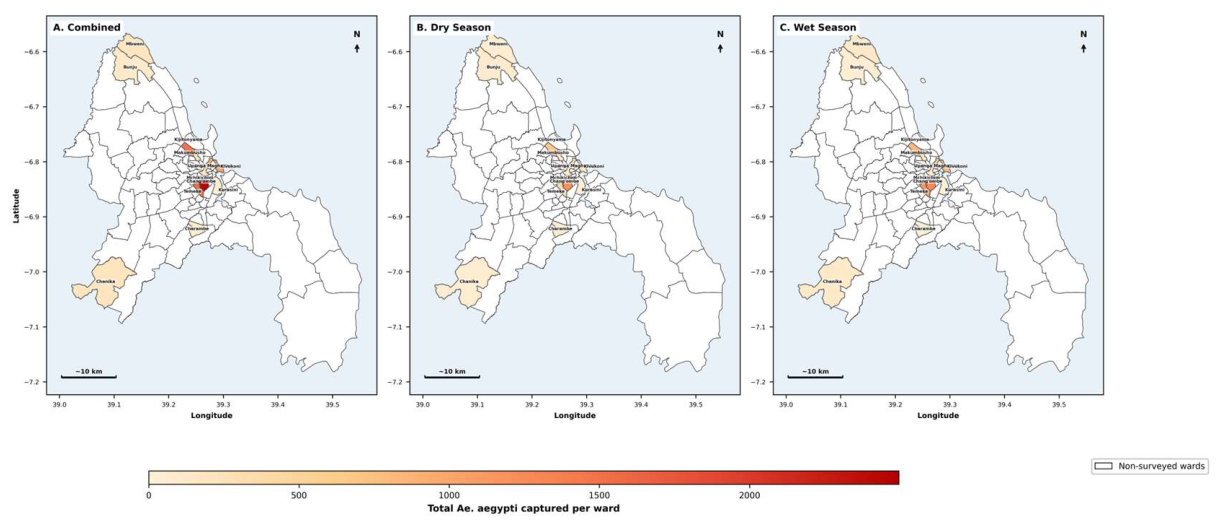
Figure 2.
Temporal distribution of Ae. aegypti in three districts of Dar es Salaam between 2022-2024.
Figure 2.
Temporal distribution of Ae. aegypti in three districts of Dar es Salaam between 2022-2024.
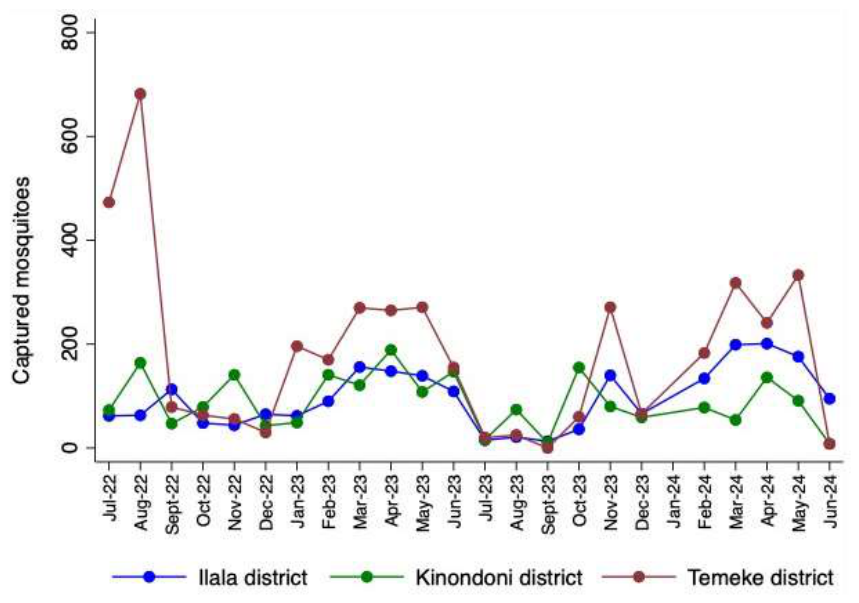
Figure 3.
Correlation between larvae and adult Ae. aegypti collected using different sampling methods a) adult mosquitoes collected using BG trap b) adult mosquitoes collected using GAT trap c) adult mosquitoes collected using prokopack aspirator.
Figure 3.
Correlation between larvae and adult Ae. aegypti collected using different sampling methods a) adult mosquitoes collected using BG trap b) adult mosquitoes collected using GAT trap c) adult mosquitoes collected using prokopack aspirator.
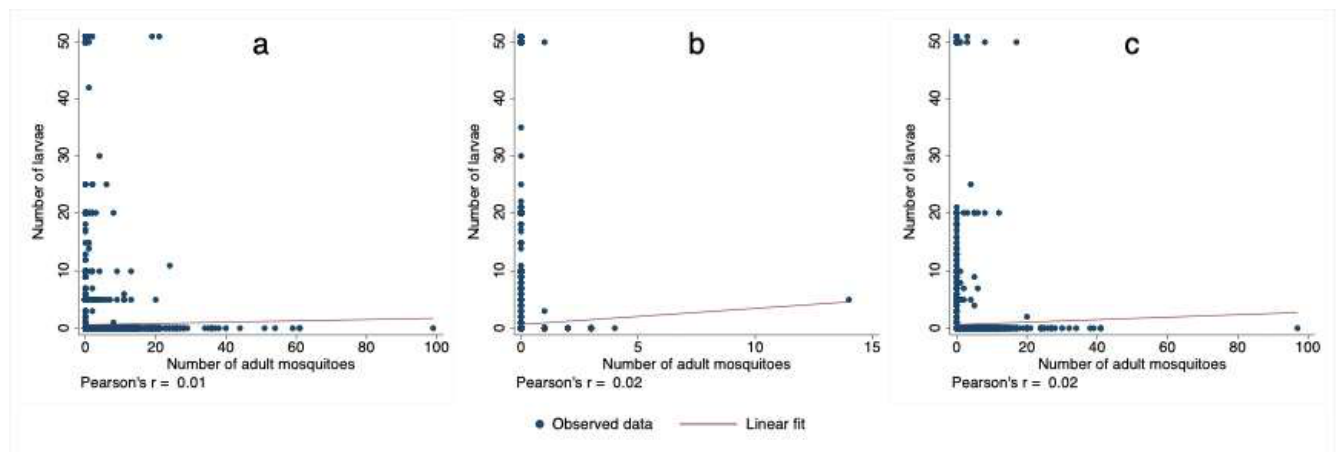
Figure 4.
Weather conditions during a longitudinal survey in Dar es Salaam.
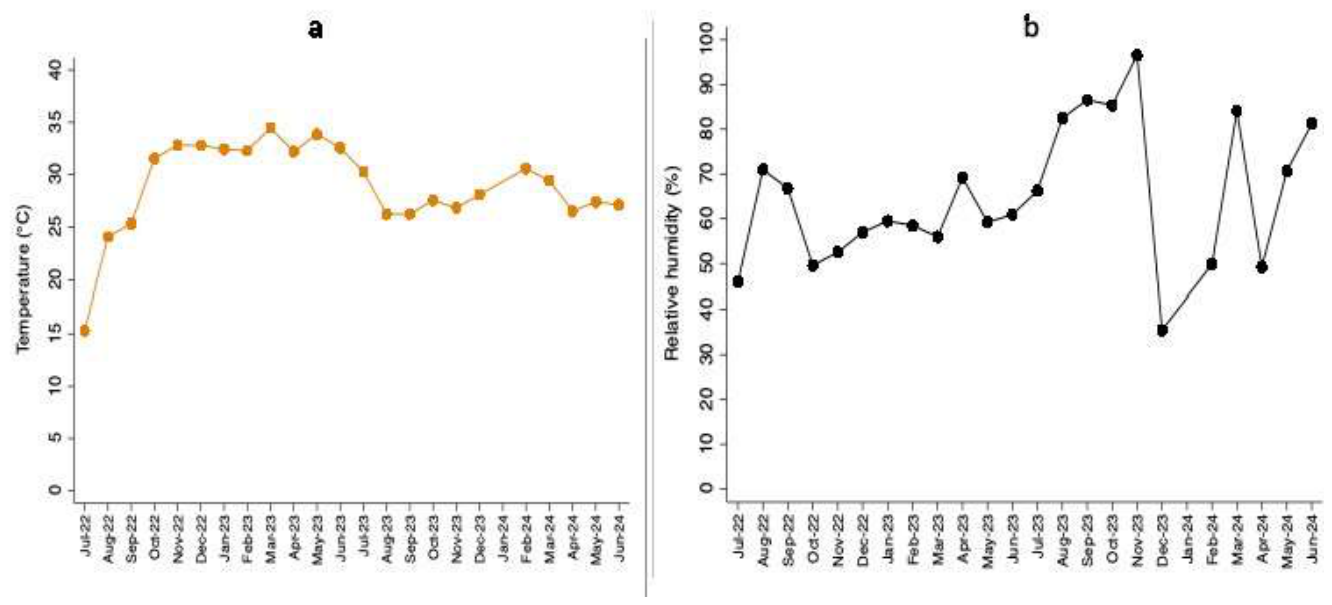

Table 1.
Socioeconomic status of sampled wards per each district.
| District | High-income ward | Low-income ward |
|---|---|---|
| Ilala | Kivukoni | Mchikichini |
| Upanga Magharibi | Chanika | |
| Kinondoni | Kijitonyama | Makumbusho |
| Mbweni | Bunju | |
| Temeke | Temeke | Kurasini |
| Chang’ombe | Charambe |
Table 2.
Percentage distribution and incidence rate ratio of captured wild Ae. aegypti in Ilala, Kinondoni, and Temeke districts in Dar es Salaam.
Table 2.
Percentage distribution and incidence rate ratio of captured wild Ae. aegypti in Ilala, Kinondoni, and Temeke districts in Dar es Salaam.
| n (%) | IRR (95%CI) | p-value | |
| Season | |||
| Dry | 3206(37.7) | 1 | - |
| Wet | 5290(62.3) | 1.72(1.48-1.98) | <0.001 |
| District | |||
| Ilala | 2195(25.8) | 1 | - |
| Kinondoni | 2066(24.3) | 0.23(0.16-0.34) | <0.001 |
| Temeke | 4235(49.9) | 2.14(1.59-2.88) | <0.001 |
Legends: n=number of captured mosquitoes and IRR=Incidence rate ratio.
Table 3.
Incidence rate ratio (IRR) for seasonal variability in Ae. aegypti density in Dar es salaam, 2022-2024.
Table 3.
Incidence rate ratio (IRR) for seasonal variability in Ae. aegypti density in Dar es salaam, 2022-2024.
|
Season |
Districts | ||||||||
| Ilala | Kinondoni | Temeke | |||||||
| n | IRR (95%CI) | p-value | n | IRR (95%CI) | p-value | n | IRR (95%CI) | p-value | |
| Dry | 570 | 1 | - | 909 | 1 | - | 1727 | 1 | - |
| Wet | 1625 | 2.48(1.94-3.18) | <0.001 | 1157 | 1.28(0.98-1.65) | 0.064 | 2508 | 2.08(1.50-2.89) | <0.001 |
Legend: n=number of captured mosquitoes, IRR= Incidence rate ratio.
Table 4.
Larval indices and associated odds ratios for Ae. aegypti during dry and wet seasons in Dar es salaam.
Table 4.
Larval indices and associated odds ratios for Ae. aegypti during dry and wet seasons in Dar es salaam.
| CI(%) | HI(%) | BI | |||||||
| CI | OR (95%CI) | p-value | HI | OR (95%CI) | p-value | BI | IRR (95%CI) | p-value | |
| District | |||||||||
| Ilala | 3.6 | 1 | - | 0.3 | 1 | - | 1.2 | 1 | - |
| Kinondoni | 14.0 | 6.92(5.30-9.03) | <0.001 | 3.4 | 12.65(10.05-15.94) | <0.001 | 11.9 | 16.53(12.72-21.46) | <0.001 |
| Temeke | 0.3 | 0.31(0.23-0.41) | <0.001 | 0.4 | 1.03(0.80-1.33) | 0.810 | 1.1 | 0.78(0.55-1.12) | 0.176 |
| Season | |||||||||
| Dry | 2.2 | 1 | - | 0.8 | 1 | - | 4.5 | 1 | - |
| Wet | 3.7 | 1.40(1.17-1.69) | <0.001 | 1.3 | 1.60(1.34-1.89) | <0.001 | 9.4 | 1.32(1.02-1.72) | 0.038 |
Legend: CI=Container Index, HI=House Index, BI= Breteau Index, OR=odds ratio, IRR=incidence rate ratio, 95%CI= 95% Confidence Interval.
Table 5.
Aedes aegypti larvae habitat types and their characteristics.
| Parameter | Category | Positive habitats n(%) | Negative habitats n(%) | Total habitats |
|
Habitat type |
Used tyres | 136(5.7) | 2263(94.3) | 2399(5.6) |
| Discarded containers | 166(1.9) | 8619(98.1) | 8785(20.6) | |
| Cans/coconut shells | 173(1.4) | 12259(98.6) | 12432(29.2) | |
| Water storage containers | 350(3.8) | 8949(96.2) | 9299(21.8) | |
| Plant pots and flower receptacles | 245(2.5) | 9436(97.5) | 9681(22.7) | |
| Subtotal | 1070(2.5) | 41526(97.5) | 42596(100) | |
|
Habitat size |
Large >100cm depth | 93(16.6) | 468(83.4) | 561(7.5) |
| Medium >50cm & ≤100cm depth | 176(3.2) | 5349(96.8) | 5525(74.5) | |
| Small ≤50cm depth | 249(18.7) | 1083(81.3) | 1332(18.0) | |
| Subtotal | 518(7.0) | 6900(93.0) | 7418(100) | |
|
Water turbidity |
Clear | 217(8.8) | 2236(91.2) | 2453(51.6) |
| Turbid | 124(17.6) | 581(82.4) | 705(14.8) | |
| Very turbid | 155(9.7) | 1441(90.3) | 1596(33.6) | |
| Subtotal | 496(10.4) | 4258(89.6) | 4754(100) |
Table 6.
Adult and larvae Ae. aegypti collected using different mosquito sampling methods in Dar es Salaam.
Table 6.
Adult and larvae Ae. aegypti collected using different mosquito sampling methods in Dar es Salaam.
| District | Habitat positivity | Total larvae | Adult captured mosquitoes | |||
| BG-trap | GAT-trap | Prokopack aspirator | Total | |||
| Ilala | 96 | 549 | 1347 | 12 | 836 | 2195 |
| Kinondoni | 883 | 7389 | 1856 | 18 | 192 | 2066 |
| Temeke | 91 | 742 | 2764 | 32 | 1439 | 4235 |
| Total | 1070 | 8680 | 5456 | 62 | 2978 | 8496 |
Disclaimer/Publisher’s Note: The statements, opinions and data contained in all publications are solely those of the individual author(s) and contributor(s) and not of MDPI and/or the editor(s). MDPI and/or the editor(s) disclaim responsibility for any injury to people or property resulting from any ideas, methods, instructions or products referred to in the content. |
© 2026 by the authors. Licensee MDPI, Basel, Switzerland. This article is an open access article distributed under the terms and conditions of the Creative Commons Attribution (CC BY) license (http://creativecommons.org/licenses/by/4.0/).
Copyright: This open access article is published under a Creative Commons CC BY 4.0 license, which permit the free download, distribution, and reuse, provided that the author and preprint are cited in any reuse.