

Submitted:
17 September 2026
Posted:
18 September 2026
You are already at the latest version
Abstract
Green hypergolic hybrid rocket propellants are being investigated as a potential solution to the ignition challenges of hybrid rockets and as safer alternatives to toxic hypergolic systems. This review summarizes recent progress in hypergolic hybrid rocket propellants, focusing on ignition behavior, thermochemical performance and motor-scale combustion and propulsion characteristics. Drop-test studies are reviewed to identify promising propellant combinations and to examine the effects of a wide range of chemical, material, drop-dynamic and environmental parameters on ignition characteristics. Thermochemical calculations are used to assess theoretical propulsion performance as a function of additive type and additive loading in a suitable fuel binder. Finally, full-motor firing studies are reviewed to evaluate stable ignition, sustained combustion, regression-rate behavior and combustion efficiency. The literature shows that several green hypergolic propellant families can achieve rapid ignition delays in drop tests, and motor-scale propulsion performance was broadly comparable to conventional hybrid rocket motors. However, the technology is still immature as gaps in the literature remain related to ignition repeatability, safe operating envelopes, pressurization delay times and mechanical integrity of additive-loaded fuel grains. Future work should therefore focus on resolving these gaps to enable wider application of this otherwise promising propulsion technology.
Keywords:
hybrid rockets
; hypergolic
; propulsion
; green propulsion
1. Introduction
1.1. Hybrid Rockets: Description, Advantages and Disadvantages
Rockets can be broadly divided into three categories based on the states of matter of the propellant combination. In this context, hybrid rockets are those that use solid fuels and fluid (typically liquid) oxidizers. A schematic diagram of a hybrid rocket is shown in Figure 1.
As shown in the figure above, the solid fuel and liquid oxidizers are stored separately. During operation, the valve between the two chambers open, allowing the oxidizer to flow. Combustion proceeds when an ignition source heats up the solid fuel surface, pyrolyzing it. Pyrolysis can be initiated by electrical or chemical means. Electrical igniters can use an arc to heat the incoming oxidizer and fuel, causing the latter to pyrolyze and mix with the incoming oxidizer. Pyrolysis can also be induced by the exothermic decomposition of an energetic chemical over a catalyst bed. The products of fuel pyrolysis then react with the incoming oxidizer, causing gas-phase ignition and subsequent propulsion.
Compared to solid rockets, hybrids are safer: since the oxidizer and fuel are stored separately (and in separate phases), the risk of accidental ignition is greatly reduced [1,2]. Additionally, hybrids allow for the usage of a wider range of more inert propellants, adding to its safety. Also, an important advantage hybrids have over solid rockets is the former’s ability to control thrust output by controlling the mass flow rate of the oxidizer. Oxidizer flow rate is the most important parameter controlling hybrid regression rate (and hence, thrust output) [3]; the ability to control oxidizer flow allows for fine thrust control. Compared to liquid rockets, hybrids are cheaper and simpler to design [4]; the cost and complexity of propellant flow plumbing is roughly halved for hybrids compared to liquid rockets, since for the latter case, the pumping and plumbing system needs to be designed for both the propellants.
Hybrids can be used in many applications, including satellite maneuvering, as gas generators for ramjets, as sounding rockets or in the field of space tourism. Specifically, hybrids are very well-suited for space tourism applications since spacecrafts operate at the edge of the earth’s atmosphere. At those altitudes, the air density is insufficient for a conventional jet engine to work effectively. Using solid rockets are infeasible because of safety and throttling issues. Liquid rockets are expensive and complex. Hence, hybrids can fill this niche application, leveraging their advantages over their solid and liquid rocket counterparts.
However, despite the many advantages of hybrid rocket engines, they have not seen widespread adoption as compared to traditional liquid and solid systems. This is primarily because hybrids suffer from two major disadvantages: low regression rates (implying comparatively lower thrust output for a given motor size) and difficulties with initiating ignition. Solving ignition difficulties remains the primary motivation for research into hypergolic hybrid rocket propellants [5,6]
1.2. Hybrid Rocket Ignition
Hybrid rocket ignition proceeds in four stages, regardless of the specific ignition method utilized [7]. The first stage is the inert heating stage where the heat source or heating element heats the solid fuel block which subsequently undergoes pyrolysis (i.e breaks into smaller molecules and converts to gas phase) above a certain temperature threshold. This is followed by the ignition stage, where the pyrolysis products mix with the incoming oxidizer and ignite, utilizing the heat source. A diffusion flame then develops which spreads throughout the fuel port. The final stage is chamber pressurization, which is controlled by the mass flow through the nozzle throat. The inert heating step is the most time-consuming (but necessary) step [7]. Figure 2 shows the first two stages.
As shown above, a heat source raises the temperature of the fuel surface which subsequently undergoes pyrolysis. The products of pyrolysis mix with the incoming oxidizer to form a diffusion flame. In a conventional hybrid rocket, this heat source could be a heating element, a plasma-based igniter [8], a laser igniter [9,10], a solid propellant-based pyrotechnic igniter [11] or a catalyst bed over which an exothermically decomposing reactant is passed [12]. Most of these propellants that involve a separate ignition system add weight and complexity to the motor. Additionally, hybrid rockets that use pyrotechnic igniters can deplete the igniter propellant with the main propellant remaining unused, thereby leading to wastage. Further, pyrotechnic propellants are powered by a solid rocket propellant, adding to safety concerns. Finally, ignition systems based on a catalyst bed degrade over time with multiple operations, making ignition unreliable.
1.3. Hypergolic Ignition: A Potential Solution
A potential solution to these problems lies in using hypergolic propellants. Briefly, hypergolic propellants are those whose constituent oxidizer and fuel react rapidly and exothermically upon contact, leading to ignition without requiring an external heat/energy source. As such, the ignition system is "built into" the propellants themselves. They greatly simplify rocket design by removing the need for a separate ignition system, thereby reducing weight, complexity, and cost. Additionally, hypergolic propellants impart multiple re-ignition capabilities. Furthermore, for hybrid rockets, hypergolic oxidizer sprays impinge on the fuel surface and undergo exothermic reaction close to the fuel surface, thereby heating a smaller area of the fuel (hence, increased heat flux) compared to conventional igniters which heat up a larger portion of the fuel surface area. Since ignition delay is inversely related to the incident heat flux on the fuel surface during inert heating [7], hypergolic ignition has the potential to be faster compared to conventional ignition. Ignition delay is a very important figure of merit for rocket propellants in general. Faster ignition implies fine control of the position or orientation of the vehicle in addition to rapid starts and restarts. Additionally, for hypergolic propellants, low ignition delays are desirable; longer ignition delays may cause the hypergolic propellants to accumulate in the combustion chamber of a rocket, which then react simultaneously, leading to potentially fatal pressure spikes called "hard starts" [13]. This can potentially compromise the structural integrity of the motor.
While hypergolic propellants have many advantages, conventional hypergols have noted toxicity to both flora and fauna. Commonly used hypergolic fuels include monomethylhydrazine (MMH) and unsymmetrical dimethylhydrazine (UDMH) while commonly used oxidizers are dinitrogen tetroxide (NTO), nitric acid and mixed oxides of nitrogen (MON) [14,15]. Specifically, monomethylhydrazine (MMH) is considered to be one of the best and widely used hypergolic propellants [15]. Overall, these propellant combinations provide high performance and have proven to be highly reliable, albeit toxic. However, due to their toxicity, there is a renewed push to research non-toxic "green" hypergolic propellants.
1.4. Hypergolic Propellants: Brief Historical Overview
Hypergolic propellants have seen use since the 1930s, with the first hypergolic combination prepared in Germany, consisting of hydrazine hydrate in methanol as the fuel and 50% hydrogen peroxide as the oxidizer, with hypergolicity imparted by copper suspended in the fuel solution [16]. In the 60s, with the space race between the United States and the Soviet Union serving as motivation, rockets based on hypergolic propellants were developed to overcome difficulties related to long-term storage of cryogenic propellants in strategic missiles. The American Titan II used a hypergolic combination of N2O4 and Aerozine 50. The R-36 ICBM of the Soviet Union uses a combination of N2O4 and UDMH. Today, hypergolic bipropellants are used in many rocket engines around the world; The SpaceX Draco (USA), the Aestus engine (Germany), Vikas (India) and the YF-20 (China) to name a few.
One of the earliest hypergolic hybrid rockets was designed by ONERA, France and used a hypergolic combination of nitric acid and amine. Moore and Berman also conducted early research on a semi-hypergolic hybrid rocket propellant in 1956 [17]. The propellant consisted of 90% concentration RGHP as the oxidizer and polyethylene as the fuel, with the RGHP being exothermically decomposed by a catalyst bed before its entry into the polyethylene chamber; the ignition proceeds as the heat of decomposition pyrolyzes the polyethylene which then reacts with the decomposition products [17]. The propellant combination was semi-hypergolic because igntion was not achieved by direct contact with the solid propellant. Other early hypergolic propellants were based on nitric acid as the oxidizer with solid fuels based on furfuramide and solid amines [18]. In the 1980s, the Chemicals System Division, United Technologies Center (USA) developed a hypergolic hybrid rocket based on a mixture of F2 and O2 as oxidizer with lithium as the fuel. However, full-scale hypergolic hybrid rocket development is still at a nascent stage, compared to their liquid counterparts [19].
Another aspect of hypergolic propellants that has guided recent research trends is safety considerations. The conventional hypergolic propellants mentioned in the preceding paragraphs are toxic, dangerous to handle and store and may cause environmental damage. The Nedelin disaster in 1960 involved the catastrophic explosion of a Soviet R-16 ICBM during a test launch; the rocket propellant was a toxic hypergolic mixture of Unsymmetrical dimethylhydrazine (UDMH), nitrogen tetroxide N2O4 and nitric acid HNO3. A short-circuit at the launch-pad ignited the toxic mixture, causing an explosion followed by emission of toxic fumes which claimed the lives of about 100 people. This incident underscored the need to address the difficulties of handling and operating with these classes of propellants. These issues have motivated the space industry to work on non-toxic or "green" propellants since the 90s. While research into liquid hypergols is more mature than hybrid hypergols, the latter is an active topic of research, with potentially promising results.
2. Scope of Review
This review focuses on recent developments in green hypergolic hybrid rocket propellants. These systems consist of a reactive additive embedded in a fuel binder that spontaneously ignites upon contact with a suitable liquid oxidizer. The major additive families considered in this study include amine–boranes, metal hydrides, metal amides and selected metal–organic or coordination compounds. Particular attention is given to ammonia borane (AB), ethylenediamine bisborane (EDBB), sodium borohydride (NaBH4), lithium aluminum hydride (LiAlH4), sodium amide (NaNH2) and related additives, since these have recieved the broadest experimental attention in the hypergolic hybrid literature. The oxidizers considered include white fuming nitric acid (WFNA), rocket grade hydrogen peroxide (or RGHP), nitrogen tetroxide (NTO) and mixed oxides of nitrogen (MON).
The first part of the review identifies major additive families and their corresponding oxidizers. The second part examines drop-test experiments, which remain the most widely used screening method for candidate hypergolic propellant combinations. These studies are reviewed in terms of ignition delays of neat additive powders and the parametric dependence of ignition on a wide range of thermo-chemical, droplet dynamic and environmental factors for both neat additives and additive-binder combinations.
Subsequently, focus shifts to propulsion performance of hypergolic hybrid additives. To complement the experimental literature, ideal thermochemical calculations are performed using a chemical equilibrium solver. These calculations are used to examine how additive type and loading in a fuel binder affects theoretical vacuum specific impulse, characteristic velocity, combustion temperature and optimum O/F ratio. The final part of the review focuses on full-motor ignition and combustion experiments. These studies are examined to determine whether promising hypergolic hybrid propellants are capable of producing stable motor-scale ignition and combustion, good regression rates, acceptable combustion efficiencies and repeatable ignition operations.
Finally, gaps in the literature are identified, based on which future research directions are suggested. The overall aim of this review is to assess the current state of green hypergolic hybrid rocket propellants, identify the most promising additive–oxidizer families, and highlight the engineering gaps that must be addressed before these systems can mature into practical propulsion technologies.
3. Hypergolic Hybrid Additive Groups
Generally, a hypergolic hybrid rocket propellant consists of a liquid phase oxidizer and an additive embedded in a fuel matrix or binder. The oxidizer-additive reaction is usually rapid and exothermic, providing the heat (and sometimes the reactive species) needed for ignition. The role of the fuel binder is to impart mechanical strength and support the post-ignition combustion reaction. Hypergolic propellant combinations need to have a negative Gibbs energy change, low activation energy and sufficient heat release such that it exceeds heat loss to the surroundings or the propellant bulk, thereby enabling thermal runaway. Table 1 lists some popular hypergolic hybrid additives that were the subject of research in recent years along with the corresponding oxidizer and fuel/binder combinations that were tested.
As shown in Table 1, amine–boranes and metal hydrides are the most extensively investigated additive families for hypergolic hybrid rocket propellants. Other reactive additives, including metal amides, hydrazones, and thiocarbohydrazones, have also been reported [18,41]; they are discussed selectively because the present review focuses on families with the broadest experimental record.
In general, a useful hypergolic additive-oxidizer pair is characterized by favorable reaction thermodynamics combined with rapid reaction rates to generate a sufficiently high heat flux. Hence, spontaneous, highly exothermic, low activation energy () reactions are desirable qualities for a suitable additive-oxidizer pair. However, particle structure, contact dynamics between the reactants, and binder compatibility are additional properties that dictate the ignition characteristics of a hypergolic propellant combination. The following subsections describe the chemical nature of the main hypergolic additives.
3.1. Amine–Boranes
Amine–boranes are Lewis Acid-base chemicals formed between an amine and an electron-deficient borane, BH3. Their representative general structure is R3N · BH3. Ammonia Borane (AB, NH3 · BH3) is the simplest member of this class. Hypergolic hybrid propellants using amine-boranes as energetic additives have been investigated, using suitable binders and oxidizer combinations [42,43]. Solid amine-boranes tend to be less toxic and more air-stable [42].
Using neat AB powder, ignition delays as low as ms have been obtained with white fuming nitric acid (WFNA) as oxidizer in a drop-test setup, with most tests yielding <10ms ignition delays [27]. Drop-tests with neat Ethylenediamine Bisborane (EDBB) powder (another amine-borane) also yielded very low ignition delays of ms with nitric acid oxidizer [28]. These results suggest the suitability of amine-boranes as hypergolic additives in hybrid rocket propellant combinations.
3.2. Metal-Hydrides
Metal-hydrides are hydrogen-containing inorganic compounds; they are reducing agents (electron donors) which can undergo rapid exothermic reaction with a strong oxidizing agent. Additionally, they release hydrogen upon reaction, which may go on to react further, thereby adding to the heat release associated with the reaction. In hypergolic hybrid studies, sodium borohydride (SBH, NaBH4) is the most extensively demonstrated example [5,6,33,36,44]. Lithium aluminum hydride (LiAlH4) has also proven to be a suitable hypergolic additive [36,45], including with hydrochloric acid (HCl) which is not an oxidizer (but a strong acid) [45]. Using high-density polyethylene (HDPE) as binder, NaBH4-containing samples achieved ignition delays as low as 3 ms; most tested conditions gave delays below 10 ms and successful ignition, with small-scale experiments showing dependence of ignition characteristics on oxidizer concentration, NaBH4 loading, and droplet impact velocity [5,29].
3.3. Metal Amides
Metal amides are ionic compounds containing an amide anion, commonly represented as M+[NR2]−, where R may be hydrogen, alkyl, or silyl. Sodium amide (SA, NaNH2) is an inorganic metal amide, whereas potassium bis(trimethylsilyl)amide (KHMDS, KN(SiMe3)2) is a silylamide. These solids have demonstrated hypergolic behavior with nitrogen tetroxide and mixed oxides of nitrogen [34,41,46]. Millisecond-scale ignition with nitric acid has also been reported [47].
3.4. Hypergolic Metal Organic Frameworks (HMOFs)
These are another class of novel compounds being considered as green additives for use in hypergolic hybrid rocket propellant formulations. MOFs are essentially chemical "frameworks" containing a metal atom, like chromium, at the center (nodes) which are linked by organic ligands, providing the "frame" for the chemical complex. The organic ligands link to the metal nodes, forming a coordination complex. They are porous materials with very high surface areas (for MOFs, the surface area-to-mass ratio can exceed 7000 [48]). Given that hypergolic reaction is sensitive to surface contact, this property makes MOFs an interesting hypergolic additive family. Work by Jobin et al. [38] characterized ignition of some potential hypergolic MOFs embedded in paraffin wax as binder, using WFNA as the oxidizer. Most tests yielded <10ms ignition delays with cobalt acetylene-substituted imidazolate (Co(AIm)2) MOF yielding the fastest ignition delay tines [38].
4. Drop-Test Experiments: Ignition Characterization and Parametric Sensitivities
Most hypergolic propellant characterization work is conducted in a drop-test ignition setup. Drop tests are important in hypergolic-propellant characterization because they reduce the ignition event to its essentials: a controlled oxidizer droplet contacts a known amount of fuel (either in solid or liquid state), and the experiment records the ignition event. The simplicity of the setup makes the method a practical screening and ranking tool for candidate fuel–oxidizer pairs and allows the close observation of the fundamental ignition interactions involved, to provide qualitative and quantitative insights [49]. The schematic diagram of a drop-test experiment is shown in Figure 3.
As shown in the figure above, a typical drop-test setup consists of a fuel sample, pellet, or grain placed beneath a syringe or droplet dispenser. The oxidizer droplet is released onto the fuel surface, and the resulting ignition event is recorded using suitable imaging equipment, commonly a high-speed camera, illuminated by a light source. Direct-current (DC) lighting is often preferred to avoid flicker during high-speed imaging.
The primary figure of merit in drop-test characterization is ignition delay, defined as the time between oxidizer droplet contact and the first visible flame emission. This parameter is critical because long ignition delays can allow propellants to accumulate before ignition, leading to hard starts, which are undesirable chamber-pressure spikes caused by simultaneous combustion of accumulated reactants [13,50,51]. Hypergolic hybrid rockets are innately less prone to hard starts because fuel and oxidizer are in different phases; pre-ignition mixing of large quantities of propellants is therefore more difficult in hybrid systems compared to liquid hypergolic systems [52]. Additionally, hybrid rocket combustion is diffusion-limited [3]; this limits the amount of fuel that can be mixed with the oxidizer. An ignition delay of or lower is considered sufficient for basic hybrid rocket operations [38] (compared to 10 ms or lower for liquid hypergolic bipropellant systems [42]). However, an ignition delay of 10 ms or lower is highly desirable for rapid thruster response, which is important for attitude control or reaction control systems [53]. Drop tests therefore provide a rapid method for ranking candidate hypergolic propellant combinations before proceeding to motor-scale testing. They are particularly useful for determining how ignition responds to thermo-chemical, fluid-dynamic and environmental conditions [5,52]. However, drop-test ignition delay is a screening metric and cannot directly predict motor-scale propellant performance; promising propellant combinations require validation under real rocket-motor conditions.
An important initial step in screening hypergolic propellant combinations is to conduct drop tests with neat additives and oxidizers to determine the combination’s inherent chemical reactivity. Table 2 summarizes ignition delays for several additives across different additive families, using different oxidizers in open-air drop-test experiments.
As shown in the table above, RGHP, HNO3 (including WFNA) and NTO are the most popular hypergolic hybrid oxidizers. Most neat additives produced ignition delays of < 10 ms; some produced ignition delays as low as ms. The size of the additive particles used in the drop tests also influences ignition delay; Figure 4 shows the variation of ignition delay with AB particle size.
As is evident in the figure above, smaller particle sizes reduce ignition delays, owing to higher surface-to-mass ratios, which increases the surface contact area for the reactants. This trend was also seen with ignition delay tests of NaBH4 additives embedded in paraffin ignited with 90% RGHP; ignition delay increased by 60% ( ms to ms) when embedded NaBH4 particle size ranges (D) increased from to [32]. However, this trend did not hold true for AB embedded in Sylgard-184 binder; ignition delays were insensitive to particle size and exhibited a wide data spread [27], as shown in Figure 5.
Figure 5 shows that ignition delay did not vary with change in particle size and showed a wide variability in data [27]. The authors attributed this behavior to a non-uniform distribution of the silicone binder on the pellet surfaces rather than variation in the additive’s intrinsic surface area. Localized accumulations of excess Sylgard-184 physically coat and shield the active fuel, reducing the surface area of exposed AB particles at the point of droplet impact and introducing random variations in the rate of the initial hypergolic reactions [27].
The development of hypergolic hybrid propellants requires consolidating the highly reactive additives into a binder matrix to produce fuel grains with sufficient structural integrity. Aside from imparting mechanical integrity, binders additionally need to be chemically non-reactive with the additive they are embedding. HTPB is a popular binder; however it chemically reacts with amine-borane additives, making it unsuitable as a binder for AB and EDBB [42,54]. However, thermosetting epoxies have been successfully utilized as binders with amine-boranes [27,42]. Additionally, epoxy binders absorb or adhere with the impinging nitric acid oxidizer to ensure better contact with the embedded hypergolic additive, ensure ultra-fast ignition delays [52]. Silicone-based elastomers are also another popular choice as binders; Sylgard-184 elastomer has been successfully used as a binder for AB [54] while Sylgard-182 is compatible with NaBH4 up to 25% additive loading [32]. RTV Silicone is compatible with EDBB [42]. Chemically inert binders like polyethylene and polypropylene are ideal for highly reducing metal hydrides [5,6,47]. DCPD is also a compatible binder for metal hydrides like NaBH4 and LiAlH4 [36]. Additionally, since DCPD is hydrophobic [56], it protects the moisture-sensitive metal hydride embedded within it [36].
Binders affect the contact surface between the additive particles and the impinging oxidizers, in addition to influencing heat and flow properties in the vicinity of the additive-oxidizer reaction zone. Hence, one of the primary parameters controlling hypergolic ignition is additive loading within the binder matrix. Several researchers have shown that hypergolic ignition delays generally decrease with increasing additive loading in the binder. Figure 6 shows ignition delay as a function of NaBH4 loading in different fuel binders.
As shown above, increasing loading of NaBH4 in a binder matrix reduces ignition delay. A similar trend was also observed when drop-tests were conducted with AB as the additive in an epoxy matrix with 95% RGHP as the oxidizer [25] and the data is represented in Figure 7
Two trends are clear from Figure 6 and Figure 7: first, the ignition delay reduces rapidly with initial increases in additive loading before stagnating; second, the data spread of the ignition delay values decreases as additive loading increases. At lower additive loadings, the active particles are few and far between, which limits the physical contact area between the impacting oxidizer droplet and the embedded promoter. This slows the initial condensed-phase heat release and introduces high variability between individual experiments. As the additive loading increases, the rate of condensed-phase reactions increases rapidly, becoming nearly instantaneous at higher weight fractions. At this threshold, the global ignition delay is no longer controlled by condensed-phase heating, but rather by gas-phase reaction kinetics (which leads to eventual light emissions from flames/sparks). Consequently, the ignition delay trend stagnates as further increases in solid additive loading cease to influence the rate-limiting gas-phase induction timescales.
However, the aforementioned trends may not always hold true; research by Clements et al. [52] found no clear trend in ignition delay with increasing AB additive loading in epoxy binder (using WFNA as the oxidizer). The authors posited that the hydrophilic nature of epoxy was causing the impinging oxidizer droplet to adhere more strongly with the fuel surface, leading to better and longer contact with the additive particles. Hence, increasing mass percentage of epoxy binder may compensate for the detrimental effect of decreasing additive loading, leading to unclear trends in ignition delay. However, surface treatment played a more important role in influencing ignition delay, as shown in Figure 8.
In the figure above, unsanded pellets did not undergo any surface treatment, while sanded, brushed pellets were those that were sanded, and the loose particles at the pellet surface were brushed away. Finally, the sanded, unbrushed pellets were sanded, but the loose particles were allowed to sit on the pellet surface [52]. As is evident from the graph above, leaving the loose particles atop the fuel pellet surface substantially reduced ignition delay, while removing the loose AB particles after sanding degraded ignition performance [52]. Also, as with AB, ignition delay for EDBB also showed sensitivity to surface treatment method as shown in Figure 9.
As seen above, sanding the surface substantially reduces the ignition delay by up to times compared to cut samples, the likely reason being greater numbers of EDBB particles exposed by sanding[26]. The effect of surface treatment on ignition delay for metal-hydride additives was studied by Sippel et al. [36], who characterized surfaces into three categories: casting surface, cut surface and scrubbed surface. Casting surface pellets were those that were in direct contact with the mold, causing a polymer-rich layer to form on the pellet surface. Cut surfaces were those that were obtained by cutting an internal surface of the pellet. Scrubbed surfaces were cut surfaces that were scrubbed with paper towels to remove lose active additive particles. Table 3 shows ignition delay and success data for NaBH4 embedded in DCPD, as a function of surface treatment [36].
As shown in the table above, casting surfaces (those covered with a thin polymer layer) performed the worst, with only a 25% ignition success rate and a very long ignition delay. For freshly cut and exposed surfaces, the NaBH4 additives reduced ignition delay by an order of magnitude. Additionally, the removal of the loose additive particles on the cut surface (pellets with scrubbed surface) did not lead to substantial degradation in ignition delay [36], as opposed to the performance of AB-epoxy fuel pellets subjected to similar removal of loose additive particles [52]. This was likely due to the highly reactive nature of NaBH4 with RGHP.
In addition to fuel grain composition, the type of oxidizer used and its concentration also matters in hypergolic ignition. Figure 10 shows ignition delay as a function of different oxidizer types obtained from drop-tests with neat additives, with data from Over [47].
As shown in the above figure, 75% RGHP oxidizers yielded longer ignition delays compared to 98% RGHP and nitric acid; this is because the excess water in RGHP acts as a heat-sink which transports heat away from the reaction zone between oxidizer and additives. Additionally, strongly basic additives like sodium hydride (NaH) react almost instantaneously with nitric acid, which is a strong acid. However, for strong reducing agents like LiAlH4 and NaBH4, strong oxidizers like high-concentration RGHP are more suitable. Additionally, Baier et al. [27] tested ignition delay of pure AB with NTO, yielding ignition delay values between ms to ms, depending on particle size, compared to just 2-10 ms for AB-WFNA [27]. This long ignition delay for NTO-AB was likely attributable to slower kinetic pathways compared to WFNA-AB [27].Nath et al. investigated the ignition delay of NaBH4-loaded HDPE fuel grains in drop-test experiments using RGHP droplets of different concentrations [5]. The results are shown in Figure 11 with data from Nath et al. [5].
Similar to the trends in Figure 10, Figure 11 demonstrates that increasing the RGHP concentration substantially reduces the ignition delay. This is due to a reduction in the thermal energy carried away by the dissolved water in the oxidizer, which acts as a local heat-sink [5]. While this trend occurs across all NaBH4 loadings, the influence of additive loading on the ignition delay is minimized as the RGHP concentration approaches maximum purity. At these elevated concentrations, the propellant combination reaches a kinetic threshold where the condensed-phase heat generation rate becomes near-instantaneous. Consequently, the global ignition delay is no longer governed by solid-phase heat release, but rather by the gas-phase reactions that produce the first visible spark/flame. The ignition delays for different additive loadings thus approach convergence as the propellant potency is increased.
Data also exist for the variation of ignition delay with the type of binder used. Castaneda et al. [32] investigated ignition delay as a function of various binders in which 25% by mass of NaBH4 was added. Figure 12 shows variation of ignition delay as a function of binder type for 25% by mass NaBH4-loaded fuel grains using 90% RGHP oxidizer.
As evident in the figure above, paraffin wax (PW) and epoxy showed higher ignition delays compared to poly(methyl methacrylate) (PMMA) and PW-LDPE mix [32]. It was also observed that the binders associated with longer ignition delays were also those that showed prolonged flames; this was likely because faster ignition delays were a result of rapid and violent reactions that separated the reactants, resulting in short-lived flames [32]. The sensitivity of ignition delay to binder type was also studied by Pfeil et al. [42], using EDBB as the hypergolic additive with WFNA oxidizer. Figure 13 shows ignition delay as a function of EDBB loading for different binders, using data from Pfeil et al. [42].
As seen above, epoxy was the best-performing binder (with RTV’s performance being comparable); paraffin was likely coating the active EDBB, thereby hindering hypergolic ignition [42]. This could also explain why softer materials like paraffin wax (PW) or epoxy were associated with longer ignition delays compared to PMMA and LDPE-PW combination for the study by Castaneda et al. [32].
Ambient pressure has also been found to exert a major influence on drop-test ignition delays. Benhidjeb et al. [41] conducted drop-test experiments on several candidate oxidizer-neat additive combinations to investigate the effect of pressure on ignition delay. Ignition delay was found to reduce with increasing pressure [41]. The relationship between pressure P and ignition delay was modeled as where K and m are constants. Experimentally obtained ignition delay values and the corresponding pressure values were used to determine the values of K and m; the ignition delay and pressure relationships for some amide additives with MON-25 oxidizer are listed in Table 4.
Castaneda and Natan [6] also observed a similar trend of ignition delay reduction with increasing pressure for their NaBH4-LDPE fuel pellets. Keeping the additive loading constant, increasing the pressure from ambient to 5 bar reduced the ignition delay by almost half [6]. However, an additional increase in ambient pressure to 10 bar did not lead to further reduction in ignition delays [6]. The pressure effect was similar for all binder loadings tested, as shown in Figure 14.
As shown in the figure above, pressure was a stronger influence on ignition delay than additive loading of the fuel pellets; however, the trend stagnated above 5 bar [6]. The initial reaction between NaBH4 and the RGHP was violent, which tended to expel the propellants from the reaction zone, thereby hindering further reactions [6]. However, increased pressure forced the reactants to "stick together" and continue the reaction, which likely reduced ignition delay and generally enhanced ignition strength [6]. Nath et al. [5] did not find a strong influence of pressure on ignition delay. However, increasing pressure substantially increased the area of the flame (measured in pixel counts), as shown in Figure 15.
The explanation for the increasing flame area with increasing pressure, as shown in the figure above, may be a result of increased pressure prolonging reactant contact and preventing rapid separation post-reaction [5], as seen in work by Castaneda and Natan [6].
Research has also looked into the influence of oxidizer droplet impact velocity on ignition delay in drop-test setups. Clements et al. studied the influence of drop-impact velocity of WFNA drops on top of AB-epoxy fuel grains [52]. The impact velocity had a measurable statistical impact on ignition delay; increasing impact velocity from 76 cm/s to 148 cm/s decreased ignition delay by [52]. This was likely due to the increased droplet impact momentum allowing the oxidizer to overcome the gas layer barrier formed due to initial AB-WFNA reaction and continue additional reaction [52]. The velocity effect was more prominent for fuel samples that were unsanded before ignition compared to sanded samples due to the inherent non-uniformity of the sanding process [57]. Nath et al. [5] studied the influence of drtoplet impact velocity and droplet diameter of RGHP-HDPE-NaBH4 propellant combination. The variation of ignition delay with droplet diameter and droplet impact velocity is shown in Figure 16.
The figure above shows a strong sensitivity of ignition delay to droplet impact velocity [5]. In fact, just increasing the droplet impact velocity from the baseline 0.94 m/s to 2 m/s reduced the ignition delay from ms to around 3 ms, without needing the use of very high concentrated RGHP, high additive-loaded samples or elevated pressure conditions [5]. Additionally, droplet impact velocity also substantially increased the strength of the ignition reaction as measured by detecting the number of flame pixels in the drop-test experiment videos using an image processing algorithm [5,58]. Figure 17 shows the flame pixel area as a function of the droplet impact velocity [5].
As shown in Figure 16 and Figure 17, higher droplet impact velocities reduced ignition delay while increasing flame-spread area [5]. This was attributed to enhanced post-impact spreading, which increased oxidizer–fuel contact zones and local heat release. Applying the splashing criterion of Josserand and Thoroddsen [59], Nath et al. further showed that splashing droplets produced larger flame areas, likely because secondary droplet breakup created additional ignition sites near the droplet periphery [5]. These findings were also confirmed by an additional experimental study on the impact of droplet dynamics on ignition [29]. However, the experiment data showed that oxidizer droplet diameter had a very weak influence on ignition delay [5]; this fact was also confirmed by Zhang et al. in their study [44].
The effect of diluent gas (the gas surrounding the drop-test experiment setup) was also studied by Nath et al. [5]. Nath et al. found that in a helium environment, none of the tested samples ignited, which was likely a result of helium’s high thermal diffusivity siphoning away reaction zone heat, thereby hindering ignition [5]. This finding is in line with work by Pourpoint and Anderson, whose work also found helium to be negatively influencing ignition [60]. Additionally, ignition delays in argon atmospheres were lower ( ms) compared to open-air ignition delays ( ms) [5]. This was likely attributable to argon’s lower specific heat capacity [5]. Ignition delay results obtained by exposing the fuel samples to atmospheric humidity before ignition tests revealed that humidity exposure may enhance ignition [5]. This was contrary to the expectation that the hygroscopic nature of NaBH4[61] would lead to moisture absorption and deactivation. Exposing the samples to moisture for 3 hours reduced ignition delay from ms to ms; flame spread areas were also larger for 3-hour exposed samples [5]. Additionally, humidity exposures upto 24 hours in a 50% relative humidity environment did not substantially degrade ignition performance, thereby demonstrating good storage characteristics [5]. These results are summarized in Figure 18.
The figure above shows a clear ignition enhancement after 3 hours of humidity exposure. This was attributed to moisture-induced hydrolysis of NaBH4, which generated hydrogen that became trapped in surface droplets or bubbles and subsequently contributed additional heat release during ignition [5].
Drop-test studies have established that several hypergolic hybrid additive–oxidizer families can produce rapid ignition, with many reported ignition delays below 10 ms and some as low as ∼2–3 ms. These experiments have also identified key parameters governing ignition, including additive loading, particle size, binder compatibility, oxidizer concentration, ambient pressure, droplet velocity, diluent gas, and humidity exposure. Nevertheless, drop tests are best viewed as screening tools rather than direct predictors of motor performance. They do not establish stable combustion, combustion efficiency, regression-rate behavior, restart capability, or safe operating limits under rocket-motor conditions. Consequently, candidate propellant combinations that perform well in drop tests require further evaluation through thermochemical analysis and full-motor firing experiments, as discussed in the following sections.
5. Thermochemical Performance Trends of Additive-Loaded Hypergolic Hybrid Fuels
To complement the experimental review, ideal thermochemical calculations were performed using RocketCEA (a Python package wrapper for NASA CEA [62]) to examine how hypergolic additive species and additive loading influence theoretical propulsion performance. The calculations assumed shifting-equilibrium expansion downstream of the combustion chamber. The principal quantities extracted were the maximum vacuum specific impulse, the characteristic velocity corresponding to the O/F ratio at which this maximum occurs, the corresponding ideal combustion temperature, and the optimum oxidizer-to-fuel ratio. These calculations are intended to identify thermochemical trends rather than predict realized motor performance, since actual hybrid rocket performance also depends on mixing efficiency, heat loss, condensed-phase products, nozzle losses, combustion efficiency, and feed-system dynamics, among others.
To perform the equilibrium calculation, enthalpy of formation () values are required as inputs to the equilibrium calculator. Table 5 lists out the formation enthalpy values used to perform the thermochemical calculations for the propellants considered, along with their corresponding data sources.
Figure 19 compares the ideal vacuum specific impulse and characteristic velocity of selected hypergolic hybrid propellant combinations at 50 wt.% additive loading.
As shown in the figure above, LiAlH4-loaded DCPD with 90% RGHP exhibited the highest ideal vacuum specific impulse and characteristic velocity among all the propellant combinations considered. NaBH4-loaded DCPD produced slightly lower ideal performance, but both metal-hydride-loaded fuels exhibited relatively broad –O/F and –O/F performance plateaus. This behavior is significant for hybrid rocket applications because the operating O/F ratio can shift during firing as the fuel port regresses and the oxidizer mass flux changes [66,67,68]. Therefore, additive-loaded formulations with broad –O/F plateaus may be more tolerant of off-design O/F operation.
The effect of additive loading is summarized in Table 6.
Increasing AB loading in HTPB with WFNA increased both ideal vacuum specific impulse and characteristic velocity, while shifting the optimum O/F ratio substantially toward fuel-rich operation. A similar but weaker trend was observed for EDBB-loaded HTPB. Among the peroxide-based metal-hydride systems, LiAlH4 addition to DCPD produced a clear improvement in ideal performance, whereas NaBH4 addition had only a small effect on ideal vacuum specific impulse and slightly reduced ideal characteristic velocity. By contrast, increasing NaNH2 loading in paraffin with MON3 degraded ideal performance substantially, indicating that the amide additive acts mainly as an ignition promoter rather than a performance-enhancing energetic additive.
Overall, the thermochemical computation results indicate that, for most additive-loaded fuel formulations considered here, even high additive loadings of 50 wt.% or greater produced relatively modest changes in ideal thermochemical performance, typically below 10% in ideal vacuum . The main exception was NaNH2-loaded paraffin, for which increasing additive loading caused a substantial decrease in both ideal and . However, even when the change in peak ideal performance was modest, additive loading often shifted the optimum O/F ratio significantly toward fuel-rich operation and altered the sensitivity of and to off-design O/F conditions.
Additive species and loading can influence the optimum O/F ratio, combustion temperature, and tolerance to O/F shifts, all of which are important for hybrid rockets because the operating O/F ratio changes during firing as the fuel port regresses. At the same time, ideal thermochemical calculations do not capture several practical effects that may dominate real motor performance, including additive dispersion, condensed-phase products, incomplete combustion, heat losses, combustion efficiency, regression behavior, mechanical integrity, storability, and ignition reliability. Therefore, CEA calculations are useful for identifying theoretical performance trends, but the practical suitability of additive-loaded hypergolic hybrid propellants must ultimately be established through systematic experiments covering ignition reliability, regression rate, combustion efficiency, mechanical integrity, storage behavior, and safe operating limits.
6. Full-Motor Experiments
Hypergolic technology is significantly less developed for hybrid rocket motors compared to their liquid bipropellant counterparts. However, several laboratory-scale motor investigations have successfully demonstrated preliminary feasibility of this technology for hybrid motors. Notably, Benhidjeb-Carayon et al. conducted extensive hot-fire testing utilizing mixed oxides of nitrogen (MON) as the liquid oxidizer with paraffin-based fuel grains containing embedded hypergolic and reactive additives [34,46,69]. These investigations primarily used sodium amide (NaNH2) and/or Potassium bis (trimethylsilyl) amide (KHMDS) as the hypergolic additive with MON [34,46,69] and NaBH4 as a non-hypergolic reactive additive to enhance combustion [34,69]. Motor ignition and combustion characteristics were studied primarily as a function of grain configuration in a 2" outer diameter and ∼ 9" length paraffin-based grain [46,69]. The effect of low ambient pressures [34] and increased oxidizer mass flow rates [34,69] was also investigated for the aforementioned propellant and additive combinations.
The general fuel grain configuration of these tests involved a short front-section of the fuel grain heavily loaded with hypergolic additives (90% by mass of NaNH2 [46] or a combination of NaNH 2 and KHMDS in equal proportions, with a total mass fraction of 90% [34,69].) The remaining fuel grain length (divided into segments) was either neat paraffin or contained different additive mass loadings and distributions. Oxidizer supply times were usually 2-3 s long, depending on test objectives. Figure 20 shows the general grain configuration for these NaNH2- KHMDS-NaBH4 additive-based tests [34,46,69].
In atmospheric ignition tests on a <150N class rocket engine with NaNH2 as the hypergolic additive, ignition and stable combustion was achieved for up to 2 s of constant operation [46]. With the front section unchanged, different fuel grain configurations were tested with varying overall additive loadings [46]. Using the data provided in the paper, propulsion performance characteristics were calculated; Figure 21 shows variation in characteristic velocity as a function of overall NaNH2 loading in the fuel binder [46]. A graph of additive loading and vacuum-specific impulse is also provided; however, characteristic velocity is a useful figure of merit for comparing propellant performance. Calculations were performed assuming a nozzle efficiency () of 100% and a constant value of 1.2 for the specific heat ratio () of the combustion gases.
Figure 21 shows a clear trend of decreasing propulsion performance with increasing overall additive loading of the fuel grain. The calculated value of characteristic velocity, as shown in the above figure, can be combined with the combustion efficiency data provided by the authors [46] to compute the theoretical combustion performance of the different additive-loaded fuels. Although the highest additive-loaded fuel grain exhibited the greatest ideal thermochemical performance potential ( m/s), it performed poorly in actual combustion tests. The authors attributed this discrepancy to increased expulsion of unburned fuel-grain material from the highly loaded grains, as confirmed by visual imaging [46]. The authors also found that the regression rate increased with increasing additive loading; additives may promote enhanced fuel grain regression by facilitating heat release and anchoring the flame close to the fuel grain surface [46,69]. However, all tests showed evidence of "hard-starts" during the start-up transients, with re-ignition attempts associated with the most severe pressure spikes [46]. The pressure spikes were at least twice the stable combustion pressures and was likely a result of reactant accumulation followed by simultaneous combustion as the hypergolic front-section’s temperature rose [46]. The likely cause of this hard start could be unacceptably long ignition delays for the NaNH2-MON combination [5,13]. Drop tests with NaNH2 and MON at bar produced a short ignition delay of 4.80 ms [41]. However, because hypergolic ignition delay increases rapidly as pressure decreases [5,6,32,41,60], open-air atmospheric-pressure tests would be expected to yield longer ignition delays, potentially exceeding the 10 ms threshold commonly associated with avoiding hard starts [53]. The same research also experimentally showed that KHMDS and MON produced ignition delays that were less than a quarter of the MON-NaNH2 ignition delay under similar pressure conditions; KHMDS and MON were estimated to demonstrate atmospheric pressure ignition delays of just ∼ 8ms [41]. This is likely why rocket firing experiments involved the hypergolic front-section of the grain loaded with equal parts KHMDS and NaNH2 (45% each) in paraffin [34,69].
In subsequent experiments, it was found that increasing the length of the hypergolic front section of the fuel grain twice almost halved the time required to reach 90% of the steady-state combustion chamber pressure [69]. Additionally, a 34% increase in oxidizer mass flow rate (MON-25) resulted in a % increase in characteristic velocity, as calculated from data in Benhidjeb-Carayon et al. [69]. However, the time needed to reach 90% of steady-state combustion chamber pressure increased by more than three times, since more time was needed to vaporize a larger quantity of incoming oxidizer [69]. Additives were also provided downstream of the hypergolic front section to promote stable combustion by acting as an additional source of heat-release [34,69]. Using 100% NaBH4 pellets downstream of the front section enabled rapid pressure build-up; however once the hypergolic front section depleted, the heat-release was too localized to sustain stable pressure [69]. Successful ignition and stable combustion pressure were subsequently achieved by uniformly distributed NaBH4 (25%) by mass in the rest of the paraffin grain downstream of the hypergolic front section [69]. Hence, this grain configuration was used to evaluate motor ignition and combustion performance at 0.15 psia in an enclosed chamber [34].
Combustion performance improved substantially when ignition occurred under reduced-pressure conditions, with all other parameters held constant. Compared with atmospheric-pressure ignition, the reduced-pressure case increased characteristic velocity by 14.35% and reduced the time required to reach 90% of steady-state chamber pressure by approximately 36% [34]. The authors attributed these improvements to flash vaporization of the incoming MON-25 oxidizer at low ambient pressure, which reduced or eliminated the energy required for oxidizer vaporization prior to combustion [34].
However, increasing the oxidizer mass flow rate by 34% resulted in ignition failure [34]. Thermocouple measurements showed that flash vaporization produced a temperature drop in the combustion chamber, while the reduced liquid-phase oxidizer contact likely weakened the surface-controlled hypergolic reaction between MON-25 and the fuel additives. These results suggest that, for a given low-pressure hypergolic hybrid motor configuration, an upper oxidizer mass-flow threshold may exist: operation near this threshold can enhance ignition and combustion performance, whereas exceeding it may suppress ignition by excessive cooling due to flash vaporization and insufficient oxidizer-additive contact [34]. This behavior is particularly relevant to in-space hypergolic hybrid propulsion, where low ambient pressure can cause oxidizer phase change, thereby affecting surface contact, which in turn affects ignition performance and reliability.
The systematic studies by Benhidjeb-Carayon et al. [34,46,69] provided meaningful insights on propulsion performance of hypergolic hybrid rocket motors as a function of key grain design parameters; additionally, reduced pressure tests demonstrated that hypergolic hybrid rockets can perform reasonably well at high altitudes, potentially enabling in-space applications. Table 7 summarizes important parameters, grain configurations and combustion performance for the different experiments performed by Benhidjeb-Carayaon et al. [34,46,69].
Amine-borane-based hypergolic propellants were subjected to motor-scale experiments by Pfeil [42] and Baier [54]. Pfeil [42] investigated a hypergolic hybrid fuel grain comprising 80% by mass of EDBB, 1% ferrocene and 19% epoxy, using nitric acid as the liquid oxidizer. EDBB was the main hypergolic additive of interest and epoxy was the binder while ferrocene was used to broaden the particle size distribution and thereby improve the processing of the high-solids grain formulation. Nine combustion tests were reported; seven achieved stable combustion, one quenched mid-test, one failed to ignite and two tests resulted in detectable nozzle throat erosion. The data was used to derive an equation for regression rate which showed an unusually strong pressure-dependence. The derived regression rate law is . In this expression, the chamber pressure is in psia, the oxidizer mass flux () is in and the resulting fuel grain regression rate is in inch/s. Figure 22 shows predicted and actual regression rates as a function of combustion chamber pressure and oxidizer mass flux, with data from Pfeil’s experiments [42].
As is clear in the figure above, the predicted regression rate data from Pfeil’s regression rate equation is in close agreement with experiment values [42]. Additionally, both chamber pressure and oxidizer mass flux influences fuel regression rate; however, regression rate shows an even stronger dependence on combustion chamber pressure [42].
Pfeil attributed the strong pressure dependence to the formation of a partially-reacted foam-like layer formed at the fuel surface. This porous layer was hypothesized to act as a thermal insulator between the diffusion flame and the solid fuel grain below the foam layer. Pfeil proposed that increased chamber pressure caused alterations to the porous foam layer’s structure, thereby decreasing thermal resistance of the said layer. This likely increased heat-transfer to the unreacted fuel grain, thereby increasing regression rate with increasing pressure. The author also found a negative correlation between oxidizer mass flow rate and ignition/pressurization time; this was due to quicker filling of the flow-lines between the oxidizer supply and the injector head rather than due to any chemistry effects attributed to hypergolic ignition reactions. A simplified flow-line resulted in a very low ignition delay of 0.135 seconds which was the lowest among all the tests conducted.
Baier [54] continued the work on hybrid rocket motor tests with amine-borane based propellant combinations. Baier evaluated a hybrid motor using fuel grains containing 80% by mass of ammonia borane (AB) and 20% by mass of epoxy binder, the latter being used to improve the mechanical properties of the fuel grain. White fuming nitric acid (WFNA) was used as the oxidizer. The tests varied WFNA supply conditions and nozzle throat diameter to obtain different oxidizer flow rates, oxidizer mass fluxes, O/F ratios, and target chamber pressures; successful hypergolic ignition and combustion was achieved in all five tests. Combustion efficiencies were reported to be between 66-76% with a prolonged 3-4 second startup transient before steady-state operation conditions were reached. The low combustion efficiencies were attributed to incomplete combustion, imperfect mixing, heat loss to the chamber walls, limited residence times, and condensed-phase products of combustion, which contributed to propellant mass consumption without resulting in pressure rise. The spatially and temporally averaged regression rate (derived from fuel grain mass consumption) showed little to no dependence on oxidizer mass flux, unlike the EDBB-based propellant grain tested by Pfeil [42]. Hence, regression rate was likely controlled by thermal decomposition of AB, rather than oxidizer-flux-controlled diffusion-limited regression, as proposed by Marxman and Gilbert[3].
A lab-scale hybrid rocket motor using a hypergolic metal-hydride additive was the subject of a recent investigation by Zhu et al. [33]. This full motor test used 90% RGHP as the oxidizer, NaBH4 as the hypergolic additive, and polyethylene wax (PEW) as the fuel binder which contained the NaBH4 particles [33]. A 20% loading of NaBH4 in PEW was used as the fuel grain after an initial drop-test experiment confirmed 9 ms ignition delays [33]. The main parameter against which ignition and combustion were characterized was the mass flow rate of 90% RGHP oxidizer (and in turn, the chamber pressure) [33]. Using data from the paper, characteristic velocity was calculated; Figure 23 shows the variation of characteristic velocity and combustion efficiency as a function of oxidizer mass flow rate and combustion chamber pressure [33].
From the above figure, the trend was clear; higher mass flow rate (and hence, combustion pressure) enhanced combustion efficiency [33]. At very low mass flow rate, the O/F ratio was unfavorable, and insufficient oxidizer caused expulsion of unburnt fuel, as visually confirmed by the authors [33]. Once the optimum O/F was reached (oxidizer flow rates above 25 g/s), higher combustion efficiencies were a result of increased chamber pressure, enhancing chemical kinetics of the gas-phase combustion reactions [33]. Regression rates were 2-3 mm/s and comparable to high regression-rate fuels like paraffin. None of these factors or observations are exclusive to hypergolic hybrids; however, the experiments conducted by Zhu et al. [33] successfully demonstrated the feasibility of using hypergolic propellants in hybrid rockets.
Zhang et al. [44] also demonstrated a successful firing of a hybrid rocket motor using a borohydride-based hypergolic propellant combination. The tests used 90% concentration RGHP oxidizer and a paraffin wax grain containing 5 % by mass of NaBH4 as the hypergolic additive. The burn duration was 4.5 s and the experiment O/F ratio was 1.173, which was substantially lower than the thermochemically computed value. The engine operated with an initial oxidizer mass flux of , operating at a nominal combustion chamber pressure of MPa, producing a temporally and spatially averaged regression rate of 2.12 mm/s. Using data in the paper [44], the experiment characteristic velocity () was m/s; the combustion efficiency of the test was calculated from the data provided by the authors and it was %.
Zhang et al. also reported several unsuccessful motor tests, highlighting the existence of practical ignition boundaries for NaBH4/paraffin–90% H2O2 hypergolic hybrid motors [44]. In one test using a 5% NaBH4-loaded fuel grain with a 14 mm port diameter, the combustion-chamber pressure rose rapidly, resulting in an explosion, operating with an initial oxidizer mass flux of 0.194. A similar failure was observed for a 10% NaBH4-loaded grain with a 19 mm port diameter, while a 3% NaBH4-loaded grain failed to ignite [44]. The authors attributed these outcomes to the combined influence of hypergolic additive loading and oxidizer mass flux: excessive additive loading or oxidizer flux can lead to sharp pressure spikes and "hard-starts", whereas insufficient additive loading prevents adequate heat build-up because heat is removed by the oxidizer flow [44]. These results suggest that hypergolic hybrid propellants likely have a specific operating window defined by additive loading and oxidizer mass flux. Although drop tests provide valuable information, they cannot by themselves establish these motor-level ignition operating windows, which require dedicated firing experiments in hybrid rocket motor-scale tests.
Another work involving metal-hydride additives was performed by Shark et al. [35]. Shark et al. experimentally evaluated static hybrid rocket motor performance for DCPD fuel grains containing metal-hydride additives, focusing on regression rate and combustion efficiency as functions of metal-hydride loading and oxidizer mass flux [35]. All tests used 90% RGHP. The study did not seek to study unassisted hypergolic ignition; rather ignition was achieved by the thermal decomposition of RGHP over a catalytic bed before the oxidizer entered the combustion chamber. Analysis of pressure traces involving tests with neat 100% DCPD fuel grains and DCPD grains with 25% NaBH4 loading revealed that the latter reduced ignition/pressurization delays by [35]. The authors stated that this enhancement was likely because incompletely decomposed liquid RGHP was undergoing exothermic hypergolic reaction with NaBH4, enhancing ignition characteristics [35]. Combustion efficiencies were in the 80-90% range, and no clear relationships were found with O/F [35]. However, the authors noted that propulsion performance of NaBH4 loaded fuels showed higher sensitivity to oxidizer mass flux. Figure 24 shows experiment characteristic velocities and combustion efficiencies as functions of initial oxidizer mass flux, for neat DCPD and NaBH4-loaded grains, using data from Shark et al. [35]. The percentage changes in combustion efficiencies and characteristic velocities due to change in initial oxidizer mass flux are also mentioned in Figure 24.
The figure above shows that for NaBH4-loaded fuel grains, both characteristic velocities and combustion efficiencies change substantially with change in initial oxidizer mass flux, compared to the neat DCPD grain. Additionally, the 50% NaBH4-loaded grain shows higher sensitivity to oxidizer mass flux compared to the 25% loaded grain for both combustion efficiency and characteristic velocity. A similar trend is also visible for regression rate values, as shown in Figure 25.
The regression rates of neat DCPD, 25% NaBH4 and 50% NaBH4 loaded grains are mentioned in Table 8.
As shown in the table above, the exponent for oxidizer mass flux increases with increasing NaBH4 loading. The authors postulated that increased NaBH4 loading added hydrogen across the fuel grain port, enhancing heat release. Additionally, higher oxidizer mass flux enhanced hydrogen diffusion to the flame zone. The authors proposed the aforementioned postulates to explain increased sensitivities of NaBH4- loaded fuel grains to oxidizer mass flux [35].
Comparing the performance of 50% NaBH4 and the 25% NaBH4 loaded grains, the former fuel grain enhanced regression rate by about and for the high flux and low flux conditions, respectively, as compared to the 25% loaded grain [35]. However, compared to the 25% grain, the 50% grain was associated with a % and lower value of characteristic velocity for the higher and lower mass flux conditions, respectively [35]. Combustion efficiency also reduced by and respectively for the higher and lower mass fluxes [35]. The higher NaBH4 fuel grain also showed unsteady combustion behavior, likely resulting from localized composition non-uniformity resulting from the casting process. Additionally, one test showed a pressure spike towards the end of the combustion process, likely due to NaBH4 agglomerating and temporarily blocking the nozzle exit for the 50% NaBH4 samples [35]. Taken together, the 25% loaded samples may be more suitable for rocket motor applications compared to higher additive-loaded samples despite modest gains in regression rates [35].
The hybrid rocket experiments involving hypergolic propellant combinations described above provide important data for performance comparisons. Taken together, the available full-motor studies show that hypergolic hybrid propellants have progressed beyond drop-test screening to laboratory-scale motor demonstrations. However, the tested systems differ substantially in oxidizer chemistry, additive type, grain architecture, ignition method, chamber pressure, and feed-system design. Therefore, direct one-to-one comparison is difficult. The following comparison focuses only on broad motor-level performance indicators, namely regression rate and combustion efficiency, while treating ignition delay more cautiously because of its strong dependence on system architecture. Figure 26 shows regression rate as a function of oxidizer mass fluxes of various hybrid rocket propellants (both conventional and hypergolic). Note: Regression rates were calculated from published empirical regression-rate correlations where available. Otherwise, experimentally measured regression rates reported in the literature were plotted directly against the corresponding oxidizer mass fluxes. Additionally, conventional and hypergolic propellants are denoted by "(Conv.)" and "(Hyperg.)", respectively. Gray lines and markers represent conventional propellants, whereas black lines and symbols denote hypergolic propellants.
As shown in the figure above, the regression rates from hypergolic propellant combinations are comparable to those from conventional propellants (except perhaps EDBB-Nitric Acid combination [42]). Additionally, fuel grains containing 20% by mass of NaBH4 in polyethylene wax (PEW) with 90% RGHP oxidizer [33] had the highest regression rates among all hybrid propellants considered, including traditional high-regression-rate conventional propellants like gaseous oxygen (GOX) - paraffin [70]. Regression rates of amide-based propellants [34,46,69] were also comparable to GOX-paraffin rockets.
Figure 27 shows combustion efficiency as a function of oxidizer-to-fuel ratios for different conventional and hypergolic hybrid rocket propellant combinations. As with Figure 26, conventional and hypergolic propellants are denoted by "(Conv.)" and "(Hyperg.)" respectively; additionally, gray lines and markers represent conventional propellants, whereas black lines and symbols denote hypergolic propellants.
As shown in Figure 27, combustion efficiency generally increases with increasing oxidizer-to-fuel ratio for all propellant formulations. Furthermore, the combustion efficiencies of hypergolic propellants are broadly comparable to those of conventional hybrid propellants. Notably, amide- and NaBH4-based hypergolic fuel grains achieve high combustion efficiencies at considerably more fuel-rich operating conditions, which may be attributable to their higher regression rates (Figure 26).
Motor-level ignition delay is more difficult to compare across studies than drop-test ignition delays, regression rates, or combustion efficiencies. This is because it depends strongly on the specific motor and feed-system configuration. In full-motor tests, ignition delay is often defined as the time between the start of oxidizer flow and chamber-pressure rise to a specified fraction of steady-state or peak pressure, commonly 90%. This interval includes not only the intrinsic chemical ignition delay of the propellant combination, but also the time required to fill the feed lines, establish oxidizer flow, atomize or distribute the oxidizer, achieve oxidizer–fuel contact, and pressurize the chamber. Consequently, motor-level ignition delays reported from different experimental systems should not be compared directly as intrinsic propellant properties.
A more meaningful comparison is possible when hypergolic and non-hypergolic propellant combinations are tested in the same motor configuration. Under such conditions, hypergolic ignition has been shown to accelerate the ignition and chamber-pressurization process relative to non-hypergolic ignition [35]. Future studies should therefore evaluate different hypergolic and non-hypergolic propellant combinations using fixed motor dimensions and oxidizer feed-system conditions, enabling more direct comparison of innate propellant-dependent ignition delay times.
Full-motor firing tests demonstrate that hypergolic hybrid rocket propellants are viable alternatives to conventionally ignited hybrid systems. The studies reviewed above report successful ignition, stable combustion, and propulsion performance broadly comparable to conventional hybrids, at least for first-start operation. Nevertheless, hypergolic hybrid propulsion remains at an early stage of development relative to both conventional hybrid rockets and liquid hypergolic bipropellant systems.
Several key gaps remain. First, re-ignition has not been systematically investigated, despite being one of the main proposed advantages of hypergolic hybrid propulsion. Existing studies suggest that repeated ignition may be affected by oxidizer residues from prior ignition events [6], while the limited re-ignition tests reported by Benhidjeb and co-workers produced either longer ignition/pressurization delays or ignition failures [34,69]. Second, motor tests suggest the existence of a finite operating envelope governed by additive loading and oxidizer mass flux (and likely other parameters); outside this envelope, ignition failure or damaging pressure spikes may occur [44]. Finally, nozzle erosion and the mechanical integrity of additive-loaded fuel grains require further characterization, particularly under vibration, thermal loading, and combustion-induced stresses. These issues must be addressed before hypergolic hybrid propellants can be considered mature engineering systems.
7. Conclusions and Future Directions
Green hypergolic hybrid rocket propellants represent a promising alternative to conventional hybrid rocket ignition systems, which add to mass and complexity to the system. Hypergolic systems consist of a reactive additive embedded within a compatible binder matrix and ignited with a suitable oxidizer; thus, the "ignition system" is built into the propellant. The literature reviewed in this work shows that several additive families, including amine–boranes, metal hydrides, metal amides and metal organic co-ordination compounds can produce rapid hypergolic ignition with oxidizers such as WFNA, RGHP, NTO and MON.
Drop-test studies have established that many additive-oxidizer combinations are feasible, exhibiting rapid spontaneous reaction and ignition upon contact. For additive-binder fuel grains, ignition delays below 10 ms have been reported for several hypergolic propellant systems, with some pairs producing delays as low as ms. These studies have also shown the sensitivity of ignition to major parameters, including additive particle size, additive loading, binder compatibility, oxidizer concentration, ambient pressure, droplet impact velocity, surface condition and humidity exposure. While drop-tests provide important insight into ignition behavior, they remain a primary screening tool; they cannot establish motor-scale ignition and combustion behavior, including combustion stability, combustion efficiency, regression behavior, restart capability or safe operating envelopes.
Thermochemical calculations showed that hypergolic additive addition produce modest changes to theoretical propulsion performance; the primary exception was NaNH2-loaded paraffin, for which increasing additive loading substantially reduced ideal specific impulse and characteristic velocity. More generally, increased additive loading lowered the ideal O/F ratio (ratio at which peaked) and made the O/F versus curve flatter, reducing sensitivity of propulsion performance to change in O/F ratio away from ideal O/F value. These characteristics are particularly relevant for hybrid rockets because the operating O/F ratio changes during operation as the fuel port diameter increases, causing the oxidizer mass flux to change.
Full-motor experiments demonstrated that hypergolic hybrid propellants have progressed beyond small-scale ignition screening to laboratory-scale motor operation. Several studies have reported successful ignition, stable combustion, regression rates comparable to conventional high-regression-rate conventional hybrid fuels, and combustion efficiencies that are generally comparable to conventional hybrid rockets. These results indicate that hypergolic hybrid propellants are viable candidates for practical rocket-motor operation.
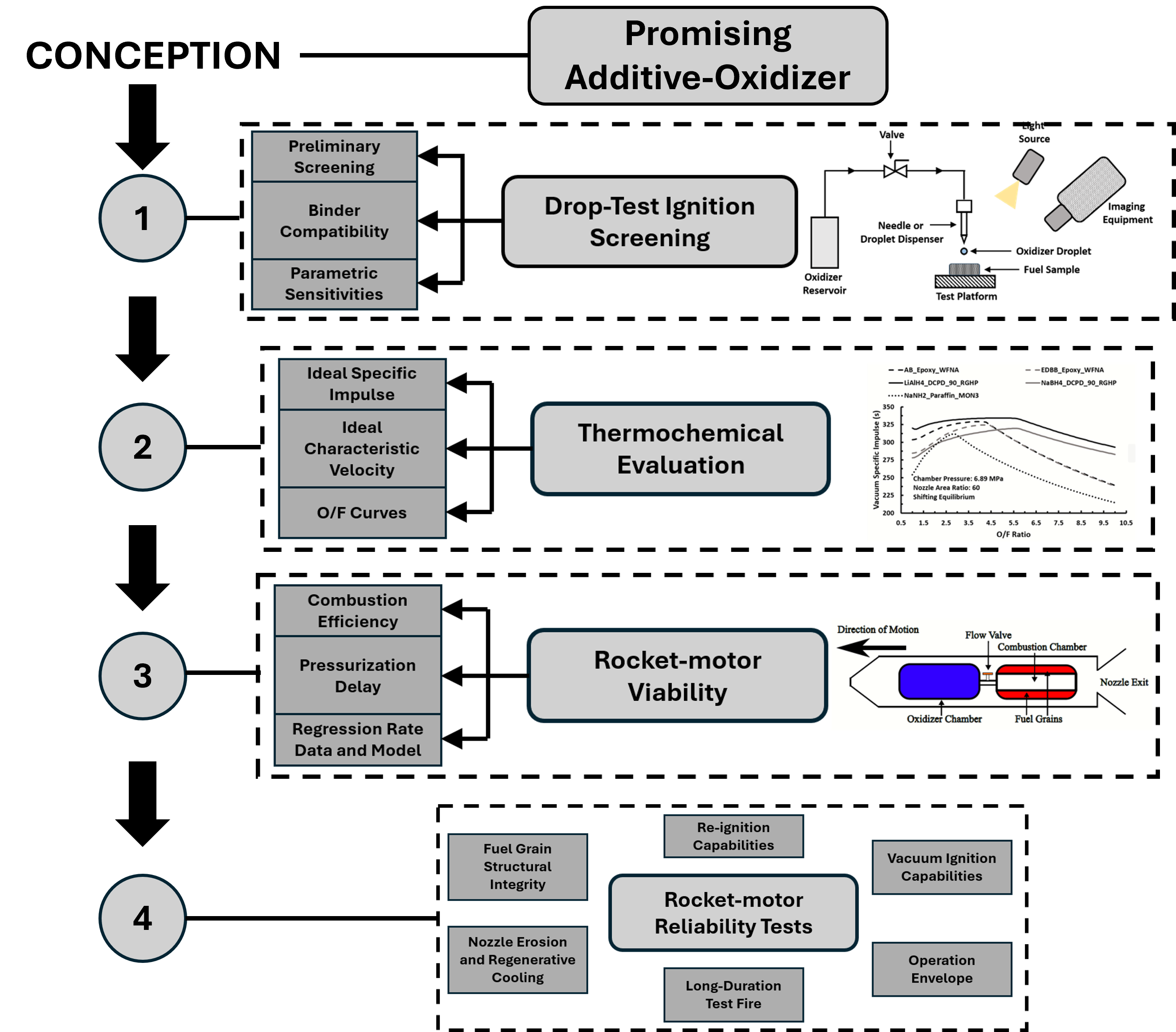
However, several important research gaps remain. First, repeatable re-ignition must be studied systematically and be prioritized in future full-motor hypergolic hybrid rocket propellant tests. Reliable restart capability is one of the principal motivations for hypergolic hybrid rocket propulsions; however existing studies remain limited and indicate that re-ignition may be affected by oxidizer residues or altered fuel surfaces among other factors. Second, the motor-level operating envelope must be determined for each viable propellant family. Additive loading, oxidizer mass flux and port-geometry (and likely other parameters) control this operating envelope within which ignition and combustion is rapid, stable and safe. Operation outside this envelope may lead either to ignition failure or catastrophic pressure spikes, leading to equipment failure. Third, the effect of additive-loading on the mechanical properties of the fuel grain must be studied systematically. The addition of additives to a binder matrix can significantly change the mechanical properties of the hypergolic fuel grain. Rocket motors need to withstand high thermal and mechanical stresses (including vibration) during operation; as such, the mechanical integrity of the fuel grain inside the combustion chamber is crucial. Finally, nozzle erosion needs to be characterized to enable the effective design of nozzles and regenerative cooling systems, ensuring stable, long-duration operations. A possible technology maturation pathway is shown in Figure 28.
Addressing these gaps will be essential for advancing green hypergolic hybrid rocket propellant technology from the current laboratory demonstration stage to reliable propulsion systems.
Author Contributions
Syamantak Nath: Conceptualization, Data curation, Writing- original draft preparation; Daanish Bambery: Writing- review and editing; Landon Kamps: Writing- review and editing
Funding
This research received no external funding.
Conflicts of Interest
The authors declare no conflicts of interest.
References
- Kuo, K.K.; Chiaverini, M.J. Fundamentals of hybrid rocket combustion and propulsion; American Institute of Aeronautics and Astronautics, 2007.
- Schmierer, C.; Kobald, M.; Tomilin, K.; Fischer, U.; Schlechtriem, S. Low cost small-satellite access to space using hybrid rocket propulsion. Acta Astronautica 2019, 159, 578–583.
- Marxman, G.; Gilbert, M. Turbulent boundary layer combustion in the hybrid rocket. In Proceedings of the Symposium (International) on Combustion. Elsevier, 1963, Vol. 9, pp. 371–383.
- Brown, T.R.; Lydon, M.C. Testing of Paraffin-Based Hybrid Rocket Fuel Using Hydrogen Peroxide Oxidizer. In Proceedings of the AIAA Region 5 Student Conference, Wichita, USA, 2005.
- Nath, S.; Laso, I.; Mallick, L.; Sobe, Z.; Koffler, S.; Blumer-Ganon, B.; Borzin, E.; Libis, N.; Lefkowitz, J.K. Comprehensive ignition characterization of a non-toxic hypergolic hybrid rocket propellant. Proceedings of the Combustion Institute 2023, 39, 3361–3370.
- Castaneda, D.A.; Natan, B. Experimental investigation of the hydrogen peroxide–solid hydrocarbon hypergolic ignition. Acta Astronautica 2019, 158, 286–295.
- Tian, H.; Li, X.; Cai, G. Ignition theory investigation and experimental research on hybrid rocket motor. Aerospace Science and Technology 2015, 42, 334–341.
- Kimura, R.; Nakagawa, I. Study on a plasma jet igniter for a hybrid rocket. In Proceedings of the 51st AIAA/SAE/ASEE Joint Propulsion Conference, 2015, p. 4037.
- Jens, E.T.; Karp, A.C.; Nakazono, B.; Williams, K.T.; Rabinovitch, J.; Dyrda, D.; Mechentel, F.S. Low pressure ignition testing of a hybrid smallsat motor. In Proceedings of the AIAA Propulsion and Energy 2019 Forum, 2019, p. 4009.
- Dyrda, D.M.; Mechentel, F.S.; Cantwell, B.J.; Karp, A.C.; Rabinovitch, J.; Jens, E.T. Diode laser ignition of a poly (methyl methacrylate) and gaseous oxygen hybrid motor. Journal of Propulsion and Power 2020, 36, 773–782.
- Mahottamananda, S.N.; Kadiresh, N.P.; Pal, Y. Regression Rate Characterization of HTPB-Paraffin Based Solid Fuels for Hybrid Rocket. Propellants, Explosives, Pyrotechnics 2020, 45, 1755–1763.
- Ruffin, A.; Paccagnella, E.; Santi, M.; Barato, F.; Pavarin, D. Real-time deep throttling tests of a hydrogen peroxide hybrid rocket motor. Journal of Propulsion and Power 2022, 38, 833–848.
- Kang, H.; Lee, E.; Kwon, S. Suppression of Hard Start for Nontoxic Hypergolic Thruster Using H 2 O 2 Oxidizer. Journal of Propulsion and Power 2017, 33, 1111–1117.
- Sam, I.I.; Gayathri, S.; Santhosh, G.; Cyriac, J.; Reshmi, S. Exploring the possibilities of energetic ionic liquids as non-toxic hypergolic bipropellants in liquid rocket engines. Journal of Molecular Liquids 2022, 350, 118217.
- Mahakali, R.; Kuipers, F.; Yan, A.; Anderson, W.; Pourpoint, T. Development of reduced toxicity hypergolic propellants. In Proceedings of the 47th AIAA/ASME/SAE/ASEE Joint Propulsion Conference & Exhibit, 2011, p. 5631.
- Guseinov, S.L.; Fedorov, S.; Kosykh, V.; Storozhenko, P. Hypergolic propellants based on hydrogen peroxide and organic compounds: historical aspect and current state. Russian Chemical Bulletin 2018, 67, 1943–1954.
- Moore, G.E.; Berman, K. A solid-liquid rocket propellant system. Journal of Jet Propulsion 1956, 26, 965–968.
- Jain, S. Self-igniting fuel-oxidizer systems and hybrid rockets. Journal of scientific & industrial research 2003, 62, 293–310.
- Jain, S. Spontaneously igniting hybrid fuel-oxidiser systems. Defence Science Journal 1995, 45, 5–16.
- Jobin, O.; Chartray-Pronovost, M.; Kaprolat, W.; Étienne Robert. Hypergolic ignition of hybrid rocket fuels in a slab burner experiment. Combustion and Flame 2025, 274, 113948. [CrossRef]
- Dumas, B.; Jobin, O.; Kaprolat, W.; Zahlawi, J.; Robert, E. Ignition delay and performance of sorbitol based hypergolic hybrid fuels. Fuel 2023, 349, 128417. [CrossRef]
- Jobin, O.; Dumas, B.; Zahlawi, J.; Chartray-Pronovost, M.; Étienne Robert. Hypergolic ignition of paraffin-based hybrid rocket fuels by sprays of liquid oxidizer. Proceedings of the Combustion Institute 2023, 39, 5073–5082. [CrossRef]
- Dumas, B.; Jobin, O.; Robert, É. Multiple diagnostics of hybrid rocket ignition and effect of hypergolic additive granulometry. Journal of Propulsion and Power 2024, 40, 497–506.
- Elzein, B.; Jobin, O.; Robert, E. Reducing the ignition delay of hypergolic hybrid rocket fuels. Journal of Propulsion and Power 2021, 37, 77–85.
- Jeong, J.; Bhosale, V.K.; Kwon, S. Ultrafast igniting, low toxicity hypergolic hybrid solid fuels and hydrogen peroxide oxidizer. Fuel 2021, 286, 119307.
- Pfeil, M.A.; Kulkarni, A.S.; Ramachandran, P.V.; Son, S.F.; Heister, S.D. Solid amine–boranes as high-performance and hypergolic hybrid rocket fuels. Journal of Propulsion and Power 2016, 32, 23–31.
- Baier, M.J.; Ramachandran, P.V.; Son, S.F. Characterization of the hypergolic ignition delay of ammonia borane. Journal of Propulsion and Power 2019, 35, 182–189.
- Pfeil, M.A.; Dennis, J.D.; Son, S.F.; Heister, S.D.; Pourpoint, T.L.; Ramachandran, P.V. Characterization of ethylenediamine bisborane as a hypergolic hybrid rocket fuel additive. Journal of Propulsion and Power 2015, 31, 365–372.
- Nath, S.; Mallick, L.; Lefkowitz, J.K. Hypergolic ignition response to oxidizer droplet properties. Combustion and Flame 2023, 258, 113061.
- Nath, S.; Mallick, L.; Lefkowitz, J. Spray ignition studies on a green hypergolic hybrid rocket propellant. In Proceedings of the AIAA SCITECH 2023 Forum, 2023, p. 1831.
- Levi, S.; Peles, D.; Nath, S.; Mizrahi, K.; Lefkowitz, J.K. Combustion of Hypergolic Hybrid Rocket Fuel in Hydrogen Peroxide Spray Environment. In Proceedings of the AIAA SCITECH 2026 Forum, 2026, p. 2870.
- Castaneda, D.A.; Natan, B. Hypergolic ignition of hydrogen peroxide with various solid fuels. Fuel 2022, 316, 123432.
- Zhu, H.; Tong, M.; Zhang, Y.; Hu, K.; Zhang, Y.; Mu, C.; Tian, H.; Cai, G. Combustion characteristics of hypergolic solid fuel using NaBH4-embedded polyethylene wax for hydrogen peroxide hybrid rocket. Acta Astronautica 2025, 236, 1316–1326. [CrossRef]
- Benhidjeb-Carayon, A.; McCormick, J.M.; Yilmaz, C.; Gabl, J.R.; Whitehead, B.E.; Pourpoint, T.L. Hypergolic ignition of a paraffin-based hybrid motor with MON-25 at 100,000 ft simulated altitude. In Proceedings of the AIAA Propulsion and Energy 2020 Forum, 2020, p. 3728.
- Shark, S.; Pourpoint, T.; Son, S.; Heister, S. Performance of dicyclopentadiene/H 2 O 2-based hybrid rocket motors with metal hydride additives. Journal of Propulsion and Power 2013, 29, 1122–1129.
- Sippel, T.; Shark, S.; Hinkelman, M.; Pourpoint, T.; Son, S.; Heister, S. Hypergolic ignition of metal hydride-based fuels with hydrogen peroxide. In Proceedings of the 7th US National Combustion Meeting. Georgia Inst. of Technology Atlanta, GA, 2011, pp. 1–15.
- Petrutik, N.; Kaminker, I.; Flaxer, E.; Shem-Tov, D.; Giladi, T.; Bar-Bechor, Y.; Das, J.; Gozin, M. Janus-type hypergolic fuels for hybrid systems using hydrogen peroxide and hydroxylammonium nitrate-based oxidizers. Chemical Engineering Journal 2023, 454, 140170.
- Jobin, O.; Mottillo, C.; Titi, H.M.; Marrett, J.M.; Arhangelskis, M.; Rogers, R.D.; Elzein, B.; Friščić, T.; Robert, É. Metal–organic frameworks as hypergolic additives for hybrid rockets. Chemical Science 2022, 13, 3424–3436.
- Titi, H.; Marrett, J.; Jobin, O.; Mottillo, C.; Fiss, B.; Moores, A.; Robert, É.; Rogers, R.; Friscic, T. Metal-organic frameworks induce hypergolic ignition of bulk metals 2021.
- John, J.; Nandagopalan, P.; Baek, S.W.; Cho, S.J. Hypergolic ignition delay studies of solidified ethanol fuel with hydrogen peroxide for hybrid rockets. Combustion and Flame 2020, 212, 205–215.
- Benhidjeb-Carayon, A.; Drolet, M.P.; Gabl, J.R.; Pourpoint, T.L. Reactivity and hypergolicity of solid fuels with mixed oxides of nitrogen. Journal of Propulsion and Power 2019, 35, 466–474.
- Pfeil, M. Solid Amine-Boranes as High Performance Hypergolic Hybrid Rocket Fuels and Their Combustion Behavior in a Hypergolic Hybrid Combustor. PhD, Purdue University, Indiana, USA 2014.
- Ramachandran, P.V.; Kulkarni, A.S.; Pfeil, M.A.; Dennis, J.D.; Willits, J.D.; Heister, S.D.; Son, S.F.; Pourpoint, T.L. Amine–boranes: green hypergolic fuels with consistently low ignition delays. Chemistry–A European Journal 2014, 20, 16869–16872.
- Zhang, Y.; Yang, Z.; Mu, C.; Zhang, Y.; Zhu, H.; Wang, L. Hypergolic ignition of green propellant: Testing of 90% hydrogen peroxide with paraffin wax including sodium borohydride. Acta Astronautica 2025, 229, 277–285.
- DeSain, J.; Curtiss, T.; Metzler, K.; Brady, B. Testing hypergolic ignition of paraffin wax/LiAlH4 mixtures. In Proceedings of the 46th AIAA/ASME/SAE/ASEE Joint Propulsion Conference & Exhibit, 2010, p. 6636.
- Benhidjeb-Carayon, A.; Gabl, J.; Pourpoint, T.L. Hypergolic ignition and relights of a paraffin-based hybrid grain. In Proceedings of the 2018 Joint Propulsion Conference, 2018, p. 4661.
- Over, D. Hypergolic Characterization of HAN-Based Ionic Liquids for Propulsion and Gas Generating Systems. Master’s thesis, The Pennsylvania State University, 2024.
- Farha, O.K.; Eryazici, I.; Jeong, N.C.; Hauser, B.G.; Wilmer, C.E.; Sarjeant, A.A.; Snurr, R.Q.; Nguyen, S.T.; Yazaydın, A.O.; Hupp, J.T. Metal–organic framework materials with ultrahigh surface areas: is the sky the limit? Journal of the American Chemical Society 2012, 134, 15016–15021.
- Boruc, .; Kapusta, .J.; Kindracki, J. Selection of the method for determination of ignition delay of hypergolic propellants. Combustion Engines 2024, 63.
- Matsuura, Y.; Matsuda, N.; Tashiro, Y.; Naka, T. Investigation on Suppression of Hard-Start Phenomena in a Hypergolic Bipropellant Engine. Journal of Propulsion and Power 2025, 41, 72–81.
- Chang, C.S.; Wei, S.S.; Chang, K.L.; Chang, Y.X.; Wu, J.S. Performance investigation of DETA-and EDA-based green hypergolic fuels with 90% hydrogen peroxide. Aerospace Science and Technology 2026, p. 112278.
- Clements, K.A.; Baier, M.J.; Ramachandran, P.V.; Son, S.F. Experimental study of factors affecting hypergolic ignition of ammonia borane. Journal of Propulsion and Power 2021, 37, 202–210.
- Jindal, P.; Botchu Vara Siva, J. Ignition Delay Times of Conventional and Green Hypergolic Propellants at Ambient Conditions: A Comparative Review. Applied Sciences 2025, 15. [CrossRef]
- Baier, M. Development and Characterization of High Performance Ammonia Borane Based Rocket Propellants. PhD thesis, Purdue University, 2021.
- Pfeil, M.A. Changes in combustion behavior of liquid fuels due to the addition of small amounts of ammonia borane or nano aluminum. Master’s thesis, Purdue University, 2012.
- Wang, Z.; Gao, J.; Ustach, V.; Li, C.; Sun, S.; Hu, S.; Faller, R. Tunable permeability of cross-linked microcapsules from pH-responsive amphiphilic diblock copolymers: a dissipative particle dynamics study. Langmuir 2017, 33, 7288–7297.
- Stanford Advanced Materials. Ammonia Borane Powder. https://www.samaterials.com/boron/2723-ammonia-borane.html, 2026. Accessed: 2026-07-27.
- Patel, P.; Tiwari, S. Flame detection using image processing techniques. International Journal of Computer Applications 2012, 58, 13–16.
- Josserand, C.; Thoroddsen, S.T. Drop impact on a solid surface. Annual review of fluid mechanics 2016, 48, 365–391.
- Pourpoint, T.L.; Anderson, W.E. Hypergolic reaction mechanisms of catalytically promoted fuels with rocket grade hydrogen peroxide. Combustion Science and Technology 2007, 179, 2107–2133.
- Beaird, A.M.; Davis, T.A.; Matthews, M.A. Deliquescence in the hydrolysis of sodium borohydride by water vapor. Industrial & engineering chemistry research 2010, 49, 9596–9599.
- Gordon, S.; McBride, B.J. Computer program for calculation of complex chemical equilibrium. NASA reference publication 1994, 1311, 19–20.
- National Center for Biotechnology Information. PubChem Compound Summary for CID 28112, Lithium aluminum hydride. https://nih.gov, 2026. Retrieved September 1, 2026.
- Thomas, J.C.; Petersen, E.L. HTPB heat of formation: literature survey, group additive estimations, and theoretical effects. AIAA Journal 2022, 60, 1269–1282.
- Grosse, M. Effect of a diaphragm on performance and fuel regression of a laboratory scale hybrid rocket motor using nitrous oxide and paraffin. In Proceedings of the 45th AIAA/ASME/SAE/ASEE Joint Propulsion Conference & Exhibit, 2009, p. 5113.
- Karabeyoglu, A.M.; Evans, B.J. Effect of “O/F Shift” on combustion efficiency. In Proceedings of the 50th AIAA/ASME/SAE/ASEE Joint Propulsion Conference, 2014, p. 3851.
- Ozawa, K.; Shimada, T. Effects of O/F Shifts on Flight Performances of Vertically Launched Hybrid Sounding Rockets. In Proceedings of the 53rd AIAA/SAE/ASEE Joint Propulsion Conference, 2017, p. 5051.
- Wei, S.S.; Li, M.C.; Lai, A.; Chou, T.H.; Wu, J.S. A review of recent developments in hybrid rocket propulsion and its applications. Aerospace 2024, 11, 739.
- Benhidjeb-Carayon, A.; McCormick, J.; Yilmaz, C.; Gabl, J.R.; Whitehead, B.E.; Pourpoint, T.L. Hypergolic Hybrid Rocket Motor Characterization with MON-25 at Atmospheric and Reduced Pressures. In Proceedings of the AIAA Propulsion and Energy 2019 Forum, 2019, p. 4338.
- Karabeyoglu, A.; Zilliac, G.; Cantwell, B.J.; DeZilwa, S.; Castellucci, P. Scale-up tests of high regression rate paraffin-based hybrid rocket fuels. Journal of propulsion and power 2004, 20, 1037–1045.
- Kamps, L.; Sakurai, K.; Saito, Y.; Nagata, H. Comprehensive data reduction for N2O/HDPE hybrid rocket motor performance evaluation. Aerospace 2019, 6, 45.
- Karabeyoglu, A.; Cantwell, B.; Stevens, J. Evaluation of the homologous series of normal alkanes as hybrid rocket fuels. In Proceedings of the 41st AIAA/ASME/SAE/ASEE Joint Propulsion Conference & Exhibit, 2005, p. 3908.
- Kang, S.; Lee, D.; Lee, E.; Kwon, S. Design and performance evaluation of hybrid rocket using 95 wt.% H2O2. In Proceedings of the 52nd AIAA/SAE/ASEE Joint Propulsion Conference, 2016, p. 4864.
Figure 1.
Schematic diagram of a hybrid rocket engine
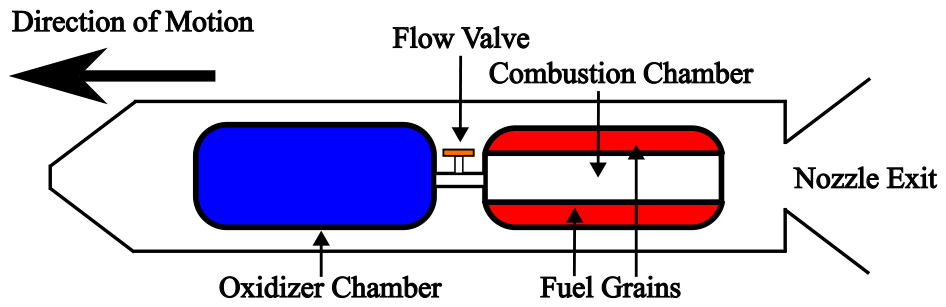
Figure 2.
Schematic of hybrid rocket ignition stages
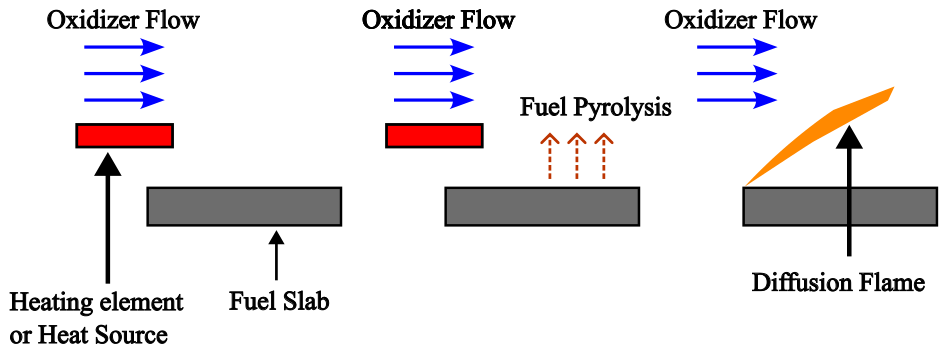
Figure 3.
General schematic of a drop-test experiment involving hypergolic propellants
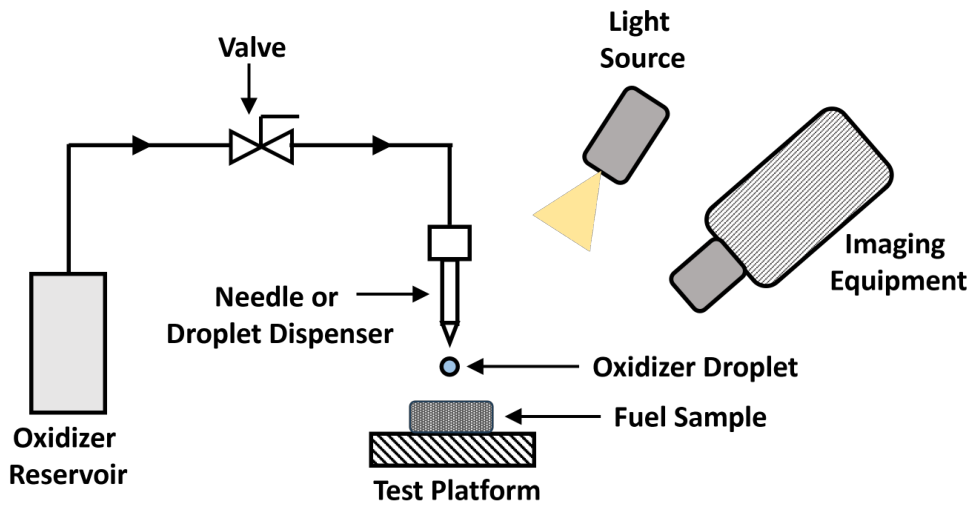
Figure 4.
Ignition delay of AB powder with WFNA oxidizer as a function of particle size. Data from Baier et al. [27]
Figure 4.
Ignition delay of AB powder with WFNA oxidizer as a function of particle size. Data from Baier et al. [27]
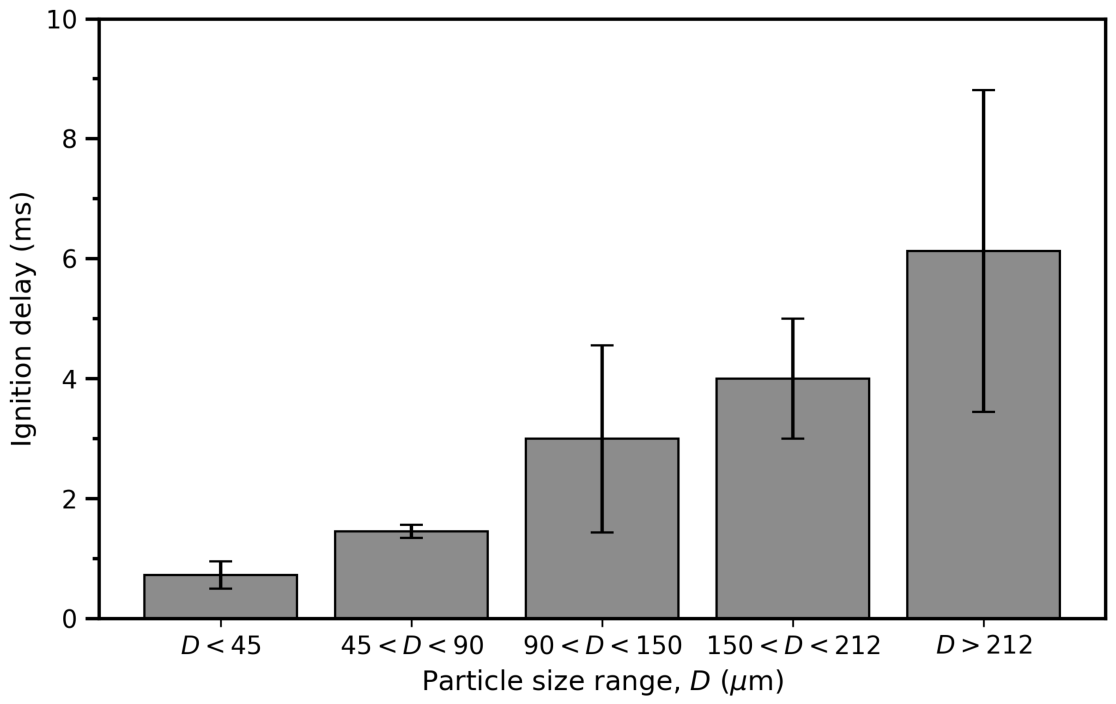
Figure 5.
Ignition delay of AB-Sylgard fuel pellets with WFNA oxidizer as function of AB particle sizes used to prepare fuel pellets. Data from Baier et al. [27]
Figure 5.
Ignition delay of AB-Sylgard fuel pellets with WFNA oxidizer as function of AB particle sizes used to prepare fuel pellets. Data from Baier et al. [27]
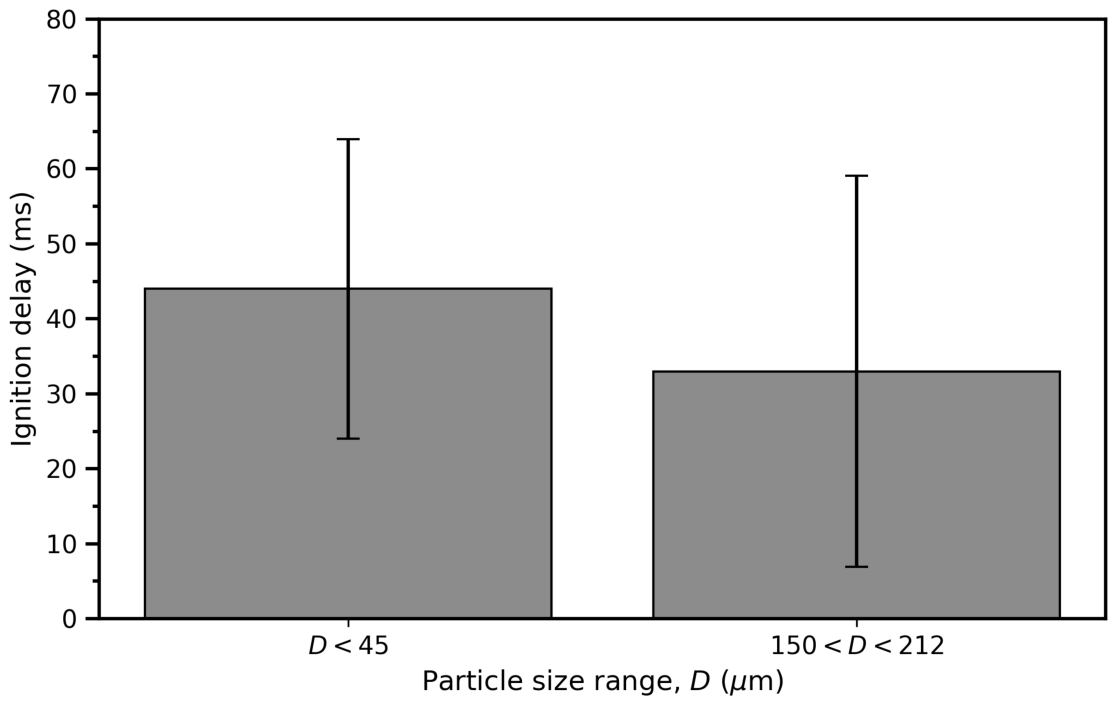
Figure 6.
Ignition delay as a function of NaBH4 for different fuel binders. Data from Zhang et al. [44], Zhu et al. [33], Nath et al. [5] and Castaneda & Natan [6]
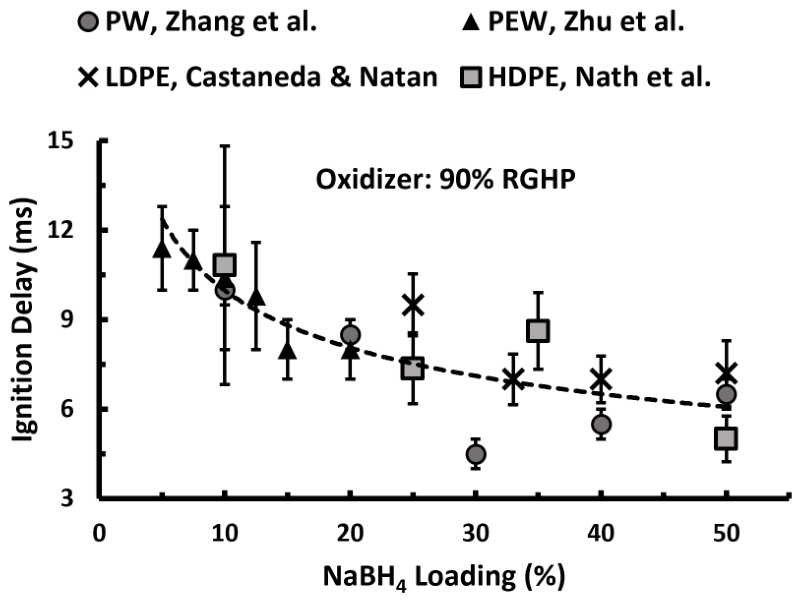
Figure 7.
Ignition delay as a function of AB loading in epoxy binder. Data from Jeong et al. [25]
Figure 7.
Ignition delay as a function of AB loading in epoxy binder. Data from Jeong et al. [25]
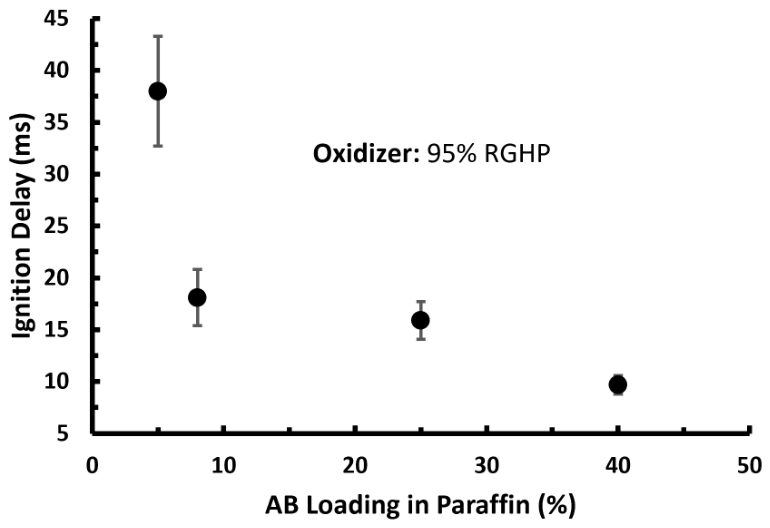
Figure 8.
Ignition delay as a function of AB additive loading in epoxy and surface treatment. Data from Clements et al. [52]
Figure 8.
Ignition delay as a function of AB additive loading in epoxy and surface treatment. Data from Clements et al. [52]
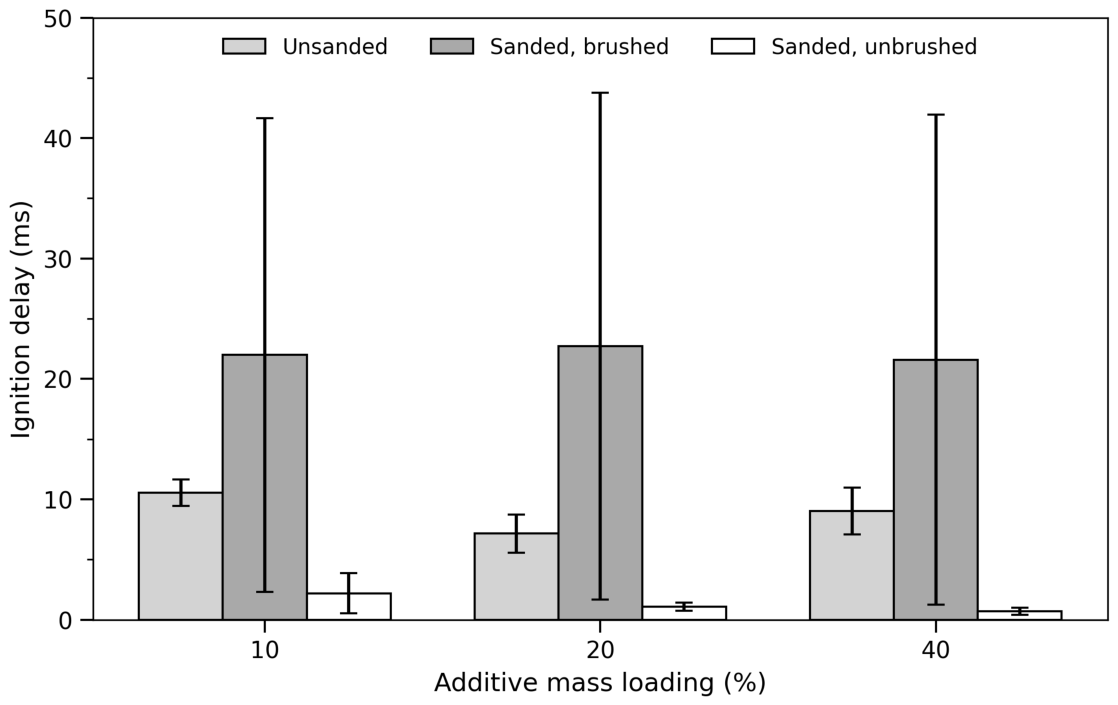
Figure 9.
Variation of ignition delay with fuel pellet surface treatment for different epoxy binder loadings. Data from [26]
Figure 9.
Variation of ignition delay with fuel pellet surface treatment for different epoxy binder loadings. Data from [26]
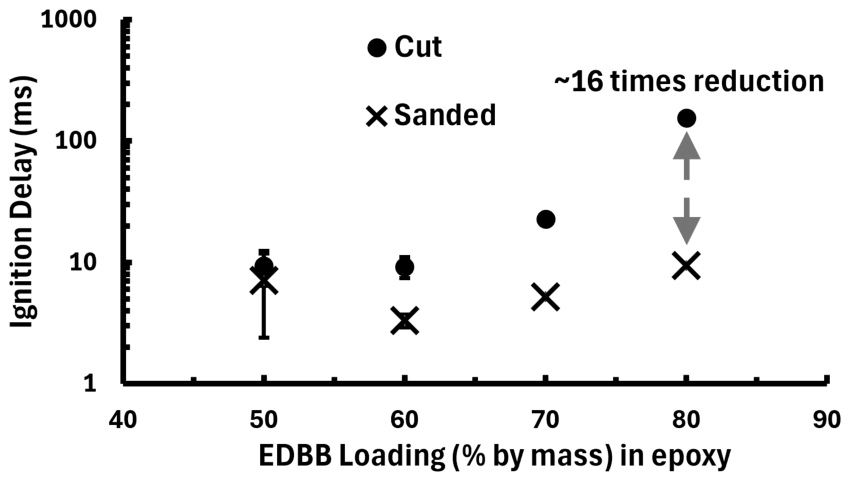
Figure 10.
Ignition delay as a function of oxidizer type for several neat additives. Data from Oliver [47]
Figure 10.
Ignition delay as a function of oxidizer type for several neat additives. Data from Oliver [47]
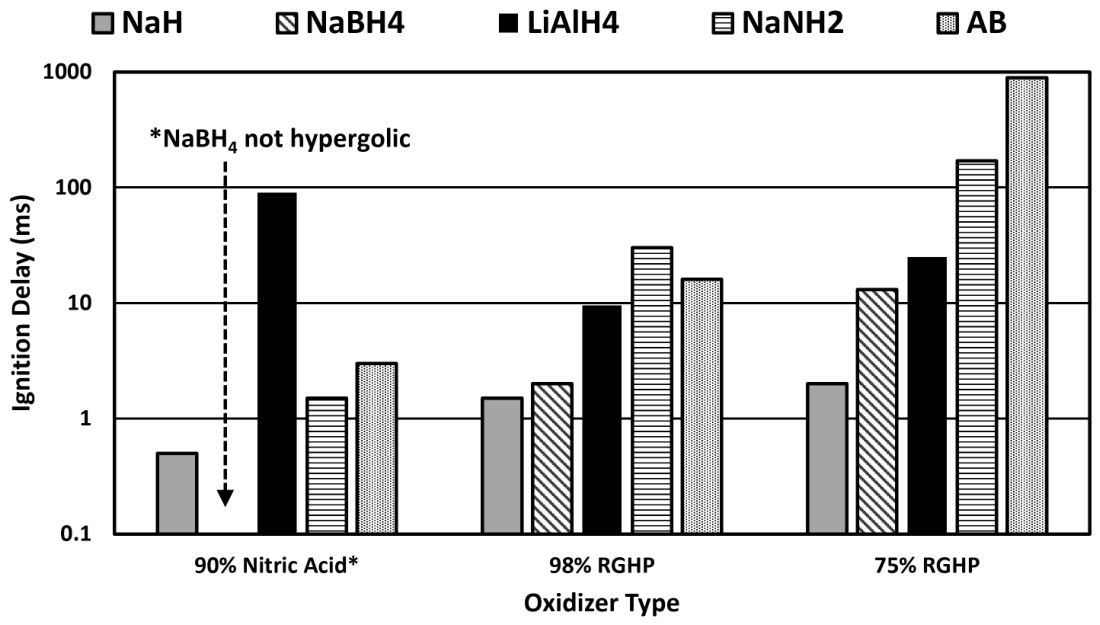
Figure 11.
Ignition delay as a function of RGHP concentration for different grains with different mass loadings of NaBH4 in HDPE binder. Data from Nath et al. [5]
Figure 11.
Ignition delay as a function of RGHP concentration for different grains with different mass loadings of NaBH4 in HDPE binder. Data from Nath et al. [5]
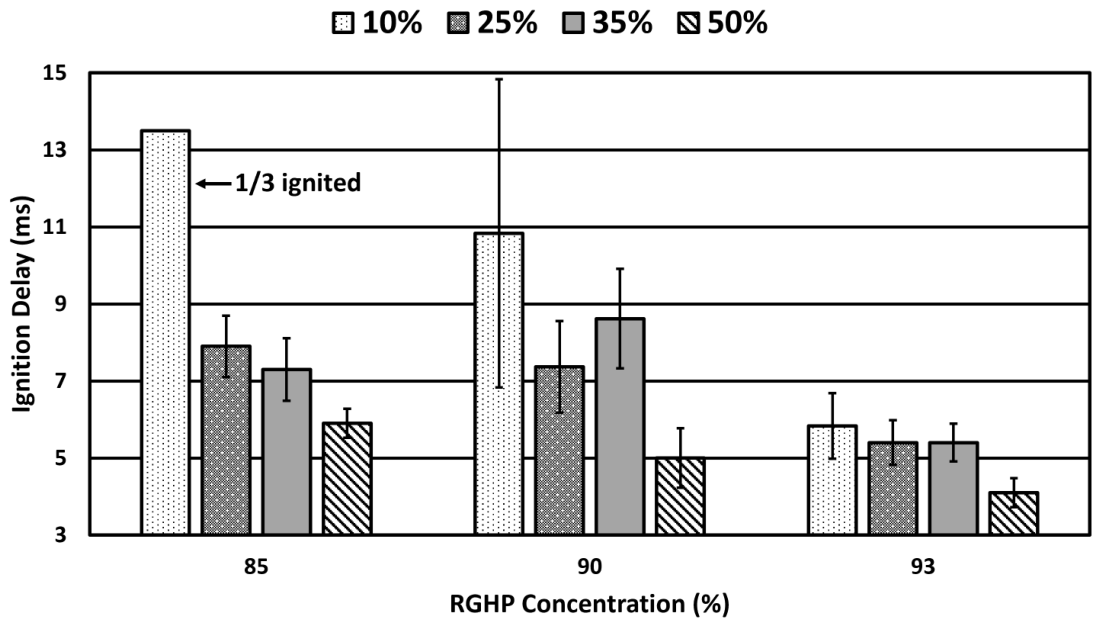
Figure 12.
Ignition delay as a function of different binders with 25% by mass NaBH4, using 90% RGHP as oxidizer. Data from Castaneda et al. [32]
Figure 12.
Ignition delay as a function of different binders with 25% by mass NaBH4, using 90% RGHP as oxidizer. Data from Castaneda et al. [32]
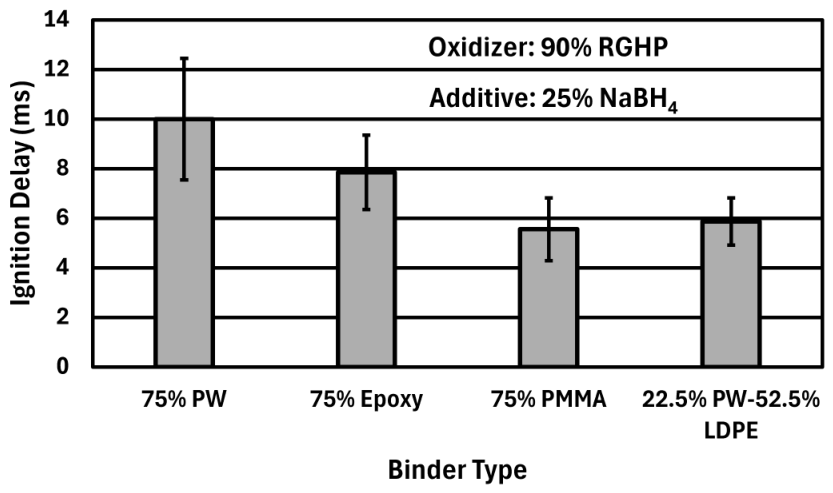
Figure 13.
Ignition delay as a function of different binders for EDBB-WFNA combination. Data from Pfeil et al. [42]
Figure 13.
Ignition delay as a function of different binders for EDBB-WFNA combination. Data from Pfeil et al. [42]
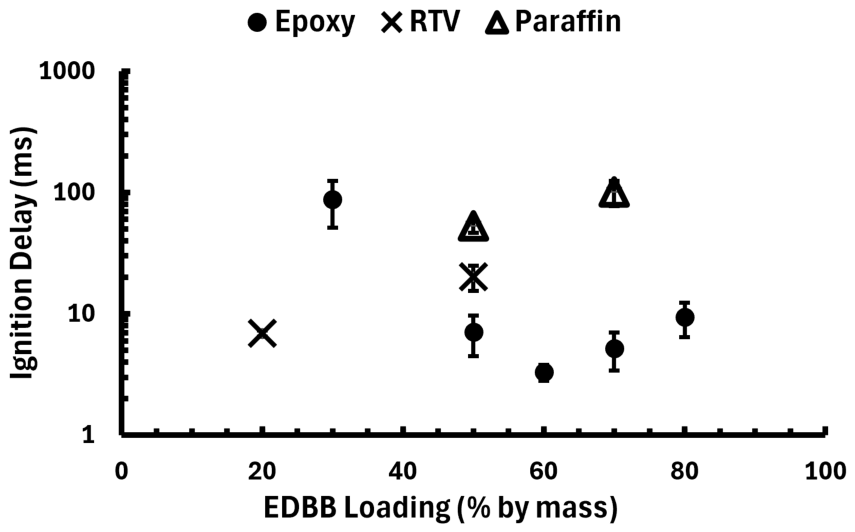
Figure 14.
Ignition delay as a function of nitrogen pressure for different additive loadings. Data from [6]
Figure 14.
Ignition delay as a function of nitrogen pressure for different additive loadings. Data from [6]
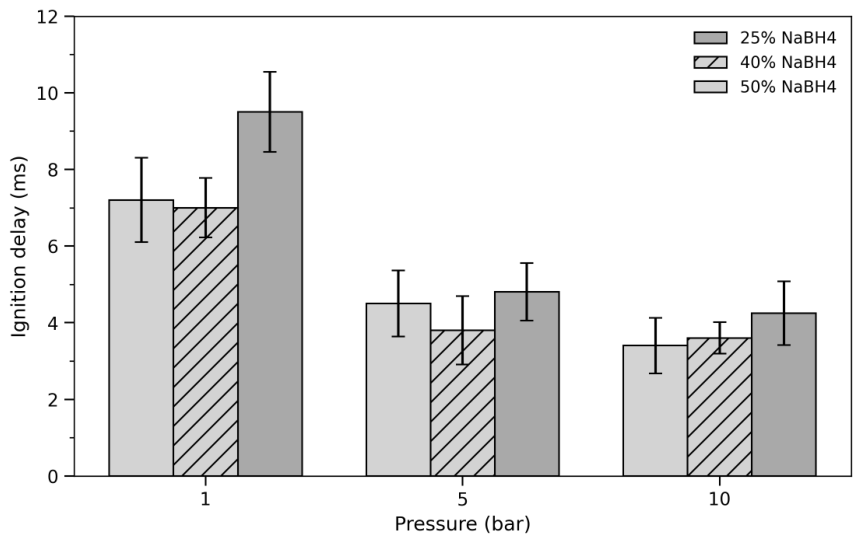
Figure 15.
Flame spread area (measured in pixel counts) as a function of pressure for different NaBH4-HDPE-RGHP propellant combination. Data from Nath et al. [5]
Figure 15.
Flame spread area (measured in pixel counts) as a function of pressure for different NaBH4-HDPE-RGHP propellant combination. Data from Nath et al. [5]
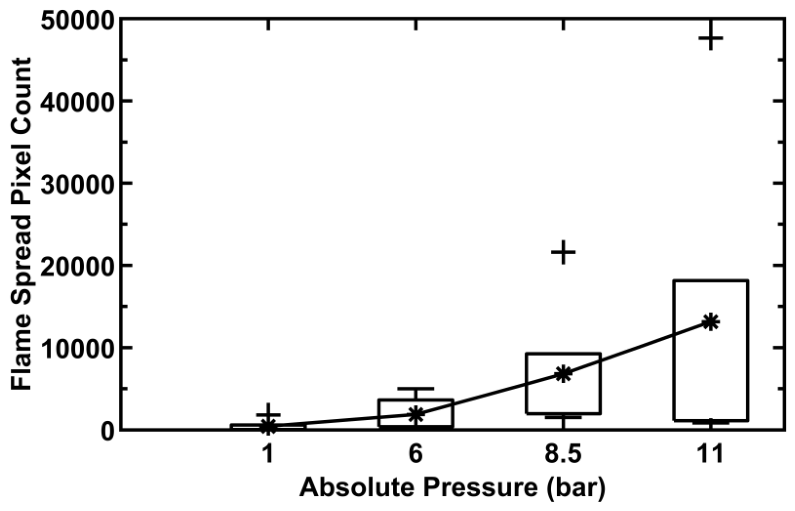
Figure 16.
Ignition delay as a function of oxidizer droplet properties. Data from Nath et al. [5]
Figure 16.
Ignition delay as a function of oxidizer droplet properties. Data from Nath et al. [5]
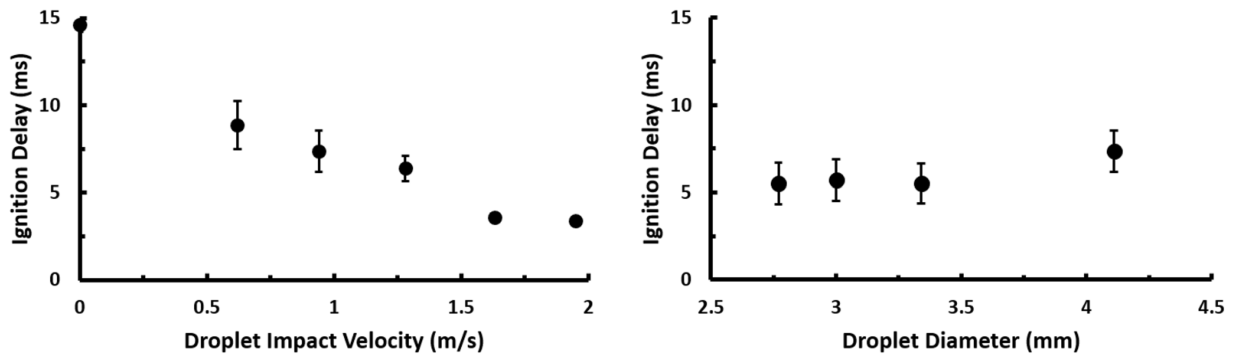
Figure 17.
Flame area (in pixels) as a function of droplet impact velocity. Data from Nath et al. [5]
Figure 17.
Flame area (in pixels) as a function of droplet impact velocity. Data from Nath et al. [5]
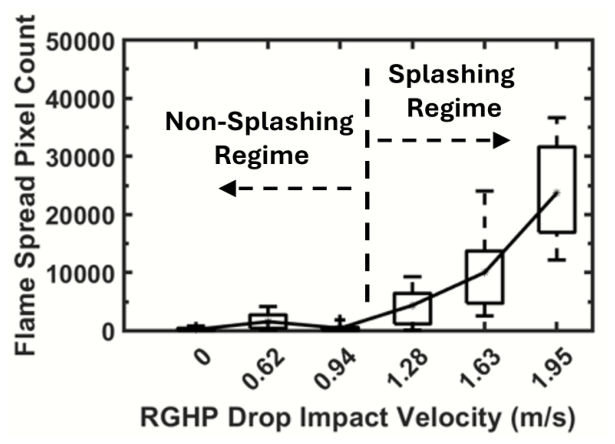
Figure 18.
Ignition delay as a function of humidity exposure in a 50% relative humidity environment before drop-test ignition experiments. Data from Nath et al. [5]
Figure 18.
Ignition delay as a function of humidity exposure in a 50% relative humidity environment before drop-test ignition experiments. Data from Nath et al. [5]
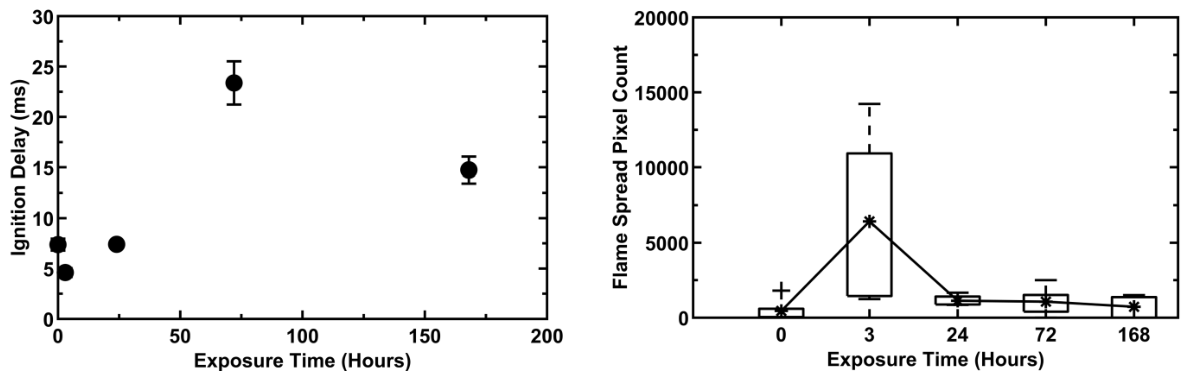
Figure 19.
Ideal vacuum specific impulse and characteristic velocity as functions of O/F ratio for selected 50% additive-loaded hypergolic hybrid fuel formulations. Calculations were performed assuming shifting-equilibrium expansion with a chamber pressure of 6.89 MPa (or 1000 psia) and a nozzle expansion ratio of 60
Figure 19.
Ideal vacuum specific impulse and characteristic velocity as functions of O/F ratio for selected 50% additive-loaded hypergolic hybrid fuel formulations. Calculations were performed assuming shifting-equilibrium expansion with a chamber pressure of 6.89 MPa (or 1000 psia) and a nozzle expansion ratio of 60
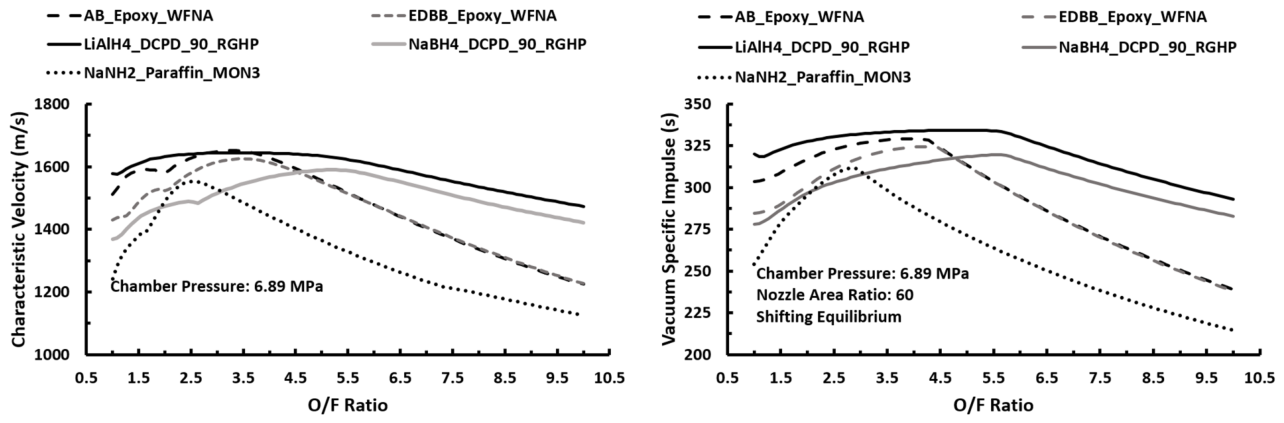
Figure 20.
General configuration of fuel grain used for tests by Benhidjeb-Carayon et al. [34,46,69]
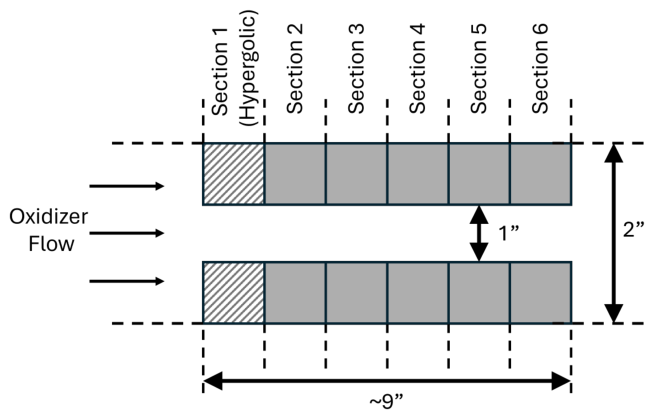
Figure 21.
Propulsion performance as a function of hypergolic additive loading. Calculated using data from Benhidjeb-Carayon et al. [46]. Calculations assumed a specific heat ratio, and a nozzle efficiency () of 100%. Error values reflect steady-state combustion chamber pressure variations, the data for which were provided in the paper [46]
Figure 21.
Propulsion performance as a function of hypergolic additive loading. Calculated using data from Benhidjeb-Carayon et al. [46]. Calculations assumed a specific heat ratio, and a nozzle efficiency () of 100%. Error values reflect steady-state combustion chamber pressure variations, the data for which were provided in the paper [46]
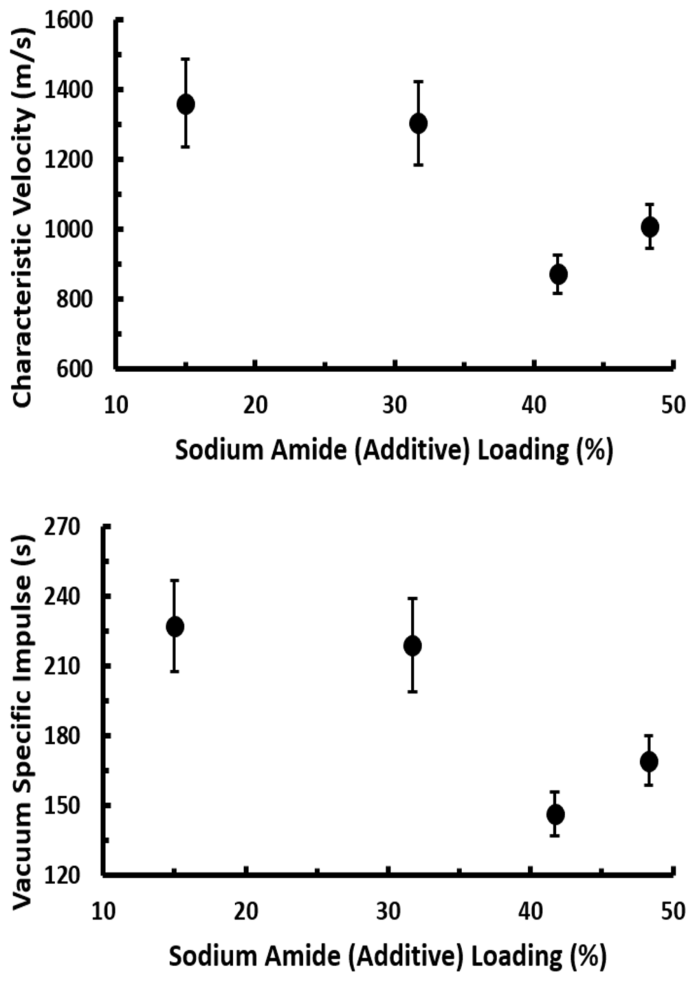
Figure 22.
Actual and predicted regression rate as function of combustion chamber pressure and oxidizer mass flux, with data from Pfeil [42]
Figure 22.
Actual and predicted regression rate as function of combustion chamber pressure and oxidizer mass flux, with data from Pfeil [42]
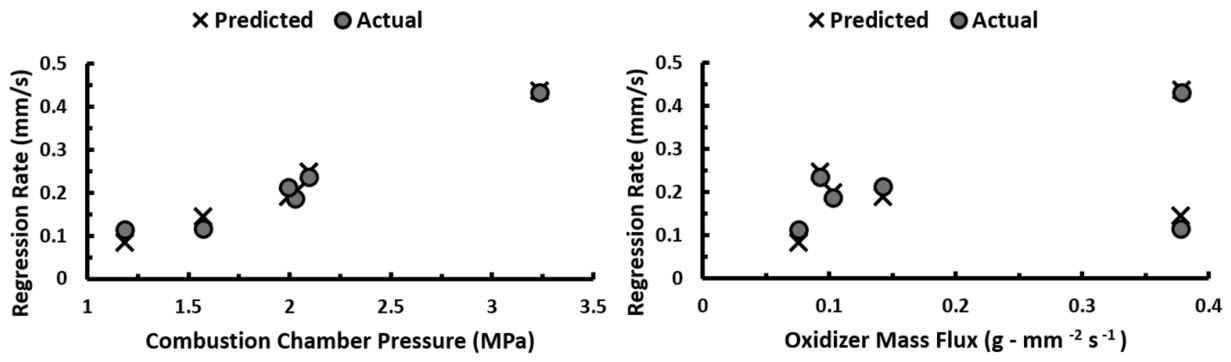
Figure 23.
Characteristic velocity and combustion efficiency as a function of oxidizer mass flow rate and combustion chamber pressure. Created from data in Zhu et al. [33]
Figure 23.
Characteristic velocity and combustion efficiency as a function of oxidizer mass flow rate and combustion chamber pressure. Created from data in Zhu et al. [33]
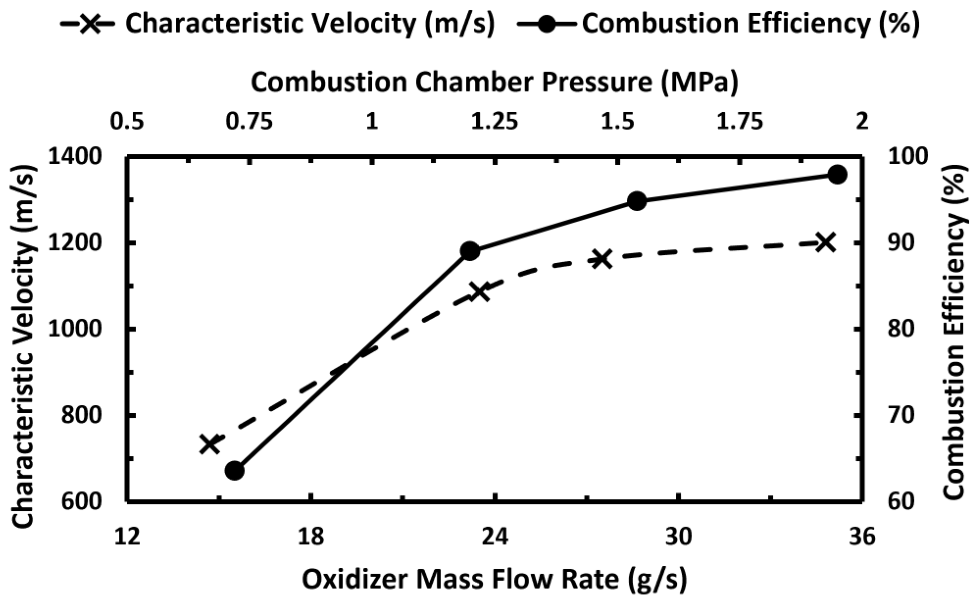
Figure 24.
Characteristic velocity and combustion efficiency as a function of initial oxidizer mass flux. Created from data in Shark et al. [35]
Figure 24.
Characteristic velocity and combustion efficiency as a function of initial oxidizer mass flux. Created from data in Shark et al. [35]
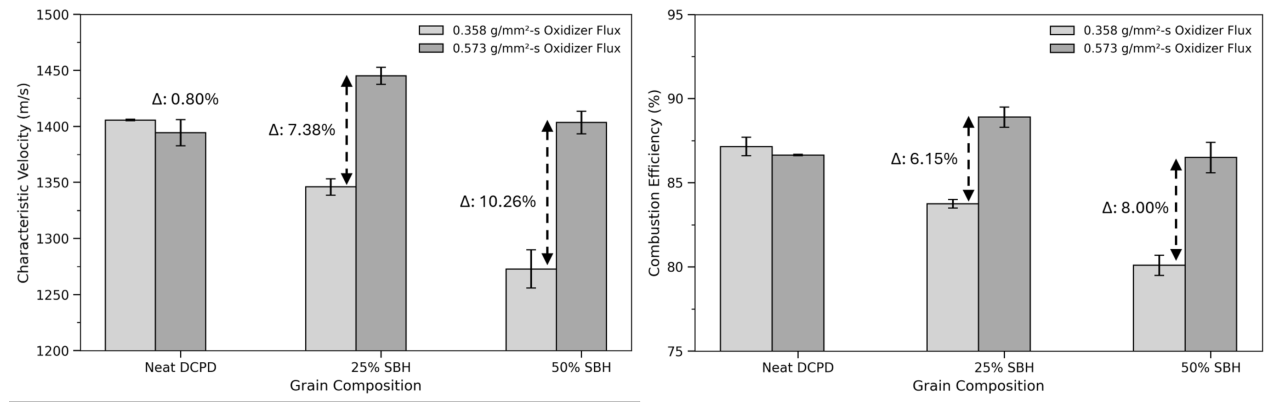
Figure 25.
Fuel grain regression rate as a function of initial oxidizer flux for different fuel grain compositions. Data from Shark et al. [35]
Figure 25.
Fuel grain regression rate as a function of initial oxidizer flux for different fuel grain compositions. Data from Shark et al. [35]
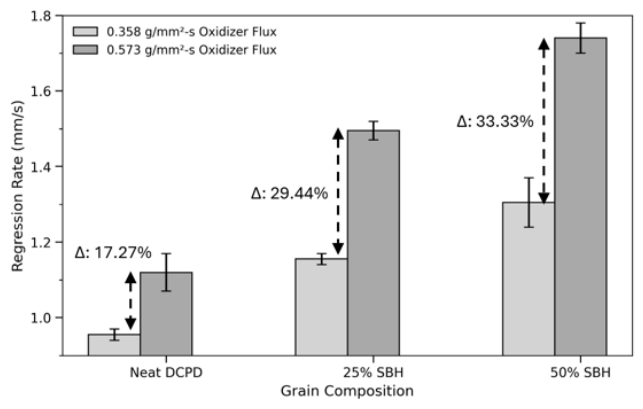
Figure 26.
Regression rate as a function of oxidizer mass flux for different conventional and hypergolic hybrid rocket propellant combinations. Data sources- WFNA-80% AB in epoxy: Ref. [54], GOX-paraffin: Ref. [70], RGHP-HTPB and RGHP-DCPD: Ref. [35], RGHP-SBH in DCPD: Ref. [35], RGHP-SBH in DCPD: Ref. [35], Liquid Nitrous Oxide- HDPE: Ref. [71], Nitric Acid-EDBB in epoxy: Ref. [42], GOX-HDPE: Ref. [72], nitric acid-amides in paraffin: Ref. [46,69], RGHP-SBH in polyethyelene Wax (PEW): Ref. [33], RGHP-SBH in paraffin wax (PW): Ref. [44]
Figure 26.
Regression rate as a function of oxidizer mass flux for different conventional and hypergolic hybrid rocket propellant combinations. Data sources- WFNA-80% AB in epoxy: Ref. [54], GOX-paraffin: Ref. [70], RGHP-HTPB and RGHP-DCPD: Ref. [35], RGHP-SBH in DCPD: Ref. [35], RGHP-SBH in DCPD: Ref. [35], Liquid Nitrous Oxide- HDPE: Ref. [71], Nitric Acid-EDBB in epoxy: Ref. [42], GOX-HDPE: Ref. [72], nitric acid-amides in paraffin: Ref. [46,69], RGHP-SBH in polyethyelene Wax (PEW): Ref. [33], RGHP-SBH in paraffin wax (PW): Ref. [44]
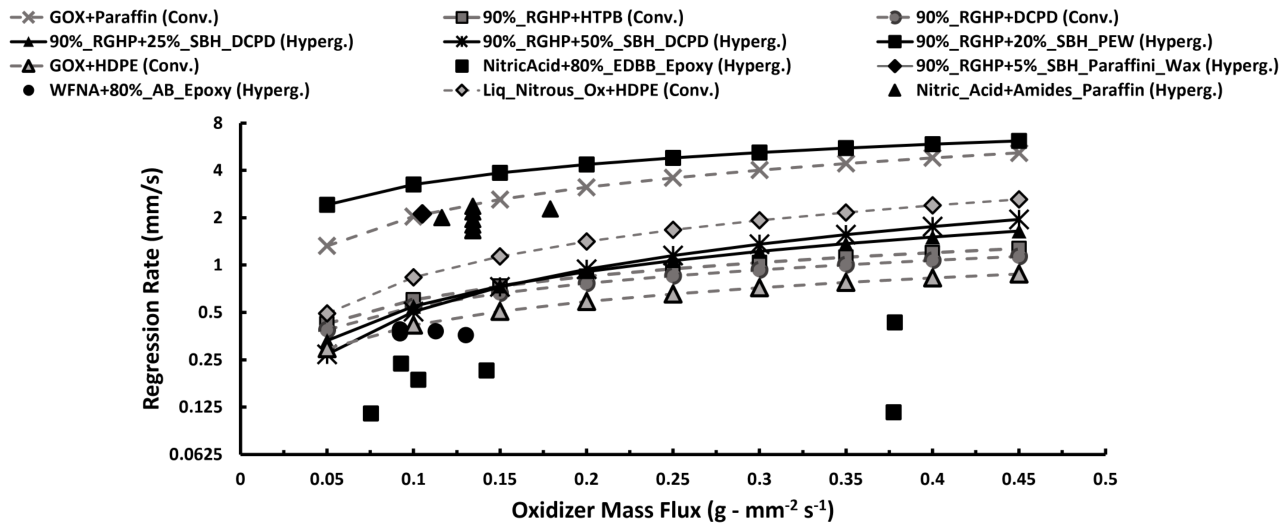
Figure 27.
Combustion efficiency as a function of oxidizer-to-fuel ratio for different hybrid rocket propellant combinations. Data sources: WFNA-80% AB in epoxy- Ref. [54], MON- Amides in Paraffin- Ref. [46,69], RGHP-NaBH4 (25% and 50%) in DCPD- Ref. [35], RGHP-DCPD and RGHP-HTPB- Ref. [35], Nitric Acid-EDBB in Epoxy- Ref. [55], GOX-paraffin- Ref. [70], RGHP-HDPE- Ref. [73], RGHP-SBH in Polyethylene wax (PEW)- Ref. [33], RGHP-SBH in Paraffin wax (PW)- Ref. [44]
Figure 27.
Combustion efficiency as a function of oxidizer-to-fuel ratio for different hybrid rocket propellant combinations. Data sources: WFNA-80% AB in epoxy- Ref. [54], MON- Amides in Paraffin- Ref. [46,69], RGHP-NaBH4 (25% and 50%) in DCPD- Ref. [35], RGHP-DCPD and RGHP-HTPB- Ref. [35], Nitric Acid-EDBB in Epoxy- Ref. [55], GOX-paraffin- Ref. [70], RGHP-HDPE- Ref. [73], RGHP-SBH in Polyethylene wax (PEW)- Ref. [33], RGHP-SBH in Paraffin wax (PW)- Ref. [44]
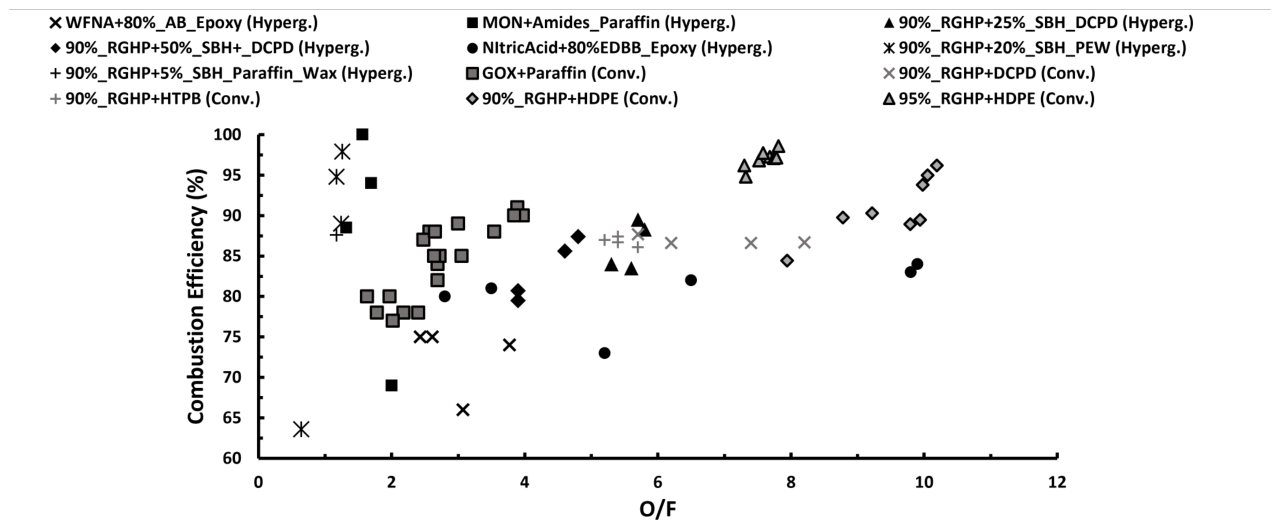
Figure 28.
Suggested technology maturation pathway for green hypergolic hybrid rocket propellants. Promising additive–oxidizer combinations identified through drop-test ignition screening should be further evaluated using thermochemical performance calculations and motor-scale ignition/combustion tests. Propellant systems that demonstrate stable motor operation must then undergo reliability testing, including re-ignition, vacuum ignition, long-duration firing, safe operating-envelope determination, nozzle erosion characterization, regenerative cooling requirement/viability, and fuel-grain structural integrity evaluation.
Figure 28.
Suggested technology maturation pathway for green hypergolic hybrid rocket propellants. Promising additive–oxidizer combinations identified through drop-test ignition screening should be further evaluated using thermochemical performance calculations and motor-scale ignition/combustion tests. Propellant systems that demonstrate stable motor operation must then undergo reliability testing, including re-ignition, vacuum ignition, long-duration firing, safe operating-envelope determination, nozzle erosion characterization, regenerative cooling requirement/viability, and fuel-grain structural integrity evaluation.
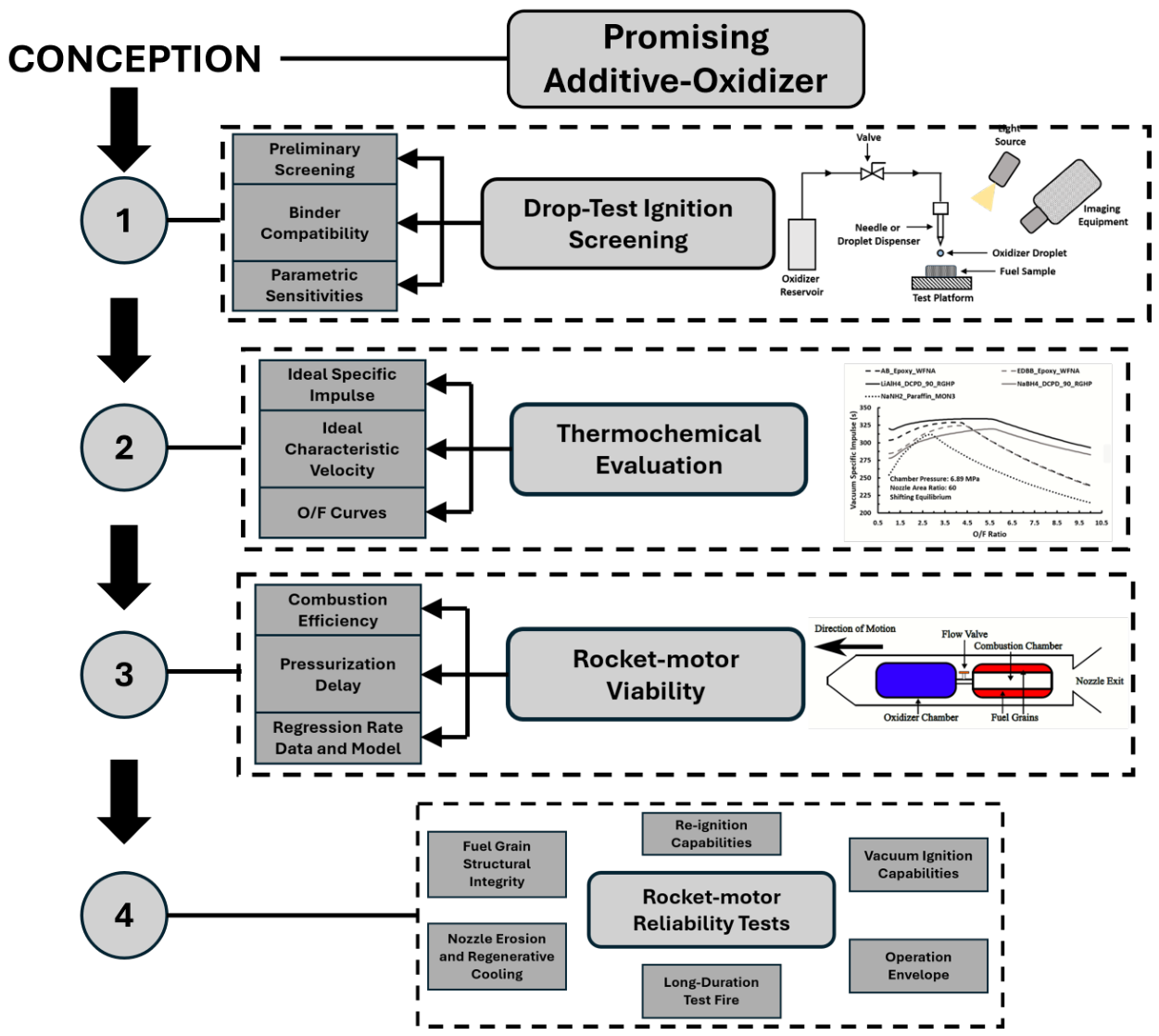

Table 1.
Representative hypergolic hybrid rocket propellant families.
| Additive family | Additive | Fuel/binder matrix | Oxidizer | Representative works |
|---|---|---|---|---|
| Amine boranes | Ammonia borane (AB) | Paraffin | WFNA | [20,21,22,23,24] |
| AB + trace MnO2, Pt-Ru or Pd | Paraffin | WFNA | [25] | |
| AB | Sorbitol | WFNA | [21] | |
| Ethylenediamine bisborane (EDBB) | Epoxy | WFNA | [26] | |
| AB | Sylgard-184 | WFNA | [27] | |
| EDBB | HTPB | WFNA | [28] | |
| Metal hydrides | NaBH4 | HDPE | RGHP | [5,29,30,31] |
| NaBH4 | LDPE | RGHP | [6,32] | |
| NaBH4 | PMMA | RGHP | [32] | |
| NaBH4 | Paraffin | RGHP | [32] | |
| NaBH4 | Sylgard-182 | RGHP | [32] | |
| NaBH4 | Epoxy | RGHP | [32] | |
| NaBH4 | Polyethylene wax | RGHP | [33] | |
| NaBH4 | Paraffin | MON-25 | [34] | |
| NaBH4 | DCPD | RGHP | [35,36] | |
| LiAlH4 | DCPD | RGHP | [36] | |
| AlH3 | DCPD | RGHP | [35] | |
| Others | Crystalline coordination compound | Crystalline coordination compound | HAN + RGHP | [37] |
| HMOF | Paraffin | WFNA | [38] | |
| HMOF | Pure metal bulk | WFNA | [39] | |
| Mn(III)-based additive | Solidified ethanol | RGHP | [40] |
Table 2.
Representative drop-test ignition delays for selected hypergolic hybrid rocket additives.
| Additive | Oxidizer | Ignition delay (ms) | Ref. |
|---|---|---|---|
| Amine–boranes | |||
| Ammonia borane (AB) | WFNA | 2–10a | [54,55] |
| 95% RGHP | 8.1 | [25] | |
| 75% RGHP | 890 | [47] | |
| 50% H2O2 | 1221 | [47] | |
| 90% HNO3 | 3 | [47] | |
| Ethylenediamine bisborane (EDBB) | WFNA | 2.9–5.7a | [55] |
| NTO | 421 | [41] | |
| Metal hydrides | |||
| NaBH4 | 98% RGHP | 2 | [47] |
| 90% RGHP | 4–7 | [6,36] | |
| 75% RGHP | 13 | [47] | |
| 50% H2O2 | 14–50b | [36,47] | |
| LiBH4 | 98% RGHP | 2.5 | [47] |
| 75% RGHP | 6.5 | [47] | |
| 50% RGHP | 8 | [47] | |
| NaAlH4 | 98% RGHP | 7.5 | [47] |
| LiAlH4 | 98% RGHP | 9.5 | [47] |
| 90% RGHP | 9 | [36] | |
| 80% RGHP | 9–33c | [36] | |
| 75% RGHP | 25 | [47] | |
| Amides | |||
| NaNH2 | 98% RGHP | 30 | [47] |
| 75% RGHP | 170 | [47] | |
| NTO | 86.6 | [41] | |
| KHMDS | NTO | 7.3 | [41] |
| Metal–organic / coordination compounds | |||
| Co(Alm)2 | WFNA | 2 | [38] |
| Co(VIm)2 | WFNA | 11.5 | [38,39] |
| Zn(VIm)2 | WFNA | 29 | [38,39] |
| Zn(AIm)2 | WFNA | 2 | [38,39] |
a Range depends on particle size of additive granules. b Sippel et al. [36] consistently obtained longer ignition delays for RGHP/H2O2-NaBH4 combinations, compared to Castaneda and Natan [6] and Over [47]. The particle sizes for NaBH4 were comparable for Castaneda and Natan [6] and Sippel et al. [36] (Over [47] did not provide particle size information); hence, the reason for this discrepancy is unclear. c Wide variation in ignition delay data, likely caused by wide particle size distributions [36].
Table 3.
Effect of surface treatment on ignition success rate and average ignition delay for 40% NaBH4- loaded DCPD fuel pellets. Oxidizer was 90% RGHP. Data from Sippel et al. [36]
Table 3.
Effect of surface treatment on ignition success rate and average ignition delay for 40% NaBH4- loaded DCPD fuel pellets. Oxidizer was 90% RGHP. Data from Sippel et al. [36]
| Surface condition | Ignition Success Rate | Ignition Delay (ms) |
|---|---|---|
| Casting surface | 1/4 | 43.1 |
| Cut surface | 4/4 | 5.43 |
| Scrubbed surface | 4/4 | 6.37 |
Table 4.
Relationship between ignition delay (in ms) and pressure (in pounds per square inch) for some amide additives with MON-25 oxidizer (at -200 C) in nitrogen environment. Data from Benhidjeb et al. [41]
Table 4.
Relationship between ignition delay (in ms) and pressure (in pounds per square inch) for some amide additives with MON-25 oxidizer (at -200 C) in nitrogen environment. Data from Benhidjeb et al. [41]
| Additive | Pressure-ignition delay relationship |
|---|---|
| Lithium Amide | |
| KHMDS | |
| Lithium bis(trimethylsilyl) amide |
Table 5.
Thermochemical input data used for RocketCEA calculations.
| Material | Type | (kJ/mol) | Reference |
|---|---|---|---|
| NaBH4 | Additive | [32] | |
| LiAlH4 | Additive | [63] | |
| NaNH2 | Additive | [46] | |
| AB | Additive | [54] | |
| EDBB | Additive | [55] | |
| HTPB | Binder | [64] | |
| Paraffin (Sasol 0907) | Binder | [65] | |
| DCPD | Binder | [35] |
Table 6.
Summary of RocketCEA-predicted additive-loading effects on ideal propulsion performance.
| System | Loading range | Ideal O/F shift | ||
|---|---|---|---|---|
| AB/HTPB/WFNA | 0–80 wt.% AB | 4.73–1.55 | +6.5% | +7.7% |
| EDBB/HTPB/WFNA | 0–80 wt.% EDBB | 4.73–3.82 | +2.92% | +4.0% |
| LiAlH4/DCPD/RGHP | 0–50 wt.% LiAlH4 | 7.36–4.82 | +4.7% | +2.7% |
| NaBH4/DCPD/RGHP | 0–50 wt.% NaBH4 | 7.36–5.64 | +0.14% | % |
| NaNH2/paraffin/MON3 | 0–90 wt.% NaNH2 | 4.55–1.27 | % | % |
Table 7.
Combustion performance of selected NaNH2-based hypergolic hybrid fuel-grain configurations.Note: Tests conducted under ambient atmospheric pressures used a nozzle area ratio of 5.1 [46,69]. Tests at low ambient pressures used a nozzle with area ratio of 54.56 [34,69].
| Grain configuration | Oxidizer flow rate (g/s) | Fuel flow rate (g/s) | Combustion pressure (MPa) | Characteristic velocity (m/s) | Vacuum (s) | Ignition delay (ms) | Regression rate (mm/s) | Ambient condition |
|---|---|---|---|---|---|---|---|---|
| Front: 90% NaNH2, 2–6: 40% NaNH2 in paraffin evenly dispersed | 68.04 | 34.02 | 300 | 1.65 | Atmospheric | |||
| Front: 90% NaNH2, 2–6: 70% NaNH2 in decreasing order | 68.04 | 49.90 | 240 | 2.37 | Atmospheric | |||
| Front: 90% NaNH2, 2–6: 20% NaNH2 evenly dispersed | 68.04 | 40.37 | 280 | 1.67 | Atmospheric | |||
| Front: 90% NaNH2, 2–6: neat paraffin | 68.04 | 43.55 | 260 | 1.95 | Atmospheric | |||
| Front: NaNH2 + KHMDS, 45% each; 2–3: 100% NaBH4 pellets; 4–6: neat paraffin | 68.04 | 41.73 | 310 | 2.18 | Atmospheric | |||
| Same as above | 90.71 | 42.64 | 1017 | 2.27 | Atmospheric | |||
| Front: NaNH2 + KHMDS, 45% each; 2–6: 25% NaBH4 in paraffin evenly dispersed | 68.04 | 35.38 | 665 | 1.80 | Atmospheric | |||
| Same as above | 58.97 | 39.10 | 425 | 2.00 | 1034.21 Pa | |||
| Same as above but front-section length = 1.5” | ∼90 | Ignition failed | 1034.21 Pa | |||||
Table 8.
Regression rate expressions for pure DCPD and NaBH4-loaded fuel grains [35].
Table 8.
Regression rate expressions for pure DCPD and NaBH4-loaded fuel grains [35].
| Fuel grain | Regression rate law |
|---|---|
| Neat DCPD | |
| 25% NaBH4 in DCPD | |
| 50% NaBH4 in DCPD |
Disclaimer/Publisher’s Note: The statements, opinions and data contained in all publications are solely those of the individual author(s) and contributor(s) and not of MDPI and/or the editor(s). MDPI and/or the editor(s) disclaim responsibility for any injury to people or property resulting from any ideas, methods, instructions or products referred to in the content. |
© 2026 by the authors. Licensee MDPI, Basel, Switzerland. This article is an open access article distributed under the terms and conditions of the Creative Commons Attribution (CC BY) license (http://creativecommons.org/licenses/by/4.0/).
Copyright: This open access article is published under a Creative Commons CC BY 4.0 license, which permit the free download, distribution, and reuse, provided that the author and preprint are cited in any reuse.