

Submitted:
17 September 2026
Posted:
18 September 2026
You are already at the latest version
Abstract
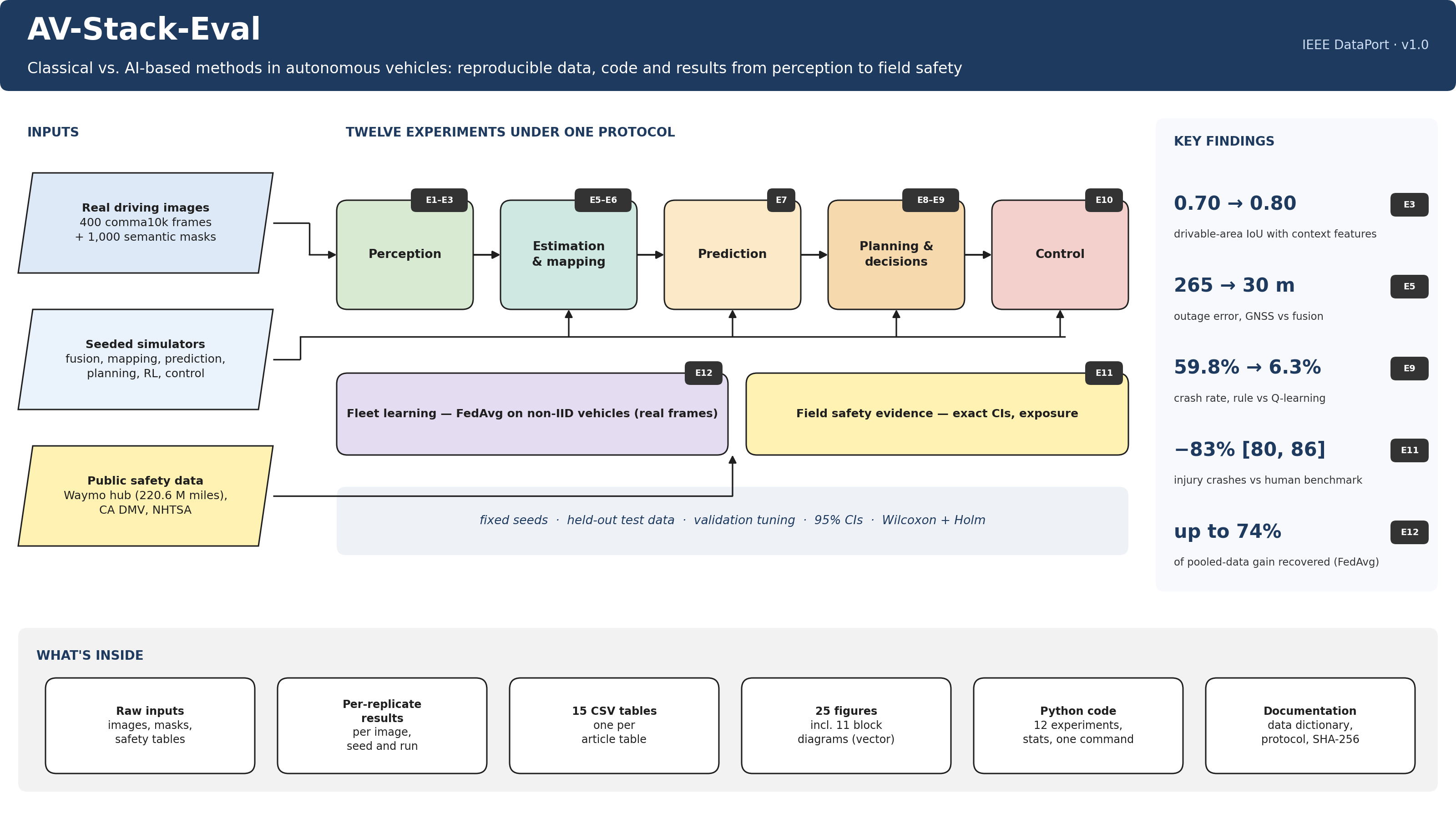
Artificial intelligence (AI) is used throughout autonomous vehicle (AV) software, yet published comparisons of perception, estimation, prediction, planning and control methods rarely share data, protocols or statistical analysis, which makes their trade-offs difficult to judge. This paper reports a reproducible experimental evaluation that spans the AV stack under a single protocol: fixed seeds, held-out test data, validation-based tuning, 95% confidence intervals (CIs), and paired non-parametric tests with multiplicity correction. Twelve experiments address four research questions using the public comma10k driving dataset, seeded simulations, and public field data. On 150 held-out real frames, context features raise drivable-area intersection over union (IoU) from 0.701 to 0.803 (p < 10−11), whereas a classical lane detector reaches an F1 score of 0.658 [0.620, 0.694] irrespective of frame brightness (p = 0.93). Odometry–GNSS fusion reduces outage error from 265.5 m to 30.2 m. Multimodal prediction halves displacement error only because it outputs several hypotheses; its single-hypothesis variant is the worst model. Q-learning reduces lane-change crash rate from 59.8%to 6.3% relative to a rule with identical inputs, and validation-tuned controllers reverse the rankings obtained with hand-picked gains. FedAvg recovers 54–74% of the accuracy gap between isolated and centralised training. A re-analysis of 220.6 million rider-only miles of Waymo data confirms an 83%reduction in injury crashes (ratio 0.170 [0.143, 0.201]), while about 388 million miles would be needed to demonstrate an 80% fatality reduction. All code and data are released.
Keywords:
artificial intelligence
; autonomous vehicles
; benchmarking
; federated learning
; Kalman filtering
; lane detection
; model predictive control
; motion planning
; reinforcement learning
; reproducibility
; safety assessment
; semantic segmentation
; trajectory prediction
Copyright: This open access article is published under a Creative Commons CC BY 4.0 license, which permit the free download, distribution, and reuse, provided that the author and preprint are cited in any reuse.