

Submitted:
17 September 2026
Posted:
18 September 2026
You are already at the latest version
Abstract
Social
contract theories constructed by Enlightenment thinkers through rational
speculative reasoning are highly prone to cognitive divergences stemming from researchers’ differing standpoints. Even in the twenty
first century, scholars adopting distinct theoretical perspectives still hold markedly different interpretations of the concept of the “social contract”. Some viewpoints even categorize contemporary autocratic regimes as a form of social contract. Synthesizing multidisciplinary research findings, this paper distills and proposes the underlying contract, which is captured through the metaphor of ancient balance scales embedded within the human psyche. This paper seeks to resolve cognitive divergences arising from differences in standpoints by drawing on empirical evidence from psychological and behavioural studies, while also offering a fresh perspective for analysing a wide range of social and political phenomena.
Keywords:
underlying contract
; self interest fairness balance
; tension elasticity
; political psychology
; evolutionary political science
; social cognition
; behavioral decision making
; power and institutions
1. Introduction
For decades, interdisciplinary research spanning behavioral experiments, neuroscientific experiments, genetic experiments, game theory, evolutionary theory, social psychology, and anthropology has yielded fruitful findings in the domain of human-human interaction. Although this chapter cannot exhaust all relevant literature, existing research suffers from at least two limitations: first, the neural-pathway mechanisms underpinning the enforcement of fairness norms have not yet been fully and precisely characterized (Feng et al., 2015); second, research coverage of genetic factors shaping fairness preferences remains to be expanded (Wang et al., 2019). Nevertheless, cumulative evidence from neural and genetic levels, together with documented interaction patterns between the brain’s intuitive automatic processing system and deliberate control system when individuals face conflicts between self-interested motives and a sense of fairness (Feng et al., 2015; Satpute & Lieberman, 2006; Lieberman, 2007; Wang et al., 2019), sufficiently support the following inference: in the long course of evolution, humans have developed a set of psychological-behavioral dispositions with both tension and elasticity , which balance self-interested demands and perceptions of fairness. Like an ancient balance in the human mind, such dispositions manifest with both antagonism and plasticity across micro-level dyadic interactions and within small-group settings, as well as in macro-level city-state societies and across social strata of nation-states, whether people consciously recognize them or not. The following section summarizes and refines findings from micro-level studies across multiple disciplines.
2. Symbiotic Balance Between Self-Interest and Fairness
Distribution, cooperation, and exchange constitute fundamental forms of social interaction and are often intertwined. For instance, gains from cooperation cannot be separated from distribution, and exchange itself can be regarded as a form of cooperation (hereafter exchange is subsumed under the category of cooperation for discussion). Since the advent of the Ultimatum Game in 1982, abundant social-interaction experiments have continuously revealed a complex symbiotic relationship between self-interested motives and demands for fairness.
2.1. Evidence from Behavioral-Decision Research
First, in the field of distributive-behavior research, starting from the seminal Ultimatum Game experiment (Güth et al., 1982), scholars have developed multiple behavioral-game variants, including the Dictator Game (Kahneman et al., 1986), reduced-form Ultimatum Game (Falk et al., 2003), Impunity Game (Garrod, 2009), Private Impunity Game (Yamagishi et al., 2009), and various composite-game paradigms (Chen et al., 2011). Comparisons across these variants show that responders exhibit higher rejection rates for unfair proposals when proposals originate from human agents, especially when the offered share falls below 20%. By contrast, when proposals come from neutral third-party actors or machines, rejection rates for highly unequal allocations such as 1:9 or 2:8 splits are markedly lower than in human-proposer conditions. This indicates that responders’ rejections do not stem merely from egoistic preferences but represent social feedback targeting the proposer’s subjective intent to act unfairly, which strongly demonstrates that fairness preferences depend substantially on social interaction (Blount, 1995). This conclusion is corroborated by human-computer contrast experiments: when participants play games against both human partners and computer algorithms, they seldom reject unfair proposals generated randomly by computers, yet maintain relatively high rejection rates (approximately 50 %) for equally unfair proposals from human counterparts (Sanfey et al., 2003). This further suggests that fairness preferences essentially constitute individuals’ dynamic responses to others’ subjective intentions within social interactions; only in interpersonal contexts do individuals resist intentionally unfair allocations.
Consistent experimental results confirm that fairness preferences profoundly shape individual decision-making: participants are willing to forgo all available payoffs to reject manifestly unfair proposals. Such behavior amounts to proactive punishment of unfairness rather than mere aversion to distributional disparities. It demonstrates that individuals attend not only to material gains and losses for themselves but also pursue distributive fairness in interpersonal exchanges. This result has been replicated across 15 small-scale indigenous societies and multiple countries (Camerer, 2003; Henrich et al., 2005), and the magnitude of experimental stakes does not alter this pattern: higher offers from proposers correspond to lower probabilities of proposal rejection. The 50-50 equal split represents the most prevalent proposal within these games, with common offers ranging from 30 % to 40 % of the total stake (Camerer & Thaler, 1995,pp.214-216). When allocated shares drop below 20 %, rejection probabilities range from 40 % to 60 % (Ruan & Huang, 2005,pp.10-16).
Second, from the perspective of cooperation (including exchange), individuals facing one-shot interactions often fall into the dilemma posed by the Prisoner’s Dilemma. Real-world social interactions, however, rarely take the form of one-shot zero-sum games; most involve repeated rounds of interaction. Based on simulations using computer tournament models, Axelrod argued that under repeated-game conditions, agents can typically arrive at stable reciprocal cooperative strategies after iterative trials and adjustments (Axelrod, 2007, 2008). This simulation-based hypothesis has received empirical support from human laboratory experiments, and the boundary conditions for such strategies have been further delineated (Wedekind & Milinski, 1996). It should be emphasized that although reciprocity represents conditional fairness and cannot fully equate to fairness in its entirety, it constitutes one of the core behavioral manifestations of fairness in interpersonal interaction (Falk et al., 2003).
Third-Party Punishment Game experiments show that even when unfair allocations bear no relevance to one’s own material interests, 50 %-60 % of participants are willing to incur personal costs to punish actors who violate fairness norms (Buckholtz et al., 2008). Beyond that, the Gift-Exchange Game (Fehr et al., 1993), Public Goods Game (Fehr & Gächter, 1999, 2002), altruistic-punishment trust game (de Quervain et al., 2004), and Justice Game (Stallen et al., 2018), alongside other social-decision experiments (Chen et al., 2011), collectively attest to robust tendencies toward strong reciprocity (including altruistic punishment) and conditional cooperation in human decision-making. Human motivational structures thus transcend narrow material self-interest and are deeply embedded within social norms of reciprocity and fairness.
Despite substantial cross-societal variation in subsistence patterns (e.g., foraging, agriculture, pastoralism), social structures (e.g., strength of kinship ties, levels of market integration, scale of cooperation, interpersonal anonymity), and cultural norms, individuals differ in how they weigh self-interested demands against motives of fairness, altruism, and reciprocity. People diverge markedly in their subjective standards for fairness, tolerance for unfair acts, and willingness to inflict punishment. Nevertheless, cross-group experiments consistently confirm that fairness preference represents a universal human psychological trait, whether in one-shot distributive scenarios or repeated cooperative exchanges (Henrich et al., 2004). Comparative experiments with non-human primates and human children further supply evolutionary evidence: children’s fair-behavior tendencies strengthen with age (3-year-olds tend toward resource monopolization, whereas school-age children behave more fairly). Social experiences, such as cooperative institutions and sanctioning systems, may reinforce or refine innate predispositions, yet human senses of fairness possess deep evolutionary roots and do not arise exclusively from acquired social learning (Brosnan & de Waal, 2003; Proctor et al., 2013).
It should be supplemented that in both real-world contexts and laboratory settings, people are not consistently inclined toward prosocial helping when fairness norms are not salient. Instead, they constantly trade off self-interested gains against altruistic costs (Hu et al., 2021). Once fairness norms are introduced into social-interaction contexts, however, the original binary trade-off between self-interest and altruism transforms into a trade-off between self-interested demands and fairness criteria. Inter-individual variation in prosocial generosity becomes fully observable within this process (Liu et al., 2019).
2.2. Evidence from Neural-Mechanism Research
Neuroscientific experiments have corroborated these two mutually antagonistic psychological motives: self-interest and fairness. Interventional studies further establish causal links between the functioning of brain regions such as the dorsolateral prefrontal cortex and fairness-oriented decision-making when personal gains conflict with fairness norms (Knoch et al., 2006).
Sanfey and colleagues were pioneers in deploying Magnetic Resonance Imaging (MRI) to investigate neural mechanisms underlying Ultimatum-Game performance. Their experiments demonstrate that the anterior insula serves as a core region for processing negative affect. Unfair allocations trigger moral negative emotions such as disgust and anger. Activation intensity within bilateral anterior insula correlates positively with the magnitude of distributive unfairness: stronger insular activation predicts higher odds of rejecting unfair proposals. The anterior cingulate cortex fulfills conflict-monitoring functions, detecting internal tensions between self-interested demands and fairness perceptions, hence unfair offers elicit enhanced activation within this region. The dorsolateral prefrontal cortex participates primarily in goal maintenance and cost-benefit deliberation and is indispensable for fairness-related decision-making. In short, unfair allocations simultaneously activate emotion-processing and cognitive-control brain networks, and affective responses play a pivotal role in fairness-driven choices (Sanfey et al., 2003).
Transcranial Direct-Current Stimulation (tDCS) experiments further validate the causal regulatory role of the right Dorsolateral Prefrontal Cortex (rDLPFC) in fairness-related decisions. Compared with sham-stimulation controls and cathode-inhibition groups, anodal excitatory stimulation targeting rDLPFC significantly elevates anger and rejection rates in response to unfair offers; anger intensity positively predicts rejection probabilities. Decision latencies for unfair allocations are substantially longer than for fair allocations, and this response-time difference is amplified under anodal stimulation. This tDCS intervention directly establishes the causal contribution of rDLPFC to fairness-relevant choice. The underlying mechanism is as follows: elevated rDLPFC excitability suppresses self-serving impulses, enhances processing of fairness-related information, and motivates individuals to uphold reciprocal norms (Hu et al., 2022).
Repetitive Transcranial Magnetic Stimulation (rTMS) interventions provide complementary causal evidence from the opposite direction: suppressing neural activity in rDLPFC using low-frequency rTMS leaves participants’ subjective judgments of unfairness intact yet significantly reduces their willingness to reject unfair proposals, rendering them more susceptible to self-interested temptations. This experiment shows that rDLPFC is not responsible for generating subjective perceptions of unfairness. Instead, it exerts indispensable regulatory functions when balancing self-serving instincts against fairness norms and suppressing selfish impulses to implement fairness criteria (Knoch et al., 2006). Distinct from the rational cognitive regulatory functions of rDLPFC, the Ventromedial Prefrontal Cortex (VMPFC) supports affect integration and affect-driven decision-making. Patients with bilateral VMPFC lesions display generally blunted affect but tend toward irritability, argumentativeness, and aggression in response to minor frustrations. In Ultimatum-Game tasks, such patients reject unfair disadvantageous offers far more frequently than control participants (Koenigs & Tranel, 2007).
Numerous distributive-task experiments point to systematic neural circuits sustaining the symbiotic relationship between self-interest and fairness. According to the dual-system theory of social cognition (Feng et al., 2015; Lieberman, 2007; Sanfey et al., 2006, 2008; Satpute & Lieberman, 2006; Buckholtz & Marois, 2012), brain activity during Ultimatum-Game performance can be parsed into two processing systems. System 1, the intuitive automatic processing system, encompasses the anterior insula, amygdala, dorsal striatum, dorsal anterior cingulate cortex, and ventromedial prefrontal cortex. It rapidly evaluates norm-violating events and instantaneously generates impulses for altruistic punishment of unfair behavior (Gospic et al., 2014; Sanfey et al., 2003). System 2, the deliberate control processing system, includes prefrontal regions, posterior parietal cortex, medial prefrontal cortex, anterior cingulate cortex, hippocampus, and adjacent temporal-lobe areas. Its function is to re-evaluate and temper intuitive impulses, weighing self-serving pursuits against adherence to fairness norms (Brüne et al., 2012; Fehr & Camerer, 2007; Sanfey & Chang, 2008). Activation of System 2 facilitates resolution of motivational conflicts between self-interest and fairness and enables flexible decision-making (Feng et al., 2015; Satpute & Lieberman, 2006; Lieberman, 2007). Consistently, neuroimaging studies of Ultimatum-Game responders report stronger activation across brain regions belonging to both systems when participants encounter unfair rather than fair proposals (Wang et al., 2019).
Neural experiments focused on cooperative behavior likewise corroborate evolved neural foundations for human fairness-norm maintenance (de Quervain et al., 2004). Zhou Xiaolin’s research team deployed interpersonal-helping experimental paradigms and identified specialized neural pathways that underpin trade-offs between self-payoffs and others’ welfare within cooperative social contexts. These pathways integrate costs and benefits and mediate altruistic helping decisions, offering neural accounts of individual variation in social value orientation and cooperative inclinations (Hu J et al., 2021).
Two competing interpretive frameworks rooted in dual-system theory have been advanced to explain neural processing of conflicts between self-interested and fairness-based motives. Proponents of each framework maintain neutrality in their publications and do not dismiss empirical evidence supporting the alternative hypothesis. The first perspective holds that pursuing material self-interest constitutes an automatic intuitive response. Rejecting unfair offers and complying with fairness norms therefore requires the deliberate control system to inhibit selfish impulses (Martinsson et al., 2014; Myrseth et al., 2009). This aligns with rTMS results showing that rDLPFC impairment increases acceptance of unfair proposals (Knoch et al., 2006). The second perspective posits that rejecting unfair allocations and pursuing fairness represent automatic intuitive responses. Accepting unfair proposals to maximize personal gains then demands deliberate-system engagement to override such prosocial impulses (Rand et al., 2012; Rubinstein, 2007). Both viewpoints draw support from multiple behavioral and neuroscientific datasets (Achtziger et al., 2016; Dunn et al., 2012; Halali et al., 2014; Sütterlin et al., 2011; Van’t Wout et al., 2010).
To date, scholarly consensus remains absent regarding which response dominates when self-interest and fairness clash in social decision-making (Bear & Rand, 2016; Hu J. et al., 2021). Regardless of the precise neural regulatory mechanisms governing such conflicts, regardless of whether individuals pursue fairness for its intrinsic value or as an instrumental means to advance self-interest, and independent of the relative weight of competing motives, one fact remains undeniable: fairness and self-interest form a set of symbiotically balanced psychological dispositions.
2.3. Evidence from Genetic-Control Research
Extensive studies in behavioral genetics and neuroscience indicate that most human psychological traits exhibit substantial heritability (Bouchard & McGue, 2003; Bouchard et al., 1990). Genes exert measurable influences over distributive choices within the Ultimatum Game. Research measuring testosterone levels shows that men with higher endogenous testosterone tend to reject low-value unfair offers more readily (Burnham, 2007). Wallace and colleagues first introduced behavioral-genetic designs to study responder behavior in the Ultimatum Game. Drawing on the Swedish Twin Registry, they recruited 658 twins for monozygotic-dizygotic comparison experiments to disentangle genetic and environmental effects. Results show that additive genetic effects explain more than 40 % of variance in the tendency to reject unfair allocations, shared family environment contributes virtually nothing, and remaining inter-individual behavioral differences are attributable entirely to non-shared environment, i.e., each person’s unique life histories, social interactions, and chance events (Wallace et al., 2007).
To further investigate whether fairness-evoked brain activity is under genetic control, Wang Yun and associates incorporated functional Magnetic Resonance Imaging (fMRI) into twin research in 2019. One-hundred-and-ten Chinese adolescent twins (62 monozygotic pairs, 48 dizygotic pairs; mean age = 19.32 ± 1.38 years) participated. Two manipulated variables were implemented: proposer type (human versus computer) and stake magnitude (high stake = 1000 units versus low stake = 10 units). Each participant completed 40 game rounds: 20 rounds paired with human proposers and 20 paired with computer proposers. Researchers recorded differences in brain activation elicited by fair versus unfair allocations. Voxel-wise heritability analysis revealed that 24 %-35 % of inter-individual variance in rejection of unfair proposals can be attributed to genetic contributions, demonstrating moderate heritability of punishment-related fairness intuitions. This genetic effect proved stable and insensitive to proposer identity or stake size. For the first time, this study documented significant heritability of bilateral anterior insula activation associated with inequity aversion: heritability estimates reached 37 % for the left anterior insula and 40 % for the right anterior insula. By contrast, variance in rejections of fair proposals was driven chiefly by environmental factors. Behavioral fluctuations induced by stake magnitude and proposer type were also shaped environmentally rather than genetically (Wang et al., 2019).
Such human-genetics evidence converges with interdisciplinary findings from evolutionary biology and anthropology, including documented inequity-aversion and fairness-preference behaviors among capuchin monkeys and chimpanzees (Brosnan & de Waal, 2003; Proctor et al., 2013); evolutionary models of indirect reciprocity centered on image-score mechanisms (Nowak & Sigmund, 1998; Wedekind & Milinski, 2000); sociobiological analyses of moral origins grounded in cognitive adaptation and group-level egalitarian mechanisms (Barkow et al., 1992; Boehm, 2012); and interdisciplinary research on reputation management integrating evolutionary-biology and economics perspectives (Marsh, 2018). Collectively, these independent lines of evidence converge on one conclusion: the symbiotic mechanism linking self-interested motives and fairness preferences possesses deep evolutionary origins, supplying cross-species and multidisciplinary support for the innate evolutionary foundations of fairness intuitions.
3. Tension and Elasticity Within “Psychological Dyads”
Drawing on abundant empirical material, scholars have developed well-established explanatory frameworks for human fairness preferences from cognitive-mechanism and evolutionary-logic perspectives (Bowles & Gintis, 2004; Fehr & Gächter, 2002; Fehr & Schmidt, 1999). Despite divergent angles of analysis, these classic theories collectively reveal that self-interested inclinations and fairness demands do not merely co-exist statically. Instead, they generate inherent psychological tension marked by mutual countervailing forces and ongoing dynamic trade-offs (Kaltwasser et al., 2016; Knoch et al., 2006; Martinsson et al., 2014; Rand et al., 2012). Furthermore, these trade-offs are not fixed but shift across situational contexts. This paper conceptualizes such decision-making plasticity as “elasticity”.
Building on literature reviews and conceptual refinement, the following section clarifies operational definitions for “tension” and “elasticity”, and systematically explores mechanisms and empirical evidence for these two foundational variables and their sub-variables within the symbiotic self-interest-fairness relationship.
3.1. Connotation and Empirical Validation of Tension
Tension between self-interested needs and fairness needs encompasses two opposing components: destructive force and restorative force, which can be mitigated or amplified by elasticity mechanisms.
First, destructive force disrupts the symbiotic balance between self-interest and fairness and manifests primarily in three categories of behavior.
The first category is imposition of injustice upon others. Behavioral experiments reviewed above repeatedly document its corrosive effects on social relationships, which will not be reiterated here.
The second category is defection from reciprocal cooperation, exemplified by fraud and free-riding. Proposing intentionally unfair allocations or implementing exploitative cooperative rules generates imbalances between self-interested psychology and fairness perceptions and erodes overall cooperative efficiency. Unchecked defection can spread contagiously, destabilizing cooperative social systems (Barkow et al., 1992; Boyd et al., 2003). In extreme cases, this gives rise to the Tragedy of the Commons (Hardin, 1968; Rankin et al., 2007).
The third category is suppression or deprivation of individual rights. As a special component of self-interested needs, individual rights resist suppression or expropriation; attempts to suppress them trigger backlash effects of tension , which are repeatedly corroborated by historical records and experimental findings. As outlined in Chapter 1, the organized famines of the Soviet Union, man-made disasters rooted in falsehood within China, and century-long suffering in North Korea all represent consequences stemming from coercive expropriation of private rights including property rights. Numerous small-scale utopian experiments throughout history have ended in failure, and some produced humanitarian tragedies driven by coercion (Xu, 2024, chap. 6, sec. 1). The Israeli Kibbutz persisted for a comparatively long time, yet its early viability depended on existential constraints: “settle collectively or do not settle at all”. Eventually, Kibbutzim were compelled to permit private possessions and gradually integrate with market economies (Rayman, 1982).
To investigate behavioral and neural responses to rights violations, Stallen and colleagues designed a randomized double-blind, placebo-controlled Justice Game. Two situational conditions were implemented: dyadic two-person interaction, and dyadic interaction with a third-party observer present. Within dyadic rounds, two participants each began with 200 tokens. One randomly assigned participant acted as a usurper permitted to seize tokens from their counterpart. Following usurpation, victimized participants could spend tokens to impose punishment: every token sacrificed reduced the usurper’s holdings by three tokens. Experimental results showed that negative affect elicited by active usurpation exceeds that elicited by merely receiving unfair allocations, accompanied by heightened punitive motivation. Two parallel procedures were implemented for third-party observers, who also started with 200 tokens: (1) observers could spend tokens to punish the usurper (cost = 1 token to subtract 3 tokens from the usurper, blind to whether the victim had already punished); (2) observers declined to punish and instead spent tokens to compensate the victim (cost = 1 token to add 3 tokens to the victim). Comparisons demonstrate that direct victims of injustice accept higher costs for punishment and exhibit stronger punitive motivation than third-party observers. Observers nevertheless retain motives to intervene against unfairness. At the neural level, punishment engages more reward-related brain regions than compensation (Stallen et al., 2018). This experiment supplies psychological and neuroscientific empirical support for the destructive consequences of rights suppression.
By contrast, restorative force serves to maintain dynamic balance between self-interest and fairness, and comprises three principal sets of behaviors.
First, individual resistance to and rejection of unfair treatment. Relevant experiments confirm that such behavior is affect-driven and functions as a costly signal (Salahshour, 2019; Soler, 2012). When personal shares fall below 20 % in distributive proposals, participants commonly reject offers even when this means sacrificing immediate gains (Camerer & Thaler, 1995; Kahneman et al., 1986; Sanfey et al., 2003). Rejection persists even when it imposes no direct financial penalty on proposers. Such behavior builds personal reputations for inequity aversion, which facilitates future reciprocal cooperation (Garrod, 2009; Yamagishi et al., 2009).
Neuroimaging experiments reveal that rejection of unfairness relies primarily on a “detection-inhibition” network: the anterior insula and anterior cingulate cortex encode the severity of unfairness and evoke disgust; the precuneus simulates social-interaction contexts; dorsolateral and ventrolateral prefrontal cortices implement cognitive control and suppress self-interested impulses, jointly generating rejection decisions without necessarily triggering aggressive intervention against violators.
Second, punishment of defection such as fraud and free-riding. To avert collapse of collaborative systems and sustain stable fair cooperative orders, individuals weigh personal payoffs against distributive fairness during social exchanges. When subjected to unfair treatment, most people are willing to sacrifice personal interests to punish others’ unfair conduct (Decety & Yoder, 2017; Hu & Mai, 2021). Standard Public Goods Game paradigms confirm this mechanism sustaining cooperation among strangers: participants are grouped into teams of four, each endowed with 20 monetary units at the start of every round. Participants freely choose how many units to contribute to a public project. Contributions generate multiplier effects: every unit contributed yields 0.4 units for each group-member, corresponding to an overall multiplier of 1.6; units not contributed remain in private hands. Experimental outcomes show that permitting costly individual punishment substantially elevates and stabilizes group cooperation levels. When punishment opportunities are removed, cooperation deteriorates and collaborative systems collapse. Punishment directed at defectors therefore constitutes a core psychological motive sustaining group cooperation (Fehr & Gächter, 2000, 2002).
Neuroimaging findings indicate that punishment of defection operates via a “motive-reward” closed-loop circuit. At motive-triggering stages, amygdala activation intensity correlates positively with punishment magnitude, whereas the dorsolateral prefrontal cortex engages in cognitive appraisal and responsibility attribution for violations. These two regions underpin affective and cognitive dimensions of punitive decision-making respectively (Buckholtz et al., 2008; Stallen et al., 2018). At outcome-reinforcement stages, de Quervain and co-workers’ altruistic-punishment game demonstrates that when participants voluntarily incur costs to sanction unfair actors, the thalamus and caudate nucleus activate in tandem. The thalamus relays perceptual and motor signals associated with punishment, while the caudate nucleus responds to dopamine signaling to generate subjective neural reward and satisfaction for punishers (de Quervain et al., 2004).
Evolutionary theories integrating anthropology, genetics, and behavioral science also corroborate restorative force derived from punishing defection. Boehm’s fieldwork documents that hunter-gatherer societies commonly deploy group sanctions including public shaming, threats, and expulsion to suppress and correct extreme self-serving behaviors and prevent social breakdown (Boehm, 2012). Simulation work by Boyd and colleagues further confirms that punishment’s core function lies in sustaining viable collective collaboration. Only extremely small kin-based communities can maintain cooperation in the absence of sanctioning institutions (Boyd et al., 2003).
It should be emphasized that the “punishment” referred to here denotes altruistic punishment — punishment in which the punisher bears costs and receives no direct material return. Only altruistic punishment can sustain regular-pattern cooperation. Punishment stemming from self-interested motives will backfire; even reliance on violent coercion can hardly stem the spread of overt or covert defection (Alam & Rai, 2025; Rand et al., 2010; Hoeft & Mill, 2017). Relevant scenarios are elaborated in Chapter 4 of my manuscript The Underlying Contract: The Primary Internal Cause of China’s Historical Cycle [Unpublished manuscript], where they are discussed in conjunction with Chinese dynastic cycles.
Third, assistance to the vulnerable, namely aiding victims of distributive unfairness or groups whose rights have been suppressed or violated. The normative justification for this sub-variable stems from the disadvantaged status of recipients. Disadvantaged groups often suffer from ascribed characteristics or acquired unfair circumstances. From a social-compensation perspective, assistance directed toward such groups can be interpreted as redress for social injustice. Its neural substrates have been validated across multiple studies. Moll and colleagues deployed charitable-donation experiments and established that the prefrontal-mesolimbic system (centered on the subgenual anterior cingulate cortex) plays critical roles in altruistic donation choices (Moll et al., 2006). Krueger’s trust-game research further shows that the paracingulate cortex fulfills key regulatory functions in interpersonal reciprocity and prosocial cooperation (Krueger et al., 2007).
Building upon these foundations, Zhang Chao’s research team conducted third-party-intervention experiments. Participants under stress-induction conditions faced three decision options: spend tokens to punish violators, spend tokens to assist victims, or refrain from intervention. Under moderate unfairness (60:40 splits), third-party behavioral patterns remained dominated by punishment with limited intervention intensity. In contexts of extreme unfairness (80:20 / 90:10 splits), participants exhibited elevated cortisol concentrations, HPA-axis activation, enhanced functional coupling between amygdala and ventromedial prefrontal cortex, and robust activation within affective networks amplifying empathy for victim suffering. Simultaneously, cognitive-control load within the dorsolateral prefrontal cortex increased, impulsive punishment was inhibited, and participants shifted markedly toward helping behaviors. Even under resource constraints, participants prioritized aiding victims, demonstrating that severity of unfairness represents a critical situational trigger for shifts in third-party behavioral strategies (Wang et al., 2024). Briefly, witnessing extreme unfairness triggers acute stress responses among third-party observers, shifting intervention strategies from adversarial punishment of perpetrators toward direct support for victims.
3.2. Connotation and Empirical Validation of Elasticity
Beyond tension, elasticity represents another internal mechanism shaping the symbiotic balance between fairness and self-interest within interpersonal interactions. As a moderating factor, elasticity may mitigate conflicts generated by tension or, under specific conditions, become part of tension itself. Its functional direction depends on situational specifics. This mechanism manifests along three dimensions: cooperative strategies, individual contributions, and collective efficiency.
First, cooperative strategies. Research from evolutionary theory, anthropology, and game theory confirms that humans have evolved suites of cooperative strategies adapted to social interaction (Boyd et al., 2003;Cosmides & Tooby, 1992, pp. 163–228; Axelrod, 1984/2007, pp. 22–47; Axelrod, 2008, pp. 20–26, pp. 30–40; Boehm, 2012).
Axelrod’s 1984 study found that among unconditional cooperation, unconditional defection, and Tit for Tat, Tit for Tat constitutes the most successful strategy. This strategy begins with voluntary cooperation and never initiates defection. Upon encountering defection, it retaliates proportionally, unambiguously communicating cooperative norms and preventing sustained exploitation. Following retaliation, it resumes cooperation voluntarily to avoid endless cycles of conflict. This fairness-oriented strategy yields enhanced cooperative opportunities, improves individual fitness, and attains superior long-term standing within social interactions. Computer simulations further demonstrate that Tit for Tat sustains reciprocal cooperation and retaliation against defection, persisting as an evolutionarily stable strategy among self-interested actors engaged in long-run games (Axelrod, 1984/2007, pp. 21–36). Subsequent work addressing real-world noise and misperception led Nowak and Sigmund to propose the adaptive Win-Stay, Lose-Shift strategy, which outperforms pure Tit for Tat under game-theoretic conditions (Nowak & Sigmund, 1993). In 2006, Nowak summarized five principles for the evolution of cooperation and advanced “generous Tit for Tat”, where moderate generosity reduces risks of cooperative breakdown (Nowak, 2006).
It is worth noting that kin groups and repeatedly interacting groups can sustain cooperation via direct reciprocity. Among strangers, however, prosocial acts seldom receive direct repayment from beneficiaries, yet humans frequently engage in helping behavior. Computer simulations show that indirect reciprocity generates net positive returns over long time horizons (Nowak & Sigmund, 1998). Acts of helping or refusal to help update image scores within groups; such scores reflect individual reputation and status and constitute important bases upon which others decide whether to enter cooperative relationships. Individuals with favorable reputations tend to receive more cooperative overtures.
To test this proposition, Wedekind and Milinski recruited 79 undergraduate students for donation-game experiments. Participants were assigned to eight groups and could donate funds to or receive donations from other participants. All subjects initially possessed 7 Swiss francs except those in Group 4, who began with 13 Swiss francs. Every donation guaranteed recipients a gain of 4 Swiss francs. Donor costs were set at 1 Swiss franc for Groups 1-3 and 2 Swiss francs for Groups 4-8, with experimental investigators covering resulting financial discrepancies. Choosing not to donate produced no gains or losses for either side. Experiments were anonymous; participants never encountered the same interaction partner repeatedly across rounds. Before each interaction, however, each participant’s donation history was displayed. Subjects used others’ cooperative image records to decide whether to offer assistance. Results indicated that participants with histories of generosity received more donations from others, empirically validating indirect reciprocity grounded in image-scoring mechanisms (Wedekind & Milinski, 2000).
From Nowak and Sigmund’s perspective, emergence of indirect-reciprocity mechanisms represents a decisive turning-point in human social evolution (Nowak & Sigmund, 1998). Marsh and colleagues’ neuroscientific work further identifies neural correlates of indirect reciprocity: individuals with larger amygdalae exhibit greater capacities to perceive others’ fear and suffering and display stronger unconditional prosocial motives (Bickart et al., 2014; Marsh et al., 2014; Sonne & Gash, 2018). Cumulative neuroscientific and interdisciplinary evidence supports stable causal connections linking reputation, positive interpersonal bonds, and indirect-reciprocity behaviors (Knoch et al., 2009; Marsh, 2018).
Second, individual contributions. Individual contributions correlate closely with self-interested competitive drives and distributive outcomes shaped by competition. Multiple investigators report that contextual factors including proposer intent (Falk et al., 2003; Güroğlu et al., 2010, 2011; Sutter, 2007), social distance between proposers and recipients (Bohnet & Frey, 1999), and gain-versus-loss framing (Buchan et al., 2005; Guo et al., 2013; Zhou & Wu, 2011) exert large influences over fairness considerations mediated by personal contributions (Cappelen et al., 2007; Konow, 2000).
When comparing self-contributions against others’ contributions, individuals commonly endorse distributive norms of “more pay for more work”, accepting that fairness requires rewards proportional to contributions. Developmental-psychology experiments confirm that as children grow older, they come to accept unequal distributions justified by differences in personal contributions (Almås et al., 2010).
Researchers modified the Ultimatum Game paradigm to examine behavioral and neural signatures of personal-contribution effects on fairness judgments. Before distributive stages, participants completed a ball-guessing mini-game. Distribution rounds proceeded only when at least one player guessed correctly. Researchers manipulated responder guessing accuracy to vary relative contributions toward distributive entitlements. Behavioral outcomes demonstrated that responders who made greater contributions than proposers rejected unfair offers more frequently and assigned lower fairness ratings. At the neural level, unfair proposals evoked stronger activation within the anterior insula, anterior cingulate cortex, dorsolateral prefrontal cortex, and temporoparietal junction under conditions of high self-contribution. When proposers contributed more, fair proposals elicited enhanced activation in the ventral striatum and medial orbitofrontal gyrus. Furthermore, under high self-contribution conditions, right dorsolateral prefrontal-cortex activation in response to unfair offers correlated positively with rejection probability. These findings highlight the importance of personal contributions for fairness-related decision-making: higher individual contributions toward shared resources amplify resentment triggered by unfair allocations and reduce perceived legitimacy of unequal distributions (Guo et al., 2014). The egalitarian distributive model implemented under twentieth-century Soviet-style planned economies directly violated distribution-according-to-contribution principles.
Third, collective efficiency. When pursuing aggregate group interests, individuals face trade-offs between social equality and collective efficiency (Okun, 1975/2013, p. 1). Multiple experimental studies document that reciprocal-fairness motives can enhance or undermine collective cooperative efficiency (Falk et al., 2003; Fehr & Gächter, 2000; Fehr et al., 1997). Taxation games, envy games, and wealth-distribution paradigms collectively demonstrate that efficiency concerns, self-interested motives, and fairness preferences (including inequity aversion and max-min preferences) jointly shape distributive decisions (Engelmann & Strobel, 2004). Although scholarly disagreement persists regarding relative effect sizes of efficiency and inequity aversion (Engelmann & Strobel, 2006; Fehr et al., 2006), the interplay among efficiency, self-interest, and fairness undoubtedly shapes social decision-making across political, economic, and public-choice domains (Debowicz et al., 2021; Le et al., 2021, 2024).
To investigate neural substrates of efficiency-fairness trade-offs, Hsu and associates designed a novel distributive task. Twenty-six adult participants allocated meals for children in Ugandan orphanages. In every round, participants selected between two options: one delivering higher total meals but unequal distribution, and another guaranteeing fully fair allocation yet lower overall provision. Multiple task phases with response-time constraints captured neural responses across distinct decision stages. Neuroimaging results show that during efficiency-fairness trade-offs, the putamen encodes collective-efficiency signals, the insula encodes perceptions of distributive unfairness, and the caudate nucleus together with septal-subgenual regions integrate subjective utility derived from efficiency and unfairness perceptions to drive final allocative choices. Individuals with heightened sensitivity to fairness norms exhibit stronger negative affective signals originating within the insula, whereas less fairness-sensitive participants are driven predominantly by collective-efficiency considerations. Therefore, insula-mediated fairness perceptions constitute affective foundations for distributive justice, and putamen-encoded efficiency signals undergo subjective value processing before exerting downstream influences over final decisions (Hsu et al., 2008). This study supplies neuroscientific empirical foundations for understanding how individuals weigh collective interests (efficiency) against fairness principles during distributive decision-making.
4. Model: Variable Interactions and Dynamic Balance
The above-described relationships between self-interest and fairness, alongside mechanisms of tension and elasticity, are derived primarily from individual-level decision-making within laboratory contexts, yet their theoretical insights extend beyond micro-level phenomena. When generalized from dyadic individual interactions to distributive and cooperative relationships among groups, psychological and neural mechanisms operating at individual levels may become amplified and reshaped within collective action. Interpretations of inter-variable relationships below adopt this logic of micro-to-macro projection.
As core independent variables, self-interest need (S) and fairness need (F) normally maintain a dynamic balance (B). Higher-quality balance generates superior social outcomes. This proposition receives cross-disciplinary experimental confirmation at micro-levels: regarding acceptance of distributive proposals, higher offers achieve higher acceptance rates, and 50-50 splits prove most readily accepted (Camerer & Thaler,1995,pp.214-216; Ruan & Huang, 2005,pp.10-16). Macro-level evidence, both supportive and contradictory, also bears on this tendency. Chapters 1-2 illustrated consequences of imbalance through negative case studies of Soviet-style socialism. Societies characterized by higher degrees of democracy tend to furnish better institutional conditions for bargaining between self-interest and fairness, typically achieving improved balance and superior social outcomes. Within economics, long-standing debates persist concerning whether democracy functions as an engine of prosperity or a consequence of prosperity. Empirical data nevertheless show that most wealthy nations operate under democratic political systems, while most poor nations are governed by authoritarian regimes (Sunde, 2006). According to the Economist Intelligence Unit (EIU) Democracy Index published since 2006, although annual counts of “full-democracy” polities fluctuate, countries classified as full democracies that are not designated as developed nations by the United Nations still rank among the most comprehensively developed within their respective regions, for example Uruguay, Costa Rica, and Mauritius.
As a foundational variable, tension (T) incorporates opposing destructive-force and restorative-force components and is modulated by elasticity mechanisms. Its net value is jointly determined by the net difference between destructive and restorative forces, after modulation exerted by elasticity.
By definition, destructive force represents balance-undermining variable encompassing three sub-variables: imposition of injustice, contagion of defection, and suppression of rights. These sub-variables produce synergistic destructive effects: simultaneous occurrence or mutual reinforcement magnifies destructive force beyond effects generated by any single sub-variable. Scenarios and functions for each sub-variable are illustrated in the table below.

| Symbol | Example within tribal contexts | Core function |
| Imposition of injustice | Powerful group-members dominate distribution, for instance allocating high-quality game exclusively to personal confidants | Actively generate “fairness gaps” and trigger negative affect among group-members |
| Contagion of defection | Self-appropriation of game, shirking, and similar behaviors spread, for example expanding from one to five individuals | Defection diffuses across group-members, eroding cooperative trust |
| Suppression of rights | Chiefs conduct hunting decisions autocratically without consulting community members; group-members lose voice | Block channels for articulating individual interests at source and undermine individuals’ sense of belonging |
Conversely, restorative force represents balance-sustaining power incorporating three sub-variables: resistance to injustice, punishment of defection, and assistance to the vulnerable. These sub-variables generate synergistic restorative effects. Resistance to injustice, forceful punishment of defection, and adequate social assistance together yield stronger restorative outcomes than any single sub-variable operating alone. If any component becomes absent or functionally negligible, non-cooperative behaviors spread. Scenarios and functions for each sub-variable are illustrated below.
| Symbol | Example within tribal contexts | Core function |
| Resistance to injustice | Reject unfair distributions of hunted game | Directly resist and reduce destructive-force occurrences at source |
| Punishment of defection | Expulsion of individuals who embezzle game, sanctions against shirkers such as reduced resource allocations | Contain diffusion of defection via negative incentives |
| Assistance to the vulnerable | Distribute food to the elderly, sick, and disabled; support vulnerable members during hunting activities | Reduce defection risks originating from resource scarcity and deter poaching driven by hunger |
As another foundational variable, elasticity (E) exerts bidirectional moderating consequences over tension. It includes three sub-variables: cooperative strategies, individual contributions, and collective efficiency. These sub-variables act respectively upon cooperative rules, individual rewards, and overall system performance. Their trajectories of change remain relatively independent, yet each possesses dual potential to either mitigate or amplify tension. Specifically: elasticity of cooperative strategies manifests in sustained cooperation when self-interest and fairness are reconciled; failure to reconcile them may trigger conflict or systemic collapse. Elasticity of individual contributions manifests as tolerance for certain distributive disparities when individual worth receives due recognition; otherwise social loafing or contagious defection may emerge. Elasticity of collective efficiency manifests as willingness among individuals to concede partial rights when collective goals are normatively legitimate; illegitimate collective goals may break dynamic balance and weaken social cohesion. Scenarios and functions for each sub-variable are presented below.
| Symbol | Example within tribal contexts | Core function |
| Cooperative strategies | Observe hunting-cooperation agreements and implement distributive schemes balancing self-interest and fairness | Restrain defection, sustain tribal cooperation, avert conflict or systemic collapse |
| Individual contributions | Distribute resources proportional to individual hunting yields and frequency of voluntary communal-task participation | Mitigate destructive force and raise group-members’ tolerance for distributive unfairness |
| Collective efficiency | Achieve shared tribal objectives such as collective hunting or nest-building | Mitigate destructive force and motivate group-members to concede partial rights |
Destructive-force, restorative-force, and elasticity sub-variables do not operate in isolation but participate in multi-directional feedback loops. For instance, institutional recognition of individual contributions reduces probabilities of imposition of injustice and defection from their origins. Greater normative legitimacy for collective-efficiency goals and cooperative strategies elevates social legitimacy for punishing defection and strengthens popular willingness to resist injustice and assist vulnerable groups. Conversely, decay of restorative mechanisms such as punishment and assistance erodes willingness to contribute individually and destabilizes cooperative strategies.
Beyond core and foundational variables, human social decision-making is shaped by external variable environmental disturbance (Env), which divides into shared-environment and non-shared-environment components covering macro social-natural conditions and individual-unique life experiences respectively. First, shared-environment factors include social and natural conditions. Regarding social environments, organizational-behavior research indicates that authoritarian management styles erode employees’ interactional fairness perceptions and suppress organizational citizenship behaviors (Huang, 2022). Distributive experiments similarly document substantial cross-societal differences in rates of rejection of unfair offers under divergent institutional and cultural traditions (Henrich et al., 2001). These findings confirm systematic shared-environmental influences over fairness-related decision-making at macro-levels. Second, non-shared environment denotes each individual’s unique life experiences. Twin-study designs separate contributions stemming from genetics, shared environment, and non-shared environment. Swedish twin research reports 42 % genetic contribution to variance in rejection of unfair proposals with negligible shared-environmental effects (Wallace et al., 2007). Chinese twin experiments attribute 24 %-35 % of variance in such behavior to genetics, with 65 %-76 % of remaining variation explained by non-shared environment (Wang et al., 2019). Therefore, analyses of micro-level individual differences must emphasize non-shared-environment factors, whereas analyses of macro-level group differences must prioritize shared-environment factors.
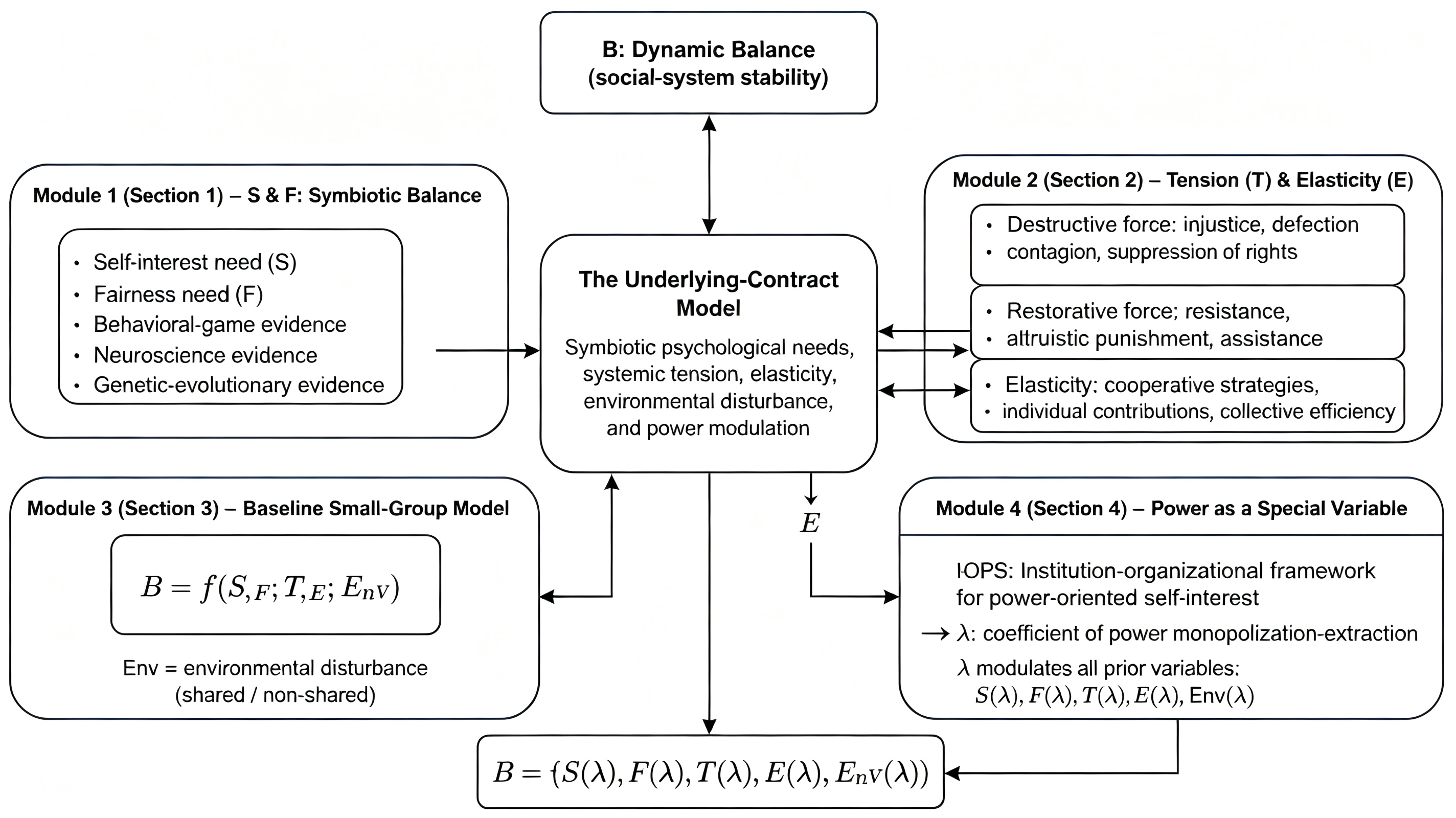
In short, the underlying-contract model constructed within this section incorporates multi-layered variable systems. The dependent variable is dynamic balance (B), jointly determined by satisfaction levels of core independent variables self-interest need (S) and fairness need (F) and trade-offs between them. Such trade-offs operate internally within individual minds, manifesting as mutual constraints between profit-seeking and fairness motives, and also manifest within group-level social processes as contestation and adjustment among diverse actors’ demands. Tension (T) and elasticity (E) function as foundational variables performing conflict-generating and moderating-buffering functions respectively. Fluctuations in tension (T) directly perturb balance between self-interest need (S) and fairness need (F), while elasticity (E) modulates the direction and magnitude of such perturbations. As an exogenous disturbance variable, environmental disturbance (Env) continuously impinges upon dynamic balance (B). Interactions and couplings across these variables generate characteristic nonlinear behavior within the overall model.
To intuitively characterize linkages among variables, this qualitative relational expression is introduced:B=f(S,F;T,E;Env)
This formula serves solely to illustrate pathways of variable influence and is not intended for quantitative computation.
5. Power: A Special Variable
The variables and their inter-relationships examined in the preceding section are rooted primarily in interpersonal interactions among individuals and within small groups. Once communities grow beyond a certain size, spontaneous individual-level restorative mechanisms and elastic adjustments alone are inadequate to sustain large-scale orders of reciprocal cooperation and social fairness. This observation is supported by evolutionary-psychological scholarship: as Leda Cosmides and John Tooby have noted, the human mind is adapted for social exchange within small-group settings rather than for interactions involving populations numbering in the tens of thousands (Cosmides & Tooby, 1997). Political power therefore emerges as a distinct new variable that fills this governance gap. Historical research corroborates this point. According to Stavrianos’s account, tribal chiefs governed their communities mainly through personal prestige and influence down to the late Paleolithic, without established coercive dominative power (Stavrianos, 2006, pp. 7–9). Following the end of the late Paleolithic and entering the phase of early civilizations, global population expanded dramatically. Estimates indicate that the world population increased sixty-fold over ten thousand years: from approximately 5 million people ten thousand years ago to roughly 300 million in 1 CE (Kaneda & Haub, 2022). Political power operating on a global-wide scale gradually took shape amid such social transformations.
Where, then, does political power originate? Diverse perspectives have been advanced on this question since antiquity. For instance, the divine-will theory holds that power derives from divine investiture (Bible, n.d., Exodus 19:5–6; Dong, c. 2nd-century BCE). The social-contract theory argues that power comes from popular delegation (Hobbes, 2009; Rousseau, 1980). The popular-consent theory maintains that power arises from the consent of the people (Locke, 2011). The natural-aptitude theory posits that power stems from individual capacities (Nietzsche, 2018). The experiential-reflection theory claims that power emerges from reflection upon injustice (Dershowitz, 2014, p. 8). Notwithstanding these competing interpretations of the origins of power and the complex, varied trajectories of power evolution across different regions of the world, the principle of public power for public purposes best conforms to fairness norms shaped by human evolutionary selection. This conclusion receives theoretical justification from Enlightenment thinkers including Locke, as well as empirical evidence from historical and anthropological studies. Over the long pre-historic period, tribal democracy and equal rights for group members represented prevalent social configurations, a pattern observable among foraging and early-agricultural tribes across the Americas and Eurasia ( Stavrianos, 2006, pp. 37–39;Leacock, 1978; Morgan, 1881/1985). Scholarship long held that despotism had been inherent to ancient Eastern civilizations. In recent decades, however, archaeological and historical investigations of sites from ancient Mesopotamia, ancient India and other Eastern-civilization contexts have uncovered vestiges and embryonic forms of democratic institutions such as popular assemblies, councils of noble elders, and public elections (Shi & Guo, 1998, p. 151).
Military structures of early civilizations furnish further corroboration of this observation. In those eras, soldiers took up arms mostly to safeguard the interests of themselves and their communities, rather than to uphold the rule of a single individual or lineage. Main military forces within Sumerian city-states, ancient Greek poleis, ancient Indian republican tribes, and the Roman Republic predominantly consisted of citizen-soldiers and tribal militias endowed with freedoms. During China’s Zhou Dynasty, primary combat forces likewise comprised aristocratic youths and free commoners: royal guards selected among nobility, and chariot troops conscripted from “Guoren”, free commoners at grassroots social strata (Liu, 1995, p. 3).
Beyond proto-democratic and egalitarian institutional features, early civilizations developed ethical value systems supporting public-oriented power and egalitarian governance. Classical-era Aristotle explicitly defined political justice, arguing that politics essentially concerns distributive justice and that rulers ought to act as guardians of fairness and equality (Aristotle, 350 BCE/2003, pp. 134–151, p. 148). Karl Jaspers’ modern Axial-Age theory further documents synchronous intellectual breakthroughs occurring between the eighth and second centuries BCE among civilizations situated roughly along the 30th degree north latitude, including China, India, Iran, Hebrew societies, and ancient Greece (Jaspers, 2019, pp. 8–35, p. 39, pp. 73–77). Although Jaspers did not directly connect this spiritual transformation to egalitarian-governance institutions, Eastern and Western civilizations of that era articulated variants of the golden rule: “Do not do unto others what you would not want done unto you”, and “Treat others as you would wish to be treated yourself”. Such maxims show that perspective-taking and respect for others constituted interpersonal norms advocated by intellectual elites across those societies.
Ironically, however, these six centuries celebrated in later eras for “human spiritual awakening” witnessed intensified inter-group conquest, plunder, and oppression. Ancient civilizations across the globe entered varying phases of power-driven self-interest. Restorative and elastic mechanisms originally designed to punish defection, sustain cooperation, and regulate inter-group relations gradually lost efficacy, and early egalitarian-co-governance orders collapsed.
Within this historical transformation, inter-polity wars of annexation in China were exceptionally intense.According to Cho-yun Hsu’s estimates, the 294-year Spring-and-Autumn period saw 1211 battles among feudal states; only 38 years remained free of warfare, and over 110 political entities were eliminated through conflict. The subsequent 254-year Warring-States period brought 468 additional battles, with merely 89 years of peace, culminating in the formation of seven major competing powers (Hsu,2006, pp. 66–80).Warfare during Spring-and-Autumn and Warring-States eras exceeded intensity within contemporaneous ancient Western civilizations in terms of mobilization scales and casualties. Scholarly estimates indicate that military mobilization ratios reached approximately 1 % of total population within the Roman Republic and 5.2 % within the Greek Delian League, whereas mobilization ratios in the state of Qin ranged between 8 % and 20 %. Regarding casualties, Roman forces suffered roughly 50 000 total fatalities across the Battle of Lake Trasimene and the Battle of Cannae (Fukuyama, 2012, p. 121). By contrast, between 364 BCE and 260 BCE, Qin military campaigns killed over 1 200 000 enemy soldiers (Hsu,2006, p. 81). Such stark contrasts in mobilization depth and casualty magnitudes reveal divergent responses to existential pressures shaped by alternative power structures.
As Max Weber observed, patrimonial armies constituted crucial pillars sustaining domination by Egyptian pharaohs and emperors under the Qin system (Weber, 2004, pp. 156–159, 159–164). This observation demonstrates that the nature of political power hinges upon institutional belonging of military forces. When armies cease to serve public ends and instead swear allegiance exclusively to particular individuals, lineages, or factions, power inevitably acquires self-interested orientations. Sustained large-scale wars of annexation function as catalysts eroding armies’ public character and driving power privatization. Although not focusing explicitly on power privatization, scholars including Hui Yun-chun, Francis Fukuyama, and Charles Tilly have all demonstrated how warfare reshapes power structures, fiscal systems, and military institutions (Hui, 2018, pp. 106–114; Fukuyama, 2012, pp. 111–121; Tilly, 2012, pp. 81–115, 152–156).
Precisely amid persistent and intense inter-group conflicts and wars of annexation throughout Spring-and-Autumn and Warring-States times, the royal house of Qin gradually built large-scale privatized standing armies. Military privatization was not an isolated event, however. To sustain and guarantee absolute loyalty from these massive armed forces, the Qin royal house constructed complementary administrative, fiscal, and policing governance systems, implementing centrally controlled commandery-county institutions and hostage-style governance mechanisms (Xue, n.d., Chs. 5–6). In comparative research between China and the West, Hui Yun-chun notes that China’s centralized bureaucracy facilitated state-mandated taxation, conscription, and population surveillance (Hui, 2018, pp. 106–114).
An analogous evolutionary trajectory of power unfolded within ancient Rome. Rome originated as a small polity in central Italy and expanded continuously throughout its republican era. Between 264 BCE and 146 BCE, three Punic Wars defeated Carthage and secured Mediterranean hegemony. Four Macedonian Wars from 215 BCE to 148 BCE conquered Greek territories, and Syrian-War campaigns combined with diplomatic maneuvering extended Roman control across portions of West Asia, culminating in a trans-continental Mediterranean empire. Cumulative effects of prolonged foreign conquests and internal factional strife drove transformations across the Sulla-Caesar-Octavian succession. Roman armies transitioned from citizen-soldiers loyal to the republican commonwealth toward private warlord retinues. Public power became increasingly privatized, ultimately yielding imperial principate institutions replacing republican governance.
Power-privatization processes driven by warfare and military privatization were not unique to individual civilizations. Nevertheless, transitions from relatively egalitarian tribal orders toward highly self-interested patrimonial orders unfolded not instantaneously but cumulatively across generations of power contests and institutional experimentation. Superficially, Mongol polities appear to have transformed rapidly from steppe tribal confederations into patrimonial empires. Before imperial formation, however, steppe societies had already experienced successive dynastic transitions and long-standing exposure to power-self-interest logics. Indeed, Genghis Khan displayed power-privatizing inclinations during his rise. For instance, when forming alliances, he prioritized personal loyalty over ancient tribal traditions, exemplified by the Baljuna Covenant (Atwood, 2004, p. 101; Ratchnevsky, 1991, pp. 147–148). To consolidate personal authority and eliminate internal tribal opponents, he openly violated traditional tribal judicial customs. Around 1197 CE, the Jurkin clan declined joint military campaigns against the Tatars and raided Genghis Khan’s home encampment. According to steppe-clan traditions, major disputes required collective adjudication by tribal elders. Genghis Khan nonetheless used this incident as pretext to execute aristocratic kinsmen Sachi Beki and Tuchin autocratically. Later, he ordered Belgutei to kill aristocratic noble Buri Boko affiliated with the Jurkin during a wrestling contest(Ratchnevsky, 1991, pp. 54–56). These episodes demonstrate that tendencies toward power patrimonialization within Mongol societies had already advanced alongside wars of annexation.
It must be emphasized that power differs from variables analyzed above because it operates primarily through institutions and organizations, extending implicit underlying-contract dynamics from small-group contexts into diverse domains and across social strata within macro-scale societies. Once power becomes privatized, institutional-organizational framework (IO) built upon power-oriented self-interest (PS) distorts and potentially dismantles symbiotic balance (B) between popular self-interest need (S) and fairness need (F) from its source. It simultaneously reshapes manifestations of tension (T), erodes regulatory capacities of elasticity (E), and even diminishes systemic efficiency in responding to environmental disturbance (Env). Greater monopolization and extractive capacity of self-interested power correspond to more severe overall systemic imbalance.
Given varying power intensities across contexts, this qualitative functional model is introduced to characterize nonlinear inter-variable relationships:
B=f(S(λ),F(λ),T(λ),E(λ),Env(λ))
Identical to prior formulas, this expression is not designed for quantitative calculation; it only signifies that social balance B is jointly shaped by variables modulated by λ, the coefficient of power monopolization and extraction. λ is generated by IO_PS, the institutional-organizational framework serving power-oriented self-interest.
Definitions for symbolic notation are presented below. All partial-derivative symbols ∂ appearing within tables and subsequent deductions serve qualitatively to indicate directions of marginal variable shifts; they do not imply analytical differentiation or numerical solvability for this model.
| Symbol. | Meaning | Explanation |
| B | State of social dynamic balance | Dependent variable, final output of the model, reflecting coordination and stability of overall social functioning |
| λ | Coefficient of power monopolization and extraction | Mediating variable, λ = φ(IO_PS), range: 0 < λ ≤ 1; measures monopolization and extractive intensity of IO_PS. λ = 0 denotes purely public-oriented power, outside the domain of power monopolization-extraction scenarios addressed in this model |
| φ(·) | Institution-organization mapping symbol | Conceptual mapping symbol expressing causal relationships whereby IO_PS generates and determines λ; no quantitative computational purpose |
| IO_PS | Institutional-organizational framework serving power-oriented self-interest | Fundamental independent variable, encompassing real-world institutions, organizations, laws, personnel networks and other tangible structures |
| S(λ) | Self-interest need perturbed by λ | Core variable, reflecting reasonable popular demands for realization of personal interests and their practically attainable levels under given institutions |
| F(λ) | Fairness need perturbed by λ | Core variable, reflecting popular demands for distributive justice and equal rule-enforcement alongside their practically attainable levels under given institutions |
| T(λ) | Net value of tension perturbed by λ | Foundational variable; net tension rising with λ, jointly determined by destructive-restorative forces modulated by system elasticity E. Captures both direct λ effects on destruction-restoration mechanisms and indirect effects mediated via E(λ). Qualitatively ∂T/∂λ > 0 |
| E(λ) | System elasticity perturbed by λ | Foundational variable; system elasticity decaying as λ rises, determined by comprehensive buffering-moderating capacities of sub-variables including cooperative strategies, individual contributions, and collective efficiency. Qualitatively ∂E/∂λ < 0 |
| Env(λ) | External environment perturbed/shaped by λ | Exogenous variable encompassing sociocultural and physical-geographical environments, whose conditions are intervened upon and shaped by IO_PS coping strategies. Marginal response directions are indeterminate |
| f(·) | Multi-variable coupling system function | Functional symbol integrating variables S, F, T, E, Env to produce comprehensive rules generating final social balance B |
Based on variable definitions above, two ideal-type intervals describing power-privatization degrees can be distinguished.
When λ → 1, self-interested power approaches maximal monopolization and extraction. Institutional structures almost fully block pathways for realizing popular self-interest need and fairness need. Under these conditions, marginal increases in λ cannot depress S and F further; both variables approach asymptotic minima with marginal rates of change near zero, i.e. ∂S/∂λ ≈ 0, ∂F/∂λ ≈ 0.The Soviet-type system and slavery serve as the most typical cases.
Within the gradient interval 0 < λ < 1 for monopolization-extraction of self-interested power, regardless of whether λ assumes low or high values within this range, rising power monopolization-extraction intensity persistently suppresses popular reasonable self-interest- and fairness-need satisfaction. Every marginal unit increase in λ reduces satisfaction levels for S and F; marginal rates of change remain consistently negative: ∂S/∂λ < 0, ∂F/∂λ < 0.Ancient monarchies and aristocracies fall within this gradient.
Furthermore, rising λ generates decaying system elasticity E(λ) (∂E/∂λ < 0) and diminished regulatory capacity, which in turn may increase net tension T(λ) (∂T/∂λ > 0). Diminished regulatory capacity and amplified destructive forces jointly exacerbate tendencies toward social-system imbalance.
6. Conclusion
The underlying-contract defined in this paper differs both from the category of social contract in political-philosophy scholarship and from the social-contract theory deployed within evolutionary psychology to explain social reciprocal exchange. The shortcoming of the former lies in its reasoning-based approach, which readily generates divergences stemming from differing standpoints. For instance, in their respective arguments in Leviathan, Second Treatise of Government, and The Social Contract, Hobbes, Locke, and Rousseau all share the concept of “contract”, yet hold manifestly distinct positions regarding assumptions about the state of nature, the purposes of contract, the nature of sovereignty, the role of government, and individual freedom together with the alienation of rights. Even in the twenty-first century, researchers adopting disparate theoretical perspectives still produce markedly different interpretations of the “social-contract” concept (Zhang,2002, p.11; Song,2023,pp. 34-44). Some accounts even characterize contemporary autocratic regimes as forms of social contract, a claim that has gained considerable circulation (Li,2015). By contrast, the latter body of theory draws on evolutionary theory, cognitive science and game theory to investigate cognitive adaptiveness in reciprocal cooperation. It reveals that the human brain is highly sensitive to social-contract violations, especially to cheating behaviour in which agents reap benefits without bearing corresponding costs. It addresses implicit or explicit reciprocal agreements or exchange relations among individuals (“You help me, and I will help you”) and touches on the “computational mechanism” behind social-exchange problems. Nevertheless, this theory centres on explaining the evolutionary mechanisms governing social-exchange cognition (Barkow et al.,1992, pp.163-228).
This implicit underlying-contract can be traced for its modes of existence and operation across dimensions including historical cycles, the survival capacity of political regimes, and power decontamination (the public-oriented transformation of power). In my manuscript The Underlying Contract: The Primary Internal Cause of China’s Historical Cycle [Unpublished manuscript], I offer comparatively detailed analyses drawing on China’s historical cycle, sixteen political regimes that endured for more than 500 years, as well as power decontamination and moral-elevation processes in Britain and the United States. This work aims to deliver a root-level cognitive perspective that helps avert theoretical misguidance and governance disasters analogous to those brought about by Soviet-style socialism. Aware of my own scholarly limitations, I recognize that the arguments put forward in this text may still be sketchy. I only hope that these tentative observations can inspire a measure of reflection among readers.
References
- Achtziger, A., Alós-Ferrer, C., & Wagner, A. K. (2016). The impact of self-control depletion on social preferences in the ultimatum game. Journal of Economic Psychology, 53, 1-16. [CrossRef]
- Alam, R., & Rai, T. S. (2025). Profitable third-party punishment. Proceedings of the National Academy of Sciences, 122(34), Article e2508479122. [CrossRef]
- Almås, I., Cappelen, A. W., Sørensen, E. Ø., & Tungodden, B. (2010). Fairness and the development of inequality acceptance. Science, 328(5982), 1176-1178. [CrossRef]
- Aristotle. (2003). Nicomachean ethics (S.-B. Liao, Annotated & Trans.). The Commercial Press. (Original work, c. 340 BCE).
- Atwood, C. P. (2004). Encyclopedia of Mongolia and the Mongol empire. Facts on File.
- Axelrod, R. (1984/2007). *The evolution of cooperation* (J. Wu, Trans.). Shanghai People’s Publishing House. ISBN 978-7-208-07145-2.
- Axelrod, R. (1997/2008). *The complexity of cooperation: Agent-based models of competition and cooperation* (J. Liang & X. Gao, Trans.). Shanghai People’s Publishing House. ISBN 978-7-208-07570-2.
- Barkow, J. H., Cosmides, L., & Tooby, J. (Eds.). (1992). The adapted mind: Evolutionary psychology and the generation of culture. Oxford University Press.
- Bear, A., & Rand, D. G. (2016). Intuition, deliberation, and the evolution of cooperation. Proceedings of the National Academy of Sciences, 113(4), Article 936-941. [CrossRef]
- Bickart, K. C., Dickerson, B. C., & Barrett, L. F. (2014). The amygdala as a hub in brain networks that support social life. Neuropsychologia, 63, 235-248. [CrossRef]
- Blount, S. (1995). When social outcomes aren’t fair: The effect of causal attributions on preferences. Organizational Behavior and Human Decision Processes, 63(2), 131-144. [CrossRef]
- Boehm, C. (2012). Moral origins: The evolution of virtue, altruism, and shame. Basic Books.
- Bohnet, I., & Frey, B. S. (1999). Social distance and other-regarding behavior in dictator games: Comment. The American Economic Review, 89(3), 335-339. [CrossRef]
- Bowles, S., & Gintis, H. (2004). The evolution of strong reciprocity: Cooperation in heterogeneous populations. Theoretical Population Biology, 65(1), 17-28. [CrossRef]
- Boyd, R., Gintis, H., Bowles, S., & Richerson, P. J. (2003). The evolution of altruistic punishment. Proceedings of the National Academy of Sciences, 100(6), 3531-3535. [CrossRef]
- Brosnan, S. F., & de Waal, F. B. M. (2003). Monkeys reject unequal pay. Nature, 425(6955), 297-299. [CrossRef]
- Bouchard, T. J., Jr., Lykken, D. T., McGue, M., Segal, N. L., & Tellegen, A. (1990). Sources of human psychological differences: The Minnesota study of twins reared apart. Science, 250(4978), 223-228. [CrossRef]
- Bouchard, T. J., Jr., & McGue, M. (2003). Genetic and environmental influences on human psychological differences. Journal of Neurobiology, 54(1), 4-45. [CrossRef]
- Brüne, M., Scheele, D., Heinisch, C., Tas, C., Wischniewski, J., & Güntürkün, O. (2012). Empathy moderates the effect of repetitive transcranial magnetic stimulation of the right dorsolateral prefrontal cortex on costly punishment. PLOS ONE, 7(9), Article e44747. [CrossRef]
- Buckholtz, J. W., Asplund, C. L., Dux, P. E., Zald, D. H., Gore, J. C., Jones, O. D., & Marois, R. (2008). The neural correlates of third-party punishment. Neuron, 60(5), 930-940. [CrossRef]
- Buckholtz, J. W., & Marois, R. (2012). The roots of modern justice: Cognitive and neural foundations of social norms and their enforcement. Nature Neuroscience, 15(5), 655-661. [CrossRef]
- Buchan, N. R., Croson, R. T. A., Johnson, E. J., & Wu, G. (2005). Gain and loss ultimatums. In J. Morgan (Ed.), Advances in applied microeconomics (Vol. 13, pp. 1-24). Elsevier. [CrossRef]
- Burnham, T. C. (2007). High-testosterone men reject low ultimatum game offers. Proceedings of the Royal Society B: Biological Sciences, 274(1623), 2327-2330. [CrossRef]
- Camerer, C. F. (2003). Behavioral game theory: Experiments in strategic interaction. Princeton University Press.
- Camerer, C. F., & Thaler, R. H. (1995). Anomalies: Ultimatums, dictators and manners. Journal of Economic Perspectives, 9(2), 209-219. [CrossRef]
- Cappelen, A. W., Hole, A. D., Sørensen, E. Ø., & Tungodden, B. (2007). The pluralism of fairness ideals: An experimental approach. The American Economic Review, 97(3), 818-827. [CrossRef]
- Chen, Y.-F., Zhou, Y.-A., & Song, Z.-F. (2011). Do people care about distributive intention or distributive outcome? [What do people care about: Distributive motive versus distributive outcome]. Economic Research Journal, 6, 31-44.
- Cosmides, L., & Tooby, J. (1997, January 13). Evolutionary psychology: A primer. University of California, Santa Barbara, Center for Evolutionary Psychology. https://www.cep.ucsb.edu/primer.html.
- de Quervain, D. J.-F., Fischbacher, U., Treyer, V., Schellhammer, M., Schnyder, U., Buck, A., & Fehr, E. (2004). The neural basis of altruistic punishment. Science, 305(5688), 1254-1258. [CrossRef]
- Debowicz, D., Saporiti, A., & Wang, Y. (2021). Redistribution, power sharing, and inequality concern. Social Choice and Welfare, 57(2), 197-228. [CrossRef]
- Decety, J., & Yoder, K. J. (2017). The emerging social neuroscience of justice motivation. Trends in Cognitive Sciences, 21(1), 6-14. [CrossRef]
- DeShanowitz, A. M. (2014). Where rights come from: A secular theory of the origins of rights (Y.-W. Huang, Trans.). Peking University Press. (Original work published 2004).
- Dong, Z.-S. (c. 2nd century BCE). Chun-qiu fan-lu (S.-L. Zhang, Z.-P. Zhong, & G.-D. Zhou, Annot.). Zhonghua Book Company. (Annotated edition published 2012).
- Dunn, B. D., Evans, D., Makarova, D., White, J., & Clark, L. (2012). Gut feelings and the reaction to perceived inequity: The interplay between bodily responses, regulation, and perception shapes the rejection of unfair offers on the ultimatum game. Cognitive, Affective, & Behavioral Neuroscience, 12(3), 419-429. [CrossRef]
- Engelmann, D., & Strobel, M. (2004). Inequality aversion, efficiency, and maximin preferences in simple distribution experiments. The American Economic Review, 94(4), 857-869. [CrossRef]
- Engelmann, D., & Strobel, M. (2006). Inequality aversion, efficiency, and maximin preferences in simple distribution experiments: Reply. The American Economic Review, 96(5), 1918-1923. [CrossRef]
- Falk, A., Fehr, E., & Fischbacher, U. (2003). On the nature of fair behavior. Economic Inquiry, 41(1), 20-26. [CrossRef]
- Fehr, E., & Camerer, C. F. (2007). Social neuroeconomics: The neural circuitry of social preferences. Trends in Cognitive Sciences, 11(10), 419-427. [CrossRef]
- Fehr, E., Fischbacher, U., & Gächter, S. (2002). Strong reciprocity, human cooperation, and the enforcement of social norms. Human Nature, 13(1), 1-25. [CrossRef]
- Fehr, E., & Gächter, S. (2000). Cooperation and punishment in public goods experiments. The American Economic Review, 90(4), 980-994. [CrossRef]
- Fehr, E., & Gächter, S. (2002). Altruistic punishment in humans. Nature, 415(6868), 137-140. [CrossRef]
- Fehr, E., Gächter, S., & Kirchsteiger, G. (1997). Reciprocity as a contract enforcement device: Experimental evidence. Econometrica, 65(4), 833-860. [CrossRef]
- Fehr, E., Kirchsteiger, G., & Riedl, A. (1993). Does fairness prevent market clearing? An experimental investigation. The Quarterly Journal of Economics, 108(2), 437-459. [CrossRef]
- Fehr, E., Naef, M., & Schmidt, K. M. (2006). Inequality aversion, efficiency, and maximin preferences in simple distribution experiments: Comment. The American Economic Review, 96(5), 1912-1917. [CrossRef]
- Fehr, E., & Schmidt, K. M. (1999). A theory of fairness, competition, and cooperation. The Quarterly Journal of Economics, 114(3), 817-868. [CrossRef]
- Feng, C., Luo, Y.-J., & Krueger, F. (2015). Neural signatures of fairness-related normative decision making in the ultimatum game: A coordinate-based meta-analysis. Human Brain Mapping, 36(2), 591-602. [CrossRef]
- Fukuyama, F. (2012). The origins of political order: From prehuman times to the French Revolution (J. Mao, Trans.). Guangxi Normal University Press. (Original work published 2011).
- Garrod, L. (2009). Investigating motives behind punishment and sacrifice: A within-subject analysis [Preprint]. SSRN Electronic Journal. [CrossRef]
- Gospic, K., Sundberg, M., Maeder, J., Fransson, P., Petrovic, P., Isacsson, G., Karlström, A., & Ingvar, M. (2014). Altruism costs-the cheap signal from amygdala. Social Cognitive and Affective Neuroscience, 9(9), 1325-1332. [CrossRef]
- Guo, X., Zheng, L., Zhu, L., Li, J., Wang, Q., Dienes, Z., & Yang, Z. (2013). Increased neural responses to unfairness in a loss context. NeuroImage, 77, 246-253. [CrossRef]
- Guo, X., Zheng, L., Cheng, X., Chen, M., Zhu, L., Li, J., Chen, L., & Yang, Z. (2014). Neural responses to unfairness and fairness depend on self-contribution to the income. Social Cognitive and Affective Neuroscience, 9(10), 1498-1505. [CrossRef]
- Güroğlu, B., van den Bos, W., Rombouts, S. A. R. B., & Crone, E. A. (2010). Unfair? It depends: Neural correlates of fairness in social context. Social Cognitive and Affective Neuroscience, 5(4), 414-423. [CrossRef]
- Güroğlu, B., van den Bos, W., van Dijk, E., Rombouts, S. A. R. B., & Crone, E. A. (2011). Dissociable brain networks involved in development of fairness considerations: Understanding intentionality behind unfairness. NeuroImage, 57(2), 634-641. [CrossRef]
- Güth, W., Schmittberger, R., & Schwarze, B. (1982). An experimental analysis of ultimatum bargaining. Journal of Economic Behavior & Organization, 3(4), 367-388. [CrossRef]
- Halali, E., Bereby-Meyer, Y., & Meiran, N. (2014). Between self-interest and reciprocity: The social bright side of self-control failure. Journal of Experimental Psychology: General, 143(2), 745-755. [CrossRef]
- Hardin G.(1968).The Tragedy of the Commons.Science162,1243-1248(1968). [CrossRef]
- Henrich, J., Boyd, R., Bowles, S., Camerer, C., Fehr, E., Gintis, H., & McElreath, R. (2001). In search of homo economicus: Behavioral experiments in 15 small-scale societies. The American Economic Review, 91(2), 73-78. [CrossRef]
- Henrich, J., Boyd, R., Bowles, S., Camerer, C., Fehr, E., & Gintis, H. (Eds.). (2004). Foundations of human sociality: Economic experiments and ethnographic evidence from fifteen small-scale societies. Oxford University Press. [CrossRef]
- Henrich, J., Boyd, R., Bowles, S., Camerer, C., Fehr, E., Gintis, H., McElreath, R., Alvard, M., Barr, A., Ensminger, J., Henrich, N. S., Hill, K., Gil-White, F., Gurven, M., Marlowe, F. W., Patton, J. Q., & Tracer, D. (2005). “Economic man” in cross-cultural perspective: Behavioral experiments in 15 small-scale societies. Behavioral and Brain Sciences, 28(6), 795-815. [CrossRef]
- Hoeft, L., & Mill, W. (2017). Selfish punishers: An experimental investigation of designated punishment behavior in public goods. Economics Letters, 157, 41-44. [CrossRef]
- Hobbes, T. (2009). Leviathan (S.-F. Li, & Z.-Y. Li, Trans.). The Commercial Press. (Original work published 1651).
- Hsu, C. Y. (2006). *Ancient China’s social history: Social mobility during the Spring and Autumn and Warring States periods* (S. Zou, Trans.). Guangxi Normal University Press. ISBN 7-5633-5798-X.
- Hsu, M., Anen, C., & Quartz, S. R. (2008). The right and the good: Distributive justice and neural encoding of equity and efficiency. Science, 320(5879), 1092-1095. [CrossRef]
- Hu, J., Hu, Y., Li, Y., & Zhou, X.-L. (2021). Computational and neurobiological substrates of cost-benefit integration in altruistic helping decision. The Journal of Neuroscience, 41(15), 3545-3561. [CrossRef]
- Hu, X., & Mai, X. (2021). Social value orientation modulates fairness processing during social decision-making: Evidence from behavior and brain potentials. Social Cognitive and Affective Neuroscience, 16(7), 670-682. [CrossRef]
- Hu, X., Zhang, Y., Liu, X., Guo, Y., Liu, C., & Mai, X. (2022). Effects of transcranial direct current stimulation over the right dorsolateral prefrontal cortex on fairness-related decision-making. Social Cognitive and Affective Neuroscience, 17(8), 695-702. [CrossRef]
- Huang, Y.-H. (2022). An integrated study on the influencing mechanism of authoritarian leadership on employees’ organizational citizenship behavior [Master’s thesis]. Northwest Normal University.
- Hui, V. T.-B. (2018). War and state formation in ancient China and early-modern Europe (J. Xu, Trans., 2nd Chinese ed.). Shanghai People’s Publishing House. (Original work published 2005).
- Jaspers, K. (2019). The origin and goal of history (X.-F. Li, Trans.). Li River Publishing House. (Original work published 1949).
- Kahneman, D., Knetsch, J. L., & Thaler, R. H. (1986). Fairness and the assumptions of economics. The Journal of Business, 59(4), S285-S300. [CrossRef]
- Kaltwasser, L., Hildebrandt, A., Wilhelm, O., & Sommer, W. (2016). Behavioral and neuronal determinants of negative reciprocity in the ultimatum game. Social Cognitive and Affective Neuroscience, 11(10), 1608-1617. [CrossRef]
- Kaneda, T., & Haub, C. (2022, November 15). How many people have ever lived on earth? [Research report]. Population Reference Bureau. https://www.prb.org/how-many-people-have-ever-lived-on-earth/.
- Knoch, D., Pascual-Leone, A., Meyer, K., Treyer, V., & Fehr, E. (2006). Diminishing reciprocal fairness by disrupting the right prefrontal cortex. Science, 314(5800), 829-832. [CrossRef]
- Knoch, D., Schneider, F., Schunk, D., Hohmann, M., & Fehr, E. (2009). Disrupting the prefrontal cortex diminishes the human ability to build a good reputation. Proceedings of the National Academy of Sciences, 106(49), 20895-20899. [CrossRef]
- Koenigs, M., & Tranel, D. (2007). Irrational economic decision-making after ventromedial prefrontal damage: Evidence from the ultimatum game. The Journal of Neuroscience, 27(4), 951-956. [CrossRef]
- Konow, J. (2000). Fair shares: Accountability and cognitive dissonance in allocation decisions. The American Economic Review, 90(5), 1072-1091. [CrossRef]
- Krueger, F., McCabe, K., Moll, J., Kriegeskorte, N., Zahn, R., Strenziok, M., Heinecke, A., & Grafman, J. (2007). Neural correlates of trust. Proceedings of the National Academy of Sciences, 104(50), 20084-20089. [CrossRef]
- Le, M. T., Saporiti, A., & Wang, Y. (2021). Distributive politics with other-regarding preferences. Journal of Public Economic Theory, 23(2), 203-227. [CrossRef]
- Le, M. T., & Saporiti, A. (2024). Inequity aversion and the stability of majority rule. Public Choice. [CrossRef]
- Leacock, E. (1978). Women’s status in egalitarian society: Implications for social evolution. Current Anthropology, 19(2), 245-270. [CrossRef]
- Li, D.-H. (2015, June 28). Is the party greater than the law? A simple comparison cannot be made. https://m2.hswh.org.cn/index.php/wzzx/llyd/zz/2015-06-27/32607.html [in Chinese].
- Lieberman, M. D. (2007). Social cognitive neuroscience: A review of core processes. Annual Review of Psychology, 58, 259-289. [CrossRef]
- Liu, H.-T. (1995). Soldier life and warfare in ancient China: Military systems in ancient China. The Commercial Press.
- Liu, Y., Li, S., Lin, W., Li, W., Yan, X., Wang, X., Pan, X., Si, Y., & Ma, Y. (2019). Oxytocin modulates social value representations in the amygdala. Nature Neuroscience, 22(4), 633-641. [CrossRef]
- Locke, J. (2011). Second treatise of government (Q.-F. Ye, & J.-N. Qu, Trans.). The Commercial Press. (Original work published 1689).
- Marsh, A. A. (2018). Indirect reciprocity and reputation management: Interdisciplinary findings from evolutionary biology and economics. Public Relations Review, 44(4), 463-470. [CrossRef]
- Marsh, A. A., Stoycos, S. A., Brethel-Haurwitz, K. M., Robinson, P., VanMeter, J. W., & Cardinale, E. M. (2014). Neural and cognitive characteristics of extraordinary altruists. Proceedings of the National Academy of Sciences, 111(42), 15036-15041. [CrossRef]
- Martinsson, P., Myrseth, K. O. R., & Wollbrant, C. (2014). Social dilemmas: When self-control benefits cooperation. Journal of Economic Psychology, 45, 213-236. [CrossRef]
- Moll, J., Krueger, F., Zahn, R., Pardini, M., de Oliveira-Souza, R., & Grafman, J. (2006). Human fronto-mesolimbic networks guide decisions about charitable donation. Proceedings of the National Academy of Sciences, 103(42), 15623-15628. [CrossRef]
- Morgan, L. H. (1881/1985). Houses and house-life of the American aborigines(P. Li, Trans.). China Social Sciences Press.
- Myrseth, K. O. R., Fishbach, A., & Trope, Y. (2009). Counteractive self-control. Psychological Science, 20(2), 159-163. [CrossRef]
- Nietzsche, F. W. (2018). The will to power (Z.-X. Sun, Trans.). Shanghai People’s Publishing House. (Original work published 1901).
- Nowak, M. A. (2006). Five rules for the evolution of cooperation. Science, 314(5805), 1560-1563. [CrossRef]
- Nowak, M. A., & Sigmund, K. (1993). A strategy of win-stay, lose-shift that outperforms tit-for-tat in the prisoner’s dilemma game. Nature, 364(6432), 56-58. [CrossRef]
- Nowak, M. A., & Sigmund, K. (1998). Evolution of indirect reciprocity by image scoring. Nature, 393(6685), 573-577. [CrossRef]
- Okun, A. M. (1975/2013). Equality and efficiency: The big tradeoff(T. Chen, Trans.). China Social Sciences Press. ISBN 978-7-5161-1757-6.
- Proctor, D., Williamson, R. A., de Waal, F. B. M., & Brosnan, S. F. (2013). Chimpanzees play the ultimatum game. Proceedings of the National Academy of Sciences, 110(6), 2070-2075. [CrossRef]
- Rand, D. G., Armao IV, J. J., Nakamaru, M., & Ohtsuki, H. (2010). Anti-social punishment can prevent the co-evolution of punishment and cooperation. Journal of Theoretical Biology, 265(4), 624-632. [CrossRef]
- Rand, D. G., Greene, J. D., & Nowak, M. A. (2012). Spontaneous giving and calculated greed. Nature, 489(7416), 427-430. [CrossRef]
- Ratchnevsky, P. (1991). Genghis Khan: His life and legacy (T. Haining, Trans.). Blackwell.
- Rankin, D. J., Milinski, M., & Wedekind, C. (2007). Competitive and cooperative punishment. Nature, 445(7125), 348-351. [CrossRef]
- Rayman, P. M. (1982). Kibbutz community and nation building. Princeton University Press.
- Rousseau, J.-J. (1980). The social contract (Z.-W. He, Trans.). The Commercial Press. (Original work published 1762).
- Ruan, Q.-S., & Huang, X.-H. (2005). Literature review on western theories of fairness preference [A review of western fairness-preference theory]. Foreign Economics & Management, 6, 10-16.
- Rubinstein, A. (2007). Instinctive and cognitive reasoning: A study of response times. The Economic Journal, 117(523), 1243-1259. [CrossRef]
- Salahshour, M. (2019). Evolution of costly signaling and partial cooperation. Scientific Reports, 9, Article 8792. [CrossRef]
- Sanfey, A. G., & Chang, L. J. (2008). Multiple systems in decision making. Annals of the New York Academy of Sciences, 1128, 53-62. [CrossRef]
- Sanfey, A. G., Loewenstein, G., McClure, S. M., & Cohen, J. D. (2006). Neuroeconomics: Cross-currents in research on decision-making. Trends in Cognitive Sciences, 10(3), 108-116. [CrossRef]
- Sanfey, A. G., Rilling, J. K., Aronson, J. A., Nystrom, L. E., & Cohen, J. D. (2003). The neural basis of economic decision-making in the ultimatum game. Science, 300(5626), 1755-1758. [CrossRef]
- Satpute, A. B., & Lieberman, M. D. (2006). Integrating automatic and controlled processes into neurocognitive models of social cognition. Brain Research, 1079(1), 86-97. [CrossRef]
- Shi, Z.-S., & Guo, F. (Eds.). (1998). Ancient democracy and republican institutions. China Social Sciences Press.
- Soler, M. (2012). Costly signaling, ritual and cooperation: Evidence from Candomblé, an Afro-Brazilian religion. Evolution and Human Behavior, 33(4), 346-356. [CrossRef]
- Song, C.-F. (2023). Common prosperity as the social contract of socialism with Chinese characteristics. *Guangxi Social Sciences*, (1), 34-44. [in Chinese].
- Sonne, J. W. H., & Gash, D. M. (2018). Psychopathy to altruism: Neurobiology of the selfish-selfless spectrum. Frontiers in Psychology, 9, Article 575. [CrossRef]
- Stallen, M., Rossi, F., Heijne, A., Smidts, A., De Dreu, C. K. W., & Sanfey, A. G. (2018). Neurobiological mechanisms of responding to injustice. The Journal of Neuroscience, 38(12), 2944-2954. [CrossRef]
- Stavrianos, L. S. (2006). A global history: From prehistory to the 21st century (X.-Y. Wu, C.-M. Liang, S.-H. Dong, & C. Wang, Trans., 7th rev. ed.). Peking University Press. (Original work published 1999).
- Sütterlin, S., Herbert, C., Schmitt, M., Kübler, A., & Vögele, C. (2011). Overcoming selfishness: Reciprocity, inhibition, and cardiac-autonomic control in the ultimatum game. Frontiers in Psychology, 2, Article 173. [CrossRef]
- Sunde, U. (2006). Wirtschaftliche Entwicklung und Demokratie – Ist Demokratie ein Wohlstandsmotor oder ein Wohlstandsprodukt? Perspektiven der Wirtschaftspolitik, 7(4), 471-499. [CrossRef]
- Sutter, M. (2007). Outcomes versus intentions: On the nature of fair behavior and its development with age. Journal of Economic Psychology, 28(1), 69-78. [CrossRef]
- Tilly, C. (2012). Coercion, capital, and European states, AD 990-1992 (H.-Z. Wei, Trans.). Shanghai People’s Publishing House. (Original work published 1990).
- Van’t Wout, M., Chang, L. J., & Sanfey, A. G. (2010). The influence of emotion regulation on social interactive decision-making. Emotion, 10(6), 815-821. [CrossRef]
- Wallace, B., Cesarini, D., Lichtenstein, P., & Johannesson, M. (2007). Heritability of ultimatum game responder behavior. Proceedings of the National Academy of Sciences, 104(40), 15631-15634. [CrossRef]
- Wang, H., Wu, X., Xu, J., Zhu, R., Zhang, S., Xu, Z., et al. (2024). Acute stress during witnessing injustice shifts third-party interventions from punishing the perpetrator to helping the victim. PLOS Biology, 22(5), Article e3002195. [CrossRef]
- Wang, Y., Zheng, D., Chen, J., Rao, L.-L., Li, S., & Zhou, Y. (2019). Born for fairness: Evidence of genetic contribution to a neural basis of fairness intuition. Social Cognitive and Affective Neuroscience, 14(5), 539-548. [CrossRef]
- Weber, M. (2004). Economy and society: Sociology of domination (K.-L. Kang, & H.-M. Jian, Trans.). Guangxi Normal University Press. (Original work published 1922).
- Wedekind, C., & Milinski, M. (1996). Human cooperation in the simultaneous and the alternating Prisoner’s Dilemma: Pavlov versus Generous Tit-for-Tat. Proceedings of the National Academy of Sciences, 93(7), 2686-2689. [CrossRef]
- Wedekind, C., & Milinski, M. (2000). Cooperation through image scoring in humans. Science, 288(5467), 850-852. [CrossRef]
- Xu, C.-G. (2024). Institutional genes: The origins of China’s institutions and totalitarianism. National Taiwan University Press.
- Xue, R. (n.d.). The underlying contract: The primary internal cause of China’s historical cycle [Unpublished manuscript].
- Yamagishi, T., Horita, Y., Takagishi, H., Shinada, M., Tanida, S., & Cook, K. S. (2009). The private rejection of unfair offers and emotional commitment. Proceedings of the National Academy of Sciences, 106(28), 11520-11523. [CrossRef]
- Zhang, H.-S. (2002). From voluntarism to contractarianism: On the conceptual cornerstone of the construction of the rule of law in contemporary China. *Jinling Law Review*, (1), 11. [in Chinese].
- Zhou, X., & Wu, Y. (2011). Sharing losses and sharing gains: Increased demand for fairness under adversity. Journal of Experimental Social Psychology, 47(3), 582-588. [CrossRef]
Disclaimer/Publisher’s Note: The statements, opinions and data contained in all publications are solely those of the individual author(s) and contributor(s) and not of MDPI and/or the editor(s). MDPI and/or the editor(s) disclaim responsibility for any injury to people or property resulting from any ideas, methods, instructions or products referred to in the content. |
© 2026 by the authors. Licensee MDPI, Basel, Switzerland. This article is an open access article distributed under the terms and conditions of the Creative Commons Attribution (CC BY) license (http://creativecommons.org/licenses/by/4.0/).
Copyright: This open access article is published under a Creative Commons CC BY 4.0 license, which permit the free download, distribution, and reuse, provided that the author and preprint are cited in any reuse.