

Submitted:
15 September 2026
Posted:
17 September 2026
You are already at the latest version
Abstract
Neuromuscular aging involves changes in motor-unit number, recruitment, discharge behavior, sensory feedback, muscle properties, and the coordination of movement. Preserved performance in selected muscles does not establish preservation of the entire movement system. I propose the Systemic Motor Unit Integrity Hypothesis: maintaining neuromuscular function across the body may protect integrated movement capacity, whereas deterioration in an inadequately maintained region may impair the wider system through altered feedback, compensatory control, biomechanical redistribution, and secondary disuse. The accompanying Network Degradation Model distinguishes local impairment, compensatory reorganization, cross-regional functional consequences, and possible progressive loss of reserve. The pelvic floor, neck, shoulder, hands, and feet are illustrative regions, not an exhaustive list or a demonstrated hierarchy of initiating sites. This revision integrates human motor-unit studies, shared-input and intermuscular-coherence research, disuse experiments, and evidence of training-related neural adaptation. It distinguishes structural neuron loss from altered excitability, synaptic disconnection, junctional dysfunction, and muscle-fiber phenotype. Published findings support the relevance of distributed control and regional heterogeneity, but do not yet establish the proposed causal propagation or the superiority of lifelong whole-body training for preserving motor-unit number. A prospective measurement framework and a controlled intervention are proposed to distinguish propagation from shared aging and local compensation. The model concerns movement longevity and functional reserve; it does not establish that neuromuscular decline initiates all biological aging or determines a universal lifespan limit.
Keywords:
neuromuscular aging
; motor units
; common synaptic input
; intermuscular coherence
; functional reserve
; whole-body training
; Network Degradation Model
Plain Language Summary
The body must coordinate many regions to move effectively. Strong legs, for example, do not tell us whether the rest of the movement system is functioning well. My hypothesis is that maintaining function throughout the body matters because a neglected region could affect how other regions work together. The concern extends beyond five particular muscle groups: the examples in this paper illustrate a wholebody principle.
The proposed sequence is that local deterioration changes feedback or movement demands, other regions compensate, and continued compensation or reduced activity may gradually produce wider difficulties. Some steps have established physiological foundations; the complete aging cascade remains to be tested. A muscle that becomes difficult to activate has not necessarily lost its motor neurons, and a change in muscle-fiber type does not establish neuron death. These distinctions identify where function might still improve.
The paper sets out what to measure and how to test whether a broader training strategy provides benefits beyond those explained by exercise amount, strength gains, or practice. The objective is to preserve movement, independence, and adaptability. Extending maximal human lifespan is a separate question that these studies do not answer.
1. Introduction
Movement requires sufficient force, timely recruitment, sensory information, and coordination across joints and body regions. A decline in any of these can constrain performance even when muscle mass remains substantial. Reviews of human neuromuscular aging describe interacting changes in motor neurons, their innervation of muscle fibers, contractile behavior, and central control rather than a single uniform lesion (Hepple & Rice, 2016; Hunter et al., 2016).
This paper develops the Systemic Motor Unit Integrity Hypothesis and its associated Network Degradation Model. The organizing proposition is that preserving selected muscle groups may leave important limitations elsewhere in the movement system. A stronger, causal proposition is that deterioration in one region can contribute to dysfunction in other regions through their functional connections. The first proposition concerns coverage of capacity; the second concerns propagation. They must be evaluated separately.
My intended scope is the entire body. The pelvic floor, neck stabilizers, shoulder region, hands, and feet were introduced as examples of regions that may receive insufficient attention in some training programs. They are neither the only relevant regions nor an established set of five obligatory collapse points. A limitation could arise in another region, and its consequences would depend on the activities and control demands involved.
The hypothesis is motivated partly by the contrast between high athletic performance and continued agerelated motor-unit remodeling. However, athlete studies show heterogeneous findings and sample particular muscles. They cannot directly compare every possible lifelong training strategy or identify the cause of all later functional decline (Piasecki et al., 2019; Power et al., 2012, 2016). Their value is to expose the distinction between sporting performance, regional preservation, and whole-body function.
The contribution proposed here is a framework linking regional vulnerability to measurable changes in integrated control. It is not a claim that network thinking or neural contributions to aging are new. Earlier work addressed network aging, muscle synergies, shared motor input, and multisystem frailty (De Luca & Erim, 1994; Simkó et al., 2009; Taylor et al., 2023). The distinctive prediction is that the distribution of regional impairment may matter beyond its total amount, and that maintaining function across regions may interrupt specific pathways of wider deterioration.
2. Scope and Approach to the Evidence
This is a targeted narrative synthesis and hypothesis revision, not a systematic review, meta-analysis, or report of a new participant study. The source manuscript provided the conceptual starting point. References were checked against publisher and bibliographic records, and targeted searches were used to identify literature on motor-unit remodeling, common input, motor coordination, regional aging, disuse, and neural adaptation. The literature assessment was completed on 15 September 2026. No claim of exhaustive retrieval or formal risk-of-bias scoring is made.
Human physiological and intervention studies are used to assess specific components of the model. Animal and tissue studies are identified when they provide mechanistic context. Mathematical network work supplies conceptual tools rather than direct evidence of a neuromuscular cascade. Associations, experimental perturbations, and prospective tests are distinguished throughout. Numerical examples are retained only where their measured outcome can be stated without equating unlike quantities.
Four questions guide the synthesis. Does aging affect the proposed component? Does that component relate to movement performance? Can changing it influence another component or region? Does sustained change alter the trajectory of whole-body function? Evidence answering an earlier question cannot automatically answer a later one. For example, a relationship between neural input and force steadiness does not establish that motor-unit loss elsewhere caused the input change.
3. What Constitutes Neuromuscular Integrity
3.1. Structure, Access, and Output
A motor unit comprises one motor neuron and the muscle fibers it innervates. Its contribution to movement depends both on structural survival and on recruitment and discharge during a task. Motorunit number estimates characterize a sampled motor pool under method-specific assumptions; they are not a census of all motor neurons in the body. Motor-unit potential size, muscle-fiber size, and muscle volume describe different features (Enoka & Duchateau, 2017; Piasecki et al., 2016).
Loss of a motor neuron eliminates that neuron’s contribution, but surviving axons can reinnervate some denervated fibers. This enlarges surviving units and may partly sustain muscle tissue despite fewer units. Compensation is incomplete and its capacity varies. Thus, neither complete redundancy nor complete absence of redundancy is an adequate description of the motor system (Hepple & Rice, 2016).
Functional impairment can also occur without neuronal death. Changes in synaptic input, intrinsic excitability, conduction, junctional transmission, or voluntary activation can reduce useful output from a surviving unit. These mechanisms have different implications for intervention. Recovery of activation or transmission is not evidence that a lost neuron has been regenerated; conversely, impaired activation is not proof of irreversible structural loss (Castro et al., 2023; Mesquita et al., 2024).
I therefore use neuromuscular integrity to mean the combined capacity to recruit surviving units, transmit effective commands, produce appropriate contractile output, and incorporate that output into coordinated action. This is a conceptual definition, not a validated clinical score. A research protocol must identify which component each measurement assesses.
3.2. The Body is Connected Through Several Kinds of Relationships
Motor units are not connected to one another like components in a simple series circuit. Motor neurons receive convergent inputs; muscles contribute to task-dependent combinations of force; and sensory pathways convey information about the consequences of action. A useful systems model must represent these distinct relationships rather than drawing an undifferentiated wire between every muscle (Bruton & O’Dwyer, 2018; De Luca & Erim, 2002).
Figure 1 separates descending control, spinal integration, peripheral execution, and sensory feedback. It also identifies a proposed longer-term route from altered regional output to wider functional deterioration. The physiological existence of a feedback loop does not by itself establish a degenerative process. Feedback can restore performance, redistribute effort, or limit the impact of a local impairment.
3.3. Whole-Body Scope Does Not Require Identical Training Everywhere
The hypothesis concerns adequate functional engagement across the body over time. It does not imply that every muscle needs the same exercise, load, speed, or weekly volume. Muscles used continuously for posture or respiration are not inactive merely because a person does not isolate them in the gym. Likewise, habitual activation does not establish that all relevant recruitment and coordination demands are met.
For testing, inadequate regional maintenance must be defined independently of the eventual outcome. Candidate indicators include persistently limited task exposure, reduced regional function relative to the person’s requirements, or measurable physiological impairment. Simply labeling a region neglected after a person develops difficulty would make the hypothesis circular. Training history, daily movement, occupational activity, and disability-related constraints should all be considered.
5. Rapid Force and Intrinsic Motor-Neuron Excitability
5.1. Early Output Can Reveal Limitations Missed by Maximal Strength
The rate of force or torque development quantifies how quickly mechanical output rises. The early part of a contraction can reveal limitations that are less apparent at the eventual peak. Klass et al. (2008) reported a larger age-related difference in rapid torque development than in maximal strength, together with lower early motor-unit discharge frequencies. This supports investigating activation timing and rate coding alongside muscle size.
Del Vecchio et al. (2019) linked the speed of motor-neuron recruitment and discharge behavior to maximal rate of force development. This supplies a direct connection between population-level neural behavior and rapid output. It does not establish that an untrained distant region caused the observed behavior or that the measure identifies one particular motor-unit subtype.
An assessment over the first 50 milliseconds should begin at a defined mechanical force onset. It must not be confused with reaction time from a cue or the delay between electrical activation and mechanical output. Contraction instructions, onset detection, sampling, familiarization, and normalization all affect interpretation. Early force development remains influenced by contractile and mechanical properties as well as neural activation (Maffiuletti et al., 2016).
5.2. Persistent Inward Currents Provide a Modifiable Mechanism
Persistent inward currents amplify synaptic input within motor neurons and can influence discharge behavior. In humans, their contribution is generally estimated indirectly from paired motor-unit recordings rather than measured with intracellular electrodes. Those estimates depend on recruitment, inhibition, task conditions, and analytical choices (Mesquita et al., 2024).
Orssatto et al. (2023) reported increased estimates of intrinsic motor-neuron excitability after resistance training in older adults. This is relevant because it shows that some neural properties remain adaptable. It strengthens the case for measuring more than muscle mass, while leaving open whether those adaptations preserve neuron number, spread beyond trained muscles, or change long-term functional decline.
The model consequently distinguishes two intervention aims: improving the use of existing capacity and preventing its structural loss. A short-term improvement in output may achieve the first without demonstrating the second. Likewise, absence of short-term motor-unit-number change does not mean an intervention has no functional value.
6. Master Athletes and the Limits of Regional Inference
6.1. Preservation and Compensation are Different Outcomes
The athlete literature does not yield a single result of complete protection or complete failure. Power et al. (2012) found that motor-unit survival in lifelong runners was muscle dependent. This supports regional specificity, but findings in sampled muscles should not be converted into a map of every untested region. The distinction between a trained region and the rest of the body remains important without claiming that all unmeasured tissue follows an identical trajectory.
Power et al. (2016) reported better motor-unit number and transmission stability in octogenarian worldclass athletes than comparison participants. That observation challenges a universal claim that all highly trained people converge on sedentary neuromuscular status in their eighties. Selection and survival, lifelong exposure, and the muscles sampled limit causal attribution, but the favorable findings must remain part of the evidence.
Piasecki et al. (2019) studied 85 men across young and older control, endurance, and power groups, plus 11 older tennis players. Their findings emphasized enlargement of surviving motor units as a possible compensation for lower numbers. The tennis comparison supported local influences on unit size. These outcomes concern remodeling in sampled muscles, not a directly observed propagation of impairment from neglected tissue.
Jones et al. (2021) associated lifelong exercise with more homogeneous motor-unit potential features across deep and superficial areas of vastus lateralis. Greater homogeneity is relevant to regional organization, but it should not be translated into proof that deep units were previously silent, unreachable, or rescued from death. Recording features and anatomical survival are not interchangeable.
6.2. The Revised Sprinter Paradox
I retain the sprinter paradox as a motivating question: why can high performance in a practiced activity coexist with limitations in other movements or later functional decline? The answer may include regional capacity, task specificity, motor control, tissue properties, and aging outside the trained system. It cannot be assigned solely to training omissions from cross-sectional performance differences.
Existing sports comparisons do not directly test a lifetime of deliberately broad, whole-body engagement with explosive intent. This limits what they can rule out about that strategy. It does not demonstrate that the strategy prevents motor-unit loss. A strong test requires an explicit description of its content and comparison with programs matched for time, effort, and attention.
The model predicts that the distribution of capacity will help explain function beyond the bestperforming muscle or event. A runner’s leg measure and an upper-limb dexterity task may reveal different aspects of preservation. Whether a deficit in one predicts later decline in the other is a longitudinal question rather than a conclusion already supplied by athlete studies.
7. Disuse as an Experimental Perturbation
Sarto et al. (2025) examined nine healthy young men aged 18–29 before and after 21 days of horizontal bed rest. Quadriceps cross-sectional area decreased by 11.9%, whereas maximal voluntary contraction
decreased by 23.1%. Motor-unit discharge and neuromuscular-transmission measures also changed. Figure 2 presents the two reported percentage changes, keeping their different measurement meanings explicit.
This experiment demonstrates that a short period of unloading can alter neuromuscular performance in young adults. The disproportion between size and strength change makes a muscle-size-only account insufficient. However, bed rest changes many conditions simultaneously. It does not selectively disable one region while maintaining normal exposure elsewhere, so it cannot isolate the proposed crossregional cascade.
The junction morphology findings also require separate interpretation from neuron death. The baseline and post-bed-rest junction samples were not matched; the later sample involved only three participants. Denervated appearance at a sampled junction does not establish death of its parent motor neuron. The study provides a perturbation model and motivates recovery follow-up, but neither a body-wide neuronloss percentage nor an inevitable permanent deficit follows from it (Sarto et al., 2025). Disuse is a potential amplifier rather than a sufficient explanation of all aging. Regional impairment could reduce activity, which could affect other regions; conversely, general inactivity could impair several regions without propagation from any single one. Repeated exposure and recovery measurements are needed to separate these possibilities.
In this model.
8. Structural Loss, Disconnection, and Muscle Phenotype
8.1. A Surviving Neuron Can Become Less Effectively Connected
Castro et al. (2023) examined aging spinal motor neurons in mice, rhesus monkeys, and human tissue. Their strongest mechanistic evidence came from animal analyses showing altered excitatory synaptic input despite substantial preservation of neuron number and structure. Human cervical spinal-cord samples showed no significant age difference in neuron density and a trend toward fewer measured excitatory inputs. The small, regional human comparison cannot establish universal preservation or the absence of motor-neuron loss elsewhere.
This evidence is important for a systems hypothesis because it permits impaired communication without requiring that every functional deficit begin with cell death. It also challenges the narrower proposition that neuron death must always be the first event. A model of neuromuscular integrity should accommodate structural loss and altered connectivity as distinguishable routes (Castro et al., 2023).
8.2. Fiber Phenotype Does Not Count Motor Neurons
Cefis et al. (2025) reported no pure Type IIx fibers in their sampled muscle material. This is a fiberphenotype observation, not proof that all corresponding motor neurons were lost. Their analysis included Type IIa fibers as well as hybrid categories; it should not be described as finding that every fast fiber was a IIa/IIx hybrid. A biopsy samples a limited volume of a particular muscle and cannot establish body-wide absence.
The distinction matters because the argument for network deterioration should rest on measurements of control and innervation rather than an inferred neuronal census from myosin expression. The fiber finding remains relevant to phenotype and sampling. It does not specify when a person lost units, demonstrate irreversible loss in young adulthood, or establish that other muscles share the same composition (Cefis et al., 2025).
8.3. Output Per Muscle Size Provides a Complementary Perspective
Sarcosthenia draws attention to reduced performance in relation to available muscle size. Zange et al. (2026) combined MRI and jumping measures in younger and older men. Figure 3 shows reported muscle-volume and peak-power means in athlete and control groups. This distinction is compatible with investigating neural control, but a deficit in power per size can also reflect tissue properties, architecture, coordination, or measurement conditions. It is not a direct estimate of neural damage.
The broader masters-athlete literature likewise distinguishes preservation of muscle quantity from maintenance of performance (Tanaka et al., 2019). In the present framework, muscle output is the final expression of several interacting capacities. Separating quantity, activation, and contractile quality prevents the model from treating every unexplained power difference as motor-unit loss.
9. Regional Examples Within a Whole-Body Hypothesis
9.1. Examples Do Not Define the Boundary of the Model
The five regions below illustrate ways that local function can matter to integrated movement. They are not a ranked list, an exhaustive training prescription, or five demonstrated initiating sites. The same questions apply to other limb, trunk, cranial, and respiratory functions. The hypothesis concerns the consequences of inadequate maintenance wherever it occurs, not a claim that every region carries equal risk or that every local deficit inevitably spreads.
A region can constrain a task through ordinary mechanics without causing deterioration of other regions. For example, a local limitation may immediately change how a task is performed. A degenerative cascade is a stronger claim: it requires evidence that the resulting adaptations contribute to later impairment beyond the initiating site. These possibilities should be separately measured.
9.2. Shoulder Region
Raz et al. (2015) described different patterns of age-associated degeneration among shoulder muscles. Regional heterogeneity supports examining more than a single representative muscle. Changes in volume or fatty infiltration may affect local performance, but the study does not establish that the shoulder acts as a universal neural hub whose deterioration corrupts whole-body common input. Injury, tendon pathology, and activity history must be considered in regional analyses.
9.3. Neck and Postural Control
Kocur et al. (2019) measured superficial sternocleidomastoid and upper trapezius mechanical properties in 95 women. Age explained 53% of variance in the measured sternocleidomastoid elasticity-related outcome. This is explained statistical variance, not 53% loss of elasticity or motor units. These were superficial muscles, not direct measurements of deep cervical stabilizers, and the design was crosssectional.
This study supports a regional assessment of mechanical properties. A proposed link to broader coordination would need independent measures of sensory function, postural performance, and activity. It cannot be inferred merely from age associations in stiffness.
9.4. Pelvic floor
Swenson et al. (2020) compared pelvic-floor support in younger and older nulliparous women in a pilot study. It provides a regional aging comparison, not direct validation of a body-wide propagation mechanism. The pelvic floor is retained as an example because local function and movement demands can interact, but the title central switchboard would imply a demonstrated control hierarchy that the model has not established.
Future studies would need to distinguish muscle structure, innervation, activation, connective-tissue support, and clinical function. They should also account for sex, reproductive history, symptoms, and relevant surgery. Evidence from one selected female population cannot be generalized uncritically to all adults.
9.5. Hands and Feet
Doherty and Brown (1997) examined age-related differences in thenar motor-unit contractile properties. Tanzarella et al. (2020) developed non-invasive analysis of motor neurons controlling intrinsic and extrinsic hand muscles. Together these studies support detailed regional assessment, but neither establishes that hand deterioration initiates whole-body aging.
Mickle et al. (2016) examined toe-flexor strength and morphology with age. Such measurements can identify local deficits relevant to function, while leaving their neural versus muscular origin unresolved. An apparent association between a distal deficit and broader disability may reflect a shared disease or general inactivity rather than a causal cascade.
9.6. Extending Beyond the Examples
A whole-body strategy should identify the functions required for a person’s movement repertoire and assess where capacity is insufficient. The relevant distribution will vary with habitual tasks, prior injury, sensory status, and environmental demand. A single maximal strength test cannot summarize that distribution, but neither can five example regions substitute for a comprehensive assessment.
The model therefore makes a coverage prediction: a multiregional profile should predict integrated performance better than an isolated favorable measure. This can be tested without assuming that a universal neglected muscle exists. Figure 4 shows how the examples fit within an open, task-dependent framework.
10. The Network Degradation Model
10.1. Stage 1: Regional Vulnerability or Impairment
The initiating state is a regional change in structural capacity, activation, feedback, or tissue output. It may arise from aging, disease, injury, or inadequate functional exposure. Motor-neuron death is one possible initiating lesion, not a necessary definition of every case. The vulnerable region need not be one of the five examples.
An initiating region should be identified prospectively where possible. A baseline deficit does not itself establish chronology: multiple systems may already be affected. This is especially important when interpreting older participants first assessed after disability has developed.
10.2. Stage 2: Compensatory Reorganization
Other components may change recruitment, timing, loading, or strategy to preserve the task. Compensation can initially be effective. Heuninckx et al. (2005, 2008) examined age-related recruitment of brain regions during movement; additional activity cannot automatically be labeled noise or failed control. Whether reorganization is helpful depends on its relationship with performance and task demands.
The hypothesis proposes that persistent compensation may sometimes increase demand elsewhere or reduce reserve. This is a candidate mechanism, not an inevitable consequence of additional neural recruitment. Stable, successful compensation would represent resilience and should be recorded as such.
10.3. Stage 3: Cross-Regional Consequences
Three candidate pathways are proposed. First, changed sensory feedback may alter how spinal and supraspinal circuits coordinate action. Second, biomechanical redistribution may repeatedly increase or reduce demands on other regions. Third, difficulty performing activities may lead to secondary disuse, narrowing the movement repertoire and reducing functional exposure elsewhere.
These routes need not involve degeneration spreading directly from neuron to neuron. They can produce a wider functional problem through behavior and mechanics. However, each proposed route requires a measured intermediate step. A correlation between impairment in two muscles does not demonstrate any of the three.
10.4. Stage 4: Loss of Integrated Reserve
If adaptation is insufficient, the person may become less able to meet changing demands. A task formerly manageable under distraction, perturbation, or fatigue may become difficult even while isolated force remains relatively high. Frailty literature describes multisystem loss of reserve and vulnerability, providing a relevant clinical context without identifying a unique neuromuscular cause (Taylor et al., 2023; Thillainadesan et al., 2020).
These stages are proposed functional states rather than fixed age categories or a validated staging instrument. Recovery, stable compensation, and alternative trajectories are possible. Version 2 therefore includes return paths and competing explanations instead of depicting an unavoidable march toward complete network failure.
11. Competing Explanations and Boundary Conditions
11.1. Propagation Versus a Shared Cause
General inactivity, vascular disease, systemic inflammation, medication effects, nutritional limitations, or primary central nervous-system changes could affect several regions at once. A common cause can produce correlated decline even if neither region drives the other. Modern descriptions of aging and frailty already recognize interacting mechanisms and should not be represented as exclusively musclesize models (López-Otín et al., 2023; Taylor et al., 2023).
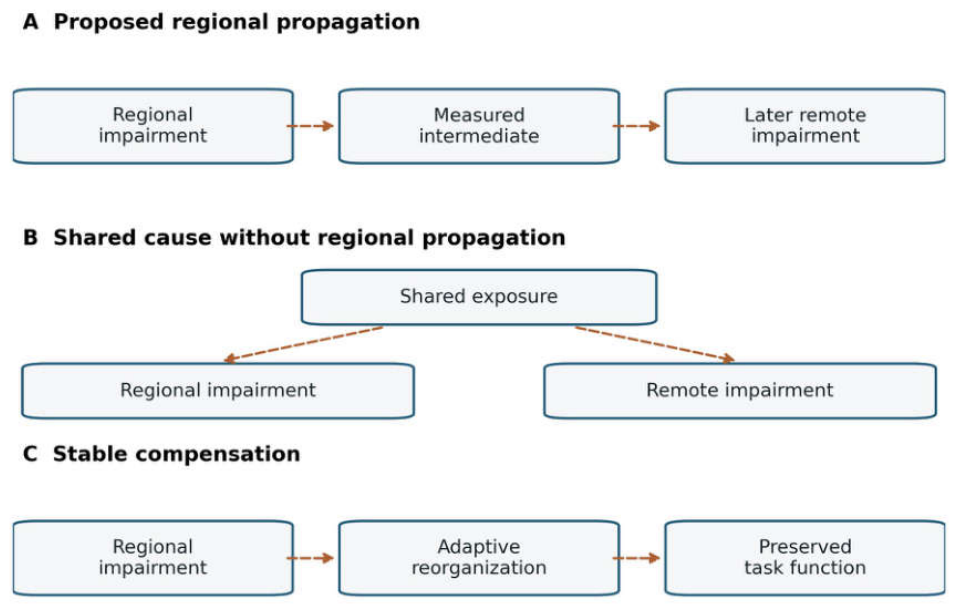
The Network Degradation Model gains explanatory value only if its regional pathways improve prediction or intervention beyond these alternatives. Figure 5 compares local propagation, shared exposure, and compensation without progressive spread. These structures may coexist in an individual, and their relative contributions may change over time.
11.2. Training Effects can Extend Beyond the Directly Exercised Limb
Green and Gabriel (2018) studied cross-education of strength and skill after unilateral training. Transfer to the opposite side demonstrates that not all functional training effects are confined to the directly loaded muscle. This challenges an absolute statement that local training does nothing elsewhere, while supporting the broader importance of distributed neural adaptation.
Cross-education does not prove structural preservation of all untrained motor pools or remove the need for regional function. Its relevance is to define what whole-body training must add beyond known transfer effects. A comparison should test additional coverage, not assume the localized program has zero systemic benefit.
11.3. Similar Networks do not Imply Identical Mechanisms
Interdependent-network models describe circumstances under which local perturbations can produce wider failure. Biological-network topology can also help predict patterns of perturbation. These are useful conceptual precedents, but their assumptions must be checked before transferring them to neuromuscular aging (Buldyrev et al., 2010; Santolini & Barabási, 2018).
The motor system has feedback, variable coupling, adaptation, and multiple ways to accomplish a task. It should not be assumed to be a scale-free network or a fragile series circuit merely because other systems have those properties. Cardiac conduction, vascular obstruction, and neurodegenerative disease remain analogies unless a corresponding mechanism is demonstrated in the present setting (Simkó et al., 2009).
11.4. Movement Longevity and Maximal Lifespan
Movement longevity refers here to sustained capacity for useful, adaptable action. Healthspan, frailty, and independence are related outcomes but are not identical to maximal lifespan. The present evidence does not establish that broad neuromuscular training extends the human lifespan ceiling or that local motor-unit loss initiates all molecular hallmarks of aging.
The model can be scientifically valuable if it explains or prevents functional decline without determining the ultimate duration of life. A stronger claim about lifespan would require survival evidence and assessment of competing limiting systems. It should not be inferred from a change in force, coherence, or motor-unit estimates alone.
12. A prospective Empirical Framework
12.1. Primary Hypotheses and Measurements
The first hypothesis is that multiregional neuromuscular profiles predict later integrated movement performance beyond isolated strength and total muscle quantity. The second is that deterioration in a region precedes changes in connected functions through specified intermediate pathways. The third is that a program addressing broad functional coverage produces additional benefits over a dose-matched regional program.
A cohort should include a broad adult age range and sufficient representation of women and men, habitual activity levels, and common clinical conditions to examine heterogeneity. The recruitment criteria must match the intended population. An exclusively healthy athletic cohort could test highfunctioning aging but would not establish applicability to frailty or neurological disease.
Assessments at baseline and repeated follow-up could combine motor-unit estimates in accessible muscles, decomposed high-density EMG, early force development, maximal force, muscle imaging, sensory and balance testing, and standardized multiregional tasks. No single method can measure every motor unit. Repeated recordings should use documented placement, contraction targets, and consistent processing. Carbonaro et al. (2026) reinforces the need to consider age and sex when interpreting motorunit discharge behavior.
Tasks should include both practiced and unfamiliar components. Candidate outcomes include coordinated reaching, stepping responses, gait under a specified secondary task, and a standardized dexterity task. A primary outcome should be chosen before analysis. The broader battery can characterize mechanisms, but should not permit post hoc selection of whichever task improves.
12.2. Timing and Causal Analysis
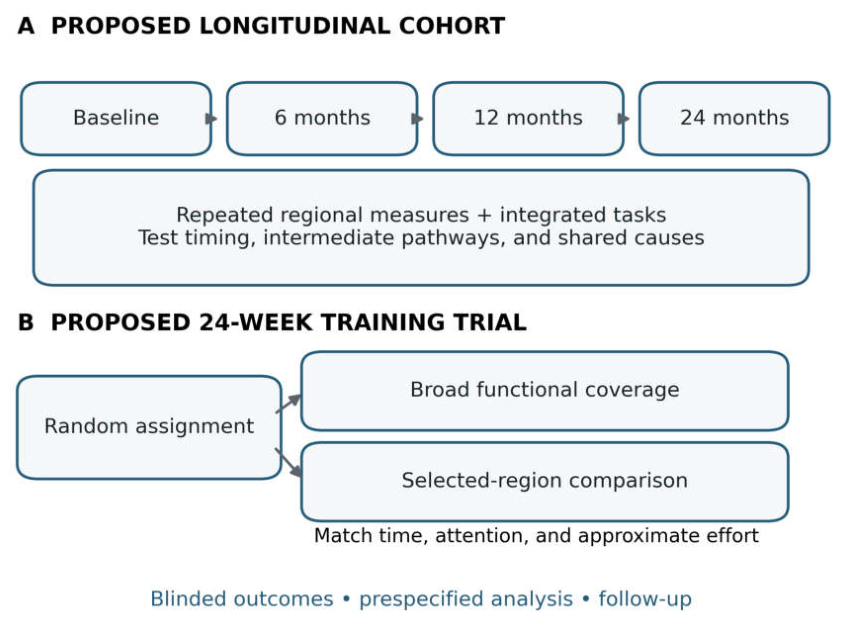
A feasible proposed observation schedule is baseline, 6, 12, and 24 months, with the recognition that structural change may require longer follow-up. The schedule is a design proposal, not an established optimal interval. Short-term repeated measurements should first quantify reliability and learning effects, particularly for rapid-force and coherence outcomes.
The analysis should ask whether earlier regional change predicts later change elsewhere after accounting for baseline function, prior outcome, activity, disease, and relevant exposures. This temporal ordering improves interpretation but does not eliminate unmeasured confounding. Competing models should include shared causes and reverse direction, not only the proposed cascade.
A mediation analysis could test whether altered movement strategy, sensory measures, or activity exposure lies between regional impairment and later remote change. Such analyses depend on causal assumptions and measurement quality. Repeated association alone should not be described as proof of transmission. Participant-level inference must also distinguish many sampled motor units from the number of independent people.
12.3. A Controlled Training Comparison
A proposed intervention would compare a program designed for broad functional coverage with a program emphasizing selected regions. Total session time, supervised contact, progression, and approximate effort should be matched as closely as practical. Both groups should receive credible training; the comparator should not be deliberately inadequate.
The broad program would vary movement demands across body regions, incorporating strength, appropriately scaled rapid activation, balance, and coordination. Its exact content should be specified before recruitment. Whole-body coverage does not require maximal ballistic loading of every structure. Regional symptoms and functional requirements should guide the form of engagement, with adherence and achieved exposure documented.
A 24-week intervention with follow-up after supervised training is one practical starting proposal. The study would test changes in function and physiological measures, not directly establish lifelong structural preservation. Outcome assessors should be blinded where feasible. Analysis should follow assignment, report adherence and adverse events, and predefine how missing data and multiple outcomes will be handled.
Sample size should be calculated using a prespecified clinically meaningful difference and reliability or pilot variance. Assigning an impressive-looking participant number without these inputs would create false precision. A feasibility phase should establish whether the intended regional exposures can be delivered and whether the measurements remain reproducible across visits.
12.4. What Would Count as Support or Challenge
Support for the coverage claim would come from improved prediction of integrated function using regional distribution rather than a single best-muscle measure. Support for propagation would require temporal and mechanistic evidence linking regional change to later remote consequences. Support for the intervention would require an advantage over the matched comparator that is not explained solely by greater dose or task practice.
The model would be challenged if regional impairments remained functionally contained over adequate follow-up, if shared causes accounted for apparent spread, or if successful restoration of the proposed initiating function failed to change downstream outcomes. A null result is interpretable only if intervention fidelity, measurement sensitivity, and follow-up are adequate. These conditions should be specified in advance rather than invoked only after unfavorable findings.
Figure 6.
A proposed sequence of empirical tests. Panel A illustrates repeated observation; Panel B illustrates a controlled intervention. Intervals and duration are design proposals. Regional physiology, meaningful task outcomes, adherence, and competing explanations should be prespecified. No study has been conducted and no sample-size claim is implied.
Figure 6.
A proposed sequence of empirical tests. Panel A illustrates repeated observation; Panel B illustrates a controlled intervention. Intervals and duration are design proposals. Regional physiology, meaningful task outcomes, adherence, and competing explanations should be prespecified. No study has been conducted and no sample-size claim is implied.
13. Implications for Assessment and Training Research
The practical implication is to assess the distribution of function. A favorable result in one muscle group should be interpreted as evidence about that group and its task, not a certificate of whole-body preservation. Conversely, a local limitation does not imply global failure. Assessment should identify which activities are affected and what compensations sustain them.
A training program intended to test the hypothesis should define breadth, intensity, progression, and coordination demands separately. Breadth concerns regional and task coverage. Intensity concerns the demand within an activity. Complexity concerns the information and coordination requirements. These dimensions should not be collapsed into an undefined prescription to train harder or introduce movement chaos.
Unpredictable tasks may be useful experimental probes of adaptability, but unpredictability alone is not evidence of superior preservation. A repeated task can train a relevant capacity; a complex task can also be learned through practice without changing general function. Transfer tests and follow-up are necessary to distinguish these outcomes.
The model complements measurement of muscle mass, power, endurance, sensory capacity, and disease burden. It does not justify excluding tissue-level mechanisms because a neural contribution is present.
Effective movement depends on both neural command and the properties of the tissue responding to it (Enoka & Duchateau, 2017; Hunter et al., 2016).
14. Limitations and Future Work
The central limitation is that the proposed local-to-systemic aging cascade has not been established. Much of the supporting literature concerns sampled muscles, cross-sectional differences, or short interventions. These studies support components of the framework but do not test its complete sequence or a lifelong whole-body strategy.
The five anatomical examples have heterogeneous evidence. Some studies assess morphology, others mechanics or neural behavior. None supplies a validated ranking of initiating sites. Additional regions should be included when function and measurement feasibility justify them, rather than restricting future work to the original examples.
Motor-unit estimation and EMG decomposition have method-specific limitations, and the same recorded motor unit may not be identifiable across visits. Coherence depends on task, signal quality, frequency, and analysis. Muscle imaging and biopsies cannot replace neural measurements. Cross-method agreement and reproducibility should be evaluated before constructing a composite index.
The proposed model also risks explaining too much unless its boundaries are explicit. A general statement that everything affects everything is not falsifiable. Version 2 instead requires named pathways, temporal predictions, and comparison with stable compensation and shared causes. Negative evidence should narrow the model when those tests are adequate.
Finally, genetic, hormonal, metabolic, vascular, sensory, and behavioral differences may influence both regional and integrated outcomes. The framework does not assume that all decline is preventable or caused by insufficient training. It proposes that functional coverage is an underexamined dimension worth testing alongside these determinants.
15. Conclusions
The Systemic Motor Unit Integrity Hypothesis proposes that maintaining neuromuscular function throughout the body may preserve integrated movement capacity, and that inadequately maintained regions may contribute to wider dysfunction through identifiable connections. The five regions discussed are examples of this principle, not its boundary.
The revised Network Degradation Model separates local impairment, compensation, possible crossregional consequences, and loss of reserve. It recognizes that neurons can survive while their effective inputs change, that muscle phenotype does not count motor units, and that compensation can preserve rather than necessarily erode function. These distinctions make the proposed sequence testable.
Current evidence supports the importance of regional heterogeneity, distributed neural control, rapid activation, and retained neural adaptability. It does not establish universal propagation or prove that whole-body training prevents neuromuscular aging. The next step is a prospective program linking regional measurements, intermediate mechanisms, and meaningful integrated outcomes. Movement longevity can then be evaluated as a property of coordinated capacity across the body, rather than inferred from isolated strength alone.
Ethics Statement
This manuscript is a theoretical synthesis of publicly available scientific literature. It reports no newly recruited participants, animal experiments, or proprietary clinical data. No institutional ethics approval was required for this literature-based work.
Acknowledgments and Author Contribution
Tony Ruggia originated the Systemic Motor Unit Integrity Hypothesis and Network Degradation Model presented in the source manuscript. This revision develops the whole-body interpretation and distinguishes the proposed mechanisms from the evidence currently available to test them.
AI assistance Disclosure
OpenAI’s ChatGPT assisted with literature retrieval, reference checking, drafting and revision, organization, and preparation of figures and document formatting for Version 2. This assistance extended beyond grammar correction. AI assistance does not constitute authorship or peer review. The author is responsible for reviewing and approving the final manuscript and its scientific claims before submission.
Data and Figure Availability
Version Statement
Version 2 clarifies that the five anatomical regions are non-exclusive examples, refines the definitions of common input and motor-unit integrity, updates the evidence, replaces the conceptual figures, and specifies prospective tests and competing explanations. It remains a hypothesis paper.
Funding
This research was conducted independently and received no financial support, sponsorship, or institutional backing.
Conflicts of Interest
The author declares no conflicts of interest related to the content or conclusions of this manuscript.
Glossary
| Motor unit | One motor neuron and the muscle fibers it innervates. A motor unit is not simply a muscle fiber or a neuromuscular junction. |
| Motor-unit remodeling | Changes in unit number, innervation territory, and related properties, including compensatory reinnervation by surviving neurons. |
| Common synaptic input | Input shared by motor neurons. Its effect depends on timing, frequency content, and task demands. |
| Common drive | Shared modulation of motor-unit discharge activity; it does not require simultaneous spikes from every neuron. |
| Intermuscular coherence | A frequency-specific statistical relationship between muscle signals, used to investigate shared control. It does not by itself establish direction or causation. |
| Persistent inward currents | Intrinsic currents that amplify input to motor neurons. Human paired-unit estimates are indirect measures of their contribution. |
| Early rate of force development | The rise in force over a defined early interval after mechanical force onset, distinct from reaction time. |
| Regional vulnerability | A local limitation in structure, activation, feedback, or output relative to relevant functional demands. |
| Functional coverage | The distribution of maintained neuromuscular capacities across the body and across relevant tasks; not identical exercise for every muscle. |
| Compensatory reorganization | A change in control or movement strategy that may preserve a task despite an impairment. |
| Proposed propagation | A causal contribution from one region’s impairment to later dysfunction elsewhere through specified intermediate mechanisms. |
| Integrated reserve | Capacity to meet additional task demands beyond habitual conditions. No validated numerical reserve score is introduced here. |
| Illustrative collapse point | A candidate regional limitation that may have wider consequences; neither an established universal hub nor an inevitable source of spread. |
| Movement longevity | Sustained capacity for useful and adaptable movement over time, distinct from maximal lifespan. |
References
- Bruton, M.; O’Dwyer, N. Synergies in coordination: A comprehensive overview of neural, computational, and behavioral approaches. J. Neurophysiol. 2018, 120(6), 2761–2774. [Google Scholar] [CrossRef] [PubMed]
- Buldyrev, S. V.; Parshani, R.; Paul, G.; Stanley, H. E.; Havlin, S. Catastrophic cascade of failures in interdependent networks. Nature 2010, 464(7291), 1025–1028. [Google Scholar] [CrossRef] [PubMed]
- Carbonaro, M.; Boccardo, M.; Brusco, C. M.; Pilotto, A. M.; Re, R.; Lauretani, F.; Porcelli, S.; Franchi, M. V.; Botter, A. Motor unit behavior adaptations across lifespan: Sex differences in young, middle-aged and old adults. In npj Aging. Advance online publication.; 2026. [Google Scholar] [CrossRef] [PubMed]
- Castro, R. W.; Lopes, M. C.; Settlage, R. E.; Valdez, G. Aging alters mechanisms underlying voluntary movements in spinal motor neurons of mice, primates, and humans. JCI Insight 2023, 8(9), e168448. [Google Scholar] [CrossRef] [PubMed]
- Castronovo, A. M.; Mrachacz-Kersting, N.; Stevenson, A. J. T.; Holobar, A.; Enoka, R. M.; Farina, D. Decrease in force steadiness with aging is associated with increased power of the common but not independent input to motor neurons. J. Neurophysiol. 2018, 120(4), 1616–1624. [Google Scholar] [CrossRef] [PubMed]
- Cefis, M.; Marcangeli, V.; Hammad, R.; Granet, J.; Leduc-Gaudet, J. P.; Gaudreau, P.; Trumpff, C.; Huang, Q.; Picard, M.; Aubertin-Leheudre, M.; Bélanger, M.; Robitaille, R.; Morais, J. A.; Gouspillou, G. Impact of physical activity on physical function, mitochondrial energetics, ROS production, and Ca2+ handling across the adult lifespan in men. Cell Rep. Med. 2025, 6(2), 101968. [Google Scholar] [CrossRef] [PubMed]
- De Luca, C. J.; Erim, Z. Common drive of motor units in regulation of muscle force. Trends Neurosci. 1994, 17(7), 299–305. [Google Scholar] [CrossRef] [PubMed]
- De Luca, C. J.; Erim, Z. Common drive in motor units of a synergistic muscle pair. J. Neurophysiol. 2002, 87(4), 2200–2204. [Google Scholar] [CrossRef] [PubMed]
- Del Vecchio, A.; Negro, F.; Holobar, A.; Casolo, A.; Folland, J. P.; Felici, F.; Farina, D. You are as fast as your motor neurons: Speed of recruitment and maximal discharge of motor neurons determine the maximal rate of force development in humans. J. Physiol. 2019, 597(9), 2445–2456. [Google Scholar] [CrossRef] [PubMed]
- Doherty, T. J.; Brown, W. F. Age-related changes in the twitch contractile properties of human thenar motor units. J. Appl. Physiol. 1997, 82(1), 93–101. [Google Scholar] [CrossRef] [PubMed]
- Enoka, R. M.; Duchateau, J. Rate coding and the control of muscle force. Cold Spring Harb. Perspect. Med. 2017, 7(10), a029702. [Google Scholar] [CrossRef] [PubMed]
- Green, L. A.; Gabriel, D. A. The cross education of strength and skill following unilateral strength training in the upper and lower limbs. J. Neurophysiol. 2018, 120(2), 468–479. [Google Scholar] [CrossRef] [PubMed]
- Hepple, R. T.; Rice, C. L. Innervation and neuromuscular control in ageing skeletal muscle. J. Physiol. 2016, 594(8), 1965–1978. [Google Scholar] [CrossRef] [PubMed]
- Heuninckx, S.; Wenderoth, N.; Debaere, F.; Peeters, R.; Swinnen, S. P. Neural basis of aging: The penetration of cognition into action control. J. Neurosci. 2005, 25(29), 6787–6796. [Google Scholar] [CrossRef] [PubMed]
- Heuninckx, S.; Wenderoth, N.; Swinnen, S. P. Systems neuroplasticity in the aging brain: Recruiting additional neural resources for successful motor performance in elderly persons. J. Neurosci. 2008, 28(1), 91–99. [Google Scholar] [CrossRef] [PubMed]
- Hunter, S. K.; Pereira, H. M.; Keenan, K. G. The aging neuromuscular system and motor performance. J. Appl. Physiol. 2016, 121(4), 982–995. [Google Scholar] [CrossRef] [PubMed]
- Jones, E. J.; Piasecki, J.; Ireland, A.; Stashuk, D. W.; Atherton, P. J.; Phillips, B. E.; McPhee, J. S.; Piasecki, M. Lifelong exercise is associated with more homogeneous motor unit potential features across deep and superficial areas of vastus lateralis. GeroScience 2021, 43(4), 1555–1565. [Google Scholar] [CrossRef] [PubMed]
- Kerkman, J. N.; Bekius, A.; Boonstra, T. W.; Daffertshofer, A.; Dominici, N. Muscle synergies and coherence networks reflect different modes of coordination during walking. Front. Physiol. 2020, 11, 751. [Google Scholar] [CrossRef] [PubMed]
- Klass, M.; Baudry, S.; Duchateau, J. Age-related decline in rate of torque development is accompanied by lower maximal motor unit discharge frequency during fast contractions. J. Appl. Physiol. 2008, 104(3), 739–746. [Google Scholar] [CrossRef] [PubMed]
- Kocur, P.; Tomczak, M.; Wiernicka, M.; Goliwąs, M.; Lewandowski, J.; Łochyński, D. Relationship between age, BMI, head posture and superficial neck muscle stiffness and elasticity in adult women. Sci. Rep. 2019, 9(1), 8515. [Google Scholar] [CrossRef]
- López-Otín, C.; Blasco, M. A.; Partridge, L.; Serrano, M.; Kroemer, G. Hallmarks of aging: An expanding universe. Cell 2023, 186(2), 243–278. [Google Scholar] [CrossRef] [PubMed]
- Maffiuletti, N. A.; Aagaard, P.; Blazevich, A. J.; Folland, J.; Tillin, N.; Duchateau, J. Rate of force development: Physiological and methodological considerations. Eur. J. Appl. Physiol. 2016, 116(6), 1091–1116. [Google Scholar] [CrossRef] [PubMed]
- Mesquita, R. N. O.; Taylor, J. L.; Heckman, C. J.; Trajano, G. S.; Blazevich, A. J. Persistent inward currents in human motoneurons: Emerging evidence and future directions. J. Neurophysiol. 2024, 132(4), 1278–1301. [Google Scholar] [CrossRef] [PubMed]
- Mickle, K. J.; Angin, S.; Crofts, G.; Nester, C. J. Effects of age on strength and morphology of toe flexor muscles. J. Orthop. Sports Phys. Ther. 2016, 46(12), 1065–1070. [Google Scholar] [CrossRef] [PubMed]
- Orssatto, L. B. R.; Rodrigues, P.; Mackay, K.; Blazevich, A. J.; Borg, D. N.; Souza, T. R.; Sakugawa, R. L.; Shield, A. J.; Trajano, G. S. Intrinsic motor neuron excitability is increased after resistance training in older adults. J. Neurophysiol. 2023, 129(3), 635–650. [Google Scholar] [CrossRef] [PubMed]
- Piasecki, M.; Ireland, A.; Jones, D. A.; McPhee, J. S. Age-dependent motor unit remodelling in human limb muscles. Biogerontology 2016, 17(3), 485–496. [Google Scholar] [CrossRef]
- Piasecki, M.; Ireland, A.; Piasecki, J.; Degens, H.; Stashuk, D. W.; Swiecicka, A.; Rutter, M. K.; Jones, D. A.; McPhee, J. S. Long-term endurance and power training may facilitate motor unit size expansion to compensate for declining motor unit numbers in older age. Front. Physiol. 2019, 10, 449. [Google Scholar] [CrossRef] [PubMed]
- Pierrieau, E.; Charissou, C.; Vernazza-Martin, S.; Pageaux, B.; Lepers, R.; Amarantini, D.; Fautrelle, L. Intermuscular coherence reveals that affective emotional pictures modulate neural control mechanisms during the initiation of arm pointing movements. Front. Hum. Neurosci. 2024, 17, 1273435. [Google Scholar] [CrossRef] [PubMed]
- Power, G. A.; Allen, M. D.; Gilmore, K. J.; Stashuk, D. W.; Doherty, T. J.; Hepple, R. T.; Taivassalo, T.; Rice, C. L. Motor unit number and transmission stability in octogenarian world class athletes: Can age-related deficits be outrun? J. Appl. Physiol. 2016, 121(4), 1013–1020. [Google Scholar] [CrossRef] [PubMed]
- Power, G. A.; Dalton, B. H.; Behm, D. G.; Doherty, T. J.; Vandervoort, A. A.; Rice, C. L. Motor unit survival in lifelong runners is muscle dependent. Med. Sci. Sports Exerc. 2012, 44(7), 1235–1242. [Google Scholar] [CrossRef] [PubMed]
- Raz, Y.; Henseler, J. F.; Kolk, A.; Riaz, M.; van der Zwaal, P.; Nagels, J.; Nelissen, R. G. H. H.; Raz, V. Patterns of age-associated degeneration differ in shoulder muscles. Front. Aging Neurosci. 2015, 7, 236. [Google Scholar] [CrossRef] [PubMed]
- Santolini, M.; Barabási, A. L. Predicting perturbation patterns from the topology of biological networks. Proc. Natl. Acad. Sci. 2018, 115(27), E6375–E6383. [Google Scholar] [CrossRef] [PubMed]
- Sarto, F.; Kalc, M.; Motanova, E. S.; Franchi, M. V.; Stashuk, D.; Murks, N.; Valli, G.; Negro, S.; Prašnikar, T.; Gasparini, M.; Martino, G.; De Vito, G.; Holobar, A.; Simunič, B.; Pišot, R.; Narici, M. V. Twenty-one days of bed rest alter motor unit properties and neuromuscular junction transmission in young adults. J. Appl. Physiol. 2025, 138(6), 1411–1424. [Google Scholar] [CrossRef] [PubMed]
- Simkó, G. I.; Gyurkó, D.; Veres, D. V.; Nánási, T.; Csermely, P. Network strategies to understand the aging process and help age-related drug design. Genome Med. 2009, 1(9), 90. [Google Scholar] [CrossRef] [PubMed]
- Swenson, C. W.; Masteling, M.; DeLancey, J. O.; Nandikanti, L.; Schmidt, P.; Chen, L. Aging effects on pelvic floor support: A pilot study comparing young versus older nulliparous women. Int. Urogynecology J. 2020, 31(3), 535–543. [Google Scholar] [CrossRef]
- Tanaka, H.; Tarumi, T.; Rittweger, J. Aging and physiological lessons from master athletes. Compr. Physiol. 2019, 10(1), 261–296. [Google Scholar] [CrossRef] [PubMed]
- Tanzarella, S.; Muceli, S.; Del Vecchio, A.; Casolo, A.; Farina, D. Non-invasive analysis of motor neurons controlling the intrinsic and extrinsic muscles of the hand. J. Neural Eng. 2020, 17(4), 046033. [Google Scholar] [CrossRef] [PubMed]
- Taylor, J. A.; Greenhaff, P. L.; Bartlett, D. B.; Jackson, T. A.; Duggal, N. A.; Lord, J. M. Multisystem physiological perspective of human frailty and its modulation by physical activity. Physiol. Rev. 2023, 103(2), 1137–1191. [Google Scholar] [CrossRef] [PubMed]
- Thillainadesan, J.; Scott, I. A.; Le Couteur, D. G. Frailty, a multisystem ageing syndrome. Age Ageing 2020, 49(5), 758–763. [Google Scholar] [CrossRef] [PubMed]
- Zange, J.; Endres, J.; Clemen, C. S.; Rittweger, J. Leg and hip muscles show muscle-specific effects of ageing and sport on muscle volume and fat fraction in male Masters athletes. J. Physiol. 2026, 604(2), 917–935. [Google Scholar] [CrossRef] [PubMed]
Figure 1.
Physiological architecture and the proposed wider consequences of regional impairment. Solid connections represent movement-control dependencies and sensory feedback, not an established sequence of aging. The dashed route represents the proposed contribution of compensation or secondary disuse to later integrated impairment. Conceptual synthesis informed by De Luca and Erim (2002), Hunter et al. (2016), and Castro et al. (2023); no participant data.
Figure 1.
Physiological architecture and the proposed wider consequences of regional impairment. Solid connections represent movement-control dependencies and sensory feedback, not an established sequence of aging. The dashed route represents the proposed contribution of compensation or secondary disuse to later integrated impairment. Conceptual synthesis informed by De Luca and Erim (2002), Hunter et al. (2016), and Castro et al. (2023); no participant data.
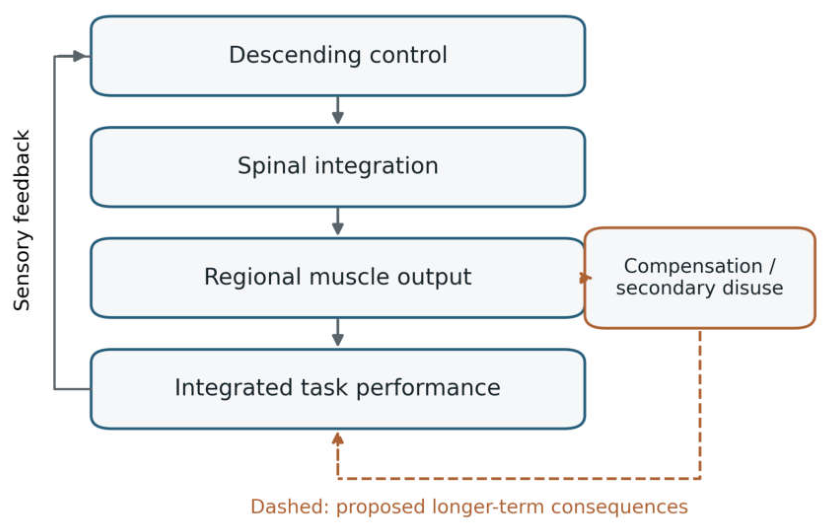
Figure 2.
Strength and muscle-size changes after bed rest. Reported changes after 21 days of horizontal bed rest in nine young men: quadriceps cross-sectional area −11.9% and maximal voluntary contraction −23.1% (Sarto et al., 2025). Bars show different outcomes, not two equivalent measures of mass. Uncertainty intervals are not reproduced. These changes do not quantify motor-neuron death.
Figure 2.
Strength and muscle-size changes after bed rest. Reported changes after 21 days of horizontal bed rest in nine young men: quadriceps cross-sectional area −11.9% and maximal voluntary contraction −23.1% (Sarto et al., 2025). Bars show different outcomes, not two equivalent measures of mass. Uncertainty intervals are not reproduced. These changes do not quantify motor-neuron death.
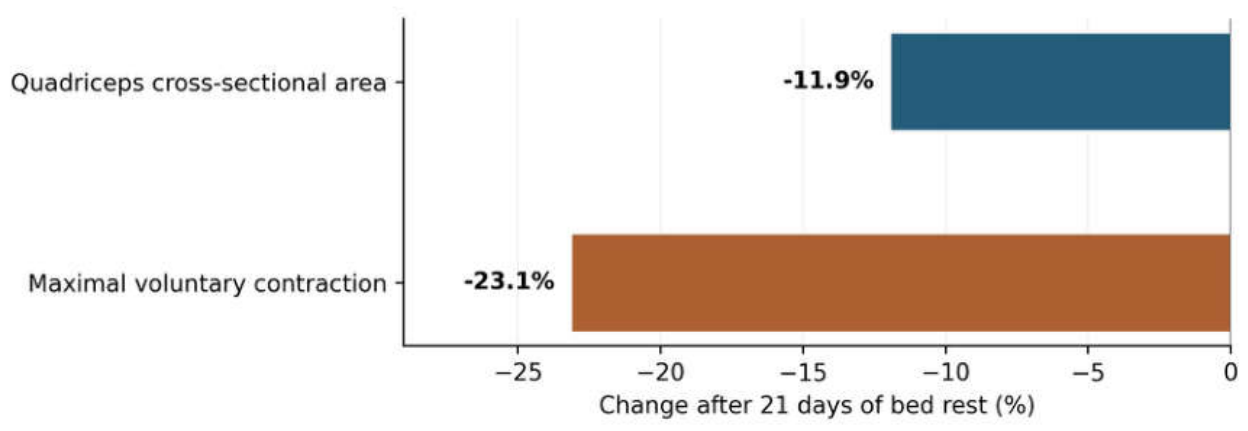
Figure 3.
Muscle volume and peak jump power in younger and older men. Means ± SD from Table 7 of Zange et al. (2026; online publication 2025). A: combined gluteal, quadriceps, and triceps surae volume. B: peak countermovementjump power. Young athletes n = 10; older athletes n = 10; young controls n = 12; older controls n = 11. Ages: young 20 –35; older 60–75 years. Error bars show participant variability, not confidence intervals. Cross-sectional differences are not longitudinal rates of decline.
Figure 3.
Muscle volume and peak jump power in younger and older men. Means ± SD from Table 7 of Zange et al. (2026; online publication 2025). A: combined gluteal, quadriceps, and triceps surae volume. B: peak countermovementjump power. Young athletes n = 10; older athletes n = 10; young controls n = 12; older controls n = 11. Ages: young 20 –35; older 60–75 years. Error bars show participant variability, not confidence intervals. Cross-sectional differences are not longitudinal rates of decline.
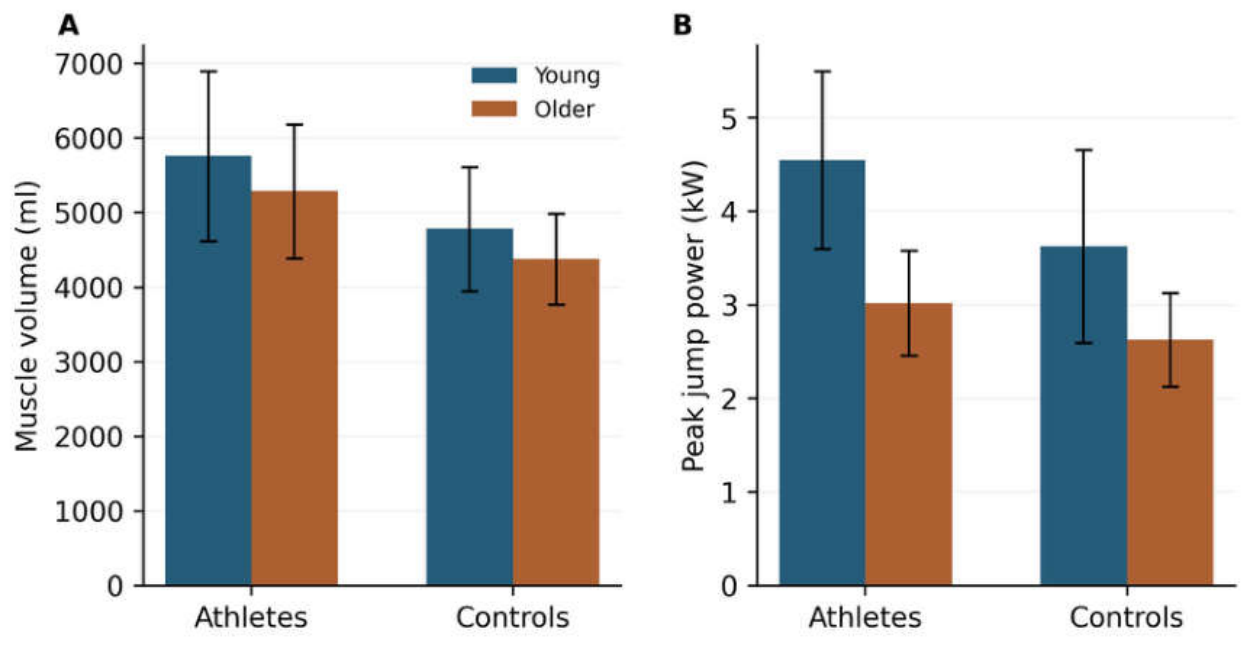
Figure 4.
An open framework for whole-body functional coverage. The five regions are non-exclusive examples. The assessment dimensions apply across relevant regions and tasks; the multiplication symbol indicates considering anatomy together with function, not a numerical score. No ranking of collapse points or mandatory exercise prescription is implied. Author-proposed conceptual framework.
Figure 4.
An open framework for whole-body functional coverage. The five regions are non-exclusive examples. The assessment dimensions apply across relevant regions and tasks; the multiplication symbol indicates considering anatomy together with function, not a numerical score. No ranking of collapse points or mandatory exercise prescription is implied. Author-proposed conceptual framework.
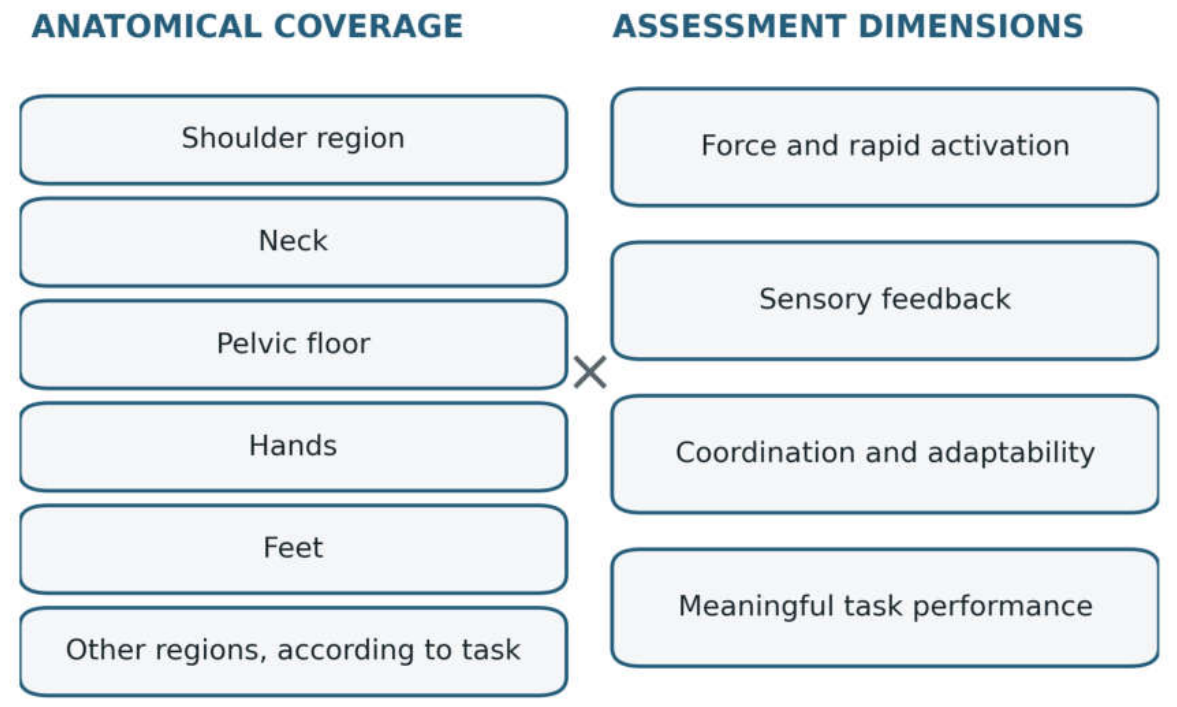
Figure 5.
Three distinguishable explanations for regional and integrated outcomes. Dashed arrows denote candidate causal relationships. A: regional impairment contributes to a later remote outcome through an intermediate mechanism. B: a shared exposure affects both regions. C: adaptation preserves task performance. These alternatives may coexist and must be distinguished empirically. Conceptual illustration, not fitted data.
Figure 5.
Three distinguishable explanations for regional and integrated outcomes. Dashed arrows denote candidate causal relationships. A: regional impairment contributes to a later remote outcome through an intermediate mechanism. B: a shared exposure affects both regions. C: adaptation preserves task performance. These alternatives may coexist and must be distinguished empirically. Conceptual illustration, not fitted data.
Disclaimer/Publisher’s Note: The statements, opinions and data contained in all publications are solely those of the individual author(s) and contributor(s) and not of MDPI and/or the editor(s). MDPI and/or the editor(s) disclaim responsibility for any injury to people or property resulting from any ideas, methods, instructions or products referred to in the content. |
© 2026 by the authors. Licensee MDPI, Basel, Switzerland. This article is an open access article distributed under the terms and conditions of the Creative Commons Attribution (CC BY) license (http://creativecommons.org/licenses/by/4.0/).
Copyright: This open access article is published under a Creative Commons CC BY 4.0 license, which permit the free download, distribution, and reuse, provided that the author and preprint are cited in any reuse.