

Submitted:
16 September 2026
Posted:
17 September 2026
You are already at the latest version
Abstract
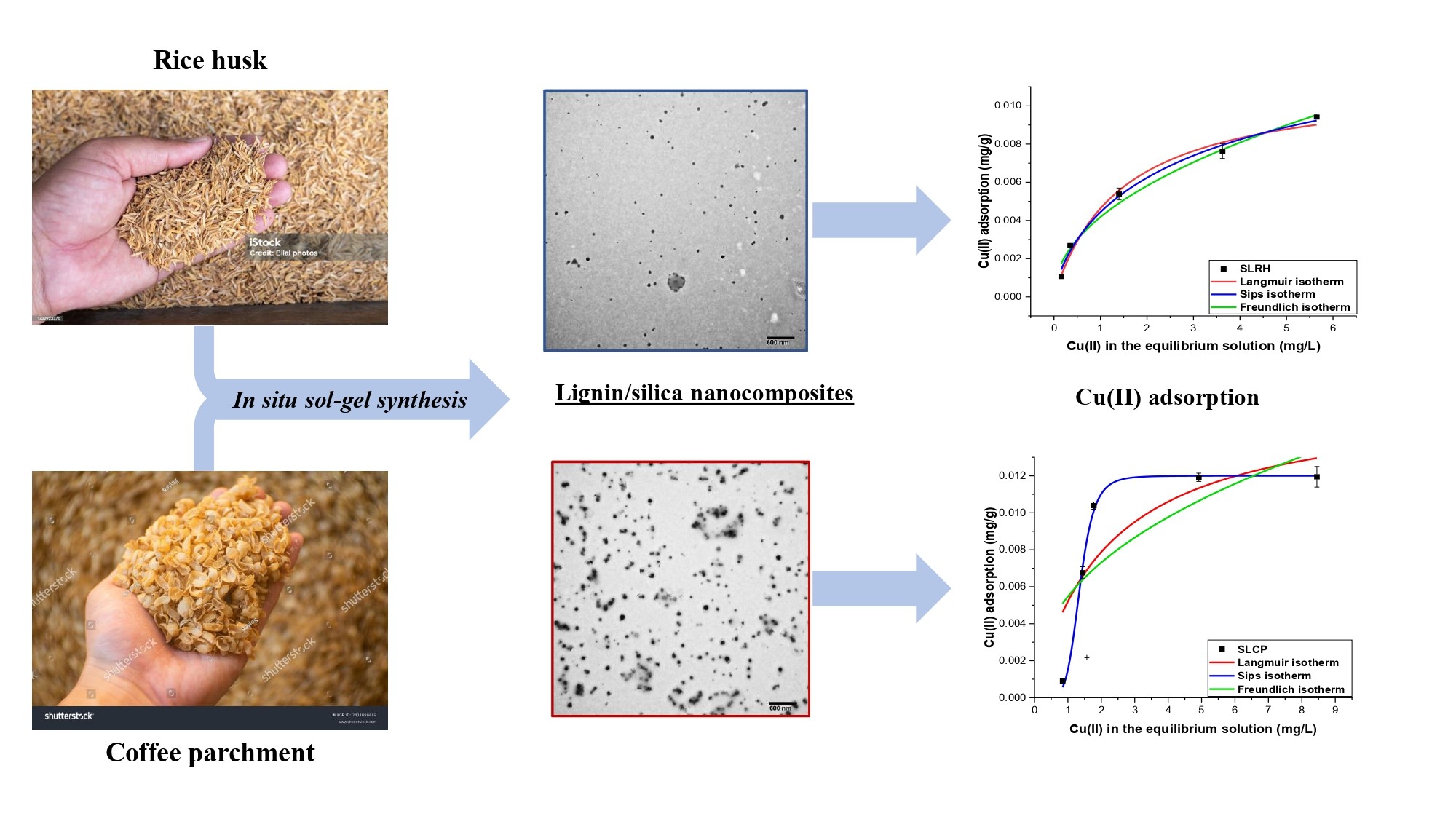
Intensive agricultural production generates large volumes of lignocellulosic residues and contributes to heavy metal pollution, particularly copper (Cu). The valorization of these by-products as low-cost adsorbents offers a promising strategy for circular economy implementation and environmental remediation. In this study, lignin–silica nanocomposites were synthesized via a sol–gel process from two abundantly available agricultural wastes in Cuba: rice husk and coffee parchment. The nanocomposites were characterized by FT-IR, TEM and TGA methods. The nanocomposites showed a spherical shape and a diameter between 50 and 60 nm and their silica composition depended on the composition of the starting material. The nanocomposite obtained from rice husk had a silica ratio of 52 % while in the one prepared from coffee parchment it was 11 %. Adsorption capacities and adsorption behaviors with Cu(II) in water of the nanocomposites were studied. The adsorbents reached equilibrium within 10 minutes and the estimated maximum sorption capacities were 15 mg/g using rice husk as the starting material and 12 mg/g for the one prepared from coffee parchment. Nanocomposite synthesis is a promising route for lignocellulosic biomass revalorization as heavy metal adsorbents for environmental sanitation.
Keywords:
lignin/silica nanocomposite
; coffee parchment
; rice husk
; heavy metal adsorption
; sol-gel synthesis
1. Introduction
The agricultural sector is experiencing sustained growth to meet the increasing global demand for food. Among the most widely produced and consumed crops worldwide are rice and coffee, whose substantial demand drives increasingly intensive agricultural practices. These large-scale productions generate vast volumes of waste: only 5% of the coffee dried fruit is used for consumption, with the parchment being discarded, while rice husk accounts for approximately 20% of the grain weight [1,2]. Inadequate disposal methods, such as burning or landfilling, contribute significantly to soil, water, and atmospheric pollution [3].
Parallel to this solid waste generation, intensive agriculture introduces other contaminants that alter biogeochemical cycles. Of particular concern is the accumulation of potentially toxic elements (PTEs), such as copper (Cu), resulting from the widespread application of copper-based fungicides and pesticides [4]. Excess Cu leads to imbalances in soil fertility, adversely affects microbial communities, and, through leaching, contaminates groundwater and surface water bodies, thereby posing a threat to human health . Mitigating these anthropogenically induced imbalances in elemental cycles is crucial for environmental sustainability.
In response to this dual challenge, the valorization of agricultural residues such as rice husk and coffee parchment—both rich in lignin and silica—emerges as a promising strategy for the adsorption of such metals [5,6]. Lignin, the second most abundant natural polymer, possesses functional groups (phenolic, carboxyl) with affinity for metal ions, while silica provides mechanical stability and active sites. Together, they would form a composite material with high metal-binding capacity [7]. These properties enable the modulation of PTE transport and fate in aquatic and edaphic environments through immobilization [7,8].
In this context, green and cost-effective methods exist for producing lignin–silica nanocomposites (SLNPs) via alkaline hydrolysis and acid coprecipitation, utilizing residual biomass [8,9,10,11]. However, most studies have focused on rice or wheat husk. Coffee parchment remains largely unexplored for this purpose, despite its particular chemical composition potentially conferring distinct surface chemistry and metal sorption behavior. Furthermore, no such studies have been reported using Cuban agricultural products, where coffee and rice cultivation are economically significant and waste management practices are still being developed.
Therefore, the present study aims to prepare lignin/silica nanocomposites from coffee parchment and rice husk, and to evaluate their Cu(II) sorption capacity as a model PTE. Using the methodology of Qu et al. [12] as a reference, the novelty lies in the use of coffee parchment and the Cuban context. This work advances toward sustainable waste management and metal pollution control, directly addressing the agricultural impact on water–soil cycles and environmental health.
2. Materials and Methods
2.1. Materials
Rice husk (RH) was provided by the agro-industrial complex Sur del Jíbaro, in Sancti Spíritus province, and coffee parchment (CP) was given by the experimental station in III Frente, Santiago de Cuba, both in Cuba, wastes of 2021 harvests. The sodium hydroxide pellets pure, concentrated sulfuric acid (98%) extra pure, and copper sulfate pentahydrate were obtained from Merck.
2.2. Biomass Characterization
To determine the content of humidity, soluble components, hemicellulose, cellulose, lignin, and ash in biomass, Chesson-Datta semiquantitative method (CDSM) was used as described. 3 g of starting material was dried to constant weight at 120 °C; then 1 g (A) of dry material was transferred to a flask with 150 ml of distilled water and heated in a water bath for 1 h. The mixture was then filtered, and the filtrate was washed thoroughly with hot water, the solid residue was dried and weighted (B). Afterwards, the solid was heated in a water bath with 150 ml of H2SO4 0.5 M for 1 h, passed that time, the remaining solid was separated by filtration and properly washed with hot water, then dried and weighted (C). Consecutively, the material was soaked in 10 ml H2SO4 70 % w/v for 4 h and later diluted with 150 ml of H2SO4 0.5 M and heated for 1 h at 100 °C. The mixture was filtered and the solid was washed abundantly with water, then it was dried at room temperature in a desiccator and the remaining solid was weighted (D). The percentage of each component was calculated using the formulae given below. The whole procedure was repeated five-fold.
| %Soluble components=(A-B)/A*100 | (1) |
| %Hemicellulose=(B-C)/A*100 | (2) |
| %Cellulose= (C-D)/A*100 | (3) |
| %lignin+ash=D/A*100 | (4) |
2.3. Nanocomposite Synthesis
Silica-lignin nanocomposites (SLNPs) were synthesized starting from both rice husk and coffee parchment, following the same procedure based on a sol-gel method. 10 g of vegetal material was washed with 150 ml of hot water, and the solid obtained by filtration is put into a 150 ml flask. Then 70 ml of NaOH 2 M were added (1:7 w/v). The mixture was heated in a water bath at 90 ºC for 4 h, and after filtration while hot, the filter was thoroughly washed to afford a black liquor (97 ml was obtained from coffee parchment and 158 ml from rice husk). The liquor was heated at 90 °C and stirred with a mechanical stirrer (~200 rpm) and then acidified to pH = 3 by slowly adding H2SO4 2 M (~25 ml were required). Immediately, a precipitate was observed, nevertheless, the system was incubated with agitation during 6 h. After the incubation period, the colloid was centrifuged for 20 min at 5000 rpm, then washed three times with water and dried in an oven to yield the lignin-silica nanocomposites from rice husk (SLRH) and coffee parchment (SLCP).
2.4. Nanocomposite Characterization
The prepared nanocomposites were characterized via FT-IR, TEM and TGA. Fourier transform infrared spectroscopy (FTIR) was recorded using a WQF-510 spectrometer from Rayleigh. Each spectrum was collected with ATR mode in the transmittance mode from an accumulation of 32 scans in the range from 500 to 4000 cm-1 with a resolution of 2 cm-1. TEM micrographs were obtained with a JEOL 1200EX TEMSCAN electronic microscope (acceleration voltage of 120 kV) and processed with IMAGE J software. Data for thermogravimetric and differential thermogravimetric analyses were obtained using a TGA 4000 / Pyris 6 apparatus under N2 atmosphere (20 ml/min) heating from 30 to 600 °C at a rate of 10.00 °C/min. All charts and statistical analyses were done using OriginPro 2021 v.9.8.0.200.
2.5. Silicon Content Determination
A weighted sample of particles were fully dissolved in 10 ml of hot NaOH 2M, filtered while still hot, and then diluted to 50 ml with water. Before quantification a 1 ml aliquot of the sample was diluted to 25 ml. Silicon content as SiO2 was determined using an ICP-OES Ultima Expert, from HORIBA France SAS at a wavelength of 251.611 nm using the corresponding calibration curve with concentration the range of 2.5-30.0 mg/L, using Silicium standard solution 1000 μg/ml (Spectro ECON) from CHEM-LAB NV.
2.6. Batch Adsorption Experiments
The sorption capacity of SLRH and towards Cu(II) was studied. Batch experiments were conducted using 50 ml polyethylene centrifuge tubes at constant temperature. The mixture consisted of 50 mg of nanocomposites and a known initial concentration of Cu(II) (between 2-20 ppm) in a total volume of 50 ml. This mixture was shaken for up to 2 hours to guarantee the equilibrium had been reached. Passed this time, the adsorbent was removed by centrifugation at 10 000 rpm for 15 minutes, then, the equilibrium concentration of Cu(II) in the supernatant was measured. A Unicam 969 flame atomic absorption spectrophotometer was used for the determination of copper. It was equipped with a copper hollow cathode lamp and air/acetylene burner. The instrumental parameters were as follows: wavelength 324.8 nm, lamp current 3 mA. The calibration curve was prepared from a standard 1000 mg/L solution from Merck. The pH of the supernatant solutions were measured by an EXTECH pH meter, Microcomputer pH – Vision 246071. All measurements were performed in triplicate.
The amount (qe) of Cu(II) adsorbed at equilibrium was calculated using the following equation:
where C0, Ce are the concentrations of Cu(II) at initial and equilibrium in mg/L, respectively; m is the mass of the adsorbents in g; and V is the volume of Cu(II) solution in L.
2.6.1. Adsorption Isotherm Models
The Langmuir, Sips and the Freundlich model equations were used to describe the Cu(II) adsorption on the nanocomposites.
The Langmuir equation is:
where qe is the sorption capacity at equilibrium in mg/g; Ce is the equilibrium concentration of Cu(II) in mg/L; qm is the maximum sorption capacity in mg/g and KL is the sorption equilibrium constant.
The Sips equation is:
where qe is the sorption capacity at equilibrium in mg/g; Ce is the equilibrium concentration of Cu(II) in mg/L; qm is the maximum sorption capacity in mg/g; Ks is the sorption equilibrium constant and n is a heterogeneity factor.
The Freundlich equation is:
where KF is the sorption equilibrium constant according to the Freundlich model, qe is the sorption capacity at equilibrium in mg/g and Ce is the equilibrium concentration of Cu(II) in mg/L.
The parameters of all models were obtained by nonlinear least-squares regression analysis using OriginPro 2021 v.9.8.0.200.
2.6.2. Adsorption Kinetics
Adsorption kinetics experiments were carried out in the same operation conditions as those of the equilibrium studies using Cu(II) solutions of fixed concentration (8 mg/L for SLRH and 15 mg/L for SLCP). The adsorption amount of Cu(II) at specific times were calculated according to the following equation:
where qt is the sorption capacity in mg/g at time t (min); and Ct is the Cu(II) concentration in mg/L at time t (min).
3. Results
3.1. Raw Material Proximate Composition
Proximate analysis of rice husk and coffee parchment in this study was done using the CDSM, to determine the suitability of the raw materials for the synthesis of lignin-silica composites. Results are summarized in Table 1 after carrying out the procedure five-fold.
3.2. Synthesis and Characterization of Nanocomposites
The synthetic procedure was carried out at the optimal conditions for maximizing yield previously reported by [12,13]. Starting from 10 g of the lignocellulosic material, yielded 284 mg of SLCP particles and 1.22 g of SLRH particles.
The morphological analysis made by TEM microscopy (Figure 1) showed that in both silica/lignin nanoparticles from rice husk and coffee parchment the particles were sphere-shaped, and, after proper processing, their size distribution was fitted to a log-normal curve with a mean diameter of 58 ± 2 nm for SLCP and 51 ± 2 nm for SLRH.
The presence of the two main components of the nanocomposites was first confirmed by FT-IR and TGA/DTG analysis (Figure 2 and Tabla 2). The percentages of SiO2 present in the nanoparticles were determined using ICP-OES (Tabla 2), otherwise silica content would have been overestimated if determined by TGA, since above 600 °C is expected to take place the cleavage of lignin-silica bonds.
Figure 2.
FTIR spectra (A), TGA curves (B), and DTG curves (C). In all cases curves in red are the results for SLCP and blue curves are for SLRH.
Figure 2.
FTIR spectra (A), TGA curves (B), and DTG curves (C). In all cases curves in red are the results for SLCP and blue curves are for SLRH.
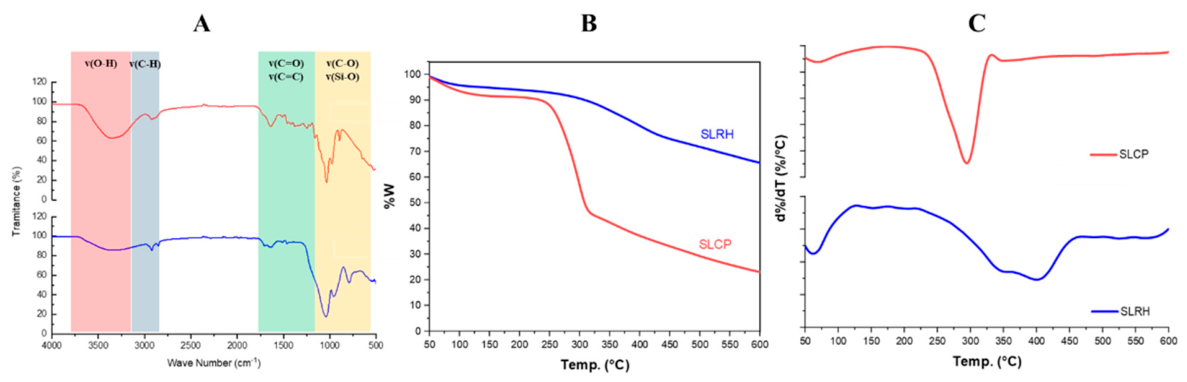

Table 2.
Weight loss during thermogravimetric analysis and silica content of SLRH and SLCP.
| NPs | Interval 1; loss | Interval 2; loss | Interval 3; loss | Remainder 600 °C | SiO2 ICP-OES |
|---|---|---|---|---|---|
| SLRH | 30 – 130 °C; 4.8 % | 222 – 470 °C; 19.7 % | 470 – 600 °C; 9.9 % | 65.6 % | 51.5 % |
| SLCP | 30 – 168 °C; 8.3 % | 195 – 331 °C; 46.7 % 331 – 428 °C; 9.7 % |
428 – 600 °C; 12.3 % | 23.0 % | 11.1 % |
3.3. Adsorption
The sorption isotherms and adsorption kinetics of Cu(II) on SLRH and SLCP are presented in Figure 3, 4 and Table 3.
Figure 3.
Adsorption isotherm of Cu(II) on a) SLRH fitted by Freundlich and Sips model, and b) SLCP fitted by Sips model.
Figure 3.
Adsorption isotherm of Cu(II) on a) SLRH fitted by Freundlich and Sips model, and b) SLCP fitted by Sips model.
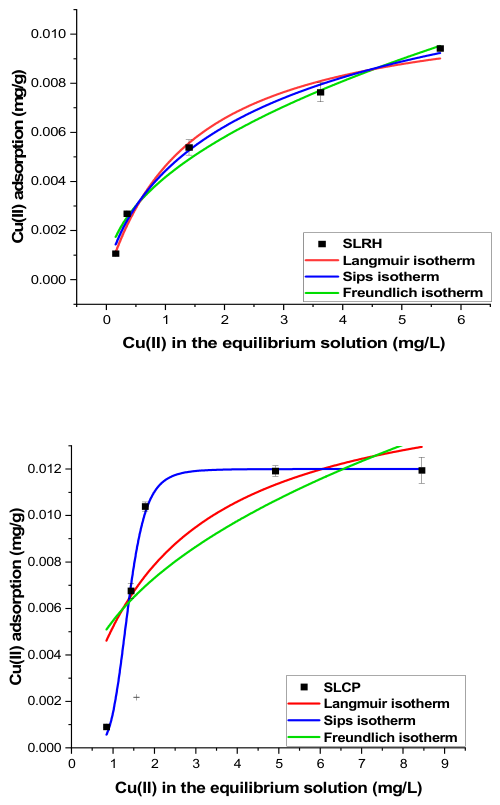
Table 3.
Isotherm parameters for Cu(II) adsorption onto SLRH and SLCP.
| Langmuir´s Model |
Sip’s Model
|
Freundlich’s Model
|
||||
|---|---|---|---|---|---|---|
| Parameters | Value | Parameters | Value | Parameter | Value | |
| SLRH | qm (mg/g) | 11.3 ± 0.9 | qm (mg/g) | 15 ± 7 | 1/n | 0.47 ± 0.05 |
| KL | 0.7 ± 0.2 | KS | 0.4 ± 0.3 | KF | 0.0042 ± 0.0003 | |
| R2 | 0.9817 | n | 0.7 ± 0.2 | R2 | 0.9794 | |
| R2 | 0.9845 | |||||
| SLCP | qm (mg/g) | 16 ± 5 | qm (mg/g) | 12.0 ± 0.3 | 1/n | 0.4 ± 0.2 |
| KL | 0.5 ± 0.4 | KS | 0.14 ± 0.05 | KF | 0.005 ± 0.002 | |
| R2 | 0.6333 | n | 6.3 ± 0.9 | R2 | 0.4976 | |
| R2 | 0.9941 | |||||
Figure 4.
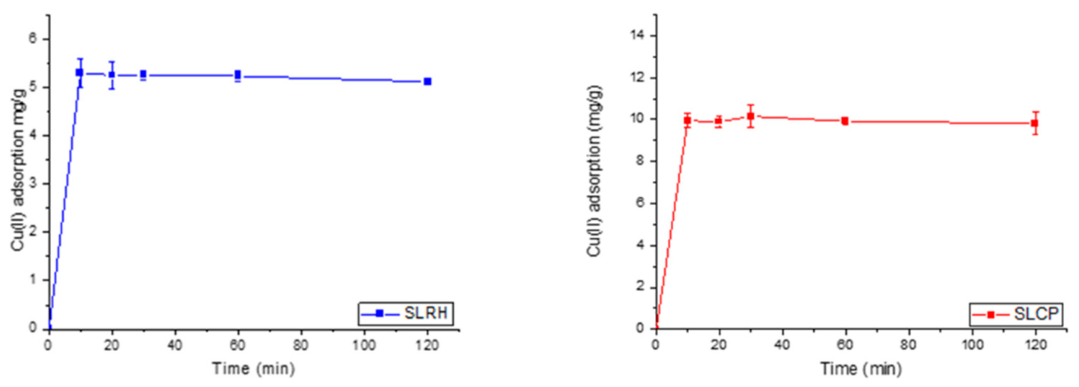
Adsorption kinetics of Cu(II) adsorption onto SLRH and SLCP.
4. Discussion
4.1. Raw Material Proximate Composition
Proximate analysis of rice husk and coffee parchment in this study was done using the CDSM. From this characterization can be concluded that the main component in both rice husk and coffee parchment is cellulose, followed by lignin, together with acid-insoluble ash. These results for each component in the raw materials are in agreement with the ones reported in the literature [14].A more detailed study of the composition of coffee parchment was previously made by our group [15], and the results are similar to the ones here presented. It should be noticed that despite the percentage of lignin plus ash being similar in both materials, the silica content in rice husk is well known to be greater than that in coffee parchment [16]. From these percentages, a greater content of silica is expected to be present in composites obtained from rice husk, whilst those from coffee parchment shall be richer in lignin.
4.2. Raw Material Proximate Composition
The synthesis of the silica–lignin nanocomposites was carried out using the sol–gel method. First, the obtention of the sol using a basic solution allows for the selective separation of lignin and silica from the biomass, and then, the posterior decrease of pH allows their precipitation and the formation of the gel. The incubation period at an acid pH allows for the self-association reaction between lignin and silica to take place and the growth of the nanoparticles. They report a maximum mass ratio of lignin when the gel is formed at a pH of around 2 and a reaction temperature of 90°C.
The morphological analysis made by TEM microscopy (Figure 1). In the case of SLCP, the shape was not as uniform as SLRH, since some particles don’t make up a well-defined sphere and some rods and stretched ellipses are observed. The rod-shaped structures are characteristic of cellulose nanocrystals which suggests the presence of cellulose impurities [17]. The nanoparticles show little agglomeration and their uniform shape suggests that during the co-precipitation process, the lignin tends to deposit on the surface of the silica of the nanocomposites, instead of forming separate structures. The lignin coating on the silica deters the agglomeration characteristic of silica particles [18]. Additionally, the size and morphology of the nanocomposites are consistent with the results reported by Qu et al., 2010[12].
The presence of the two main components of the nanocomposites was first confirmed by FT-IR (Figure 2A). Based on previous literature reports the main peaks of lignin and silica were assigned [19].In the SLCP spectrum, the broad signal at 3340 cm-1 corresponds to the stretching vibration of OH groups, present in both lignin and silica. The peaks at 2915 and 2830 cm-1 correspond to the antisymmetric and symmetric stretching of methylene groups, respectively. The peak around 1710 cm-1 was assigned to the stretching vibration of carbonyl groups. The peaks between 1650 and 1550 correspond to the characteristic vibrations of aromatic rings. The signals at 1040, 970, and 900 cm -1 were attributed to the stretching vibrations of Si-O-Si, and the stretching and bending vibrations of Si-O bonds, respectively.
In the SLRH spectrum, lignin and silica can likewise be identified. There’s a broad signal around 3350 cm-1 corresponding to the stretching vibration of OH groups. Peaks at 2920 and 2835 cm-1 correspond to the antisymmetric and symmetric stretching of methylene groups and a peak around 1710 cm-1 corresponds to the stretching of carbonyl group. The peaks at 1050, 950 cm-1 and 790 cm-1 can be attributed to the stretching vibrations of Si-O-Si and Si-O groups.
The presence of the characteristic peaks of both lignin and silica in the infrared spectra of the obtained nanocomposites proves the presence of both compounds in their composition. It is expected a higher silica proportion in SLRH relative to SLCP due to a higher silica concentration in rice husk, as stated in Section 4.1; this is confirmed by the silica content determination by ICP-OES (Table 2), SiO2 content in composites was 11.1 % and 51.5 % for SLCP and SLRH, respectively. This could explain the lower intensity of the characteristic peaks for the vibrations of aromatic groups relative to the peak due to the stretching of Si-O-Si in the SLRH FTIR spectrum.
TGA/DTG analysis are displayed in Figure 2B and 2C; all mass percent losses are listed in Table 2. In both cases, the thermal analysis can be interpreted in three main stages of mass loss, the first one being for temperatures below 200 °C, the second one between 200 °C and 400 °C, and the third one above 400 °C. The mass loss in the first interval, below 200 ºC, may be assigned to the evaporation of adsorbed water. The glass transition of lignin might also occur at these temperatures [20]. The decomposition of lignin structure takes place in the 200 ºC to 600 ºC interval, split into two stages. From 200 °C up to 400 °C the first steps of lignin pyrolysis take place [21], attributed to the decomposition of the methyl-aryl ether bonds of lignin. In this stage the major mass loss is observed, being greater for SLCP (~55 %), while ~20 % was registered for SLRH. Further information could be obtained from DTG graphs, showing that lignin degradation of SLRH occurs in two main transformations since two peaks can be seen between 300 and 400 °C. Regarding SLCP, a sharp peak centered on 300 °C followed by a small hollow going from 330-430 °C, is displayed. These results suggest that two different types of lignin make up the afforded nanomaterials, because different mechanisms of pyrolysis are taking place. At temperatures above 400 ºC, the secondary pyrolysis reactions of lignin take place, attributed to the decomposition of aromatic rings and side chains in lignin [21]. In this stage, a gradual mass loss is observed with a solid remainder of 65% for SLRH and 23% for SLCP.
The percentages of SiO2 present in the nanoparticles were determined using ICP-OES, otherwise silica content would have been overestimated if determined by TGA, since above 600 °C is expected to take place the cleavage of lignin-silica bonds. The determined values are consistent with the reported for the synthesis of SLRH under similar conditions of temperature and pH [12]. Therefore, it could be assumed that, in composites, lignin and silica are in a condensed complex structure [22]. As expected, due to the higher silica content in the rice husk relative to the coffee parchment, SLRH has a significantly higher silica content than SLCP, granting it a higher thermal stability and a less pronounced mass loss during pyrolysis.
4.3. Adsorption
The sorption isotherms of Cu(II) on SLRH and SLCP are presented in Figure 3. The adsorption isotherm experiments were performed with initial concentrations of Cu (II) from 2-20 ppm. Copper concentration in contaminated soil and water can range from 1 to a 100 ppm, and the World Health Organization estimates the maximum Cu(II) concentration in drinking water should be 3 ppm [4], therefore adsorption studies in this range of concentrations are of interest. The pH of the solution in equilibrium was measured and the values were between 5 and 7, being lower with the higher Cu(II) concentration. The sorption capacity of the nanocomposites increased with the increasing initial concentration. In the case of SLCP, a sorption capacity plateau seems to be reached while for SLRH a maximum capacity was not reached.
The adsorption isotherm for SLCP shows a steep increase in the sorption capacity, indicating a high affinity of the nanocomposite to the Cu(II), and a plateau is quickly reached due to the occupation of the surface active sites. The Sips model was used to successfully fit the adsorption isotherm with a correlation coefficient of 0.9941, so, the model’s hypothesis can be applied (Table 3). The Sips model is a combination of the Langmuir and Freundlich models accounting for the heterogeneity of the adsorbent´s surface [23,24]. The factor n is indicative of the surface-active centers’ heterogeneity and the deviation from the Langmuir isotherm model, the more the value of n deviates from 1, the more heterogenous the surface is considered [25]. The obtained value of 6.3 accounts for a highly heterogenous surface, due to the presence of functional groups from both lignin and silica, forming a complex structure in the material. The predicted maximum sorption capacity using this model was 12.0 mg/g (Table 3).
For SLRH all three models can be used to fit the adsorption isotherm data, although a slightly higher correlation coefficient was achieved for the Sips model. The Sips and the Langmuir model can be used to estimate a maximum sorption capacity, resulting in an estimated value of 15 mg/g and 11.3 mg/g respectively (Table 3). The difference in maximum sorption capacity values can be due to a lack of a sorption capacity plateau in the isotherm, making it more difficult to precisely determine a saturation concentration for SLRH. The different adsorption behavior of SLRH relative to SLCP can be related to the higher silica content. The more sloped isotherm (with an n = 0.7, close to 1 in the Sips model) is characteristic of the adsorption onto silica and the Langmuir fit suggests a more homogeneous active surface, so the silica present in the nanocomposite could have a more important role in the adsorption process. It is known that the silica has a better porous structure [12], and that can result in the slightly higher sorption capacities compared to SLCP.
The adsorption kinetics was studied in an interval of 10 to 120 min (Figure 4). This essay showed that both SLRH and SLCP reach an equilibrium with the Cu(II) solution in under 10 minutes. After that time, the Ct remains constant. These fast adsorption times can be due to the small size of the nanocomposites, and therefore, the higher specific surface, which rapidly reaches equilibrium. The faster adsorption of nanocomposites can be an advantage in remediation technology for contaminated water since it allows the quick processing of higher volumes of water.
Several studies have covered the adsorption capacities of both lignin and silica-based materials towards heavy metals. Some of these reports are summarized in Table 4. Lignin on its own generally shows low adsorption capacities towards heavy metals in water. Organosolv lignin, extracted using organic solvents from hardwood and softwood exhibits low sorption capacities towards Cu(II), between 1.5 and 2.5 mg/g, and the adsorption equilibrium is reached in around 80 minutes as shown by [26]. The extraction of lignin using a strongly basic medium and high temperatures results in depolymerization reactions and the generation of free phenolic hydroxyl groups, increasing the hydrophilicity of lignin (known as alkaline lignin) and, therefore, the adsorption capacity towards heavy metals is usually higher. Alkaline lignin extracted from wheat straw and Eucalyptus showed a saturated adsorption amount of 26 mg/g and 137.03 mg/g towards Cu(II) respectively [27,28].
Silica-based materials extracted from natural sources have also shown properties as heavy metal adsorbents. Silica extracted from rice husk using a sol/gel method and modified with nitric acid showed a Cu(II) sorption capacity of 19.61 mg/g [32], a similar sorption capacity to the ones obtained in this study. Zawrah & Alhogbi [31] reported the synthesis of silica/activated carbon (SiO2@C) nanocomposites from rice husk ash using chemical and thermal activation with a sorption capacity towards Cu(II) of 30 mg/g and a high adsorption efficiency.
Composites of lignin and silica have also been used as adsorbents of heavy metals. For example, a MgO-SIO2/lignin hybrid presented a high specific surface area and it showed a saturated adsorption amount of 83.9 mg/g of Cu(II) [29]. Klapiszewski et al. [30] reported the synthesis of TiO2-SiO2/lignin hybrids, and it exhibited a maximum sorption capacity of 59.9 mg/g torwards Pb(II) in water within 30 minutes. Although these lignin-silica composites consistently show higher sorption capacities and efficiency (relative to isolated lignin and silica adsorbents), their synthesis usually requires a longer synthetic route, high temperatures, and aren’t as environmentally friendly as a composite extracted directly from vegetal biomass. At some point, there could be a trade-off between the facility of preparation and adsorption performance. In any case, the different lignin hybrids reported show the positive effect of the inorganic oxides on the adsorption capacity of heavy metals.
The higher affinity for Cu(II) displayed by SLCP remarks the role of lignin in the adsorption process. Capitalizing on the lignin organic framework for chemical functionalization can also be a feasible course of action for the enhancement of the sorption capacity. In this regard, Budnyak et al. [33] report the immobilization of lignosulphonate and kraft lignin on mesoporous silica using epichlorohydrin as a crosslinker. They demonstrated a synergistic effect in the adsorption of Co(II), outperforming the individual constituents. The development of greener procedures for the synthesis of modified silica/lignin nanocomposites from natural sources could be a viable strategy moving forward for the preparation of environmentally friendly and efficient adsorbent materials.
5. Conclusions
To sum up, lignin/silica nanocomposites were synthesized via a sol-gel method, starting from rice husk and coffee parchment. The characterization by TEM, FTIR, and TGA revealed spherical-shaped lignin/silica nanoparticles with diameters ranging from 50 to 60 nm, where the lignin content in the material influenced in the shape and size of the particle. The ability to adsorb Cu(II) cations, as representative for heavy metals species, was tested. The nanocomposites were shown to be fast adsorbents with adsorption capacities of 15 mg/g for SLRH and 12 mg/g for SLCP. As expected, the silica content of the starting material plays a crucial role in the properties of the obtained nanocomposites. A nanocomposite with a higher silica content exhibits higher thermal stability and changes in the adsorption isotherm behavior. Interestingly, although SLRH exhibited a higher estimated sorption capacity than SLCP, the shape of the isotherms suggests a higher affinity of Cu(II) for SLCP. Regardless of the source, the nanocomposite preparation methodology constitutes a promising alternative in the revalorization of agricultural waste and the obtention of novel inexpensive high-value products, an important step towards the proper management of Cuban agricultural subproducts.
Author Contributions
For research articles with several authors, a short paragraph specifying their individual contributions must be provided. The following statements should be used “Conceptualization, J.P.F and C.C.H.; methodology, J.P.F, D.M and C.C.H; formal analysis, J.P.F, A.D.G and C.C.H.; investigation A.D.G, D.M, J.P.F and C.C.H.; resources, Y.M. and Y.C.; writing—original draft preparation, D.M., J.P.F. and C.C.H.; writing—review and editing, Y.M. and Y.C.; visualization, Y.C. and Y.M.; supervision, Y.C. and Y.M.; project administration, Y.M. and Y.C.; funding acquisition, Y.M.
Funding
This research was funded by the research projects FIC Maule BIP: 40058819, and FIA: PYT-2026-0259, both from Chile.
Institutional Review Board Statement
Not applicable.
Acknowledgments
The authors would like to thank to project Fondo de Innovación para la Competitividad FIC (BIP: 40058819) del Gobierno regional del Maule, Chile, FIA (PYT-2026-0259) Chile, and project “Desarrollo de nanoestructuras con aplicaciones en las esferas bio, agro y medioambiental” (Code PN223LH010-062), Programa Nacional de Ciencias Básicas y Naturales, Cuba.
Conflicts of Interest
The authors declare no conflicts of interest.
Abbreviations
The following abbreviations are used in this manuscript:
| RH | Rice husk |
| CP | Coffee parchment |
| CDSM | Chesson-Datta semiquantitative method |
| SLNPs | Silica-lignin nanocomposites |
| H2SO4 | Sulfuric acid |
| SLRH | Lignin-silica nanocomposites from rice husk |
| SLCP | Lignin-silica nanocomposites from coffee parchment |
References
- Torres-Valenzuela, L.S.; Serna-Jiménez, J.A.; Martínez, K. Coffee by-products: Nowadays and perspectives. Coffee—Production Res. 2020, 1–18. [Google Scholar]
- Juliano, B.O.; Tuaño, A.P.P. Gross structure and composition of the rice grain. In rice; Elsevier, 2019; pp. 31–53. [Google Scholar]
- Van Dyk, J.S.; Gama, R.; Morrison, D.; Swart, S.; Pletschke, B.I. Food processing waste: Problems, current management and prospects for utilisation of the lignocellulose component through enzyme synergistic degradation. Renew. Sust. Energ. Rev. 2013, 26, 521–31. [Google Scholar] [CrossRef]
- Liu, Y.; Wang, H.; Cui, Y.; Chen, N. Removal of copper ions from wastewater: a review. Int. J. Environ. Res. Public Health 2023, 20(5), 3885. [Google Scholar] [CrossRef] [PubMed]
- Wang, J.; Qian, Y.; Deng, Y.; Liu, D.; Li, H.; Qiu, X. Probing the interactions between lignin and inorganic oxides using atomic force microscopy. Appl. Surf. Sci. 2016, 390, 617–22. [Google Scholar] [CrossRef]
- Ge, Y.; Li, Z. Application of lignin and its derivatives in adsorption of heavy metal ions in water: a review. ACS Sustain Chem. Eng. 2018, 6(7), 7181–92. [Google Scholar] [CrossRef]
- Lora, J.H.; Glasser, W.G. Recent Industrial Applications of Lignin: A Sustainable Alternative to Nonrenewable Materials. J. Polym. Environ. 2002, 10(1), 39–48. [Google Scholar] [CrossRef]
- Zhang, Z.; Terrasson, V.; Guenin, E. Lignin Nanoparticles and Their Nanocomposites. Nanomaterials 2021, 11(5). [Google Scholar] [CrossRef] [PubMed]
- Klapiszewski, Ł.; Bartczak, P.; Wysokowski, M.; Jankowska, M.; Kabat, K.; Jesionowski, T. Silica conjugated with kraft lignin and its use as a novel ‘green’ sorbent for hazardous metal ions removal. Chem. Eng. J. 2015, 260, 684–93. [Google Scholar] [CrossRef]
- Thulluri, C.; Pinnamaneni, S.R.; Shetty, P.R.; Addepally, U. Synthesis of lignin-based nanomaterials/nanocomposites: recent trends and future perspectives. Ind. Biotechnol. 2016, 12(3), 153–60. [Google Scholar] [CrossRef]
- Xiong, W.; Yang, D.; Zhong, R.; Li, Y.; Zhou, H.; Qiu, X. Preparation of lignin-based silica composite submicron particles from alkali lignin and sodium silicate in aqueous solution using a direct precipitation method. Ind. Crops Prod. 2015, 74, 285–92. [Google Scholar] [CrossRef]
- Qu, Y.; Tian, Y.; Zou, B.; Zhang, J.; Zheng, Y.; Wang, L.; et al. A novel mesoporous lignin/silica hybrid from rice husk produced by a sol-gel method. Bioresour. Technol. 2010, 101(21), 8402–5. [Google Scholar] [CrossRef] [PubMed]
- Cui, J.; Sun, H.; Wang, X.; Sun, J.; Niu, M.; Wen, Z. Preparation of siliceous lignin microparticles from wheat husks with a facile method. Ind. Crops Prod. 2015, 73, 689–96. [Google Scholar] [CrossRef]
- Scatolino, M.V.; Costa, AdO; Guimarães Júnior, J.B.; Protásio, TdP; Mendes, R.F.; Mendes, L.M. Madeira de eucalipto e pergaminho de café na produção de aglomerados: Propriedades físicas e mecânicas. Ciência E Agrotecnologia 2017, 41(2), 139–46. [Google Scholar]
- Mesa, D.; Figueroa, J.P.; Leyes, E.A.; Castillo, C.R.; Collazo, A.; Núñez, H.A.; et al. Preliminary Physical and Chemical Characterization of By-Products from Cuban Coffee Production. Foods 2024, 13(21), 3348. [Google Scholar] [CrossRef] [PubMed]
- Zemnukhova, L.; Panasenko, A.; Tsoi, E.; Fedorishcheva, G.; Shapkin, N.; Artem’Yanov, A.; et al. Composition and structure of amorphous silica produced from rice husk and straw. Inorg. Mater. 2014, 50, 75–81. [Google Scholar] [CrossRef]
- Wijaya, C.J.; Ismadji, S.; Gunawan, S. A Review of Lignocellulosic-Derived Nanoparticles for Drug Delivery Applications: Lignin Nanoparticles, Xylan Nanoparticles, and Cellulose Nanocrystals. Molecules 2021, 26(3), 676. [Google Scholar] [CrossRef] [PubMed]
- Zhang, X.; Zhao, Z.; Ran, G.; Liu, Y.; Liu, S.; Zhou, B.; et al. Synthesis of lignin-modified silica nanoparticles from black liquor of rice straw pulping. Powder Technol. 2013, 246, 664–8. [Google Scholar] [CrossRef]
- Tian, W.; Li, H.; Zhou, J.; Guo, Y. Preparation, characterization and the adsorption characteristics of lignin/silica nanocomposites from cellulosic ethanol residue. RSC Adv. 2017, 7(65), 41176–81. [Google Scholar] [CrossRef]
- Laurichesse, S.; Avérous, L. Chemical modification of lignins: Towards biobased polymers. Prog. Polym. Sci. 2014, 39(7), 1266–90. [Google Scholar] [CrossRef]
- Kawamoto, H. Lignin pyrolysis reactions. J. Wood Sci. 2017, 63(2), 117–32. [Google Scholar] [CrossRef]
- Klapiszewski, Ł.; Zdarta, J.; Szatkowski, T.; Wysokowski, M.; Nowacka, M.; Szwarc-Rzepka, K.; et al. Silica/lignosulfonate hybrid materials: Preparation and characterization. Open Chem. 2014, 12(6), 719–35. [Google Scholar] [CrossRef]
- Piccin, J.S.; Cadaval, T.R.S.A.; De Pinto, L.A.A.; Dotto, G.L. Adsorption isotherms in liquid phase: experimental, modeling, and interpretations. In Adsorption processes for water treatment and purification; 2017; pp. 19–51. [Google Scholar]
- Sips, R. Combined form of Langmuir and Freundlich equations. J. Chem. Phys. 1948, 16(429), 490–5. [Google Scholar]
- Singh, J.K.; Verma, N. Theory, molecular, mesoscopic simulations, and experimental techniques of aqueous phase adsorption. in: Aqueous Phase Adsorption; Press, C., Ed.; 2018; pp. 1–42. [Google Scholar]
- Harmita, H.; Karthikeyan, K.; Pan, X. Copper and cadmium sorption onto kraft and organosolv lignins. Bioresour. Technol. 2009, 100(24), 6183–91. [Google Scholar] [CrossRef] [PubMed]
- Mohan, D.; Pittman, C.U., Jr.; Steele, P.H. Single, binary and multi-component adsorption of copper and cadmium from aqueous solutions on Kraft lignin—a biosorbent. J. Colloid Interface Sci. 2006, 297(2), 489–504. [Google Scholar] [CrossRef] [PubMed]
- Todorciuc, T.; Bulgariu, L.; Popa, V.I. Adsorption of Cu (II) from aqueous solution on wheat straw lignin: Equilibrium and kinetic studies. Cell Chem. Technol. 2015, 49(5-6), 439–47. [Google Scholar]
- Ciesielczyk, F.; Bartczak, P.; Klapiszewski, Ł.; Jesionowski, T. Treatment of model and galvanic waste solutions of copper (II) ions using a lignin/inorganic oxide hybrid as an effective sorbent. J. Hazard Mater. 2017, 328, 150–9. [Google Scholar] [CrossRef] [PubMed]
- Klapiszewski, Ł.; Siwińska-Stefańska, K.; Kołodyńska, D. Preparation and characterization of novel TiO2/lignin and TiO2-SiO2/lignin hybrids and their use as functional biosorbents for Pb (II). Chem. Eng. J. 2017, 314, 169–81. [Google Scholar] [CrossRef]
- Zawrah, M.; Alhogbi, B.G. Preparation and characterization of SiO2@ C nanocomposites from rice husk for removal of heavy metals from aqueous solution. Ceram. Int. 2021, 47(16), 23240–8. [Google Scholar] [CrossRef]
- Kukwa, R.E.; Kukwa, D.T.; Oklo, A.D.; Ligom, T.T.; Ishwah, B.; Omenka, J.A. Adsorption studies of silica adsorbent using rice husk as a base material for metal ions removal from aqueous solution. J. Chem. Eng. 2020, 8(2), 48. [Google Scholar] [CrossRef]
- Budnyak, T.M.; Slabon, A.; Sipponen, M.H. Lignin–Inorganic Interfaces: Chemistry and Applications from Adsorbents to Catalysts and Energy Storage Materials. ChemSusChem 2020, 13(17), 4344–55. [Google Scholar] [CrossRef] [PubMed]
Figure 1.
TEM micrographies and diameter distributions for SLCP (red border) and SLRH (blue border). The scale bars for micrographies are set at 600 nm.
Figure 1.
TEM micrographies and diameter distributions for SLCP (red border) and SLRH (blue border). The scale bars for micrographies are set at 600 nm.
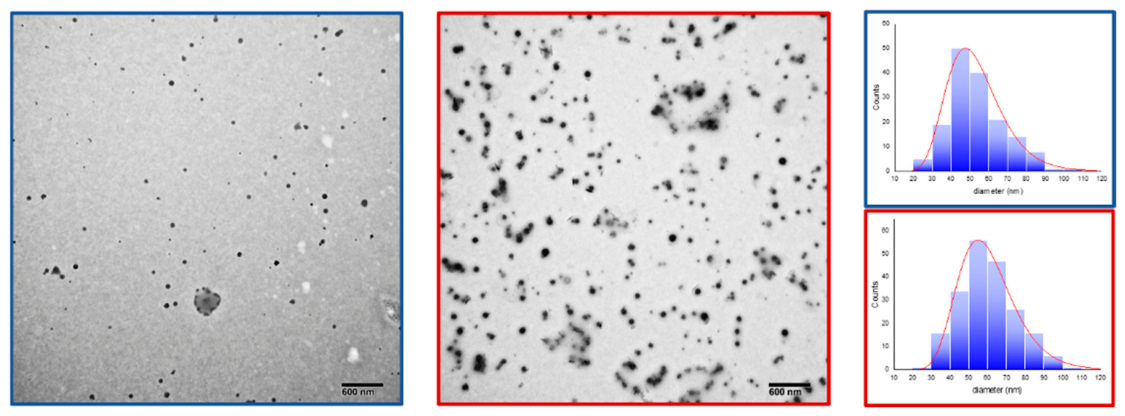
Table 1.
Compositional analysis of rice husk and coffe parchment using Chesson-Datta method .
| % Humidity | % Soluble | % Hemicellulose | % Cellulose | % Ligin + ash | |
|---|---|---|---|---|---|
| CP | 8 ± 1 | 13 ± 2 | 17 ± 2 | 37 ± 3 | 33 ± 2 |
| RH | 10.0 ± 0.7 | 7 ± 2 | 16 ± 5 | 45 ± 5 | 31 ± 5 |
Table 4.
Adsorption capacities of selected lignin and silica based adsorbents.
| Adsorbent | Source material | q | Metal | Ref. |
|---|---|---|---|---|
| Alkaline lignin | Wheat straw | 26 | Cu(II) | [28] |
| Kraft lignin | Eucalyptus | 137.03 | Cu(II) | [27] |
| Organosolv lignin | softwood | 1,38 | Cu(II) | [26] |
| hardwood | 2.56 | |||
| MgO-SiO2-lignin | Commercial | 83.9 | Cu(II) | [29] |
| TiO2-SiO2-lignin | Commercial | 59.9 | Pb(II) | [30] |
| SiO2@C | Rice husk | 36.19 | Cu(II) | [31] |
| Silica | Rice husk | 19.61 | Cu(II) | [32] |
| LS/SiO2 KL/SiO2 |
Commercial | 75 59 |
CO(II) | [33] |
Disclaimer/Publisher’s Note: The statements, opinions and data contained in all publications are solely those of the individual author(s) and contributor(s) and not of MDPI and/or the editor(s). MDPI and/or the editor(s) disclaim responsibility for any injury to people or property resulting from any ideas, methods, instructions or products referred to in the content. |
© 2026 by the authors. Licensee MDPI, Basel, Switzerland. This article is an open access article distributed under the terms and conditions of the Creative Commons Attribution (CC BY) license (http://creativecommons.org/licenses/by/4.0/).
Copyright: This open access article is published under a Creative Commons CC BY 4.0 license, which permit the free download, distribution, and reuse, provided that the author and preprint are cited in any reuse.