

Submitted:
16 September 2026
Posted:
17 September 2026
You are already at the latest version
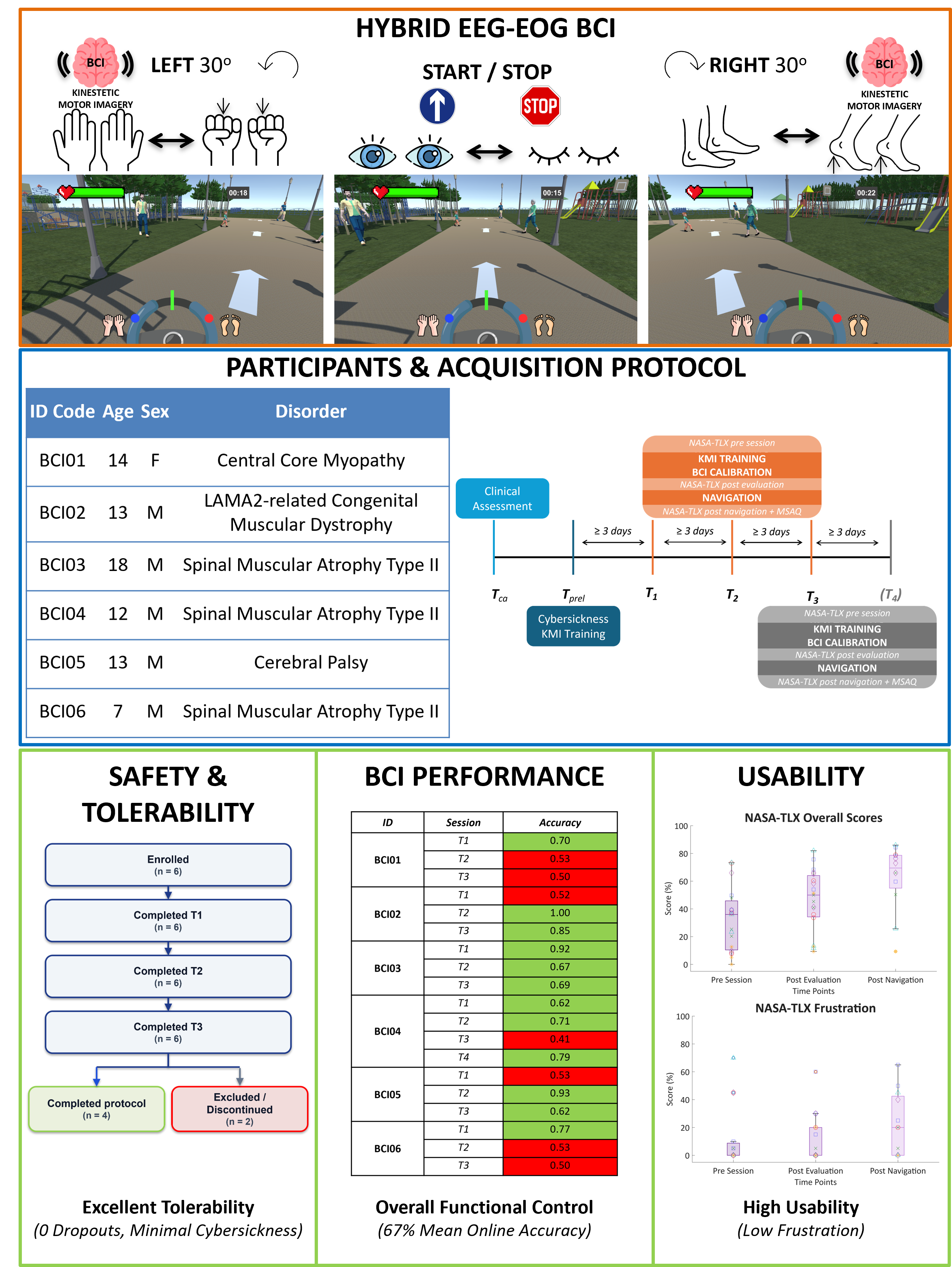
Abstract
Background: Developing Brain–Computer Interfaces (BCIs) for children with severe neuromotor disabilities remains challenging due to developmental neurophysiology and the high cognitive demands of motor imagery. Hybrid BCIs integrating electroencephalography (EEG) and electrooculography (EOG) can overcome these limitations by combining continuous motor-related control with reliable discrete commands. This multiple-case study investigated the feasibility of a hybrid EEG–EOG BCI integrated with a virtual reality (VR) powered-wheelchair simulator for mobility training. Methods: Six participants (one child, five adolescents) with severe neuromotor disabilities completed repeated sessions using a self-paced BCI. The system combined continuous kinesthetic motor imagery (KMI) for steering and EOG-detected voluntary blinks for discrete commands. We evaluated online classification performance (accuracy, sensitivity, specificity), user workload (NASA-TLX), and simulator-related discomfort (MSAQ) under fully and semi-immersive VR conditions. Results: Despite expected inter-subject variability, most participants achieved functional online VR wheelchair control, reaching a mean accuracy of 77% in successful sessions with balanced sensitivity and specificity. NASA-TLX scores indicated moderate cognitive workload but consistently low frustration. Zero dropouts and low MSAQ scores demonstrated excellent protocol tolerability, high engagement, and minimal cybersickness across both VR modalities. Conclusions: This study demonstrates the feasibility of combining hybrid EEG–EOG BCI control with VR for pediatric powered mobility training. The framework enabled functional control with high usability and minimal adverse effects, supporting the clinical potential of hybrid BCI–VR systems as accessible assistive technologies and providing a foundation for larger clinical trials.
Keywords:
brain computer interface
; kinesthetic motor imagery
; virtual reality
; neuromotor disabilities
; powered mobility
1. Introduction
Independent mobility is a fundamental prerequisite for cognitive, social, and emotional development in children [1]. For children with severe neuromotor disabilities, powered wheelchairs (PWs) can provide an important means of achieving independent mobility and promoting autonomous exploration and participation in daily life. However, conventional PWs typically require residual upper-limb function for their operation, which may be limited or absent in this population [2]. It is indeed estimated that up to 10–15% of potential PW users are unable to operate standard joystick-based interfaces due to profound motor impairments [3,4]. While powered mobility (PM) systems remain the primary assistive technologies to improve functional independence and, consequently, health-related quality of life [5], this physical barrier creates a critical accessibility gap during crucial developmental stages.
Even for users capable of alternative access, safe and effective PW use requires specific driving skills. Conventionally, wheelchair training (WT) is delivered in structured clinical settings under direct therapist supervision. Although this approach ensures patient safety and standardized skill acquisition, often guided by pediatric frameworks like the Powered Mobility Program (PMP) [6], it places considerable demands on clinical resources, specialized personnel, and infrastructure [7]. Technology-assisted and home-based solutions may complement conventional training by increasing opportunities for individualized, repeated practice outside clinical settings.
Virtual reality (VR) has emerged as a promising platform for mobility training, providing safe, controlled, and repeatable environments for skill acquisition [8]. Both fully immersive (FI) systems, using head-mounted displays, and semi-immersive (SI) desktop configurations can simulate ecologically meaningful driving scenarios while removing the physical risks of real-world practice [7]. Furthermore, VR enables minimally supervised, high-intensity sessions that are highly suitable for home-based WT [9].
Despite these advantages, existing VR wheelchair training simulators often fail to bridge the aforementioned accessibility gap for users with severe upper-limb dysfunction [10]. Many systems lack realistic driving challenges and, most importantly, do not support interoperability with alternative, joystick-free control interfaces [11,12]. The development of reliable alternative access strategies is therefore essential to ensure VR-mediated PM training is truly inclusive.
Brain–computer interfaces (BCIs) offer a viable solution by enabling users to control external devices through physiological signals, bypassing neuromuscular pathways [13]. While BCIs have been increasingly investigated as assistive technologies [14,15] and integrated with VR environments [16], transitioning them from laboratory prototypes to practical clinical tools remains hindered by variable performance, demanding training, and high user burden [17].
These challenges are exceptionally pronounced in pediatric BCI research. Pediatric BCIs represent a particularly challenging and clinically relevant research domain. Recent clinical evidence further supports the growing interest in pediatric BCI applications, highlighting their potential as assistive technologies while emphasizing the need for developmentally appropriate protocols and clinically meaningful outcome measures [18]. A systematic review by Orlandi et al. highlighted that pediatric BCI studies are still predominantly feasibility-oriented, characterized by small sample sizes and high performance variability [19]. Pediatric users present unique challenges, including higher inter- and intra-subject variability, shorter attention spans, susceptibility to fatigue, and ongoing neurodevelopmental changes [19,20,21]. Nevertheless, clinical studies demonstrate that children with severe neurological disabilities can achieve functional BCI control, provided that calibration and training procedures are highly individualized and user-centered [22,23].
Among non-invasive BCI paradigms, motor imagery (MI)-based approaches are particularly suited for mobility applications. Unlike stimulus-driven paradigms (e.g., P300 or SSVEP), MI enables endogenous, continuous, and self-paced control without relying on external sensory stimulation [24,25]. Specifically, kinesthetic motor imagery (KMI), the internal reproduction of proprioceptive and somatosensory sensations associated with movement [26], is strongly linked to sensorimotor activation, making it a highly effective directional control strategy [27,28]. Although KMI is cognitively demanding and can induce fatigue [19,29], engaging residual sensorimotor networks actively exploits the high neuroplastic potential typical of childhood [30,31,32]. Previous evidence confirms that pediatric users can perform KMI and achieve functional control, albeit with greater variability than adults [20,21,22,23].
To address these cognitive demands and improve overall reliability, hybrid BCIs combine neural signals with additional physiological inputs. Integrating electroencephalography (EEG) with electrooculography (EOG) to detect voluntary eye blinks provides complementary control channels that enhance decoding robustness and command separability [13,33,34]. This multimodal strategy is especially relevant in pediatric contexts, where EEG signal variability can severely limit single-modality control [35]. Recent studies support this direction, showing that multimodal paradigms enhance engagement [20,22] and that children can achieve meaningful functional mobility outcomes even with variable classification performance [36].
Despite these advancements, a significant literature gap remains. Current pediatric BCI research focuses heavily on communication tasks or simplified laboratory interfaces, while existing VR simulators remain largely joystick-dependent. Although recent clinical evidence has demonstrated the feasibility of BCI-enabled powered mobility training in children [36], the integration of a hybrid EEG-EOG control framework within an immersive VR-based wheelchair training protocol has not yet been investigated.
In response to these gaps, we developed BCI4VR-PMP, a hybrid EEG-EOG platform integrating self-paced KMI control with a VR-powered wheelchair simulator. This multiple-case feasibility study evaluated BCI-related online controllability, usability, and workload, along with VR tolerability in children and adolescents with severe neuromotor disabilities.
2. Materials and Methods
Study Design
This exploratory multiple-case feasibility study was designed to evaluate the accessibility, online controllability, usability, and tolerability of a hybrid EEG-EOG BCI integrated with a VR-powered wheelchair simulator in children and adolescents with severe neuromotor disabilities. Owing to the rarity and heterogeneity of the target population, a multiple-case design was selected instead of a conventional group-comparison design. Participants were recruited from the “UOC Medicina Riabilitativa Infantile (UOC-MRI)” unit of the IRCCS Institute of Neurological Sciences of Bologna (IRCCS-ISNB). Experiments were performed after prior informed consent and under the supervision of physicians, neurologists, or physiotherapists. The study was conducted in accordance with the ethical principles established by the Declaration of Helsinki and was approved by the local Ethical Committee (37-2023-OSS-AUSLBO). The protocol is registered on ClinicalTrials.gov (ID: NCT06586125) and is part of a broader research project investigating the integration of VR and BCIs. Specifically, this manuscript presents the findings related to the BCI component.
Participants Recruitment
Participants' recruitment was done according to the following inclusion criteria:
- Both genders;
- Ages between 6 and 20 years;
- PMP score higher than 0;
- Clinical diagnosis of central motor disability, classified as Gross Motor Function Classification System (GMFCS [40]) levels 3, 4, or 5;
- Use of either a PW or a manual wheelchair with an electric propulsion system.
Based on these criteria, six participants without prior experience with VR or BCI technologies were enrolled (mean age: 12.83 ± 3.24 years; 1 female, 5 males). This limited sample size reflects the stringent inclusion criteria and the practical complexities of conducting multiple experimental sessions with severely impaired pediatric patients who require continuous caregiver support. Participants were intentionally selected to represent the spectrum of pediatric neuromotor disorders commonly requiring powered mobility, while preserving sufficient cognitive abilities to perform the demanding KMI and VR tasks. Detailed demographic and clinical characteristics are reported in Error! Reference source not found.. None of the participants presented cognitive impairments, perceptual disorders, or epilepsy. Regarding visual conditions, BCI03 had mild myopia, and BCI06 had astigmatism. All participants had previous experience operating powered wheelchairs. Ongoing pharmacological therapies were reported only for BCI04 and BCI06, who were under respiratory bronchodilator and salbutamol therapy, respectively.
The recruited participants presented heterogeneous patterns of residual motor function, reflecting the clinical variability of the target population. Lower-limb (LL) motor control was severely impaired in all participants, with only BCI01 retaining limited voluntary ankle movement, whereas the remaining participants exhibited minimal motor control confined to the hip region. Upper-limb (UL) function showed greater variability, ranging from residual proximal arm movements (e.g., elbow flexion or forearm pronation/supination) to isolated finger movements. Detailed information on residual UL and LL motor abilities for each participant is reported in Table 1.
Participants with residual motor function were intentionally included, consistent with the exploratory feasibility nature of this study. Residual motor experience is considered advantageous for KMI, as this paradigm relies on the internal representation of previously experienced movements and their associated proprioceptive sensations [37]. Conversely, the complete or congenital absence of voluntary motor function may limit the development of accurate motor representations and potentially reduce KMI performance. Future studies will extend the evaluation of the proposed framework to participants with more severe motor impairments.
BCI4VR-PMP System
The system used in this study, the BCI4VR-PMP (depicted in Figure 1a) consists of two integrated modules: a VR wheelchair-driving simulator (VR-PMP) and a hybrid EOG-EEG BCI system.
EEG recordings were acquired through a 32-channel Waveguard cap (EEG64-BIP24CA209, ANT Neuro, Hengelo, The Netherlands) arranged according to the international 10–20 layout (depicted in Error! Reference source not found.b). The cap was connected to an eego Sports amplifier (ANT Neuro, Hengelo, The Netherlands), and signals were digitized at a sampling frequency of 512 Hz. Additionally, ocular activity was monitored by thresholding the deflections of frontal electrodes, specifically Fp1 and Fp2.
The VR-PMP simulator was developed using Unity (Unity Technologies) and designed to simulate the first 20 tasks of the PMP in both FI and SI VR environments. The hybrid BCI system was developed within the ROS-Neuro framework [38], where signal pre-processing included the application of a Common Average Reference (CAR) spatial filter to implement average re-referencing across all channels. The VR simulator and the BCI module run on two dedicated computers connected via a TCP/IP LAN connection, enabling seamless real-time control of the virtual environment through the physiological data.
The hybrid BCI can discriminate between three specific classes to drive the virtual wheelchair. Specifically, imagining the movement of the UL rotates the wheelchair by 30 degrees to the left, while imagining the movement of the lower limbs LL rotates it by 30 degrees to the right. Finally, discrete voluntary eye blinks are used to intentionally start and stop the forward motion of the wheelchair at a fixed speed.
More detailed technical information about the system can be found in a previous work [39] in which we tested it on a group of six participants without disabilities, demonstrating the feasibility and usability on that court.
Experimental Protocol
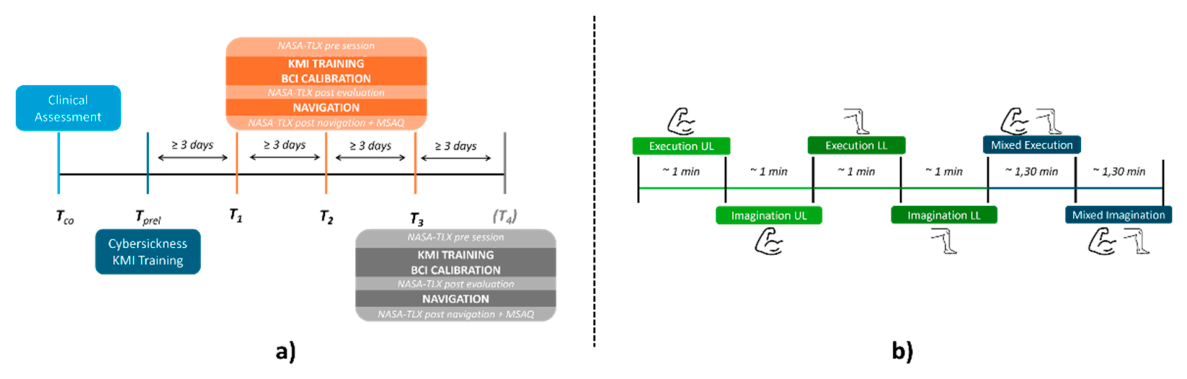
The experimental protocol is illustrated in Figure 2a. It consists of a clinical assessment (Tca), a preliminary session (Tprel), and three to four experimental sessions (T1-T4), with at least 3 days between consecutive time points.
Preliminary Session
Once the movements were chosen, the next preliminary phase (Tprel) started, the same day as Tca. In the beginning, cybersickness, a known adverse effect associated with VR exposure [40], was tested on a dedicated assessment module of the VR-PMP simulator. To this aim, participants were instructed to navigate two distinct virtual environments (a park and a city scenario) for a cumulative duration of 8 minutes. The simulator modality was then selected according to predefined age and VR-tolerability criteria. In compliance with VR headset usage guidelines [41,42], participants younger than 13 years old were restricted to the SI version of the VR-PMP simulator due to safety concerns and the potential for adverse effects. For participants aged 13 years or older, the presence or absence of VR-related side effects observed during the preliminary assessment was used to determine the most appropriate simulator modality (FI or SI).
To assess cybersickness, the motion sickness assessment questionnaire (MSAQ) [43] was used. Although the Simulator Sickness Questionnaire (SSQ) [44] is commonly employed to assess symptoms associated with VR exposure, the MSAQ provides a broader multidimensional characterization of motion sickness symptoms, encompassing gastrointestinal, central, peripheral, and sopite-related manifestations. Moreover, previous research using the MSAQ showed that cybersickness and classical motion sickness are characterized by largely comparable symptom profiles [40]. The MSAQ has also been previously used to assess visually induced motion sickness in VR-based wheelchair simulators [45], further supporting its use in the present study. Importantly, cybersickness monitoring was not limited to questionnaire administration. At each session, participants were explicitly asked about discomfort and modality preferences, with the possibility to switch
Figure 2.
a) Acquisition protocol scheme; b) KMI training protocol. (BCI: brain computer interface, KMI: Kinesthetic Motor Imagery, LL: Lower Limbs, MSAQ: motion sickness assessment questionnaire, NASA-TLX: NASA task load index UL: Upper Limbs).
Figure 2.
a) Acquisition protocol scheme; b) KMI training protocol. (BCI: brain computer interface, KMI: Kinesthetic Motor Imagery, LL: Lower Limbs, MSAQ: motion sickness assessment questionnaire, NASA-TLX: NASA task load index UL: Upper Limbs).
VR modality, when necessary, in order to minimize adverse effects and prevent study withdrawal.
Afterwards, each participant underwent the KMI training (KMIT). This training had two aims. Primarily, it provided standardized training on the KMI paradigm adopted for BCI calibration and control. Additionally, it was systematically administered at the beginning of each of the subsequent sessions to orient participants’ attention toward the target movements before EEG acquisition and BCI operation. As illustrated inError! Reference source not found.b, the KMIT protocol began with 1 minute of motor execution of the specific UL movement decided for each participant, followed by a corresponding KMI of the same movement. Both the execution and imagery blocks consisted of 10 consecutive trials, each comprising a few seconds of active task followed by a brief rest. The same sequence was then performed for LL movements. The protocol concluded with a mixed condition in which participants responded to visual cues by alternately executing and imagining UL and LL movements presented in randomized order (seven trials per effector). The mixed block had a total duration of approximately 90 seconds. The duration of each block was intentionally kept short to ensure focused engagement and to minimize cognitive and physical fatigue, given the overall length of the experimental sessions and the pediatric clinical population involved.
To guide participants through the KMI training, visual cues corresponding to the target movements and preparation intervals were presented on a laptop screen (Error! Reference source not found.).
Figure 3.
KMIT Feedback; a) Fixation cross feedback; b) Hands MI or ME feedback; c) Feet MI or ME feedback.
Figure 3.
KMIT Feedback; a) Fixation cross feedback; b) Hands MI or ME feedback; c) Feet MI or ME feedback.
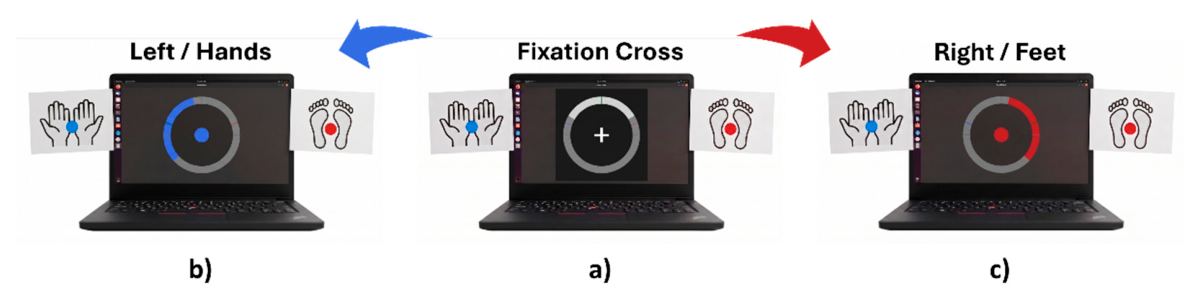
These specific visual cues were selected to ensure consistency with the subsequent BCI calibration procedure, detailed in the following section. To further support the cognitive association between the target movement, the visual cue, and the resulting wheelchair direction, visual aids depicting hands and feet were attached to the sides of the laptop monitor. This setup was specifically designed to help pediatric participants internalize the control strategy and minimize cognitive load.
Crucially, these visual aids were kept physically attached to the monitor throughout the later BCI calibration, evaluation, and VR navigation phases. This strategy aimed to continuously help the children in recalling the correct imagery-to-command associations without increasing memory burden.
Previous literature on motor imagery training suggests that shorter, repeated blocks may help preserve imagery quality and attentional resources, especially in rehabilitation settings [46,47,48]. Participants were instructed to continue KMIT at home for a minimum of three days between each experimental sessions. To support them during this independent practice, participants were provided with video recordings, replicating the exact visual cues and timing used in the laboratory setting. This was meant to ensure consistent guidance and reinforcing the correct imagery-to-command associations during the execution of the home-based KMIT. However, it must be noted that while home practice was strongly recommended, it was not objectively monitored.
Conversely, no specific preliminary training was conducted for the eye-blinking command. Prior to calibration, each participant’s ability to voluntarily and reliably produce eye blinks was assessed and confirmed. Given the adequate voluntary control observed in all participants, individual calibration of the EOG detection threshold during the session was considered sufficient to ensure reliable system operation.
Experimental Sessions
After a minimum interval of three days, participants attended the first experimental session (T1), starting with the repetition of the KMIT. The structure and progression of all experimental BCI sessions (T1–T4) are summarized in Table 2.
Subsequently, the BCI classifier was trained for each participant by acquiring at least three runs, each composed of ten repetitions of UL and ten of LL KMI, presented randomly through visual cues, as described by the article of Tonin et al. [49]. Then, the online accuracy of each participant with the system was tested through the evaluation session, in which participants performed in random order 20 trials (10 UL, 10 LL), with the aim of reaching a predefined activation threshold. A session was considered successful if classification accuracy exceeded 60% (see Marcaccini et al. [39] for the detailed methodology), and it could have been repeated twice. In the case of a successful evaluation phase, the threshold for detection of eye blinking was individually calibrated. Participants were instructed to perform voluntary blinks while different values were tested, aiming to identify the optimal threshold that reliably discriminated intentional blinks from involuntary ones. To ensure system reliability before proceeding, the selected threshold was definitively confirmed only if the participant successfully triggered the command with five consecutive voluntary blinks, without eliciting any false positives during spontaneous blinking. A higher number of trials was deliberately avoided to prevent unnecessary physical and visual fatigue prior to the main navigation task, taking into consideration the young age and clinical conditions of the participants. Subsequently, participants used the BCI system to navigate through 5 of the 20 levels of the VR-PMP in order to provide a preview of the tasks they would have to perform in the next sessions. Full navigation across all VR-PMP levels was intentionally avoided since, given the relatively young age of the population, the session duration was intentionally kept as short as possible.
Later sessions (T2, T3, and T4) were separated by at least three days to allow continued at-home KMIT. These sessions followed the same general structure as T1 with minor adaptations. Specifically, the evaluation stage was performed immediately after KMIT, using the classifier trained during T1. Recalibration was carried out only if performance during evaluation was considered insufficient, followed by a repeated evaluation. Upon completion of the final system evaluation, participants proceeded to the VR-BCI Navigation phase, during which they completed all 20 tasks of the VR-PMP simulator by controlling the virtual wheelchair via BCI.
Session T4 was optional and scheduled only when adequate BCI control was not achieved in T2 or T3. Study discontinuation would have occurred if reliable BCI control was not obtained in more than one session among T2, T3, and T4. Failure at T1 was considered acceptable, given the expected adaptation challenges during first exposure in pediatric and adolescent participants.
Perceived workload was assessed in all BCI sessions using the NASA Task Load Index (NASA-TLX) questionnaire [50], administered in three different time-points: before the session (pre-session, PS), after system evaluation (post-evaluation, PE), and when participants had control of the system, after the navigation phase (post-navigation, PN). The evaluation of potential VR-related side effects was performed after the navigation phase, using the MSAQ.
Data Analysis
To evaluate the feasibility of the proposed system within this multiple-case design, study outcomes were divided into primary and secondary measures. Primary outcomes focused on online controllability and BCI performance metrics, including online accuracy, sensitivity, and specificity. Secondary outcomes encompassed system usability and patient tolerability, evaluated through the NASA-TLX workload index, MSAQ side effects, drop-outs, user tolerance, and adherence to the protocol.
BCI Performance
BCI performance was quantified during the evaluation phase of each session. For every session, classification outcomes were summarized in a confusion matrix, from which overall accuracy and class-specific metrics were derived. Correct identification of UL imagery trials was defined as the positive class (true positive, TP), whereas correct LL imagery trials were defined as the negative class (true negative, TN). Misclassifications were limited to incorrect activation of the non-target class, corresponding to false positives (FP) or false negatives (FN). Trials in which the instructed class did not reach any activation threshold were not considered classification errors and were therefore excluded from FP and FN counts. This definition was selected because failure to activate the classifier resulted in no directional command rather than an unsafe movement, as initiation and termination of wheelchair movement were controlled independently via voluntary eye blinks. This choice reflects the operational logic of the system, in which the KMI paradigm was used to steer the virtual wheelchair left or right. An incorrect class activation would have resulted in steering in the unintended direction, being a potentially unsafe event. In contrast, failure to reach the activation threshold resulted in no directional command, which did not pose safety concerns. Based on this framework, sensitivity reflected the proportion of correctly detected UL imagery trials, while specificity represented the correct identification of LL imagery trials.
It is worth noting that formal classification metrics were not computed for the EOG-based voluntary blink commands.
System Usability
Subjective workload was assessed using the NASA-TLX, computed according to the original scoring procedure [50]. Percentual scores were obtained for each of the six fields (mental demand, physical demand, temporal demand, performance, effort, and frustration), and the overall workload index was calculated. In addition to the raw scores collected at each assessment point, delta values were computed to quantify changes between PS and PE, and between PE and PN. The assumption of normality was assessed using the Shapiro–Wilk test. As most variables did not meet the normality assumption and the sample size was limited, non-parametric statistical methods were adopted. Within-subject differences across the three assessment points (PS, PE, and PN) and across the experimental sessions (T1, T2, and T3) were examined using the Friedman test. Moreover, pairwise comparisons between assessment points, as well as comparisons between the two computed delta values, were performed using the Wilcoxon signed-rank test. To account for differences in protocol length, session T1, which included a shortened navigation preview compared to the full navigation performed in T2 and T3, was explicitly evaluated to investigate potential variations in post-navigation workload. To control for inflation of Type I error due to multiple comparisons, the p-values for pairwise tests were adjusted using the Bonferroni correction by multiplying the raw p-values by the number of comparisons (n = 3). Given the feasibility nature of the study and the limited sample size completing all assessment time points, these inferential statistics should be interpreted as exploratory and descriptive of preliminary trends rather than definitive evidence.
VR-Related Side Effects
The evaluation of potential VR-related side effects was performed using the MSAQ. In accordance with Gianaros et al. [43], four subscales (gastrointestinal, central, peripheral, and drowsiness) as well as the total score were computed and expressed as percentage values. Comparisons across sessions (Tprel, T1, T2, T3 and T4) and stimulation modalities (SI and FI) were explored descriptively through graphical representations. Inferential statistical analyses were not conducted due to the extremely limited sample size and the structural characteristics of the dataset. Specifically, only four participants completed all sessions with sufficient BCI control, yielding four repeated observations per time point. In addition, the number of sessions conducted with the FI modality (n = 6) was markedly lower than those performed with the SI modality (n = 13), resulting in an unbalanced design. Importantly, the choice of stimulation modality was not randomized but driven by individual clinical needs and practical constraints, introducing potential confounding factors that would not be adequately controlled in a formal statistical comparison.
All computations and statistical procedures were implemented in MATLAB (R2025b). Owing to the exploratory feasibility design and the small sample size, all inferential statistics should be interpreted descriptively and as hypothesis-generating rather than confirmatory.
Results
Feasibility and Protocol Adherence
Four out of six participants (67%) successfully completed the protocol, whereas two participants (BCI01 and BCI06) did not achieve stable online control and discontinued the study after T3. Moreover, only one participant (BCI004) required session T4. The overall study progression, including enrollment and session completion, is summarized in Figure 4.
Individualized KMI Task Selection
As a result of the clinical evaluation session, specific UL and LL movements were selected for each participant based on their residual motor abilities. The LL movement was standardized as hip adduction-abduction for almost all participants, with the exception of BCI01 who performed feet dorsiflexion. Conversely, UL movements were highly individualized: hand opening-closing for BCI05 and BCI06; biceps curl for BCI03; elbow flexion-extension with a pronated forearm supported on the wheelchair tray for BCI02; stabilized forearm pronation-supination for BCI01; and gravity-assisted index finger flexion-extension for BCI04.
Features and Thresholds
Table 3 summarizes the EEG used to train the classifier and the corresponding threshold values. The feature columns report, for each participant and session, the combination of EEG channels (in bold) and the associated frequencies (in Hz, indicated in round brackets), used to extract the power spectral density as input features for the BCI. Specifically, these features were selected by identifying the most discriminative ones between the two KMI classes using a Canonical Variate Analysis. The table also reports the thresholds used for the recognition of UL and LL KMI, as well as the thresholds for voluntary blink detection expressed in microvolts (µV). When a threshold was modified during the navigation session, the most recent value is reported in round brackets, whereas the value outside the brackets corresponds to the one used during the BCI calibration and evaluation phases. Given the deterministic nature of the thresholding approach and the inherently high signal-to-noise ratio of ocular artifacts, the blink detection proved to be highly reliable. All participants successfully used the blink command to intentionally initiate and terminate the wheelchair movement without reported operational issues during the sessions.
Classification Metrics
Table 4 summarizes the classification performance obtained in each session. When participants performed multiple evaluations within the same session (i.e., in case of failed evaluation sessions), only the evaluation with the highest accuracy was considered for both the table and the subsequent analyses.
Across all evaluation sessions and participants, mean accuracy was 0.67 ± 0.16, with a sensitivity of 0.65 ± 0.32 and a specificity of 0.69 ± 0.31. When evaluating the temporal progression across the protocol, these overall accuracy values were 0.68 ± 0.15 at T1, 0.73 ± 0.20 at T2, and 0.60 ± 0.15 at T3.
Considering only successful sessions (i.e., the ones with accuracy ≥ 60%), mean accuracy increased to 0.77 ± 0.12, alongside a sensitivity of 0.87 ± 0.11 and a specificity of 0.90 ± 0.16. Finally, when isolating the subgroup of four participants who successfully completed the entire protocol, the accuracy trends across the sessions were 0.65 ± 0.19 in T1, 0.83 ± 0.16 in T2, and 0.64 ± 0.18 in T3.
A formal accuracy value for the EOG-based eye-blinking command was not computed. During calibration, participants were required to achieve five consecutive successful voluntary activation without false-positive detection before proceeding to the VR navigation phase. Accordingly, all participants who advanced to the VR navigation phase had already demonstrated highly reliable control over the blinking command.
System Usability
For consistency, statistical analyses were performed only on sessions in which participants completed the calibration, evaluation, and navigation timepoints, yielding all NASA-TLX values (i.e., PS, PE, and PN). For this reason, the following sessions were excluded: BCI01 sessions T2 and T3, BCI02 session T1, BCI04 session T3, BCI05 session T1, and BCI06 session T2 and T3. Consequently, the inferential statistical analyses examining the complete PS-PE-PN trajectory were conducted on a final subset of four participants.
P-values from the statistical analyses are presented in Table 5. For the first column of the table, referred to the Friedman Test, p-values were multiplied by Bonferroni’s coefficient. Following this, for all comparisons, statistical significance was obtained if the corresponding p-value was lower than or equal to 0.05. The Friedman Test, after Bonferroni’s correction, revealed statistically significant differences between the 3 session timepoints on the total score and mental, physical, effort, and temporal fields.
Wilcoxon signed-rank test revealed significant differences between PS and PE on mental and effort scores. Between PE and PN, significant differences were observed in total score, mental, and effort scores. Between PS and PN, significant differences were observed in the total score and in the mental, temporal, performance, and effort scores.
As for the delta values analysis, the comparison between the two delta values (i.e., PE minus PN and PN minus PE) did not reveal any significant differences.
The distribution of NASA-TLX mental demand and overall scores across participants and BCI sessions (PS, PE, and PN) is reported in Figure 5a and Figure 5b. Mental demand was specifically highlighted as the proposed task is primarily cognitive.
To provide an overview, Table 6 reports the mean values and standard deviations for all NASA-TLX subscales, calculated across the sessions included in the statistical analyses and divided into timepoints.
Figure 5c and Figure 5d present the differential workload scores used to compare the relative demands of the calibration and navigation phases. The plotted values represent the changes in NASA-TLX scores between the three assessment time points: PS to PE, and PE to PN. Consistent with the rationale described above, both the mental demand and the overall workload scores are shown.
Virtual Reality Modality and Tolerability
Regarding the VR modalities used across the experimental protocol, participants BCI05 and BCI06 used the SI setup exclusively. For BCI06, this choice was dictated by age-related restrictions associated with VR headset use, whereas for BCI05 the SI modality was selected a priori because of severe visual impairment and involuntary head movements, which could have been exacerbated by the weight and visual demands of the headset. The remaining participants initially used the FI modality but transitioned to the SI setup during the protocol to improve comfort: BCI03 and BCI04 switched from T2 onwards, while BCI01 and BCI02 transitioned during T3. Reasons for FI-to-SI change are reported for each participant in the next section.
As illustrated by Figure 5e the MSAQ total scores remained below 20% across all sessions and modalities
Individual Case Studies
To address the inter-subject variability, individual clinical profiles and performance trajectories are summarized in Table 7 and detailed below.
BCI01 was a 14-year-old female with central core myopathy presenting minimal residual motor control (limited ankle movement and forearm pronation / supination). In session T1, classification accuracy reached 0.70, with a sensitivity of 0.40. In subsequent sessions (T2 and T3), performance declined to accuracies of 0.53 and 0.50, respectively, and a sensitivity of 0.00. The participant transitioned from the FI to the SI modality in T3. Overall, she tolerated the VR environment without significant side effects, but the inability to reach consistent control thresholds led to her exclusion after T3.
BCI02 was a 13-year-old male diagnosed with LAMA2-related congenital muscular dystrophy (MDC1A), presenting residual elbow motor control and minimal lower-limb function. Following an unsuccessful evaluation in T1 (accuracy = 0.52), online performance substantially improved, reaching perfect classification accuracy in T2 (accuracy = 1.00; sensitivity = 1.00; specificity = 1.00). Performance remained above the predefined success threshold (i.e., 60%) in T3 (accuracy = 0.85), allowing successful completion of all navigation sessions. The participant initially used the FI VR modality but switched to the SI configuration from T3 onward because of discomfort related to the brightness of the head-mounted display.
BCI03 was an 18-year-old male with SMA II, presenting mild myopia, minimal hip control, and residual elbow motor control. The participant achieved an accuracy of 0.92 in T1. In subsequent sessions, accuracies decreased but remained sufficient for control (0.67 in T2; 0.69 in T3). During T1, BCI03 reported an MSAQ total score of 20.83% and an overall NASA-TLX score increase of 38.34 between PS and PE. The participant switched from FI to SI VR from T2 onward due to pre-existing cervical musculoskeletal limitations. BCI03 maintained reliable functional control and completed the experimental protocol successfully.
BCI04 was a 12-year-old male with SMA II, presenting severe UL impairment (restricted to index finger dorsiflexion) and minimal hip control. The participant required the maximum number of sessions (T1-T4) to complete the protocol due to an insufficient T3. Accuracy values were 0.62 in T1 and 0.71 in T2, dropping to 0.41 in T3, before recovering to 0.79 in T4. System recalibration was necessary in T3 and T4. BCI04 switched from FI to SI modality starting in T2, reporting pronounced fatigue related to the VR headset. During sessions T1 and T2, the participant exhibited increases between PS and PE in NASA-TLX mental demand (approximately 80%) and overall workload (between 50% and 60%). The participant successfully completed the protocol.
BCI05 was a 13-year-old male with CP who retained residual finger, hand, and proximal UL motor abilities. Due to severe visual impairment and involuntary head movements, this participant used the SI modality exclusively throughout the protocol. After an accuracy of 0.53 in T1, performance peaked at 0.93 in T2, but fell to 0.62 in T3, necessitating recalibration. The participant achieved the required thresholds in T2 and T3, successfully completing the protocol without notable VR-related side effects. Substantial increases in NASA-TLX scores were observed between the PE and PN time points in session T3, with delta values reaching approximately 85% for mental demand and 72% for overall workload.
BCI06 was a 7-year-old male with SMA II who retained residual finger, hand, and proximal UL motor control. Due to age restrictions associated with head-mounted display usage guidelines, the participant utilized the SI modality exclusively. He achieved functional control in T1 (accuracy = 0.77) but failed subsequent sessions, scoring 0.53 in T2 and 0.50 in T3. While sensitivity was high in later sessions (1.00 in T2; 0.83 in T3), specificity dropped drastically (0.12 in T2; 0.25 in T3). Consequently, the participant was excluded after T3.
Overall, no participant reported serious adverse events related to either the BCI system or the VR environment, and no withdrawals occurred because of cybersickness.
4. Discussion
The present multiple-case feasibility study demonstrated that most participants achieved functional online control of the proposed hybrid EEG–EOG BCI while maintaining good tolerability and minimal VR-related adverse effects. Although classification performance was characterized by substantial inter-subject variability, the observed online accuracies were consistent with previous pediatric MI-based BCI studies [51,52,53]. Indeed, the primary objective of a mobility-oriented BCI is not maximizing classification accuracy per se, but enabling safe, interpretable, and functional interaction with the environment.
From a clinical feasibility perspective, our system prioritized accessibility and usability. Four out of the six enrolled participants effectively completed the protocol, demonstrating reliable controllability of the virtual wheelchair. When considering the classification metrics, the observed mean accuracy of 0.77 in successful sessions (and approximately 0.67 across all sessions) must be contextualized within the clinical and developmental characteristics of the population under investigation. Pediatric BCI studies have consistently reported performance values typically ranging between 60% and 80% [20,21]. As highlighted by a systematic review focusing on pediatric BCI applications, performance variability and training requirements represent key limiting factors in this demographic [19]. For these reasons, in clinical pediatric settings, accuracy values around or above 70% are generally considered indicative of effective and functional BCI control [23].
Comparable findings have been reported in studies targeting BCI-based powered mobility. For instance, Hammond et al. [36] showed that nine pediatric users achieved functional control despite high BCI calibration variability. While they evaluated physical wheelchairs using commercial EEG systems in real-world settings, our study utilized a custom hybrid EEG–EOG framework within a VR simulator prior to physical exposure. Despite these methodological differences, both studies converge on a critical conclusion: variable classification accuracy does not prevent pediatric users from acquiring functional BCI control. Similarly, Floreani et al. [22] reported that children with severe motor disabilities successfully engaged with BCI systems at performance levels comparable to those seen in the present study. When compared to controlled or non-clinical MI studies, the observed performance appears lower but stays clinically meaningful. A substantial part of the literature reports classification accuracies above 80% or 90% derived from offline analyses on public datasets, often involving neurotypical participants [24]. However, such values do not reflect real-time interaction. In contrast, real-time BCI applications involving mobility control commonly report performance in the 60–85% range, supporting the validity of the present online evaluations.
For a more direct comparison, an earlier study evaluating the same BCI system in neurotypical adults reported a mean online accuracy of 71 ± 21% [39]. The comparable performance achieved by the pediatric clinical cohort in the present study shows that no specific modifications to the calibration procedure or classifier configuration were needed to accommodate potential neurophysiological differences [54]. Notably, unlike the earlier study [39] where sensitivity was disproportionately higher than specificity, the present results show a more balanced relationship between the two metrics. This symmetric detection of the two KMI classes shows a more stable classification behavior, which is critical for reliability in practical BCI mobility applications.
Hybrid EEG–EOG Control and KMI Training
A key innovative aspect of the present work lies in the integration of KMIT, hybrid EEG–EOG control, and a structured VR-based WT paradigm. While many pediatric BCI systems rely on stimulus-driven paradigms, such as the P300, due to their robustness [55], these approaches are typically limited to discrete and exogenous interactions. In contrast, KMI-based paradigms enable endogenous, continuous, and self-paced control, which is strictly needed for realistic navigation tasks [24]. However, MI-based approaches are intrinsically more demanding and less stable, particularly in pediatric populations [19].
To mitigate these challenges, the hybrid integration with EOG signals enhances system robustness by introducing complementary control channels, reducing classification ambiguity, and overall improving usability. Hybrid BCIs have been shown to improve reliability in complex interaction scenarios [13]. In the present study, the effectiveness of this approach was confirmed by the participants' subjective experience. Specifically for the EOG-based eye blinking control, none of the participants reported any difficulty in executing the voluntary eye-blinking commands during the VR navigation, suggesting that the control strategy was well tolerated and functionally adequate for the navigation task. Furthermore, the implementation of a structured KMI training protocol, supported by the continuous visual aids (i.e., the virtual steering wheel providing directional feedback, alongside the images of hands and feet displayed on the screen sides), represents an additional strength. Guided motor imagery training has been shown to improve performance and engagement, particularly in rehabilitation settings [46], and proved to be highly beneficial in supporting the specific cognitive demands of the pediatric participants in this study.
Inter-Subject Variability
A key finding of the present study is the marked inter-subject variability in BCI performance. While some participants rapidly achieved stable control (ranging up to 100% accuracy), others struggled to reach consistent activation thresholds. This variability is a defining characteristic of MI-based BCIs, and it is heavily amplified in pediatric populations due to interconnected clinical and neurodevelopmental factors [21].
Specifically, severe motor impairment can directly impact KMI efficacy; participants with profoundly restricted and long-standing motor deficits may experience greater difficulties in generating distinguishable EEG patterns. This phenomenon can easily be misinterpreted as permanent BCI illiteracy. However, our findings suggest that initial failure does not necessarily preclude functional control. As demonstrated by the individual trajectories, extended training and adaptive strategies can help overcome these barriers, highlighting that learning curves are highly individualized [22,23,56]. Indeed, while all participants required system recalibration in T2, only one needed it in later sessions.
Furthermore, neurodevelopmental heterogeneity and fatigue play crucial roles in these performance fluctuations. Maintaining sustained attention for repetitive KMI tasks is particularly challenging for very young pediatric users, where cognitive fatigue can lead to a sudden drop in performance across sessions despite an initially successful calibration.
This need for individualization was also reflected in the clinical choice of the target KMI tasks. A greater task variability was seen for UL movements compared to LL ones, reflecting both the broader inclusion criteria for UL residual function and the intrinsically higher degrees of freedom of UL articulations. Nevertheless, this task heterogeneity is unlikely to have affected the classification outcomes. Current literature indicates that standard EEG-based techniques struggle to discriminate different MI tasks within the same limb [53,57], suggesting that simple differences between imagined UL movements were less relevant for the classifier than the macroscopic spatial distinction between the UL and LL classes.
The validity of the classification process is further supported by the feature selection outcomes. For all participants, the selected channels consistently localized over the sensorimotor cortex, and the identified frequency components (8–28 Hz) overlapped perfectly with classical alpha (8–12 Hz) and beta (12–30 Hz) rhythms. This is consistent with the well-established role of these cortical areas and oscillatory activities in voluntary motor planning and execution [58,59]. Interestingly, these spatial and spectral features closely mirror those selected in our earlier work with neurotypical individuals using the exact same system. While the present feasibility study cannot draw firm conclusions on neurophysiological differences between populations, this similarity shows that the neural patterns exploited by the classifier remained robust and comparable despite the presence of severe neuromotor disabilities.
Usability, Workload, and Engagement
Beyond classification accuracy, the present study contributes important insights into system usability, specifically regarding the interplay between cognitive workload, user frustration, and task engagement.
The NASA-TLX results indicated moderate-to-high overall workload levels, with significant increases across sessions primarily driven by the mental demand and effort sub-scales. This trend is consistent with earlier findings showing that MI-based BCI control is inherently cognitively demanding [60]. In pediatric populations, this cognitive fatigue is a critical factor influencing both performance and compliance, as demonstrated by Keough et al. [29]. Notably, the differential workload scores between the calibration and navigation phases did not show statistically significant differences. This contrasts with the adult neurotypical group evaluated in our previous work [39], where VR navigation was found to be significantly less demanding than standard calibration.
Despite this high cognitive burden, frustration was the only NASA-TLX sub-scale that remained consistently low and unchanged throughout the sessions. Low frustration, coupled with the absence of dropouts related to task intolerance, suggests that the system was well-tolerated by the participants even when performance was suboptimal.
Crucially, this tolerance can be explained by a high level of engagement. Scores in the NASA-TLX performance sub-scale, which reflects perceived success, increased significantly during the navigation phase. This suggests that the goal-oriented VR interaction successfully fostered a strong feeling of achievement and motivation, effectively compensating for the high mental demand and mitigating potential frustration.
The evaluation of VR-related side effects further supports this feasibility. As measured by the MSAQ, minimal negative effects were seen. Interestingly, participants didn’t switch VR modality because of cybersickness. Instead, the 4 transitions made by participants BCI01-BCI04 were motivated by comfort, fatigue, musculoskeletal limitations, or hardware-related factors. This suggests that prolonged VR use is feasible even in pediatric neuromotor populations when the stimulation modality is individualized. The integration of VR stands as a key contribution of the present study, enabling the implementation of ecologically valid training scenarios. VR is widely recognized as an effective tool for skill acquisition in rehabilitation [61], and its combination with BCI systems may enhance accessibility and motivation for users with severe motor impairments.
Limitations
Despite these promising findings, several limitations should be acknowledged. First, the small sample size limits generalizability, although this is consistent with a feasibility-oriented design and the inherent challenges of recruiting a pediatric clinical population requiring caregiver support. Second, participant clinical heterogeneity and unavoidable variability in session scheduling, primarily driven by real-world logistical constraints, may have influenced learning effects and fatigue levels.
Furthermore, while intentionally minimizing the total number of sessions effectively prevented dropouts, it restricted the ability to observe long-term BCI performance evolution.
From a technical and methodological perspective, the reliance on conventional gel-based EEG systems, which require time-consuming preparation, may limit the scalability and daily applicability of the setup. Finally, the absence of a comparator condition (e.g., joystick control or a non-hybrid BCI) prevents direct quantification of the added value provided by the hybrid architecture.
Future Work
To address these limitations and move toward clinical translation, future work should focus on expanding the cohort through multicenter studies. This will be necessary to validate the findings on a larger scale, particularly including individuals with more severe or congenital motor disabilities.
From a hardware and usability standpoint, the adoption of more user-friendly technologies, such as dry or semi-dry EEG sensors, will be crucial to reduce setup times and facilitate the potential home deployment of the system.
Moreover, future protocols should incorporate a higher number of sessions to assess long-term learning effects. This longitudinal approach, combined with detailed neurophysiological analyses comparing neural patterns between successful and unsuccessful users, will inform the development of robust, adaptive decoders capable of continuous personalized classification.
Translating these VR-based findings into physical environments by testing the framework on a real wheelchair, alongside the systematic integration of functional outcome measures, will be the ultimate step to confirm clinical efficacy. Finally, as pediatric BCI technologies move closer to daily applications, evaluating the impact of different VR modalities (e.g., SI versus FI) and addressing ethical and regulatory considerations, particularly regarding future invasive and implantable solutions, will become increasingly important [62].
5. Conclusions
This multiple-case feasibility study demonstrates that a hybrid EEG-EOG BCI integrated with VR enables safe and functional powered mobility training in children and adolescents with severe neuromotor disabilities. Although considerable inter-subject variability remains, the combination of self-paced KMI control, hybrid interaction, and ecologically valid VR scenarios proved feasible, well tolerated, and clinically promising. These findings support the development of more accessible pediatric assistive technologies while motivating larger longitudinal studies to optimize individualized training and adaptive decoding strategies.
Unlike many laboratory BCI studies, the present framework was specifically designed around an existing clinical assessment (i.e., PMP), increasing its potential for integration into pediatric rehabilitation pathways. The possibility of combining standardized wheelchair training with hybrid BCI control may facilitate future implementation in rehabilitation centers and, eventually, home-based training programs.
Author Contributions
Conceptualization, K.M., A.C. and S.O.; methodology, K.M., S.O., F.Pi., F.T. and G.P.; software, K.M. and F.Pi.; validation, F.Pi., K.M., G.P. and F.T.; formal analysis, K.M. and S.O.; investigation, K.M., F.Pu., L.D., M.B., G.P., F.Pi., and F.T.; resources, L.C., A.C. and S.O.; data curation, K.M., and F.Pi.; writing—original draft preparation, K.M.; writing—review and editing, K.M., F.Pu., F.Pi., L.D., M.B., G.P., F.T., L.T., S.T., L.C., A.C., S.O. and S.M.; visualization, K.M.; supervision, L.C., S.M., A.C. and S.O.; project administration, A.C. and S.O.; funding acquisition, A.C. and S.O. All authors have read and agreed to the published version of the manuscript.
Funding
This work was supported by the PRIN 2022 project titled “VR-BCI4PM: A virtual reality system controlled by a hybrid brain-computer interface to improve powered mobility in individuals with neuromotor disorders” (Project Code: 2022BCZ52A_001, CUP: J53D23000690006), funded under the National Recovery and Resilience Plan (PNRR) – Mission 4 – Component 2 – Investment 1.1 “Fund for the National Research Program and Projects of Significant National Interest (PRIN)” (Call issued by Ministerial Decree No. 104 of February 2, 2022).
Institutional Review Board Statement
The study was conducted in accordance with the ethical principles established by the Declaration of Helsinki and was approved by the local Ethical Committee (37-2023-OSS-AUSLBO). The protocol is registered on ClinicalTrials.gov (ID: NCT06586125).
Informed Consent Statement
Informed consent was obtained from all subjects involved in the study.
Data Availability Statement
The datasets presented in this article are not readily available due to ethical and privacy restrictions.
Acknowledgments
The authors would like to express their deepest gratitude to the children, adolescents, and their families who participated in this study. Their time, patience, and engagement were essential to the success of this research. During the preparation of this manuscript, the authors used Google Gemini for the purposes of language editing and structural formatting assistance. The authors have reviewed and edited the output and take full responsibility for the content of this publication.
Conflicts of Interest
The authors declare no conflicts of interest.
Abbreviations
The following abbreviations are used in this manuscript:
| BCIs | Brain–Computer Interfaces |
| CAR | Common Average Reference |
| CP | Cerebral Palsy |
| EEG | Electroencephalography |
| EF–E | Elbow Flexion–Extension |
| EOG | Electrooculography |
| F | Female |
| FI | Fully-Immersive |
| FN | False Negative |
| FP | False Positive |
| GMFCS | Gross Motor Function Classification System |
| HanOC | Hand Opening–Closing |
| HMDs | Head-Mounted Displays |
| ID | Identifier |
| IF F–E | Index Finger Flexion–Extension |
| IRCCS-ISNB | IRCCS Institute of Neurological Sciences of Bologna |
| KMI | Kinesthetic Motor Imagery |
| KMIT | KMI Training |
| LL | Lower Limbs |
| M | Male |
| MI | Motor Imagery |
| MSAQ | Motion Sickness Assessment Questionnaire |
| NASA-TLX | NASA Task Load Index |
| PE | Post Evaluation |
| PM | Powered Mobility |
| PMP | Powered Mobility Program |
| PN | Post Navigation |
| PS | Pre Session |
| PW | Powered Wheelchairs |
| SI | Semi-Immersive |
| SMA II | Spinal Muscular Atrophy Type II |
| SSQ | Simulator Sickness Questionnaire |
| SSVEPs | Steady-State Visual Evoked Potentials |
| TN | True Negative |
| TP | True Positive |
| UL | Upper Limb |
| UOC-MRI | UOC Medicina Riabilitativa Infantile |
| VR | Virtual Reality |
| WT | Wheelchair Training |
References
- Bottos M, Bolcati C, Sciuto L, Ruggeri C, Feliciangeli A. Powered wheelchairs and independence in young children with tetraplegia. Dev Med Child Neurol 2001;43:769–77. [CrossRef]
- WHO. Disability - World Health Organization (WHO) 2023. https://www.who.int/news-room/fact-sheets/detail/disability-and-health (accessed February 4, 2025).
- Fehr L, Langbein WE, Skaar SB. Adequacy of power wheelchair control interfaces for persons with severe disabilities: a clinical survey. J Rehabil Res Dev 2000;37:353–60.
- Simpson R. Smart wheelchairs: A literature review. J Rehabil Res Dev 2005;42:423–36. [CrossRef]
- Domingues I, Pinheiro J, Silveira J, Francisco P, Jutai J, Correia Martins A. Psychosocial Impact of Powered Wheelchair, Users’ Satisfaction and Their Relation to Social Participation. Technologies 2019;7:73. [CrossRef]
- Furumasu J, Guerette P, Tefft D. The development of a powered wheelchair mobility program for young children. Technol Disabil 1996;5:41–8. [CrossRef]
- Lam J-F, Gosselin L, Rushton PW. Use of Virtual Technology as an Intervention for Wheelchair Skills Training: A Systematic Review. Arch Phys Med Rehabil 2018;99:2313–41. [CrossRef]
- Abich J, Parker J, Murphy JS, Eudy M. A review of the evidence for training effectiveness with virtual reality technology. Virtual Real 2021;25:919–33. [CrossRef]
- Gefen N, Archambault PS, Rigbi A, Weiss PL. Pediatric powered mobility training: powered wheelchair versus simulator-based practice. Assist Technol 2023;35:389–98. [CrossRef]
- de Sá AAR, Morère Y, Naves ELM. Skills assessment metrics of electric powered wheelchair driving in a virtual environment: a survey. Med Biol Eng Comput 2022;60:323–35. [CrossRef]
- Abellard P, Randria I, Abellard A, Khelifa MM, Ramanantsizehena P. Electric Wheelchair Navigation Simulators: why, when, how?, 2010. [CrossRef]
- Tao G, Archambault PS. Powered wheelchair simulator development: implementing combined navigation-reaching tasks with a 3D hand motion controller. J Neuroeng Rehabil 2016;13:3. [CrossRef]
- Wen D, Liang B, Zhou Y, Chen H, Jung T-P. The Current Research of Combining Multi-Modal Brain-Computer Interfaces With Virtual Reality. IEEE J Biomed Heal Informatics 2021;25:3278–87. [CrossRef]
- Belwafi K, Ghaffari F. Thought-Controlled Computer Applications: A Brain–Computer Interface System for Severe Disability Support. Sensors 2024;24:6759. [CrossRef]
- Jamil N, Belkacem AN, Ouhbi S, Lakas A. Noninvasive Electroencephalography Equipment for Assistive, Adaptive, and Rehabilitative Brain-Computer Interfaces: A Systematic Literature Review. Sensors (Basel) 2021;21. [CrossRef]
- Lécuyer A, Lotte F, Reilly RB, Leeb R, Hirose M, Slater M. Brain-Computer Interfaces, Virtual Reality, and Videogames. Computer (Long Beach Calif) 2008;41:66–72. [CrossRef]
- Chaudhary U, Birbaumer N, Ramos-Murguialday A. Brain-computer interfaces for communication and rehabilitation. Nat Rev Neurol 2016;12:513–25. [CrossRef]
- Bobier Christopher A, Peyravi Reza, Hurst Daniel. Small Brains, Big Data: The Current Landscape of Pediatric Brain-Computer Interface Clinical Trials. J Child Neurol 2026:08830738261467621. [CrossRef]
- Orlandi S, House SC, Karlsson P, Saab R, Chau T. Brain-Computer Interfaces for Children With Complex Communication Needs and Limited Mobility: A Systematic Review. Front Hum Neurosci 2021;15. [CrossRef]
- Mussi MG, Adams KD. EEG hybrid brain-computer interfaces: A scoping review applying an existing hybrid-BCI taxonomy and considerations for pediatric applications. Front Hum Neurosci 2022;Volume 16. [CrossRef]
- Niu X, Yuan M, Wang D. Influence of age, cognitive function, attention, and mental state on the effectiveness of EEG-based brain-computer interface device use: a systematic review. J Neuroeng Rehabil 2025;22:270. [CrossRef]
- Floreani ED, Rowley D, Kelly D, Kinney-Lang E, Kirton A. On the feasibility of simple brain-computer interface systems for enabling children with severe physical disabilities to explore independent movement. Front Hum Neurosci 2022;Volume 16. [CrossRef]
- Jadavji Z, Zewdie E, Kelly D, Kinney-Lang E, Robu I, Kirton A. Establishing a Clinical Brain-Computer Interface Program for Children With Severe Neurological Disabilities. Cureus 2022;14:e26215. [CrossRef]
- Pfurtscheller G, Lopes da Silva FH. Event-related EEG/MEG synchronization and desynchronization: basic principles. Clin Neurophysiol Off J Int Fed Clin Neurophysiol 1999;110:1842–57. [CrossRef]
- Wolpaw J, Wolpaw EW, editors. Brain–Computer Interfaces: Principles and Practice 2012. [CrossRef]
- Reyhani-Masoleh B, Institute TCBR, Hospital HBKR, Toronto, of Metallic Biomaterials I, Engineering B, et al. Navigating in Virtual Reality using Thought: The Development and Assessment of a Motor Imagery based Brain-Computer Interface. ArXiv Signal Process 2019.
- Stinear CM, Byblow WD, Steyvers M, Levin O, Swinnen SP. Kinesthetic, but not visual, motor imagery modulates corticomotor excitability. Exp Brain Res 2006;168:157–64. [CrossRef]
- Toriyama H, Ushiba J, Ushiyama J. Subjective Vividness of Kinesthetic Motor Imagery Is Associated With the Similarity in Magnitude of Sensorimotor Event-Related Desynchronization Between Motor Execution and Motor Imagery. Front Hum Neurosci 2018;12:295. [CrossRef]
- Keough JR, Irvine B, Kelly D, Wrightson J, Comaduran Marquez D, Kinney-Lang E, et al. Fatigue in children using motor imagery and P300 brain-computer interfaces. J Neuroeng Rehabil 2024;21:61. [CrossRef]
- Kinney-Lang E, Auyeung B, Escudero J. Expanding the (kaleido)scope: exploring current literature trends for translating electroencephalography (EEG) based brain–computer interfaces for motor rehabilitation in children. J Neural Eng 2016;13:61002. [CrossRef]
- Stefano Filho CA, Ignacio Serrano J, Attux R, Castellano G, Rocon E, del Castillo MD. Reorganization of Resting-State EEG Functional Connectivity Patterns in Children with Cerebral Palsy Following a Motor Imagery Virtual-Reality Intervention. Appl Sci 2021;11:2372. [CrossRef]
- Gentile AE, Rinella S, Desogus E, Verrelli CM, Iosa M, Perciavalle V, et al. Motor imagery for paediatric neurorehabilitation: how much do we know? Perspectives from a systematic review. Front Hum Neurosci 2024;Volume 18. [CrossRef]
- Holmes CJ, MacDonald H V, Esco MR, Fedewa M V, Wind SA, Winchester LJ. Comparison of Heart Rate Variability Responses to Varying Resistance Exercise Volume-Loads. Res Q Exerc Sport 2022;93:391–400. [CrossRef]
- Tiwari R, Kumar R, Malik S, Raj T, Kumar P. Analysis of Heart Rate Variability and Implication of Different Factors on Heart Rate Variability. Curr Cardiol Rev 2021;17:e160721189770. [CrossRef]
- An X, Kuang D, Guo X, Zhao Y, He L. A Deep Learning Method for Classification of EEG Data Based on Motor Imagery. Int. Conf. Intell. Comput., 2014.
- Hammond L, Rowley D, Tuck C, Floreani ED, Wieler A, Kim VS-H, et al. BCI move: exploring pediatric BCI-controlled power mobility. Front Hum Neurosci 2025;Volume 19. [CrossRef]
- Panachakel JT, Vinayak NN, Nunna M, Ramakrishnan AG, Sharma K. An Improved EEG Acquisition Protocol Facilitates Localized Neural Activation 2020.
- Tonin L, Beraldo G, Tortora S, Menegatti E. ROS-Neuro: An Open-Source Platform for Neurorobotics. Front Neurorobot 2022;16:1–7. [CrossRef]
- Marcaccini K, Pulvirenti FR, Pierotti F, Arcobelli VA, Tonin L, Tortora S, et al. Toward Inclusive Powered Mobility: A Novel Protocol Utilizing a Hybrid EOG-EEG BCI in a VR-Based Wheelchair Driving Simulator. 2025 IEEE Int. Conf. Syst. Man, Cybern., 2025, p. 4572–8. [CrossRef]
- Mazloumi Gavgani A, Walker FR, Hodgson DM, Nalivaiko E. A comparative study of cybersickness during exposure to virtual reality and “classic” motion sickness: are they different? J Appl Physiol 2018;125:1670–80. [CrossRef]
- Kaimara P, Oikonomou A, Deliyannis I. Could virtual reality applications pose real risks to children and adolescents? A systematic review of ethical issues and concerns. Virtual Real 2022;26:697–735. [CrossRef]
- Bexson C, Oldham G, Wray J. Safety of virtual reality use in children: a systematic review. Eur J Pediatr 2024;183:2071–90. [CrossRef]
- Gianaros PJ, Muth ER, Mordkoff JT, Levine ME, Stern RM. A questionnaire for the assessment of the multiple dimensions of motion sickness. Aviat Space Environ Med 2001;72:115–9.
- Kennedy RS, Lane NE, Berbaum KS, Lilienthal MG. Simulator Sickness Questionnaire: An Enhanced Method for Quantifying Simulator Sickness. Int J Aviat Psychol 1993;3:203–20. [CrossRef]
- Salimi Z, Ferguson-Pell MW. Motion sickness and sense of presence in a virtual reality environment developed for manual wheelchair users, with three different approaches. PLoS One 2021;16:e0255898. [CrossRef]
- Goble MSL, Raison N, Mekhaimar A, Dasgupta P, Ahmed K. Adapting Motor Imagery Training Protocols to Surgical Education: A Systematic Review and Meta-Analysis. Surg Innov 2021;28:329–51. [CrossRef]
- Hilt PM, Bertrand MF, Féasson L, Lebon F, Mourey F, Ruffino C, et al. Motor Imagery Training Is Beneficial for Motor Memory of Upper and Lower Limb Tasks in Very Old Adults. Int J Environ Res Public Health 2023;20. [CrossRef]
- Rozand V, Lebon F, Stapley PJ, Papaxanthis C, Lepers R. A prolonged motor imagery session alter imagined and actual movement durations: Potential implications for neurorehabilitation. Behav Brain Res 2016;297:67–75. [CrossRef]
- Tonin L, Bauer FC, del R. Millán J. The Role of the Control Framework for Continuous Teleoperation of a Brain–Machine Interface-Driven Mobile Robot. IEEE Trans Robot 2020;36:78–91. [CrossRef]
- Hart SG, Staveland LE. Development of NASA-TLX (Task Load Index): Results of Empirical and Theoretical Research. In: Hancock PA, Meshkati N, editors. Hum. Ment. Workload, vol. 52, North-Holland; 1988, p. 139–83. [CrossRef]
- Tiwari S, Goel S, Bhardwaj A. MIDNN- a classification approach for the EEG based motor imagery tasks using deep neural network. Appl Intell 2022;52:4824–43. [CrossRef]
- Ghritlahare R, Sahu M, Kumar R. Classification of Two-Class Motor Imagery EEG Signals Using Empirical Mode Decomposition and Hilbert–Huang Transformation BT - Computing and Network Sustainability. In: Peng S-L, Dey N, Bundele M, editors., Singapore: Springer Singapore; 2019, p. 375–86.
- Kauati-Saito E, Pereira AD, Fontana AP, de Sá AM, Soares JG, Tierra-Criollo CJ. Classification of Different Motor Imagery Tasks with the Same Limb Using Electroencephalographic Signals. Sensors 2025;25:5291. [CrossRef]
- Pfurtscheller G, Linortner P, Winkler R, Korisek G, Müller-Putz G. Discrimination of Motor Imagery-Induced EEG Patterns in Patients with Complete Spinal Cord Injury. Comput Intell Neurosci 2009;2009:104180. [CrossRef]
- Donchin E, Spencer KM, Wijesinghe R. The mental prosthesis: assessing the speed of a P300-based brain-computer interface. IEEE Trans Rehabil Eng a Publ IEEE Eng Med Biol Soc 2000;8:174–9. [CrossRef]
- Ma J, Yang B, Qiu W, Li Y, Gao S, Xia X. A large EEG dataset for studying cross-session variability in motor imagery brain-computer interface. Sci Data 2022;9:531. [CrossRef]
- Ramu V, Lakshminarayanan K. Enhanced motor imagery of digits within the same hand via vibrotactile stimulation. Front Neurosci 2023;Volume 17. [CrossRef]
- Pfurtscheller G, Neuper C. Motor imagery and direct brain-computer communication. Proc IEEE 2001;89:1123–34. [CrossRef]
- Khanna P, Carmena JM. Beta band oscillations in motor cortex reflect neural population signals that delay movement onset. Elife 2017;6:e24573. [CrossRef]
- Lin Q, Zhang Y, Zhang Y, Zhuang W, Zhao B, Ke X, et al. The Frequency Effect of the Motor Imagery Brain Computer Interface Training on Cortical Response in Healthy Subjects: A Randomized Clinical Trial of Functional Near-Infrared Spectroscopy Study. Front Neurosci 2022;16:810553. [CrossRef]
- Laver KE, Lange B, George S, Deutsch JE, Saposnik G, Crotty M. Virtual reality for stroke rehabilitation. Cochrane Database Syst Rev 2017;11:CD008349. [CrossRef]
Figure 1.
a) System Description; b) EEG montage.
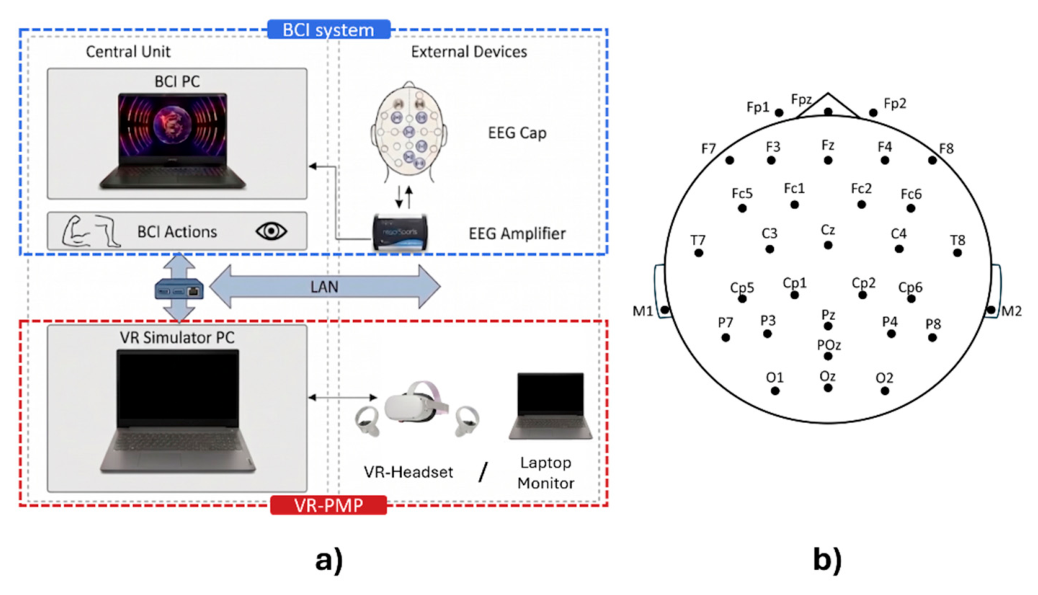
Figure 4.
Study progression and protocol adherence.BCI Performance.
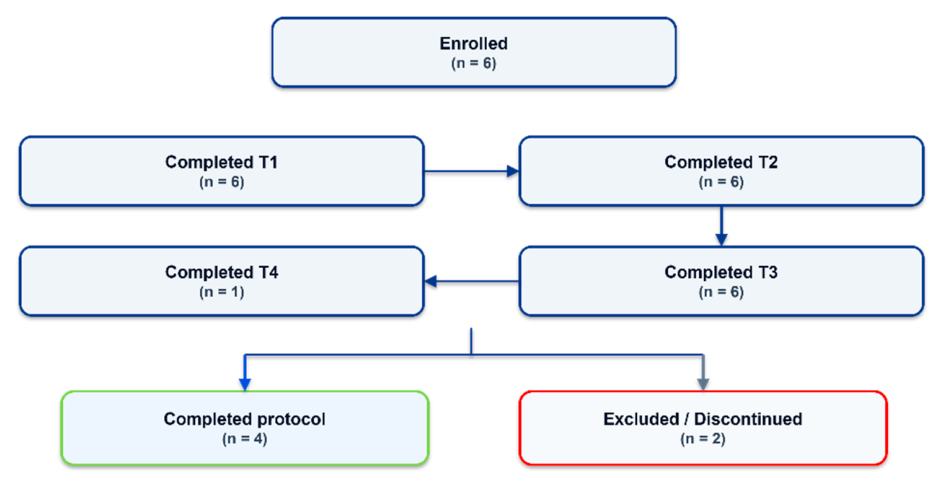
Figure 5.
(a) Distribution of NASA-TLX mental demand scores across all sessions, expressed as percentage values. (b) Distribution of NASA-TLX total scores across all sessions, expressed as percentage values. (c) Distribution of the delta values between the three time points for the NASA-TLX mental demand scores, expressed as percentage values. (d) Distribution of the delta values between the three time points for the NASA-TLX total scores, expressed as percentage values. (e) MSAQ scores across sessions for the different extracted subscales. Session T4 includes data from a single participant (i.e., BCI04).
Figure 5.
(a) Distribution of NASA-TLX mental demand scores across all sessions, expressed as percentage values. (b) Distribution of NASA-TLX total scores across all sessions, expressed as percentage values. (c) Distribution of the delta values between the three time points for the NASA-TLX mental demand scores, expressed as percentage values. (d) Distribution of the delta values between the three time points for the NASA-TLX total scores, expressed as percentage values. (e) MSAQ scores across sessions for the different extracted subscales. Session T4 includes data from a single participant (i.e., BCI04).
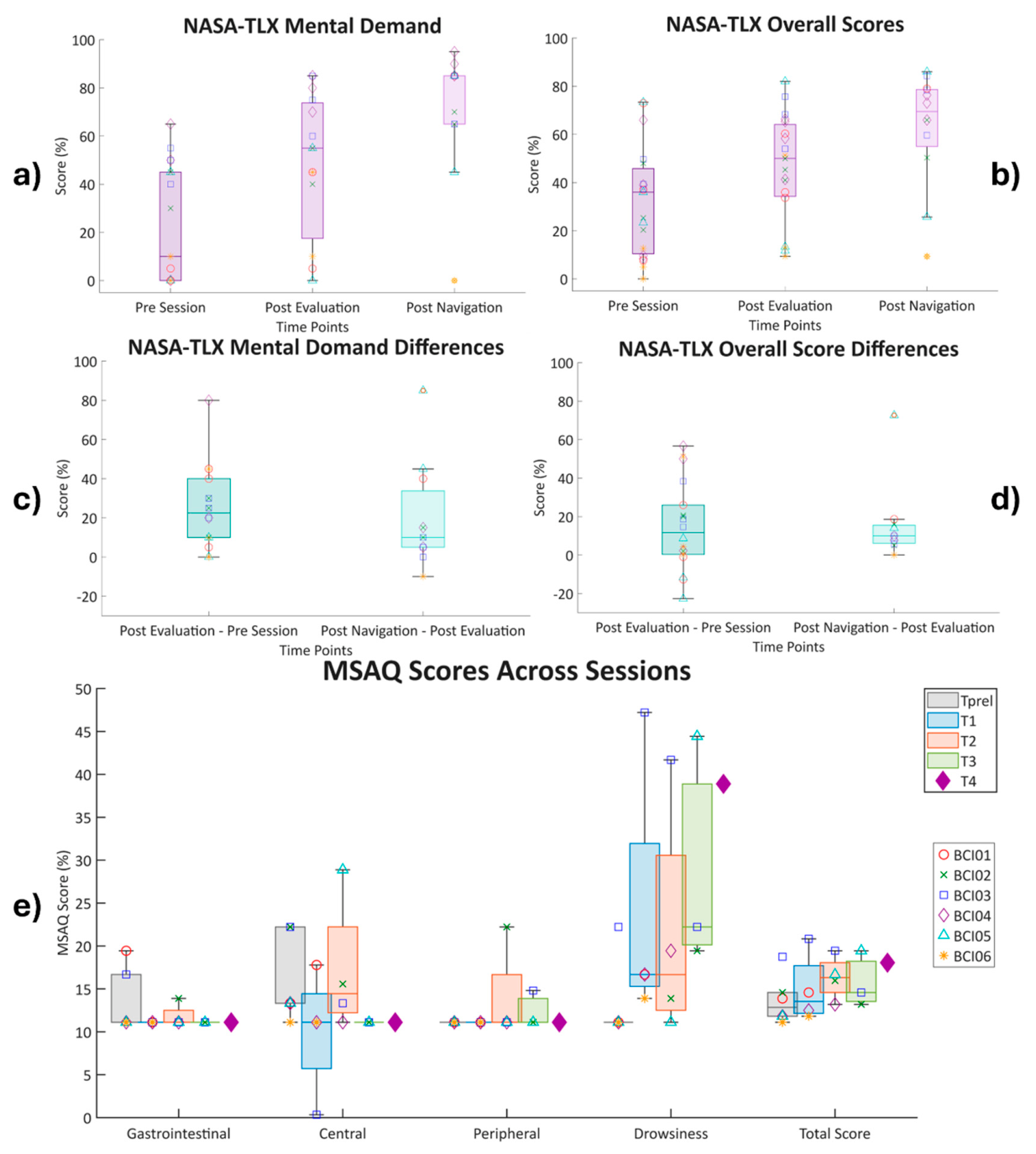

Table 1.
Participant's information.
| ID | Age | Sex | Disorder | Residual UL Motor Function | Residual LL Motor Function |
|---|---|---|---|---|---|
| BCI01 | 14 | F | Central Core Myopathy | Forearm pronation/supination | Limited ankle movement |
| BCI02 | 13 | M | LAMA2-related Congenital Muscular Dystrophy (MDC1A) | Elbow flexion | Minimal motor control at hip |
| BCI03 | 18 | M | SMA II | Elbow flexion | Minimal motor control at hip |
| BCI04 | 12 | M | SMA II | Index finger dorsiflexion | Minimal motor control at hip |
| BCI05 | 13 | M | CP | Proximal UL, hand, and finger | Minimal motor control at hip |
| BCI06 | 7 | M | SMA II | Proximal UL, hand, and finger | Minimal motor control at hip |
CP: Cerebral Palsy, F: Female, ID: Identifier, LL: Lower Limb, M: Male, SMA II: Spinal Muscular Atrophy Type II, UL: Upper Limb.
Table 2.
Structure of BCI experimental sessions.
| Session | Calibration (Training) | Evaluation | VR Navigation |
|---|---|---|---|
| T1 | Yes | Yes | Preview (5 levels) |
| T2 | If needed | Yes | Full (20 levels) |
| T3 | If needed | Yes | Full (20 levels) |
| T4 | If needed | Yes | Full (20 levels) |
Table 3.
Selected features and thresholds in sessions T1-T4.
| ID | T1 | T2 | T3 | T4 | ||||
|---|---|---|---|---|---|---|---|---|
| Features | Tresholds | Features | Tresholds | Features | Tresholds | Features | Tresholds | |
| BCI01 | C3 (8, 14 Hz) |
UL: 0.56 LL: 0.56 EOG: 100 uV |
FC1 (12 Hz), FC5 (14 Hz) |
UL: 0.56 LL: 0.56 EOG: 100 uV |
FC1 (16 Hz), CP1 (14 Hz), CP6 (16 Hz) |
UL: 0.52 LL: 0.77 |
||
| BCI02 | FC5 (16 Hz), FC2 (16 Hz), FC1 (18 Hz) |
UL: 0.59 LL: 0.54 EOG: 200 uV |
C3 (10, 12 Hz) |
UL: 0.68 (0.61) LL: 0.64 EOG: 120 uV |
C3 (10, 12 Hz) |
UL: 0,63 LL: 0,63 EOG: 125 uV |
||
| BCI03 | C3 (12 Hz), C4 (16 Hz), CP6 (20 Hz) |
UL: 0.58 LL: 0.55 EOG: 120 uV |
C3 (12 Hz), CP1 (12 Hz) |
UL: 0.55 LL:0.53 EOG: 125 uV |
C3 (12 Hz), CP1 (12 Hz) |
UL: 0.55 LL: 0.58 EOG: 125 uV |
||
| BCI04 | CP5 (10, 12 Hz), C3 (10, 12 Hz) |
UL: 0,60 LL:0.57 EOG: 125 uV |
C4 (10, 16, 18 Hz), CP5 (10 Hz) |
UL: 0.60 LL: 0.65 (0.60) EOG: 125 uV |
CZ (16 Hz), CP2 (16 Hz) |
UL: 0.59 LL: 0.54 |
C4 (10, 12 Hz), CP6 (12 Hz) |
UL: 0.59 LL: 0.55 EOG: 125 uV |
| BCI05 | FC2 (16 Hz), FC6 (16, 18 Hz) |
UL: 0.56 LL: 0.62 |
FC5 (14 Hz), FC2 (16 Hz), C4 (12 Hz) |
UL: 0.77 LL: 0.53 EOG: 121 uV |
FC5 (14 Hz), FC2 (16 Hz), C4 (12 Hz) |
UL: 0.60 LL: 0.55 EOG: 121 uV |
||
| BCI06 | FC5 (18 Hz), FC2 (18 Hz), CZ (10 Hz) |
UL: 0.62 LL: 0.63 |
C3 (26,28 Hz), CP2 (26,28 Hz) |
UL: 0.58 LL: 0.63 |
C4 (10, 12 Hz) |
UL: 0.60 LL: 0.63 |
||
C: central; Cp, Centro-parietal, ID: identifier, EOG: electrooculography, F: frontal; Fc: fronto-central, LL: lower limbs, UL: upper limbs.
Table 4.
Evaluation phase scores.
| ID | Session | Accuracy | Sensitivity | Specificity |
|---|---|---|---|---|
| BCI01 | T1 | 0.70 | 0.40 | 1.00 |
| T2 | 0.53 | 0.00 | 1.00 | |
| T3 | 0.50 | 0.00 | 1.00 | |
| BCI02 | T1 | 0.52 | 0.40 | 0.67 |
| T2 | 1.00 | 1.00 | 1.00 | |
| T3 | 0.85 | 1.00 | 0.60 | |
| BCI03 | T1 | 0.92 | 0.86 | 1.00 |
| T2 | 0.67 | 0.86 | 0.50 | |
| T3 | 0.69 | 0.89 | 0.43 | |
| BCI04 | T1 | 0.62 | 0.29 | 0.89 |
| T2 | 0.71 | 0.78 | 0.60 | |
| T3 | 0.41 | 0.71 | 0.20 | |
| T4 | 0.79 | 1.00 | 0.50 | |
| BCI05 | T1 | 0.53 | 0.67 | 0.38 |
| T2 | 0.93 | 0.88 | 1.00 | |
| T3 | 0.62 | 0.40 | 1.00 | |
| BCI06 | T1 | 0.77 | 0.40 | 1.00 |
| T2 | 0.53 | 1.00 | 0.12 | |
| T3 | 0.50 | 0.83 | 0.25 |
Bold values represent sufficient (i.e.,≥ 0.60) accuracies. (ID: Identifier).
Table 5.
NASA-TLX statistical analyses p-values.
| Session time points comparison | Delta Values | ||||
|---|---|---|---|---|---|
| NASA Field | Friedman | PS vs PE | PE vs PN | PS vs PN | PE - PS vs PN - PE |
| Total Score | 0.0004 | 0.1293 | 0.0010 | 0.0005 | 0.7910 |
| Mental | 0.0002 | 0.0019 | 0.0097 | 0.0009 | 0.2598 |
| Physical | 0.0311 | 0.3730 | 0.1406 | 0.1250 | 0.3672 |
| Temporal | 0.0394 | 0.1074 | 0.1504 | 0.0156 | 1.0000 |
| Frustration | 0.2585 | 0.6250 | 0.1016 | 0.1328 | 0.5039 |
| Performance | 0.1163 | 0.9814 | 0.0103 | 0.0386 | 0.4199 |
| Effort | 0.0014 | 0.0371 | 0.0117 | 0.0019 | 0.1855 |
Bold values represent p-values lower than 0.05. (PE: Post Evaluation; PN: Post Navigation; PS: Pre Session).
Table 6.
NASA-TLX mean scores across timepoints.
| Pre Session | Post Evaluation | Post Navigation | |
|---|---|---|---|
| Tot. Score | 32.16±22.75 | 46.12±22.24 | 62.83±23.77 |
| Mental | 21.32±24.03 | 47.37±29.55 | 71.25±26.47 |
| Physical | 17.89±22.13 | 27.63±19.39 | 32.50±19.48 |
| Temporal | 14.74±24.92 | 24.47±24.49 | 28.33±22.70 |
| Frustration | 10.26±20.03 | 10.53±16.24 | 22.50±22.81 |
| Performance | 43.68±27.28 | 49.21±24.74 | 70.42±23.78 |
| Effort | 24.74±23.06 | 47.89±28.79 | 61.67±31.79 |
In each box there is the mean value ± the standard deviation.
Table 7.
Individual participant findings.
| Participant | Main finding |
|---|---|
| BCI01 | Persistently insufficient control |
| BCI02 | Rapid learning effect and high accuracy |
| BCI03 | Early and stable proficiency |
| BCI04 | Control achieved through extended training |
| BCI05 | Variable but functional performance |
| BCI06 | Progressive performance instability (age-related) |
Disclaimer/Publisher’s Note: The statements, opinions and data contained in all publications are solely those of the individual author(s) and contributor(s) and not of MDPI and/or the editor(s). MDPI and/or the editor(s) disclaim responsibility for any injury to people or property resulting from any ideas, methods, instructions or products referred to in the content. |
© 2026 by the authors. Licensee MDPI, Basel, Switzerland. This article is an open access article distributed under the terms and conditions of the Creative Commons Attribution (CC BY) license (http://creativecommons.org/licenses/by/4.0/).
Copyright: This open access article is published under a Creative Commons CC BY 4.0 license, which permit the free download, distribution, and reuse, provided that the author and preprint are cited in any reuse.