

Submitted:
04 September 2026
Posted:
17 September 2026
You are already at the latest version
Abstract
Purpose: Gallbladder cancer is highly prevalent in North India and associated with poor survival in advanced disease. Although chemoimmunotherapy improves outcomes in biliary tract cancers, prospective data specific to gallbladder cancer remain limited. We compared gemcitabine-cisplatin (GemCis) with or without durvalumab in patients with advanced gallbladder cancer. Methods: In this ambispective observational cohort study at a North Indian tertiary cancer center (Jan 2023–June 2025), 98 patients with unresectable/metastatic gallbladder cancer received GemCis alone (n=48) or GemCis+durvalumab (n=50) based on drug availability and patient preference after counseling. Primary endpoints were progression-free survival (PFS) and overall survival (OS). Secondary endpoints included objective response rate (ORR), disease control rate (DCR), and safety. Results: Baseline characteristics were balanced. ORR was 30.0% with durvalumab vs 18.8% with GemCis alone; DCR was 56.0% vs 39.6%. Median PFS was 6.1 vs 4.1 months (HR 0.62, 95% CI 0.45–0.88; P=0.007). Median OS was 14.2 vs 9.7 months (HR 0.69, 95% CI 0.52–0.91; P=0.012). Grade ≥3 adverse events were similar between arms. Immune-related adverse events occurred in 20% receiving durvalumab (grade ≥3: 2%), all manageable. Conclusions: In this gallbladder cancer-specific cohort, durvalumab added to GemCis was associated with improved PFS and OS without increased toxicity. These findings support further evaluation of chemoimmunotherapy for advanced gallbladder cancer in high-incidence regions.
Keywords:
gallbladder cancer
; gemcitabine
; cisplatin
; durvalumab
; chemoimmunotherapy
Key Points
- Question:
Does the addition of durvalumab to gemcitabine–cisplatin improve outcomes in advanced gallbladder cancer?
- Findings:
In this ambispective cohort (n=98), chemo-immunotherapy improved progression-free survival (6.1 vs 4.1 months) and overall survival (14.2 vs 9.7 months) with acceptable toxicity.
- Meaning:
These findings provide prospective, gallbladder-specific evidence supporting chemo-immunotherapy as first-line treatment in high-incidence regions.
Introduction
Gallbladder cancer is an aggressive malignancy with marked geographic variation in incidence. While biliary tract cancers collectively account for ~3% of gastrointestinal malignancies worldwide[1], gallbladder cancer predominates in high-incidence regions including North India, Chile, and East Asia. Along India's Gangetic belt, gallbladder cancer imposes a major oncologic burden, linked to chronic cholelithiasis, infections, and environmental exposures. Most patients present with unresectable or metastatic disease.
Advanced gallbladder cancer carries a poor prognosis, with median overall survival rarely exceeding 7-9 months in Indian cohorts[2,3]. The ABC-02 trial established gemcitabine-cisplatin (GemCis) as first-line therapy for advanced biliary tract cancers[4], yet gallbladder cancer consistently demonstrates inferior outcomes compared with cholangiocarcinoma in subgroup and real-world analyses.
Immunotherapy has transformed solid tumor oncology[5]. Combining chemotherapy with PD-(L)1 inhibitors leverages chemotherapy-induced antigen release and immune microenvironment modulation. The TOPAZ-1 trial showed durvalumab plus GemCis improved survival vs GemCis alone in advanced biliary tract cancers (HR 0.80)[6]. KEYNOTE-966 demonstrated similar benefits with pembrolizumab[7].
However, both trials underrepresented gallbladder cancer (TOPAZ-1: ~17%; KEYNOTE-966: ~20%), with no subtype-specific outcomes reported. Given biliary tract cancer heterogeneity and gallbladder cancer's distinct biology, mixed-population results may not apply directly as highlighted in recent reviews[8]. Gallbladder cancer differs biologically from cholangiocarcinoma, with higher inflammatory signaling and HER2 alterations, which may influence responsiveness to systemic therapies including immunotherapy. This evidence gap is critical in India, where gallbladder cancer comprises most biliary tract cases.
Real-world implementation in resource-constrained settings faces additional barriers: immunotherapy costs, access limitations, and patient differences from trial populations. While retrospective series suggest chemoimmunotherapy benefit, prospective gallbladder cancer-specific data remain scarce.
We therefore conducted an ambispective cohort study comparing GemCis with or without durvalumab in patients with advanced gallbladder cancer treated at a North Indian tertiary cancer center (2023-2025). We report progression-free survival, overall survival, response rates, and safety outcomes from this high-incidence region.
To our knowledge, this is among the first ambispective real-world studies focusing exclusively on patients with advanced gallbladder cancer treated with gemcitabine-cisplatin with or without durvalumab. Unlike TOPAZ-1 and KEYNOTE-966, which included heterogeneous biliary tract cancers, our study specifically evaluates gallbladder carcinoma from a high-incidence Indian population, thereby addressing an important evidence gap.
Methods
Study Design
We conducted an ambispective observational cohort study at a tertiary cancer center in North India. Patients with advanced gallbladder cancer treated from January 2023 through June 2025 were included. Retrospective data collection covered earlier cases; prospective follow-up applied to later enrollees. Treatment allocation to gemcitabine-cisplatin (GemCis) alone or GemCis+durvalumab was based on drug availability and patient preference after shared decision-making and counseling. To minimize selection bias, baseline characteristics were compared between groups and found to be balanced; however, no formal propensity score adjustment was performed.
The Institutional Ethics Committee approved the study (approval RES/SCM/70/2025/80). All procedures followed the Declaration of Helsinki. Written informed consent was obtained from all patients.
Patients
Eligible patients were aged ≥18 years with histologically/cytologically confirmed unresectable, recurrent, or metastatic gallbladder cancer, Eastern Cooperative Oncology Group performance status 0-2, and adequate hematologic, hepatic, and renal function. Exclusion criteria included prior systemic therapy for advanced disease, uncontrolled infection, autoimmune disease requiring systemic immunosuppression, or solid organ transplantation.
Staging and Histology
All patients underwent contrast-enhanced CT or MRI of chest/abdomen/pelvis for staging. Histology was adenocarcinoma in >95%. Common metastatic sites were liver (68%), peritoneum (30%), and lymph nodes (25%). Biliary obstruction was relieved prechemotherapy when indicated. Recurrent cases had prior cholecystectomy ± adjuvant therapy.
Treatments
GemCis (Arm A): Gemcitabine 1000 mg/m² + cisplatin 25 mg/m² IV, days 1 and 8 every 21 days (maximum 8 cycles).
GemCis+durvalumab (Arm B): GemCis as above + durvalumab 1500 mg IV day 1 every 3 weeks during chemotherapy, followed by durvalumab 1500 mg every 4 weeks maintenance until progression/unacceptable toxicity.
Dose modifications, premedication, hydration, and antiemetics followed institutional protocols. Durvalumab was held for grade ≥2 immune-related adverse events (irAEs) and discontinued for recurrent grade ≥3 irAEs.
Endpoints
Primary: Progression-free survival (time from treatment start to progression/death) and overall survival (time to death from any cause).
Secondary: Objective response rate and disease control rate per RECIST v1.1 (stable disease ≥8 weeks); adverse events per CTCAE v5.0.
Assessments
Baseline assessments included history, examination, labs, and imaging. Tumor response was evaluated every 9 weeks by treating physicians using RECIST v1.1. irAEs were managed per international guidelines.
Statistical Analysis
Categorical variables are presented as frequencies and percentages and were compared using the χ² test or Fisher's exact test, as appropriate. Continuous variables are presented as medians (range) and were compared using the Mann–Whitney U test or Student's t test, as appropriate. Progression-free survival (PFS) and overall survival (OS) were estimated using the Kaplan–Meier method and compared using the log-rank test. Hazard ratios (HRs) with 95% confidence intervals (CIs) were estimated using univariable Cox proportional hazards regression. The proportional hazards assumption was assessed graphically using log-minus-log survival plots. Exploratory subgroup analyses were performed according to age, sex, ECOG performance status, and metastatic sites. Missing data were minimal (<5%) and were handled using complete-case analysis. All statistical analyses were performed using SPSS version 26.0 (IBM Corp., Armonk, NY, USA) and GraphPad Prism version 9 (GraphPad Software, San Diego, CA, USA). All tests were two-sided, and a P value <0.05 was considered statistically significant.
Follow-Up
Follow-up continued until progression, death, or data cutoff (December 2025; median 14 months, range 3-28). Event-free patients were censored at last contact.
Results
Patient Population
Between January 2023 and June 2025, a total of 98 patients with advanced gallbladder carcinoma were included in this ambispective cohort study. Of these, 48 patients received gemcitabine–cisplatin (GemCis; Arm A), and 50 patients received GemCis in combination with durvalumab (Arm B). Baseline demographic and disease characteristics were well balanced between the two treatment groups (Table 1).
Figure 1.
Study flow diagram of patient inclusion and treatment allocation.
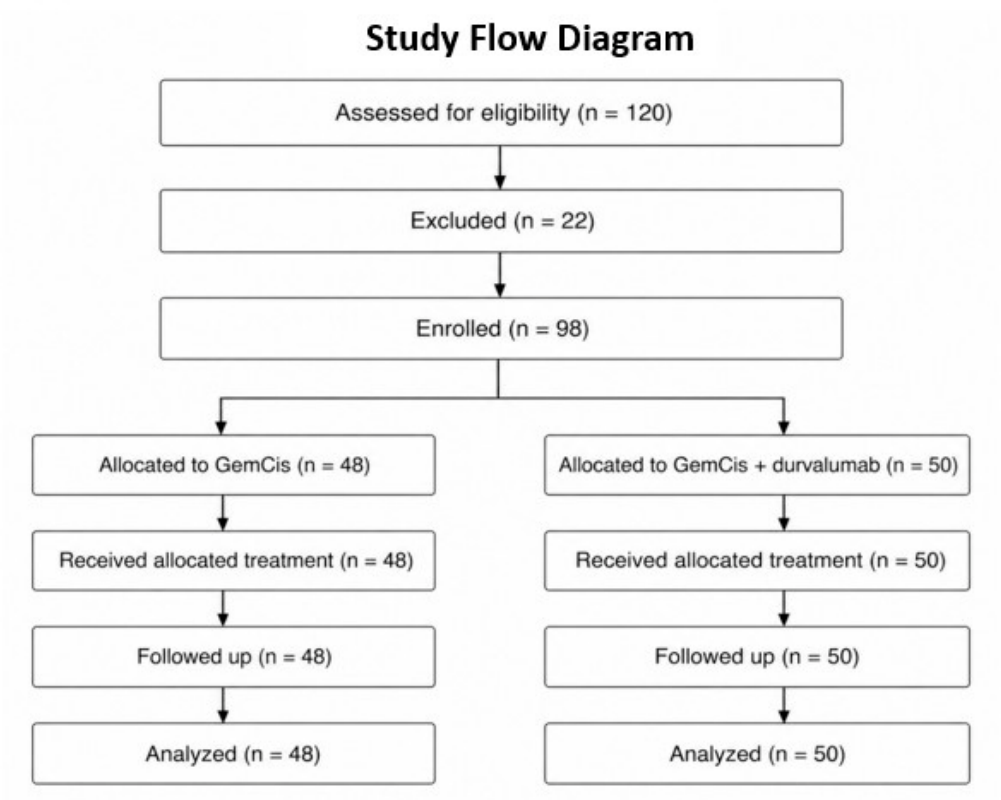
Flow diagram showing the number of patients assessed, enrolled, allocated, and analyzed. Note: 98 patients were included in the final analysis.
The median age of the overall cohort was 58 years (range, 34–72 years), with a slight female predominance (59%). Eastern Cooperative Oncology Group (ECOG) performance status of 0–1 was observed in 74% of patients in Arm A and 76% in Arm B. Approximately 70% of patients in both groups presented with de novo metastatic disease, while the remainder had recurrent disease following prior surgical management.
The liver was the most common site of metastasis (67% in Arm A and 68% in Arm B), followed by peritoneal involvement (29% vs 30%) and nodal disease (27% vs 24%). Overall, the two treatment groups were comparable in terms of baseline disease burden and clinical characteristics.

Table 1.
Baseline patient and disease characteristics.
| Characteristic | Arm A (GemCis, n=48) | Arm B (GemCis+Durva, n=50) |
| Median age (years) | 58 | 58 |
| Female (%) | 58 | 60 |
| ECOG 0–1 (%) | 74 | 76 |
| De novo metastatic (%) | 70 | 72 |
| Liver metastases (%) | 67 | 68 |
| Peritoneal disease (%) | 29 | 30 |
Table 1. Baseline demographic and disease characteristics of patients with advanced gallbladder carcinoma treated with gemcitabine–cisplatin (Arm A) or gemcitabine–cisplatin plus durvalumab (Arm B). Values are median (range) or number (%). ECOG, Eastern Cooperative Oncology Group; PS, performance status.
Treatment Exposure
Patients in both arms received a median of six cycles of GemCis chemotherapy (range, 2–8 cycles). Chemotherapy dose reductions were required in 31% of patients in Arm A and 28% in Arm B, primarily due to hematologic toxicities. Treatment discontinuation due to toxicity was infrequent, occurring in 4% and 6% of patients, respectively.
In the chemo-immunotherapy arm, 28 patients (56%) transitioned to maintenance durvalumab following completion of combination therapy. The median duration of maintenance treatment was 7 months (range, 2–18 months), with several patients continuing therapy beyond one year at the time of data cutoff.
Among evaluable patients, objective responses were observed in 9 of 48 patients (18.8%) in Arm A and 15 of 50 patients (30.0%) in Arm B. Although this difference did not reach statistical significance (p=0.223), a consistent numerical improvement in response rate was observed with the addition of durvalumab.
The disease control rate (DCR) was higher in the durvalumab arm (56.0% vs 39.6%), largely driven by an increased proportion of patients achieving stable disease. This finding suggests that the addition of immunotherapy may contribute to prolonged disease stabilization in a subset of patients (Table 2).
Table 2. Best tumor response according to RECIST v1.1 in evaluable patients. CR, complete response; PR, partial response; SD, stable disease; PD, progressive disease; ORR, objective response rate; DCR, disease control rate.
Progression-Free Survival
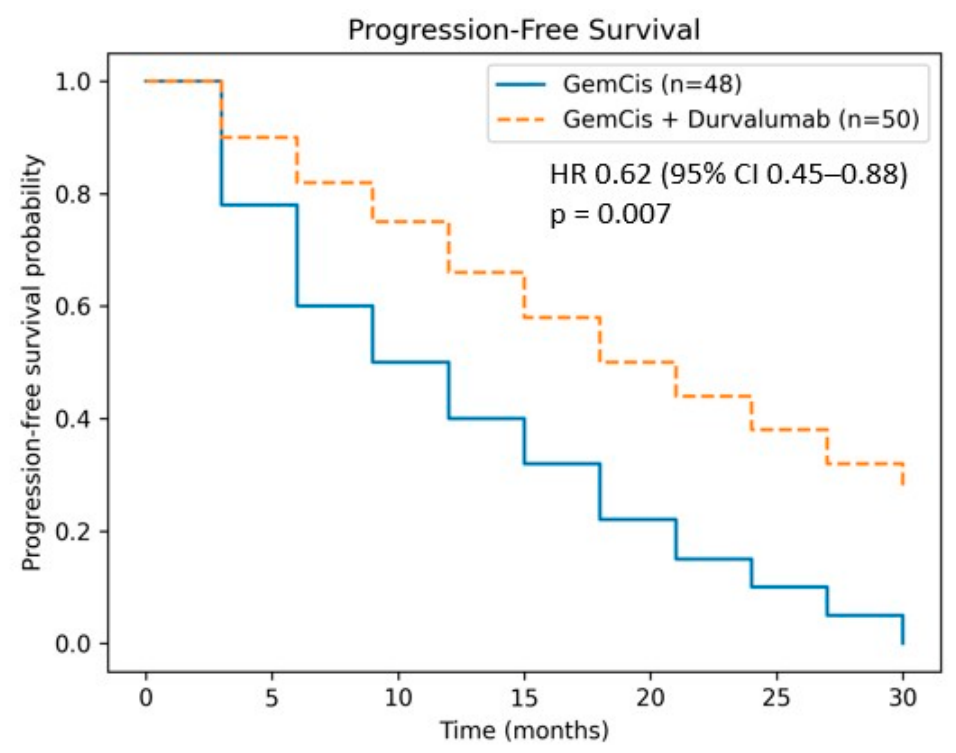
At a median follow-up of 14 months, progression-free survival (PFS) was significantly improved in the chemo-immunotherapy arm. Median PFS was 6.1 months (95% CI, 5.0–7.2) in Arm B compared with 4.1 months (95% CI, 3.2–5.0) in Arm A, corresponding to a hazard ratio (HR) of 0.62 (95% CI, 0.45–0.88; p=0.007).
Kaplan–Meier analysis demonstrated early divergence of PFS curves, with sustained separation throughout the follow-up period (Figure 2). At 6 months, the PFS rate was 45% in Arm B compared with 29% in Arm A, and at 12 months, 24% versus 10% of patients remained progression-free, respectively.
Figure 2. Kaplan–Meier curves for progression-free survival (PFS).
Figure 2.
Kaplan–Meier estimates of progression-free survival in patients treated with gemcitabine–cisplatin (Arm A) versus gemcitabine–cisplatin plus durvalumab (Arm B). Median PFS was 4.1 months versus 6.1 months, respectively (HR 0.62; 95% CI 0.45–0.88; p=0.007).
Figure 2.
Kaplan–Meier estimates of progression-free survival in patients treated with gemcitabine–cisplatin (Arm A) versus gemcitabine–cisplatin plus durvalumab (Arm B). Median PFS was 4.1 months versus 6.1 months, respectively (HR 0.62; 95% CI 0.45–0.88; p=0.007).
NO. AT RISK
| Time (months) | Arm A (GemCis) | Arm B (GemCis + Durvalumab) |
| 0 | 48 | 50 |
| 3 | 38 | 44 |
| 6 | 25 | 34 |
| 9 | 15 | 25 |
| 12 | 5 | 12 |
Overall Survival
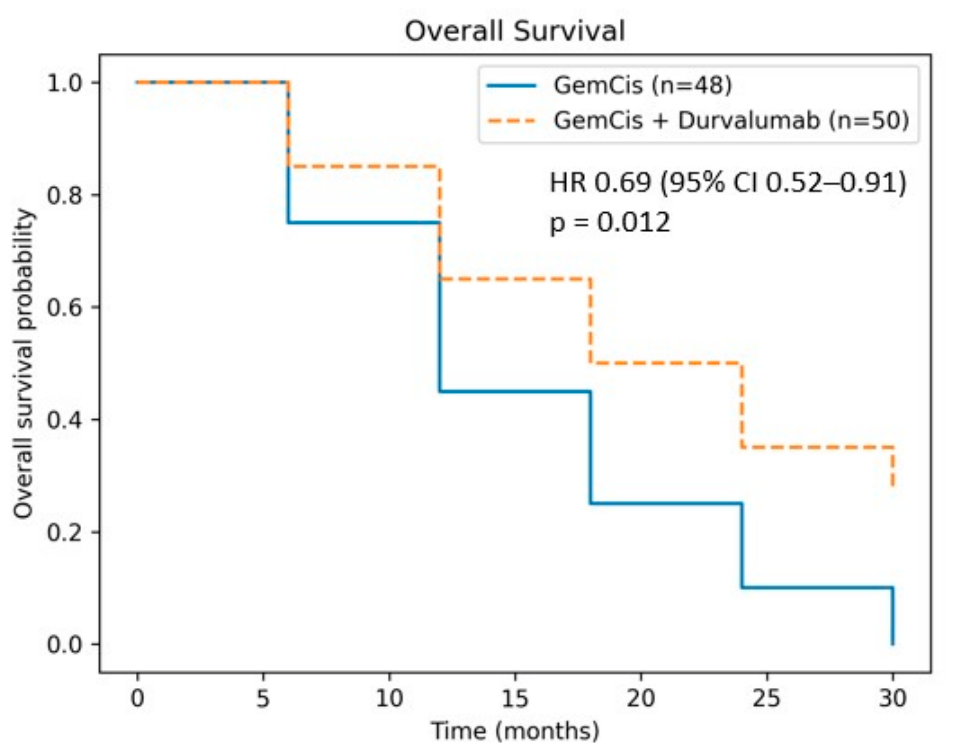
Overall survival (OS) was also significantly improved with the addition of durvalumab. Median OS was 14.2 months (95% CI, 11.9–16.5) in Arm B compared with 9.7 months (95% CI, 8.2–11.3) in Arm A, corresponding to an HR of 0.69 (95% CI, 0.52–0.91; p=0.012).
Survival probabilities at 12 months were 55% in the durvalumab arm versus 39% in the chemotherapy-alone arm. At 18 months, OS rates were 32% and 17%, respectively. Kaplan–Meier curves demonstrated durable separation favoring chemo-immunotherapy (Figure 3), suggesting a sustained survival benefit beyond the chemotherapy phase.
Figure 3. Kaplan–Meier curves for overall survival (OS).
Figure 3.
Kaplan–Meier estimates of overall survival in patients treated with gemcitabine–cisplatin (Arm A) versus gemcitabine–cisplatin plus durvalumab (Arm B). Median OS was 9.7 months versus 14.2 months, respectively (HR 0.69; 95% CI 0.52–0.91; p=0.012)..
Figure 3.
Kaplan–Meier estimates of overall survival in patients treated with gemcitabine–cisplatin (Arm A) versus gemcitabine–cisplatin plus durvalumab (Arm B). Median OS was 9.7 months versus 14.2 months, respectively (HR 0.69; 95% CI 0.52–0.91; p=0.012)..
NO. AT RISK
| Time (months) | Arm A (GemCis) | Arm B (GemCis + Durvalumab) |
| 0 | 48 | 50 |
| 6 | 35 | 40 |
| 12 | 18 | 28 |
| 18 | 8 | 16 |
Subgroup Analyses
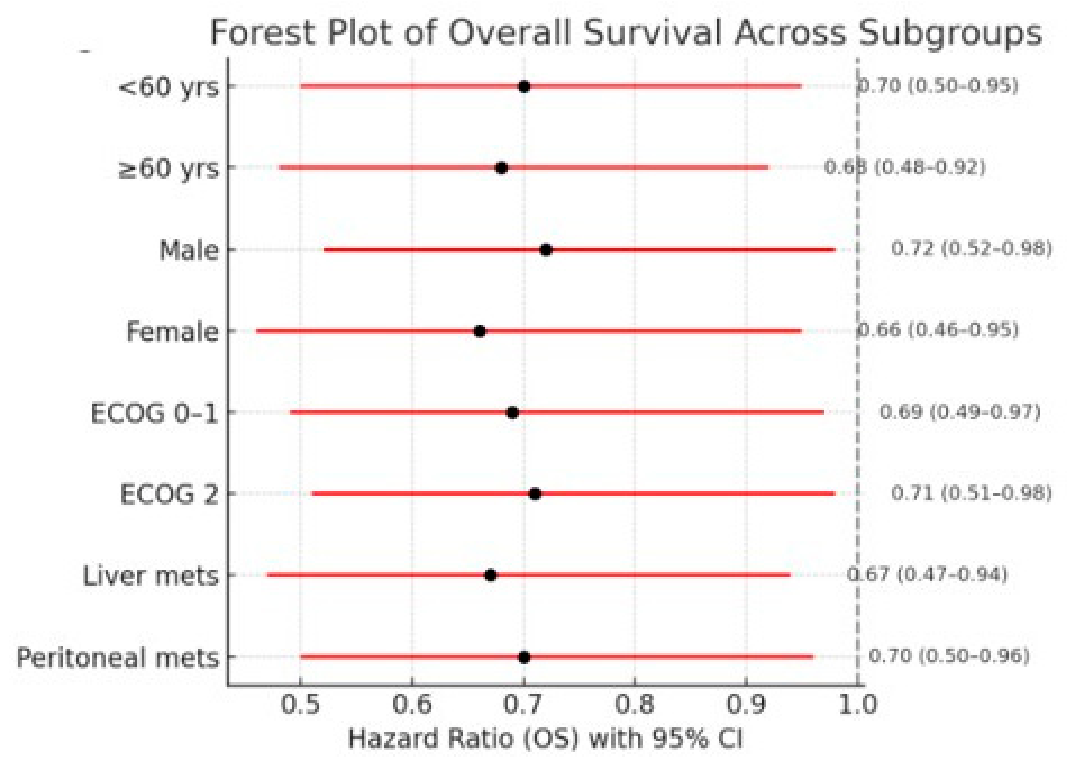
Exploratory subgroup analyses indicated that the survival benefit associated with durvalumab was consistent across predefined subgroups, including age (<60 vs ≥60 years), sex, ECOG performance status (0–1 vs 2), and sites of metastasis (Figure 3). No subgroup demonstrated a loss of benefit with the addition of immunotherapy, although these analyses were not powered for definitive conclusions.
Figure 4. Forest plot of hazard ratios for overall survival across subgroups.
Figure 4.
Forest plot of hazard ratios for overall survival in prespecified subgroups. Treatment benefit of gemcitabine–cisplatin plus durvalumab (Arm B) compared with gemcitabine–cisplatin (Arm A) was consistent across subgroups, including age, sex, ECOG PS, and metastatic site.
Figure 4.
Forest plot of hazard ratios for overall survival in prespecified subgroups. Treatment benefit of gemcitabine–cisplatin plus durvalumab (Arm B) compared with gemcitabine–cisplatin (Arm A) was consistent across subgroups, including age, sex, ECOG PS, and metastatic site.
Safety and Tolerability
All treated patients were evaluable for safety. The incidence of grade ≥3 adverse events was comparable between the two treatment arms. The most common severe toxicities were hematologic, including neutropenia (15% in Arm A vs 14% in Arm B), anemia (13% vs 12%), and thrombocytopenia (4% in both arms). Rates of gastrointestinal toxicities such as nausea, vomiting, and diarrhea were low and similar between groups.
Immune-related adverse events (irAEs) were observed in 20% of patients receiving durvalumab, with the majority being grade 1–2 events, including thyroid dysfunction, hepatitis, and skin rash. Grade ≥3 irAEs occurred in 2% of patients and were successfully managed with corticosteroids. No treatment-related deaths were reported.
Overall, the addition of durvalumab did not increase the frequency or severity of chemotherapy-related adverse events and was well tolerated in this patient population.
Table 3. Treatment-related adverse events (grade ≥3).
Follow-Up and Outcomes
At the time of data cutoff (June 2025), the median follow-up was 14 months (range, 3–28 months). A total of 58 deaths had occurred (31 in Arm A and 27 in Arm B). Forty patients remained alive at last follow-up, including 13 patients who were progression-free on durvalumab maintenance therapy.
Discussion
In this ambispective cohort of 98 patients with advanced gallbladder cancer, durvalumab added to gemcitabine-cisplatin (GemCis) was associated with longer median progression-free survival (6.1 vs 4.1 months; HR 0.62, P=0.007) and overall survival (14.2 vs 9.7 months; HR 0.69, P=0.012) compared with GemCis alone. These improvements occurred without increased grade ≥3 toxicity. Objective response rates were numerically higher (30.0% vs 18.8%) and disease control substantially better (56.0% vs 39.6%) with chemoimmunotherapy.
The survival benefit observed compares favorably with phase III trials in biliary tract cancers. TOPAZ-1[6] reported durvalumab plus GemCis improved median OS to 12.9 months vs 11.3 months with GemCis alone (HR 0.80) across mixed histologies. KEYNOTE-966[7] showed similar gains with pembrolizumab (OS HR 0.83). Updated analyses of TOPAZ-1 have demonstrated sustained survival benefit with durvalumab[9]. Additionally, meta-analyses of immune checkpoint inhibitors in biliary tract cancers support the role of chemo-immunotherapy in improving outcomes[10]. Our study demonstrated greater absolute OS benefit (Δ4.5 months) despite shorter follow-up, potentially reflecting gallbladder cancer's worse baseline prognosis compared with cholangiocarcinoma. However, cross-trial comparisons remain hypothesis-generating due to differences in patient selection, follow-up duration, and unmeasured confounders.
Gallbladder cancer's underrepresentation in these trials (~17% TOPAZ-1; ~20% KEYNOTE-966) limits direct applicability. Both trials reported no histology-specific interaction tests, leaving uncertainty about immunotherapy efficacy across biliary tract cancer subtypes. Gallbladder cancer exhibits distinct molecular features, including higher rates of TP53 mutations, ERBB2 amplification, and inflammatory tumor microenvironments linked to chronic cholelithiasis[1]. These characteristics may enhance immunogenicity and responsiveness to PD-(L)1 blockade, consistent with our observed early PFS curve separation and 18-month OS tail (32% vs 17%).
The disease control rate improvement merits attention. While ORR differences were nonsignificant (P=0.223), durvalumab doubled stable disease rates, suggesting immunotherapy-mediated immune equilibrium rather than rapid tumor killing. In advanced gallbladder cancer—where visceral crises, biliary obstruction, and cachexia drive mortality—prolonged disease stabilization likely contributes to survival gains and quality-of-life preservation, particularly given comparable toxicity profiles.
From a global oncology perspective, these findings address a critical evidence gap for high-incidence regions. India reports age-adjusted gallbladder cancer incidence rates of 4-21/100,000 among women along the Gangetic plain, far exceeding global averages. Yet most immunotherapy data derive from Western or mixed Asian cohorts with cholangiocarcinoma predominance. Real-world implementation faces resource barriers as demonstrated in Indian real-world cohorts evaluating chemoimmunotherapy[11]: durvalumab costs ~US$6000/cycle in India, often requiring patient self-payment absent insurance. Our single-center experience demonstrates feasibility and tolerability despite nutritional variability and comorbidity burdens exceeding trial populations.
Safety outcomes align with TOPAZ-1: grade ≥3 hematologic events were comparable (neutropenia 14-15%), while immune-related adverse events proved manageable (20% incidence, 2% grade ≥3). Notably, no treatment-related deaths occurred, reassuring for resource-limited settings where intensive irAE management capacity varies. Corticosteroid-responsive grade 3 events resolved without permanent durvalumab discontinuation, suggesting routine practice tolerability.
Study limitations require careful consideration. The ambispective design combines retrospective data abstraction with prospective follow-up, introducing risks of information bias and temporal confounding. Treatment allocation by drug availability and patient preference—rather than randomization—precludes causal inference. Residual confounding due to non-randomized treatment allocation cannot be excluded. Immortal time bias related to maintenance durvalumab exposure cannot be excluded. Although baseline characteristics appeared balanced, unmeasured confounders including known prognostic factors in biliary tract cancers[12] (insurance status, physician recommendation, PD-L1 expression) likely influenced selection. Multivariable adjustment or propensity score methods could have strengthened causal estimates but were not reported.
The single-center design at a high-volume academic center limits generalizability to community or lower-resource settings. With 98 patients, subgroup analyses lacked power despite consistent point estimates. RECIST assessments by treating physicians (not blinded central review) may inflate response rates. Critically, no biomarker data exist: PD-L1 combined positive score, tumor mutational burden, or microsatellite instability might identify immunotherapy responders, as seen in other indications. Follow-up remains immature for long-term tail assessment (median 14 months).
These limitations notwithstanding, this study provides the largest gallbladder cancer-specific prospective comparison of GemCis vs GemCis+durvalumab to date. Prior Indian series were retrospective or mixed-histology. By focusing exclusively on gallbladder cancer—a neglected biliary tract cancer subtype in immunotherapy trials—we fill a substantive evidence gap. The observed survival benefit (OS HR 0.69) appears clinically meaningful despite methodological constraints.
Future research should prioritize multicenter randomized trials in gallbladder cancer to validate these findings. Biomarker-stratified designs incorporating PD-L1, tumor mutational burden, and novel immune correlates will optimize patient selection. Sequential strategies including second-line chemotherapy such as FOLFOX[13] warrant comparison (chemotherapy → immunotherapy at progression) against combination approaches, supported by emerging phase II chemoimmunotherapy trials[14]. Cost-effectiveness analyses specific to high-incidence regions remain essential, particularly given immunotherapy's expense relative to per-capita GDP.
Integration with evolving biliary tract cancer therapies merits exploration. IDH1 inhibitors (ivosidenib)[15], FGFR inhibitors (pemigatinib)[16] and HER2-targeted agents (trastuzumab deruxtecan)[17] show promise in molecularly defined subsets, often co-occurring in gallbladder cancer. Triple combinations (GemCis+durvalumab+targeted agent) or immunotherapy maintenance optimization represent rational next steps. Real-world registries capturing diverse practice patterns will complement trial data.
In summary, durvalumab plus GemCis demonstrated promising activity in advanced gallbladder cancer without excess toxicity in this ambispective cohort. While observational design limits causal claims, these gallbladder-specific data from a high-incidence region support chemoimmunotherapy feasibility and encourage definitive prospective evaluation. Enhanced access to immunotherapy for this neglected cancer warrants consideration by regional health authorities and global oncology stakeholders, in alignment with international guideline recommendations including NCCN[18] and ASCO[19].
Funding
No external funding was received for this study.
Prior Presentation
This study has not been previously presented.
Conflicts of Interest
The authors declare no conflicts of interest.
References
- Valle, J.W.; Lamarca, A.; Goyal, L.; et al. New horizons for BTCs: immunotherapy and beyond. Nat. Rev. Clin. Oncol. 2023, 20, 399–414. [Google Scholar]
- Doval, D.C.; Sekhon, J.S.; Gupta, S.K.; et al. A phase II study of gemcitabine and cisplatin in advanced gallbladder cancer. Br. J. Cancer 2004, 90, 1516–1520. [Google Scholar] [CrossRef] [PubMed]
- Sharma, A.; Doval, D.C.; Kumar, V.; et al. Outcomes of gemcitabine and cisplatin in advanced gallbladder cancer: a retrospective Indian series. Br. J. Cancer 2016, 115, 464–471. [Google Scholar]
- Valle, J.W.; Wasan, H.; Palmer, D.H.; et al. Cisplatin plus gemcitabine versus gemcitabine for biliary tract cancer. N Engl. J. Med. 2010, 362, 1273–1281. [Google Scholar] [CrossRef] [PubMed]
- Patel, T.; Gores, G.J. Evolving therapeutic landscape in BTC: rationale for chemo-immunotherapy. ESMO Open 2024, 9, 102065. [Google Scholar]
- Oh, D.Y.; Abou-Alfa, G.K.; Park, S.H.; et al. Durvalumab or placebo plus gemcitabine and cisplatin in advanced biliary tract cancer (TOPAZ-1). Lancet 2022, 399, 777–788. [Google Scholar]
- Marabelle, A.; Le, D.T.; Kim, J.W.; et al. Pembrolizumab with gemcitabine and cisplatin in BTC (KEYNOTE-966). Lancet 2023, 401, 1165–1176. [Google Scholar]
- McNamara, M.G.; Abou-Alfa, G.K. Immunotherapy combinations in BTC. Clin. Cancer Res. 2024, 30, 1002–1014. [Google Scholar]
- Oh, D.Y.; Abou-Alfa, G.K.; Park, S.H.; et al. Durvalumab plus gemcitabine and cisplatin in advanced BTC: updated analyses. J. Hepatol. 2025, 82, e1–e12. [Google Scholar]
- Zhang, Q.; Chen, M.; Liu, H.; et al. Immune checkpoint inhibitors in BTC: meta-analysis. Front Oncol. 2022, 12, 902345. [Google Scholar] [CrossRef] [PubMed]
- Muddu, V.K.; Sharma, A.; Raina, V.; et al. Gemcitabine, cisplatin, and durvalumab in advanced BTC: Indian experience. JCO Glob. Oncol. 2024, 10, e2400216. [Google Scholar] [CrossRef] [PubMed]
- Yoo, C.; Kim, K.P.; Jeong, J.H.; et al. Gemcitabine and cisplatin for BTC: predictive value of factors. Cancer Chemother. Pharmacol. 2011, 68, 137–143. [Google Scholar]
- Lamarca, A.; Palmer, D.H.; Wasan, H.S.; et al. ABC-06: FOLFOX second-line chemo in BTC. Lancet Oncol. 2021, 22, 690–701. [Google Scholar] [PubMed]
- Qin, S.; Li, Q.; Gu, S.; et al. Sintilimab plus IBI305 with GemCis in BTC: randomized phase II. Lancet Oncol. 2021, 22, 1112–1122. [Google Scholar]
- Zhu, A.X.; Macarulla, T.; Javle, M.; et al. Ivosidenib in IDH1-mutant cholangiocarcinoma. N Engl. J. Med. 2020, 382, 1209–1220. [Google Scholar]
- Abou-Alfa, G.K.; Sahai, V.; Hollebecque, A.; et al. Pemigatinib for FGFR2-rearranged cholangiocarcinoma. Lancet Oncol. 2020, 21, 671–684. [Google Scholar] [PubMed]
- Javle, M.; Roychowdhury, S.; Kelley, R.K.; et al. HER2-targeted therapy in BTC: horizon. J. Clin. Oncol. 2022, 40, 906–918. [Google Scholar]
- NCCN Clinical Practice Guidelines in Oncology: Hepatobiliary Cancers. Version 2. National Comprehensive Cancer Network, 2025. Available online: https://www.nccn.org/professionals/physician_gls/pdf/hepatobiliary.pdf (accessed on 4 May 2026).
- Shroff, R.T.; Kennedy, E.B.; Bachini, M.; et al. Adjuvant and systemic therapy for BTC: ASCO guideline. J. Clin. Oncol. 2019, 37, 1015–1027. [Google Scholar] [CrossRef] [PubMed]
Table 2.
Tumor response by RECIST v1.1.
| Endpoint | Arm A (GemCis) | Arm B (GemCis+Durva) |
| ORR (%) | 18.8 | 30.0 |
| DCR (%) | 39.6 | 56.0 |
| Median PFS | 4.1 mo | 6.1 mo |
| Median OS | 9.7 mo | 14.2 mo |
Table 3.
Grade ≥3 treatment-related adverse events in patients treated with gemcitabine–cisplatin (Arm A) or gemcitabine–cisplatin plus durvalumab (Arm B). AEs graded according to CTCAE v5.0.
Table 3.
Grade ≥3 treatment-related adverse events in patients treated with gemcitabine–cisplatin (Arm A) or gemcitabine–cisplatin plus durvalumab (Arm B). AEs graded according to CTCAE v5.0.
| Adverse Event | Arm A ≥Grade 3 (%) | Arm B ≥Grade 3 (%) |
| Neutropenia | 15 | 14 |
| Anemia | 13 | 12 |
| Thrombocytopenia | 4 | 4 |
| Vomiting/Diarrhea | 5 | 5 |
| Immune-related events | 0 | 2 |
| Treatment deaths | 0 | 0 |
Disclaimer/Publisher’s Note: The statements, opinions and data contained in all publications are solely those of the individual author(s) and contributor(s) and not of MDPI and/or the editor(s). MDPI and/or the editor(s) disclaim responsibility for any injury to people or property resulting from any ideas, methods, instructions or products referred to in the content. |
© 2026 by the authors. Licensee MDPI, Basel, Switzerland. This article is an open access article distributed under the terms and conditions of the Creative Commons Attribution (CC BY) license (http://creativecommons.org/licenses/by/4.0/).
Copyright: This open access article is published under a Creative Commons CC BY 4.0 license, which permit the free download, distribution, and reuse, provided that the author and preprint are cited in any reuse.