

Submitted:
15 September 2026
Posted:
17 September 2026
You are already at the latest version
Abstract
This study investigates the remediation of natural soil samples from diverse locations, which exhibit varying degrees of copper contamination. To further elucidate the mechanisms of contaminant retention and desorption, similar extraction studies were conducted on representative soils. Finally, the resulting metal-rich leachates were treated using advanced organomodified adsorbents. This step aimed to minimize the volume of contaminated solutions and facilitate the recovery of valuable components, thereby contributing to a circular remediation process.
Keywords:
soil remediation
; heavy metals
; low molecular weight organic acids (LMWOA)
; functional mesoporous silica
; metal recovery
; circular economy
1. Introduction
The remediation of soils contaminated with heavy metals remains one of the most persistent environmental challenges worldwide [1,2,3]. Rapid industrialization, intensive agriculture, mining activities, and improper waste management have led to the accumulation of potentially toxic metals such as cadmium, lead, zinc, copper, and nickel in soils. Due to their non-biodegradable nature, long environmental persistence, and potential for bioaccumulation, heavy metals pose serious risks to ecosystems, food security, and human health [4,5]. Conventional remediation strategies often focus on immobilization or removal of contaminants, yet they frequently generate secondary waste streams and rarely address the long-term sustainability of the applied solutions [6].
In recent years, the concept of circular economy has emerged as a key concept guiding the transformation of environmental management and resource use [7,8]. Unlike the traditional linear model based on extraction, consumption, and disposal, the circular economy emphasizes resource efficiency, waste minimization, and the recovery of valuable materials from secondary sources [9,10]. Within this framework, contaminated soils and remediation-derived effluents can be reconsidered not only as environmental liabilities but also as potential reservoirs of recoverable metals. Integrating remediation processes with metal recovery aligns soil protection goals with resource conservation and contributes to closing material loops.
Beyond its general framing as a shift from a linear to a circular model, the circular economy places particular emphasis on securing supplies of secondary raw materials: materials recovered from waste, by-products, or contaminated streams that can substitute virgin, ore-derived resources. Copper is among the metals commonly identified as economically important due to its central role in electrification, renewable energy and construction technologies, combined with finite primary reserves and supply-chain vulnerabilities [11,12,13,14,15]. Materials-chemistry approaches explicitly built around this agenda are increasingly common, from waste-derived catalysts designed for circular resource use [16] to detailed mechanistic studies of how such sorbent/catalyst materials transform and regenerate over repeated use, which underpins their long-term reusability [17]. Recovering metals from secondary sources, including mining- and smelting-impacted soils and their remediation effluents, is therefore increasingly viewed not only as an environmental obligation but as a genuine resource-recovery opportunity, sometimes described as “urban” or “anthropogenic” mining. This philosophy extends naturally to the adsorbents themselves: industrial by-products such as aluminum saline slag have been valorised as raw materials for functional clay-based materials [18], and the waste liquor generated during acid activation of vermiculite has been converted into layered-double-hydroxide hybrid adsorbents active toward Cu2+ and dyes [19], with a wet fine-milling pre-treatment step before acid activation further improving the efficiency of this preparation route [20]. Such waste-derived, low-cost adsorbents have repeatedly proven capable of handling diverse pollutant classes: from pharmaceuticals [21], to the simultaneous removal of dyes and metal cations by the same sustainable, recyclable material [22], to dual-function sorbents that combine pollutant capture with additional storage functionality [23], underscoring that a single tailor-made material can plausibly address more than one contaminant at once. Viewed this way, soils historically contaminated by industrial or mining activity can be regarded as diffuse, low-grade secondary deposits: although metal concentrations are far below those of primary ores, the scale of contaminated land, the mounting heavy-metal pressure this places on soil and water ecosystems [24], and the regulatory pressure to remediate it make selective, low-cost recovery strategies both economically and environmentally attractive. Embedding metal recovery directly into the remediation workflow, rather than treating it as an afterthought, is therefore a concrete way to align soil protection with the broader secondary raw materials agenda.
Soil washing and leaching techniques are widely applied for the removal of heavy metals from contaminated soils, particularly in cases where metals occur in mobile or weakly bound fractions. These approaches, often assisted by chelating agents or environmentally benign extractants, can effectively transfer metals from the solid phase into aqueous leachates [25,26,27]. However, the resulting metal-rich solutions require further treatment to prevent secondary pollution and to enable safe disposal or reuse. From a circular perspective, this step represents a critical opportunity for selective metal capture and recovery rather than simple neutralization or dilution. Advanced adsorbent materials have attracted increasing attention as efficient tools for the treatment of metal-containing aqueous streams. Tailor-made adsorbents, designed with specific surface functionalities, porosity, and selectivity, offer the possibility of targeting individual metal ions even in complex matrices [28,29,30]. Compared to conventional sorbents, such materials can combine high adsorption capacity with regeneration potential, thereby supporting repeated use and reducing overall material consumption. When applied to soil leachates, advanced adsorbents can simultaneously contribute to environmental risk reduction and the recovery of metals for potential reuse in industrial or technological applications.
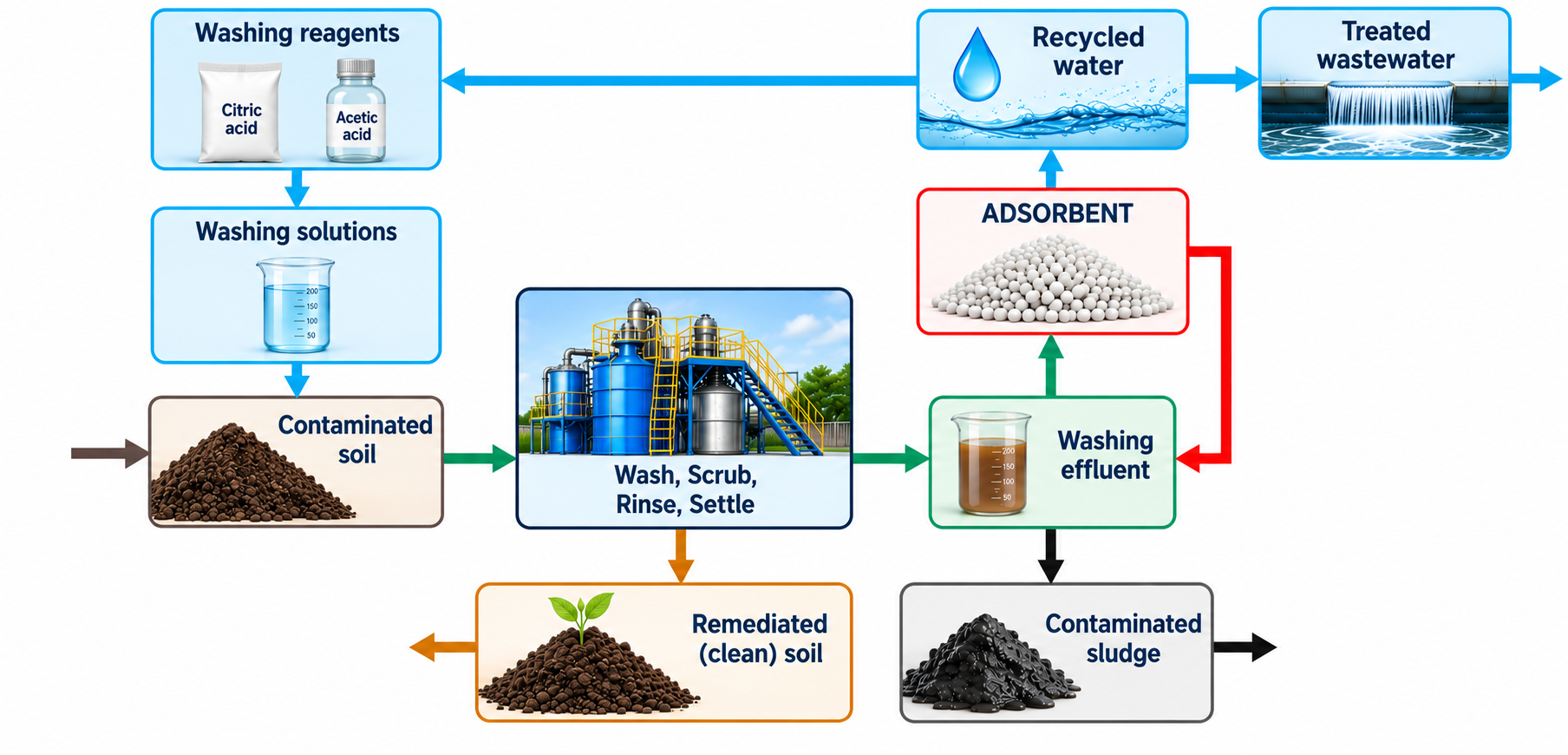
The present study explores this opportunity by proposing and testing a closed-loop treatment scheme, illustrated in Figure 1, in which contaminated soil is first washed with a mild, environmentally benign leaching agent, and the resulting metal-laden washing effluent is then treated with tailor-made adsorbents to selectively capture the leached metals. By recovering the metals from the effluent and enabling regeneration of both the sorbent and the aqueous phase, this approach aims to close the water loop of the soil-washing process, reducing the volume and toxicity of the waste stream that ultimately requires disposal while simultaneously generating a metal-rich, recoverable output stream.
The aim of this work is
- to analyse the efficiency of copper leaching from exemplar contaminated soils and model systems using environmentally friendly reagents, with acetic acid as the primary example,
- to attempt the recycling of copper salts from the resulting leachates, in line with circular-economy principles of secondary raw material recovery,
- to design and characterize tailor-made organomodified SBA-15 adsorbents, obtained by post-synthesis grafting and by co-condensation and functionalized with aminothiazole and aminobenzothiazole groups, for the capture of heavy metals from soil leachates,
- to evaluate the adsorption capacity and metal selectivity of these adsorbents in both single-metal and competitive multi-metal aqueous systems representative of real leachate compositions,
- to assess the reusability of the best-performing adsorbents through repeated adsorption-desorption cycles, thereby enabling both metal recovery and reuse of the treated water, and to demonstrate a viable closed-loop treatment scheme for soil-washing effluents.
2. Materials and Methods
2.1. Chemicals
All reagents employed in the experiments were of high-purity analytical grade, and no additional purification was performed prior to use. Deionized (DI) water was used to prepare all preparation steps. Standard solutions of Pb, Zn, Cu and Cd were applied to calibrate the analytical instrument. Sample digestion was employed using 65% HNO3 (POCH) and 30% H2O2 (Chempur).
Citric acid (Thermo Scientific), L(+)-ascorbic acid (Chempur), were used as biochelators for the soil washing test. High-purity acetylene and argon gas were supplied for flame atomic absorption spectrometry (F-AAS). In adsorption experiments chloride or acetate metal salts were used: ZnCl2, CdCl2·5H2O, CuCl2·2H2O, Pb(CH3COO)2·3H2O, Cd(CH3COO)2·2H2O, Cu(CH3COO)2. H2O (Warchem, per analysis).
2.2. Soil Sample Collection
Samples were collected along a gradient of metal concentration, from relatively low to high, in the vicinity of the Bukowno mine and smelter, directly responsible for the heavy metal soil contamination in the region [31,32,33,34]. The concentrations of the selected elements (Cd, Zn, Pb, and Cu) as a function of distance from the potential source of contamination are presented in Figure 2.
The samples were obtained exclusively from non-forested sites, including arable fields and grasslands, in order to eliminate the influence of tree cover on the results. Soil was collected from the surface down to a depth of 0.3 m, corresponding to the topsoil horizon. At every sampling point, a minimum of 10 subsamples were gathered within an area of about 10 m × 10 m and combined into a single composite sample with a mass of up to 1 kg. The collected material was then air-dried, crushed, and passed through a 2 mm sieve. Afterwards, each initial sample was quartered into four equal parts. Three portions were rejected, while the remaining one, treated as the laboratory sample, was retained for further analyses.
To characterize the soils, basic physicochemical properties were determined, namely pH, clay fraction proportion, and organic matter content. A detailed description of the analytical procedures has been provided in our earlier publications [31,35]. Soil pH was measured potentiometrically in 1.0 M KCl solution in accordance with ISO 10390:2005, using an Elmetron CP-461 pH meter [36]. The clay fraction percentage was established by the Bouyoucos hydrometer method as modified by Casagrande and Proszynski [37]. Organic carbon content was determined with the Shimadzu SSM-5000A carbon analyzer, and the results were expressed as percentage values.
2.3. Mineralization of the Original Soil Samples
For the digestion procedure, 1.5 g of soil was accurately weighed to the nearest 0.0001 g using an analytical balance and transferred into a Teflon vessel. Subsequently, 4 mL of hydrogen peroxide and 10 mL of concentrated nitric acid were added. Once the initial vigorous oxidation reaction had ceased and foaming was no longer observed, the samples were mineralized using the Ertec Magnum II digestion system. After completion of the process, the obtained solution was filtered into a 25 mL volumetric flask. The applied procedure was consistent with the US EPA standard and corresponded with the methodologies used in our previous studies [35,38,39,40].
2.4. Extraction Analysis of Soil Samples
Acetic acid was selected as an example of an inexpensive and widely available low-molecular-weight organic acid (LMWOA) for the leaching of metals from soils with varying contamination levels. Citric acid, in turn, was used as a reference compound, as it is one of the most commonly applied LMWOAs in soil remediation processes [41].
Two series of soil-washing experiments were carried out. In the first series, 0.01 M acetic acid was applied, whereas in the second, 0.01 M citric acid was used for comparison. The soil-to-solution ratio was maintained at 1:10, corresponding to 2.0 g of soil mixed with 20.0 mL of acid solution. The suspensions were subjected to mechanical shaking for contact times of 15 min, 1 h, and 4 h. After extraction, the samples were centrifuged at 6000 rpm, and the supernatants were decanted and subsequently filtered.
All filtered extracts were analyzed by flame atomic absorption spectrometry (F-AAS) using a Contraa 800 atomic spectrometer (Analytik Jena). Copper, cadmium, zinc, and lead were selected as target analytes in order to assess both the efficiency of their removal from soil and the subsequent effectiveness of metal recovery from the obtained solutions.
The limits of detection (LOD) were calculated as three times the standard deviation of repeated blank solution measurements. The obtained values were 4 μg/dm3 for copper, 5 μg/dm3 for zinc, 7 μg/dm3 for lead, and 1.5 μg/dm3 for cadmium.
2.5. Synthesis of the Organic Ligands and Their Incorporation into SBA-15
Tailor-made organic ligands designed to capture cationic pollutants (metals) were synthesised by reacting (3-chloropropyl)-trimethoxysilane or (3-isocyanatopropyl)-triethoxysilane with the target heterocyclic amines, 2-aminothiazole and 2-aminobenzothiazole [42]. The resulting organosilanes were incorporated into ordered hexagonal mesoporous silica (SBA-15) by two independent routes: (i) homogeneous post-synthesis grafting onto a pre-formed SBA-15 support, and (ii) co-condensation of the organosilane with the silica precursor during SBA-15 synthesis (sample codes prefixed X). For the grafted materials, two different parent SBA-15 batches were used, denoted by the prefixes A and B, depending on parent silica pore size. Details of synthesis and physicochemical characterisation of precursors was presented in Supporting materials chapter S1. The molecular structures and abbreviations of the synthesized anchoring compounds are summarized in Table S1, while detailed synthesis procedures for the modified organosilanes, co-condensation and post-synthesis grafting are provided in Section S1. The five adsorbents used in the adsorption study are therefore AAmBenS and BAmS (grafted, on pore-size-matched parent silicas), and XAmBenS and XAmS (co-condensed). Successful incorporation of both ligands by both routes, and the associated decrease in pore size and pore volume upon grafting without loss of the underlying hexagonal pore ordering, were confirmed by physicochemical characterization. Detailed spectroscopic evidence for the successful formation of the anchoring compounds is provided in the Supporting Material (Section S2.1, Figure S1–S3 and Table S2 and Table S3).
2.6. Purification of the Co-Condensed Adsorbents
The co-condensed adsorbents (XAmS, XAmBenS) were purified by Soxhlet extraction before use, to remove the structure-directing agent (Pluronic P123) and any unreacted organosilane. Approximately 1 g of ground XAmS, or 1.3 g of ground XAmBenS, was placed in a paper extraction thimble and extracted in two consecutive stages: first with a methanol-acetic acid mixture (90:10, v/v, 117 mL methanol + 13 mL acetic acid), and subsequently with pure methanol (130 mL), each stage lasting approximately 10-12 h under reflux. Small portions of the purified solid and of the spent solvent were withdrawn after each stage (stage I at half-time and stage II which was equivalent to finished process) and analysed by infrared (IR) spectroscopy and X-ray diffraction, together with reference spectra of P123, methanol, acetic acid and the methanol-acetic acid mixture, to confirm removal of the template. The corresponding FT-IR and XRD monitoring data are provided in Figure S5 and Figure S7 of the Supporting Material. The extraction was repeated for fresh batch of samples with methanol only (140 mL, Soxhlet). Two purification batches of XAmS were thereby obtained and both were carried forward into the adsorption experiments: XAmS(MA), extracted with the methanol-acetic acid mixture, and XAmS(M), extracted with methanol only. XAmBenS was purified with methanol only (XAmBenS(M)).
2.7. Metal Recovery from Liquid Solutions
Adsorption properties of synthesized organo-modified silica adsorbents were determined in single metal solution (Cu) as well as multicomponent mixtures.
2.7.1. Cu Recovery from Single Component Solution
The adsorption experiments were carried out in polypropylene vessels by adding 25 mg of the functionalized SBA-15 to 10 mL of 1 mmol L-1 (63.5 mg Cu2+ L-1) copper solution in a form of chloride or acetate. The resulting mixture was stirred at 25 °C for 2.5 hours.
2.7.2. Batch Adsorption Screening (Single-Run Experiments) in Multi-Metal Aqueous Solutions
Batch adsorption tests were carried out using synthetic multi-metal aqueous solutions prepared from analytical-grade metal salts: Pb(CH3COO)2·3H2O, Cd(CH3COO)2·2H2O and Cu(CH3COO)2·H2O for the acetate-based ternary system (Pb-Cd-Cu, “PCC”), and CdCl2·2.5H2O, ZnCl2 and CuCl2·2H2O for the chloride-based ternary system (Zn-Cd-Cu, “ZCC”). Individual 100 mL stock solutions of each salt were prepared at a nominal concentration of 1.5 mmol/L. For each adsorption test, 10 mg of adsorbent was contacted with 3 mL of each of the three relevant metal-salt stock solutions (9 mL total per test; solid:liquid ratio close to 1.1 g/L), giving a nominal concentration of 0.5 mmol/L per metal in the resulting solution. A second series of experiments extended the ZCC system to a five-fold higher Zn loading (2.5 mmol/L Zn, Cd and Cu unchanged at 0.5 mmol/L) to probe the sorbents’ response to a higher competing-metal load. Two blank solutions (50 mL of 0.1 mmol/L HCl and 50 mL of 0.1 mmol/L acetic acid) were run alongside the metal solutions as background controls. Suspensions were agitated by shaking for 18 h at room temperature, after which they were centrifuged and the supernatants diluted ten-fold prior to determination of residual metal concentration by flame atomic absorption spectroscopy (AAS) and evaluated by ion chromatography (IC) for ZCC system. Each sorbent/metal-mixture combination was run in triplicate. The initial screening set comprised the three aminothiazole-based sorbents (XAmS(M), XAmS(MA), BAmS); an analogous screening of the aminobenzothiazole-based sorbents (AAmBenS, XAmBenS(M)) was carried out following the same protocol. Equilibrium uptake (qe, in mg/g and mmol/g) and removal efficiency (R, %) were calculated from the difference between initial and residual metal concentration, according to the following equations:
qe (mg/g) - adsorption amount of copper:
Rads (%) - adsorption efficiency:
Where:
V (dm3) - volume of copper solution
C0 (mg/dm3) - initial adsorbate concentration
Ce (mg/dm3) - equilibrium adsorbate concentration
m (mg) - mass of the adsorbent
qe values were also expressed as mmol/g, therefore it was possible to calculate percentage of functional groups involved in adsorption process (occupied functional groups [%]).
2.7.3. Adsorption-Desorption Cycling Experiments in Multi-Metal Aqueous Solutions
To assess sorbent reusability, the two best-performing co-condensed adsorbents from the screening step, XAmS(M) and XAmBenS(M), were subjected to five consecutive adsorption-desorption cycles in both the PCC and ZCC ternary systems (0.5 mmol/L per metal). Each adsorption step used the same solid:liquid conditions as the single-run screening (10 mg adsorbent contacted with 3 mL of each of the three metal-salt stock solutions, 9 mL total, 0.5 mmol/L per metal) and the same 18 h contact time, but unlike the screening experiments each cycle was run once, without triplicate repetition, to limit the sample usage and analysis burden of the multi-cycle protocol. After each adsorption step, the loaded sorbent was separated, the supernatant analysed by AAS, and the sorbent then subjected to a desorption (regeneration) step with 9 mL of 0.01 M HCl solution followed by a wash step before being returned to a fresh aliquot of metal solution for the next adsorption cycle. This adsorption/desorption/wash sequence was repeated for five cycles per sorbent/matrix combination. From the resulting concentration data, per-cycle and cumulative metal uptake (Qads, Qcum,ads), per-cycle and cumulative metal recovered (Qdes, Qcum,ades), capacity retention (CR, %, relative to cycle 1) and desorption efficiency (DE, %, fraction of the adsorbed metal recovered in the corresponding desorption step) were calculated. Definitions and calculation procedures for Qads, Qdes, capacity retention, desorption efficiency and cumulative recovery are provided in Supporting Material, Section S3.
2.8. Instrumental Methods for Samples Analysis
Copper, cadmium, zinc, and lead have been chosen to check both the efficiency of leaching from the soil using LMWOA and the efficiency of metal recovery from liquid solutions via adsorption.
The solutions obtained from the soil samples digestion and adsorption experiments were analyzed to determine the contents of particular metals with the flame atomic absorption spectrometry (F-AAS), using the contrAA 800 model (Analytik Jena). Based on the results of three independent measurements performed for each sample, the average values of copper, cadmium, lead, and zinc concentration as well as the relative standard deviations were calculated. The detection limits were determined as a 3-fold standard deviation of repeated measurements of a blank solution and were 4 μg/dm3 for copper, 5 μg/dm3 for zinc, 7 μg/dm3 for lead, and 1.5 μg/dm3 for cadmium.
For single metal Cu-containing liquid samples after metal recovery from liquid solutions via adsorption metal determination was performed using Ion Chromatography (IC) HIC-ESP LC-20Ai (Shimadzu). Analysis conditions were as follows: column Shim-pack IC-C4 (150 mm L × 4.6 mm I.D., 7 μm), mobile phase A) 2.5 mmol/L oxalic acid and B) 2.5 mmol/L methanesulfonic acid, A/B = 60/40 (v/v), flow rate 1.0 mL/min, column temperature 40 °C, detector CDD-10A VP, injection volume 20 µL.
The percentage content of hydrogen, carbon, nitrogen and sulfur in organo-modified silica adsorbents (CHNS) was performed using a Vario Micro Cube elemental analyzer with electronic microbalance (Elementar Analysensysteme GmbH).
Infrared spectra of the samples were recorded using attenuated total reflectance technique using Nicolet iS5 FTIR (Thermo Scientific) equipped with an iD3 ATR module with a germanium crystal window. The number of scans recorded during a single spectral measurement was 64, with a resolution of 2 cm-1. Absorbance spectra were recorded in the 4000-525 cm-1 range.
The 1H NMR spectra were recorded using a Bruker Avance II 300 MHz spectrometer with TMS as an internal standard.
The structure of the materials was characterized by X-ray powder diffractometer BRUKER D2 PHASER equipped with a CuKα radiation source. The patterns were collected in the 2θ range of 0.5° to 4° with a step of 0.02°.
UV-Vis spectra of Cu-containing solutions were recorded on an Evolution 220 (Thermo Scientific) spectrophometer in the range of 190-900 nm with a resolution of 2 nm.
UV-vis-DRS spectra of organo-modified silica adsorbents before and after adsorption were recorded on an Evolution 600 (Thermo Scientific) spectrophometer in the range of 190-900 nm with a resolution of 4 nm.
Thermoporometry (TPM) investigations were performed using Mettler Toledo apparatus DSC 822e, with the accuracy 4 ۰ 10−6 W, equipped with the liquid nitrogen cooling system (Criofab) allowing work between -140 and 400 °C. Apparatus calibration for heat flux and temperature was done with an n-octane, indium and zinc standards provided by the supplier. The tolerance in the instrument calibration is 0.2 °C. Before the TPM experiment a sample was placed in aluminium pan, water was added and the pan was sealed with lid. To avoid super-cooling effect, the samples were quenched far below the equilibrium freezing temperature (to -30 °C) with the cooling rate β = 10 K/min and then heated with β = 2 K/min to +10 °C [43]. After the experiment, a small hole was made in the lid of the crucible and the sample was heated up to 200 °C in order to evaporate the liquid component and the sample mass obtaining. Pore size distribution was determined from the solid to liquid DSC profiles. The melting point depression was obtained relative to the excess phase, so that each experiment was internally calibrated for temperature[44].
3. Results & Discussion
3.1. Soil Decontamination
The efficiency of metal leaching from the selected soil samples with acetic acid, and in comparison with citric acid, is depicted in Figure 3.
Figure 3 illustrates that although acetic acid is notably less effective than citric acid, its performance provides essential insights for evaluating the feasibility of mild-organic-acid soil washing systems, especially where low cost, low environmental burden and on-site applicability are priorities.
Acetic acid extracted up to 10-11% of total Cd within 4 h in soils with low and increased contamination, and typically 4-5% in high-contaminated soils. This moderate efficiency, though significantly lower compared with citric acid, indicates that acetic acid is capable of mobilizing a meaningful fraction of Cd even without strong complexation. Zn showed the highest extraction efficiency with acetic acid, reaching 4-5% after 4 h. This reflects Zn’s relatively weaker binding in many soil matrices. Despite still being lower than the citric-acid counterpart, the values confirm that acetic acid is able to remove a non-negligible portion of Zn even in more contaminated soils. Pb extraction with acetic acid remained consistently low (≤0.6%), irrespective of soil contamination class or duration of washing. This confirms the strong association of Pb with mineral phases and its limited susceptibility to weak organic acids. The contrast with citric acid (up to ~5%) highlights the limitations of mild organic acids in addressing strongly sorbing contaminants such as Pb. However, it also emphasizes that Pb remains largely immobilized in the soil even after washing, reducing risks of secondary spreading. Acetic acid extracted ~0.9-1.6% of total Cu, placing this metal between Zn and Pb in terms of susceptibility to mild-organic-acid mobilization. The limited extraction reflects Cu’s tendency to form stable complexes with soil organic matter and mineral surfaces, which acetic and citric acids only partially disrupt.
Even though acetic acid shows modest extraction percentages (Figure 3), the absolute concentrations of metals measured in the washing solutions (Table 1) reveal that even this mild organic acid generates effluents that cannot be discharged without treatment.
Table 1 clearly demonstrates that for instance Cd concentrations in acetic-acid leachates may even reach 0.27 mg/L (depending on soil class), which already exceeds commonly accepted limits for direct discharge to surface waters or sewer systems due to high toxicity of this element [45]. In soils with increased contamination, Cd concentrations in leachates approach or surpass values classified as “requiring purification” under many environmental guidelines [46,47]. In the case of lead, despite the extraction never exceeded 0.6% with acetic acid and 4.5% with citric acid, the concentration in leachates still reaches even 0.2 mg/L in acetic acid leachates from soils with high initial Pb content, and exceeds 12 mg/L in the case of citric acid leaching. This occurs because even a very small extraction fraction corresponds to a sizeable absolute mass transfer at elevated soil Pb levels. These values also exceed the maximum allowable concentration of this element in surface water and must be subjected to a purification process [47]. Moreover, other studies confirmed the toxic impact of those metals on living organisms and human health even at such low concentrations [48,49].
Zn concentrations in acetic-acid effluents, however, generally lower than in citric-acid filtrates, still reach as much as 32 mg/L for leachates from soils with increased or high Zn content. In the case of citric acid, this value is over 7 times higher. Although Zn is less critical from a toxicological standpoint, these values may exceed standard reuse or irrigation limits [50]. Copper, forming relatively stable soil complexes, appears in acetic-acid filtrates at moderate levels (up to 0.02 mg/L with acetic acid and 0.1 mg/L with citric acid), yet these may still surpass allowed concentrations for direct environmental release [51].
The ranges reported in Table 1 underscore a crucial point that even when a weak acid such as acetic acid is used, the resulting leachates frequently contain metal concentrations high enough to require dedicated purification.
3.2. Adsorbents Properties
Structural parameters of the SBA-15 synthesized in different conditions (synthesis A and B) and of the grafted samples are presented in Table 2. The low-angle XRD diffractograms recorded for the synthesized samples are presented in Figure 4.
The presence of the characteristic diffraction peaks (100), (110) and (200) proves that the obtained materials have highly ordered porous structure [52]. The successful formation of the corresponding anchoring compounds was independently confirmed by FT-IR and ^1H NMR spectroscopy (Supporting Material, Figure S1–S3; Table S2 and Table S3). The observed vibrational bands are consistent with previously reported spectroscopic data for the corresponding organosilane and heterocyclic structures [53,54,55,56]. It should be noted that the intensity, width and position of reflections are significantly different depending on the procedure used for the mesoporous silica aging and synthesis route. The wall thickness (Table 2) for the SBA-15 materials is in the range of 4.9-5.2 nm. Determined pore size (Table 3) for the sample prepared according to the synthesis procedure B is significantly larger in comparison to other samples. The obtained results are in accordance with the data reported in the literature (i.e., increased temperature results in formation of larger pores) [57]. However, hydrothermal conditions cause even larger increase of pore size. Silica with grafted functional groups is characterized by smaller pore size and thicker pore walls what has been also proven in publication of Majda et al.[58]. According to Wang et al.[59], 2D-hexagonal ordering has been retained after post-synthesis grafting what was also observed in the presented studies. The ^1H NMR spectra of the anchoring compounds (Supporting Material, Figure S2 and Figure S3; Table S3) further support the successful formation of AmS and AmBenS.
The extraction-monitoring series (Figure 5) provides a complementary view of the same structural trends. Complementary FT-IR data for the fresh, extracted and metal-treated organo-functionalised silicas are presented in Figure S5. For both XAmS and XAmBenS, the (100) reflection loses intensity and broadens progressively from the as-synthesized material through stage I to stage II of Soxhlet purification, indicating a real, if modest, loss of long-range mesostructural order as the P123 template is removed, rather than a simple dilution effect from washing. This loss is more pronounced for the methanol-only extraction (M) than for the methanol-acetic acid route (MA): at stage II, the MA samples retain visibly more (100) intensity than their M counterparts, suggesting the acid-assisted extraction is gentler on the framework, plausibly because it more completely removes residual template rather than leaving it to be mechanically stripped by methanol alone.
A further, less expected pattern appears in Figure 6 and Table 2: after the multi-metal adsorption step (PCC/ZCC), the (100) reflection shifts back toward lower 2θ relative to the freshly-extracted (stage II) material, for example, a0 for XAmS(M) rises from 11.0 nm (extracted) to 11.9 nm (PCC) and 11.6 nm (ZCC), approaching the as-synthesized value of 12.0 nm. The peaks remain broader than in the pristine material, so this is not a simple reversal of the extraction-induced disordering, but it does indicate that the framework partially re-expands on prolonged aqueous exposure (18 h contact), most likely via hydration/swelling of the silica walls rather than any metal-templating effect, since the same partial-recovery pattern is observed for both the PCC and ZCC systems despite their different metal content. Additional XRD patterns of the spent organo-silica adsorbents are provided in Figure S7.
Figure 7.
Pore size distribution for parent calcined SBA-15, organo-functionalized silicas before and after calcination and after copper salt adsorption.
Figure 7.
Pore size distribution for parent calcined SBA-15, organo-functionalized silicas before and after calcination and after copper salt adsorption.
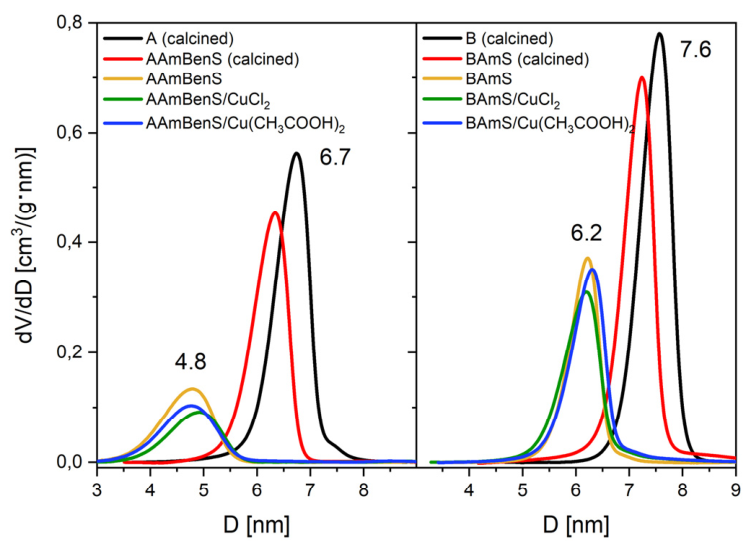
Thermoporometry provides a second, largely independent line of evidence, and for the unmodified parent silicas it agrees well with XRD: B (calcined) shows both a larger pore diameter (7.6 vs. 6.7 nm) and larger pore volume (0.57 vs. 0.46 cm3/g) than A, mirroring the larger unit-cell parameter seen by XRD (a0 = 11.1 vs. 10.4 nm). Complementary N2 adsorption-desorption isotherms and pore-size distributions are presented in Figure S8 and Figure S9, respectively, while the corresponding BET and pore-volume parameters are compiled in Table S5. The observed isotherm profiles are characteristic of mesoporous materials with relatively uniform pore-size distributions [60]. The grafting-vs-calcination comparison in Table 3 further demonstrates that the organic ligand physically occupies pore space: as-grafted AAmBenS shows a pore diameter of only 4.8 nm and a volume of 0.15 cm3/g, but calcining it back off recovers 6.3 nm and 0.43 cm3/g, close to (though not quite matching) the 6.7 nm/0.46 cm3/g of the never-grafted parent. The same pattern holds for BAmS (6.2 → 7.2 nm; 0.26 → 0.52 cm3/g against a 7.6 nm/0.57 cm3/g parent), but the relative pore-diameter reduction on grafting is smaller for BAmS (~18%) than for AAmBenS (~28%), consistent with the bulkier aminobenzothiazole ligand occupying proportionally more of the pore space than the aminothiazole ligand.
Copper adsorption itself perturbs the two materials differently. TPM shows that CuCl2 and Cu(CH3COO)2 exposure barely change BAmS’s pore metrics (D and V essentially unchanged, 6.2 nm and 0.26–0.30 cm3/g throughout) but measurably shrink AAmBenS’s pore volume (0.15 → 0.11–0.13 cm3/g) at an unchanged pore diameter, despite AAmBenS adsorbing markedly less copper than BAmS under the same single-metal conditions (paragraph 3.3.1, Table 4). This suggests the small amount of copper AAmBenS does capture is deposited in a way that measurably obstructs its already-narrow pores, whereas BAmS’s wider channels accommodate a larger absolute Cu uptake with comparatively little volumetric consequence, a structural explanation for why pore geometry, and not only ligand density, may be limiting AAmBenS’s practical capacity.
The clearest correlation between the two techniques is, in fact, a quantifiable disagreement, and it is worth stating explicitly rather than smoothing over. The wall-thickness column in Table 2 (W = a0 − D) can be computed by pairing the (non-calcined) grafted-sample XRD lattice parameter with either the non-calcined or the calcined TPM pore diameter, and the two routes disagree substantially: 4.7 vs. 3.7 nm for BAmS, and 5.4 vs. 3.9 nm for AAmBenS, against a third, directly measured (DBJH) calcined value of ~5.3 nm for both. A spread of 1.5-1.7 nm on a wall that is nominally 4-5 nm thick (35–45% relative) is a methodological artefact rather than a real structural feature: it arises from combining a room-temperature, water-swollen TPM pore size with a dry XRD lattice parameter measured on a sample of a different thermal history (organic-laden vs. calcined), which is not a self-consistent pairing. By contrast, the clean agreement between XRD and TPM for the two unmodified, matched-state parent silicas, both techniques rank B > A in pore size, with proportionally similar margins, confirms that the two methods are fundamentally consistent with one another, and that the wall-thickness discrepancy is specifically a consequence of mixing calcination states rather than a disagreement between XRD and TPM as such. Future reporting of W should therefore be restricted to same-state comparisons, or the mixed-state values should be flagged as approximate.
3.3. Metal Recovery and Water Cycling
3.3.1. Copper Adsorption on Organomodified SBA-15 Sorbents
Table 4 summarises the equilibrium uptake of Cu2+ from single-metal chloride and acetate solutions on the two grafted sorbents evaluated individually, BAmS and AAmBenS, alongside representative Cu-selective SBA-15 adsorbents reported in the literature. Under the short-contact-time conditions used for this preliminary test (25 mg adsorbent, 10 mL of 1 mmol/L Cu2+, 2.5 h), both materials captured markedly more copper from the acetate salt than from the chloride salt: qₑ rose from 0.214 to 0.607 mmol/g for BAmS (13% → 38% removal) and from 0.029 to 0.087 mmol/g for AAmBenS (2% → 7% removal). Expressed relative to the actual, CHNS-determined ligand loading of each material - 1.59/1.17 mmol/g (N-/S-based) for BAmS and 1.15/0.89 mmol/g for AAmBenS, themselves only 12-35% of the nominal 5 mmol/g synthesis target (Supplementary Material, Table S4), this corresponds to 13-52% and 3-10% of the available functional groups being engaged, respectively. The underlying CHNS-derived ligand loadings and calculated surface coverages are summarized in Supporting Material, Table S4.
Two observations follow. First, BAmS engaged a substantially larger share of its (already limited) ligand inventory than AAmBenS under these conditions, suggesting the thiazole ligand is kinetically more accessible to Cu2+ at short contact times than the bulkier benzothiazole ligand, even though the competitive multi-metal screening discussed in paragraph 3.3.2 shows the opposite capacity ranking once the system is allowed to equilibrate over 18 h. This points to a kinetic rather than thermodynamic origin for the low apparent capacity measured here: the 2.5 h contact time used for this single-metal test is short relative to the 18 h used in the multi-metal experiments, and the accompanying UV-Vis-DRS and FT-IR data (Supplementary Material, Figure S4–S6) show no measurable spectral shift attributable to ligand-metal coordination, consistent with the system not having reached equilibrium. Second, both materials remain well below the uptake reported for comparable Cu-selective SBA-15 adsorbents, aminopropyl- and N-propylsalicylaldimine-functionalised SBA-15 report qₑ values of 0.82 and 0.73 mmol/g, respectively [61] consistent with the substantially incomplete, and per CHNS analysis partially degraded, ligand grafting achieved here (Table S4), rather than with an intrinsic limitation of the aminothiazole/aminobenzothiazole chemistry itself.
3.3.2. Screening of Adsorption Performance of the Organomodified SBA-15 Sorbents
In contrast to the short single-metal Cu test above, the multi-metal screening (paragraph 2.7.2) allowed 18 h for equilibration and was carried out in competitive ternary mixtures designed to mimic the leachate compositions identified in chapter 3.1: a Pb-Cd-Cu acetate system (PCC) and a Zn-Cd-Cu chloride system (ZCC), each at a nominal 0.5 mmol/L per metal, plus a higher-loading ZCC variant (2.5 mmol/L Zn). Table 5 summarises the triplicate-averaged removal efficiency (R, %) obtained for each metal, matrix and sorbent.
The five sorbents separate into two clearly distinct performance groups. The aminobenzothiazole-functionalised materials (AAmBenS, grafted, and XAmBenS(M), co-condensed) removed 96.0-97.2% of every metal in both matrices, essentially independent of metal identity, counter-ion (acetate vs. chloride) or the presence of a fourth competing cation. The aminothiazole-based materials (BAmS, XAmS(M), XAmS(MA)) performed markedly lower and non-uniformly across metals: 63-63% for Pb, 66-71% for Cd and Zn, and 78-90% for Cu.
Two conclusions follow. First, the benzothiazole-extended ligand provides a substantially stronger, less metal-selective binding site than the simple thiazole ring: expressed on a molar basis, the AmBenS-family sorbents captured 1.13-1.25 mmol/g of total metal across the ternary systems, roughly 20-45% more than the AmS-family sorbents (0.83-0.93 mmol/g), despite carrying a comparable or even lower actual ligand loading (Table S4), indicating a genuinely stronger per-site affinity rather than simply a higher site density. Second, within the aminothiazole family, removal efficiency does not distinguish the grafted material (BAmS) from the co-condensed ones (XAmS(M), XAmS(MA)): the three sorbents overlap within experimental error for every metal/matrix combination, indicating that for this ligand the synthesis route (grafting vs. co-condensation) is a secondary factor compared with the identity of the ligand itself - consistent with the similar actual grafting densities obtained for the three materials by CHNS (Table S4).
Raising the Zn feed concentration five-fold (0.5 → 2.5 mmol/L) increased Zn uptake proportionally (qₑ rising from ~17 to ~79 mg/g) while removal efficiency stayed essentially unchanged (64-66%), and Cd/Cu removal on the same sorbents shifted by no more than a few percentage points, indicating that none of the three aminothiazole-based sorbents were close to saturation even at the highest metal loading tested.
3.3.3. Metal Selectivity and the Role of the Competing-Ion Matrix
To move beyond the qualitative comparison above, a distribution coefficient was calculated for each metal/sorbent/matrix combination on a molar basis, Kᴅ = qₑ/Cₑ, and pairwise selectivity factors αᵢ/ⱼ = Kᴅ,ᵢ/Kᴅ,ⱼ were derived for every metal pair present in each ternary system (Table 6).
The aminothiazole-type sorbents show genuine, reproducible selectivity: Cu is bound roughly five-fold more strongly than Pb and about two-fold more strongly than Zn, an order that persists essentially unchanged when the Zn loading is raised five-fold, confirming that this is a ligand property rather than a loading artefact. The aminobenzothiazole-type sorbents, by contrast, are essentially non-selective, with every pairwise α falling within roughly ±20% of unity in both matrices, turning the qualitative observation in paragraph 3.3.2 (“all metals removed to a similar extent”) into a quantitative, defensible claim.
Notably, the sign of the AmS-family’s molar preference reverses between matrices: Cd > Cu > Pb in the acetate-based PCC system (Cd/Cu = 0.27, i.e., Cu is preferred over Cd), but Cu > Cd ≈ Zn in the chloride-based ZCC system. This is consistent with competitive aqueous-phase complexation of Pb2+ and Cu2+ by acetate, which would lower their free-ion activity, and hence their availability for surface complexation, relative to the more weakly acetate-complexed Cd2+; in the chloride matrix, where such complexation is comparatively weak for all four metals, Cu2+ instead shows the highest molar affinity, plausibly reflecting its favourable coordination geometry with the thiazole N/S donor set. These remain working hypotheses that would benefit from complementary aqueous-speciation modelling or single-metal reference experiments.
3.3.4. Adsorption-Desorption Cyclability and Reusability
The two best-performing co-condensed sorbents, XAmS(M) and XAmBenS(M), were carried through five adsorption-desorption cycles (paragraph 2.7.3) using 0.01 M HCl as the regenerating eluent. Table 7 summarises the cumulative metal uptake, cumulative metal recovered and overall retention over the full five-cycle sequence; Figure 8 shows the per-cycle removal efficiency trend for each metal as well as desorption potential.
XAmBenS(M) showed outstanding operational stability: removal efficiency for Pb, Cd and Cu stayed within a narrow 96.0-98.0% band across all five cycles in both matrices (maximum drop of 1.4 percentage points between cycle 1 and cycle 5). XAmS(M) behaved differently and metal-specifically: Pb and Cd removal did not decline at all: both increased slightly over the five cycles (Pb: 80.2% → 81.7%; Cd: 84.0% → 86.3%, PCC matrix), while Cu removal fell steadily and substantially, from 96.8% to 89.0% in the PCC matrix (a 7.8-percentage-point, ~8% relative loss) and from 88.5% to 84.9% in the ZCC matrix, indicating progressive fatigue of the Cu-binding sites specifically on the aminothiazole sorbent.
This selective fatigue is corroborated by the desorption data: Cu was also the metal desorbed most efficiently from XAmS(M) at every cycle (15.8% of the adsorbed Cu recovered in cycle 1, falling to 6.9% by cycle 5), whereas Pb and Cd were desorbed only marginally (≤1.0% per cycle) throughout. On XAmBenS(M), desorption of all three metals - including Cu - remained below 1% per cycle throughout, i.e., essentially irreversible under the 0.01 M HCl elution used. Cumulatively, over the whole five-cycle sequence, only 11.1% (PCC) and 4.4% (ZCC) of the Cu taken up by XAmS(M) was ever recovered by the eluent, versus 0.30-0.31% for XAmBenS(M) (Table 7); Pb, Cd and Zn were essentially fully retained (>99.5% cumulative retention) on both sorbents regardless of matrix. The complete cycle-by-cycle calculation framework used to derive desorption efficiency, retained metal and reversible/retained fractions is given in Supporting Material, Section S3.
Taken together with the screening and selectivity results (paragraphs 3.3.2-3.3.3), these cycling data support a two-tier sorbent strategy consistent with the closed-loop scheme proposed in Figure 1. XAmBenS(M) (and, by extension, its grafted analogue AAmBenS) is best suited to a polishing/immobilisation step that drives residual metal concentrations to very low levels and can be reused many times without measurable loss of capacity: closing the water loop by returning a near metal-free effluent for reuse or safe discharge. XAmS(M) (and BAmS), while less efficient overall and subject to gradual Cu-specific capacity loss on cycling, uniquely combines strong retention of Pb/Cd/Zn with reversible, recoverable binding of Cu, offering a route to selectively harvest copper, the metal targeted for recycling in this study (chapter 1) - from a multi-metal leachate using a simple 0.01 M HCl regeneration step. Realising higher overall recovery yields for Cu, or extending selective recovery to Pb, Cd and Zn, would likely require a dedicated regeneration chemistry optimised independently of the adsorption step, since the present dataset, built around a single fixed elution protocol, cannot establish whether the low desorption of Pb, Cd and Zn reflects an intrinsic binding limit or an eluent choice not yet optimized for recovery.
4. Conclusions
This study addressed both halves of the closed-loop scheme proposed in Figure 1: a soil-washing step that mobilizes heavy metals into an aqueous effluent, and a sorbent-based treatment step that recovers them from it. Four conclusions follow.
1. Soil decontamination does not eliminate the problem - it shifts it
The washing step successfully reduces the total metal content in the soil, especially at moderately contaminated sites, but the extracted metals accumulate in the liquid phase rather than disappearing. For Cd and Pb, both subject to strict regulatory thresholds, Table 1 shows that acetic-acid filtrates often exceed permissible discharge concentrations.
2. Mild acids do not guarantee mild effluents
Although acetic acid is less efficient than citric acid, Table 1 shows that the absolute metal loads it mobilizes remain environmentally relevant. This is particularly striking for Cd: even an extraction of only 5-10% can produce filtrates with concentrations that require dedicated treatment.
3. Filtrates constitute a valuable but contaminated stream
Given the quantified ranges in Table 1, acidic leachates can be regarded as metal-rich solutions suitable for secondary purification or metal recovery. Their composition, low pH, moderate ionic strength, a relatively simple organic matrix, makes them favorable for sorption-based purification, as demonstrated by the organomodified SBA-15 sorbents evaluated in paragraph 3.3.
4. Tailor-made adsorbents close the loop, but no single material does everything
The two sorbent families examined offer complementary, not interchangeable, solutions to the effluent problem identified above. The aminobenzothiazole-functionalised materials (AAmBenS, XAmBenS(M)) remove 96–97% of Pb, Cd, Cu and Zn essentially independent of matrix and retain this performance over at least five adsorption-desorption cycles, making them well suited to driving residual metal concentrations down to safely dischargeable or reusable levels. The aminothiazole-functionalised materials (BAmS, XAmS(M)/(MA)) are markedly less efficient overall but are genuinely Cu-selective (a distribution-coefficient ratio of ~5 relative to Pb) and are the only sorbents from which a meaningful fraction of the adsorbed copper, up to 11% cumulatively, can be recovered under mild 0.01 M HCl elution. This reversibility is what distinguishes true metal recovery from simply relocating the contamination a second time, from liquid effluent to spent solid sorbent.
Taken together, these results show that closing the water loop in Figure 1 requires pairing these two sorbent behaviours rather than choosing between them: a non-selective, highly reusable material to purify the bulk effluent, and a selective, regenerable material to harvest copper as a genuine secondary raw material. The soil-washing step should therefore be viewed not as an endpoint but as the first stage of an integrated remediation-and-recovery scheme, in which the adsorption step demonstrated here returns both a cleaner aqueous phase and a copper-enriched stream suitable for further valorisation.
Supplementary Materials
The following supporting information can be downloaded at the website of this paper posted on Preprints.org, “A_Wegrzyn_Closing_the_loop_supplementary_material.doc”, “A_Wegrzyn_RESULTS_adsorption-desorption.xls”.
Author Contributions
Conceptualization, A.W. and P.M.; methodology, A.W., D.C., P.M. D.M.;; formal analysis, A.W.; investigation, P.M., A.W. A.K., M.D.-Z., D.C., D.M., X.T.D.; data curation, A.K., P.M.; writing—original draft preparation, A.W., P.M.,; writing—review and editing, P.M.,A.W.; supervision, A.W., P.M., D.C. All authors have read and agreed to the published version of the manuscript.
Data Availability Statement
The original contributions presented in this study are included in the article/supplementary material. Further inquiries can be directed to the corresponding author(s).
Acknowledgments
The study was partially carried out using research infrastructure funded by the European Union in the framework of the Smart Growth Operational Programme, Measure 4.2; Grant Number POIR.04.02.00-00-D001/20, “ATOMIN 2.0 - Center for materials research on ATOMic scale for the INnovative economy.”.
Conflicts of Interest
The authors declare no conflicts of interest.
References
- Xu, L.; Zhao, F.; Xing, X.; Peng, J.; Wang, J.; Ji, M.; Li, B.L. A Review on Remediation Technology and the Remediation Evaluation of Heavy Metal-Contaminated Soils. Toxics 2024, 12, 897. [Google Scholar] [CrossRef] [PubMed]
- Raffa, C.M.; Chiampo, F.; Shanthakumar, S. Remediation of Metal/Metalloid-Polluted Soils: A Short Review. Appl. Sci. 2021, 11, 4134. [Google Scholar] [CrossRef]
- Wuana, R.A.; Okieimen, F.E. Heavy Metals in Contaminated Soils: A Review of Sources, Chemistry, Risks and Best Available Strategies for Remediation. ISRN Ecol. 2011, 2011, 1–20. [Google Scholar] [CrossRef]
- Kabata-Pendias, A. Trace Elements in Soils and Plants: Fourth Edition; CRC Press, 2010; ISBN 9781420093704. [Google Scholar]
- Saleem, M.; Pierce, D.; Wang, Y.; Sens, D.A.; Somji, S.; Garrett, S.H. Heavy Metal(Oid)s Contamination and Potential Ecological Risk Assessment in Agricultural Soils. J. Xenobiotics 2024, 14, 634–650. [Google Scholar] [CrossRef] [PubMed]
- Correia, A.A.S.; Rasteiro, M.G. A Review of Persistent Soil Contaminants: Assessment and Remediation Strategies. Environ.-MDPI 2025, 12, 229. [Google Scholar] [CrossRef]
- Vogiantzi, C.; Tserpes, K. On the Definition, Assessment, and Enhancement of Circular Economy across Various Industrial Sectors: A Literature Review and Recent Findings. Sustain. 2023, 15, 16532. [Google Scholar] [CrossRef]
- Geissdoerfer, M.; Savaget, P.; Bocken, N.M.P.; Hultink, E.J. The Circular Economy – A New Sustainability Paradigm? J. Clean. Prod. 2017, 143, 757–768. [Google Scholar] [CrossRef]
- Cardona, Y.; Węgrzyn, A.; Miśkowiec, P.; Korili, S.A.; Gil, A. Heterogeneous Fenton- and Photo-Fenton-like Catalytic Degradation of Emerging Pollutants Using Fe2O3/TiO2/Pillared Clays Synthesized from Aluminum Industrial Wastes. J. Water Process Eng. 2023, 52. [Google Scholar] [CrossRef]
- Rodríguez-Rasero, C.; Garrido-Zoido, J.M.; García-Galán, M. del M.; Cuerda-Correa, E.M.; Alexandre-Franco, M.F. Coffee Waste as a Green Precursor for Iron Nanoparticles: Toward Circular, Efficient and Eco-Friendly Dye Removal from Aqueous Systems. J. Xenobiotics 2025, 15, 158. [Google Scholar] [CrossRef] [PubMed]
- Ostellari, P.; Gross, S. A Mature Tool to Address New Challenges: Harnessing Coordination Chemistry for The Sustainable Copper Recovery from Industrial and E-Waste in The Age of Energy Transition. Eur. J. Inorg. Chem. 2025, 28. [Google Scholar] [CrossRef]
- Valenta, R.K.; Kemp, D.; Owen, J.R.; Corder, G.D.; Lèbre, É. Re-Thinking Complex Orebodies: Consequences for the Future World Supply of Copper. J. Clean. Prod. 2019, 220, 816–826. [Google Scholar] [CrossRef]
- Biancardi, A.; D’Adamo, I.; Santibanez-Gonzalez, E.D.R.; Bascur, J.F.V. A Flexible and Circular Management of Copper in Chile: New Perspectives Toward Sustainable Development. Glob. J. Flex. Syst. Manag. 2025, 26, 813–837. [Google Scholar] [CrossRef]
- Elshkaki, A.; Graedel, T.E.; Ciacci, L.; Reck, B.K. Copper Demand, Supply, and Associated Energy Use to 2050. Glob. Environ. Chang. 2016, 39, 305–315. [Google Scholar] [CrossRef]
- Moreno-Leiva, S.; Haas, J.; Junne, T.; Valencia, F.; Godin, H.; Kracht, W.; Nowak, W.; Eltrop, L. Renewable Energy in Copper Production: A Review on Systems Design and Methodological Approaches. J. Clean. Prod. 2020, 246, 118978. [Google Scholar] [CrossRef]
- Węgrzyn, A.; Katarzyńska, A.; Miśkowiec, P.; Makowski, W. Beyond Fossil Fuels: The Role of V-Doped Hydrotalcites in n-Butane Oxidative Dehydrogenation for a Circular Economy. Catalysts 2025, 15, 841. [Google Scholar] [CrossRef]
- Węgrzyn, A.; Witkowski, S.; Majda, D.; Białoruski, M.; Miśkowiec, P.; Skórkiewicz, S.; Piskorz, W. Towards Sorption Degradation Mechanism: Transformation of Hydrotalcite to Periclase and Spinel upon Calcination — Experimental Studies and DFT Modelling. Sep. Purif. Technol. 2025, 377, 133963. [Google Scholar] [CrossRef]
- Cardona, Y.; Węgrzyn, A.; Miśkowiec, P.; Korili, S.A.; Gil, A. Catalytic Photodegradation of Organic Compounds Using TiO2/Pillared Clays Synthesized Using a Nonconventional Aluminum Source. Chem. Eng. J. 2022, 446, 136908. [Google Scholar] [CrossRef]
- Stawiński, W.; Węgrzyn, A.; Mordarski, G.; Skiba, M.; Freitas, O.; Figueiredo, S. Sustainable Adsorbents Formed from By-Product of Acid Activation of Vermiculite and Leached-Vermiculite-LDH Hybrids for Removal of Industrial Dyes and Metal Cations. Appl. Clay Sci. 2018, 161, 6–14. [Google Scholar] [CrossRef]
- Węgrzyn, A.; Stawiński, W.; Freitas, O.; Komędera, K.; Błachowski, A.; Jęczmionek, Ł.; Dańko, T.; Mordarski, G.; Figueiredo, S. Study of Adsorptive Materials Obtained by Wet Fine Milling and Acid Activation of Vermiculite. Appl. Clay Sci. 2018, 155, 37–49. [Google Scholar] [CrossRef]
- Silva, A.; Martinho, S.; Stawiński, W.; Węgrzyn, A.; Figueiredo, S.; Santos, L.H.M.L.M.; Freitas, O. Application of Vermiculite-Derived Sustainable Adsorbents for Removal of Venlafaxine. Environ. Sci. Pollut. Res. 2018, 25, 17066–17076. [Google Scholar] [CrossRef] [PubMed]
- Stawiński, W.; Węgrzyn, A.; Freitas, O.; Chmielarz, L.; Mordarski, G.; Figueiredo, S. Simultaneous Removal of Dyes and Metal Cations Using an Acid, Acid-Base and Base Modified Vermiculite as a Sustainable and Recyclable Adsorbent. Sci. Total Environ. 2017, 576, 398–408. [Google Scholar] [CrossRef] [PubMed]
- Stawiński, W.; Węgrzyn, A.; Freitas, O.; Chmielarz, L.; Figueiredo, S. Dual-Function Hydrotalcite-Derived Adsorbents with Sulfur Storage Properties: Dyes and Hydrotalcite Fate in Adsorption-Regeneration Cycles. Microporous Mesoporous Mater. 2017, 250, 72–87. [Google Scholar] [CrossRef]
- Węgrzyn, A.; Tsurtsumia, A.; Witkowski, S.; Freitas, O.; Figueiredo, S.; Cybińska, J.; Stawiński, W. Vermiculite as a Potential Functional Additive for Water Treatment Bioreactors Inhibiting Toxic Action of Heavy Metal Cations Upsetting the Microbial Balance. J. Hazard. Mater. 2022, 433, 128812. [Google Scholar] [CrossRef] [PubMed]
- Gusiatin, Z.M.; Kulikowska, D.; Klik, B. New-Generation Washing Agents in Remediation of Metal-Polluted Soils and Methods for Washing Effluent Treatment: A Review. Int. J. Environ. Res. Public Health 2020, 17, 1–19. [Google Scholar] [CrossRef] [PubMed]
- Dermont, G.; Bergeron, M.; Mercier, G.; Richer-Laflèche, M. Soil Washing for Metal Removal: A Review of Physical/Chemical Technologies and Field Applications. J. Hazard. Mater. 2008, 152, 1–31. [Google Scholar] [CrossRef] [PubMed]
- Liu, J.; Zhao, L.; Liu, Q.; Li, J.; Qiao, Z.; Sun, P.; Yang, Y. A Critical Review on Soil Washing during Soil Remediation for Heavy Metals and Organic Pollutants. Int. J. Environ. Sci. Technol. 2022, 19, 601–624. [Google Scholar] [CrossRef]
- Bhattacharyya, K.G.; Gupta, S. Sen Adsorption of a Few Heavy Metals on Natural and Modified Kaolinite and Montmorillonite: A Review. Adv. Colloid Interface Sci. 2008, 140, 114–131. [Google Scholar] [CrossRef] [PubMed]
- Wang, S.; Peng, Y. Natural Zeolites as Effective Adsorbents in Water and Wastewater Treatment. Chem. Eng. J. 2010, 156, 11–24. [Google Scholar] [CrossRef]
- Joseph, L.; Jun, B.M.; Flora, J.R.V.; Park, C.M.; Yoon, Y. Removal of Heavy Metals from Water Sources in the Developing World Using Low-Cost Materials: A Review. Chemosphere 2019, 229, 142–159. [Google Scholar] [CrossRef] [PubMed]
- Miśkowiec, P.; Łaptaś, A.; Zięba, K. Soil Pollution with Heavy Metals in Industrial and Agricultural Areas: A Case Study of Olkusz District. J. Elem. 2015, 20, 353–362. [Google Scholar] [CrossRef]
- Gruszecka-Kosowska, A.; Kicińska, A. Long-Term Metal-Content Changes in Soils on the Olkusz Zn–Pb Ore-Bearing Area, Poland. Int. J. Environ. Res. 2017, 11, 359–376. [Google Scholar] [CrossRef]
- Kicińska, A.; Smreczak, B.; Jadczyszyn, J. Soil Bioavailability of Cadmium, Lead, and Zinc in Areas of Zn-Pb Ore Mining and Processing (Bukowno, Olkusz). J. Ecol. Eng. 2019, 20, 84–92. [Google Scholar] [CrossRef]
- Miśkowiec, P. Contamination of Small Watercourses with Heavy Metals Depending on Distance from Emission Sources: Lesser Poland Case Study. Water Environ. J. 2018, 32, 197–208. [Google Scholar] [CrossRef]
- Miśkowiec, P.; Olech, Z. Searching for the Correlation Between the Activity of Urease and the Content of Nickel in the Soil Samples: The Role of Metal Speciation. J. Soil Sci. Plant Nutr. 2020, 20, 1904–1911. [Google Scholar] [CrossRef]
- ISO ISO 10390:2005; Soil Quality — Determination of PH. 2005.
- Ryżak, M.; Bartmiński, P.; Bieganowski, A. Methods for Determination of Particle Size Distribution of Mineral Soils. Acta Agrophysica 2009, 175, 48–51. [Google Scholar]
- EPA METHOD 3050B; Acid Digestion of Sediments, Sludges and Soils. Washington, DC., 1996.
- Miśkowiec, P. Spatial Distribution of Contamination With Selected Trace Metals in Mountain Soils of the Beskid Mały Mountains in Southern Poland. Clean-Soil Air Water 2025, 53, e70020. [Google Scholar] [CrossRef]
- Miśkowiec, P. The Impact of the Mountain Barrier on the Spread of Heavy Metal Pollution on the Example of Gorce Mountains, Southern Poland. Environ. Monit. Assess. 2022, 194, 14. [Google Scholar] [CrossRef] [PubMed]
- Shi, J.; Pang, J.; Liu, Q.; Luo, Y.; Ye, J.; Xu, Q.; Long, B.; Ye, B.; Yuan, X. Simultaneous Removal of Multiple Heavy Metals from Soil by Washing with Citric Acid and Ferric Chloride. RSC Adv. 2020, 10, 7432–7442. [Google Scholar] [CrossRef] [PubMed]
- Węgrzyn, A.; Radko, M.; Majda, D.; Stawiński, W.; Skiba, M.; Cież, D. Interaction between Adsorbed Molecules and Tailor Made Large Chelating Ligands Grafted on SBA-15 Studied by Means of Thermoporometry. Microporous Mesoporous Mater. 2018, 268, 31–38. [Google Scholar] [CrossRef]
- Majda, D.; Zimowska, M.; Tarach, K.; Góra-Marek, K.; Napruszewska, B.D.; Michalik-Zym, A. Water Thermoporosimetry as a Tool of Characterization of the Textural Parameters of Mesoporous Materials: Refinement of the Methodology. J. Therm. Anal. Calorim. 2017, 127, 207–220. [Google Scholar] [CrossRef]
- Landry, M.R. Thermoporometry by Differential Scanning Calorimetry: Experimental Considerations and Applications. Thermochim. Acta 2005, 433, 27–50. [Google Scholar] [CrossRef]
- Davidova, S.; Milushev, V.; Satchanska, G. The Mechanisms of Cadmium Toxicity in Living Organisms. Toxics 2024, 12, 875. [Google Scholar] [CrossRef] [PubMed]
- García-Ruiz, S.; Petrov, I.; Vassileva, E.; Quétel, C.R. Cadmium Determination in Natural Waters at the Limit Imposed by European Legislation by Isotope Dilution and TiO2 Solid-Phase Extraction. Anal. Bioanal. Chem. 2011, 401, 2785–2792. [Google Scholar] [CrossRef] [PubMed]
- EU Directive 2013/39/EU of the European Parliament and of the Council of 12 August 2013 Amending Directives 2000/60/EC and 2008/105/EC as Regards Priority Substances in the Field of Water Policy. In European Parliament and Council of the European Union; 2013; Vol. 226.
- Onen, P.; Akemkwene, R.; Nakiguli, C.K.; Nimusiima, D.; Ruma, D.H.; Khanakwa, A. V.; Angiro, C.; Bamanya, G.; Opio, B.; Gonzaga, A.; et al. Health Risks from Intake and Contact with Toxic Metal-Contaminated Water from Pager River, Uganda. J. Xenobiotics 2023, 13, 544–559. [Google Scholar] [CrossRef] [PubMed]
- Generalova, A.; Davidova, S.; Satchanska, G. The Mechanisms of Lead Toxicity in Living Organisms. J. Xenobiotics 2025, Vol. 15(Page 146 2025, 15), 146. [Google Scholar] [CrossRef] [PubMed]
- Schoofs, H.; Schmit, J.; Rink, L. Zinc Toxicity: Understanding the Limits. Molecules 2024, 29, 3130. [Google Scholar] [CrossRef] [PubMed]
- Liao, W.; Zhu, Z.; Feng, C.; Yan, Z.; Hong, Y.; Liu, D.; Jin, X. Toxicity Mechanisms and Bioavailability of Copper to Fish Based on an Adverse Outcome Pathway Analysis. J. Environ. Sci. 2023, 127, 495–507. [Google Scholar] [CrossRef] [PubMed]
- Majda, D.; Makowski, W.; Mańko, M.; Mlekodaj, K.; Michalik-Zym, A.; Napruszewska, B.D.; Zimowska, M.; Serwicka, E.M. Porosity Characterization of SBA-15 Silicas with Thermoporosimetry of Water and n-Alkanes - The Effect of the Probe Liquid Nature. Microporous Mesoporous Mater. 2015, 201, 141–150. [Google Scholar] [CrossRef]
- Smith, A.L. Infrared Spectra-Structure Correlations for Organosilicon Compounds. Spectrochim. Acta 1960, 16, 87–105. [Google Scholar] [CrossRef]
- Büyükmurat, Y.; Akalin, E.; Özel, A.E.; Akyüz, S. Calculation and Analysis of IR Spectrum of 2-Aminopyridine. J. Mol. Struct. 1999, 482–483, 579–584. [Google Scholar] [CrossRef]
- Arkles, B.; Peterson, W.R.; Anderson, R. Silicon Compounds: Register and Review (3rd Edition); 1984. [Google Scholar]
- Ahmed, G.S.; Gilberts, M.; Mainprize, S.; Rogerson, M. FTIR Analysis of Silane Grafted High Density Polyethylene. Plast. Rubber Compos. 2009, 38, 13–20. [Google Scholar] [CrossRef]
- Mazinani, B.; Beitollahi, A.; Masrom, A.K.; Ibrahim, S.; Jamil, F. The Effect of Aging Temperature on the Pores of Mesoporous SBA-15 Silica. AIP Conf. Proc. 2012, 1502, 272–279. [Google Scholar] [CrossRef]
- Majda, D.; Napruszewska, B.D.; Zimowska, M.; Makowski, W. Porosity of SBA-15 after Functionalization of the Surface with Aminosilanes. Microporous Mesoporous Mater. 2016, 234, 98–106. [Google Scholar] [CrossRef]
- Wang, X.; Wang, P.; Dong, Z.; Dong, Z.; Ma, Z.; Jiang, J.; Li, R.; Ma, J. Highly Sensitive Fluorescence Probe Based on Functional SBA-15 for Selective Detection of Hg2+. Nanoscale Res. Lett. 2010, 5, 1468–1473. [Google Scholar] [CrossRef] [PubMed]
- Thommes, M. Physical Adsorption Characterization of Nanoporous Materials. In Chemie-Ingenieur-Technik; STRING:PUBLICATION: WGROUP, 2010; Volume 82, pp. 1059–1073. [Google Scholar] [CrossRef]
- Walcarius, A.; Mercier, L. Mesoporous Organosilica Adsorbents: Nanoengineered Materials for Removal of Organic and Inorganic Pollutants. J. Mater. Chem. 2010, 20, 4478–4511. [Google Scholar] [CrossRef]
Figure 1.
Proposed closed-loop water management scheme for heavy-metal-contaminated soil remediation.
Figure 1.
Proposed closed-loop water management scheme for heavy-metal-contaminated soil remediation.
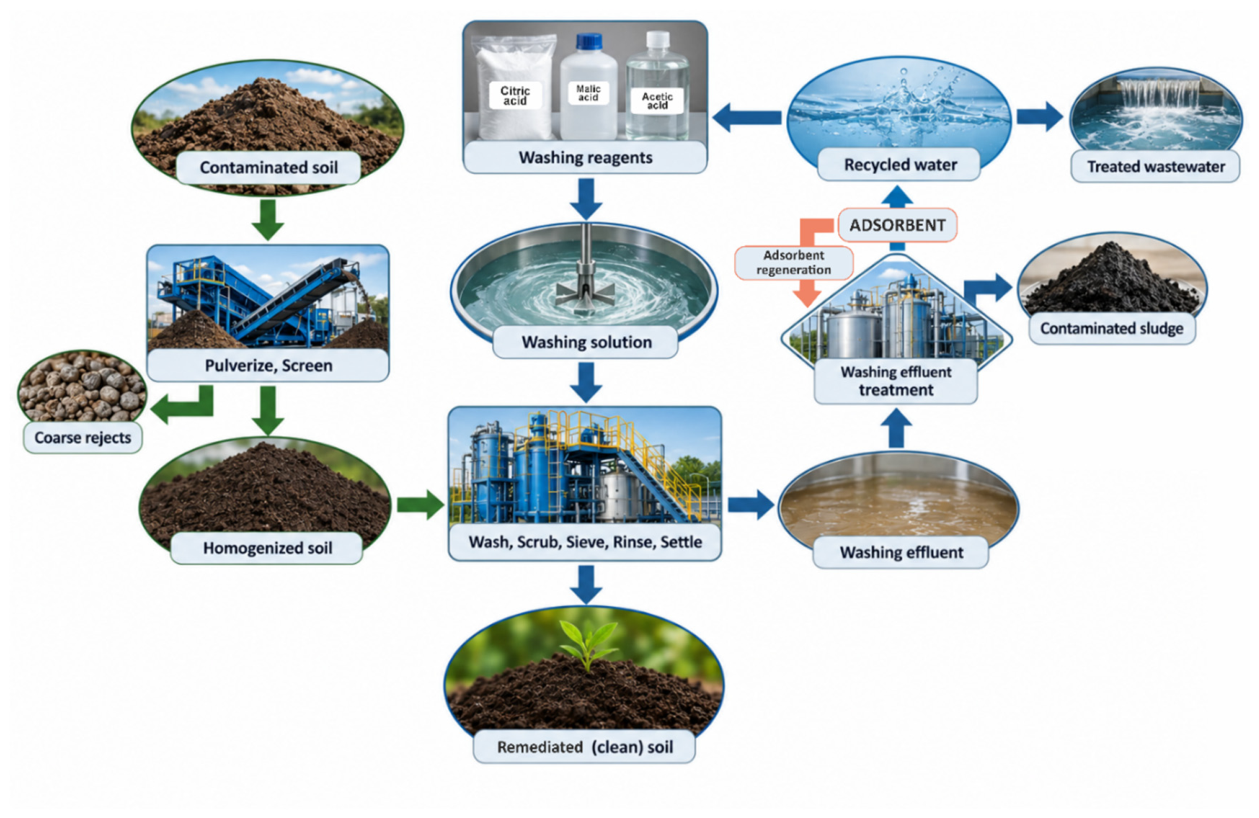
Figure 2.
Soil concentrations of cadmium (Cd), zinc (Zn), copper (Cu) and lead (Pb) as a function of distance from the potential emission source (Bukowno zinc smelter). Up to 35 km (A) and 50 to 100 km (B).
Figure 2.
Soil concentrations of cadmium (Cd), zinc (Zn), copper (Cu) and lead (Pb) as a function of distance from the potential emission source (Bukowno zinc smelter). Up to 35 km (A) and 50 to 100 km (B).
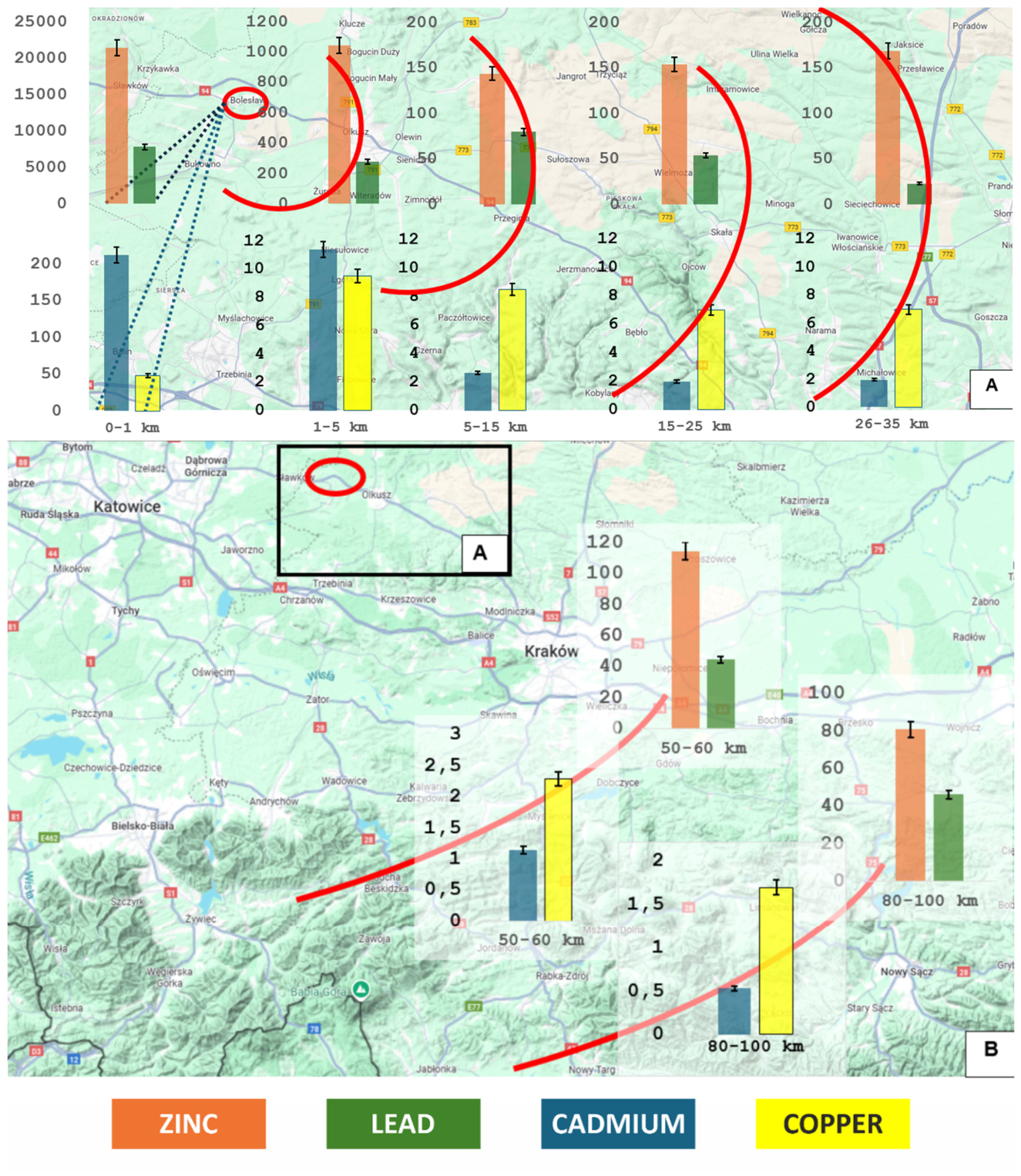
Figure 3.
Heatmap visualization of the extraction efficiency of Cd, Zn, Pb and Cu with acetic and citric acids, expressed as the percentage of the total metal content released after 15 min, 1 h and 4 h of washing. Values shown in each cell represent the mean extraction percentage ± uncertainty. Color intensity increases with extraction efficiency within each metal, enabling direct comparison between acids and extraction times. Soil samples were classified into three groups according to their initial metal concentrations: low, increased and high for Cd, Pb and Zn, and low, medium and increased for Cu, reflecting natural variability in soil contamination.
Figure 3.
Heatmap visualization of the extraction efficiency of Cd, Zn, Pb and Cu with acetic and citric acids, expressed as the percentage of the total metal content released after 15 min, 1 h and 4 h of washing. Values shown in each cell represent the mean extraction percentage ± uncertainty. Color intensity increases with extraction efficiency within each metal, enabling direct comparison between acids and extraction times. Soil samples were classified into three groups according to their initial metal concentrations: low, increased and high for Cd, Pb and Zn, and low, medium and increased for Cu, reflecting natural variability in soil contamination.
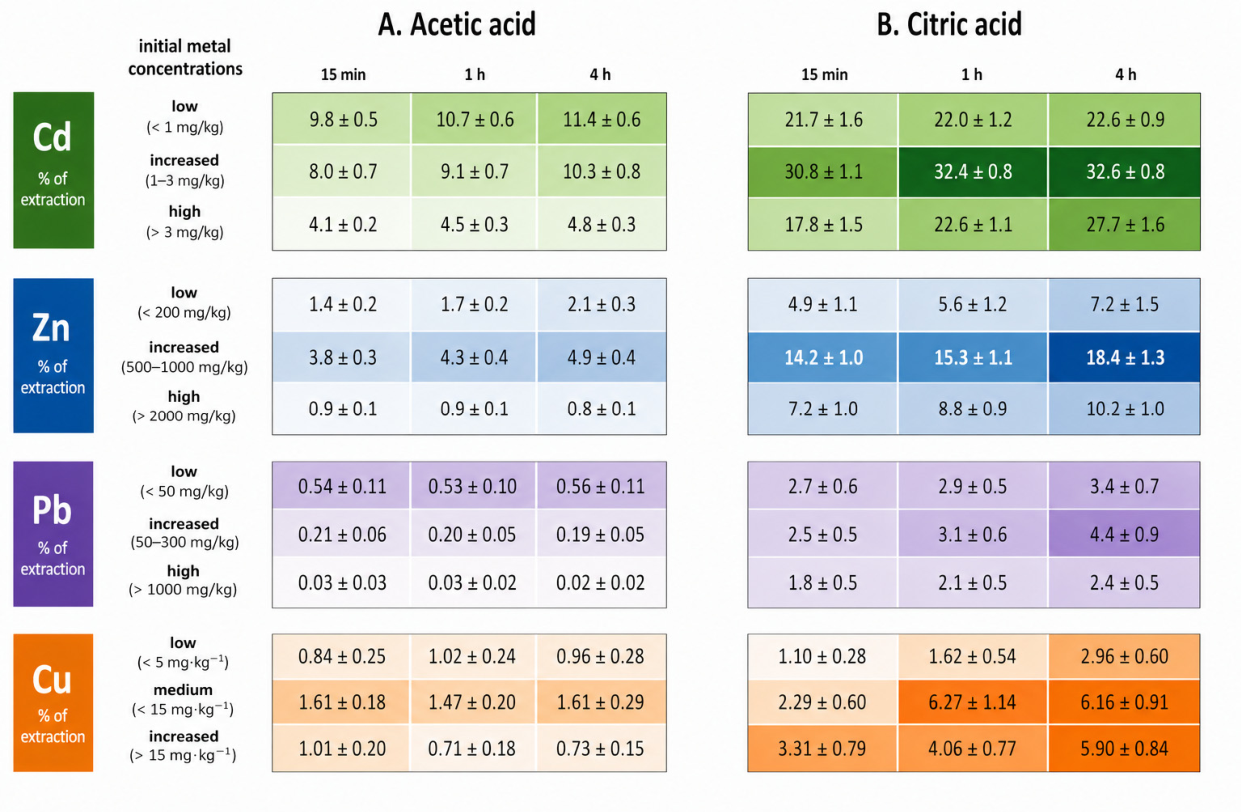
Figure 4.
XRD patterns of as prepared SBA-15 adsorbents with organic functional groups.
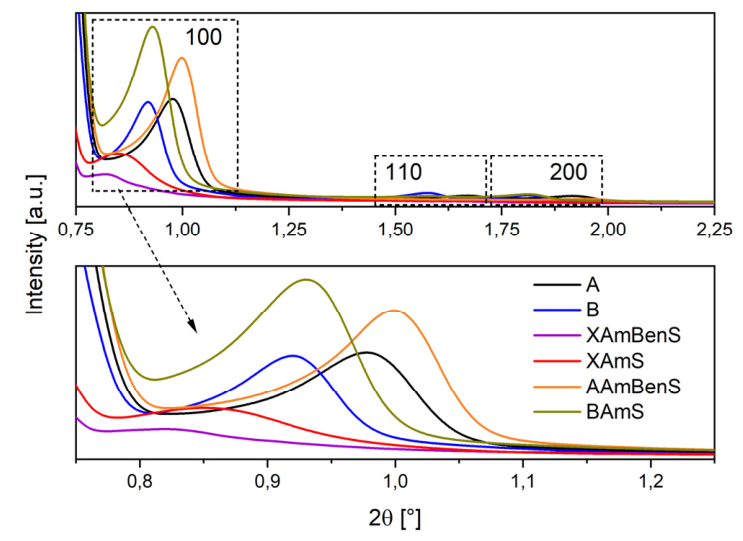
Figure 5.
XRD monitoring of organo-functionalised SBA-15 adsorbents extraction.
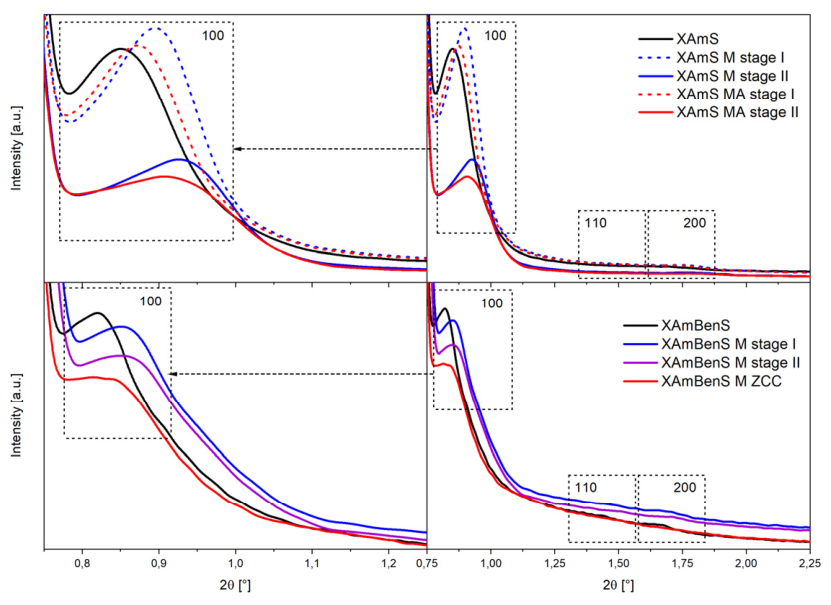
Figure 6.
XRD patterns of fresh, extracted and spent XAmS adsorbents.
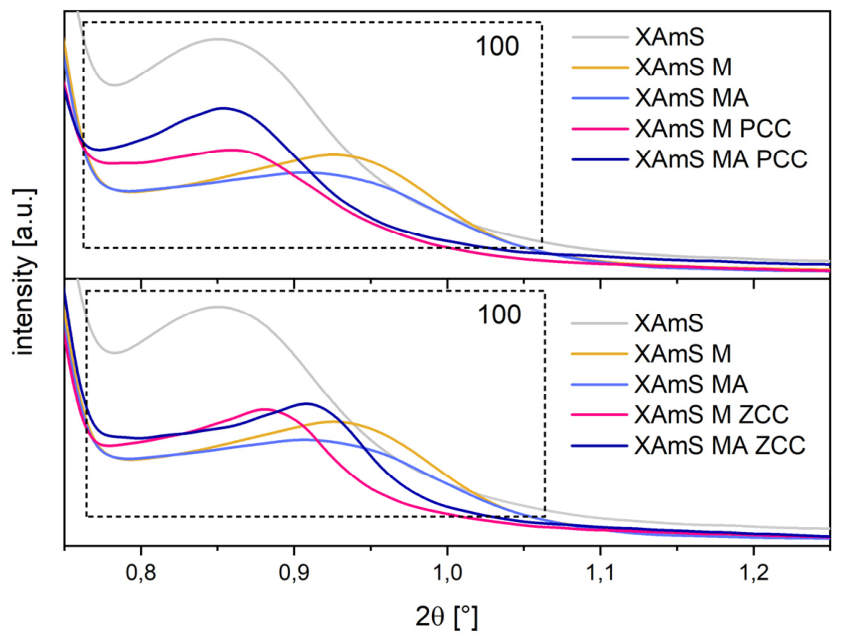
Figure 8.
Removal efficiency (R, %) over five consecutive adsorption cycles for XAmBenS(M) and XAmS(M) in the Pb-Cd-Cu (acetate) and Zn-Cd-Cu (chloride) leachate and per-cycle desorption efficiency (DE, %) of Cu from XAmS(M) and XAmBenS(M) in both leachate matrices, illustrating the much greater reversibility of Cu binding on the aminothiazole sorbent.
Figure 8.
Removal efficiency (R, %) over five consecutive adsorption cycles for XAmBenS(M) and XAmS(M) in the Pb-Cd-Cu (acetate) and Zn-Cd-Cu (chloride) leachate and per-cycle desorption efficiency (DE, %) of Cu from XAmS(M) and XAmBenS(M) in both leachate matrices, illustrating the much greater reversibility of Cu binding on the aminothiazole sorbent.
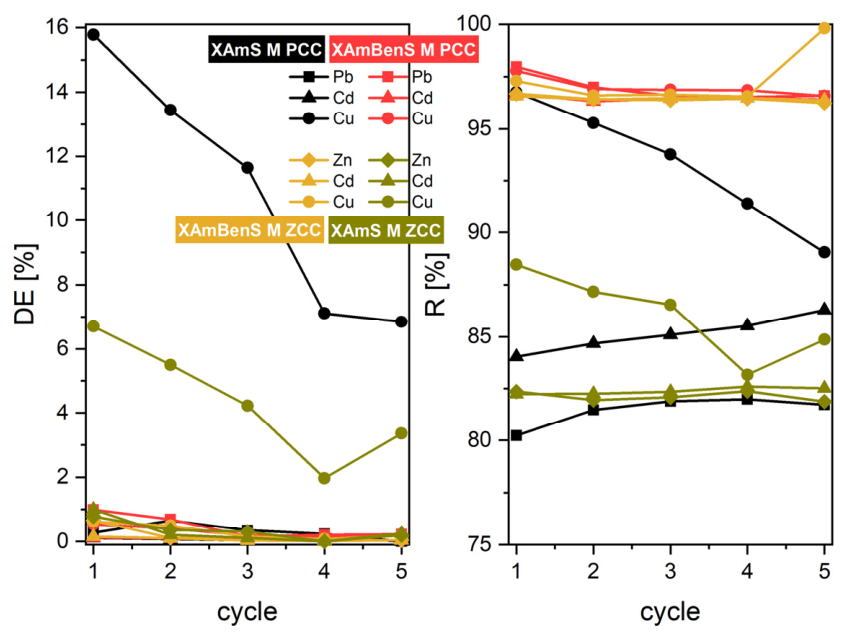

Table 1.
Concentration ranges of selected heavy metals in leachates obtained after soil washing with acetic and citric acids.
Table 1.
Concentration ranges of selected heavy metals in leachates obtained after soil washing with acetic and citric acids.
| Metal | Concentration range in acetic acid leachates (mg/L) | Concentration range in citric acid leachates (mg/L) |
|---|---|---|
| Cadmium (Cd) | 0.005 - 0.27 | 0.01 - 1.7 |
| Lead (Pb) | 0.013 - 0.20 | 0.06 - 12.1 |
| Zinc (Zn) | 0.11 - 32 | 0.21 - 234 |
| Copper (Cu) | 0.004 - 0.02 | 0.03 - 0.10 |
Table 2.
Calculation of structural parameters for SBA-15 prepared in the synthesis A, B, post-synthesis grafting with functional groups, co-condensation and samples after adsorption.
Table 2.
Calculation of structural parameters for SBA-15 prepared in the synthesis A, B, post-synthesis grafting with functional groups, co-condensation and samples after adsorption.
| Sample name | 2θ [°] |
d100 [nm] |
a0 [nm] |
W or WTPM [nm] |
|---|---|---|---|---|
| A | 0.984 | 8.97 | 10.4 | 5.2 |
| B | 0.920 | 9.59 | 11.1 | 4.9 |
| BAmS* | 0.933 | 9.46 | 10.9 | *5.3 / 4.7TPM non-calc vs. 3.7TPM calc |
| XAmS | 0.850 | 10.38 | 12.0 | - |
| XAmS M stage I | 0.895 | 9.86 | 11.4 | - |
| XAmS M stage II | 0.926 | 9.53 | 11.0 | - |
| XAmS MA stage I | 0.872 | 10.12 | 11.7 | - |
| XAmS MA stage II | 0.907 | 9.73 | 11.2 | - |
| XAmS M PCC | 0.860 | 10.26 | 11.9 | - |
| XAmS M ZCC | 0.882 | 10.00 | 11.6 | - |
| XAmS MA PCC | 0.855 | 10.32 | 11.9 | - |
| XAmS MA ZCC | 0.909 | 9.71 | 11.2 | - |
| AAmBenS* | 0.998 | 8.85 | 10.2 | *5.3 / 5.4TPM non-calc vs. 3.9TPM calc |
| XAmBenS | 0.820 | 10.77 | 12.4 | - |
| XAmBenS M stage I | 0.852 | 10.37 | 12.0 | - |
| XAmBenS M stage II | 0.854 | 10.34 | 11.9 | - |
| XAmBenS M PCC | 0.831 | 10.63 | 12.3 | - |
where: d100 is the XRD (100) interplanar spacing; a0 is the unit cell parameter (a0=2×(d100/√3); W is the pore wall thickness (a0−DBJH), DBJH is the BJH pore diameter, * - porosity measured after calcination, TPM – pore size for calculations was adopted from thermoporometry of non-calcined or calcined samples.
Table 3.
Porosity indicators obtained via thermoporometry measurements on silicas, organo-functionalized silicas before and after calcination and after copper salt adsorption.
Table 3.
Porosity indicators obtained via thermoporometry measurements on silicas, organo-functionalized silicas before and after calcination and after copper salt adsorption.
| Sample name | D [nm] | V [cm3/g] |
|---|---|---|
| A (calcined) | 6.7 | 0.46 |
| AAmBenS | 4.8 | 0.15 |
| AAmBenS (calcined) | 6.3 | 0.43 |
| AAmBenS + CuCl2 | 4.9 | 0.11 |
| AAmBenS + Cu(CH3COO)2 | 4.8 | 0.13 |
| B (calcined) | 7.6 | 0.57 |
| BAmS | 6.2 | 0.26 |
| BAmS (calcined) | 7.2 | 0.52 |
| BAmS + CuCl2 | 6.2 | 0.28 |
| BAmS + Cu(CH3COO)2 | 6.3 | 0.30 |
Table 4.
Adsorption capacity of pollutants (qe), adsorption efficiency (Rads) and percentage of occupied functional groups.
Table 4.
Adsorption capacity of pollutants (qe), adsorption efficiency (Rads) and percentage of occupied functional groups.
| Sample (density of grafted ligands [mmol g-1]) /adsorbate |
qe [mmol g-1] |
qe [mg g-1] |
Rads [%] |
Percentage of occupied functional groupsa [%] |
|---|---|---|---|---|
| BAmS (1.59-1.17b) /CuCl2 |
0.214 |
13.6 |
13 |
13 |
| /Cu(CH3COO)2 | 0.607 | 38.6 | 38 | 38-52b |
| AAmBenS (1.15-0.89b) /CuCl2 |
0.029 |
1.8 |
2 |
3 |
| /Cu(CH3COO)2 | 0.087 | 5.5 | 7 | 8-10b |
| Reference materials | ||||
| SBA-15 aminopropyl /Cu2+ [61] propyl ethylenediamine /Cu2+ |
0.82 0.35 |
52.1 22.2 |
x | x |
| SBA-16 cyclam mono- /Cu2+ di- /Cu2+ tetra-sylilated /Cu2+ [61] |
0.30 0.13 0.03 |
19.1 8.3 1.9 |
x | x |
| SBA-15 N-propylsalicylaldimine /Cu2+ [61] | 0.73 | 46.4 | x | x |
a assuming ligand:adsorbate binding molar ratio equal 1:1, b with respect to nitrogen (first value) or sulfur (second value) content.
Table 5.
Removal efficiency (R, %; mean of triplicates) for each metal/matrix combination at 0.5 mmol/L per metal.
Table 5.
Removal efficiency (R, %; mean of triplicates) for each metal/matrix combination at 0.5 mmol/L per metal.
| Sorbent | Pb (PCC) | Cd (PCC) | Cu (PCC) | Zn (ZCC) | Cd (ZCC) | Cu (ZCC) |
|---|---|---|---|---|---|---|
| AAmBenS (grafted) | 96.4 | 96.5 | 97.2 | 96.7 | 96.4 | 96.6 |
| XAmBenS(M) (co-cond.) | 97.0 | 96.6 | 97.0 | 96.0 | 96.5 | 97.1 |
| BAmS (grafted) | 63.5 | 70.8 | 89.0 | 64.2 | 66.6 | 80.2 |
| XAmS(M) (co-cond.) | 62.8 | 69.8 | 89.8 | 65.1 | 65.9 | 77.9 |
| XAmS(MA) (co-cond.) | 63.1 | 70.1 | 90.0 | 66.1 | 65.9 | 79.3 |
Table 6.
Pairwise selectivity factors (α = Kᴅ,ᵢ/Kᴅ,ⱼ) calculated from the screening data in Table 5, averaged within each sorbent family.
Table 6.
Pairwise selectivity factors (α = Kᴅ,ᵢ/Kᴅ,ⱼ) calculated from the screening data in Table 5, averaged within each sorbent family.
| System | Pair | AmS-type α (mean ± SD) | AmBenS-type α (mean ± SD) |
|---|---|---|---|
| PCC (Pb-Cd-Cu) | Cu/Pb | 5.03 ± 0.34 | 1.14 ± 0.19 |
| PCC | Cd/Pb | 1.38 ± 0.01 | 0.95 ± 0.09 |
| PCC | Cd/Cu | 0.27 ± 0.02 | 0.84 ± 0.06 |
| ZCC (Zn-Cd-Cu) | Cu/Zn | 2.07 ± 0.07 | 1.17 ± 0.27 |
| ZCC | Cd/Zn | 1.14 ± 0.03 | 1.03 ± 0.15 |
| ZCC | Cd/Cu | 0.55 ± 0.01 | 0.89 ± 0.08 |
Table 7.
Cumulative metal uptake, cumulative metal recovered by 0.01 M HCl elution, and overall cumulative recovery over five adsorption-desorption cycles.
Table 7.
Cumulative metal uptake, cumulative metal recovered by 0.01 M HCl elution, and overall cumulative recovery over five adsorption-desorption cycles.
| Sorbent | Matrix | Metal | Qcum,ads (mg/g) | Qcum,des (mg/g) | Cumulative recovery (%) |
|---|---|---|---|---|---|
| XAmBenS(M) | PCC | Pb | 403.1 | 1.85 | 0.46 |
| XAmBenS(M) | PCC | Cd | 213.8 | 0.14 | 0.07 |
| XAmBenS(M) | PCC | Cu | 113.8 | 0.34 | 0.30 |
| XAmS(M) | PCC | Pb | 338.7 | 1.03 | 0.31 |
| XAmS(M) | PCC | Cd | 188.6 | 0.13 | 0.07 |
| XAmS(M) | PCC | Cu | 109.4 | 12.10 | 11.07 |
| XAmBenS(M) | ZCC | Zn | 147.5 | 0.29 | 0.20 |
| XAmBenS(M) | ZCC | Cd | 210.5 | 0.14 | 0.07 |
| XAmBenS(M) | ZCC | Cu | 127.1 | 0.39 | 0.31 |
| XAmS(M) | ZCC | Zn | 125.6 | 0.41 | 0.33 |
| XAmS(M) | ZCC | Cd | 179.7 | 0.57 | 0.32 |
| XAmS(M) | ZCC | Cu | 112.3 | 4.92 | 4.39 |
Disclaimer/Publisher’s Note: The statements, opinions and data contained in all publications are solely those of the individual author(s) and contributor(s) and not of MDPI and/or the editor(s). MDPI and/or the editor(s) disclaim responsibility for any injury to people or property resulting from any ideas, methods, instructions or products referred to in the content. |
© 2026 by the authors. Licensee MDPI, Basel, Switzerland. This article is an open access article distributed under the terms and conditions of the Creative Commons Attribution (CC BY) license (http://creativecommons.org/licenses/by/4.0/).
Copyright: This open access article is published under a Creative Commons CC BY 4.0 license, which permit the free download, distribution, and reuse, provided that the author and preprint are cited in any reuse.