

Submitted:
15 September 2026
Posted:
16 September 2026
You are already at the latest version
Abstract
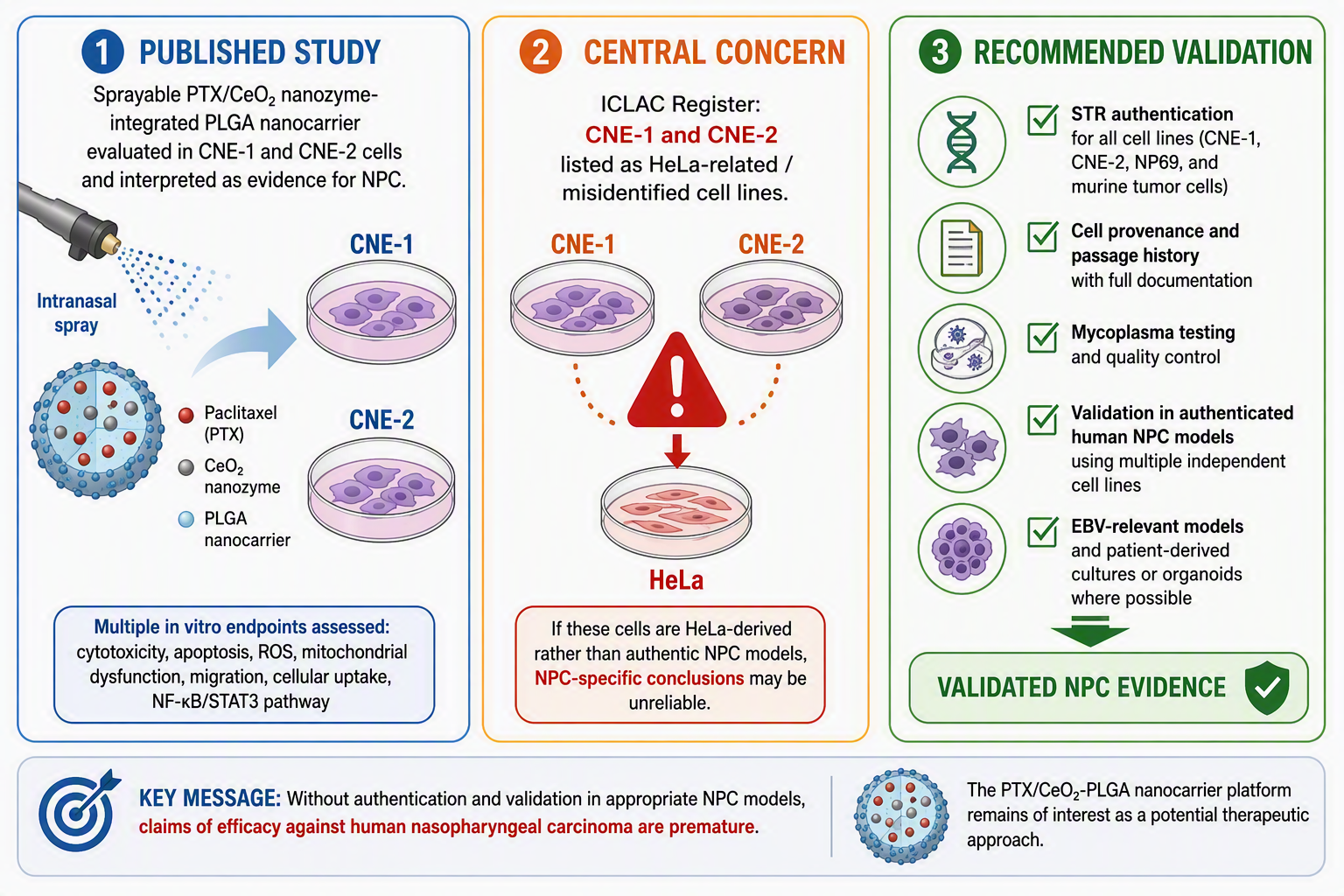
This communication raises concerns about conclusions drawn from CNE-1 and CNE-2 cells in a recent study reporting a sprayable paclitaxel/cerium oxide nanozyme-integrated PLGA nanocarrier for nasopharyngeal carcinoma (NPC) therapy. Because CNE-1 and CNE-2 are listed by ICLAC as misidentified HeLa-related or HeLa-derived cell lines, the interpretation of in vitro cytotoxicity, apoptosis, reactive oxygen species modulation, mitochondrial dysfunction, migration, cellular uptake, and NF-κB/STAT3 data as NPC-specific evidence may be problematic. The article recommends STR authentication, documentation of cell-line provenance and culture history, mycoplasma testing, and validation in authenticated NPC models, including EBV-relevant or patient-derived systems where possible. Until such validation is provided, claims of efficacy against human nasopharyngeal carcinoma should be qualified, while the nanocarrier platform may still remain of methodological and therapeutic interest.
Keywords:
nasopharyngeal carcinoma
; CNE-1
; CNE-2
; HeLa contamination
; cell-line misidentification
; cell-line authentication
; ICLAC
; STR profiling
; cancer nanomedicine
; PLGA nanocarrier
; paclitaxel
; cerium oxide nanozyme.
Zheng et al. recently published an article in Colloids Surf B Biointerfaces entitled “Sprayable paclitaxel/cerium oxide nanozyme-integrated PLGA nanocarrier suppresses nasopharyngeal carcinoma via ROS scavenging and NF-κB/STAT3 inhibition” [1]. The study reports the development of a sprayable paclitaxel/cerium oxide nanozyme-loaded PLGA nanocarrier for localized therapy of nasopharyngeal carcinoma (NPC), with in vitro testing performed in CNE-1 and CNE-2 cells and a comparison with NP69 normal nasopharyngeal epithelial cells. I would like to raise a concern regarding the use of CNE-1 and CNE-2 as human NPC cell lines.
According to the International Cell Line Authentication Committee (ICLAC) Register of Misidentified Cell Lines, CNE-1 (CVCL_6888) and CNE-2 (CVCL_6889) have been reported as misidentified and as HeLa-related or HeLa-derived cell lines [2,3]. If these cell lines are indeed HeLa-derived rather than authentic NPC models, the interpretation of the in vitro data as evidence of activity against NPC becomes problematic. This issue is particularly important because the manuscript uses CNE-1 and CNE-2 as the principal human NPC cell models for evaluating cytotoxicity, apoptosis, ROS modulation, antioxidant activity, mitochondrial dysfunction, migration, and cellular uptake.
Several key conclusions may therefore require reconsideration. First, the reported reduction of CNE-1 and CNE-2 viability to approximately 25% after treatment with PTX@CeO₂-PLGA nanocarriers may reflect responses of HeLa-derived cells rather than responses of NPC cells. Second, the reported selectivity of the formulation for malignant NPC cells over NP69 normal nasopharyngeal epithelial cells is difficult to interpret if the malignant comparator cells are not authentic NPC cells. Third, the apoptosis assays, ROS measurements, antioxidant enzyme assays, mitochondrial membrane potential experiments, DAPI nuclear staining, and scratch-wound migration assays may not support NPC-specific mechanisms if they were performed in misidentified HeLa-related cells. Fourth, the conclusion that the nanocarrier suppresses NPC through ROS scavenging and NF-κB/STAT3 inhibition should be treated cautiously, because the in vitro mechanistic evidence appears to rely heavily on CNE-1 and CNE-2 experiments. Although the manuscript also reports in vivo antitumor activity in a mouse NPC model, the in vivo section describes inoculation of murine NPC cells, and the identity, provenance, and authentication status of those cells should be clearly documented.
The use of misidentified or cross-contaminated cell lines is a well-recognized problem in biomedical research. Estimates from cell-line authentication studies have often suggested that a substantial fraction of commonly used cell lines, frequently around 10%, may be misidentified, cross-contaminated, or otherwise incorrectly annotated [4,5]. HeLa contamination has historically been one of the most common causes of cell-line misidentification because of the rapid growth and robustness of HeLa cells [4]. The consequences are significant: disease-specific mechanisms may be incorrectly inferred, drug sensitivity profiles may be misattributed, biomarkers may be falsely validated, and preclinical findings may become difficult or impossible to reproduce. In cancer nanomedicine, this problem is especially serious because cellular uptake, intracellular trafficking, oxidative stress responses, apoptosis pathways, and drug susceptibility can vary substantially among tumor types.
To support the validity of the conclusions, I suggest that the authors provide additional authentication and validation data. At a minimum, the authors should report short tandem repeat profiling (STR) for CNE-1, CNE-2, NP69, and any murine tumor cell line used in vivo. The STR profiles should be compared with reference databases and checked against the ICLAC Register of Misidentified Cell Lines. The authors should also provide information on the cell-line source, passage number, culture history, species verification where relevant, and mycoplasma testing. If CNE-1 and CNE-2 are confirmed to be HeLa-derived, the authors should avoid describing results from these cells as NPC-specific evidence. Key experiments should be repeated in authenticated human NPC models, preferably using multiple independent NPC cell lines, Epstein–Barr virus (EBV)-relevant models where possible, and ideally, primary patient-derived cultures or organoids. The most important experiments to repeat would include cytotoxicity, apoptosis, ROS scavenging, mitochondrial membrane potential, migration, cellular uptake, and NF-κB/STAT3 pathway analyses. For the in vivo component, the tumor cell line should be explicitly identified and authenticated, and an orthotopic NPC model would provide stronger support for a sprayable local intranasal therapy. If the authors cannot provide such validation, the claims should be revised to state that the formulation showed activity in HeLa-related cells and in the specific animal model used, rather than broadly claiming efficacy against human NPC.
It is surprising and concerning that the use of well-documented misidentified cell lines such as CNE-1 and CNE-2 was apparently not recognized during peer review or by the journal editors, despite the availability of the ICLAC Register and other resources documenting their HeLa-related status. Greater awareness among reviewers and editors of cell-line authentication, STR profiling, and misidentification databases could help prevent the publication of studies whose disease-specific conclusions are based on inappropriate cellular models. In fields such as cancer nanomedicine, this is particularly important because cellular uptake, oxidative stress responses, apoptosis pathways, and drug sensitivity may differ substantially between authentic tumor models and misidentified HeLa-derived cells.
In summary, the reported nanocarrier platform may still be of interest, but the use of CNE-1 and CNE-2 as NPC models raises an important concern about the disease relevance of the in vitro findings. Clarification and additional authentication would help readers assess whether the reported effects truly support the proposed application in NPC.
Conflict of Interest
The author is member of the International Cell Line Authentication Committee (ICLAC).
References
- Zheng, Y.; Yu, Q.; Zhou, H.; Wang, Q. Sprayable paclitaxel/cerium oxide nanozyme-integrated PLGA nanocarrier suppresses nasopharyngeal carcinoma via ROS scavenging and NF-κB/STAT3 inhibition. Colloids Surf. B Biointerfaces 2026, 268 Pt 2, 116014. [Google Scholar] [CrossRef] [PubMed]
- ICLAC Register of Misidentified Cell Lines. Available online: https://iclac.org/databases/cross-contaminations/ (accessed on 19 August 2026).
- Weiskirchen, R. ICLAC Has Released Version 14 of Its Misidentified Cell Line Register: Updating the Global Watchlist of Misidentified Cell Lines. Cells 2026, 15(7), 576. [Google Scholar] [CrossRef] [PubMed]
- Horbach, S.P.J.M.; Halffman, W. The ghosts of HeLa: How cell line misidentification contaminates the scientific literature. PLoS ONE 2017, 12(10), e0186281. [Google Scholar] [CrossRef] [PubMed]
- Weiskirchen, R. Misidentified cell lines: failures of peer review, varying journal responses to misidentification inquiries, and strategies for safeguarding biomedical research. Res. Integr. Peer Rev. 2025, 10(1), 12. [Google Scholar] [CrossRef] [PubMed]
Disclaimer/Publisher’s Note: The statements, opinions and data contained in all publications are solely those of the individual author(s) and contributor(s) and not of MDPI and/or the editor(s). MDPI and/or the editor(s) disclaim responsibility for any injury to people or property resulting from any ideas, methods, instructions or products referred to in the content. |
© 2026 by the author. Licensee MDPI, Basel, Switzerland. This article is an open access article distributed under the terms and conditions of the Creative Commons Attribution (CC BY) license.
Copyright: This open access article is published under a Creative Commons CC BY 4.0 license, which permit the free download, distribution, and reuse, provided that the author and preprint are cited in any reuse.