

Submitted:
15 September 2026
Posted:
16 September 2026
You are already at the latest version
Abstract
Plant microbiome research is a rapidly developing and productive field, with substantial attention directed toward the identification of the major determinant of plant growth, nutrient acquisition, stress tolerance, disease resistance and associated agricultural productivity. Advances in high-throughput sequencing and multi-omics technologies have generated large and complex datasets describing plant-associated microbial communities. However, the high dimensionality, sparsity, compositionality and heterogeneity of microbiome datasets create substantial analytical challenges for conventional statistical approaches. Machine learning (ML) and artificial intelligence (AI) provide new opportunities to identify microbial biomarkers, predict plant phenotypes, characterize plant–microbe interactions and design beneficial microbial communities. Applications include plant disease prediction, crop productivity, abiotic-stress tolerance, nutrient cycling, biomarker discovery, microbiome-assisted breeding and synthetic microbial community (SynCom) design. Recent studies increasingly combine AI with multi-omics, synthetic biology and predictive modelling, indicating a transition from descriptive microbiome analysis toward microbiome engineering. Nevertheless, model generalizability remains constrained by small sample sizes, compositional data, technical variation, batch effects, environmental heterogeneity and insufficient external validation. The combination of microbiome science and AI has considerable potential to support sustainable, climate-resilient crop production, but successful translation will require rigorous biological validation and field-scale testing.
Keywords:
plant microbiome
; rhizosphere
; machine learning
; artificial intelligence
; microbiome engineering
; multi-omics
; synthetic microbial communities
; crop improvement
; sustainable agriculture
Plants and Microbes
Plants forms association with complex microbial communities with microbial communities inhabiting the rhizosphere, phyllosphere, endosphere and surrounding soil (Table 1). These microbial communities influence plant nutrition, development, immune responses, resistance to pathogens and tolerance to environmental stresses. The rhizosphere is particularly important because root exudates influence microbial recruitment and activity, while microorganisms reciprocally modify nutrient availability, hormone signalling and plant stress responses (Table 2). Consequently, the plant and its associated microbiota can be considered an interconnected biological system in which microbial functions contribute substantially to plant performance [1,2].
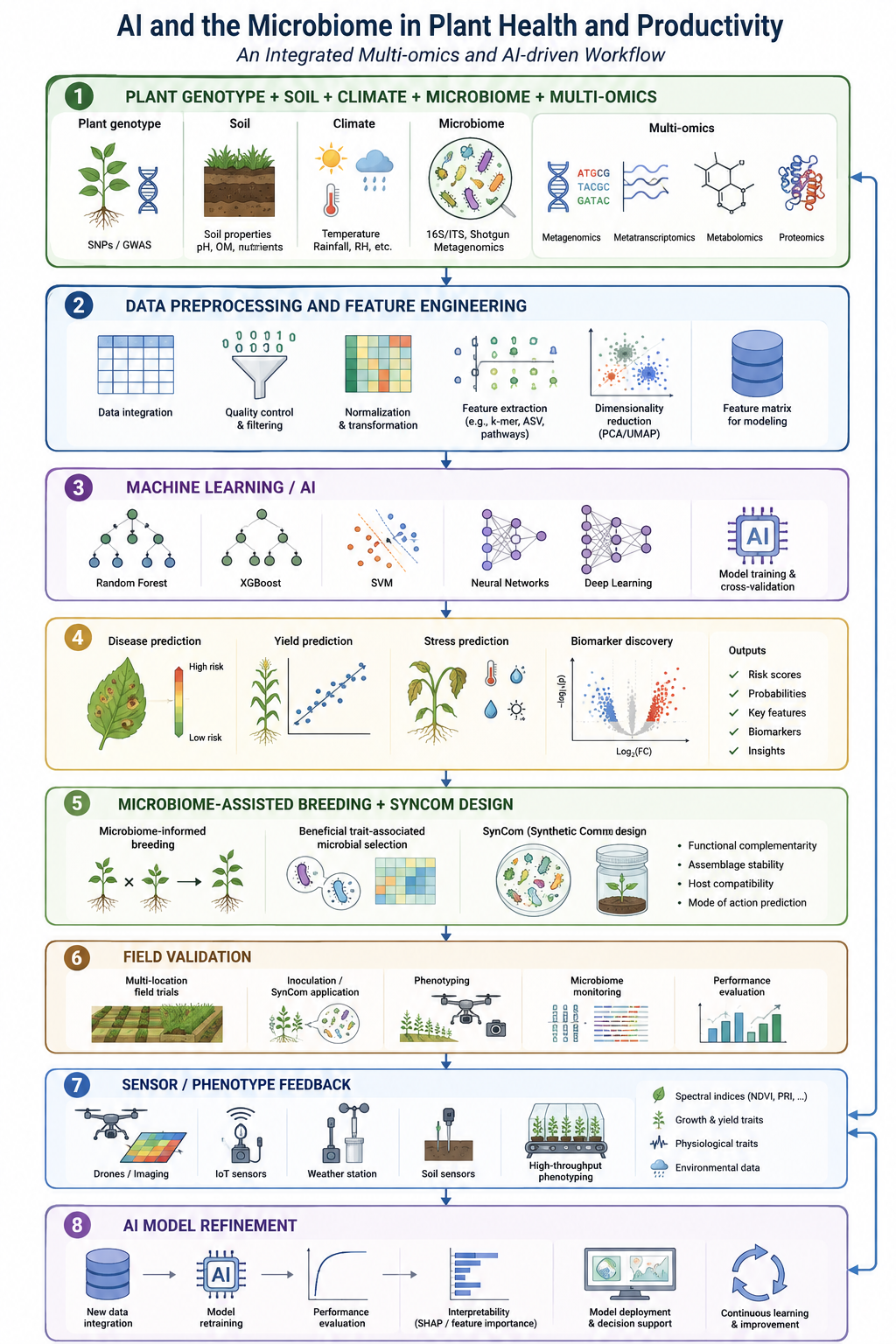
Recent advances in amplicon sequencing, shotgun metagenomics, metatranscriptomics, metabolomics and other omics technologies have transformed plant microbiome research, allowing the characterization of the microbial composition and functional potential at unprecedented resolution. However, the resulting datasets frequently contain thousands of microbial and molecular features measured across relatively small numbers of biological samples. Such datasets are high-dimensional, sparse and compositional, and are strongly influenced by environmental and technical factors. These characteristics make plant microbiome datasets particularly challenging for conventional statistical analyses and create a strong rationale for machine-learning approaches [3].
Machine learning (ML) in particular can identify nonlinear relationships between microbiome features and plant phenotypes, classify disease states, select informative microbial biomarkers and predict ecosystem or plant responses. Recent studies have increased the emphasis on integrating microbiome information with plant genotype, environmental conditions and multi-omics measurements and highlighted the growing role of ML in decoding plant–microbiome dynamics for sustainable agriculture [4]. More recently, Ma et al. reviewed AI applications specifically for the rhizosphere microbiome and proposed an integrated framework combining microbiome-enabled genomic selection, synthetic microbial communities, federated learning, large language models and digital twins [5].In this opinion article, I summarize recent advances in ML and AI for plant microbiome research, examine major applications, discuss methodological limitations and identify emerging opportunities for microbiome-enabled agriculture.
Plant Microbiome Data and the Need for Machine Learning
Microbiome datasets are heterogeneous, encompassing amplicon sequencing data that characterize bacterial and fungal community composition. Shotgun sequencing provides broader information on microbial genomes and functional genes, genome-wide metatranscriptomic approaches and metabolomics, which together provide complementary information for characterizing of microbial communities and the metabolites produced by associated microorganisms. Accordingly, integrating these complementary data modalities may help mitigate biases associated with compositional features and sparse taxonomic representations and may provide a more robust analytical framework than conventional classification and regression approaches alone. Busato et al. emphasized that low sample size, soil heterogeneity and technical variation can adversely affect ML performance in plant microbiome studies. They also identified compositionality and sparsity as important sources of difficulty for predictive modelling [3]. These issues remain highly relevant to current AI-based microbiome research.
Supervised learning and ensemble learning including random forests, support vector machines (SVMs), and gradient boosting have been widely applied across biological domains, demonstrating their utility for classification and prediction tasks. While the classification models predict the distinguishable traits between healthy and susceptible plants, regularized regression models can reduce overfitting when the number of the microbial features are substantially larger than the number of samples playing important role in predicting microbial taxa associated with environmental and plant phenotypic variables (Table 3). The application of deep learning has remained comparatively limited in the microbial community based machine learning mainly due to the large number of microbial features as compared to biological samples thus making deep-learning models particularly susceptible to overfitting. Ma et al. proposed the integration of large language models, knowledge graphs, retrieval-augmented generation, federated learning, digital twins and autonomous AI agents into rhizosphere microbiome research [5].
One of the most promising applications of AI is the prediction of plant disease based on microbiome characteristics. Plant pathogens do not operate independently; disease development can be influenced by the composition and functional properties of surrounding microbial communities.Systematic analyses of soil microbiomes and associated plant microbial communities have highlighted the integration of computational approaches, host genetics, microbial interactions and microbiome engineering as a promising strategy for sustainable agriculture [6]. ML models can integrate microbial abundance with soil properties, climatic variables and plant genetic information. Such multimodal models may be more informative than models based exclusively on microbiome composition because plant performance is influenced simultaneously by host genotype and environmental conditions. Accordingly, the plant microbiome has become an important component of climate-resilient agriculture [2]. AI can potentially identify microbial combinations associated with stress tolerance and predict which microbial communities are most likely to benefit specific plant genotypes. The challenge is that microbiome–stress relationships are strongly context dependent. A microbial taxon associated with drought tolerance in one soil or cultivar may not produce the same effect elsewhere. Models therefore require multi-environment datasets and external validation.
Machine learning can contribute by predicting microbial compatibility, identifying potentially complementary strains and optimizing community composition. Integration of AI with synthetic biology may therefore facilitate rational design of plant-associated microbial consortia [5,7] Dubey et al. described plant-microbiome engineering as an emerging strategy for crop health and sustainability, while emphasizing the importance of microbial partners and targeted community design [7]. The major challenge is ecological stability. A SynCom that performs well in a controlled laboratory experiment may behave differently when introduced into a complex agricultural soil containing thousands of competing microorganisms. Ma et al. proposed hologenome-based genomic selection as an “inside-out” approach, in which host genetic information and microbiome characteristics are integrated to improve breeding decisions [5].This framework represents an important shift from conventional host-centric breeding toward a more integrated plant–microbiome breeding framework.
Several developments are likely to shape plant microbiome AI research over the next decade. First, larger and better-standardized datasets will be essential. Data from multiple cultivars, locations, soil types and growing seasons should be collected using harmonized protocols. Second, multimodal AI should integrate microbial, plant, soil and environmental data rather than treating microbiome composition in isolation. Third, causal AI should complement predictive modelling. The objective should shift from identifying correlations toward determining which microbial changes actually cause improved plant performance. Fourth, explainable AI will be important for translating computational predictions into biological hypotheses. Fifth, federated learning could facilitate collaboration among institutions while allowing sensitive or proprietary datasets to remain locally stored. Finally, AI should increasingly be connected with synthetic microbial communities, robotics, sensors and field experiments, creating an iterative cycle in which computational predictions are tested experimentally and experimental outcomes improve subsequent predictions.
AI can identify candidate microorganisms, predict interactions and prioritize metabolic functions. Synthetic biology can then modify microbial strains or construct defined communities to test those predictions. Kamath et al. described this convergence of AI, omics and synthetic biology as a route toward rational design of plant growth-promoting microorganisms and microbial consortia [8]. However, engineered microbial systems introduce additional considerations, including ecological stability, biosafety, horizontal gene transfer, environmental persistence and regulatory approval. Therefore, future plant microbiome engineering should integrate computational prediction with controlled experimentation, ecological assessment and appropriate regulatory frameworks. The most promising applications include disease prediction, plant phenotype prediction, stress tolerance, nutrient management, biomarker discovery, microbiome-assisted breeding and SynCom design. Recent reviews emphasize that the ultimate objective is not merely to predict microbiome states but to use those predictions to engineer beneficial plant–microbe interactions [5,6,7,8]. The integration of AI with multi-omics, synthetic biology, and precision agriculture provides a promising route toward predictive and engineered plant microbiomes. If these approaches can be validated across diverse field environments, microbiome-informed AI could become an important component of sustainable and climate-resilient crop production.
Acknowledgments
No funding was acquired for this research. This research has no associated clinical trial and I consent to publish this research paper and participate in Springer research. Ethics declaration: not applicable.
References
- Berendsen, R.L.; Pieterse, C.M.J.; Bakker, P.A.H.M. The rhizosphere microbiome and plant health. Trends Plant Sci. 2012, 17, 478–486. [Google Scholar] [CrossRef]
- Compant, S.; Cassan, F.; Kostić, T.; Johnson, L.; Brader, G.; Trognitz, F.; et al. Harnessing the plant microbiome for sustainable crop production. Nat. Rev. Microbiol. 2025, 23, 9–23. [Google Scholar] [CrossRef]
- Busato, S.; Gordon, M.; Chaudhari, M.; Jensen, I.T.; Akyol, T.Y.; Andersen, S.U.; et al. Compositionality, sparsity, spurious heterogeneity, and other data-driven challenges for machine learning algorithms within plant microbiome studies. Curr. Opin. Plant Biol. 2023, 71, 102326. [Google Scholar] [CrossRef]
- Yoosefzadeh Najafabadi, M.; Khalaf, E.M.; Mysara, M.; El-Baz, A.M. Editorial: Harnessing machine learning to decode plant-microbiome dynamics for sustainable agriculture. Front. Microbiomes. 2025, 4, 1602938. [Google Scholar] [CrossRef]
- Ma, J.; Qiao, J.; Cao, Y.; Cheng, Z. Harnessing artificial intelligence to decode the rhizosphere microbiome. aBIOTECH 2026, 7(1), 100005. [Google Scholar] [CrossRef]
- Berruto, C.A.; Demirer, G.S. Engineering agricultural soil microbiomes and predicting plant phenotypes. Trends Microbiol. 2024, 32(9), 858–873. [Google Scholar] [CrossRef]
- Dubey, A.; Malla, M.A.; Vimal, S.R.; Kumar, A.; Prasad, S.M.; Khan, M.L.; et al. Plant-microbiome engineering: synergistic microbial partners for crop health and sustainability. Plant Growth Regul. 2025, 105, 1825–1839. [Google Scholar] [CrossRef]
- Kamath, A.; Patel, D.; Saraf, M.; Patel, S. Rooted intelligence: Integrating AI, Omics, and Synthetic biology to engineer the plant microbiome. 3 Biotech 2026, 16(1), 10. [Google Scholar] [CrossRef]
- Prasannath, K.; Peter Arulraj, S.; Shakthivel, K.; Rakulan, T.; Karunarathna, S.C. Revisiting the ecological significance, composition, and functions of plant microbiome: a review. N Z. J. Crop Hortic. Sci. 2025, 53(5), 1329–1361. [Google Scholar] [CrossRef]
- Zeng, Q.; Hu, H.W.; Ge, A.H.; Xiong, C.; Zhai, C.C.; Duan, G.L.; et al. Plant–microbiome interactions and their impacts on plant adaptation to climate change. J. Integr. Plant Biol. 2025, 67(3), 826–844. [Google Scholar] [CrossRef]
- Yadav, J.; Gehlot, P.; Soni, P.; Jain, T. Plant microbiome engineering: from inoculation to genome editing. Front. Microbiol. 2026, 17, 1781381. [Google Scholar] [CrossRef]
- Wei, M.; Lian, T.; Chen, L.; Wang, L.; Ye, J.; Yao, X.; et al. The plant microbiome: From ecological foundations to precision microbial engineering for sustainable agriculture. iMeta 2026, 2026, e70152. [Google Scholar] [CrossRef]

Table 1.
Classification of bacterial communities associated with plant microbiome.
| Plant microbiome location | Major bacterial classes/groups | Main findings/functions | Ref. |
| Rhizosphere | Alpha-, Gammaproteobacteria; Bacilli; Actinomycetia; Bacteroidia; Acidobacteriae | Nutrient cycling, root growth, hormone production, pathogen suppression | [2,3,4,5,6,7,8,9,10] |
| Endosphere | Alpha-/Gammaproteobacteria; Bacilli; Actinomycetia | Internal colonization, stress tolerance, nutrient acquisition and plant defense | [2,9] |
| Phyllosphere | Alphaproteobacteria, Gammaproteobacteria | Leaf colonization, nutrient use, pathogen competition and environmental adaptation | [10] |
| Soil-associated microbiome | Acidobacteriae, Actinomycetia, Proteobacteria, Bacteroidia, Gemmatimonadetes-related groups | Carbon decomposition, nutrient cycling and adaptation to soil conditions | [2,9] |
| Beneficial inoculants / SynComs | Bacilli (Bacillus), Gammaproteobacteria (Pseudomonas), Alphaproteobacteria (rhizobia) | Nitrogen fixation, phosphate mobilization, biocontrol and stress resistance | [9,11,12] |
Table 2.
Multi-omics integration for AI-based plant microbiome research.
| Data layer | Information obtained | Potential ML application |
| 16S/ITS sequencing | Microbial community composition | Classification and biomarker discovery |
| Shotgun metagenomics | Microbial genes and pathways | Functional prediction |
| Metatranscriptomics | Active microbial processes | Prediction of functional activity |
| Metabolomics | Plant/microbial metabolites | Mechanistic prediction |
| Plant transcriptomics | Host responses | Plant–microbe interaction modelling |
| Plant genomics | Host genetic variation | Microbiome-assisted breeding |
| Soil chemistry | Nutrient/environmental status | Yield and microbiome prediction |
| Climate/environment | Temperature, rainfall, drought | Context-specific prediction |
| Plant phenotyping | Growth, yield and stress responses | Supervised learning targets |
Table 3.
Major applications of ML and AI in plant microbiome research.
| Application | Typical ML task | Main data sources | Potential outcome | References |
| Disease prediction | Classification/risk prediction | 16S/ITS, metagenomics, plant phenotype | Early disease detection and risk assessment | [4,5] |
| Crop yield and plant phenotype | Regression/prediction | Microbiome, soil, climate, plant phenotype | Yield and biomass prediction | [5,6] |
| Abiotic-stress tolerance | Classification/regression | Microbiome, environmental and plant data | Prediction of drought/salinity/stress responses | [2,5] |
| Nutrient cycling and soil health | Regression/feature selection | Metagenomics, soil chemistry, environmental data | Functional prediction and soil-health assessment | [2,5,6] |
| Biomarker discovery | Feature selection/classification | Amplicon and metagenomic data | Identification of diagnostic taxa or genes | [3,4,5] |
| Microbial interaction prediction | Network/graph modelling | Taxonomic, genomic and metabolomic data | Identification of microbial interactions | [5,6] |
| SynCom design | Optimization/prediction | Microbial genomes, interaction networks and plant phenotypes | Rational design of microbial consortia | [5,7] |
| Microbiome-assisted breeding | Genomic prediction | Plant genotype + microbiome + phenotype | Selection of genotypes associated with beneficial microbiomes | [5,6] |
| Crop management | Predictive modelling | Microbiome, soil, weather and agronomic data | Microbiome-informed management decisions | [5,7] |
Disclaimer/Publisher’s Note: The statements, opinions and data contained in all publications are solely those of the individual author(s) and contributor(s) and not of MDPI and/or the editor(s). MDPI and/or the editor(s) disclaim responsibility for any injury to people or property resulting from any ideas, methods, instructions or products referred to in the content. |
© 2026 by the author. Licensee MDPI, Basel, Switzerland. This article is an open access article distributed under the terms and conditions of the Creative Commons Attribution (CC BY) license.
Copyright: This open access article is published under a Creative Commons CC BY 4.0 license, which permit the free download, distribution, and reuse, provided that the author and preprint are cited in any reuse.