
Submitted:
16 September 2026
Posted:
16 September 2026
You are already at the latest version
Abstract
Branching or partially specified reconstruction cannot in general be represented by an inverse se- quence of surjective maps: continuation may be multivalued, stage-dependent, and may contain dead ends. We therefore study compact Hausdorff stage spaces joined by closed continuation relations and equipped with closed observational equivalences. The central questions are viability and pathwise soundness. We prove that indefinite viability is exactly the intersection of the finite-horizon viability kernels. We characterize exact successor congruence by representative-independent one-step lifting, prove that it lifts every finite and infinite observable history, and obtain a homeomorphism between the observable quotient of the primitive history space and the history space of the quotient system. Consequently, indefinite viability descends exactly. Finite obstruction sets and minimal obstruction depth diagnose quotient splicing; moreover, every nonliftable infinite observable history has a nonliftable finite prefix. Counterexamples isolate the roles of compactness, closedness, and successor congruence. For finite systems, a balance criterion characterizes when uniform primitive transitions induce a representative-independent Markov kernel, thereby separating qualitative history descent from proba- bilistic lumpability. Backward pruning, successor signatures, count vectors, and subset lifting yield executable audits and certificates. The significance is twofold. The results supply a model-independent audit layer for reconstruction-before-dynamics approaches to law and parameter selection, and an action-labelled extension gives a sufficient soundness condition for Reconstruction-Before-Control: each controller-visible policy history then possesses a coherent primitive lift. The framework does not validate any physical bridge or establish general agency; it identifies exact conditions those applications must satisfy.
Keywords:
closed relations
; viability kernel
; observable quotient
; history lifting
; bisimulation
; obstruction certificate
; Markov lumpability
; nondeterministic systems
; Reconstruction Before Control
1. Introduction
Many reconstruction, abstraction, and control problems are intrinsically nondeterministic. At stage n, a state may admit several continuations, no continuation, or continuations whose observable content depends on hidden representative data. Such a system is not faithfully described by an inverse sequence of surjective functions. The natural primitive object is instead a closed relation
whose fibers are the admissible successor sets. If identifies states with the same declared read-out, one must then determine whether quotienting preserves complete histories or manufactures them by splicing incompatible representatives.
This paper develops that closed-relational problem. The stage spaces are compact Hausdorff, the continuation relations and observational equivalences are closed, and dead ends are permitted. The resulting theory connects compactness arguments from inverse-limit theory [2,3], inverse limits generated by set-valued maps and closed relations [4,5], viability kernels [6,7], coalgebraic bisimulation [8,9], Markov lumpability [10,11], and finite partition-refinement methods [12]. The individual ingredients are classical. The contribution is a single history-level framework in which finite viability, representative-independent descent, quotient splicing, probabilistic balance, and finite failure certificates can be compared precisely.
1.1. Why This Problem Matters
The formulation has two independent motivations. The first is a reconstruction-before-dynamics programme in fundamental physics: instead of beginning with a fixed continuum ontology and equations of motion, one first asks which primitive relations admit indefinite completion, which distinctions survive read-out, and which laws or finite weights remain well defined on the resulting observable classes. The logical order is
Published applications have made this programme concrete enough that its mathematical consistency can and should be audited. They include a classification of admissible topological operations and persistent meridian obstructions [15,16]; a codimension-two carrier construction for particle structure [17]; structural expressions for the charged-lepton hierarchy [18] and the fine-structure constant [19]; a selection chain leading conditionally to a four-dimensional Lorentzian read-out, Maxwell–Einstein law forms, and the global Standard Model quotient [20]; and a history-based account of quantum computational advantage [21]. Table 1 states why the present mathematics is needed by these applications.
These results do not by themselves establish the reconstruction programme as a fundamental theory of nature. They do make it more than an uninstantiated philosophical proposal: the same architecture has generated published law-selection and parameter constructions in several sectors. That reuse creates a precise mathematical burden. A purported stable structure must extend indefinitely; an observable history must lift coherently; and an equal-weight argument must survive quotienting without representative bias. The present framework converts those requirements into theorems, counterexamples, and finite failure certificates. It can therefore support the programme when its hypotheses are verified and reject a proposed construction when an obstruction is found.
The second motivation is Reconstruction-Before-Control (RBC) for robotics and general agency. An agent acting under partial observability maintains latent candidate states, suppresses distinctions irrelevant to its current task, and plans on a controller-visible quotient [13,14]. A quotient plan may nevertheless be fictitious: its first action may be realizable from one hidden representative and its second only from another. One-step validity does not exclude this form of path splicing. In the present notation, is the latent candidate space, is action-conditioned continuation, and is the controller-visible state. Actionwise exact successor congruence and history lifting then supply a verifiable soundness condition. When lifting fails, a finite obstruction can justify abstention, additional sensing, or revision of the current ontology. This is relevant to general agency because long-horizon action requires coherent composition across changing information and task-dependent abstractions. It is not, by itself, a theorem that an RBC system is intelligent or safe.
The mathematical significance is independent of both motivations. The paper connects compact closed relations, viability kernels, quotient topology, bisimulation, Markov lumpability, and subset-based certificates in one stage-dependent history formalism. Its contribution is not a renaming of these classical subjects, but their integration around an exact question that each subject alone leaves open: when does a many-to-one read-out preserve complete admissible behavior? The answer includes a history-space homeomorphism, exact viability descent, complete finite certificates for nonliftable infinite histories, and an action-labelled lifting theorem. These statements provide reusable tests for any nondeterministic system that combines latent continuation with observational coarse-graining.
The relational problem is easy to state and easy to underestimate. Suppose each reconstruction depth n has a space of currently available structures, a relation saying which next structures are admissible, and an equivalence relation saying which structures are observationally indistinguishable. Three failures are possible.
- (i)
- Every finite horizon may be realizable while no single infinite realization exists.
- (ii)
- Two equivalent representatives may have different observable successor sets, so quotient continuation is representative-dependent.
- (iii)
- Every pair of consecutive quotient states may have a primitive lift, while a longer quotient history has none; the quotient has spliced together transitions belonging to incompatible representatives.
The third failure is particularly important. Local quotient edges can all be genuine and yet their concatenation can be fictitious. A stable read-out theory must therefore audit histories, not only individual states or one-step arrows.
1.2. Principal Contributions
The paper establishes the following results.
- C1.
- Finite-to-infinite continuation. For compact stages and closed admissibility relations, the states extendible to every finite horizon are exactly the states lying on infinite admissible histories.
- C2.
- Exact successor congruence. Observable successor content is representative-independent exactly when every quotient edge lifts from every representative of its source class.
- C3.
- History-level commutation. Under exact successor congruence, the quotient of the compact space of infinite histories is homeomorphic to the infinite history space of the quotient system:
- C4.
- No-spurious-stability theorem. The indefinitely viable primitive kernel maps exactly onto the indefinitely viable quotient kernel; indeed, every representative of a viable observable class is viable.
- C5.
- Complete finite obstruction certificates. Finite obstruction sets record quotient histories with no primitive lift, while minimal obstruction depth identifies the first level at which a read-out becomes fictitious. Every nonliftable infinite quotient history has a nonliftable finite prefix; thus compactness makes finite certificates complete.
- C6.
- Equal-weight balance. In finite systems, equal weighting of primitive successors descends to a representative-independent Markov kernel if and only if normalized counts into every observable class agree across equivalent representatives. Qualitative descent alone is insufficient.
- C7.
- Finite audit procedures. Backward pruning computes viability; successor signatures test exact congruence; and subset lifting either verifies a proposed quotient history or returns a minimal finite obstruction certificate.
- C8.
- Action-labelled control soundness. Actionwise exact successor congruence guarantees that every finite or infinite controller-visible policy history lifts from every primitive representative of its initial read-out, providing a precise consistency condition for reconstruction-before-control architectures.
The Indefinite Reconstruction Stability Principle (IRSP) is given a deliberately limited meaning: a structure eligible for stable read-out must belong to an indefinitely viable history and must descend through the declared observational equivalence. IRSP is therefore an existence and consistency condition. It does not imply that a particular physical object lives forever, and it does not derive the admissibility relation from nothing.
Theorems below concern the declared spaces, relations, equivalences, and kernels. Any physical interpretation requires an additional model-specific bridge. Section 2 and Section 3 define the system and prove finite-to-infinite continuation; Section 4 and Section 5 establish exact descent and history lifting; Section 6 gives complete finite obstruction certificates and necessity counterexamples; and Section 7, Section 8 and Section 9 treat persistent predicates, Markov descent, and finite audits. The final sections provide worked models, the action-labelled RBC extension, and open problems.
2. Admissible Reconstruction Systems
We begin with a stage-dependent relational formulation. It includes deterministic inverse systems as a special case but does not assume that a completion has a unique predecessor or successor.
Definition 1
(Admissible reconstruction system). An admissible reconstruction system is a sequence
such that:
- (A1)
- is a nonempty compact Hausdorff space;
- (A2)
- is a closed relation;
- (A3)
- is a closed equivalence relation;
- (A4)
- and is the quotient map.
The index n is called reconstruction depth. No temporal or metric meaning is assigned to it by the definition.
Because is closed and is compact Hausdorff, is compact Hausdorff and is a closed continuous surjection. Write
for the primitive successor correspondence. Its values may be empty; dead ends are permitted and will be removed by the viability kernel.
Definition 2
(Finite and infinite histories). For , define
When , the first index is omitted.
The history spaces are closed in their corresponding compact products. Hence every finite history space and every infinite history space is compact Hausdorff, although it may be empty.
Definition 3
(Finite-horizon and indefinite kernels). For , let
The set is the indefinite viability kernel at depth m.
The primitive-to-observable square for a single reconstruction step is displayed in Figure 1. The commutation suggested by the diagram is not automatic: the lower relation is always definable existentially, but representative-independent continuation requires the additional condition introduced in Section 4.
3. From Finite Consistency to Infinite Continuation
The phrase “can be reconstructed indefinitely” must mean more than the existence of arbitrarily long, mutually unrelated finite histories. Compactness is the condition that turns finite-horizon consistency into one coherent infinite history.
Theorem 4
(Compact finite-to-infinite continuation). For every admissible reconstruction system and every ,
Consequently, is nonempty if and only if is nonempty for every .
Proof.
An infinite history has a finite prefix of every length, so . For the converse, fix and consider the compact product . For , let contain those sequences whose mth coordinate is x and which satisfy all relations . Each is closed because the relations are closed. It is nonempty because and an admissible finite prefix may be followed by arbitrary coordinates. Moreover,
The nested-intersection property of compact spaces gives . Every element of that intersection satisfies every relation and is an infinite history beginning at x. Thus .
The final equivalence follows by applying the same argument without fixing the initial coordinate. One direction follows by taking prefixes; the other follows from the finite intersection property. □
Remark 5
(Why compactness matters). If all stages are finite discrete spaces, Theorem 4 is a form of Konig’s infinity lemma. Compactness permits infinite but controlled stages. Without it, arbitrarily long finite histories need not possess a coherent infinite subsequence; Example 22 below gives an explicit failure.
The time-homogeneous case connects the reconstruction kernel with a greatest fixed point. Let X be compact Hausdorff, let be closed, and let be closed. For , define
Theorem 6
(Greatest stable kernel). Set and . Then is a decreasing sequence of compact sets and
Moreover, is the greatest fixed point of and consists exactly of the states that begin an infinite R-history contained in C.
Proof.
The projection of the compact set is compact whenever S is compact, so is compact. Monotonicity of gives . If , then for every r, hence .
Conversely, fix . For each r, the compact set
is nonempty: . The are nested, so their intersection is nonempty. Any y in the intersection lies in and satisfies . Therefore , proving (11).
If , monotonicity gives for every r, so . Thus is the greatest fixed point, consistent with the Knaster–Tarski theorem [1]. Finally, Theorem 4 identifies membership in every with the existence of an infinite constrained history. □
Corollary 7
(Finite termination). If C is finite, the iteration in Theorem 6 stabilizes after at most strict deletions. The stabilized set is the indefinite viability kernel.
This theorem gives IRSP a precise scope. IRSP retains ; it does not assert that , nor does it supply R. In a physical interpretation, a finite-lived object may still be represented by an indefinitely stable law or identity type; the theorem concerns continued representability, not biological or material immortality.
4. Observable Quotients and Exact Successor Descent
Every relation has an existential quotient image
Because is compact and is Hausdorff, is closed. Therefore
is itself a closed relational system. Existence, however, is weaker than representative independence. By definition,
The union may combine different behaviors of unread representatives.
Definition 8
(Exact successor congruence). The equivalences satisfy exact successor congruence (ESC) when
for every n and all .
ESC is the unlabelled, stage-dependent form of a bisimulation congruence: equivalent states have the same set of observable next behaviors [8,9]. It is stronger than the statement that equivalent states possess at least one common successor class.
Proposition 9
(Representative-independent successor theorem). For a fixed depth n, the following are equivalent.
- (i)
- ESC holds at depth n.
- (ii)
- There is a unique correspondence such thatfor every .
- (iii)
- Every quotient edge can be lifted from every representative of its source: for all there exists with .
When these conditions hold, .
Proof.
Condition (i) makes the right-hand side of (16) constant on each fiber of , so it defines a unique ; thus (i) implies (ii). Condition (ii) gives
for every . Hence every has a successor representative in , proving (iii). Finally, if (iii) holds and , then every class reached from x is a quotient edge from and therefore is reached from ; reversing gives equality in (15). □
The proposition is an exact local audit. If it fails, the quotient relation remains a legitimate existential relation, but it is not the behavior of each representative in the class. Any law that uses as though it were available from every unread representative has added behavior at read-out.
Definition 10
(Coordinatewise history read-out). For , let
The map is continuous. On infinite histories define
Theorem 11
(Finite history lifting). Assume ESC at depths . Let be a quotient history and choose any . Then there exists a primitive history satisfying for every n.
Conversely, if every one-edge quotient history lifts from every representative of its source, then ESC holds.
Proof.
Suppose has been selected in the fiber of . Since , Proposition 9((iii) supplies with . Induction gives the full lift. The converse is exactly the implication (iii)⇒(i) in Proposition 9. □
This theorem already prevents finite splicing. Under ESC one can also construct an infinite lift recursively, using countable dependent choice. We retain the compactness proof below because compactness is part of an admissible reconstruction system, avoids a separate choice principle in the presentation, and is essential for the weaker obstruction criterion in Theorem 19, where only existence of lifts for all finite prefixes is assumed. The noncompact counterexample in Example 22 concerns that weaker implication; it does not show that ESC itself needs compactness for recursive liftability.
5. Infinite History Lifting and Completion–Read-Out Commutation
Theorem 12
(Infinite history lifting). Assume ESC at every depth . For every quotient history and every initial representative , there exists such that
Proof.
Let
a compact product of nonempty compact fibers, and restrict its first coordinate to the chosen point . For , let be the set satisfying . It is closed. By Theorem 11, is nonempty. The sets are nested, so compactness yields . Every point of the intersection is the required infinite lift. □
Theorem 13
(History-level completion–read-out commutation). Under ESC at every depth, the coordinatewise read-out is a continuous surjection and induces a homeomorphism
Proof.
Continuity is coordinatewise, and surjectivity is Theorem 12. The fibers of are exactly the classes of , so the induced map is bijective. The domain before quotienting is compact. Since the target is a closed subspace of a product of compact Hausdorff spaces, it is Hausdorff. Hence a continuous bijection from the compact quotient to the Hausdorff target is a homeomorphism. □
Equation (20) is the paper’s central read-out statement. It does not say that primitive representatives are physically observable. It says that no complete observable history is gained or lost by passing to observational equivalence, provided ESC and compactness hold. Thus “complete and then read out” agrees with “read out consistently while completing.”
The same hypotheses control the viability kernel.
Theorem 14
(Exact descent of indefinite viability). Let and be the indefinite viability kernels of and . Then always
If ESC holds at every depth , then
Proof.
The image of a primitive infinite history is a quotient infinite history, proving (21). Now let and choose any . An infinite quotient history begins at y. By Theorem 12, it lifts beginning at the chosen x, so . This proves both reverse inclusion and the preimage equality. □
The second equality is stronger than surjectivity. It says viability is saturated: if one representative of an observable class has an indefinitely admissible future, every representative does. This is the precise sense in which stable read-out is independent of unread detail.

Table 2.
Logical roles of the main hypotheses. None should be inferred merely from the use of reconstruction terminology.
Table 2.
Logical roles of the main hypotheses. None should be inferred merely from the use of reconstruction terminology.
| Hypothesis | Mathematical role | Failure if omitted |
|---|---|---|
| Compact stages | Converts compatible finite-prefix existence into an infinite history | Arbitrarily long finite lifts may have no coherent infinite lift |
| Closed relations | Keeps finite constraint sets compact/closed | A limiting sequence of admissible prefixes can converge to a forbidden transition |
| Closed equivalence | Produces Hausdorff compact quotient stages | Quotient topology may be poorly separated; homeomorphism argument fails |
| ESC | Makes observable successor content independent of representatives | Quotient histories may splice incompatible primitive transitions |
| Balance condition | Makes equal primitive probabilities representative-independent | Qualitative successor sets agree while quotient probabilities differ |
6. Reconstruction Obstructions
ESC is a transparent sufficient local criterion, but a model may be presented directly through histories. We therefore define global finite obstructions that can be inspected even when ESC fails.
Definition 15
(Finite history obstruction). For , the finite reconstruction obstruction set is
Its elements are observable histories whose individual states and quotient edges are admitted but which have no joint primitive lift.
By construction : a quotient state has a representative, and a quotient edge was defined as the image of a primitive edge. The first possible obstruction has two edges and three stages. This already shows why auditing only states and arrows is insufficient.
Definition 16
(Obstruction depth). For a finite quotient history , define its lift sets recursively by
where . The obstruction depth is
with if no such n exists.
Proposition 17
(Exact finite obstruction test). A quotient history has a primitive lift if and only if . Consequently,
Proof.
Induction on n shows that is exactly the set of terminal primitive states of lifts of the prefix . Thus the full history has a lift exactly when its terminal lift set is nonempty. □
Finite obstructions also give a complete audit of individual infinite histories. Let
be the prefix projection, and define the infinite obstruction set
Theorem 18
(Completeness of finite obstruction certificates). For every admissible reconstruction system,
Moreover, each is open in and is open in . Thus every nonliftable infinite quotient history has a finite obstruction certificate. When the stages are finite and discrete, each finite obstruction set is clopen.
Proof.
If a finite prefix belongs to , then no infinite primitive history can map to the full quotient history, proving the inclusion from right to left in (30). Conversely, suppose that every finite prefix of an infinite quotient history has a primitive lift. Inside the compact product of its primitive coordinate fibers, the sets of sequences satisfying the first continuation relations are nonempty, closed, and nested. Their intersection is nonempty, so the quotient history has an infinite primitive lift. This proves the reverse inclusion.
For finite N, the primitive history space is compact and its image under is compact, hence closed in the Hausdorff quotient history space. Therefore is open. Equation (30) and continuity of the prefix maps show that is open. In a finite discrete history space every subset is clopen. □
For finite systems one may normalize the obstruction count,
when the denominator is nonzero. This is a combinatorial defect index, not a physical probability unless a uniform measure on quotient histories is independently justified.
Theorem 19
(Finite obstruction criterion for infinite lifting). Suppose for every . Then is surjective. Conversely, if every finite quotient history extends to an infinite quotient history and is surjective, then for every .
Proof.
Fix . The hypothesis says each finite prefix has a primitive lift. As in the proof of Theorem 12, the compact sets of primitive sequences satisfying the first relations and prescribed quotient coordinates are nonempty and nested. Their intersection supplies an infinite lift.
For the converse, let and extend it to . Surjectivity supplies an infinite primitive lift; its finite prefix lifts . Thus . □
Corollary 20
(ESC eliminates every obstruction). If ESC holds at depths , then . If ESC holds at all later depths, the finite obstruction sets vanish and infinite read-out is exact.
Proof.
Apply Theorem 11 and then Theorem 19. □
6.1. Counterexample: Quotient Splicing
Example 21
(A two-edge splicing obstruction). Let
Let and . At depth 1, declare ; all other equivalence classes are singletons. Writing , , and , the quotient contains edges
Hence is a quotient history. It has no primitive lift: the first edge forces the middle representative a, while the second requires b. Thus
ESC fails because but .
The incompatible middle representatives and the fictitious concatenated quotient path are shown in Figure 2.
6.2. Counterexample: Compactness Cannot Be Dropped
Example 22
(Every finite horizon, no infinite history). Let and with the discrete topology for . Put for every k, and for put
Every finite horizon beginning at r is realizable: choose the first integer large enough and count downward. No infinite history begins at r, because a nonnegative integer cannot decrease strictly forever. Now quotient every to a singleton. The quotient has one edge at every depth and therefore one infinite history. Every finite prefix of that quotient history lifts, yet the infinite history does not. The stages are noncompact, precisely the missing hypothesis in Theorems 4 and 19.
This example separates “all finite tests pass” from “an infinite object exists.” In applications, finite state spaces automatically supply compactness. For continuous models, compactness, tightness, coercivity, or a substitute inverse-limit condition must be proved rather than assumed.
6.3. Counterexample: Closedness Cannot Be Dropped
Example 23
(Compact stages with nonclosed continuation). Let and, for , let
with the subspace topology inherited from . Every stage is compact Hausdorff. Define
For any finite horizon N, choose and count upward through the reciprocals until the history ends at 1. Thus r is viable at every finite horizon. No infinite history begins at r, because every allowed first value reaches 1 after finitely many steps and 1 has no successor. The failure is exactly nonclosedness: omits the limit edge , and each omits the limit edge . Hence compact stages alone do not prove Theorem 4; the closed-relation hypothesis prevents a limiting compatible sequence from losing its limiting transition.
7. Persistent Predicates and Stable Identity
Reconstruction is intended to select structures whose identities remain readable under admissible continuation. This can be expressed without identifying the stage index with time.
Definition 24
(Universally persistent predicate). A family with is universally persistent when
for every . A primitive predicate family with is universally persistent when
for every . It is saturated when for every n.
Proposition 25
(Predicate descent). The assignment
is an order isomorphism between universally persistent observable predicates and saturated universally persistent primitive predicates. These families form complete lattices under componentwise unions and intersections.
Proof.
If P is persistent and , then every primitive successor satisfies
so . Thus the pullback is persistent and saturated.
Conversely, let be saturated and persistent. If and , choose a primitive edge mapping to . Then , so and . The constructions are inverse. Unions and intersections preserve implication (36), and pullback preserves both operations. □
The proposition distinguishes persistence of an identity predicate from indefinite existence of each individual representative. A physical particle can decay while the predicate defining the particle type and the law governing its allowed continuations remain stable. This is why IRSP should not be paraphrased as immortality.
Under ESC, persistent observable predicates can be tested from any representative rather than from the union in (14). Under Theorem 14, the predicate “belongs to the indefinite kernel” is itself saturated. These two facts give the minimal mathematical content of stable read-out: existence and identity commute with observational identification.
8. Markov-Kernel Descent Through Observable Quotients
Qualitative successor sets do not determine statistical weights. This matters whenever a reconstruction model assigns equal weight to primitive alternatives and obtains unequal observable weights from multiplicity. The relevant condition is the classical idea of strong lumpability, stated here in reconstruction notation [10,11].
Assume in this section that and are finite and that for every . Equivalently, one may first restrict to a finite viable subkernel on which this condition holds. Equal primitive successor weighting defines
Definition 26
(Probabilistic balance). The pair is probabilistically balanced when, for every and every ,
For the uniform kernel (39), this becomes
Theorem 27
(Equal-weight descent). There exists a unique Markov kernel satisfying
for every x and z if and only if probabilistic balance holds. For equal primitive successor weighting,
Proof.
If exists, the right-hand side of (42) depends only on , which is exactly (40). Conversely, balance makes (42) independent of the representative. Nonnegativity is immediate, and summing over all gives one because the quotient fibers partition . Surjectivity of gives uniqueness. Equation (43) follows from (39). □
Corollary 28
(When the quotient successors are uniform). Assume ESC and probabilistic balance. The descended kernel is uniform on the accessible observable successors if and only if, for one and hence every ,
for every .
The corollary locates the source of an observable multiplicity. Equal primitive alternatives need not yield equal outcomes; the observable weight of z is the normalized size of its successor fiber. But that multiplicity is representative-independent only after (41) has been checked.
Example 29
(Qualitative descent without probabilistic descent). Let and let the next stage contain two observable classes and . Put
Both representatives reach exactly the classes C and D, so ESC holds. Equal primitive weighting gives class probabilities from a but from b. Thus probabilistic balance fails. The quotient relation is qualitatively honest, but the proposed quotient probability is not defined independently of the unread representative.
Proposition 30
(Observable path-law descent). Suppose probabilistic balance holds at every depth and let be the descended kernels. If an initial primitive distribution has quotient marginal , then the coordinatewise image of the primitive Markov history law has finite-dimensional distributions
Hence observable path probabilities are independent of the primitive representative distribution within each initial observable fiber.
Proof.
Sum the primitive path probability successively over the fibers of . At each step, probabilistic balance replaces the inner sum by the corresponding , independent of the remaining representative. Induction yields (46). □
Thus a uniform transition rule on primitive successors does not automatically define a transition rule on observations. Exact successor congruence fixes the support of the observable relation; probabilistic balance is the additional condition that fixes its probabilities independently of the hidden representative. In a concrete finite model, a symmetry can establish balance by giving bijections between the relevant successor fibers, but the symmetry action must be specified.
9. Finite Verification and Obstruction Certificates
For finite stages, all central conditions are decidable directly from edge lists and partitions. The purpose of this section is not to improve the asymptotic theory of bisimulation algorithms; efficient partition refinement is classical [12]. The goal is to give reconstruction models a transparent audit protocol.
9.1. Backward Viability
For a finite horizon N, initialize and compute
Each edge is inspected at most once per backward pass. In a time-homogeneous finite model, repeat the pruning until no state is removed; Corollary 7 guarantees termination after at most strict iterations.
9.2. Successor-Signature Audit
Assign each primitive state its observable successor signature
ESC holds exactly when is constant on every fiber of . With hashed quotient labels, the signatures can be assembled in time linear in the number of primitive edges up to sorting or hashing overhead. If a class fails, two representatives and their unequal signatures form a local countercertificate.
9.3. Balance Audit
For equal primitive weighting, replace the set signature by the vector
Probabilistic balance holds exactly when is constant on each source fiber. This check must not be inferred from equality of the supports .
9.4. Minimal History Obstruction
When ESC fails, the quotient may still be adequate on a restricted set of histories. A breadth-first search over quotient histories can find the shortest false read-out. Carry with each quotient prefix its lift set from (25). Extending by an allowed quotient successor z replaces by
The first empty set returns a minimal obstruction path. In the worst case the subset construction is exponential, as in automata determinization, but the output is an explicit certificate that can be inspected independently of the search procedure.
Table 3.
Minimal finite audit for a concrete reconstruction model.
| Claim to be made | Required calculation | Failure certificate |
|---|---|---|
| Indefinite continuation | Backward viability or finite-horizon compactness proof | Dead-end state or shrinking kernels with empty limit |
| Representative-independent read-out | Compare successor signatures inside every equivalence class | Equivalent representatives with different signatures |
| No spurious quotient histories | Verify ESC or run subset lifting | A shortest member of |
| Stable identity | Verify predicate closure under all quotient successors | One admissible edge leaving the predicate |
| Equal-weight descent | Compare normalized class-count vectors | Equivalent representatives with unequal probability vectors |
| Uniform observable weighting | Verify equal successor multiplicities across accessible classes | Two outcome classes with unequal fiber counts |
The audit is deliberately modular. Failure of probabilistic balance does not invalidate the qualitative quotient; it invalidates only the claim that equal primitive counting defines an observable Markov law. Failure of ESC does not prove that every quotient history is false; it requires the model to identify the restricted histories that still lift.
10. Worked Models
10.1. A Compact Branching Circle System
Let , fix , and set
The second coordinate is hidden: . Define the successor correspondence by
All angular coordinates are taken modulo 1. The relation is a finite union of graphs of continuous maps and is therefore closed. Every primitive state has four successors, so every state is indefinitely viable. The two representatives of an observed angle have the same observable successor set
and ESC holds. Each observable successor class contains two of the four primitive successors; hence probabilistic balance holds and the quotient kernel assigns probability to each angular move.
An observable history is determined by an initial angle and a sequence of signs through . Every such history lifts from either initial hidden label, with the later hidden labels chosen arbitrarily. The example is genuinely relational: each state branches, the quotient retains that branching, and complete-history lifting is not a consequence of a single bonding map.
10.2. A Finite Viability Kernel with Observational Failure
Let and
The first viability pruning removes e; no further state is removed, so
If , then ESC fails: b has an observable successor in , whereas c does not. If instead while all other classes are singletons, ESC again fails because their successor signatures differ. The example illustrates that observational equivalence is not licensed by visual or semantic similarity; it must respect future admissible behavior.
11. Action-Labelled Extension and Control Soundness
The same separation supplies a mathematical foundation for a two-layer Reconstruction-Before-Control (RBC) architecture. The first layer maintains candidate latent states, admissible continuations, and task-relative equivalences. The second layer receives only the quotient state and issues an action through a policy. In this interpretation,
The architectural separation and its mathematical audits are summarized in Figure 3. Reconstruction is not an ornamental preprocessor in this diagram: viability, congruence, and obstruction tests determine whether a quotient state is authorized to reach the controller.
Let A be a finite action set. For every , suppose
is closed, and write and . The equivalences satisfy actionwise exact successor congruence when
A controller-visible policy is a family of maps . A quotient history is π-compatible when
Corollary 31
(RBC policy-lifting soundness). Assume actionwise ESC at every depth. Let be an infinite π-compatible quotient history. Then, for every initial representative , there exists a primitive history such that
The analogous statement holds for every finite policy history. If each also belongs to a declared safe set , the lift remains in the saturated primitive safe set .
Proof.
Fix the quotient history and put . Actionwise ESC applied to gives the representative-lifting property in Proposition 9(iii). Induction therefore lifts every finite prefix from the prescribed . The closed relations and compact fibers give a nested family of nonempty compact finite-prefix lift sets. Their intersection supplies the infinite lift, exactly as in Theorem 12. The final assertion follows from . □
11.1. Relevance to General Agency
The corollary states a consistency property, not a performance theorem. It does not learn , choose the policy, infer the correct ontology, or prove collision avoidance in a physical robot. It says that once an RBC implementation declares these objects and verifies actionwise ESC, the controller cannot authorize an abstract policy trajectory that exists only because incompatible hidden representatives were spliced together. If a finite quotient plan fails to lift, the obstruction sets of Section 6 provide a natural rejection certificate; in an adaptive implementation, such a certificate may trigger abstention, additional sensing, or expansion of the reconstruction ontology.
This matters beyond ordinary state abstraction. A generally capable agent must reuse abstractions across tasks, preserve alternatives when observations are incomplete, compose actions over long horizons, and revise its ontology when inherited concepts fail. The present framework contributes three checkable components to that objective:
- (G1)
- safe abstraction: actionwise ESC tests whether hidden representatives assigned the same controller-visible state really have the same observable action-conditioned futures;
- (G2)
- temporal compositionality: policy lifting tests whether locally permitted abstract transitions form a single realizable latent history;
- (G3)
- recoverable failure: a minimal obstruction path identifies where the current quotient or ontology became inadequate and supplies information for sensing, abstention, or reconstruction.
These properties do not suffice for general agency, which also requires perception, learning, planning, resource control, and physical validation. They address a narrower foundational failure mode: an agent can appear competent at one-step prediction while its long-horizon plan exists only in an inconsistent mixture of hidden models. Invariance of the current encoding is therefore insufficient. The relevant audit is actionwise successor congruence together with viability and history lifting. The finite procedures in Section 9 make these conditions executable for finite-state RBC models and provide targets for approximate extensions.
12. Limitations and Open Problems
12.1. Compactness and Noncompact Stage Spaces
Compactness is sufficient and transparent, but many state spaces of interest are noncompact. Possible replacements include tightness of finite-history laws, coercive compact exhaustions, properness of the relevant projections, or Mittag–Leffler-type stabilization. Identifying minimal hypotheses under which finite prefix liftability implies infinite liftability is an important extension. ex:noncompact shows that no condition can simply be omitted.
12.2. Approximate Observational Equivalence
The equivalences are exact. Noisy or lossy read-outs may be better represented by pseudometrics, channels, or approximate behavioral relations. A quantitative version of ESC could compare successor pushforwards in Hausdorff, Wasserstein, or total-variation distance. One would then seek bounds on how local descent defects accumulate along histories. Such a theory would connect reconstruction obstructions with approximate lumpability and probabilistic bisimulation.
12.3. Endogenous Selection of the Quotient
The equivalences are declared data. In an endogenous formulation, one would seek the greatest equivalence preserving a selected family of read-outs and all admissible futures. Coalgebraic behavioral equivalence and partition refinement suggest a route [8,12]. The resulting equivalence must then be reconciled with viability: dead states that are behaviorally indistinguishable for a finite horizon need not remain so indefinitely.
12.4. Computational Complexity and Certificate Compression
Backward viability and local successor signatures are inexpensive on finite graphs, but unrestricted subset lifting may explore exponentially many lift sets. Useful special cases may admit polynomial-time tests, symbolic representations, antichain methods, or compact certificates. A precise complexity classification in terms of graph size, partition width, horizon, and action alphabet remains open. For applications, it is also important to determine how much of a minimal obstruction path must be retained for independent verification.
13. Conclusions
We introduced a closed-relational reconstruction framework for systems with branching continuation, dead ends, and observational quotients. Its central distinction from a functional inverse-system theory is that continuation is not assumed to exist or to be unique. Viability must therefore be calculated before claims about complete histories can be made.
Compactness and closedness convert realizability at every finite horizon into an infinite history. Exact successor congruence then characterizes representative-independent one-step descent, lifts to complete histories, and makes the quotient of the primitive history space homeomorphic to the history space of the quotient relation. Indefinite viability descends exactly under the same condition. When congruence fails, obstruction sets identify false quotient histories, and compactness guarantees that every false infinite history is exposed by a finite prefix. For finite systems, Markov-kernel descent requires normalized probabilistic balance in addition to equality of observable successor supports. The action-labelled extension shows how these results rule out quotient-spliced policy histories in RBC systems.
For the reconstruction-before-dynamics programme, this closes a necessary logical gap between finite structural constructions and claims about stable laws or parameters. The published physical applications summarized in Table 1 are not evidence for the theorems, and the theorems do not prove their bridge assumptions. The value is instead reciprocal and falsifiable: a concrete application can now exhibit its stage spaces, continuation relations, read-out equivalences, successor signatures, viable kernel, and balance vectors; failure at any step produces a mathematical reason to reject or revise the claimed read-out. If the programme continues to obtain cross-sector law and parameter results, the same audit prevents that success from depending silently on incompatible representatives or unstable finite truncations.
For RBC, the action-labelled theorem converts a broad architectural idea into a precise condition on task-relative abstraction. It distinguishes a merely plausible quotient plan from one having a coherent latent realization and turns failure into a finite certificate that can guide sensing, abstention, or ontology repair. This does not establish general agency, but it supplies a rigorous component that long-horizon agency under partial observability requires.
The mathematical dependencies can be summarized by the chain
Each arrow has explicit hypotheses, a finite test in finite models, and a counterexample when the hypotheses fail. The result is an independently motivated, auditable theory of pathwise descent for nondeterministic relational systems, with applications to foundational physics and control but mathematical content that does not depend on either application.
Funding
This research received no external funding.
Data Availability Statement
No empirical dataset was created or analyzed in this study. All finite examples and audit procedures are specified completely in the article.
Conflicts of Interest
The author is an employee of Silicon Minds Inc. The views expressed in this article are those of the author and do not necessarily represent the views of Silicon Minds Inc. The author declares no conflict of interest.
Abbreviations
The following abbreviations are used in this manuscript:
| ESC | Exact successor congruence |
| IRSP | Indefinite Reconstruction Stability Principle |
| RBC | Reconstruction Before Control |
References
- Tarski, A. A lattice-theoretical fixpoint theorem and its applications. Pac. J. Math. 1955, 5, 285–309. [Google Scholar] [CrossRef]
- Mardešić, S.; Segal, J. Shape Theory: The Inverse System Approach; North-Holland: Amsterdam, The Netherlands, 1982. [Google Scholar]
- Ingram, W.T. An Introduction to Inverse Limits with Set-Valued Functions; SpringerBriefs in Mathematics; Springer: New York, NY, USA, 2012. [Google Scholar] [CrossRef]
- Ingram, W.T. Inverse limits with set-valued functions having graphs that are arcs. Topol. Appl. 2021, 299, 107737. [Google Scholar] [CrossRef]
- Greenwood, S.; Kennedy, J. Generic inverse limits with set-valued functions. Topol. Appl. 2022, 315, 108142. [Google Scholar] [CrossRef]
- Aubin, J.-P. Viability Theory; Birkhäuser: Boston, MA, USA, 1991. [Google Scholar] [CrossRef]
- Saint-Pierre, P. Approximation of the viability kernel. Appl. Math. Optim. 1994, 29, 187–209. [Google Scholar] [CrossRef]
- Rutten, J.J.M.M. Universal coalgebra: A theory of systems. Theor. Comput. Sci. 2000, 249, 3–80. [Google Scholar] [CrossRef]
- Jacobs, B. Introduction to Coalgebra: Towards Mathematics of States and Observation; Cambridge University Press: Cambridge, UK, 2016. [Google Scholar] [CrossRef]
- Kemeny, J.G.; Snell, J.L. Finite Markov Chains; Springer: New York, NY, USA, 1976. [Google Scholar]
- Buchholz, P. Exact and ordinary lumpability in finite Markov chains. J. Appl. Probab. 1994, 31, 59–75. [Google Scholar] [CrossRef]
- Paige, R.; Tarjan, R.E. Three partition refinement algorithms. SIAM J. Comput. 1987, 16, 973–989. [Google Scholar] [CrossRef]
- Kaelbling, L.P.; Littman, M.L.; Cassandra, A.R. Planning and acting in partially observable stochastic domains. Artif. Intell. 1998, 101, 99–134. [Google Scholar] [CrossRef]
- Givan, R.; Dean, T.; Greig, M. Equivalence notions and model minimization in Markov decision processes. Artif. Intell. 2003, 147, 163–223. [Google Scholar] [CrossRef]
- Li, B. Topological classification of admissible reconstruction operations. Int. J. Topol. 2026, 3, 8. [Google Scholar] [CrossRef]
- Li, B. Primary meridian obstructions under admissible reconstruction: A local-to-global topological framework for codimension, holonomy, and persistence. Int. J. Topol. 2026, 3, 19. [Google Scholar] [CrossRef]
- Li, B. Particle structure from codimension-two carrier closure. Symmetry 2026, 18, 1154. [Google Scholar] [CrossRef]
- Li, B. A structural origin of the charged-lepton hierarchy. Symmetry 2026, 18, 1232. [Google Scholar] [CrossRef]
- Li, B. A conditional structural derivation of the fine-structure constant from neutral codimension-two holonomy capacity. Symmetry 2026, 18, 1418. [Google Scholar] [CrossRef]
- Li, B. Reconstruction before dynamics: A premetric framework for selecting physical laws. Symmetry 2026, 18, 1420. [Google Scholar] [CrossRef]
- Li, B. A structural theory of quantum computational advantage from admissible histories. Quantum Rep. 2026, 8, 49. [Google Scholar] [CrossRef]
Figure 1.
One stage of an admissible reconstruction system. The quotient relation always exists existentially, but exact successor congruence is required for its successor content to be independent of the representative chosen in .
Figure 1.
One stage of an admissible reconstruction system. The quotient relation always exists existentially, but exact successor congruence is required for its successor content to be independent of the representative chosen in .
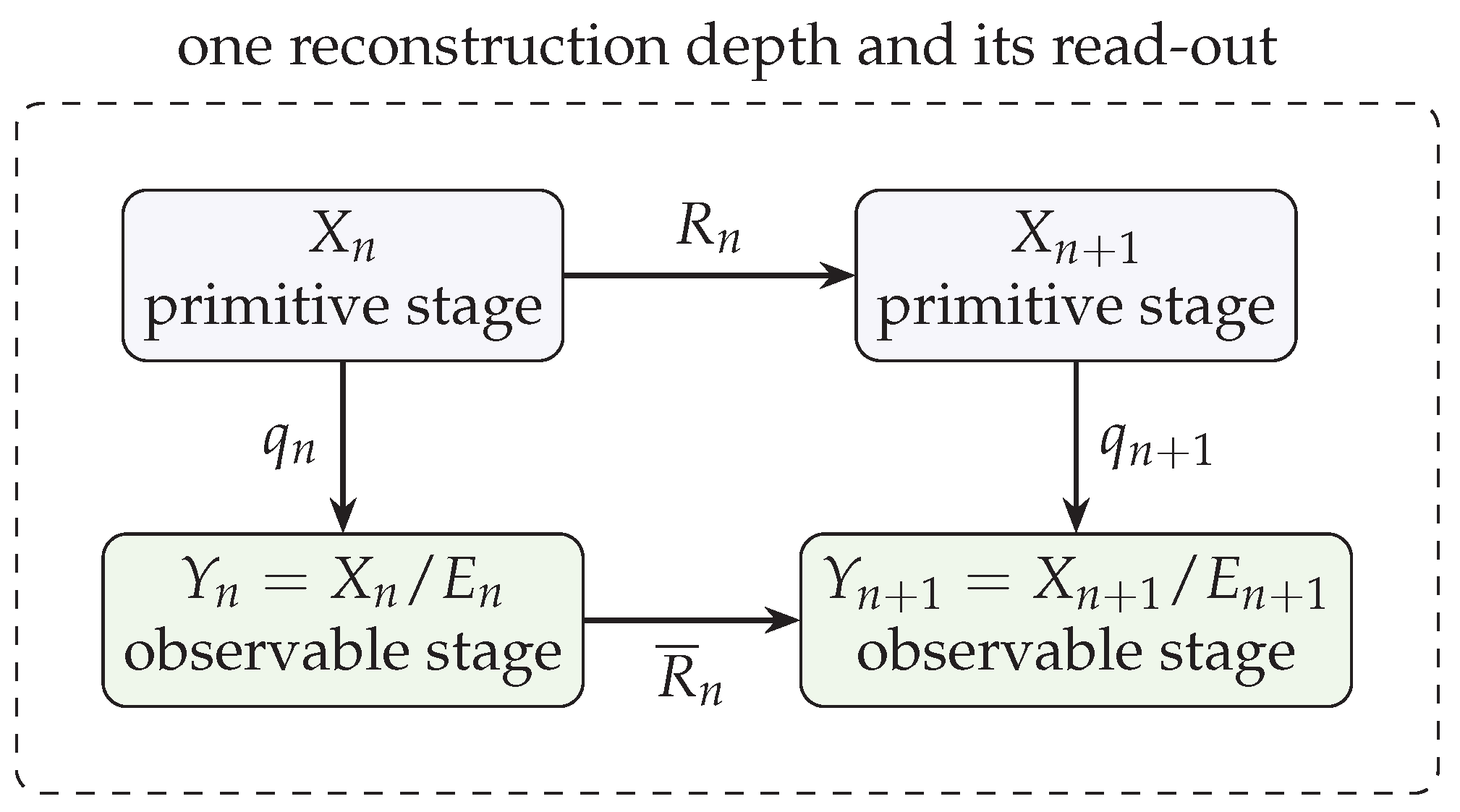
Figure 2.
Quotient splicing in Example 21. Both quotient edges are images of genuine primitive edges, but no primitive history realizes their concatenation.
Figure 2.
Quotient splicing in Example 21. Both quotient edges are images of genuine primitive edges, but no primitive history realizes their concatenation.
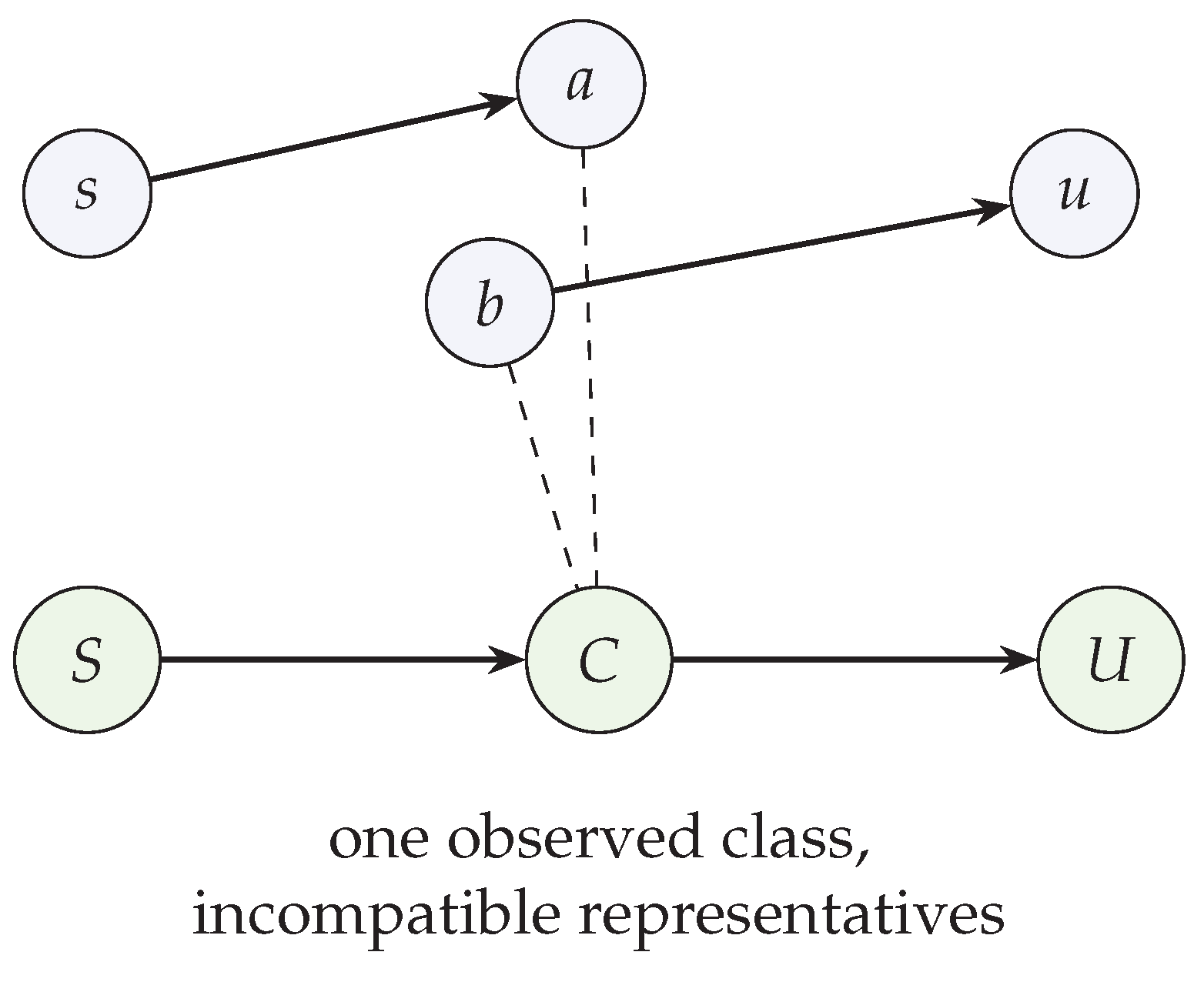
Figure 3.
Mathematical organization of Reconstruction Before Control. Candidate continuations remain in the reconstruction layer until viability and quotient-consistency audits authorize a stable read-out. The controller acts on , while the selected action constrains the next primitive continuation relation .
Figure 3.
Mathematical organization of Reconstruction Before Control. Candidate continuations remain in the reconstruction layer until viability and quotient-consistency audits authorize a stable read-out. The controller acts on , while the selected action constrains the next primitive continuation relation .
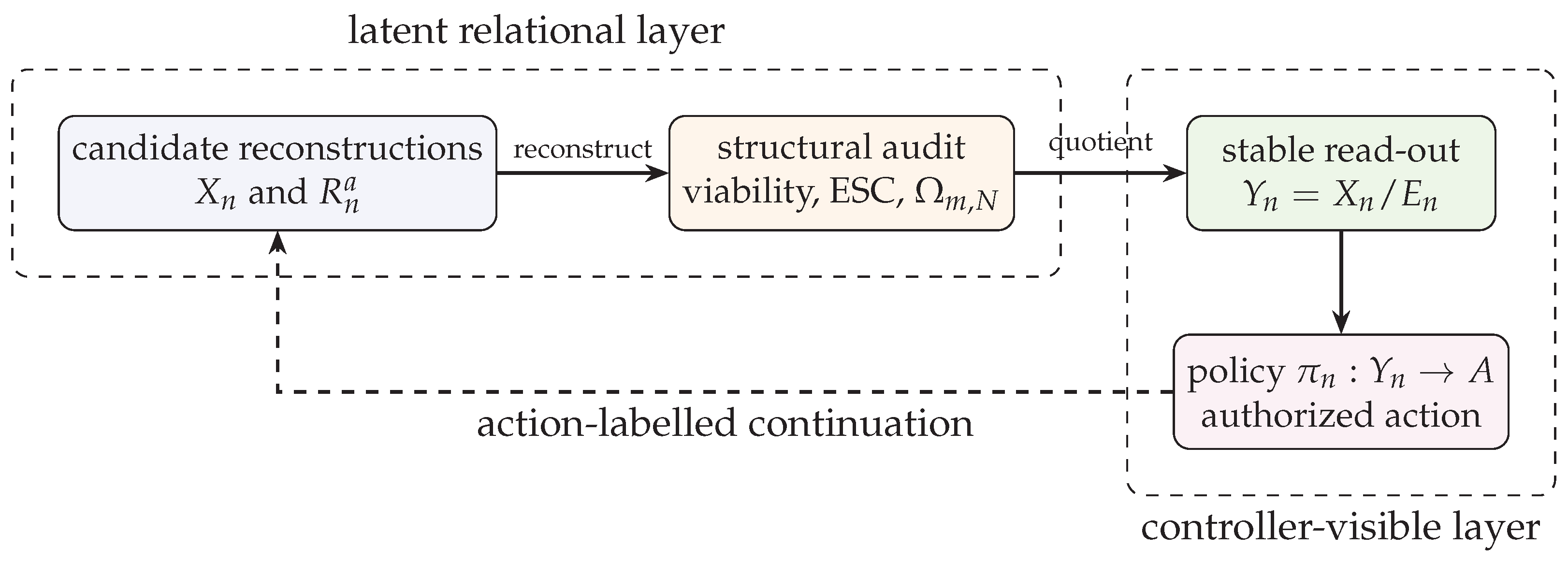
Table 1.
Published reconstruction results motivating the present mathematical audit. The reported physical conclusions remain conditional on the bridge assumptions of the cited papers; none is used as a premise in the proofs below.
Table 1.
Published reconstruction results motivating the present mathematical audit. The reported physical conclusions remain conditional on the bridge assumptions of the cited papers; none is used as a premise in the proofs below.
| Application | Previously reported result | Question answered by this paper |
|---|---|---|
| Topological identity [15,16,17] | Admissible topological operations, persistent meridian obstructions, and a codimension-two carrier closure | Do finite constructions belong to coherent infinite histories, and do identity predicates remain stable after read-out? |
| Law selection [20] | Conditional selection of a four-dimensional Lorentzian platform, curvature, Maxwell–Einstein law forms, and the global quotient | Does the proposed observable continuation depend on hidden representatives, or does it define genuine complete histories? |
| Dimensionless parameters [17,18,19] | Structural values including , , , and , reported to agree closely with reference data | When do equal primitive alternatives and their multiplicities descend to a representative-independent observable probability law? |
| Quantum histories [21] | A structural account of quantum computational advantage in terms of admissible histories | Can an observable history be lifted coherently, or was it created by splicing incompatible primitive representatives? |
Disclaimer/Publisher’s Note: The statements, opinions and data contained in all publications are solely those of the individual author(s) and contributor(s) and not of MDPI and/or the editor(s). MDPI and/or the editor(s) disclaim responsibility for any injury to people or property resulting from any ideas, methods, instructions or products referred to in the content. |
© 2026 by the author. Licensee MDPI, Basel, Switzerland. This article is an open access article distributed under the terms and conditions of the Creative Commons Attribution (CC BY) license (http://creativecommons.org/licenses/by/4.0/).
Copyright: This open access article is published under a Creative Commons CC BY 4.0 license, which permit the free download, distribution, and reuse, provided that the author and preprint are cited in any reuse.