

Submitted:
15 September 2026
Posted:
16 September 2026
You are already at the latest version
Abstract
The growing adoption of sensor-based Particle Ore Sorting (POS) across mineral processing operations increases the need for an objective and repeatable method to assess whether and how an ore can be upgraded. Standardised POS testwork methods have recently been proposed but no universally accepted framework yet provides cross-comparable measures of material, classification and mechanical contributions. This review excludes sensor-based Batch Bulk Ore Sorting and Belt Bulk Ore Sorting and structures the POS literature into three analytical categories: Intrinsic Sortability, Sensor Amenability and Sensor Sortability. Intrinsic Sortability is represented by Sorter Feed Heterogeneity (SFH) and describes the theoretical upgrading potential under ideal separation. Sensor Amenability addresses Detection Effectiveness (DE) and Image Processing Effectiveness (IPE), which together determine Classification Effectiveness (CE). Sensor Sortability evaluates the POS process result under dynamic conditions, including CE, material presentation and Mechanical Effectiveness (ME). The review identifies inconsistent terminology and frequent overlap between these categories. The recently defined Single Particle Test (SPT), Bench Scale Test (BST), Cascade Test (CT) and Process Test (PT) clarify which combinations of SFH, CE and ME are assessed but cross-study comparability remains limited by project-lot heterogeneity, sensor configuration and operating conditions. A universal framework must retain clear system boundaries, standardise performance metrics and use Process Tests as the final validation and feasibility stage. Simulation based on SFH and CE data, supported by open reference datasets and cross-laboratory benchmarks, offers a route towards scalable and vendor-independent assessment.
Keywords:
sensor-based sorting
; Particle Ore Sorting
; sortability
; Sorter Feed Heterogeneity
; Classification Effectiveness
; Mechanical Effectiveness
; standardised testwork methodologies
1. Introduction
1.1. Industrial Context and Decision Relevance
Sensor-Based Sorting (SBS) is the umbrella term for processes in which sensor-classified material units are physically separated. This review concerns sensor-based Particle Ore Sorting (POS), where individual particles are detected and separated [1,2]. POS is increasingly applied for pre-concentration and waste rejection to reduce downstream processing demand across base-metal, precious-metal and industrial-mineral applications [3,4,5]. Industrial implementations extend from X-ray-transmission sorting of tin ore at production scale [6] to the reprocessing of phosphate waste rock, where POS is linked explicitly to waste valorisation and circular-economy objectives [7]. Techno-economic studies connect the sorting decision to comminution energy demand and to the wider flowsheet configuration [8], and cut-off estimation methodologies translate measured feed variability into an economic decision criterion [9]. At exploration and project-development stages, project teams must determine whether the project-lot material is amenable to POS, the relevant particle-size interval and whether the expected response justifies further testwork and flowsheet integration. These decisions can affect process design, plant capacity, comminution duty, tailings generation and project economics [2].
The decision sequence extends beyond a sorter trial (Figure 1). Ore characterisation must be translated into a testwork strategy that defines the project lot, significant financial and technical features, feed type and test objective before an informed POS decision and subsequent process design. An underdefined assessment stage can therefore introduce bias early in project development [2,10].
1.2. Problem Definition
Current practice relies on laboratory characterisation, vendor testing and case-specific academic methods (amongst others, described here: [11,12]). Robben et al. [2] recently consolidated these practices into Single Particle Tests, Bench Scale Tests, Cascade Tests and Process Tests using Endmember, Lithotype and Composite feed types. This provides a standard testwork nomenclature but not a single cross-comparable measure of POS potential. Individual proposals for such a measure exist: Gülcan [13] evaluates an industrial near-infrared sorter using material-specific partition coefficients, an Ecart probability and a cut value, and separates the correct identification of particles from their correct delivery to the accept or reject stream. Descriptors of this kind quantify the separation achieved by a defined machine, feed presentation and operating point and therefore characterise the process rather than the ore alone. Sensor-specific results, platform effects and operator-selected settings therefore remain relevant sources of uncertainty.
The central conceptual problem is that Sorter Feed Heterogeneity (SFH), Detection Effectiveness (DE), Image Processing Effectiveness (IPE) and Mechanical Effectiveness (ME) are often combined under the term “sortability”. Robben et al. [2] resolve these contributions through Classification Effectiveness (CE), Total Process Effectiveness (TPE) and explicit test boundaries. Although connected in an operating POS process, these elements answer different scientific questions and must remain distinguishable in a universal assessment framework.
1.3. Scope and Objectives
This review focuses on sensor-based POS. Sensor-based Batch Bulk Ore Sorting and Belt Bulk Ore Sorting are excluded as primary method classes, although selected publications are retained where they provide relevant approaches to heterogeneity, modelling or test design [9,14,15,16,17]. Terminology is aligned with the frameworks proposed by Duncan and Deglon [10] and Robben et al. [2,18], including project lot, financial and technical features, SFH, DE, IPE, CE, ME and TPE.
The objectives are to:
- map academic and industrial methods used to assess POS sortability;
- separate the assessment of intrinsic material properties from sensor capability and sorter performance;
- compare the extent to which published methods address predefined assessment criteria;
- identify terminology conflicts, methodological overlap and evidence gaps;
- define requirements for an objective, scalable and vendor-independent testing hierarchy;
- define the minimum criteria that a sortability assessment method must fulfil to be considered universal, including objectivity, sensor independence, scalability and cross-comparability.
2. Conceptual Framework and Terminology
2.1. Three Assessment Categories
The literature was organised into three analytical categories with distinct system boundaries (Figure 2). Intrinsic Sortability concerns the project-lot particle population and SFH; Sensor Amenability concerns DE, IPE and CE; Sensor Sortability concerns the dynamic POS process result, including ME. These categories are not substitutes for the test names SPT, BST, CT and PT. Rather, they identify which material and effectiveness contributions each test addresses [2,10,18]. Table 1 summarises these boundaries together with the predefined criteria assigned to each category and the standard test methods to which each category maps.
2.2. Intrinsic Sortability and Sorter Feed Heterogeneity
Intrinsic Sortability is the theoretical upgrading potential of a particle population under ideal separation. In the nomenclature of Robben et al. [2], the material condition relevant to POS is Sorter Feed Heterogeneity (SFH), expressed through particle-level grade-frequency distributions of defined financial and technical features. SFH should not be confused with Intrinsic Heterogeneity of the Lot (IHL), a Theory of Sampling parameter used to estimate the Fundamental Sampling Error. The assessment should include granulo-chemical and particle-grade distributions and where possible the relationship between liberation and particle size [2,10,22,23]. Sousa et al. [19] characterise ore macro-texture and assess liberation at coarse crushing sizes and provide one of the few explicit treatments of this relationship at POS-relevant particle sizes.
These existing methodologies apply to particle-level heterogeneity, but there is no standard framework defining the geological and geometallurgical data requirements that are necessary to establish whether a measured particle population is representative of the expected sorter feed. Geometallurgical sampling and testwork frameworks address domain definition, sample representativity and programme design [24], but they are not yet expressed in terms of the particle populations that a sorter actually receives.
2.3. Sensor Amenability and Classification Effectiveness
Sensor Amenability determines whether a detection system obtains a useful and spatially adequate signal and whether image processing converts that signal into a reliable particle classification. In Robben et al. [2], Detection Effectiveness (DE) and Image Processing Effectiveness (IPE) combine into Classification Effectiveness (CE). Relevant measures include signal contrast, signal-to-noise ratio, dynamic range, spatial resolution, object segmentation, Sorting Index response and classification performance [25,26,27,28,29]. The sensing principles examined in the reviewed literature include dual-energy X-ray transmission [26,28,29,30], X-ray fluorescence [20,31], short-wave infrared reflectance [32], X-ray absorption spectroscopy [33] and microwave imaging [34], while automated mineralogy and X-ray radiography supply particle-level reference data for calibration and validation [25,35]. Mechanical Effectiveness and throughput remain outside this boundary.
2.4. Sensor Sortability and Total Process Effectiveness
Sensor Sortability describes the POS process result under dynamic conditions. The result combines SFH with Total Process Effectiveness (TPE), while TPE comprises Classification Effectiveness (CE) and Mechanical Effectiveness (ME) [2,18]. Feed presentation, object tracking, software settings, travelling speed, separation geometry and ejection conditions influence the result. Throughput rate, feed composition, particle shape and the availability of ejection valves have been shown to affect yield and product purity independently of the classification decision [21]. It is therefore conditional on the project lot, feed type, machine, calibration, operator and operating window and cannot represent the ore alone [6,11,12,13,36]. Figure 3 relates the three assessment categories to the review criteria used in the original conference presentation.
3. Review Methodology
3.1. Literature Search and Selection
Literature was collected from Scopus and Web of Science, supplemented by ScienceDirect and the Minerals archive and by direct searches of institutional repositories and conference proceedings (e.g. IMPC, World Gold, WCSB) for theses and grey literature. Search terms combined three groups: the process (sensor-based sorting, ore sorting, particle sorting, pre-concentration); the assessment objective (sortability, amenability, sorting potential, testwork, protocol, methodology); and the contributing elements (heterogeneity, grade distribution, liberation, texture; XRT, XRF, near-infrared, hyperspectral, microwave; classification, machine learning; throughput, ejection, separation efficiency). The set was completed by checking independently in primary sources as well as citationsin secondary publications from the principal methodological references [2,10,13,25], which is how most of the conference papers and theses were identified. Seven of the retained publications are not indexed in Scopus nor Web of Science, indicating that a relevant part of the POS testwork and sampling literature is published outside the indexed journals.
Records were screened against four criteria:
- separation principle, particle-by-particle sensor classification and ejection; batch and belt bulk ore sorting and on-belt grade measurement without particle separation were excluded as primary evidence;
- feed material, ore, mine waste rock, coal and industrial minerals; sorting of food, plastics, glass, scrap and construction waste was excluded;
- methodological content, a documented method, protocol, metric or dataset addressing SFH, DE, IPE, CE or ME; equipment and vendor descriptions and results reported without a test procedure, were excluded;
- record type, English-language journal articles, conference papers and doctoral or master's theses with obtainable full text; patents, trade publications and abstracts without full text were excluded.
Publications excluded under the first three criteria were retained only where they contribute a transferable method, metric or model and are then identified as contextual or transferable evidence in Appendix A.Forty-two publications were retained after screening. Robben et al. [2], published after the conference presentation, was incorporated into the final synthesis and used to harmonise nomenclature for test methods, feed types and process-effectiveness contributions. General reviews provided technology context rather than primary experimental evidence [4,5]. A complete inventory of the reviewed publications and the role each one plays in this review is given in Appendix A.
3.2. Classification and Rating Procedure
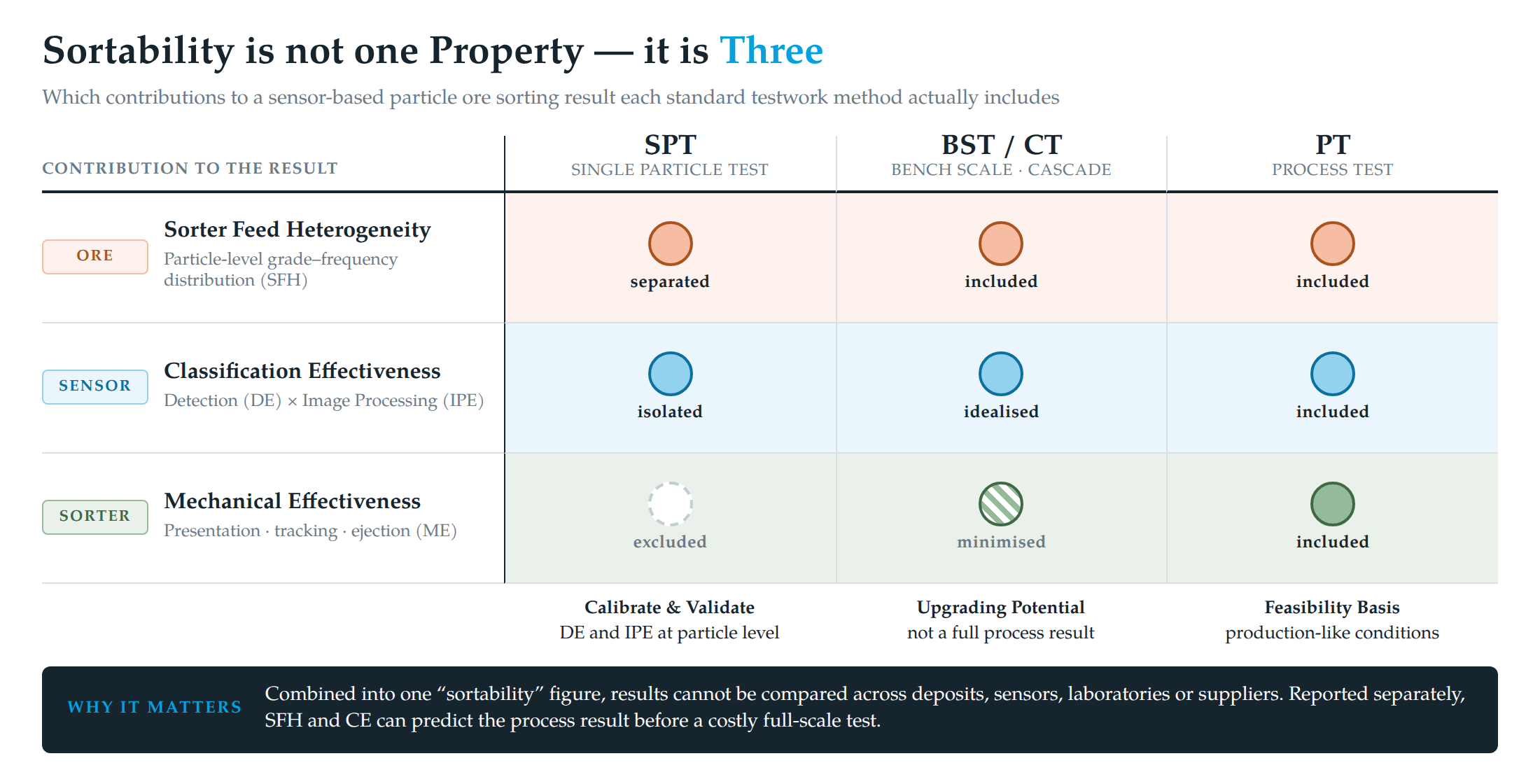
Each publication was assigned to one or more analytical categories according to its primary purpose and mapped where possible to SFH, DE, IPE, CE and ME. The predefined criteria were rated qualitatively from the reported methods and results (Table 2). The SPT separates SFH from CE and excludes ME, BST and CT combine SFH with CE under idealised conditions and PT includes SFH, CE and ME under production-like conditions [2]. The assessment is comparative rather than a quantitative meta-analysis.
3.3. Scope Controls and Evidence Roles
The review distinguishes direct POS method evidence from contextual evidence. Sampling-heterogeneity studies addressing IHL and Fundamental Sampling Error, geometallurgical sampling and testwork frameworks, analytical reference methods, bulk-sortability studies and broad reviews inform sampling, analysis or framework development but are not equivalent to direct SFH or POS testwork protocols. Contextual sources were therefore retained separately [9,14,15,16,17,24,37,38,39], while direct evidence was assessed against the predefined criteria. Studies from adjacent sorting domains were retained as transferable evidence where their reported conclusions are independent of the feed-material type [21].
4. Results
4.1. Intrinsic Sortability and SFH Assessment
The intrinsic literature covers granulo-chemical distributions, particle-level grade-frequency distributions, liberation, mineralogical and textural characterisation and particle-grade estimation. Duncan and Deglon [10] combine particle-size and grade distributions in an explicit intrinsic framework. Robben et al. [2] formalise the physical-separation descriptor as SFH and distinguish it from IHL used for sampling. Texture modelling, XCT and surface mapping provide complementary approaches [22,23,25,27] and are extended by macro-texture and liberation assessment at coarse crushing sizes [19] and by the integration of X-ray radiography with automated mineralogy to generate particle-level reference grades [35]. Sampling and geometallurgical studies provide contextual evidence for representative testwork [24,37,38]. Table 3 shows the coverage of the predefined Intrinsic Sortability and SFH criteria across these publications.
Most studies analyse grade heterogeneity and particle characteristics but use different representations of the theoretical separation limit. The SFH and grade-frequency-distribution nomenclature provides a common physical basis, while IHL remains a sampling descriptor rather than a direct sortability metric [2]. A universally accepted method for converting size-dependent SFH into comparable ideal yield-recovery functions is still absent. Methods derived from material reference data should therefore be distinguished from those using a particular sensor as a proxy for particle grade [10,25,27,35]. Non-destructive bulk analytical methods provide particle-level reference values with a stated analytical uncertainty and are particularly relevant where conventional assaying is unreliable, as for coarse-gold material [39]. Further development must also focus on including domain-weighting, qualifying the uncertainty and transferability to recovery aspects.
4.2. Sensor Amenability and CE Assessment
Sensor Amenability studies mainly determine whether a detection system provides sufficient contrast and whether the image-processing chain supports correct classification. In the harmonised nomenclature, these contributions are DE and IPE and together form CE [2]. Dual-energy X-ray transmission dominates the reviewed examples for rare-earth minerals, heavy rare earth elements, sulphide ore and coal [26,28,29,30]. Surface-XRF mapping, automated-mineralogy-based sensor selection and multi-sensor concepts increase the scope [25,27,35,40] and are complemented by microwave imaging [34] and by combined microwave and infrared sensing concepts [8]. Machine-learning classification is now reported for particle-level XRF sorting [20,31], hyperspectral short-wave infrared pre-sorting [32] and X-ray absorption spectroscopy [33], while bench-scale testwork on phosphate waste rock combines dual-energy X-ray transmission with near-infrared and colour sensing [7]. Table 4 shows the coverage of the predefined DE and IPE criteria.
Research commonly addresses DE and signal contrast. Classification performance is increasingly quantified using confusion matrices, receiver-operating-characteristic analysis and separated calibration and validation sets [15,20], and the error contributed by the sensing step itself has been analysed explicitly [16]. These metrics are nevertheless reported against study-specific protocols, are rarely related back to an independently measured SFH and are seldom accompanied by a stated measurement uncertainty, so CE values remain difficult to compare across studies. The SPT is the only test in the Robben et al. [2] framework that separates SFH from CE and permits particle-level calibration and validation of DE and IPE. BST and CT results combine SFH with CE under idealised conditions and must not be interpreted as full TPE.
4.3. Sensor Sortability and TPE Assessment
Sensor Sortability is represented by tests that progressively include dynamic process contributions. BST and CT combine SFH with CE while ME is excluded or minimised, whereas the PT includes SFH, CE and ME and most closely approximates the full POS process result [2]. Complete-chain methodologies also address feed presentation and mechanical separation effects [12,41]. Industrial implementation at production scale documents feed preparation, calibration, operating windows and mass-grade reconciliation over extended periods [6], and bench-scale multi-sensor testwork demonstrates the same sequence at reduced scale [7]. Küppers et al. [21] quantify the separate contribution of throughput rate, feed composition, particle shape and ejection-valve failure to yield and product purity, and report that a small proportion of flat particles in the feed can degrade yield to a similar extent as a substantial loss of ejection capacity. Gülcan [13] reports material-specific partition coefficients, an Ecart probability of 0.105 and a cut value of 0.730 for the separation criterion ‘reflectance value’ (RV) for an industrial near-infrared sorter, demonstrating that separation-sharpness descriptors familiar from density separation can be applied to other separation criteria in the context of POS. Reviews and smaller-scale studies cover these effects less completely [4,5,36,42]. Table 5 shows the coverage of the predefined CE, presentation and ME criteria.
Applied literature most often evaluates POS performance on laboratory or industrial platforms. Robben et al. [2] identify the PT as the decisive production-like test and basis for feasibility decisions because it includes all TPE contributions. Its result nevertheless remains conditional on project-lot representativity, feed type, machine configuration, presentation, calibration, operating settings and operator decisions. Process Tests should therefore be the final validation of prior SFH and CE assessments rather than an ore-only sortability metric.
4.4. Distribution of Literature and Principal Gaps
Table 6 summarises the qualitative distribution of the reviewed literature across the three assessment categories, together with the principal gap identified in each.
The literature remains unbalanced. Sensor Amenability is now the best represented category, driven by sensor-specific detectability studies and by the growth of machine-learning classification. Applied sorter testing remains well represented, whereas sensor-independent SFH assessment is the least developed and is supported by comparatively few dedicated studies. The SPT/BST/CT/PT nomenclature improves transparency by stating which SFH, CE and ME contributions are included [2]. It does not remove the need for cross-comparable metrics within each contribution.
4.5. Cross-Category Overlap
Robben et al. [2] make the overlap across categories explicit: SPT separates SFH and CE and excludes ME, BST and CT combine SFH with CE under idealised conditions and PT combines SFH, CE and ME. The three analytical categories therefore describe contributions rather than mutually exclusive test names. Imprecision exists when studies report a result without identifying the project lot, feed type, test method and included effectiveness contributions (Figure 4). A dynamic result reported without the corresponding throughput, presentation condition and machine availability cannot subsequently be resolved into SFH, CE and ME contributions [13,21].
5. Discussion
5.1. Sensor-Neutral SFH and Intrinsic Sortability
A universal Intrinsic Sortability method must describe the project-lot material independently of sensor performance. SFH must be reported as particle-level grade-frequency distributions of defined financial and technical features within sorting relevant size classes [2]. Granulo-chemical distributions, liberation, texture and heterogeneity explain how SFH changes with size and comminution history [10,19,22,23]. IHL and its parameters support sampling design but must not be treated as a metric showing direct POS potential, since it is not necessarily scaled to sortable size ranges.
Simulation and modelling offer a scalable route because ideal separation at 100% TPE can be evaluated directly from SFH [2,17,23]. Representative primary sampling and mass reduction must comply with the Theory of Sampling and the project’s Sampling Quality Objective. Sampling, analytical and model uncertainty must be combined and reported as Total Measurement Uncertainty when theoretical recovery, yield and waste-grade predictions are produced [2,24,37,38,39].
5.2. Quantitative DE, IPE and CE Metrics
A qualitative observation that ore and waste appear different is insufficient for a comparable amenability test. Standard protocols must define the detection geometry, energy or wavelength range, spatial sampling, calibration, Sorting Index and reference-analysis method. DE must be separated from IPE: the former concerns sensor response relative to true analytical content and the latter concerns segmentation, feature extraction and classification. Together they determine CE [2,20,25,35,40].
Candidate metrics include signal contrast, signal-to-noise ratio, dynamic range, spatial resolution, object-segmentation effectiveness and CE. Confusion matrices and threshold-dependent yield-recovery or recovery-rejection curves can provide transparent reporting when calibration and independent validation particle sets are separated [2,20]. Receiver-operating-characteristic analysis provides a threshold-independent summary of detection performance and supports transparent cut-point selection [15], and an explicit error analysis of the sensing step quantifies its contribution to the reported uncertainty [16]. Reference values used for calibration and validation should be obtained by an independent analytical method of stated uncertainty [39].
5.3. Role and Limitations of Dynamic POS Testwork
The standard test hierarchy distinguishes the contributions included in dynamic testwork. SPT isolates CE at particle level, BST and CT evaluate SFH with CE under idealised or repeated-pass conditions and PT includes all TPE contributions under production-like conditions [2]. Reports must document project lot, feed type, feed preparation, throughput, area occupancy, travelling speed, sensor and software settings, separation geometry and mass-grade reconciliation [6,21].
PT must serve as the final validation and feasibility basis after heterogeneity characterisation, calibration and validation have been completed [2]. It is not a universal measure of the ore because its outcome includes CE, ME and process-island conditions. BST and CT results require explicit qualification because ME is excluded or minimised and the repeated passes of a CT can introduce positive bias. Where a dynamic result is reported, partition-based descriptors such as the Ecart probability and the cut value make the sharpness of the achieved separation explicit and are more informative than a single recovery or mass-rejection value [13]. As the tail ends of a partition function for POS are often not closed due to the decoupling of separation criterion and separation force, it is recommended to report the full partition, or the Ecart probable in combination with misplacement metrics (ore-to-waste, waste-to-ore, and total misplacement).
5.4. Implications for Comparability and Early Project Decisions
When SFH, CE and ME are reported as one outcome, studies cannot be compared reliably across deposits, commodities or vendors. The same project-lot material can produce different results with different feed types, calibrations, presentation conditions or equipment [13,21] and even test operators. A hierarchical framework using the SPT/BST/CT/PT nomenclature makes these sources of variation detectable rather than hiding them in a single recovery or mass-rejection value [2].
6. Proposed Development Path for a Universal Framework
Future work must retain the three analytical categories while mapping them to the standard test methods and feed types proposed by Robben et al. [2]. Each stage must define its project lot, significant financial and technical features, included effectiveness contributions and required Total Measurement Uncertainty. Iteration remains possible but a commercial POS result must not be interpreted as an intrinsic ore property. Figure 5 shows the proposed analytical hierarchy and its mapping to SFH, CE and TPE.
6.1. Stage 1—Intrinsic Sortability and Sorter Feed Heterogeneity
- Define the project lot, relevant sub-lots and significant financial and technical features;
- Apply granulo-chemical analysis and Theory of Sampling-compliant primary sampling and mass reduction;
- Estimate SFH as particle-level grade-frequency distributions in relevant size classes, including the size dependence of liberation and texture [19];
- Calculate ideal liberation functions, yield, recovery, product grade and waste grade at 100% TPE;
- Report Sampling Uncertainty, Analysis Uncertainty and Total Measurement Uncertainty using reference analyses of stated uncertainty [39];
- Ensure test material represents relevant geochemical and geometallurgical domains within resource and reserve confidence categories [24];
- Align the scale and confidence of SFH, CE and TPE assessments with project maturity and geological confidence from exploration to short-term mine planning.
6.2. Stage 2—Sensor Amenability and Classification Effectiveness
- Use SPT to separate SFH from CE and to calibrate and validate the detection and image-processing chain;
- Specify the sensing principle, geometry, energy or wavelength range and spatial resolution;
- Relate the Sorting Index to independent reference values for financial and technical features;
6.3. Stage 3—Sensor Sortability and Total Process Effectiveness
- Use BST and CT to assess SFH with CE under idealised conditions and report their limitations;
- Use PT to include all TPE contributions and support final feasibility decisions;
- State whether Endmember, Lithotype or Composite feed types were tested;
- Separate CE, presentation effects and ME and test robustness across operating windows [21];
6.4. Simulation, Open Data and Benchmarking
A major research need is to predict the POS process result from SFH and CE before starting efforts on a cost-intensive PT or pilot campaign. Models must combine grade-frequency distributions, CE confusion matrices, spatial-resolution and presentation effects and ME estimates [2,23,25]. Bulk-sorting model development provides a template in which a predictive model is first constructed and then validated and optimised against measured results [17]. Open reference datasets can allow algorithms and sensing concepts to be compared on the same particle populations and feature sets, which is increasingly relevant as machine-learning classifiers are trained on study-specific data [20,31,32,33]. A key validation test would be to predict the result of a blind PT, within the stated uncertainty, using independently determined SFH, CE and ME data.
Cross-laboratory benchmarks and community-driven protocols are required to test repeatability and reproducibility. Reference materials must span commodities, size classes, grade-frequency distributions and relevant heterogeneity scales. A shared reporting template based on project lot, feed type, SPT/BST/CT/PT and SFH/CE/ME contributions will accelerate convergence towards universal metrics [2].
7. Conclusions
Standardised POS testwork methods and feed-type nomenclature have now been proposed but a universally accepted cross-comparable metric for particle ore sortability does not exist yet.
The three analytical categories map onto SFH, CE and the dynamic POS process result: Intrinsic Sortability concerns SFH, Sensor Amenability concerns DE and IPE as contributions to CE and Sensor Sortability concerns TPE including CE and ME. SPT is the only test that separates SFH from CE and excludes ME; BST and CT combine SFH with CE under idealised conditions and PT includes all TPE contributions under production-like conditions.
SFH must be expressed through particle-level grade-frequency distributions of financial and technical features. IHL is important for sampling design but is not by itself a direct metric to assess POS potential. PT is the most complete basis for feasibility decisions, but its result remains conditional on project-lot representativity, feed type, presentation, calibration, operating settings and Mechanical Effectiveness.
A universal framework must combine sensor-independent SFH assessment, standardised DE/IPE/CE metrics and fully qualified PT results within explicit system boundaries. Simulation, open datasets, cross-laboratory benchmarking and consistent reporting of Total Measurement Uncertainty are necessary for scalable, transparent and vendor-independent assessment.
Author Contributions
Conceptualization, F.R., T.V., C.R. and D.H.P.; methodology, F.R., T.V., C.R. and D.H.P.; validation, T.V., C.R. and D.H.P.; formal analysis, F.R.; investigation, F.R. and D.H.P.; resources, F.R. and C.R.; data curation, D.H.P.; writing—original draft preparation, F.R.; review and editing, T.V., C.R. and D.H.P.; visualization, F.R.; supervision, T.V. and D.H.P.; project administration, F.R. All authors have read and agreed to the published version of the manuscript.
Funding
This research received no external funding.
Institutional Review Board Statement
Not applicable.
Informed Consent Statement
Not applicable.
Data Availability Statement
No new data were created or analysed in this study. All material discussed is available in the cited publications. Data sharing is not applicable to this article.
Acknowledgments
Generative artificial intelligence was used to assist with language editing, manuscript structuring and improvement of the clarity of selected passages. All AI-assisted content was critically reviewed, verified and revised by the authors, who take full responsibility for the final content of the manuscript.
Conflicts of Interest
The authors declare no conflicts of interest.
Abbreviations
The following abbreviations are used in this manuscript:
| BST | Bench Scale Test |
| CE | Classification Effectiveness |
| CT | Cascade Test |
| DE | Detection Effectiveness |
| DE-XRT | Dual-Energy X-ray Transmission |
| Ep | Ecart Probability |
| GFD | Grade-Frequency Distribution |
| IHL | Intrinsic Heterogeneity of the Lot |
| IPE | Image Processing Effectiveness |
| ME | Mechanical Effectiveness |
| MU | Measurement Uncertainty |
| NIR | Near-Infrared |
| POS | Particle Ore Sorting |
| PT | Process Test |
| REE | Rare Earth Elements |
| ROC | Receiver Operating Characteristic |
| SBOS | Sensor-Based Ore Sorting |
| SBS | Sensor-Based Sorting |
| SFH | Sorter Feed Heterogeneity |
| SPT | Single Particle Test |
| SVM | Support Vector Machine |
| SWIR | Short-Wave Infrared |
| TOS | Theory of Sampling |
| TPE | Total Process Effectiveness |
| XAS | X-ray Absorption Spectroscopy |
| XCT | X-ray Computed Tomography |
| XRF | X-ray Fluorescence |
| XRT | X-ray Transmission |
Appendix A
Appendix A.1. Literature Inventory and Role in the Review
Appendix A lists every publication considered in this review together with the primary role it plays in the analysis and the assessment category or evidence status assigned to it in Section 3. Publications marked as contextual inform sampling design, analysis, framework development or technology background and were not rated against the predefined criteria in Table 3, Table 4 and Table 5. Publications marked as transferable evidence originate outside ore sorting but report conclusions that are independent of the feed-material type and are therefore applicable to POS presentation and Mechanical Effectiveness.

Table A1.
Literature inventory and role of each publication in this review.
| Publication | Primary Role in This Review | Category / Status |
| Adewuyi et al. (2025) [40] | Multi-sensor integration and image-processing context | Sensor Amenability; review/context |
| Amar et al. (2023) [7] | Bench-scale DE-XRT, near-infrared and colour sorting of phosphate waste rock; waste-rock valorisation and circular-economy case | Sensor Amenability / Sensor Sortability; direct method |
| Chieregati et al. (2023) [37] | Sampling and heterogeneity context | Intrinsic; contextual evidence |
| Claassen (2016) [38] | Heterogeneity in complex mining environments | Intrinsic; contextual evidence |
| Dance et al. (2024) [42] | Lab-scale pre-concentration test | Sensor Sortability; direct method |
| Dominy and Glass (2025) [24] | Geometallurgical sampling and testwork design, domaining and sample representativity | Intrinsic; contextual evidence |
| Dominy et al. (2024) [39] | Non-destructive reference analysis for coarse-gold particles; rig-to-assay optimisation and analysis uncertainty | Intrinsic / Sensor Amenability; contextual evidence |
| Duan et al. (2023) [34] | Microwave imaging as an alternative detection principle for SBS | Sensor Amenability; direct method |
| Duncan and Deglon (2022) [10] | Intrinsic POS methodology and principal classification framework | Intrinsic; direct method |
| Duncan (2016) [11] | Protocol development linking particle properties and sorter tests | Intrinsic / Sensor Sortability; direct method |
| Fang et al. (2024) [33] | X-ray absorption spectroscopy with deep-learning mineral classification | Sensor Amenability; direct method |
| Fitzpatrick (2008) [12] | Automated-sorting methodology | Sensor Sortability; direct method |
| Genn (2013) [3] | Ore characterisation and sorting background | General background; not rated in category tables |
| Gülcan (2020) [13] | Partition-coefficient, Ecart probability and cut-value approach to SBS separation performance; separates correct particle identification from correct delivery to the product stream | Sensor Sortability; direct method |
| Kern et al. (2019) [25] | Mineralogy-based sorting potential and sensor selection | Intrinsic / Sensor Amenability |
| Kern et al. (2022) [35] | Integration of X-ray radiography with automated mineralogy for particle-level calibration of sorting routines | Intrinsic / Sensor Amenability; direct method |
| Küppers et al. (2021) [21] | Effect of throughput, feed composition, particle shape and ejection-valve failure on yield and product purity; conclusions independent of feed-material type | Sensor Sortability; transferable evidence |
| Li et al. (2020) [15] | ROC-based evaluation of XRF sensing performance and cut-point selection | Sensor Amenability; contextual (bulk sorting) |
| Li et al. (2021) [16] | Lab-scale error analysis of XRF sensing; sensing-error contribution to measurement uncertainty | Sensor Amenability; contextual (bulk sorting) |
| Li et al. (2021) [17] | Bulk ore sorting model validation and optimisation; template for predictive simulation of a sorting result | Simulation and modelling; contextual (bulk sorting) |
| Li et al. (2022) [14] | Fractal modelling of bulk sortability | Contextual and outside primary POS scope |
| Liu et al. (2024) [31] | Particle-swarm-optimised support vector machine classification for XRF sorting of porphyritic copper ore | Sensor Amenability; direct method |
| Modise et al. (2022) [4] | Review of electromagnetic sensing in ore sorting | General / Sensor Sortability context |
| Neubert and Wotruba (2017) [26] | DE-XRT detectability of rare-earth minerals | Sensor Amenability; direct method |
| Peukert et al. (2022) [5] | Review of sensor fusion | General / Amenability context |
| Reple et al. (2020) [9] | Heterogeneity-based cut-off estimation linking measured variability to an economic decision criterion | Intrinsic / decision context; contextual (bulk sorting) |
| Robben (2014) [1] | Sensor-based sorting technology and implementation background | General background; not rated in category tables |
| Robben and Dumont (2019) [41] | Industrial sorter methodology applied to gold ores | Sensor Sortability; direct method |
| Robben et al. (2020) [6] | Industrial XRT particle sorting at the San Rafael tin mine; production-scale operation, calibration and reconciliation | Sensor Sortability; direct method |
| Robben et al. (2022) [22] | XCT-based particulate heterogeneity | Intrinsic; direct/contextual method |
| Robben et al. (2024) [18] | Terminology and heterogeneity framework | Framework / terminology |
| Robben et al. (2026) [2] | Standardised SPT/BST/CT/PT methods, Endmember/Lithotype/Composite feeds and SFH/CE/ME nomenclature | Intrinsic / Sensor Amenability / Sensor Sortability; framework |
| Seiler (2017) [27] | Surface-XRF mapping and particle-grade estimation | Intrinsic / Sensor Amenability |
| Sousa et al. (2020) [19] | Macro-texture characterisation and liberation assessment at coarse crushing sizes for pre-concentration | Intrinsic; direct method |
| Tian et al. (2024) [8] | Technological and economic evaluation of microwave-assisted comminution combined with multi-sensor sorting | General / new-sensor and flowsheet context |
| Tong (2012) [36] | Laboratory sensor amenability and sorter testing | Sensor Amenability / Sensor Sortability |
| Tuşa et al. (2020) [32] | Hyperspectral SWIR sensor performance with machine-learning classification for pre-sorting | Sensor Amenability; direct method |
| Veras et al. (2020) [30] | DE-XRT detectability of minerals bearing heavy rare earth elements | Sensor Amenability; direct method |
| Wilkie (2016) [23] | Texture and grade-distribution modelling | Intrinsic; direct method |
| Xu et al. (2023) [20] | Logistic regression and SVM classifiers for XRF particle sorting of copper ore; separated calibration and validation sets | Sensor Amenability; direct method |
| Zhang et al. (2021) [28] | DE-XRT assessment of sulphide ore | Sensor Amenability; direct method |
| Zhang et al. (2022) [29] | DE-XRT coal sortability and washability | Sensor Amenability; cross-commodity context |
References
- Robben, C. Characteristics of Sensor-Based Sorting Technology and Implementation in Mining. Ph.D. Dissertation, RWTH Aachen University, Aachen, Germany, 2014. [Google Scholar]
- Robben, C.; Esbensen, K.H.; Dominy, S.C.; Halle, M.-C.; McCubbing, M.; Turner, D. Standard Testwork Methodologies for Sensor-Based Particle Ore Sorting Project Development and Process Optimization. Minerals 2026, 16, 678. [Google Scholar] [CrossRef]
- Genn, G. Novel Techniques in Ore Characterisation and Sorting. Ph.D. Thesis, The University of Queensland, Brisbane, Australia, 2013. [Google Scholar] [CrossRef]
- Modise, E.G.; Zungeru, A.M.; Mtengi, B.; Ude, A.U. Sensor-Based Ore Sorting—A Review of Current Use of Electromagnetic Spectrum in Sorting. IEEE Access 2022, 10, 112307–112326. [Google Scholar] [CrossRef]
- Peukert, D.; Xu, C.; Dowd, P. A Review of Sensor-Based Sorting in Mineral Processing: The Potential Benefits of Sensor Fusion. Minerals 2022, 12, 1364. [Google Scholar] [CrossRef]
- Robben, C.; Condori, P.; Pinto, A.; Machaca, R.; Takala, A. X-ray-Transmission Based Ore Sorting at the San Rafael Tin Mine. Miner. Eng. 2020, 145, 105870. [Google Scholar] [CrossRef]
- Amar, H.; Benzaazoua, M.; Elghali, A.; Taha, Y.; El Ghorfi, M.; Krause, A.; Hakkou, R. Mine Waste Rock Reprocessing Using Sensor-Based Sorting (SBS): Novel Approach toward Circular Economy in Phosphate Mining. Miner. Eng. 2023, 204, 108415. [Google Scholar] [CrossRef]
- Tian, X.; Forster, J.; Bobicki, E.R. Technological and Economic Considerations for the Application of Combined Microwave Assisted Comminution and Multi-Sensor Ore Sorting. Miner. Eng. 2024, 208, 108582. [Google Scholar] [CrossRef]
- Reple, A.; Chieregati, A.C.; Valery, W.; Prati, F. Bulk Ore Sorting Cut-off Estimation Methodology: Phu Kham Mine Case Study. Miner. Eng. 2020, 149, 105498. [Google Scholar] [CrossRef]
- Duncan, M.; Deglon, D. A Methodology to Determine the Potential for Particulate Ore Sorting Based on Intrinsic Particle Properties. Minerals 2022, 12, 630. [Google Scholar] [CrossRef]
- Duncan, M.G. Development of a Protocol to Determine the Sorting Potential of Particulate Ore Material. Master’s Thesis, University of Cape Town, Cape Town, South Africa, 2016. Available online: http://hdl.handle.net/11427/20327.
- Fitzpatrick, R.S. The Development of a Methodology for Automated Sorting in the Minerals Industry. Ph.D. Thesis, University of Exeter, Exeter, UK, 2008. [Google Scholar]
- Gülcan, E. A Novel Approach for Sensor Based Sorting Performance Determination. Miner. Eng. 2020, 146, 106130. [Google Scholar] [CrossRef]
- Li, G.; Klein, B.; Sun, C.; Kou, J. Investigation on Influential Factors of Bulk Ore Sortability Based on Fractal Modelling. Miner. Eng. 2022, 177, 107362. [Google Scholar] [CrossRef]
- Li, G.; Klein, B.; Sun, C.; Kou, J. Applying Receiver-Operating-Characteristic (ROC) to Bulk Ore Sorting Using XRF. Miner. Eng. 2020, 146, 106117. [Google Scholar] [CrossRef]
- Li, G.; Klein, B.; Sun, C.; Kou, J. Lab-Scale Error Analysis on X-ray Fluorescence Sensing for Bulk Ore Sorting. Miner. Eng. 2021, 164, 106812. [Google Scholar] [CrossRef]
- Li, G.; Klein, B.; He, C.; Yan, Z.; Sun, C.; Kou, J. Development of a Bulk Ore Sorting Model for Ore Sortability Assessment—Part II: Model Validation and Optimisation. Miner. Eng. 2021, 172, 107143. [Google Scholar] [CrossRef]
- Robben, C.; Chieregati, A.C.; Condori, P. Embrace Heterogeneity—Create Value with Separation: Elaborations on Single Particle Analyses for Calibration and Validation Test Work and Sensor-Based Heterogeneity Testing. In Proceedings of the 11th World Conference on Sampling and Blending (WCSB11), Muldersdrift, South Africa, 21–23 May 2024. [Google Scholar]
- Sousa, R.; Futuro, A.; Fiúza, A.; Leite, M.M. Pre-Concentration at Crushing Sizes for Low-Grade Ores Processing—Ore Macro Texture Characterization and Liberation Assessment. Miner. Eng. 2020, 147, 106156. [Google Scholar] [CrossRef]
- Xu, Y.; Klein, B.; Li, G.; Gopaluni, B. Evaluation of Logistic Regression and Support Vector Machine Approaches for XRF Based Particle Sorting for a Copper Ore. Miner. Eng. 2023, 192, 108003. [Google Scholar] [CrossRef]
- Küppers, B.; Schlögl, S.; Friedrich, K.; Lederle, L.; Pichler, C.; Freil, J.; Pomberger, R.; Vollprecht, D. Influence of Material Alterations and Machine Impairment on Throughput Related Sensor-Based Sorting Performance. Waste Manag. Res. 2021, 39, 122–129. [Google Scholar] [CrossRef] [PubMed]
- Robben, C.; Moslemiyekan, A.; Esbensen, K. X-ray Computed Tomography (XCT) for Characterization of Particulate Materials Heterogeneity: Embrace Heterogeneity—Create Value with Separation. TOS Forum 2022, 2022, 442. [Google Scholar] [CrossRef]
- Wilkie, G.J. Rapid Assessment of the Sorting Potential of Copper Porphyry Ores through Modelling of Textures and Grade Distributions. Ph.D. Thesis, The University of Queensland, Brisbane, Australia, 2016. Available online: https://espace.library.uq.edu.au/view/UQ:411674.
- Dominy, S.C.; Glass, H.J. Geometallurgical Sampling and Testwork for Gold Mineralisation: General Considerations and a Case Study. Minerals 2025, 15, 370. [Google Scholar] [CrossRef]
- Kern, M.; Tusa, L.; Leißner, T.; van den Boogaart, K.G.; Gutzmer, J. Optimal Sensor Selection for Sensor-Based Sorting Based on Automated Mineralogy Data. J. Clean. Prod. 2019, 234, 1144–1152. [Google Scholar] [CrossRef]
- Neubert, K.; Wotruba, H. Investigations on the Detectability of Rare-Earth Minerals Using Dual-Energy X-ray Transmission Sorting. J. Sustain. Metall. 2017, 3, 3–12. [Google Scholar] [CrossRef]
- Seiler, S. Surface XRF Mapping for Interparticle Heterogeneity Assessment and Particle Grade Estimation. Master’s Thesis, The University of British Columbia, Vancouver, BC, Canada, 2017. [Google Scholar]
- Zhang, Y.; Yoon, N.; Holuszko, M.E. Assessment of Sortability Using a Dual-Energy X-ray Transmission System for Studied Sulphide Ore. Minerals 2021, 11, 490. [Google Scholar] [CrossRef]
- Zhang, Y.R.; Yoon, N.; Holuszko, M.E. Assessment of Coal Sortability and Washability Using Dual Energy X-ray Transmission System. Int. J. Coal Prep. Util. 2022, 42, 2895–2907. [Google Scholar] [CrossRef]
- Veras, M.M.; Young, A.S.; Born, C.R.; Szewczuk, A.; Bastos Neto, A.C.; Petter, C.O.; Sampaio, C.H. Affinity of Dual Energy X-ray Transmission Sensors on Minerals Bearing Heavy Rare Earth Elements. Miner. Eng. 2020, 147, 106151. [Google Scholar] [CrossRef]
- Liu, Z.; Kou, J.; Yan, Z.; Wang, P.; Liu, C.; Sun, C.; Shao, A.; Klein, B. Enhancing XRF Sensor-Based Sorting of Porphyritic Copper Ore Using Particle Swarm Optimization-Support Vector Machine (PSO-SVM) Algorithm. Int. J. Min. Sci. Technol. 2024, 34, 545–556. [Google Scholar] [CrossRef]
- Tuşa, L.; Kern, M.; Khodadadzadeh, M.; Blannin, R.; Gloaguen, R.; Gutzmer, J. Evaluating the Performance of Hyperspectral Short-Wave Infrared Sensors for the Pre-Sorting of Complex Ores Using Machine Learning Methods. Miner. Eng. 2020, 146, 106150. [Google Scholar] [CrossRef]
- Fang, Z.; Song, S.; Wang, H.; Yan, H.; Lu, M.; Chen, S.; Li, S.; Liang, W. Mineral Classification with X-ray Absorption Spectroscopy: A Deep Learning-Based Approach. Miner. Eng. 2024, 217, 108964. [Google Scholar] [CrossRef]
- Duan, B.; Bobicki, E.R.; Hum, S.V. Application of Microwave Imaging in Sensor-Based Ore Sorting. Miner. Eng. 2023, 202, 108303. [Google Scholar] [CrossRef]
- Kern, M.; Akushika, J.N.P.; Godinho, J.R.A.; Schmiedel, T.; Gutzmer, J. Integration of X-ray Radiography and Automated Mineralogy Data for the Optimization of Ore Sorting Routines. Miner. Eng. 2022, 186, 107739. [Google Scholar] [CrossRef]
- Tong, Y. Technical Amenability Study of Laboratory-Scale Sensor-Based Ore Sorting on a Mississippi Valley Type Lead-Zinc Ore. Master’s Thesis, University of British Columbia, Vancouver, BC, Canada, 2012. [Google Scholar] [CrossRef]
- Chieregati, A.C.; Prado, G.C.; Fernandes, F.L.; Villanova, F.L.S.P.; Dominy, S.C. A Comparison between the Standard Heterogeneity Test and the Simplified Segregation Free Analysis for Sampling Protocol Optimisation. Minerals 2023, 13, 680. [Google Scholar] [CrossRef]
- Claassen, J.O. Testing for Heterogeneity in Complex Mining Environments. J. South. Afr. Inst. Min. Metall. 2016, 116, 181–188. [Google Scholar] [CrossRef]
- Dominy, S.C.; Graham, J.; Esbensen, K.H.; Purevgerel, S. Application of PhotonAssay™ to Coarse-Gold Mineralisation—The Importance of Rig to Assay Optimisation. Sampl. Sci. Technol. 2024, 1, 2–30. [Google Scholar] [CrossRef]
- Adewuyi, S.O.; Anani, A.; Luxbacher, K.; Ndlovu, S. From Single-Sensor Constraints to Multisensor Integration: Advancing Sustainable Complex Ore Sorting. Minerals 2025, 15, 1101. [Google Scholar] [CrossRef]
- Robben, C.; Dumont, J.-A. Sensor-Based Ore Sorting Methodology Investigation Applied to Gold Ores. In Proceedings of World Gold 2019; The Australasian Institute of Mining and Metallurgy: Melbourne, Australia, 2019; pp. 596–603. [Google Scholar]
- Dance, A.; McCarthy, B.; Bruin, C. Development of a Lab-Scale Test for Pre-Concentration Evaluation. In Proceedings of the XXXI International Mineral Processing Congress (IMPC 2024), Washington, DC, USA, 29 September–3 October 2024. [Google Scholar]
Figure 1.
Position of sortability assessment within the POS project decision chain.
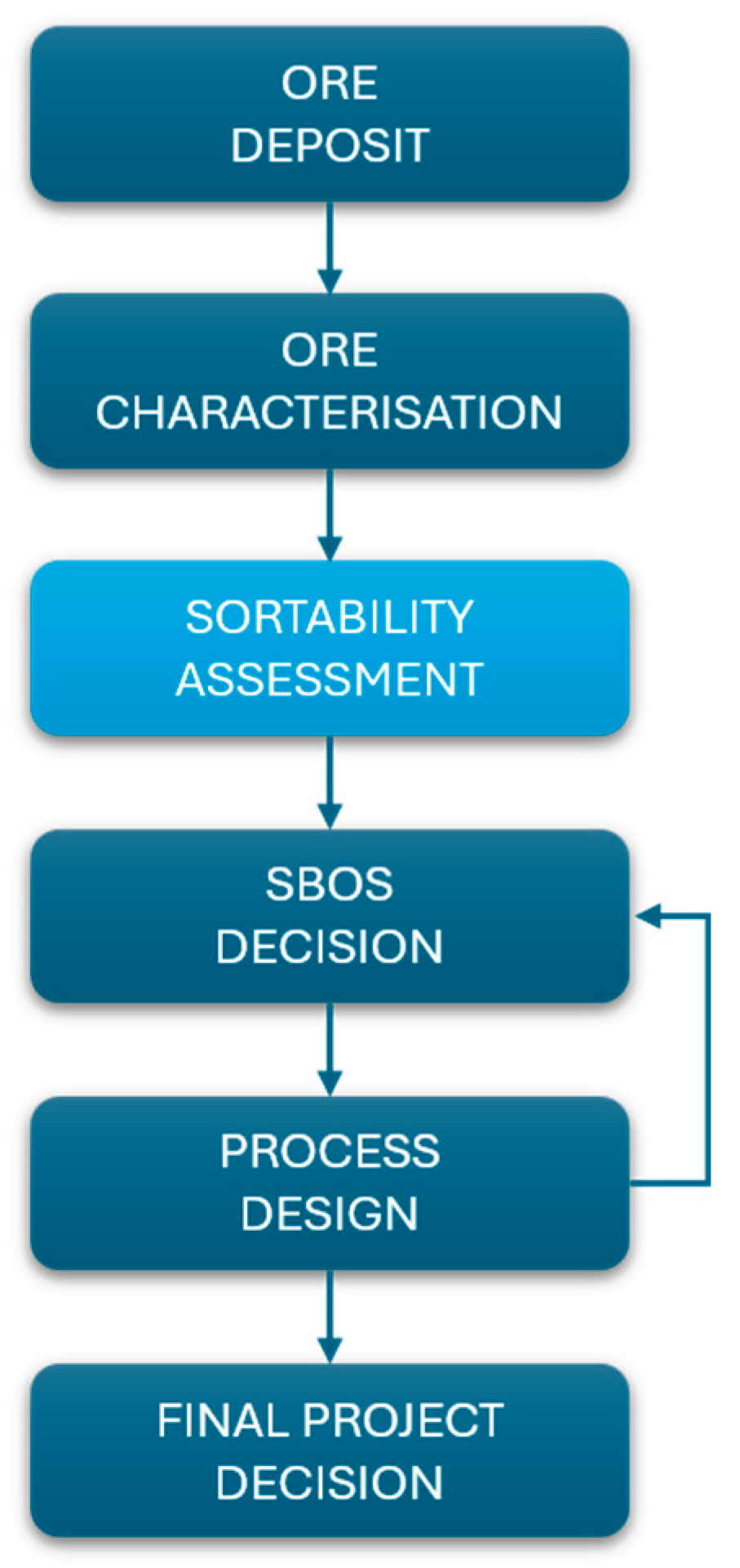
Figure 2.
Conceptual overlap between Intrinsic Sortability, Sensor Amenability and Sensor Sortability.
Figure 2.
Conceptual overlap between Intrinsic Sortability, Sensor Amenability and Sensor Sortability.
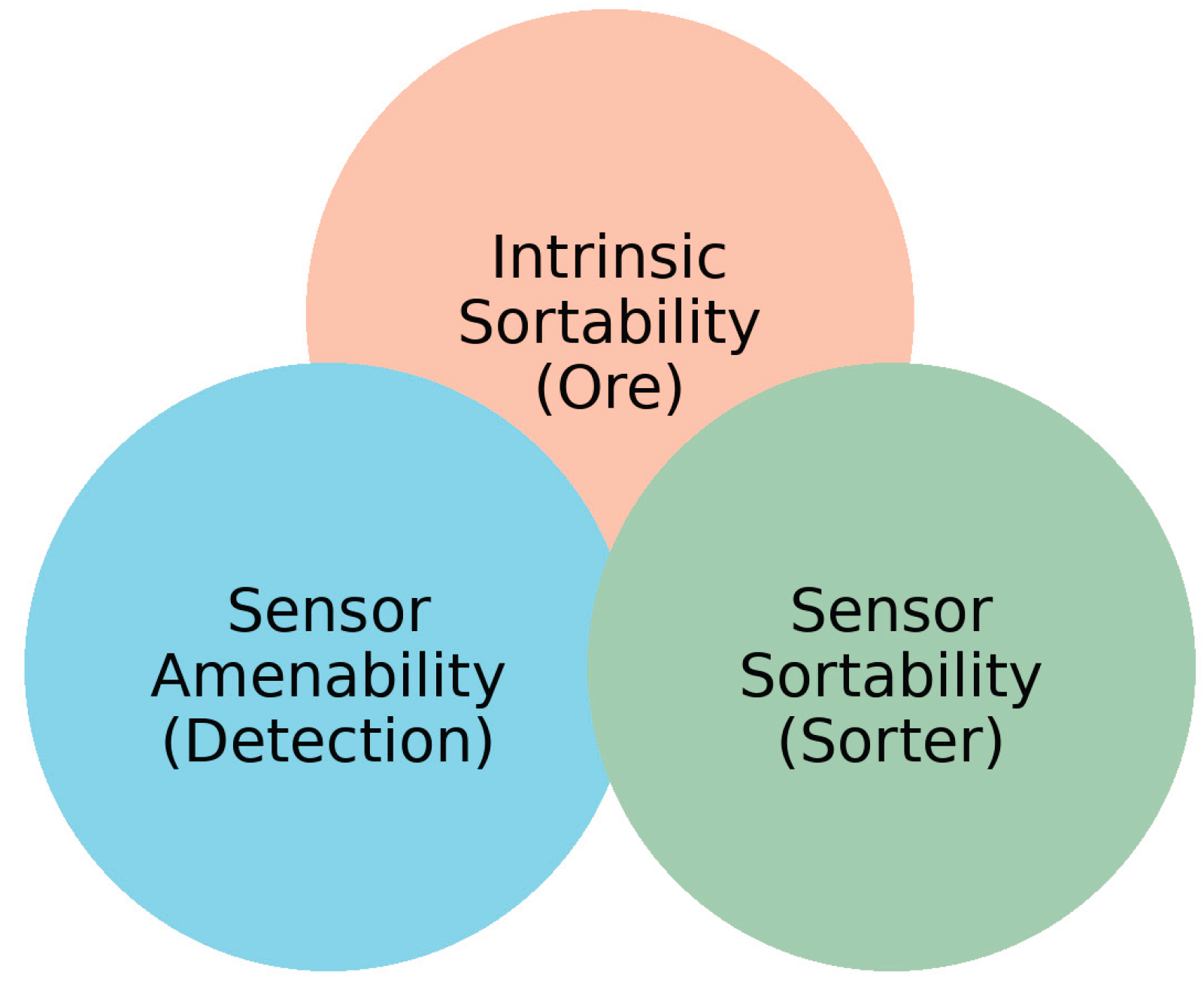
Figure 3.
Assessment categories and original conference review criteria. In the revised nomenclature, platform effectiveness is represented primarily by Classification Effectiveness (CE).
Figure 3.
Assessment categories and original conference review criteria. In the revised nomenclature, platform effectiveness is represented primarily by Classification Effectiveness (CE).
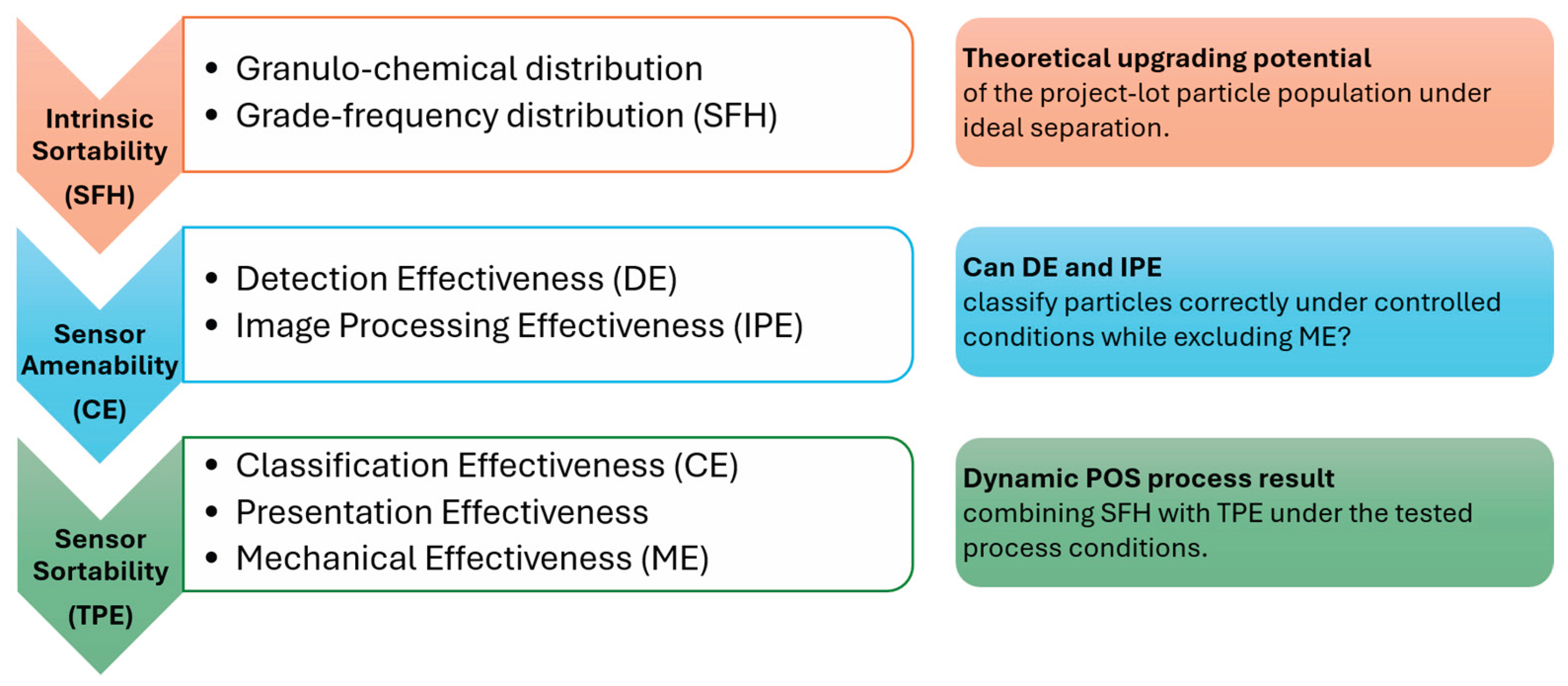
Figure 4.
Consequences of combining SFH, CE and ME into a single sortability result.
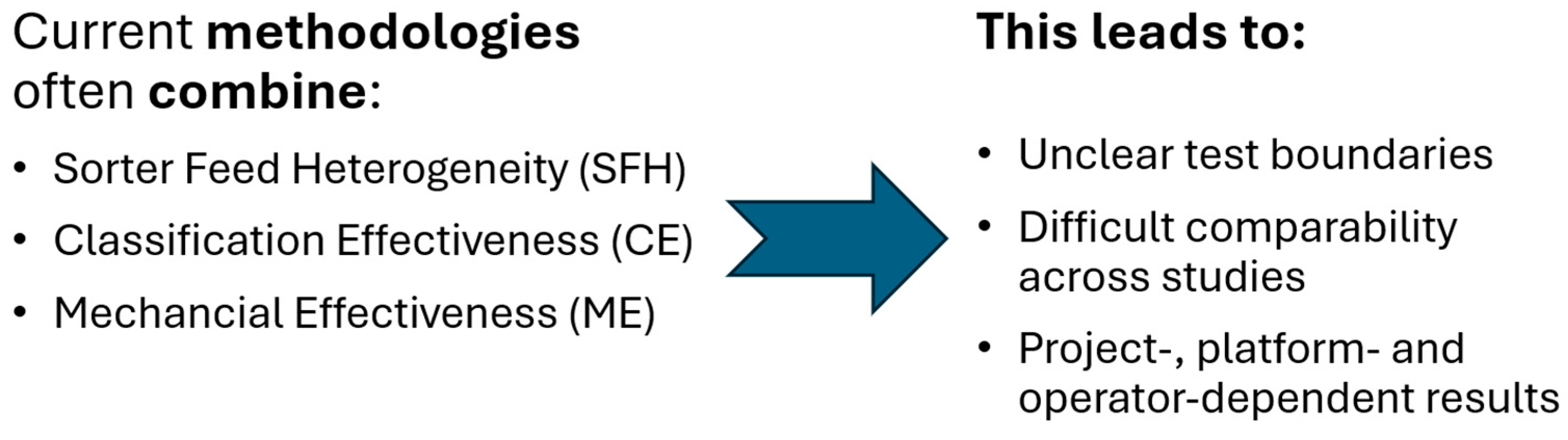
Figure 5.
Proposed analytical hierarchy for future sortability frameworks, mapped to SFH, CE and TPE.
Figure 5.
Proposed analytical hierarchy for future sortability frameworks, mapped to SFH, CE and TPE.
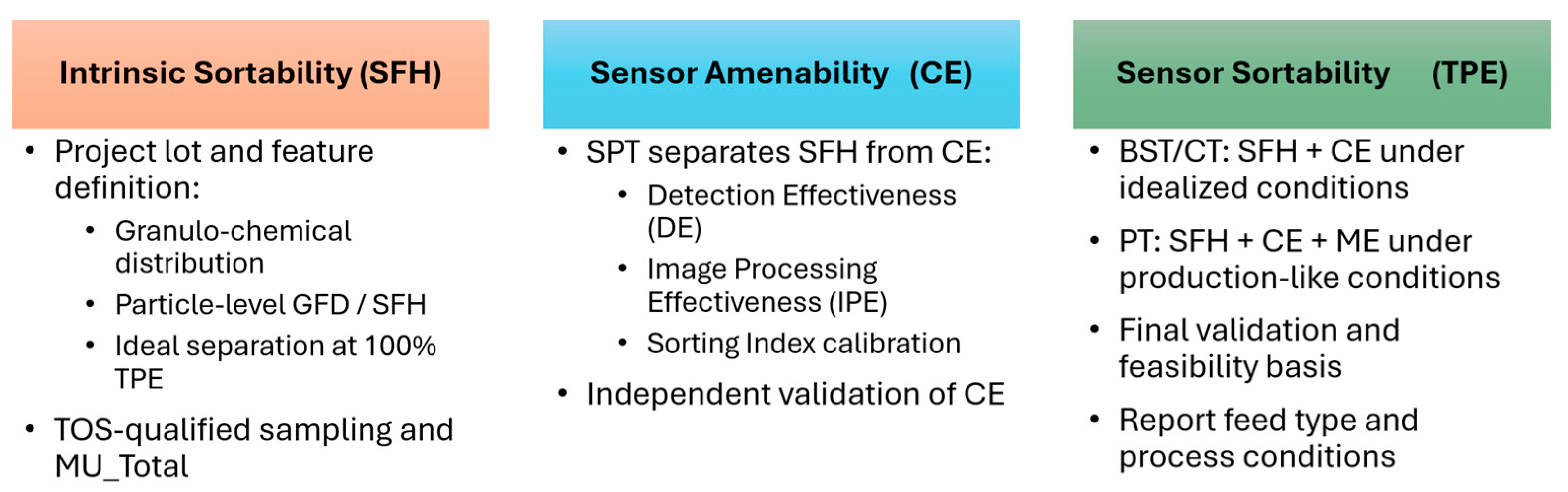
Table 1.
Proposed analytical system boundaries and mapping to the nomenclature of Robben et al. [2].
Table 1.
Proposed analytical system boundaries and mapping to the nomenclature of Robben et al. [2].
| Category | Primary Question | System Boundary and Mapped Standard Test Methods [2] | Predefined Criteria and Representative Measures |
| Intrinsic Sortability / SFH | What is the theoretical upgrading potential of the project-lot particle population under ideal separation? | Particle-level grade-frequency and granulo-chemical distributions of financial and technical features within sorting-relevant size classes, including the size dependence of liberation and texture in concjunction with the processes of size reduction and classification applied. Sensor response and sorter performance are excluded. Precedes the SPT and supplies the SFH input to BST, CT and PT. |
Particle-size / granulo-chemical distribution; grade-frequency distribution / SFH; size-dependent liberation and texture [19]. Representative outputs: ideal yield, recovery, product grade and waste grade at 100% TPE, with Total Measurement Uncertainty. |
| Sensor Amenability / CE | To what extend can the detection and image-processing chain classify particles correctly under controlled conditions? | DE and IPE under controlled, static conditions, which combine into CE. Material presentation and ME are excluded. The SPT is the only test that separates SFH from CE and excludes ME. | DE: signal contrast, signal-to-noise ratio, dynamic range, spatial resolution, Sorting Index against an independent reference analysis, sensing error [16]. IPE: object segmentation, feature extraction, classifier performance [20]. CE over a range of cut points using confusion matrices and ROC analysis [15], with separated calibration and validation particle sets. |
| Sensor Sortability / TPE | What POS process result is achieved under dynamic conditions? | SFH combined with TPE, comprising CE, presentation and ME, within the tested project lot, machine configuration and operating window. BST and CT combine SFH with CE while ME is excluded or minimised; PT includes SFH, CE and ME under production-like conditions. | CE under dynamic conditions; Presentation Effectiveness: feed rate, area occupancy, particle shape and singulation, travelling speed [21]; ME: ejection accuracy, valve availability, separation geometry [21]. Representative outputs: partition coefficients, Ecart probability and cut value [13]; mass and grade reconciliation with Total Measurement Uncertainty. |
Table 2.
Qualitative rating scale used in the review.
| Rating | Meaning Used in the Review |
| + | The criterion is explicitly addressed by the reported method or evaluation. |
| o | The criterion is addressed partially, indirectly or without a complete quantitative evaluation. |
| – | The criterion is not addressed within the reported scope. |
Table 3.
Coverage of the predefined Intrinsic Sortability and SFH criteria.
| Publication | Particle-Size / Granulo-Chemical Distribution | Grade-Frequency Distribution / SFH | Role / Remark |
| Chieregati et al. [37] | o | o | Heterogeneity testing for sampling and IHL; contextual to SFH |
| Claassen [38] | o | o | Sampling heterogeneity in complex mining environments; contextual to SFH |
| Dominy and Glass [24] | o | – | Geometallurgical sampling and testwork design; domain representativity of the sorter feed |
| Dominy et al. [39] | – | o | Non-destructive reference analysis for particle-level grades in coarse-gold material |
| Duncan and Deglon [10] | + | + | Intrinsic particle properties and ideal separation framework |
| Kern et al. [25] | o | + | Automated mineralogy used to infer particle features and sensor selection |
| Kern et al. [35] | o | + | X-ray radiography combined with automated mineralogy for particle-level reference grades |
| Li et al. [14] | + | + | Fractal modelling of bulk sortability; outside primary POS scope |
| Reple et al. [9] | o | o | Heterogeneity-based cut-off estimation; contextual and at bulk scale |
| Robben et al. [22] | + | + | XCT-based particle heterogeneity and liberation characterisation |
| Robben et al. [2] | + | + | Standardised granulo-chemical, GFD and SFH framework linked to test methods |
| Seiler [27] | o | + | Surface-XRF mapping for particle reference-grade estimation |
| Sousa et al. [19] | + | o | Macro-texture characterisation and liberation assessment at coarse crushing sizes |
| Wilkie [23] | + | + | Texture modelling and GFD-based ideal separation simulation |
Table 4.
Coverage of the predefined DE and IPE criteria.
| Publication | Detection Effectiveness (DE) | Image Processing Effectiveness (IPE) | Role / Remark |
| Adewuyi et al. [40] | + | + | Multi-sensor integration concepts |
| Amar et al. [7] | + | o | Bench-scale DE-XRT, near-infrared and colour sorting of phosphate waste rock |
| Duan et al. [34] | + | o | Microwave imaging as an alternative detection principle |
| Fang et al. [33] | + | + | X-ray absorption spectroscopy with deep-learning mineral classification |
| Kern et al. [25] | + | o | Automated mineralogy used for sensor selection |
| Kern et al. [35] | + | + | X-ray radiography with automated mineralogy for calibration of sorting routines |
| Li et al. [15] | + | + | ROC-based evaluation of XRF sensing and cut-point selection; bulk scale |
| Li et al. [16] | + | – | Error analysis of XRF sensing; sensing-error contribution to uncertainty; bulk scale |
| Liu et al. [31] | + | + | Particle-swarm-optimised support vector machine for XRF sorting of porphyritic copper ore |
| Neubert and Wotruba [26] | + | – | Dual-energy XRT detectability of rare-earth minerals |
| Robben et al. [2] | + | + | SPT calibration and validation of DE, IPE and CE; BST/CT idealised CE |
| Seiler [27] | + | o | Surface-XRF mapping and particle-grade estimation |
| Tong [36] | + | o | Laboratory sensor-amenability study |
| Tuşa et al. [32] | + | + | Hyperspectral SWIR sensor performance with machine-learning classification |
| Veras et al. [30] | + | – | DE-XRT detectability of minerals bearing heavy rare earth elements |
| Xu et al. [20] | + | + | Logistic regression and SVM classifiers for XRF particle sorting; separated calibration and validation sets |
| Zhang et al. [28] | + | o | DE-XRT assessment for a sulphide ore |
| Zhang et al. [29] | + | o | DE-XRT assessment of coal sortability and washability |
Table 5.
Coverage of the predefined CE, presentation and ME criteria.
| Publication | Classification Effectiveness (CE) | Presentation Effectiveness | Mechanical Effectiveness (ME) | Role / Remark |
| Amar et al. [7] | + | o | – | Bench-scale multi-sensor sorting of phosphate waste rock; ME not isolated |
| Dance et al. [42] | + | o | + | Lab-scale pre-concentration test |
| Duncan [11] | + | o | o | Protocol integrating intrinsic and sensor testing |
| Fitzpatrick [12] | + | + | + | Methodology for automated sorting evaluation |
| Gülcan [13] | + | + | + | Partition coefficients, Ecart probability and cut value for an industrial NIR sorter |
| Küppers et al. [21] | o | + | + | Throughput, feed composition, particle shape and valve failure; transferable evidence |
| Modise et al. [4] | o | – | o | Review of sensor technologies |
| Peukert et al. [5] | o | – | o | Review of sensor fusion potential |
| Robben and Dumont [41] | + | + | + | Industrial sorter test methodology |
| Robben et al. [6] | + | + | + | Industrial XRT sorting at production scale; reconciliation over extended operation |
| Robben et al. [2] | + | + | + | SPT/BST/CT/PT framework; PT includes full TPE |
| Tong [36] | o | o | o | Laboratory-scale sensor-based sorting tests |
Table 6.
Qualitative distribution of the reviewed literature.
| Assessment Category | Typical Methods | Literature Coverage | Principal Gap Identified |
| Intrinsic Sortability (SFH) | Granulo-chemical analysis, GFD/SFH, mineralogical and textural modelling | Low–Moderate | No universally accepted cross-comparable SFH metric or size-dependent liberation function; geometallurgical data requirements for sorter-feed representativity are not defined |
| Sensor Amenability (CE) | SPT, detectability studies, DE/IPE calibration and validation, machine-learning classification | High | DE, IPE and CE metrics are reported against study-specific protocols and are rarely linked to an independently measured SFH or to a stated measurement uncertainty |
| Sensor Sortability (TPE) | BST, CT, PT and industrial dynamic testwork | High | PT results are project-lot and condition specific; presentation and ME contributions are seldom separated and require TOS-qualified reporting |
Disclaimer/Publisher’s Note: The statements, opinions and data contained in all publications are solely those of the individual author(s) and contributor(s) and not of MDPI and/or the editor(s). MDPI and/or the editor(s) disclaim responsibility for any injury to people or property resulting from any ideas, methods, instructions or products referred to in the content. |
© 2026 by the authors. Licensee MDPI, Basel, Switzerland. This article is an open access article distributed under the terms and conditions of the Creative Commons Attribution (CC BY) license (http://creativecommons.org/licenses/by/4.0/).
Copyright: This open access article is published under a Creative Commons CC BY 4.0 license, which permit the free download, distribution, and reuse, provided that the author and preprint are cited in any reuse.