

Submitted:
14 September 2026
Posted:
16 September 2026
You are already at the latest version
Abstract
The environmental chemical exposome encompasses legacy pollutants and emerging contaminants that collectively shape ecological and human health risks. Texas and New Mexico contain petrochemical, agricultural, mining, and energy production regions, yet no quantitative synthesis has characterized exposure research or identified knowledge gaps that limit environmental management. We present a bibliometric and text-mining assessment of research on environmental pollution across both states from 1999 to 2024. A search of Web of Science and PubMed yielded 4,936 records, of which 191 met eligibility criteria. Keyword normalization, trend factor and co-occurrence analyses, geospatial mapping, and domain classification characterized the landscape. The most frequent keywords were air pollution, lead, arsenic, and polycyclic aromatic hydrocarbons, reflecting emphasis on legacy contaminants and industrial air pollution. Trend factor analysis revealed growth in PFAS, EDCs, pharmaceuticals, black carbon, microplastics, and nanoplastics during 2020 to 2024; normalization of the log response ratio by period reproduced the ranking (Spearman rho = 0.999). Air (31.9%), soil and sediment (25.7%), and water (25.7%) dominated, whereas health and exposure (16.3%) and environmental justice (11.6%) remained underrepresented. Clusters included Industrial Air Quality and Health (n = 85) and Heavy Metals in Soil and Water (n = 72). Studies concentrated in the Houston Gulf Coast region, while New Mexico contributed 9.4% of publications. Approximately 82% did not address environmental justice. Persistent gaps include PFAS homologs, 6PPD quinone, flame retardants, neuroactive pharmaceuticals, transboundary waterways, and Indigenous communities. These findings establish an evidence-based framework for prioritizing regional monitoring, biomonitoring, environmental justice research, and regulatory decisions.
Keywords:
legacy pollutants
; contaminants of emerging concern
; environmental pollution
; trend-factor analysis
; New Mexico
; Texas
1. Introduction
The States of Texas and New Mexico occupy a strategically important environmental corridor in the United States’ South Central and Southwestern regions. Together, they encompass more than 400,000 square miles and share interconnected air, water, energy, agricultural, and borderland systems that are central to national environmental health, resource security, and climate resilience [1,2]. The region includes major petrochemical and shale-energy infrastructure, including the Permian Basin, one of the most productive unconventional (horizontal drilling and fracking) oil and gas provinces in the world, as well as critically stressed water resources such as the Ogallala, Edwards, and Hueco-Mesilla Bolson aquifer systems and the transboundary Rio Grande and Galveston Bay estuary [3,4,5]. Despite their ecological and economic importance, Texas and New Mexico face overlapping pollution challenges that are difficult to evaluate through a single regulatory or monitoring framework. Industrial activities, energy production, agriculture, mining, wildfire smoke, and contaminants of emerging concern collectively generate a complex regional pollution profile [6,7,8,9]. A regional, cross-state framework is therefore needed to better characterize contaminant sources, transport pathways, cumulative exposures, and environmental-health risks across this shared Texas-New Mexico landscape.
Within this framework of interconnected environmental challenges, scientific investigations of pollution across Texas and New Mexico have expanded considerably over the past two decades. Previous investigations have documented atmospheric pollutants associated with petrochemical activities, groundwater contamination by metals and inorganic pollutants, persistent organic pollutants, produced-water impacts, PFAS, microplastics, pharmaceuticals, and other contaminants of emerging concern [6,10,11,12,13,14,15,16,17,18,19,20]. Notwithstanding this substantial body of research, the scientific literature remains highly fragmented, often organized around individual contaminants, isolated geographic locations, or specific environmental media. Consequently, no comprehensive, data-driven synthesis has systematically evaluated the regional pollution research landscape spanning both Texas and New Mexico. Existing reviews rarely examine how research priorities have evolved over time, identify geographic or demographic disparities in scientific attention, and reveal emerging contaminant classes that remain understudied. As a result, research priorities continue to be shaped largely by historical emphasis rather than by an objective assessment of current environmental risks and knowledge gaps.
A systematic assessment is therefore needed to identify dominant contaminant classes, evaluate temporal shifts in research priorities, and determine geographic and thematic gaps that limit environmental monitoring and policy development. In recent years, bibliometric analysis integrated with text-mining and computational mapping techniques has been used as a powerful approach for synthesizing large and heterogeneous scientific literature [21]. By combining keyword normalization and stemming, temporal trend analysis, co-occurrence network mapping, thematic clustering, and rule-based domain classification, these methods enable quantitative characterization of research patterns that cannot be discerned through conventional narrative reviews [22,23]. When applied to a geographically defined body of literature, they provide insight into not only what has been investigated but also where scientific attention has been disproportionately concentrated, which contaminants or environmental media remain understudied, which populations and ecosystems have been overlooked, and where future investigations are likely to produce the greatest reductions in scientific uncertainty and regulatory risk [21,23].
While bibliometric and text-mining approaches provide a powerful means of characterizing research landscapes, their application in environmental science can also be viewed through the broader conceptual lens of the chemical exposome [24]. Beyond cataloging pollutants, the present study is grounded in the environmental chemical exposome concept, which views human and ecological health as being influenced by the totality of chemical exposures occurring across space, time, and environmental media rather than by individual contaminants in isolation. Although exposome research is traditionally associated with direct measurement of external and internal exposures using biomonitoring, omics technologies, and personal exposure assessment, a complementary systems-level perspective recognizes that comprehensive characterization of the environmental chemical landscape is an essential prerequisite for understanding cumulative exposure [25,26]. In this context, literature mapping functions as an exposome-discovery framework by systematically identifying which contaminant classes, environmental compartments, geographic regions, exposure pathways, and vulnerable populations have been extensively investigated and, equally importantly, which components of the regional exposure landscape remain poorly characterized [27]. Rather than measuring individual exposures directly, the present analysis maps the current state of scientific knowledge describing the regional chemical exposome, revealing where evidence exists, where critical blind spots persist, and where future environmental monitoring should be prioritized to enable a more complete assessment of cumulative chemical exposures. By integrating bibliometric analysis with contaminant classification, temporal trend analysis, geospatial mapping, and environmental justice evaluation, this study extends conventional bibliometric approaches beyond publication statistics toward a systems-level representation of the evolving regional chemical exposome across Texas and New Mexico.
To address these gaps, the present study applies an integrated bibliometric and text-mining framework to a systematically curated 191 peer-reviewed, field-based environmental pollution studies conducted in Texas and New Mexico between 1999 and 2024. To the best of our knowledge, this represents the first comprehensive quantitative assessment of the regional environmental pollution literature spanning these two states. Beyond documenting publication trends, the study characterizes the temporal evolution of research priorities, identifies dominant contaminant classes and environmental media, maps geographic patterns of scientific investigation, evaluates institutional and thematic research networks, and reveals areas where environmental monitoring and field observations remain limited. Importantly, the analysis extends beyond identifying research “hotspots” to systematically uncovering research “blind spots”, contaminants, ecosystems, geographic regions, and vulnerable communities that have received disproportionately little scientific attention despite their potential environmental and public health significance. This study addresses five overarching questions concerning research trends, contaminant priorities, temporal evolution, geographic disparities, and future monitoring needs.
The region encompasses diverse industrial, agricultural, military, and border environments that bear disproportionate environmental burdens and face increasing challenges from legacy and emerging contaminants [7,28,29,30]. At the same time, regulatory priorities continue to evolve rapidly. The U.S. Environmental Protection Agency’s 2024 National Primary Drinking Water Regulations for six PFAS compounds have substantially increased the need for robust regional occurrence data, while contaminants such as tire-wear-derived 6PPD-quinone, micro- and nanoplastics, organophosphate flame retardants, pharmaceuticals, produced-water constituents, and replacement PFAS chemistries remain inadequately characterized in field investigations across much of the region. Identifying these deficiencies through a systematic, quantitative assessment of the literature is therefore a critical prerequisite for prioritizing future monitoring programs, informing regulatory decision-making, directing research investments, and ultimately strengthening environmental and public health protection throughout Texas and New Mexico.
2. Methodology
The methodological framework adopted in this study is based on the bibliometric and text-mining approach employed by Zhu et al. (2021) [23], with modifications to accommodate the specific research objectives, study area, and analytical requirements of the present investigation. The adapted methodology is described below.
2.1. Data Collection and Research Approach
Data were collected from the Web of Science Core Collection (all collections) and PubMed, the two primary bibliographic databases employed in this study. Both databases were searched for peer-reviewed research articles and review papers published between January 1999 and December 2024. The Web of Science query combined topic-field (TS=) operators to require geographic specificity (Texas OR New Mexico OR TX OR NM), broad pollution terminology (pollut* OR contaminat* OR exposure OR emerging contaminant*), and environmental media (air OR soil OR water OR wastewater OR solid waste). These were further combined with contaminant-specific terms representing major classes of environmental pollutants, including per- and polyfluoroalkyl substances (PFAS), perfluorooctanoic acid (PFOA), perfluorooctane sulfonate (PFOS), polycyclic aromatic hydrocarbons (PAHs), polychlorinated biphenyls (PCBs), microplastics (MPs), endocrine-disrupting chemicals (EDCs), pharmaceuticals and personal care products (PPCPs), and selected heavy metals (e.g., arsenic, lead, and cadmium). An equivalent search strategy was implemented in PubMed using relevant Medical Subject Headings (MeSH), including Environmental Pollution, Soil Pollutants, Water Pollution, Air Pollution, Wastewater, and Solid Waste, combined with title-and-abstract (tiab) searches for the same geographic and contaminant terms. Publication dates were restricted to the period from 01/01/1999 to 12/31/2024. Records retrieved from both databases were merged, and duplicate entries were removed, yielding a final dataset of 4,936 unique publications. For each record, bibliographic metadata, including article title, authors, abstract, author-provided keywords, publication year, journal title, digital object identifier (DOI), and institutional affiliations (where available), were exported for subsequent bibliometric and text-mining analyses. The complete Web of Science and PubMed query strings, the truncation and Boolean syntax, the search execution dates, the database editions searched, the records returned by each database, and the deduplication procedure are reported verbatim in Supplementary Information S1.
2.2. Screening and Eligibility Criteria
The study screening and eligibility check process consisted of three stages. Stage 1 involved title-and-abstract screening using predefined inclusion criteria. These criteria require that studies be (i) peer-reviewed research articles or review papers, (ii) published within the specified date range (01/01/1999–12/31/2024), (iii) explicitly focused on environmental pollution in Texas or New Mexico, and (iv) contain at a minimum an abstract, author-supplied keywords, and sufficient geographic information. Editorials, letters to the editors, conference abstracts, book chapters, dissertations, and other non-peer-reviewed publications were excluded. This initial screening reduced the textual dataset from 4,936 to 1,219 records. Stage 2 consisted of full-text screening to verify geographic specificity, environmental relevance, and compliance with the inclusion criteria. Studies lacking adequate geographic information or those not directly addressing environmental pollution within the study region were excluded, reducing the dataset to 719 publications. Stage 3 applied two additional eligibility criteria to define the final analytical study pool. First, studies were required to investigate one or more classes of emerging contaminants, including PFAS, MPs, PAHs, PCBs, PBDEs, EDCs, PPCPs, or other contaminant classes specified in the search strategy. Second, only field-based investigations, including environmental monitoring, exposure assessment, source apportionment, ecological assessment, and geospatial analyses conducted using environmental samples, were retained. Consequently, laboratory-only experiments, mechanistic toxicological studies without environmental sampling, and computational or modeling studies lacking field observations were excluded. To enhance the dataset’s completeness, the literature search was supplemented by reviewing the Google Scholar publication profiles of six leading researchers conducting active field-based research on environmental pollution in Texas and New Mexico. Publications identified through this supplementary search were included only if they satisfied all predefined eligibility criteria and were not already captured in the primary database searches. Following the three-stage screening process and a supplementary literature search, the final analytical dataset comprised 191 peer-reviewed publications, which served as the basis for all subsequent bibliometric, text-mining, and network analyses.
2.3. Data Extraction Protocol
For each of the 191 retained papers, two reviewers independently extracted 26 data fields. These fields covered bibliographic information (title, authors, year, journal, DOI); geographic information (state(s) studied, specific locations, coordinates where available); environmental media (air, water, soil, sediment, biota, wastewater); contaminant information (major categories, specific compounds, and excluded compounds); analytical methods and detection-limit adequacy, study design type (cross-sectional, longitudinal, seasonal, and trend); duration (one-time vs. multi-year); reported knowledge gaps and temporal gaps, gap category, suggested future directions, and environmental justice considerations. Extracted data were compiled into a structured relational spreadsheet and cross-checked for consistency.
2.4. Keyword Preprocessing and Normalization
Raw keywords were extracted from three sources for each paper: author-supplied keywords, title-derived n-grams, and abstract-derived n-grams. This generated a raw vocabulary of 2,020 cumulative keyword instances across 276 keyword entries. Following this step was the preprocessing of keywords, in which a six-step normalization pipeline was adapted as follows. First, all keywords were converted to lowercase, and punctuation was removed. Second, parenthetical abbreviations were removed to canonicalize chemical names (e.g., “polycyclic aromatic hydrocarbons (PAHs)” became “pahs”). Third, we applied stemming using regular expression-based suffix removal to reduce inflectional variants (“contamination”, “contaminant”, “contaminating” to a common root). Fourth, we constructed a domain-knowledge synonym map of 136 substitution rules to consolidate chemical family variants and abbreviations. These rules collapsed, for example, all PFAS nomenclature variants (PFOA, PFOS, PFHxA, PFHxS, PFBA, PFBS, GenX, PFNA, and HFPO-DA) into a normalized PFAS vocabulary; merged “polychlorinated biphenyls” and “PCBs” into “PCBs”; and combined “microplastics” and “nanoplastics” into a shared class. Fifth, stop words and generic connective terms (e.g., “the,” “using,” “and”) were removed. Sixth, keywords with a post-normalization frequency below two occurrences were removed from trend and co-occurrence analyses, though they were retained in the full frequency table. After preprocessing, the normalized vocabulary contained 1,263 unique terms from 2,019 usable keyword instances. The synonym map and full normalization decisions are documented in Supplementary Information S1, Table S1. To test whether manual consolidation altered the frequency structure of the corpus, we compared the pre-normalization and post-normalization rankings of the 67 terms common to both tables. The two rankings agree closely (Spearman rho = 0.82, p < 0.001; Kendall tau = 0.76, p < 0.001), 9 of the top 10 and 14 of the top 20 terms are shared, and the largest rank shifts occur exactly where consolidation was intended, namely shale and oil and gas terminology, EDC and pharmaceutical terminology, and Indigenous community terminology. Supplementary Information S1, Table S2, reports the full side-by-side comparison.
2.5. Keyword Frequency and Temporal Analysis
Keyword frequencies were calculated after normalization of author-supplied keywords through preprocessing, including case standardization, spelling harmonization, stemming, and synonym consolidation. Overall keyword frequency was then determined across the final study pool of 191 publications. To examine temporal patterns, the publications were partitioned into five approximately equal five-year intervals (1999–2004, 2005–2009, 2010–2014, 2015–2019, and 2020–2024). Publication years for all 191 papers in the final analytical pool were manually extracted and verified. Each paper was assigned to its corresponding five-year interval based on its confirmed publication year, yielding exact period-level paper counts of 20 (1999–2004), 35 (2005–2009), 46 (2010–2014), 45 (2015–2019), and 45 (2020–2024). All temporal keyword frequencies and trend factors reported below are computed from verified publication-year assignments for all 191 papers. Keywords were assigned to periods based on structured data extracted from each paper, using the “contaminant,” “medium,” “state,” “environmental justice,” “classification,” and “title” fields as keyword signal sources. Temporal trends were quantified by adapting the trend-factor approach proposed by Zhu et al. (2021) [23] (Supplementary Information S1, Supplementary Information S2, and Table S3). For each keyword, the trend factor (TF) was calculated as:
where is the keyword count in the 2020–2024 interval, and is the keyword count in the 1999–2004 interval. Positive TF values indicate increasing research attention, TF values equal to zero indicate persistence, and negative TF values indicate declining attention. When a keyword was absent from the 1999–2004 interval but appeared in 2020–2024, the ratio was undefined. Such keywords were classified as emerging and assigned the zero-baseline convention . For keywords with non-zero earliest-period counts, positive TF values indicate increasing research attention, whereas negative values indicate declining attention. Zero-baseline TF values were treated separately as ordinal indicators of emerging topics. Keywords with trend factors close to one were considered persistent, indicating relatively stable research interest, whereas those with trend factors less than one were classified as declining. In addition to overall keyword frequency, this framework enabled the identification of three principal categories of research themes: top keywords (most frequently occurring), trending keywords (increasing over time), and emerging keywords (newly appearing during the most recent period). However, two important features of this metric are that TF measures relative change in raw keyword counts, so the value is bounded below by -1 and is unbounded above. A keyword with TF = 0 occurs equally often in both intervals, a keyword with TF > 0 occurs more often in the recent interval, and a keyword with TF < 0 occurs less often. Also, the ratio is undefined for keywords absent from 1999-2004, and the zero-baseline convention stated above assigns these keywords values that scale with their 2020-2024 count rather than with any measured rate of change. These zero-baseline TF values are ordinal indicators of novelty and magnitude of recent occurrence and are not numerically comparable with TF values calculated from a non-zero baseline. Reported TF values for PFAS, EDCs and pharmaceuticals, black carbon, and microplastics and nanoplastics fall in this category. Because the five intervals contain unequal numbers of papers (20, 35, 46, 45, and 45), and because the ratio is undefined at a zero baseline, we computed a companion metric for every keyword. The log response ratio (LRR) expresses the change in keyword prevalence instead of raw count, and applies a 0.5 continuity correction to both intervals so that the statistics is defined throughout:
where N is the number of papers in the interval. The two metrics rank keywords almost identically (Spearman’s rho = 0.999, p < 0.001) and return the same ten leading keywords, which indicates that the temporal conclusions of this study do not depend on the choice of metric. The LRR nonetheless reverses the sign for several keywords whose raw counts rose while their prevalence fell, and Supplementary Table S4 reports both metrics for all 37 keywords together with the interval prevalences from which they were computed.
2.6. Co-Occurrence Analysis
Co-occurrence frequencies were calculated for all pairwise combinations of the 30 most frequently occurring normalized keywords. To avoid duplicate counting, keywords within each pair were arranged in alphabetical order prior to analysis, ensuring each keyword pair was represented only once. Keyword pairs with a co-occurrence frequency of two or more publications were retained for subsequent analysis. The retained co-occurrence pairs were grouped into thematic research clusters through expert-guided manual annotation based on their conceptual and environmental relevance. Each cluster was subsequently characterized by its core keywords, estimated number of associated publications, predominant study locations, linked environmental and human health endpoints, and an evidence-gap rating that reflected the extent of research coverage within the cluster. To test the manual clusters against a data-driven partition, we reconstructed the co-occurrence network as a weighted undirected graph of 29 nodes and 50 edges and applied Louvain community detection, repeating the optimization across 20 random seeds and retaining the highest-modularity solution. We measured agreement between the algorithmic and manual partitions using the adjusted Rand index and normalized mutual information.
2.7. Domain Classification
Each publication was classified into one or more of six environmental research domains: Air, Water, Soil/Sediment, Health/Exposure, Environmental Justice, and Oil and Gas. Domain assignment was performed using a rule-based keyword matching approach in which each domain was represented by a predefined set of domain-specific surrogate keywords. A publication was assigned to a domain if one or more of its normalized keywords matched the corresponding surrogate keyword set. Because publications could address multiple environmental domains, multi-domain assignments were permitted. Consequently, co-membership frequencies were calculated to identify the most common combinations of research domains and to characterize interdisciplinary patterns within the literature. For descriptive analyses requiring a single domain assignment, each publication was assigned a primary domain corresponding to the domain with the greatest number of matched surrogate keywords. When multiple domains produced the same number of keyword matches, ties were resolved using the overall frequency of domain co-membership across the analytical study pool. Rule-based assignment is deterministic and therefore reproducible from the surrogate keyword lists in Supplementary Table S1, but it is not independent of the judgement used to build those lists. Domain assignment was performed once by the rule set rather than by two independent human coders, so no inter-rater agreement statistic applies to this step. The upstream data extraction was performed independently by two reviewers and reconciled by discussion, and the surrogate keyword lists were agreed by the full author team before application. Section 4.5 states the residual classification uncertainty this leaves.
2.8. Geospatial and Environmental Justice Analysis
Geographic coverage was evaluated by assigning each publication to one or more study locations based on location-specific terms identified in its normalized keywords and study-site descriptions. Fifteen (15) geographic regions of interest were defined across Texas and New Mexico, encompassing major metropolitan areas (e.g., Houston, Dallas–Fort Worth, El Paso, and Albuquerque) as well as ecologically and industrially significant subregions (e.g., the Permian Basin, Navajo Nation, Rio Grande Corridor, and Ogallala–High Plains). The frequency of publications per region was quantified, and qualitative evidence gap ratings were assigned based on the density and thematic diversity of the available literature. Environmental justice (EJ) was assessed using the EJ/Vulnerable Populations field extracted during data collection, which recorded whether a study explicitly incorporated environmental justice considerations or investigated populations disproportionately affected by environmental contamination, including low-income communities, racial or ethnic minority groups, Indigenous communities, pregnant women, and children. Publications were categorized as EJ-inclusive, non-EJ-inclusive, or unspecified, and their distributions were subsequently examined across research domains and geographic regions to identify spatial and thematic disparities in environmental justice representation. The EJ variable is coded Yes when a study either named the environmental justice framework and analysed exposure or outcome inequity directly, or investigated a demographically vulnerable population without adopting that framing. Studies of schoolchildren, pregnant women, colonia residents, private-well users, and Diné and Pueblo communities therefore code as EJ-inclusive whether or not the authors invoked environmental justice terminology. The variable measures coverage of environmental justice and vulnerable population concerns taken together, and it does not separate explicit framing from implicit population focus. Section 4.5 sets out the three-tier scheme that would make that separation.
3. Results and Discussion
3.1. Overview of the Analyzed Dataset
The three-stage screening workflow reduced the initial dataset of 4,936 records to a final analytical study pool of 191 eligible publications. The primary reasons for exclusion were insufficient geographic specificity (i.e., studies that mentioned Texas or New Mexico only peripherally), laboratory-only study designs without environmental field sampling, and the absence of field-based investigations addressing emerging contaminants. The final study pool spans the period from 1999 to 2024, extending from early sediment-core reconstructions of legacy contaminant deposition along the Gulf Coast [31] to recent radiological assessments of uranium-mine-impacted surface waters in New Mexico [32], and includes publications from 38 peer-reviewed journals, with Environmental Science & Technology, Science of the Total Environment, Environmental Pollution, Chemosphere, and Environmental Health Perspectives being the most frequently published outlets [33,34,35,36,37].
Texas accounted for the overwhelming majority of the literature, contributing 163 publications (85.3%) of the environmental media investigated across studies (Figure 1A) [38,39], the distribution of study designs, including cross-sectional, one-time, and multi-year/longitudinal investigations (Figure 1B) [40,41,42], and the number of studies that explicitly incorporated environmental justice (EJ) or vulnerable populations (Figure 1C) [43,44], whereas 18 publications (9.4%) focused exclusively on New Mexico [45,46] and 7 publications (3.7%) investigated both states [47]. Also, relatively few investigations explicitly addressed environmental justice in either state. Despite hosting nationally significant environmental challenges, including the Waste Isolation Pilot Plant (WIPP), extensive legacy uranium mining sites on the Navajo Nation, and one of the most intensively developed oil and gas regions in the United States, the peer-reviewed field-study literature on New Mexico remains disproportionately limited [48]. The resulting 9:1 Texas-to-New Mexico publication ratio therefore reveals a substantial imbalance in the distribution of published research attention. The literature is consistent with an underlying imbalance in research investment, monitoring infrastructure, and scientific capacity rather than a corresponding difference in environmental risk or contaminant burden, although bibliometric data record publication output and cannot measure investment, infrastructure, or capacity directly. Consequently, the underrepresentation of New Mexico in field-based research on environmental pollution is one of the principal findings of this review and highlights a critical need for expanded monitoring and research across the state. Annual publication output rises across the study window (Spearman rho = 0.40, p = 0.049, 25 years). The proportion of EJ-inclusive studies differs by state, with 7 of 18 New Mexico-focused studies and 26 of 157 Texas-focused studies coded as EJ-inclusive (chi-square = 3.90, df = 1, p = 0.048; Fisher exact p = 0.049). The proportion also rises over time, from 4 of 69 studies published in 2000-2011 to 30 of 116 published in 2012-2024 (chi-square = 10.31, df = 1, p = 0.001; Fisher exact p = 0.0007) [3,49,50,51].
3.2. Top Keywords and Dominant Research Foci
After normalization, the five most frequent keywords, as shown in Figure 2, were Texas (56 papers, 20.3%), air pollution (30, 10.9%), lead (24, 8.7%), arsenic (23, 8.3%), and polycyclic aromatic hydrocarbons (PAHs) (23, 8.3%). Houston appeared in 22 papers (8.0%), while groundwater and oil-and-gas/shale terminology each appeared in 21 papers (7.6%) [52]. Microplastics and nanoplastics ranked ninth, appearing in 14 papers (5.1%), followed by PCBs, which appeared in 13 papers (4.7%). These frequencies reveal the structural priorities that have shaped 25 years of regional pollution research. The literature is strongly anchored in Texas, particularly Houston and other metropolitan or industrial corridors [54,55]. It also remains concentrated on legacy contaminants, including lead, arsenic, PAHs, and PCBs, which have been regulated and studied for decades [56,57]. In contrast, emerging contaminant classes such as PFAS, microplastics, and endocrine-disrupting chemicals (EDCs), despite increasing regulatory and public-health urgency since 2015, remain comparatively underrepresented.
The prominence of PAHs and lead is historically understandable. PAHs are widespread combustion byproducts generated by the Houston-Galveston petrochemical complex, vehicle emissions, and flaring [12,16,57,58,59,60]. In El Paso, lead contamination in residential soil remains a concern due to the legacy of lead gasoline and smelter emissions [61]. The high frequency of arsenic depicts its dual identity as both a naturally occurring geologic hazard in the Southern High Plains aquifer and a mining-associated contaminant in the Animas River watershed of New Mexico. These contaminants clearly warranted sustained investigation, and the literature confirms that priority [62,63,64]. However, the keyword-frequency data also shows that the field has been slow to redirect attention toward contaminant classes that now represent some of the greatest unresolved regulatory and public-health uncertainties. Regional literature that devotes a quarter-century of effort primarily to well-established legacy contaminants, while leaving several emerging contaminant classes only sparsely represented, is not merely incomplete; it is structurally misaligned with the current landscape of environmental risk and realities. Figure 2 displays the top 25 normalized keywords ranked by frequency. The full 80-term frequency table is presented in Supplementary Table S5.
3.3. Temporal Evolution and Emerging Contaminants
Table 1 summarizes the ten most prominent keywords identified within each five-year interval of the study period. Trend-factor analysis revealed three distinct phases in the evolution of environmental pollution research across Texas and New Mexico. The first phase (1999–2009) was characterized by a strong emphasis on legacy contaminants. Sediment, heavy metals, PAHs, and PCBs dominated the earliest period (1999–2004), each appearing in 6 of the 20 papers published during that period (30.0%), depicting the concentration of Superfund-era legacy-contaminant characterization in the earliest years of the study window. Lead appeared in 1 of the 20 papers (5.0%), substantially lower than the proportional estimate used in the preliminary analysis (which assumed ~55 papers per period) Endocrine-disrupting chemicals (EDCs) and pharmaceuticals appeared in the 2010–2014 and 2015–2019 periods (9 papers, 10.9% and 20.0%, respectively) [65,66,67,68], corresponding to the growing regulatory concern regarding wastewater discharges and endocrine disruption in Texas surface waters; they were largely absent from the earliest period (1999–2004) under the corrected year-based analysis. Other legacy contaminants, including PCBs, uranium, PBDEs, and mercury, featured prominently throughout the first two periods, consistent with extensive post-Superfund investigations of contaminated sites in the Houston Ship Channel, Caddo Lake, the Rio Grande corridor, and Lavaca–Matagorda Bay [6,14,50,69,70,71,72]. Perchlorate also ranked fourth during 1999–2004, reflecting heightened concern following its detection in groundwater across Texas and New Mexico in the early 2000s.
The second phase (2010–2019) marked the emergence of contaminants associated with unconventional energy production alongside a new generation of environmental pollutants. Shale- and oil-and-gas-related terminology entered the top ten keywords during 2010–2014, owing to the rapid expansion of the Barnett Shale and Eagle Ford formations, which established Texas as a major center of unconventional hydrocarbon extraction [7,73,74]. Microplastics and nanoplastics ranked third during this period, indicating an earlier regional research focus than expected, largely driven by the urgent need to understand their fate, transport, and impact on marine and coastal ecosystems [75,76]. PFAS also entered the top 20 keywords for the first time, though it was represented by only three publications. During the same period, increased attention to ultrafine particles, black carbon, and PM2.5 revealed a growing recognition of traffic-related air pollution and its association with adverse cardiovascular health outcomes. The third phase (2020–2024) represents a clear realignment of regional research priorities toward emerging contaminants and environmental health. Air pollution ranked second most frequently, while shale, oil, and gas ranked third, appearing in approximately 10 and 9 papers, respectively. Microplastics and nanoplastics increased to 7 publications, environmental justice to 6, and PFAS to 4. Produced water, a waste stream generated during unconventional oil and gas production and increasingly recognized as a potential source of PFAS, radionuclides, and other contaminants, appeared among the top 20 keywords for the first time. Black carbon and PM2.5 also remained high, showing continued investigation of traffic-related air pollution, particularly in Houston and other rapidly urbanizing regions of South Texas [7,77].
Trend-factor analysis further quantified these temporal shifts. PFAS exhibited the highest trend factor (12.0), reflecting its growth from zero papers in 1999–2004 to 6 in 2020–2024 [16,17,30,78,79,80]. Environmental justice recorded a trend factor of 2.33, growing from 3 papers in 1999–2004 [8,81,82] to 10 papers in 2020–2024 [9,16,61,83,84,85,86,87,88], which is a substantial absolute increase, followed by a rapid increase in recent years. EDCs/pharmaceuticals recorded a trend factor of 10.0 [89,90,91,92]; black carbon reached 6.0 [7,92]; shale/oil & gas reached 6.0 [74,84,94]; and microplastics/nanoplastics recorded 4.0 [76,95]. PFAS now records the highest trend factor (12.0), followed by EDCs/pharmaceuticals (10.0), while black carbon reached 6.0 and microplastics and nanoplastics recorded 4.0. Produced water [96], cancer risk, socioeconomic disparity [7,9], traffic-related air pollution, hurricane/extreme events [9,57,93,97,98], and drinking water each recorded trend factors of 2.0, marking newly established research topics absent from the 1999–2004 literature. Particulate matter (6.0) [99,100,101], shale/oil & gas (6.0), and EDCs/pharmaceuticals (10.0) exceeded a trend factor of 4.0, collectively indicating a substantial transition in regional environmental research priorities. Importantly, however, a high trend factor refers to the rate of growth rather than the maturity of the evidence base. Several emerging contaminant classes have expanded rapidly from a very small initial literature and, therefore, remain supported by relatively few field investigations [102]. Consequently, despite their rapid rise in prominence, the available evidence is still insufficient to provide robust exposure assessments or comprehensive risk characterization for either Texas or New Mexico [103]. This finding highlights a critical gap between emerging environmental concerns and the volume of field-based research available to inform regulatory decision-making and public health policy. Figure 3A depicts the temporal heatmap of the top 20 keywords across all five periods, while Figure 3B shows the trend-factor bar chart of the 0 keywords with the largest positive or negative shift between 1999-2004 and 2020-2024.
3.4. Co-Occurrence Analysis: Research Theme Connections
Co-occurrence analysis of the 30 most frequently occurring normalized keywords identified 50 keyword pairs with co-occurrence frequencies of two or more. The 27 most frequent pairs are presented in Figure 4. The most common pair was Houston-Texas, which appeared in 13 publications (4.7% of the analytical study pool). Among environmentally meaningful associations, Houston-PAHs co-occurred in seven publications, reinforcing the long-standing link between the Houston petrochemical corridor and polycyclic aromatic hydrocarbon monitoring [10,29,104,105,106,107]. Air pollution-NOx/NO2 and PAHs-Texas each co-occurred in six publications. Environmental justice-Texas also appeared in six studies, while environmental justice-Houston occurred in five, indicating that environmental justice research within the region has been concentrated primarily in the state of Texas, particularly in the Houston metropolitan area [7,28,29,83,104]. The Indigenous communities-uranium pair co-occurred in five publications, and the concentrated body of research on legacy uranium contamination across the Navajo Nation can account for this number [6,69,108]. Although this represents one of the most cohesive thematic clusters, given its geographic extent, it also reveals a critical research gap. Existing studies have largely focused on environmental characterization and exposure assessment, with little evidence of community-based biomonitoring, longitudinal health surveillance, remediation trials, or evaluations of intervention effectiveness. Thus, a dense body of publications should not be interpreted as evidence that the underlying environmental or public health problem has been adequately addressed; rather, it may indicate that affected communities have been repeatedly studied without corresponding remediation or sustained public health intervention. The arsenic-groundwater pair co-occurred in four publications, consistent with the persistent occurrence of arsenic contamination in the Southern High Plains, Gulf Coast aquifer, and groundwater basins of New Mexico [62,109,110,111]. Endocrine-disrupting chemicals (EDCs)/pharmaceuticals–wastewater appeared in three publications, all of which investigated municipal wastewater treatment plant effluents in Texas. No comparable field-based studies were identified for New Mexico [67,112,113].
Cluster analysis grouped the keyword co-occurrence network (Figure 4) into 10 major research themes (Figure 5A, B). The largest cluster, Industrial Air Quality and Health (approximately 85 publications), encompasses PAHs, PM2.5, black carbon, volatile organic compounds (VOCs), hazardous air pollutants (HAPs), and NOx, with research concentrated in Houston, El Paso, the U.S.-Mexico border region, and the Dallas-Fort Worth metropolitan area [114]. The second largest cluster, Heavy Metals in Soil and Water (approximately 72 publications), includes lead, arsenic, mercury, cadmium, and chromium, with major study locations centered on El Paso, the Houston Ship Channel, and the Navajo Nation [115]. A third cluster, groundwater contamination (approximately 55 publications), links nitrate, arsenic, perchlorate, fluoride, and total dissolved solids (TDS) across the Ogallala Aquifer, Southern High Plains, Gulf Coast Aquifer, and Permian Basin [116,117]. Three thematic clusters exhibited the most substantial evidence gaps (Figure 5C). The PFAS and Emerging Contaminants of Emerging Concern (CECs) cluster (approximately 28 publications), comprising PFOA, PFOS, EDCs, pharmaceuticals, and triclosan, received a critical gap rating because key locations—including the Houston Ship Channel, waterways in New Mexico, and Galveston Bay—contain industrial facilities, military installations, and agricultural drainage systems where PFAS contamination has been documented elsewhere but remains inadequately characterized in this region. The Microplastics and Novel Emerging Contaminants cluster (approximately 12 publications) was the smallest in the analytical study pool and included no field-based studies from New Mexico. Finally, the Environmental Justice and Exposure cluster (approximately 32 publications) was sufficiently developed to constitute a distinct research theme but was overwhelmingly concentrated in four metropolitan areas [118]. Consequently, Indigenous communities, rural populations, and other underserved regions remain among the most significant geographic and environmental justice gaps in the current literature.
Louvain community detection on the same co-occurrence network returned a modularity of Q = 0.368 across six communities, and greedy modularity maximization converged on an identical partition. A modularity of this magnitude indicates real community structure rather than a random graph, which supports the premise that the keyword network carries thematic organization. The algorithmic partition is coarser than the manual scheme and nests within it. Louvain recovers the air-quality community (air pollution, black carbon, nitrogen oxides, ultrafine particles), a soil and sediment metals community (lead, particulate matter, PCBs, sediment, soil), a water and subsurface community (arsenic, drinking water, groundwater, New Mexico, PFAS, shale and oil and gas, water quality), a uranium and Indigenous community (contamination, Indigenous communities, uranium), a wastewater community (EDCs and pharmaceuticals, wastewater), and a mixed Texas community. Agreement with the ten manual clusters is partial (adjusted Rand index 0.11, normalized mutual information 0.48 across all 29 nodes; 0.16 and 0.53 after excluding the four purely geographic terms). The two schemes share substantial information, and they differ mainly in granularity, because the manual scheme separates PFAS from oil and gas and separates climate-driven from legacy organic contamination, while the network merges these on the strength of co-occurrence alone. We therefore present the manual clusters as an interpretive layer that the algorithmic partition supports at the level of broad structure without reproducing at the level of individual cluster boundaries. A full VOSviewer or Bibliometrix analysis of the complete 4,936-record corpus, rather than of the top 30 keywords, would test this further.
3.5. Environmental Domain Classification
The rule-based domain classification assigned each publication to one or more of six environmental research domains (Figure 6A & Figure 6B), allowing multi-domain membership where appropriate. Air accounted for the largest proportion of publications (31.9%), followed by Soil/Sediment (25.7%) and Water (25.7%). Together, these three domains represented 83.3% of the analytical study pool, highlighting the historical emphasis on environmental media monitoring in the region. In contrast, Health/Exposure (16.3%) and Environmental Justice (11.6%) received comparatively less attention, while Oil and Gas (5.4%) constituted the smallest domain despite the extensive footprint of conventional and unconventional energy development across Texas and New Mexico [73,119,120]. The nearly equal representation of the Air, Water, and Soil/Sediment domains differs from the global pattern reported by Zhu et al. (2021) [23], in which water-focused studies dominated the environmental pollution literature, accounting for approximately 44% of classified publications, whereas soil-related studies represented approximately 25%. The relatively greater emphasis on air pollution research in Texas and New Mexico likely correlates with the region’s concentration of major emission sources, including the Houston petrochemical complex, the Barnett Shale, and the U.S.-Mexico border region, where industrial emissions and transboundary air pollution have been longstanding environmental and public health concerns [8,61,101,104,121,122,123].
Multi-domain co-membership analysis further demonstrated the interdisciplinary nature of this regional literature. The most frequent domain combination was Air-Health/Exposure (20 publications; 7.2%), reflecting the strong integration of air pollution monitoring with human exposure and health outcome studies, especially in the Houston metropolitan area [124,125]. The Soil/Sediment-Water combination ranked second (16 publications; 5.8%), driven primarily by investigations that simultaneously analyzed sediment and surface-water samples from the Houston Ship Channel, Galveston Bay, and the Rio Grande [14,71,72,103,126,127]. The Air-Environmental Justice pairing was the third most common (14 publications; 5.1%), underscoring the growing body of research examining disproportionate exposure to industrial air pollutants among low-income and minority communities [7,61,84,126,128,129]. In contrast, the Oil and Gas-Water combination was reported in only 5 publications (1.8%), suggesting a notable mismatch between research effort and environmental risk. Major hydrocarbon-producing regions, including the Barnett Shale, Eagle Ford Shale, and Permian Basin, overlie critical groundwater resources, including the Edwards, Trinity, and Pecos aquifer systems. Moreover, produced water from unconventional oil and gas operations has been shown elsewhere [73,94], to contain per- and polyfluoroalkyl substances (PFAS), naturally occurring radioactive materials (NORM), barium, strontium, and other contaminants of emerging concern. The limited integration of oil and gas research with groundwater investigations suggests that assessments of aquifer vulnerability have not kept pace with the region’s rapid expansion of energy production. Figure 6A shows the distribution of proportional domains across all papers. Figure 6B shows the multi-domain interaction network.
3.6. Contaminant Landscape: Legacy vs. Emerging Pollutants
Figure 7 summarizes the 21 contaminant classes identified in the analytical study pool, ranked by publication frequency. Five contaminant groups dominated the literature: PM2.5 and black carbon (35 publications; 12.7%), arsenic (24; 8.7%), lead (21; 7.6%), polycyclic aromatic hydrocarbons (PAHs) (21; 7.6%), and nitrate/nutrients (19; 6.9%) [122,130,131]. These contaminant classes account for the largest share of field-based environmental pollution research in Texas and New Mexico. All five represent well-established or legacy contaminants with mature regulatory frameworks, standardized analytical methods, and extensive historical monitoring programs. Their predominance suggests that regional research has remained largely focused on long-recognized environmental hazards, while comparatively less attention has been directed toward recently emerging contaminants.
In contrast, contaminants of emerging concern were substantially underrepresented. Per- and polyfluoroalkyl substances (PFAS) were investigated in 11 publications (4.0%), microplastics in 9 (3.3%), endocrine-disrupting chemicals (EDCs)/pharmaceuticals in 4 (1.4%), and the broader category of novel emerging contaminants, including 6PPD-quinone, tire-wear-derived chemicals, flame retardants, and neuroactive pharmaceuticals, in only 5 publications (1.8%). These low publication frequencies contrast sharply with the increasing environmental and public health significance of these contaminant classes reported globally [16,30,76,95,132,133]. For example, the U.S. Environmental Protection Agency (EPA) established legally enforceable maximum contaminant levels (MCLs) for six PFAS compounds in 2024 [134], demonstrating the growing recognition of their widespread occurrence and potential health risks. Despite documented or suspected PFAS sources associated with military installations, industrial facilities, airports, and wastewater systems throughout Texas and New Mexico, only 11 field-based studies on PFAS were identified. Similarly, field investigations of 6PPD-quinone, tire-wear-derived contaminants, organophosphate flame retardants, and neuroactive pharmaceuticals were virtually absent from the regional literature. This points to substantial knowledge gaps despite increasing evidence of their ecological and toxicological importance. Furthermore, Figure 8 illustrates these disparities using a research-prioritization bubble chart, in which publication frequency is plotted against contaminant maturity (legacy versus emerging), with bubble size indicating the severity of the identified research gap. Legacy contaminants such as PAHs and lead occupy the high-publication, lower-gap quadrant. In contrast, PFAS, microplastics, and other emerging contaminants cluster in the low-publication, high-gap quadrant, indicating they are priority targets for future investigation. This visualization stresses that a low publication frequency should not be taken as a sign of low environmental importance. Rather, for many emerging contaminants, sparse regional literature implies a lack of field-based investigation despite substantial evidence from other regions demonstrating their occurrence, persistence, and potential risks. Consequently, these contaminants represent areas where future monitoring and research investments are likely to yield the greatest reductions in scientific uncertainty and the greatest benefits for environmental management and public health protection.
3.7. Geospatial Distribution and Regional Research Disparities
The geospatial analysis revealed a pronounced spatial imbalance in environmental pollution research, as suggested by other analyses. Studies are heavily concentrated in a few locations in Texas and comparatively sparse across most of New Mexico (Figure 9). Houston and the adjacent Texas Gulf Coast accounted for approximately 37 of the 191 publications, making this region the most intensively studied area in the analytical study pool [135,136]. This concentration likely points to Houston’s extensive industrial activity, well-established academic and research institutions (including the University of Houston, Rice University, and Texas A&M University systems), and a long history of disproportionate environmental burdens affecting low-income and minority communities, which has stimulated sustained research on environmental pollution, environmental justice, and human health disparities [7,28,29,137]. Beyond Houston, South and Southeast Texas contributed approximately 13 publications [138]; West Texas contributed 14, including El Paso [139]; and the Dallas-Fort Worth metropolitan area contributed 3.
In contrast, New Mexico contributed only 18 publications during the 25-year study period. These studies were primarily concentrated in the Rio Grande Corridor (approximately 8 publications) and the Navajo Nation/Four Corners region (approximately 5 publications). The Albuquerque metropolitan area, despite being the state’s largest urban center and home to a substantial Hispanic population, was represented by only three studies. Moreover, Northern New Mexico, including the Santa Fe, Española, and Taos regions, was entirely absent from the analytical study pool.
Importantly, the absence of published field studies should not be interpreted as evidence of low environmental risk. New Mexico contains numerous potential sources of environmental contamination, including legacy uranium mining districts, extensive oil and gas development, military installations, and other industrial activities. The limited number of field investigations, therefore, is more likely to account for disparities in research capacity, monitoring infrastructure, and funding than true differences in contaminant occurrence or environmental burden. This inference is based on the publication record rather than a direct measurement because the bibliometric dataset contains no funding, staffing, or monitoring network variables. Overall, the observed spatial distribution suggests that research effort has historically been driven more by the location of major well-funded research institutions and established monitoring programs than by a systematic assessment of regional environmental risks. Raw publication counts do not adjust for the substantial differences in scale between the two states, so we normalized study counts against population and land area. Texas appears in 170 of the 191 studies, and New Mexico in 25, counting the seven two-state studies in both totals. Against a 2024 resident population of 31,290,831 for Texas and 2,126,774 for New Mexico [140,141], Texas yields 5.4 studies per million residents and New Mexico yields 11.8, so New Mexico is covered 2.2 times more densely than Texas on a per-capita basis. With land areas of 676,587 square kilometers and 314,161 square kilometers, respectively, Texas yields 25.1 studies per 100,000 square kilometers, and New Mexico yields 8.0, so Texas is covered 3.2 times more densely per square kilometer. The 9:1 raw ratio, therefore, overstates the disparity when read as a measure of research attention per resident, and understates it when read as a measure of spatial monitoring density. We accordingly frame the New Mexico shortfall as a deficit in spatial coverage of a large, sparsely populated state that contains concentrated legacy uranium, oil and gas, and military contamination sources, rather than as a uniform deficit in research attention. Normalization against state research funding and institutional counts would further sharpen this comparison, and we recommend it for future regional bibliometric work.
3.8. Environmental Justice Dimensions
Environmental justice analysis reveals one of the most significant structural deficiencies in the body of regional environmental pollution research. Although field-based investigations have substantially advanced the understanding of contaminant occurrence, transport, and fate across Texas and New Mexico, relatively few studies have examined whether these environmental burdens are distributed equitably among affected populations. Of the 191 studies included in this review, 34 (17.8%) were coded as EJ-inclusive under the study’s combined environmental justice and vulnerable-population definition: investigation of disproportionate environmental exposures or health outcomes among low-income communities, racial and ethnic minorities, Indigenous populations, or other socially vulnerable groups. In contrast, approximately 157 studies (82%) contained no explicit assessment of environmental justice, vulnerable populations, or exposure inequities. This omission is concerning, given the studied region’s demographic and industrial characteristics. Within the 34 EJ-inclusive studies, both modes are represented. Some analyse exposure disparity directly, as in the flaring study in South Texas and the residential contamination comparison in Houston. Others sample in vulnerable communities while framing the work as exposure characterization, as in the school-based ultrafine particle measurements and the metal recycling facility cancer risk assessment. Section 4.5 sets out the three-tier scheme that would separate these modes. Texas contains several nationally recognized environmental justice hotspots, including communities along the U.S.-Mexico border, the Fifth Ward and Manchester neighborhoods of Houston, and populations residing adjacent to the Houston Ship Channel [8,29,61,142], where decades of industrial activity have resulted in elevated exposures to hazardous air pollutants, heavy metals, and persistent organic contaminants. Similarly, in New Mexico, Indigenous communities, particularly within the Navajo Nation [6,85,86], continue to experience the legacy impacts of historical uranium mining while simultaneously facing emerging contaminant threats such as per- and polyfluoroalkyl substances (PFAS) associated with military installations [80,143]. Despite these well-documented environmental burdens, the limited number of studies conducted in these communities has focused primarily on environmental characterization, with virtually no long-term epidemiological investigations, community-based biomonitoring programs, or cumulative exposure assessments. The distribution of EJ-focused research also differed markedly across environmental domains. The Air domain contained the greatest number of EJ-inclusive studies (approximately seven), which otherwise show extensive investigations of air toxics, particulate matter, and associated respiratory and cancer risks in historically marginalized communities surrounding Houston’s industrial corridor [58,107,124,126]. By contrast, only three studies within the water domain explicitly incorporated environmental justice [144], despite drinking water being one of the most direct and consequential exposure pathways for vulnerable populations. Even more concerning, no study within the Oil and Gas domain explicitly addressed environmental justice, in spite of extensive unconventional oil and gas development in the Permian Basin and Barnett Shale, where numerous extraction activities occur in or adjacent to economically disadvantaged rural and Hispanic communities. This absence is a critical knowledge gap because these populations may experience cumulative exposures from groundwater contamination, produced water management, air emissions, and associated industrial activities without corresponding environmental health investigations.
Taken together, these findings demonstrate that regional literature has emphasized contaminant monitoring while largely overlooking the populations most likely to experience disproportionate environmental risks. Integrating rigorous field-based environmental measurements with environmental justice frameworks is therefore essential for identifying cumulative exposures, prioritizing vulnerable communities, informing equitable environmental policies, and guiding future monitoring and public health interventions. The distribution of environmental justice inclusion across environmental domains is summarized above, while Figure 10 presents a paired comparison of Texas and New Mexico across nine study-design and thematic categories, with corresponding research-gap severity ratings, highlighting the substantial disparities that remain in both environmental monitoring and environmental justice scholarship.
Field-based environmental pollution research provides the empirical foundation for understanding the occurrence, transport, fate, and ecological and human health impacts of environmental contaminants. By systematically sampling air, water, soil, sediments, and biota, these studies generate spatially explicit data that support exposure assessment, risk characterization, regulatory decision-making, and remediation. Increasing evidence shows that contaminant distributions are influenced not only by environmental processes but also by socioeconomic and historical factors that disproportionately expose vulnerable populations to pollution. This realization has integrated environmental monitoring with environmental justice (EJ), which examines inequities in environmental hazards, health outcomes, and decision-making [145,146,147]. Numerous studies report elevated levels of heavy metals, particulate matter, persistent organic pollutants, PFAS, and other emerging contaminants in low-income, minority, and Indigenous communities located near industrial and transportation infrastructure [149,150]. Despite this evolution, our bibliometric synthesis reveals that environmental justice remains largely overlooked in regional research on environmental pollution across Texas and New Mexico.
3.9. Research Rationale Analysis
Co-occurrence analysis of contaminant keywords with health-impact, ecological, regulatory, and industrial-source terms provides insight into the underlying drivers of environmental pollution research in Texas and New Mexico. Rather than simply identifying which contaminants have been studied most frequently, these associations reveal why specific contaminants have attracted scientific attention and the environmental, public health, and regulatory contexts in which they have been investigated. Table 2 summarizes the co-occurrence patterns for the seven most frequently studied contaminant classes. Polycyclic aromatic hydrocarbons (PAHs) exhibit the strongest association with industrial activities. The most common co-occurring terms are Houston, Ship Channel, petrochemical, flaring, traffic emissions and combustion [10,104,105,120], which suggests that industrial operations and vehicular emissions are the primary drivers of PAH research. Health-related terms such as cancer, hypertension, birth outcomes, maternal exposure, and inhalation exposure [28,58,88,107] demonstrate well-established concerns regarding the carcinogenic, cardiovascular, and developmental effects of PAHs. The frequent co-occurrence of PAHs with fish consumption advisories and bioaccumulation further links industrial emissions to aquatic contamination and human exposure through dietary pathways [150,151]. Lead (Pb) displays a co-occurrence pattern characteristic of legacy contamination shaped by historical regulatory practices. Keywords including blood lead, children, growth status, and lead-based paint demonstrate that protecting children’s neurological development has been the principal motivation for lead research. Source-related terms such as smelter [61], leaded gasoline, and residential soil identify historical industrial emissions and urban contamination as dominant exposure pathways. Notably, the recurring appearance of African American children and Hispanic children explicitly connects lead investigations with environmental justice concerns, particularly in urban centers such as Dallas and El Paso. Arsenic (As) exhibits a dual research focus driven by both natural geologic processes and anthropogenic contamination. Co-occurring terms such as “geologic source,” “unsaturated zone,” and “Ogallala Aquifer” characterize groundwater studies across the High Plains [62,111] whereas “mine-impacted creek,” “mine tailings,” and “XANES (X-ray Absorption Near Edge Structure spectroscopy)” are indicative of investigations of legacy mining contamination in New Mexico [63]. Arsenic research includes chronic cancer epidemiology and developmental and reproductive health effects from drinking-water exposure to contaminated supplies as evidenced by health-related associations including cancer, bladder carcinogenesis, melanoma, neural tube defects, and blood arsenic in children. Per- and polyfluoroalkyl substances (PFAS) exhibit a distinctly emerging and regulation-driven research profile. Frequently associated terms include firefighting foam, ITC Tank Farm, Brayton Fire Training Field, regulatory screening, and drinking-water maximum contaminant levels (MCLs) [16,78,80], indicating that PFAS investigations have largely been motivated by site-specific contamination events, military and industrial sources, and evolving regulatory requirements rather than long-standing environmental monitoring programs. The relatively small number of PFAS studies (n = 11) reflects both the recent recognition of PFAS contamination within the region and the limited duration available for scientific response. Given the U.S. EPA’s 2024 implementation of the first national drinking-water standards for several PFAS compounds, regional PFAS research is expected to expand substantially in the coming years as monitoring programs, risk assessments, and remediation efforts accelerate [152].
4. Research Gaps and Future Priorities
The analyses above converge on a set of well-defined research gaps that the next generation of field-based studies in Texas and New Mexico must address. These gaps are not symmetric in consequence. A missing study on a well-characterized legacy contaminant is a minor inefficiency, but a missing study on a contaminant that is already known to cause harm elsewhere, in a state that already has a documented exposure burden, is a policy failure, even if that harm and exposure burden cannot yet be quantified due to the lack of the very data this review calls for. Table 3 consolidates these gaps by dimension, with severity ratings and priority scores. We discuss the most consequential gaps below, ordered by the size of the population each gap leaves unprotected.
4.1. Chemical and Analytical Gaps
The most critical chemical gap is the absence of systematic field data on newer PFAS homologs. While legacy PFOA and PFOS have received limited attention in the study pool, the short-chain and replacement compounds that chemical manufacturers adopted following the regulatory phase-out of C8 chemistry (GenX/HFPO-DA, PFHxA, PFHxS, PFBA, PFBS) have generated virtually no field studies in either state. This gap is most consequential in New Mexico, where the Ogallala, Mesilla, and Hueco Bolson aquifers supply drinking water to millions of people and where military installations, AFFF-using fire training facilities, and industrial sites create multiple PFAS source scenarios. The MCL rule issued by EPA in April 2024 sets legally enforceable limits for PFOA, PFOS, HFPO-DA, PFHxS, PFNA, and a hazard-index mixture and provides an immediate regulatory mandate for systematic PFAS monitoring that the current literature cannot support.
6PPD-quinone, the transformation product of a tire rubber antiozonant (N-(1,3-dimethylbutyl)-N’-phenyl-p-phenylenediamine), kills coho salmon at concentrations as low as 95 ng/L in stormwater. The compound has been detected in road runoff across multiple urban watersheds. Texas contains three of the ten largest cities in the United States; its highway network generates millions of vehicle miles of tire wear daily, yet no field-based study in this study pool measured 6PPD-quinone in Texas or New Mexico waters. This absence is a prototypical example of a contaminant where the research-to-regulation lag is proceeding in reverse order, i.e., ecological harm was documented in Pacific salmon before any regional field characterization existed in the southwestern US. The same inversion likely applies to every novel contaminant this review identifies as absent. Waiting for a regional fish kill or a human health signal before commissioning the first field study is not a defensible research strategy, but the absence of one.
Non-targeted analysis (NTA) using high-resolution mass spectrometry (HRMS) remains rare in this study pool, with fewer than 10% of papers reporting any non-targeted or suspect-screening approach. The predominance of targeted methods means that unknown or unexpected contaminants cannot be detected, and that contamination events driven by novel industrial chemicals, transformation products, or contaminant mixtures will likely be missed. Expanding the adoption of suspect-screening workflows for surface water and groundwater monitoring in this region would substantially increase the probability of detecting the next contaminant of concern before it causes harm.
4.2. Spatial and Geographic Gaps
New Mexico has only a 9.4% share of the study pool, despite documented uranium legacy contamination, PFAS exposure from military bases, a large Indigenous population with known environmental health burdens, and an active oil and gas sector in the Permian Basin extension. This highlights a structural failure of the regional research enterprise. Northern New Mexico, including the Espanola Valley, Taos, and Santa Fe, is entirely absent from the study pool, whereas these communities include predominantly Hispanic and Indigenous residents, several of whom live downstream from Los Alamos National Laboratory, which has released radionuclides, PCBs, and chlorinated solvents into the Rio Grande watershed over decades [153].
The transboundary dimension of the Rio Grande and Pecos River systems adds urgency. Both rivers cross the Texas-New Mexico border and carry contaminant loads accumulated from agricultural, municipal, mining, and industrial sources across multiple states. Only one or two papers in the study pool address these rivers as transboundary systems, and none employ a framework that explicitly tracks contaminant transfer across state lines. A joint Texas-New Mexico monitoring framework for these shared waterways does not yet exist in the peer-reviewed literature.
4.3. Temporal and Study Design Gaps
Approximately 55% of papers in the study pool were one-time cross-sectional studies [154,155]. Long-term trend data, seasonal variation, and post-event tracking (after hurricanes, floods, wildfires, or industrial accidents) require multi-year or repeat-sampling designs, which account for only about 23% of the study pool. The absence of trend data makes it impossible to determine whether contamination levels are increasing, decreasing, or stable; whether seasonal processes (summer ozone formation, winter temperature inversions, spring flood mobilization of sediment-bound contaminants) affect exposure [156,157]; or whether regulatory interventions have produced measurable improvements in environmental quality.
Hurricane Harvey (2017) generated a post-event monitoring response that appears in the study pool, and that work established the redistribution of PAHs and legacy contaminants in Houston-area soils and surface water [12,29,57]. Hurricane-related contamination tracking represents a growing sub-field [158], but its lessons have not been applied to comparable events in New Mexico, where flooding and wildfire-related contaminant mobilization occur regularly in the Rio Grande watershed.
4.4. Environmental Justice and Population Gaps
The 82% exclusion rate for EJ and vulnerable-population considerations is not merely a research design omission. It means that the science most needed to support regulatory and public health action in the most exposed communities has not been produced. Environmental justice research does not require a special study design; it requires that study location, participant recruitment, and outcome measurement be oriented toward the populations that bear the greatest burden. Mandating an EJ component in all future monitoring grant applications for this region would close this gap at low incremental cost.
The Navajo Nation and Pueblo communities of New Mexico represent the largest specific population gap. Uranium mining on the Navajo Nation contaminated hundreds of homes, water sources, and agricultural soils with uranium, radium, and other radioactive and heavy-metal contaminants. Community members have lived with this contamination for generations [6,69]. Five papers in this study pool address the Navajo Nation, and none have produced long-term health outcome data in current residents. Five papers across multiple decades of documented exposure are a paper trail establishing that a problem exists without ever measuring what that problem has done to the people living inside it. Community-based participatory research (CBPR) approaches, which build research capacity within the community and ensure that findings are translated into protective action, are entirely absent from the study pool.
5. Limitations of the Study
First, the corpus for the study was derived from the Web of Science Core Collection and PubMed and therefore represents the indexed, peer-reviewed literature rather than all environmental monitoring conducted in Texas and New Mexico. These databases exclude much grey literature, including technical reports and unpublished datasets from state agencies, the U.S. Geological Survey, tribal environmental programs, and consultancies. Scopus, Engineering Village, and Google Scholar also index partially non-overlapping literature. Therefore, total monitoring activity is underestimated, particularly in New Mexico, where a larger share of contamination work is conducted by federal and tribal agencies. Second, restricting the search to English-language records excluded Spanish-language research on border communities and the Rio Grande corridor, potentially underrepresenting transboundary and Hispanic-community exposure studies. Peer-reviewed records may also favor positive or novel findings over null results that establish baseline conditions. Thus, emerging contaminant trends may reflect both publication interest and changes in contaminant occurrence. Third, author-supplied keywords vary in coverage and granularity, and synonym mapping within the six-step normalization pipeline required judgment. Although pre- and post-normalization rankings agreed closely, residual duplication remained between particulate matter and PM2.5 and between PFAS and the PFAS/PFOS composite, splitting frequencies that could otherwise be consolidated. Moreover, keywords were extracted from structured fields rather than full texts, so unindexed terms were not counted.
Moreover, domain assignment, thematic clustering, and environmental justice (EJ) coding relied on author-defined rules rather than independent duplicate coding. Although Louvain analysis supported the broad cluster structure, it did not validate individual boundaries. Future studies should independently code a random subsample, report Cohen’s kappa, and document the resolution of disagreements. The binary EJ variable also measures coverage rather than depth. It combines studies that explicitly analyze exposure inequity with those that merely sample vulnerable populations. Thus, the 34 EJ-inclusive studies should not be interpreted as 34 explicit EJ analyses. Future syntheses should distinguish explicit EJ, implicit vulnerable-population research, and no EJ dimension. This reclassification would alter the composition of the EJ-inclusive group but leave the 82% without an EJ dimension unchanged. Existing annotations permit provisional classification of 21 of the 34 studies; the remaining 13 require full-text review. Finally, trend factors based on a zero 1999–2004 baseline indicate novelty and scale with recent counts rather than measured rates of change. They are not comparable with non-zero-baseline estimates. The supplementary log response ratio accommodates zero counts and unequal period sizes, and both metrics produced similar rankings. Confidence intervals were not estimated because the earliest interval contained only 20 papers, and several keyword counts were below five; therefore, low-frequency trends should be interpreted as directional rather than precise.
6. Conclusions
This study provides a systematic bibliometric characterization of field-based research on environmental pollution conducted in Texas and New Mexico over the past 25 years. It is more than a summary of existing knowledge; it shows where the evidence is concentrated, where important knowledge gaps remain, and how future research can be strategically directed. Using a combination of systematic literature retrieval, keyword pre-processing, trend-factor analysis, co-occurrence network analysis, and domain classification of 191 peer-reviewed studies, we demonstrate that the regional literature has been dominated by legacy contaminants, with a recent, still limited transition to emerging contaminants and environmental justice (EJ). The principal challenge, therefore, is not a lack of scientific effort but the absence of a coordinated research framework capable of identifying regional priorities.
Four major patterns emerged. First, research is geographically concentrated in Houston and the Texas Gulf Coast, which account for approximately 20% of all studies, whereas New Mexico contributes fewer than 10% despite its extensive mining, military, and energy-related contamination legacy. Second, the literature is dominated by cross-sectional investigations, with more than half of the studies representing one-time sampling campaigns that preclude long-term trend analysis and seasonal assessment. Third, legacy contaminants, including PAHs, lead, arsenic, and PCBs, continue to dominate the research landscape, while PFAS, microplastics, endocrine-disrupting chemicals, pharmaceuticals, and other contaminants of emerging concern remain comparatively underrepresented despite increasing regulatory and public health significance. Fourth, approximately 82% of studies do not incorporate environmental justice or vulnerable-population considerations, representing a major structural gap in a region where millions of residents experience disproportionate environmental exposures.
Trend-factor analysis indicates that environmental justice, PFAS, microplastics, black carbon, and PM2.5 are the fastest-growing research themes. Although encouraging, this growth is supported by limited evidence and remains insufficient to meet emerging regulatory and public health needs. Recent developments, including the U.S. EPA’s 2024 PFAS drinking-water standards, continued expansion of oil and gas production in the Permian Basin, increasingly frequent extreme weather events, and growing concern over tire-wear chemicals and pharmaceutical contaminants, underscore the need for substantially expanded field-based monitoring. The analytical framework developed in this study provides a transferable approach for evaluating regional environmental research landscapes. For Texas and New Mexico, priority investments should include statewide PFAS surveillance in New Mexico drinking water systems, community-based monitoring within the Navajo Nation, systematic monitoring of tire-wear contaminants in urban stormwater, decade-scale surveillance of emerging contaminants associated with Permian Basin energy production, and broader implementation of non-targeted high-resolution mass spectrometry. Collectively, these priorities address the most consequential research gaps identified in this review and provide a strategic roadmap for advancing environmental monitoring, environmental justice, and evidence-based regulatory decision-making across one of the most environmentally complex regions of the United States.
Supplementary Materials
The following supporting information can be downloaded at the website of this paper posted on Preprints.org, The accompanying Supplementary Material contains Supplementary Information S1–S2 and Table S1–S5.
Author Contributions
Conceptualization, O.O.F and W.O.; methodology, O.O.F, T.U.M, O.F.F and K.K.; software, T,U.M, B.I.A, O.F.F.; validation, O.O.F, T.U.M, K.K, Y.B. and W.B.A.; formal analysis, T.U.M, B.I.A, O.F.F.; investigation, O.O.F, K.K, T.U.M, B.I.A, C.E.S, O.O.O, W.O, Y.B, W.B.A.; resources, O.O.F.; data curation, T.U.M, B.I.A, O.F.F.; writing—original draft preparation, O.O.F, T.U.M. and K.K.; writing—review and editing, O.O.F, K.K, T.U.M, B.I.A, C.E.S, O.O.O, W.O, Y.B, W.B.A.; O.F.F.; visualization, T,U.M, B.I.A, O.F.F.; supervision, O.O.F and K.K.; project administration, O.O.F.; funding acquisition, O.O.F. All authors have read and agreed to the published version of the manuscript.
Funding
This research received no external funding.
Data Availability Statement
The data supporting the findings of this study are contained within the manuscript and Supplementary Materials. Additional data and supporting analyses not included in the manuscript are available from the corresponding author upon reasonable request.
Conflicts of Interest
The authors declare no conflicts of interest.
Abbreviations
The following abbreviations are used in this manuscript:
| AFFFFC | Aqueous film-forming foam |
| CBPR | Community-based participatory research |
| C8 | Perfluorooctanoic Acid (and related 8-carbon PFAS) |
| DOI | Digital object identifier |
| ECORG | Environmental, Composite and Optimization Research Group |
| EDCs | Endocrine-disrupting chemicals |
| EJ | Environmental justice |
| EPA | U.S. Environmental Protection Agency |
| HAPs | Hazardous air pollutants |
| HFPO-DA | Hexafluoropropylene oxide dimer acid |
| HRMS | High-resolution mass spectrometry |
| ITC | Intercontinental Terminals Company |
| LANL | Los Alamos National Laboratory |
| LRR | Log response ratio |
| MCL | Maximum contaminant level |
| MeSH | Medical Subject Headings |
| MPs | Microplastics |
| NORM | Naturally occurring radioactive materials |
| NTA | Non-targeted analysis |
| NHANES | National Health and Nutrition Examination Survey |
| NO2 | Nitrogen dioxide |
| NOX | Nitrogen oxides |
| NP | Nanoplastics |
| OPFRs | Organophosphate flame retardants |
| PAHs | Polycyclic aromatic hydrocarbons |
| PBDEs | Polybrominated diphenyl ethers |
| PCBs | Polychlorinated biphenyls |
| PFAS | Per- and polyfluoroalkyl substances |
| PFBA | Perfluorobutanoic acid |
| PFBS | Perfluorobutanesulfonic acid |
| PFHxA | Perfluorohexanoic acid |
| PFHxS | Perfluorohexanesulfonic acid |
| PFNA | Perfluorononanoic acid |
| PFOA | Perfluorooctanoic acid |
| PFOS | Perfluorooctane sulfonate |
| PM2.5 | Fine particulate matter with an aerodynamic diameter ≤2.5 μm |
| PPCPs | Pharmaceuticals and personal care products |
| TDS | Total dissolved solids |
| TF | Trend factor |
| VOCs | Volatile organic compounds |
| WIPP | Waste Isolation Pilot Plant |
| WWTP | Wastewater treatment plant |
| XANES | X-ray absorption near-edge structure spectroscopy |
References
- Jiang, W.; Xu, X.; Hall, R.; Zhang, Y.; Carroll, K.C.; Ramos, F.; Engle, M.A.; Lin, L.; Wang, H.; Sayer, M.; Xu, P. Characterization of produced water and surrounding surface water in the Permian Basin, the United States. J. Hazard. Mater. 2022, 430, 128409. [CrossRef]
- Mendoza, J.; Botsford, J.; Hernandez, J.; Montoya, A.; Saenz, R.; Valles, A.; Vazquez, A.; Alvarez, M. Microbial contamination and chemical toxicity of the Rio Grande. BMC Microbiol. 2004, 4, 17. [CrossRef]
- Adu-Gyamfi, M.N.; Golding, P.; Perez, L.; Raj, A. Comparing resource plays in the Texas and New Mexico Permian Basin–implications for exploration research. Sci. 2021, 9, 22–29. http://doi.org/10.11648/j.sjee.20210902.12.
- Anning, D.W.; Paul, A.P.; McKinney, T.S.; Huntington, J.M.; Bexfield, L.M.; Thiros, S.A. Predicted nitrate and arsenic concentrations in basin-fill aquifers of the Southwestern United States. U.S. Geological Survey Scientific Investigations Report 2012–5065, 2012; 78 p. [CrossRef]
- Gurdak, J.J.; McMahon, P.B.; Dennehy, K.; Qi, S.L. Water Quality in the High Plains Aquifer, Colorado, Kansas, Nebraska, New Mexico, Oklahoma, South Dakota, Texas, and Wyoming, 1999–2004. U.S. Geological Survey: Reston, VA, USA, 2009. https://pubs.usgs.gov/pp/1749/.
- Erdei, E.; Shuey, C.; Pacheco, B.; Cajero, M.; Lewis, J.; Rubin, R.L. Elevated autoimmunity in residents living near abandoned uranium mine sites on the Navajo Nation. J. Autoimmun. 2019, 99, 15–23. [CrossRef]
- Johnston, J.E.; Chau, K.; Franklin, M.; Cushing, L. Environmental justice dimensions of oil and gas flaring in South Texas: Disproportionate exposure among Hispanic communities. Environ. Sci. Technol. 2020, 54, 6289–6298. [CrossRef]
- Mukerjee, S.; Shadwick, D.S.; Smith, L.A.; Somerville, M.C.; Dean, K.E.; Bowser, J.J. Techniques to assess cross-border air pollution and application to a US-Mexico border region. Sci. Total Environ. 2001. [CrossRef]
- Rowles, L.S.; Hossain, A.I.; Ramirez, I.; Durst, N.J.; Ward, P.M.; Kirisits, M.J.; Araiza, I.; Lawler, D.F.; Saleh, N.B. Seasonal contamination of well-water in flood-prone colonias and other unincorporated U.S. communities. Sci. Total Environ. 2020. [CrossRef]
- Hwang, H.M.; Wade, T.L. Aerial distribution, temperature-dependent seasonal variation, and sources of polycyclic aromatic hydrocarbons in pine needles from the Houston metropolitan area, Texas, USA. J. Environ. Sci. Health A 2008, 43, 1243–1251. [CrossRef]
- Iyer, R.; Damania, A. Draft genome sequence of alkane-degrading Acinetobacter venetianus JKSF02, isolated from contaminated sediment of the San Jacinto River in Houston, Texas. Genome Announc. 2016, 4, 10–128. [CrossRef]
- Bera, G.; Camargo, K.; Sericano, J.L.; Liu, Y.; Sweet, S.T.; Horney, J.; Jun, M.; Chiu, W.; Rusyn, I.; Wade, T.L.; Knap, A.H. Baseline data for distribution of contaminants by natural disasters: Results from a residential Houston neighborhood during Hurricane Harvey flooding. Heliyon 2019, 5. [CrossRef]
- Barrett, M.E.; Shaw, C.B. Benefits of porous asphalt overlay on storm water quality. Transp. Res. Rec. 2007, 2025, 127–134. [CrossRef]
- Howell, N.L.; Suarez, M.P.; Rifai, H.S.; Koenig, L. Concentrations of polychlorinated biphenyls (PCBs) in water, sediment, and aquatic biota in the Houston Ship Channel, Texas. Chemosphere 2008, 70, 593–606. [CrossRef]
- Hu, L.; Jiang, W.; Xu, X.; Wang, H.; Carroll, K.C.; Xu, P.; Zhang, Y. Toxicological characterization of produced water from the Permian Basin. Sci. Total Environ. 2022, 815, 152943. [CrossRef]
- Aly, N.A.; Luo, Y.S.; Liu, Y.; Casillas, G.; McDonald, T.J.; Kaihatu, J.M.; Jun, M.; Ellis, N.; Gossett, S.; Dodds, J.N.; Baker, E.S. Temporal and spatial analysis of per- and polyfluoroalkyl substances in surface waters of Houston Ship Channel following a large-scale industrial fire incident. Environ. Pollut. 2020, 265, 115009. [CrossRef]
- Thompson, J.D. A Quantitative Analysis of Per- and Polyfluoroalkyl Substances (PFAS) in Drinking and Surface Waters of Texas A&M at Galveston. Doctoral Dissertation, Texas A&M University at Galveston. https://hdl.handle.net/1969.1/200283.
- Westerhoff, P.; Zimmerman, J.B.; Field, J.; Lowry, G. Making waves. Environ. Sci. Technol. 2020, 54, 6449–6450. [CrossRef]
- Yang, Y.; Metre, P.C.; Mahler, B.J.; Wilson, J.T.; Ligouis, B.; Razzaque, M.M.; Schaeffer, D.J.; Werth, C.J. Influence of coal-tar sealcoat and other carbonaceous materials on polycyclic aromatic hydrocarbon loading in an urban watershed. Environ. Sci. Technol. 2010, 44, 1217–1223. [CrossRef]
- Fadare, O.O.; Conkle, J.L.; Siddiqui, S.; Brander, S.M. What are pollutants, contaminants, and chemicals of emerging concerns (CECs). In Aquatic Ecotoxicology: Understanding Pollutants, Aquatic Organisms, and Their Environments; Springer International Publishing: Cham, Switzerland, 2024; pp. 11–19. [CrossRef]
- Jiang, D.; Yang, Q.; Fang, Y.; Zhang, X.; Song, J. A bibliometric review of environmental pollution research in major global gulfs. Water 2025, 17, 1455. [CrossRef]
- Hu, J.; Ma, Y.; Zhang, L.; Gan, F.; Ho, Y.S. A historical review and bibliometric analysis of research on lead in drinking water field from 1991 to 2007. Sci. Total Environ. 2010, 408, 1738–1744. [CrossRef]
- Zhu, J.J.; Dressel, W.; Pacion, K.; Ren, Z.J. ES&T in the 21st century: A data-driven analysis of research topics, interconnections, and trends in the past 20 years. Environ. Sci. Technol. 2021, 55, 3453–3464. [CrossRef]
- Bocato, M.Z.; Ximenez, J.P.B.; Hoffmann, C.; Barbosa, F. An overview of the current progress, challenges, and prospects of human biomonitoring and exposome studies. J. Toxicol. Environ. Health B 2019, 22, 131–156. [CrossRef]
- Canali, S. What is new about the exposome? Exploring scientific change in contemporary epidemiology. Int. J. Environ. Res. Public Health 2020, 17, 2879. [CrossRef]
- Giroux, É. A critical assessment of exposures integration in exposome research. In Integrative Approaches in Environmental Health and Exposome Research; Giroux, É., Merlin, F., Fayet, Y., Eds.; Palgrave Macmillan: Cham, Switzerland, 2023. [CrossRef]
- Senier, L.; Brown, P.; Shostak, S.; Hanna, B. The socio-exposome: Advancing exposure science and environmental justice in a postgenomic era. Environ. Sociol. 2017, 3, 107–121. [CrossRef]
- Maypole-Keenan, C.M.; Symanski, E.; Stock, T.H.; Waller, D.K. Association between ambient levels of polycyclic aromatic hydrocarbons and small for gestational age Hispanic infants born along the United States-Mexico border. J. Immigr. Minor. Health 2016, 18, 143–149. [CrossRef]
- Horney, J.A.; Casillas, G.A.; Baker, E.; Stone, K.W.; Kirsch, K.R.; Camargo, K.; Wade, T.L.; McDonald, T.J. Comparing residential contamination in a Houston environmental justice neighborhood before and after Hurricane Harvey. PLoS ONE 2018, 13, e0192660. [CrossRef]
- Heston, L. An Ecological Risk Assessment of the Potential Effects of PFOS on Invertivorous Birds Nesting near Two Point Sources in Texas. Doctoral Dissertation. https://hdl.handle.net/1969.1/195071.
- Santschi, P.H.; Presley, B.J.; Wade, T.L.; Garcia-Romero, B.; Baskaran, M. Historical contamination of PAHs, PCBs, DDTs, and heavy metals in Mississippi River Delta, Galveston Bay and Tampa Bay sediment cores. Mar. Environ. Res. 2001. [CrossRef]
- Rodriguez, V.G.; Majumdar, A.; Meza, I.; Corcoran, L.; Pierson, A.; Gagnon, K.; Cano, C.; Ali, A.S.; Shuey, C.M.; Jojola, G.; et al. Radiological analyses of 226Ra and 238U in surface water and sediments from the Jackpile Member of the Morrison Formation, Pueblo of Laguna, New Mexico. Environ. Sci. Technol. 2024, 58, 15138–15146. [CrossRef]
- Yeager, K.M.; Santschi, P.H.; Rifai, H.S.; Suarez, M.P.; Brinkmeyer, R.; Hung, C.C.; Schindler, K.J.; Andres, M.J.; Weaver, E.A. Dioxin chronology and fluxes in sediments of the Houston Ship Channel, Texas: Influences of non-steady-state sediment transport and total organic carbon. Environ. Sci. Technol. 2007. [CrossRef]
- Lopez, A.M.; Fitzsimmons, J.N.; Adams, H.M.; Dellapenna, T.M.; Brandon, A.D. A time-series of heavy metal geochemistry in sediments of Galveston Bay estuary, Texas, 2017–2019. Sci. Total Environ. 2022. [CrossRef]
- Louchouarn, P.; Seward, S.M.; Cornelissen, G.; Arp, H.P.H.; Yeager, K.M.; Brinkmeyer, R.; Santschi, P.H. Limited mobility of dioxins near San Jacinto Superfund site (waste pit) in the Houston Ship Channel, Texas due to strong sediment sorption. Environ. Pollut. 2018. [CrossRef]
- Sappington, E.N.; Balasubramani, A.; Rifai, H.S. Polychlorinated dibenzo-p-dioxins and polychlorinated dibenzofurans (PCDD/Fs) in municipal and industrial effluents. Chemosphere 2015. [CrossRef]
- Schecter, A.; Colacino, J.; Haffner, D.; Patel, K.; Opel, M.; Päpke, O.; Birnbaum, L. Perfluorinated compounds, polychlorinated biphenyls, and organochlorine pesticide contamination in composite food samples from Dallas, Texas, USA. Environ. Health Perspect. 2010. [CrossRef]
- Clements, A.L.; Jia, Y.L.; Denbleyker, A.; McDonald-Buller, E.; Fraser, M.P.; Allen, D.T.; Collins, D.R.; Michel, E.; Pudota, J.; Sullivan, D.; Zhu, Y.F. Air pollutant concentrations near three Texas roadways, Part II: Chemical characterization and transformation of pollutants. Atmos. Environ. 2009. [CrossRef]
- Rainwater, T.R.; Reynolds, K.D.; Cañas, J.E.; Cobb, G.P.; Anderson, T.A.; McMurry, S.T.; Smith, P.N. Organochlorine pesticides and mercury in cottonmouths (Agkistrodon piscivorus) from northeastern Texas, USA. Environ. Toxicol. Chem. 2005. [CrossRef]
- Heintzman, L.J.; Anderson, T.A.; Carr, D.L.; McIntyre, N.E. Local and landscape influences on PAH contamination in urban stormwater. Landsc. Urban Plan. 2015. [CrossRef]
- Barrett, M.E. Effects of a permeable friction course on highway runoff. J. Irrig. Drain. Eng. 2008, 134, 646–651. [CrossRef]
- Dunham, N.R.; Peper, S.T.; Downing, C.D.; Kendall, R.J. Aflatoxin contamination in corn sold for wildlife feed in Texas. Ecotoxicology 2017. [CrossRef]
- Clark-Reyna, S.E.; Grineski, S.E.; Collins, T.W. Ambient concentrations of metabolic disrupting chemicals and children’s academic achievement in El Paso, Texas. Int. J. Environ. Res. Public Health 2016, 13, 874. [CrossRef]
- Askariyeh, M.H.; Vallamsundar, S.; Zietsman, J.; Ramani, T. Assessment of traffic-related air pollution: Case study of pregnant women in South Texas. Int. J. Environ. Res. Public Health 2019, 16, 2433. [CrossRef]
- Taylor, H.E.; Antweiler, R.C.; Roth, D.A.; Brinton, T.I.; Peart, D.B.; Healy, D.F. The occurrence and distribution of selected trace elements in the Upper Rio Grande and tributaries in Colorado and northern New Mexico. Arch. Environ. Contam. Toxicol. 2001. [CrossRef]
- Fair, J.M.; Myers, O.B.; Ricklefs, R.E. Immune and growth response of western bluebirds and ash-throated flycatchers to soil contaminants. Ecol. Appl. 2003. [CrossRef]
- Rao, B.; Anderson, T.A.; Orris, G.J.; Rainwater, K.A.; Rajagopalan, S.; Sandvig, R.M.; Scanlon, B.R.; Stonestrom, D.A.; Walvoord, M.A.; Jackson, W.A. Widespread natural perchlorate in unsaturated zones of the southwest United States. Environ. Sci. Technol. 2007, 41, 4522–4528. [CrossRef]
- Widner, T.E.; Flack, S.M. Characterization of the world’s first nuclear explosion, the Trinity test, as a source of public radiation exposure. Health Phys. 2010. [CrossRef]
- Blake, J.M.; Brown, J.E.; Ferguson, C.L.; Bixby, R.J. Sediment cores in a municipal drinking-water reservoir as a record of geochemical transport within a watershed, Farmington Lake, New Mexico, USA. Environ. Earth Sci. 2022, 81, 96. [CrossRef]
- Fresquez, P.R.; Jacobi, G.Z. Bioassessment of the Rio Grande upstream and downstream of Los Alamos National Laboratory, New Mexico, USA. J. Environ. Prot. 2012, 3, 1596. [CrossRef]
- Rajagopalan, S.; Anderson, T.A.; Fahlquist, L.; Rainwater, K.A.; Ridley, M.; Jackson, W.A. Widespread presence of naturally occurring perchlorate in high plains of Texas and New Mexico. Environ. Sci. Technol. 2006, 40, 3156–3162. [CrossRef]
- Chakraborty, J.; Varonka, M.; Orem, W.; Finkelman, R.B.; Manton, W. Geogenic organic contaminants in the low-rank coal-bearing Carrizo-Wilcox aquifer of East Texas, USA. Hydrogeol. J. 2017. [CrossRef]
- Suarez, M.P.; Rifai, H.S.; Schimek, J.; Bloom, M.; Jensen, P.; Koenig, L. Dioxin in storm-water runoff in Houston, Texas. J. Environ. Eng. 2006, 132, 1633–1643. [CrossRef]
- Van Metre, P.C.; Mahler, B.J.; Wilson, J.T. PAHs underfoot: Contaminated dust from coal-tar sealcoated pavement is widespread in the United States. Environ. Sci. Technol. 2009. [CrossRef]
- Bell, K.S.; Fuchsman, P.C.; Sacks, V.P.; Brown, L.E.; Epperson, C.; Magar, V.S. Monitored natural recovery of contaminated sediment in Cottonwood Bay, Texas. Soil Sediment Contam. 2022. [CrossRef]
- Shipley, H.J.; Sokoly, D.; Johnson, D.W. Historical data review and source analysis of PCBs/Arochlors in the Lower Leon Creek Watershed. Environ. Monit. Assess. 2017. [CrossRef]
- Bacosa, H.P.; Steichen, J.; Kamalanathan, M.; Windham, R.; Lubguban, A.; Labonté, J.M.; Kaiser, K.; Hala, D.; Santschi, P.H.; Quigg, A. Polycyclic aromatic hydrocarbons (PAHs) and putative PAH-degrading bacteria in Galveston Bay, TX (USA), following Hurricane Harvey (2017). Environ. Sci. Pollut. Res. 2020, 27, 34987–34999. [CrossRef]
- Bangia, K.S.; Symanski, E.; Strom, S.S.; Bondy, M. A cross-sectional analysis of polycyclic aromatic hydrocarbons and diesel particulate matter exposures and hypertension among individuals of Mexican origin. Environ. Health 2015, 14, 51. [CrossRef]
- Bojes, H.K.; Pope, P.G. Characterization of EPA’s 16 priority pollutant polycyclic aromatic hydrocarbons (PAHs) in tank bottom solids and associated contaminated soils at oil exploration and production sites in Texas. Regul. Toxicol. Pharmacol. 2007, 47, 288–295. [CrossRef]
- Han, I.; Ramos-Bonilla, J.P.; Rule, A.M.; Mihalic, J.N.; Polyak, L.M.; Breysse, P.N.; Geyh, A.S. Comparison of spatial and temporal variations in p-PAH, BC, and p-PAH/BC ratio in six US counties. Atmos. Environ. 2011, 45, 7644–7652. [CrossRef]
- Van Pelt, R.S.; Shekhter, E.G.; Barnes, M.A.W.; Duke, S.E.; Gill, T.E.; Pannell, K.H. Spatial and temporal patterns of heavy metal deposition resulting from a smelter in El Paso, Texas. J. Geochem. Explor. 2020. [CrossRef]
- Gates, J.B.; Nicot, J.P.; Scanlon, B.R.; Reedy, R.C. Arsenic enrichment in unconfined sections of the southern Gulf Coast aquifer system, Texas. Appl. Geochem. 2011, 26, 421–431. [CrossRef]
- Jha, G.; Ulery, A.L.; Lombard, K.; VanLeeuwen, D.; Brungard, C.; Dari, B.; Sihi, D. Portable x-ray fluorescence (PXRF) analysis of total metal(loid)s and sequential extraction of bioavailable arsenic in agricultural soils of Animas watershed. Water Air Soil Pollut. 2021, 232, 308. [CrossRef]
- Jones, K.D.; Huang, W.H. Evaluation of toxicity of the pesticides, chlorpyrifos and arsenic, in the presence of compost humic substances in aqueous systems. J. Hazard. Mater. 2003, 103, 93–105. [CrossRef]
- Carr, R.S.; Biedenbach, J.M.; Hooten, R.L. Sediment quality assessment survey and toxicity identification evaluation studies in Lavaca Bay, Texas, a marine Superfund site. Environ. Toxicol. 2001, 16, 20–30. [CrossRef]
- Mora, M.A.; Papoulias, D.; Nava, I.; Buckler, D.R. A comparative assessment of contaminants in fish from four resacas of the Texas, USA-Tamaulipas, Mexico border region. Environ. Int. 2001. [CrossRef]
- Du, B.; Haddad, S.P.; Luek, A.; Scott, W.C.; Saari, G.N.; Kristofco, L.A.; Connors, K.A.; Rash, C.; Rasmussen, J.B.; Chambliss, C.K.; Brooks, B.W. Bioaccumulation and trophic dilution of human pharmaceuticals across trophic positions of an effluent-dependent wadeable stream. Philos. Trans. R. Soc. B Biol. Sci. 2014, 369, 20140058. [CrossRef]
- Du, B.; Haddad, S.P.; Scott, W.C.; Chambliss, C.K.; Brooks, B.W. Bioaccumulation of human pharmaceuticals in fish across habitats of a tidally influenced urban bayou. Environ. Toxicol. Chem. 2016. [CrossRef]
- Emery, R.J. How the University of Texas system responded to the need for interim storage of low-level radioactive waste materials. Health Phys. 2012, 103, S194–S198. [CrossRef]
- Flores, B.; Camarena, C.; Ren, J.; Krishnamurthy, S.; Belzer, W. Assessment of organochlorine pesticide levels in Manadas Creek, an urban tributary of the Rio Grande in Laredo, Texas. Arch. Environ. Contam. Toxicol. 2009, 57, 11–20. [CrossRef]
- Howell, N.L.; Rifai, H.S.; Koenig, L. Comparative distribution, sourcing, and chemical behavior of PCDD/Fs and PCBs in an estuary environment. Chemosphere 2011, 83, 873–881. [CrossRef]
- Oziolor, E.M.; Apell, J.N.; Winfield, Z.C.; Back, J.A.; Usenko, S.; Matson, C.W. Polychlorinated biphenyl (PCB) contamination in Galveston Bay, Texas: Comparing concentrations and profiles in sediments, passive samplers, and fish. Environ. Pollut. 2018, 236, 609–618. [CrossRef]
- Fontenot, B.E.; Hunt, L.R.; Hildenbrand, Z.L.; Carlton, D.D., Jr.; Oka, H.; Walton, J.L.; Hopkins, D.; Osorio, A.; Bjorndal, B.; Hu, Q.H.; Schug, K.A. An evaluation of water quality in private drinking water wells near natural gas extraction sites in the Barnett Shale formation. Environ. Sci. Technol. 2013, 47, 10032–10040. [CrossRef]
- Sanguinito, S.; Cvetic, P.; Goodman, A.; Kutchko, B.; Natesakhawat, S. Characterizing pore-scale geochemical alterations in Eagle Ford and Barnett shale from exposure to hydraulic fracturing fluid and CO2/H2O. Energy Fuels 2020, 35, 583–598. [CrossRef]
- Lasee, S.; Mauricio, J.; Thompson, W.A.; Karnjanapiboonwong, A.; Kasumba, J.; Subbiah, S.; Morse, A.N.; Anderson, T.A. Microplastics in a freshwater environment receiving treated wastewater effluent. Integr. Environ. Assess. Manag. 2017, 13, 528–532. [CrossRef]
- Waddell, E.N.; Lascelles, N.; Conkle, J.L. Microplastic contamination in Corpus Christi Bay blue crabs, Callinectes sapidus. Limnol. Oceanogr. Lett. 2020, 5, 92–102. [CrossRef]
- Bozlaker, A.; Prospero, J.M.; Fraser, M.P.; Chellam, S. Quantifying the contribution of long-range Saharan dust transport on particulate matter concentrations in Houston, Texas, using detailed elemental analysis. Environ. Sci. Technol. 2013, 47, 10179–10187. [CrossRef]
- Valdiviezo, A.; Aly, N.A.; Luo, Y.S.; Cordova, A.; Casillas, G.; Foster, M.; Baker, E.S.; Rusyn, I. Analysis of per- and polyfluoroalkyl substances in Houston Ship Channel and Galveston Bay following a large-scale industrial fire. J. Environ. Sci. 2022. [CrossRef]
- Wilkins, K.; Beisner, K.R.; Travis, R.E. Assessing influence from wastewater treatment facilities on Glorieta Creek and the Pecos River within Pecos National Historical Park, New Mexico. U.S. Geological Survey Open-File Report 2024–1014, 2024. https://pubs.usgs.gov/publication/ofr20241014.
- Travis, R.E.; Beisner, K.R.; Wilkins, K.; Jasmann, J.R.; Keefe, S.H.; Barber, L.B. Assessment of per- and polyfluoroalkyl substances in water resources of New Mexico, 2020–21. U.S. Geological Survey, 2024. https://www.usgs.gov/publications/assessment-and-polyfluoroalkyl-substances-water-resources-new-mexico-2020-21.
- Mahler, B.J.; Van Metre, P.C. A simplified approach for monitoring hydrophobic organic contaminants associated with suspended sediment. Arch. Environ. Contam. Toxicol. 2003. [CrossRef]
- Jackson, W.; Rainwater, K.; Anderson, T.; Lehman, T.; Tock, R.; Rajagopalan, S.; Ridley, M. Distribution and Potential Sources of Perchlorate in the High Plains Region of Texas: Final Report, Phase 1. 2003.
- Han, I.; Whitworth, K.W.; Zhang, X.; Afshar, M.; Berens, P.D.; Symanski, E. Characterization of urinary concentrations of heavy metals among socioeconomically disadvantaged black pregnant women. Environ. Monit. Assess. 2020, 192, 200. [CrossRef]
- Willis, M.; Hystad, P.; Denham, A.; Hill, E. Natural gas development, flaring practices and paediatric asthma hospitalizations in Texas. Int. J. Epidemiol. 2020. [CrossRef]
- Samuel-Nakamura, C.; Hodge, F.S. Occurrence and risk of metal(loid)s in Thelesperma megapotamicum tea plant. Plants 2019, 9, 21. [CrossRef]
- Samuel-Nakamura, C. Using traditional methods for collaborative fieldwork in a uranium food chain study on Diné lands in the US Southwest. Sustainability 2020. [CrossRef]
- Clayton, J.B.; Patiño, R.; Rashel, R.H.; Tábora-Sarmiento, S. Water quality associations and spatiotemporal distribution of the harmful alga Prymnesium parvum in an impounded urban stream system. J. Urban Ecol. 2021, 7, juab011. [CrossRef]
- Mendoza-Sanchez, I.; Uwak, I.; Myatt, L.; Van Cleve, A.; Pulczinski, J.C.; Rychlik, K.A.; Sweet, S.; Ramani, T.; Zietsman, J.; Zamora, M.L.; Koehler, K.; Carrillo, G.; Johnson, N.M. Maternal exposure to polycyclic aromatic hydrocarbons in South Texas, evaluation of silicone wristbands as personal passive samplers. J. Expo. Sci. Environ. Epidemiol. 2022. [CrossRef]
- Clark, D.R.; Bickham, J.W.; Baker, D.L.; Cowman, D.F. Environmental contaminants in Texas, USA, wetland reptiles: Evaluation using blood samples. Environ. Toxicol. Chem. 2000. [CrossRef]
- Švecová, H.; Grabic, R.; Grabicová, K.; Vojs Staňová, A.; Fedorova, G.; Cerveny, D.; Turek, J.; Randák, T.; Brooks, B.W. De facto reuse at the watershed scale: Seasonal changes, population contributions, instream flows and water quality hazards of human pharmaceuticals. Environ. Pollut. 2021, 268, 115888. [CrossRef]
- Burket, S.R.; Wright, M.V.; Baker, L.F.; Chambliss, C.K.; King, R.S.; Matson, C.W.; Brooks, B.W. Periphyton, bivalves and fish differentially accumulate select pharmaceuticals in effluent-dependent stream mesocosms. Sci. Total Environ. 2020, 745, 140882. [CrossRef]
- Franco, M.E.; Stroski, K.M.; Sims, J.L.; Burket, S.R.; Ashcroft, C.; Luers, M.; Brooks, B.W.; Lavado, R. Plasma vitellogenin reveals potential seasonal estrogenicity in fish from on-site wastewater treatment systems in semi-arid streams influenced by snowmelt. Bull. Environ. Contam. Toxicol. 2020, 105, 692–698. [CrossRef]
- Ji, C.X.; El-Halwagi, M.M. A data-driven study of IMO compliant fuel emissions with consideration of black carbon aerosols. Ocean Eng. 2020. [CrossRef]
- Thakur, P.; Ward, A.L.; Schaub, T.M. Occurrence and behavior of uranium and thorium series radionuclides in the Permian shale hydraulic fracturing wastes. Environ. Sci. Pollut. Res. 2022. [CrossRef]
- DuBois, S.; Lacy, B.; Rahman, A.F.; Rahman, M.S. Elevated CYP1A expression detected in pinfish collected from a coastal lagoon in the southern Texas Gulf Coast: Indicative of exposure to microplastics or pollutants? Environ. Sci. Pollut. Res. 2021, 28, 32066–32073. [CrossRef]
- Tarazona, Y.; Wang, H.Y.B.; Hightower, M.; Xu, P.; Zhang, Y.Y. Benchmarking produced water treatment strategies for non-toxic effluents. J. Hazard. Mater. 2024. [CrossRef]
- Kumar, N.; Zhao, H.N.; Awoyemi, O.; Kolodziej, E.P.; Crago, J. Toxicity testing of effluent-dominated stream using predictive molecular-level toxicity signatures based on high-resolution mass spectrometry: A case study of the Lubbock Canyon Lake System. Environ. Sci. Technol. 2021, 55, 3070–3080. [CrossRef]
- Carr, R.S.; Montagna, P.A.; Biedenbach, J.M.; Kalke, R.; Kennicutt, M.C.; Hooten, R.; Cripe, G. Impact of storm-water outfalls on sediment quality in Corpus Christi Bay, Texas, USA. Environ. Toxicol. Chem. 2000. [CrossRef]
- Emert, A.D.; Subbiah, S.; Green, F.B.; Griffis-Kyle, K.; Smith, P.N. Atmospheric deposition of particulate matter from beef cattle feedlots is a likely contributor of pyrethroid occurrence in isolated wetland sediment: Source apportionment and ecological risk assessment. Environ. Pollut. 2023, 316, 120493. [CrossRef]
- Peterson, E.M.; Green, F.B.; Smith, P.N. Pesticides used on beef cattle feed yards are aerially transported into the environment via particulate matter. Environ. Sci. Technol. 2020, 54, 13008–13015. [CrossRef]
- Sadeghi, B.; Choi, Y.; Yoon, S.; Flynn, J.; Kotsakis, A.; Lee, S. The characterization of fine particulate matter downwind of Houston: Using integrated factor analysis to identify anthropogenic and natural sources. Environ. Pollut. 2020. [CrossRef]
- Sarma, H.; Nava, A.R.; Manriquez, A.M.E.; Dominguez, D.C.; Lee, W.Y. Biodegradation of bisphenol A by bacterial consortia isolated directly from river sediments. Environ. Technol. Innov. 2019. [CrossRef]
- Scott, W.C.; Du, B.; Haddad, S.P.; Breed, C.S.; Saari, G.N.; Kelly, M.; Broach, L.; Chambliss, C.K.; Brooks, B.W. Predicted and observed therapeutic dose exceedances of ionizable pharmaceuticals in fish plasma from urban coastal systems. Environ. Toxicol. Chem. 2016, 35, 983–995. [CrossRef]
- Chellam, S.; Kulkarni, P.; Fraser, M.P. Emissions of organic compounds and trace metals in fine particulate matter from motor vehicles: A tunnel study in Houston, Texas. J. Air Waste Manag. Assoc. 2005, 55, 60–72. [CrossRef]
- Naumova, Y.Y.; Eisenreich, S.J.; Turpin, B.J.; Weisel, C.P.; Morandi, M.T.; Colome, S.D.; Totten, L.A.; Stock, T.H.; Winer, A.M.; Alimokhtari, S.; Kwon, J. Polycyclic aromatic hydrocarbons in the indoor and outdoor air of three cities in the US. Environ. Sci. Technol. 2002, 36, 2552–2559. [CrossRef]
- Park, J.S.; Wade, T.L.; Sweet, S. Atmospheric distribution of polycyclic aromatic hydrocarbons and deposition to Galveston Bay, Texas, USA. Atmos. Environ. 2001, 35, 3241–3249. [CrossRef]
- Scheurer, M.E.; Danysh, H.E.; Follen, M.; Lupo, P.J. Association of traffic-related hazardous air pollutants and cervical dysplasia in an urban multiethnic population: A cross-sectional study. Environ. Health 2014, 13, 52. [CrossRef]
- Ruiz, O.; Thomson, B.; Cerrato, J.M.; Rodriguez-Freire, L. Groundwater restoration following in-situ recovery (ISR) mining of uranium. Appl. Geochem. 2019, 109, 104418. [CrossRef]
- Chaudhuri, S.; Ale, S. Evaluation of long-term (1960–2010) groundwater fluoride contamination in Texas. J. Environ. Qual. 2014, 43, 1404–1416. [CrossRef]
- Johnston, J.E.; Gibson, J.M. Probabilistic approach to estimating indoor air concentrations of chlorinated volatile organic compounds from contaminated groundwater: A case study in San Antonio, Texas. Environ. Sci. Technol. 2011, 45, 1007–1013. [CrossRef]
- Kandakji, T.; Udeigwe, T.K.; Dixon, R.; Li, L. Groundwater-induced alterations in elemental concentration and interactions in semi-arid soils of the Southern High Plains, USA. Environ. Monit. Assess. 2015, 187, 665. [CrossRef]
- Brooks, B.W.; Chambliss, C.K.; Stanley, J.K.; Ramirez, A.; Banks, K.E.; Johnson, R.D.; Lewis, R.J. Determination of select antidepressants in fish from an effluent-dominated stream. Environ. Toxicol. Chem. 2005, 24, 464–469. [CrossRef]
- Kvanli, D.M.; Marisetty, S.; Anderson, T.A.; Jackson, W.A.; Morse, A.N. Monitoring estrogen compounds in wastewater recycling systems. Water Air Soil Pollut. 2008, 188, 31–40. [CrossRef]
- Schade, G.W.; Khan, S.; Park, C.; Boedeker, I. Rural Southeast Texas air quality measurements during the 2006 Texas Air Quality Study. J. Air Waste Manag. Assoc. 2011. [CrossRef]
- Yang, Y.; Wang, Y.F.; Westerhoff, P.; Hristovski, K.; Jin, V.L.; Johnson, M.V.V.; Arnold, J.G. Metal and nanoparticle occurrence in biosolid-amended soils. Sci. Total Environ. 2014. [CrossRef]
- Hughes, L.J. Mapping contaminant-transport structures in karst bedrock with ground-penetrating radar. Lead. Edge 2009. [CrossRef]
- Rajagopalan, S.; Anderson, T.; Cox, S.; Harvey, G.; Cheng, Q. Perchlorate in wet deposition across North America. Environ. Sci. Technol. 2009, 43, 616–622. [CrossRef]
- Geer, L.A.; Weedon, J.; Bell, M.L. Ambient air pollution and term birth weight in Texas from 1998 to 2004. J. Air Waste Manag. Assoc. 2012. [CrossRef]
- Hudak, P.F. Sulfate and chloride concentrations in Texas aquifers. Environ. Int. 2000. [CrossRef]
- Pavlovic, R.T.; Allen, D.T.; McDonald-Buller, E.C. Temporal variability in flaring emissions in the Houston-Galveston area. Ind. Eng. Chem. Res. 2012. [CrossRef]
- Liu, L.; Talbot, R.; Lan, X. Influence of climate change and meteorological factors on Houston’s air pollution: Ozone a case study. Atmosphere 2015, 6, 623–640. [CrossRef]
- Nobles, T.; Zhang, Y.X. Survival, growth and condition of freshwater mussels: Effects of municipal wastewater effluent. PLoS ONE 2015, 10, e0128488. [CrossRef]
- Raysoni, A.U.; Stock, T.H.; Sarnat, J.A.; Montoya Sosa, T.; Ebelt Sarnat, S.; Holguin, F.; Greenwald, R.; Johnson, B.; Li, W.W. Characterization of traffic-related air pollutant metrics at four schools in El Paso, Texas, USA: Implications for exposure assessment and siting schools in urban areas. Atmos. Environ. 2013, 80, 140–151. [CrossRef]
- Lupo, P.J.; Symanski, E. A comparative analysis of modeled and monitored ambient hazardous air pollutants in Texas: A novel approach using concordance correlation. J. Air Waste Manag. Assoc. 2009, 59, 1278–1286. [CrossRef]
- Khan, N.N.; Wilson, B.L. An environmental assessment of mold concentrations and potential mycotoxin exposures in the greater Southeast Texas area. J. Environ. Sci. Health A 2003. [CrossRef]
- Raun, L.; Pepple, K.; Hoyt, D.; Richner, D.; Blanco, A.; Li, J. Unanticipated potential cancer risk near metal recycling facilities. Environ. Impact Assess. Rev. 2013. [CrossRef]
- Su, W.C.; Lee, J.; Afshar, M.; Zhang, K.; Han, I. Assessing community health risks from exposure to ultrafine particles containing transition metals in the Greater Houston Area. Sci. Total Environ. 2024. [CrossRef]
- Gong, X.; Lin, Y.; Zhan, F.B. Industrial air pollution and low birth weight: A case-control study in Texas, USA. Environ. Sci. Pollut. Res. 2018. [CrossRef]
- Brender, J.D.; Zhan, F.B.; Langlois, P.H.; Suarez, L.; Scheuerle, A. Residential proximity to waste sites and industrial facilities and chromosomal anomalies in offspring. Int. J. Hyg. Environ. Health 2008. [CrossRef]
- Scoggins, M.; McClintock, N.L.; Gosselink, L.; Bryer, P. Occurrence of polycyclic aromatic hydrocarbons below coal-tar-sealed parking lots and effects on stream benthic macroinvertebrate communities. J. N. Am. Benthol. Soc. 2007. [CrossRef]
- Eck, B.J.; Winston, R.J.; Hunt, W.F.; Barrett, M.E. Water quality of drainage from permeable friction course. J. Environ. Eng. 2012. [CrossRef]
- Coogan, M.A.; Point, T.W. Snail bioaccumulation of triclocarban, triclosan, and methyltriclosan in a North Texas, USA, stream affected by wastewater treatment plant runoff. Environ. Toxicol. Chem. 2008, 27, 1788–1793. [CrossRef]
- Waltman, E.L.; Venables, B.J.; Waller, W.T. Triclosan in a North Texas wastewater treatment plant and the influent and effluent of an experimental constructed wetland. Environ. Toxicol. Chem. 2006, 25, 367–372. [CrossRef]
- U.S. Environmental Protection Agency. EPA announces it will keep maximum contaminant levels for PFOA, PFOS. U.S. Environmental Protection Agency, 14 May 2025. Available online: https://www.epa.gov/newsreleases/epa-announces-it-will-keep-maximum-contaminant-levels-pfoa-pfos (accessed on 28 March 2026).
- Balasubramani, A.; Rifai, H.S. Occurrence and distribution of polychlorinated dibenzo-p-dioxins and polychlorinated dibenzofurans (PCDD/Fs) in industrial and domestic sewage sludge. Environ. Sci. Pollut. Res. 2015. [CrossRef]
- Venkataraman, K.; Uddameri, V. A GIS-based evaluation of risks due to trihalomethane exposure during showering in coastal Texas. Clean Technol. Environ. Policy 2012. [CrossRef]
- Sexton, K.; Salinas, J.J.; McDonald, T.J.; Gowen, R.M.; Miller, R.P.; McCormick, J.B.; Fisher-Hoch, S.P. Biomarker measurements of prenatal exposure to polychlorinated biphenyls (PCB) in umbilical cord blood from postpartum Hispanic women in Brownsville, Texas. J. Toxicol. Environ. Health A 2013, 76, 1225–1235. [CrossRef]
- Ogdee, J.L.; Henke, S.E.; Wester, D.B.; Fedynich, A.M. Assessing potential environmental contamination by Baylisascaris procyonis eggs from infected raccoons in southern Texas. Vector-Borne Zoonotic Dis. 2017. [CrossRef]
- Longing, S.; Peterson, E.; Jewett, C.T.; Rendon, B.M.; Discua, S.A.; Wooten, K.J.; Subbiah, S.; Smith, P.N.; McIntyre, N.E. Exposure of foraging bees (Hymenoptera) to neonicotinoids in the US Southern High Plains. Environ. Entomol. 2020. [CrossRef]
- U.S. Census Bureau. U.S. Census Bureau QuickFacts: New Mexico. 2024. Available online: https://www.census.gov/quickfacts/fact/table/NM/POP815224 (accessed on 20 June 2026).
- U.S. Census Bureau. U.S. Census Bureau QuickFacts: Texas. 2024. Available online: https://www.census.gov/quickfacts/fact/table/TX/RHI125224 (accessed on 20 June 2026).
- Camargo, K.; Vogelbein, M.A.; Horney, J.A.; Dellapenna, T.M.; Knap, A.H.; Sericano, J.L.; Wade, T.L.; McDonald, T.J.; Chiu, W.A.; Unger, M.A. Biosensor applications in contaminated estuaries: Implications for disaster research response. Environ. Res. 2022. [CrossRef]
- Salice, C.J.; Anderson, T.A.; Anderson, R.H.; Olson, A.D. Ecological risk assessment of perfluorooctane sulfonate to aquatic fauna from a bayou adjacent to former fire training areas at a US Air Force installation. Environ. Toxicol. Chem. 2018, 37, 2198–2209. [CrossRef]
- Uddameri, V.; Venkataraman, K. Assessing the effect of initial vapor-phase concentrations on inhalation risks of disinfection-by-products (DBP) in multi-use shower facilities. Clean Technol. Environ. Policy 2013. [CrossRef]
- Brulle, R.J.; Pellow, D.N. Environmental justice: Human health and environmental inequalities. Annu. Rev. Public Health 2006, 27, 103–124. [CrossRef]
- Maantay, J. Mapping environmental injustices: Pitfalls and potential of geographic information systems in assessing environmental health and equity. Environ. Health Perspect. 2002, 110, 161. [CrossRef]
- Morello-Frosch, R.; Zuk, M.; Jerrett, M.; Shamasunder, B.; Kyle, A.D. Understanding the cumulative impacts of inequalities in environmental health: Implications for policy. Health Aff. 2011, 30, 879–887. [CrossRef]
- Mohai, P.; Pellow, D.; Roberts, J.T. Environmental justice. Annu. Rev. Environ. Resour. 2009, 34, 405–430. [CrossRef]
- Tessum, C.W.; Paolella, D.A.; Chambliss, S.E.; Apte, J.S.; Hill, J.D.; Marshall, J.D. PM2.5 polluters disproportionately and systemically affect people of color in the United States. Sci. Adv. 2021, 7, eabf4491. [CrossRef]
- Mora, M.A.; Musquiz, D.; Bickham, J.W.; Mackenzie, D.S.; Hooper, M.J.; Szabo, J.K.; Matson, C.W. Biomarkers of exposure and effects of environmental contaminants on swallows nesting along the Rio Grande, Texas, USA. Environ. Toxicol. Chem. 2006. [CrossRef]
- Sandoval, C.; Mora, M.A.; Sericano, J.; Rech, R.R. Persistent organic pollutants in livers and Hg in feathers of neotropic cormorants (Phalacrocorax brasilianus) from the Trinity River watershed (Texas, USA). Arch. Environ. Contam. Toxicol. 2019. [CrossRef]
- U.S. Environmental Protection Agency. EPA advances comprehensive PFAS strategy with legally defensible, practical, scientifically sound drinking water protections. U.S. Environmental Protection Agency, 18 May 2026. Available online: https://www.epa.gov/newsreleases/epa-advances-comprehensive-pfas-strategy-legally-defensible-practical-scientifically (accessed on 28 August 2026).
- Fair, J.M.; Myers, O.B. Early reproductive success of western bluebirds and ash-throated flycatchers: A landscape-contaminant perspective. Environ. Pollut. 2002. [CrossRef]
- Koo, H.L.; Jiang, Z.D.; Brown, E.; Garcia, C.; Qi, H.; DuPont, H.L. Coliform contamination of vegetables obtained from popular restaurants in Guadalajara, Mexico, and Houston, Texas. Clin. Infect. Dis. 2008. [CrossRef]
- Nobles, M.M.; Wilding, L.P.; Lin, H.S. Flow pathways of bromide and Brilliant Blue FCF tracers in caliche soils. J. Hydrol. 2010. [CrossRef]
- Borhan, M.S.; Capareda, S.; Mukhtar, S.; Faulkner, W.B.; McGee, R.; Parnell, C.B., Jr. Comparison of seasonal phenol and p-cresol emissions from ground-level area sources in a dairy operation in central Texas. J. Air Waste Manag. Assoc. 2012. [CrossRef]
- Duffy, E.A.; Lucia, L.M.; Kells, J.M.; Castillo, A.; Pillai, S.D.; Acuff, G.R. Concentrations of Escherichia coli and genetic diversity and antibiotic resistance profiling of Salmonella isolated from irrigation water, packing shed equipment, and fresh produce in Texas. J. Food Prot. 2005, 68, 70–79. [CrossRef]
- Zachry, B.C.; Schroeder, J.L.; Kennedy, A.B.; Westerink, J.J.; Letchford, C.W.; Hope, M.E. A case study of nearshore drag coefficient behavior during Hurricane Ike (2008). J. Appl. Meteorol. Climatol. 2013. [CrossRef]
Figure 1.
Summary of the analytical study pool by state, (A). Primary environmental media studied (B). Study design type, and (C) Environmental Justice (EJ)/Vulnerable Population (n = 191).
Figure 1.
Summary of the analytical study pool by state, (A). Primary environmental media studied (B). Study design type, and (C) Environmental Justice (EJ)/Vulnerable Population (n = 191).
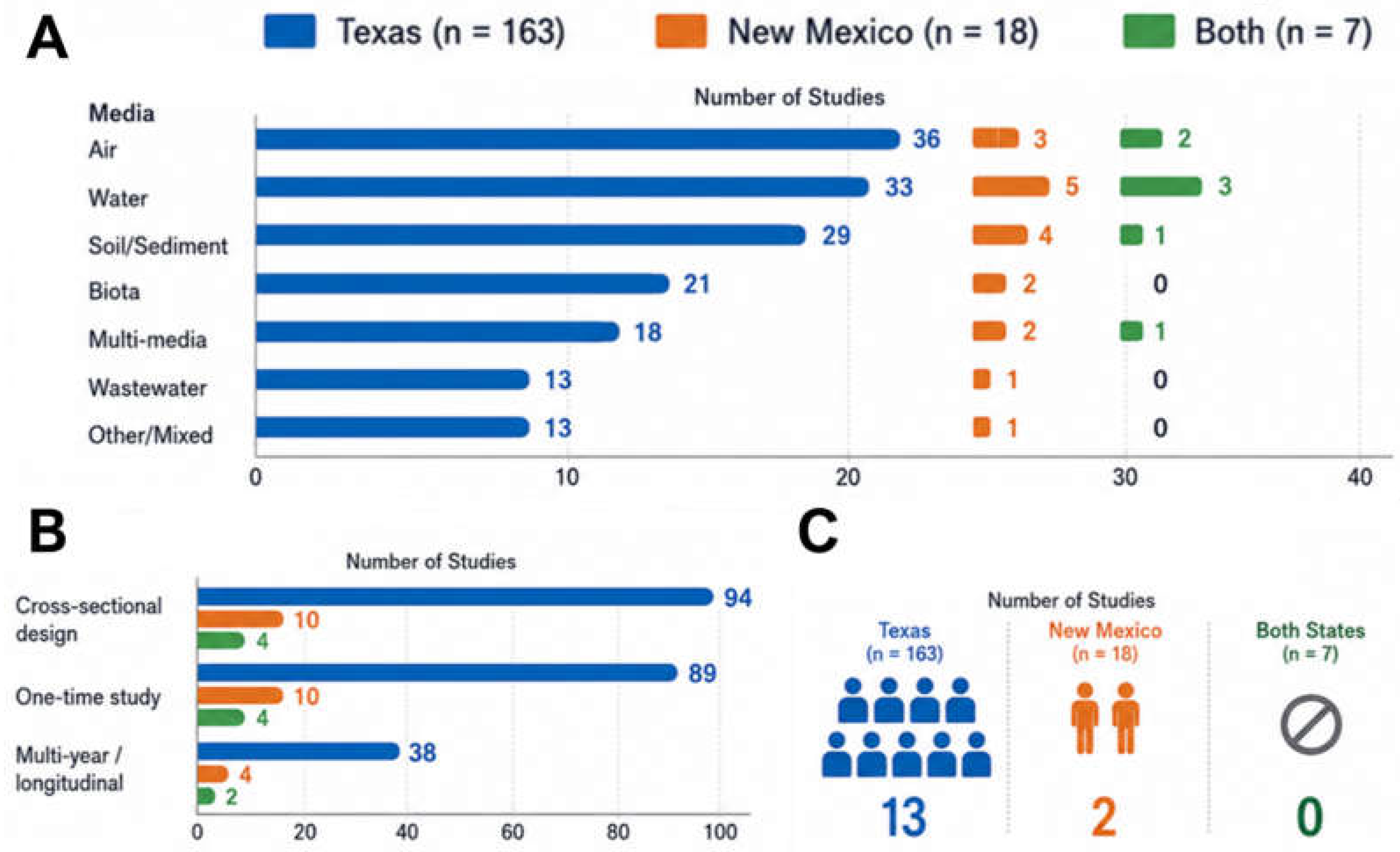
Figure 2.
The top 25 normalized keywords ranked by frequency.
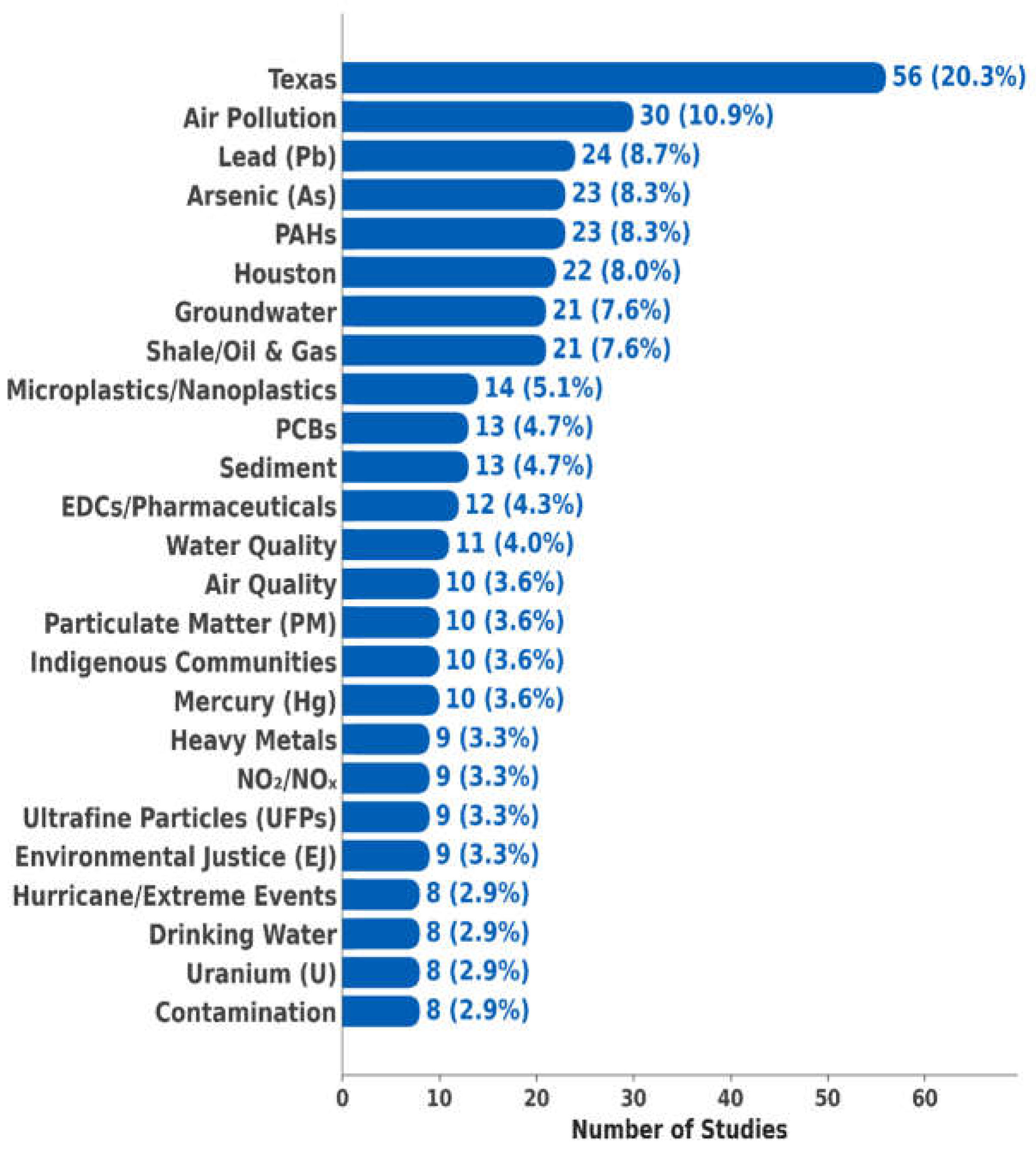
Figure 3.
(A) Temporal keyword heatmap showing normalized frequency of the top 20 keywords across five five-year periods (1999–2004 through 2020–2024). (B). Trend-factor bar chart for the 30 keywords with the largest positive or negative shift between 1999–2004 and 2020–2024.
Figure 3.
(A) Temporal keyword heatmap showing normalized frequency of the top 20 keywords across five five-year periods (1999–2004 through 2020–2024). (B). Trend-factor bar chart for the 30 keywords with the largest positive or negative shift between 1999–2004 and 2020–2024.
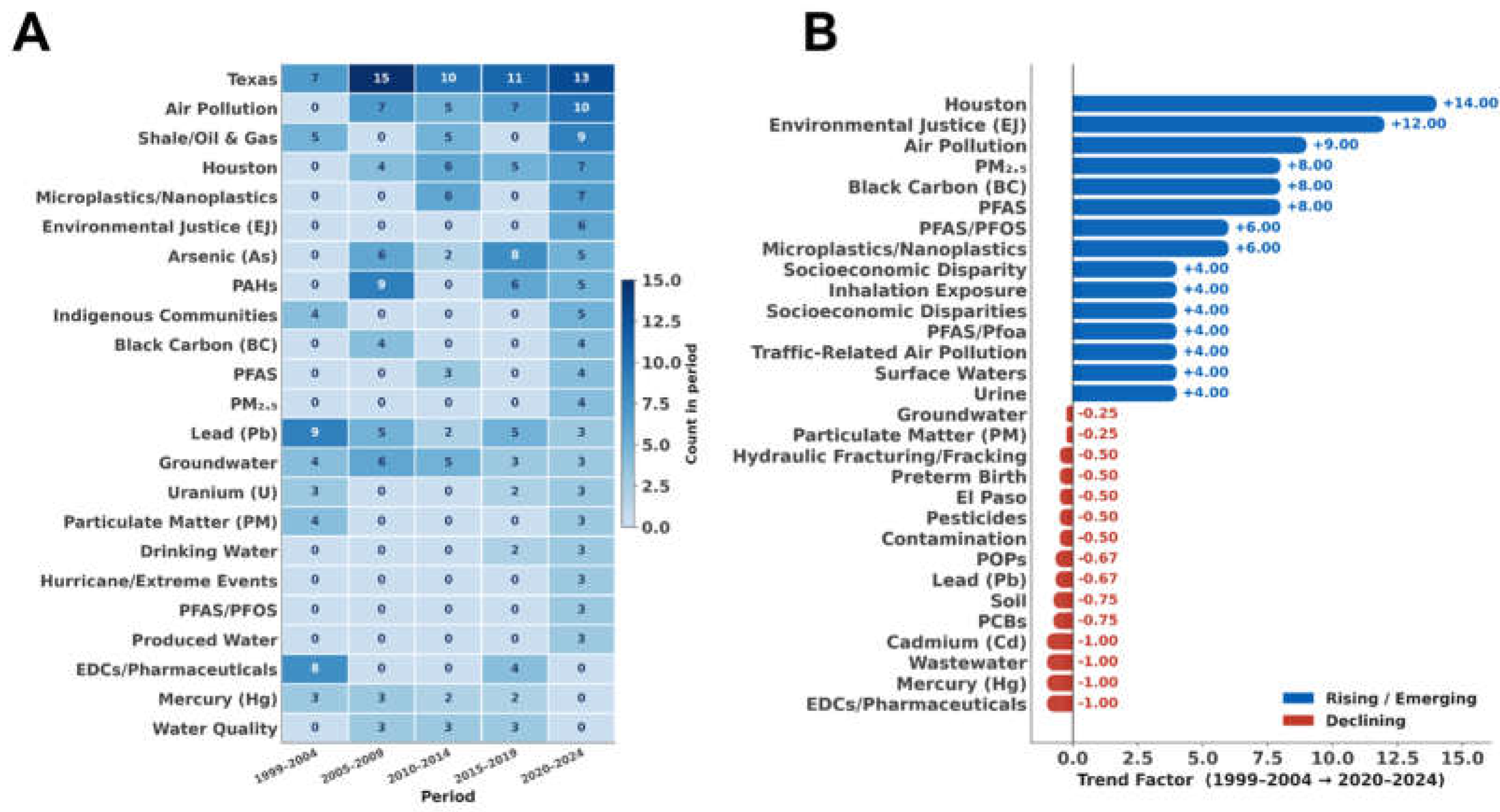
Figure 4.
Co-occurrence circos plot of the top 30 normalized keywords. Nodes are arranged clockwise from 12 o’clock by descending overall frequency; a node’s color intensity indicates keyword frequency. Edges represent co-occurrence between keyword pairs; both edge thickness and color intensity scale with the number of papers in which both keywords appear.
Figure 4.
Co-occurrence circos plot of the top 30 normalized keywords. Nodes are arranged clockwise from 12 o’clock by descending overall frequency; a node’s color intensity indicates keyword frequency. Edges represent co-occurrence between keyword pairs; both edge thickness and color intensity scale with the number of papers in which both keywords appear.
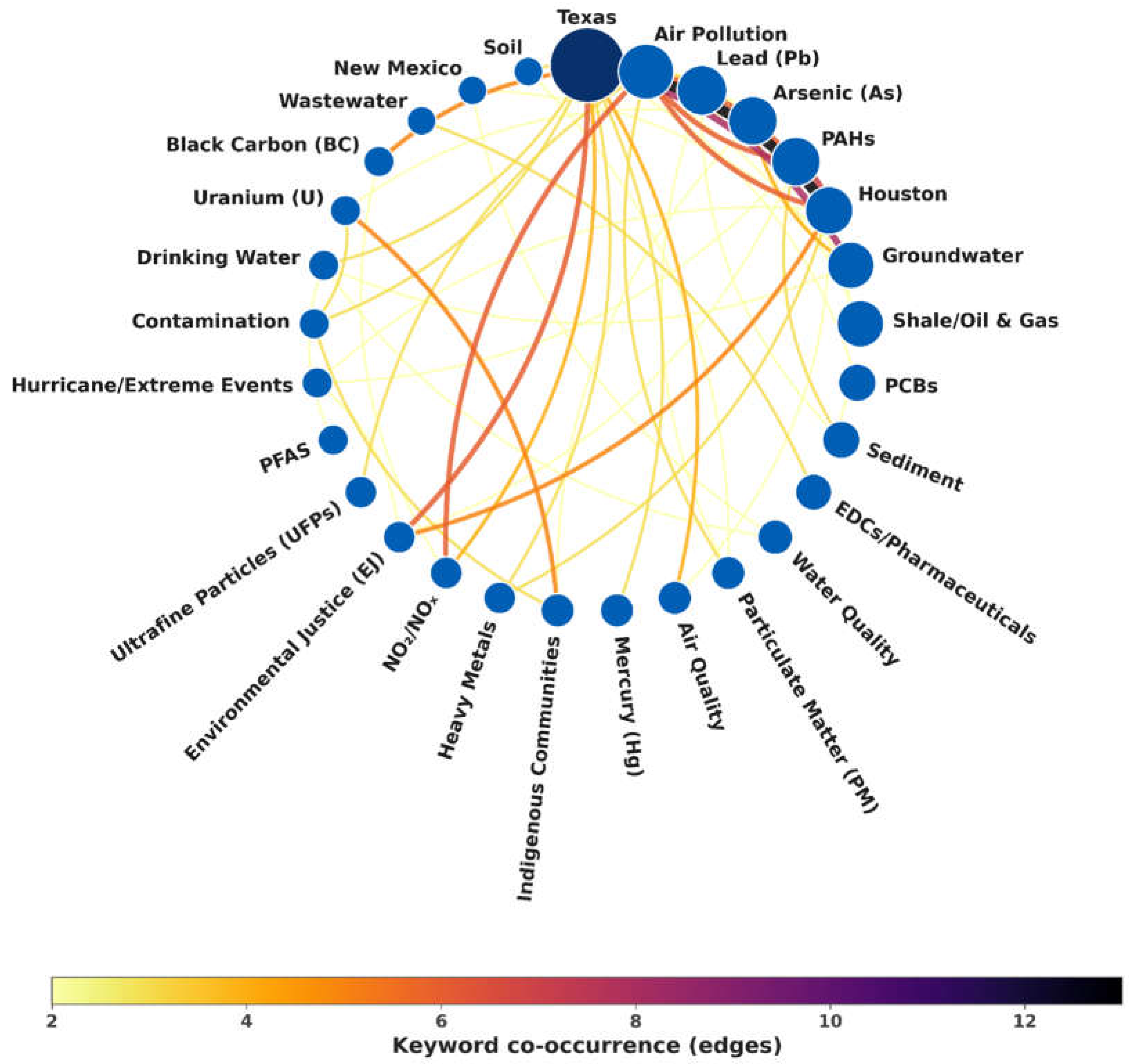
Figure 5.
Thematic research clusters identified from keyword co-occurrence analysis (n = 191 papers). (A). Research Intensity and knowledge-gap severity (B). Thematic clusters with their representative core keywords and (C). Research Prioritization Matrix for the Thematic Clusters.
Figure 5.
Thematic research clusters identified from keyword co-occurrence analysis (n = 191 papers). (A). Research Intensity and knowledge-gap severity (B). Thematic clusters with their representative core keywords and (C). Research Prioritization Matrix for the Thematic Clusters.
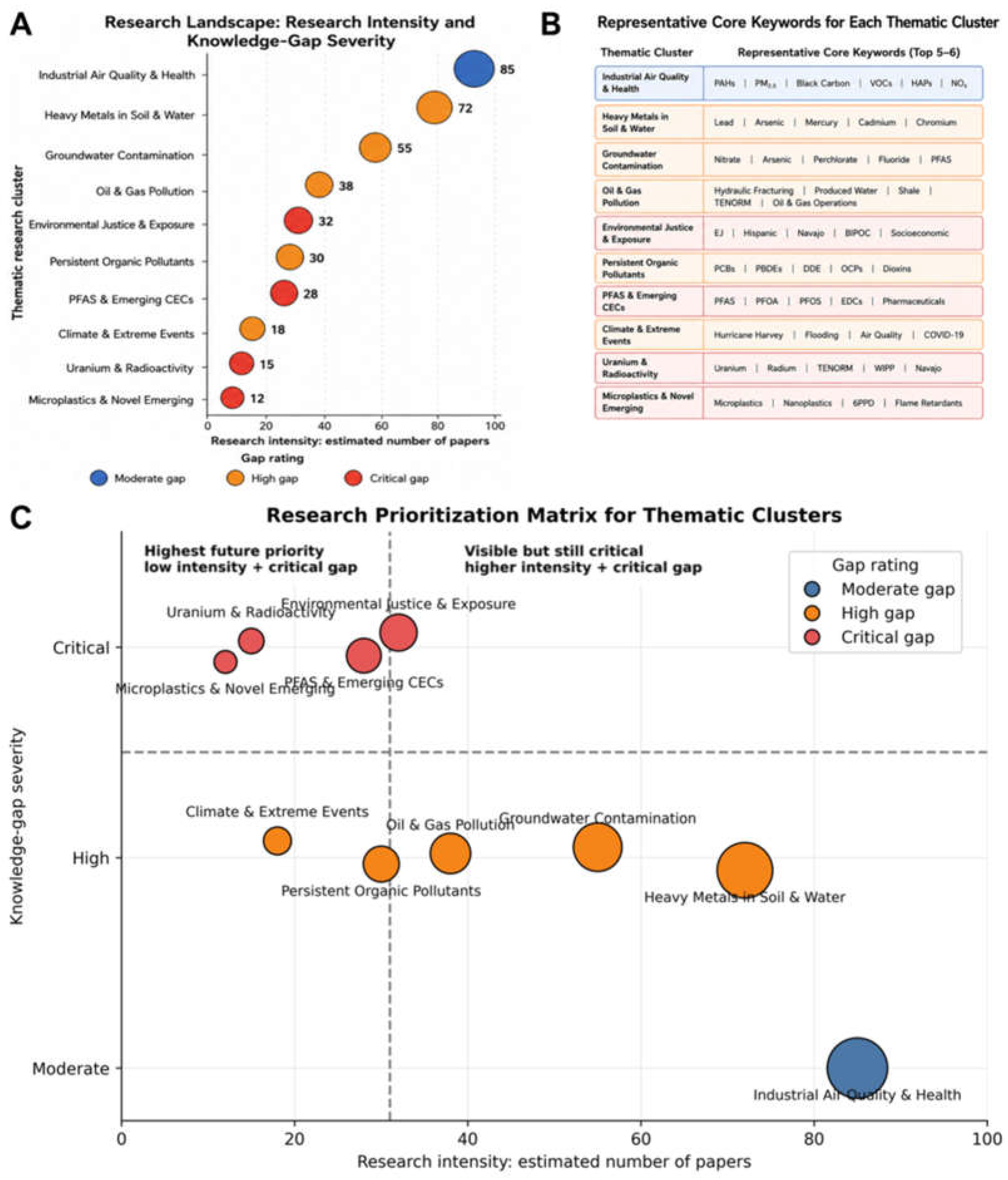
Figure 6.
(A) Proportional distribution of publications across the six research domains. (B) Multi-domain co-membership network.
Figure 6.
(A) Proportional distribution of publications across the six research domains. (B) Multi-domain co-membership network.
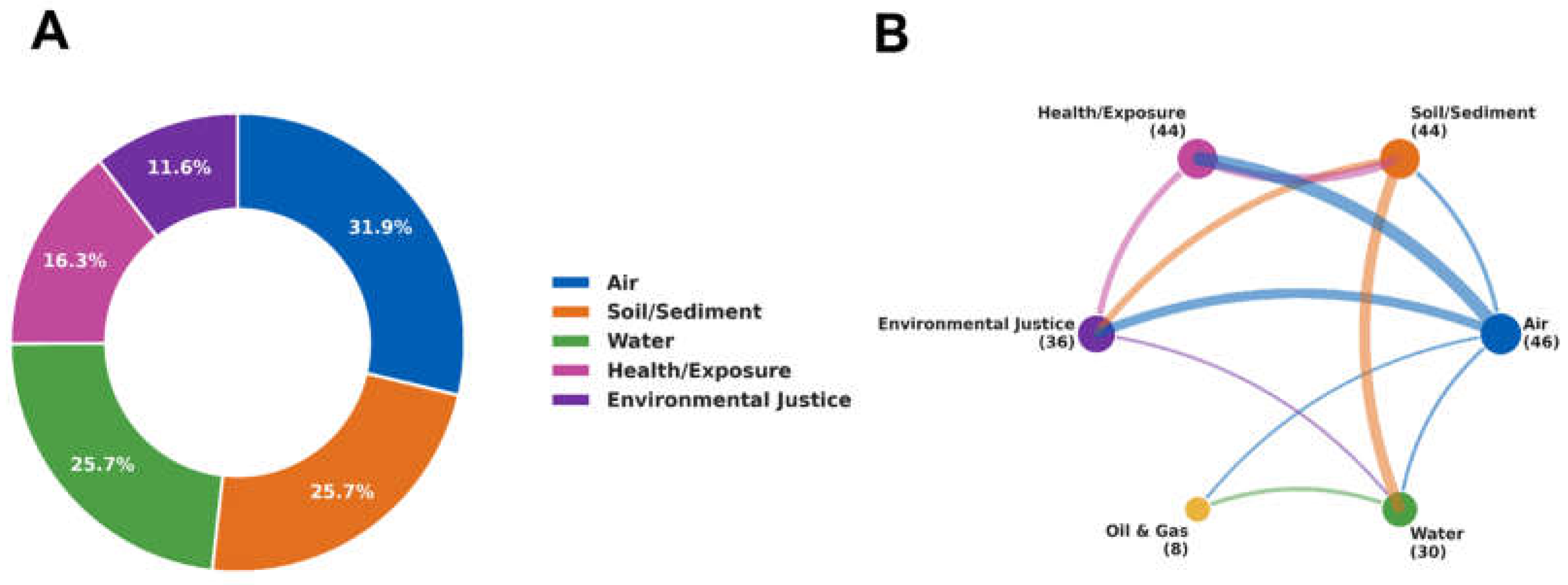
Figure 7.
(A) Contaminant frequency, classification, and (B) geographical research emphasis and gap assessment for the 191-paper analytical study pool.
Figure 7.
(A) Contaminant frequency, classification, and (B) geographical research emphasis and gap assessment for the 191-paper analytical study pool.
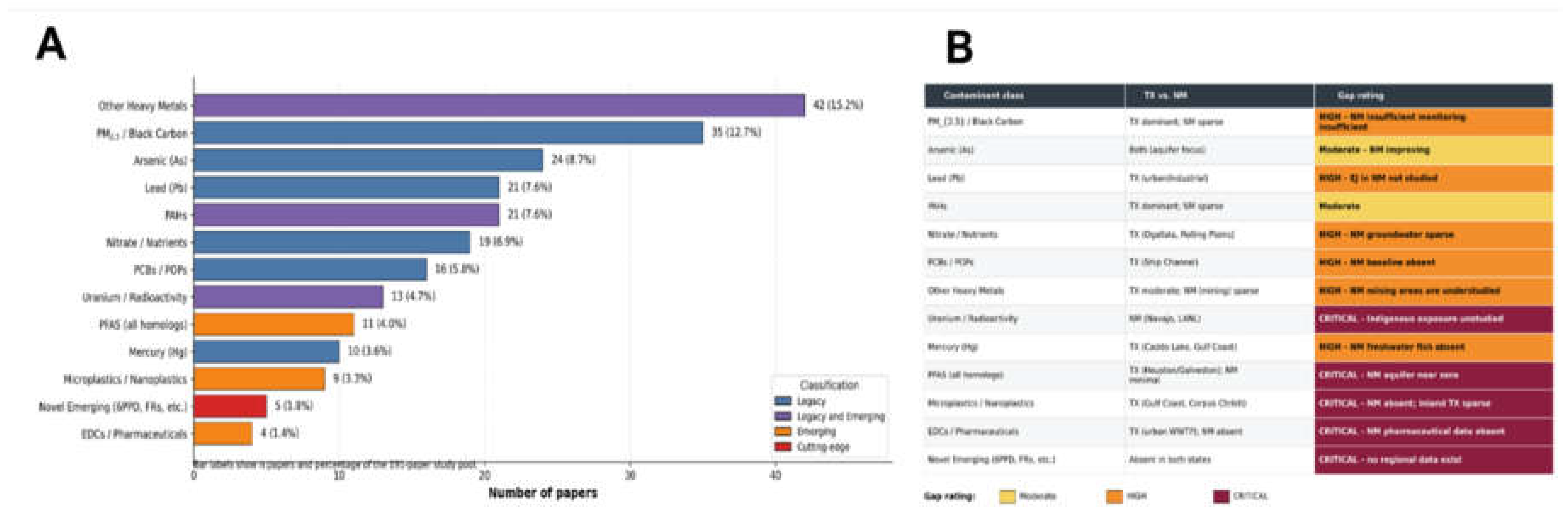
Figure 8.
Bubble chart of contaminant class research intensity and gap priority.
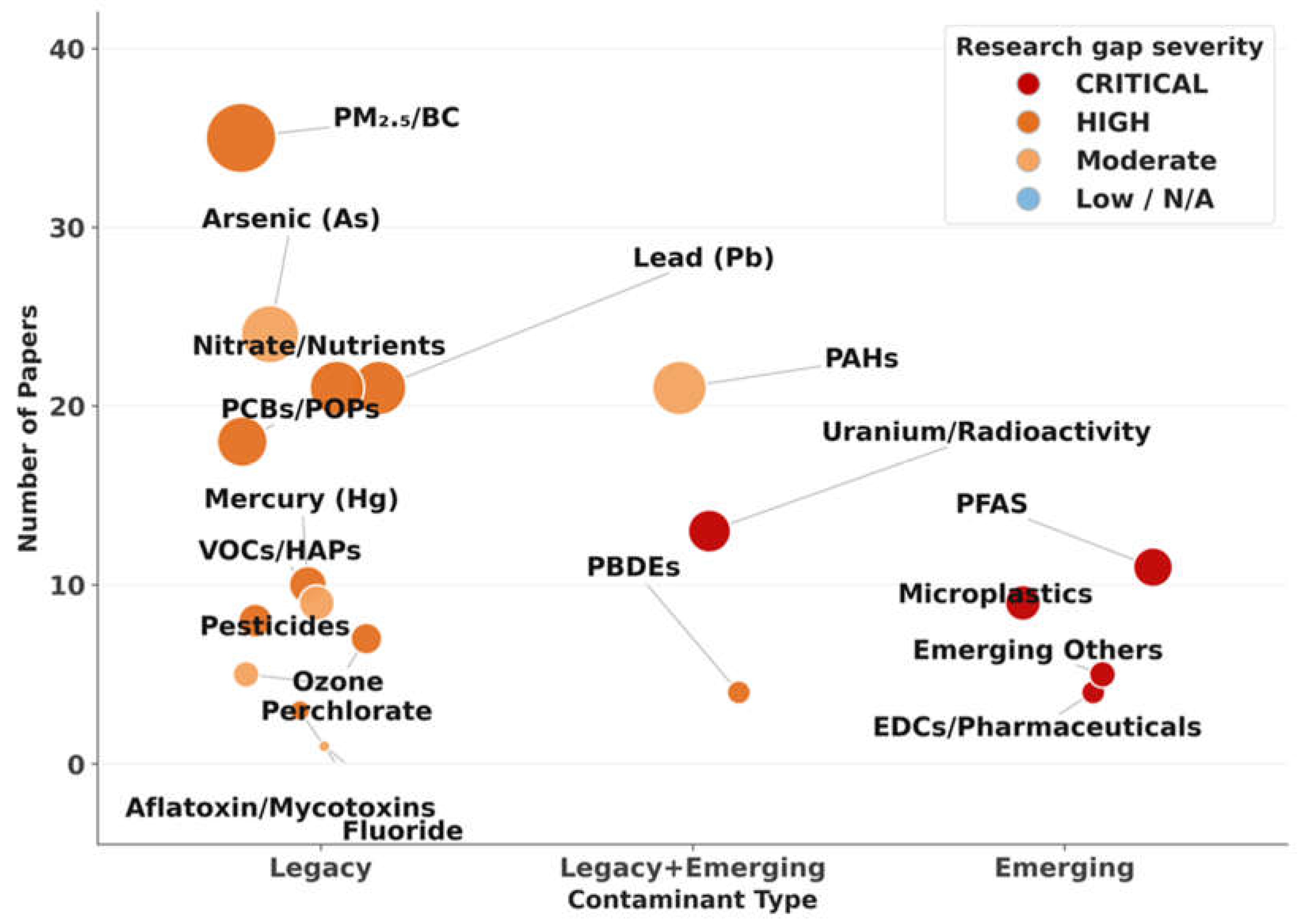
Figure 9.
Geographical distribution of the analytical study pool, with proportional symbols placed at each study area, bubble size representing publication frequency, and bubble color indicating the severity of the identified research gap.
Figure 9.
Geographical distribution of the analytical study pool, with proportional symbols placed at each study area, bubble size representing publication frequency, and bubble color indicating the severity of the identified research gap.
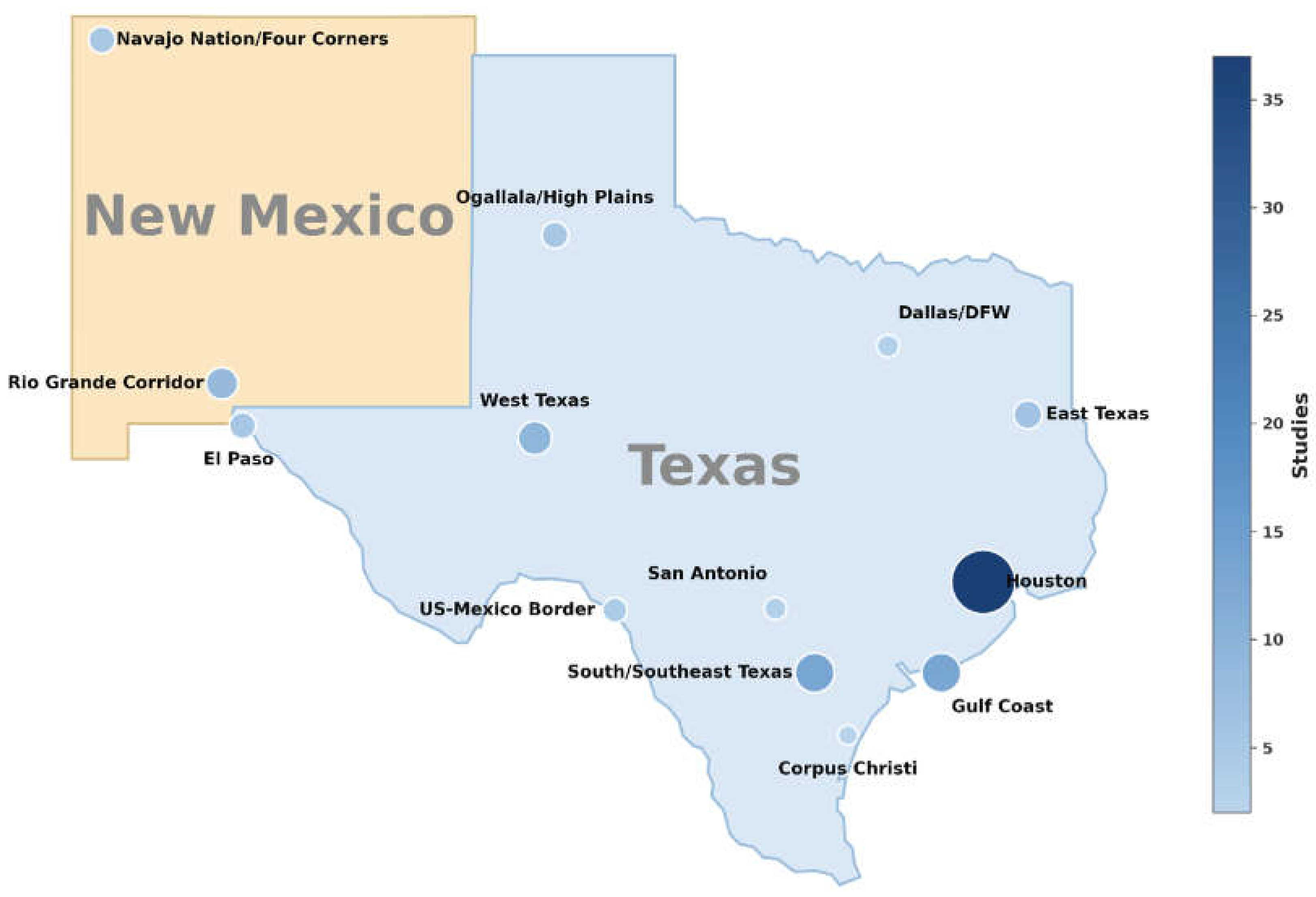
Figure 10.
Paired horizontal bar chart comparing Texas (blue bar) and New Mexico (red bar) paper counts across ten study-design and topical categories (Total Studies, Water Studies, Multi-year Studies, Air Studies, Metals Studies, EJ-Inclusive Studies, Pharma/PPCP Studies, Biota Studies, PFAS Studies, Non-targeted Analysis). Severity tags on the right (CRITICAL, HIGH, Moderate).
Figure 10.
Paired horizontal bar chart comparing Texas (blue bar) and New Mexico (red bar) paper counts across ten study-design and topical categories (Total Studies, Water Studies, Multi-year Studies, Air Studies, Metals Studies, EJ-Inclusive Studies, Pharma/PPCP Studies, Biota Studies, PFAS Studies, Non-targeted Analysis). Severity tags on the right (CRITICAL, HIGH, Moderate).
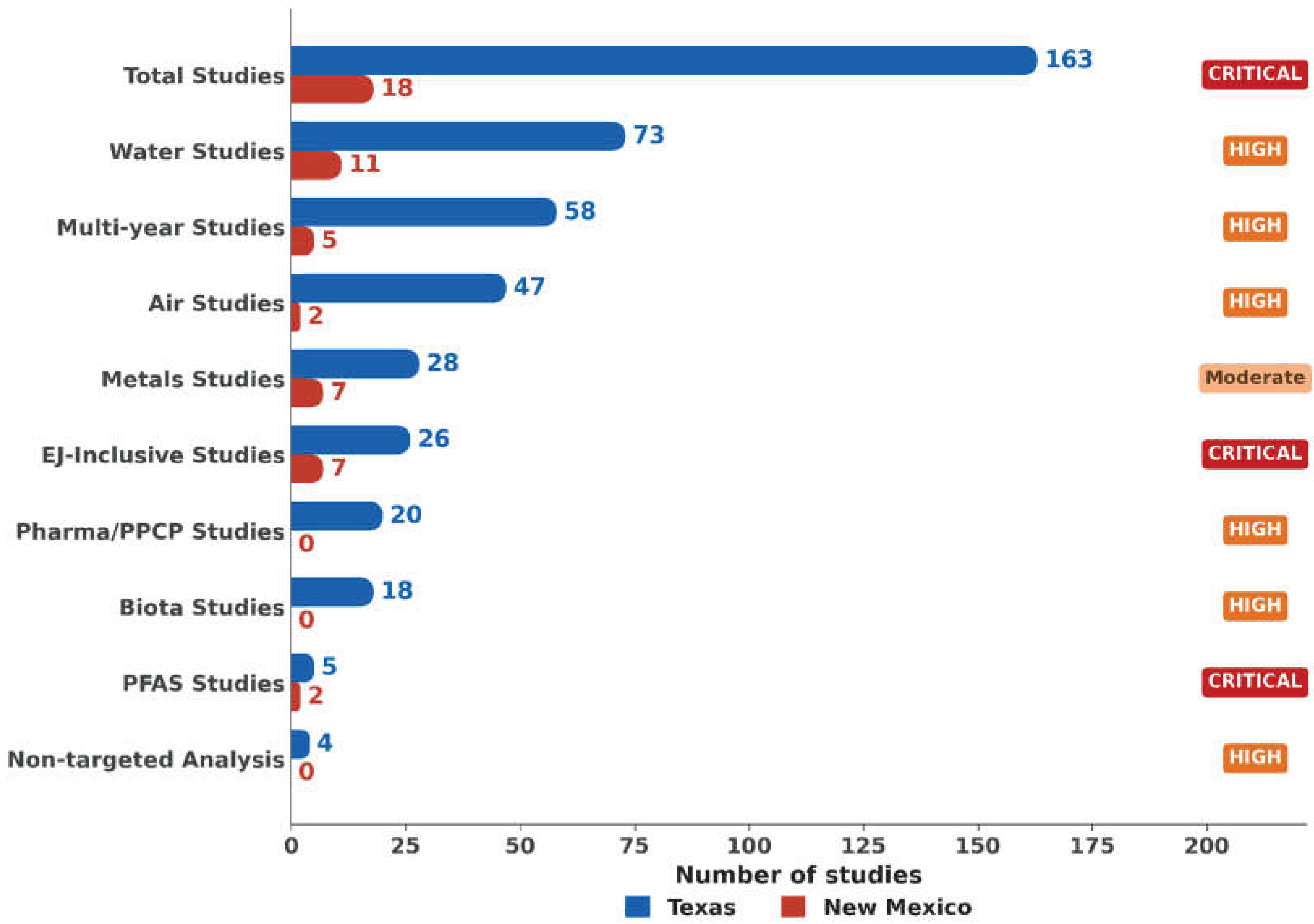

Table 1.
Top 10 normalized keywords per five-year period and trend-factor classification for selected emerging terms.
Table 1.
Top 10 normalized keywords per five-year period and trend-factor classification for selected emerging terms.
| 2020-2024 | 2015-2019 | 2010-2014 | 2005-2009 | 1999-2004 | Keyword |
|---|---|---|---|---|---|
| #16 (4) | NR | #17 (3) | #10 (3) | #16 (1) | Lead (Pb) |
| #18 (4) | #15 (3) | #14 (3) | NR | #12 (3) | Arsenic (As) |
| #10 (6) | #6 (8) | #6 (6) | #2 (10) | #4 (6) | PAHs |
| #2 (10) | #2 (13) | #2 (16) | #6 (5) | #7 (6) | Air pollution |
| #20 (3) | NR | NR | NR | NR | Shale / Oil & Gas |
| NR | NR | NR | #12 (2) | #9 (3) | Microplastics/Nanoplastics |
| #9 (6) | NR | NR | #3 (13) | #3 (8) | PFAS (any class) |
| #4 (10) | NR | NR | NR | NR | Environmental justice |
| #19 (3) | NR | #20 (2) | NR | NR | Black Carbon / PM2.5 |
| NR | NR | #15 (3) | #16 (2) | #13 (3) | Mercury (Hg) |
Note: Rank (#) and paper count per period are shown. NR = not in the top 20 for that period, but the term is present.
Table 2.
Research rationale analysis: keywords co-occurring with seven major contaminant classes, organized by driver category.
Table 2.
Research rationale analysis: keywords co-occurring with seven major contaminant classes, organized by driver category.
| Summary Rationale | Industrial/Source Co-terms | Ecological Co-terms | Health Impact Co-terms | Contaminant |
|---|---|---|---|---|
| Industrial corridor ubiquity; strong carcinogen; EJ exposure | Petrochemical, flaring, Houston Ship Channel, traffic | Bioaccumulation, fish, sediment toxicity | Cancer, hypertension, birth outcomes, inhalation, child health | PAHs |
| Legacy urban soil; children in EJ communities at highest risk | Smelter, leaded gasoline, lead-based paint, residential soil | Birds, raptors, food chain | Blood lead, children, neurotoxicity, growth status, prenatal exposure | Lead (Pb) |
| Natural geologic and mining sources; well-water communities at risk | Geogenic source, Ogallala, mine tailings | Aquifer, sorption, plant uptake, rice | Cancer, bladder cancer, melanoma, neural tube defects, blood arsenic | Arsenic (As) |
| Atmospheric deposition from coal; methylation in aquatic systems | Coal combustion, fluidized bed, atmospheric deposition | Largemouth bass, swallows, food webs | Neurotoxin, endocrine disruptor, bioaccumulation, fish consumption | Mercury (Hg) |
| Regulatory urgency (2024 MCLs); site-specific fires and training fields | Firefighting foam, ITC fire, military sites, industrial fire | Birds, fish, reproductive success | Endocrine disruption, cancer, immunotoxicity, bioaccumulation | PFAS |
| Rapidly emerging; Gulf Coast and Corpus Christi data sparse | Plastic waste, tire wear, agricultural mulch | Blue crabs, pinfish, cyanobacteria, coastal biota | Physical harm, chemical carrier, airway inflammation | Microplastics |
| Legacy mining; Navajo Nation exposure; extreme EJ gap | Uranium mining (NM), WIPP, LANL | Mine tailings, groundwater restoration, ferrihydrite | Nephrotoxin, cancer, autoantibodies, immunotoxicity | Uranium (U) |
Table 3.
Consolidated research gap matrix for Texas and New Mexico emerging contaminant research (1999–2024).
Table 3.
Consolidated research gap matrix for Texas and New Mexico emerging contaminant research (1999–2024).
| Recommended Action | Severity | State Affected | Gap Description | Gap Dimension |
|---|---|---|---|---|
| Targeted multi-class PFAS screening in all TX and NM water sources | CRITICAL | Both | Newer PFAS homologs (GenX, PFBA, PFBS, PFHxA, PFHxS) absent from most studies | Chemical |
| Stormwater monitoring in urban watersheds | CRITICAL | Both | 6PPD-quinone from tire wear: zero studies in either state | Chemical |
| Systematic MP/NP survey in rivers, sediment, biota | CRITICAL | Both | Microplastics: absent in NM; sparse inland TX | Chemical |
| PPCP monitoring in NM municipal and rural water sources | CRITICAL | NM | EDCs/pharmaceuticals: absent in NM; urban TX WWTP only | Chemical |
| Target psychiatric medications in WWTP effluent | HIGH | Both | Neuroactive pharmaceuticals: no studies in either state | Chemical |
| Biota and sediment baseline monitoring | HIGH | Both | Flame retardants (PBDEs, OPFRs): no dedicated studies | Chemical |
| Incorporate suspect screening in routine monitoring | HIGH | Both | Non-targeted analysis: <10% of papers use HRMS | Analytical |
| Fund NM-specific research programs; multi-investigator NM consortium | CRITICAL | NM | New Mexico severely under-studied: 18 papers vs. 163 for Texas | Spatial |
| Baseline environmental quality survey for region | CRITICAL | NM | Northern NM (Santa Fe, Taos, Espanola) entirely absent | Spatial |
| Joint TX-NM transboundary monitoring framework | HIGH | Both | Transboundary Rio Grande and Pecos River: 1–2 studies | Spatial |
| Establish long-term monitoring networks | CRITICAL | Both | One-time studies dominate: >55% of study pool | Temporal |
| Include sediment in all water-body studies | HIGH | Both | Sediment chronically under-sampled relative to water | Medium |
| Mandate EJ component in future monitoring grants | CRITICAL | Both | 82% of studies exclude EJ or vulnerable populations | Population/EJ |
| Community-based participatory research with Tribal nations | CRITICAL | NM | Navajo/Pueblo communities: no long-term health outcome data | Population/EJ |
| Regional biomonitoring analogous to NHANES for TX/NM populations | CRITICAL | Both | Human biomonitoring absent for PFAS, MPs, novel emerging | Mechanistic |
Disclaimer/Publisher’s Note: The statements, opinions and data contained in all publications are solely those of the individual author(s) and contributor(s) and not of MDPI and/or the editor(s). MDPI and/or the editor(s) disclaim responsibility for any injury to people or property resulting from any ideas, methods, instructions or products referred to in the content. |
© 2026 by the authors. Licensee MDPI, Basel, Switzerland. This article is an open access article distributed under the terms and conditions of the Creative Commons Attribution (CC BY) license (http://creativecommons.org/licenses/by/4.0/).
Copyright: This open access article is published under a Creative Commons CC BY 4.0 license, which permit the free download, distribution, and reuse, provided that the author and preprint are cited in any reuse.