
Submitted:
14 September 2026
Posted:
16 September 2026
You are already at the latest version
Abstract
The recently proposed Bedside-to-Outside model aims to bridge inpatient efficacy and free-living effectiveness trials in human nutrition research. Its translational ambition is laudable, yet its core premise – that changes in body mass can be used to calculate energy intake with sufficient precision – rests on problematic assumptions. First, the cited correlation between mass change and energy intake is tautological, not independently validating. Second, reliance on the Wishnofsky rule ignores diet-dependent variation in tissue composition, glycogen, and water. Third, recent analytical work has exposed internal logical inconsistencies in the energy balance model (EBM), while the mass balance model (MBM) delivers superior predictive accuracy by tracking macronutrient mass directly. Finally, omission of hormonal data that reportedly track mass intake more closely than energy intake further weakens the evidentiary foundation. True triangulation requires independent anchors; the present formulation risks circularity by relying solely on EBM assumptions. Six concrete modifications are proposed: (1) inclusion of mass-based metrics as co-primary outcomes; (2) pre-specification and competitive testing of both EBM and MBM predictions; (3) routine quantification of uncertainty propagation; (4) mandatory reporting of hormonal and appetite data; (5) use of MBM predictions as independent validation anchors; and (6) transparent reporting standards for all measured variables. Implemented, these changes would convert the Bedside-to-Outside model from a framework that assumes the EBM into a rigorous test of competing paradigms.
Keywords:
Bedside-to-Outside model
; energy balance model
; mass balance model
; methodological triangulation
; predictive validity
; body composition
; ad libitum intake
; appetite regulation
1. The Ambitious Premise—And Its Hidden Assumptions
The Bedside-to-Outside model seeks to close the longstanding gap between tightly controlled inpatient studies and free-living trials by studying the same participants in both settings [1]. This ambition is well founded and addresses a genuine methodological need.
The supporting rationale, however, embeds several assumptions that require examination. These assumptions sit at the center of the unresolved contest between the energy balance model (EBM) and the mass balance model (MBM). Independent analyses have repeatedly shown that the MBM achieves substantially higher predictive accuracy than the EBM when subjected to genuine external validation [2,3,4,5,6,7].
2. The Claimed Linear Relationship Between Body Mass Change and Energy Intake Is Tautological
The model paper cites a “strong positive linear correlation between changes in body mass with changes in energy intake” from NCT03407053 [8] and notes that the relationship persisted “despite the additional considerations of fluid shifts” in NCT03878108 [9] [1].
A correlation generated under identical experimental conditions does not validate the use of one variable to calculate the other. Diets that elicit higher ad libitum energy intake necessarily produce greater weight gain; the observed association is a structural consequence of the design, not an independent demonstration of predictive precision.
The further claim that body-mass change can serve as a reliable proxy for energy intake rests on the Wishnofsky rule – a fixed tissue energy density of approximately 7,700 kcal/kg [10]. This figure is a statistical average, not a physical constant. It collapses fat, lean tissue, glycogen, and water – tissues with radically different energy densities – into a single number and ignores diet-dependent shifts in their relative proportions [10,11]. Dynamic models that account for changing body composition and metabolic adaptation consistently outperform the fixed-density assumption [11,12]. Direct mass accounting avoids these conversions entirely and has been shown to reduce propagated uncertainty by 40–65 % [5].
More fundamentally, numerical and analytical scrutiny of the EBM has revealed internal contradictions. When the model’s own accounting rules are applied under weight-maintenance conditions, they generate the inconsistent result that body mass is simultaneously stable and decreasing [2,7]. This is not a feature of physiology; it is a logical failure of the framework. Under the same conditions, food-mass intake tracks body weight change more consistently [7].
3. The Missing Hormonal Data
Hormonal data collected in the Nature Medicine trial [9] were not reported alongside the energy-intake results [1]. Independent reanalysis indicates that these hormones track mass intake more closely than energy intake [7].
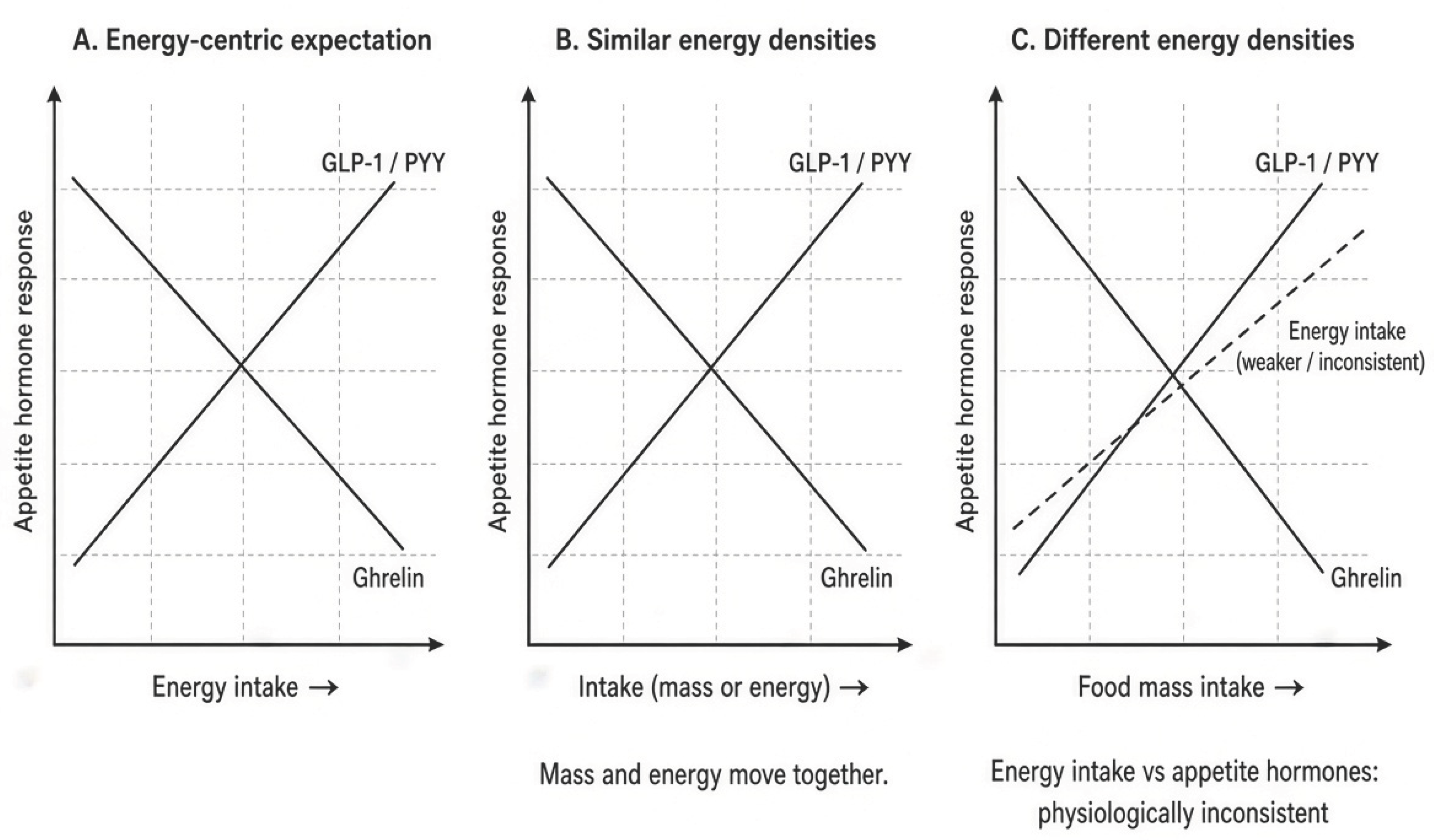
The relationship between intake and appetite hormones depends critically on whether the tested diets have similar or substantially different energy densities. When diet compositions (and therefore energy densities) are similar, mass intake and energy intake tend to move together. Under these conditions, appetite-related hormonal responses show comparable associations regardless of whether intake is expressed in units of mass or energy (Figure 1B).
The situation changes markedly when energy densities differ substantially – for example, when comparing a very-low-carbohydrate (high energy-density) diet with a very-low-fat (low energy-density) diet. In such cases, energy intake and mass intake can diverge. Critically, the unpublished hormonal findings from Hall et al. [9] indicate that the lower mass intake tracked with a hormonal signature consistent with reduced appetite, even when energy intake was higher [7]. In other words, the hormones followed mass, not energy (Figure 1C).
These patterns are illustrated conceptually in Figure 1.
- Panel A shows the conventional energy-centric expectation.
- Panel B shows the situation of similar energy densities, in which mass and energy track together.
- Panel C shows the diagnostically decisive case of divergent energy densities. Here the solid lines (hormone responses vs. food mass intake) remain consistent with known physiology, whereas the relationship with energy intake becomes weaker or physiologically inconsistent.
This dissociation is central. Appetite hormones do not reliably track energy intake across varying dietary contexts, whereas they do track mass intake. The observation further undermines the assumption that energy-based metrics alone possess sufficient precision for translation across research settings [1].
This does not imply misconduct. Editorial constraints or analytical priorities may explain the original omission of the hormonal data. It does, however, leave a material empirical question unresolved at a critical point in the argument for the Bedside-to-Outside model.
4. Triangulation Requires Independent Anchors
The model aspires to “methodological triangulation of outcomes between settings” [1]. Triangulation is powerful only when the methods being compared rest on independent foundations. If both the inpatient and free-living arms operate inside the same EBM assumptions (fixed energy densities, equivalence of mass and energy accounting), the exercise risks circular confirmation rather than genuine cross-validation.
The MBM supplies an independent measurement path: mass is tracked directly, without conversion to and from energy units [5,6,7]. Incorporating both frameworks would allow the Bedside-to-Outside design to test which system better predicts outcomes across contexts. In its present form the model assumes the EBM rather than testing it.
5. Six Proposals to Convert the Model Into a Genuine Test of Paradigms
5.1. Designate Mass-Based Metrics as Co-Primary Outcomes
5.2. Pre-Register and Competitively Test Both Models
Both EBM and MBM predictions must be pre-specified before data collection. Explicit rival hypotheses (EBM: strongest correlation with energy intake; MBM: strongest correlation with mass intake after macronutrient adjustment) transform the study from a confirmatory exercise into a critical test of paradigm validity.
5.3. Report Uncertainty Propagation for Both Metric Families
Energy metrics require multiple conversions; each step adds error. Mass metrics require fewer conversions. Protocols should report measurement error, Wishnofsky-related error, metabolic-measurement error, and total propagated uncertainty for both families. Direct mass accounting reduces this uncertainty by 40–65 % [5]; the magnitude of the advantage should be visible in every dataset.
5.4. Report Hormonal and Appetite Data as Standard Secondary Outcomes
Ghrelin, leptin, GLP-1, PYY and validated appetite ratings should be collected and analyzed against both energy intake and mass intake. Making these data obligatory removes any residual ambiguity about selective reporting and supplies direct evidence on which metric better tracks regulatory physiology.
5.5. Use MBM Predictions as Independent Validation Anchors
MBM-derived predictions of body-mass change should be compared with observed change in both settings. Superior performance of either model constitutes positive evidence; the current design cannot generate such evidence because the two frameworks are never placed in competition.
5.6. Enforce Transparent Reporting of all Measured Variables
Every collected variable – hormones, compartmental body composition, food mass, energy intake, and relevant metadata – must be reported or explicitly justified if withheld. This standard eliminates residual concerns about selective disclosure and aligns the model with contemporary open-science norms.
6. Conclusion
Energy balance remains a serviceable first-order approximation. The question is whether the EBM, burdened by indirect conversions, fixed assumptions, and internal logical inconsistencies, possesses the precision and mechanistic fidelity required for translational research. The accumulating evidence favors direct mass accounting [2,3,4,5,6,7].
The Bedside-to-Outside model is a valuable methodological contribution [1]. Its lasting impact will be determined by whether it is used to test competing paradigms or merely to assume one of them. The six modifications proposed here convert the model into a rigorous comparative test. Implemented, they would render a genuine service to the field.
Funding
This research did not receive any specific grant from funding agencies in the public, commercial, or not-for-profit sectors.
Acknowledgments
I would like to thank my family for their unwavering support and care, as well as my colleagues for many stimulating discussions. I am especially grateful to Prof. Francisco Arencibia-Albite for his insightful comments and suggestions regarding Figure 1, which significantly improved the clarity of the conceptual illustration.
Conflicts of Interest
The author declares no conflict of interest.
Ethics Approval and Consent to Participate
Not applicable.
Consent for Publication
Not applicable.
Availability of Data
All data generated or analyzed during this study can be found in the sources cited in this article.
References
- Hengist, A.; Chung, S.T.; Darcey, V.L.; et al. A bedside-to-outside model of human nutrition research. Cell Metab Epub ahead of print. 2026. [Google Scholar] [CrossRef] [PubMed] [PubMed Central]
- Arencibia-Albite, F. Serious analytical inconsistencies challenge the validity of the energy balance theory. Heliyon Erratum in: Heliyon. 2020 Sep 14;6(9):e04609. doi: 10.1016/j.heliyon.2020.e04609. PMID: 32685707; PMCID: PMC7355950.. 2020, 6(7), e04204. [Google Scholar] [CrossRef] [PubMed]
- Arencibia-Albite, F. The energy balance theory is an inconsistent paradigm. J. Theor. Biol. 2022, 550, 111240. [Google Scholar] [CrossRef] [PubMed]
- Manninen, A.H. Chronic positive mass balance is the actual etiology of obesity: A living review. Glob. Transl. Med. 2023, 2(1), 222. [Google Scholar] [CrossRef]
- Manninen, A.H. Mass Balance over Energy Balance: Why Direct Mass Accounting Offers a More Precise and Mechanistically Faithful Framework for Human Body Weight Regulation. Preprints 2026, 2026040690. [Google Scholar] [CrossRef]
- Manninen, A.H. Implementing the Mass Balance Model (MBM) in Human Nutrition and Obesity Research: Protocols, Analytical Frameworks, and Translational Applications. Preprints 2026, 2026041641. [Google Scholar] [CrossRef]
- Arencibia-Albite, F. A numerical and analytical evaluation of the consistency of the energy balance model identifies limitations and systematic relationships between mass intake and body weight dynamics. Front Nutr. 2026, 13, 1777554. [Google Scholar] [CrossRef] [PubMed] [PubMed Central]
- Hall, K.D.; Ayuketah, A.; Brychta, R.; et al. Ultra-Processed Diets Cause Excess Calorie Intake and Weight Gain: An Inpatient Randomized Controlled Trial of Ad Libitum Food Intake. Cell Metab. Epub 2019 May 16. Erratum in: <italic>Cell Metab</italic>. 2019 Jul 2;30(1):226. doi: 10.1016/j.cmet.2019.05.020. Erratum in: <italic>Cell Metab</italic>. 2020 Oct 6;32(4):690. doi: 10.1016/j.cmet.2020.08.014. PMID: 31105044; PMCID: PMC7946062. 2019, 30(1), 67–77.e3. [Google Scholar] [CrossRef] [PubMed]
- Hall, K.D.; Guo, J.; Courville, A.B.; et al. Effect of a plant-based, low-fat diet versus an animal-based, ketogenic diet on ad libitum energy intake. Nat. Med. 2021, 27(2), 344–353. [Google Scholar] [CrossRef] [PubMed]
- Manninen, A.H. The Wishnofsky Trap: How the Mass Balance Model Reveals Critical Blind Spots in Ultraprocessed Food Trials. Preprints 2026, 2026060578. [Google Scholar] [CrossRef]
- Thomas, D.M.; Martin, C.K.; Lettieri, S.; et al. Can a weight loss of one pound a week be achieved with a 3500-kcal deficit? Commentary on a commonly accepted rule. Int. J. Obes. (Lond) 2013, 37(12), 1611–3. [Google Scholar] [CrossRef] [PubMed] [PubMed Central]
- Hall, K.D.; Sacks, G.; Chandramohan, D.; et al. Quantification of the effect of energy imbalance on bodyweight. Lancet 2011, 378(9793), 826–37. [Google Scholar] [CrossRef] [PubMed] [PubMed Central]
- Hengist, A.; Sciarrillo, C.M.; Guo, J.; et al. Gut-derived appetite hormones do not explain energy intake differences in humans following low-carbohydrate versus low-fat diets. Obes. 2024, 32(9), 1689–1698. [Google Scholar] [CrossRef] [PubMed] [PubMed Central]
Figure 1.
Conceptual illustration of the relationship between intake metrics and appetite hormone responses under different dietary conditions. (A) Energy-centric expectation: appetite hormone responses (GLP-1 and PYY increasing, ghrelin decreasing) are assumed to scale primarily with energy intake. (B) Diets with similar energy densities: mass intake and energy intake move together, producing comparable associations with hormone responses. (C) Diets with substantially different energy densities: mass intake and energy intake can diverge. Hormone responses track food mass intake consistently (solid lines). The relationship with energy intake is weaker or physiologically inconsistent (dashed line).
Disclaimer/Publisher’s Note: The statements, opinions and data contained in all publications are solely those of the individual author(s) and contributor(s) and not of MDPI and/or the editor(s). MDPI and/or the editor(s) disclaim responsibility for any injury to people or property resulting from any ideas, methods, instructions or products referred to in the content. |
© 2026 by the authors. Licensee MDPI, Basel, Switzerland. This article is an open access article distributed under the terms and conditions of the Creative Commons Attribution (CC BY) license (http://creativecommons.org/licenses/by/4.0/).
Copyright: This open access article is published under a Creative Commons CC BY 4.0 license, which permit the free download, distribution, and reuse, provided that the author and preprint are cited in any reuse.