

Submitted:
14 September 2026
Posted:
15 September 2026
You are already at the latest version
Abstract
The ubiquitous integration of lithium-ion batteries (LIBs) into modern society, powering applications from portable electronics to grid-scale energy storage and electric mobility, has been paralleled by a growing concern over their safety. The high energy density that makes LIBs so advantageous also renders them susceptible to catastrophic failure modes, most notably fire and explosion. This review provides a comprehensive and multidisciplinary analysis of the phenomenon of battery fires. We begin by delineating the fundamental root causes of thermal runaway, the critical event precipitating combustion, including mechanical abuse, electrical abuse, thermal abuse, and manufacturing defects. The review then delves into the intricate mechanisms of thermal runaway, tracing the sequence of exothermic reactions from Solid Electrolyte Interphase (SEI) decomposition to the violent reactions of cathode materials and electrolyte. A detailed examination of the complex combustion chemistry of LIBs is presented, highlighting the roles of gaseous, liquid, and solid components as fuels and the generation of toxic and flammable effluents. The propagation of failure within a battery module or pack is discussed, underscoring the challenges in containing single-cell incidents. We systematically catalog and critically evaluate the current state-of-the-art mitigation strategies, spanning intrinsic safety approaches (novel electrolytes, solid-state batteries, advanced electrode materials) and extrinsic safety systems (battery management systems, thermal management systems, and fire suppression technologies). Finally, the review identifies persistent knowledge gaps and outlines future research directions, emphasizing the need for multi-scale modeling, advanced diagnostics, and the development of inherently safe next-generation battery chemistries. This work aims to serve as a foundational reference for researchers and engineers across academia and industry, fostering the development of safer energy storage systems.
Keywords:
lithium-ion battery
; battery safety
; thermal runaway
; fire safety
; combustion
; hazard mitigation
; solid-state battery
; Battery Management System
; toxic emissions
1. Introduction
The 21st century is witnessing a profound energy transition, driven by the dual imperatives of decarbonization and technological advancement. At the heart of this transition lies the lithium-ion battery (LIB), a technology that has revolutionized energy storage. Since their commercialization by Sony in 1991, LIBs have become the dominant power source for portable electronics, and are now the critical enabler for two of the most significant technological shifts of our time: the electrification of transport and the integration of intermittent renewable energy sources into the electrical grid. The success of LIBs is predicated on their superior properties, including high energy density, high power density, low self-discharge rate, and long cycle life compared to other rechargeable battery chemistries.
However, the very attribute that makes LIBs so transformative—their high energy density—is also the source of their most significant safety challenge. A commercial LIB is, in essence, a sealed device containing a significant amount of chemical energy in a metastable state. Under normal operating conditions, this energy is released in a controlled manner as electrical current. But under specific, often unpredictable, conditions of abuse or failure, this energy can be released rapidly and uncontrollably as heat, leading to a destructive process known as thermal runaway.
Thermal runaway is an exothermic, self-accelerating reaction within the cell that results in a rapid increase in temperature and pressure. If the cell's internal pressure surpasses its mechanical integrity, it will vent, ejecting hot, flammable, and toxic gases. Upon contact with air, these gases can ignite, leading to a jet fire or explosion. This sequence of events constitutes a "battery fire," a complex multi-stage, multi-physics phenomenon that poses severe risks. The consequences extend beyond the loss of the device, encompassing toxic fume inhalation hazards, the risk of secondary fires, and significant economic and reputational damage. High-profile incidents involving smartphones, hoverboards, aviation, electric vehicles (EVs), and grid storage facilities have starkly illustrated these risks, bringing the issue of battery safety to the forefront of public and scientific discourse.
The challenge of mitigating battery fires is inherently multidisciplinary, sitting at the intersection of electrochemistry, materials science, thermodynamics, heat transfer, combustion science, and engineering. Over the past decade, substantial research efforts have been dedicated to understanding the root causes, unraveling the complex mechanisms, and developing effective mitigation strategies. This body of work is vast and rapidly evolving.
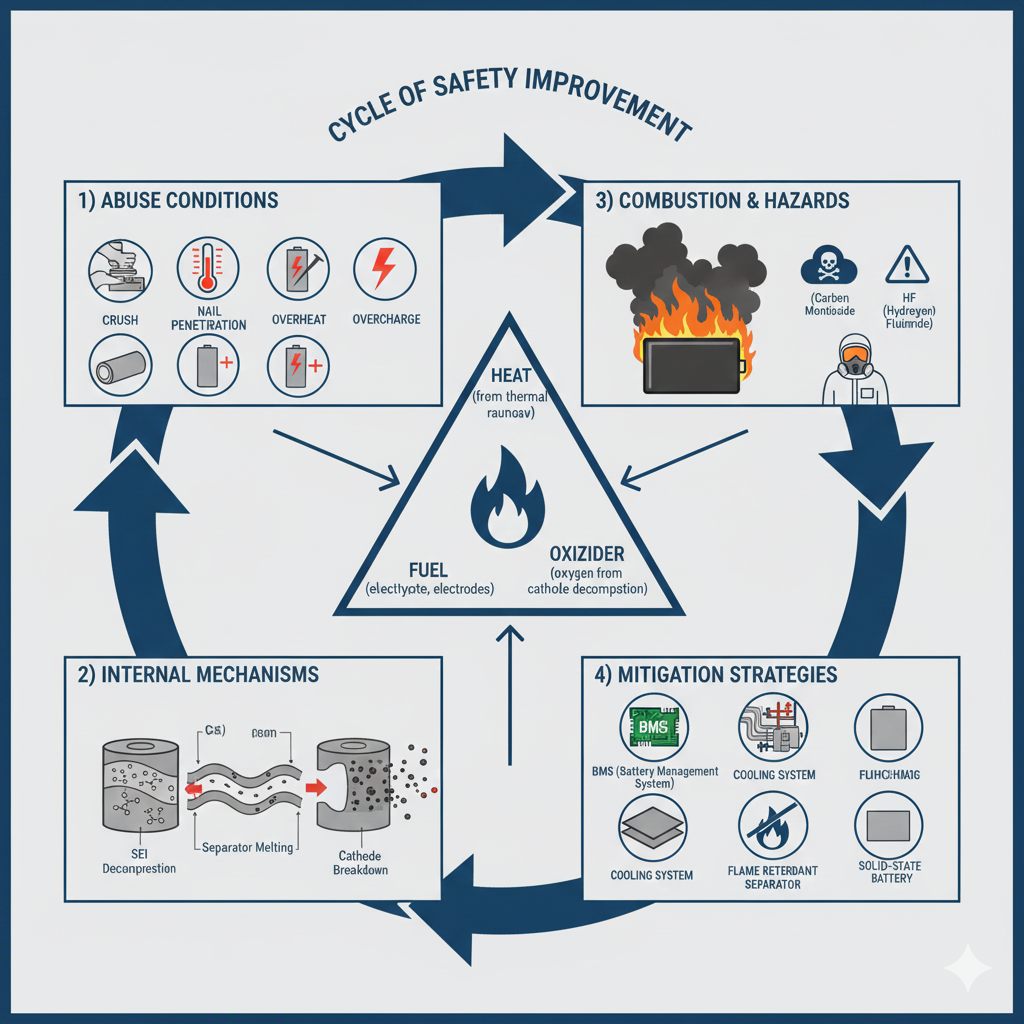
This review article aims to synthesize this extensive knowledge base into a cohesive and comprehensive resource. We will systematically dissect the lifecycle of a battery fire, from the initial insult to the final combustion products. The objectives of this review are:
- To provide a detailed taxonomy of the root causes of thermal runaway.
- To elucidate the step-by-step mechanistic pathways of internal failure and heat generation.
- To describe the combustion behavior and associated hazards of failing LIBs.
- To critically evaluate the current landscape of mitigation strategies, from cell-level materials design to system-level engineering controls.
- To identify critical knowledge gaps and propose future research directions that will pave the way for inherently safer energy storage systems.
By providing a holistic overview, this review seeks to serve as a valuable reference for researchers, engineers, and policymakers working to ensure that the sustainable energy future enabled by batteries is also a safe one.
2. Fundamental Root Causes of Thermal Runaway
Thermal runaway is not a spontaneous event; it is the culmination of a sequence of failures initiated by a specific trigger. These triggers, or abuse conditions, can be broadly categorized into three primary types: mechanical, electrical, and thermal. A fourth, more insidious category, involves internal or manufacturing defects that can act as latent failure points.
2.1. Mechanical Abuse
Mechanical abuse involves the physical deformation of the battery cell, which can compromise the internal structure and lead to an internal short circuit. This is a primary concern in automotive applications where crash safety is paramount.
- •
- Crush and Indentation: A large-scale deformation, such as a vehicle crash, can crush the cell, forcing the electrodes together and creating a large-area short circuit. The localized heat generated from this short can be sufficient to initiate thermal runaway. The failure mode depends on the indentation speed and the state of charge (SOC), with higher SOCs leading to more violent responses.
- •
- Penetration: Nail penetration is a standard safety test that simulates an extreme internal short circuit. A conductive object (e.g., a nail) pierces the battery casing, simultaneously connecting the anode and cathode and creating a low-resistance path for current flow. The intense local Joule heating at the penetration site rapidly heats the cell, triggering exothermic decomposition reactions. The nail's diameter and conductivity significantly influence the severity of the outcome.
- •
- Impact and Shock: Sudden impacts, while not necessarily causing immediate penetration, can damage internal components. This can include fracturing of electrode particles, delamination of coatings, or micro-tears in the separator, all of which can create micro-shorts that may evolve over time into a more significant failure. Vibration, a form of repeated, low-level impact, can also lead to fatigue and eventual failure of internal connections.
The severity of mechanical abuse is determined by the force, geometry of the intruding object, state of charge (SOC), and the cell's internal construction (e.g., electrode thickness, separator strength).
2.2. Electrical Abuse
Electrical abuse occurs when the battery is operated outside its designated safe voltage and current windows, typically defined by the Battery Management System (BMS).
- •
- External Short Circuit (ESC): An ESC occurs when the two terminals of the battery are connected by a very low resistance path. This results in a massive current discharge, limited only by the internal resistance of the cell. The associated Joule heating (P=I2RP=I2R) can cause the cell temperature to rise rapidly. While modern fuses and BMS can often interrupt an ESC, if the protection fails, thermal runaway can ensue. The rate of temperature rise is a function of the short-circuit resistance and the cell's capacity.
- •
- Overcharge: Overcharging forces excess lithium into the anode structure beyond its design capacity. This leads to lithium metal plating on the anode surface, which is highly reactive and can form dendrites that pierce the separator. Furthermore, overcharging delithiates the cathode to an unstable, highly oxidized state, which can undergo exothermic decomposition, releasing oxygen. The combination of a reactive anode and an oxygen-releasing cathode is a potent recipe for thermal runaway. The risk is particularly high with high-nickel cathodes, which are more prone to oxygen release.
- •
- Over-discharge: Discharging a cell below its minimum voltage can cause the copper current collector to oxidize and dissolve at the anode. Upon subsequent recharge, this copper can redeposit as dendrites anywhere within the cell, potentially piercing the separator and causing an internal short circuit. This "copper shuttle" effect can degrade the cell over multiple cycles, eventually leading to failure.
- •
- High-Rate Charging/Discharging: Operating at currents significantly above the manufacturer's specification generates substantial Ohmic heat. While a single event may not be catastrophic, repeated high-rate cycling can accelerate degradation mechanisms, such as SEI growth, particle cracking, and lithium plating, increasing the cell's susceptibility to thermal runaway over its lifetime. This is a key consideration for fast-charging protocols in EVs.
2.3. Thermal Abuse
Thermal abuse refers to exposing the battery to an external temperature beyond its safe operating limit, typically >60-80°C.
- •
- External Heating: This can occur in scenarios such as a vehicle fire, exposure to a hot environment (e.g., left in a car on a sunny day), or proximity to a heat source. Elevated temperature accelerates the chemical kinetics within the cell, lowering the activation energy for the decomposition reactions that initiate thermal runaway. The time to thermal runaway decreases exponentially with increasing external temperature.
- •
- Thermal Runaway Propagation: In a multi-cell pack, the failure of one cell can release enough energy to heat adjacent cells beyond their thermal stability limit. This can create a chain reaction, where thermal runaway propagates through the entire module or pack, even if the initial trigger was localized to a single cell. This is a system-level thermal abuse scenario that represents one of the most significant safety challenges for large battery packs.
2.4. Internal and Manufacturing Defects
These are latent flaws introduced during the production process that can lead to failure even under normal operating conditions.
- •
- Metallic Particle Contamination: During electrode manufacturing, minute metallic particles (e.g., from cutting tools) can become embedded in the electrodes or separator. These particles can gradually work their way through the separator under the influence of vibration and cycling, eventually creating a conductive bridge between the anode and cathode, leading to an internal short circuit. This is a leading cause of field failures in otherwise undamaged cells.
- •
- Separator Defects: Pinholes, weak spots, or inconsistent thickness in the separator membrane can create locations prone to early breakdown under mechanical or thermal stress. These defects reduce the margin of safety designed into the cell.
- •
- Electrode Burrs and Misalignment: Sharp edges on the electrodes, created during the slitting process, can locally stress or puncture the separator. Similarly, misalignment of the electrodes during winding or stacking can create areas where the anode and cathode are closer than intended, increasing the risk of an internal short.
- •
- Poor Welding/Jointing: Inconsistent welds in the current collectors or tab connections can lead to high local resistance, creating hot spots during operation that can degrade nearby materials and potentially initiate thermal runaway from an external point.
Understanding these root causes is the first step in designing safer batteries and systems. The next section details the cascade of internal events that these triggers set in motion.
3. The Mechanism of Thermal Runaway: A Cascading Failure
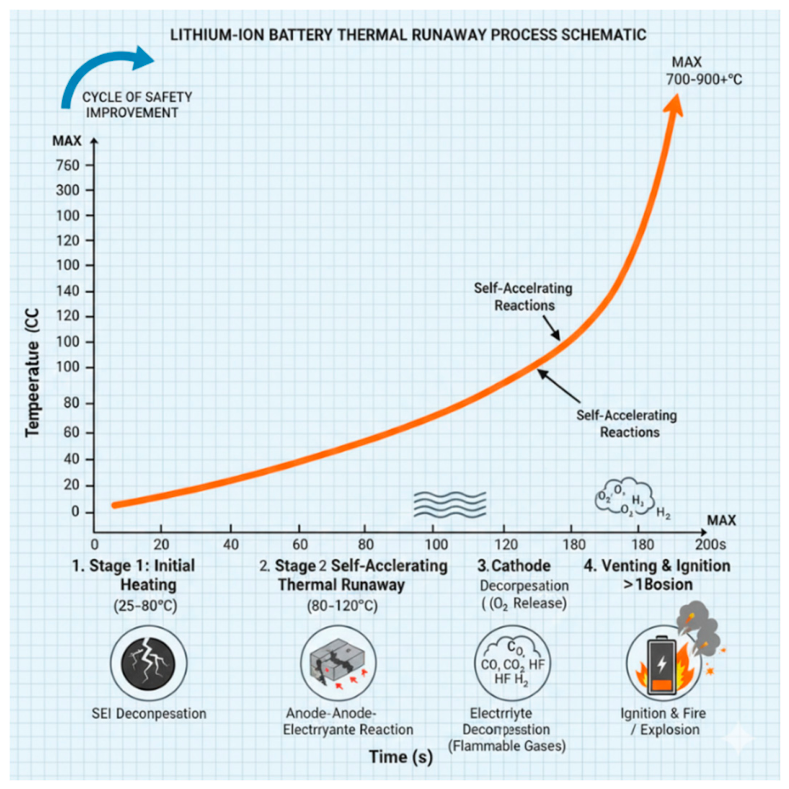
Once an abuse condition provides the initial energy input, a series of irreversible, exothermic chemical reactions are triggered within the cell. This process, thermal runaway, is a positive feedback loop: heat from reactions accelerates further reactions, generating more heat. The seminal work of Dahn, et al. and later refined by others, has established a generally accepted sequence of events, as visualized in Figure 1 and described below.
3.1. The Initiation Stage (T ~ 80-120°C)
The first line of defense within a LIB is the Solid Electrolyte Interphase (SEI). This is a passivating layer that forms on the surface of the graphite anode during the first charge cycle. It is electronically insulating but ionically conductive, allowing lithium ions to pass while preventing further electrolyte decomposition. However, the SEI is thermally metastable.
- •
- SEI Decomposition: As the cell temperature rises above ~80-120°C, the SEI begins to decompose exothermically. The composition of the SEI is complex, but key components like lithium ethylene dicarbonate (LEDC) break down into gases (e.g., CO, CO₂) and other products. This reaction provides the first significant heat release, pushing the cell temperature higher. The exact onset temperature depends on the electrolyte composition and the nature of the SEI layer.
- •
- Loss of Passivation: The breakdown of the SEI exposes the highly reactive lithiated graphite (LiₓC₆) to the organic electrolyte. With the protective layer gone, a vigorous exothermic reaction between the anode and the electrolyte commences. This is a major heat source and a key driver of the thermal runaway process. The heat release from this reaction is substantially greater than that from the SEI decomposition itself.
3.2. The Acceleration Stage (T > 120°C)
With the anode now actively reacting, the temperature rises rapidly, leading to the failure of critical cell components.
- •
- Separator Meltdown: Commercial polyolefin separators (Polyethylene, Polypropylene) have relatively low melting points (PE: ~135°C, PP: ~165°C). When the internal temperature reaches this range, the separator melts and loses its mechanical integrity, losing its porosity and collapsing. This causes a massive, cell-wide internal short circuit as the anode and cathode are brought into direct contact. The resulting high current flow generates immense Joule heating, creating a dramatic temperature spike. This is often the "point of no return" in the thermal runaway process.
- •
- Cathode Decomposition: The delithiated metal oxide cathode (e.g., LiₓNiₐMn₆CoO₂, LiₓCoO₂) becomes thermally unstable at high temperatures. These materials undergo exothermic decomposition, releasing oxygen. For example:
- o
-
Li₀.₅CoO₂ → 0.5 LiCoO₂ + (1/6) Co₃O₄ + (1/6) O₂ (Exothermic) [24]The release of oxygen is a critical turning point. It provides an internal oxidizer, allowing combustion-like reactions to occur inside the sealed cell, even in the absence of external air. The onset temperature and heat release of cathode decomposition vary significantly with chemistry (LCO < NMC < LFP).
- •
- Electrolyte Decomposition and Vaporization: The organic carbonate-based electrolyte (e.g., Ethylene Carbonate, Dimethyl Carbonate) boils and decomposes at these elevated temperatures. It can react with the released oxygen from the cathode, react directly with the highly reactive anode, or undergo pyrolysis, generating a mixture of flammable gases (e.g., H₂, CO, CH₄, C₂H₄) and other volatile organic compounds. The pressure from these gases builds up rapidly within the cell.
3.3. The Catastrophic Stage (T > 200°C) and Combustion
The reactions become increasingly violent, leading to cell rupture.
- •
- Pressure Buildup and Venting: The generation of gases from the various decomposition reactions (SEI, anode, cathode, electrolyte) causes a rapid increase in internal pressure. Once this pressure exceeds the mechanical strength of the cell casing, the cell will vent. Safety features like scored caps or vent discs are designed to open in a controlled location, ejecting the hot gas and aerosol mixture [26]. The composition and temperature of this vented material dictate the subsequent combustion behavior.
- •
- Ignition and Jet Fire: The ejected mixture is typically above its auto-ignition temperature. Upon contact with air, it ignites, often resulting in a directional jet fire. The heat from this external fire can further heat the failing cell and pose a propagation risk to neighboring cells. The flame temperature and length depend on the cell chemistry, SOC, and venting geometry.
- •
- Explosion Risk: In some cases, the vented gases may not ignite immediately, instead forming a flammable cloud around the battery. If this cloud finds an ignition source shortly after, it can lead to a gas explosion. A more severe risk is when the cell vents but the internal reactions are so rapid that the pressure buildup outpaces the venting capacity, leading to a violent physical rupture or explosion of the cell casing.
The entire process, from the initial trigger to venting, can occur in a matter of seconds to minutes, depending on the cell format, chemistry, and SOC. A cell at 100% SOC contains more active lithium and a more oxidized (unstable) cathode, making it significantly more reactive and prone to a faster, more severe thermal runaway compared to a cell at 50% SOC.
4. Combustion Chemistry and Associated Hazards
The fire resulting from a LIB in thermal runaway is distinct from a conventional hydrocarbon fire. It involves the combustion of a complex mixture of gases, liquid electrolyte aerosols, and solid particles, leading to unique fire dynamics and toxicological hazards.
4.1. Fuel Sources and Combustion Dynamics
- •
- Gaseous Fuels: The primary fuel for the flame is the mixture of flammable gases generated during thermal runaway. This includes Hydrogen (H₂), Carbon Monoxide (CO), Methane (CH₄), and various other hydrocarbons (e.g., C₂H₄, C₂H₆). The composition of this gas mixture depends heavily on the cell chemistry, electrolyte formulation, and the specific temperature history of the failure. H₂ and CO are often the most prevalent flammable species.
- •
- Liquid and Aerosol Fuels: The venting process also ejects aerosolized liquid electrolyte and its decomposition products. These droplets vaporize in the flame and burn, contributing to the heat release rate (HRR). The burning of these liquids can create a pool fire if the electrolyte accumulates, which is a particular concern in confined spaces like battery storage units.
- •
- Solid Components: While the electrodes themselves are not typically the primary fuel for the gas-phase flame, the burning of the carbonaceous anode and the binder materials can contribute to the overall energy release, particularly in the later stages of a fire.
The combustion is characterized by a high heat release rate and, in the case of a jet fire, significant radiant heat. The flame can be highly sooting due to the incomplete combustion of the organic components, especially under ventilation-limited conditions.
4.2. Toxic Gas Emissions
Perhaps the most significant immediate hazard to life, aside from the thermal threat, is the emission of toxic gases. These pose a severe inhalation risk in confined spaces like an aircraft cabin, a residential garage, or an energy storage container.
- •
- Carbon Monoxide (CO): A product of incomplete combustion, CO is a colorless, odorless gas that is highly toxic, binding to hemoglobin in the blood and preventing oxygen transport. Its generation is significant in LIB fires due to the oxygen-deficient environment inside the cell and during under-ventilated burning.
- •
- Hydrogen Fluoride (HF): This is a particularly dangerous and characteristic emission from LIB fires. The lithium hexafluorophosphate (LiPF₆) salt in the electrolyte decomposes in the presence of heat and moisture: LiPF₆ + H₂O → LiF + POF₃ + 2HF. HF is a highly corrosive and toxic gas that can cause severe damage to the respiratory system and can be fatal even at relatively low concentrations. The amount of HF generated can be substantial, with studies reporting yields of 20-200 mg/Wh of battery capacity.
- •
- Other Toxic Species: Depending on the chemistry, other compounds can be released, including Phosphorous Oxydifluoride (POF₃), various carbonyls, and Polycyclic Aromatic Hydrocarbons (PAHs) from soot. For cells with fluorine-containing binders (e.g., PVDF), additional HF can be generated. The use of phosphorus-based flame retardants can also alter the toxic gas profile.
The yield of these toxic gases is influenced by the state of charge, cell chemistry (LCO produces more HF than LFP), and fire conditions (ventilated vs. under-ventilated).
4.3. Projectiles and Secondary Fires
The violent nature of cell venting can turn cell components (e.g., the cap, tabs) into projectiles, posing a physical hazard to first responders and equipment. Furthermore, the jet fire can ignite combustible materials in the vicinity, leading to secondary fires that can be more significant than the initial battery fire itself. The management of this risk is a key aspect of battery pack and energy storage system design.
5. Failure Propagation in Battery Packs
A single cell undergoing thermal runaway is a significant event, but the primary safety concern for large-scale applications is the propagation of this failure to adjacent cells. A typical EV battery pack contains thousands of individual cells; if one fails, the energy it releases must be managed to prevent a cascading failure that could destroy the entire pack.
The propagation is primarily a thermal process. The heat released from a failing cell—through the jet fire, hot ejected particles, and conduction through interconnects—heats its neighbors. If this heat flux is sufficient to raise the temperature of adjacent cells to their thermal runaway trigger point, they too will fail, releasing their own energy and heating the next set of cells. This creates a domino effect.
The rate and extent of propagation depend on:
- Cell Format and Chemistry: Larger cylindrical (e.g., 21700, 4680) and pouch cells contain more energy and can release more heat during failure than smaller cells. Chemistries with higher energy density (NMC) generally release more heat during failure than LFP.
- Pack Design and Density: The spacing between cells, the module housing material, and the effectiveness of the Thermal Management System (TMS) are critical. Densely packed modules with poor thermal isolation are highly susceptible to propagation. The direction of the jet fire is also crucial; cells are often oriented to direct vents away from neighbors.
- State of Charge: A pack at a high SOC will propagate failure more readily than one at a low SOC, as the energy and violence of the failure are greater.
- Triggering Event and Orientation: The location of the initial failing cell (e.g., center vs. edge of a module) and the direction of its jet fire significantly influence which adjacent cells are most affected.
Preventing propagation is a core objective of battery pack engineering, as discussed in Section 6.
6. Mitigation Strategies: A Multi-Scale Approach
Ensuring battery safety requires a defense-in-depth strategy, incorporating measures at every level: from the fundamental chemistry of the materials to the system-level engineering controls and finally to external fire suppression. These can be categorized as intrinsic and extrinsic safety strategies.
6.1. Intrinsic Safety: Materials and Cell Design
This approach focuses on designing the cell itself to be more resistant to the initiation of thermal runaway.
- •
- Advanced Electrolytes:
- o
- Flame Retardant Additives: Compounds like organic phosphates (e.g., TTP, TEP), phosphazenes, and fluorinated carbonates can be added to the standard electrolyte. They act either in the condensed phase by promoting charring or in the gas phase by scavenging free radicals that sustain combustion. A key challenge is balancing flame retardancy with electrochemical performance, as these additives can increase viscosity and impair ion conductivity or SEI formation.
- o
- Concentrated ("Water-in-Salt") and Localized High-Concentration Electrolytes: These systems, while primarily developed for high-voltage or aqueous batteries, can exhibit improved thermal stability and reduced flammability compared to conventional electrolytes.
- o
- Ionic Liquids: These are salts that are liquid at room temperature, characterized by negligible vapor pressure and non-flammability. Their high thermal stability makes them excellent candidates for safer electrolytes, though challenges remain with high cost, viscosity, and poor low-temperature performance.
- •
- Solid-State Batteries (SSBs): This is considered the "holy grail" of intrinsic safety. By replacing the volatile, flammable liquid electrolyte with a solid ion conductor (ceramic, polymer, or composite), the primary fuel source for the fire is eliminated. Furthermore, many solid electrolytes are mechanically robust and can physically block lithium dendrite growth, preventing internal shorts. While significant technical hurdles regarding interfacial resistance and manufacturability persist, SSBs represent the most promising long-term solution to the battery fire problem.
- •
- Thermally Stable Cathodes: The choice of cathode material has a profound impact on safety. Layered oxides like NMC and LCO release oxygen exothermically at relatively low temperatures (~200°C). In contrast, lithium iron phosphate (LiFePO₄ or LFP) has a strong P-O covalent bond that prevents oxygen release until much higher temperatures, making it inherently much safer and more resistant to thermal runaway, albeit at a lower energy density. Research into surface coatings (e.g., Al₂O₃, ZrO₂) and concentration-gradient cathodes aims to improve the thermal stability of high-energy NMC materials.
- •
- Robust Separators:
- o
- Ceramic-Coated Separators: A layer of ceramic nanoparticles (e.g., Al₂O₃, SiO₂) is coated onto the polyolefin separator. This coating provides mechanical strength, improving puncture resistance, and also acts as a thermal insulator, increasing the shutdown temperature and improving dimensional stability during heating.
- o
- Non-Woven Separators: Made from materials like aramid (e.g., Nomex), these separators offer exceptional thermal stability (melting point > 400°C) and flame retardancy, though at a higher cost.
- •
- Internal Safety Devices: Cells are equipped with various safety features, including:
- o
- Current Interrupt Device (CID): A pressure-sensitive diaphragm that disconnects the electrical connection if internal pressure rises.
- o
- Positive Temperature Coefficient (PTC) Device: A resistor whose resistance increases dramatically with temperature, limiting current during an overcurrent event.
- o
- Vent Disc: A designed weak point that ruptures at a specific pressure to allow controlled venting, preventing explosion.
6.2. Extrinsic Safety: System-Level Engineering
These are engineering controls implemented at the module and pack level to monitor, manage, and contain cell failures.
- •
- Battery Management System (BMS): The BMS is the "brain" of the battery pack. Its safety functions are critical:
- o
- Monitoring: Continuously tracks voltage, current, and temperature of each cell or module.
- o
- Protection: Disconnects the pack via contactors in case of overvoltage, undervoltage, overcurrent, or overtemperature conditions.
- o
- State Estimation: Accurately estimates State of Charge (SOC) and State of Health (SOH) to prevent operation in unsafe regimes.
- o
- Cell Balancing: Ensures all cells are at the same voltage, preventing individual cells from being overcharged or over-discharged during cycling.
- •
- Thermal Management System (TMS): The TMS is responsible for maintaining the battery within its optimal temperature range (typically 15-35°C). It is also the first line of defense against propagation.
- o
- Active Cooling: Uses a liquid coolant (e.g., water-glycol) circulated through cooling plates or cold plates in direct contact with the cells. This is the most effective method for high-power applications like EVs. Some advanced systems can even switch to a coolant dump or refrigerant-based cooling in a thermal runaway event.
- o
- Passive Cooling: Relies on air (natural or forced convection) to remove heat. It is simpler and cheaper but less effective for large, high-density packs.
- o
- Phase Change Materials (PCMs): Materials that absorb large amounts of heat as they melt (e.g., paraffin wax), effectively acting as a thermal buffer during transient heating events or during the early stages of a cell failure.
- •
- Physical Protection and Pack Design:
- o
- Propagation Resistance: This is achieved through physical spacing between cells, the use of thermal barriers (e.g., mica sheets, aerogels), and fire-resistant encapsulation materials that can withstand the jet fire from a single cell and prevent it from impinging on its neighbors.
- o
- Structural Integrity: The pack housing must be mechanically robust to protect the cells from crush and penetration in a crash scenario. This often involves reinforced frames and ballistic protection plates.
- o
- Ventilation/Directed Venting: In large storage systems, designs include dedicated venting channels to safely route toxic and flammable gases away from the battery and towards external exhaust or suppression systems.
6.3. Fire Suppression and Intervention
When prevention fails, the goal is to extinguish the fire and prevent reignition. LIB fires present unique challenges for firefighters and suppression systems.
- •
- Challenges in Extinguishing LIB Fires:
- o
- Reignition Risk: The internal chemical reactions can continue even after the external flame is extinguished, as the cell remains hot and may contain pockets of unreacted materials. This can lead to repeated reignition hours or even days after the initial event.
- o
- Deep-Seated Fire: The fire originates within the sealed cell, making it difficult for suppressants to reach the seat of the reaction.
- o
- Toxic Runoff: Water and other suppressants used to fight the fire will become contaminated with toxic compounds (e.g., HF, dissolved metals), creating an environmental hazard that must be contained.
- •
- Suppressant Agents:
- o
- Water: Despite not being a traditional Class C (electrical) fire suppressant, water is remarkably effective for LIB fires. Its primary mechanism is cooling. Applying large volumes of water cools the pack, halting the propagation of thermal runaway to adjacent cells and eventually cooling the failing cells below their reaction thresholds. It is the most recommended agent for fire services due to its availability and cooling capacity. However, large quantities are often required.
- o
- Specialist Aerosols and Gases: Clean agent suppressants (e.g., FK-5-1-12, Novec 1230) can be used in enclosed spaces like battery storage containers. They work primarily by chemically interrupting the combustion chain reaction. However, their cooling capability is limited, so reignition remains a concern.
- o
- Vermiculite Dispersions: These are intumescent materials that can be applied as a slurry. They expand and form an insulating crust over the battery, smothering the fire and providing prolonged cooling. They are particularly useful for post-extinction cooling to prevent reignition.
7. Testing Standards and Regulations
To ensure a baseline level of safety, a comprehensive set of international standards and regulations govern the testing of LIBs. These standards, such as those from UL, IEC, and UN, prescribe a series of abuse tests that a cell, module, or pack must pass to be certified for sale and transport. These tests simulate the root causes discussed in Section 2 and include:
- Electrical Tests: Short circuit, overcharge, over-discharge.
- Mechanical Tests: Crush, nail penetration, impact, vibration.
- Environmental Tests: Thermal stability, rapid temperature cycling, altitude simulation.
- Fire Exposure Tests: Direct exposure to flame.
These standards are continuously evolving to keep pace with new battery formats and emerging failure modes, such as those for propagation resistance in large packs.
8. Conclusions and Future Perspectives
The safety of lithium-ion batteries remains a critical enabler for their continued adoption across all sectors of the economy. This review has detailed the complex, multi-stage process through which a battery fire initiates and propagates. We have seen that thermal runaway is a deterministic process, initiated by abuse conditions (mechanical, electrical, thermal) or defects, and driven by a cascade of exothermic chemical reactions involving the SEI, anode, electrolyte, and cathode. The resulting combustion is characterized by intense heat, jet flames, and the emission of highly toxic gases, posing unique challenges for hazard mitigation.
The current state-of-the-art employs a multi-scale defense-in-depth strategy. At the cell level, this involves developing safer materials, such as solid-state electrolytes, thermally stable cathodes, and flame-retardant additives. At the system level, sophisticated BMS and TMS, coupled with robust pack design featuring thermal barriers, are essential to monitor cell health and prevent the propagation of failure.
Despite significant progress, several challenges and knowledge gaps remain, pointing toward key future research directions:
- Predictive Modeling and Diagnostics: There is a pressing need for high-fidelity, multi-scale models that can predict the onset of thermal runaway under complex, real-world loading conditions. Coupled with this, the development of advanced in-operando diagnostic tools (e.g., embedded fiber optic sensors for temperature/strain, acoustic sensors for gas generation) for early fault detection is crucial. Artificial intelligence and machine learning applied to BMS data show promise for predicting impending failure.
- The Solid-State Battery Pathway: While immensely promising, the path to commercialization of SSBs is fraught with challenges related to interfacial stability, power density, and cost-effective manufacturing. Intensive research is required to overcome these barriers and realize the intrinsic safety benefits of solid-state systems. Understanding the failure modes of SSBs themselves is also a new area of inquiry.
- Managing Next-Generation Chemistries: The push for higher energy density is leading to the development of new chemistries, such as lithium-metal anodes, silicon-dominant anodes, and high-nickel or anode-free configurations. Each of these introduces new, and not yet fully understood, safety challenges that must be proactively addressed. The reactivity of lithium metal and the large volume changes in silicon pose significant thermal runaway risks.
- Standardization for Second-Life and Recycling: As EVs reach end-of-life, the repurposing of their batteries for stationary storage ("second-life") and the development of efficient recycling streams present new safety hurdles. Standardized methods for assessing the safety of aged and heterogeneous battery packs are urgently needed.
- Firefighting Protocols and Environmental Safety: Further research is needed to optimize fire suppression techniques for large-scale installations (e.g., containerized ESS) and to develop effective methods for containing and treating the toxic runoff from battery fires. Training for first responders must be continuously updated based on the latest research findings.
In conclusion, the problem of battery fires is complex but not insurmountable. A continued, concerted effort across fundamental science, materials engineering, and system design is essential. The goal is clear: to harness the tremendous potential of electrochemical energy storage while ensuring that safety is not its Achilles' heel. The journey from the "combustion cell" to the truly safe cell is one of the most important endeavors in our quest for a sustainable energy future.
References
- Tarascon, J. M., & Armand, M. (2001). Issues and challenges facing rechargeable lithium batteries. Nature, 414(6861), 359-367.
- Larcher, D., & Tarascon, J. M. (2015). Towards greener and more sustainable batteries for electrical energy storage. Nature Chemistry, 7(1), 19-29.
- Scrosati, B., & Garche, J. (2010). Lithium batteries: Status, prospects and future. Journal of Power Sources, 195(9), 2419-2430.
- Wang, Q., Ping, P., Zhao, X., Chu, G., Sun, J., & Chen, C. (2012). Thermal runaway caused fire and explosion of lithium ion battery. Journal of Power Sources, 208, 210-224.
- Feng, X., Ouyang, M., Liu, X., Lu, L., Xia, Y., & He, X. (2018). Thermal runaway mechanism of lithium ion battery for electric vehicles: A review. Energy Storage Materials, 10, 246-267.
- Lecocq, A., Bertana, M., Truchot, B., & Marlair, G. (2016). Comparison of the fire consequences of an electric vehicle and an internal combustion engine vehicle. INERIS Report.
- Liu, X., Ren, D., Hsu, H., Feng, X., Xu, G., Zhuang, M., ... & Ouyang, M. (2018). Thermal runaway of lithium-ion batteries without internal short circuit. Joule, 2(10), 2047-2064.
- Zhang, X., Wierzbicki, T., & Li, J. (2018). Characterization of plasticity and fracture of shell casing of lithium-ion cylindrical battery. Journal of Power Sources, 374, 149-159.
- Lamb, J., Orendorff, C. J., Steele, L. A., & Spangler, S. W. (2015). Failure propagation in multi-cell lithium ion batteries. Journal of Power Sources, 283, 517-523.
- Sahraei, E., Meier, J., & Wierzbicki, T. (2014). Characterization of the constitutive behavior of a lithium-ion battery cell under mechanical loading. Journal of Power Sources, 245, 609-623.
- Zhao, R., Liu, J., & Gu, J. (2015). The effects of electrode thickness on the electrochemical and thermal characteristics of lithium ion battery. Applied Energy, 139, 220-229.
- Belov, D., & Yang, M. H. (2008). Investigation of the kinetic mechanism of overcharge for lithium-ion batteries. Journal of The Electrochemical Society, 155(7), A539.
- Zhang, L., Ma, Y., Cheng, X., Du, C., Guan, T., & Sun, Y. (2019). Impact of over-discharge on the safety of lithium-ion batteries. RSC Advances, 9(37), 21133-21141.
- Waldmann, T., Iturrondobeitia, A., Kasper, M., Ghanbari, N., Aguesse, F., Bekaert, E., ... & Wohlfahrt-Mehrens, M. (2016). Review—Post-Mortem Analysis of Aged Lithium-Ion Batteries: Disassembly, Physicochemical Analysis, and Electrical Testing. Journal of The Electrochemical Society, 163(10), A2149-A2164.
- Ribière, P., Grugeon, S., Morcrette, M., Boyanov, S., Laruelle, S., & Marlair, G. (2012). Investigation on the fire-induced hazards of Li-ion battery cells by fire calorimetry. Energy & Environmental Science, 5(1), 5271-5280.
- Lopez, C. F., Jeevarajan, J. A., & Mukherjee, P. P. (2015). Experimental analysis of thermal runaway and propagation in lithium-ion battery modules. Journal of The Electrochemical Society, 162(9), A1905-A1915.
- Finegan, D. P., Scheel, M., Robinson, J. B., Tjaden, B., Hunt, I., Mason, T. J., ... & Brett, D. J. (2015). In-operando high-speed tomography of lithium-ion batteries during thermal runaway. Nature Communications, 6(1), 6924.
- Maleki, H., & Howard, J. N. (2009). Effects of overdischarge on performance and thermal stability of a Li-ion cell. Journal of Power Sources, 191(2), 568-574.
- Richard, M. N., & Dahn, J. R. (1999). Accelerating rate calorimetry study on the thermal stability of lithium intercalated graphite in electrolyte. I. Experimental. Journal of The Electrochemical Society, 146(6), 2068.
- Hatchard, T. D., MacNeil, D. D., Basu, A., & Dahn, J. R. (2001). Thermal model of cylindrical and.
Figure 1.
A detailed schematic of the thermal runaway process, showing temperature vs. time and correlating it with the key internal chemical and physical events: SEI decomposition, anode-electrolyte reaction, separator melt, cathode decomposition, electrolyte decomposition, and finally, venting and ignition.
Figure 1.
A detailed schematic of the thermal runaway process, showing temperature vs. time and correlating it with the key internal chemical and physical events: SEI decomposition, anode-electrolyte reaction, separator melt, cathode decomposition, electrolyte decomposition, and finally, venting and ignition.
Disclaimer/Publisher’s Note: The statements, opinions and data contained in all publications are solely those of the individual author(s) and contributor(s) and not of MDPI and/or the editor(s). MDPI and/or the editor(s) disclaim responsibility for any injury to people or property resulting from any ideas, methods, instructions or products referred to in the content. |
© 2026 by the authors. Licensee MDPI, Basel, Switzerland. This article is an open access article distributed under the terms and conditions of the Creative Commons Attribution (CC BY) license (http://creativecommons.org/licenses/by/4.0/).
Copyright: This open access article is published under a Creative Commons CC BY 4.0 license, which permit the free download, distribution, and reuse, provided that the author and preprint are cited in any reuse.