

Submitted:
14 September 2026
Posted:
15 September 2026
You are already at the latest version
Abstract
Acinetobacter baumannii (A. baumannii) is a major nosocomial pathogen that poses a significant threat to global health owing to its remarkable capacity for antimicrobial resistance, environmental persistence, and virulence. These adaptive traits are closely associated with its quorum-sensing (QS) network, particularly the AbaI/AbaR system. Current evidence indicates that AbaI/AbaR-mediated signalling coordinates biofilm formation, surface-associated motility, antimicrobial tolerance via modulation of efflux pump activity, oxidative stress responses, and membrane integrity, as well as biofilm-associated antibiotic resistance and stress adaptation, thereby enhancing bacterial survival and fitness. Furthermore, QS signalling contributes to epithelial cell injury and to the modulation of innate immune responses during infection, whereas its effects on adaptive immunity remain poorly understood. This review summarises current knowledge of the molecular mechanisms underlying AbaI/AbaR-mediated signalling, its role in regulating A. baumannii infection-relevant phenotypes and host–pathogen interactions, as well as the therapeutic potential of quorum quenching (QQ) strategies in attenuating A. baumannii virulence, while highlighting key knowledge gaps that warrant further mechanistic and translational investigation.
Keywords:
Acinetobacter baumannii
; quorum sensing
; quorum quenching
; biofilm
; virulence
1. Introduction
Acinetobacter baumannii is a Gram-negative coccobacillus that has emerged as one of the most problematic opportunistic pathogens in modern healthcare [1,2]. It is responsible for a wide range of healthcare-associated infections (HAIs), including hospital-acquired pneumonia (HAP), ventilator-associated bacterial pneumonia (VABP), bloodstream infections (BSI), urinary-tract infections (UTI), meningitis, and skin and soft-tissue infections, predominantly in critically ill hospitalized and immunocompromised patients [3,4,5]. Its capacity for long-term persistence is largely attributable to its robust biofilm-forming ability on medical devices and hospital surfaces, which enhances resistance to antibiotics, disinfectants, and host immune defences [6,7].
A major factor underlying the clinical success of A. baumannii is its remarkable capacity to accumulate antimicrobial resistance determinants. Resistance arises through a combination of intrinsic and acquired mechanisms, including the production of OXA-type carbapenemases and metallo-β-lactamases, reduced outer-membrane permeability resulting from porin alterations, multidrug efflux pumps, target-site modification, and the acquisition of resistance genes via plasmids, integrons, and transposons [8,9].
A. baumannii is one of the ESKAPE pathogens, a group of clinically important bacteria comprising Enterococcus faecium, Staphylococcus aureus, Klebsiella pneumoniae, Pseudomonas aeruginosa, and Enterobacter spp., known for their multidrug resistance (MDR) and responsible for a substantial proportion of HAIs worldwide [10]. The World Health Organization (WHO) classification identifies carbapenem-resistant A. baumannii (CRAB) as a critical-priority pathogen, underscoring the urgent need for new therapeutic options, antimicrobial stewardship, and strengthened infection-control strategies [11,12]. In 2019, the Centers for Disease Control and Prevention (CDC) designated CRAB as an urgent threat, highlighting its limited treatment options, high mortality, and potential to cause widespread outbreaks in hospitals and long-term care facilities [12,13].
The treatment of resistant A. baumannii infections remains highly challenging, as current antibiotic options are limited by nephrotoxicity, suboptimal pharmacokinetic characteristics, inadequate penetration into pulmonary tissues and inconsistent clinical outcomes. An agreed first-line standard of care has therefore not been established [14,15,16]. Consequently, adjunctive and alternative strategies, including phage therapy, nanoparticles, antimicrobial peptides and anti-virulence interventions that target bacterial pathogenicity, are being investigated to overcome the limitations of conventional antibiotics [17,18,19,20,21].
Among the anti-virulence approaches currently under investigation, targeting quorum sensing (QS) has attracted considerable attention because it attenuates bacterial pathogenicity without directly affecting bacterial viability. QS is a cell-density-dependent communication system in which accumulating autoinducers (AIs) activate target gene expression after reaching a threshold concentration [22,23]. This density dependence enables bacteria to postpone metabolically expensive collective behaviours until they become energetically favourable, facilitating the transition from individual activity to coordinated community behaviour. Current anti-QS strategies include quorum quenching (QQ), which degrades or inactivates signalling molecules, and quorum sensing inhibitors (QSIs), which disrupt signal synthesis, receptor binding, or downstream signal transduction [24].
In Gram-negative bacteria, QS is commonly mediated by N-acyl-homoserine lactone (AHL) signalling molecules and LuxI/LuxR-type regulatory proteins [24] [25]. In A. baumannii, this canonical signalling architecture is represented by the AbaI/AbaR circuit, in which AbaI functions as the AHL synthase and AbaR as the cognate transcriptional regulator. The predominant autoinducer identified in A. baumannii isolates is N-(3-hydroxydodecanoyl)-L-homoserine lactone (OHC12-HSL), although the type and quantity of AHLs produced may vary depending on the strains [25,26] [27]. Activation of the AbaI/AbaR circuit regulates the expression of genes involved in biofilm formation, surface-associated motility, bacterial persistence, and host colonization, thereby promoting adaptation to the host environment and enhancing pathogenicity [25] [7] [26] [27]. QS influences the expression of factors involved in bacterial adhesion (OmpA, Chaperone-usher system), epithelial cell invasion (Plc1, Plc2), and survival in host tissues (biofilm production, bauA). Clinical and experimental studies have linked an intact AbaI/AbaR system to increased epithelial cell invasion and enhanced virulence, suggesting that the QS system contributes to epithelial damage during infection [27]. Furthermore, AbaI/AbaR-associated biofilm formation and virulence-related phenotypes may influence host responses during infection, although the direct immunological consequences of this regulation remain incompletely defined [25] [7] [26] [27,28].
This review summarizes the current understanding of the AbaI/AbaR QS system in A. baumannii, its contribution to biofilm formation, pathogenicity, epithelial injury, innate immune activation and the emerging potential of QQ enzymatic strategies as adjunct approaches for controlling multidrug-resistant infections.
2. Molecular Basis of AbaI/AbaR QS System
2.1. AbaI-Dependent AHL Synthesis
2.1.1. AbaI as the LuxI-Type Autoinducer Synthase
The AbaI/AbaR signalling axis characteristic of A. baumannii belongs to LuxI/LuxR-type QS systems, which occur in many Gram-negative bacteria [29,30,31]. The nomenclature of this signalling scheme derives from the model LuxI/LuxR system, first discovered in Vibrio fischeri, in which this system controls the expression of the luminescence operon, while the LuxI and LuxR proteins function as an acyl-HSL synthase and a transcriptional activator, respectively [30]. Analogously, AbaI represents the A. baumannii LuxI-type autoinducer synthase, whereas AbaR denotes a LuxR-type transcriptional regulator [32,33]. The indirect identification of the AbaI protein was made possible through a clinical Acinetobacter spp. isolate producing diffusible molecules capable of activating the biosensor strain Agrobacterium tumefaciens, which responds to the presence of AHL [32], [33] [34]. In the next step, it was demonstrated that a single open reading frame designated abaI caused AHL production in recombinant Escherichia coli cells [32,34]. Later studies on A. baumannii American Type Culture Collection (ATCC) 17978 showed an analogous relationship, as mutation (deletion) of abaI abolished AHL production under the examined conditions [34].
Considering AbaI at the level of biochemical features, this protein should be classified as a LuxI-type AHL synthase [32,33]. This type of enzyme is responsible for catalysing the formation of AHL from two substrates belonging to the category of metabolites of cellular processes: S-adenosyl-L-methionine, which provides the homoserine lactone ring, and acylated acyl carrier protein (acyl-ACP), which donates the acyl side chain. Therefore, AHL production is not a simple reaction of producing signalling molecules, but rather a process linked to the basic metabolism of the organism and fatty acid biosynthesis [35]. Additionally, AHL should be considered as a heterogeneous group of signalling molecules, in which differences result from diverse acyl groups of acyl-ACP [35,36]. The structural diversity of AHL molecules is biologically relevant, because variation in the acyl side chain may affect receptor binding, transcriptional activation, and consequently, the phenotype regulated by this QS system [30,35,37]. The dominance of specific AHL variants is influenced by AbaI itself, whose active site may determine the predominance of a product of a particular type [35,36]. Considering A. baumannii and other closely related species of the genus Acinetobacter spp., AbaI-dependent signalling is dominated by AHLs with long side chains [33,38]. In the case of the widely studied A. baumannii strain ATCC 17978, based on genomic analyses and experimental observations, it is now well established that AbaI is the main classical LuxI-type AHL synthase [33,34]. Although mutation of abaI in ATCC 17978 abolished detectable AHL production, the presence of LuxI-independent AHL synthesis pathways in other A. baumannii strains cannot be completely excluded [34,39].
It should be noted that some of the early insights into AbaI were obtained using the historically important strain referred to as A. baumannii M2, which, as a result of genome analyses, was later reclassified as A. nosocomialis M2 [33,40]. Although the findings from the above-mentioned studies do not undermine the key assumptions regarding the mechanism of AbaI action, they should be now presented as evidence derived from species within the Acinetobacter calcoaceticus-Acinetobacter baumannii complex (ACB), a group of closely related species that also includes A. baumannii [33,40]. Information directly referring to A. baumannii, derived from studies on strains such as ATCC 17978, ATCC 19606, AB5075, and clinical isolates, supported the earlier assumptions resulting from studies on strain M2 [33,34,38,41,42,31].
In terms of the functional aspect of this QS system, the AbaI synthase is responsible for initiating the signal by producing AHL [32,41]. As a result of AbaI activity, AHLs can be detected in the culture medium, while their distribution between the cell, membrane-associated compartment, and extracellular environment most likely depends on their physicochemical properties [43] [44]. AHLs with shorter acyl chains are considered capable of passive diffusion across bacterial membranes, whereas long-chain AHLs interact more strongly with the lipid phase and therefore may potentially exhibit slower distribution between the cell and the environment. However, this distribution model should be regarded as an inference based on general AHL properties rather than as a process directly demonstrated for the AbaI/AbaR system in A. baumannii [43,44]. When the signal of this QS system reaches an effective threshold, dependent on the concentration and properties of the AHL, population density, and culture conditions, the signalling molecule binds to AbaR, which acts as a cytoplasmic AHL-responsive transcriptional regulator; although this binding site has not been structurally resolved [33] [37] [39] [41,43]. This binding prompts the AbaR-AHL complex to interact with specific promoter regions, typically described as lux box-like motifs, directly causing broad transcriptional changes, including positive feedback involving abaI expression [41,32] [42]. Niu et al. showed that, in the examined M2 strain, abaI expression was induced by culture extracts containing AHLs and by synthetic 3-hydroxy-C12-HSL. This supports the model of a self-amplifying AbaI regulatory loop, more extensively developed later in the article. However, the precise characteristics of this AbaR binding site, including its exact sequence length and a validated consensus motif, remain poorly defined. Furthermore, while the abaR gene itself is highly conserved across A. baumannii species, the sequence-level conservation of its specific DNA-binding operator has not yet been systematically characterized [32].
2.1.2. Chemical Nature and Diversity of AHL Signals
At the molecular level, AHLs consist of a conserved homoserine lactone ring connected by an amide bond to an acyl chain, which varies with respect to length, degree of saturation, and degree of oxidation at the C3 position, including unsubstituted, 3-hydroxy, and 3-oxo forms [37] [45]. These are biochemically important differences that affect signal properties such as hydrophobicity, diffusion, partitioning into the membrane compartment, stability, and selectivity of receptor binding [37,45,44,46]. Accordingly, in LuxI/LuxR-type systems, the acyl chain co-determines the specificity and kinetics of signalling, because the corresponding LuxR-type regulators usually contain a binding domain matched to an acyl chain of a defined length and corresponding substitution profile [37,45]. This is particularly important in the case of Acinetobacter spp., because in many examined strains belonging to the ACB complex, a predominance of long-chain AHLs has been detected, in particular molecules with C10-C14 acyl chains [33] [34].
According to the current state of knowledge regarding QS systems in A. baumannii, the best-documented AHL signal is N-(3-hydroxydodecanoyl)-L-homoserine lactone (OHC12-HSL) [33,34]. In studies on A. baumannii ATCC 17978 using high-performance liquid chromatography coupled with mass spectrometry, OHC12-HSL was identified as the main AHL type detected in the supernatants of static cultures. The dominance of this type of signalling was also supported by its concentration, which reached a level one to two orders of magnitude higher than that of other AHLs [33]. Accordingly, it is assumed that the AbaI/AbaR system in best characterized A. baumannii models is most likely OHC12-HSL-centered [33] [34].
When analysing the diversity of the AbaI-dependent signal specifically in A. baumannii, the available evidence provided by Mayer et al. also supports the presence of additional AHLs. In addition to the dominance of OHC12-HSL in ATCC 17978, smaller amounts of N-(3-hydroxydecanoyl)-L-homoserine lactone (OHC10-HSL), N-(3-oxododecanoyl)-L-homoserine lactone (OC12-HSL), and N-(3-hydroxytetradecanoyl)-L-homoserine lactone (OHC14-HSL) were also detected. Under some culture conditions, small amounts of N-hexanoyl-L-homoserine lactone (C6-HSL), N-(3-oxohexanoyl)-L-homoserine lactone (OC6-HSL), and N-octanoyl-L-homoserine lactone (C8-HSL) were also recorded. Information from studies on clinical isolates also indicates heterogeneity through the detection of OHC10-HSL, OC12-HSL, N-(3-oxotetradecanoyl)-L-homoserine lactone (OC14-HSL), and OHC14-HSL. It should be noted that in all clinical isolates examined in that study, the abaI and abaR genes were amplified by PCR (polymerase chain reaction), and their sequences showed high identity to the corresponding genes in strain ATCC 17978. Therefore, the heterogeneity of the AHL profile is probably not solely dependent on the presence of the canonical AbaI/AbaR genes but may result from differences in the regulation of their expression, the activity of QQ enzymes, nutrient availability, or culture conditions [33].
The dominance of long-chain AHLs has important physicochemical significance and may potentially influence the characteristics of AbaI/AbaR signalling [33,44,46]. Elongation of the acyl chain increases the hydrophobicity of the molecule, its interactions with membranes, and its stability against lactonolysis [44,46]. The length of the acyl chain and substitution at the C3 position also influence the specificity of interaction with LuxR-type regulators [37,45]. Due to these relationships, the above features should be classified as potentially important from the perspective of their influence on the behaviour of the signal of this QS system and its recognition [37,45,44,46].
2.1.3. Factors Influencing AHL Accumulation
The classical QS system model describes AHL accumulation as a process dependent on increasing bacterial density until a functional level is reached, which is necessary to activate receptor-dependent signalling pathways [29,37] [39]. In the case of A. baumannii, a strictly defined numerical threshold for AbaR activation by AHLs has not been established. In the literature devoted to AbaI-dependent AHL production, experimentally observed patterns of accumulation of these signalling molecules are primarily presented [33,34,38]. The best characterization of these trends has been described based on information derived from strain ATCC 17978 [33,34]. In this model, OHC12-HSL accumulation was significantly dependent on the growth phase under static culture conditions, with the peak observed around the transition to the stationary phase, followed by a sharp decrease in the level of the examined AHL. This indicates that AHL accumulation is growth-phase-dependent rather than constitutive under the tested static culture conditions. Specifically, OHC12-HSL levels peak at the transition to the stationary phase and then decline sharply, rendering the signal largely undetectable during the stationary phase itself. Attention should also be paid to the different results obtained in shaken cultures, where A. baumannii populations showed low abaI expression and no detectable AHLs in the tested media. These observations support the conclusion that static conditions possibly reflecting surface-associated growth or increased cell-to-cell contact favours AbaI-dependent QS signalling [33,34] [42]. AHL accumulation may also be affected by variability within the species itself [33,27]. Among 80 A. baumannii clinical isolates, abaI and abaR were common, but only 24 of 61 isolates carrying both genes produced biosensor-detectable AHLs. This shows that the presence of abaI and abaR does not necessarily predict an active AHL-producing phenotype [27].
Additional factors determining AHL signal accumulation are environmental conditions [33,34,47]. Both in the case of strain ATCC 17978 and in studies on clinical isolates, the profile of produced AHLs depended on nutrient availability or on the salt concentration in the medium [33,34]. Blue light and temperature were also identified as environmental elements modulating, in this case, abaI expression and AHL production in ATCC 17978 [47,48]. At 23°C, abaI expression was markedly higher in darkness than under blue light, and AHLs were mainly detected in dark-grown biofilm-associated samples. At 37°C, the direction was reversed. AHL production and abaI expression were higher under blue light than in darkness, although the magnitude of the light-dark difference was smaller than at 23°C [47].
2.1.4. Consequences of AbaI Disruption
The consequence of deletion or inactivation of abaI, which prevents functional AbaI production, is impairment of AbaI-dependent AHL synthesis below the detectable level, which translates into disruption of the AHL-dependent component of AbaI/AbaR system signalling [34] [38] [42]. The ΔabaI mutant of ATCC 17978 did not induce AHL biosensor responses, whereas under identical conditions the wild-type (WT) A. baumannii strain produced detectable signals [38]. This supports the conclusion that the presence of AbaI, as the expression product of abaI, is necessary for detectable AHL production in this strain under tested condition [34] [38] [42].
Although AbaI-dependent AHL production is a key element of AbaI/AbaR signalling, the impact of abaI disruption extends beyond the simple disappearance of the extracellular signal [41] [42,49,50]. RNA sequencing of the ΔabaI mutant of ATCC 19606 revealed 380 genes with altered expression. This group included 256 upregulated genes and 124 downregulated genes. Enrichment analysis showed downregulation of pathways associated with arginine biosynthesis, purine metabolism, biofilm formation, and the type VI secretion system (T6SS), whereas pathways related to fatty-acid and amino-acid metabolism were upregulated [41]. This supports a model in which AbaI/AbaR signalling participates directly or indirectly in a broad spectrum of transcriptional processes, rather than only in selected virulence traits [41] [42] [49] [50]. However, it is important to interpret the transcriptomic changes observed after abaI deletion as a consequence of disruption of the AbaI/AbaR system, and not as evidence that every gene with altered expression is a direct transcriptional target of AbaR [37] [41] [42]. Xiong et al. noted that RNA-sequencing studies performed in abaI deletion backgrounds in ATCC 17978, AB5075, and clinical strains showed different numbers of differentially expressed genes, partly because of different analytical cutoffs and culture conditions [41] [42]. Some changes may reflect direct AbaR-dependent regulation, although direct promoter binding has not been demonstrated for most of the identified genes [37] [41]. Others may instead represent secondary expression disturbances resulting from changes in metabolism, stress response, cell envelope organization, or surface-associated growth, which develop as a direct or indirect consequence of QS system disruption [34] [41] [42] [49] [50].
Recent proteomic data further support the view that abaI disruption results in extensive remodelling of the bacterial cell at transcriptomic and proteomic level [41] [42] [49]. In the ΔabaI mutant of ATCC 17978, altered expression of polypeptides associated with membrane proteins, membrane transport, membrane biogenesis, and antibiotic resistance was demonstrated. The mutant exhibited reduced levels of outer-membrane-associated proteins, including Survival Protein A (SurA), an Outer Membrane Protein A (OmpA) family protein, an Outer Membrane Protein W (OmpW) family protein, and β-Barrel Assembly Machinery Protein A (BamA), linking abaI disruption to changes in cell envelope organization and potentially increased vulnerability to membrane-associated stresses [49,51].
2.2. AbaR-Mediated Transcriptional Regulation and Positive-Feedback Loop
AbaR is a partially characterized transcriptional receptor-regulator belonging to the LuxR-type receptor family [32] [37,52,53,25]. It constitutes a component of the AbaI/AbaR QS system that links AbaI-dependent production of AHLs with corresponding transcriptional changes in the studied A. baumannii strains [31] [38] [41] [42] [50] [52] [53] [25]. In the original characterization of the AbaI-associated QS region, AbaR was described as a 198-amino-acid LuxR-type protein with characteristics similar to those of other AHL-responsive regulators from the LuxR family, supporting its proposed role as the cognate receptor paired with AbaI [32] [33] [40] [54]. AbaR is expected to contain an N-terminal domain responsible for AHL binding and a C-terminal helix-turn-helix domain predicted to mediate DNA binding at regulated promoter regions [37] [39]. This mechanistic prediction underlies the proposed functional model of AbaR, in which AbaI-derived AHLs—particularly OHC12-HSL—are proposed to modulate AbaR activity and thereby enable AbaR-dependent transcriptional regulation [32] [37] [38] [52] [54].
The abaI promoter region remains the most frequently discussed candidate site for AbaR-mediated feedback regulation. In the historically studied M2 strain the nucleotide sequence CTGTAAATTCTTACAG, located 67 bp upstream of the predicted abaI start codon, was described as a Lux-box-like sequence and proposed as a putative binding site through which AbaR could participate in the autoinductive positive-feedback loop of abaI [32] [33] [40]. In A. baumannii AB5075, a putative Lux-box-like sequence has also been indicated in the intergenic region between abaM and abaI, upstream of the predicted abaI start codon, within the broader abaR-abaM-abaI locus architecture [42]. However, these candidate regions should not be regarded as validated AbaR-binding sites. To date, the complete regulatory sequence recognized by AbaR has not been directly mapped, and no experimental structure of the protein has been obtained. Although later studies successfully generated abaR mutants and showed that AbaR affects abaI expression and biofilm-related phenotypes, the structural basis of AbaR-AHL-DNA recognition and the direct promoter occupancy of AbaR remain unresolved [32] [42] [52] [53] [25]. Nevertheless, the presence of the LuxR-type abaR gene within the abaI-associated locus, together with candidate Lux-box-like sequences upstream of abaI and functional data from abaR mutants, supports AbaR as the most plausible cognate regulator mediating this feedback [32] [42] [52] [53].
Positive feedback within the AbaI/AbaR system was demonstrated in a study using strain M2, a representative of the closely related ACB complex [32] [33] [40] [25]. Evidence supporting the positive-feedback-loop model directly in A. baumannii is based on strain AB5075, in which an abaI promoter-lux reporter fusion was used to indirectly demonstrate an increase in abaI promoter activity stimulated by exogenous OHC12-HSL. In addition to increased abaI expression, the same study also showed that abaM expression is positively regulated by QS, whereas AbaM functions as a negative modulator of the QS circuit, since disruption of abaM increased AHL production and abaI/abaR expression [42]. Thus, in A. baumannii, AbaR-associated autoinduction of abaI is best viewed as part of a broader feedback architecture rather than as a simple linear loop [32] [42] [52] [53] [25].
The effects of AbaR-associated gene-expression regulation within the AbaI/AbaR QS system seems to extend beyond this feedback mechanism and modulate numerous characteristics, including metabolism, virulence-associated traits, stress responses, cell envelope organization, and surface-associated growth [38] [41] [42] [49] [50] [51] [52] [53]. However, the direct AbaR regulon has not yet been comprehensively defined, and many reported downstream or upstream effects of AbaI/AbaR signalling are inferred from studies of abaI mutants, AHL-production status, or global expression analyses rather than from evidence of direct AbaR-promoter binding [41] [42] [49] [50] [52] [53]. This makes it difficult to distinguish the primary effects of the QS system from its secondary effects [41] [42] [50] [52] [53].
2.3. AbaM-Dependent Modulation and Strain-Dependent Complexity
The current perception of the AbaI/AbaR QS system in A. baumannii should extend beyond a simple two-gene LuxI/LuxR-type system [31] [37] [42] [25]. In A. baumannii AB5075 studies identified abaM as a third gene located between abaR and abaI, with abaR divergently transcribed relative to the tandemly oriented abaM and abaI genes, and a putative Lux-box-like sequence located in the intergenic region between abaM and abaI, upstream of the predicted abaI start codon. Comparative genomic analysis indicated that this three-gene locus organization is conserved among Acinetobacter spp. [42]. The product of this gene, AbaM, is a small RsaM-type protein (the first representative of this family of AHL-dependent QS systems negative regulators was originally identified in Pseudomonas fuscovaginae) that is predicted to function as neither an AHL synthase nor a LuxR-type AHL receptor within the AbaI/AbaR system [42,55,56]. Such organization of the locus is important from the perspective of refining the mechanistic model of the described QS system and the interdependent modulation of the expression of its constituent genes. Experimental findings have suggested that stimulation with OHC12-HSL enhances the expression of both abaI and abaM, resulting in a more diverse response that extends beyond the simplest model of a positive-feedback loop [42] [56].
Experimental data, particularly those obtained from strain AB5075, support the RsaM-like nature of AbaM and characterize this protein as a negative regulator of the AbaI/AbaR system [42] [56]. Disruption of AbaM was shown to cause a significant increase in AHL production and increased expression of abaI and abaR, supporting the view that AbaM restricts the activity of the signal-production and signal-reception components of the pathway rather than constituting an additional signal-producing or signal-receiving module [42]. The currently accepted organization of the abaR-abaM-abaI locus and the proposed autoregulatory interactions within this module are summarized in Figure 1 [31,32,37,38,42,52,53,55,56]. Additionally, AbaM is considered to be more than merely a minor regulatory element of the QS pathway. Transcriptomic analysis showed that AbaM modulates approximately 21% of the regulon of the AbaI/AbaR system. However, similarly to the reservations concerning the assessment of the direct and indirect effects of AbaR stimulation, in the case of AbaM it also remains unknown what proportion of the modulation of the transcriptional program results from the direct action of the abaM product and what proportion constitutes a secondary effect of the mechanism restricting the activity of the AbaI/AbaR signalling system itself [42] [56].
Important information regarding the functional consequences of AbaM activity was provided by phenotypic observations in abaM mutants. Loss of AbaM was associated with increased biofilm formation and surface-associated motility, as well as significantly reduced virulence in a Galleria mellonella infection model [42]. These paradoxical observations of enhanced QS signalling and surface-associated phenotypes show that these effects should not necessarily be equated with increased virulence in vivo, while the AbaM regulator may potentially act as a factor preventing excessive AbaI/AbaR activity and thereby contribute to maintaining QS signalling at a desirable level, which may favour the preservation of pathogenic fitness [38] [42] [56].
AbaM-mediated modulation may also explain why the AbaI/AbaR system does not produce identical effects in all A. baumannii strains or isolates. AHL accumulation is additionally controlled by AbaM, which negatively regulates the AbaI/AbaR system and may reduce AHL levels below the detection threshold of some assays. The mere presence of abaI and abaR is not equivalent to detectable AHL production, while detectable AHL production should not be equated with a uniform pathogenic phenotype [33,42,27]. Studies of clinical isolates indicate that some isolates possessing both canonical genes of the discussed QS system do not produce AHLs detectable using a biosensor, whereas other isolates producing detectable AHLs vary in terms of surface-associated motility, invasion capacity, behaviour in virulence models, and biofilm formation [27]. This suggests that the abaI/abaR genotype, AHL production, and downstream phenotype should be regarded as related but distinct functional levels of the same QS system [33,42,27].
In addition to differences in the expression of abaI, abaR and abaM, strain-dependent variability may also be influenced by variation in the architecture of the promoters of both the canonical genes and those belonging to the QS-system regulon, the structure of AHLs and the rate of their degradation, the metabolic state of the cells, environmental growth conditions, and interactions with other regulatory pathways [32,33,37,41,42,45,44,46,47,48,50,52,53,56,27]. Therefore, AbaI/AbaR/AbaM signalling appears to be part of a broader adaptive signalling network rather than an isolated mechanism determining specific virulence traits [31,41,42,49,50,56,27].
Because evidence for the AbaI/AbaR/AbaM QS system has been derived from different experimental models and strain backgrounds, direct generalization across studies requires caution. The historically important M2 strain, reference A. baumannii strains, the AB5075 model and clinical isolate collections each contributed different types of evidence and have distinct interpretative limitations. These key study models and their relevance to the current understanding of AbaI/AbaR/AbaM signalling are summarized in Table 1 [32] [33] [34] [40] [41] [42] [27] [49].
3. AbaI/AbaR-Regulated Phenotypes Relevant to A. baumanii Infection
Figure 2 presents the role of AbaI/AbaR-regulated phenotypes relevant to A. baumanii infection like biofilm formation and persistence, surface-associated motility, adhesion to and invasion of epithelial cells as well as drug resistance and stress adaptation [57,58,31,59].
3.1. Role of QS in Biofilm Formation and Persistence of A. baumanii
One of the major determinants providing A. baumanii to persist in healthcare-associated environments and contribute to infectious disease is its capacity to form biofilms, defined as highly organized bacterial communities within a self-produced extracellular polymeric substance (EPS) matrix [60,61,62]. In a study evaluating 100 A. baumannii isolates from immunocompromised patients hospitalized in an intensive care unit (ICU), all analysed isolates demonstrated the ability to form biofilm [63]. Furthermore, biofilm formation is estimated to contribute to over 65% of HAIs and nearly 80% of chronic infections [63,64]. The QS system is recognized as an important regulatory mechanism controlling biofilm development and virulence regulation in A. baumannii [65].
Biofilm formation in A. baumannii is a multifactorial process driven by several genes that support bacterial adhesion, surface colonization and biofilm maturation. Among the most frequently described determinants are ompA, which encodes Acinetobacter OmpA (AbOmpA), beta-lactamase PER-1 (blaPER-1) and biofilm-associated protein (Bap) [66]. The role of OmpA has been demonstrated in A. baumannii ATCC 19606. Strains lacking ompA showed a reduced ability to form biofilm, whereas replenishment of a functional ompA gene recovered this phenotype [67]. At the same time, genomic studies of extensively drug-resistant (XDR) A. baumannii isolates indicate that biofilm-associated genes may vary substantially between strains [68]. Recent studies suggest that understanding the molecular mechanisms of biofilm formation may help evaluate new therapeutic strategies against A. baumannii. Yang et al. showed that α-pinene combined with meropenem synergistically inhibited biofilm formation in carbapenem-resistant A. baumannii, reducing EPS production, surface motility, QS activity and the expression of key biofilm-related genes, including ompA, bfmR, bap, csuAB, abaI and abaR [65]. These findings indicate that changes in biofilm-associated gene expression may serve as useful markers for assessing the anti-biofilm activity of new treatments. Table 2 was prepared based on a PubMed search using the query “Acinetobacter baumannii AND biofilm AND quorum sensing” to summarize the role of QS in the formation, maturation and regulation of A. baumannii biofilms.
Overall, Table 2 shows that AbaI/AbaR- and AHL-dependent QS contributes to several stages of A. baumannii biofilm development. The selected studies indicate that QS is involved not only in biofilm biomass formation, but also in surface adaptation, motility, matrix organization and structural maturation of the biofilm.
The contribution of QS to A. baumannii persistence may also extend beyond direct regulation of biofilm formation. During desiccation, bacterial cells experience oxidative stress and increased expression of antioxidant enzymes, such as catalase and superoxide dismutase, can improve their survival under these conditions [73,74,75]. One reported mechanism involves the insertion sequence ISAba1 upstream of katG, a catalase-encoding gene, which may enhance katG expression and increase tolerance to hydrogen peroxide [75]. Importantly, the activity of these antioxidant defences has been linked to QS regulation, suggesting that QS may help coordinate both biofilm-associated behaviour and adaptation to oxidative stress in A. baumannii [76,25]. He et al. proposed that Resistance-Nodulation-cell Division (RND)-family efflux pumps, especially AdeFGH, may interact functionally with the QS system by facilitating the export of QS signalling molecules, thereby supporting biofilm formation [58].
3.2. QS Role in Surface-Associated Motility, Adhesion and Invasion of Epithelial Cells of A. baumanii
Although A. baumannii was historically considered non-motile due to the absence of flagella, recent studies have shown that several clinical and environmental isolates exhibit robust surface-associated motility on low-percentage agar plates. This phenotype is now recognized as an important component of early surface adaptation, facilitating the interaction of A. baumannii with abiotic and biotic surfaces and potentially promoting subsequent adhesion and biofilm development [77,78].
Experimental evidence suggests that surface-associated motility should be considered not only as a phenotypic feature of selected isolates, but also as a QS-linked characteristics potentially involved in colonization. Tang et al. examined 80 clinical isolates and reported that only five displayed clear surface-associated motility, whereas the remaining isolates were weakly motile or non-motile [27]. Importantly, all motile strains harboured the abaI and abaR genes and produced AHL signalling molecules, suggesting an association between the AbaI/AbaR QS system and surface translocation. The same study demonstrated considerable strain-dependent variability in adhesion and invasion of epithelial cells, with QS-positive isolates showing stronger invasive capacity. These findings are consistent with previous observations showing that disruption of abaI markedly reduced motility, whereas exogenous OHC12-HSL restored motility in the abaI mutant [27,79]. Collectively, these data support the role of AbaI/AbaR-mediated QS in regulating surface-associated motility and suggest that this system may contribute to epithelial adhesion and invasion, both of which are critical for A. baumannii colonization and nosocomial infection [79,80]. More recent findings by Jiang et al. further support this conclusion at the functional level. Using an abaI deletion mutant, the authors showed that disruption of QS reduced the ability of A. baumannii to adhere to and invade A549 epithelial cells. Infection with the ΔabaI strain was also associated with higher host-cell viability, reduced cellular injury, lower production of inflammatory cytokines and decreased apoptosis compared with the wild-type strain [81]. The contribution of the AbaI/AbaR system to surface-associated motility was further demonstrated by Sun et al. in A. baumannii ATCC 17978 [38]. In this study, deletion of abaI, abaR, or both genes markedly impaired bacterial motility on low-percentage agar, indicating that an intact QS system is required for efficient surface translocation. Interestingly, complementation of the abaR mutant partially restored motility, whereas complementation of the abaI mutant did not recover the wild-type phenotype. Moreover, overexpression of abaR increased motility compared with the wild-type strain. These findings suggest that both components of the AbaI/AbaR system participate in motility regulation, with AbaR potentially exerting a stronger or more direct regulatory effect on this phenotype [38]. However, AbaI/AbaR-mediated regulation should not be interpreted as a linear or isolated process, because this QS system interacts with additional regulatory networks, for example, the Biofilm formation Regulator/Sensor (BfmRS) two-component system [82].
Therefore, the regulatory and phenotypic alterations described above may serve as useful indicators for assessing the efficacy of QQ approaches targeting AbaI/AbaR-mediated signalling. Mayer et al. demonstrated that a functional AbaI/AbaR QS system is required for surface-associated motility in A. baumannii ATCC 17978. Both deletion of the AHL synthase gene abaI and enzymatic degradation of AHL signals by the QQ enzyme Aii20J reduced surface-associated motility, indicating that AHL-mediated QS contributes to the transition of A. baumannii from planktonic growth to surface-adapted phenotypes [34].
3.3. Drug Resistance and Stress Adaptation
The contribution of QS to antibiotic resistance has been examined using QS-deficient mutants. Sun et al. showed that the deletion of abaI, abaR, or both QS genes in A. baumanii ATCC 17978 reduced the minimum inhibitory concentration (MIC) values of several antibiotics like kanamycin, gentamicin, penicillin, streptomycin, meropenem, imipenem and ampicillin, compared with the wild-type strain. Complementation of ΔabaI and ΔabaR partially restored the wild-type susceptibility pattern, whereas overexpression of abaI or abaR increased the MICs of selected antibiotics due to enhanced biofilm formation. In particular, WT(pMEabaI) with additional abaI copy showed higher MICs for cefepime and cefoperazone-sulbactam, while WT(pMEabaR) with additional abaR copy showed higher MICs for kanamycin, streptomycin, ceftizoxime, cefepime, cefoperazone–sulbactam and piperacillin–tazobactam. These findings suggest that QS-mediated modulation of antimicrobial susceptibility in A. baumannii is both gene-specific and antibiotic-dependent [38]. Mendes et al. further linked QS with antibiotic adaptation by showing that a ciprofloxacin-resistant isogenic strain of A. baumannii ATCC 19606 exhibited increased biofilm formation and overexpression of the AbaI/AbaR QS system in biofilm cells. Importantly, QS inhibition reduced biofilm formation without changing ciprofloxacin MIC, suggesting that QS may participate in the co-regulation of antibiotic resistance, biofilm development and virulence rather than acting as the sole determinant of resistance [83]. The link between AbaI/AbaR-mediated QS and antimicrobial resistance is also supported by data from clinical A. baumannii isolates. Previous findings indicate that the OHC12-HSL AHL signal, produced by A. baumannii, can enhance the expression of resistance-associated genes, including blaOXA-51, blaAmpC, adeA and adeB [84]. In a collection of 80 clinical strains, most isolates showed high resistance rates to commonly used antibiotics and 75% were classified as MDR. The presence of both abaI and abaR genes was detected in a substantial proportion of isolates and a subset of these strains produced detectable AHL signalling molecules [27].
However, this effect appears to be strain- and antibiotic-dependent. In contrast to Sun et al., Xiong et al. showed that abaI deletion in A. baumannii ATCC 19606 strongly affected the virulence-related pathways but did not cause a clear global change in antimicrobial resistance. This study is important because it indicates that the impact of AbaI/AbaR on antimicrobial resistance may be both strain-dependent and antibiotic-specific [41].
Subinhibitory antibiotic concentrations may arise in clinical settings as a consequence of inadequate dosing, limited penetration into infected tissues, biofilm-associated barriers, or pharmacokinetic conditions that prevent effective drug exposure at the infection site. At these levels, antibiotics may fail to eliminate A. baumannii and instead function as stress-related signals capable of altering bacterial physiology. In this context, it has been shown that exposure to sub-MIC concentrations of meropenem or tigecycline can affect AbaI/AbaR-mediated QS. In particular, increased expression of abaI and abaR under subinhibitory antibiotic pressure was positively associated with biofilm formation, suggesting that QS may participate in the adaptive response of A. baumannii to non-lethal antibiotic exposure [85]. This association was further supported by functional evidence provided by Jiang et al., who directly investigated the role of AbaI during antibiotic-induced adaptation. It has been shown that sub-MIC meropenem pressure can promote an adaptive phenotype in A. baumannii through an AbaI-dependent mechanism. Under antibiotic stress, the wild-type strain displayed increased antimicrobial resistance, biofilm formation, surface-associated motility, adhesion and invasion of A549 cells, as well as enhanced virulence in the Galleria mellonella model. In contrast, the ΔabaI mutant did not show comparable increases in resistance, motility, host-cell interaction, or pathogenicity, indicating that AbaI-mediated QS contributes to antibiotic-induced virulence adaptation [50].
AbaI-mediated QS may also contribute to antimicrobial resistance and stress adaptation through mechanisms extending beyond biofilm regulation. Wang et al. showed that CRISPR-Cas-mediated repression of endogenous abaI in the clinical isolate AB43 was associated with reduced efflux pump activity and lower drug resistance, suggesting that AbaI-dependent QS may participate in antimicrobial resistance partly through efflux pump regulation [86]. The same study also linked reduced abaI activity with increased reactive oxygen species (ROS) accumulation, indicating that active QS may help A. baumannii limit antibiotic-induced oxidative stress [86].
Additional evidence suggests that abaI influences membrane-associated adaptation. Pumirat et al. demonstrated that the ΔabaI mutant displayed impaired outer membrane structure and increased susceptibility to membrane-targeting antibiotics. Moreover, despite the upregulation of a metallo-β-lactamase-superfamily protein, the ΔabaI mutant showed lower MICs for the carbapenems imipenem and meropenem. These findings indicate that AbaI affects antimicrobial susceptibility through multiple and potentially overlapping mechanisms, including outer membrane integrity, envelope adaptation and resistance-associated protein expression [49]. Together, these observations support the view that AbaI/AbaR-mediated QS contributes to antimicrobial resistance and stress adaptation in A. baumannii by coordinating efflux activity, oxidative stress control, membrane integrity and biofilm-associated antibiotic tolerance.
4. AbaI/AbaR as a Mediator of Host-Pathogen Interactions
Following adhesion to epithelial surfaces, A. baumannii colonises host tissues, forms biofilms, invades epithelial cells, and triggers pro-inflammatory signalling with the release of cytokines and chemokines [87,88,89]. Disruption of epithelial barrier integrity, particularly in the lungs, promotes bacterial dissemination and tissue damage [88,89]. Once the barrier is breached, the pathogen interacts with innate immune cells, including neutrophils, macrophages, and other innate immune cells.
The host-pathogen relevance of the AbaI/AbaR QS system can be interpreted at two levels. The better-supported mechanism involves AbaI/AbaR-dependent regulation of bacterial behaviour during infection [27] [34] [38] [49] [50] [60] [86]. A second, less directly demonstrated possibility is signalling between A. baumanii and host, in which diffusible AHL molecules influence host-cell pathways [81] [90]. However, in A. baumannii, current evidence does not clearly distinguish direct effects of AHLs on host cells from indirect consequences of QS-regulated bacterial phenotypes [81].
4.1. Host Consequences of AbaI/AbaR-Regulated Virulence Traits
As described in Section 3, AbaI/AbaR-dependent QS has been associated with bacterial phenotypes that are relevant to host interaction, including biofilm formation, surface-associated motility, adhesion and invasion of epithelial cells, antibiotic susceptibility, and stress adaptation [27] [34] [38] [49] [50] [60] [86]. In the context of infection, these traits are important because they influence the ability of A. baumannii to attach to host-associated surfaces, persist in protected bacterial communities, interact with epithelial cells, and maintain fitness under hostile conditions such as antimicrobial exposure or host-derived stress [60,7,61,62]. Therefore, the host-pathogen relevance of AbaI/AbaR should be interpreted mainly through its effect on bacterial behaviour that facilitates colonisation and persistence, rather than only through direct activity of AHL molecules on host cells.
Host-model evidence supports this interpretation. Among clinical A. baumannii isolates, the presence of a detectable AHL-producing QS phenotype was associated with stronger invasion of A549 epithelial cells and higher virulence in the Galleria mellonella infection model [27]. In A. baumannii ATCC 17978, disruption of abaI markedly reduced virulence in G. mellonella and attenuated lethality and early bacterial burdens in a murine infection model, whereas deletion of abaR did not produce the same reduction in virulence [38]. Under sub-inhibitory meropenem pressure, the wild-type strain showed increased biofilm formation, surface-associated motility, adhesion and invasion of A549 cells, and enhanced virulence in G. mellonella and mice, while the ΔabaI mutant did not show comparable antibiotic-induced increases [50]. These more direct findings indicate that AbaI-dependent QS contributes to host colonisation and infection outcome through regulation of virulence-associated bacterial traits.
4.2. Epithelial Injury and Apoptosis
Evidence from other bacterial species demonstrates that AHLs can directly affect epithelial cells. Direct exposure to the P. aeruginosa signal 3O-C12-HSL disrupted junction-associated proteins and increased paracellular permeability in Caco-2 epithelial monolayers, while inducing mitochondrial dysfunction, reactive oxygen species production, and apoptosis in LS174T epithelial cells [91,92,93]. It should be noted that both cell types are derived from colorectal epithelial cancer cell lines. These findings do not concern A. baumannii and should therefore be considered only as proof of principle that an AHL can directly affect host epithelium.
Evidence specific to A. baumannii is derived primarily from a 2024 Jiang et al. study using A549 lung epithelial cells infected with strain ATCC 17978. Infection with the wild-type strain induced pronounced cytoskeletal remodelling, disorganisation of actin microfilaments, and cellular deformation. In contrast, the ΔabaI mutant caused less pronounced structural alterations, was associated with higher host-cell viability, and induced lower lactate dehydrogenase release, indicating reduced cellular injury. Supplementation of the mutant with exogenous AHLs shifted these phenotypes toward those observed during infection with the wild-type strain, supporting the involvement of AbaI-dependent AHL signalling in the observed cellular damage. Infection with the ΔabaI mutant also resulted in less apoptosis and lower intracellular ROS production than infection with the wild-type strain, whereas supplementation with exogenous AHLs shifted both responses toward the wild-type phenotype. In the same experimental model, infection with the wild-type strain increased the production of tumour necrosis factor alpha (TNF-α), interleukin-1 beta (IL-1β), interleukin-6 (IL-6), and interleukin-8 (IL-8), while lower levels were detected following infection with the ΔabaI mutant and were increased again after AHL supplementation. Together, these observations support a functional contribution of AbaI-dependent AHL signalling to epithelial injury, oxidative stress, apoptosis, and inflammatory activation during A. baumannii infection [81].
Nevertheless, the experimental design does not distinguish between a direct effect of A. baumannii-derived AHLs on epithelial cells and an indirect consequence of AHL-dependent regulation of bacterial phenotypes. In the same study, abaI deletion reduced bacterial adhesion and invasion of A549 cells derived from human lung adenocarcinoma [81]. Consequently, the lower degree of epithelial injury and apoptosis could reflect reduced bacteria-host contact or changes in other QS-regulated virulence traits rather than direct cytotoxic activity of AHLs. Further investigation is required to determine a detailed model of epithelial injury connected to AbaI/AbaR QS system.
4.3. Innate Host Defence During AbaI-Dependent Infection
Evidence connecting AbaI-dependent QS with innate immunity comes mainly from infection models rather than from isolated immune-cell assays. In the murine model used by Sun et al., ΔabaI and ΔabaIR mutants showed reduced early bacterial burdens in blood, lung, and spleen compared with the wild-type strain, and ΔabaI was more susceptible to normal human serum [38]. These findings possibly link AbaI-dependent QS with bacterial survival during early host defence, including serum-dependent antibacterial activity. However, the study did not identify the specific serum component or immune mechanism responsible for this phenotype.
The epithelial cytokine response described in section 4.2 also has relevance in terms of innate host defence. In the A549 infection model, AbaI-dependent QS was associated with increased production of TNF-α, IL-1β, IL-6, and IL-8, mediators that can amplify local inflammation and promote recruitment or activation of innate immune cells. Zebrafish model used by Jiang et al., additionally reported that ΔabaI mutant showed reduced pathogenicity and reduced neutrophil recruitment compared with the wild-type strain [81]. This result suggests that AbaI-dependent QS might affect the intensity of innate immune recruitment during infection. Together with the serum-sensitivity and murine-burden data, these findings support the involvement of AbaI-dependent QS in shaping innate host-pathogen interactions, although current evidence does not determine whether this reflects direct immune modulation by AHLs or indirect effects caused by altered bacterial virulence phenotypes.
4.4. Adaptive Immunity: Current Evidence Gap
The role of AbaI/AbaR-dependent QS in adaptive immunity remains largely unexplored. Current evidence indirectly and/or directly links AbaI-dependent signalling mainly with epithelial responses, serum susceptibility, neutrophil recruitment, and infection outcome, whereas direct effects on dendritic cells (DCs), T cells, B cells, antibody responses, or immunological memory have not been demonstrated for A. baumannii. Studies in other Gram-negative pathogens, particularly P. aeruginosa, indicate that AHLs can suppress T-cell differentiation and cytokine production, interfere with DC-induced T-cell proliferation, and promote regulatory T-cell induction by preventing DC maturation [94,95,96]. However, these findings should be treated only as proof of principle and cannot be directly extrapolated to the AbaI/AbaR system.
The evidence linking AbaI/AbaR-dependent QS with host-related effects is summarised in Table 3, with emphasis on experimentally observed outcomes and the main limitations of their interpretation.
5. Quorum Quenching and Counter Regulation
5.1. Endogenous AbaI/AbaR QQ Enzymes in A. baumannii
Endogenous QQ mechanisms in A. baumannii constitute an additional counter-regulatory layer of the AbaI/AbaR QS system [31] [33] [25]. In contrast to AbaM, which limits the activity of the system at the level of gene expression, QQ mechanisms are based on enzymatic signal quenching, acting directly on AHLs through the degradation or inactivation of signal molecules [33] [42] [25] [56]. Therefore, endogenous QQ enzymes may influence the duration, spatial localization, and accumulation/intensity of the AHL-dependent signal [33] [25].
Important evidence for the existence of such mechanisms is provided by Mayer et al. 2018 studies on strain ATCC 17978 [33]. Mayer at al. demonstrated that the main AbaI-dependent signal OHC12-HSL did not accumulate indefinitely. Under static culture conditions, the concentration of the above-mentioned AHL increased, reaching its maximum value during the transition to the stationary phase, and subsequently markedly decreased. The decrease itself does not directly demonstrate the activity of QQ mechanisms, however, functional assays showed that cell extracts from the examined strain degraded AHLs, which indicated the presence of endogenous activity degrading signal molecules [33]. The above observation can therefore be described as endogenous signal degradation, although the contribution of individual enzymes to this decrease requires additional confirmation [33] [25].
The first endogenous QQ enzyme identified in clinical isolates of A. baumannii was AidA, classified as an α/β-hydrolase exhibiting AHL-degrading activity. The presence of this enzyme was demonstrated during the analysis of QS-system activity and QQ mechanisms in clinical strains, and the function of AidA was confirmed through heterologous expression in E. coli [97]. It should also be remembered that the presence of AidA does not exclude the existence of other QQ enzymes [33] [97] .
In strain ATCC 17978, both the presence of AidA and additional AHL-degrading activity, not attributable solely to AidA were demonstrated. Additionally, related Acinetobacter strains may exhibit QQ activity even in the absence of an identical aidA gene. The above observations support the view that endogenous AHL turnover within the ACB complex depends on several enzymes rather than on a single universal QQ factor [33].
Further analyses of strain ATCC 17978 allowed the identification of several putative AHL lactonases, most of which were classified as proteins belonging to the metallo-β-lactamase-like family. Among the above candidates, the activity of three recombinant enzymes was experimentally confirmed: A1S_2662/YtnP, A1S_0383, and A1S_1876. Together with AidA, these enzymes degraded AHLs in vitro, although their substrate ranges were not identical. Additionally, cell extracts from ATCC 17978 preferentially degraded long-chain AHLs and reduced OHC12-HSL levels by approximately 75% within 3 hours. These findings indicate that endogenous QQ activity in A. baumannii acts on the predominant AHL form but is not limited to it and may degrade minor AHL fractions [33].
The available literature also presents endogenous QQ mechanisms as condition-dependent processes [33] [97]. The expression of aidA in strain ATCC 17978 was increased under static culture conditions. In turn, changes in the expression of other putative lactonases were not uniform, and no single defined model emerged from them [33].
Endogenous enzymatic QQ mechanisms, together with AbaM-dependent regulation, may be factors responsible for limiting AHL signal accumulation [33] [42] [56] [97]. This may help explain why the presence of abaI and abaR does not always mean the display of a single pattern of AHL accumulation or the development of an AHL-dependent phenotype [33] [42] [27] [97]. Irrespective of the above, data on QQ in A. baumannii remain incomplete, and most experimental data come from strain ATCC 17978 and selected clinical isolates [33] [25] [97].
5.2. Exogenous AHL-Degrading QQ Enzymes
Numerous strategies have been developed to disrupt QS systems, with a strong emphasis on preventing biofilm formation. In A. baumannii, non-enzymatic QS inhibitors have been investigated mainly as small molecules that interfere with AHL-mediated signalling rather than directly degrading the signal. The most direct evidence concerns non-native AHL analogues acting as AbaR antagonists, which attenuate AbaR-dependent responses and reduce QS-associated phenotypes, including surface-associated motility and biofilm formation [54]. Other compounds, such as virstatin, unsaturated fatty acids, and subinhibitory concentrations of streptomycin, have also been reported to inhibit biofilm formation, motility, or QS-associated signalling in A. baumannii, although their mechanistic connection with the AbaI/AbaR system appears less direct or more context-dependent [98,99,100]. Among anti-QS approaches, the enzymatic degradation of AHLs by acylases and lactonases has received particular attention as a promising alternative to these non-enzymatic inhibitors [101,102,103].
The broad-spectrum N-acylhomoserine lactonase Aii20J, derived from the marine bacterium Tenacibaculum sp. 20J, has been evaluated as an exogenous QQ agent against A. baumannii [34]. By degrading N-acylhomoserine lactone signals involved in AbaI/AbaR-mediated QS, Aii20J blocked surface-associated motility of strain ATCC 17978, while deletion of the N-acylhomoserine lactone synthase gene abaI similarly impaired this phenotype. Aii20J also reduced biofilm biomass by approximately 80% in ATCC 17978. However, its activity against MDR clinical isolates was strain-dependent, with significant biofilm inhibition observed in only two of the four isolates tested. The lower sensitivity of isolates producing negligible amounts of N-acylhomoserine lactones suggests that enzyme efficacy may partly depend on endogenous signal production. Transmission electron microscopy showed that Aii20J-treated cells were almost completely devoid of the short surface appendages present in untreated cells, a finding consistent with, but not directly demonstrating, reduced production of chaperone/usher pili. Combined treatment with Aii20J and deoxyribonuclease reduced biofilm formation in all five strains examined, although a statistically significant synergistic interaction was not demonstrated. These results support the potential of Aii20J, particularly in combination with matrix-degrading enzymes, for controlling QS-associated motility and biofilm formation in A. baumannii [34].
Likewise, an engineered QQ lactonase variant carrying the E101G/R230C substitutions, derived from Geobacillus kaustophilus, has also demonstrated strong antibiofilm activity against the clinical A. baumannii isolate S1. This enzyme hydrolyses the primary AHL signalling molecules of the bacterium’s LuxI/LuxR-type QS network, namely OHC10-HSL and OHC12-HSL. Quantitative analyses indicate that treatment with the engineered lactonase significantly decreases biofilm biomass, average thickness, and surface coverage. By destabilizing the protective biofilm architecture, this antivirulence approach not only reduces pathogen persistence but may also potentiate the efficacy of conventional antibiotics against A. baumannii [104].
Another lactonase, the marine-derived N-acylhomoserine lactonase MomL, originally identified in Muricauda olearia, reduced the biofilm biomass of A. baumannii LMG 10531 by approximately 42% at 5 μg/mL and enhanced the activity of several antibiotics against biofilm-associated cells. Its combination with tobramycin reduced viable cell numbers by approximately 80% compared with tobramycin alone. However, its activity was strain and model dependent: a higher concentration was required for LMG 10520, no significant effect was observed for AB5075, and MomL was ineffective in a wound-like biofilm model and a Caenorhabditis elegans infection model [105].
AaL, a broad-spectrum N-acylhomoserine lactonase from Alicyclobacillus acidoterrestris, belongs to the metallo-β-lactamase superfamily and hydrolyses structurally diverse N-acylhomoserine lactones. In A. baumannii ATCC 19606, AaL reduced biofilm formation by more than fourfold relative to untreated cultures without decreasing bacterial cell density, supporting an antibiofilm rather than growth-inhibitory effect. However, its activity has not been evaluated in clinical isolates or infection models [106].
Finally, GcL is a thermostable, broad-spectrum N-acylhomoserine lactonase derived from Geobacillus caldoxylosilyticus, currently classified as Parageobacillus caldoxylosilyticus. Exogenous GcL inhibited biofilm formation by A. baumannii ATCC 19606 in a dose-dependent manner without reducing planktonic cell density. However, the study did not identify the endogenous AHL responsible for this effect or assess the enzyme in clinical isolates or infection models. Therefore its broader relevance to AbaI/AbaR-dependent phenotypes remains to be established [107].
Collectively, these studies demonstrate that enzymatic QQ, particularly through AHL lactonases, represents a promising antivirulence strategy for attenuating QS-dependent phenotypes in A. baumannii, including biofilm formation and surface-associated motility. However, the strain-dependent efficacy of these enzymes and the limited validation in clinically relevant infection models highlight the need for further studies to establish their therapeutic potential.
5.3. Host-Mediated QS Modulation
Host-derived QQ has not yet been directly demonstrated for A. baumannii. Nevertheless, studies involving other Gram-negative pathogens show that mammalian enzymes can degrade bacterial AHLs, providing a plausible basis for investigating host-mediated interference with the AbaI/AbaR system. Human paraoxonases PON1, PON2, and PON3 possess lactonase activity. PON1 and PON3 are produced predominantly in the liver and circulate in association with high-density lipoprotein, whereas PON2 is a cell-associated enzyme expressed in numerous tissues [108,109]. All three paraoxonases hydrolyse the P. aeruginosa signal OC12-HSL, with PON2 exhibiting the highest activity [110]. Accordingly, PON2 deficiency in murine tracheal epithelia impaired OC12-HSL degradation and enhanced P. aeruginosa QS, while transgenic expression of human PON1 protected Drosophila melanogaster against P. aeruginosa in a lactonase-dependent manner [111,112].
However, these findings cannot be directly extrapolated to A. baumannii. The available studies concern predominantly P. aeruginosa and OC12-HSL, whereas the major AbaI-dependent signal of A. baumannii is OHC12-HSL [33]. To date, it has not been demonstrated that host paraoxonases degrade this signal during A. baumannii infection or suppress AbaI/AbaR-dependent phenotypes. Similarly, aryl hydrocarbon receptor (AhR)-mediated recognition of P. aeruginosa QS metabolites represents host surveillance rather than direct signal quenching and has not been investigated in A. baumannii [113]. Additional, less well-defined forms of host-dependent QS modulation may involve host-derived signal mimics and interactions with the resident microbiota. Mammalian epithelial cells can produce an autoinducer-2 (AI-2)-mimicking activity in response to bacterial exposure or disruption of epithelial tight junctions, while commensal microorganisms may influence QS through signal production, cross-species signalling, or signal degradation [114,115]. However, these observations concern signalling networks other than the AbaI/AbaR system, and their relevance to AHL-dependent communication in A. baumannii remains unknown [114,90]. Host-mediated degradation or sensing of A. baumannii AHLs should therefore be regarded as a plausible but currently unverified research direction requiring direct biochemical studies and validation in infection models.
6. Future Directions
Despite the growing interest in anti-virulence therapies and the increasing recognition of QS as an important regulator of A. baumannii pathogenicity, the clinical translation of QS-targeted strategies remains in its infancy. This is largely due to the scarcity of large-scale studies and lack of relevant preclinical validation. In A. baumannii, the AbaI/AbaR regulatory network, including the modulator AbaM, has emerged as an important determinant of pathogenesis-related traits and antimicrobial adaptation. However, current mechanistic understanding still relies heavily on AbaI mutant analyses, in vitro phenotypic assays, and a limited number of laboratory or strain-specific models, whereas direct definition of the AbaR regulon and its downstream effectors remain incomplete. This limitation has important translational implications, as QS-associated phenotypes vary substantially across clinical isolates, and the presence of AbaI or AbaR alone does not reliably predict AHL production, biofilm formation, antimicrobial tolerance, or virulence potential.
Future research should therefore prioritize comprehensive mapping of the AbaR regulon by integrating transcriptomic, proteomic and single-cell approaches with clinically diverse isolate collections to define conserved QS-dependent pathways and identify robust therapeutic targets. Equally important will be the evaluation of QQ enzymes, small-molecule QS inhibitors, and other anti-virulence agents in combination with conventional antibiotics or immunomodulatory therapies. Such combination strategies may enhance bacterial clearance while reducing tissue damage and limiting the selective pressure associated with traditional antimicrobial therapy. Ultimately, successful clinical translation will require standardized susceptibility testing for QS inhibitors, validated biomarkers of QS activity in vivo, and well-designed preclinical and clinical studies demonstrating efficacy in clinically relevant models of CRAB infection.
7. Conclusions
The AbaI/AbaR QS system constitutes an important regulatory mechanism of A. baumannii, influencing key traits associated with adaptation, persistence, and pathogenicity during infection. Current evidence indicates that AbaI-dependent production of AHLs, particularly OHC12-HSL, is associated with the expression of several infection-relevant phenotypes. This set of expressed traits includes biofilm formation, surface-associated motility, adhesion to and invasion of epithelial cells, altered antimicrobial susceptibility, stress adaptation, and virulence in experimental infection models. However, the AbaI/AbaR system itself should not be interpreted as a simple signalling pathway. The functioning of this system is also modulated by additional factors, including AbaM, endogenous QQ enzymes, environmental influences, and strain-dependent variability. It should also be emphasized that the mere presence of abaI and abaR does not necessarily indicate detectable AHL production, and such production does not translate into a uniform virulence phenotype. Therefore, findings obtained using reference strains, clinical isolates, or infection models should always be interpreted in the context of the genetic background of A. baumannii, the experimental model used, and the cultivation conditions.
The AbaI/AbaR system appears to participate in host–pathogen interactions indirectly, through the regulation of bacterial traits and behaviours that are important for infection and that influence colonisation, persistence, interactions with epithelial cells, and the course of infection. This does not exclude the direct involvement of AbaI-derived AHLs in communication and interactions with host cells; however, to date, these effects have not been unequivocally distinguished from the indirect consequences resulting from changes in the traits regulated by the AbaI/AbaR system. Distinguishing between these mechanisms will allow determination of whether this QS system acts primarily as a bacterial regulatory system or also as a direct modulator affecting the host organism. Considering QS-oriented therapeutic strategies, in addition to non-enzymatic QS inhibitors, enzymatic QQ approaches (including AHL-degrading lactonases) appear to represent a promising anti-virulence strategy that may complement standard antibiotic therapy in the treatment of MDR and CRAB infections; however, they require further research and thorough validation. Future studies should define the direct AbaR regulon, identify conserved QS-dependent pathways and phenotypes, clarify pathogen-host interactions mediated by AbaI/AbaR signalling, including the distinction between direct AHL-dependent host-cell modulation and indirect effects of QS-regulated bacterial traits, and establish standardized methods for assessing QS activity and anti-QS efficacy.
Author Contributions
Conceptualization, T.B. and K.P.; methodology, T.B. and K.P.; ; software, M.K. and E.N.; validation, K.P., M.K., E.P., E.N. and Z.Z.; formal analysis, T.B., K.P., E.P. .; investigation, T.B., K.P., M.K., E.P., ; resources, K.P and M.K..; data curation, T.M., E.N., E.P., B.C. and B.S; writing—original draft preparation, T.B., K.P., M.K., E.P., B.C. and B.S ; writing—review and editing, E.P., B.C. and B.S.; visualization, M.K.; supervision, E.P, B.C. and B.S; project administration, E.P., B.C. and B.S; funding acquisition, E.P., B.C. and B.S. All authors have read and agreed to the published version of the manuscript.
Funding
This research received no external funding.
Institutional Review Board Statement
Not applicable.
Informed Consent Statement
Not applicable.
Conflicts of Interest
The authors declare no conflicts of interest.
References
- Lin, M.-F. Antimicrobial Resistance in Acinetobacter Baumannii : From Bench to Bedside. World J. Clin. Cases 2014, 2, 787. [Google Scholar] [CrossRef]
- Yehya, A.; Ezzeddine, Z.; Chakkour, M.; Dhaini, Z.; Bou Saba, M.S.; Bou Saba, A.S.; Nohra, L.; Nassar, N.B.; Yassine, M.; Bahmad, H.F.; et al. The Intricacies of Acinetobacter Baumannii: A Multifaceted Comprehensive Review of a Multidrug-Resistant Pathogen and Its Clinical Significance and Implications. Front. Microbiol. 2025, 16. [Google Scholar] [CrossRef]
- Sharma, R.; Lakhanpal, D. Acinetobacter Baumannii: A Comprehensive Review of Global Epidemiology, Clinical Implications, Host Interactions, Mechanisms of Antimicrobial Resistance and Mitigation Strategies. Microb. Pathog. 2025, 204, 107605. [Google Scholar] [CrossRef]
- Maure, A.; Robino, E.; Van der Henst, C. The Intracellular Life of Acinetobacter Baumannii. Trends Microbiol. 2023, 31, 1238–1250. [Google Scholar] [CrossRef]
- Marino, A.; Augello, E.; Stracquadanio, S.; Bellanca, C.M.; Cosentino, F.; Spampinato, S.; Cantarella, G.; Bernardini, R.; Stefani, S.; Cacopardo, B.; et al. Unveiling the Secrets of Acinetobacter Baumannii: Resistance, Current Treatments, and Future Innovations. Int. J. Mol. Sci. 2024, 25, 6814. [Google Scholar] [CrossRef]
- Boutzoukas, A.; Doi, Y. The Global Epidemiology of Carbapenem-Resistant Acinetobacter Baumannii. JAC. Antimicrob. Resist. 2025, 7. [Google Scholar] [CrossRef]
- Mendes, S.G.; Combo, S.I.; Allain, T.; Domingues, S.; Buret, A.G.; Da Silva, G.J. Co-Regulation of Biofilm Formation and Antimicrobial Resistance in Acinetobacter Baumannii: From Mechanisms to Therapeutic Strategies. Eur. J. Clin. Microbiol. Infect. Dis. 2023, 42, 1405–1423. [Google Scholar] [CrossRef]
- Stoian, I.A.; Balas Maftei, B.; Florea, C.-E.; Rotaru, A.; Costin, C.A.; Pasare, M.A.; Crisan Dabija, R.; Manciuc, C. Multidrug-Resistant Acinetobacter Baumannii: Resistance Mechanisms, Emerging Therapies, and Prevention—A Narrative Review. Antibiotics 2025, 15, 2. [Google Scholar] [CrossRef]
- Zhang, S.; Di, L.; Qi, Y.; Qian, X.; Wang, S. Treatment of Infections Caused by Carbapenem-Resistant Acinetobacter Baumannii. Front. Cell. Infect. Microbiol. 2024, 14. [Google Scholar] [CrossRef]
- World Health Organization. WHO Bacterial Priority Pathogens List, 2024: Bacterial Pathogens of Public Health Importance to Guide Research, Development and Strategies to Prevent and Control Antimicrobial Resistance; World Health Organization: Geneva, Switzerland, 2024. [Google Scholar]
- Yoshino, Y.; Kimura, Y.; Ito, F. Combating Multidrug-Resistant Acinetobacter Baumannii: Insights from Japan, with Global Relevance. Infect. Drug Resist. 2025, Volume 18, 6673–6683. [Google Scholar] [CrossRef]
- Antibiotic Resistance Threats in the United States, 2019; Atlanta, Georgia, 2019.
- Thacharodi, A.; Vithlani, A.; Hassan, S.; Alqahtani, A.; Pugazhendhi, A. Carbapenem-Resistant Acinetobacter Baumannii Raises Global Alarm for New Antibiotic Regimens. iScience 2024, 27, 111367. [Google Scholar] [CrossRef]
- Serapide, F.; Guastalegname, M.; Gullì, S.P.; Lionello, R.; Bruni, A.; Garofalo, E.; Longhini, F.; Trecarichi, E.M.; Russo, A. Antibiotic Treatment of Carbapenem-Resistant Acinetobacter Baumannii Infections in View of the Newly Developed β-Lactams: A Narrative Review of the Existing Evidence. Antibiotics 2024, 13, 506. [Google Scholar] [CrossRef]
- de Souza, J.; D’Espindula, H.R.S.; Ribeiro, I. de F.; Gonçalves, G.A.; Pillonetto, M.; Faoro, H. Carbapenem Resistance in Acinetobacter Baumannii: Mechanisms, Therapeutics, and Innovations. Microorganisms 2025, 13, 1501. [Google Scholar] [CrossRef]
- Choi, S.J.; Kim, E.S. Optimizing Treatment for Carbapenem-Resistant Acinetobacter Baumannii Complex Infections: A Review of Current Evidence. Infect. Chemother. 2024, 56, 171. [Google Scholar] [CrossRef]
- Fortaleza, J.A.G.; Cabuhat, K.S.P.; Kim, S.; Mortel, F.A.; Bacalzo, G.D.; Nuevo, J.J.M. Bacteriophages Targeting Acinetobacter Baumannii in the Era of Antibiotic Failure: A Review. Front. Microbiol. 2026, 17. [Google Scholar] [CrossRef]
- Pawłuszkiewicz, K.; Busłowicz, T.; Korgiel, M.; Faltus, A.; Kucharczyk, E.; Porębska, B.; Pochciał, P.; Kucharczyk, N.; Paluch, E. Bacteriophage-Based Approach Against Biofilm Infections Associated with Medical Devices: A Narrative Review of ESKAPE Pathogens. Int. J. Mol. Sci. 2025, 26, 8699. [Google Scholar] [CrossRef]
- Hayat, S.; Ashraf, A.; Siddique, M.H.; Aslam, B.; Shafaqat, H.; Javed, S.; Taj, Z.; Sarfraz, M.H.; Rafiq, H.; Muzammil, S. Nanoparticle-Mediated Approaches to Combat Antibiotic Resistance: A Comprehensive Review on Current Progress, Mechanisms, and Future Perspectives. RSC Adv. 2025, 15, 42460–42478. [Google Scholar] [CrossRef]
- Kumar, G. Natural Peptides and Their Synthetic Congeners Acting against Acinetobacter Baumannii through the Membrane and Cell Wall: Latest Progress. RSC Med. Chem. 2025, 16, 561–604. [Google Scholar] [CrossRef]
- Elanany, A.A.; Khalifa, A.G.; Attia, A.S. Antivirulence Drugs against Acinetobacter Baumannii: Where Do They Stand? World J. Microbiol. Biotechnol. 2025, 41, 424. [Google Scholar] [CrossRef]
- Juszczuk-Kubiak, E. Molecular Aspects of the Functioning of Pathogenic Bacteria Biofilm Based on Quorum Sensing (QS) Signal-Response System and Innovative Non-Antibiotic Strategies for Their Elimination. Int. J. Mol. Sci. 2024, 25, 2655. [Google Scholar] [CrossRef]
- Zeng, X.; Zou, Y.; Zheng, J.; Qiu, S.; Liu, L.; Wei, C. Quorum Sensing-Mediated Microbial Interactions: Mechanisms, Applications, Challenges and Perspectives. Microbiol. Res. 2023, 273, 127414. [Google Scholar] [CrossRef]
- Papenfort, K.; Bassler, B.L. Quorum Sensing Signal–Response Systems in Gram-Negative Bacteria. Nat. Rev. Microbiol. 2016, 14, 576–588. [Google Scholar] [CrossRef]
- Zhong, S.; He, S. Quorum Sensing Inhibition or Quenching in Acinetobacter Baumannii: The Novel Therapeutic Strategies for New Drug Development. Front. Microbiol. 2021, 12. [Google Scholar] [CrossRef]
- Fortaleza, J.A.G.; Cabuhat, K.S.P.; Ong, C.J.N.; Mortel, F.A.; Bacalzo, G.D.; Nuevo, J.J.M. Acinetobacter Baumannii : Mechanisms of Antibiotic Resistance, Quorum Sensing Regulation, and Current Therapeutic Strategies. Virulence 2026, 17. [Google Scholar] [CrossRef]
- Tang, J.; Chen, Y.; Wang, X.; Ding, Y.; Sun, X.; Ni, Z. Contribution of the AbaI/AbaR Quorum Sensing System to Resistance and Virulence of Acinetobacter. Infect. Drug Resist. 2020, Volume 13, 4273–4281. [Google Scholar] [CrossRef]
- Markowska, K.; Szymanek-Majchrzak, K.; Pituch, H.; Majewska, A. Understanding Quorum-Sensing and Biofilm Forming in Anaerobic Bacterial Communities. Int. J. Mol. Sci. 2024, 25, 12808. [Google Scholar] [CrossRef]
- Soto-Aceves, M.P.; Diggle, S.P.; Greenberg, E.P. Microbial Primer: LuxR-LuxI Quorum Sensing. Microbiology (N. Y) . 2023, 169. [Google Scholar] [CrossRef]
- Antunes, L.C.M.; Schaefer, A.L.; Ferreira, R.B.R.; Qin, N.; Stevens, A.M.; Ruby, E.G.; Greenberg, E.P. Transcriptome Analysis of the Vibrio Fischeri LuxR-LuxI Regulon. J. Bacteriol. 2007, 189, 8387–8391. [Google Scholar] [CrossRef]
- Cui, B.; Peng, G.; Wang, L.-E.; Deng, Y. Signaling in Acinetobacter Baumannii : Quorum Sensing and Nucleotide Second Messengers. Comput. Struct. Biotechnol. J. 2025, 27, 2168–2175. [Google Scholar] [CrossRef]
- Niu, C.; Clemmer, K.M.; Bonomo, R.A.; Rather, P.N. Isolation and Characterization of an Autoinducer Synthase from Acinetobacter Baumannii. J. Bacteriol. 2008, 190, 3386–3392. [Google Scholar] [CrossRef]
- Mayer, C.; Muras, A.; Romero, M.; López, M.; Tomás, M.; Otero, A. Multiple Quorum Quenching Enzymes Are Active in the Nosocomial Pathogen Acinetobacter Baumannii ATCC17978. Front. Cell. Infect. Microbiol. 2018, 8. [Google Scholar] [CrossRef]
- Mayer, C.; Muras, A.; Parga, A.; Romero, M.; Rumbo-Feal, S.; Poza, M.; Ramos-Vivas, J.; Otero, A. Quorum Sensing as a Target for Controlling Surface Associated Motility and Biofilm Formation in Acinetobacter Baumannii ATCC® 17978TM. Front. Microbiol. 2020, 11. [Google Scholar] [CrossRef]
- Gould, T.A.; Herman, J.; Krank, J.; Murphy, R.C.; Churchill, M.E.A. Specificity of Acyl-Homoserine Lactone Synthases Examined by Mass Spectrometry. J. Bacteriol. 2006, 188, 773–783. [Google Scholar] [CrossRef]
- Watson, W.T.; Minogue, T.D.; Val, D.L.; von Bodman, S.B.; Churchill, M.E.A. Structural Basis and Specificity of Acyl-Homoserine Lactone Signal Production in Bacterial Quorum Sensing. Mol. Cell 2002, 9, 685–694. [Google Scholar] [CrossRef]
- Cai, Y.; Zhang, X. The Atypical Organization of the LuxI/R Family Genes in AHL-Driven Quorum-Sensing Circuits. J. Bacteriol. 2024, 206. [Google Scholar] [CrossRef]
- Sun, X.; Ni, Z.; Tang, J.; Ding, Y.; Wang, X.; Li, F. The AbaI/AbaR Quorum Sensing System Effects on Pathogenicity in Acinetobacter Baumannii. Front. Microbiol. 2021, 12. [Google Scholar] [CrossRef]
- Kumar, L.; Patel, S.K.S.; Kharga, K.; Kumar, R.; Kumar, P.; Pandohee, J.; Kulshresha, S.; Harjai, K.; Chhibber, S. Molecular Mechanisms and Applications of N-Acyl Homoserine Lactone-Mediated Quorum Sensing in Bacteria. Molecules 2022, 27, 7584. [Google Scholar] [CrossRef]
- Carruthers, M.D.; Harding, C.M.; Baker, B.D.; Bonomo, R.A.; Hujer, K.M.; Rather, P.N.; Munson, R.S. Draft Genome Sequence of the Clinical Isolate Acinetobacter Nosocomialis Strain M2. Genome Announc. 2013, 1. [Google Scholar] [CrossRef]
- Xiong, L.; Yi, F.; Yu, Q.; Huang, X.; Ao, K.; Wang, Y.; Xie, Y. Transcriptomic Analysis Reveals the Regulatory Role of Quorum Sensing in the Acinetobacter Baumannii ATCC 19606 via RNA-Seq. BMC Microbiol. 2022, 22, 198. [Google Scholar] [CrossRef]
- López-Martín, M.; Dubern, J.-F.; Alexander, M.R.; Williams, P. AbaM Regulates Quorum Sensing, Biofilm Formation, and Virulence in Acinetobacter Baumannii. J. Bacteriol. 2021, 203. [Google Scholar] [CrossRef]
- Pearson, J.P.; Van Delden, C.; Iglewski, B.H. Active Efflux and Diffusion Are Involved in Transport of Pseudomonas Aeruginosa Cell-to-Cell Signals. J. Bacteriol. 1999, 181, 1203–1210. [Google Scholar] [CrossRef]
- Jin, T.; Patel, S.J.; Van Lehn, R.C. Molecular Simulations of Lipid Membrane Partitioning and Translocation by Bacterial Quorum Sensing Modulators. PLoS ONE 2021, 16, e0246187. [Google Scholar] [CrossRef]
- Gosset-Erard, C.; Han, G.; Kyrko, D.; Hueber, A.; Nay, B.; Eparvier, V.; Touboul, D. Structural Characterization of N-Acyl-Homoserine Lactones from Bacterial Quorum Sensing Using LC–MS/MS Analyses after Paternò-Büchi Derivatization in Solution. Anal. Bioanal. Chem. 2024, 416, 5431–5443. [Google Scholar] [CrossRef]
- Roggatz, C.C.; Parsons, D.R. Potential Climate Change Impacts on the Abiotic Degradation of Acyl-Homoserine Lactones in the Fluctuating Conditions of Marine Biofilms. Front. Mar. Sci. 2022, 9. [Google Scholar] [CrossRef]
- Tuttobene, M.R.; Müller, G.L.; Blasco, L.; Arana, N.; Hourcade, M.; Diacovich, L.; Cribb, P.; Tomás, M.; Nieto-Peñalver, C.G.; Mussi, M.A. Blue Light Directly Modulates the Quorum Network in the Human Pathogen Acinetobacter Baumannii. Sci. Rep. 2021, 11, 13375. [Google Scholar] [CrossRef]
- Yang, J.; Yun, S.; Park, W. Blue Light Sensing BlsA-Mediated Modulation of Meropenem Resistance and Biofilm Formation in Acinetobacter Baumannii. mSystems 2023, 8. [Google Scholar] [CrossRef]
- Pumirat, P.; Santajit, S.; Tunyong, W.; Kong-Ngoen, T.; Tandhavanant, S.; Lohitthai, S.; Rungruengkitkun, A.; Chantratita, N.; Ampawong, S.; Reamtong, O.; et al. Impact of AbaI Mutation on Virulence, Biofilm Development, and Antibiotic Susceptibility in Acinetobacter Baumannii. Sci. Rep. 2024, 14, 21521. [Google Scholar] [CrossRef]
- Jiang, X.; Shan, X.; Yang, X.; Zhang, X.; Xiang, Y.; Chen, Y.; Ni, Z. Regulation of Drug Resistance and Virulence of Acinetobacter Baumannii by Quorum Sensing System under Antibiotic Pressure. Front. Microbiol. 2026, 17. [Google Scholar] [CrossRef]
- Scribano, D.; Cheri, E.; Pompilio, A.; Di Bonaventura, G.; Belli, M.; Cristina, M.; Sansone, L.; Zagaglia, C.; Sarshar, M.; Palamara, A.T.; et al. Acinetobacter Baumannii OmpA-like Porins: Functional Characterization of Bacterial Physiology, Antibiotic-Resistance, and Virulence. Commun. Biol. 2024, 7, 948. [Google Scholar] [CrossRef]
- Oh, M.H.; Han, K. AbaR Is a LuxR Type Regulator Essential for Motility and the Formation of Biofilm and Pellicle in Acinetobacter Baumannii. Genes Genom. 2020, 42, 1339–1346. [Google Scholar] [CrossRef]
- Sun, X.; Xiang, J. Mechanism Underlying the Role of LuxR Family Transcriptional Regulator AbaR in Biofilm Formation by Acinetobacter Baumannii. Curr. Microbiol. 2021, 78, 3936–3944. [Google Scholar] [CrossRef]
- Stacy, D.M.; Welsh, M.A.; Rather, P.N.; Blackwell, H.E. Attenuation of Quorum Sensing in the Pathogen Acinetobacter Baumannii Using Non-Native N -Acyl Homoserine Lactones. ACS Chem. Biol. 2012, 7, 1719–1728. [Google Scholar] [CrossRef]
- Mattiuzzo, M.; Bertani, I.; Ferluga, S.; Cabrio, L.; Bigirimana, J.; Guarnaccia, C.; Pongor, S.; Maraite, H.; Venturi, V. The Plant Pathogen Pseudomonas Fuscovaginae Contains Two Conserved Quorum Sensing Systems Involved in Virulence and Negatively Regulated by RsaL and the Novel Regulator RsaM. Environ. Microbiol. 2011, 13, 145–162. [Google Scholar] [CrossRef]
- Venturi, V.; Špacapan, M.; Ristović, N.; Bez, C. RsaM: A Unique Dominant Regulator of AHL Quorum Sensing in Bacteria. Microbiology (N. Y) . 2023, 169. [Google Scholar] [CrossRef]
- Saipriya, K.; Swathi, C.H.; Ratnakar, K.S.; Sritharan, V. Quorum-sensing System in Acinetobacter Baumannii : A Potential Target for New Drug Development. J. Appl. Microbiol. 2020, 128, 15–27. [Google Scholar] [CrossRef]
- He, X.; Lu, F.; Yuan, F.; Jiang, D.; Zhao, P.; Zhu, J.; Cheng, H.; Cao, J.; Lu, G. Biofilm Formation Caused by Clinical Acinetobacter Baumannii Isolates Is Associated with Overexpression of the AdeFGH Efflux Pump. Antimicrob. Agents Chemother. 2015, 59, 4817–4825. [Google Scholar] [CrossRef]
- Fernandez-Garcia, L.; Ambroa, A.; Blasco, L.; Bleriot, I.; López, M.; Alvarez-Marin, R.; Fernández-Cuenca, F.; Martinez-Martinez, L.; Vila, J.; Rodríguez-Baño, J.; et al. Relationship Between the Quorum Network (Sensing/Quenching) and Clinical Features of Pneumonia and Bacteraemia Caused by A. Baumannii. Front. Microbiol. 2018, 9. [Google Scholar] [CrossRef]
- Monem, S.; Furmanek-Blaszk, B.; Łupkowska, A.; Kuczyńska-Wiśnik, D.; Stojowska-Swędrzyńska, K.; Laskowska, E. Mechanisms Protecting Acinetobacter Baumannii against Multiple Stresses Triggered by the Host Immune Response, Antibiotics and Outside-Host Environment. Int. J. Mol. Sci. 2020, 21, 5498. [Google Scholar] [CrossRef]
- Colquhoun, J.M.; Rather, P.N. Insights Into Mechanisms of Biofilm Formation in Acinetobacter Baumannii and Implications for Uropathogenesis. Front. Cell. Infect. Microbiol. 2020, 10. [Google Scholar] [CrossRef]
- Gedefie, A.; Demsiss, W.; Belete, M.A.; Kassa, Y.; Tesfaye, M.; Tilahun, M.; Bisetegn, H.; Sahle, Z. Acinetobacter Baumannii Biofilm Formation and Its Role in Disease Pathogenesis: A Review. Infect. Drug Resist. 2021, Volume 14, 3711–3719. [Google Scholar] [CrossRef]
- Zeighami, H.; Valadkhani, F.; Shapouri, R.; Samadi, E.; Haghi, F. Virulence Characteristics of Multidrug Resistant Biofilm Forming Acinetobacter Baumannii Isolated from Intensive Care Unit Patients. BMC Infect. Dis. 2019, 19, 629. [Google Scholar] [CrossRef]
- Assefa, M.; Amare, A. Biofilm-Associated Multi-Drug Resistance in Hospital-Acquired Infections: A Review. Infect. Drug Resist. 2022, Volume 15, 5061–5068. [Google Scholar] [CrossRef]
- Yang, S.; Mu, Y.; Wang, L.; Zeng, H. Synergistic Inhibition of Acinetobacter Baumannii Biofilm Formation and Reduction of Lung Inflammation In Vivo by Combination of α-Pinene and Meropenem. Microorganisms 2026, 14, 968. [Google Scholar] [CrossRef]
- Badmasti, F.; Siadat, S.D.; Bouzari, S.; Ajdary, S.; Shahcheraghi, F. Molecular Detection of Genes Related to Biofilm Formation in Multidrug-Resistant Acinetobacter Baumannii Isolated from Clinical Settings. J. Med. Microbiol. 2015, 64, 559–564. [Google Scholar] [CrossRef]
- Gaddy, J.A.; Tomaras, A.P.; Actis, L.A. The Acinetobacter Baumannii 19606 OmpA Protein Plays a Role in Biofilm Formation on Abiotic Surfaces and in the Interaction of This Pathogen with Eukaryotic Cells. Infect. Immun. 2009, 77, 3150–3160. [Google Scholar] [CrossRef]
- Wiradiputra, M.R.D.; Khuntayaporn, P.; Thirapanmethee, K.; Wanapaisan, P.; Chomnawang, M.T. Genomic Insights into Biofilm-Associated Virulence in Extensively Drug-Resistant Acinetobacter Baumannii. Curr. Res. Microb. Sci. 2025, 9, 100434. [Google Scholar] [CrossRef]
- Romero, M.; Mayer, C.; Heeb, S.; Wattanavaekin, K.; Cámara, M.; Otero, A.; Williams, P. Mushroom-shaped Structures Formed in Acinetobacter Baumannii Biofilms Grown in a Roller Bioreactor Are Associated with Quorum Sensing–Dependent Csu-pilus Assembly. Environ. Microbiol. 2022, 24, 4329–4339. [Google Scholar] [CrossRef]
- Guo, T.; Yang, J.; Sun, X.; Wang, Y.; Yang, L.; Kong, G.; Jiao, H.; Bao, G.; Li, G. Whole-Genome Analysis of Acinetobacter Baumannii Strain AB43 Containing a Type I-Fb CRISPR-Cas System: Insights into the Relationship with Drug Resistance. Molecules 2022, 27, 5665. [Google Scholar] [CrossRef]
- Oh, M.H.; Kim, N.; Islam, M.M.; Kim, S.Y.; Lee, D.E.; Kim, Y.K.; Kwon, K.T.; Lee, J.C. Comparative Genomic and Phenotypic Analysis of Low- and High-Virulent Acinetobacter Baumannii Strains: Insights into Antimicrobial Resistance and Virulence Potential. Microb. Pathog. 2025, 198, 107118. [Google Scholar] [CrossRef]
- Kim, N.; Son, J.H.; Kim, K.; Kim, H.J.; Kim, Y.J.; Shin, M.; Lee, J.C. Global Regulator DksA Modulates Virulence of Acinetobacter Baumannii. Virulence 2021, 12, 2750–2763. [Google Scholar] [CrossRef]
- Gayoso, C.M.; Mateos, J.; Méndez, J.A.; Fernández-Puente, P.; Rumbo, C.; Tomás, M.; Martínez de Ilarduya, Ó.; Bou, G. Molecular Mechanisms Involved in the Response to Desiccation Stress and Persistence in Acinetobacter Baumannii. J. Proteome Res. 2014, 13, 460–476. [Google Scholar] [CrossRef]
- Harding, C.M.; Hennon, S.W.; Feldman, M.F. Uncovering the Mechanisms of Acinetobacter Baumannii Virulence. Nat. Rev. Microbiol. 2018, 16, 91–102. [Google Scholar] [CrossRef]
- Wright, M.S.; Mountain, S.; Beeri, K.; Adams, M.D. Assessment of Insertion Sequence Mobilization as an Adaptive Response to Oxidative Stress in Acinetobacter Baumannii Using IS-Seq. J. Bacteriol. 2017, 199. [Google Scholar] [CrossRef]
- Bhargava, N.; Sharma, P.; Capalash, N. Pyocyanin Stimulates Quorum Sensing-Mediated Tolerance to Oxidative Stress and Increases Persister Cell Populations in Acinetobacter Baumannii. Infect. Immun. 2014, 82, 3417–3425. [Google Scholar] [CrossRef]
- Harding, C.M.; Tracy, E.N.; Carruthers, M.D.; Rather, P.N.; Actis, L.A.; Munson, R.S. Acinetobacter Baumannii Strain M2 Produces Type IV Pili Which Play a Role in Natural Transformation and Twitching Motility but Not Surface-Associated Motility. mBio 2013, 4. [Google Scholar] [CrossRef]
- Skiebe, E.; de Berardinis, V.; Morczinek, P.; Kerrinnes, T.; Faber, F.; Lepka, D.; Hammer, B.; Zimmermann, O.; Ziesing, S.; Wichelhaus, T.A.; et al. Surface-Associated Motility, a Common Trait of Clinical Isolates of Acinetobacter Baumannii, Depends on 1,3-Diaminopropane. Int. J. Med. Microbiol. 2012, 302, 117–128. [Google Scholar] [CrossRef]
- Clemmer, K.M.; Bonomo, R.A.; Rather, P.N. Genetic Analysis of Surface Motility in Acinetobacter Baumannii. Microbiology (N. Y) . 2011, 157, 2534–2544. [Google Scholar] [CrossRef]
- Pérez-Varela, M.; Corral, J.; Aranda, J.; Barbé, J. Roles of Efflux Pumps from Different Superfamilies in the Surface-Associated Motility and Virulence of Acinetobacter Baumannii ATCC 17978. Antimicrob. Agents Chemother. 2019, 63. [Google Scholar] [CrossRef]
- Jiang, X.; Shan, X.; Jia, J.; Yang, X.; Yang, M.; Hou, S.; Chen, Y.; Ni, Z. The Role of AbaI Quorum Sensing Molecule Synthase in Host Cell Inflammation Induced by Acinetobacter Baumannii and Its Effect on Zebrafish Infection Model. Int. J. Biol. Macromol. 2024, 278, 134568. [Google Scholar] [CrossRef]
- Kim, H.-J.; Kim, N.-Y.; Ko, S.-Y.; Park, S.-Y.; Oh, M.-H.; Shin, M.-S.; Lee, Y.-C.; Lee, J.-C. Complementary Regulation of BfmRS Two-Component and AbaIR Quorum Sensing Systems to Express Virulence-Associated Genes in Acinetobacter Baumannii. Int. J. Mol. Sci. 2022, 23, 13136. [Google Scholar] [CrossRef]
- Mendes, S.G.; Combo, S.I.; Allain, T.; Mó, I.; Domingues, S.; Buret, A.G.; Da Silva, G.J. Ciprofloxacin Resistance Enhances Biofilm Formation and Modulates Virulence in Acinetobacter Baumannii: Insights into the Role of Efflux Pumps and Quorum Sensing. Eur. J. Clin. Microbiol. Infect. Dis. 2026, 45, 1141–1156. [Google Scholar] [CrossRef]
- Dou, Y.; Song, F.; Guo, F.; Zhou, Z.; Zhu, C.; Xiang, J.; Huan, J. Acinetobacter Baumannii Quorum-Sensing Signalling Molecule Induces the Expression of Drug-Resistance Genes. Mol. Med. Rep. 2017, 15, 4061–4068. [Google Scholar] [CrossRef]
- Navidifar, T.; Amin, M.; Rashno, M. Effects of Sub-Inhibitory Concentrations of Meropenem and Tigecycline on the Expression of Genes Regulating Pili, Efflux Pumps and Virulence Factors Involved in Biofilm Formation By Acinetobacter. Infect. Drug Resist. 2019, Volume 12, 1099–1111. [Google Scholar] [CrossRef]
- Wang, Y.; Yang, J.; Sun, X.; Li, M.; Zhang, P.; Zhu, Z.; Jiao, H.; Guo, T.; Li, G. CRISPR-Cas in Acinetobacter Baumannii Contributes to Antibiotic Susceptibility by Targeting Endogenous AbaI. Microbiol. Spectr. 2022, 10. [Google Scholar] [CrossRef]
- Choi, C.H.; Lee, J.S.; Lee, Y.C.; Park, T.I.; Lee, J.C. Acinetobacter Baumannii Invades Epithelial Cells and Outer Membrane Protein A Mediates Interactions with Epithelial Cells. BMC Microbiol. 2008, 8, 216. [Google Scholar] [CrossRef]
- Wong, D.; Nielsen, T.B.; Bonomo, R.A.; Pantapalangkoor, P.; Luna, B.; Spellberg, B. Clinical and Pathophysiological Overview of Acinetobacter Infections: A Century of Challenges. Clin. Microbiol. Rev. 2017, 30, 409–447. [Google Scholar] [CrossRef]
- Zhang, W.; Zhou, H.; Jiang, Y.; He, J.; Yao, Y.; Wang, J.; Liu, X.; Leptihn, S.; Hua, X.; Yu, Y. Acinetobacter Baumannii Outer Membrane Protein A Induces Pulmonary Epithelial Barrier Dysfunction and Bacterial Translocation Through The TLR2/IQGAP1 Axis. Front. Immunol. 2022, 13. [Google Scholar] [CrossRef]
- Mirtaleb, M.S.; Bakhshandeh, B.; Mohammadipanah, F.; Seyed Shirazi, S.R.; Mobashery, A.R. Bacterial and Fungal Quorum Sensing Interactions with Human Cells; Mechanisms and Potential Therapeutical Applications. Microb. Pathog. 2025, 207, 107925. [Google Scholar] [CrossRef]
- Vikström, E.; Bui, L.; Konradsson, P.; Magnusson, K.-E. The Junctional Integrity of Epithelial Cells Is Modulated by Pseudomonas Aeruginosa Quorum Sensing Molecule through Phosphorylation-Dependent Mechanisms. Exp. Cell Res. 2009, 315, 313–326. [Google Scholar] [CrossRef]
- Vikström, E.; Tafazoli, F.; Magnusson, K.-E. Pseudomonas Aeruginosa Quorum Sensing Molecule N -(3 Oxododecanoyl)- l -homoserine Lactone Disrupts Epithelial Barrier Integrity of Caco-2 Cells. FEBS Lett. 2006, 580, 6921–6928. [Google Scholar] [CrossRef]
- Tao, S.; Luo; He, Y.; Bin; Liu, J.; Qian, X.; Ni, Y.; Zhao, R. Paraoxonase 2 Modulates a Proapoptotic Function in LS174T Cells in Response to Quorum Sensing Molecule N-(3-Oxododecanoyl)-L-Homoserine Lactone. Sci. Rep. 2016, 6, 28778. [Google Scholar] [CrossRef]
- Ritchie, A.J.; Jansson, A.; Stallberg, J.; Nilsson, P.; Lysaght, P.; Cooley, M.A. The Pseudomonas Aeruginosa Quorum-Sensing Molecule N -3-(Oxododecanoyl)- l -Homoserine Lactone Inhibits T-Cell Differentiation and Cytokine Production by a Mechanism Involving an Early Step in T-Cell Activation. Infect. Immun. 2005, 73, 1648–1655. [Google Scholar] [CrossRef]
- Skindersoe, M.E.; Zeuthen, L.H.; Brix, S.; Fink, L.N.; Lazenby, J.; Whittall, C.; Williams, P.; Diggle, S.P.; Froekiaer, H.; Cooley, M.; et al. Pseudomonas Aeruginosa Quorum-Sensing Signal Molecules Interfere with Dendritic Cell-Induced T-Cell Proliferation. FEMS Immunol. Med. Microbiol. 2009, 55, 335–345. [Google Scholar] [CrossRef]
- Zhang, X.; Liu, Y.; Lu, Y.; Li, S.; Liu, J.; Zhang, Y.; Wang, L.; Li, M.; Luo, Y.; Zhang, W.; et al. N-3-(Oxododecanoyl)-l-Homoserine Lactone Suppresses Dendritic Cell Maturation by Upregulating the Long Noncoding RNA NRIR. J. Biosci. 2021, 46, 65. [Google Scholar] [CrossRef]
- López, M.; Mayer, C.; Fernández-García, L.; Blasco, L.; Muras, A.; Ruiz, F.M.; Bou, G.; Otero, A.; Tomás, M. Quorum Sensing Network in Clinical Strains of A. Baumannii: AidA Is a New Quorum Quenching Enzyme. PLoS ONE 2017, 12, e0174454. [Google Scholar] [CrossRef]
- Nait Chabane, Y.; Mlouka, M. Ben; Alexandre, S.; Nicol, M.; Marti, S.; Pestel-Caron, M.; Vila, J.; Jouenne, T.; Dé, E. Virstatin Inhibits Biofilm Formation and Motility of Acinetobacter Baumannii. BMC Microbiol. 2014, 14, 62. [Google Scholar] [CrossRef]
- Nicol, M.; Alexandre, S.; Luizet, J.-B.; Skogman, M.; Jouenne, T.; Salcedo, S.; Dé, E. Unsaturated Fatty Acids Affect Quorum Sensing Communication System and Inhibit Motility and Biofilm Formation of Acinetobacter Baumannii. Int. J. Mol. Sci. 2018, 19, 214. [Google Scholar] [CrossRef]
- Saroj, S.D.; Rather, P.N. Streptomycin Inhibits Quorum Sensing in Acinetobacter Baumannii. Antimicrob. Agents Chemother. 2013, 57, 1926–1929. [Google Scholar] [CrossRef]
- Nowak, E.; Korgiel, M.; Pawłuszkiewicz, K.; Widelski, J.; Cheaib, B.; Paluch, E. Quorum Sensing and Quorum Quenching in Pseudomonas Aeruginosa and Staphylococcus Aureus Infections: Therapeutic Potential, Limitations and Clinical Challenges. Antibiotics 2026, 15, 447. [Google Scholar] [CrossRef]
- Dong, Y.-H.; Xu, J.-L.; Li, X.-Z.; Zhang, L.-H. AiiA, an Enzyme That Inactivates the Acylhomoserine Lactone Quorum-Sensing Signal and Attenuates the Virulence of Erwinia Carotovora. Proc. Natl. Acad. Sci. 2000, 97, 3526–3531. [Google Scholar] [CrossRef]
- Romero, M.; Avendaño-Herrera, R.; Magariños, B.; Cámara, M.; Otero, A. Acylhomoserine Lactone Production and Degradation by the Fish Pathogen Tenacibaculum Maritimum, a Member of the Cytophaga-Flavobacterium-Bacteroides (CFB) Group. FEMS Microbiol. Lett. 2010, 304, 131–139. [Google Scholar] [CrossRef]
- Chow, J.Y.; Yang, Y.; Tay, S.B.; Chua, K.L.; Yew, W.S. Disruption of Biofilm Formation by the Human Pathogen Acinetobacter Baumannii Using Engineered Quorum-Quenching Lactonases. Antimicrob. Agents Chemother. 2014, 58, 1802–1805. [Google Scholar] [CrossRef]
- Zhang, Y.; Brackman, G.; Coenye, T. Pitfalls Associated with Evaluating Enzymatic Quorum Quenching Activity: The Case of MomL and Its Effect on Pseudomonas Aeruginosa and Acinetobacter Baumannii Biofilms. PeerJ 2017, 5, e3251. [Google Scholar] [CrossRef]
- Bergonzi, C.; Schwab, M.; Naik, T.; Daudé, D.; Chabrière, E.; Elias, M. Structural and Biochemical Characterization of AaL, a Quorum Quenching Lactonase with Unusual Kinetic Properties. Sci. Rep. 2018, 8, 11262. [Google Scholar] [CrossRef]
- Bergonzi, C.; Schwab, M.; Naik, T.; Elias, M. The Structural Determinants Accounting for the Broad Substrate Specificity of the Quorum Quenching Lactonase GcL. ChemBioChem 2019, 20, 1848–1855. [Google Scholar] [CrossRef]
- Furlong, C.E.; Marsillach, J.; Jarvik, G.P.; Costa, L.G. Paraoxonases-1, -2 and -3: What Are Their Functions? Chem. Biol. Interact. 2016, 259, 51–62. [Google Scholar] [CrossRef]
- Draganov, D.I.; Teiber, J.F.; Speelman, A.; Osawa, Y.; Sunahara, R.; La Du, B.N. Human Paraoxonases (PON1, PON2, and PON3) Are Lactonases with Overlapping and Distinct Substrate Specificities. J. Lipid Res. 2005, 46, 1239–1247. [Google Scholar] [CrossRef]
- Teiber, J.F.; Horke, S.; Haines, D.C.; Chowdhary, P.K.; Xiao, J.; Kramer, G.L.; Haley, R.W.; Draganov, D.I. Dominant Role of Paraoxonases in Inactivation of the Pseudomonas Aeruginosa Quorum-Sensing Signal N -(3-Oxododecanoyl)- l -Homoserine Lactone. Infect. Immun. 2008, 76, 2512–2519. [Google Scholar] [CrossRef]
- Stoltz, D.A.; Ozer, E.A.; Ng, C.J.; Yu, J.M.; Reddy, S.T.; Lusis, A.J.; Bourquard, N.; Parsek, M.R.; Zabner, J.; Shih, D.M. Paraoxonase-2 Deficiency Enhances Pseudomonas Aeruginosa Quorum Sensing in Murine Tracheal Epithelia. Am. J. Physiol.-Lung Cell. Mol. Physiol. 2007, 292, L852–L860. [Google Scholar] [CrossRef]
- Stoltz, D.A.; Ozer, E.A.; Taft, P.J.; Barry, M.; Liu, L.; Kiss, P.J.; Moninger, T.O.; Parsek, M.R.; Zabner, J. Drosophila Are Protected from Pseudomonas Aeruginosa Lethality by Transgenic Expression of Paraoxonase-1. J. Clin. Investig. 2008, 118, 3123–3131. [Google Scholar] [CrossRef]
- Moura-Alves, P.; Puyskens, A.; Stinn, A.; Klemm, M.; Guhlich-Bornhof, U.; Dorhoi, A.; Furkert, J.; Kreuchwig, A.; Protze, J.; Lozza, L.; et al. Host Monitoring of Quorum Sensing during Pseudomonas Aeruginosa Infection. Science 2019, 366. [Google Scholar] [CrossRef]
- Ziegert, Z.; Dietz, M.; Hill, M.; McBride, M.; Painter, E.; Elias, M.H.; Staley, C. Targeting Quorum Sensing for Manipulation of Commensal Microbiota. BMC Biotechnol. 2024, 24, 106. [Google Scholar] [CrossRef]
- Ismail, A.S.; Valastyan, J.S.; Bassler, B.L. A Host-Produced Autoinducer-2 Mimic Activates Bacterial Quorum Sensing. Cell Host Microbe 2016, 19, 470–480. [Google Scholar] [CrossRef]
Figure 1.
Proposed model of the abaR-abaM-abaI locus architecture and simplified autoregulatory interactions within the AbaI/AbaR/AbaM quorum-sensing (QS) system [31] [32] [37] [38] [42] [52] [53] [55,56].
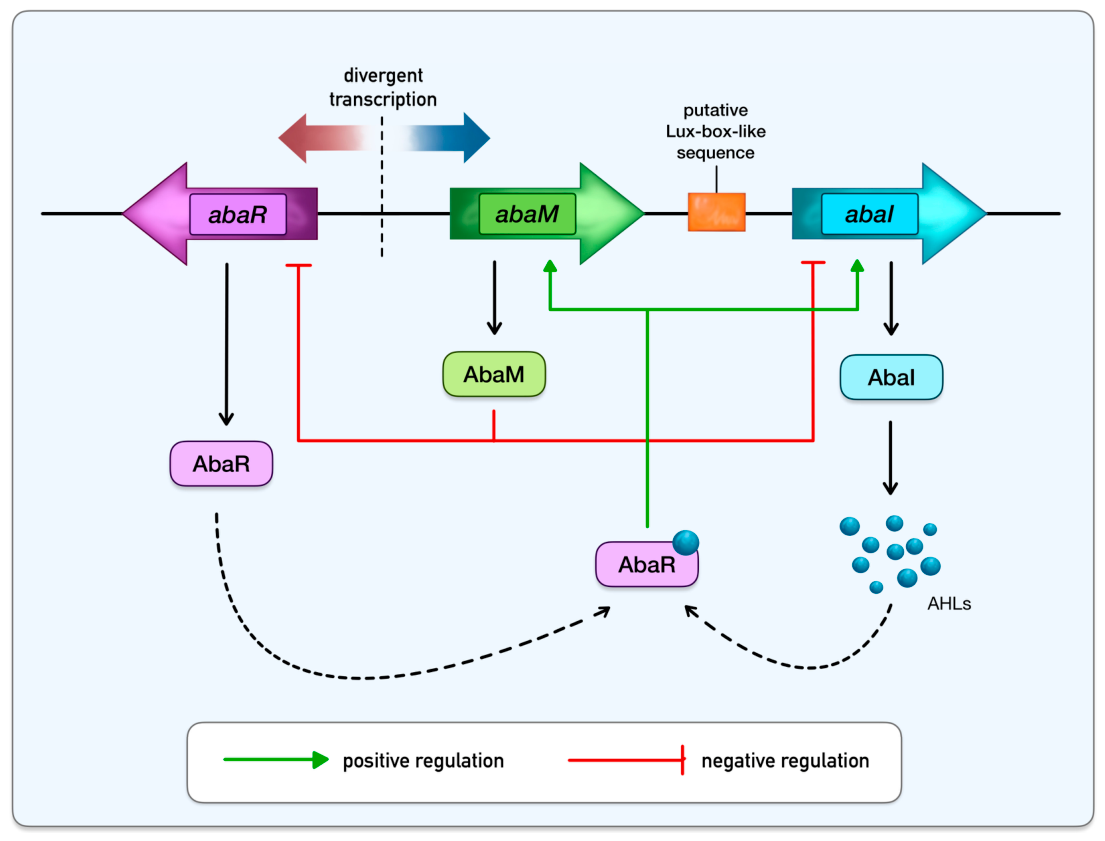
Figure 2.
Infection-associated functions controlled by the AbaI/AbaR quorum sensing (QS) system in Acinetobacter baumannii [57,58,31,59]. Abbreviations: ROS - reative oxygene species.
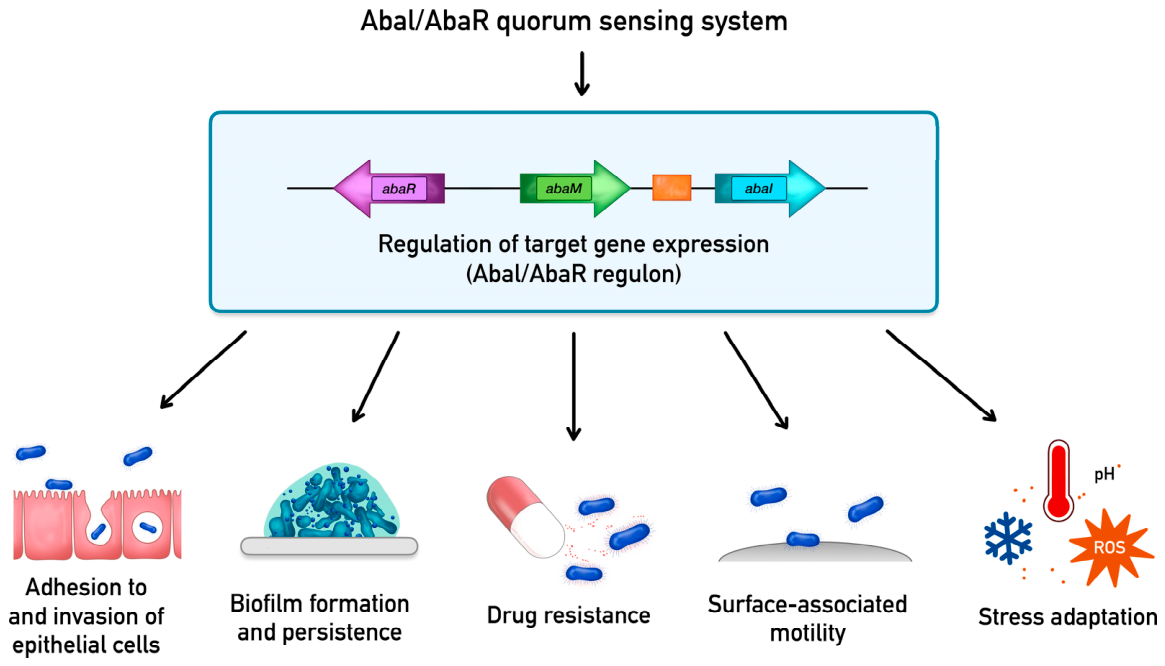

Table 1.
Summary of key experimental backgrounds used to define the AbaI/AbaR quorum-sensing system in Acinetobacter baumannii and related Acinetobacter strains [32] [33] [34] [40] [41] [42] [27] [49].
| Experimental model | Taxonomic relevance | Main contribution to AbaI/AbaR system knowledge | Main limitation | Key references |
| M2 | Historical, currently classified as Acinetobacter nosocomialis, part of closely related A. calcoaceticus-A. baumannii complex | Foundational identification of AbaI-dependent AHL production; OHC12-HSL centered profile; AHL-dependant AbaI induction | Cannot be treated as species-specific evidence for A. baumannii | Niu et al., 2008; Mayer et al., 2018; Carruthers et al., 2013 [32] [33] [40] |
| ATCC 17978 WT and ΔabaI mutant | Confirmed A. baumannii reference strain | OHC12-HSL centered profile; AbaI disruption abolishes detectable AHL production; AHL accumulation depends on culture conditions; endogenous QQ activity described | Laboratory reference strain, may not represent clinical lineages | Mayer et al., 2018; Mayer et al., 2020; Pumirat et al., 2024 [33] [34] [49] |
| ATCC 19606 WT and ΔabaI mutant | Confirmed A. baumannii reference strain | Provided evidence that ΔabaI affects broad transcriptional programs, including metabolism, biofilm associated genes and T6SS-related genes | Differences in expression don’t prove direct AbaR influence on all affected genes | Xiong et al., 2022 [41] |
| AB5075 WT and abaI and abaM mutants | Confirmed A. baumannii reference strain; clinically relevant | Provided evidence for AbaM as RsaM-like negative modulator; abaM disruption increases AHL production and affects ~21% of QS system regulon | Differences in expression don’t prove direct AbaM influence on all affected genes | López-Martín et al., 2021 [42] |
| Clinical isolates | Clinically relevant A. baumannii isolate collection | Demonstration of strain variability; presence of abaI and abaR does not always predict detectable AHL production; detectable AHL production does not correspond to a uniform phenotype | Heterogeneous backgrounds and aggregate analyses may limit direct strain-to-strain comparison | Mayer et al., 2018; Tang et al., 2020 [33] [27] |
Abbreviations: A. baumanii—Acinetobacter baumanii; A. calcoacetius—Acinetobacter calcoacetius; AHL—acyl-homoserine lactone; WT—wild-type; ATCC—American Type Culture Collection; OHC12-HSL—N-(3-hydroxydodecanoyl)-L-homoserine lactone; QQ—quorum quenching; QS—quorum sensing; T6SS—type VI secretion system.
Table 2.
Experimental evidence for the involvement of quorum sensing (QS) in Acinetobacter baumannii biofilm formation and maturation.
Table 2.
Experimental evidence for the involvement of quorum sensing (QS) in Acinetobacter baumannii biofilm formation and maturation.
| QS component | A. baumaniistrain | Key findings | Authors and the Date |
| AHL-dependent QS | Acinetobacter baumannii ATCC 17978 WT strain, abaI deletion mutant and and csuD::kan insertion mutant | The abaI mutant formed only scattered monolayers, whereas the WT strain developed thick mushroom-shaped microcolonies; supplementation with AHLs, especially OHC10-HSL, restored complex biofilm architecture. | Romero et al., 2022 [69] |
| AbaI-dependent QS | A. baumannii ATCC 19606 WT strain and ΔabaI mutant | Deletion of abaI reduced biofilm formation in A. baumannii ATCC 19606, indicating that AbaI-dependent QS contributes to biofilm-associated pathogenicity. | Xiong et al., 2022 [41] |
| AbaI/AbaR QS | A. baumannii ATCC 17978; ΔabaI, ΔabaR and ΔabaIR mutants | In comparison with the WT strain, biofilm production was markedly reduced in most mutant and complemented strains, whereas abaR overexpression in WT(pMEabaR) enhanced biofilm formation beyond the WT level. | Sun et al., 2021 [38] |
| AbaI-mediated QS | A. baumannii ATCC 17978; ΔabaI and ΔabaI::abaI | Deletion of abaI significantly reduced biofilm biomass compared with the WT strain, while genetic complementation of abaI restored biofilm formation to a wild-type-like level. | Pumirat et al., 2024 [49] |
| CRISPR-Cas–AbaI axis | Clinical isolate AB43 with a complete I-Fb CRISPR-Cas system and deletion mutants | Loss of the CRISPR-Cas system in the clinical A. baumannii AB43 strain increased biofilm formation, as deletion of the whole crispr-cas locus or individual components such as cas1, cas3 and csy1–csy4 resulted in stronger biofilm production than the WT or complemented strains. | Wang et al., 2022 [70] |
| AbaI/R and biofilm-associated gene expression | A. baumannii strains, KBN10P01317 (low-virulent) and KBN10P01599 (high-virulent) | Although the two A. baumannii strains carried a comparable set of virulence-associated genes, strain KBN10P01599 showed markedly higher expression of abaI/abaR and key biofilm-related genes, including csuCDE, bap and pgaA, which was associated with enhanced surface motility, stronger biofilm formation and increased adhesion to host cells. | Oh et al., 2025 [71] |
| DksA–AbaI/AbaR regulatory interaction | A. baumannii ATCC 17978 WT, ΔdksA mutant and complemented strain | DksA modulates QS and biofilm regulation in a non-linear manner: ΔdksA reduced autoinducer production and abaI/abaR expression, but increased biofilm formation and upregulated BfmR/S and csuC/D/E-related genes. | Kim et al., 2021 [72] |
Abbreviations: A. baumanii—Acinetobacter baumanii; QS—quorum sensing; AHL—acyl-homoserine lactone; WT—wild-type; ATCC—American Type Culture Collection; OHC10-HSL—N-(3-hydroxydecanoyl)-L-homoserine lactone; CRISPR-Cas—clustered regularly interspaced short palindromic repeats and CRISPR-associated proteins; MIC—minimum inhibitory concentration; MBEC—minimum biofilm eradication concentration; XDR—extensively drug-resistant; CRAB—carbapenem-resistant Acinetobacter baumannii.
| Host-related effect | Experimentally observed outcome | Experimental model | Main limitation | Key references |
| Adhesion/ invasion of epithelial cells | ΔabaI or AHL-producing phenotype changes adhesion/invasion in A549 cells | A549 epithelial infection model | Does not distinct direct AHL-host signalling from general observations | Tang et al. 2020, Jiang et al. 2026, Jiang et al. 2024 [27] [50] [81] |
| Epithelial injury/ apoptosis | ΔabaI causes less LDH release, ROS, apoptosis and cytokine production; AHL supplementation shifts phenotype toward wild-type | A549 epithelial infection model | Reduced injury may reflect reduced bacterial adhesion/invasion | Jiang et al. 2024 [81] |
| Infection outcome | ΔabaI shows reduced virulence in Galleria mellonella, zebrafish and/or mouse models | Galleria mellonella, zebrafish, murine infection models | Model-dependent; ΔabaR effects are not equivalent to ΔabaI | Tang et al. 2020, Sun et al. 2021, Jiang et al. 2026, Jiang et al. 2024 [27] [38] [50] [81] |
| Serum susceptibility/ early clearance | ΔabaI and ΔabaIR show reduced early burdens and increased serum sensitivity | Normal human serum assay; murine early-burden model | Specific serum component or immune mechanism not identified | Sun et al. 2021 [38] |
| Neutrophil recruitment | ΔabaI reduces neutrophil recruitment in zebrafish | Zebrafish infection model | Could reflect lower bacterial burden/ virulence rather than direct immune modulation | Jiang et al. 2024 [81] |
| Adaptive immunity | No direct AbaI/AbaR A. baumannii data | No direct A. baumannii AbaI/AbaR data; proof-of-principle AHL studies in P. aeruginosa | Only proof-of-principle data from other AHL-producing bacteria | Ritchie et al. 2005, Skindersoe et al. 2009, Zhang et al. 2021 [94,95,96] |
Abbreviations: A. baumanii—Acinetobacter baumanii; P. aeruginosa—Pseudomonas aeruginosa; AHL—acyl-homoserine lactone; LDH—lactate dehydrogenase; ROS—reactive oxygen species.
Disclaimer/Publisher’s Note: The statements, opinions and data contained in all publications are solely those of the individual author(s) and contributor(s) and not of MDPI and/or the editor(s). MDPI and/or the editor(s) disclaim responsibility for any injury to people or property resulting from any ideas, methods, instructions or products referred to in the content. |
© 2026 by the authors. Licensee MDPI, Basel, Switzerland. This article is an open access article distributed under the terms and conditions of the Creative Commons Attribution (CC BY) license.
Copyright: This open access article is published under a Creative Commons CC BY 4.0 license, which permit the free download, distribution, and reuse, provided that the author and preprint are cited in any reuse.