

Submitted:
13 September 2026
Posted:
15 September 2026
You are already at the latest version
Abstract
Reverse electrodialysis (RED) is an emerging process intensification technology for sustainable energy generation from the salinity gradient between concentrated brines and dilute streams. Concentrated brines, generated in large volumes by seawater reverse osmosis (SWRO) desalination, mining operations, and saltworks, represent an abundant and underutilised resource whose energetic valorisation via RED can simultaneously reduce brine disposal impacts and contribute to decarbonising the water-energy nexus. This review critically examines existing simulation and modelling approaches for RED systems applied to concentrated brines, covering ion transport models, thermodynamic and exergy frameworks, semi-empirical stack models, multi-physics computational fluid dynamics (CFD), and data-driven machine learning (ML) methods. The review identifies the principal knowledge gaps limiting large-scale deployment: the incomplete description of multicomponent, multivalent ion transport in real brines; the translation of validated laboratory models to pilot and industrial stacks; and the absence of techno-economic and life-cycle analysis integrated with process models. Future research should focus on hybrid models that couple high-fidelity electrochemical simulation with experimental calibration, ML-accelerated parametric studies, and system-level integration of RED with reverse osmosis and membrane distillation. This work provides a structured assessment of current modelling capabilities and a roadmap for simulation-driven optimisation of RED technology.
Keywords:
reverse electrodialysis
; simulation
; concentrated brines
; ion transport
; Nernst–Planck
; CFD
; process intensification
; salinity gradient energy
1. Introduction
The global transition towards low-carbon energy requires the development and deployment of technologies that exploit renewable energy flows at multiple scales. Among emerging electrochemical processes, reverse electrodialysis (RED) has attracted increasing research attention as a means of generating electricity directly from the free energy of mixing between solutions of different salinity [4,6,72,73]. In RED, a high-salinity (concentrated) stream and a low-salinity (dilute) stream flow in alternating channels separated by selective cation-exchange membranes (CEMs) and anion-exchange membranes (AEMs). Counter-ions migrate from the concentrated to the dilute stream through the membrane selective to their charge—cations through CEMs and anions through AEMs—thereby generating membrane potentials that are converted to electric current at the electrodes [1,2,3].
Concentrated brines suitable for RED are generated in large quantities by industrial processes. Seawater reverse osmosis (SWRO) desalination, which provides drinking water for hundreds of millions of people worldwide, rejects approximately 40–65% of its feed as a concentrated brine stream at 1.5–2× the salinity of the feed. At the global level, SWRO plants currently discharge on the order of 142 million m3 per day of concentrated brine, representing a substantial environmental burden and an underexploited energy resource [4,5]. Mining operations, saltworks, and geothermal or oil-field produced waters similarly yield high-TDS effluents [9]. Harnessing these streams through RED can simultaneously address brine disposal and energy recovery within a process-intensification framework, in which selective ion transport and energy conversion are coupled in a single membrane stack, potentially reducing energy use and environmental burden relative to separate treatment and energy-recovery operations [2,5].
Despite this promise, widespread RED deployment faces significant barriers. Current commercial ion exchange membranes (IEMs) were not designed for RED and exhibit suboptimal combinations of resistance and permselectivity for this application [1,11,45]. Real brines contain substantial fractions of multivalent ions (, , ) that disproportionately increase membrane resistance and reduce open-circuit voltage (OCV), cutting power density by up to 30–50% relative to equivalent pure NaCl systems [12,30]. Fouling and scaling further limit continuous operation with industrial streams. At the stack and plant levels, ionic short-circuit currents and osmotic water transport introduce additional irreversibilities not captured by simplified models [25,26].
Accurate simulation and modelling of the RED process is a prerequisite for rational system design, membrane development, and techno-economic optimisation. Models span a hierarchy of spatial and temporal scales: from molecular-level descriptions of ion-membrane interactions, through cell-pair Nernst–Planck and CFD models, to stack-scale equivalent circuit representations and plant-level process models. Each level captures different phenomena and involves distinct assumptions and computational demands. Critically, the translation of models validated on binary NaCl solutions to real, multicomponent brine compositions remains an open challenge [31,32].
The objectives of this review are threefold:
- (i)
- To systematically describe and compare the simulation approaches applied to RED systems, from ion transport models at the micro/meso scale to multi-physics CFD and data-driven methods, identifying strengths, limitations, and applicability to concentrated brine conditions.
- (ii)
- To assess how modelling has advanced understanding of the effects of brine composition (ionic species, concentration), operating conditions (flow rate, temperature, counter/co-current mode), and stack geometry on RED performance.
- (iii)
- To identify knowledge gaps and propose a simulation-centred research agenda that can accelerate the path from laboratory model validation to industrial-scale RED deployment.
The review is organised as follows. Section 2 describes the RED process, membrane types, performance benchmarks, and principal technical challenges. Section 3 covers modelling approaches at all scales. Section 4 discusses simulation strategies, software tools, and model coupling. Section 5 examines how dilute and concentrated stream characteristics enter the models. Section 6 reviews operational variables studied in simulation. Section 7 addresses process optimisation, including ML-based approaches. Section 8 analyses energy efficiency from a thermodynamic and exergy perspective. Section 9 presents future prospects. Section 10 concludes.
2. Reverse Electrodialysis: Process, Membranes, and Performance
2.1. Process Overview and Operating Principle
Figure 1 illustrates the basic arrangement of a reverse-electrodialysis stack. In a RED stack, N cell pairs are positioned between two end electrodes. Each cell pair consists of one cation exchange membrane (CEM), one channel carrying the concentrated brine (HC), one anion exchange membrane (AEM), and one channel carrying the dilute stream (LC). The ionic concentration difference across each membrane generates a Nernst-type electromotive force (EMF). For a 1:1 electrolyte (e.g. NaCl), the theoretical OCV per cell pair is:
where is the average apparent permselectivity of the CEM–AEM pair, R is the gas constant, T the absolute temperature, F Faraday’s constant, and , the mean ionic activities in the concentrated and dilute compartments, respectively [39,50]. Equation 1 is an idealised expression for a binary 1:1 electrolyte and uses an apparent cell-pair permselectivity. For concentrated multicomponent brines, the electromotive force depends on the activities, valences, and membrane transport properties of the individual ionic species; therefore, this expression is best regarded as a benchmark rather than a predictive model for real brines. The total stack OCV is , and the net power extracted across an external load must account for the internal stack resistance (membrane resistance, solution resistance in channels, electrode resistance):
where represents the hydraulic pumping power [39,50]. Power density (W/m2 of membrane) is the key performance metric for comparing systems of different scale.
As a process intensification technology, RED combines the functions of ion transport and selective separation (membrane permeation) within a single unit. This integration is conceptually analogous to membrane reactors in the chemical engineering context, where coupling reaction and separation in one device shifts thermodynamic equilibria and reduces downstream separation loads [2]. In RED, the continuous removal of ions from the concentrated stream and their accumulation in the dilute stream represents the “driving-force consumption” that is the analogue of equilibrium conversion; once the streams equilibrate, the available free energy is exhausted. Designing RED stacks and operating protocols to maximise the extraction of free energy before equilibration is reached is therefore the central design challenge.
2.2. Ion Exchange Membranes for RED
IEMs are the critical functional components of RED stacks. Their performance is characterised primarily by two parameters [1,18,45]:
- Area resistance (): the ohmic resistance per unit membrane area, which dominates total internal resistance at practical channel concentrations. Minimum target values for RED competitiveness are typically [45].
- Permselectivity (%): the fraction of current carried by counter-ions relative to total ionic current. Values are desirable; commercial membranes typically achieve 85–98% in dilute NaCl.
- Heterogeneous polymeric IEMs (e.g. Ralex, Fumasep): commercially available, low cost, but higher resistance than homogeneous counterparts.
- Homogeneous polymeric IEMs (e.g. Neosepta, FujiFilm): lower resistance and higher permselectivity; preferred for RED but more expensive.
Across commercial IEM families, homogeneous Neosepta membranes generally sit at the high-permselectivity end, heterogeneous Ralex-type membranes at the higher-resistance/lower-permselectivity end, and Fujifilm membranes span both regimes depending on subtype [74,75,76].
A key insight from the broader membrane technology literature is that the trade-off between resistance and selectivity is not confined to RED: analogous challenges arise in gas-separation and high-temperature inorganic membranes, where improving permeability typically reduces selectivity (the Robeson upper bound) [77]. For IEMs in RED, a comparable trade-off exists between monovalent selectivity and overall resistance — membranes with very high monovalent selectivity often achieve this through surface coatings that increase resistance, resulting in no net improvement in power density [47,48].
2.3. Performance Benchmarks with Concentrated Brines
Table 1 summarises representative power densities reported for RED systems using various brine types.
These data illustrate that the use of highly concentrated brines (approaching 5 M NaCl) increases power density by nearly an order of magnitude relative to standard seawater/river configurations, at the cost of increased osmotic water transport, higher membrane resistance in real compositions, and greater sensitivity to multivalent ion content.
2.4. Challenges: Multivalent Ions, Fouling, and Scaling
2.4.1. Multivalent Ions
The presence of , , and in real brines reduces RED performance through two coupled mechanisms [12,30,35]:
- (a)
- Uphill transport: divalent cations can be driven against their concentration gradient from the dilute to the concentrated stream, reducing OCV.
- (b)
- Increased area resistance: divalent ions with lower mobility and stronger interaction with fixed charges in the membrane matrix increase the local resistance of both CEMs and AEMs.
2.4.2. Fouling and Scaling
Organic and inorganic fouling limits continuous operation with industrial brine feeds, necessitating pretreatment and periodic cleaning strategies [5,6]. Prior removal of Mg2+ by precipitation (e.g. Mg(OH)2 crystallisation) has been shown to recover a significant fraction of the power loss [7,16]. Stable operation has been demonstrated on a timescale of weeks in laboratory studies with produced water [9].
2.4.3. Ionic Short-Circuit Currents and Osmosis
At the plant scale, manifold channels connect multiple stacks; ionic current can leak through these manifolds (“shortcut currents”), causing significant power losses particularly in large stacks with highly conductive brines [26]. Simultaneously, osmotic water transport from the dilute to the concentrated side (driven by the high osmotic pressure difference) can dominate irreversible losses at salinity gradients M, reducing exergy efficiency even as gross power increases [25].
2.5. Life-Cycle and Techno-Economic Context
Life-cycle assessment (LCA) indicates that the environmental impact of salinity gradient energy recovery per MWh is comparable to or lower than solar and wind power, with favourable impacts when concentrated brines are used owing to their higher power density [17]. Membrane lifespan, energy cost of pretreatment, and levelised cost of energy (LCOE) remain undercharacterised for real brine scenarios [5,6].
Table 2 summarises the principal technical knowledge gaps for scaling RED with concentrated brines.
3. RED Modelling and Simulation: Approaches and Frameworks
Modelling RED systems from first principles requires the simultaneous description of ionic transport, fluid flow, electric potential, and thermodynamic driving forces across length scales from the membrane nanopore to the full stack. The literature has addressed these through four main model families, which are described below and compared in Table 3.
3.1. Ion Transport Models: Nernst-Planck and Maxwell-Stefan
3.1.1. Nernst–Planck (NP) Framework
The Nernst–Planck equation describes the molar flux of ionic species i subject to diffusion, migration, and convection:
where is the diffusion coefficient, the concentration, the charge number, the electric potential, and the fluid velocity. In RED models, Eq. (3) is coupled with local electroneutrality (), Donnan equilibrium at membrane–solution interfaces, and fixed-charge membrane theory to relate ion concentrations inside the membrane to external solution concentrations [31,32].
One-dimensional NP models along the channel flow direction [24,39,50] are computationally efficient and suitable for stack-scale design studies, including optimisation of cell number, channel length, and co-/counter-current configurations. Two-dimensional and three-dimensional NP models, coupled with the Navier–Stokes equations for the flow field (see Section 3.4), resolve spatial distributions of concentration, potential, and current density and are used for membrane and channel geometry design [23,34,51].
3.1.2. Multi-Ion Extensions
Multi-ion NP models explicitly account for the transport of Na+, , , , Ca2+, K+, and other species present in real brines. Pintossi et al. [30] developed a validated multi-ion model that predicts power density reductions of ∼15–25% in mixed monovalent/divalent systems. Gómez-Coma et al. [35] modelled the influence of divalent ions on membrane resistance and electric power, providing empirical resistance correlations as functions of ionic composition. Cho et al. [32] presented a 3D multi-ion CFD model validated against experimental data, enabling calibration of effective diffusion coefficients in the membrane phase.
3.1.3. Maxwell-Stefan Approach
The Maxwell–Stefan (MS) framework explicitly represents the friction interactions between all ionic species and between ions and the membrane matrix, capturing cross-diffusion effects that the Nernst–Planck formulation neglects [33]. While more physically rigorous for concentrated, multicomponent systems, the MS approach requires a larger set of binary interaction parameters and greater computational resources. Its application to RED remains limited to single-stack configurations [33].
3.2. Thermodynamic and Irreversible Thermodynamics Models
Thermodynamic models describe the maximum energy recoverable from mixing a concentrated and a dilute stream without resolving spatial or kinetic detail [37]. The Gibbs free energy of mixing provides the theoretical upper bound; irreversible thermodynamics (IT) formalisms using Onsager phenomenological coefficients relate driving forces (chemical potential gradients, electric potential gradient) to fluxes (ionic current, water flux) through membrane transport coefficients (conductivity, apparent transport number, osmotic permeability) [38].
IT models are useful for quantifying the relative magnitude of irreversibility sources:
- Ohmic dissipation in membrane and channel resistance.
- Co-ion (counter to intended direction) transport through non-ideal membranes.
- Osmotic water transport driven by the concentration gradient (particularly at high salinity differences).
- Salt diffusion from the concentrated to the dilute side (“reverse salt flux”).
Giacalone et al. [25] demonstrated through exergy analysis that at salinity gradients M, osmotic water transport becomes the dominant irreversibility, reducing exergy efficiency even as gross power increases. This has direct design implications. For the conditions and membrane properties considered in the cited studies, the optimal operating point reflects a trade-off between increased electromotive force and transport losses.
The governing equation for exergy destruction rate in a RED stack can be written:
where denotes stream exergy flow rates and is the reference (dead-state) temperature [25]. Here, must be defined consistently to include the deduction of pumping power and any other auxiliary loads included in the analysis.
In concentrated-brine RED, osmotic water transport should be treated as a coupled transport phenomenon rather than only as a post-processing loss. Water flux changes the local flow rates and concentrations in both channels, alters ionic activities and concentration polarisation, and may create substantial exergy destruction. Models intended for high-salinity operation should therefore include coupled salt and water transport, ideally with experimentally determined membrane water-permeability parameters.
3.3. Semi-Empirical Electrical Circuit Models
The RED stack can be represented as an equivalent electrical circuit: N cell-pair EMFs in series (each given by Eq. (1)), internal resistance contributions from membranes and solution channels, and an external load. This approach, pioneered by Veerman et al. [50], is computationally inexpensive and has been used extensively to:
- Optimise stack design (number of cell pairs, channel length, electrode geometry).
- Compare flow configurations (co-current, counter-current, cross-flow, multi-stage).
- Study electrode segmentation for improved current collection.
- Extend to multi-ion compositions using empirical resistance correlations [30].
Under ideal conditions, circuit-based models can predict high fractions of the reversible Gibbs free energy of mixing [50]. In practice, experimental and pilot-scale performance is reduced by membrane and solution resistance, non-ideal permselectivity, concentration polarisation, osmotic water transport, pumping losses and ionic shortcut currents [8,25].
3.4. Multi-Physics CFD Models
Multi-physics CFD models couple momentum transport with ionic species transport and electric-potential equations. At the macroscopic channel and membrane scale, most RED models impose local electroneutrality and determine the electric field through current continuity:
Poisson’s equation is principally required in pore-scale or electrical-double-layer-resolving formulations, for which charge separation cannot be neglected.
In conventional stack- and channel-scale RED CFD, the electroneutrality approximation is generally adequate outside thin electrical double layers; Poisson–Nernst–Planck formulations are more appropriate when nanoscale interfacial charge effects are explicitly resolved [56]. These models resolve the spatial distributions of velocity, concentration, potential, and current density within each cell, providing the most detailed description of transport phenomena in RED systems. Representative concentration distributions predicted by 2D/3D Nernst–Planck–Navier–Stokes CFD models illustrate concentration polarisation near membrane surfaces and axial concentration gradients along the channel [23]. Key findings from CFD studies include:
- Geometry optimisation: channel length, aspect ratio, and inlet conditions affect the local concentration polarisation profile. Increasing fluid velocity reduces polarisation but raises pumping power; an optimal Reynolds number exists for each configuration [66].
- Counter-current advantage: counter-current flow maintains a more uniform concentration difference along the channel length, improving OCV utilisation compared to co-current flow, especially at high brine concentrations [43].
- 3D multi-ion CFD: Cho et al. [32] coupled multi-ion transport with experimentally-calibrated membrane diffusivities in a 3D geometry, enabling design guidance for complex brine compositions.
- Profiled membranes (2025): Dong et al. [64] resolved the three-dimensional flow and mass-transfer fields in stacks with profiled IEMs and reported reductions in polarisation resistance of up to approximately 25% for the configurations examined.
The main limitation of CFD models for RED is computational cost: full 3D multi-ion simulations of single cell pairs can require hours to days of compute time, precluding direct parametric sweeps over stack-scale design variables. Coupling 3D CFD with 1D stack models (Section 4.3) is an active strategy to bridge this gap [52].
4. Simulation Strategies and Software Tools
4.1. Simulation Objectives
Simulation studies of RED systems pursue several distinct objectives that drive the choice of model complexity, spatial dimensionality, and computational approach:
- Performance prediction: Given membrane properties, brine composition, and operating conditions, predict power density, energy efficiency, and OCV. Typically addressed by 1D circuit or NP models.
- Geometry and spacer design: Evaluate the effect of channel thickness, spacer geometry, and membrane profiling on mass transfer and pressure drop. Requires 2D/3D CFD.
- Brine composition sensitivity: Assess how the presence of Mg2+, , Ca2+ and other species alters resistance, OCV, and net power. Requires multi-ion NP models with empirical resistance correlations.
- Stack and plant design: Optimise number of cell pairs, stack length, flow configuration, and electrode segmentation. Addressed by 1D stack models coupled to economic objectives.
- Process integration: Model RED in hybrid systems with RO, MD, or electrodialysis; evaluate energy balances and water recovery. Requires plant-level process models.
- Design-space exploration and optimisation: Efficiently identify optimal operating conditions across many parameters. Addressed by surrogate models, genetic algorithms, and ML-based approaches (Section 7).
4.2. Software Platforms
In published research on RED modelling, COMSOL Multiphysics is the clearest recurring platform for multi-physical finite-element models that couple Navier–Stokes flow, Nernst–Planck ion transport, electroneutrality, and Donnan interfacial conditions in 2D or 3D cell-pair domains [23,34,51]. Gurreri et al. implemented a 2D periodic cell-pair model in COMSOL and emphasised its ability to represent electrochemistry, diffusion, and fluid dynamics within one framework, while Dong et al. extended the same Nernst–Planck-based multiphysics strategy to a 3D finite-element simulation of profiled membranes [23,51]. Jin et al. likewise used a 2D full-length coupled model to resolve velocity, ion concentration, and electric fields, showing why COMSOL-style multiphysics environments are attractive for mechanistic RED studies and parametric sweeps [34].
In addition to COMSOL, the literature uses custom process models and specialised CFD codes for different scales of RED analysis [23,39]. Examples of this approach include the comprehensive RED simulation tool developed by Tedesco et al. [39] and the validated process model by Veerman et al. [50]. Tedesco et al. built a simulation tool with separate cell-pair and stack scales inside a process simulator, then validated it against experiments across inlet concentrations, flow rates, and temperatures, reaching good agreement between predictions and experimental results [39]. Gurreri et al. describe parallel use of Ansys CFX for 3D CFD of spacer-filled and profiled channels, mainly to extract pressure drop and mass transfer descriptors that are then coupled to a large-scale 1D stack model [23]. More recently, the field has seen a distinct shift toward integrating data-driven methods: CFD-generated data are used to train artificial neural network (ANN) surrogate models, allowing rapid, multi-variable optimisation when paired with genetic algorithms [54].
4.3. Model Coupling: 1D–3D Hybrid Strategies
A central strategy in advanced RED simulation is the coupling of high-fidelity 3D CFD (which resolves local transport in detail but is computationally expensive) with 1D stack models (which are fast and handle system-level design variables). Cerva et al. [52] demonstrated that coupling CFD with a one-dimensional model can predict full-stack performance with substantially reduced computational cost relative to full 3D simulation, while retaining the geometric information needed for membrane and spacer design. The information flow between the detailed cell-pair model and the reduced stack model is illustrated schematically in Figure 2.
This multiscale coupling strategy is well established in analogous membrane reactor systems for gas-phase reactions, where the same principle applies: detailed CFD resolves local reaction and transport phenomena in a single reactor element, and reduced-order models propagate this information to plant-scale simulations [78]. For RED, the key challenge is that both the ion transport inside membranes and the hydrodynamics in microchannels exhibit characteristic features (Donnan potentials, spacer wake effects) that must be captured at the element level before being accurately represented at the stack level.
5. Dilute and Concentrated Feed Streams
5.1. Brine Sources and Typical Compositions
The choice of concentrated stream directly determines the salinity gradient, ionic composition, and hence the achievable power density in RED. Industrial brine sources differ substantially in composition:
- Oil-field produced water: Variable composition; typically 1–5 M ionic strength with significant divalent and organic content. Demonstrated at laboratory scale [9].
- Mining process waters: Highly variable; can contain lithium, sulphate, heavy metals. Requires tailored modelling of multi-ion transport [29].
5.2. Effect of Salinity Gradient on Performance
Increasing the concentration of the concentrated stream raises both the OCV (logarithmically, via Eq. (1)) and the power density, but only up to an optimal point beyond which additional losses (osmotic water transport, higher solution resistance in the concentrated channel, concentration polarisation) begin to dominate. Table 4 summarises the qualitative relationship between gradient magnitude and achievable power.
5.3. Effect of Ionic Composition
Real brines deviate significantly from idealized binary NaCl systems. The principal compositional effects documented in the simulation literature are:
- Divalent cations (Mg2+, Ca2+): increase CEM resistance; drive uphill transport through AEMs; reduce OCV. Quantified by Gómez-Coma et al. [35] through empirical resistance correlations incorporated into 1D stack models.
- Organic matter and trace metals: not yet incorporated in mechanistic models; represent a significant gap for produced water and mining brine applications.
Using binary NaCl simulations to predict performance with real brine compositions systematically overestimates power density. Multi-ion models that include explicit ionic composition, divalent selectivity, and resistance correlations as functions of mixing are required for predictively accurate simulations of industrial-scale RED [30,35,42]. Figure 3 illustrates a typical performance penalty of divalent-ion-containing feeds relative to a binary NaCl feed for one stack configuration. Further examples can be found in [30].
6. Operational Variables in RED Simulation
Simulation studies have systematically investigated the influence of many operational variables on RED performance. Table 5 gives a summary list and discussion follows.
6.1. Temperature
Temperature affects RED performance through several coupled pathways: (i) increased ion mobility reduces membrane and solution resistance; (ii) higher T reduces solution viscosity, improving flow; (iii) the Nernstian OCV (Eq. (1)) increases linearly with T at fixed activity ratio. The combination typically makes higher temperatures beneficial, with studies reporting 40 °C as near- optimal for 5 M/0.1 M NaCl systems [8].
6.2. Flow Configuration and Hydraulics
Counter-current flow maintains a more uniform local OCV along the membrane area compared to co-current flow, particularly important when the concentration difference changes significantly along the channel length (as it does with concentrated brine feeds at low flow rates). High-fidelity CFD studies confirm that counter-current operation improves both power density and energy efficiency, at the cost of greater hydraulic complexity [43].
Closed-loop RED heat engines that pair distillation with RED convert low-grade heat to electricity more effectively when the saline feeds are recirculated, but this gain depends on controlling water transport, ionic build-up, and stack resistance [14,15]. Recirculation improves recovery from a fixed solution volume, yet it also introduces exergetic losses that become more severe at the high salinity gradients used in heat engines [14,15].
Hulme et al. [14] showed that recycling feeds produced seven-fold higher energy efficiency than single-pass operation for a fixed membrane area, with improved power density and the lowest unit energy cost, making recirculation the preferred configuration for closed-loop heat-to-power systems. The same work showed that ionic transport, osmosis, and concentration polarisation cause performance to decay over time during brine reuse, so regenerating the salinity gradient after approximately 80% energy dissipation was judged the most pragmatic operating point, because resistance to mass transport rises beyond that threshold [14]. Although lower brine concentrations gave the highest RED energy efficiency, higher salinity produced more work from a fixed feed volume, so higher brine concentrations were recommended at the system level because thermal-to-electric conversion is constrained by the heat needed in the distillation reset step [14].
Hulme et al. [15] explained why these closed-loop engines need different RED stack design rules from conventional seawater–river RED: at high concentration gradients in recycle, water flux and exergy loss become dominant, pushing the optimal design closer to electrodialysis stacks. A conventional RED stack still delivered much higher gross power density than an ED stack in single pass, but in recycle the ED-style design achieved roughly double the energy efficiency at low current density, because the larger intermembrane distance increases residence time while the lower water permeance reduces membrane exergy losses [15]. Intermediate membrane water permeability and ohmic resistance (Neosepta ACS/CMS) were found to optimise power density and energy efficiency, whereas wider intermembrane distances (up to 0.3 mm) improved energy efficiency [15].
6.3. Stack Geometry: Spacers and Profiled Membranes
Channel spacers fulfil the dual role of maintaining channel thickness and promoting mass transfer by disturbing the concentration boundary layer. However, non-conducting spacers block ionic current over a fraction of the membrane area, consistently reducing power density. Profiled membranes with integral surface reliefs (chevron, pillar, or other geometries) avoid this current-blocking penalty while providing mixing enhancement through geometry-induced secondary flows [23,51,64].
CFD studies of spacer-filled channels show that increasing flow rate or optimising spacer geometry can both reduce concentration polarisation, but the optimal strategy depends on the specific brine conditions [66]. Profiled membrane designs were reported to achieve up to ∼25% improvement in effective power density compared to woven spacer configurations at equivalent flow rates [64].
7. Optimisation of the RED Process
7.1. Multi-Objective Optimisation with Process Models
The design of RED systems involves multiple competing objectives: maximising power density, maximising energy efficiency (the fraction of available free energy converted to electricity), and minimising capital and operating costs. These objectives conflict: for example, maximising power density typically requires operating at a lower external resistance (and hence lower efficiency), while maximising energy extraction requires slow flow rates that reduce pumping power but lower power density.
Long et al. [53] applied multi-objective evolutionary optimisation to a process model of RED, generating Pareto fronts of power density vs. energy efficiency. The results showed that the trade-off is sensitive to membrane resistance and brine concentration, and that no single operating point is universally optimal. Similar multi-objective frameworks have been applied to hybrid RED–RO system design [79].
7.2. Data-Driven and Machine Learning Approaches
Machine learning (ML) methods are increasingly applied to membrane process modelling as a complement to physics-based simulation. Their role is not to replace mechanistic models but to:
- Accelerate design-space exploration: trained on CFD or experimental data, ML surrogates can evaluate thousands of design variants at negligible cost.
- Extract empirical descriptors: ML can identify which structural or operational parameters most strongly determine performance, guiding experimental prioritisation.
- Improve parameter estimation: inverse ML methods can extract membrane transport properties from indirect measurements more efficiently than traditional fitting.
In the broader membrane technology field, ML-trained surrogate models have demonstrated accuracy improvements of up to 40% over conventional empirical correlations for predicting membrane performance in multicomponent separation systems [80]. For RED specifically, Faghihi and Jalali [54] combined CFD simulation with an artificial neural network (ANN) trained on CFD-generated data, then used a genetic algorithm to optimise cell geometry and operating conditions for maximum net power with desalination reject brine. The ANN surrogate reduced computational cost by orders of magnitude relative to direct CFD optimisation while retaining physical fidelity within the training domain.
Key remaining gaps in ML application to RED include:
- Limited availability of large, well-characterised experimental datasets for diverse brine compositions and membrane types.
- Lack of physics-informed neural network (PINN) formulations that respect conservation laws and thermodynamic constraints.
- Published RED-specific ML models addressing multivalent-ion effects remain limited.
Much of the molecular-modelling literature discussed below concerns ion-exchange membranes in related electrochemical applications rather than RED specifically; it is included here to identify transferable modelling methods and future directions for RED membrane design.
IEM-specific studies emphasise multiscale workflows that combine DFT, all-atom MD, coarse-grained or mesoscale models, and increasingly machine learning to predict conductivity, selectivity, morphology, and degradation [81,82,83].
For transport-property prediction, classical MD is the main screening tool because it directly estimates diffusion, conductivity, clustering, and nanophase structure from trajectories, but its accuracy depends strongly on force fields, convergence, and realistic polymer construction [81,84,85]. In IEMs specifically, MD has been used to predict counterion diffusion and identify how fixed-charge chemistry and ion binding control selectivity, such as stronger Mg2+ adsorption to sulfonic groups and transport barriers in cation exchange membranes [86], while theory frameworks beyond MD improve conductivity prediction by accounting for mobile condensed counterions that older Donnan–Manning treatments missed by up to about 5-fold [87].
AIMD is used when bond breaking, polarisation, or poorly parameterised chemistries matter, and it is especially useful for identifying transport mechanisms without pre-specifying pathways [82,88]. However, AIMD remains limited by small cells, short times, and sparse diffusion events, so reliable transport prediction usually requires long enough sampling, elevated-temperature studies, or ML/ML-potential acceleration to extend AIMD-quality screening toward larger membrane-relevant spaces [88,89,90].
7.3. Fractal and Bioinspired Stack Architectures
Veerman [65] proposed bioinspired fractal designs for RED stacks that aim to preserve the high specific power density observed in small laboratory units when scaling to larger assemblies. The fractal architecture addresses the well-documented performance drop between small and large RED stacks by distributing manifold connections in a hierarchical pattern that minimises ionic short-circuit currents and maintains uniform flow distribution.
8. Energy Efficiency: Thermodynamic Analysis and Exergy
8.1. Thermodynamic Efficiency Limits
The maximum work extractable from mixing a concentrated stream (HC) and a dilute stream (LC) is the Gibbs free energy of mixing . For dilute solutions approximated as ideal:
8.2. Decomposition of Efficiency Losses
Exergy analysis (Eq. (4)) allows the decomposition of the gap between theoretical maximum and actual net power into its principal contributions [25]:
- (i)
- Ohmic losses: resistive heating in membranes and solution channels; minimised by low-resistance IEMs and optimal channel thickness.
- (ii)
- Co-ion (non-ideal permselectivity) losses: fraction of ionic current carried by co-ions; reduced by high-permselectivity membranes.
- (iii)
- Osmotic water transport: transmembrane water flux driven by the osmotic pressure difference; increases rapidly with salinity gradient above ∼2 M; the dominant loss at very high gradients.
- (iv)
- Uncontrolled salt diffusion: back-diffusion of salt from HC to LC; wasted concentration gradient without useful current.
- (v)
- Ionic short-circuit currents: current leaking through manifolds and electrodes in multi-stack systems [26].
This decomposition directly informs simulation priorities: models that do not account for osmotic water transport are inadequate for concentrated brine systems; models that neglect ionic short-circuit currents are inadequate for multi-stack plant simulations.
8.3. Influence of Concentration Gradient on Efficiency
A consistent finding across simulation studies is that maximum power density and maximum energy efficiency do not occur at the same operating point. High flow rates (short residence times) maximise power density but leave significant concentration gradient unexploited (low efficiency). Low flow rates (long residence times) allow more complete gradient utilisation but reduce power density. The simulation framework of Ortiz-Martínez et al. [24] provides a comprehensive mapping of this trade-off as a function of salinity, flow rate, and membrane properties. Table 6 summarises the qualitative distinction between operating points selected for maximum power density, multi-objective performance, and maximum energy efficiency [53].
9. Future Prospects
9.1. Advanced Membrane Design and Modelling
The current generation of commercial IEMs was not designed for RED and represents a primary performance bottleneck. The modelling community’s role in advancing membrane development lies in:
- Providing multi-ion transport models that quantify the performance gain achievable from improved monovalent selectivity, guiding experimental synthesis targets.
- Developing molecular-level models (MD, AIMD) of fixed-charge polymer networks to predict ion solvation, diffusion coefficients, and Donnan potentials from first principles, enabling computational screening analogous to what GCMC/MD simulation has enabled for MOF-based gas separation membranes [91].
- Incorporating membrane degradation (chemical, mechanical) into long-term performance predictions, which is currently absent from all published RED models.
9.2. Hybrid System Integration
The integration of RED with other membrane-based processes offers synergistic opportunities for simultaneous energy recovery and water treatment [2,28]:
- RED thermal engines (REDHE): Closed-loop systems use low-grade industrial waste heat to recreate salinity gradients via distillation, with RED converting thermal energy to electrical energy. Stack design for REDHE requires different principles (larger intermembrane distance, intermediate water permeability) than open RED configurations [13,15].
- RED–microbial fuel cells and flow batteries: Electrochemical coupling for simultaneous wastewater treatment and energy generation/storage [28].
- RED–electrochemical degradation: Integration with electrochemical oxidation of organics, Cr(VI) reduction, and ammonium removal, driven by the RED-generated current [67].
- Decentralised systems: MD–RED coupling for water and energy recovery from complex matrices (e.g. human urine) in off-grid settings [69].
Process-level simulation of these hybrid systems requires the coupling of RED stack models with membrane distillation, reverse osmosis, and electrodialysis models — a multiscale modelling challenge that has not yet been systematically addressed in the literature.
9.3. Fractal and Scalable Stack Designs
A persistent challenge is the performance drop observed when scaling from small laboratory stacks to large-area commercial units, caused by non-uniform flow distribution, increased ionic short-circuit currents, and electrode overpotentials. Bioinspired fractal stack architectures [65] and modular, scalable designs informed by process simulation offer pathways to preserve specific power at larger scales. Simulation-guided design of manifold geometries to minimise shortcut currents [26] is an emerging and practically important research direction.
9.4. Physics-Informed Machine Learning
Future ML contributions to RED modelling are likely to take the form of physics-informed neural networks (PINNs) that embed the Nernst–Planck and Navier–Stokes equations as soft constraints during training, potentially improving physical consistency and data efficiency; their ability to extrapolate reliably to new brine compositions and geometries will require dedicated validation. Coupled to genetic or Bayesian optimisation algorithms, such approaches could enable computationally efficient simultaneous optimisation of membrane properties, stack geometry, and operating conditions — a capability not achievable with current sequential (simulate then optimise) workflows.
9.5. Techno-Economic and Life-Cycle Integration
The coupling of RED process models with techno-economic analysis (TEA) and life-cycle assessment (LCA) is currently underdeveloped. The literature on analogous membrane reactor systems (e.g. Pd-membrane reformers for H2 production) demonstrates that the path from laboratory performance to commercial deployment requires simultaneous optimisation of membrane cost, lifespan, and regenerability alongside process performance [92]. For RED, a validated model chain from ion transport to stack to plant to economic metrics would enable evidence-based policy and investment decisions regarding brine energy valorisation at the regional or national scale.
10. Conclusions
This review has critically assessed the state of simulation and modelling approaches for reverse electrodialysis applied to concentrated brines, drawing on the literature from 2007 to 2025. The principal conclusions are:
- A mature hierarchy of models exists, spanning one-dimensional equivalent circuit and Nernst–Planck stack models, two- and three-dimensional multi-physics CFD, exergy analysis frameworks, and emerging ML-based surrogate and optimisation methods. Each tier of this hierarchy is well-suited to specific design tasks, and the productive coupling of models across scales (1D–3D hybrids) is an increasingly adopted strategy.
- Multi-ion transport is the central unsolved modelling challenge. The majority of validated models assume binary NaCl feeds. Real concentrated brines contain significant fractions of , , and Ca2+ that reduce power by 30–60% relative to pure NaCl predictions. Multi-ion NP models with empirical resistance correlations have made progress but remain incompletely validated for the full range of industrial brine compositions.
- Concentrated brine configurations offer transformative power density gains (up to 12 W/m2 with synthetic 5 M/ 0.1 M NaCl), but the benefits are eroded by osmotic water transport and concentration polarisation at high gradients. Exergy analysis reveals that osmotic losses dominate irreversibility at gradients M, setting a practical upper limit on useful salinity gradient magnitude that models must capture accurately.
- Process integration with RO, MD, and other membrane technologies offers the most promising path to commercially competitive RED systems, but requires multi-scale process simulation tools that do not yet exist in validated form.
- Machine learning and data-driven methods are entering RED modelling through ANN-based surrogate models and CFD-coupled genetic optimisation. Their full potential will be realised through physics-informed formulations that respect conservation laws and may improve physical consistency and, subject to validation, the transferability of models to unexplored brine conditions and membrane designs.
- Critical gaps remain in membrane lifespan modelling, fouling prediction, molecular-level IEM characterisation, and integrated techno-economic analysis, each of which must be addressed before simulation can serve as a fully reliable tool for industrial-scale RED design.
Progress in RED simulation depends on the convergence of advances in multi-ion membrane transport theory, high-fidelity CFD validated against carefully designed experiments with real brine compositions, and scalable ML methods for design-space exploration. The growing body of pilot-scale RED experience with concentrated industrial brines provides an increasingly rich dataset against which future models must be validated. The field is approaching the point at which simulation-driven design can meaningfully accelerate the translation of RED from promising laboratory technology to commercially deployed brine energy recovery.
Author Contributions
Conceptualization, J.G., S.B. and J.P.M.; methodology, J.G., S.B., R.E.H., J.P.M., R.O., J.S. and M.L.; validation, J.G., S.B., R.E.H., J.P.M., R.O., J.S. and M.L.; formal analysis, J.G., S.B., R.E.H., J.P.M., R.O., J.S. and M.L.; investigation, J.G., S.B., R.E.H., J.P.M., R.O., J.S. and M.L.; resources, J.G. and R.E.H.; data curation, J.G., S.B., R.E.H., J.P.M., R.O., J.S. and M.L.; writing - original draft preparation, J.G., S.B., R.E.H., J.P.M., R.O., J.S. and M.L.; writing - review and editing, J.G., S.B., R.E.H., J.P.M., R.O., J.S. and M.L.; supervision, J.G., and J.P.M.; project administration, J.G. and R.E.H. All authors have read and agreed to the published version of the manuscript.
Funding
This work did not receive any external funding
Institutional Review Board Statement
Not applicable.
Informed Consent Statement
Not applicable.
Data Availability Statement
Not applicable. No new data were created in this study. All data discussed are available in the cited publications.
Conflicts of Interest
The authors declare no conflicts of interest.
Abbreviations
The following abbreviations are used in this manuscript:
| AEM | Anion exchange membrane |
| ANN | Artificial neural network |
| CEM | Cation exchange membrane |
| CFD | Computational fluid dynamics |
| HC | High-concentration (concentrated) channel |
| IEM | Ion exchange membrane |
| LC | Low-concentration (dilute) channel |
| LCA | Life-cycle assessment |
| LCOE | Levelised cost of energy |
| MD | Membrane distillation |
| ML | Machine learning |
| MS | Maxwell–Stefan |
| NP | Nernst–Planck |
| OCV | Open-circuit voltage |
| PI | Process intensification |
| PINN | Physics-informed neural network |
| RED | Reverse electrodialysis |
| REDHE | Reverse electrodialysis heat engine |
| RO | Reverse osmosis |
| SWRO | Seawater reverse osmosis |
| TEA | Techno-economic analysis |
| TDS | Total dissolved solids |
Nomenclature
| Symbol | Description | Units |
| Mean ionic activity of species i | – | |
| Molar concentration of species i | mol/m3 | |
| Diffusion coefficient of species i in membrane | m2/s | |
| Exergy flow rate | W | |
| F | Faraday constant (96 485) | C/mol |
| Molar flux of species i | mol/(m2 s) | |
| N | Number of cell pairs in stack | – |
| Net electrical power | W | |
| p | Pressure | Pa |
| R | Universal gas constant (8.314) | J/(mol K) |
| Membrane area resistance | cm2 | |
| Internal stack resistance | ||
| External load resistance | ||
| T | Absolute temperature | K |
| Reference (dead-state) temperature | K | |
| Fluid velocity vector | m/s | |
| Charge number of species i | – | |
| Apparent membrane permselectivity | – | |
| Permittivity | F/m | |
| Electric potential | V | |
| Dynamic viscosity | Pa s | |
| Fluid density | kg/m3 | |
| Power density | W/m2 |
References
- Hong, J.G.; Zhang, B.; Glabman, S.; Uzal, N.; Dou, X.; Zhang, H.; Wei, X.; Chen, Y. Potential ion exchange membranes and system performance in reverse electrodialysis for power generation: A review. J. Membr. Sci. 2015, 486, 71–88. [Google Scholar] [CrossRef]
- Othman, N.H.; Kabay, N.; Guler, E. Principles of reverse electrodialysis and development of integrated-based system for power generation and water treatment: A review. Rev. Chem. Eng. 2022, 38, 921–958. [Google Scholar] [CrossRef]
- Altıok, E.; Kaya, T.Z.; Güler, E.; Kabay, N.; Bryjak, M. Performance of reverse electrodialysis system for salinity gradient energy generation by using a commercial ion exchange membrane pair with homogeneous bulk structure. Water 2021, 13, 814. [Google Scholar] [CrossRef]
- Tufa, R.A.; Pawlowski, S.; Veerman, J.; Bouzek, K.; Fontananova, E.; Di Profio, G.; Velizarov, S.; Goulão Crespo, J.; Nijmeijer, K.; Curcio, E. Progress and prospects in reverse electrodialysis for salinity gradient energy conversion and storage. Appl. Energy 2018, 225, 290–331. [Google Scholar] [CrossRef]
- Nazif, A.; Karkhanechi, H.; Saljoughi, E.; Mousavi, S.M.; Matsuyama, H. Recent progress in membrane development, affecting parameters, and applications of reverse electrodialysis: A review. J. Water Process Eng. 2022, 47, 102706. [Google Scholar] [CrossRef]
- Chae, S.; Kim, H.; Gi Hong, J.; Jang, J.; Higa, M.; Pishnamazi, M.; Choi, J.-Y.; Chandula Walgama, R.; Bae, C.; Kim, I.S.; Park, J.-S. Clean power generation from salinity gradient using reverse electrodialysis technologies: Recent advances, bottlenecks, and future direction. Chem. Eng. J. 2023, 452, 139482. [Google Scholar] [CrossRef]
- Shah, S.A.; Fontananova, E.; Cipollina, A.; Tamburini, A.; Figoli, A.; Micale, G. Harvesting renewable energy from saltworks waste brines via reverse electrodialysis. ACS Omega 2025, 10, 29980–29991. [Google Scholar] [CrossRef] [PubMed]
- Tedesco, M.; Brauns, E.; Cipollina, A.; Micale, G.; Modica, P.; Russo, G.; Helsen, J. Reverse electrodialysis with saline waters and concentrated brines: A laboratory investigation towards technology scale-up. J. Membr. Sci. 2015, 492, 9–20. [Google Scholar] [CrossRef]
- Cosenza, A.; Campisi, G.; Giacalone, F.; Randazzo, S.; Cipollina, A.; Tamburini, A.; Micale, G. Power production from produced waters via reverse electrodialysis: A preliminary assessment. Energies 2022, 15, 4177. [Google Scholar] [CrossRef]
- Tedesco, M.; Cipollina, A.; Tamburini, A.; Micale, G. Towards 1 kW power production in a reverse electrodialysis pilot plant with saline waters and concentrated brines. J. Membr. Sci. 2017, 522, 226–236. [Google Scholar] [CrossRef]
- Abidin, M.N.Z.; Nasef, M.M.; Veerman, J. Towards the development of new generation of ion exchange membranes for reverse electrodialysis: A review. Desalination 2022, 537, 115854. [Google Scholar] [CrossRef]
- Vermaas, D.A.; Veerman, J.; Saakes, M.; Nijmeijer, K. Influence of multivalent ions on renewable energy generation in reverse electrodialysis. Energy Environ. Sci. 2014, 7, 1434–1445. [Google Scholar] [CrossRef]
- Hulme, A.M.; Davey, C.J.; Tyrrel, S.; Pidou, M.; McAdam, E.J. Scale-up of reverse electrodialysis for energy generation from high concentration salinity gradients. J. Membr. Sci. 2021, 627, 119245. [Google Scholar] [CrossRef] [PubMed]
- Hulme, A.M.; Davey, C.J.; Parker, A.; Williams, L.; Tyrrel, S.; Jiang, Y.; Pidou, M.; McAdam, E.J. Managing power dissipation in closed-loop reverse electrodialysis to maximise energy recovery during thermal-to-electric conversion. Desalination 2020, 496, 114711. [Google Scholar] [CrossRef] [PubMed]
- Hulme, A.M.; Davey, C.J.; Tyrrel, S.; Pidou, M.; McAdam, E.J. Transitioning from electrodialysis to reverse electrodialysis stack design for energy generation from high concentration salinity gradients. Energy Convers. Manag. 2021, 244, 114493. [Google Scholar] [CrossRef] [PubMed]
- Mehdizadeh, S.; Kakihana, Y.; Abo, T.; Yuan, Q.; Higa, M. Power generation performance of a pilot-scale reverse electrodialysis using monovalent selective ion-exchange membranes. Membranes 2021, 11, 27. [Google Scholar] [CrossRef] [PubMed]
- Mueller, K.E.; Thomas, J.T.; Johnson, J.X.; DeCarolis, J.F.; Call, D.F. Life cycle assessment of salinity gradient energy recovery using reverse electrodialysis. J. Ind. Ecol. 2021, 25, 1194–1206. [Google Scholar] [CrossRef]
- Luo, T.; Abdu, S.; Wessling, M. Selectivity of ion exchange membranes: A review. J. Membr. Sci. 2018, 555, 429–454. [Google Scholar] [CrossRef]
- Gül, T.F.; Akalın, M.; Dönmezler, E.N.; Bolat, A.; Cihanoğlu, A.; Güler, E.; Kabay, N. Review on reverse electrodialysis process–a pioneering technology for energy generation by salinity gradient. Front. Membr. Sci. Technol. 2024, 3, 1414721. [Google Scholar] [CrossRef]
- Tufa, R.A.; Piallat, T.; Hnát, E.; Fontananova, E.; Paidar, M.; Chanda, D.; Curcio, E.; Di Profio, G.; Bouzek, K. Salinity gradient power reverse electrodialysis: Cation exchange membrane design based on polypyrrole–chitosan composites for enhanced monovalent selectivity. Chem. Eng. J. 2020, 380, 122461. [Google Scholar] [CrossRef]
- Kotoka, F.; Merino-Garcia, I.; Velizarov, S. Surface modifications of anion exchange membranes for an improved reverse electrodialysis process performance: A review. Membranes 2020, 10, 160. [Google Scholar] [CrossRef] [PubMed]
- Mei, Y.; Tang, C.Y. Recent developments and future perspectives of reverse electrodialysis technology: A review. Desalination 2018, 425, 156–174. [Google Scholar] [CrossRef]
- Gurreri, L.; Battaglia, G.; Tamburini, A.; Cipollina, A.; Micale, G.; Ciofalo, M. Multi-physical modelling of reverse electrodialysis. Desalination 2017, 423, 52–64. [Google Scholar] [CrossRef]
- Ortiz-Martínez, V.M.; Gómez-Coma, L.; Tristán, C.; Pérez, G.; Fallanza, M.; Ortiz, A.; Ibañez, R.; Ortiz, I. A comprehensive study on the effects of operation variables on reverse electrodialysis performance. Desalination 2020, 482, 114389. [Google Scholar] [CrossRef]
- Giacalone, F.; Catrini, P.; Tamburini, A.; Cipollina, A.; Piacentino, A.; Micale, G. Exergy analysis of reverse electrodialysis. Energy Convers. Manag. 2018, 164, 588–602. [Google Scholar] [CrossRef]
- Culcasi, A.; Gurreri, L.; Zaffora, A.; Cosenza, A.; Tamburini, A.; Cipollina, A.; Micale, G. Ionic shortcut currents via manifolds in reverse electrodialysis stacks. Desalination 2020, 485, 114450. [Google Scholar] [CrossRef]
- Ortiz-Imedio, R.; Gomez-Coma, L.; Fallanza, M.; Ortiz, A.; Ibañez, R.; Ortiz, I. Comparative performance of salinity gradient power–reverse electrodialysis under different operating conditions. Desalination 2019, 457, 8–21. [Google Scholar] [CrossRef]
- Tian, H.; Wang, Y.; Pei, Y.; Crittenden, J.C. Unique applications and improvements of reverse electrodialysis: A review and outlook. Appl. Energy 2020, 262, 114482. [Google Scholar] [CrossRef]
- Foo, Z.H.; Thomas, J.B.; Heath, S.M.; Garcia, J.A.; Lienhard, J.H. Sustainable lithium recovery from hypersaline salt-lakes by selective electrodialysis: Transport and thermodynamics. Environ. Sci. Technol. 2023, 57, 14747–14759. [Google Scholar] [CrossRef] [PubMed]
- Pintossi, D.; Simões, C.; Saakes, M.; Borneman, Z.; Nijmeijer, K. Predicting reverse electrodialysis performance in the presence of divalent ions for renewable energy generation. Energy Convers. Manag. 2021, 243, 114369. [Google Scholar] [CrossRef]
- Tedesco, M.; Hamelers, H.V.M.; Biesheuvel, P.M. Nernst–Planck transport theory for (reverse) electrodialysis: I. Effect of co-ion transport through the membranes. J. Membr. Sci. 2016, 510, 370–381. [Google Scholar] [CrossRef]
- Cho, H.; Kim, J.; Han, C.-S. Multi-ion transport in reverse electrodialysis: A validated model for design and optimization. Desalination 2024, 586, 117746. [Google Scholar] [CrossRef]
- Veerman, J. A Maxwell–Stefan approach to ion and water transport in a reverse electrodialysis stack. Processes 2024, 12, 1407. [Google Scholar] [CrossRef]
- Jin, D.; Xi, R.; Xu, S.; Wang, P.; Wu, X. Numerical simulation of salinity gradient power generation using reverse electrodialysis. Desalination 2021, 512, 115132. [Google Scholar] [CrossRef]
- Gómez-Coma, L.; Ortiz-Martínez, V.M.; Carmona, J.; Palacio, L.; Prádanos, P.; Fallanza, M.; Ortiz, A.; Ibañez, R.; Ortiz, I. Modeling the influence of divalent ions on membrane resistance and electric power in reverse electrodialysis. J. Membr. Sci. 2019, 592, 117385. [Google Scholar] [CrossRef]
- Veerman, J.; Gómez-Coma, L.; Ortiz, A.; Ortiz, I. Resistance of ion exchange membranes in aqueous mixtures of monovalent and divalent ions and the effect on reverse electrodialysis. Membranes 2023, 13, 322. [Google Scholar] [CrossRef] [PubMed]
- Chichirov, A.A.; Filimonova, A.A.; Chichirova, N.D.; Mayorov, E.S. Experimental studies of electrical and mass transfer processes in reverse electrodialysis. Izv. Vyss. Uchebnykh Zavedenii–Problemy Energ. 2023, 25, 53–70. [Google Scholar] [CrossRef]
- Kujawski, W.; Yaroshchuk, A.; Zholkovskiy, E.; Koter, I.; Koter, S. Analysis of membrane transport equations for reverse electrodialysis (RED) using irreversible thermodynamics. Int. J. Mol. Sci. 2020, 21, 6325. [Google Scholar] [CrossRef] [PubMed]
- Tedesco, M.; Cipollina, A.; Tamburini, A.; Bogle, I.D.L.; Micale, G. A simulation tool for analysis and design of reverse electrodialysis using concentrated brines. Chem. Eng. Res. Des. 2015, 93, 441–456. [Google Scholar] [CrossRef]
- Shah, S.A.; Cucchiara, R.; Vicari, F.; Cipollina, A.; Tamburini, A.; Micale, G. Energetic valorisation of saltworks bitterns via reverse electrodialysis: A laboratory experimental campaign. Membranes 2023, 13, 293. [Google Scholar] [CrossRef] [PubMed]
- Tedesco, M.; Cipollina, A.; Tamburini, A.; Van Baak, W.; Micale, G. Modelling the reverse electrodialysis process with seawater and concentrated brines. Desalin. Water Treat. 2012, 49, 404–424. [Google Scholar] [CrossRef]
- Jin, D.; Jin, Y. Sustainable power generation from salinity gradients by reverse electrodialysis: Influence of divalent ions. Chem. Eng. Res. Des. 2023, 198, 69–80. [Google Scholar] [CrossRef]
- Gao, H.; Li, J.; Fu, R.; Wang, L.; Wang, H.; Pan, T.; Kong, X. The effect of flow modes on the capture of the energy between concentrated brine and seawater by reverse electrodialysis. Energy Convers. Manag. 2023, 292, 117357. [Google Scholar] [CrossRef]
- Zhou, T.; Liu, T.; Huang, S.; He, X.; Zhao, J.; Shi, L.; Yan, H.; Wen, L. The influence of divalent ions on the osmotic energy conversion performance of 2D cation exchange membrane in reverse electrodialysis process. Desalination 2024, 591, 118036. [Google Scholar] [CrossRef]
- Długołęcki, P.; Nijmeijer, K.; Metz, S.; Wessling, M. Current status of ion exchange membranes for power generation from salinity gradients. J. Membr. Sci. 2008, 319, 214–222. [Google Scholar] [CrossRef]
- Besha, A.T.; Tsehaye, M.T.; Aili, D.; Zhang, W.; Tufa, R.A. Design of monovalent ion selective membranes for reducing the impacts of multivalent ions in reverse electrodialysis. Membranes 2019, 10, 7. [Google Scholar] [CrossRef] [PubMed]
- Moreno, J.; Díez, V.; Saakes, M.; Nijmeijer, K. Mitigation of the effects of multivalent ion transport in reverse electrodialysis. J. Membr. Sci. 2018, 550, 155–162. [Google Scholar] [CrossRef]
- Pintossi, D.; Chen, C.-L.; Saakes, M.; Nijmeijer, K.; Borneman, Z. Influence of sulfate on anion exchange membranes in reverse electrodialysis. npj Clean Water 2020, 3, 29. [Google Scholar] [CrossRef]
- Guler, E.; Zhang, Y.; Saakes, M.; Nijmeijer, K. Tailor-made anion-exchange membranes for salinity gradient power generation using reverse electrodialysis. ChemSusChem 2012, 5, 2262–2270. [Google Scholar] [CrossRef] [PubMed]
- Veerman, J.; Saakes, M.; Metz, S.J.; Harmsen, G.J. Reverse electrodialysis: A validated process model for design and optimization. Chem. Eng. J. 2011, 166, 256–268. [Google Scholar] [CrossRef]
- Dong, F.; Jin, D.; Xu, S.; Wu, X.; Wang, P.; Wu, D.; Xi, R. Three-dimensional multi-physical simulation of a reverse electrodialysis stack with profiled membranes. Desalination 2022, 537, 115894. [Google Scholar] [CrossRef]
- Cerva, M.L.; Liberto, M.D.; Gurreri, L.; Tamburini, A.; Cipollina, A.; Micale, G.; Ciofalo, M. Coupling CFD with a one-dimensional model to predict the performance of reverse electrodialysis stacks. J. Membr. Sci. 2017, 541, 595–610. [Google Scholar] [CrossRef]
- Long, R.; Li, B.; Liu, Z.; Liu, W. Reverse electrodialysis: Modelling and performance analysis based on multi-objective optimization. Energy 2018, 151, 1–10. [Google Scholar] [CrossRef]
- Faghihi, P.; Jalali, A. An artificial neural network-based optimization of reverse electrodialysis power generating cells using CFD and genetic algorithm. Int. J. Energy Res. 2022, 46, 21217–21233. [Google Scholar] [CrossRef]
- Kang, S.; Li, J.; Wang, Z.; Zhang, C.; Kong, X. Salinity gradient energy capture for power production by reverse electrodialysis experiment in thermal desalination plants. J. Power Sources 2022, 519, 230806. [Google Scholar] [CrossRef]
- Kang, B.D.; Kim, H.J.; Lee, M.G.; Kim, D. Numerical study on energy harvesting from concentration gradient by reverse electrodialysis in anodic alumina nanopores. Energy 2015, 86, 525–538. [Google Scholar] [CrossRef]
- Turek, M.; Bandura, B. Renewable energy by reverse electrodialysis. Desalination 2007, 205, 67–74. [Google Scholar] [CrossRef]
- Brauns, E. Salinity gradient power by reverse electrodialysis: Effect of model parameters on electrical power output. Desalination 2009, 237, 378–391. [Google Scholar] [CrossRef]
- Wang, Z.; Li, J.; Wang, H.; Li, M.; Wang, L.; Kong, X. The effect of trace ions on the performance of reverse electrodialysis using brine/seawater as working pairs. Front. Energy Res. 2022, 10, 919878. [Google Scholar] [CrossRef]
- Kaya, T.Z.; Altıok, E.; Güler, E.; Kabay, N. Effect of co-existing ions on salinity gradient power generation by reverse electrodialysis using different ion exchange membrane pairs. Membranes 2022, 12, 1240. [Google Scholar] [CrossRef] [PubMed]
- Wu, X.; Chen, Z.; Lv, Y.; Zhang, Y.; Xu, S.; Zhu, X. Effects of multivalent ions on hydrogen production from the salinity gradient between desalination concentrated brine and river by reverse electrodialysis. Desalination 2023, 567, 116953. [Google Scholar] [CrossRef]
- Shah, S.A.; Haider, Z.; Shahbabaei, M.; Kim, D. Development of an efficient system for blue energy production based on reverse electrodialysis by optimizing electrolyte composition: Experimental and theoretical simulations. Energy Fuels 2022, 36, 6353–6361. [Google Scholar] [CrossRef]
- Kwon, K.; Lee, S.J.; Li, L.; Han, C.; Kim, D. Energy harvesting system using reverse electrodialysis with nanoporous polycarbonate track-etch membranes. Int. J. Energy Res. 2014, 38, 530–537. [Google Scholar] [CrossRef]
- Dong, F.; Liu, H.; Wu, X. Flow and mass transfer enhancement in reverse electrodialysis stacks using profiled ion exchange membranes. Phys. Fluids 2025, 37, 107112. [Google Scholar] [CrossRef]
- Veerman, J. Bioinspired fractal design of (reverse) electrodialysis stacks. Processes 2025, 13, 3720. [Google Scholar] [CrossRef]
- Al-Amshawee, S.K.A.; Yunus, M.Y.B.M. Electrodialysis membrane with concentration polarization–a review. Chem. Eng. Res. Des. 2024, 201, 645–678. [Google Scholar] [CrossRef]
- Leng, Q.; Li, F.; Tao, Z.; Wang, Z.; Wu, X. Advanced wastewater treatment: Synergistic integration of reverse electrodialysis with electrochemical degradation driven by low-grade heat. Energies 2024, 17, 5362. [Google Scholar] [CrossRef]
- Tufa, R.A.; Noviello, Y.; Di Profio, G.; Macedonio, F.; Ali, A.; Drioli, E.; Fontananova, E.; Bouzek, K.; Curcio, E. Integrated membrane distillation–reverse electrodialysis system for energy-efficient seawater desalination. Appl. Energy 2019, 253, 113551. [Google Scholar] [CrossRef]
- Mercer, E.; Davey, C.J.; Azzini, D.; Eusebi, A.L.; Tierney, R.; Williams, L.; Jiang, Y.; Parker, A.; Kolios, A.; Tyrrel, S.; Cartmell, E.; Pidou, M.; McAdam, E.J. Hybrid membrane distillation–reverse electrodialysis configuration for water and energy recovery from human urine: An opportunity for off-grid decentralised sanitation. J. Membr. Sci. 2019, 584, 343–352. [Google Scholar] [CrossRef] [PubMed]
- Sampedro, T.; Tristán, C.; Gómez-Coma, L.; Rioyo, J.; Sainz, M.; Ortiz, I.; Ibañez, R. SWRO concentrates for more efficient wastewater reclamation. Desalination 2023, 545, 116156. [Google Scholar] [CrossRef]
- Chanda, S.; Tsai, P.A. Renewable power generation by reverse electrodialysis using an ion exchange membrane. Membranes 2021, 11, 830. [Google Scholar] [CrossRef] [PubMed]
- Długołęcki, P.; Ogonowski, P.; Metz, S.J.; Saakes, M.; Nijmeijer, K.; Wessling, M. On the resistances of membrane, diffusion boundary layer and double layer in ion exchange membrane transport. J. Membr. Sci. 2010, 349, 369–379. [Google Scholar] [CrossRef]
- Długołęcki, P.; Anet, B.; Metz, S.J.; Saakes, M.; Nijmeijer, K.; Wessling, M. Transport limitations in ion exchange membranes at low salt concentrations. J. Membr. Sci. 2010, 346, 163–171. [Google Scholar] [CrossRef]
- Sarapulova, V.; Shkorkina, I.; Mareev, S.; Pismenskaya, N.; Kononenko, N.; Larchet, C.; Dammak, L.; Nikonenko, V. Transport characteristics of Fujifilm ion-exchange membranes as compared to homogeneous membranes AMX and CMX and to heterogeneous membranes MK-40 and MA-41. Membranes 2019, 9, 84. [Google Scholar] [CrossRef] [PubMed]
- Merino-Garcia, I.; Kotoka, F.; Portugal, C.A.M.; Crespo, J.G.; Velizarov, S. Characterization of poly(acrylic) acid-modified heterogeneous anion exchange membranes with improved monovalent permselectivity for RED. Membranes 2020, 10, 134. [Google Scholar] [CrossRef] [PubMed]
- Park, J.H.; Im, K.S.; Nam, S.Y. Evaluation of commercial anion exchange membrane for the application to water electrolysis. Membr. J. 2022, 32, 496–513. [Google Scholar]
- Dal-Cin, M.M.; Kumar, A.; Layton, L. Revisiting the experimental and theoretical upper bounds of light pure gas selectivity–permeability for polymeric membranes. J. Membr. Sci. 2008, 323, 299–308. [Google Scholar] [CrossRef]
- Minette, F.; De Wilde, J. Multi-scale modeling and simulation of low-pressure methane bi-reforming using structured catalytic reactors. Chem. Eng. J. 2021, 407, 127218. [Google Scholar] [CrossRef]
- Tristán, C.; Fallanza, M.; Ortiz, I.; Ibáñez, R.; Grossmann, I.E. Cost-optimal design of reverse electrodialysis process for salinity gradient-based electricity generation in desalination plants. Energy 2024, 313, 134005. [Google Scholar] [CrossRef]
- Zhai, C.; Sui, Y.; Wu, W. Machine learning-assisted correlations of heat/mass transfer and pressure drop of microchannel membrane-based desorber/absorber for compact absorption cycles. Int. J. Heat Mass Transf. 2023, 214, 124431. [Google Scholar] [CrossRef]
- Ouma, C.N.M.; Obodo, K.O.; Bessarabov, D. Computational approaches to alkaline anion-exchange membranes for fuel cell applications. Membranes 2022, 12, 1051. [Google Scholar] [CrossRef] [PubMed]
- Karibayev, M.; Kalybekkyzy, S.; Wang, Y.; Mentbayeva, A. Molecular modeling in anion exchange membrane research: A brief review of recent applications. Molecules 2022, 27, 3574. [Google Scholar] [CrossRef] [PubMed]
- Mahajan, S.; Li, Y. Toward molecular simulation guided design of next-generation membranes: Challenges and opportunities. Langmuir 2025, 41, 12388–12402. [Google Scholar] [CrossRef] [PubMed]
- Ruža, J.; Leon, P.; Jun, K.; Johnson, J.; Shao-Horn, Y.; Gómez-Bombarelli, R. Benchmarking classical molecular dynamics simulations for computational screening of lithium polymer electrolytes. Macromolecules 2025, 58, 6732–6742. [Google Scholar] [CrossRef]
- Mason, T.G.; Freeman, B.D.; Izgorodina, E.I. Influencing molecular dynamics simulations of ion-exchange membranes by considering comonomer propagation. Macromolecules 2023, 56, 1263–1277. [Google Scholar] [CrossRef]
- Sun, S.-Y.; Nie, X.-Y.; Huang, J.; Yu, J.-G. Molecular simulation of diffusion behavior of counterions within polyelectrolyte membranes used in electrodialysis. J. Membr. Sci. 2020, 595, 117528. [Google Scholar] [CrossRef]
- Huang, Y.; Fan, H.; Yip, N.Y. Mobility of condensed counterions in ion-exchange membranes: Application of screening length scaling relationship in highly charged environments. Environ. Sci. Technol. 2024, 58, 836–846. [Google Scholar] [CrossRef] [PubMed]
- He, X.; Zhu, Y.; Epstein, A.; Mo, Y. Statistical variances of diffusional properties from ab initio molecular dynamics simulations. npj Comput. Mater. 2018, 4, 18. [Google Scholar] [CrossRef]
- Wang, J.; Panchal, A.A.; Canepa, P. Strategies for fitting accurate machine-learned inter-atomic potentials for solid electrolytes. Mater. Futur. 2023, 2, 015101. [Google Scholar] [CrossRef]
- Li, Y.; Bahamon, D.; Lozada-Hidalgo, M.; Singh, N.; Geim, A.K.; Vega, L.F. Machine learning-accelerated discovery of proton-conducting 2D materials for proton exchange membranes. ACS Nano 2026, 20, 719–730. [Google Scholar] [CrossRef] [PubMed]
- Altintas, C.; Keskin, S. Molecular simulations of MOF membranes and performance predictions of MOF/polymer mixed matrix membranes for CO2/CH4 separations. ACS Sustain. Chem. Eng. 2018, 7, 2739–2750. [Google Scholar] [CrossRef]
- Sweeney, D.M.; Alves, V.; Sakhai, S.; Dinh, S.; Lima, F.V. Techno-economic analysis and optimization of intensified, large-scale hydrogen production with membrane reactors. Ind. Eng. Chem. Res. 2023, 62, 19740–19751. [Google Scholar] [CrossRef] [PubMed]
Figure 1.
Conceptual schematic of a reverse-electrodialysis stack, showing alternating cation-exchange membranes (CEMs) and anion-exchange membranes (AEMs), high-concentration (HC) and low-concentration (LC) channels, electrode compartments, and the external electrical circuit.
Figure 1.
Conceptual schematic of a reverse-electrodialysis stack, showing alternating cation-exchange membranes (CEMs) and anion-exchange membranes (AEMs), high-concentration (HC) and low-concentration (LC) channels, electrode compartments, and the external electrical circuit.
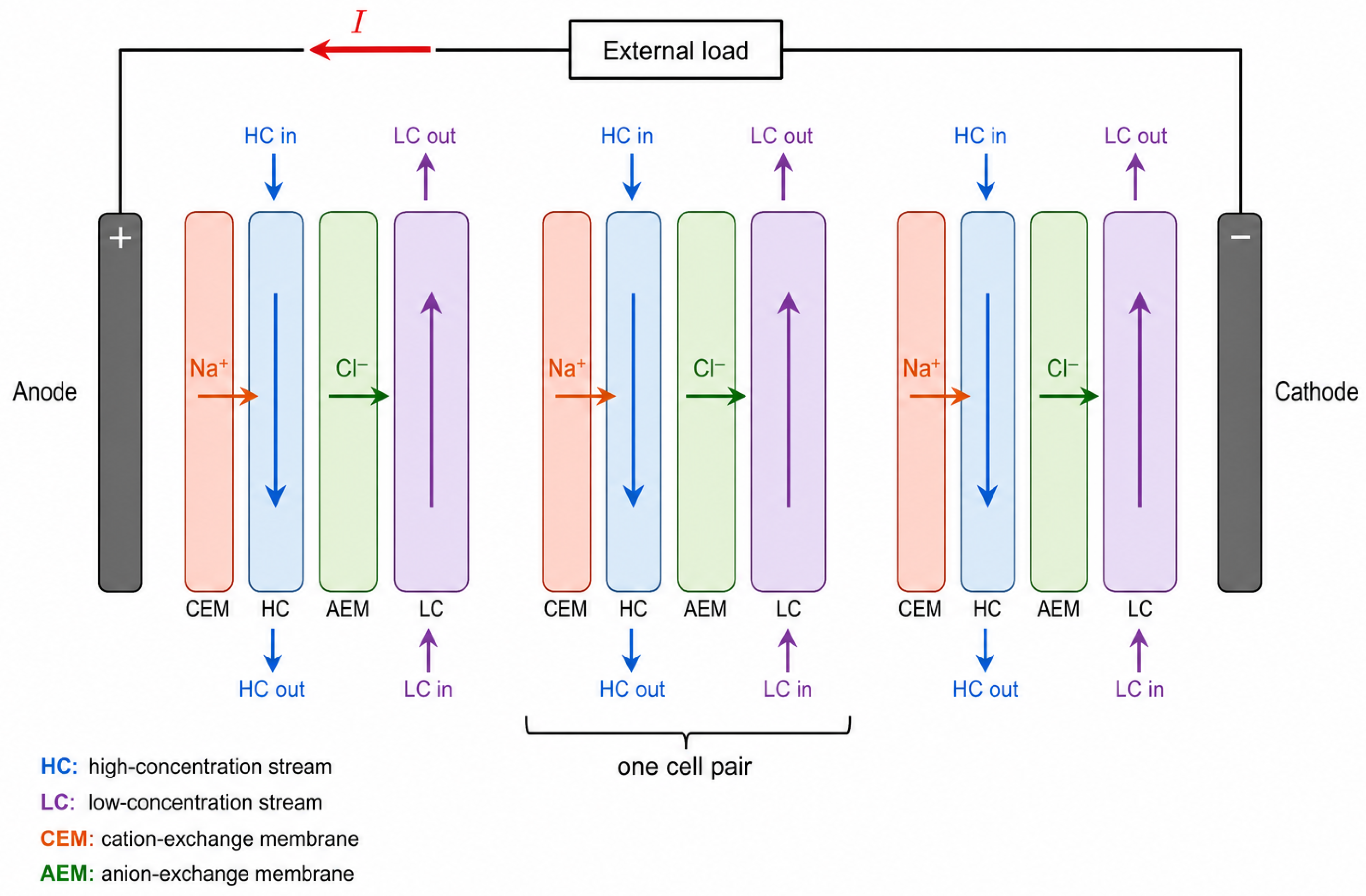
Figure 2.
Multiscale workflow for RED-stack simulation. Detailed cell-pair-scale CFD provides effective transport and hydraulic descriptors for a reduced-order stack model, which predicts electrical performance and supports optimisation of stack geometry and operating conditions.
Figure 2.
Multiscale workflow for RED-stack simulation. Detailed cell-pair-scale CFD provides effective transport and hydraulic descriptors for a reduced-order stack model, which predicts electrical performance and supports optimisation of stack geometry and operating conditions.
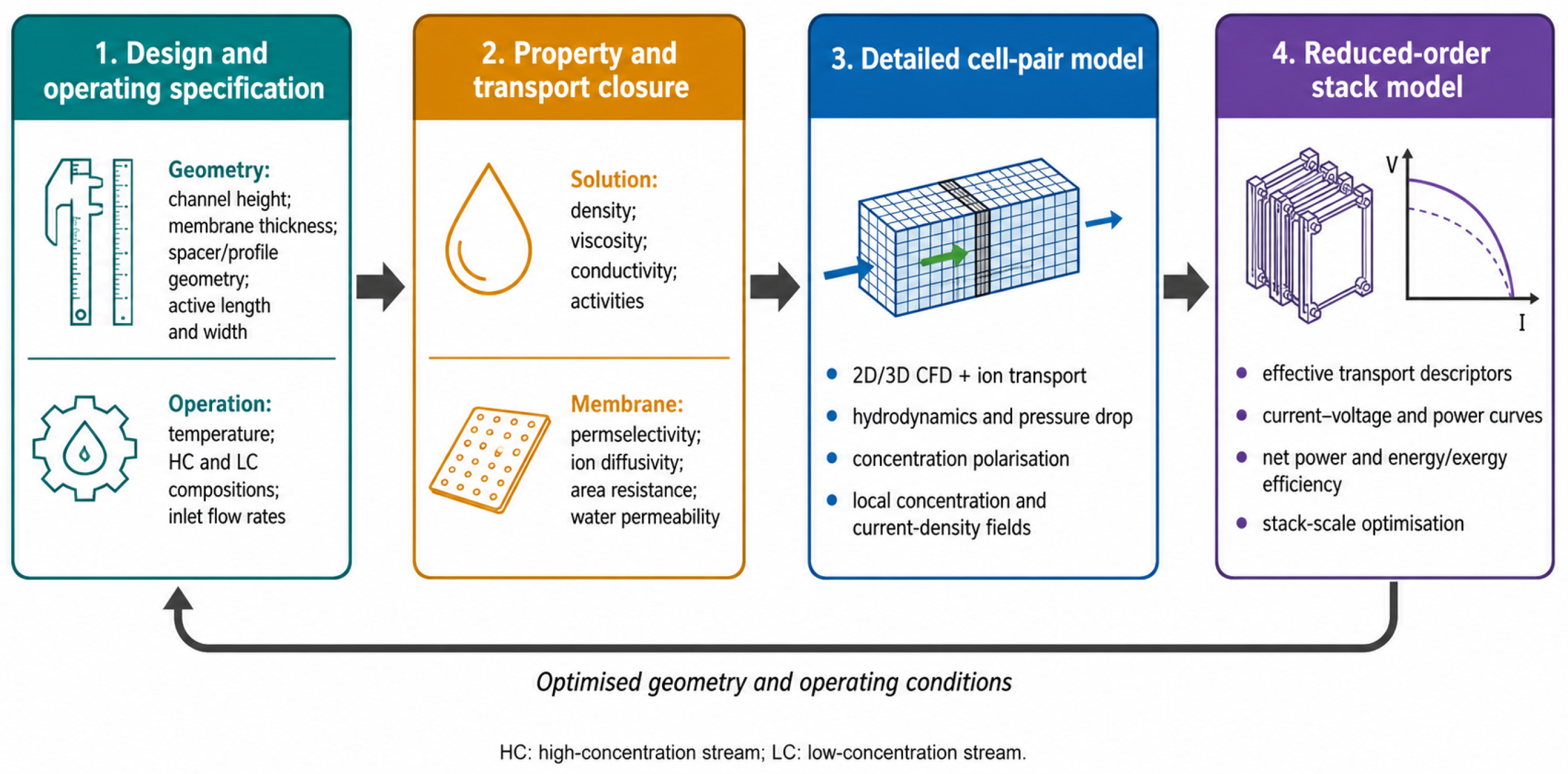
Figure 3.
Simulated net power density × net energy efficiency vs. residence time for pure NaCl and mixed divalent-ion feeds (Na2SO4, MgCl2, MgSO4) for a multi-stage counter-current RED operation, illustrating the performance penalty introduced by divalent ions relative to binary NaCl. Constructed from data in Pintossi et al. (2021) [30].
Figure 3.
Simulated net power density × net energy efficiency vs. residence time for pure NaCl and mixed divalent-ion feeds (Na2SO4, MgCl2, MgSO4) for a multi-stage counter-current RED operation, illustrating the performance penalty introduced by divalent ions relative to binary NaCl. Constructed from data in Pintossi et al. (2021) [30].
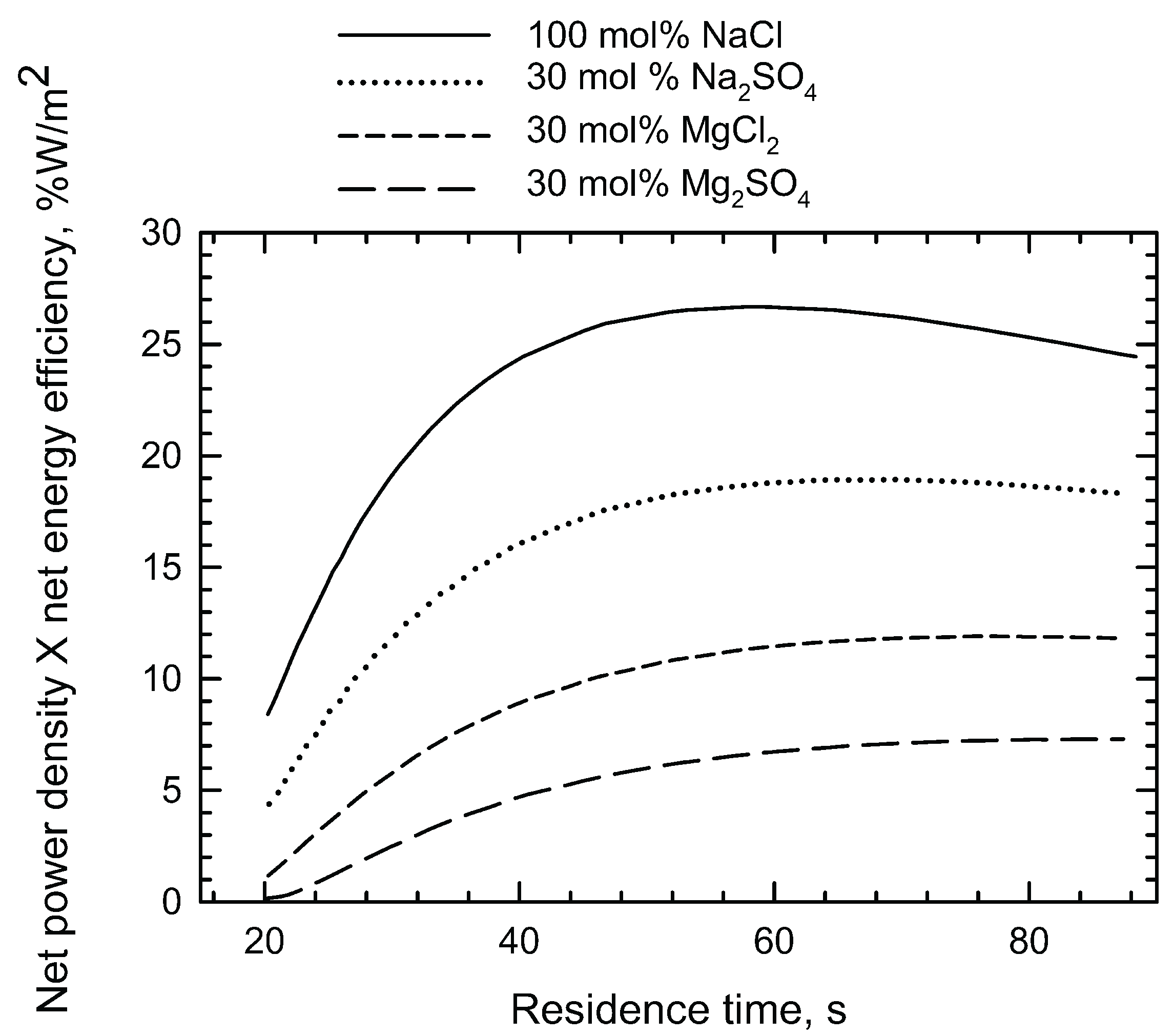

Table 1.
Representative RED power densities with different brine types and scales.
| Brine / System | Reported maximum performance | Scale | Ref. |
|---|---|---|---|
| Saltworks brine, Trapani (IT) | 3.6–4.3 W m−2 | Lab RED | [7] |
| Synthetic brine, 5 M / 0.1 M NaCl, 40 °C | ∼12 W m−2 | Lab RED | [8] |
| Oil-field produced water | ∼2.5 W m−2 | Lab, 10×10 cm2 | [9] |
| REAPower pilot (>400 m2 IEM) | ∼700 W total | Pilot | [10] |
| SWRO brine + freshwater, pilot | 0.96–1.46 W m−2 | Pilot | [16] |
| Optimised sea/river, commercial IEM | up to ∼2.2 W m−2 | Lab | [4,5] |
| Note: Reported values are not fully normalised across studies. Power density may be expressed per unit active membrane area, total ion-exchange-membrane area, cell-pair projected area, or another study-specific basis; total stack power is reported where that is the published metric. Direct numerical comparisons should therefore be interpreted cautiously. | |||
Table 2.
Summary of critical knowledge gaps for large-scale RED with concentrated brines.
| Topic | Main gap | Ref. |
|---|---|---|
| Ion–membrane interaction in real brines | The effect of multicomponent mixtures (, , , organics) on selectivity, resistance, and degradation is only partially known; binary NaCl data overestimate performance. | [7,10,29] |
| Models vs. real conditions | Most models use binary NaCl and ignore fouling, ionic short-circuits, and temporal brine variability, limiting predictive capacity at pilot/industrial scale. | [12,24,25,26] |
| Scaling and economy | Few long-term pilot datasets; lack of membrane lifespan, cleaning strategy, and LCOE data for varied brine scenarios. | [5,6,10] |
Table 3.
Comparison of model families for RED simulation.
| Approach | Best describes | Main limitations | Key refs. |
|---|---|---|---|
| Nernst–Planck / Maxwell–Stefan | Ion profiles, co-ion transport, water transport, geometry effects | High cost, many parameters requiring calibration | [31,32,33] |
| Thermodynamic / irreversible | Overall efficiency, osmotic losses, polarisation, exergy decomposition | Limited spatial detail; requires transport coefficients from experiment | [25,38] |
| Semi-empirical circuit | Stack design, flow configurations, multi-stage arrangements | “Black-box” parameters; low local explanatory power | [30,50] |
| Multi-physics CFD | Local velocity, concentration and current fields; spacer and geometry effects | High computational cost; limited to single cell pairs or small stacks | [23,32,51] |
| Data-driven / ML | Design-space exploration, surrogate modelling, parameter extraction | Requires substantial training data; limited physical interpretability | [53,54] |
Table 4.
Qualitative relationship between salinity gradient and RED power density.
| Configuration (NaCl) | Typical gradient | Trend | Ref. |
|---|---|---|---|
| Brine / river water | 0.1–5 M vs. 0.01–0.1 M | Power increases with gradient up to ∼5 M; then penalised by osmotic losses | [8,57,58] |
| SWRO brine / seawater | 1–3 M vs. ∼0.5 M | Power increases sharply with brine concentration | [24,55] |
Table 5.
Summary of operational variables studied in RED simulation and their principal effects on performance.
Table 5.
Summary of operational variables studied in RED simulation and their principal effects on performance.
| Variable | Principal effect on performance | Key refs. |
|---|---|---|
| Concentrated stream salinity | Increases OCV and power up to ∼5 M; beyond this osmotic and resistance losses dominate. In the cited studies, near-optimal performance was reported around ∼4.5–5 M / 0.1 M at 40 °C under the tested conditions. | [8,39,40] |
| Dilute stream salinity | Dilute channel resistance dominates internal losses; reducing dilute concentration below ∼0.05 M gives diminishing returns | [24,27] |
| Temperature | Higher T increases ion mobility, reduces membrane resistance and raises OCV. In the cited 5 M/0.1 M NaCl study, 40 °C was reported as near-optimal under the tested conditions. | [8,39] |
| Flow rate (velocity) | Higher velocity reduces concentration polarisation but increases pumping power; optimal Reynolds number depends on channel geometry | [23,66] |
| Flow configuration | Counter-current maintains more uniform driving force along channel length; preferred for concentrated brines | [13,43] |
| Number of cell pairs | More pairs increase OCV but also internal resistance; optimum exists for given brine conditions | [39,50] |
| Channel thickness | Thinner channels reduce solution resistance but increase pumping pressure; profiled membranes mitigate this trade-off | [23,51] |
| Electrode segmentation | Multi-segment electrodes allow adaptation to local current density along stack length; improve efficiency | [50] |
Table 6.
Qualitative trade-off between net power density, energy efficiency, and hydrodynamic losses for differently optimised RED operating points.
Table 6.
Qualitative trade-off between net power density, energy efficiency, and hydrodynamic losses for differently optimised RED operating points.
| Optimisation objective | Net power density | Net energy efficiency | Hydrodynamic loss |
|---|---|---|---|
| Single-objective optimisation for maximum net power density | Highest | Lowest | Highest |
| Multi-objective optimisation | Intermediate | Intermediate | Intermediate |
| Single-objective optimisation for maximum energy efficiency | Lowest | Highest | Lowest |
| Note: The qualitative ranking reflects the trade-offs reported for the model configurations and conditions examined by Long et al. [53] and Giacalone et al. [25]. The precise ranking and magnitude of each metric depend on membrane properties, feed composition, stack geometry, flow rate, and the definition of the optimisation objective. | |||
Disclaimer/Publisher’s Note: The statements, opinions and data contained in all publications are solely those of the individual author(s) and contributor(s) and not of MDPI and/or the editor(s). MDPI and/or the editor(s) disclaim responsibility for any injury to people or property resulting from any ideas, methods, instructions or products referred to in the content. |
© 2026 by the authors. Licensee MDPI, Basel, Switzerland. This article is an open access article distributed under the terms and conditions of the Creative Commons Attribution (CC BY) license (http://creativecommons.org/licenses/by/4.0/).
Copyright: This open access article is published under a Creative Commons CC BY 4.0 license, which permit the free download, distribution, and reuse, provided that the author and preprint are cited in any reuse.