
Submitted:
14 September 2026
Posted:
15 September 2026
You are already at the latest version
Abstract
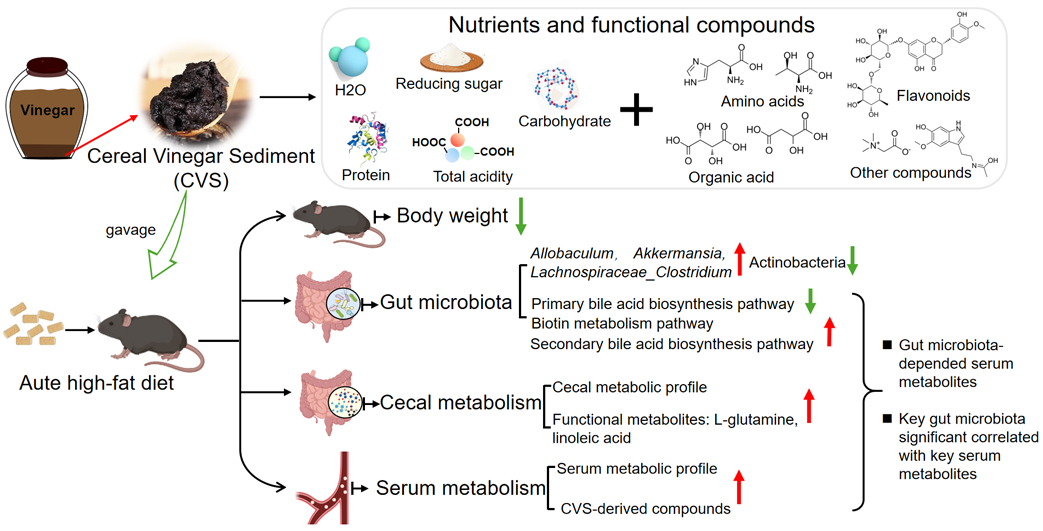
Background: Cereal vinegar sediment (CVS), a byproduct formed during traditional grain vinegar storage, possesses lipid-lowering, glucose-lowering, and antioxidant properties. However, its effects on gut microbial and metabolic responses to short-term high-fat diet [HFD] exposure remain unclear. This study aimed to characterize the compositional profiles of Dade CVS (DD-CVS) and Hengshun CVS (HS-CVS) and investigate their effects on host metabolism and gut microbiota in mice with short-term HFD exposure. Methodology: The physicochemical properties of CVSs were evaluated, and their chemical compositions were characterized via untargeted metabolomics. Mice were fed a short-term HFD and administered DD-CVS or HS-CVS. Gut microbiota, cecal metabolites, and serum metabolites were analyzed using 16S rRNA gene sequencing, metabolomics, and integrative multi-omics analysis. Results: Both CVSs were rich in amino acids, their derivatives, and polyphenolic compounds. CVS treatments attenuated body-weight gain and reshaped the gut microbiota composition of mice, including changes in the relative abundance of Allobaculum, Akkermansia, and Lachnospiraceae_Clostridium. Differentially, DD-CVS enriched Blautia and Ruminococcus, whereas HS-CVS promoted Bacillus. The results of gut microbial metabolic profiles showed that DD-CVS treatment regulated amino acid metabolism, while HS-CVS treatment influenced bile acid and arachidonic acid metabolism. Furthermore, serum metabolomics revealed that CVSs modulated systemic metabolic profiles and enriched CVS-associated compounds, such as α-linolenic acid. The candidate microbiota-sensitive metabolites, including lithocholic acid and 9(S)-HPODE, showed significant correlations with specific microbial taxa. Conclusion: DD-CVS and HS-CVS induced distinct gut microbial and metabolic responses during short-term HFD exposure, supporting further evaluation of CVS as a potential functional food.
Keywords:
cereal vinegar sediment
; chemical composition analysis
; metabolome
; gut microbiota
; short-term high-fat diet exposure
Copyright: This open access article is published under a Creative Commons CC BY 4.0 license, which permit the free download, distribution, and reuse, provided that the author and preprint are cited in any reuse.