

Submitted:
14 September 2026
Posted:
15 September 2026
You are already at the latest version
Abstract
Progressive Design-Build (PDB) has gained increasing attention as an alternative project delivery method that promotes early collaboration between owners and design-builders. However, limited empirical research has systematically identified the factors that are critical to successful PDB project delivery. This study identifies and evaluates critical success indicators (CSIs) and groups them into broader critical success factors (CSFs) affecting the cost and schedule performance of PDB projects during the procurement and implementation phases. A literature review and exploratory expert survey were used to identify and validate the CSIs, followed by a questionnaire survey of industry professionals. Twenty-nine valid responses representing 55 PDB projects across multiple infrastructure sectors were analyzed using statistical analyses. Six procurement-phase and eight implementation-phase CSIs were identified as critical. Principal Component Analysis (PCA) was used to group the procurement indicators into four CSFs related to owner competencies, owner–design-builder working relationships, design-builder competencies, and owner procurement processes. Four implementation CSFs were identified: owner–design-builder working relationships; owner project management processes; owner and design-builder competencies; and owner-, design-, and change-management processes. The findings provide empirical guidance for owners and design-build teams to prioritize organizational, relational, and managerial practices that support successful PDB project delivery.
Keywords:
progressive design-build
; project delivery methods
; critical success factors
; critical success indicators
; principal component analysis
; cost performance
; schedule performance
1. Introduction
One major alternative delivery method for designing and constructing building and infrastructure projects is lump-sum Design-Build. In this delivery method, the design and construction costs are bid during the procurement phase when about 15% of the design is completed. Because detailed design information is lacking during procurement, the design-builder has difficulty estimating construction costs. Therefore, the design-builder must accept the risk of a cost overrun. To reduce cost-overrun risks, the revised lump-sum DB method was introduced, in which the design-builder is selected based on qualifications. After 50-90% of the design is completed, the design-builder sets the Guaranteed Maximum Price (GMP) for the construction portion of the project. This method is called Progressive Design-Build (PDB). PDB has been successfully implemented across infrastructure sectors, including water, wastewater, aviation, and building projects, with more recent adoption in highway projects [1]. This success is attributed to the advantages PDB offers over the lump-sum DB method, including greater owner control over project scope, cost, and schedule; improved quality, flexibility, innovation, and risk allocation [2,3,4].
Another notable feature of PDB is the off-ramp option, which allows the owner to terminate the contract and pursue an alternative contracting strategy if the parties cannot agree on the final project terms [5]. PDB is also characterized by open-book negotiation processes, in which the project team collaboratively develops a work plan with full cost transparency, promoting a trust-based decision-making environment and alignment with the owner’s budget goals [4]. To support cost transparency and ensure that the price aligns with fair market value, the owner typically hires an Independent Cost Estimator (ICE) [1].
Research on PDB remains relatively limited but has attracted increasing attention in recent years due to the growing adoption of the method across infrastructure sectors. However, few studies have evaluated the success factors influencing PDB project performance. Recent studies have examined the cost and schedule benefits of PDB across infrastructure projects, suggesting that PDB is particularly valuable for complex projects with tight schedules. Adamtey and Onsarigo [6] conducted a comprehensive literature review and case study analysis to identify effective tools for successful PDB implementation. Among those, project packaging was especially effective in promoting cost and schedule certainty by enabling progressive estimates and better cost control. However, their study was primarily based on literature and recommended further validation through interviews and surveys with project stakeholders.
To compare the time and cost performance of PDB and DB projects, Adamtey [7] analyzed data from 75 PDB and 92 DB projects across sectors. The study concluded that PDB consistently achieved lower schedule overruns than DB, although it found no significant differences in cost performance. Further supporting these findings, Jeong et al. [8] proposed the “Four Pillars of Project Success,” which are predictability, risk, schedule, and cost, and emphasized that PDB enhances schedule performance and project predictability through early party integration and collaborative planning. While PDB may not always reduce costs, it can maximize project value.
Alameri and Esmaeili [9] further explored the main factors influencing owners’ decisions to select PDB and identified eight critical selection criteria. Their research outlined that scope flexibility and early procurement of long-lead materials can support budget control and schedule performance. Building on this, Alameri and Esmaeili [10] statistically analyzed 19 completed PDB projects. They recommended best practices, including early design-builder involvement, formal partnering agreements, risk identification and allocation, setting the GMP after 60% design completion, verifying costs through independent estimators, and prioritizing team qualifications. Their findings highlighted that early collaboration, transparent cost processes, and trust among stakeholders are essential to successful project outcomes. However, both studies were limited by sample size and sector focus, indicating the need for broader research using a more diverse dataset and more advanced statistical analysis techniques.
In recent years, researchers have also explored the implementation of PDB in specific sectors. Gad et al. [11] investigated PDB in airport projects. They found that owners primarily choose this approach to accelerate schedules and transfer design risks to the design-builder while maintaining input in design decisions. Their case study of a California terminal expansion highlighted the importance of continuous owner engagement, strong upper-management buy-in, efficient change-order processing, and clear procurement documents to ensure project quality and minimize delays.
Similarly, Shang and Migliaccio [12] conducted a case study on the University of Washington’s West Campus Utility Plant, presenting lessons learned for PDB implementation in the building sector. Their research proposed early collaboration, real-time cost feedback, workforce continuity, and targeted PDB training for new team members as essential to project success. The study also stressed that owners must remain actively engaged throughout all project phases, and not just design, to achieve intended outcomes.
Salih et al. [13] analyzed 21 water and wastewater PDB projects from the DBIA database, including their cost and scheduled performance. Their study found that most projects were completed on or ahead of schedule and under budget. The authors emphasize that strong planning, early risk management, and team collaboration are essential for PDB success. Nevertheless, the authors caution that these findings should not be generalized to other sectors, as project type can significantly influence the performance of delivery methods.
Addressing the challenges of PDB implementation in highway projects, Alleman and Tran [1] have identified legislative barriers, limited owner education and resources, and a lack of industry interest. Their study emphasized that early contractor involvement improves risk allocation, project quality, and schedule performance when teams are well-coordinated. To explore alternatives for states where PDB legislation is restrictive or unclear, Gransberg [4] has demonstrated through case studies and legislative content analysis that many DOTs can implement PDB under existing DB statutes, even without specific PDB legislation. The study further reinforces that PDB can accelerate procurement and improve cost and schedule certainty through early contractor engagement and open-book pricing practices.
In summary, studies on PDB across infrastructure sectors have highlighted several practices that improve schedule and cost performance in complex projects. However, the literature reveals a few gaps. First, many studies are limited by small sample sizes or sector-specific analyses, which restricts the generalizability of their findings. Second, while previous research has identified important practices and selection criteria, no prior research has comprehensively identified and analyzed critical success indicators across procurement and implementation phases and grouped them into critical success factors using principal component analysis. Therefore, this study aims to fill these gaps by identifying CSIs through a literature review, evaluating their relative importance using industry survey data, and grouping them into CSFs using statistical analysis techniques.
2. Materials and Methods
This study adopts a mixed-methods approach, following the methodology proposed by Shrestha et al. [14], to identify and evaluate the CSFs that influence cost and schedule performance in PDB transportation projects. The study consisted of three main phases: 1. Identification of potential indicators through an extensive literature review; 2. Validation and prioritization of the identified CSIs through a questionnaire survey; and 3. analysis of the collected data using inter-rater reliability, Relative Importance Index (RII), Mann-Whitney U, and principal component analysis. These steps are described in the following sections.
2.1. Literature Review
The authors initially conducted a literature review exploring PDB applications to identify and synthesize the main indicators associated with successful project outcomes. Relevant publications were retrieved from the DBIA bookstore and Google Scholar using the keywords “progressive design-build”, “design-build”, “success factors”, “project performance”, and “infrastructure.” Sources included peer-reviewed journal articles, conference papers, industry white papers, and DBIA publications. Studies were included if they examined PDB procurement or implementation practices, selection factors, cost and schedule performance, or success practices for implementing PDB. Because research specifically addressing critical success factors in PDB projects is limited, we have also included influential studies on success factors in lump-sum DB projects.
The success indicators were extracted based on their relevance to project performance, as discussed in the studies, and on their repeated mention in them. The authors evaluated these indicators based on their potential influence on PDB project outcomes and then organized them by contract phases (procurement and implementation).
This literature review initially identified 63 individual success indicators influencing PDB project outcomes. After synthesizing the concepts and removing duplicates, they were consolidated into an initial list of 35 distinct indicators. Table A1 and Table A2 list the critical success indicators for both procurement and implementation phases and their corresponding literature sources.
2.2. Questionnaire Development and Data Collection
2.2.1. Exploratory Survey
Before the main survey, an exploratory survey was conducted on Qualtrics with two senior engineers with extensive project delivery experience to validate the relevance of the extracted success indicators preliminarily. One expert is a faculty member who has researched alternative delivery methods for the last 30 years, and the other has more than 20 years of professional experience in alternative delivery methods, including PDB. Participants reviewed the initial list of 35 success indicators and rated their relevance as “Not at all important,” “Moderately Important,” or “Extremely Important.” They were also invited to suggest additional indicators not included in the initial list.
The exploratory survey results helped refine the final list of success indicators. Respondents rated all indicators as either “Moderately Important” or “Extremely Important,” and none of them was identified as “Not at all important.” Each respondent also suggested one additional success indicator, both rated as “Extremely Important”:
- Design-builder participation in the procurement phase, through competitive bidding and selection of subcontractor packages.
- Consistent communication of the Owner’s procurement plan and expectations from project initiation through procurement.
The authors incorporated both indicators into the final list of 37 CSIs, which will be presented in the study.
2.2.2. Questionnaire Survey
A second, more comprehensive questionnaire was then developed in Qualtrics to gather data on PDB projects and assess the importance of the final list of success indicators. This survey was distributed to a wider group of professionals, including DOT personnel and project managers, owner advisors, design-builders, PDB researchers, and practitioners. The questionnaire consisted of four main sections: 1. Respondent’s background (years of experience, number of PDB projects involved); 2. Project’s characteristics (project location, respondent’s role in the project, project type, procurement method, payment method, cost, and schedule performances); 3. Importance rating for factors affecting project performance related to procurement phase; and 4. Importance rating for factors affecting project performance related to implementation phase. This time, the importance rating was measured on a 5-point Likert Scale (1=Not at all important, 2=Slightly important, 3=Moderately important, 4=Very important, and 5=Extremely important). It included all indicators identified through the literature review and exploratory survey.
2.2.3. Statistical Testing
This research used four statistical tests to draw conclusions. First, the raters' responses were checked to determine whether they agreed on their ratings. Then, a descriptive statistical test was conducted to determine the relative importance index and identify the most important CSIs. A statistical test was then conducted to compare their rankings of the most important critical indicators. Finally, Principal Component Analysis (PCA) was used to identify the CSFs from these indicators. All these statistical tests were conducted using IBM SPSS Statistics. They are described below.
The Inter-Rater Reliability Agreement Test was applied to the collected questionnaire data to assess the consistency of respondents' ratings of the CSIs of PDB projects. In this test, the Intra-Class Correlation Coefficient (ICC) is used to measure the reliability of ratings when multiple evaluators assess the same set of variables, like in Likert-scale data. The ICC can be expressed as in Equation (1):
The ICC ranges from 0 to 1, with values closer to 1 indicating greater agreement among respondents. According to similar research by Shrestha et al. [14], ICC values less than 0.40 indicate poor significance; values between 0.40 and 0.59 indicate fair significance; values between 0.60 and 0.74 indicate good significance; and values greater than 0.75 indicate excellent significance.
The Relative Importance Index (RII) was used to rank the perceived importance of the identified CSIs based on responses collected using a 5-point Likert scale. The RII test is commonly used in construction research because it allows factors to be ranked based on the importance assigned to each [14]. The RII is calculated as in Equation (2):
Where:
is the weight assigned to each indicator by respondents.
is the highest possible weight, equal to 5.
is the total number of respondents.
The RII values range from 0 to 1, where values closer to 1 indicate greater importance. After calculating the RII values, the CSIs were ranked from highest to lowest importance. Procurement and implementation indicators were ranked independently to better understand how the importance of the factors differs in project phases.
This study used the Mann-Whitney U test to evaluate whether there were statistically significant differences between two groups of indicators: critical and non-critical. The null hypothesis assumes no significant difference in the distribution of ratings between the two groups, while the alternative hypothesis assumes a significant difference. A significance level of 0.05 was adopted for this study.
In this study, Principal Component Analysis (PCA) was applied to the two sets of CSIs, comprising 18 procurement and 19 implementation indicators, to reduce the total number of correlated variables to a smaller number of uncorrelated components. The extracted components represent groups of related indicators that explain the major patterns in the dataset. These components were then interpreted and labeled based on the common characteristics of the indicators within each group, representing the PDB critical success factors. Before conducting PCA, the suitability of the data for factor analysis was evaluated using the Kaiser-Meyer-Olkin (KMO) measure of sampling adequacy and Bartlett’s Test of Sphericity.
3. Results
This section presents the results of the questionnaire survey and the statistical analyses conducted to identify and prioritize the CSIs and CSFs affecting PDB project performance.
3.1. Demography of the Respondents
In the questionnaire survey, the response rate among contacted respondents was about 20%. Of the 72 responses received, 11 participants reported no experience with PDB, and several entries were incomplete or contained missing data. Ultimately, we analyzed 29 valid responses from professionals with PDB experience. The respondents provided information on 55 PDB projects, as shown in Table 2: 27 transportation, 19 building, 6 water and wastewater, 2 airport, and 1 stormwater.
The level of PDB experience among participants ranged from less than 2 years to over 10 years, with most professionals involved in 1 to 3 projects or more. Respondents also reported serving in a wide range of professional roles for each project, like Procurement Manager, Project Manager, Principal Engineer, Project Engineer, Design Manager, Project Director, Owner's Advisor/Representative, Owner Executive, Architect, Partner-in-Charge, Design Principal, Construction Manager, and Design-Build Manager.
3.2. Projects’ Characterization
The 55 projects analyzed varied geographically, with 54 located in the United States and 1 in Canada. The highest number of projects was reported in California (13), followed by Washington (8), Arizona (3), Oklahoma (3), Texas (3), Michigan (3), North Carolina (3), Indiana (2), Kansas (2), Virginia (2), Ohio (2), and Utah, Michigan, Missouri, Maryland, Colorado, Georgia, New Mexico, and Kentucky (1 each). The types of construction represented included expansion, new construction, repair and maintenance, rehabilitation, and other projects.
Regarding procurement methods (Figure 1a), approximately 62% of the projects used QBS, 33% used BV, and 5% used other methods. Regarding payment methods (Figure 1b), 58% of projects implemented a GMP, 33% used a lump sum, and 9% used other methods.
Regarding cost performance (Figure 2), 21% of projects were completed under budget, 60% met the budget, and 19% experienced cost overruns. Schedule performance (Figure 3) showed that 15% of projects were delivered ahead of schedule, 57% on schedule, and 28% behind schedule. For two of the projects rated, cost and schedule performance data were not specified.
3.2. Procurement Phase Critical Success Factors
3.2.1. Consistency of Responses for Critical Success Indicators
To assess the reliability of respondents' ratings of the procurement phase critical success indicators, the IRR test was conducted. Table 3 presents the results for the procurement phase CSIs' consistency. The ICC results indicate a single-measure value of 0.336 and an average value of 0.910. The single-measure intraclass correlation is significant because the 95% confidence interval is between 0.253 and 0.445. Similarly, the average measure was statistically significant, as the 95% confidence interval was between 0.872 and 0.941. The single-measure ICC reflects the reliability of individual respondents' ratings and suggests that their responses are reliable. Similarly, the average-measure ICC reflects the reliability of the aggregated ratings and indicates excellent agreement among all the respondents, demonstrating high overall consistency.
3.2.1. Ranking of Critical Success Indicators
The top CSIs in the procurement phase were identified using the RII and the median rating. A median value of 5 indicates that 50% or more of respondents rated the indicator as highly important. Table 4 shows all procurement-phase items along with the RII results, mean, median, and rankings. The results showed that six procurement-phase CSIs were identified as critical in influencing the cost and schedule performance of PDB projects. These include CSIs 14, 10, 2, 1, 15, and 7. The remaining indicators were classified as non-critical.
3.2.1. Statistical Significance
The Mann-Whitney U test results are presented in Table 5. The results indicate there is a statistically significant difference between the two groups evaluated: critical and non-critical indicators, with a p-value of less than 0.001. The critical CSIs show higher mean (4.50) and median (5) ratings than the non-critical CSIs, which have a mean of 3.83 and a median of 4. The mean rank for the critical group (700.52) is also higher than that of the non-critical group (486.21). These results confirm that the CSIs classified as critical are rated significantly higher by respondents than the non-critical indicators.
3.2.1. Principal Component Analysis of Critical Success Indicators
Principal Component Analysis was used to identify the critical success factors among these 19 indicators. These factor analysis results will show how these indicators align within a factor, so that the owner can focus on making their PDB project procurement phase successful. Varimax rotation with the Kaiser Normalization method was used to form factors from these indicators. Adequacy of samples and the correlations among the CSIs with corresponding factors were determined by conducting Bartlett’s Test of Sphericity. A KMO value of 0.750 was obtained, indicating good sampling adequacy for factor analysis. In addition, Bartlett’s Test of Sphericity was statistically significant (p-value less than 0.001), indicating that the correlations among the CSIs and factors were significant (Table 6).
The results of PCA are shown in Table 7. The analysis identified four CSFs among these 19 CSIs. The first CSF shows a high correlation with eight CSIs, each with a loading factor greater than 0.50. All retained factor loadings were greater than 0.50. The first factor accounts for 40.60% of the total weight and defines its relationship with these 8 CSIs. The second CSF consists of 4 CSIs and has a total weight of 10.0%, indicating that these 4 factors contribute 10% of the relationship with the second factor. In aggregate, these two factors account for 50.6% of the weights. The third and fourth CSFs are related to 3 CSIs, with weights of 9.20% and 7.0%, respectively. These 18 CSIs account for 66.82% of the weights for these four CSFs. So, four CSFs could be identified for the procurement phase to correlate with cost and schedule growth in PDB projects.
The four extracted CSFs are interpreted according to the common characteristics of the indicators loading on each component, as described below:
• CSF #1 - Owner’s Competencies: This CSF includes indicators related to the owner’s risk identification and allocation process, experience with the PDB method, flexibility in making changes in design and scope, procurement policies and types, communication practices, and collaborative efforts with the design-builder during the procurement phases.
• CSF #2 - Owner’s and Design-Builder’s Working Relationship: This CSF represents the quality of interaction and collaboration between the owner and design-builder during the procurement phase, including clear communication of project needs, open-book negotiations, effective communication between stakeholders, and timing of construction cost setting. It highlights the importance of transparency and trust between the owner and design-builder during the PDB project procurement phase.
• CSF #3 - Design-Builder’s Competencies: This CSF consists of indicators related to the design-builder’s ability to effectively manage project risks, resources, and requirements, including experience with PDB projects, financial capacity, and payment method used in the construction contract.
• CSF #4 - Owner’s Procurement Process: This CSF includes indicators related to procurement support mechanisms and project preparation, like early procurement of long-lead materials, independent QA/QC expertise, and ICE experience. All these indicators are a major part of the procurement phase.
3.2. Implementation Phase Critical Success Factors
3.2.1. Consistency of Responses for Critical Success Indicators
The results for the implementation phase of CSIs' consistency are presented in Table 8.
The ICC results indicate a single-measure value of 0.438 and an average value of 0.933. The single measure intraclass correlation is significant because the 95% confidence interval is between 0.346 and 0.550. Similarly, the average measure was statistically significant, as the 95% confidence interval was between 0.905 and 0.957. The single-measure ICC reflects the reliability of individual respondents' ratings and suggests that their responses are reliable. Similarly, the average-measure ICC reflects the reliability of the aggregated ratings and indicates excellent agreement among all the respondents, demonstrating high overall consistency.
3.2.1. Ranking of Critical Success Indicators
Following the same criteria used in the procurement phase, the top CSIs in the implementation phase were identified using the RII and the median rating values. Eight implementation-phase CSIs were identified as critical to the performance of PDB projects. These include CSIs 11, 13, 1, 12, 7, 2, 4, and 8. Table 9 presents the results, including RII values, the mean, the median, and the rankings.
3.2.1. Statistical Significance
The Mann-Whitney U test results show a statistically significant difference between the critical and non-critical indicators in the implementation phase. As shown in Table 10, the critical CSIs have a higher mean rating (4.47) and median (5) than the non-critical CSIs, which have a mean of 4.08 and a median of 4. In addition, the mean rank for the critical group (567.60) is higher than that of the non-critical group (437.82). Similar to the procurement phase results, these findings confirm that the indicators classified as critical are rated significantly higher by respondents.
3.2.1. Principal Component Analysis of Critical Success
Like in the procurement phase, Principal Component Analysis was used to identify the critical success factors among these 18 indicators. These factor analysis results will show how these indicators align within a factor, so that the owner of PDB projects can focus on making their PDB project implementation phase successful. Varimax rotation with the Kaiser Normalization method was also used to form factors from these indicators. Adequacy of samples and the correlations among the CSIs with corresponding factors were determined by conducting Bartlett’s Test of Sphericity. A KMO value of 0.850 was obtained, indicating good sampling adequacy for factor analysis. In addition, Bartlett’s Test of Sphericity was statistically significant (p-value less than 0.001), indicating that the correlations among the CSIs and factors were significant (Table 11).
The PCA results for the successful PDB implementation phase are shown in Table 12. The analysis identified four CSFs among the 18 CSIs. The first CSF shows a high correlation with 6 CSIs, each with a loading factor greater than 0.62. All retained factor loadings were greater than 0.62. The first factor accounts for 48.77% of the total weight and defines its relationship with these 6 CSIs. The second CSF consists of 6 CSIs and has a total weight of 11.87%, indicating that these 6 indicators contribute about 12% of the relationship with the second factor. In aggregate, these two CSFs account for 60.64% of the weights. The third and fourth CSFs are related to 4 and 2 CSIs, with weights of 6.74% and 6.52%, respectively. These 18 CSIs account for 73.90% of the weights for these four CSFs. So, four CSFs could be identified for the implementation phase to correlate with improved cost and schedule growth in PDB projects.
The four factor groups are explained below:
• CSF #1 - Owner’s and Design-Builder’s Working Relationship: This factor includes indicators associated with communication, trust, alignment of project goals, and owner upper management support. It emphasizes the importance of good working relationships and collaboration between the owner and design-builder during the implementation phase.
• CSF #2 - Owner’s Project Management Processes: This factor consists of indicators related to project execution and management, including clearly defined roles and responsibilities of owner’s and design-builder’s staff, work packaging quality, QA/QC programs, project controls, and workforce and material availability.
• CSF #3 - Owner’s and Design-Builder’s Competencies: This factor represents the organizational and managerial capabilities of both the owner and design-builder, including project management capability, design-builder’s support, and stakeholder feedback during the design phase.
• CSF #4 - Owner’s Design and Change Management Processes: This factor includes indicators associated with the owner’s involvement during the design phase and the ability to effectively manage project changes throughout implementation.
4. Discussion
4.1. Procurement-Related Critical Success Indicators (CSI) Rankings
First, this study identified the critical success indicators for PDB infrastructure projects in the procurement phase. Based on ratings from experts involved in PDB infrastructure projects, the study identified the top 8 critical indicators that will play an important role in the successful execution of the procurement phase. The results showed that CSI #14 was the top-ranked indicator, vital to the successful completion of the PDB procurement phase. This indicator relates to effective communication between the owner and the design-builder during the procurement phase. It is very important for the owner to be transparent and to provide up-to-date information about the procurement process to the design-builders bidding for the PDB projects. Therefore, most owners hold pre-bid meetings with prospective design-builders to communicate project goals effectively during the procurement phase. Also, the owner invites all design-builders to present their proposals separately so the owner can speak with the prospective design-builders about their plans for the PDB projects.
The second top-ranked indicator was CSI #10, which relates to the design-builder's early involvement in the design phase. This is a very important issue for the design-builder and the owner. If the owner can bring the design-builder into the early design phase, they can introduce innovative design to make the project successful in terms of cost and schedule. Generally, it is helpful to bring the design-builder when the preliminary design is 15% complete.
The third top-ranked indicator is CSI #2. This indicator relates to the owner’s process for clearly communicating the project's end needs. As in PDB projects, the owner can provide lots of feedback during the design phase, so the owner must provide the design-builder with the end needs of the project so that they can design and build the project in such a way that the owner can operate and maintain the project cost-effectively without any difficulty.
The fourth top indicator was CSI #1, which relates to the owner’s capability to identify and allocate risks for the PDB project. This issue is very important in the PDB project because if the risk identification process is not carried out in detail, it can negatively affect procurement and the implementation phase. Without proper risk identification, the owner cannot allocate the risk to the appropriate party. If proper identification and allocation of risk can be done during the procurement phase, the chances of the PDB project being successful will increase.
The fifth and sixth critical indicators are CSI #15 and CSI #7, respectively. These indicators relate to collaboration and communication between the owner and the design-builder from project initiation through the procurement phase. The main factors during the procurement phase for making the PDB project successful are maintaining constant communication and collaboration with the design-builder. If the owner and design-builder can work as a team and communicate effectively, it will be easy to solve any problems that arise in PDB projects.
The authors conducted a statistical analysis to determine whether ratings for top critical success factors and non-critical success factors differ significantly. The Mann-Whitney test shows that the average ratings for the top 6 critical indicators are significantly higher than those for the remaining 13 non-critical indicators. The authors have reviewed previous studies to identify similar findings regarding CSI during the procurement phase of PDB projects; however, none have reported critical success indicators for this phase in PDB infrastructure projects.
Authors should discuss the results and how they can be interpreted from the perspective of previous studies and of the working hypotheses. The findings and their implications should be discussed in the broadest context possible. Future research directions may also be highlighted.
4.2. Procurement-Related Critical Success Factors (CSFs)
The PCA analysis showed that these 18 indicators were correlated with four factors. One CSI, #10, was not correlated with any CSF during the procurement phase. Based on the indicators correlated with these four factors, they were Owner’s competencies, Owner’s and Design-Builder’s working relationship, Design-Builder’s competencies, and Owner’s procurement process.
The first critical factor, which correlates strongly with 8 indicators, is the owner’s competencies, as all the attributes identified in this factor relate to the owner. The owner should have a proper risk identification and allocation process and experience with procurement PDB projects to ensure a successful procurement phase. In addition, the owner should be flexible with the project scope and design, as working with the design-builder to finalize the project scope and design alternatives can make the PDB project more successful in terms of cost and schedule. CSIs #6 and #8 relate to procurement laws, policies, and the types of procurement processes used to hire a design-builder. As PDB is a relatively new delivery method and very few state agencies have used it to design and construct infrastructure projects, the owner must revise the state procurement policy so that the state agency can hire a contractor capable of successfully designing and constructing the infrastructure project using the PDB method. In addition, the state agency should select the procurement method that best helps identify the most qualified design-builder to complete the project successfully. CSI #7 discusses the owner’s effective communication with the design-builder regarding the contract procurement method. This highlights the need for transparency in the design-builder selection process. In PDB projects, the design-builder is selected based on qualifications. Therefore, the owner must be very transparent about the attributes they are seeking with the prospective design-builder bidders for their PDB projects. This will assist the design-builder in preparing their best-qualified team for the PDB projects. In addition, the owner must disclose during the procurement phase how non-cost factors will be scored in the proposal. CSIs #13 and #15 relate to the collaboration between the owner and the design-builder during the procurement phase. To ensure the project’s success, the design-builder should actively participate in procurement and select subcontractor packages during the construction phase.
The second CSF comprises the attributes related to the working relationship between the owner and the design-builder. The owner must communicate their project’s end needs to the design-builder for the project to be successful. Similarly, the working relationship between the owner and the design-builder should be honest and fair, and negotiations over design and construction costs should be transparent. The owner and the design-builder should discuss and decide on the timing of the GMP for the construction cost. If the construction cost is set early without sufficient design advancement, there is a risk of a construction cost overrun. If the construction cost GMP is fixed after most of the design is complete, there is less chance of design and construction overlap, reducing cost uncertainty.
The third CSF includes CSIs #9, #11, and #12. These indicators are the design-builder’s competencies. While negotiating construction costs with the owner, the design-builder should decide on the payment types. Generally, in PDB, the GMP for construction cost is used. However, the design-builder can negotiate payment terms with the owner. Another important aspect is that the design-builder should have sufficient financial capacity to bid on the construction portion of the PDB project. They should also have enough experience in the PDB project to complete it successfully. These attributes related to the design-builder were grouped into a single factor, indicating that to make the PDB project procurement successful, the design-builder should also have strong competencies.
The final CSF comprises three CIS related to the owner’s procurement process. CSIs #17, #18, and #19 were included in this factor. If the PDB project includes purchasing long-lead items and equipment, the owner should ensure they procure these early to avoid negatively impacting the design-builder during the construction phase. In the PDB project, a performance-based specification is generally used. Under this specification, the owner must hire an experienced independent quality assurance/quality control (QA/QC) firm to effectively control project quality. Also, the owner should hire an ICE with extensive experience in PDB project construction costs. Without experience with ICE, it will be difficult to negotiate the GMP of the construction portion of the PDB project with the design-builder.
The authors compare these critical success factors for PDB projects with those identified in previous studies; however, no prior studies have identified the CSFs for PDB projects in the procurement phase. Some studies compare the CSI and CSF of DB projects to assess their successful completion.
4.3. Implementation-Related Critical Success Indicators (CSI) Rankings
This study also asked the PDB experts to rank the most important indicators for the project’s success during the design and construction phases. Generally, the successful design and construction phase is determined by whether projects are completed on time, on schedule, and to a high standard of quality. Seven indicators were ranked highly and were significantly different from the other 12 indicators.
The top indicator for a successful design and construction phase of the PDB project is the trust between the owner and the design-builder (CSI #11). CSIs #13 and #1, which relate to communication between the owner and the designer during the design and construction phases, are also crucial. The owner should be in constant communication with the design-builder regarding their design and construction requirements, enabling the design-builder to conduct value engineering and assess constructability during the design phases. Any changes during the construction phase should be communicated to the design-builder continuously so that a proper change management process can be used to minimize their impact on the cost and schedule of the PDB projects.
The fourth indicator is CSI #12, which states that the owner and the design-builder should have common project goals. They should sit down together to set project goals and work together to achieve them. CSIs #7 and #4 were also ranked as the top indicators of the PDB project's success during the design and construction phases. Both are related to support from their upper management. As PDB projects are very complex, and their design is in a very early stage when the design-builder is selected, the owner and design-builder project managers should receive sufficient support from their upper management, as there can be many negotiations throughout the project.
CSI #2 was also found to be a highly rated indicator, suggesting that the owner must be highly involved in the design phase. As a variation of lump-sum DB, the PDB was introduced to give the owner greater control over the design. So, the owner should be involved in design early in the project and provide feedback to the design-builder so that they can design the project according to the owner’s requirements and can reduce the operation and maintenance costs. The last highly ranked indicator was that the design-builder should have management capacity to handle PDB projects. As PDB is a relatively new delivery method, and many design-builders lack sufficient experience to execute a PDB project, a successful PDB project requires project management capacity.
When comparing these top-ranked CSIs for PDB projects with previous studies, none have examined the CSI for PDB projects. However, some studies have been conducted to identify the CSI for DB projects. Table 13 compares the CSI rankings of PDB projects with those of DB projects from previous studies.
There are four prior studies on lump-sum DB projects, and their findings show that only four CSIs, which were ranked highly in this study, were also ranked in some of these studies. CSI #11, related to trust between the owner and the designer, was ranked by Chan et al. [15] as 1st, by Shrestha et al. [14] as 2nd, and by Lam et al. [16] as 4th. CSI #13 ranks second among PDB projects in terms of success. However, this indicator was ranked number 9 by Chan et al. [15], number 2 by Shrestha et al. [14], and number 13 by Lee et al. [17] for DB projects.
CSI #1 was ranked 3rd for the PDB project in this study, and for the DB project, it was ranked 2nd by Shrestha et al. [14], 9th by Chan et al. [15], and 13th by Lee et al. [17]. Another CSI #8 was ranked 4th by this study for PDB projects, whereas for DB projects, Shrestha et al. [14], Lam et al. [16], and Lee et al. [17] ranked it 1st, 5th, and 7th, respectively. These comparisons show that some of the ranked indicators were also highly ranked in the study of DB projects, which is intuitive because PDB is another form of DB method.
4.4. Implementation-Related Critical Success Factors (CSFs)
The PCA analysis shows that 18 CSIs are correlated with four factors. Those factors are named as Owner’s and Design-Builder’s Working Relationship, Owner’s Project Management Processes, Owner’s and Design-Builder’s Competencies, and Owner’s Design and Change Management Processes. Six CSIs are highly correlated with the first factor, with correlation coefficients higher than 0.60. All these indicators relate to the owner’s and design-builder’s working relationship. As PDB is a collaborative method, to ensure the PDB design and construction phase is successful, both project participants must work in an arm-in-arm relationship. The highly correlated indicators are CSIs #11 and #12, which relate to trust and understanding between the owner and the design-builder. Both project participants should share a common goal and have mutual trust. In addition, CSIs #13 and 1 were also highly related to good communication between the owner and the design-builder regarding project requirements during the design and construction phases. Chan et al. [15] also found these four indicators to be highly correlated with the factor the authors call Project Team Commitment. Another two CSIs, #4 and #9, relate to the owner’s upper management support, and the design-builder’s design innovation were also highly correlated to this factor. All these attributes are part of the owner-design-builder working relationship that makes PDB projects successful.
The second CSF, named ’Owner’s Project Management Processes’, is highly correlated with CSIs #16, #17, and #18. All these attributes are related to the owner’s project control process during the design and construction phases. CSI #14 is also highly correlated with this factor, which concerns construction work packaging. In the PDB project, the construction work package is a key aspect in setting the GMP. If the owner and design-builder can collaboratively prepare a quality work package, it will be easier to reduce the risk of construction cost overruns. Two additional CSIs, #6 and #10, were also correlated and concern the roles and responsibilities of the owner and design-builder during the design and construction phases of PDB projects. To make a PDB design and construction phase successful, the owner should have a project management process that defines the roles and responsibilities of both project participants. If all project participants know their roles and responsibilities, the PDB projects can be implemented successfully. Chan et al. [15] also found that some of these attributes were required for the successful implementation of PDB projects, and the authors termed this factor Client’s Competencies.
CSIs #5, #7, #8, and #15 were correlated with the third CSF, named Owner’s and Design-Builder’s Competencies. In this factor, two indicators were related to the owner, and two were related to the design-builder. The owner must have good project management personnel to effectively implement PDB projects, as these are newer versions of lump-sum DB projects. The owner should also involve end users and operations personnel during the design phase to ensure the project is designed and built with lower maintenance and operating costs in mind. The competencies the design-builder should have to make the PDB project successful include upper management support for design and construction personnel, and strong project management personnel to handle the design and construction phases of PDB projects. In [15], these attributes were grouped into two factors, Contractor’s Competencies and Client’s Competencies, for lump-sum DB projects.
The final CSF, Owner’s Design and Change Management Processes, had two attributes that were highly correlated. They are CSIs #2 and #3 and relate to the owner’s involvement in the design phase and the owner’s effective change management process. One of the drawbacks of lump-sum DB projects was that the owner had little input during the design phase, as the design and construction contract had been executed. However, in the PDB project, the design-builders are selected based on their qualifications, and their design fees are negotiated, leaving room to provide design feedback to the design-builders. In addition to design involvement, the owner can implement an effective change management process, as construction costs are set later once the design is 60 to 90% complete. These attributes of the owner are important to making PDB projects successful.
4.5. Limitations
There are certain limitations of this study. The first one is the sample size. These authors collected responses from 55 experts’ projects, as PDB is currently used, and finding experts in this area is difficult. Similarly, previous studies that conducted PCA analyses, Shrestha et al. [14] and Chan et al. [15], had 27 and 53, respectively. However, Lam et al. [16] and Lee et al. [17] had 92 and 111 responses, respectively. Even though the sample size is only 55 in this study, the KMO value of 0.85 showed sampling adequacy for factor analysis.
This study did not divide the responses by infrastructure project type due to the limited number of experts in transportation and aviation. As PDB is a new delivery method, many state agencies have not yet adopted it, and obtaining a large sample size across infrastructure project types is difficult. Previous studies on factor analysis for DB projects have also not segregated responses by project type, except for Shrestha et al. [14], which was conducted with experts in lump-sum DB water and wastewater projects.
Additionally, this study did not include the attributes necessary during the preplanning, operation, and maintenance phases. To ensure a project is successful during the procurement and implementation phases, the owner needs to ensure that the PDB projects are well planned during the preplanning phase. The owner should have conducted sufficient studies to ensure that the projects are suitable for the PDB delivery method. Also, the preliminary design, complexity, and economic analyses should have been conducted effectively to ensure the PDB project will be successful during the procurement and implementation phases. Another aspect to consider is that the operational and maintenance attributes should be carefully reviewed when aiming for project success, as well as the end users' requirements. Therefore, it will be helpful to include the attributes of the preplanning, operation, and maintenance phases.
5. Conclusions
This study focuses on identifying the CSIs for the procurement and implementation phases of PDB infrastructure projects. The literature review was conducted to determine the CSIs related to the procurement and implementation phases of PDB projects. As there was a lack of studies on PDB critical success factors, the authors, through a literature review of DB projects, identified procurement-related and implementation-related CSIs for inclusion in the questionnaire. First, these CSIs were sent to two experts (one academic and the other professional) who have been involved in PDB infrastructure projects to assess their importance and add any missing CSIs to the list. The experts added two CSIs to be included for the implementation phase. In the final questionnaire sent to the respondents, there were 19 procurement-related CSIs and 18 implementation-related CSIs. A total of 55 completed responses were analyzed to rank the procurement- and implementation-related CSIs.
The IRR and Reliability analyses showed that these respondents agreed with and ranked six procurement-related CSIs and eight implementation-related CSIs very highly. The Mann-Whitney test results also showed a significant difference in ratings between the top-ranked and non-ranked CSIs for procurement- and implementation-related CSIs. Out of six top-ranked procurement-related CSIs, three were related to communications. The owner should be in constant communication with the design-builder regarding project end needs, the procurement plan, and expectations. Other CSIs ranked by respondents are the owner’s early involvement in the design phase, risk identification and allocation during procurement, and collaboration among project participants. All these attributes play an important role in selecting the right design-builder during the procurement phase.
During the implementation phase analysis, the statistical results indicated that eight implementation-related CSIs were ranked highly by respondents. Two CSIs, #13 and #1, were related to the level of communication between the owner and the design-builder regarding project requirements and goals. This shows that effective communication is a key to the successful procurement and implementation of PDB infrastructure projects. Two CISs, #7 and #4, were related to the support that the owner and design-builder project managers received from their upper management. Both project managers must be supported by their higher-level personnel, because PDB projects should be completed through collaboration between the two project participants. The rest of CSIs #2, #8, #11, and #12 were related to trust between them, common goals, the owner’s involvement in the design process, and the design-builder’s management capabilities. All these attributes are important for the successful implementation of PDB infrastructure projects.
The study also conducted a factor analysis to identify procurement- and implementation-related factors that are highly correlated among these CSIs. The factor analysis results showed that 18 out of 19 procurement-related CSIs were highly correlated to four factors. Similarly, 4 factors were also created for 18 implementation-related CSIs. Two factors are similar across these two phases; however, one factor in the procurement phase and two factors in the implementation phase differ and are specific to their respective phases: Owner and Design-Builder Competencies, Owner’s and Design-Builder’s Working Relationship. These factors are very important whether the project is in the procurement phase or the design-construction (implementation) phase. However, the Owner’s Procurement Process involves early procurement of long-lead equipment and materials and the selection of an experienced QA/QC firm, both of which are particularly important during this phase. Therefore, this factor is important during the procurement phase to ensure the successful completion of PDB design and construction.
Two implementation-related factors, distinct from procurement-related factors, are the Owner’s Project Management Processes and the Owner’s Design and Change Management Processes, which are specifically related to the implementation phase. All the attributes loaded into these two factors relate to the design and construction phase and have nothing to do with the procurement phase. Therefore, there are factors common to the procurement and implementation phases that are crucial for successful procurement and implementation. So, owner and design-builder competencies and working relationships are already important factors to consider, whether in the procurement or design phases. However, to proceed with the procurement phase, the owner must ensure that certain requirements are met before engaging a qualified design-builder. Once the qualified design-builder is on board, the owner and the design-builder should ensure that both parties' project management is effective, so that project scope, change management, inspections, schedules, and costs can be controlled collaboratively.
The major contribution of this study is to identify the critical attributes of the procurement and implementation phases of PDB infrastructure projects, enabling the owner and prospective design-builders to focus on these attributes to ensure project success. Another major contribution of this study is the identification of procurement- and implementation-related factors critical to the successful execution of PDB infrastructure projects. There are no prior studies that have determined the critical success factors for PDB infrastructure projects. For this reason, these study findings have practical implications for state agencies considering the use of PDB in their infrastructure projects. The state agencies can focus on the factors identified in this study and carefully review them during the procurement and implementation phases to ensure the success of their PDB projects, thereby saving taxpayers' time and money. Lumpsum DB and PDB projects differ, so when selecting the PDB delivery method, state agencies can use some of the new factors developed in this study in their PDB infrastructure projects to ensure their future PDB projects are completed.
As this is the first study on PDB critical success factors, the authors recommend conducting a follow-up study by collecting more data once more project managers gain PDB experience. Also, once there are enough highway, water, wastewater, and aviation PDB projects, this study can be repeated by project type. Collecting data from only one group of experts will help identify the success factors specific to a single type of infrastructure project. In the future, it is also recommended to conduct a study to determine whether state and federal policies are based on these critical success factors and whether state agencies can use these factors during the procurement and implementation of PDB infrastructure projects.
Appendix A
Appendix A.1

Table A1.
Procurement Phase Critical Success Indicators Synthesized for PDB Projects.
| CSI # | CSI Description | S1 | S2 | S3 | S4 | S5 | S6 | S7 | S8 | S9 | S10 | S11 | S12 | S13 | S14 | S15 | S16 |
|---|---|---|---|---|---|---|---|---|---|---|---|---|---|---|---|---|---|
| 1 | Proper risk identification and allocation from the Owner | √ | √ | √ | - | - | - | √ | - | √ | - | √ | - | - | - | √ | - |
| 2 | The Owner has clearly communicated their end needs of the project | - | - | - | - | √ | - | - | - | √ | - | - | √ | - | - | √ | √ |
| 3 | Owner's experience with the PDB process | √ | √ | √ | - | √ | - | - | - | - | - | - | - | √ | - | √ | |
| 4 | Owner's flexibility with project scope and design | - | - | - | - | √ | - | - | √ | √ | √ | - | - | - | - | - | - |
| 5 | The Owner's process of open-book negotiations for design and construction costs | - | - | √ | - | - | - | - | - | √ | √ | √ | - | - | - | - | - |
| 6 | The Owner has established a procurement policy for PDB projects | - | √ | - | √ | - | - | - | - | - | - | - | - | - | - | - | √ |
| 7 | Types of contract procurement methods used to select the Design-Builder | - | - | - | - | - | - | - | - | √ | - | - | - | - | - | - | - |
| 8 | Types of payment method used for construction work (GMP or Lump-Sum) | - | - | - | - | - | √ | - | - | - | - | - | - | - | - | - | - |
| 9 | Early involvement of the Design-Builder during the project design phase | - | - | - | √ | √ | - | - | - | √ | √ | √ | - | - | - | √ | - |
| 10 | Design-Builder's experience with the PDB process | - | - | - | - | - | - | - | - | - | - | - | √ | √ | √ | √ | √ |
| 11 | Design-Builder's financial capacity | - | - | - | - | - | - | - | - | - | - | - | - | √ | √ | √ | |
| 12 | Effective communication between Owner and Design-Builder during the procurement phase | - | - | - | - | √ | - | - | - | √ | - | - | √ | - | - | √ | √ |
| 13 | Collaboration between Owner and Design-Builder during the procurement phase | - | - | - | - | - | - | √ | - | √ | - | √ | - | - | - | - | - |
| 14 | Timing of the construction costs setting | - | - | - | - | - | - | - | - | √ | - | - | - | - | - | - | - |
| 15 | Early procurement of long-lead equipment and materials | - | - | - | - | - | - | - | √ | - | - | - | - | - | - | - | - |
| 16 | Independent QA/QC firm's experience | - | √ | - | - | - | - | - | - | - | - | - | - | - | - | - | - |
| 17 | Independent Cost Estimator's (ICE) experience | - | - | - | - | √ | - | - | - | √ | - | - | - | - | - | - | - |
Note. √ indicates the indicator was identified in the corresponding study. Study key: S1 = Adamtey & Onsarigo [6]; S2 = Gad et al. [11]; S3 = Gransberg & Molenaar [3]; S4 = Alleman & Tran[1]; S5 = Shang & Migliaccio [12]; S6 = Alleman & Tran [18]; S7 = Jeong et al. [8]; S8 = Alameri & Esmaeili [9]; S9 = Alameri & Esmaeili [10]; S10 = Gransberg [4]; S11 = Salih et al.[13]; S12 = Chan et al. [15]; S13 = Lam et al. [16]; S14 = Shrestha et al. [19]; S15 = Lee et al. [17]; S16 = Shrestha et al.[14].
Table A2.
Implementation Phase Critical Success Indicators Synthesized for PDB Projects.
| CSI # | CSI Description | S1 | S2 | S3 | S4 | S5 | S6 | S7 | S8 | S9 | S10 | S11 | S12 | S13 | S14 | S15 | S16 |
|---|---|---|---|---|---|---|---|---|---|---|---|---|---|---|---|---|---|
| 1 | The Owner has clearly communicated the project requirements to the Design-Builder | - | - | - | - | - | - | - | - | √ | - | - | √ | - | - | √ | √ |
| 2 | Level of Owner’s involvement during the design phase | - | - | - | √ | √ | - | √ | - | - | - | √ | - | - | - | - | - |
| 3 | Owner’s effective change management process | - | √ | - | - | - | - | - | - | - | - | - | √ | - | - | √ | √ |
| 4 | Owner’s upper management support | - | √ | - | - | - | - | - | - | √ | - | - | - | - | - | - | √ |
| 5 | The Owner has good project management capability for PDB projects | - | - | - | - | - | - | - | - | - | - | - | √ | √ | - | √ | √ |
| 6 | Clearly defined goals and responsibilities of the Owner’s staff | - | - | - | - | - | - | - | - | - | - | - | √ | - | - | √ | - |
| 7 | Design-Builder's upper management support | - | √ | - | - | - | - | - | - | √ | - | - | - | - | - | - | √ |
| 8 | Design-Builder has good project management capability for PDB projects | - | - | - | - | - | - | - | - | - | - | - | √ | √ | - | √ | √ |
| 9 | Design innovations from the Design-Builder | √ | - | - | - | - | - | - | - | - | √ | - | - | - | - | - | - |
| 10 | Clearly defined roles and responsibilities of the Design-Builder's staff | - | - | - | - | - | - | - | - | - | - | - | √ | √ | - | √ | √ |
| 11 | Level of trust between Owner and Design-Builder | - | - | - | - | - | - | - | - | √ | - | - | √ | √ | - | - | √ |
| 12 | The Owner and Design-Builder share common project goals | - | - | - | - | - | - | - | - | - | - | - | - | √ | - | √ | - |
| 13 | Effective communication between the Owner and Design-Builder during the implementation phase | - | - | - | - | - | - | - | - | - | - | - | √ | - | - | √ | √ |
| 14 | Quality of work packaging during the construction phase | √ | - | - | - | - | √ | - | - | - | - | - | - | - | - | - | - |
| 15 | Feedback was provided from the stakeholders, including end users and operations personnel, during the design phase | - | - | - | - | - | - | - | - | - | - | - | - | - | - | - | - |
| 16 | Effective QA/QC program in place | - | √ | - | - | - | - | - | - | - | - | - | - | - | - | - | - |
| 17 | An effective project control mechanism is in place | √ | - | - | - | - | - | - | - | - | - | - | √ | - | - | √ | - |
| 18 | Availability of construction workforce and materials | - | - | - | - | - | - | - | - | - | - | - | - | - | √ | - | - |
Note. √ indicates the indicator was identified in the corresponding study. Study key: S1 = Adamtey & Onsarigo [6]; S2 = Gad et al. [11]; S3 = Gransberg & Molenaar [3]; S4 = Alleman & Tran[1]; S5 = Shang & Migliaccio [12]; S6 = Alleman & Tran [18]; S7 = Jeong et al. [8]; S8 = Alameri & Esmaeili [9]; S9 = Alameri & Esmaeili [10]; S10 = Gransberg [4]; S11 = Salih et al.[13]; S12 = Chan et al. [15]; S13 = Lam et al. [16]; S14 = Shrestha et al. [19]; S15 = Lee et al. [17]; S16 = Shrestha et al.[14]. CSI #15 was identified based on expert opinion.
References
- Alleman, D.; Tran, D. Challenges of Implementing Progressive Design-Build in Highway Construction Projects. J. Leg. Aff. Dispute Resolut. Eng. Constr. 2020, 12, 04519036. [Google Scholar] [CrossRef]
- Design-Build Institute of America. Progressive Design-Build: A Design-Build Done Right Primer; Design-Build Institute of America: Washington, DC, USA, 2017. [Google Scholar]
- Gransberg, D.D.; Molenaar, K.R. Critical Comparison of Progressive Design-Build and Construction Manager/General Contractor Project Delivery Methods. Transp. Res. Rec. 2019, 2673, 261–268. [Google Scholar] [CrossRef]
- Gransberg, D.D. Implementing Progressive Design Build: Enabling Legislation May Not Be Required. J. Leg. Aff. Disput. Resolut. Eng. Constr. 2023, 15, 04523033. [Google Scholar] [CrossRef]
- Design-Build Institute of America. Progressive Design-Build: A Design-Build Done Right Deeper Dive; Design-Build Institute of America: Washington, DC, USA, 2023. [Google Scholar]
- Adamtey, S.; Onsarigo, L. Effective Tools for Projects Delivered by Progressive Design-Build Method. In Proceedings of the CSCE Annual Conference: Growing with Youth—Croître avec les jeunes, Laval, QC, Canada, 2019. [Google Scholar]
- Adamtey, S. Cost and Time Performance Analysis of Progressive Design-Build Projects. J. Eng. Des. Technol. 2021, 686–697. [Google Scholar] [CrossRef]
- Jeong, E.; Anderson, C.; Lin, K.-Y.; Migliaccio, G. Progressive Design-Build: Its Functions as a Contracting Method and the Four Pillars of Project Success. In Proceedings of the 9th International Conference on Construction Engineering and Project Management, Las Vegas, NV, USA, 2022. [Google Scholar]
- Alameri, R.; Esmaeili, B. Selection Factors for Progressive Design-Build Delivery Method. In Construction Research Congress 2022; American Society of Civil Engineers: Reston, VA, USA, 2022; pp. 244–253. [Google Scholar]
- Alameri, R.; Esmaeili, B. Progressive Design-Build Delivery Method: Assessment of Project Performance. Int. J. Constr. Educ. Res. 2023, 19, 22–41. [Google Scholar] [CrossRef]
- Gad, G.; Davis, B.; Shrestha, P.; Harder, P. Lessons Learned from Progressive Design-Build Implementation on Airport Projects. J. Leg. Aff. Disput. Resolut. Eng. Constr. 2019, 11, 04519020. [Google Scholar] [CrossRef]
- Shang, L.; Migliaccio, G. Demystifying Progressive Design-Build: Implementation Issues and Lessons Learned through Case-Study Analysis. Organ. Technol. Manag. Constr. 2020, 12, 2095–2108. [Google Scholar] [CrossRef]
- Salih, F.; Eissa, R.; El-Adaway, I. Data-Driven Analysis of Progressive Design Build in Water and Wastewater Infrastructure Projects. J. Constr. Eng. Manag. 2024, 150, 04023149. [Google Scholar] [CrossRef]
- Shrestha, P.P.; Shrestha, S.; Basnet, P. Budget and Schedule-Related Critical Success Factors for Design-Build Water and Wastewater Projects: Principal Component Analysis. Buildings 2025, 15, 1653. [Google Scholar] [CrossRef]
- Chan, A.P.C.; Ho, D.C.K.; Tam, C.M. Design and Build Project Success Factors: Multivariate Analysis. J. Constr. Eng. Manag. 2001, 127, 93–100. [Google Scholar] [CrossRef]
- Lam, E.W.M.; Chan, A.P.C.; Chan, D.W.M. Determinants of Successful Design-Build Projects. J. Constr. Eng. Manag. 2008, 134, 333–341. [Google Scholar] [CrossRef]
- Lee, Z.P.; Rahman, R.A.; Doh, S.I. Critical Success Factors for Implementing Design-Build: Analysing Malaysian Public Projects. J. Eng. Des. Technol. 2022, 20, 1041–1056. [Google Scholar] [CrossRef]
- Alleman, D.; Tran, D. Exploring a Progressive Design-Build Best-Value Delivery Method in Highway Construction. J. Leg. Aff. Disput. Resolut. Eng. Constr. 2021, 13, 04021009. [Google Scholar] [CrossRef]
- Shrestha, P.P.; Batista, J.; Maharjan, R. Impediments in Using Design-Build or Construction Management-at-Risk Delivery Methods for Water and Wastewater Projects. In Construction Research Congress 2016: Old and New Construction Technologies Converge in Historic San Juan; American Society of Civil Engineers: Reston, VA, USA, 2016; pp. 380–387. [Google Scholar]
Figure 1.
Distribution of Procurement and Payment Methods Among Surveyed Projects: (a) procurement methods; (b) payment methods.
Figure 1.
Distribution of Procurement and Payment Methods Among Surveyed Projects: (a) procurement methods; (b) payment methods.
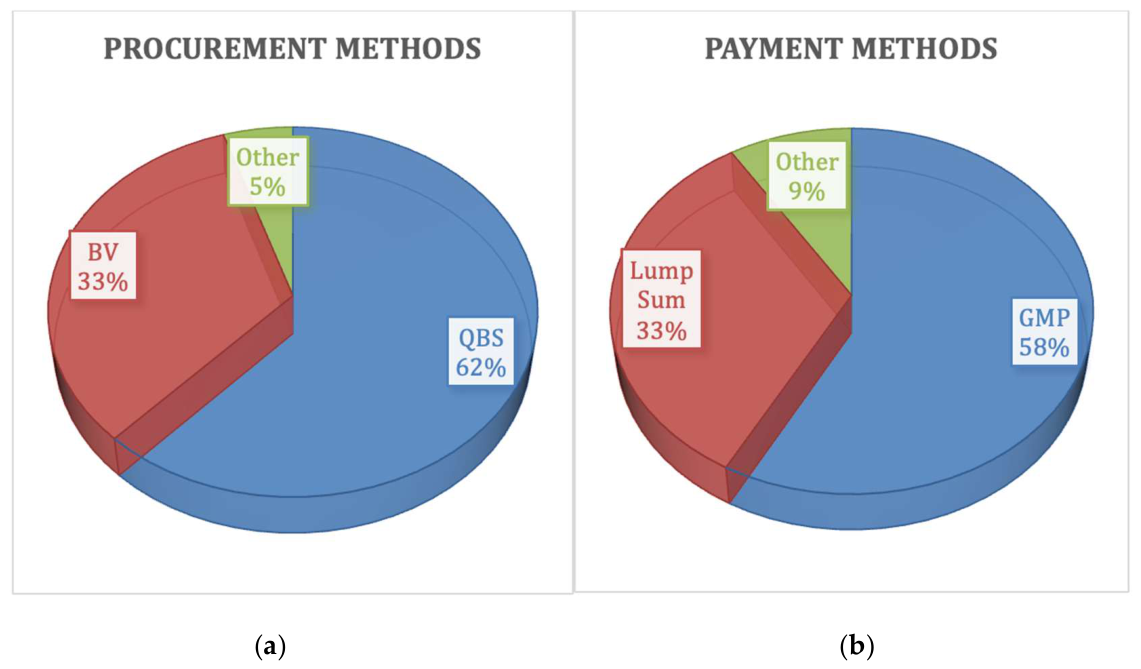
Figure 2.
Distribution of Cost Performance Among Surveyed Projects.
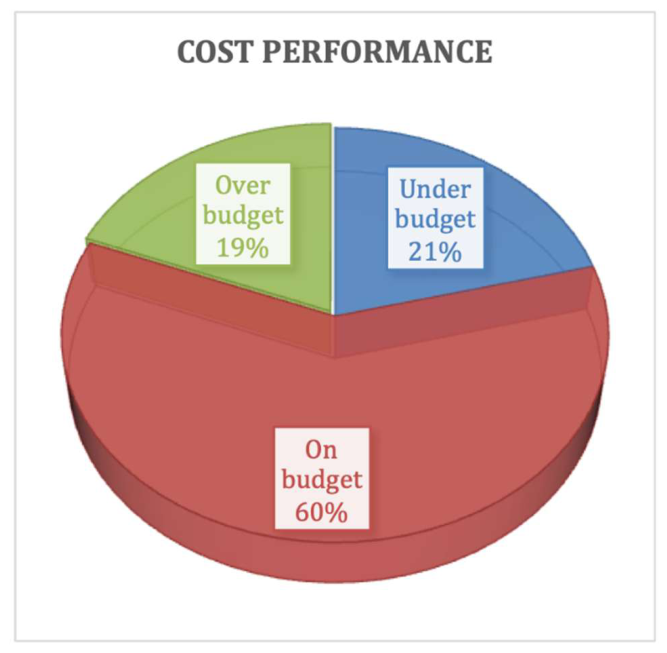
Figure 3.
Distribution of Schedule Performance Among Surveyed Projects.
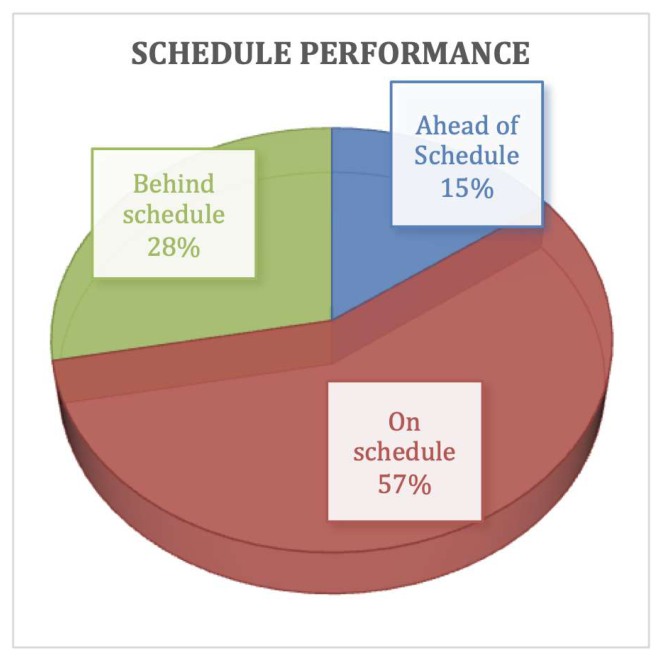
Table 2.
Project Types Represented in the Survey.
| Project type | Number of Projects |
|---|---|
| Transportation | 27 |
| Building | 19 |
| Water/wastewater | 6 |
| Airport | 2 |
| Stormwater | 1 |
| Total | 55 |
Table 3.
Inter-Rater Reliability Results for Procurement Phase CSIs.
| Measures | Intraclass Correlation | 95% Confidence Interval Lower Bound | 95% Confidence Interval Upper Bound |
|---|---|---|---|
| Single Measures | 0.336 | 0.253 | 0.445 |
| Average Measures | 0.910 | 0.872 | 0.941 |
Table 4.
Inter-Rater Reliability Results for Procurement Phase CSIs.
| CSI # | CSI Description | RII | Mean | Median | Rank |
|---|---|---|---|---|---|
| 14 | Effective communication between Owner and Design-Builder during the procurement phase | 0.93 | 4.64 | 5 | 1 |
| 10 | Early involvement of the Design-Builder during the project design phase | 0.92 | 4.62 | 5 | 2 |
| 2 | The Owner has clearly communicated their end needs of the project | 0.92 | 4.58 | 5 | 3 |
| 1 | Proper risk identification and allocation from the Owner | 0.90 | 4.51 | 5 | 4 |
| 15 | Collaboration between Owner and Design-Builder during the procurement phase | 0.88 | 4.40 | 5 | 5 |
| 7 | Consistent communication of the Owner’s procurement plan and expectations from project initiation to procurement | 0.85 | 4.27 | 5 | 6 |
| 13 | Design-Builder’s participation in the procurement phase, through the competitive bidding and selection of subcontractor’s packages | 0.84 | 4.20 | 4 | 7 |
| 4 | Owner's flexibility with project scope and design | 0.83 | 4.16 | 4 | 8 |
| 5 | The Owner's process of open-book negotiations for design and construction costs | 0.83 | 4.13 | 4 | 9 |
| 17 | Early procurement of long-lead equipment and materials | 0.80 | 4.02 | 4 | 10 |
| 11 | Design-Builder's experience with the PDB process | 0.80 | 4.00 | 4 | 11 |
| 16 | Timing of the construction cost setting | 0.80 | 3.98 | 4 | 12 |
| 6 | The Owner has established a procurement policy for PDB projects | 0.78 | 3.91 | 4 | 13 |
| 9 | Types of payment method used for construction work (GMP or Lump-Sum) | 0.78 | 3.89 | 4 | 14 |
| 8 | Types of contract procurement methods used to select the Design-Builder | 0.75 | 3.73 | 4 | 15 |
| 12 | Design-Builder's financial capacity | 0.73 | 3.65 | 4 | 16 |
| 19 | Independent Cost Estimator's (ICE) experience | 0.71 | 3.56 | 4 | 17 |
| 3 | Owner's experience with the PDB process | 0.71 | 3.53 | 4 | 19 |
| 18 | Independent QA/QC firm's experience | 0.65 | 3.27 | 3 | 20 |
Table 5.
Mann-Whitney U Test Results for Procurement Phase CSIs.
| Indicators | N | Mean | Median | Mean Rank | p-value |
|---|---|---|---|---|---|
| Critical | 330 | 4.50 | 5 | 700.52 | <0.001 |
| Non-critical | 770 | 3.83 | 4 | 486.21 | <0.001 |
Table 6.
Bartlett’s Test of Sphericity Results.
| Chi-Square Value | Degree of Freedom | p-value |
|---|---|---|
| 687.90 | 190 | <0.001 |
Table 7.
Principal Component Analysis Results for Procurement Phase CSIs.
| CSI # | Critical Success Items | Factor Loading | % Variance |
% Cumulative |
|---|---|---|---|---|
| Critical Success Factor (CSF) #1: Owner’s Competencies | ||||
| 1 | Proper risk identification and allocation from the Owner | 0.620 | 40.60 | 40.60 |
| 3 | Owner's experience with the PDB process | 0.525 | ||
| 4 | Owner's flexibility with project scope and design | 0.821 | ||
| 6 | The Owner has established a procurement policy for PDB projects | 0.632 | ||
| 7 | Consistent communication of the Owner’s procurement plan and expectations | 0.741 | ||
| 8 | Types of contract procurement methods used to select the Design-Builder | 0.593 | ||
| 13 | Design-Builder’s participation in the procurement phase, through the competitive bidding and selection of subcontractors' packages | 0.710 | ||
| 15 | Collaboration between Owner and Design-Builder during the procurement phase | 0.700 | ||
| Critical Success Factor (CSF) #2: Owner’s and Design-Builder’s Working Relationship | ||||
| 2 | The Owner has clearly communicated their end needs of the project | 0.712 | 10.0 | 50.60 |
| 5 | The Owner’s process of open-book negotiations for design and construction costs | 0.740 | ||
| 14 | Effective communication between Owner and Design-Builder during the procurement phase | 0.681 | ||
| 16 | Timing of the construction costs setting | 0.713 | ||
| Critical Success Factor (CSF) #3: Design-Builder’s Competencies | ||||
| 9 | Types of payment method used for construction work (GMP or Lump-Sum) | 0.622 | 9.20 | 59.82 |
| 11 | Design-Builder's experience with the PDB process | 0.701 | ||
| 12 | Design-Builder’s financial capacity | 0.679 | ||
| Critical Success Factor (CSF) #4: Owner’s Procurement Process | ||||
| 17 | Early procurement of long-lead equipment and materials | 0.591 | 7.0 | 66.82 |
| 18 | Independent QA/QC firm's experience | 0.713 | ||
| 19 | Independent Cost Estimator's (ICE) experience | 0.860 | ||
Table 8.
Inter-Rater Reliability Results for Implementation Phase CSIs.
| Measures | Intraclass Correlation | 95% Confidence Interval Lower Bound | 95% Confidence Interval Upper Bound |
|---|---|---|---|
| Single Measures | 0.438 | 0.346 | 0.550 |
| Average Measures | 0.933 | 0.905 | 0.957 |
Table 9.
Inter-Rater Reliability Results for Implementation Phase CSIs.
| CSI # | CSI Description | RII | Mean | Median | Rank |
|---|---|---|---|---|---|
| 11 | Level of trust between Owner and Design-Builder | 0.94 | 4.69 | 5 | 1 |
| 13 | Effective communication between the Owner and Design-Builder during the implementation phase | 0.93 | 4.65 | 5 | 2 |
| 1 | The Owner has clearly communicated the project requirements to the Design-Builder | 0.92 | 4.60 | 5 | 3 |
| 12 | The Owner and Design-Builder share common project goals | 0.89 | 4.44 | 5 | 4 |
| 7 | Design-builder's upper management support | 0.87 | 4.36 | 5 | 5 |
| 2 | Level of Owner’s involvement during the design phase | 0.87 | 4.35 | 5 | 6 |
| 4 | Owner’s upper management support | 0.87 | 4.35 | 5 | 6 |
| 8 | Design-Builder has good project management capability for PDB projects | 0.87 | 4.33 | 5 | 7 |
| 6 | Clearly defined goals and responsibilities of the Owner’s staff | 0.85 | 4.27 | 4 | 8 |
| 10 | Clearly defined roles and responsibilities of the Design-Builder's staff | 0.83 | 4.15 | 4 | 9 |
| 18 | Availability of construction workforce and materials | 0.82 | 4.11 | 4 | 10 |
| 9 | Design innovations from the Design-Builder | 0.82 | 4.11 | 4 | 10 |
| 16 | Effective QA/QC program in place | 0.81 | 4.07 | 4 | 11 |
| 5 | The Owner has good project management capability for PDB projects | 0.81 | 4.07 | 4 | 11 |
| 3 | Owner’s effective change management process | 0.81 | 4.07 | 4 | 11 |
| 15 | Feedback was provided from the stakeholders, including end users and operations personnel, during the design phase | 0.80 | 4.02 | 4 | 12 |
| 14 | Quality of work packaging during the construction phase | 0.80 | 4.00 | 4 | 13 |
| 17 | An effective project control mechanism is in place | 0.78 | 3.91 | 4 | 14 |
Table 10.
Mann-Whitney U Test Results for Implementation Phase CSIs.
| Indicators | N | Mean | Median | Mean Rank | p-value |
|---|---|---|---|---|---|
| Critical | 440 | 4.47 | 5 | 567.60 | <0.001 |
| Non-critical | 550 | 4.08 | 4 | 437.82 | <0.001 |
Table 11.
Bartlett’s Test of Sphericity Results.
| Chi-Square Value | Degree of Freedom | p-value |
|---|---|---|
| 735.00 | 153 | <0.001 |
Table 12.
Principal Component Analysis Results for Implementation Phase CSIs.
| CSI # | Critical Success Items | Factor Loading | % Variance |
% Cumulative |
|---|---|---|---|---|
| Critical Success Factor (CSF) #1: Owner’s and Design-Builder’s Working Relationship | ||||
| 1 | The owner has clearly communicated the project requirements to the Design-Builder | 0.748 | 48.77 | 48.77 |
| 4 | Owner's upper management support | 0.627 | ||
| 9 | Design innovations from the Design-Builder | 0.601 | ||
| 11 | Level of trust between the Owner and Design-Builder | 0.822 | ||
| 12 | Owner and Design-Builder share common project goals | 0.891 | ||
| 13 | Effective communication between Owner and Design-Builder during the implementation phase | 0.784 | ||
| Critical Success Factor (CSF) #2: Owner’s Project Management Processes | ||||
| 6 | Clearly defined roles and responsibilities of the Owner's staff | 0.500 | 11.87 | 60.64 |
| 10 | Clearly defined roles and responsibilities of the Design-Builder's staff | 0.577 | ||
| 14 | Quality of work packaging during the construction phase | 0.767 | ||
| 16 | Effective QA/QC program in place | 0.805 | ||
| 17 | An effective project control mechanism is in place | 0.827 | ||
| 18 | Availability of construction workforce and materials | 0.807 | ||
| Critical Success Factor (CSF) #3: Owner’s and Design-Builders’ Competencies | ||||
| 5 | The owner has good project management capability for PDB projects | 0.802 | 6.74 | 67.38 |
| 7 | Design-Builder's upper management support | 0.790 | ||
| 8 | Design-Builder has good project management capability for the PDB project | 0.677 | ||
| 15 | Feedback provided from stakeholders, including end users and operations personnel, during design | 0.574 | ||
| Critical Success Factor (CSF) #4: Owner’s Design and Change Management Processes | ||||
| 2 | Level of Owner's involvement during the design phase | 0.859 | 6.52 | 73.90 |
| 3 | Owner's effective change management process | 0.743 | ||
Disclaimer/Publisher’s Note: The statements, opinions and data contained in all publications are solely those of the individual author(s) and contributor(s) and not of MDPI and/or the editor(s). MDPI and/or the editor(s) disclaim responsibility for any injury to people or property resulting from any ideas, methods, instructions or products referred to in the content. |
© 2026 by the authors. Licensee MDPI, Basel, Switzerland. This article is an open access article distributed under the terms and conditions of the Creative Commons Attribution (CC BY) license (http://creativecommons.org/licenses/by/4.0/).
Copyright: This open access article is published under a Creative Commons CC BY 4.0 license, which permit the free download, distribution, and reuse, provided that the author and preprint are cited in any reuse.