
Submitted:
12 September 2026
Posted:
15 September 2026
You are already at the latest version
Abstract
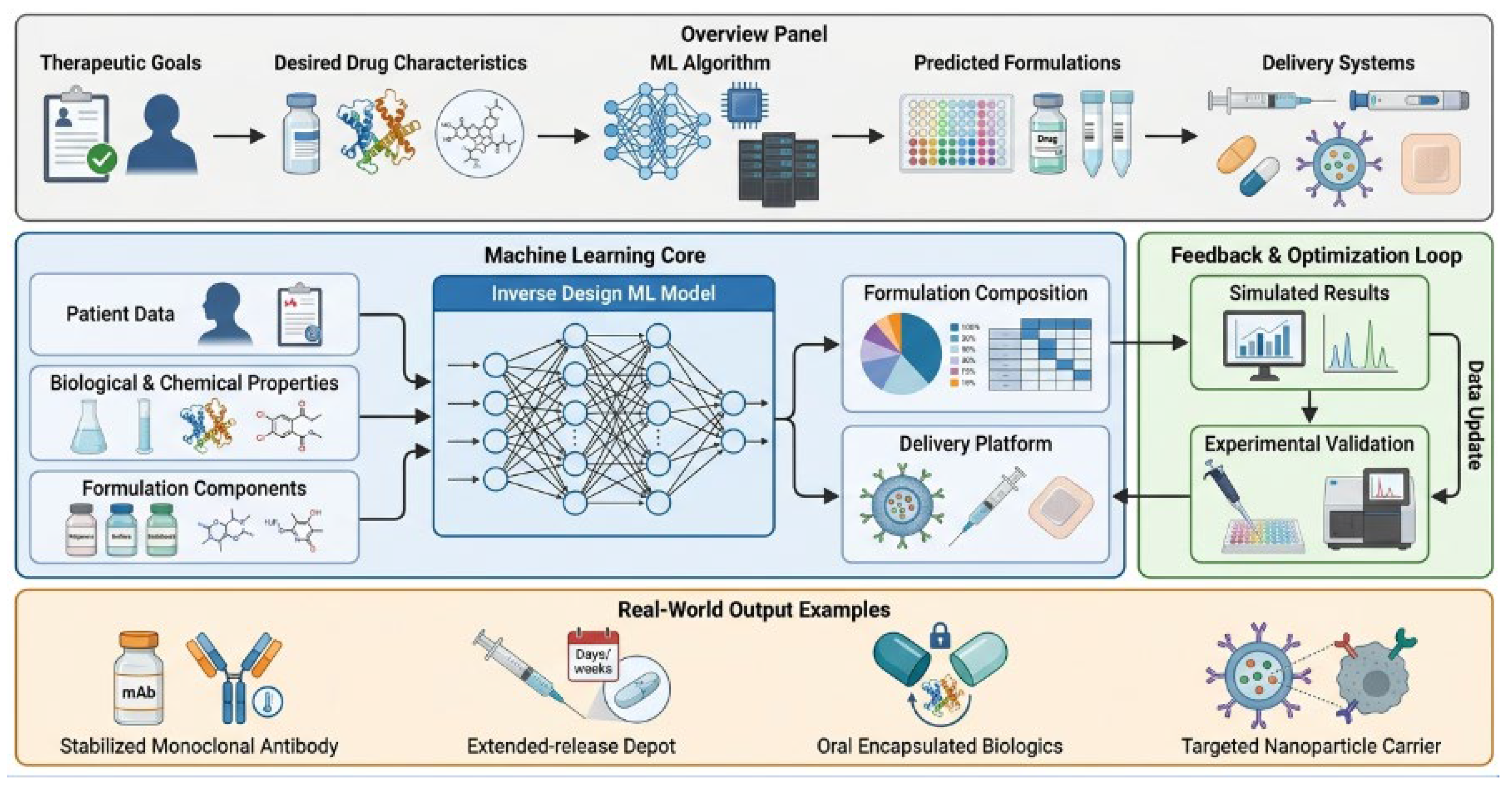
Pharmaceutical formulation and delivery-device development has historically proceeded by forward trial and error: a candidate material, formulation, or geometry is proposed, fabricated, and tested, and the cycle repeats until an acceptable product emerges. Machine learning enables an inverse alternative: given a target product profile — a desired release rate, gastric-residence time, transfection efficiency, or shape transformation — a model proposes the material composition or device geometry predicted to achieve it, collapsing what was previously dozens of design-build-test cycles into a handful. This review develops that inverse-design paradigm specifically for biopharmaceutical formulation and delivery, grounding each technical claim in verifiable, named research from the Massachusetts Institute of Technology and Harvard University. We examine four case studies: the directed message-passing graph neural network that Stokes, Yang, Collins, Barzilay, Jaakkola and colleagues at MIT used to discover the antibiotic halicin from a chemical library of over one hundred million candidates; the geometrically optimized, origami-inspired ingestible device that Traverso, Langer and colleagues at MIT and Brigham and Women’s Hospital/Harvard Medical School designed to self-deploy into a gastric-retentive torus; the algorithmically encoded, biomimetic 4D-printing platform that Lewis, Mahadevan and colleagues at the Harvard Wyss Institute developed to program anisotropic hydrogel swelling into predetermined shape changes; and the autonomous, machine-learning-guided closed-loop synthesis and formulation systems that Jensen and colleagues in the MIT Department of Chemical Engineering have advanced as “self-driving laboratories.” From these cases we distill a general method taxonomy — Bayesian optimization, generative models, graph neural networks, physics-informed machine learning coupled to finite-element simulation, and active-learning closed loops — and map each onto concrete biopharmaceutical inverse-design problems: ionizable-lipid and lipid-nanoparticle design for mRNA delivery, shape-memory device and 4D-printed geometry optimization, and controlled-release formulation screening. We close by examining the regulatory posture of the U.S. Food and Drug Administration toward artificial intelligence in drug development, including its January 2025 draft guidance and the January 2026 joint FDA-EMA guiding principles, and by outlining the data, validation, and interpretability barriers that stand between today’s proof-of-concept demonstrations and routine, regulator-accepted inverse design of biopharmaceutical products.
Keywords:
inverse design
; machine learning
; generative models
; biopharmaceutical formulation
; drug delivery systems
; self-driving laboratories
; lipid nanoparticles
; shape-memory devices
; 4D printing
; regulatory science
1. Introduction
Biopharmaceutical formulation and delivery-device development shares a structural inefficiency with much of materials engineering: the dominant workflow is forward. A scientist proposes a candidate — a lipid composition, a polymer blend, a device geometry — synthesizes or fabricates it, measures its performance, and, if the result falls short of the target, proposes a modified candidate and repeats. Each cycle can consume weeks to months, and the combinatorial space of plausible candidates (lipid head groups and tails, polymer molecular weights and ratios, particle sizes, device geometries) is vast enough that even well-resourced programs sample only a small, often locally biased, fraction of it. Artificial intelligence and machine learning offer a structurally different approach: rather than predicting the performance of a given candidate (the forward problem), a trained model can be queried in reverse to propose the candidate — or a ranked shortlist of candidates — predicted to achieve a specified target performance (the inverse problem). This is not a new idea in engineering generally; the physics and materials communities have used inverse design and topology optimization for decades. What is new, and the subject of this review, is the maturing application of inverse design specifically to biopharmaceutical formulation and delivery, an area that combines the combinatorial complexity of materials design with the added constraints of biological safety, manufacturability under Good Manufacturing Practice, and regulatory acceptability.
This review is deliberately grounded rather than aspirational: every mechanistic and case-study claim is tied to a specific, verifiable piece of research from the Massachusetts Institute of Technology or Harvard University (including its affiliated Wyss Institute for Biologically Inspired Engineering and Harvard-affiliated teaching hospitals), because a large share of the public discourse on “AI-designed drugs” and “AI-designed materials” is imprecise about which claims are established, peer-reviewed science and which are extrapolation. Four case studies anchor the discussion. First, a team including James Collins, Regina Barzilay, and Tommi Jaakkola at MIT used a directed message-passing graph neural network to screen a chemical library exceeding one hundred million molecules and identified halicin, a structurally novel antibiotic active against multidrug-resistant pathogens — a landmark demonstration that a model trained on measured biological activity can propose candidates a human medicinal chemist would not have considered [1]. Second, a team led by Giovanni Traverso and Robert Langer at MIT, working with colleagues at Brigham and Women’s Hospital and Harvard Medical School, geometrically optimized an origami-inspired ingestible dosage form so that it folds into a swallowable capsule and self-deploys into a pylorus-spanning torus in the stomach, extending gastric residence to one to three weeks in a swine model [2]. Third, Jennifer Lewis at the Harvard John A. Paulson School of Engineering and Applied Sciences (Harvard SEAS) and Wyss Institute, working with the applied mathematician L. Mahadevan, used a predictive mathematical model of cellulose-fibril alignment to program anisotropic swelling into 4D-printed hydrogel composites, so that a flat, printed architecture autonomously folds into a predetermined three-dimensional shape upon hydration [3]. Fourth, Klavs Jensen in the MIT Department of Chemical Engineering, together with collaborators, has advanced autonomous, machine-learning-guided “self-driving laboratories” that close the loop between experiment design, execution, and model updating for organic synthesis, a paradigm directly transferable to formulation screening [4].
None of these four programs was framed by its authors as “inverse design of biopharmaceuticals” in exactly the terms used here; the Traverso/Langer device and the Lewis/Mahadevan 4D-printing platform used geometric and mathematical optimization rather than a trained machine-learning model in their original forms, and the Collins/Barzilay/Jaakkola work targeted a small-molecule antibiotic rather than a delivery system. Part of the contribution of this review is to show how these four methodologically related but application-distinct research threads converge on a single, generalizable inverse-design framework for biopharmaceutical formulation and delivery, and to map that framework onto the machine-learning method families — Bayesian optimization, generative modelling, graph neural networks, physics-informed machine learning, and active-learning closed loops, that make the inverse query computationally tractable at the scale biopharmaceutical development requires.
Section 2 defines the forward/inverse design distinction formally. Section 3 develops the four MIT/Harvard case studies in depth. Section 4 surveys the machine-learning method families available for biopharmaceutical inverse design. Section 5 describes the closed-loop, self-driving-laboratory architecture that operationalizes these methods experimentally. Section 6 maps the framework onto three concrete application domains: lipid nanoparticle design for mRNA delivery, shape-memory/4D-printed device geometry, and controlled-release formulation screening. Section 7 examines the regulatory posture of the FDA and EMA toward AI-designed biopharmaceutical products. Section 8 consolidates current limitations, Section 9 discusses future directions, and Section 10 concludes.
2. The Inverse Design Paradigm
Momeni and Ni’s formalization of forward and inverse problems for 4D-printed structures provides a clean starting vocabulary that generalizes directly to biopharmaceutical formulation. In the forward problem, one is given a material composition and a geometry and asks what property or behaviour results are, for example, what shape a printed shape-memory structure adopts after a thermal trigger, or what plasma concentration profile a given tablet formulation produces after oral administration. Forward problems are the natural domain of physical simulation (finite-element modelling, pharmacokinetic compartmental modelling) and of empirical characterization. In the inverse problem, one is given a target property or behaviour and asks what material composition or geometry would produce it — for example, what printed geometry will fold into a specific target shape, or what lipid composition will produce a specified transfection efficiency in a specified tissue [3,5].
Figure 1 contrasts the two workflows schematically. The forward workflow is iterative but undirected: each candidate is chosen by intuition, prior literature, or a systematic but exhaustive design-of-experiments sweep, and the number of cycles needed to reach an acceptable target scales unfavourably with the dimensionality of the design space. The inverse workflow, by contrast, uses a model — trained on forward data generated by prior simulation or experiment — to search or generate candidates specifically predicted to satisfy the stated target, converting an undirected search into a directed one. Critically, the model in an ML-assisted inverse design pipeline is not a new kind of physics; it is a learned approximation of the forward mapping, inverted computationally (by optimization, by conditional generation, or by direct training of an inverse mapping) rather than analytically. This means the quality of inverse-designed candidates is bounded by the quality and coverage of the forward data the model was trained on — a point returned to in Section 8 when discussing data scarcity as a central limitation [1,5,6].
A second useful distinction, developed further in Section 4, is between optimization-based inverse design, in which a model searches a pre-defined, finite design space (varying, for example, the length and diameter parameters of a helical shape-memory tablet, or the ratio of four defined lipid components in a nanoparticle formulation) and generative inverse design, in which a model — typically a variational autoencoder, generative adversarial network, or diffusion model trained on a large corpus of molecular or material structures — proposes entirely novel candidates from a continuous latent representation of chemical or material space, unconstrained to previously enumerated options [1,5]. The halicin discovery (Section 3.1) is the paradigmatic example of the latter: a directed message-passing graph neural network screened existing molecular libraries directly, while a companion generative model (a variational autoencoder) was used to propose novel molecules from a much larger, continuously parameterized chemical space [1]. The origami ingestible device (Section 3.2) and the biomimetic 4D-printing platform (Section 3.3), by contrast, are examples of optimization-based inverse design over a well-defined geometric parameter space (fold angles and edge lengths; local fibril orientation along a print path) using analytical and mathematical models rather than a trained neural network — an important methodological point developed in Section 3, since it shows that the inverse-design paradigm predates, and is broader than, the specific tools of modern deep learning, even as deep learning now increasingly supplies the inverse solver [2,3].
3. Case Studies from MIT and Harvard Engineering Research
This section develops in depth the four case studies summarised in Figure 3 and the graphical abstract. Each was selected because it is peer-reviewed, its authors and institutional affiliations are independently verifiable, and taken together the four span the methodological range from pure deep learning (Section 3.1) through analytical geometric optimization (Section 3.2 and Section 3.3) to autonomous closed-loop experimentation (Section 3.4), illustrating that “inverse design” is a design philosophy realizable through more than one computational toolset.
3.1. Generative Deep Learning for Molecular Design: The Halicin Discovery
In 2020, Stokes, Yang, Swanson, Jin, Cubillos-Ruiz, Donghia and colleagues, working with James Collins, Regina Barzilay, and Tommi Jaakkola at MIT, published a deep-learning approach to antibiotic discovery in Cell [1]. The team trained a directed message-passing graph neural network — a model architecture that represents a molecule as a graph of atoms and bonds and iteratively passes learned messages between neighbouring atoms to build a whole-molecule representation — on a dataset of approximately 2,500 molecules with measured growth-inhibition activity against Escherichia coli. This forward model, once trained to predict antibacterial activity from molecular structure, was then applied to screen a library of more than 107 million molecules drawn from public chemical databases, an in silico search space orders of magnitude larger than any wet-laboratory screen could feasibly cover. The model identified halicin, a compound structurally dissimilar to conventional antibiotics, which was subsequently confirmed experimentally to be active against a broad range of multidrug-resistant bacterial pathogens, including strains resistant to essentially all clinically available antibiotics. In a methodological extension directly relevant to generative inverse design, the same collaboration used genetic algorithms and variational autoencoders to generate millions of candidate molecules de novo — rather than only screening pre-existing ones — yielding several additional compounds with confirmed antibacterial activity. James Collins’ laboratory has since extended this generative approach: work reported in 2025 used generative AI to design novel antibiotic candidates from scratch, yielding two compounds, designated NG1 (active against drug-resistant gonorrhoea) and DN1 (active against methicillin-resistant Staphylococcus aureus), both reported to show low resistance-development rates and favourable toxicity profiles in preclinical testing [7].
While halicin and its successors are small-molecule antibiotics rather than delivery systems, the methodological lesson for biopharmaceutical formulation is direct: a graph neural network trained on a measured, biologically relevant forward property (here, growth inhibition) can be inverted computationally into a screening or generative tool that explores chemical space far beyond what iterative synthesis and testing could achieve, and the same architecture family is directly applicable to formulation-relevant properties such as lipid transfection efficiency, polymer biodegradation rate, or excipient-API compatibility (Section 6.1) [1,7].
3.2. Inverse-Designed Ingestible Shape-Transforming Device
In 2026, Javid, Babaee, Quigley, Kirtane and colleagues, with Robert Langer and Giovanni Traverso as senior authors, published an origami-inspired ingestible metamaterial for prolonged oral delivery of therapeutics in Nature Communications, representing the Traverso laboratory’s Laboratory for Translational Engineering at MIT together with the Division of Gastroenterology at Brigham and Women’s Hospital and Harvard Medical School [2]. The device — termed an origami-inspired dosage form (ODF) — is based on a circular Miura-ori folding pattern, a tessellation widely used in deployable engineering structures (solar-panel arrays, stents) for its ability to transform between a compact, folded state and a much larger deployed state via a single, geometrically constrained motion. The research team analytically optimized the device’s geometric parameters — edge lengths, fold angle, and central angle — to satisfy two simultaneous, competing constraints: the folded semi-cylinder had to be small enough to fit within a swallowable capsule while carrying a clinically meaningful drug payload, and the deployed torus had to be large enough in diameter to exceed the pylorus opening, preventing the device from passing out of the stomach prematurely. This is a textbook inverse design problem — the target outcome (a torus exceeding pyloric diameter, achieved from a capsule-sized starting volume) was specified first, and the geometric parameters were solved for, rather than an arbitrary geometry being fabricated and its deployed diameter measured after the fact.
The device itself comprises drug-loaded polycaprolactone sheets (37 kDa molecular weight): a bulk formulation of 60% polycaprolactone with 40% moxifloxacin by weight forms the drug-carrying structure, while pH-sensitive safety bands — composed of 75% polycaprolactone and 25% Eudragit L100-155 — dissolve once the device transits into the small intestine, allowing safe passage and preventing long-term gastric obstruction. In swine models, the optimized device achieved a minimum gastric residence of one week and a maximum of three weeks, released drug approximately linearly with roughly 70% of the payload released within five days, and produced no gastrointestinal obstruction, with all devices safely transiting the intestine once their pH-sensitive retention bands dissolved [2]. Although the specific optimization reported was analytical and geometric rather than a trained machine-learning model, the same geometric parameterization — fold angle, edge length, layer count, and material distribution — is a natural target for the physics-informed, ML-coupled inverse-design methods discussed in Section 4.4, in which a finite-element model of the folding/deployment mechanics is combined with a learned optimizer to search the parameter space far faster than manual analytical iteration [2,6].
3.3. Algorithmically Encoded Shape-Morphing 4D Printing
In 2016, Gladman, Matsumoto, Nuzzo, Mahadevan, and Jennifer Lewis published “Biomimetic 4D printing” in Nature Materials, a foundational paper for the shape-morphing 4D-printing field conducted at Harvard SEAS and the Wyss Institute for Biologically Inspired Engineering, with the applied mathematics contributed by L. Mahadevan [3]. The work took direct biological inspiration from plant organs — flowers, tendrils, leaves — whose tissue microstructure encodes anisotropic, environmentally triggered shape change, and asked the inverse question: given a desired final three-dimensional shape, what local material microstructure, printed along what path, will produce that shape upon a hydration trigger? The team’s answer combined a predictive mathematical model of local swelling behaviour with a direct-ink-writing printing process capable of aligning cellulose fibrils along the print path. Because the aligned fibrils constrain swelling to be anisotropic (greater perpendicular to fibril orientation than along it), encoding a spatially varying fibril-alignment pattern into the print path allows the printed flat or simple architecture to swell, upon water immersion, into a complex, previously specified three-dimensional target shape — replicating, for example, the helical or saddle-like transformations seen in real plant tendrils and leaves.
The Wyss Institute’s subsequent public description of this platform explicitly frames the fibril-alignment configuration as “predicted with a proprietary mathematical model in the 4D-printing process,” underscoring that the shape-programming step is a computational inverse-design calculation, not empirical trial and error [8]. This is directly relevant to the 4D-printed pharmaceutical devices discussed at length elsewhere in the broader 4D-printing literature (gastroretentive helical tablets, self-expanding implants): the same design logic — specify the target deployed geometry, solve for the required print-path material encoding — applies whether the swelling trigger is gastric fluid uptake or a controlled hydration bath, and whether the printed material is a cellulose-fibril hydrogel composite or a pharmaceutical-grade polymer-drug matrix. Later work by other groups has begun to replace Lewis and Mahadevan’s closed-form mathematical model with trained neural-network inverse solvers for related shape-morphing design problems, illustrating the natural progression from analytical to learned inverse design discussed in Section 2 [3,8,9].
3.4. Autonomous, Machine-Learning-Guided Closed-Loop Experimentation
McDonald and Jensen — Klavs Jensen holding a primary appointment in the MIT Department of Chemical Engineering — reviewed the state of autonomous chemistry and self-driving laboratories in a 2026 Annual Review of Analytical Chemistry article, synthesizing over a decade of the Jensen laboratory’s own contributions to integrated microreactor systems for automated reaction self-optimization alongside the broader autonomous-chemistry literature [4]. A self-driving laboratory, in this framing, closes the loop between four stages that are traditionally executed manually and sequentially by a bench chemist: proposing the next experiment to run (often via Bayesian optimization or a related sample-efficient search algorithm), executing that experiment on automated flow or batch hardware, analyzing the resulting data (a bottleneck the review specifically identifies, particularly for structural elucidation of unexpected reaction products), and updating the underlying model before proposing the next experiment. Because each cycle requires no human intervention beyond initial setup and periodic oversight, a self-driving laboratory can run many more design-build-test-learn cycles per unit time than a manual laboratory, directly attacking the throughput limitation that motivates inverse design in the first place.
Although McDonald and Jensen’s review centers on organic synthesis and reaction discovery rather than pharmaceutical formulation specifically, the architecture is formulation-agnostic: the same closed loop — propose, execute, analyze, update — applies equally to screening lipid nanoparticle compositions for transfection efficiency, screening polymer-excipient blends for a target dissolution profile, or screening 4D-printable material formulations for a target shape-recovery ratio, provided the relevant property can be measured by automatable analytical methods. This transferability is the basis for the closed-loop formulation-screening architecture developed in Section 5 [4].
4. Machine Learning Methods for Biopharmaceutical Inverse Design
The four case studies in Section 3 draw, implicitly or explicitly, on five method families that recur throughout the broader machine-learning-for-materials and machine-learning-for-drug-delivery literature: Bayesian optimization, generative models, graph neural networks, physics-informed machine learning coupled to mechanistic simulation, and active-learning closed loops. Figure 4 summarises each family’s mechanism and a representative biopharmaceutical use case; this section discusses each in turn.
4.1. Bayesian Optimization and Design of Experiments
Bayesian optimization builds a probabilistic surrogate model (commonly a Gaussian process) over a defined design space and uses that surrogate’s predicted mean and uncertainty to select the next experiment expected to most improve the target objective, balancing exploitation of promising regions against exploration of uncertain ones. Because it is explicitly designed to minimize the number of expensive evaluations needed to optimize an unknown function, Bayesian optimization is naturally suited to pharmaceutical formulation screening, where each evaluation may require synthesis, fabrication, and analytical testing that cannot be parallelized indefinitely. McDonald and Jensen’s review of autonomous chemistry identifies Bayesian optimization as a central algorithmic component of self-driving laboratories for exactly this reason [4].
4.2. Generative Models: Variational Autoencoders, GANs, and Diffusion Models
Generative models learn a continuous, typically lower-dimensional latent representation of a training corpus of molecules, materials, or formulations, such that sampling a point in the latent space and decoding it produces a novel, chemically or physically valid candidate. Once a property-prediction model or scoring function is layered on top of this latent space, the generative model can be conditioned or optimized to sample candidates predicted to exhibit a target property, directly realizing generative inverse design as introduced in Section 2. The variational autoencoder component of the halicin discovery programme is the clearest biopharmaceutically adjacent example: rather than only ranking existing molecules, it generated new candidate structures from the learned latent space of antibacterial-relevant chemistry [1,7]. In a formulation context, the analogous application would train a generative model on a corpus of known lipid or excipient structures paired with measured formulation performance (transfection efficiency, encapsulation efficiency, release rate) and sample novel candidates predicted to exceed the performance of the training set.
4.3. Graph Neural Networks for Structure-Property Prediction
Graph neural networks represent a molecule or material as a graph — atoms or structural units as nodes, bonds or spatial relationships as edges — and learn, through repeated rounds of message passing between connected nodes, a representation that captures both local chemical environment and whole-structure context. This architecture is naturally suited to structure-property prediction tasks central to formulation screening: predicting an ionizable lipid’s pKa or membrane-disruption propensity from its structure, or predicting a polymer’s degradation rate from its repeat-unit chemistry. The directed message-passing graph neural network at the core of the halicin discovery is the paradigmatic example, and the same architecture family underlies much of the recent lipid nanoparticle machine-learning literature discussed in Section 6.1 [1,10,11].
4.4. Physics-Informed Machine Learning Coupled to Mechanistic Simulation
Where a mechanistic physical model already exists — a finite-element simulation of viscoelastic shape-memory recovery, or a compartmental pharmacokinetic model of drug absorption — physics-informed machine learning couples that mechanistic model to a learned optimizer, using the mechanistic model to constrain the search to physically realizable candidates while using the learned component to search the parameter space far more efficiently than a purely analytical or grid-search approach. Recent, independently published inverse-design frameworks for 4D-printed structures illustrate this approach concretely: one framework formulates inverse design as an optimization problem over a finite-element model incorporating viscoelasticity, geometric nonlinearity, and time-dependent behaviour, iteratively adjusting structural parameters (length, thickness, material distribution) to achieve a user-specified target deformation under a given stimulus, for hydrogel and thermoplastic-polyurethane bilayer systems [6]. Other independently published frameworks have applied deep-learning-based inverse design and forward prediction to bi-material 4D-printed shape-morphing surfaces and to fully convolutional network-based inverse design of multi-material 4D-printed structures [9,12]. While these particular frameworks originate outside MIT and Harvard, they operationalize precisely the analytical design logic that Traverso, Langer, Lewis, and Mahadevan established in Section 3.2 and Section 3.3, replacing closed-form or purely analytical solving with a trained neural inverse solver — the natural next step for translating the MIT/Harvard case studies into a fully machine-learning-driven pipeline for biopharmaceutical shape-memory device design.
4.5. Active Learning and Closed-Loop (Self-Driving) Experimentation
Active learning selects, from a pool of candidate experiments, the one whose outcome would most reduce uncertainty in or most improve the current model — a natural companion to Bayesian optimization and the algorithmic core of the self-driving-laboratory architecture described by McDonald and Jensen [4] and developed further in Section 5. In a formulation context, active learning determines which of many possible next formulations to synthesize and test, given the results already available, so that a fixed experimental budget is allocated to the most informative measurements rather than spread evenly or chosen by intuition.
5. A Closed-Loop, Self-Driving-Laboratory Architecture for Formulation Screening
The method families of Section 4 into a single, six-stage closed loop directly adapted from the self-driving-laboratory architecture that McDonald and Jensen describe for autonomous organic synthesis [4], re-expressed here for biopharmaceutical formulation and delivery-device screening. The cycle begins by defining a target product profile — a desired release rate, gastric-residence time, transfection efficiency, or shape-recovery ratio, expressed as a quantitative objective or constraint set. A generative or Bayesian-optimization model then proposes a shortlist of candidate formulations or device geometries predicted to satisfy that profile. Before committing laboratory resources, a surrogate or physics-informed model predicts each candidate’s expected performance, allowing low-promise candidates to be filtered out computationally. The remaining, most promising candidates are synthesized or fabricated — via automated flow chemistry, robotic liquid handling for nanoparticle formulation, or additive manufacturing for device geometries — and subjected to experimental or in silico validation (analytical characterization, in vitro release testing, or in vivo/ex vivo performance measurement). The resulting data, whether the candidate succeeded or failed, is fed back to update the model via active learning, and the cycle repeats, typically converging on an acceptable candidate in substantially fewer cycles than an undirected, purely empirical search.
The throughput advantage of this architecture depends critically on the availability of automatable, sufficiently fast analytical readouts for the target property; McDonald and Jensen explicitly flag purification and analytical structural elucidation as the principal remaining bottlenecks even in the comparatively mature domain of organic synthesis [4], and the same bottleneck applies, arguably more severely, to biological readouts relevant to formulation performance (cell-based transfection assays, in vivo pharmacokinetics), which cannot yet be fully automated or accelerated to the cycle times achievable for a purely chemical reaction outcome. This gap between what can be computationally proposed and what can be experimentally validated at matching speed is a recurring theme in Section 8.
6. Applications in Biopharmaceutical Formulation and Delivery
6.1. Lipid Nanoparticle and Ionizable-Lipid Design for mRNA Delivery
Lipid nanoparticles (LNPs) are the dominant delivery vehicle for clinically approved mRNA therapeutics, and their performance transfection efficiency, tissue tropism, and toxicity depends sensitively on the structure of the ionizable lipid component together with the molar ratios of the other three canonical LNP components (helper phospholipid, cholesterol, and PEG-lipid). Because the ionizable-lipid structural space is combinatorially vast (varying head group, linker chemistry, and tail length and saturation independently), it is a natural inverse-design target. A widely cited 2023 preprint (subsequently published) trained a multilayer perceptron neural network on a curated dataset of 622 previously reported lipid nanoparticle formulations and achieved 98% classification accuracy in predicting transfection efficiency outcomes, allowing computational prioritization of new LNP candidates for experimental validation rather than exhaustive empirical screening [10]. More recent reviews of machine learning for lipid nanoparticle formulation and process development catalogue a rapidly growing body of similar structure-property models, alongside machine-learning-assisted design of immunomodulatory lipid nanoparticles for targeted mRNA delivery to specific cell populations [11,13]. This application area is a direct, if not yet MIT/Harvard-specific, extension of the graph-neural-network and generative-model methodology validated for small-molecule antibiotic discovery in Section 3.1: the forward property (transfection efficiency or immune activation) is measurable at reasonable throughput, the structural space is well parameterized, and the clinical stakes of faster, better-targeted LNP design are self-evidently high given the central role LNPs now play in RNA therapeutics.
6.2. Shape-Memory and 4D-Printed Device Geometry Optimization
Section 3.2 and Section 3.3 established that geometric inverse design of shape-transforming pharmaceutical devices — the origami ingestible dosage form, biomimetic 4D-printed hydrogel composites — already has a rigorous, published, MIT/Harvard-grounded precedent, achieved to date primarily through analytical and mathematical optimization rather than trained neural inverse solvers. The natural extension, illustrated by independently published inverse-design frameworks discussed in Section 4.4, replaces the analytical solver with a physics-informed machine-learning model trained on finite-element simulation data, enabling faster exploration of a larger geometric parameter space (multi-material layer distributions, spatially varying print-path fibril or fiber orientation, non-uniform wall thickness) than manual analytical iteration allows [2,3,6,9,12]. For gastroretentive, colon-targeted, and self-expanding implant applications specifically, the target outcome is naturally expressed as a quantitative objective (deployed diameter, shape-recovery ratio, drug-release half-life) well suited to the Bayesian-optimization and physics-informed-ML methods of Section 4.1 and Section 4.4.
6.3. Controlled-Release Formulation Screening
Beyond lipid nanoparticles and shape-transforming devices, machine-learning-guided formulation design has been applied to conventional and nanoparticulate controlled-release systems more broadly: reviews of machine-learning-empowered formulation design for nanoparticulate drug delivery systems catalogue applications spanning polymeric nanoparticle size and encapsulation-efficiency prediction, machine-learning-integrated design-of-experiments approaches within a quality-by-design framework for optimizing polymeric nanoparticle formulations (for example, resveratrol-loaded systems), and multistep machine-learning pipelines for polymeric nanoparticle design that combine several of the method families discussed in Section 4 into a single formulation-screening pipeline [14,15,16,17]. These applications illustrate that the inverse-design paradigm developed in this review, while grounded here in landmark MIT/Harvard case studies for narrative and methodological clarity, is being operationalized across a much broader, rapidly growing pharmaceutical-sciences literature, of which the MIT/Harvard work represents foundational rather than exclusive contributions.
7. Regulatory Considerations for AI/ML-Designed Biopharmaceutical Products
The U.S. Food and Drug Administration’s Center for Drug Evaluation and Research (CDER) reports that more than 500 drug-application submissions incorporating an artificial-intelligence component were received between 2016 and 2023, indicating that regulatory engagement with AI-assisted development is already well underway even as a comprehensive framework remains in progress [18]. In January 2025, FDA published a draft guidance, “Considerations for the Use of Artificial Intelligence to Support Regulatory Decision Making for Drug and Biological Products,” providing initial recommendations for using AI to generate the safety, effectiveness, or quality information that supports a regulatory submission [18]. This draft guidance followed an FDA discussion paper that drew more than 800 external comments in 2023 and an expert workshop held in December 2022, and was itself followed by further public workshops in August 2024 and October 2025, indicating an unusually iterative, consultative development process for a topic FDA and industry both regard as high-stakes [18]. In January 2026, CDER and the European Medicines Agency jointly issued ten guiding principles for responsible use of AI in accelerating drug and biological product development, marking the first explicit transatlantic regulatory alignment specifically on this topic [18]. FDA has separately established an internal AI Council, formed in 2024, to coordinate AI-related policy, regulatory, and technology initiatives across the agency, and maintains a dedicated contact point (CDER-AI@fda.hhs.gov) for AI-related drug-development inquiries [18].
None of this guidance currently addresses inverse-designed formulations or shape-transforming delivery devices as a distinct regulatory category; the emerging framework is oriented toward the credibility and context-of-use of an AI model used to generate evidence supporting a regulatory decision, a framing well suited to, for example, an AI model used to predict a formulation’s stability or bioequivalence, but less obviously mapped onto a scenario in which an AI model was used generatively to originate the candidate formulation or device geometry itself. A separate, longer-standing body of FDA guidance on Good Machine Learning Practice, developed initially for AI/ML-based Software as a Medical Device, offers a partially transferable framework — emphasizing data quality and representativeness, model transparency, and performance monitoring across the product lifecycle — that sponsors of inverse-designed biopharmaceutical products are likely to need to satisfy by analogy even in the absence of a purpose-built inverse-design guidance document [18]. Given the pace of the FDA/EMA guiding-principles work relative to the pace of academic and industrial adoption of generative and inverse-design methods documented in Section 3, Section 4, and Section 6, sponsors developing inverse-designed biopharmaceutical products should expect to engage FDA early and iteratively — for example, through the agency’s existing Type C meeting or INTERACT meeting mechanisms — rather than assume an established, self-executing regulatory pathway exists for this class of technology.
8. Challenges and Limitations
Data scarcity and forward-model quality. Every inverse-design method discussed in Section 4 is only as reliable as the forward data it was trained or validated against; the 622-formulation lipid nanoparticle dataset noted in Section 6.1 is illustrative of how comparatively small the curated, structured pharmaceutical datasets available for model training still are relative to the size of chemical and formulation space [1,10].
Experimental validation throughput. McDonald and Jensen identify purification and analytical structural elucidation as persistent bottlenecks even for organic synthesis; biologically relevant formulation readouts (cell-based transfection, in vivo pharmacokinetics, in vivo shape-recovery and gastric residence) are typically slower and harder to automate than chemical-reaction analytics, limiting how fully the self-driving-laboratory architecture of Section 5 can be realized for biopharmaceutical endpoints specifically [2,4].
Generalizability beyond the training domain. A generative or graph-neural-network model trained on antibacterial activity, as in the halicin case study, does not automatically generalize to a formulation-performance property such as transfection efficiency or shape-recovery ratio; each new application domain requires its own curated forward dataset and, typically, its own model retraining or transfer-learning strategy [1,7].
Interpretability and regulatory trust. FDA’s emerging AI guidance emphasizes model credibility and context-of-use, but current generative and graph-neural-network architectures are not inherently interpretable, and demonstrating to a regulator’s satisfaction why a model proposed a specific inverse-designed candidate — rather than only that the candidate subsequently performed well experimentally — remains an open methodological and regulatory-science problem [18].
Multi-scale integration. A complete biopharmaceutical inverse-design pipeline must eventually connect molecular-scale design (lipid or polymer chemistry) to device-scale geometric design (particle size, device shape) to whole-body pharmacokinetic/pharmacodynamic outcome; the case studies in Section 3 each address one of these scales in isolation, and integrating them into a single, end-to-end inverse-design pipeline remains substantially unsolved [1,2,3].
Manufacturability and GMP transfer. An inverse-designed candidate optimized purely for target performance may not be readily manufacturable at GMP scale using existing unit operations, echoing the scale-up and process-transfer challenges long documented for additively manufactured pharmaceuticals more generally; inverse-design objectives should ideally incorporate manufacturability constraints directly rather than treating them as a separate, downstream filtering step.
9. Future Directions
The most immediate extension of the work reviewed here is the direct replacement of the analytical/mathematical inverse solvers used in the Traverso/Langer ingestible-device and Lewis/Mahadevan 4D-printing case studies (Section 3.2–Section 3.3) with trained, physics-informed neural inverse solvers of the kind already published, though not yet by MIT/Harvard groups specifically, for related shape-morphing structures (Section 4.4) [6,9,12]. Such a replacement would allow these platforms to explore substantially larger, multi-material and multi-stimulus geometric design spaces than closed-form analytical solutions can tractably handle, directly extending the shape-memory pharmaceutical device applications discussed at length in the broader 4D-printing literature. A second, complementary direction is deeper integration of self-driving-laboratory architectures (Section 5) specifically for biological, rather than purely chemical, readouts — for example, automated cell-based transfection assays coupled in closed loop to a lipid nanoparticle generative model — which would directly address the experimental-validation-throughput limitation identified in Section 8 as the most significant current bottleneck. A third direction, suggested by the convergence of methods documented across Section 3 and Section 4, is multi-objective inverse design that jointly optimizes molecular-scale formulation chemistry and device-scale geometry within a single pipeline, rather than treating them as sequential, separately optimized design stages. Finally, as foundation models — large models pretrained on broad chemical, materials, or biological data and subsequently fine-tuned for specific tasks — mature in adjacent fields such as protein structure prediction and small-molecule drug discovery, an analogous foundation-model approach to biopharmaceutical formulation (pretrained broadly on public formulation, materials, and pharmacokinetic data, then fine-tuned on a sponsor’s proprietary formulation data) is a plausible next step, though one that would inherit, and likely intensify, the interpretability and regulatory-trust questions raised in Section 8 and discussed in FDA’s evolving AI guidance [18].
10. Conclusion
Machine-learning-assisted inverse design reframes biopharmaceutical formulation and delivery-device development from an undirected, iterative trial-and-error search into a directed search guided by a model trained on prior forward data. This review has grounded that reframing in four verifiable, peer-reviewed research programs at MIT and Harvard: generative deep learning that discovered a structurally novel antibiotic from a chemical library of over one hundred million candidates; an analytically inverse-designed, origami-inspired ingestible device that self-deploys into a gastric-retentive geometry; a mathematically encoded, biomimetic 4D-printing platform that programs hydrogel shape transformation at the print-path level; and an autonomous, closed-loop experimentation architecture that accelerates the design-build-test-learn cycle for chemical synthesis and, by direct extension, formulation screening. Bayesian optimization, generative models, graph neural networks, physics-informed machine learning, and active-learning closed loops constitute the general-purpose toolkit that connects these specific case studies to the broader, rapidly growing literature on machine learning for lipid nanoparticle design, shape-memory device geometry, and controlled-release formulation screening. Yet the gap between what can be computationally proposed and what can be experimentally validated, manufactured at GMP scale, and accepted by regulators under an as-yet-incomplete AI-specific regulatory framework remains substantial. Closing that gap — through better-curated forward data, faster and more fully automated biological readouts, multi-scale integration of molecular and device-level design, and continued, iterative engagement with FDA’s and EMA’s evolving AI guidance — is the critical path by which inverse design moves from a small number of landmark academic demonstrations to a routine tool of biopharmaceutical formulation science.
References
- Stokes JM, Yang K, Swanson K, Jin W, Cubillos-Ruiz A, Donghia NM, et al. A deep learning approach to antibiotic discovery. Cell 2020;180(4):688-702.e13.
- Javid F, Babaee S, Quigley J, Kirtane A, Mazdiyasni H, Rogner J, et al. An ingestible origami-inspired metamaterial for prolonged oral delivery of therapeutics. Nature Communications 2026;17:9090. [CrossRef]
- Gladman AS, Matsumoto EA, Nuzzo RG, Mahadevan L, Lewis JA. Biomimetic 4D printing. Nature Materials 2016;15:413-418. [CrossRef]
- McDonald MA, Jensen KF. Machine learning and autonomous systems for accelerated synthesis. Annual Review of Analytical Chemistry 2026;19:331-353. [CrossRef]
- Momeni F, Ni J. Four-dimensional printing: forward and inverse problems, as discussed in reviews of 4D printing innovations. RSC Pharmaceutics 2026 (secondary citation via Chakraborty et al.).
- Liu Z, Imani KBC, Wang M, Ma S, Furukawa H, Hirai S, Wang Z. Inverse design framework for 4D printed structures using the finite element method. Scientific Reports 2025;15:42481. [CrossRef]
- 3 Questions: Using AI to accelerate the discovery and design of therapeutic drugs (interview with James J. Collins). MIT News 2026.
- Wyss Institute for Biologically Inspired Engineering. 4D Printing of Shapeshifting Devices. Harvard University (technology page).
- Deep learning-based inverse design and forward prediction of bi-material 4D-printed facial shells. Soft Science 2025. [CrossRef]
- Machine Learning-guided Lipid Nanoparticle Design for mRNA Delivery. arXiv 2023. arXiv:2308.01402.
- Review of machine learning for lipid nanoparticle formulation and process development. Journal of Controlled Release / ScienceDirect (Elsevier) 2024.
- Multi-Material 4D Printing Technology of Masks via the Inverse Design of Fully Convolutional Network Models. Advanced Materials Technologies / ResearchGate 2023.
- Machine learning-assisted design of immunomodulatory lipid nanoparticles for delivery of mRNA to repolarize hyperactivated microglia. Drug Delivery 2025. [CrossRef]
- Machine learning empowered formulation design, optimization and characterization of nanoparticulate drug delivery systems: current applications, challenges, and future perspectives. ScienceDirect (Elsevier) 2025.
- Predictive modeling approach using machine learning-integrated design of experiments in quality by design for optimizing resveratrol-loaded polymeric nanoparticle formulation. International Journal of Pharmaceutics 2025.
- Multistep Machine Learning Pipeline For Polymeric Nanoparticle Design. AAPS PharmSciTech 2025. [CrossRef]
- From trial-and-error to inverse design: how AI is redefining drug delivery systems. Advanced Drug Delivery Reviews 2026. (PubMed ID 42314831). [CrossRef]
- U.S. Food and Drug Administration, Center for Drug Evaluation and Research. Artificial Intelligence for Drug Development. FDA.gov (accessed 2026); includes January 2025 draft guidance “Considerations for the Use of Artificial Intelligence to Support Regulatory Decision Making for Drug and Biological Products” and January 2026 FDA-EMA joint guiding principles.
Disclaimer/Publisher’s Note: The statements, opinions and data contained in all publications are solely those of the individual author(s) and contributor(s) and not of MDPI and/or the editor(s). MDPI and/or the editor(s) disclaim responsibility for any injury to people or property resulting from any ideas, methods, instructions or products referred to in the content. |
© 2026 by the authors. Licensee MDPI, Basel, Switzerland. This article is an open access article distributed under the terms and conditions of the Creative Commons Attribution (CC BY) license (http://creativecommons.org/licenses/by/4.0/).
Copyright: This open access article is published under a Creative Commons CC BY 4.0 license, which permit the free download, distribution, and reuse, provided that the author and preprint are cited in any reuse.