

Submitted:
11 September 2026
Posted:
15 September 2026
You are already at the latest version
Abstract
Nuclear cogeneration is increasingly proposed to support decarbonisation, partly via hydrogen (H2) production through electrolysis, thermolysis, or a combination of these, but wide-scale adoption is limited by process inefficiencies, high costs, and concerns around nuclear wastes. Recent work demonstrated that gamma radiation, sourced from 137Cs, splits water into H2 at high yields with a TiO2 photocatalyst, extrapolating that world spent nuclear fuel (SNF) stockpiles could generate ~60% of world hydrogen demand, worth ~90 billion USD/y. This is achievable using present technology and would valorise SNF, commonly viewed as a waste, and decouple H2 production from reactor operations, but would limit operations to open fuel cycles, replacing the cooling ponds therein. By combining advanced separations in SNF recycle, partitioning the high-heat radionuclides (137Cs, 134Cs, and 90Sr) responsible for most SNF radiation, and forming these into dedicated sources for hydrogen production, a closed fuel cycle option is afforded. This would lower remaining SNF recycle raffinates to intermediate level waste and free the actinides for further energy generation, turning nuclear wastes from liabilities into resources. In this publication, we discuss the scientific, technological, and regulatory development needed to realise this concept in full. As this H2 production approach is distinct from others on the “colour spectrum”, we propose to call radiolytically-produced H2 “platinum hydrogen”.
Keywords:
nuclear waste valorisation
; waste-to-resource
; nuclear cogeneration
; fission product separation
; spent fuel recycle
; radiolytic hydrogen production
; gamma radiolysis
; photocatalytic water splitting
; low-carbon hydrogen
1. Introduction and Context
Co-generation or cogeneration (CoGen) is defined as the exploitation of both heat and electrical power from energy generating sources (Royal Society, 2020; Matthews et al., 2024), including the recovery of waste heat and combined heat and power (CHP) (Khamis et al., 2013). In a nuclear context, this means the use of heat produced from reactors for various processes such as saltwater desalination, district and industrial heating, and hydrogen (H2) production, in addition to conventional electricity generation (Figure 1) (Royal Society, 2020; Matthews et al., 2024). For the purposes of this work, we shall designate this concept as reactor co-generation (RCG). The primary goal of RCG is the decarbonisation of carbon-intensive operations currently driven by fossil fuels, by instead employing the vast amounts of heat generated within nuclear reactors (IAEA, 1999), in addition to conventional baseload power generation (Matthews et al., 2024). Secondary goals include load following more transient renewables such as wind and solar (Royal Society, 2020), and the flexible use of excess electrical or thermal output for other cogeneration applications (including hydrogen production) where renewables are generating at scale (Dong et al., 2021; Verfondern et al., 2017; Kowalczyk et al., 2019; IAEA, 1999; Novotny et al., 2024). Both conventional, large and small modular reactors (SMRs) are noted as being suitable for this concept (Alabbadi and AlZahrani, 2024, Vanatta, 2025), sometimes where these are coupled with high-temperature energy storage for alternative pathways to load following (Jin et al., 2024). In concert with nuclear energy, hydrogen is viewed as the optimal energy storage medium as a zero-carbon alternative to fossil fuels (Agyekum et al., 2025; Ali et al., 2025). It has been forecast that hydrogen and derivatives will make up 12% of worldwide energy consumption by 2050 (Guerrero-Rodriguez et al., 2024).
Despite RCG’s potential, several drawbacks have limited uptake beyond small-scale test beds. Firstly, most current reactors are water-cooled types with limited output temperature (≤ 335 oC), well below the minimum temperatures required to drive many industrial processes (Khamis et al., 2013; Royal Society, 2020). Consequently, such high temperature heat must be provided by resistive heating, with 60-70% losses in convert reactor heat to electricity. Secondly, the advanced, high-temperature reactors capable of driving thermally demanding industrial processes (T > 700 oC (Navotny et al., 2024)) are developmental at the time of writing, with lead times of a decade or more before construction starts except for a single prototype and twin-reactor first-of-a-kind station operating/under construction in China (IAEA, 2024). In any case, some of these designs have issues with the long-term sustainability of their fuel cycle as their spent nuclear fuel (SNF) cannot be readily recycled and lack turnkey disposal options for open cycles (Holdsworth and Ireland, 2024). Regardless, these designs have historically proven troublesome in operation (Holdsworth and Ireland, 2024; Ramana, 2016), with further potential concerns surrounding the development and efficacy of thermochemical cycles for H2 production in time for high-temperature gas-cooled reactor HTGR deployment (Boretti, 2021; Li et al., 2024; Ahmaruzzaman, et al., 2025; Parkinson et al., 2019). This means that even HTGRs will likely rely on electrolysis for hydrogen production, albeit with a significant increase in thermal efficiency over pressurised water reactors (PWRs). Other technologies driven by HTGRs, such as methane pyrolysis (with a carbon by-product), and high-temperature steam electrolysis using solid oxide fuel cells, are under consideration (Onishi et al., 2025). The round-trip efficiencies of nuclear-electrolysis hydrogen production, factoring in compression/liquefaction for storage, are overall low, around 20-30%.
Realising fuel cycle opportunities will be key to the long-term sustainability of nuclear fission; in this context the definition of sustainability being the ability to maintain the NFC in the long-term (centuries or millennia) (Taylor et al., 2024). In addition to RCG proposals, increased interest in fission more generally has arisen given urgent imperatives to decarbonise in the face of rapidly accelerating climate change, with ~50 new reactors under construction at the time of writing and many more planned (IAEA PRIS). This will increase demands on finite natural uranium (and thorium) reserves (Peel, 2021) already threatened by recent geopolitical shifts, especially if fuel continues to be utilised only once in the open fuel cycle (Figure 2a) (Holdsworth and Ireland, 2024). Closing the fuel cycle by recycling spent nuclear fuel (SNF) to recover the fissile and fertile actinides (U and Pu, Figure 2b, or with addition of the minor actinides (MAs – Np, Am, Cm), Figure 2c) for further energy generation can greatly increase sustainability (IAEA, 2008). This sustainability improvement is achieved by reducing environmental demands of mining, as well as by decreasing waste volumes for disposal. Furthermore, careful selection of separation and recycling procedures can reduce radiotoxicity and duration of post disposal hazards markedly (IAEA, 2008, Holdsworth et al., 2025a). Uptake of SNF recycle is limited however due to high costs, proliferation concerns , and historical lack of commercial necessity in the form of low U prices and/or demand for MOX (mixed oxide) fuel (Holdsworth and Ireland, 2024).
More recent proposals for recovery of valuable fission products (FPs) such as the platinum group metals (Ru, Rh, Pd, (and Ag)), rare earth elements (Y, La-Lu), and noble gases (He, Kr, Xe) alongside useful isotopes from SNF during recycle would further increase nuclear fuel cycle (NFC) sustainability. These separations would further reduce waste volumes, whilst offering direct value recovery to offset the high costs of fuel recycle (Holdsworth et al., 2023; Holdsworth and Ireland, 2024; Bourg and Poinssot, 2017; Holdsworth et al., 2025a; Hodgson et al., 2023; Holdsworth et al., 2025b; Rohrmann, 1965; Kolarik and Renard, 2003; Jensen et al., 1984). These are in addition to further refinements to SNF recycle developed in recent decades (Baron et al., 2019). Around 300 000 USD of valuable FPs could be recovered from each ton of SNF, representing an untapped stream of valuable, naturally-scarce resources (Holdsworth et al., 2023; Holdsworth et al., 2025a; OECD, 2024).
Separation of the high-heat radionuclides (HHRs – 137Cs, 134Cs, and 90Sr/90Y as high-yielding fission products (Holdsworth et al., 2019)) has been proposed several times in the literature (McKibben, 1984; Venkatesan et al., 2009). This includes in service of advanced waste management (Forsberg, 2000a, 2000b, and 2000c), and more recently in some of the authors’ research for additional mitigation of operation challenges in SNF recycle (Bond et al., 2019; Holdsworth et al., 2019a, 2019b, and 2019c; Holdsworth et al., 2020; Holdsworth et al., 2021a, 2021b, 2021c and 2021d). This could reduce all other outputs of recycle operations from high level to intermediate level wastes (Holdsworth et al., 2025) at the expense of producing a “screaming hot” Cs-Sr wasteform. This waste stream would then either be stored pending decay or disposed of in a dedicated repository. If these materials could be utilised, however, their disposal would become a secondary consideration, and the radiotoxicity of NFC would outputs reduced to a fraction of present day values. The use of neutron activation products (e.g., 60Co) could also be considered for waste valorisation; producing these intentionally in a reactor would otherwise negatively affect the neutron economy of the fuel cycle and should ideally be avoided (Rohrmann, 1965).
2. Putting “Waste” Radiation to Use
Although the generation of hydrogen by radiolysis of water has long been recognised as a problematic side-effect of radioactive materials (Bibler, 1998; Agyekum et al., 2025; IAEA, 1999; Vinson et al., 2002; Bottomley et al., 2011), research has proposed harnessing this for energy generation since the 1970s (Sauer et al., 1976; Yoshida et al., 2007; Agyekum et al., 2025; Vandenborre et al., 2024; Ali et al., 2024; Ali et al., 2025; Sawasaki et al., 2003, Blibler, 1998; Jafarov et al., 2024; Cecal et al., 2008), a concept we shall henceforth call radiolytic hydrogen production (RHP). The most interesting and likely practical of these concepts proposes using individual SNF assemblies stored in “silos” filled with water containing a TiO2 photocatalyst to increase the efficiency of this process (Figure 3).
This would function by harnessing the intense gamma emissions arising from this material (Vandeborre, 2024), most of which are produced Cs isotopes, and is reported to function by harnessing photoelectric and Compton effects (Yoshida et al., 2007; Ali et al., 2024). Vandenborre et al. calculated that the current worldwide stockpile of SNF (390 000 t as of 2017) could produce at least 42.9 MtH2/y (millions of tons of H2 per year; 60% of world demand) via this approach, or 110 tH2/tSNF.y (tons of hydrogen per ton of spent fuel per year) in what they reported to be a technologically simple system. We assume that these values are based on the bulk of the world SNF stockpile being both longer-cooled and relatively low burnup; SNF from modern, Gen III(+) reactors will be both higher burnup and shorter cooled, and thus potentially much more effective for H2 production. We use the conservative values presented for discussions here until this can be more accurately modelled. The radiolysis of water itself is a complex process, producing a range of reactive species in addition to H2 and H2O2, the minutiae of which, including studies with other photocatalysts, have been reported extensively elsewhere and are beyond the scope of this work (Agyekum et al., 2025; Ali et al., 2024; Yoshida et al., 2007; Ali et al., 2025; Yoshida et al., 2007; Sawasaki et al., 2003; Jafarov et al., 2024; Cecal et al., 2008).
In fuel cycle terms, we view this approach as a replacement for traditional SNF cooling ponds. Hydrogen produced in this manner would be essentially passive and “free” as natural radiolysis is exploited to harness energy that is otherwise wasted as heat. In contrast, to produce the same volume of H2 from current light water reactors driving electrolysis would require around 164 large current-generation fission plants such as EPRs (European Pressurised water Reactors) devoting their entire electrical output to this operation. This assumes an electrical output of 1650 MWe and a conversion efficiency of 70%, taking 55 kWh to produce 1 kg of H2, and represents around half of the installed fission generating capacity at the time of writing.
The H2 produced could be used to generation zero-carbon energy (electricity generation or heating) or other industrial uses. However, this approach would essentially “lock out” the actinides present in such SNF from fuel cycle use and thus be less sustainable than a closed fuel cycle (IAEA, 2008), though this would be beneficial from criticality and security standpoints if individual SNF bundles are used in isolated silos. This is dependent on the availability of fissile and fertile materials from existing stockpiles and the primary economic drivers to reuse U and Pu as MOX, and/or the MAs for waste management purposes. Preliminary results indicate that single assemblies of even fresh fuel in such a silo (representing a severe maloperation) would be sufficiently subcritical (keff = 0.832) to be satisfactorily safe; this can be reduced further by the addition of neutron absorbers to the system (See Supplementary Information). Other applications for radiation such as conversion of bio-feedstocks (Plant et al., 2023), polymer grafting and cross-linking (Naikwadi et al., 2022) medical device sterilisation (McEvoy et al., 2023), and water purification (Sanchez-Polo et al., 2009) could also be harnessed.
While it has been demonstrated that gamma radiation, produced by 137Cs, 134Cs, and the like, can effectively produce H2 from water at significantly enhanced yields (relative to pure water alone) in the presence of a photocatalyst such as TiO2, the same effects has yet to be verified for beta radiation, although the effects should be similar to gamma (Leotlela, 2024; Spinks and Woods, 1990). The most prominent source of this in SNF is 90Sr, which could further increase the theoretical H2 yields if effective with the same photocatalyst as demonstrated for gamma radiation. As TiO2 likely enhances H2 production yields in water by more conversion of gamma rays into energetic electrons than the photoelectric and Compton effects, this would seem likely (Ni et al., 2007). These, amongst many other optimisations of the system, remain to be explored, as was noted by the authors of that study (Vadenborre et al., 2024) and other previous proposals (Sawasaki, et al., 2003). As alpha emitters deposit the majority of their energy within a short range of the source, these are not considered for hydrogen production here.
3. Recovering and Using the HHRs for H2 Production
A combination of our own previous work in HHR separations and the H2 production proposed by Vandenborre et al., could provide a revolutionary approach to the NFC with numerous, unrealised benefits. In contrast to the open fuel cycle (Figure 4a), closed fuel cycle (Figure 4b), and Vandenborre’s proposal (Figure 4c), we would combine the closed fuel cycle with two stages of hydrogen production (Figure 4d). Firstly, SNF would be cooled on-site at the reactor until it can be safely shipped to a cooling pond. At this time, we would instead transfer individual SNF bundles to individual silos, using of their intense radiation field to produce large quantities of H2.
Once the SNF bundles have cooled sufficiently to permit it (typically 5-10 years depending upon burnup) they would be recycled. This would enable the recovery the U, Pu, and MAs for further energy generation, ideally alongside valuable FPs, the HHRs, and other useful isotopes. The HHRs would then be processed and concentrated into suitable sources for long-term H2 production and eventual disposal, returned to the silos or similar apparatus, and retained in-place until radiolysis is no longer effective. The HHRs could be further recycled or “refreshed” midlife to increase activity.
The rationale behind this approach is that most of the radiolysis will arise from only a few kg of Cs and perhaps Sr present within each tonne of SNF (Forsberg, 2000a, 2000b, and 2000c). By separating these sources from SNF during recycle operations, the actinides and other valuable FP materials are also released for further energy generation and use respectively. The remaining HHRs would then be converted from a hazardous waste into potentially one of the most valuable components of SNF and no longer require separate disposal. As demonstrated by our previous work, separating the HHRs from SNF during recycle results in all remaining raffinates being reduced to intermediate level wastes rather than high level (Holdsworth et al., 2025a); this introduces new options in waste disposal and reduces, if not entirely eliminates, the necessity for a geological disposal facility. An intermediate approach, whereby U and the HHRs (and possibly valuable FPs) are recovered from SNF in a pseudo-recycle process to reduce waste volumes could provide a proliferation-resistant fuel cycle approach for nations where such prohibitions exist. It should also be noted that separations for Cs, Sr, and other HHRs would not be isotopically-selective, and would also co-extract sTable Snd long-lived species (e.g., 133Cs and 135Cs) alongside the desired radioactive species.
4. Market Potential and Environmental Implications
The market potential for RHP is significant. Based on the conservative values utilised by Vandenborre et al., (Vandenborre et al., 2024) and the potential system optimisations that could be realised, each tonne of SNF, or the HHRs present therein, would produce 110 tH2 annually, decreasing slightly each year due to radioactive decay. This corresponds to an annual return of 220,000 USD per tSNF at a base price (for H2 produced by fossil fuels, gas price valuation after 2008 crisis recovery) of 2 USD/kg of H2 (Curson and Hassan, 2025), though prices are often variable and in the EU are often higher than this (Li et al., 2024). For the world SNF stockpile (390 kt), this corresponds to a potential income of 85.8b USD per year generating 42.9 Mt per year, representing ~60% of world demand in 2024 (Vandenborre, 2024).
While the fuel cycle and other processing costs of RHP are not currently well understood, the inherently low operating costs arising from the ability to generate large volumes of H2 in a fuel-less, passive system make this concept highly desirable compared to incumbent approaches such as methane steam reforming, and may even compete with conventional electrolysis. As additional SNF is produced every year with current rates and recycle capacity is limited, the production potential of RHP increases cumulatively. This continued fuel production has higher burnup than legacy fuels and thus more radioactive, and therefore potentially capable of greater H2 production.
There are several critical use-cases for low-carbon hydrogen: first and foremost, energy storage for later use, either in compressed or liquefied form, and secondly for industrial use for production of important feedstocks, such as ammonia. Direct energy generation could be achieved via fuel cells or combustion. Despite the promise of fuel cell technology, their application to grid-scale energy generation for load following is currently insufficient relative to other technologies due to longer start-up times, challenges in load following, high costs, and the efficiency losses incurred with conversion from DC to AC. In contrast, combined-cycle gas turbines (CCGTs), which normally run on natural gas, can be readily converted to partially or completely run on hydrogen and directly output 50 or 60 Hz AC at grid voltages with thermal efficiencies over 60% (Boretti, 2025).
The approximate energy contained within a kg of H2 is 33.3 kWh which, if continuously turned into electrical energy in a CCGT (at 60% efficiency) at a grid price of 0.12 USD/kWh, would afford 264k USD in energy generation per tonne of SNF annually, not accounting for energy consumption in H2 processing, storage, transfer, overheads, and so on. This would offset the equivalent of 670 tons of CO2 per year per tonne of SNF from burning natural gas to generate the same volume of energy, assuming CO2 production of 0.183 kgCO2/kWh of natural gas. One ton of light water reactor fuel is estimated to have a total carbon footprint (including all upstream activities such as mining, enrichment, etc.) of 1.58 tCO2-equivalent (Ecoinvent, 2025). Therefore, this pathway effectively offsets 42% of the fuel’s carbon footprint annually. Individually, these numbers may seem relatively small, but given the potential scalability of this system, a large impact could be reached relatively quickly, especially if integrated alongside other H2 producing and consuming (i.e., energy or industrial) infrastructure. These values assume continuous operation without significant H2 storage; use for load following would have a lower capacity factor and higher costs for storage.
Moreover, RHP might offer a route to mitigate some of the increasingly clear environmental challenges associated with other hydrogen production routes. Environmental life cycle assessments of hydrogen production via both electrolysis and steam methane reforming (with and without carbon capture) have suggested that, while hydrogen’s carbon footprint is lower than that of fossil fuels such as natural gas, worsening of other environmental impacts is likely: one study found that hydrogen boilers had higher environmental impacts than gas boilers for 18 out of 19 environmental impact categories, with climate change being the exception (Slorach & Stamford, 2021). Meanwhile, another study analysed scenarios for the production of 500 Mt H2/y, finding a high likelihood of transgressing 4 out of 9 ‘safe operating spaces’ under the Planetary Boundaries framework, as well as high overall impacts on ecotoxicity and metal depletion (Weidner et al., 2023). While the life cycle implications of RHP are currently unknown, its seemingly low material and energy inputs might enable hydrogen production that outcompetes other options on environmental grounds, mitigating the above concerns.
5. Technical and Regulatory Considerations
The necessary development and regulatory challenges for this concept to be implemented in full are manyfold. As noted in their work, Vandenborre et al. state that RHP with SNF bundles could be implemented with little technological development, though further optimisations are required (Vandenborre et al., 2024) but the second stage we have outlined requires significant further study, advancement, and technological fusion.
Ideally, RHP would be co-sited with SNF recycle operations, augmenting or replacing current cooling ponds as H2 production from SNF assemblies would essentially fulfil the same role. Once SNF bundles have been sufficiently cooled to allow for recycle (10 years for high-burnup PWR fuel), those operations would be performed and the separated HHRs converted into targets for further RHP. From a security standpoint, this second step would best be performed co-sited with SNF recycle and generation on site. However, given the nuclear industry’s extensive expertise in the transport of active sources (especially SNF), it may be possible for RHP to occur on suitably licensed non-nuclear sites; given that such HHR targets would be neither fissile nor fertile. This would mitigate the challenges of compressing and/or liquefying and transporting or piping H2, but compressed storage for later energy generation or industrial use would be necessary anyway, and could provide the means to achieve localised H2 production “off-grid” with minimal supporting infrastructure.
A further approach would be integration into clean energy hubs where fission reactors and hydrogen production are co-sited, for example where excess generation capacity is used to electrolyse water, the facilities for handling H2 would already be present and could accommodate RHP without duplication of resources, thus lowering costs. This would also negate the need to ship SNF assemblies to a recycle facility prematurely. In this regard, RHP complements, rather than a replaces, reactor H2 production, and could serve to simplify the safety case and economics of such operations. .
The separation of Cs in hydrometallurgical SNF recycle has seen significant development by some of the authors, and can be assessed, based on a modified TRL scale (Baron et al., 2019), to be at TRL 3-4. The Sr separations in this context, and the processing of both Cs and Sr into inert matrices suitable for long-term RHP (and disposal) are all at TRL 1. Several options for these matrices are discussed in the supplementary information, as are the various isotopes present in SNF for H2 production from both beta and gamma-emitting nuclides (Leotlela, 2024). The only other isotope in addition to 134Cs, 137Cs, and 90Sr that may appreciably contribute to HHR RHP is 154Eu (see Supplementary Information), which could be recovered from REE-rich feeds from MA separations (Holdsworth et al., 2025b), if this is economical and practical. The level of “dilution” to which the HHRs would need to be incorporated in an inert matrix for RHP must also be determined. Industry-standard H2 purification and handling technologies (TRL 9) are employed worldwide and would not need significant further development for system integration.
Vandenborre et al. demonstrated that gamma emissions effectively produce H2 with a TiO2 photocatalyst (Vandenborre et al., 2024), but these results remain to be verified experimentally for beta-emitting isotopes (Leotlela, 2024), though the yields should be similar (Spinks and Wood, 1990). If the radiolytic mechanism by which beta-emitters (90Sr/90Y) produce hydrogen in water is different from gamma, then a different (photo)catalyst may be required, and would logically dictate that Cs and Sr are used separately. Alternatively, 90Sr could (as outlined in the supplementary) be used as a heat source for low-intensity but high-temperature applications, if not effective in H2 production, as an isotope with negligible gamma emission (each tonne of high-burnup PWR SNF contains about 700 Wth of 90Sr (Ando and Takano, 1999, Shor et al., 1971; Uherka, 1987; Rohrmann, 1963; Wood, 1971; Hoisington, 1982)), and as a source of 90Y for medical applications (Chakravarty, 2012). A portion of separated 137Cs could similarly be recovered for other industrial processes requiring radiation sources, such as conversion of bio feedstocks for other co-generation purposes (Plant et al., 2023) and polymer grafting and cross-linking (Naikwadi et al., 2022), medical device sterilisation (McEvoy et al., 2023), and water purification (Sanchez-Polo et al., 2009). Further optimisations in H2 yields can likely be found in “silo” geometry, photocatalyst loadings and doping, flow rates, water chemistry, and so on. Given the sensitivities around the use of nuclear-derived materials, valuable FPs recovered from SNF, such as Pd and Ag, could be used in remote operations to purify hydrogen produced using this concept (Bourg and Poinssot, 2017; Holdsworth et al., 2023; Holdsworth et al., 2025). At all stages, the safety implications of producing hydrogen, as a highly explosive gas, especially in contact with oxygen or air, must be considered; these have been extensively explored in a RCG context elsewhere, but will require specific modifications for the context outlined here in future works (Verfondern et al., 2017), especially given the presence of high radiation fields (Agyekum et al., 2025; IAEA, 1999).
Current regulations in industrial setting require official certification of hydrogen related technologies and the financial support from the UK Government (under the Energy Act 2023 law) was restricted to a set of projects on hydrogen transport and storage. A wider approach/consideration for hydrogen production has been taken since 2023, encouraging more technologies to be used but only if they meet the Low Carbon Hydrogen Standard (CMS, 2024). A lack of regulations regarding the interface of nuclear (both fission and fusion) and hydrogen is apparent.
Safety considerations around the handling of hydrogen in the presence of radioactive materials must be a foremost concern. Radiolytic production of H2 occurs naturally in spent fuel pools and within water-cooled reactors and are actively suppressed within existing fuel cycle operations. The explosion risks would be mitigated through proper process design, ensuring that H2 is never mixed with sufficient oxygen to present a risk, alongside the omission of ignition sources and comprehensive monitoring. This likely means that new regulations will be needed to implement RHP and as such, early engagement with national and international regulators must be sought to remove roadblocks on the path to implementation.
6. Discussion, Conclusions, and Further Work
Building upon both our own research and that of peers, we have outlined a novel approach to both the NFC and sustainable H2 production using RHP. This has the potential to drive substantial paradigm shift in the sustainability of the NFC and decarbonisation of both energy grids and, more generally, industrial hydrogen production. This could facilitate modern, sustainable, fully-closed fuel cycles for recovery of valuable resources and, most importantly, utilising materials previously considered as wastes (SNF and more importantly the HHRs) as an incredibly valuable resource.
Our approach would offer further NFC benefits, including mitigating a large proportion of the highly active wastes from SNF recycle, and this minimising or potentially even eliminating the need for costly geological disposal (Holdsworth et al., 2025), in addition to offsetting a large proportion, if not the entire costs of SNF recycle assuming the full range of valuable FPs are recovered (Bourg and Poinssot, 2017; Holdsworth et al., 2023; Hodgson et al., 2023; Holdsworth et al., 2025b). This would hopefully eliminate the barriers to SNF recycle and facilitate a wider closing of the fuel cycle, which will be essential to the long-term sustainability of nuclear fission (Holdsworth and Ireland, 2024). The ability to decouple hydrogen production at least partially and if not entirely from reactor operations could significantly simplify the safety and economic cases of nuclear hydrogen energy storage and production, with the potential for decentralised operations if the security and safety challenges can be addressed.
Significant development is needed to realise our concept in its entirety, despite the enormous potential to the NFC and Net Zero transition more generally. The first stage, where H2 is produced using SNF assemblies, as proposed by Vandenborre, is achievable using current technology with little further development, albeit with substantial regulatory and licensing barriers to be overcome, and more comprehensive modelling required to better understand the production potential and safety aspects. We invite collaboration to achieve these aims.
The second stage requires comprehensive technological development of HHR separations, recovery, and processing to usable forms, optimisation of hydrogen production with respect to Cs and Sr partitioning (i.e., beta/gamma effectiveness), the potential inclusion of other nuclides, disposal route at the end of life, and so on, though these should all be achievable with present-day technology. A comprehensive life-cycle assessment of this potential approach to hydrogen generation ideally should be undertaken soon, accounting for environmental, socio-economic, and regulatory factors, to inform the following research and best approach to implementation. New regulatory and licensing frameworks may be needed to achieve what has been outlined here alongside a step-change in the attitudes of the nuclear industry, whose conservatism has often held back emerging technologies from having meaningful impact (Holdsworth and Ireland, 2024). These will be assessed in future works.
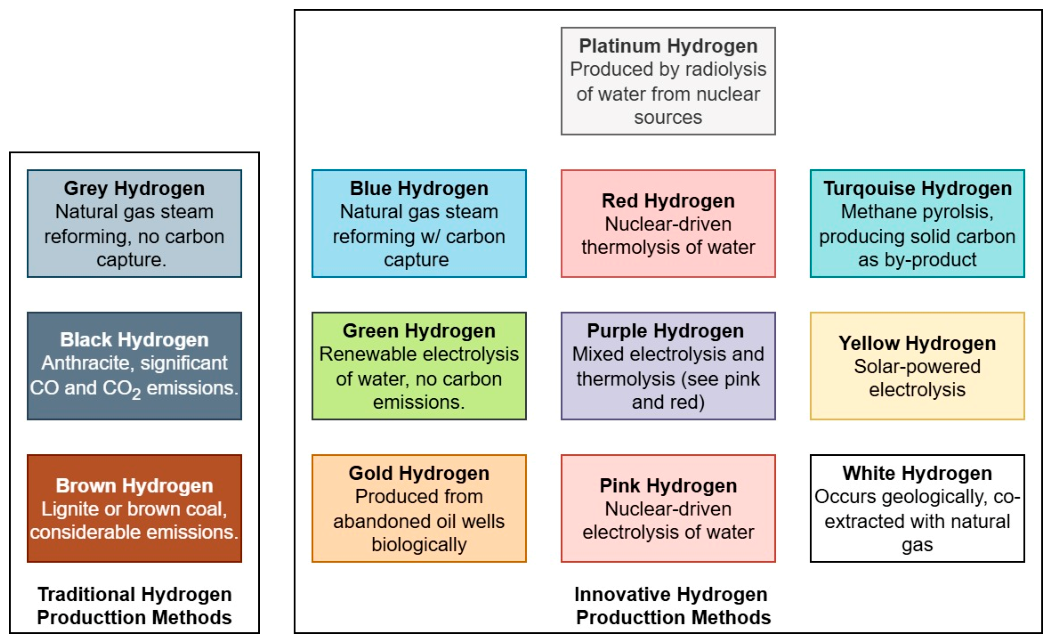
On a final note, as radiolytically-produced H2 is distinct from the other “colours” of hydrogen (Figure 5) – red, pink, and purple normally being assigned to nuclear-derived hydrogen, from electrolysis, (catalytic) thermolysis, and combinations of these respectively (Arcos and Santos, 2023; Ahmaruzzaman, et al., 2025) – we propose that this method be designated as PLATINUM HYDROGEN. This is to distinguish this method versus the other proposed approaches, all of which require some external or natural (underground) chemical and/or energy feedstock in order to function (Osselin, et al., 2025).
Supplementary Materials
Please see Appendix at the end of this article.
Author Contributions
Conceptualization, A.F.H and E.I.; methodology, A.F.H.; software, A.F.H. and E.I.; validation, A.F.H., E.I., and J.M.; formal analysis, A.F.H.; investigation, A.F.H.; resources, A.F.H. and E.I.; data curation, A.F.H. and E.I.; writing—original draft preparation, A.F.H.; writing—review and editing, A.F.H., E.I., A.B., W.B., G.B., F.C., H.E., C.d.l.F., M.G.-R., S.-Y.H., J.M., J.R., and L.S.; visualization, A.F.H.; supervision, A.F.H.; project administration, A.F.H.; funding acquisition, N/A. All authors have read and agreed to the published version of the manuscript.
Funding
This research received no external funding.
Institutional Review Board Statement
Not applicable.
Informed Consent Statement
Not applicable.
Data Availability Statement
Supporting data available upon request.
Conflicts of Interest
The authors declare no conflict of interest.
Abbreviations
The following abbreviations are used in this manuscript:
| CCGT(s) | Combined-Cycle Gas Turbine(s) |
| CHP | Combined Heat and Power |
| CoGen | Cogeneration |
| DU | Depleted Uranium |
| EPR | European Pressurised water Reactor |
| FP(s) | Fission Product(s) |
| FY | Fission Yield |
| GWd/Thm | Gigawatt-days per Tonne of Heavy Metal |
| H2 | Hydrogen |
| H2O2 | Hydrogen Peroxide |
| HBU | High Burnup (fuel) |
| HHR(s) | High-Heat Radionuclide(s) |
| HTGR | High-Temperature Gas-Cooled Reactor |
| IAEA | International Atomic Energy Agency |
| keff | Effective Neutron Multiplication Factor |
| MA(s) | Minor Actinide(s) |
| MOX | Mixed Oxide (fuel) |
| NFC | Nuclear Fuel Cycle |
| OECD | Organisation for Economic Co-operation and Development |
| PRIS | Power Reactor Information System (IAEA service) |
| PWR(s) | Pressurised Water Reactor(s) |
| Qβ | Beta/Gamma Decay Energy per Decay |
| RCG | Reactor Cogeneration |
| REE(s) | Rare Earth Element(s) |
| RHP | Radiolytic Hydrogen Production |
| SMR(s) | Small Modular Reactor(s) |
| SNF | Spent Nuclear Fuel |
| T0.5 | Half Life |
| Thm | Tonne(s) of Heavy Metal |
| TiO2 | Titanium Dioxide |
| TRL | Technology Readiness Level |
| UOx/UO2 | Uranium Oxide (fuel) |
| USD | United States Dollar |
Appendix
Derivation of Keff for RHP
The reactivity of the proposed storage and hydrogen production system was verified using a SERPENT Monte Carlo model. This model was composed of radially stacked elements of one fuel assembly extending to infinity and was axially infinite. Both of these assumptions are conservative in terms of system reactivity compared to a real, finite, storage silo. No discharge credit was taken for the fuel, which consisted of unirradiated enriched uranium dioxide of 4.75% 235U assay. Furthermore, no credit was taken for the neutron absorption in the titanium dioxide nanoparticles in the water on account of their comparatively low density, despite the comparatively high neutron capture cross section of natural titanium.
The fuel assembly was a 17x17 PWR assembly, with integral water filled Zircaloy guide tubes, and was emplaced in a square lattice, surrounded by a 20cm thick blanket of light water (Figure S1), representing a doubling of water thickness than that modelled by Vandenborre for H2 production. This arrangement ensures that at least 40cm of light water separates adjacent fuel assemblies, not counting for steel or concrete silo barriers or other absorbers. This simultaneously provides ample depth of absorber to interact with the released gamma rays effectively and prevents neutron interactions between assemblies, as this is much greater than the neutron diffusion distance in light water.
For the simple case of a single, fresh fuel assembly in the above configuration, keff was 0.832, despite the lack of any active neutron absorbers. Although conceptually more assemblies could be arranged in larger lattices (i.e., 2x2, 3x3, etc.), this would likely require fixed neutron absorbers be placed in the silo, and additionally self shielding of gamma rays in adjacent fuel assemblies would tend to reduce the efficacy of hydrogen generation. That the keff is substantially less than 1, despite several conservative assumptions, demonstrates that this system should provide the required performance with sufficient criticality safety.
Figure S1.
Representation of unit cell of SERPENT model run to calculate keff of fresh PWR model in storage. Water rods – blue; fuel pins – dark yellow; light water – light yellow.
Figure S1.
Representation of unit cell of SERPENT model run to calculate keff of fresh PWR model in storage. Water rods – blue; fuel pins – dark yellow; light water – light yellow.

Isotopes for RHP
We will divide the fission product isotopes for the following discussion into two categories: those that produce significant gamma radiation which are suitable for H2 production (Table S1/Figure S2), and those primary beta emitters that may more suiTable Ss heat sources (Table S2/Figure S3) if beta emissions are insufficiently effective at splitting water into hydrogen. This distinction arises primarily as beta particles more readily impart their energy and as such cause more localised heating (Holdsworth et al., 2024) ideally within the matrix containing the isotopes themselves. For the purposes of this work, we consider the recoverable outputs of a 1000 Thm/y SNF recycle facility processing either high burnup UO2 or MOX. HBU = high burnup 60 GWd/Thm UO2 LWR UNF with 10 y post-reactor cooling before recycle, or MOX equivalent. Data from Ando and Takano (Ando and Takano, 1999) and IAEA isotope browser (IAEA, 2025). Plant size approximation of the former UK THORP UNF recycle plant and UP2 and UP3 operated at La Hague in France.
As shown in Table S1/Figure S1, only 137Cs, 134Cs, and 154Eu generate any significant gamma-emission after 10 y of post-reactor cooling and thus are the most promising targets for separation for RHP use, and rationalises the chemical separations of Cs in reprocessing (Bond et al., 2019; Holdsworth et al. 2019a and 2019b), separating the 137Cs and 134Cs useful for H2 production alongside the long-lived 135Cs and stable 133Cs. Further to this, the higher fission and capture yields of 154Eu in MOX SNF mean that the potential gamma energy imparted by this isotope increases from 6.3% of 137Cs to 12.7%. Given most advanced reprocessing flowsheets co-separate the chemically-similar REEs alongside the Mas, partitioning Eu from REE raffinates separate from the other active rare earth isotopes (Holdsworth et al., 2025) may be appealing for hydrogen production when reprocessing HBU MOX fuels.

Table S1.
Gamma- emitting isotopes suitable for hydrogen production.
| Isotope | T0.5 (y) |
FY (%)a (235U/239Pu) |
SNF Conc.b (UO2/MOX) |
Activityc (Bq/g) |
Activity (Bg/Thm) |
Activity (% of 137Cs) |
Qb (keV) |
Primary Gamma Emissions (Energy, keV, Yield, %) |
| 137Cs/(137mBa) | 30.08 | 6.22/6.59 | 1745/1766 | 3.2E12 | 5.6E15/5.7E15 | 100/100 | 1175 | 661.7, 85.1 |
| 134Cs | 2.07 | 1.21E-5/6.74E-4d | 9.86/8.91 | 4.7E13 | 4.6E14/4.2E14 | 8.2/7.4 | 2059 | 604.7, 97.6; 795.9, 65.5; 569.3, 15.4; 802.0, 8.7; 563.2, 8.3, 1365.2, 3.0 |
| (126Sn)/126Sb | (2.18E5)/0.03 | 0.05/0.26 | 1.33/64.1 | 4.8E8 | 6.4E8/3.1E10 | 0.0/0.0 | (378)/3670 | (87.5, 36.5); 695.0, 99.6; 666.5, 99.6; 414.7, 83.3; 720.7, 53.8; 697.0, 32.6 |
| 106Ru/106Rh | 1.03/30.1 s | 0.41/4.19 | 0.26/0.43 | 1.2E14 | 3.1E13/5.1E13 | 0.5/0.9 | 39/3546 | 511.9, 20.4; 621.9, 9.93 |
| 144Ce/144Pr | 0.78/17.3 min | 5.47/5.24 | 0.058/0.050 | 1.2E14 | 6E12/6E12 | 0.1/0.1 | 319/2997 | (133.5, 11.1); 696.5, 1.3, 2185,7, 0.7, 1489.1, 0.3 |
| 154Eu | 8.60 | 1.95E-7/4.90E-5e | 19.1/39.5 | 1.0E13 | 1.9E14/3.9E14 | 3.4/6.8 | 1968 | 123.1, 40.4; 1274.4, 34.8; 1004.8, 18.0; 873.2, 12.1; 996.3, 10.5; 247.9, 6.89; 591.8, 5.0; 756.8, 4.52 |
| 155Eu | 4.75 | 0.09/0.17 | 3.54/5.35 | 1.8E13 | 6.4E13/9.6E13 | 1.1/1.6 | 252 | 86.5, 30.7; 105.3, 21.1; 45.3, 1.3; 60.0, 1.2 |
| 110mAg | 0.68 | 8.15E-9/6.83E-7 f | 9.02E-5/1.92E-4 | ~1.8E14 | 1.6E10/3.5E10 | 0.0/0.0 | 2891 | 657.8, 95.6; 884.7, 75.0; 937.4, 35; 1384.3, 25.1; 706.7, 16.7; 1505.0, 13.3; |
| 125Sb | 2.76 | 0.03/0.12 | 0.96/1.34 | 3.8E13 | 3.6E13/5.1E13 | 0.6/0.9 | 767 | 427.9, 29.6; 600.6, 17.7; 656.0, 11.2; 463.4, 10.5; 176.3, 6.8; 606.7, 5.0 |
a Cumulative thermal fission yield from 235U and 239Pu. b Concentration per tonne of initial heavy metal in 60 GWd/Thm UO2 and MOX cooled for 10 y post-reactor, 5% 235U initial enrichment for UO2 and 7.84% initial Pu. Data from Ando and Takano (1999). c Activity of parent isotope. d Shielded by 134Xe. e Shielded by 154Sm. f Shielded by 110Pd (Holdsworth et al., 2021e).
Figure S2.
Data for significant gamma-emitting isotopes present in SNF after 10 y of post-reactor cooling, a) half-lives; b) cumulative thermal fission yields from 235U and 239Pu fission; c) the gamma energy released per decay (accounting for branching ratios); and d) the gamma emissions by each isotope per second from both UO2 and MOX; 1E18 keV = 160.2 J. Data from Ando and Takano (1999) and IAEA Isotope Browser (sub-refs). Isotopes marked with an asterisk (*) have the values of their daughters included with them. Please note this selection is not exhaustive, but represents the primary contributors to gamma emission at time of SNF recycle.
Figure S2.
Data for significant gamma-emitting isotopes present in SNF after 10 y of post-reactor cooling, a) half-lives; b) cumulative thermal fission yields from 235U and 239Pu fission; c) the gamma energy released per decay (accounting for branching ratios); and d) the gamma emissions by each isotope per second from both UO2 and MOX; 1E18 keV = 160.2 J. Data from Ando and Takano (1999) and IAEA Isotope Browser (sub-refs). Isotopes marked with an asterisk (*) have the values of their daughters included with them. Please note this selection is not exhaustive, but represents the primary contributors to gamma emission at time of SNF recycle.
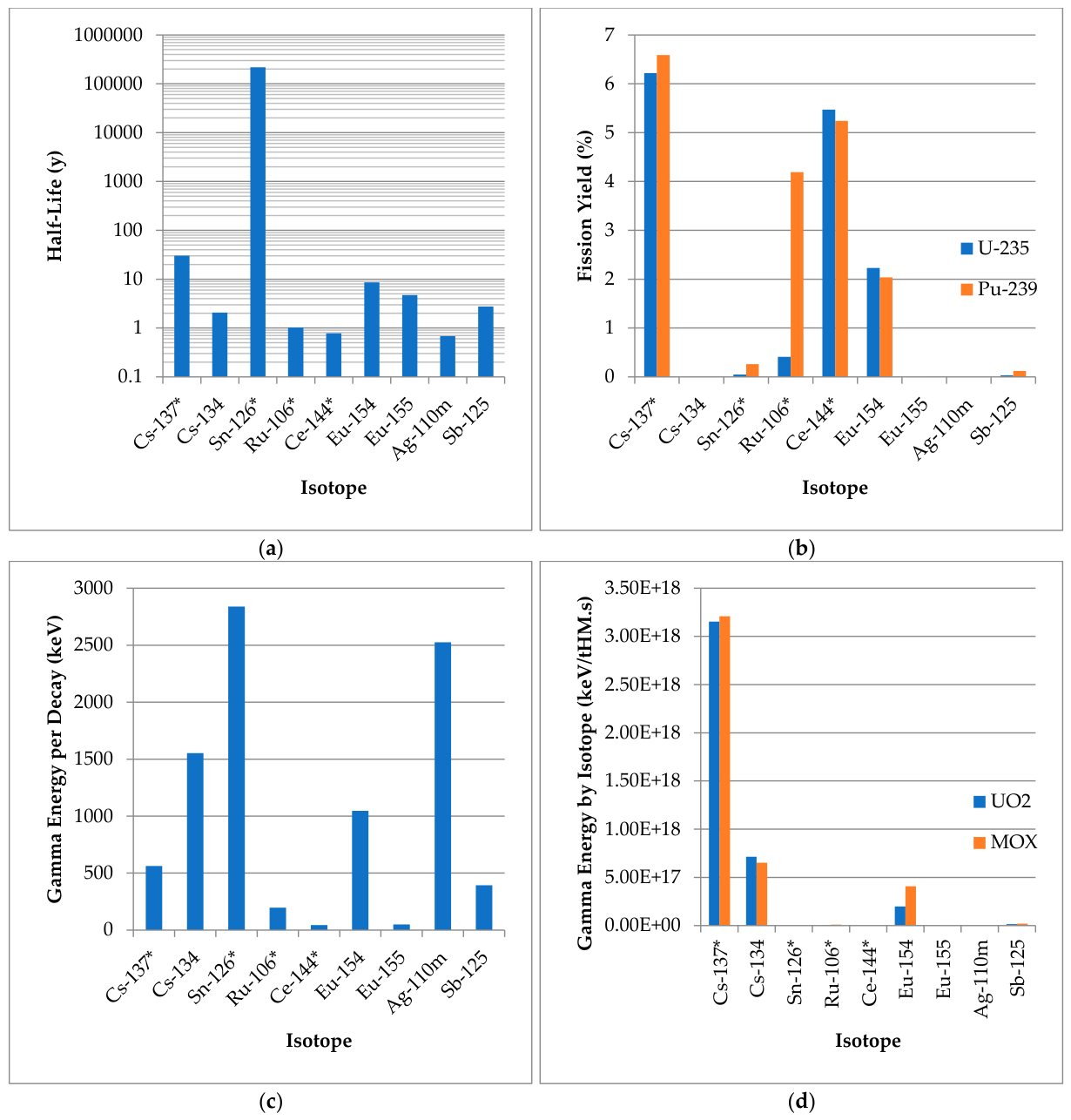
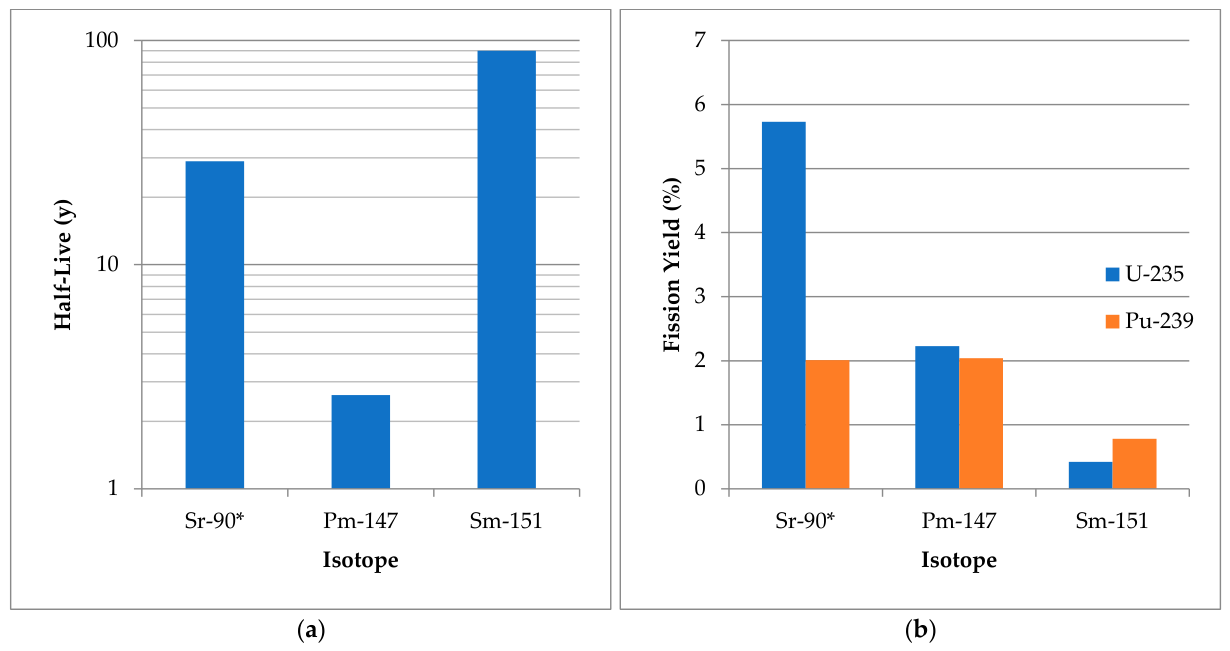
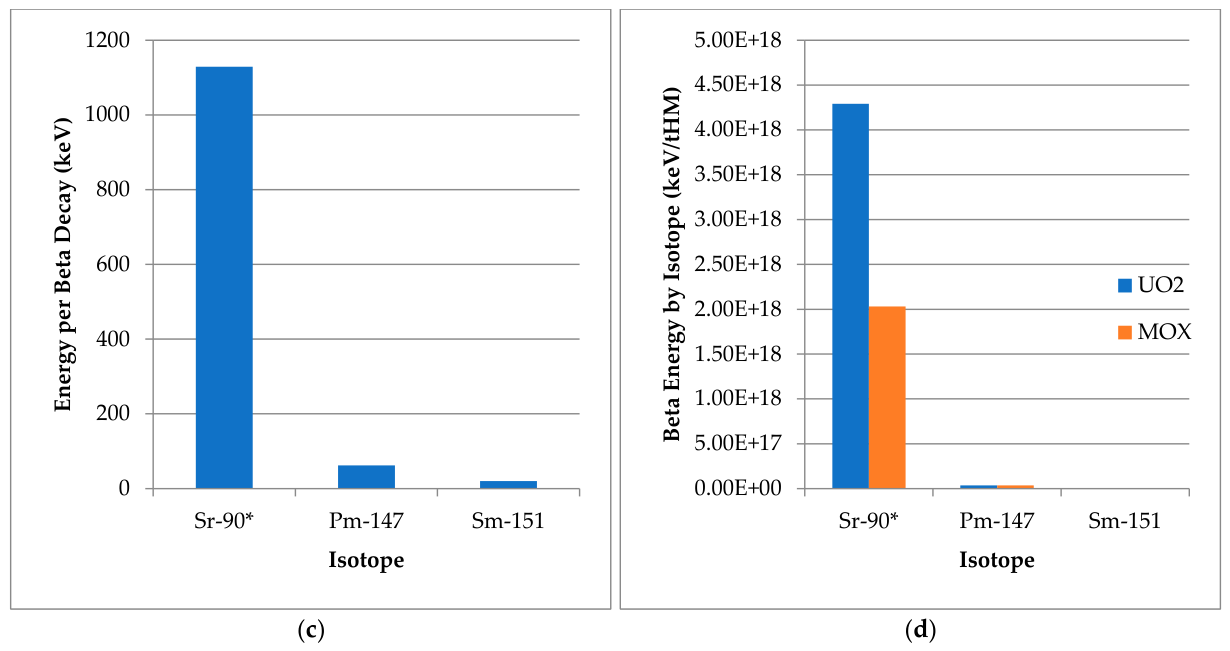
The other isotopes are either too short-lived or too low yielding hydrogen production using them would likely be uneconomical despite, on paper, several being more appealing than 137Cs. Nonetheless, these would generate hydrogen while still contained within SNF in interim storage (typically 10 years) between reactor and recycle, as originally proposed by Vandenborre et al., to maximise the potential yields from this concept. As demonstrated by the data in Figure S2/Table S2, only 90Sr and its 90Y daughter are feasible for heat generation using beta decay. Although 151Sm has a longer half-life, the low decay energy (19.62 keV on average) and lower concentration mean that the energy generated per second is insignificant in comparison to 90Sr/90Y, with the shorter half-life and relatively low decay energy of 147Pm countering its viability. The lower fission yield of 90Sr from Pu over 235U, producing just under half the decay heat in MOX over UO2, mean that recovery of 90Sr from conventional PWR UO2 would likely be preferable, though this could be offset by higher burnup MOX fuel, especially from fast reactors, which can exceed 100 GWd/tHM. As 90Sr fission yields from 233U are higher still than 235U (6.65% vs. 5.73%), more of this isotope could be recovered from Th-based fuels.
Table S2.
Heat-emitting isotopes for heat generation.
| Isotope |
T0.5 (y) |
FY (%)a (235U/239Pu) |
SNF Conc.b (UO2/MOX) |
Activity c (Bq/g) |
Activity (Bg/tHM) |
Qb (keV) |
Primary Beta Emissions (Energy, keV, Yield, %) |
Significant Gamma Emission(s) (Energy, keV, Yield, %) |
| 90Sr/90Y | 28.91/64.6 h | 5.73/2.01 | 738/361 | 5.1E12 | 3.8E15/1.8E15 | 526/2776 | (195.7, 100); 932.4, 99.9; 184.6, 0.01 |
2186.2, 1.4E-6 |
| 147Pm | 2.62 | 2.23/2.04 | 16.5/17.4 | 3.4E13 | 5.6E14/5.9E14 | 224 | 61.8, 99.9; 26.9, 5E-3 | 121.2, 2.9E-3 |
| 151Sm | 90 | 0.42/0.78 | 17.4/44.4 | 9.7E11 | 1.7E13/4.3E13 | 76.6 | 19.7, 99.1; 14.0, 0.9 | 21.5; 0.03 |
a Cumulative thermal fission yield from 235U and 239Pu. b Concentration per tonne of initial heavy metal in 60 GWd/tHM UO2 and MOX cooled for 10 y post-reactor, 5% 235U initial enrichment for UO2 and 7.84% initial Pu. Data from Ando and Takano (1999). c Activity of parent isotope.
Figure S3.
Data for significant gamma-emitting isotopes present in SNF after 10 y of post-reactor cooling, a) half-lives; b) cumulative thermal fission yields from 235U and 239Pu fission; c) the gamma energy released per decay (accounting for branching ratios); and d) the gamma emissions by each isotope per second from both UO2 and MOX; 1E18 keV = 160.2 J. Data from Ando and Takano (1999) and IAEA Isotope Browser (sub-refs). Isotopes marked with an asterisk (*) have the values of their daughters included with them. Please note this selection is not exhaustive, but represents the primary contributors to gamma emission at time of SNF recycle.
Figure S3.
Data for significant gamma-emitting isotopes present in SNF after 10 y of post-reactor cooling, a) half-lives; b) cumulative thermal fission yields from 235U and 239Pu fission; c) the gamma energy released per decay (accounting for branching ratios); and d) the gamma emissions by each isotope per second from both UO2 and MOX; 1E18 keV = 160.2 J. Data from Ando and Takano (1999) and IAEA Isotope Browser (sub-refs). Isotopes marked with an asterisk (*) have the values of their daughters included with them. Please note this selection is not exhaustive, but represents the primary contributors to gamma emission at time of SNF recycle.
References
- The Royal Society Policy Briefing: Nuclear cogeneration: civil nuclear energy in a low-carbon future; The Royal Society, London, UK, 2020; Available online: https://royalsociety.org/-/media/policy/projects/nuclear-cogeneration/2020-10-7-nuclear-cogeneration-policy-briefing.pdf.
- Matthews, J.; Bodel, W.; Butler, G. Nuclear Cogeneration to Support a Net-Zero, High-Renewable Electricity Grid. Energies 2024, 17(24), 6219. [Google Scholar] [CrossRef]
- Khamis, I.; Toshy, T.; Kavvadias, K.C. Opportunity for Cogeneration in Nuclear Power Plants. In Proceedings of the 2013 World Congress on Advances in Nano, Biomechanics, Robotics, and Energy Research (ANBRE13), Seoul, S. Korea, 25-28 Aug 2013; Available online: http://www.i-asem.org/publication_conf/anbre13/M5D.1.ER651_886F.pdf.
- IAEA-TECDOC-1085; International Atomic Energy Agency: Vienna, Austria, 1999; Available online: https://www-pub.iaea.org/MTCD/Publications/PDF/te_1085_prn.pdf.
- Dong, Z.; Li, B.; Li, J.; Guo, Z.; Huang, X.; Zhang, Y.; Zhang, Z. Flexible control of nuclear cogeneration plants for balancing intermittent renewables. Energy 2021, 221, 119906. [Google Scholar] [CrossRef]
- Verfondern, K.; Yan, X.; Nishihara, T.; Allelein, H.-J. Safety concept of nuclear cogeneration of hydrogen and electricity. Int. J. Hydrog. Ener. 2017, 42(11), 7551–7559. [Google Scholar] [CrossRef]
- Kowalczyk, T.; Badur, J.; Bryk, M. Energy and exergy analysis of hydrogen production combined with electric energy generation in a nuclear cogeneration cycle. Ener. Convers. Manag. 2019, 198, 111805. [Google Scholar] [CrossRef]
- Alabbadi, A.A.; AlZahrani, A.A. Nuclear hydrogen production using PEM electrolysis integrated with APR1400 power plant. Int. J. Hydrog. Ener. 2024, 60, 241–260. [Google Scholar] [CrossRef]
- Vanatta, M.; Stewart, W.R.; Craig, M.T. The role of policy and module manufacturing learning in industrial decarbonization by small modular reactors. Nat. Ener 2025, 10, 77–89. [Google Scholar] [CrossRef]
- Jin, J.; Wan, J.; Wu, S.; Nuerlan, A. Dynamic Simulation of a Small Modular Sodium-Cooled Fast Reactor Coupled With Molten Salt Energy Storage System. In Proceedings of the 2024 31st International Conference on Nuclear Engineering, Prague, Czech Republic, 4-8 Aug 2024; Vol 4. [Google Scholar] [CrossRef]
- Agyekum, E.B.; Odoi-Yorke, F.; Abdullah, M.; Chowdhury, P. Investigating the nexus between radiolysis using spent nuclear fuel and hydrogen production, with environmental safety considerations – A literature review. Nucl. Eng. Des. 2025, 438, 114048. [Google Scholar] [CrossRef]
- Ali, I.; Imanova, G.; Agayev, T.; Aliyev, A.; Bentalib, A.; Kurniawan, T.A.; Mbianda, X.Y. Sustainable hydrogen production by water decomposition in gamma radiolysis with post-modification studies of nano-BeO photocatalyst. J. Chem. Tech. Biotech. 2025, 100(7), 1463–1471. [Google Scholar] [CrossRef]
- Guerrero-Rodríguez, N.F.; De La Rosa-Leonardo, D.A.; Tapia-Marte, R.; Ramírez-Rivera, F.A.; Faxas-Guzmán, J.; Rey-Boué, A.B.; Reyes-Archundia, E. An Overview of the Efficiency and Long-Term Viability of Powered Hydrogen Production. Sustainability 2024, 16, 5569. [Google Scholar] [CrossRef]
- Novotny, V.; Sweeney, K.P.; Worsham, E.K.; Reyes Molina, E.A.; Root, S.J.; Joseck, F.; Choi, B.-H.; Popli, N.; Kim, Y.; Knighton, T.; Saeed, R.M. Thermal Integration of Advanced Nuclear Reactors with a Reference Refinery, Methanol Synthesis, and a Wood Pulp Plant. Report INL/RPT-24-76435, Idaho National Lab. Idaho Falls, ID, USA, 2024. Available online: https://inldigitallibrary.inl.gov/content/uploads/50/2026/04/Sort_132849.pdf.
- Nuclear Power Reactors in the World, 2024 Edition; International Atomic Energy Agency: Vienna, Austria, 2024; Available online: https://www-pub.iaea.org/MTCD/Publications/PDF/p15748-RDS-2-44_web.pdf.
- Holdsworth, A.F.; Ireland, E. Navigating the Path of Least Resistance to Sustainable, Widespread Adoption of Nuclear Power. Sustainability 2024, 16, 2141. [Google Scholar] [CrossRef]
- Ramana, M.V. The checkered operational history of high-temperature gas-cooled reactors. Bull. Atom. Sci. 2016, 72(3), 171–179. [Google Scholar] [CrossRef]
- Boretti, A. Concentrated Solar Energy with Thermal Energy Storage for Hydrogen Production by Three-Step Thermochemical Water-Splitting Cycles. Ener. Fuels 2021, 35(13), 10832–10840. [Google Scholar] [CrossRef]
- Li, Y.; Lin, R.; O’Shea, R.; Thaore, V.; Wall, D.; Murphy, J.D. A perspective on three sustainable hydrogen production technologies with a focus on technology readiness level, cost of production and life cycle environmental impacts. Heliyon 2024, 10(5), e26637. [Google Scholar] [CrossRef]
- Parkinson, B.; Balcombe, P.; Speirs, J.F.; Hawkes, A.D.; Hellgardt, K. Levelized cost of CO2 mitigation from hydrogen production routes. Ener. Env. Sci. 2019, 12(1), 19–40. [Google Scholar] [CrossRef]
- Onishi, H.; Oyama, S.; Asano, K.; Yamaji, K.; Sakuma, W.; Teruo, H. Development of High Temperature Gas-cooled Reactor for Hydrogen Production System. Mitsubishi Hvy. Ind. Tech. Rev. 2025, 61(4), 1–8. Available online: https://www.mhi.com/technology/review/sites/g/files/jwhtju2326/files/tr/pdf/e614/e614090.pdf.
- Taylor, R.; Bodel, W.; Banford, A.; Butler, G.; Livens, F. Sustainability of Nuclear Energy—A Critical Review from a UK Perspective. Sustainability 2024, 16, 10952. [Google Scholar] [CrossRef]
- IAEA (International Atomic Energy Agency) PRIS (Power Reactor Information System). Available online: https://pris.iaea.org/pris/home.aspx (accessed on 29/7/2026).
- Peel, R. Nuclear Fuel Reserves. In Kirk-Othmer Encyclopedia of Chemical Technology; 2021. [Google Scholar] [CrossRef]
- Spent Fuel Reprocessing Options. Report: IAEA-TECDOC-1587, IAEA, Vienna, Austria. 2008. Available online: https://www-pub.iaea.org/MTCD/Publications/PDF/TE_1587_web.pdf.
- Holdsworth, A.F.; Ireland, E.; Eccles, H. Spent Nuclear Fuel—Waste to Resource, Part 1: Effects of Post-Reactor Cooling Time and Novel Partitioning Strategies in Advanced Reprocessing on Highly Active Waste Volumes in Gen III(+) UOx Fuel Systems. J. Nucl. Eng. 2025, 6, 29. [Google Scholar] [CrossRef]
- Holdsworth, A.F.; Eccles, H.; Sharrad, C.A.; George, K. Spent Nuclear Fuel—Waste or Resource? The Potential of Strategic Materials Recovery during Recycle for Sustainability and Advanced Waste Management. Waste 2023, 1, 249–263. [Google Scholar] [CrossRef]
- Bourg, S.; Poinssot, C. Could spent nuclear fuel be considered as a non-conventional mine of critical raw materials? Progr. Nucl. Ener. 2017, 94, 222–228. [Google Scholar] [CrossRef]
- Holdsworth, A.F.; Eccles, H.; George, K.; Sharrad, C.A. Recovery of Strategic High-Value Fission Products from Spent Nuclear Fuel During Reprocessing. EPJ Web Conf. 2025, 317, 01004. [Google Scholar] [CrossRef]
- Hodgson, B.J.; Turner, J.R.; Holdsworth, A.F. A Review of Opportunities and Methods for Recovery of Rhodium from Spent Nuclear Fuel during Reprocessing. J. Nucl. Eng. 2023, 4, 484–534. [Google Scholar] [CrossRef]
- Rohrmann, C. A. Values in Spent Fuel from Power Reactors, Report: BNWL-25, Battelle-Northwest Lab, WA, USA. 1965. Available online: https://www.osti.gov/servlets/purl/4618921.
- Bibler, N.E.; Crawford, C.L.; Biddle, C.R. 1998. Results of Scoping Studies for Determining Radiolytic Hydrogen Production from Moist CST and CST Slurries; Report: WRSC-RP-98-01143. Savannah River Site: Jackson, SC, USA. Available online: https://www.osti.gov/servlets/purl/4877.
- Kolarik, Z.; Renard, E. V. Recovery of Value Fission Platinoids from Spent Nuclear Fuel. Platin Met. Rev. 2003, 47(2), 74–87. Available online: https://www.ingentaconnect.com/content/matthey/pmr/2003/00000047/00000002/art00010. [CrossRef]
- Jensen, G. A.; Platt, A. M.; Mellinger, G. B.; Bjorklund, W. J. Recovery of Noble Metals from Fission Products. Nucl. Tech. 1984, 65(2), 305–324. [Google Scholar] [CrossRef]
- Baron, P.; Cornet, S.M.; Collins, E.D.; DeAngelis, G.; Del Cul, G.; Fedorov, Yu.; Glatz, J.P.; Ignatiev, V.; Inoue, T.; Khaperskaya, A.; Kim, I.T.; Kormilitsyn, M.; Koyama, T.; Law, J.D.; Lee, H.S.; Minato, K.; Morita, Y.; Uhlíř, J.; Warin, D.; Taylor, R.J. A review of separation processes proposed for advanced fuel cycles based on technology readiness level assessments. Progr. Nucl. Ener. 2019, 117, 103091. [Google Scholar] [CrossRef]
- Unlocking the Hidden Value of Nuclear Fuel, The Societal Benefits of Diverse Material Recycling, OECD, Nuclear Energy Agency Report 7674, 2024. Available online: https://www.oecd-nea.org/upload/docs/application/pdf/2025-01/7674_-_unlocking_hidden_value_of_nuclear_fuel.pdf.
- Bond, G.; Eccles, H.; Kavi, P.C.; Holdsworth, A.F.; Rowbotham, D.; Mao, R. Removal of Caesium from Simulated Spent Fuel Dissolver Liquor. J. Chromatog. Sep. Tech. 2019, 10, 417. [Google Scholar] [CrossRef]
- McKibben, J.M. Chemistry of the Purex Process. Radiochim. Acta 1984, 36, 3–15. [Google Scholar] [CrossRef]
- Venkatesan, K.A.; Sukumarran, V.; Antony, M.P.; Srinivasan, T.G. Studies on the feasibility of using crystalline silicotitanates for the separation of cesium-137 from fast reactor high-level liquid waste. J. Radioanal. Nucl. Chem. 2009, 280(1), 129–136. [Google Scholar] [CrossRef]
- Forsberg, C. W. Rethinking High-Level Waste Disposal: Separate Disposal of High-Heat Radionuclides (90Sr and 137Cs). Nucl. Tech. 2000, 131(2), 252–268. [Google Scholar] [CrossRef]
- Forsberg, C.W. Disposal of Partitioning-Transmutation Wastes in a Yucca-Mountain-Type Respository with Separate Management of High-Heat Radionuclides (90Sr and 137Cs). In Proceedings of the Fourth International Topical Meeting on Nuclear Applications of Accelerator Technology, Washington DC, USA. (b), 13-15 November, 2000. [Google Scholar]
- Forsberg, C.W. Disposal of Partitioning-transmutation Wastes with Separate Management of High-heat Radionuclides. In Proceedings of the 6th Information Exchange Meeting on Actinide and Fission Product Partitioning and Transmutation, (c). Madrid, Spain, 11-13 December 2000. [Google Scholar]
- Holdsworth, A.F.; Eccles, H.; Rowbotham, D.; Bond, G.; Kavi, P.C.; Edge, R. The Effect of Gamma Irradiation on the Ion Exchange Properties of Caesium-Selective Ammonium Phosphomolybdate-Polyacrylonitrile (AMP-PAN) Composites under Spent Fuel Recycling Conditions. Separations 2019, 6, 23. [Google Scholar] [CrossRef]
- Holdsworth, A.F.; Eccles, H.; Rowbotham, D.; Brookfield, A.; Collison, D.; Bond, G.; Kavi, P.C.; Edge, R. The Effect of Gamma Irradiation on the Physiochemical Properties of Caesium-Selective Ammonium Phosphomolybdate–Polyacrylonitrile (AMP–PAN) Composites. Clean Technol. 2019, 1, 294–310. [Google Scholar] [CrossRef]
- Holdsworth, A. F.; Rowbotham, D.; Eccles, H.; Bond, G.; Kavi, P. C.; Edge, R. The Effects of Gamma Irradiation on the Physiochemical and Ion Exchange Properties of Caesium-Selective Porous AMP-PAN Composites. presented at 49th Journées des Actinides, (c). Erice, Italy, 14-18 April 2019. [Google Scholar]
- Holdsworth, A. F.; Eccles, H.; Bond, G.; Rowbotham, D.; Brookfield, A.; Collison, D.; Kavi, P. C.; Edge, R.; Natrajan, L. S.; Spencer, B.; Muryn, C.; Emmott, J. D.; Sharrad, C. A. Heterogeneous Separations of Highly Active Radionuclides for Advanced Decay Heat & Waste Management in Next-Generation Spent Fuel Recycling/Reprocessing. presented at 4th Cloud Conference: Nuclear Waste Management and Disposal, Online (UK), 2000. [Google Scholar]
- Holdsworth, A. F.; Eccles, H.; Natrajan, L. S.; Wooles, A. J.; Kavi, P. C.; Mao, R.; Bond, G.; Rowbotham, D.; Sharrad, C. A. The ART Concept - Future Reprocessing of Spent Nuclear Fuel: Head-End Separation of Cs from U; (a); presented at 50th Journées des Actinides: Online (France), 22-25 March 2021. [Google Scholar]
- Holdsworth, A. F. Future Recycling of Spent Nuclear Fuel: Modelling, Head-End Separations & Waste Management. presented at Dalton Nuclear Institute Seminar: PDRA Research Showcase, (b). 2021; Online (UK). [Google Scholar]
- Holdsworth, A. F.; Eccles, H.; Natrajan, L. S.; Wooles, A. J.; Kavi, P. C.; Mao, R.; Bond, G.; Rowbotham, D.; George, K.; Sharrad, C. A. Head-End Separations of Caesium from Uranium in Used Nuclear Fuel Recycling with AMP-PAN Composites. presented at Actinide Separations Conference, Online (USA). (c), 18-20 May 2021. [Google Scholar]
- Holdsworth, A. F.; Eccles, H.; Natrajan, L. S.; Wooles, A. J.; Kavi, P. C.; Mao, R.; Bond, G.; Rowbotham, D.; George, K.; Sharrad, C. A. Head-End Separations of Caesium from Uranium in Used Nuclear Fuel Recycling with AMP-PAN Composites. presented at Royal Society of Chemistry Radiochemistry Group Young Researcher’s Meeting, Online (UK). (d). 14 July 2021. [Google Scholar]
- Vinson, D.W.; Deible, R.W.; Sindelar, R. L Evaluation of Hydrogen Generation from Radiolysis from Breached Spent Fuel. Report: WSRC-MS--2002-00728, Westinghouse Savannah River Company, Savannah River Site, Aiken, SC, USA. 2002. Available online: https://sti.srs.gov/fulltext/ms2002728/ms2002728.pdf.
- Bottomley, P.; Papaioannou, D.; Nasyrow, R.; Rondinella, V. Estimation of hydrogen production rates from radiolysable material in contact with various irradiated fuels. In Proceedings of the HOTLAB 2011 conference, Smolenice, Slovakia, 23-27 May 2011; Available online: https://publications.jrc.ec.europa.eu/repository/handle/JRC67160.
- Sauer, M.C., Jr.; Hart, E.J.; Flynn, K.F.; Gindler, J.E. 1976. A MEASUREMENT OF THE HYDROGEN YIELD IN THE RADIOLYSIS OF WATER BY DISSOLVED FISSION PRODUCTS. Report: ANL-76-46, Argonne National Lab. Argonne, IL, USA. Available online: https://www.osti.gov/servlets/purl/7347831.
- Yoshida, T.; Tanabe, T.; Sugie, N.; Chen, A. Utilization of gamma-ray irradiation for hydrogen production from water. J. Radioanal. Nucl. Chem. 2007, 272, 471–476. [Google Scholar] [CrossRef]
- Vandenborre, J.; Guillonneau, S.; Blain, G.; Haddad, F.; Truche, L. From nuclear waste to hydrogen production: From past consequences to future prospect. Int. J. Hydrog. Ener. 2024, 64, 65–68. [Google Scholar] [CrossRef]
- Ali, I.; Imanova, G.; Alharbi, O.M.L.; Hameed, A.M.; Siddiqui, M.N. Recent updates in direct radiation water-splitting methods of hydrogen production. J. Umm Al-Qura Univ. Appl. Sci. 2024, 10, 567–578. [Google Scholar] [CrossRef]
- Sawasaki, T.; Tanabe, T.; Yoshida, T.; Ishida, R. Application of gamma radiolysis of water for H2 production. J. Radioanal. Nucl. Chem. 2003, 255(2), 271–274. [Google Scholar] [CrossRef]
- Jafarov, Y.D.; Bashirova, S.M.; Mardanov, I.J.; Imanova, G.T. Obtaining molecular hydrogen from water radiolysis in the nano-SiO2(d ¼ 20 nm)/H2O system under the influence of γ-quanta. Exper. Results 2004, 4(e9), 1–11. [Google Scholar] [CrossRef]
- Cecal, A.; Macovel, A.; Tamba, G.; Hauta, O.; Popa, K.; Ganju, D.; Rusu, I. ON THE HYDROGEN PRODUCTION BY CATALYZED RADIOLYSIS OF WATER. Reue Romaine De Chim. 2008, 53(3), 203–26. Available online: https://revroum.lew.ro/wp-content/uploads/2008/RRCh_11_2008/Tipo/RRC%2011_2008.pdf.
- Plant, A.G.; Kos, B.; Jazbec, A.; Snoj, L.; Joyce; M.J. Vesna, N.-V. Nuclear Cogeneration of Methanol and Acetaldehyde from Ethylene Glycol Using Ionizing Radiation. Ind. Eng. Chem. Res. 2023, 62(49), 21152–21163. [Google Scholar] [CrossRef]
- Naikwadi, A.T.; Sharma, B.K.; Bhatt, K.D.; Mahanwar, P.A. Gamma Radiation Processed Polymerica Materials for High Performance Applications: A Review. Front. Chem. 2022, 10, 837111. [Google Scholar] [CrossRef]
- McEvoy, B.; Maksimovic, A.; Howell, D.; Reppert, P.; Ryan, D.; Rowan, N.; Michel, H. Studies on the comparative effectiveness of X-rays, gamma rays and electron beams to inactivate microorganisms at different dose rates in industrial sterilization of medical devices. Rad. Phys. Chem. 2023, 208, 110915. [Google Scholar] [CrossRef]
- Sanchez-Polo, M.; Lopez-Penalver, J.; Prados-Yoya, G.; Ferro-Garcia, M.A.; Rivera-Utrilla, J. Gamma irradiation of pharmaceutical compounds, nitroimidazoles, as a new alternative for water treatment. Water Res. 2009, 43(16), 4028–4036. [Google Scholar] [CrossRef]
- Leotlela, M.J. Radiolysis of water by α- and β-particles from spent nuclear fuel. Rad. Phys. Chem. 2024, 216, 111361. [Google Scholar] [CrossRef]
- Spinks, J. W. T.; Woods, R. J. An introduction to radiation chemistry; Wiley-Blackwell: Hoboken, NJ, USA, 1990. [Google Scholar]
- Ni, M.; Leung, M.K.H.; Leung, D.Y.C.; Sumathy, K. A review and recent developments in photocatalytic water-splitting using TiO2 for hydrogen production. Renew. Sust. Ener. Rev. 2007, 11(3), 401–425. [Google Scholar] [CrossRef]
- Curson, N.; Hassan, B. Penspen Technical Article: 2 USD/KG HYDROGEN PRODUCTION COST THRESHOLD COULD BE A NEAR-TERM POSSIBILITY IN THE GCC REGION WITH USE OF CHINESE TECHNOLOGIES, Article: Penspen Ltd. 2025. Available online: https://www.penspen.com/wp-content/uploads/2025/02/Penspen-Technical-Article-Hydrogen-Cost-Optimisation-Feb25.pdf.
- Boretti, A. Combined cycle gas turbine (CCGT) plants utilizing methane-hydrogen blends represent a significant element in Australia’s journey toward achieving net-zero emissions. Fuel 2025, 381(A), 133339. [Google Scholar] [CrossRef]
- Ecoinvent. Ecoinvent v3.11; ecoinvent: Zurich, Switzerland, 2025.
- Slorach, P.C.; Stamford, L. Net zero in the heating sector: Technological options and environmental sustainability from now to 2050. Ener. Convers. Magan. 2021, 230, 113838. [Google Scholar] [CrossRef]
- Weidner, T.; Tulus, V.; Guillén-Gosálbez, G. Environmental sustainability assessment of large-scale hydrogen production using prospective life cycle analysis. Int. J. Hydrog. Ener. 2023, 48(22), 8310–8327. [Google Scholar] [CrossRef]
- Ando, Y.; Takano. 1999. Estimation of LWR spent fuel composition. Report: JAERI-Research-99-004, Japanese Atomic Energy Research Institute, Tokyo, Japan. Available online: https://inis.iaea.org/records/nnzmk-f6h96.
- Shor, R.; Lafferty, R.H., Jr.; Baker, P.S. Strontium-90 Heat Sources. Report: ORNL-IIC-36, Oak Ridge National Laboratory, TN, USA. 1971. Available online: https://inis.iaea.org/records/9n0kw-1kd80/files/3015004.pdf.
- Uherka, K.L. Report: ASSESSMENT OF RADIOISOTOPE HEATERS FOR REMOTE TERRESTRIAL APPLICATIONS. In Proceedings of the Twenty-second Intersociety Energy Conversion Engineering Conference, Philadelphia, PA, USA, 10-14 Aug 1987. [Google Scholar]
- Rohrmann, C.A. RADIOISOTOPIC HEAT SOURCES. Report: HW-763232 Rev 1, Hanford, Richland, WA, USA. 1965. Available online: https://www.osti.gov/servlets/purl/5712006.
- Wood, P.M. Possible Sr-90 Demands and Availabilities. Report: AECOP-1053, AECOP, Oak Ridge, TN, USA, 1971. [Google Scholar]
- Hoisington, J.E. RADIOISOTOPES FOR HEAT-SOURCE APPLICATIONS. Report: DSPT—82-842, Savannah River Laboratory, SC, USA. 1982. Available online: https://www.osti.gov/servlets/purl/6552381.
- Chakravarty, R.; Dash, A.; Pillai, M.R.A. Availability of Yttrium-90 from Strontium-90: A Nuclear Medicine Perspective. Cancer Biother. Radiopharm. 2012, 27(10), 621–641. [Google Scholar] [CrossRef]
- CMS. Expert Guide: Hydrogen law, regulations & strategy in the United Kingdom. 2024. Available online: https://cms.law/en/int/expert-guides/cms-expert-guide-to-hydrogen/united-kingdom (accessed on 27/07/2026).
- Arcos, J.M.M.; Santos, D.M.F. The Hydrogen Color Spectrum: Techno-Economic Analysis of the Available Technologies for Hydrogen Production. Gases 2023, 3, 25–46. [Google Scholar] [CrossRef]
- Osselin, F.; Soulaine, C.; Gaucher, E.C.; Scaillet, B.; Pichavant, M. Orange hydrogen is the new green. Nat. Geosci. 2022, 15, 765–769. [Google Scholar] [CrossRef]
- Fasttech US: The Colours of Hydrogen Explained. Available online: https://www.fastechus.com/blog/the-colors-of-hydrogen-explained (accessed on 19/07/2026).
- Holdsworth, A.F.; Feng, Z.; Edge, R.; Waters, J.P.; Halman, A.M.; Collison, D.; George, K.; Natrajan, L.S.; Denecke, M.A. The Effects of Irradiation on Structure and Leaching of Pure and Doped Thin-Film Ceria SIMFUEL Models Prepared via Polymer-Templated Deposition. J. Nucl. Eng. 2024, 5, 150–167. [Google Scholar] [CrossRef]
- Holdsworth, A.F.; Feng, Z.; Edge, R.; Waters, J.P.; Halman, A.M.; Collison, D.; George, K.; Natrajan, L.S.; Denecke, M.A. The Effects of Irradiation on Structure and Leaching of Pure and Doped Thin-Film Ceria SIMFUEL Models Prepared via Polymer-Templated Deposition. J. Nucl. Eng. 2024, 5, 150–167. [Google Scholar] [CrossRef]
- Holdsworth, A. F.; George, K.; Adams, S. J. S.; Sharrad, C. A. An accessible statistical regression approach for the estimation of spent nuclear fuel compositions and decay heats to support the development of nuclear fuel management strategies. Progr. Nucl. Ener. 2021, 141, 103935. [Google Scholar] [CrossRef]
- 86. IAEA isotope browser. Available online: https://nds.iaea.org/relnsd/vcharthtml/VChartHTML.html (accessed on 29/07/2026).
Figure 1.
Proposed applications of co-generation from nuclear reactors: radiation used for medical isotopes (Med Isos) or radiation synthesis (Rad Synth), direct heat used to power industrial process heat (Proc Heat), district heating (Dist Heat) or heat engines (Heat Eng., e.g., Sterling engines), and either heat or electrical output used for H2 production, CO2 capture (Capt), or saltwater desalination (Desal) in addition to conventional grid outputs. Adapted from (Royal Society, 2020).
Figure 1.
Proposed applications of co-generation from nuclear reactors: radiation used for medical isotopes (Med Isos) or radiation synthesis (Rad Synth), direct heat used to power industrial process heat (Proc Heat), district heating (Dist Heat) or heat engines (Heat Eng., e.g., Sterling engines), and either heat or electrical output used for H2 production, CO2 capture (Capt), or saltwater desalination (Desal) in addition to conventional grid outputs. Adapted from (Royal Society, 2020).
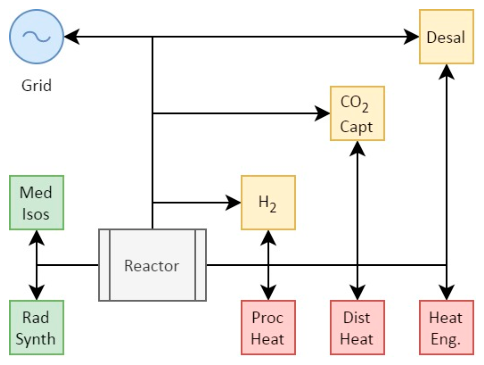
Figure 2.
Current and proposed NFC implementations: a – open fuel cycle; b - partially-closed fuel cycle; and c – fully-closed fuel cycle with MA recycle. Key: green – well developed or operating technology; amber – technology under development. DU = depleted uranium.
Figure 2.
Current and proposed NFC implementations: a – open fuel cycle; b - partially-closed fuel cycle; and c – fully-closed fuel cycle with MA recycle. Key: green – well developed or operating technology; amber – technology under development. DU = depleted uranium.
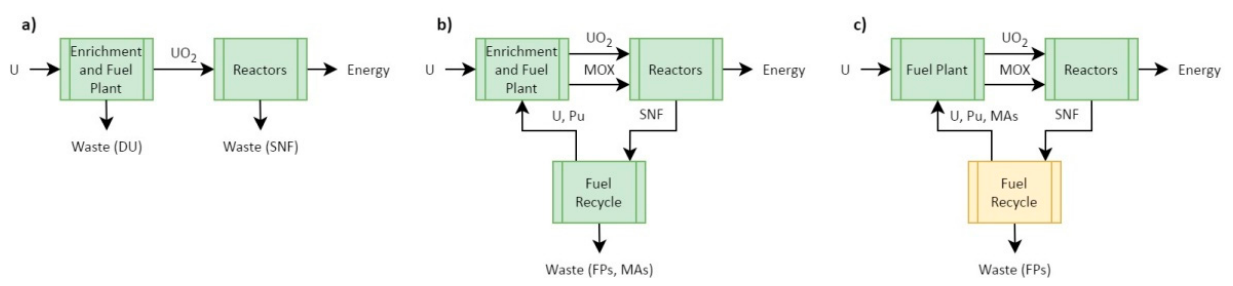
Figure 3.
Overview schematic of Vandenborre’s proposed hydrogen production using SNF bundles. Adapted from (Vandenborre et al., 2024).
Figure 3.
Overview schematic of Vandenborre’s proposed hydrogen production using SNF bundles. Adapted from (Vandenborre et al., 2024).
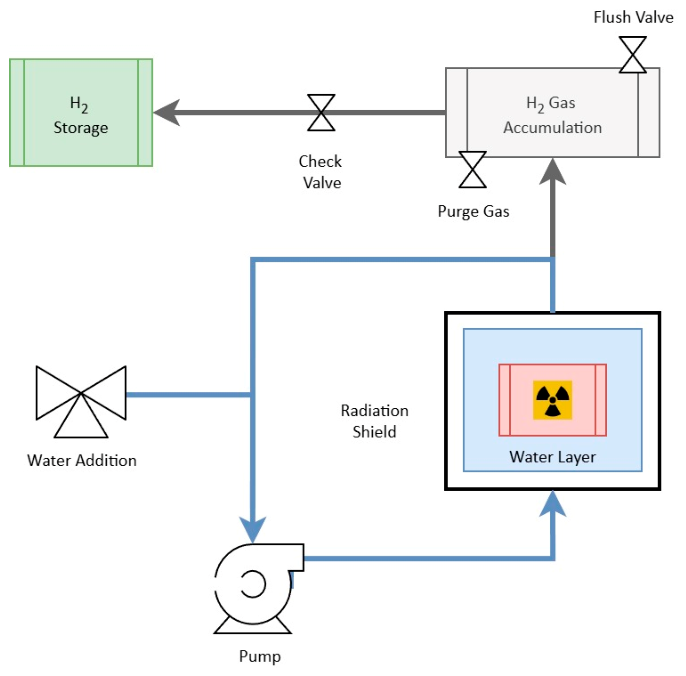
Figure 4.
Open and closed fuel cycles with and without RHP.
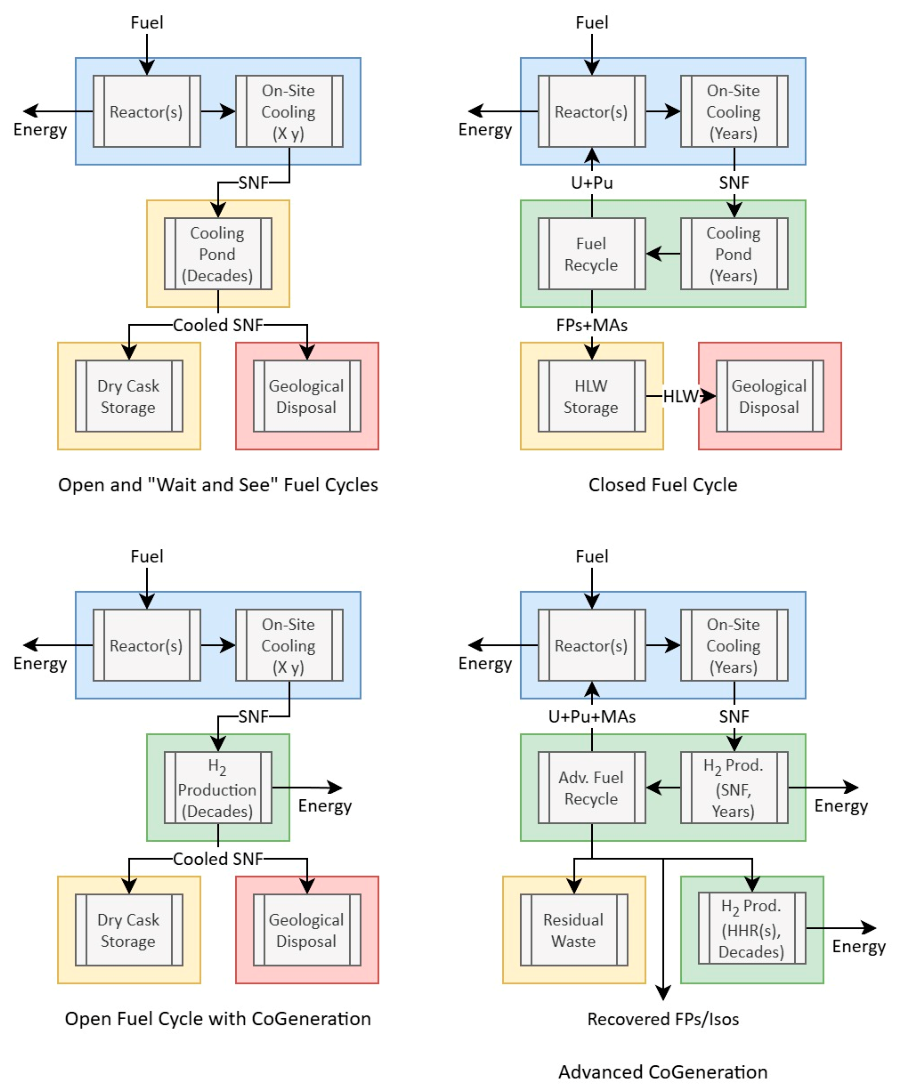
Figure 5.
Colours of hydrogen. Adapted from (Fastech US, 2024).
Disclaimer/Publisher’s Note: The statements, opinions and data contained in all publications are solely those of the individual author(s) and contributor(s) and not of MDPI and/or the editor(s). MDPI and/or the editor(s) disclaim responsibility for any injury to people or property resulting from any ideas, methods, instructions or products referred to in the content. |
© 2026 by the authors. Licensee MDPI, Basel, Switzerland. This article is an open access article distributed under the terms and conditions of the Creative Commons Attribution (CC BY) license.
Copyright: This open access article is published under a Creative Commons CC BY 4.0 license, which permit the free download, distribution, and reuse, provided that the author and preprint are cited in any reuse.