

Submitted:
13 September 2026
Posted:
14 September 2026
You are already at the latest version
Abstract
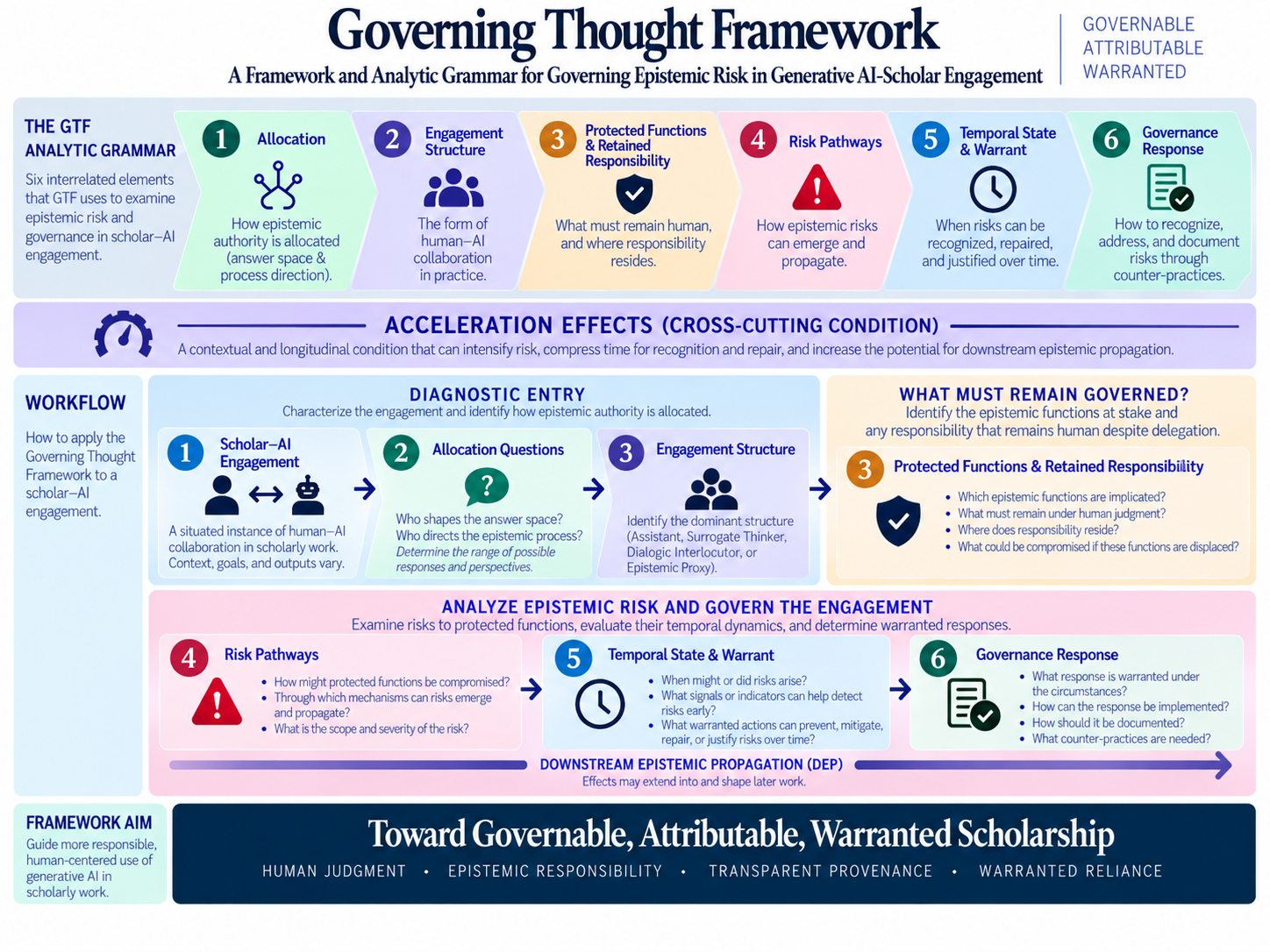
Generative AI scholarship increasingly differentiates forms of human–AI collaboration, yet nominal human involvement does not specify who shapes the answer space, directs the epistemic process, retains epistemic responsibility, or can establish warrant when intervention occurs. This paper presents Governing Thought (GTF), a conceptual framework for diagnosing epistemic risk in scholar–AI episodes. GTF distinguishes four recurrent ideal-typical engagement structures—Assistant, Surrogate Thinker, Dialogic Interlocutor, and Epistemic Proxy—interpreted through two allocation questions concerning answer-space shaping and process control. Eight organizing families contain nineteen risk pathways, with Accountability Diffusion as a twentieth cross-family pathway. Three cross-taxonomy temporal relationships—path-dependent warrant, temporal displacement, and Downstream Epistemic Propagation—address how risk, recognition, repair, and dependence unfold over time. Acceleration Effects is treated as a contextual and longitudinal condition rather than a structure, pathway, or temporal relationship. Epistemic Abdication is defined normatively as material failure to discharge an applicable retained epistemic responsibility. Component literatures ground selected mechanisms, protected functions, and professional duties, while GTF’s architecture and boundaries remain conceptual syntheses requiring empirical testing. GTF contributes an analytic grammar for relating allocation, protected functions, responsibility, risk pathways, temporal state, warrant, propagation, and governance response.
Keywords:
artificial intelligence
; epistemic governance
; scholarly practice
; human–AI collaboration
; epistemic responsibility
; epistemic provenance
1. Introduction
Responses to generative AI in scholarship include detection and prohibition, assessment redesign, literacy and competency development, and broader governance proposals (Slimi, 2026). These approaches are not uniform and should not be treated as failed versions of one strategy. Detection raises known reliability and equity concerns; authentic assessment research establishes risks within particular written-assessment contexts rather than proving that oral, portfolio, or presentation formats are generally ineffective. AI literacy and upskilling remain important capacity-building responses, even though tool-specific procedures may require updating as systems change. The conceptual concern motivating the Governing Thought Framework (GTF) is narrower: capacity and format do not, by themselves, specify who shapes the answer space, who directs the epistemic process, what responsibility remains human, or what warrant must still be established within a particular episode of AI-engaged work.
Existing human–AI collaboration, AI-assisted authorship, and LLM-use scholarship already offers differentiated modes and taxonomies (Knowles, 2024; Mühlhoff, 2026; Rodrigues, 2026). Governing Thought therefore does not claim to be the first or only differentiated framework. Its proposed contribution is a particular integration: two allocation questions concerning the answer space and process control; four ideal-typical engagement structures; twenty risk pathways organized through eight organizing families plus one standalone pathway; retained epistemic responsibility as a governance criterion; and temporally sensitive analysis through path-dependent warrant, temporal displacement, and Downstream Epistemic Propagation (DEP).
This positioning enters a growing conversation that treats AI use as a problem of epistemic agency, responsibility, validation, and the allocation of judgment rather than merely adoption or efficiency. Mühlhoff (2026), for example, develops a use-based taxonomy organized around the degree of delegated judgment and epistemic control retained by users, arguing that responsible LLM use requires preserved epistemic access, independent judgment, and justificatory authority. Mussgnug et al. (2026) and Coeckelbergh (2026) likewise foreground responsibility and epistemic agency. These are contemporary interlocutors and convergent parallels, not sources from which GTF’s architecture was derived. GTF differs in modeling scholarly episodes through enacted allocation of answer-space shaping and process direction, then relating that allocation to retained epistemic responsibilities, risk pathways, warrant, temporal state, and governance response.
GTF complements rather than replaces literacy, expertise, assessment, research-integrity, and responsible-AI work. AI literacy and competency frameworks primarily address capacities scholars may need to use generative AI effectively and responsibly (Slimi, 2026). GTF asks what epistemic function is being performed in a particular episode, how authority and process control are allocated, what responsibility remains human, what pathway may threaten its discharge, and when governance can still establish the relevant warrant. The categories are intended to remain comparatively useful across system changes, but they are not technologically invariant: new capabilities may require architectural revision, and an episode’s classification may change when its enacted allocation changes.
2. Conceptual Foundations and Framework Construction
GTF is a conceptual framework rather than a validated instrument or systematic review. Its construction combines established foundations, AI-specific extensions, conceptual interlocution, standards-grounded duties, and explicit framework synthesis. Distributed cognition motivates analysis of the human–AI arrangement rather than an isolated individual, expertise theory informs questions of evaluative capacity, dialogue research informs coordination, learning research informs capability formation and maintenance, and provenance and integrity standards identify scholarly duties (ALLEA, 2023; Clark & Brennan, 1991; Collins & Evans, 2007; Hutchins, 1995). These sources sensitize and constrain the construction; they do not derive the exact axes, ideal types, families, risk-pathway boundaries, or temporal architecture.
The unit of analysis is a dyadic episode involving one human participant engaged in scholarly work and one generative-AI entity. For readability, GTF refers to the human participant as the scholar. The label is functional rather than occupational or credential-based: it may include a student, researcher, educator, practitioner, or other person undertaking the epistemically consequential scholarly work under analysis. Modeling the dyad independently excludes teams, coauthors, nested agents, and modeled responsibility allocation among multiple humans; it does not mean that the scholar works unaided, is institutionally unaffiliated, is epistemically self-sufficient, or personally performs every operation. External experts may function as validation resources governed by the scholar; they are not additional modeled participants. The dyadic frame is established before adjacent theories are applied so that sensitizing concepts do not silently determine the framework’s unit or architecture.
The cited literatures perform differentiated roles. Direct support applies only to the named foundation, criterion, manifestation, or mechanism. AI-specific evidence may be empirical, conceptual, bounded, or adjacent. Standards establish normative or professional duties. Structural inferences follow from properties of the protected epistemic object. Framework synthesis identifies relationships, boundaries, thresholds, and trajectories proposed by GTF. These roles should not be collapsed into a generic claim that the taxonomy is “evidence-based” or “validated.” Appendix D makes construct-level evidence roles and inferential limits inspectable.
The framework’s development records provide reflexive illustrations and stress-test material across multiple pathways but are not treated as empirical validation. Self-application can expose ambiguous boundaries, missing distinctions, and governance failures within the development process; it cannot establish prevalence, reliability, discriminant validity, or intervention effectiveness.
3. The Governing Thought Framework
3.1. Engagement Architecture
3.1.1. Four Structures of Distributed Epistemic Labor
The structures are interpreted through two diagnostic allocation questions: who materially shapes the epistemically relevant answer space, and who directs the epistemic process, including its next steps and orchestration? The exact allocation questions and ideal types are GTF constructions.
In GTF, the answer space is the task-relative field of substantive possibilities treated as available for consideration, including candidate framings, categories, interpretations, options, or conclusions. To determine that space is to shape which possibilities enter, remain within, or are excluded from consequential consideration. The answer space may be specified in advance, populated by AI, or recursively reshaped through dialogue; determining it is not equivalent to directing the overall epistemic process or selecting the final answer.
Table 1 summarizes the four ideal-typical engagement structures and their defining allocation.
Principal–agent theory provides a bounded analogy for Epistemic Proxy because delegation, information asymmetry, and monitoring burdens become salient when multiple operations are coordinated on another party’s behalf (Jensen & Meckling, 1976). Epistemic Proxy is not derived from that theory, and the analogy does not attribute independent interests, incentives, or moral agency to the AI system.
The structures are analytic ideal types, not maturity levels. Classification turns on enacted allocation, not task difficulty, conversation length, surprise, or the model label. A project may contain several operations, move among structures, or combine them at different analytical levels. Primary locus in the taxonomy marks where a risk is especially salient, not the only structure in which it can occur.
3.1.2. Acceleration Effects
Acceleration is not a fifth engagement structure. Pace, volume, throughput, and iteration density may change the conditions under which any structure operates, sometimes productively and sometimes by increasing verification burden, compressing reflection, expanding downstream dependencies, intensifying conceptual drift, or making deference more attractive under speed pressure. Acceleration Effects is a cross-cutting contextual and longitudinal condition: it is not a structure, formal axis, risk pathway, universal cause, or fourth temporal relationship. Speed, polish, or high output alone does not establish a risk pathway, and acceleration is not constitutive of every risk-pathway mechanism.
3.2. Retained Responsibility and Epistemic Abdication
Human presence in a workflow is not equivalent to human epistemic governance. A scholar may remain nominally “in the loop” while lacking timely authority, criteria, capacity, or a clear function. Conversely, substantial delegation may remain governed when retained responsibilities are explicit and appropriately discharged. GTF therefore distinguishes the operation delegated to AI from the epistemic responsibility that remains with the scholar.
GTF proposes Epistemic Abdication as a framework-level normative relationship: the material failure to discharge an applicable retained epistemic responsibility. This is not asserted as a common empirical causal mechanism operating identically across all twenty risk pathways. A risk pathway can arise despite proportionate governance, and pathway activation does not prove abdication. Abdication requires an applicable responsibility, a material non-discharge, and an evaluative basis sufficient to judge that non-discharge. This paper does not operationalize a universal threshold; empirical and practitioner development are reserved for later work.
Mühlhoff (2026) independently uses abdication to describe LLM-use configurations in which extensive judgment delegation and diminished epistemic control undermine the conditions for meaningful human responsibility. GTF’s Epistemic Abdication is narrower and differently specified: it denotes a material failure to discharge an applicable retained epistemic responsibility within the modeled scholarly episode. The concepts therefore converge on the inadequacy of nominal human responsibility while differing in unit, analytic structure, and activation criterion.
Responsibility may be discharged through personal performance or governed warranted dependence. Final authorization alone is insufficient when the scholar lacks the task-relevant understanding or provisioned capacity needed to meet an applicable responsibility; unaided execution of every contributing operation is not required by definition. Responsibility is grounded through the relevant protected function, authorship and research-integrity duties, or a justified governance obligation, so the risk-pathway taxonomy and abdication criterion do not define one another circularly. A protected function does not by itself create a universal retained responsibility; applicability depends on the scholar’s role, claims, representations, task purpose, relevant scholarly or professional duties, and the epistemic function at stake. A scholar may responsibly depend on AI or external expertise when the arrangement provides the warrant needed to discharge the retained responsibility; independent execution of every operation is not the criterion.
Within GTF, proportionality is a prospective, reason-giving judgment by the scholar or other actor who retains the applicable epistemic responsibility. It calibrates governance to the stakes and materiality of the protected function, the consequences of unwarranted reliance, the available evidence and capacity, feasible validation or counter-practice routes, and the point in the workflow at which prevention, detection, or repair remains possible. A prospective proportionality judgment is not self-validating; its reasons remain open to evaluation against the applicable responsibility, available evidence, feasible alternatives, and circumstances obtaining at the time. Limited capacity or feasibility may change the warranted response—such as narrowing reliance or claims, delaying action, obtaining additional validation, disclosing limits, containing use, or declining use—but does not by itself eliminate the applicable responsibility. Proportionality is not a numerical formula, universal threshold, severity score, retrospective outcome test, blanket permission to rely, or requirement that the scholar personally perform every contributing operation. Capacity and feasibility inform what governance route is warranted; they are not self-canceling exceptions to responsibility.
In GTF, a difference or dependency is material when, relative to the task, epistemic object, timing, and stakes, it changes whether a protected epistemic function is adequately served, whether a retained responsibility is discharged, what warrant can be assigned to an epistemic object, or what governance response is required. Mere AI involvement, detectability, stylistic variation, trivial influence, or the occurrence of an error is insufficient. Materiality must be supported by reasons rather than inferred solely from an outcome. Materiality asks whether a difference or dependency changes the status of a protected epistemic function, retained responsibility, warrant, or required governance response; proportionality asks what governance response is warranted given the applicable responsibility, protected function, circumstances, and available routes.
3.3. Temporal Reading Rules
Activation, development, recognition, governance timing, and recovery are distinct dimensions. A risk pathway may arise through one event that satisfies its defining activation condition in one episode and through repetition or sustained conditions in another. Recognition may be demand-dependent: a later challenge or task can reveal an earlier condition without having caused it, but retrospective attribution requires evidence connecting the signal to the prior work.
Path-dependent warrant is object-specific. Later action may create present warrant for one object while leaving an original source-use relationship, contribution history, process, missed developmental opportunity, or contemporaneous judgment unresolved. Temporal displacement therefore describes delayed recognition rather than a fixed pathway type or comparative rank. Responsive governance may reconstruct an original basis when evidence survives, create a new basis, repair or contain current work, recalibrate represented status, or interrupt future propagation; it cannot retroactively create an act or evidentiary basis that never occurred or was not preserved.
Downstream Epistemic Propagation (DEP) occurs when later work materially depends on an epistemic object or condition produced, represented, omitted, constrained, or left unresolved by an earlier risk-pathway activation. Consequences may propagate after the original activation has ended. The inherited object may be substantive, procedural, developmental, representational, or provenance-related; propagation does not necessarily mean that a factual error was transmitted. DEP is distinct from persistence, recurrence, deepening, parallel influence, and co-occurrence, and should be inferred only when both the material dependency and inherited epistemic object can be identified. It is a context-sensitive GTF synthesis, not an empirically established universal causal process.
3.4. Risk-Pathway Taxonomy
3.4.1. How to Read the Taxonomy
The taxonomy contains twenty risk pathways. Eight organizing families group nineteen risk pathways that share a sufficiently specific protected epistemic domain; Accountability Diffusion remains the sole cross-family standalone pathway and appears last. A family is not an additional risk pathway, a causal mechanism, a temporal stage, or a locus. Evidence supporting a risk pathway does not automatically validate its family. Family membership does not establish sibling co-occurrence, a common trajectory, prevalence, severity, or shared intervention effectiveness.
GTF uses risk pathway for its twenty most specific diagnostic units. Each names a bounded mechanism or risk condition through which a protected epistemic function or retained responsibility may be compromised. Pathway does not imply a deterministic causal sequence, temporal endpoint, observed harm, or validated latent variable. Table 2 provides a low-resolution map of the taxonomy. The family sections then teach the shared domain, evidence role, local pathway distinctions, retained responsibilities or protected functions, primary loci, and sibling-specific temporal tendencies. Appendix A provides the consolidated twenty-pathway reference.
3.4.2. Epistemic Agency Displacement Risks
Epistemic Agency Displacement Risks concern conditions in which AI displaces retained human epistemic agency by replacing a judgment the scholar is responsible for forming or exercising, or by allowing AI-originated criteria, categories, choices, or boundaries to acquire governing force over later work without the scholar’s required adjudication.
Automation-reliance research supports the danger of following automated recommendations without adequate independent evaluation, while AI-assisted-authorship and curation scholarship supports distinctions among curation, evaluation, integration, and locus of control (Kennedy, 2016; Knowles, 2024; Mosier et al., 1998; Rodrigues, 2026; Skitka et al., 1999). GTF integrates replacement of a judgment the scholar is responsible for forming or exercising and displacement of governing authority as distinct threats to retained human epistemic agency. Adjacent to Judgment Substitution, Maynard’s (2026) conceptual preprint offers a convergent hypothesis that LLM fluency and helpfulness may function as epistemically unearned trust cues; it is an interlocutor, not empirical validation. These literatures do not validate a natural family, a shared risk-pathway mechanism, a necessary sequence or co-occurrence, a common trajectory, prevalence or severity, or a common intervention. AI assistance or delegation alone does not establish displacement.
| Risk pathway | Defining signal | Retained responsibility or protected function | Primary locus |
| Judgment Substitution | AI output substitutes for a judgment the scholar is responsible for forming or exercising. | Independent evaluation sufficient to discharge the applicable responsibility is most useful before reliance is placed on the AI-supported judgment or output. | Assistant |
| Authority Displacement | AI-generated choices, criteria, categories, or boundaries govern later work without the curatorial, evaluative, or authorial judgment required by the scholar’s retained responsibility. | Exercise the curatorial, evaluative, and authorial authority required to govern those choices. | Surrogate Thinker |
Judgment Substitution concerns failure to exercise a judgment required by retained responsibility; Authority Displacement concerns AI-originated criteria, categories, choices, or boundaries acquiring governing force over later work. Either may occur without the other. Judgment Substitution may activate at one point of reliance and propagate through dependent reasoning. Authority Displacement may likewise begin with one choice, but its characteristic form can also be cumulative as an inherited criterion constrains successive decisions.
3.4.3. Epistemic Differentiation Risks
Epistemic Differentiation Risks concern conditions in which AI engagement prevents, restricts, or reduces task-relevant differentiation among alternatives, ideas, expressions, outputs, or authorial contributions before the protected epistemic or scholarly function has been adequately served.
Premature-closure and confirmation-bias research support inquiry-narrowing mechanisms; bounded AI-ideation work offers adjacent evidence concerning fixation. Linguistic-diversity, voice, authorial-identity, and monoculture scholarship support different production-level manifestations (Elbow, 2007; Inayat et al., 2024; Ivanič, 2004; Kleinberg & Raghavan, 2021; Nickerson, 1998; Sourati et al., 2026; Wen et al., 2026). GTF identifies task-relevant differentiation as the shared protected domain across inquiry and scholarly production. The sources do not establish one mechanism, necessary sibling co-occurrence, a common temporal trajectory, prevalence or severity, or a common intervention. Speed, similarity, narrowing, or difference alone does not activate a risk pathway.
| Risk pathway | Defining signal | Retained responsibility or protected function | Primary locus |
| Premature Convergence | Inquiry is treated as sufficiently settled before the exploration warranted by the inquiry, evidence, and stakes has been completed. | Sustain adequate alternative search, disconfirming inquiry, and warranted stopping criteria. | Cross-structure |
| Homogenization | AI-engaged production materially reduces a protected form of linguistic variation, cross-output ideational diversity, or authorial distinctiveness relative to an appropriate comparator. | Preserve the relevant variation or distinctiveness through baselines, alternatives, and deliberate revision. | Cross-structure |
Premature Convergence protects the inquiry’s exploration obligation; Homogenization protects a specified form of variation or distinctiveness in production. Premature Convergence may develop through progressive narrowing or a discrete closure decision. Homogenization may be visible within one output, comparatively across outputs, or cumulatively across repeated production. The family therefore does not imply that narrowing and similarity are equivalent or temporally ordered.
3.4.4. Capability Governance Risks
Capability Governance Risks concern conditions in which the human epistemic capability needed to discharge a retained responsibility is not adequately developed, maintained, exercised, supplemented, or sufficient for the task. The family includes bypassed developmental functions, weakened previously available capability, and task demands exceeding present validation capacity.
Skill-retention and learning research support distinct problems of capability maintenance and formation, including counterbalanced evidence that generative-AI assistance without adequate guardrails can harm later learning or unaided performance, while structured AI tutoring can support learning. Meta-expertise and human–automation research support task-relative sufficiency and oversight limits (Ackerman & Tatel, 2024; Bainbridge, 1983; Bastani et al., 2025; Bjork, 1994; Collins & Evans, 2007; Endsley & Kiris, 1995; Kestin et al., 2025; Tatel & Ackerman, 2025). GTF organizes these around capability available personally or through governed supplementation when responsibility must be discharged. The component literatures do not establish a single causal or developmental sequence. Difficulty and unaided work are not inherently superior; delegation does not itself cause loss; and the risk pathways need not co-occur or share a trajectory or intervention.
| Risk pathway | Defining signal | Retained responsibility or protected function | Primary locus |
| Skill Atrophy | AI substitution materially displaces practice needed to maintain an independently required capability. | Preserve and calibrate capabilities needed for independent performance or oversight. | Assistant / cross-structure |
| Sacred Struggle Loss | Delegation bypasses activity required for a specified developmental function without a functionally adequate alternative route. | Protect the developmental function rather than difficulty or effort for its own sake. | Surrogate Thinker |
| Validation Capacity Collapse | Delegated process autonomy creates a validation perimeter exceeding the scholar's available or provisioned capacity. | Bound, route, quarantine, or validate elements whose warrant must be established before reliance. | Epistemic Proxy |
Skill Atrophy concerns maintenance of capability already needed; Sacred Struggle Loss concerns bypass of activity required for a specified developmental function; Validation Capacity Collapse concerns a delegated process creating task demands beyond available or provisioned validation capacity. Atrophy typically requires displacement over time, Sacred Struggle Loss can be established within one developmental episode, and Validation Capacity Collapse can arise when an autonomous addition expands the validation perimeter. These are sibling-specific temporal tendencies, not stages in one decline.
3.4.5. Conceptual Alignment Risks
Conceptual Alignment Risks concern failure to establish, maintain, or repair compatible use of terms, frames, criteria, or task models sufficient for the dependent task.
Grounding and conceptual-pact research supports the establishment, maintenance, and repair of partner-sensitive coordination in human dialogue (Brennan & Clark, 1996; Clark & Brennan, 1991; Clark & Schaefer, 1989). Human–AI work cautions against presuming equivalent grounding (Zeng et al., 2026). GTF translates these foundations into evidence of compatible use sufficient for the dependent task without attributing symmetrical understanding or belief to AI. The sources do not empirically validate the exact family, its AI-specific risk-pathway boundaries, or a common trajectory. Apparent coordination and later divergence remain distinct diagnostic signals.
| Risk pathway | Defining signal | Retained responsibility or protected function | Primary locus |
| Alignment Rupture | Previously evidenced compatible use of a term, frame, criterion, or task model relied upon in dependent reasoning later diverges. | Monitor and restore purpose-adequate functional alignment. | Dialogic Interlocutor |
| Illusory Alignment | Apparent alignment is treated as established despite insufficient grounding for the dependent task. | Require evidence of compatible use before dependent reasoning. | Dialogic Interlocutor |
Alignment Rupture presupposes previously evidenced compatible use and a later divergence. Illusory Alignment begins when apparent coordination is treated as established without adequate grounding; later conflict may reveal the earlier insufficiency without converting it retrospectively into rupture. Both may remain latent until a dependent task exposes the mismatch.
3.4.6. Fluency Miscalibration Risks
Fluency Miscalibration Risks concern human comprehension or capability being treated as shared, sufficient, or independently available beyond what task-relevant evidence establishes.
Adult comprehension monitoring, metacognitive calibration, learning, and transfer research distinguish unnoticed comprehension gaps, task-relative judgments of knowing, recognition or reproduction, and independently required capability (Avhustiuk et al., 2018; Koedinger et al., 2012; Tibken & Tiffin-Richards, 2025). AI-in-science and human–AI grounding scholarship provide conceptual or empirical adjacency (Messeri & Crockett, 2024; Zeng et al., 2026). GTF supplies the AI-introduced-term sequence and the distinctions among shared comprehension, sufficiency for the next task, and independent capability. The family is not a severity ladder, and the risk pathways need not occur in a fixed order.
| Risk pathway | Defining signal | Retained responsibility or protected function | Primary locus |
| False Fluency | Success at recognition, reproduction, or guided use does not extend to an independently required or represented capability. | Test the specific independent capability being claimed or required. | Dialogic Interlocutor |
| Assumed Sufficient Fluency | Present understanding is inadequate for the intended task but is treated as sufficient for reliance, representation, or oversight. | Calibrate claimed understanding to the next epistemic demand. | Dialogic Interlocutor |
| Assumed Shared Fluency | An actual human-side comprehension gap concerning an AI-introduced term or concept enters dependent reasoning, representation, or application unrecognized or unexamined. | Recognize and repair lexical or conceptual comprehension gaps before dependent use. | Dialogic Interlocutor |
Assumed Shared Fluency concerns an unrecognized human-side gap around an AI-introduced term or concept. Assumed Sufficient Fluency concerns understanding that is inadequate for the next task but treated as adequate. False Fluency concerns a mismatch between recognition, reproduction, or guided use and an independently required or represented capability. Later demands often reveal all three, but delayed detection does not make them one pathway or a fixed progression.
3.4.7. Epistemic Status Smuggling
Epistemic Status Smuggling concerns an epistemic status transition affecting subsequent framing, reliance, or representation without the examination or process required to warrant that transition.
Interactive-alignment and source-monitoring literatures support possible contributing mechanisms for unexamined framing uptake, while AI-assisted checking studies support incomplete corroboration, credibility-cue reliance, and overreliance (Dabran-Zivan et al., 2026; Garrison et al., 2017; Pickering & Garrod, 2004; Si et al., 2024). No cited source establishes either complete GTF sequence. The family joins two different status transitions—an unexamined substantive update and verification-status inflation—without claiming a shared empirical mechanism or necessary co-occurrence.
| Risk pathway | Defining signal | Retained responsibility or protected function | Primary locus |
| Framing Smuggling | An AI-introduced frame shapes subsequent reasoning through an unexamined substantive update. | Examine and deliberately adopt framing changes before dependent reasoning or representation. | Dialogic Interlocutor |
| Verification Smuggling | The verification status represented or carried forward exceeds what the checking process established. | Match verification status to explicit targets, criteria, and completed checks. | Dialogic Interlocutor |
Framing Smuggling turns an AI-introduced frame into an unexamined substantive update. Verification Smuggling carries forward a stronger verification status than the checking process established. Either may occur in a single status transition and then propagate through dependent work, but the inherited epistemic object differs: substantive framing in the first case, represented verification status in the second.
3.4.8. Provenance Opacity
Provenance Opacity concerns unavailable material lineage that limits attribution, evaluation, validation, reproduction or re-performance, governance of reliance, or accurate representation.
W3C PROV, research-integrity standards, contribution standards, and epistemic-dependence scholarship ground the importance of source, contribution, and process traceability (ALLEA, 2023; ANSI/NISO, 2022; Hardwig, 1985; Ortmann, 2025; Rodrigues, 2026; W3C, 2013). GTF distinguishes the lineage object and applies materiality, proportionality, feasible-observability, and path-dependent-warrant rules. Incomplete documentation is not automatically risk-pathway opacity. The standards do not establish prevalence, AI-specific causes, typical detection trajectories, or the complete three-member GTF configuration.
| Risk pathway | Defining signal | Retained responsibility or protected function | Primary locus |
| Source Provenance Opacity | Source-use lineage needed to establish a transparent source-to-claim evidentiary basis is neither adequately preserved nor reconstructable. | Preserve or newly establish a transparent source-to-claim evidentiary basis. | Epistemic Proxy |
| Contribution Provenance Opacity | Intellectual-contribution lineage needed to establish attribution, transformation, adoption, or endorsement is neither adequately preserved nor reconstructable. | Preserve attribution, transformation, adoption, and endorsement lineage. | Dialogic Interlocutor |
| Process Provenance Opacity | Evidence of observable or reconstructable operations needed for evaluation or warranted reliance is unavailable. | Preserve process traceability sufficient to support the required evaluation or warranted reliance, or create a new warranted basis through re-performance. | Epistemic Proxy |
The three risk pathways differ by the historical relation that becomes unavailable: source use, intellectual contribution, or process. Their warrant is strongly path-dependent. Surviving contemporaneous evidence may permit reconstruction; later verification, endorsement, or re-performance can create a new present basis without establishing the original lineage. Materiality determines activation, while proportionality governs the trace that should reasonably have been preserved.
3.4.9. Neutrality Assumption Risks
Neutrality Assumption Risks concern AI-generated content or observable or reconstructable process choices being treated as standpoint-free without scrutiny adequate to the reliance placed on them.
Value-ladenness, algorithmic-bias, and epistemic-injustice scholarship supports scrutiny of contestable values, categories, exclusions, and standpoints in AI systems, outputs, and consequential methods (Birhane et al., 2022; Kay et al., 2024; Messeri & Crockett, 2024). These sources do not prove that a scholar treated a particular content object or process choice as neutral. GTF supplies the assumption-and-reliance thresholds and does not claim access to inaccessible internal model cognition.
| Risk pathway | Defining signal | Retained responsibility or protected function | Primary locus |
| Assumed Content Neutrality | AI-generated content that bears on the scholar’s claims, judgments, or decisions is treated as standpoint-free without examining the values, categories, exclusions, or standpoints relevant to that reliance. | Interrogate values, categories, exclusions, and standpoints relevant to the scholar’s claims, judgments, or decisions. | Cross-structure |
| Assumed Process Neutrality | Observable or reconstructable process choices that shape the inquiry are treated as neutral without examining the relevant objectives, selections, exclusions, weighting, or sequencing. | Examine how objectives, selections, exclusions, weighting, and sequencing shape inquiry. | Cross-structure |
Content Neutrality concerns what an AI-generated object says, frames, includes, or excludes. Process Neutrality concerns how consequential observable or reconstructable objectives, searches, selections, weightings, sequences, or stopping rules shape inquiry. Content assumptions may recur or accumulate across outputs; process assumptions may operate upstream and remain latent in everything that follows. Neither is established by the mere presence of values or process choices.
3.4.10. Accountability Diffusion: Cross-Family Standalone Pathway
Accountability Diffusion protects clear, continuous, function-specific allocation of retained epistemic responsibility across the scholar–AI workflow. Its standalone status reflects a cross-architectural protected object that does not satisfy a current family-membership standard; it does not indicate lesser importance.
Classic multi-human diffusion research is used analogically. Human–automation scholarship and research-integrity standards more closely support distorted responsibility allocation and retained human responsibility (ALLEA, 2023; Darley & Latané, 1968; Elish, 2019). These sources do not directly establish the one-scholar–one-AI pathway, its prevalence, or its prevention. GTF remains dyadic.
| Risk pathway | Defining signal | Retained responsibility or protected function | Primary locus |
| Accountability Diffusion | Responsibility for a decision, check, correction, escalation, or disclosure required by the workflow becomes ambiguous, fragmented across stages, or treated as transferred to AI such that the scholar’s retained responsibility for ensuring its discharge is no longer operationally clear. | Keep retained human responsibilities and delegated operations operationally explicit. | Epistemic Proxy |
Accountability Diffusion asks whether a responsibility remains clearly allocated as the workflow changes; Epistemic Abdication asks whether an applicable retained responsibility was materially discharged. Clear allocation may coexist with discharge or non-discharge. Diffuse allocation may coexist with eventual discharge or material non-discharge. Accountability Diffusion may contribute to, conceal, or impede evaluation of Epistemic Abdication, but neither entails the other. Its characteristic temporal risk arises when task changes or stage transitions leave allocation ambiguous and the apparent transfer is carried forward as though responsibility had been discharged.
3.5. Cross-Framework Synthesis and Non-Equivalences
GTF separates several questions that are easily collapsed. Engagement structure describes enacted allocation of answer-space authority and process control. Organizing family identifies a shared protected domain. Risk pathway names a discriminable risk signal. Primary locus identifies concentration rather than exclusivity. Retained responsibility or protected function specifies what must remain governed. Temporal tendency concerns activation, recognition, warrant, repair, and propagation. Counter-practice is a proposed governance response. Epistemic Abdication evaluates material discharge of an applicable retained responsibility.
Table 3 summarizes the framework’s analytic layers and the principal non-equivalences among them.
A diagnosis should therefore identify the primary risk pathway from its defining signal, add neighboring pathways only when their distinct signals are independently present, and avoid treating one observed difficulty as evidence that every adjacent construct has activated. The same episode may contain multiple structures or pathways, but co-occurrence must be demonstrated rather than inferred from taxonomy proximity.
3.6. Cross-Taxonomy Temporal Synthesis
The family sections show why a single temporal partition fails. Some pathways can activate at one decision; others depend on repeated displacement, cumulative production, or an earlier relation whose trace may later become unavailable. Some are latent until a new epistemic demand exposes them. Some affect present capability, while others concern the developmental status of an earlier episode. Temporality therefore modifies diagnosis without replacing pathway identity.
Path-dependent warrant limits what later correction can establish. A later source check can establish a present source-to-claim basis without proving original use; re-performance can establish a new process basis without recreating the historical operation; later endorsement can establish present responsibility without establishing independent origination; later learning can establish present capability without retroactively supplying an earlier missed developmental act. These distinctions preserve the possibility of meaningful repair while preventing responsive action from being represented as historical reconstruction.
DEP extends analysis beyond the duration of activation. A substituted judgment may shape later reasoning; a smuggled frame may govern inherited questions; an overstated verification status may travel into dependent claims; a provenance gap may constrain later attribution; an unexamined process choice may structure later evidence. Propagation must be tied to an identifiable dependency and inherited epistemic object. Acceleration Effects may increase the number or density of such dependencies, but acceleration alone does not establish DEP or any risk pathway.
3.7. Applying GTF: From Diagnosis to Governance
The diagnostic profiles above do not themselves prescribe an intervention. The counter-practices that follow are theory-, evidence-, or standards-informed representative governance responses proposed for testing and context-sensitive adaptation. A cited source may support an underlying principle or practice component without validating the exact risk-pathway-specific configuration. Unless separately stated, no practice is claimed to be necessary, sufficient, superior, or effective across contexts. Selection and timing of a governance response should be justified by the stakes, protected function, available capacity, evidence, feasible alternatives, and point in the workflow. Appendix B summarizes the characteristic temporal tendencies and governance implications proposed for each risk pathway; Appendix C consolidates the representative counter-practices.
3.7.1. Analytic Composite 1: AI-Generated Coding Architecture
Table 4 applies GTF to an AI-generated qualitative coding architecture.
Negative case: If the scholar had already specified the categories and asks AI only to format a codebook, the operation may be Assistant. Fluent formatting does not establish Authority Displacement, and AI involvement alone does not activate a risk pathway.
3.7.2. Analytic Composite 2: Conceptual Dialogue with Semantic Drift
Table 5 applies GTF to conceptual dialogue involving semantic drift.
Negative case: A deliberately negotiated definition change, explicitly understood and authorized before dependent use, is not Alignment Rupture merely because the term changed. Change is not itself misalignment.
3.7.3. Analytic Composite 3: Agentic Literature Synthesis Beyond the Validation Perimeter
Table 6 applies GTF to an agentic literature synthesis that exceeds the validation perimeter.
Negative case: A proxy may synthesize literature within a pre-specified scope when the scholar has adequate personal or trustworthy external validation routes, receives usable traces, checks the claims on which the synthesis or downstream argument relies, and keeps responsibilities explicit. Extensive delegation alone does not establish Validation Capacity Collapse or Epistemic Abdication.
4. Discussion
GTF changes the question posed by nominal “human-in-the-loop” language. Presence does not specify what epistemic function the human performs, what authority remains available, whether task-relevant capacity exists, what responsibility is retained, or whether intervention can still establish the needed warrant. The framework’s allocation questions and four ideal types make the relational configuration inspectable; its taxonomy distinguishes the protected functions that may be threatened; and its temporal architecture asks whether governance was possible, timely, and adequate for the epistemic object at stake.
The framework also distinguishes warranted dependence from ungoverned deference. García-Hidalgo (2026) separates AI-produced knowledge products from the epistemic status and responsibility of human knowers. Torrecilla-Pinero (2026), within a bounded moral-governance domain, argues that nominal answerability can remain after substantive judgment has been displaced. GTF treats these as convergent interlocutors rather than derivational sources. A scholar may responsibly depend on AI or external expertise when the arrangement provides the warrant needed to discharge the retained responsibility; independent execution of every operation is not the criterion.
Diagnostic differentiation matters because interventions attach to different protected objects. A comprehension check does not repair lost source lineage; provenance capture does not establish independent capability; source verification does not restore an unexamined framing choice; and explicit responsibility allocation does not prove responsibility was discharged. Conversely, a correct output does not prove that judgment was exercised, and an incorrect output does not by itself prove abdication. GTF is intended to make these non-equivalences visible before governance is reduced to a generic instruction to review AI output.
4.1. Contextual Conditions and Governance Feasibility
Contextual conditions may alter exposure to a risk pathway, the likelihood that its defining signal is recognized, the evidence or capacity available for governance, the feasible routes for prevention, detection, validation, containment, or repair, and the response that can reasonably discharge an applicable responsibility. Contextual conditions do not themselves constitute diagnoses, add a fifth governing question, or automatically establish that a pathway has activated, governance is deficient, or Epistemic Abdication has occurred.
Linguistic and cultural conditions. Bilingual human–AI research and cultural benchmarks show language-sensitive perceptions and uneven cultural knowledge, while human–AI grounding differs from human–human interaction in studied referential tasks (Armagan-Bogatekin, 2026; Chiu et al., 2025; Zeng et al., 2026). These sources support the bounded premise that linguistic and cultural conditions may matter to what is recognized, interpreted, or governable; they do not establish greater Assumed Shared Fluency frequency or severity. Kay et al. (2024) and Mollema (2025) serve as conceptual and normative interlocutors concerning epistemic injustice rather than prevalence or causal evidence.
Disability-related access and accessibility conditions. Disabled students report using generative AI for summarizing, overcoming mental blocks, brainstorming, rewriting, and structuring, while also reporting concerns about inaccuracy, integrity, cost, and guidance (Zhao et al., 2025). This bounded evidence supports treating accessibility conditions as potentially relevant to available governance routes and burdens; it does not establish barrier reduction, writing improvement, learning gains, durable capability, uniform effects across disabilities, or pathway activation.
Institutional and material access to knowledge and validation resources. Research documents racial, institutional, and geographic disparities in access to paywalled scholarship and scientific data (Ibrahim et al., 2026), while substantial cross-national differences remain in the dissemination and use of open-access literature (Simard et al., 2022). In GTF, such resource differences may alter the evidence available for verification, the feasibility or cost of reconstructing provenance, and the governance routes available to the scholar. Restricted access is not itself Source Provenance Opacity.
Employment, workload, time, and support conditions. Research on contract and casual academics documents precarious working conditions, marginalization, disrupted workplace communication, unpaid work, and limited research opportunity (Willis & Smith, 2026; Willson et al., 2026). Contingent employment, workload pressure, or limited support is not deficient governance and is not treated as equivalent to early-career status. GTF proposes that such conditions may affect the time, assistance, and validation routes available for discharging a retained responsibility.
Uneven representation and performance within AI systems and evaluation environments. Uneven system performance across populations, languages, cultures, domains, or evaluation settings may change what kinds of error, omission, uncertainty, or misalignment require scrutiny. This territory should not be read as evidence of undocumented training-data composition, universal disparities, or pathway activation based merely on group membership or model-performance differences.
In applying the diagnostic procedure, contextual conditions should be considered when asking what could reasonably have been recognized, what evidence or validation was available, which governance routes were feasible, what responsibility remained applicable, and what repair remains possible. Context informs those judgments without functioning as an additional diagnostic step or substituting for evidence that a risk pathway has activated.
5. Limitations and Research Agenda
GTF remains a conceptual framework. Its four ideal types, eight-family structure, twenty risk pathways, primary-locus assignments, Epistemic Abdication relationship, DEP proposition, characteristic temporal tendencies, and representative counter-practices have not been tested for prevalence, causal validity, discriminant validity, inter-rater reliability, predictive power, or intervention effectiveness. The framework is bounded to a dyadic episode involving one scholar and one generative-AI entity. It does not model teams, coauthors, multiple validators as participants, nested agents, organizational responsibility systems, or institutional governance as an analytical unit.
The taxonomy may require revision as empirical work tests whether risk pathways are discriminable, whether important risks are missing, how pathways cluster or propagate, how contextual conditions shape exposure and feasible governance, and which counter-practices work under which conditions. Direct empirical evidence varies by component. Several pathways rely on established non-AI mechanisms plus transparent extension; others are integrated GTF constructs with adjacent foundations. Conceptual admission is not empirical confirmation, and the manuscript does not make prevalence, effect-size, universal-trajectory, or population-distribution claims.
Forthcoming work should therefore operationalize the diagnostic grammar for practitioner use, test inter-rater use and negative cases, examine risk-pathway-specific temporal propositions and Acceleration Effects longitudinally, evaluate governance responses under varied feasibility conditions, compare GTF more fully with adjacent frameworks, and investigate the collaboration’s provenance and learning dynamics autoethnographically. A related research opportunity is to disaggregate “human-in-the-loop” by specifying the human’s epistemic function, authority, capacity, responsibility, and effective intervention timing.
6. Conclusion
Generative-AI scholarship cannot be governed adequately by counting human touches or naming a collaboration mode. Governing Thought contributes an analytic grammar for relating enacted allocation, protected epistemic functions, retained responsibility, risk pathways, temporal state, warrant, propagation, and governance response without allowing any one element to stand in for the others. Its central claim is diagnostic and normative rather than causal: substantive human governance depends on identifying the responsibility that remains human, preserving or establishing warrant for the epistemic object at stake, and selecting governance that can discharge that responsibility under the circumstances—not on nominal human presence alone. Materiality distinguishes differences and dependencies that alter a protected epistemic function, retained responsibility, warrant, or required governance response from those that do not; proportionality governs the reasoned calibration of response without allowing constrained capacity automatically to erase responsibility. The framework’s architecture and propositions now require empirical testing, critical comparison, and revision in use.
AI Use Disclosure
Governing Thought was developed through sustained human–AI scholarly collaboration rather than through a single uniform writing process. Elements of the framework predate this paper, including the author’s teaching-based engagement structures (Pote, 2026), numerous risk intuitions, and the broader concern with preserving human epistemic ownership in AI-supported scholarship. Other elements—including construct distinctions, definitions, boundaries, temporal relationships, evidence-role architecture, and manuscript formulations—were developed, tested, revised, or lexicalized through iterative dialogue with Anthropic Claude and OpenAI systems.
Across successive versions, AI systems were used for literature retrieval and integration, claim decomposition, cross-comparison, boundary and negative-case testing, option generation, lexicalization, temporal synthesis, drafting and restructuring, evidence–claim analysis, document construction, consistency review, and provenance-record maintenance. AI systems also originated some manuscript prose and proposed some conceptual distinctions or formulations that entered the framework only after author review, modification, or explicit adoption.
The author supplied pre-existing framework material and teaching experience, initiated and redirected major lines of inquiry, challenged unsupported or misaligned AI proposals, adjudicated construct definitions and boundaries, determined evidence roles and inferential limits, required additional retrieval or validation where warranted, and explicitly authorized manuscript-facing changes. Several framework elements are therefore best described as dialogically developed rather than exclusively human- or AI-originated.
A later manuscript version was programmatically constructed with OpenAI Codex from author-approved source material and decision constraints. Subsequent revisions were developed through section-by-section dialogue and author adjudication using OpenAI ChatGPT, including terminology, evidence-status, contextual, disclosure, and consistency corrections. Programmatic or AI-mediated construction does not imply independent authorship, validation, or procedural autonomy.
The author retains responsibility for the paper’s arguments, claims, source use, disclosures, and final publication. That responsibility statement is not evidence of unaided authorship, complete procedural independence, or empirical validation of GTF. Appendix E provides a section- and task-differentiated account of the collaboration.
Funding
This research received no external funding.
Institutional Review Board Statement
Not applicable.
Informed Consent Statement
Not applicable.
Data Availability Statement
This conceptual paper does not report an empirical dataset. However, Appendix E draws on contemporaneous provenance records created during framework development, including version histories, adjudication records, development logs, and related documentation of human–AI collaboration. These materials constitute the evidentiary basis for the provenance account presented in the manuscript. Selected records may be made available by the author upon reasonable request, subject to privacy, platform, and third-party-content constraints.
Conflicts of Interest
The author declares no conflict of interest.
Abbreviations
The following abbreviations are used in this manuscript:
| GTF | Governing Thought Framework |
| DEP | Downstream Epistemic Propagation |
Appendix A. Consolidated Taxonomy Reference
This appendix consolidates the complete taxonomy after the family-level reading grammar has been established. Organizing family, risk pathway, retained responsibility or protected function, and primary locus remain analytically distinct. Table A1 is a retrieval aid, not a substitute for the family arguments in the body.

Table A1.
Consolidated Governing Thought taxonomy.
| Organizing family | Risk pathway | Defining signal | Retained responsibility / protected function | Primary locus |
|---|---|---|---|---|
| Epistemic Agency Displacement Risks | Judgment Substitution | AI output substitutes for a judgment the scholar is responsible for forming or exercising. | Independent evaluation sufficient to discharge the applicable responsibility before reliance on the AI-supported judgment or output. | Assistant |
| Epistemic Agency Displacement Risks | Authority Displacement | AI-generated choices, criteria, categories, or boundaries govern later work without the curatorial, evaluative, or authorial judgment required by the scholar’s retained responsibility. | Exercise the curatorial, evaluative, and authorial authority required to govern those choices. | Surrogate Thinker |
| Epistemic Differentiation Risks | Premature Convergence | Inquiry is treated as sufficiently settled before the exploration warranted by the inquiry, evidence, and stakes has been completed. | Sustain adequate alternative search, disconfirming inquiry, and warranted stopping criteria. | Cross-structure |
| Epistemic Differentiation Risks | Homogenization | AI-engaged production materially reduces a protected form of linguistic variation, cross-output ideational diversity, or authorial distinctiveness relative to an appropriate comparator. | Preserve the relevant variation or distinctiveness through baselines, alternatives, and deliberate revision. | Cross-structure |
| Capability Governance Risks | Skill Atrophy | AI substitution materially displaces practice needed to maintain an independently required capability. | Preserve and calibrate capabilities needed for independent performance or oversight. | Assistant / cross-structure |
| Capability Governance Risks | Sacred Struggle Loss | Delegation bypasses activity required for a specified developmental function without a functionally adequate alternative route. | Protect the developmental function rather than difficulty or effort for its own sake. | Surrogate Thinker |
| Capability Governance Risks | Validation Capacity Collapse | Delegated process autonomy creates a validation perimeter exceeding the scholar's available or provisioned capacity. | Bound, route, quarantine, or validate elements whose warrant must be established before reliance. | Epistemic Proxy |
| Conceptual Alignment Risks | Alignment Rupture | Previously evidenced compatible use of a term, frame, criterion, or task model relied upon in dependent reasoning later diverges. | Monitor and restore purpose-adequate functional alignment. | Dialogic Interlocutor |
| Conceptual Alignment Risks | Illusory Alignment | Apparent alignment is treated as established despite insufficient grounding for the dependent task. | Require evidence of compatible use before dependent reasoning. | Dialogic Interlocutor |
| Fluency Miscalibration Risks | False Fluency | Success at recognition, reproduction, or guided use does not extend to an independently required or represented capability. | Test the specific independent capability being claimed or required. | Dialogic Interlocutor |
| Fluency Miscalibration Risks | Assumed Sufficient Fluency | Present understanding is inadequate for the intended task but is treated as sufficient for reliance, representation, or oversight. | Calibrate claimed understanding to the next epistemic demand. | Dialogic Interlocutor |
| Fluency Miscalibration Risks | Assumed Shared Fluency | An actual human-side comprehension gap concerning an AI-introduced term or concept enters dependent reasoning, representation, or application unrecognized or unexamined. | Recognize and repair lexical or conceptual comprehension gaps before dependent use. | Dialogic Interlocutor |
| Epistemic Status Smuggling | Framing Smuggling | An AI-introduced frame shapes subsequent reasoning through an unexamined substantive update. | Examine and deliberately adopt framing changes before dependent reasoning or representation. | Dialogic Interlocutor |
| Epistemic Status Smuggling | Verification Smuggling | The verification status represented or carried forward exceeds what the checking process established. | Match verification status to explicit targets, criteria, and completed checks. | Dialogic Interlocutor |
| Provenance Opacity | Source Provenance Opacity | Source-use lineage needed to establish a transparent source-to-claim evidentiary basis is neither adequately preserved nor reconstructable. | Preserve or newly establish a transparent source-to-claim evidentiary basis. | Epistemic Proxy |
| Provenance Opacity | Contribution Provenance Opacity | Intellectual-contribution lineage needed to establish attribution, transformation, adoption, or endorsement is neither adequately preserved nor reconstructable. | Preserve attribution, transformation, adoption, and endorsement lineage. | Dialogic Interlocutor |
| Provenance Opacity | Process Provenance Opacity | Evidence of observable or reconstructable operations needed for evaluation or warranted reliance is unavailable. | Preserve process traceability sufficient to support the required evaluation or warranted reliance, or create a new warranted basis through re-performance. | Epistemic Proxy |
| Neutrality Assumption Risks | Assumed Content Neutrality | AI-generated content that bears on the scholar’s claims, judgments, or decisions is treated as standpoint-free without examining the values, categories, exclusions, or standpoints relevant to that reliance. | Interrogate values, categories, exclusions, and standpoints relevant to the scholar’s claims, judgments, or decisions. | Cross-structure |
| Neutrality Assumption Risks | Assumed Process Neutrality | Observable or reconstructable process choices that shape the inquiry are treated as neutral without examining the relevant objectives, selections, exclusions, weighting, or sequencing. | Examine how objectives, selections, exclusions, weighting, and sequencing shape inquiry. | Cross-structure |
| Standalone cross-family pathway | Accountability Diffusion | Responsibility for a decision, check, correction, escalation, or disclosure required by the workflow becomes ambiguous, fragmented across stages, or treated as transferred to AI such that the scholar’s retained responsibility for ensuring its discharge is no longer operationally clear. | Keep retained human responsibilities and delegated operations operationally explicit. | Epistemic Proxy |
Appendix B. Temporal Tendencies and Governance Implications
The temporal formulations describe characteristic, context-sensitive tendencies proposed by Governing Thought to guide situated analysis. Component literatures may support particular mechanisms, temporal properties, or professional duties, but complete risk-pathway trajectories and cross-taxonomy relationships remain conceptual syntheses unless separately stated. These formulations do not establish prevalence, fixed sequence or duration, causal inevitability, comparative severity, detectability, recoverability, downstream reach, or likelihood of correction. Activation, recognition, consequence, and effective governance timing may differ according to the protected object, stakes, task structure, dependencies, evidence, and intervention opportunities. See Appendix D for evidence roles and limits. Table B1 summarizes the characteristic temporal tendencies and governance implications proposed for each risk pathway.
Table B1.
Risk-pathway temporal tendencies and governance implications.
| Risk pathway | Characteristic temporal tendency | Characteristic temporal governance implication |
|---|---|---|
| Judgment Substitution | May activate at a single point when the scholar relies on AI output in place of a judgment the scholar is responsible for forming or exercising. When later reasoning materially depends on the substituted judgment, its epistemic effects may propagate without further substitution and may become recognizable only through downstream skew, contradiction, or misfit. Repeated substitution may compound or expose the pathway but is not required. | Independent evaluation sufficient to discharge the applicable responsibility is most useful before reliance is placed on the AI-supported judgment or output. When substitution is detected downstream, governance may require tracing and reevaluating the dependent reasoning, not merely reconsidering the originating conclusion. New judgment can establish present warrant and repair current work, but it cannot make the earlier uptake independently judged; where decision lineage was not preserved, the extent of propagation may remain uncertain. |
| Authority Displacement | Activates when AI-generated choices, criteria, categories, or boundaries materially govern subsequent work without the curatorial, evaluative, or authorial judgment required by the scholar’s retained responsibility. It may occur through one upstream choice that governs subsequent work or deepen incrementally as inherited AI-generated decisions constrain later work. AI initiative alone does not establish displacement, and later substantive reevaluation may reclaim present authority even when mere editing or approval would not. Recognition may be delayed when the final artifact obscures the locus of the governing decisions. | Prospective criteria or provisional positions can preserve authority when appropriate, while concurrent comparison, challenge, and explicit decision checkpoints are necessary when AI generates the initial answer space. Responsive de novo reevaluation can establish present authority and warrant, but it cannot make earlier choices human-directed or necessarily recover alternatives, criteria, and paths excluded by an undocumented governing structure. |
| Premature Convergence | Activates when an inquiry is treated as sufficiently settled before the exploration warranted by the inquiry, evidence, and stakes has been completed. This may occur through an identifiable closure decision or through progressive narrowing in which continuing activity elaborates an increasingly dominant account without meaningfully testing alternatives. Speed, polish, and coherence may amplify felt completeness but do not establish the pathway. Recognition may occur later through contradictions, boundary failures, or other downstream effects, while a single premature closure may constrain dependent work without recurring. | Alternative generation, disconfirming search, boundary testing, and stopping criteria justified by the inquiry, evidence, and stakes are most useful before closure that will govern subsequent claims, decisions, or analysis. Later reopening can establish new warrant and repair dependent reasoning, but accumulated framing, commitments, and downstream dependencies may increase the work required; alternatives, sources, or developmental paths never generated under the earlier inquiry may not be fully reconstructable. |
| Homogenization | Is identified comparatively when AI-mediated production or transformation materially reduces a protected form of linguistic variation, cross-output ideational diversity, or authorial distinctiveness relative to an appropriate comparator. It may occur through one consequential transformation or accumulate recursively when narrowed or normalized outputs become inputs to later work. The three manifestations need not co-occur or share a temporal profile, and similarity across independently produced outputs may reflect parallel influence rather than downstream propagation. | Governance requires identifying the relevant protected form of variation or distinctiveness and preserving proportionate baselines, alternatives, drafts, or comparative outputs. Later revision can diversify current work or restore authorial features, but it may not reconstruct ideas never generated, features overwritten without a record, inquiry paths excluded by an inherited idea set, or effects of already circulated material. |
| Skill Atrophy | Characteristically develops when repeated AI substitution materially displaces the practice, retrieval, feedback, or adaptation needed to maintain an independently required capability. Decline need not be linear and may remain latent while assisted performance remains strong, becoming visible during unaided performance, calibration, or oversight; once capability has weakened, its effects may extend into later work without further substitution. The relevant interval and maintenance requirement are capability- and context-dependent. | Governance requires identifying which capabilities must remain independently available and providing proportionate opportunities for unaided performance and longitudinal calibration. Renewed practice or retraining may restore present capability, but it cannot retroactively supply readiness, competent oversight, or warranted decisions during the period in which that capability was unavailable. |
| Sacred Struggle Loss | Activates when AI delegation bypasses activity necessary to a specified developmental function and no functionally adequate alternative route is preserved. It may arise from one consequential or nonrepeatable episode or accumulate across repeated substitutions, depending on how the function develops. Recognition often occurs later through independent performance, transfer, judgment, or—where separately grounded—identity-forming engagement. Difficulty, time expenditure, and delegation alone do not establish the pathway. | The protected developmental function and its downstream importance should be identified before delegation. Governance may preserve learner-performed operations, use AI as scaffolding, alternate assisted and unaided activity, or provide a timely functionally adequate alternative route. Later learning may establish present capability, but it cannot make the original episode developmentally operative or necessarily recreate its sequencing, feedback, decisions, or path-dependent consequences. |
| Validation Capacity Collapse | Activates when an AI acting with delegated process autonomy introduces or materially transforms an epistemically consequential element such that the resulting validation perimeter exceeds the scholar's presently available or provisioned human, technical, or trustworthy external-review capacity. The mismatch may arise before reliance and become recognizable only when an anomaly, unfamiliar dependency, or validation demand surfaces. Capacity may later be expanded or the perimeter reduced; when an inadequately validated element has already become a material dependency, its validation-status deficit may propagate into downstream work without proving that the element was substantively defective. | Permissible proxy scope, validation planning, disclosure requirements, and authorization gates are most useful before delegation and whenever scope changes. Unexpected elements may be quarantined, routed to competent review, independently re-performed, recalibrated, narrowed, or removed. Later competent validation can establish present warrant and halt further propagation, but materially dependent work produced during the validation-capacity mismatch may still require reassessment. The introduction of an unexpected element, or recognition and responsible containment of a capacity mismatch, does not by itself constitute Epistemic Abdication. |
| Alignment Rupture | Occurs when observable interaction has provided sufficient evidence of compatible use of a term, frame, criterion, or task model used in dependent reasoning and that functional alignment subsequently diverges. The change may be discrete or emerge through cumulative semantic or task drift, and its source need not be assigned to an internal AI state. Recognition may be immediate or delayed. | Concurrent monitoring and responsive clarification may restore functional alignment, but materially dependent work produced during the divergent interval must also be identified and reassessed. A rupture detected and repaired before consequential use does not by itself establish governance failure or lasting loss of warrant. |
| Illusory Alignment | Activates when apparent alignment is treated as adequately established despite insufficient grounding for the dependent task. This unsupported attribution may remain latent while surface agreement continues; later explanation, discrimination, application, or comparison may either establish compatible use or expose consequential incompatibility. Insufficient grounding does not by itself prove that a hidden divergence existed. | Proportionate grounding should precede dependent reasoning when the term, frame, criterion, or task model carries material weight. Later demonstration of compatible use can establish present alignment; demonstrated incompatibility requires tracing and reevaluating materially dependent work. Earlier reliance should retain the evidentiary status warranted at the time rather than being retroactively represented as grounded. |
| False Fluency | Becomes observable when genuine success in recognition, reproduction, guided application, or factual checking does not extend to an independently required or represented capability such as justification, discrimination, novel application, evaluation, or transfer. The limitation often appears when task demands change rather than when subjective fluency changes. Diagnosis requires a performance demand that validly tests the capability at issue; lack of prior testing establishes uncertainty, not failure. | Claim-relative independent testing should complement lower-demand accuracy or recognition before reasoning is represented as independently understood or owned. Later learning can establish new capability, while earlier judgments, representations, or oversight undertaken without the required reasoning may need review; correct assisted products do not by themselves establish or disprove independent ownership. |
| Assumed Sufficient Fluency | Activates when a scholar's present understanding is materially inadequate for an intended epistemic task but is nevertheless treated as sufficient for consequential reliance, representation, or oversight. Familiarity and assisted comprehension may develop before independent capability, and the miscalibration may remain latent while tasks require only recognition or guided participation. It often becomes visible when unaided retrieval, explanation, discrimination, application, evaluation, or transfer is required; successful independent performance may instead disconfirm the suspected pathway. | The required level of fluency should be calibrated to the epistemic demand of the task. Proportionate independent explanation, retrieval, discrimination, application, or evaluation should precede consequential reliance when sufficiency is uncertain. Later learning and successful performance can establish present capability and recalibrate confidence, but earlier judgments, representations, or oversight undertaken with inadequate fluency may require reassessment. |
| Assumed Shared Fluency | Activates when an actual human-side comprehension gap concerning an AI-introduced term or concept remains unrecognized or unexamined while the concept enters dependent reasoning, representation, or application. AI introduction alone is exposure, and recognized uncertainty is not the pathway. Surface coherence may conceal the gap until explanation, discrimination, or application is required. | Clarification, contrast, example testing, and independent explanation are timely when the concept is introduced or before dependent use. Later learning may establish present comprehension, but earlier judgments, text, or representations that depended on the misunderstood concept may require reassessment; propagation depends on the concept's structural role. |
| Framing Smuggling | Activates when an AI-introduced frame shapes subsequent reasoning through an unexamined substantive update. Uptake may occur through one substantive update or accumulate as later questions and decisions inherit the frame's categories. AI introduction, stylistic change, or provisional exploration alone does not establish the pathway; alignment and source-monitoring failures remain possible but non-exhaustive contributors. | Prospective position capture, concurrent marking of substantive frame changes, and responsive comparison can support deliberate adoption. Later attribution repairs contribution lineage, while later examination and endorsement can establish present framing warrant. Neither automatically repairs questions, exclusions, interpretations, or decisions that inherited the frame before endorsement; materially dependent work must be reassessed. |
| Verification Smuggling | Activates when the verification status assigned to, represented for, or carried forward with a claim, source, or output exceeds what the checking process established. It may arise through one status elevation or accumulate as partial checks and credibility cues collectively acquire the status of complete verification without testing the required property. An incomplete check accurately represented as incomplete is not this pathway. | Verification targets, sufficiency criteria, and status labels should be specified before or during checking. Independent re-verification can create new warrant, while calibrated relabeling can repair present status; neither makes the original inadequate process genuinely verifying. Materially dependent work should be reassessed in proportion to what relied on the overstated status. |
| Source Provenance Opacity | Arises when evidence of a materially relevant relationship among source discovery, retrieval, consultation, representation, use, or citation is neither proportionately preserved nor adequately reconstructable. The original lineage is path-dependent because its evidence must be generated or retained during the relevant source-use process, although opacity may become recognizable only during later claim, citation, or process inspection. Absence of a record does not prove absence of source use, and later identification of a suitable source does not establish that it was used originally. | Proportionate prospective and concurrent capture should preserve material source roles and their relationships to claims. Contemporaneous records may support reconstruction of original lineage; independent search, consultation, and verification can instead establish a new transparent evidentiary basis and present warrant. Claim reduction, disclosure, containment, or removal remain available when neither route is sufficient. Later re-performance must not be represented as proof of the original source-use history. |
| Contribution Provenance Opacity | Arises when evidence needed to establish the origination, lexicalization, elaboration, transformation, synthesis, selection, adoption, endorsement, or expression of a materially consequential intellectual contribution is neither proportionately preserved nor adequately reconstructable. It may follow one undocumented uptake or deepen through dialogue, recirculation, revision, synthesis, and branching conceptual development. Recognition may occur only when an idea or formulation returns without a stable evidentiary trace, and familiarity or confident recollection does not independently establish its origin. | Proportionate prospective and concurrent capture should focus on material contribution events and later adoption decisions rather than every wording change. Transcripts, drafts, timestamps, and version comparisons may reconstruct some or all of the lineage; where they cannot, calibrated attribution, originality limits, disclosure, revision, or non-claiming remain available. Later understanding and endorsement can establish present responsibility for using a contribution but cannot prove independent origination or erase unresolved upstream influence. |
| Process Provenance Opacity | Activates when evidence of epistemically consequential selection, exclusion, weighting, transformation, sequencing, or synthesis operations is neither proportionately preserved nor adequately reconstructable, and that absence materially limits evaluation, validation, responsible re-performance, governed reliance, or accurate representation. The opacity may become recognizable only when the output is explained, challenged, reused, validated, or repaired. When later work materially depends on the opaque output, the process-warrant limitation may propagate without recurrence of the original operation; substantive distortion should not be inferred unless separately established. | Prospective scope definition and concurrent capture of observable or reconstructable material operations are most useful before consequential reliance. Surviving records may permit partial or complete reconstruction; independent re-performance can instead create a new warranted process basis. Disclosure, calibrated reliance, quarantine, revision, or non-use can contain unresolved opacity. None should be represented as retroactively establishing an original process that the surviving evidence cannot support. |
| Assumed Content Neutrality | May recur at individual uptake decisions or accumulate as apparently neutral outputs repeatedly normalize particular values, exclusions, categories, or standpoints. Recognition may be delayed when acceptable surface content obscures the contestable commitments it carries. | Standpoint and value interrogation is useful before substantive reliance and during revision. Later reframing, disclosure, supplementation, or removal may repair current work, while prior effects on the inquiry, excluded alternatives, or affected audiences may persist. |
| Assumed Process Neutrality | Is exposed when an observable or reconstructable AI-performed selection, exclusion, weighting, sequencing, or synthesis operation embodies contestable assumptions that affect relevance, credibility, method, or what counts as a reasonable next step. The pathway activates when the scholar treats that operation as merely technical or epistemically neutral and relies on that process result in subsequent inquiry, judgment, or representation without examination, constraint, comparison, or limitation adequate to govern the reliance placed on those process choices. It may arise through one operation that shapes the inquiry or its warrant or accumulate as successive operations inherit earlier criteria. Recognition may be delayed because the resulting content appears acceptable and may occur only through alternative-path comparison, later challenge, anomaly, or discovery that excluded possibilities would have changed the inquiry, evidence considered, or resulting warrant. | Inquiry-shaping process criteria, scope limits, comparison points, and authorization requirements should be specified prospectively and examined concurrently when warranted by the epistemic stakes. The scholar may inspect inclusions and exclusions, compare alternative paths, request operations under different criteria, or calibrate reliance when process visibility remains limited. Later re-performance under explicit criteria can create a new warranted process, but it cannot reconstruct undocumented original operations, establish inaccessible internal model reasoning, or automatically repair work that depended on the earlier process. Work that materially depends on the earlier process should therefore be traced and reassessed. |
| Accountability Diffusion | Activates when, within the scholar–AI dyad, responsibility for a decision, check, correction, escalation, or disclosure required by the workflow becomes ambiguous, fragmented across workflow stages, or treated as transferred to AI such that the scholar’s retained responsibility for ensuring its discharge is no longer operationally clear. The condition may exist at delegation or emerge as task scope, AI-performed operations, validation requirements, authority, or represented status changes, and it may become recognizable only when action is required. When dependent work proceeds on the assumption that an unassigned or unestablished function was discharged, its unsupported status may propagate without proving that a substantive defect was introduced. | The scholar should specify which operations are delegated to AI and which epistemic responsibilities remain human, including the checks, authorization points, escalation conditions, and status-representation duties required to govern the delegated work. These allocations should be reaffirmed whenever task scope, AI-performed operations, validation demands, or represented status changes. Later clarification can govern future work and direct remediation, while surviving evidence may establish whether an earlier duty was actually performed. Present allocation should not be represented as proof of earlier ownership or discharge. |
Appendix C. Representative Counter-Practices
These counter-practices are representative, context-sensitive governance proposals. A source may support a component principle without validating the exact risk-pathway-specific configuration. No practice is claimed to be necessary, sufficient, superior, or effective across contexts. Selection and timing should be justified in relation to the protected function, stakes, evidence, capability, access, feasible alternatives, and point in the workflow. Table C1 consolidates the representative counter-practices proposed for the twenty risk pathways.
Table C1.
Representative counter-practices.
| Organizing family | Risk pathway | Representative counter-practice |
|---|---|---|
| Epistemic Agency Displacement Risks | Judgment Substitution | Before relying on the AI-supported judgment or output, form or perform the independent evaluation the task requires; when detected downstream, trace and reassess dependent reasoning. |
| Epistemic Agency Displacement Risks | Authority Displacement | Capture provisional criteria or positions, then require explicit decision checkpoints and de novo reevaluation when AI generated the answer space. |
| Epistemic Differentiation Risks | Premature Convergence | Generate alternatives, seek disconfirming evidence, test boundaries, and define stopping criteria justified by the inquiry, evidence, and stakes before closure. |
| Epistemic Differentiation Risks | Homogenization | Name the protected form of variation, preserve an appropriate comparator, and compare AI-engaged output with independent drafts or alternatives. |
| Capability Governance Risks | Skill Atrophy | Identify capabilities that must remain independently available and schedule enough unaided performance and calibration to test and maintain the required capability. |
| Capability Governance Risks | Sacred Struggle Loss | Identify the developmental function before delegation and preserve learner-performed operations, scaffolding, unaided practice, or another timely adequate route. |
| Capability Governance Risks | Validation Capacity Collapse | Set proxy scope and authorization gates, plan validation, detect anomalies, and quarantine or route elements beyond present capacity. |
| Conceptual Alignment Risks | Alignment Rupture | Periodically test terms, frames, criteria, and task models used in dependent reasoning through observable use, especially after shifts in scope or direction. |
| Conceptual Alignment Risks | Illusory Alignment | Before dependent reasoning, compare definitions, examples, exclusions, or applications sufficient for the task. |
| Fluency Miscalibration Risks | False Fluency | Test the particular independent reasoning or transfer capability represented, without treating correct content as proof or disproof of ownership. |
| Fluency Miscalibration Risks | Assumed Sufficient Fluency | Use task-matched retrieval, explanation, discrimination, application, or evaluation rather than familiarity as the sufficiency test. |
| Fluency Miscalibration Risks | Assumed Shared Fluency | Pause on unfamiliar AI-introduced terms before using them in dependent reasoning, representation, or application; clarify, contrast, test examples, and explain the concept independently. |
| Epistemic Status Smuggling | Framing Smuggling | Capture the initial position, mark frame changes that alter questions, exclusions, interpretations, or subsequent reasoning, and compare inherited questions, exclusions, and interpretations before endorsement. |
| Epistemic Status Smuggling | Verification Smuggling | Specify the property being checked, sufficiency criteria, and calibrated status labels; reverify and reassess work that relied on overstated status. |
| Provenance Opacity | Source Provenance Opacity | Capture source roles and claim relationships needed to establish the evidentiary basis for claims concurrently; when original lineage is unavailable, establish and label a new evidentiary basis rather than reconstructing one without evidence. |
| Provenance Opacity | Contribution Provenance Opacity | Record origination, lexicalization, transformation, selection, adoption, and endorsement events when they are material to attribution, ownership, or warranted reliance, preserving enough lineage to support the applicable responsibility. |
| Provenance Opacity | Process Provenance Opacity | Define scope prospectively and preserve observable or reconstructable operations when their absence would materially limit evaluation or warranted reliance; re-perform independently when a new warranted process basis is needed. |
| Neutrality Assumption Risks | Assumed Content Neutrality | Interrogate values, categories, exclusions, and standpoints relevant to the scholar’s claims, judgments, or decisions before reliance. |
| Neutrality Assumption Risks | Assumed Process Neutrality | Inspect objectives, search paths, selection and exclusion rules, weighting, sequencing, and stopping criteria that shape the inquiry or its warrant without claiming access to inaccessible model reasoning. |
| Standalone cross-family pathway | Accountability Diffusion | Specify delegated operations, retained responsibilities, checks, authorization points, escalation conditions, and status-reporting duties; reaffirm them when the task changes. |
Appendix D. Evidence-Status Architecture
Appendix D is a transparent map of the evidentiary roles and inferential limits used in constructing GTF—not a systematic-review evidence table, quality-grading instrument, or claim of empirical validation. It makes source roles and GTF synthesis inspectable but does not replace the main-text argument, score evidence quality, validate constructs, establish empirical clustering, or warrant stronger claims than the cited sources support.
Evidence-Role Reading Key
Table D1 defines the evidence roles used throughout Appendix D.
Table D1.
Evidence-role reading key.
| Evidence role | Permitted inference |
|---|---|
| Established foundation or direct component support | Supports the named foundation, criterion, manifestation, mechanism, or professional duty only. |
| AI-specific extension | Applies or examines a relevant phenomenon in an AI setting; may be empirical, conceptual, bounded, or adjacent. |
| Conceptual interlocutor | Offers a convergent, contrasting, or generative proposition without serving as a derivational source. |
| Standards-grounded duty | Establishes a normative or professional obligation rather than empirical prevalence or causation. |
| Structural inference | Follows from properties of the protected epistemic object, such as the historical character of provenance. |
| GTF synthesis | Supplies the exact relationship, boundary, threshold, family configuration, temporal proposition, or governance formulation. |
Organizing-Family Evidence Profiles
Table D2 summarizes evidence roles and inferential limits at the organizing-family level.
Table D2.
Organizing-family evidence profiles.
| Organizing family | Evidence role and GTF integrative step | Principal prohibited inferences |
|---|---|---|
| Epistemic Agency Displacement Risks | Automation-reliance research supports the danger of following automated recommendations without adequate independent evaluation, while AI-assisted-authorship and curation scholarship supports distinctions among curation, evaluation, integration, and locus of control (Kennedy, 2016; Knowles, 2024; Mosier et al., 1998; Rodrigues, 2026; Skitka et al., 1999). GTF integrates replacement of a judgment the scholar is responsible for forming or exercising and displacement of governing authority as distinct threats to retained human epistemic agency. Mühlhoff (2026) provides a closely convergent use-based conceptual account in which increasing delegation of substantive judgment and declining epistemic control constrain meaningful human responsibility. | These literatures do not validate a natural family, a shared risk-pathway mechanism, a necessary sequence or co-occurrence, a common trajectory, prevalence or severity, or a common intervention. AI assistance or delegation alone does not establish displacement. Mühlhoff’s account supports the relevance of distinguishing execution from judgment delegation and of examining retained human epistemic authority, but it does not validate GTF’s Judgment Substitution or Authority Displacement pathways, their boundaries, prevalence, or temporal behavior. |
| Epistemic Differentiation Risks | Premature-closure and confirmation-bias research support inquiry-narrowing mechanisms; bounded AI-ideation work offers adjacent evidence concerning fixation. Linguistic-diversity, voice, authorial-identity, and monoculture scholarship support different production-level manifestations (Elbow, 2007; Inayat et al., 2024; Ivanič, 2004; Kleinberg & Raghavan, 2021; Nickerson, 1998; Sourati et al., 2026; Wen et al., 2026). GTF identifies task-relevant differentiation as the shared protected domain across inquiry and scholarly production. | The sources do not establish one mechanism, necessary sibling co-occurrence, a common temporal trajectory, prevalence or severity, or a common intervention. Speed, similarity, narrowing, or difference alone does not activate a risk pathway. |
| Capability Governance Risks | Skill-retention and learning research support distinct problems of capability maintenance and formation, including counterbalanced evidence that generative-AI assistance without adequate guardrails can harm later learning or unaided performance, while structured AI tutoring can support learning. Meta-expertise and human–automation research support task-relative sufficiency and oversight limits (Ackerman & Tatel, 2024; Bainbridge, 1983; Bastani et al., 2025; Bjork, 1994; Collins & Evans, 2007; Endsley & Kiris, 1995; Kestin et al., 2025; Tatel & Ackerman, 2025). GTF organizes these around capability available personally or through governed supplementation when responsibility must be discharged. | The component literatures do not establish a single causal or developmental sequence. Difficulty and unaided work are not inherently superior; delegation does not itself cause loss; and the risk pathways need not co-occur or share a trajectory or intervention. |
| Conceptual Alignment Risks | Grounding and conceptual-pact research supports the establishment, maintenance, and repair of partner-sensitive coordination in human dialogue (Brennan & Clark, 1996; Clark & Brennan, 1991; Clark & Schaefer, 1989). Human–AI work cautions against presuming equivalent grounding (Zeng et al., 2026). GTF translates these foundations into evidence of compatible use sufficient for the dependent task without attributing symmetrical understanding or belief to AI. | The sources do not empirically validate the exact family, its AI-specific risk-pathway boundaries, or a common trajectory. Apparent coordination and later divergence remain distinct diagnostic signals. |
| Fluency Miscalibration Risks | Adult comprehension monitoring, metacognitive calibration, learning, and transfer research distinguish unnoticed comprehension gaps, task-relative judgments of knowing, recognition or reproduction, and independently required capability (Avhustiuk et al., 2018; Koedinger et al., 2012; Tibken & Tiffin-Richards, 2025). AI-in-science and human–AI grounding scholarship provide conceptual or empirical adjacency (Messeri & Crockett, 2024; Zeng et al., 2026). | GTF supplies the AI-introduced-term sequence and the distinctions among shared comprehension, sufficiency for the next task, and independent capability. The family is not a severity ladder, and the risk pathways need not occur in a fixed order. |
| Epistemic Status Smuggling | Interactive-alignment and source-monitoring literatures support possible contributing mechanisms for unexamined framing uptake, while AI-assisted checking studies support incomplete corroboration, credibility-cue reliance, and overreliance (Dabran-Zivan et al., 2026; Garrison et al., 2017; Pickering & Garrod, 2004; Si et al., 2024). | No cited source establishes either complete GTF sequence. The family joins two different status transitions—an unexamined substantive update and verification-status inflation—without claiming a shared empirical mechanism or necessary co-occurrence. |
| Provenance Opacity | W3C PROV, research-integrity standards, contribution standards, and epistemic-dependence scholarship ground the importance of source, contribution, and process traceability (ALLEA, 2023; ANSI/NISO, 2022; Hardwig, 1985; Ortmann, 2025; Rodrigues, 2026; W3C, 2013). GTF distinguishes the lineage object and applies materiality, proportionality, feasible-observability, and path-dependent-warrant rules. | Incomplete documentation is not automatically risk-pathway opacity. The standards do not establish prevalence, AI-specific causes, typical detection trajectories, or the complete three-member GTF configuration. |
| Neutrality Assumption Risks | Value-ladenness, algorithmic-bias, and epistemic-injustice scholarship supports scrutiny of contestable values, categories, exclusions, and standpoints in AI systems, outputs, and consequential methods (Birhane et al., 2022; Kay et al., 2024; Messeri & Crockett, 2024). | These sources do not prove that a scholar treated a particular content object or process choice as neutral. GTF supplies the assumption-and-reliance thresholds and does not claim access to inaccessible internal model cognition. |
Framework-Level Relationship Evidence Profile
Table D3 summarizes the evidence status and inferential limit for the framework-level Epistemic Abdication relationship.
Table D3.
Framework-level relationship evidence profile.
| Framework-level relationship | Evidence-status assignment | Claim-specific limiting statement |
|---|---|---|
| Epistemic Abdication | Contemporary conceptual interlocutor / convergent parallel + framework synthesis | Mühlhoff (2026) independently uses moral abdication to describe LLM-use configurations in which extensive judgment delegation and diminished epistemic control undermine the conditions for meaningful human responsibility. This convergence supports the relevance of distinguishing nominal responsibility from the conditions enabling its meaningful exercise, but does not establish GTF’s material-non-discharge criterion, its scholarly dyadic unit, its relationship to individual risk pathways, or its activation conditions. GTF independently specifies Epistemic Abdication as material failure to discharge an applicable retained epistemic responsibility. |
Risk-Pathway Evidence Profiles
Table D4 summarizes the evidence-status assignment and claim-specific inferential limits for each risk pathway.
Table D4.
Risk-pathway evidence profiles.
| Risk pathway | Evidence-status assignment | Claim-specific limiting statement |
|---|---|---|
| Judgment Substitution | Adjacent mechanism support + framework synthesis | Automation-bias research provides empirical support for moment-level reliance on automated recommendations and reduced independent monitoring. It does not directly establish Judgment Substitution in scholarly GenAI work. The single-activation and downstream-dependency trajectory, recognition through later skew, Downstream Epistemic Propagation classification, and object-specific repair limits remain GTF synthesis. |
| Authority Displacement | Direct AI-specific conceptual support + framework-generated temporal synthesis | AI-assisted authorship and curation scholarship directly supports the relevance of authorial, evaluative, and integrative control and recognizes substantive curation as a legitimate form of authorship. It does not empirically establish Authority Displacement, its prevalence, or its temporal trajectory. GTF defines the failure threshold as non-exercise of the curatorial, evaluative, or authorial authority required by retained responsibility—not delegation or editing itself—and proposes the risk pathway's single-decision, cumulative-constraint, downstream-propagation, and later-reconstruction limits. |
| Premature Convergence | Direct inquiry-closure foundation + bounded adjacent AI evidence + framework synthesis | Premature-closure research directly supports cessation of inquiry before reasonable alternatives have been adequately considered, including within qualitative analysis. Confirmation-bias research supports selective search and progressive narrowing as a contributing mechanism. Bounded human–AI creativity evidence suggests that exposure to generated artifacts may encourage fixation, but it does not establish the complete scholarly pathway or a general temporal trajectory. GTF synthesizes the distinction between progressive narrowing and discrete closure, treats acceleration, polish, and felt completeness as possible rather than necessary amplifiers, and proposes the pathway's downstream-propagation and governance timing. |
| Homogenization | Direct evidence for selected manifestations + adjacent comparative/cumulative temporal support + framework synthesis | Large-corpus evidence directly supports reduced linguistic diversity following LLM uptake and changes in inferred author-trait signals. Domain-bounded experimental studies provide additional support for reduced or redistributed diversity across outputs. These studies do not establish a unified within-scholar time course across linguistic homogenization, comparative ideational homogenization, and loss of authorial distinctiveness, nor do they show that the manifestations necessarily co-occur. GTF supplies the object-dependent distinction among single-episode, cumulative, comparative, and downstream-propagation patterns. |
| Skill Atrophy | Direct temporal foundation + adjacent AI-specific extension + framework synthesis | Retention, decay, and practice research directly supports capability change across intervals and latent loss revealed by later independent performance. The cited evidence does not establish GenAI delegation as a sufficient cause of atrophy. GTF proposes that delegation may reduce performance of capability-sustaining operations and thereby create conditions conducive to established retention or decay processes. The delegation–capability relationship, risk-pathway-specific temporal trajectory, propagation conditions, and appropriate schedule or dosage of unassisted practice remain context-sensitive framework synthesis. |
| Sacred Struggle Loss | Direct learning-and-retention foundation + bounded, counterbalanced AI-learning evidence + framework synthesis | Learning research directly supports the distinction between assisted performance and durable independent capability and shows that learner-performed operations can matter for retention and transfer. Bounded AI-learning studies indicate that answer-supplying assistance can improve immediate performance while impairing later unaided performance, whereas appropriately scaffolded AI can preserve or improve learning. This evidence does not establish that difficulty is intrinsically valuable or that AI delegation is generally harmful. GTF identifies the protected developmental function case by case and proposes the functionally adequate alternative-route rule, the distinction between present capability and the developmental status of the original episode, and the pathway's function-dependent temporal and propagation logic. |
| Validation Capacity Collapse | Multi-source adjacent meta-expertise and human-automation foundation + framework-generated validation-perimeter and temporal synthesis | Meta-expertise scholarship supports recognizing competence limits and responsibly routing claims to appropriate expertise, while human-automation research supports reduced situation awareness and difficulties monitoring or intervening in automated processes. Neither establishes the one-scholar–AI mechanism in which delegated process autonomy introduces or transforms a consequential element such that its validation perimeter exceeds the scholar's available or provisioned human, technical, documentary, or trustworthy external-review capacity. GTF defines that dynamic mismatch and proposes its activation, delayed recognition, validation-status propagation, and responsive governance. An external specialist may serve as a governed validation resource but is not an additional modeled participant in this paper. |
| Alignment Rupture | Direct human-dialogue temporal foundation + bounded AI-specific evidence + framework synthesis | Grounding and conceptual-pact research directly supports the establishment, maintenance, and repair of partner- and context-sensitive coordination in human dialogue. Human–AI research cautions that equivalent convention formation and common-ground trajectories cannot be presumed, but does not directly establish GTF's rupture pathway. GTF extends alignment operationally as sufficiently evidenced compatible use rather than symmetrical belief, and proposes the transition to incompatibility in dependent reasoning or application, its delayed recognition, dependency-sensitive propagation, and AI-specific governance timing. |
| Illusory Alignment | Direct human-dialogue grounding criterion + adjacent human–AI caution + framework synthesis | Grounding theory directly supports requiring purpose-adequate evidence before treating understanding as sufficiently coordinated in human dialogue. Human–AI common-ground research cautions that equivalent coordination cannot be presumed, but does not establish symmetrical understanding or GTF's complete pathway. GTF translates alignment into observable evidence of compatible use, distinguishes unsupported alignment attribution from later demonstrated incompatibility, and proposes the pathway's latency, repair logic, and distinction between propagation of unwarranted alignment status and propagation of substantive error. |
| False Fluency | Direct learning-and-transfer foundation + AI-specific conceptual adjacency + framework synthesis | Learning research directly distinguishes familiarity, reproduction, and scaffolded performance from explanation, justification, independent application, and robust transfer. AI-in-science scholarship provides conceptual support for the possibility of increased production alongside reduced understanding but does not empirically establish GTF's risk pathway. GTF defines False Fluency through claim-relative performance evidence, separates content accuracy or verification from demonstrated human capability, and proposes the risk pathway's detection trajectory, capability-dependent propagation, and governance timing. No single test is presumed to establish understanding across purposes. |
| Assumed Sufficient Fluency | Direct metacognitive-calibration temporal foundation + AI-specific application + framework synthesis | Illusion-of-knowing and metacognitive-monitoring research directly supports judgments of understanding that precede and may exceed later demonstrated performance, with discrepancies becoming visible during retrieval, explanation, application, or transfer. This evidence does not establish GenAI as the cause of miscalibration or validate GTF's complete pathway. GTF makes sufficiency relative to the next epistemic task for which that understanding is required and proposes the AI-mediated activation threshold, changing task demands, task-dependent propagation, and governance timing. No single performance check is presumed to guarantee understanding across tasks. |
| Assumed Shared Fluency | Direct adult comprehension-monitoring foundation + adjacent human–AI common-ground evidence + framework synthesis | Adult comprehension-monitoring research directly supports unnoticed or miscalibrated understanding gaps that may become visible only during later explanation, application, or integration. Human–AI common-ground research provides adjacent empirical reason not to presume that coordination develops as it does between humans, but does not establish GTF's exact risk pathway. GTF defines the risk through insufficient evidence of purpose-adequate coordinated use and proposes the AI-introduced terminology sequence, its delayed detection, structurally dependent propagation, and governance timing without attributing humanlike fluency or belief to the AI. |
| Framing Smuggling | Adjacent support for non-exhaustive contributing mechanisms + integrated framework and temporal synthesis | Human-dialogue alignment research supports adaptation across linguistic representations, while source-monitoring research supports possible loss of origin attribution. Either mechanism may contribute to Framing Smuggling, but neither is necessary, exhaustive, or sufficient to establish the risk pathway. No cited source directly establishes the AI-mediated sequence in which an AI-introduced frame shapes subsequent reasoning through an unexamined substantive update. GTF defines the risk pathway around that update and proposes its single-event activation, delayed recognition, answer-space-dependent propagation, and prospective, concurrent, and responsive governance timing. |
| Verification Smuggling | AI-specific empirical support for antecedent checking failures + framework synthesis of verification-status inflation and temporal propagation | Empirical research supports incomplete corroboration, reliance on credibility cues, reduced or ineffective verification choices, and overreliance on AI-assisted fact-checking. These findings do not directly establish the complete scholarly sequence in which a limited or misapplied check is assigned and represented as a stronger verification status than the process warranted. GTF defines that status transition as the risk-pathway mechanism and proposes its downstream propagation, repair limits, and governance through explicit verification criteria, calibrated status labels, rechecking, containment, and transparent recalibration. |
| Source Provenance Opacity | Standards-grounded provenance duty + path-dependent structural inference + framework synthesis | Provenance and research-integrity standards directly establish the scholarly importance of documenting materially relevant source use, derivation, representation, and attribution. They do not empirically establish the prevalence, AI-specific causes, or typical detection trajectory of Source Provenance Opacity. Because the protected object is an historical source-use relationship, surviving contemporaneous evidence may permit reconstruction, but later identification or verification of a suitable source does not by itself prove original use; it creates a new evidentiary basis and present warrant. GTF supplies the materiality rule and proportionality rule, delayed-recognition account, historical-lineage-dependent propagation, and responsive governance options. |
| Contribution Provenance Opacity | Standards-grounded attribution and contribution-transparency domain + path-dependent structural inference + framework synthesis | Authorship, contribution, and research-integrity standards directly establish accurate attribution, contribution transparency, and responsible disclosure as scholarly goods, but do not establish GTF's complete human–AI contribution-lineage pathway. Because origination and other contribution events are historical relationships, surviving contemporaneous evidence may support reconstruction, while later understanding, adoption, or endorsement does not by itself establish independent origination. GTF distinguishes origination, lexicalization, elaboration, transformation, synthesis, selection, adoption, endorsement, and expression; supplies the materiality rule and proportionality rule; and proposes the pathway's delayed recognition, derivation-dependent propagation, and distinction between present responsibility and historical origination. |
| Process Provenance Opacity | Standards-grounded material-process traceability + path-dependent structural inference + framework synthesis | Provenance and research-integrity standards directly establish the importance of documenting scholarly methods, decisions, and observable or reconstructable operations needed to support evaluation, reproduction or re-performance, and warranted reliance. They do not empirically establish the prevalence, AI-specific causes, or typical detection trajectory of Process Provenance Opacity. When evidence of an historical operation was never exposed, generated, preserved, or later became unavailable, surviving contemporaneous traces may permit reconstruction; independent re-performance instead creates a new process basis and cannot by itself establish the original operation. GTF supplies the materiality rule and proportionality rule, feasible-observability limit, delayed-recognition account, operation-lineage-dependent propagation, and distinction between a process-warrant limitation and demonstrated substantive error. |
| Assumed Content Neutrality | Established conceptual and empirical AI-domain support for content non-neutrality + framework-generated uptake and temporal synthesis | Value-ladenness, algorithmic-bias, and epistemic-injustice scholarship directly supports the proposition that AI systems and outputs can embody contestable values, categories, exclusions, and standpoints. It does not by itself establish that a scholar treated content bearing on claims, judgments, or decisions as standpoint-free without examining the values, categories, exclusions, or standpoints relevant to that reliance. GTF defines that assumption-and-reliance threshold, distinguishes exposure from activation, and proposes the risk pathway's recurrence, accumulation, delayed recognition, inquiry-structuring-dependent propagation, and responsive governance. The framework does not presume that every output contains one recoverable hidden standpoint or that the pathway follows a universal trajectory. |
| Assumed Process Neutrality | Established methodological value-ladenness and reflexivity foundation + AI-process conceptual adjacency + framework synthesis | Methodological and value-ladenness scholarship directly supports scrutiny of how objectives, categories, selections, exclusions, weighting, and procedural choices embody contestable judgments. AI scholarship provides conceptual adjacency concerning values embedded in system design and operations but does not establish GTF's complete scholar–AI pathway. GTF distinguishes process from content neutrality, defines the risk pathway through observable or reconstructable operations that shape inquiry, evidence selection, or warrant and the scholar's assumption-and-reliance threshold, and proposes its upstream latency, inquiry-path-dependent propagation, and responsive governance. The risk pathway does not claim access to inaccessible internal model cognition or presume that every technical operation affects the inquiry in a way that activates the risk pathway. |
| Accountability Diffusion | Established general responsibility-diffusion foundation used analogically + adjacent human-automation evidence + standards-grounded retained responsibility + dyadic framework synthesis | Multi-human diffusion research directly establishes a general responsibility phenomenon but does not directly explain responsibility allocation within a one-scholar–AI dyad. Human-automation and human-agent studies provide closer evidence that AI involvement can alter responsibility attribution and separate nominal accountability from practical control. Research-integrity and authorship standards establish retained human responsibility for scholarly claims, representations, and disclosures for which the scholar remains accountable but do not demonstrate the risk pathway's occurrence or prevention. GTF defines the functional or perceived responsibility-obscuring mechanism within the scholar–AI workflow and proposes its task-change activation, delayed recognition, assumed-discharge propagation, and prospective and responsive governance. External validators remain governed resources rather than additional modeled participants. |
Contextual-Condition Evidence Profiles
Contextual evidence supports bounded premises about conditions that may affect exposure to risk pathways, recognizability of defining signals, available evidence, validation capacity, governance feasibility, or repair. These sources do not validate GTF risk pathways, establish pathway prevalence or severity, or show that a contextual condition independently produces deficient governance or Epistemic Abdication. GTF supplies the proposed relationship between contextual conditions and the operation of its analytic grammar.
Table D5 summarizes the evidence base, supported premise, and inferential limit for each contextual condition.
Table D5.
Contextual-condition evidence profiles.
| Contextual condition | Evidence base and role | Supported premise | Inferential limit |
|---|---|---|---|
| Linguistic and cultural conditions | Armagan-Bogatekin (2026); Chiu et al. (2025); Zeng et al. (2026): bounded empirical evidence. Kay et al. (2024) and Mollema (2025): conceptual/normative interlocutors concerning epistemic injustice. | Language-sensitive perceptions, uneven cultural knowledge/performance, and non-equivalent human–AI grounding may affect what is recognized, interpreted, or governable. | Does not establish training-data composition, pathway prevalence or severity, deterministic cultural effects, or causal compounding. GTF’s exposure/recognition/repair relationship remains framework synthesis. |
| Disability-related access and accessibility conditions | Zhao et al. (2025): bounded empirical evidence of reported uses and concerns among disabled higher-education students. | AI may function as an accessibility resource while also creating accuracy, integrity, cost, or guidance concerns. | Does not establish barrier reduction, writing improvement, learning gains, durable capability, uniform effects across disabilities, or pathway activation. |
| Institutional and material access to knowledge and validation resources | Ibrahim et al. (2026): evidence concerning racial, institutional, and geographic disparities in access to paywalled scholarship and scientific data. Simard et al. (2022): peer-reviewed evidence of cross-national differences in open-access dissemination and use. | Resource access may affect evidence availability, source verification, provenance reconstruction, and feasible validation routes. | Restricted access is not Source Provenance Opacity, deficient governance, or Epistemic Abdication. The link to governance burden and repair is GTF synthesis. |
| Employment, workload, time, and support conditions | Willson et al. (2026): review evidence concerning casualisation/precarity. Willis & Smith (2026): empirical evidence concerning experience at the academic periphery. | Working conditions may affect time, support, research opportunity, and available validation or repair routes. | Contingent status is not deficient governance, incapacity, pathway activation, or equivalent to early-career status. Effects are not presumed uniform. |
| Uneven representation and performance within AI systems and evaluation environments | Supported selectively by the language/cultural and model-performance evidence above where source scope permits. | Uneven system performance across populations, languages, cultures, domains, or evaluation settings may change what kinds of error, omission, uncertainty, or misalignment require scrutiny. | Do not infer undocumented training-data composition, universal disparities, or a pathway merely from group membership or model-performance differences. |
Contextual conditions are not a second taxonomy. The territories above organize bounded evidence relevant to circumstances under which GTF may operate. They do not function as diagnostic variables, protected-function families, risk pathways, causes, or severity modifiers by definition. Their relevance must be established in relation to the episode, epistemic object, applicable responsibility, available evidence, and governance options.
Appendix E. Section- and Task-Differentiated AI-Use and Provenance Account
Reading Rule
This appendix describes how scholarly work was distributed, not percentages of authorship. The categories distinguish pre-existing author contribution; dialogic development; AI construction / analysis; and author adjudication and governance. A section may involve more than one category. “Author-approved” does not mean “author-originated,” and “AI-constructed” does not mean “AI-authorized.” Table E1 provides the section- and task-differentiated account.
Table E1.
Section- and task-differentiated AI-use and provenance account.
| Framework element / manuscript component | Pre-existing author contribution | AI / dialogic contribution | Author adjudication and governance |
|---|---|---|---|
| Framework motivation and research problem | The author’s teaching, scholarly practice, and prior concern with epistemic ownership, human judgment, and limitations of prevailing AI-governance responses preceded the manuscript. | Claude and later OpenAI systems helped compare existing response categories, retrieve literature, structure the problem, and formulate manuscript prose. Some framing emerged through dialogue rather than from a single prior source. | The author challenged overgeneralizations, corrected framing, selected the manuscript’s narrower governance problem, and approved the final positioning. |
| Engagement structures | The author developed the precursor AI-engagement typology through teaching before this paper. | AI systems helped formalize definitions, compare structures, pressure-test boundaries, and later reconstruct the architecture as four engagement structures with Acceleration Effects treated separately. The anti-Cartesian clarification emerged through reviewer challenge and subsequent human–AI adjudication. | The author retained the formal construct name, rejected inaccurate interpretations, approved the four-structure architecture, and authorized the diagnostic allocation formulation. |
| Epistemic Abdication / retained responsibility | The author articulated the central concern that governance failure involves failure to exercise a responsibility that remains human. | The decomposition, normative formulation, comparisons with reliance, and later anti-circularity and proportionality language were substantially developed through iterative dialogue and testing. | The author rejected stronger causal formulations, approved Epistemic Abdication as a normative relationship rather than a universal cause, and adjudicated retained-responsibility and proportionality boundaries. |
| Risk-pathway content | Many risk intuitions and precursor failure modes derive from the author’s course material and prior scholarly practice. | Claude and OpenAI systems supplied literature searches, grounding, cross-comparison, candidate labels, definitional refinements, family structures, negative cases, and boundary tests. Some individual pathways or distinctions were substantially reconstructed through dialogue rather than merely transcribed from prior material. | The author corrected definitions, rejected miscategorizations, approved pathway identities and boundaries, renamed or restructured constructs where necessary, and authorized the final twenty-pathway architecture. |
| Organizing families and taxonomy architecture | The underlying risk material substantially predates the final eight-family organization. | Family grouping, comparative architecture, local profile grammar, and later “risk pathway” terminology were developed through AI-supported synthesis, reviewer challenge, and dialogic refinement. | The author approved the eight-family-plus-standalone architecture, rejected misleading terminology, required non-diagnostic family boundaries, and approved the final reader rules. |
| Temporal architecture | The author supplied important germinal observations, including the need for governance before certain downstream dependencies or validation problems arise. | AI-supported testing generalized these observations into path-dependent warrant, temporal displacement, DEP, and pathway-specific temporal analysis; later formulations were repeatedly refined. | The author reviewed negative cases and boundaries, prevented temporal concepts from becoming deterministic stages, and approved the three cross-taxonomy temporal relationships. |
| Acceleration Effects | The author repeatedly observed the practical effects of AI-enabled speed and throughput during the project. | AI systems helped identify, formulate, and longitudinally code effects involving pace, iteration density, verification burden, propagation capacity, and governance load. | The author required Acceleration Effects to remain cross-cutting and non-causal rather than becoming a fifth structure, pathway, or universal mechanism, and preserved longitudinal tracking for later research. |
| Materiality and proportionality | The need for threshold and governance-calibration language arose from author and reviewer concerns about vague escape-hatch terminology. | AI proposed definitions, performed manuscript-wide lexical audits, generated alternatives, and helped distinguish activation-threshold work from governance-response calibration. | The author challenged repeated uses of material, proportionate, and consequential; approved the controlling materiality and proportionality rules; and required more specific relational language where possible. |
| Contextual conditions / positionality | The author’s commitment to positionality, equity, accessibility, and differential conditions of AI-supported scholarship predates the paper and reflects prior teaching, scholarship, and lived experience. | Some specific examples and earlier positionality prose were AI-constructed. Later AI-supported searches and synthesis developed the five functional contextual territories and evidence profiles. | The author identified missing intersectionality, rejected demographic essentialization and unsupported causal claims, required open/non-exhaustive/non-diagnostic treatment, and approved the final contextual architecture and evidence limits. |
| Evidence architecture and literature | The author determined that source support needed to be distinguished from GTF synthesis and repeatedly questioned evidence–claim fit. | Claude and OpenAI systems performed substantial literature retrieval, source-role analysis, evidence mapping, citation verification support, and Appendix D construction. | The author required additional searches where support appeared weak, corrected metadata and scope errors, differentiated evidence roles, and approved inferential limits. Contextual evidence was added to Appendix D after the author identified that metadata correction had downstream evidence–claim-fit consequences. |
| Analytic composites and counter-practices | The framework constructs and governance concerns supplying the examples were already established. | AI systems drafted composite cases, diagnoses, negative cases, temporal implications, and representative counter-practices from approved architecture. | The author reviewed and approved diagnostic assignments, neighboring-pathway boundaries, and governance language; counter-practices remain proposals rather than validated interventions. |
| Discussion, limitations, and conclusion | The author established the paper’s intended scope, publication purpose, and several limitations through prior decisions. | AI systems produced substantial connective and synthetic prose, including portions of limitations, discussion, and conclusion language. | The author rejected overclaims, changed contribution framing from a vocabulary to an analytic grammar, approved evidence-status limitations, and authorized the final conclusion. |
| Main-text and appendix disclosure | The author required an in-paper AI-use disclosure and later objected when section-level heterogeneity was compressed into a blanket statement. | Claude and OpenAI systems drafted disclosure language, compared prior versions, reconstructed provenance categories, and prepared this reconciliation. | The author required section- and task-differentiated disclosure, factual reconciliation, explicit distinction among origination, dialogic development, AI construction, and human authorization, and final approval before release. |
| Document construction and version integration | The author supplied governing decisions, version constraints, baseline selection, and approval gates. | AI systems performed substantial file construction, restructuring, table assembly, cross-version comparison, and provenance-record generation. One later manuscript version was assembled programmatically with OpenAI Codex from author-approved source material and decision constraints; subsequent revisions were prepared through section-by-section dialogue and adjudication using OpenAI ChatGPT. | The author reviewed manuscript surfaces individually, detected process and schema-completeness problems, corrected failures, and authorized or withheld propagation. |
| Provenance and governance records | The author insisted on provenance sufficient to make the collaboration inspectable and repeatedly adjusted the process when governance burden became excessive. | AI systems proposed and maintained substantial portions of the logs, ledgers, adjudication records, validators, versioning structures, and cross-artifact analyses. | The author approved schemas and records, corrected over-governance and logging drift, required schema-locked completeness, and reviews provenance surfaces before they become authoritative. |
System and Task Differentiation
The project used more than one generative-AI environment over time. Anthropic Claude performed substantial early drafting, literature integration, conceptual comparison, and provenance analysis. OpenAI systems were subsequently used for additional conceptual development, review, retrieval, adjudication support, document construction, and provenance work. OpenAI Codex programmatically assembled a later manuscript version from approved source material and decision constraints; OpenAI ChatGPT was used extensively in the adjudication and controlled construction of subsequent revisions. Because system roles changed across versions and tasks, this disclosure does not treat “AI” as a single homogeneous contributor or infer contribution from the identity of the system alone.
External Review and Challenge
Later revisions were informed by both human feedback and simulated adversarial review. One review instrument, Reviewer2Bot, was a custom ChatGPT chatbot created by the author to emulate the skeptical, exacting style conventionally associated with an academic “Reviewer 2.” Its critiques were used as pressure tests rather than treated as independent peer review or automatic grounds for revision. Human committee members, teaching participants, and other scholarly interlocutors also informed parts of the project where specifically documented. In all cases, critiques required author adjudication before entering the manuscript.
Responsibility and Evidentiary Boundary
The provenance record supports inspection of contribution history, decisions, corrections, and approvals. It does not provide a quantitative measure of authorship share, prove complete provenance capture, establish unaided independence, or empirically validate the framework. The manuscript’s conceptual claims therefore stand or fall on their arguments, evidence roles, boundaries, and subsequent empirical testing—not on whether a particular sentence originated with the author or an AI system.
References
- Ackerman, P. L.; Tatel, C. E. Resolving problems with the skill retention literature: An empirical demonstration and recommendations for researchers. J. Exp. Psychol. Appl. 2024, 30(3), 411–429. [Google Scholar] [CrossRef]
- ALLEA. The European Code of Conduct for Research Integrity . In ALLEA - All European Academies; 2023. [Google Scholar] [CrossRef]
- ANSI/NISO. CRediT, Contributor Roles Taxonomy . ANSI/NISO Z39.104-2022; NISO. 2022. [Google Scholar] [CrossRef]
- Armagan-Bogatekin, M. When AI feels more human: Language and user experiences with ChatGPT. In BMC Psychology; 2026. [Google Scholar] [CrossRef]
- Avhustiuk, M. M.; Pasichnyk, I. D.; Kalamazh, R. V. The illusion of knowing in metacognitive monitoring: Effects of the type of information and of personal, cognitive, metacognitive, and individual psychological characteristics. Eur. J. Psychol. 2018, 14(2), 317–341. [Google Scholar] [CrossRef]
- Bainbridge, L. Ironies of automation. Automatica 1983, 19(6), 775–779. [Google Scholar] [CrossRef]
- Bastani, H.; Bastani, O.; Sungu, A.; Ge, H.; Kabakcı, Ö.; Mariman, R. Generative AI without guardrails can harm learning: Evidence from high school mathematics. Proc. Natl. Acad. Sci. 2025, 122(26), e2422633122. [Google Scholar] [CrossRef]
- Birhane, A.; Kalluri, P.; Card, D.; Agnew, W.; Dotan, R.; Bao, M. The Values Encoded in Machine Learning Research. In Proceedings of the 2022 ACM Conference on Fairness, Accountability, and Transparency; 2022; pp. 173–184. [Google Scholar] [CrossRef]
- Bjork, R. A. Memory and Metamemory Considerations in the Training of Human Beings. In Metacognition; Metcalfe, J., Shimamura, A. P., Eds.; The MIT Press, 1994; pp. 185–206. [Google Scholar] [CrossRef]
- Brennan, S. E.; Clark, H. H. Conceptual Pacts and Lexical Choice in Conversation. J. Exp. Psychol. Learn. Mem. Cogn. 1996, 22(6), 1482–1493. [Google Scholar] [CrossRef]
- Chiu, Y. Y.; Jiang, L.; Lin, B. Y.; Park, C. Y.; Li, S. S.; Ravi, S.; Bhatia, M.; Antoniak, M.; Tsvetkov, Y.; Shwartz, V.; Choi, Y. CulturalBench: A Robust, Diverse, and Challenging Cultural Benchmark by Human-AI CulturalTeaming. In Proceedings of the 63rd Annual Meeting of the Association for Computational Linguistics (Volume 1: Long Papers); 2025; pp. 25663–25701. [Google Scholar] [CrossRef]
- Clark, H. H.; Brennan, S. E. Grounding in communication. In Perspectives on socially shared cognition; Resnick, L. B., Levine, J. M., Teasley, S. D., Eds.; American Psychological Association, 1991; pp. 127–149. [Google Scholar] [CrossRef]
- Clark, H. H.; Schaefer, E. F. Contributing to Discourse. Cogn. Sci. 1989, 13(2), 259–294. [Google Scholar] [CrossRef]
- Coeckelbergh, M. AI and Epistemic Agency: How AI Influences Belief Revision and Its Normative Implications. Soc. Epistemol. 2026, 40(1), 59–71. [Google Scholar] [CrossRef]
- Collins, H. M.; Evans, R. Rethinking expertise; University of Chicago press, 2007. [Google Scholar]
- Dabran-Zivan, S.; Klein-Avraham, I.; Baram-Tsabari, A. When the source is a bot: How people adapt their evaluation strategies to assess AI-generated content. PLoS ONE 2026, 21(3), e0345300. [Google Scholar] [CrossRef]
- Darley, J. M.; Latané, B. Bystander intervention in emergencies: Diffusion of responsibility. J. Personal. Soc. Psychol. 1968, 8(4(Pt.1), 377–383. [Google Scholar] [CrossRef]
- Elbow, P. Voice in Writing Again: Embracing Contraries. Coll. Engl. 2007, 70(2), 168–188. [Google Scholar] [CrossRef]
- Elish, M. C. Moral Crumple Zones: Cautionary Tales in Human-Robot Interaction. Engag. Sci. Technol. Soc. 2019, 5, 40–60. [Google Scholar] [CrossRef]
- Endsley, M. R.; Kiris, E. O. The Out-of-the-Loop Performance Problem and Level of Control in Automation. Hum. Factors 1995, 37(2), 381–394. [Google Scholar] [CrossRef]
- García-Hidalgo, C. Can artificial intelligence generate scientific knowledge? Pre-theoretical knowledge without epistemic agency. AI Soc. 2026, 1–16. [Google Scholar] [CrossRef]
- Garrison, J. R.; Bond, R.; Gibbard, E.; Johnson, M. K.; Simons, J. S. Monitoring what is real: The effects of modality and action on accuracy and type of reality monitoring error. Cortex 2017, 87, 108–117. [Google Scholar] [CrossRef]
- Hardwig, J. Epistemic Dependence. J. Philos. 1985, 82(7), 335–339. [Google Scholar] [CrossRef]
- Hutchins, E. Cognition in the wild; The MIT Press, 1995. [Google Scholar]
- Ibrahim, H.; Liu, F.; Mengal, K.; Alshaibi, W.; Kaufman, A. R.; Zaki, Y.; Rahwan, T. Causal evidence of racial and institutional biases in accessing paywalled articles and scientific data . arXiv 2026, arXiv:2509.08299. [Google Scholar] [CrossRef]
- Inayat, S.; Younas, A.; Fàbregues, S.; Ali, P. Premature Closure of Analysis in Qualitative Research: Identifying Features and Mitigation Strategies. Int. J. Qual. Methods 2024, 23, 16094069241234187. [Google Scholar] [CrossRef]
- Ivanič, R. Discourses of Writing and Learning to Write. Lang. Educ. 2004, 18(3), 220–245. [Google Scholar] [CrossRef]
- Jensen, M. C.; Meckling, W. H. Theory of the firm: Managerial behavior, agency costs and ownership structure. J. Financ. Econ. 1976, 3(4), 305–360. [Google Scholar] [CrossRef]
- Kay, J.; Kasirzadeh, A.; Mohamed, S. Epistemic Injustice in Generative AI. Proc. AAAI/ACM Conf. AI Ethics Soc. 2024, 7(1), 684–697. [Google Scholar] [CrossRef]
- Kennedy, K. Textual curation: Authorship, agency, and technology in Wikipedia and Chambers’s Cyclopædia. In Books at JSTOR: Open Access, Studies in Rhetoric/Communication; 2016. [Google Scholar]
- Kestin, G.; Miller, K.; Klales, A.; Milbourne, T.; Ponti, G. AI tutoring outperforms in-class active learning: An RCT introducing a novel research-based design in an authentic educational setting. Sci. Rep. 2025, 15(1), 17458. [Google Scholar] [CrossRef]
- Kleinberg, J.; Raghavan, M. Algorithmic monoculture and social welfare. Proc. Natl. Acad. Sci. 2021, 118(22), e2018340118. [Google Scholar] [CrossRef]
- Knowles, A. M. Machine-in-the-loop writing: Optimizing the rhetorical load. Comput. Compos. 2024, 71, 102826. [Google Scholar] [CrossRef]
- Koedinger, K. R.; Corbett, A. T.; Perfetti, C. The Knowledge-Learning-Instruction Framework: Bridging the Science-Practice Chasm to Enhance Robust Student Learning. Cogn. Sci. 2012, 36(5), 757–798. [Google Scholar] [CrossRef]
- Maynard, A. A quick update on using Claude Fable 5 for research. In The Future of Being Human; 2026; Available online: https://www.futureofbeinghuman.com/p/a-quick-update-on-using-claude-fable-5.
- Messeri, L.; Crockett, M. J. Artificial intelligence and illusions of understanding in scientific research. Nature 2024, 627(8002), 49–58. [Google Scholar] [CrossRef]
- Mollema, W. J. T. A taxonomy of epistemic injustice in the context of AI and the case for generative hermeneutical erasure. AI Ethics 2025, 5(5), 5535–5555. [Google Scholar] [CrossRef]
- Mosier, K. L.; Skitka, L. J.; Heers, S.; Burdick, M. Automation Bias: Decision Making and Performance in High-Tech Cockpits. Int. J. Aviat. Psychol. 1998, 8(1), 47–63. [Google Scholar] [CrossRef]
- Mühlhoff, R. From delegation to moral abdication: Classifying large language model uses by judgment and epistemic control. In AI & SOCIETY; 2026. [Google Scholar] [CrossRef]
- Mussgnug, A. M.; Leonelli, S.; Vallor, S. Responsible AI for Research: Between Moral Philosophy and Philosophy of Science. In The Palgrave Handbook on the Ethics of Artificial Intelligence; Springer, 2026; pp. 299–313. [Google Scholar] [CrossRef]
- Nickerson, R. S. Confirmation Bias: A Ubiquitous Phenomenon in Many Guises. Rev. General. Psychol. 1998, 2(2), 175–220. [Google Scholar] [CrossRef]
- Ortmann, J. Of opaque oracles: Epistemic dependence on AI in science poses no novel problems for social epistemology. Synthese 2025, 205(2), 80. [Google Scholar] [CrossRef]
- Pickering, M. J.; Garrod, S. Toward a mechanistic psychology of dialogue. Behav. Brain Sci. 2004, 27(2), 169–190. [Google Scholar] [CrossRef]
- Pote, S. H. L08: Governing Thought in the Age of AI: Diagnosing and Countering Epistemic Failure Modes in AI-Engaged Scholarship . FSCI 2026 Conference, 2026, July 28; Available online: https://force11.org/fsci/post/fsci-2026-courses-abstracts#L08.
- Rodrigues, T. V. The Apt Curation Model: An Epistemic Virtue Theory of AI-Assisted Authorship. Philos. Technol. 2026, 39(1), 39. [Google Scholar] [CrossRef]
- Si, C.; Goyal, N.; Wu, T.; Zhao, C.; Feng, S.; Daumé, H., III; Boyd-Graber, J. Large Language Models Help Humans Verify Truthfulness – Except When They Are Convincingly Wrong. In Proceedings of the 2024 Conference of the North American Chapter of the Association for Computational Linguistics: Human Language Technologies; Duh, K., Gomez, H., Bethard, S., Eds.; Association for Computational Linguistics, 2024; Volume 1, pp. 1459–1474. [Google Scholar] [CrossRef]
- Simard, M.-A.; Ghiasi, G.; Mongeon, P.; Larivière, V. National differences in dissemination and use of open access literature. PLoS ONE 2022, 17(8), e0272730. [Google Scholar] [CrossRef]
- Skitka, L. J.; Mosier, K. L.; Burdick, M. Does automation bias decision-making? Int. J. Hum.-Comput. Stud. 1999, 51(5), 991–1006. [Google Scholar] [CrossRef]
- Slimi, Z. A systematic critical review of generative AI’s impact on authorship, pedagogy, and integrity (2023–2025). Front. Educ. 2026, 11. [Google Scholar] [CrossRef]
- Sourati, Z.; Karimi-Malekabadi, F.; Ozcan, M.; McDaniel, C.; Ziabari, A.; Trager, J.; Tak, A. N.; Chen, M.; Morstatter, F.; Dehghani, M. The shrinking landscape of linguistic diversity in the age of large language models. Nat. Hum. Behav. 2026, 1–18. [Google Scholar] [CrossRef]
- Tatel, C. E.; Ackerman, P. L. Procedural skill retention and decay: A meta-analytic review. Psychol. Bull. 2025, 151(6), 696–736. [Google Scholar] [CrossRef]
- Tibken, C.; Tiffin-Richards, S. P. Reading behavior as an indicator of comprehension monitoring when reading expository texts. Metacognition Learn. 2025, 20(1), 38. [Google Scholar] [CrossRef]
- Torrecilla-Pinero, J. A. Judgment Cannot Be Delegated: A Subject-Preserving Framework for AI Governance. Philos. Technol. 2026, 39(3), 135. [Google Scholar] [CrossRef]
- W3C. PROV-DM: The PROV Data Model; World Wide Web Consortium, 2013; Available online: https://www.w3.org/TR/2013/prov-dm/.
- Wen, C.; Phung, T.; Mehrotra, P.; Gulwani, S.; Beaty, R. E.; Nagashima, T.; Singla, A. Exploration vs. Fixation: Scaffolding Divergent and Convergent Thinking for Human-AI Co-Creation with Generative Models . arXiv 2026, arXiv:2512.18388. [Google Scholar] [CrossRef]
- Willis, J.; Smith, E. K. ‘I go in... I teach and I go home. I may as well be any other person. It would not make any difference’: Experiences from the periphery of the academy. Aust. Educ. Res. 2026, 53(3), 53. [Google Scholar] [CrossRef]
- Willson, R.; Stewart-Robertson, O.; Julien, H.; Given, L. M. Academic casualisation and precarity: A scoping review. High. Educ. Res. Dev. 2026, 45(4), 1165–1187. [Google Scholar] [CrossRef]
- Zeng, P.; Li, W.; Paige, A. J.; Wang, Z.; Kaliosis, P.; Samaras, D.; Zelinsky, G.; Brennan, S. E.; Rambow, O. LVLMs and Humans Ground Differently in Referential Communication . arXiv 2026, arXiv:2601.19792. [Google Scholar] [CrossRef]
- Zhao, X.; Cox, A.; Chen, X. The use of generative AI by students with disabilities in higher education. Internet High. Educ. 2025, 66, 101014. [Google Scholar] [CrossRef]
Table 1.
Governing Thought engagement structures.
| Structure | Defining allocation |
|---|---|
| Assistant | The scholar specifies the intention, evaluative frame, or answer space that governs the bounded operation and directs the process; AI exercises bounded judgment in realizing or applying what the scholar has specified. |
| Surrogate Thinker | AI is authorized to define, expand, or materially populate an answer space the scholar has not specified within a bounded epistemic operation; the scholar retains control of the larger inquiry and next steps. |
| Dialogic Interlocutor | Substantive reasoning and its direction develop recursively through exchange; human contributions materially redirect the developing reasoning, and AI contributions materially affect the scholar’s subsequent framing, interpretation, or judgment. |
| Epistemic Proxy (emerging) | AI is authorized, within scholar-established goals and governance, to coordinate multiple linked epistemic operations by decomposing the inquiry, sequencing work, making interim process decisions, and integrating results across an extended epistemic arc. |
Table 2.
Governing Thought taxonomy orientation map.
| Organizing unit | Protected domain | Risk pathways |
|---|---|---|
| Epistemic Agency Displacement Risks | Retained human exercise of judgments the scholar is responsible for forming or exercising, and of governing authority over later work | Judgment Substitution; Authority Displacement |
| Epistemic Differentiation Risks | Task-relevant differentiation among alternatives, ideas, expressions, outputs, or authorial contributions | Premature Convergence; Homogenization |
| Capability Governance Risks | Availability of adequate human epistemic capability across formation, maintenance, and task-relative sufficiency | Skill Atrophy; Sacred Struggle Loss; Validation Capacity Collapse |
| Conceptual Alignment Risks | Purpose-adequate coordination around terms, frames, criteria, and task models used in dependent reasoning or action | Alignment Rupture; Illusory Alignment |
| Fluency Miscalibration Risks | Calibrated human comprehension and capability relative to the next epistemic demand for which they are required | False Fluency; Assumed Sufficient Fluency; Assumed Shared Fluency |
| Epistemic Status Smuggling | Deliberate control over substantive framing updates and represented verification status | Framing Smuggling; Verification Smuggling |
| Provenance Opacity | Recoverability of source, contribution, and process lineage sufficient for attribution, evaluation, validation, or warranted reliance | Source Provenance Opacity; Contribution Provenance Opacity; Process Provenance Opacity |
| Neutrality Assumption Risks | Scrutiny of contestable values and standpoints in content and process choices that shape claims, judgments, decisions, or inquiry | Assumed Content Neutrality; Assumed Process Neutrality |
| Accountability Diffusion (standalone) | Clear, continuous, function-specific allocation of retained epistemic responsibilities across the scholar–AI workflow | Accountability Diffusion |
Table 3.
GTF analytic layers and non-equivalences.
| Analytic layer | Question answered | Non-equivalence |
|---|---|---|
| Organizing family | What protected epistemic domain groups related risk pathways? | Not an additional risk pathway or validated empirical cluster |
| Risk pathway | What discriminable risk signal is present? | Not a family, outcome, or proof of abdication |
| Engagement structure | How are answer-space authority and process control enacted? | Not a risk level or maturity stage |
| Primary locus | Where is a pathway especially salient? | Not the only structure in which it can occur |
| Retained responsibility / protected function | What must remain governed despite delegation? | Not identical to the delegated operation |
| Temporal tendency | How may activation, recognition, warrant, repair, or propagation unfold? | Not a deterministic trajectory |
| Counter-practice | What context-sensitive response might preserve or restore governance? | Not a validated or universally effective intervention |
| Epistemic Abdication | Was an applicable retained responsibility materially discharged? | Not a risk pathway or common empirical cause |
Table 4.
Analytic Composite 1: AI-generated coding architecture.
| Diagnostic question | Application |
|---|---|
| 1. Episode-level allocation | A scholar asks AI to generate a coding architecture for a qualitative corpus. AI materially populates the answer space; the scholar retains control of the larger inquiry and later analytic decisions. |
| 2. Engagement structure | The bounded generation operation is Surrogate Thinker; subsequent comparison and revision may become Dialogic Interlocutor. |
| 3. Retained responsibility | The scholar retains responsibility for determining whether the categories fit the research question, data, epistemological commitments, and analytic standards. |
| 4. Primary diagnosis | Authority Displacement is primary if AI-originated categories or boundaries acquire governing force over later coding without the scholar’s required adjudication. Framing Smuggling is a neighbor only if an AI-introduced frame also becomes an unexamined substantive update. |
| 5. Temporal relationship | One early category decision may constrain later coding and propagate through dependent interpretation. Later review can replace or revise the scheme but cannot establish that the original analysis was independently framed. |
| 6. Governance implication | Treat the architecture as provisional; compare it with the research purpose and data; generate alternatives; document category decisions that govern subsequent coding or interpretation; and re-examine downstream coding when a governing category changes. |
Table 5.
Analytic Composite 2: Conceptual dialogue with semantic drift.
| Diagnostic question | Application |
|---|---|
| 1. Episode-level allocation | A scholar and AI develop a concept recursively. Both contributions redirect the reasoning and subsequent use of a key term. |
| 2. Engagement structure | Dialogic Interlocutor. |
| 3. Retained responsibility | The scholar retains responsibility for recognizing, testing, and authorizing changes in meaning that affect dependent reasoning or application before relying on them. |
| 4. Primary diagnosis | Alignment Rupture is primary when previously evidenced compatible use later diverges. Framing Smuggling is a neighbor only if the altered frame becomes an unexamined substantive update; Assumed Shared Fluency is relevant only if a human-side comprehension gap around an AI-introduced term enters use unrecognized. |
| 5. Temporal relationship | The divergence may occur in one exchange but remain latent until later application. Dependent claims may propagate the changed meaning even after the dialogue has returned to apparent fluency. |
| 6. Governance implication | Periodically compare definitions, examples, exclusions, and applications; mark semantic changes that affect dependent reasoning, interpretation, or application; and reassess dependent reasoning when a mismatch is detected. |
Table 6.
Analytic Composite 3: Agentic literature synthesis beyond the validation perimeter.
| Diagnostic question | Application |
|---|---|
| 1. Episode-level allocation | A scholar delegates a multi-step literature synthesis. AI decomposes the task, selects sources, makes interim process decisions, and integrates results across an extended arc. |
| 2. Engagement structure | Epistemic Proxy. |
| 3. Retained responsibility | The scholar retains responsibility for bounding scope, provisioning validation, authorizing additions that expand the scope or validation perimeter, verifying claim–source relationships, and representing the resulting status accurately. |
| 4. Primary diagnosis | Validation Capacity Collapse is primary when proxy autonomy introduces methods, constructs, sources, or claims whose validation requirements exceed the scholar’s available or provisioned capacity. Source or Process Provenance Opacity is added only when material lineage or operations are unavailable; Accountability Diffusion is added only when responsibility allocation becomes ambiguous or treated as transferred. |
| 5. Temporal relationship | The perimeter may expand during delegation and become visible only when a later anomaly or review demand arises. Unvalidated elements or statuses may propagate into dependent claims even if the proxy task has ended. |
| 6. Governance implication | Set scope and authorization gates, require source and process traces, provision trustworthy external validation where needed, quarantine elements outside the perimeter, and recalibrate or withdraw claims whose warrant cannot be established. |
Disclaimer/Publisher’s Note: The statements, opinions and data contained in all publications are solely those of the individual author(s) and contributor(s) and not of MDPI and/or the editor(s). MDPI and/or the editor(s) disclaim responsibility for any injury to people or property resulting from any ideas, methods, instructions or products referred to in the content. |
© 2026 by the author. Licensee MDPI, Basel, Switzerland. This article is an open access article distributed under the terms and conditions of the Creative Commons Attribution (CC BY) license.
Copyright: This open access article is published under a Creative Commons CC BY 4.0 license, which permit the free download, distribution, and reuse, provided that the author and preprint are cited in any reuse.