

Submitted:
13 September 2026
Posted:
14 September 2026
You are already at the latest version
Abstract
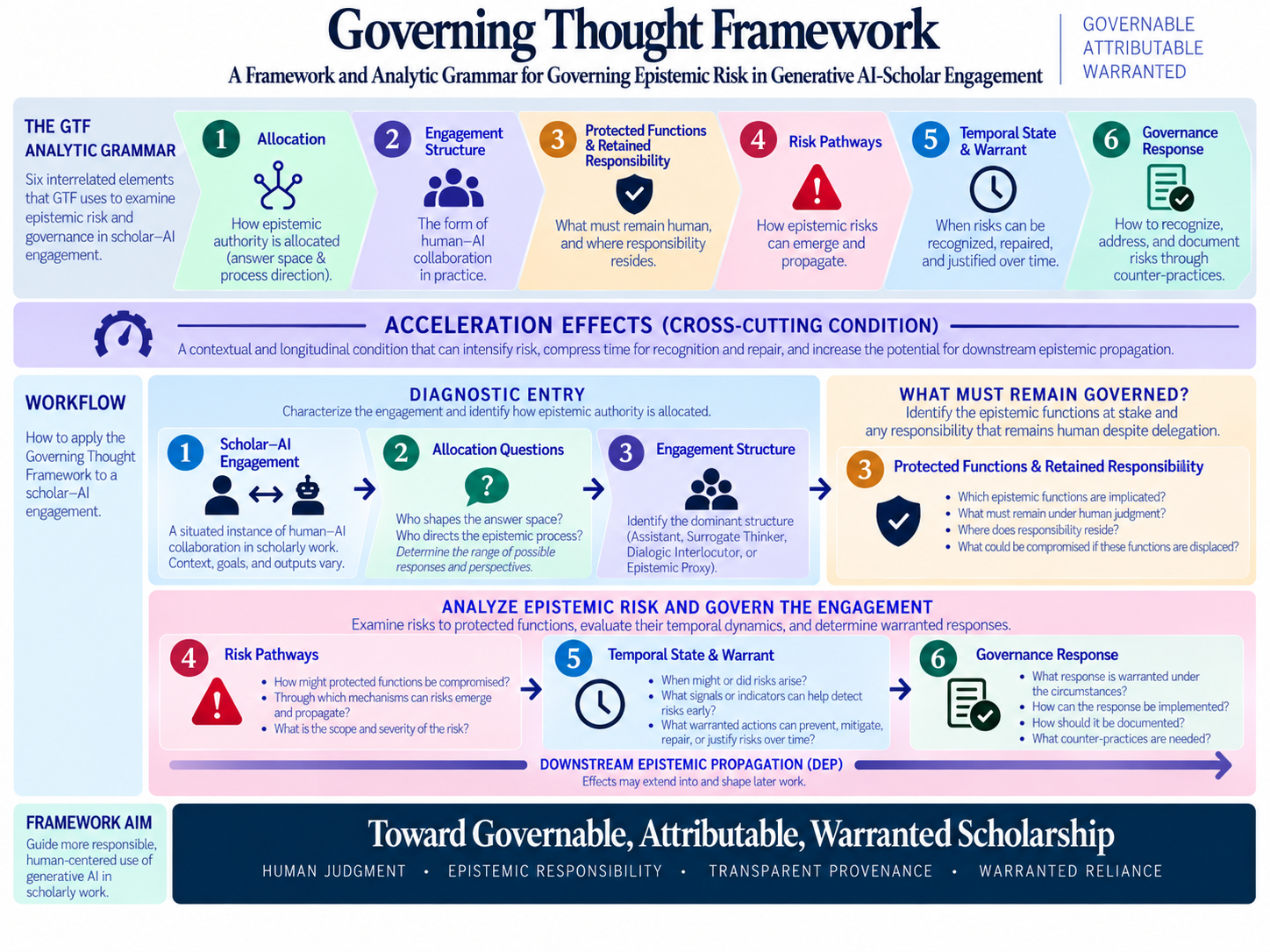
Generative AI scholarship increasingly differentiates forms of human–AI collaboration, yet nominal human involvement does not specify who shapes the answer space, directs the epistemic process, retains epistemic responsibility, or can establish warrant when intervention occurs. This paper presents Governing Thought (GTF), a conceptual framework for diagnosing epistemic risk in scholar–AI episodes. GTF distinguishes four recurrent ideal-typical engagement structures—Assistant, Surrogate Thinker, Dialogic Interlocutor, and Epistemic Proxy—interpreted through two allocation questions concerning answer-space shaping and process control. Eight organizing families contain nineteen risk pathways, with Accountability Diffusion as a twentieth cross-family pathway. Three cross-taxonomy temporal relationships—path-dependent warrant, temporal displacement, and Downstream Epistemic Propagation—address how risk, recognition, repair, and dependence unfold over time. Acceleration Effects is treated as a contextual and longitudinal condition rather than a structure, pathway, or temporal relationship. Epistemic Abdication is defined normatively as material failure to discharge an applicable retained epistemic responsibility. Component literatures ground selected mechanisms, protected functions, and professional duties, while GTF’s architecture and boundaries remain conceptual syntheses requiring empirical testing. GTF contributes an analytic grammar for relating allocation, protected functions, responsibility, risk pathways, temporal state, warrant, propagation, and governance response.
Keywords:
artificial intelligence
; epistemic governance
; scholarly practice
; human–AI collaboration
; epistemic responsibility
; epistemic provenance
Copyright: This open access article is published under a Creative Commons CC BY 4.0 license, which permit the free download, distribution, and reuse, provided that the author and preprint are cited in any reuse.