

Submitted:
30 August 2026
Posted:
14 September 2026
You are already at the latest version
Abstract
Black-hole entropy scales with horizon area rather than interior volume. This conceptual hypothesis interprets that area law as the thermodynamic signature of boundary topological recycling: in stationary exterior bookkeeping, a structured infalling configuration is mapped to conserved charges plus unresolved horizon, radiation, and correlation channels, while its detailed organization no longer appears as recoverable stationary exterior architecture. The paper represents this distinction with a many-to-one exterior map, a four-channel decomposition, and a schematic structural/topological-load template K[Γ]. It separates loss from the stationary exterior ledger from claims about microscopic nonunitarity or annihilation and compares the interpretation with stretched-horizon, holographic, fuzzball, soft-hair, entanglement, and island/Page-curve accounts. The formulation states inherited consistency conditions—leading area scaling and no additional classical hair attributable to unprotected complexity within stationary electrovacuum—and identifies transient relaxation and radiation correlations as candidate research channels. The maps and K[Γ] are bookkeeping constructions: their spaces, weights, and dynamics remain unspecified. The hypothesis therefore defines a conceptual research program rather than a microscopic entropy count or quantitative prediction. A completion would need to define and evaluate the structural quantity, recover the coefficient 1/4 without calibration, and derive an outcome that distinguishes the model from a named comparator.
Keywords:
black-hole entropy
; Bekenstein–Hawking entropy
; event horizons
; boundary topology
; topological recycling
; information bookkeeping
; quantum gravity
Methodological status. Foundational hypothesis and architectural statement. Equation (1) is an established input; Eqs. (2)–(5) are bookkeeping constructions; and Eq. (6) is a diagnostic placeholder. The article interprets the area law and specifies a research program. It does not supply a microscopic state count, derive the Bekenstein–Hawking coefficient, or make an outcome-rigid quantitative prediction.
Source context. The corpus owner Black Hole Entropy as Topological Decomposition and Substrate Recycling and the architecture paper Horizons Across Scale: Proton Confinement, Black-Hole Trapping, and the Cosmic Seam appear within version 12 of the author’s Foundations of Toroidal Scale Mechanics corpus deposited at Zenodo (version DOI: https://doi.org/10.5281/zenodo.22167841; concept DOI: https://doi.org/10.5281/zenodo.19301644) [19,20,21]. The present submission is a standalone Hypothesis manuscript with theory-neutral framing, explicit mathematical limits, and defined construction targets. The corpus is written by the present author alone, self-archived, and not peer reviewed.
Pronunciation. Nonstandard symbols introduced below are spoken as follows: (“capital pi sub ext”), (“script dee sub aitch”), ⊕ (“oh-plus”), (“kay of capital gamma”), (“capital yoo sub aitch”), R (“capital arr”), (“capital see sub corr”), (“capital sigma”), (“script ee”), (“script ell sub pee”), ℏ (“h-bar”), (“kai”), (“capital eff sub corr”), and (“see-dot out”).
1. Introduction
Black-hole thermodynamics gives one of the sharpest indications that gravitational systems do not count states like ordinary bulk matter. For a Schwarzschild black hole, the entropy is
where A is the horizon area and is the Planck length. The formula scales with area rather than interior volume. It underlies the holographic instinct and the modern black-hole information problem [1,2,3,4,5,6].
This article proposes a bounded interpretation of that area law. In the stationary exterior description, the horizon is treated as a boundary-processing surface. An infalling object can carry knotting, linking, chirality, field correlations, winding, vorticity, strain constraints, and ordinary compositional structure. After relaxation, the simplest stationary electrovacuum exterior is described by mass, angular momentum, and charge [7]. The original organization no longer appears as accessible exterior architecture.
The phrase boundary topological recycling names that bookkeeping transition. Black-hole entropy is read as the boundary-associated thermodynamic signature of unmaking organized infalling topology as exterior-recoverable structure. The resulting information may be represented by horizon degrees, radiation correlations, microscopic states, or other channels supplied by a future quantum-gravity theory. The stationary exterior ledger retains conserved quantities; it does not display the object’s detailed unprotected organization as ordinary stationary hair.
This reading is compatible with stretched-horizon, holographic, fuzzball, soft-hair, and island/Page-curve frameworks [8,9,10,11,12,13]. It also fits the thermodynamic lineage in which horizon equations are understood as coarse-grained descriptions of unspecified microscopic degrees. Jacobson obtained the Einstein equation by imposing the Clausius relation on local Rindler horizons, while Padmanabhan developed a broader emergent-gravity program based on horizon thermodynamics [14,15]. The present question is narrower: what organized structure ceases to be represented in the settled exterior ledger?
The contribution is therefore conceptual. Explicit bookkeeping maps organize the distinction between retained charges and unresolved channels. A schematic structural functional names the kind of organization under discussion. These objects identify what a dynamical completion must construct; they do not themselves provide that completion.
2. Relation to Typed Horizons in TSM
Within the revised TSM architecture, the astrophysical black-hole horizon is proposed as one typed realization of an observer-available outward-transfer channel closing relative to its frozen open-side active block [20]. The proton boundary and the cosmic scale seam are proposed to share that operator pattern, but they are not assigned the same geometry, state variables, or physical ledger. Each requires sector-specific junction conditions and an observation map.
The present paper concerns only the astrophysical black-hole ledger: the relation among a stationary exterior, horizon thermodynamics, unresolved microscopic degrees, radiation, and correlations. It supplies no proton model and no cosmological transfer law. Conversely, the cross-scale classification does not derive the bookkeeping maps below or the Bekenstein–Hawking coefficient. It identifies a possible common architectural role whose validity depends on independent recovery in every typed sector.
3. The Picture: A Boundary-Processing Abstraction
The exterior description of a settled black hole can be represented schematically by a many-to-one map
where denotes the rich state space of infalling matter and fields, while X denotes the stationary exterior ledger. Equation (2) records what that coarse-grained description retains. No topology, measure, or Hilbert-space structure is assigned to here, and is not a proposed dynamical operator.
A fuller ledger separates channels hidden by the stationary exterior summary:
Here is a structured infalling configuration; denotes unresolved horizon or microscopic degrees; R denotes radiative degrees; and denotes correlations not visible as new stationary hair. The symbol ⊕ partitions bookkeeping channels; it does not assert an algebraic direct sum. The channel spaces, their overlaps, and their evolution remain to be specified by a microscopic model.
Figure 1.
Boundary topological recycling. A structured infalling object carries organized structure and conserved charges. In the stationary bookkeeping used here, the finite-area horizon boundary maps the state into exterior charges plus unresolved horizon, radiation, and correlation channels. The stationary electrovacuum ledger retains no ordinary hair for the detailed unprotected organization. The figure and its generating script are original to this work and included in the source archive.
Figure 1.
Boundary topological recycling. A structured infalling object carries organized structure and conserved charges. In the stationary bookkeeping used here, the finite-area horizon boundary maps the state into exterior charges plus unresolved horizon, radiation, and correlation channels. The stationary electrovacuum ledger retains no ordinary hair for the detailed unprotected organization. The figure and its generating script are original to this work and included in the source archive.
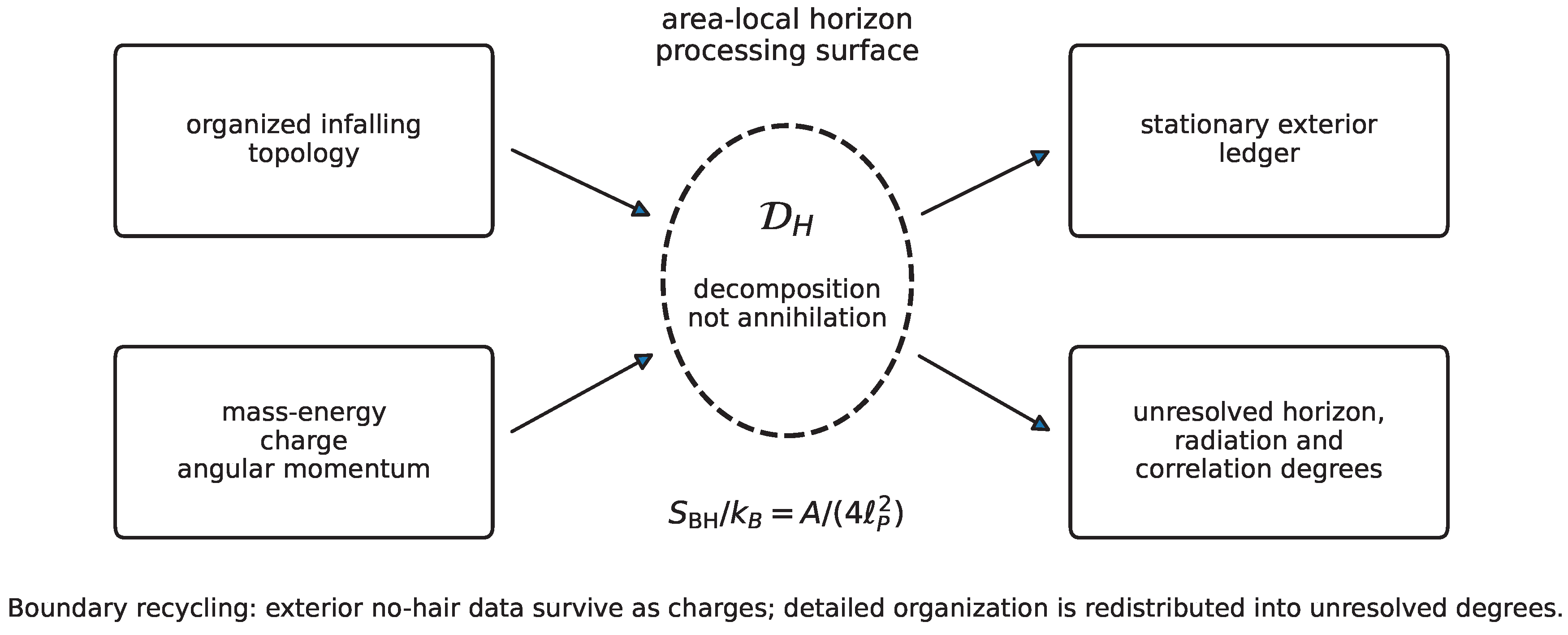
The occupant of is deliberately left open. Entanglement calculations provide one concrete neighboring example. For a scalar field discretized on a radial lattice, the ground-state contribution to entanglement entropy is concentrated near the horizon, while excited and superposed states draw contributions from farther away and generate subleading power-law corrections [16]. Such exterior field degrees are a candidate realization of part of , not an assumption of the present hypothesis.
The abstraction requires only an area-local stationary thermodynamic law and a sparse exterior ledger. It does not decide whether a microscopic completion places relevant degrees on, inside, outside, or nonlocally across the horizon.
4. Organized Structure and a Candidate Topological-Load Template
To display the proposed bookkeeping, let a configuration be associated with the template
The quantities may represent nonnegative crossing, knotting, or winding complexities; may represent linking or correlation indices; may represent chirality; and may represent strain, alignment, or field-correlation cost on a supporting surface . Related helicity and knottedness bookkeeping is standard in vortex and fluid settings [17].
Equation (4) is a schematic candidate structural/topological-load functional. It is nonnegative only under declared conditions such as , , , and . Its weights must also absorb any units needed to combine the terms. No normalization, equivalence relation, evaluation procedure, or physical measure is supplied here. Because the final term can depend on energetic or geometric structure rather than topology alone, K is not asserted to be a topological invariant. It is not identified with , a microscopic entropy, or a computed observable.
The scoped boundary-recycling claim is
The statement concerns recoverable stationary exterior organization. It does not erase conserved charges, protected hair, transient fields, microscopic degrees, or correlations carried by other channels.
5. The Area Law as a Constraint
Equation (1) provides the thermodynamic ledger that the hypothesis interprets. A larger horizon area carries a larger stationary entropy. On the present reading, the horizon is the boundary at which exterior-accessible organization ceases to remain available in its previous form.
Area scaling is an input and a correspondence constraint, not an output of Eq. (4). The interpretation does not select among candidate microstate programs and does not derive the factor . Any microscopic completion of the proposal must explain why its state count or entropy functional reduces to Eq. (1) in the relevant regime without choosing free parameters solely to enforce that result.
Two collapse histories can reach the same final and the same stationary entropy while carrying different unprotected structural workloads. Any surviving distinction must then lie outside the stationary electrovacuum ledger—for example in transient relaxation, horizon response, radiation correlations, or microscopic state assignment.
6. Recycling, Exterior Loss, and Microscopic Evolution
The phrase information loss can refer to different propositions:
- 1.
- exact microscopic evolution is nonunitary;
- 2.
- the original organized object is not recoverable from simple stationary exterior variables;
- 3.
- the physical content of the object literally vanishes.
The present hypothesis asserts the second proposition within its stated scope. It remains compatible with either unitary or nonunitary microscopic proposals until an explicit channel dynamics is supplied.
A possible future completion may place correlations in radiation, horizon edge modes, a holographic boundary Hilbert space, interior degrees, or nonclassical microstates. A schematic diagnostic for one such channel is
The flux density , its units, boundary conditions, and constitutive law are undefined here. Equation (6) therefore yields no rate, waveform, or numerical effect. It identifies a location in the bookkeeping where a microscopic realization could place correlations absent from stationary hair.
7. Relation to Existing Black-Hole Pictures
The proposal accepts the thermodynamic constraints supplied by Bekenstein entropy, the four laws, and Hawking radiation [1,2,3,6]. Holography and complementarity place strong emphasis on boundary descriptions [4,5,8]. String microstates and fuzzballs provide specific microscopic structures [9,10]. Soft-hair proposals enlarge the information that can be associated with asymptotic or horizon degrees [11]. Page-curve and island constructions address global information recovery in radiation [12,13]. Emergent-gravity approaches treat horizon thermodynamics as a coarse-grained statement about underlying degrees [14,15,18].
Boundary topological recycling does not compete with those mechanisms at their level of detail. It supplies a conceptual grammar for the transition from organized infalling structure to a sparse stationary exterior ledger. A microscopic theory can populate , R, and in different ways while preserving that distinction.
8. Consistency Conditions and Research Channels
The items below are inherited consistency conditions or development targets. They are not current predictions of Eqs. (2)–(6).
8.1. Leading Area-Scaled Stationary Entropy
A completion must preserve horizon-area scaling as its leading stationary thermodynamic result in the regime where Eq. (1) applies. Subleading corrections are compatible with the interpretation. A fundamentally volume-extensive leading stationary entropy would defeat the boundary reading developed here.
8.2. Scoped Stationary Exterior Ledger
Within the stationary electrovacuum regime represented by , varying unprotected infalling structural complexity at fixed final mass, angular momentum, and charge should not create an additional classical stationary exterior hair attributable to that complexity. This condition does not deny protected charges, transient fields, quantum hair, or microscopic distinctions.
8.3. Transient and Correlation Research Channels
A numerical-relativity or quantum-gravity implementation could compare topologically simple and complex infall at the same conserved charges and examine scrambling time, horizon shear, ringdown fine structure, radiation correlations, or late-time nonthermal residuals. Such a channel becomes discriminating only where the model’s derivation chain rigidly fixes a nonzero effect, sign, ordering, threshold, waveform feature, or other outcome that a named comparator does not share, with no free parameter available to steer it and without consuming the compared observation anywhere in the derivation.
8.4. Finite-Microstructure Compatibility
The bookkeeping does not require a physical point singularity. Finite-microstructure, boundary, interior, and nonlocal completions are compatible with it. A theory demonstrating that no boundary-associated or distributed microscopic description can support the entropy mechanism would disfavor the present interpretation.
9. Mathematical Status and Construction Targets
The boundary between the present hypothesis and a quantitative theory can be stated as four construction targets.
- 1.
- Type the state and channel spaces. Define the admissible configurations, equivalence relations, topology or measure, and the mathematical status of and . Specify whether the channels overlap and give a dynamical rule for their evolution.
- 2.
- Replace the template with an evaluable quantity. Define a physical functional or invariant with units, normalization, and controlled behavior under coarse-graining. Evaluate it on at least two nontrivial configurations with the same conserved exterior charges.
- 3.
- Supply the microstate correspondence. Connect the defined quantity to a state count, density matrix, or entropy functional and recover without calibrating an otherwise free cell scale or degeneracy to force the coefficient.
- 4.
- Derive an outcome-rigid discriminator. Produce at least one target-independent quantitative consequence whose sign, scaling, threshold, or waveform differs from a named comparator and is fixed by the model’s own structure, with the compared observation absent from its derivation chain.
These are open research requirements, not results claimed by the present article. Completing any one in isolation would be useful; a results manuscript would need a coherent chain connecting all four.
10. Discussion
Black-hole entropy is commonly described as a count of hidden states. That thermodynamic language leaves open the physical transition experienced by organized infalling matter. In the boundary-recycling grammar, the object is no longer represented as recoverable stationary exterior architecture. Its conserved quantities remain in the exterior ledger, while other content is assigned to unresolved horizon, radiation, correlation, or microscopic channels.
This frames why black-hole entropy sits differently from the entropy of ordinary bulk matter. A gas in a box is described by an extensive bulk state count. A stationary black hole presents an area-local thermodynamic ledger. The present hypothesis reads that ledger as the boundary signature of the loss of organized exterior recoverability; it does not decide the ontology of the underlying microstates.
The formal symbols sharpen the research question but do not solve it. The construction targets in Section 9 state what must be added before the proposal can support microscopic state counting or quantitative discrimination. In particular, cannot be promoted to an entropy merely because it contains topological language, and Eq. (6) cannot support a forecast until a constitutive theory fixes .
11. Conclusions
This conceptual hypothesis proposes that black-hole entropy can be read as boundary topological recycling. In the stationary bookkeeping developed here, a finite-area horizon maps structured infall into exterior conserved charges plus unresolved horizon, radiation, and correlation channels. Detailed unprotected organization ceases to appear as recoverable stationary exterior architecture. That scoped statement is distinct from assertions of microscopic nonunitarity or literal annihilation.
The area law constrains the proposal. It is not derived by the schematic maps or by . The present value of the formulation is to identify the physical distinction, keep its logical limits explicit, and define the mathematical work required for a quantitative successor: typed state spaces, an evaluable structural quantity, a non-calibrated microstate correspondence, and an outcome-rigid discriminator.
12. Glossary
Boundary topological recycling. The proposed loss of organized infalling structure as recoverable stationary exterior architecture, with physical bookkeeping redistributed among conserved, horizon, radiation, correlation, or microscopic channels.
Exterior ledger. The scoped stationary electrovacuum variables retained by the coarse-grained exterior description.
Protected structure. Information tied to a conserved or otherwise protected charge that remains in the physical ledger. The present loss claim is limited to unprotected organization.
Structural/topological-load template . The schematic functional in Eq. (4). It names candidate structural information but is not a computed invariant, state count, entropy, or observable.
Unresolved channels., R, and in Eq. (3): respectively horizon or microscopic degrees, radiative degrees, and correlations absent from ordinary stationary hair.
Outcome-rigid discriminator. A quantitative result whose sign, scaling, threshold, waveform, or other outcome is fixed by the model’s structure, cannot be steered by a free parameter, excludes the target observation from its derivation chain, and differs from a named comparator.
Author Contributions
Conceptualization, methodology, investigation, and writing—original draft preparation, review, and editing, V.A.W.; project administration, V.A.W. The author has read and agreed to the published version of the manuscript.
Funding
This research received no external funding.
Institutional Review Board Statement
Not applicable.
Informed Consent Statement
Not applicable.
Data Availability Statement
No new data were created or analyzed in this study. The manuscript source, original figure, and figure-generating script are included in the submission archive. A precursor appears in version 12 of the corpus at https://doi.org/10.5281/zenodo.22167841; the corpus concept DOI is https://doi.org/10.5281/zenodo.19301644.
Conflicts of Interest
The author declares no conflicts of interest.
Use of Artificial Intelligence
The author used multiple general-purpose large language models during the preparation of this manuscript. Uses included research and source triage, manuscript organization, drafting and revision, LaTeX and code assistance, numerical cross-checking, and internal consistency review, as applicable. AI outputs were treated as provisional working material. The author reviewed and adjudicated the underlying sources, calculations, code, figures, and final text and accepts full responsibility for the manuscript. The manuscript was also subjected to multi-model cross-refutation, with disagreements resolved against the cited sources, calculations, and code.
References
- Bekenstein, J.D. Black Holes and Entropy. Phys. Rev. D. 1973, 7, 2333–2346. [Google Scholar] [CrossRef]
- Bardeen, J.M.; Carter, B.; Hawking, S.W. The Four Laws of Black Hole Mechanics. Commun. Math. Phys. 1973, 31, 161–170. [Google Scholar] [CrossRef]
- Hawking, S.W. Particle Creation by Black Holes. Commun. Math. Phys. 1975, 43, 199–220. [Google Scholar] [CrossRef]
- ’t Hooft, G. Dimensional Reduction in Quantum Gravity. arXiv. 1993. Available online: https://arxiv.org/abs/gr-qc/9310026.
- Susskind, L. The World as a Hologram. J. Math. Phys. 1995, 36, 6377–6396. [Google Scholar] [CrossRef]
- Wald, R.M. The Thermodynamics of Black Holes. Living Rev. Relativ. 2001, 4, 6. [Google Scholar] [CrossRef] [PubMed]
- Chruściel, P.T.; Costa, J.L.; Heusler, M. Stationary Black Holes: Uniqueness and Beyond. Living Rev. Relativ. 2012, 15, 7. [Google Scholar] [CrossRef] [PubMed]
- Susskind, L.; Thorlacius, L.; Uglum, J. The Stretched Horizon and Black Hole Complementarity. Phys. Rev. D. 1993, 48, 3743–3761. [Google Scholar] [CrossRef] [PubMed]
- Strominger, A.; Vafa, C. Microscopic Origin of the Bekenstein–Hawking Entropy. Phys. Lett. B 1996, 379, 99–104. [Google Scholar] [CrossRef]
- Mathur, S.D. The Fuzzball Proposal for Black Holes: An Elementary Review. Fortschr. Phys. 2005, 53, 793–827. [Google Scholar] [CrossRef]
- Hawking, S.W.; Perry, M.J.; Strominger, A. Soft Hair on Black Holes. Phys. Rev. Lett. 2016, 116, 231301. [Google Scholar] [CrossRef] [PubMed]
- Page, D.N. Information in Black Hole Radiation. Phys. Rev. Lett. 1993, 71, 3743–3746. [Google Scholar] [CrossRef] [PubMed]
- Penington, G. Entanglement Wedge Reconstruction and the Information Paradox. JHEP 2020, 09, 002. [Google Scholar] [CrossRef]
- Jacobson, T. Thermodynamics of Spacetime: The Einstein Equation of State. Phys. Rev. Lett. 1995, 75, 1260–1263. [Google Scholar] [CrossRef] [PubMed]
- Padmanabhan, T. Thermodynamical Aspects of Gravity: New Insights. Rep. Prog. Phys. 2010, 73, 046901. [Google Scholar] [CrossRef]
- Das, S.; Shankaranarayanan, S.; Sur, S. Where Are the Degrees of Freedom Responsible for Black-Hole Entropy? Can. J. Phys. 2008, 86, 653–658. [Google Scholar] [CrossRef]
- Moffatt, H.K. The Degree of Knottedness of Tangled Vortex Lines. J. Fluid Mech. 1969, 35, 117–129. [Google Scholar] [CrossRef]
- Kothawala, D.; Padmanabhan, T. Entropy Density of Spacetime as a Relic from Quantum Gravity. Phys. Rev. D. 2014, 90, 124060. [Google Scholar] [CrossRef]
- Woodward, V.A. Foundations of Toroidal Scale Mechanics, version 12; Zenodo, 2026. [Google Scholar] [CrossRef]
- Woodward, V.A. Horizons Across Scale: Proton Confinement, Black-Hole Trapping, and the Cosmic Seam. In Foundations of Toroidal Scale Mechanics, version 12; Zenodo, 2026. [Google Scholar] [CrossRef]
- Woodward, V.A. Black Hole Entropy as Topological Decomposition and Substrate Recycling. In Foundations of Toroidal Scale Mechanics; version 12: Zenodo, 2026. [Google Scholar] [CrossRef]
Disclaimer/Publisher’s Note: The statements, opinions and data contained in all publications are solely those of the individual author(s) and contributor(s) and not of MDPI and/or the editor(s). MDPI and/or the editor(s) disclaim responsibility for any injury to people or property resulting from any ideas, methods, instructions or products referred to in the content. |
© 2026 by the authors. Licensee MDPI, Basel, Switzerland. This article is an open access article distributed under the terms and conditions of the Creative Commons Attribution (CC BY) license (http://creativecommons.org/licenses/by/4.0/).
Copyright: This open access article is published under a Creative Commons CC BY 4.0 license, which permit the free download, distribution, and reuse, provided that the author and preprint are cited in any reuse.