

Submitted:
11 September 2026
Posted:
14 September 2026
You are already at the latest version
Abstract
Bipolar membrane electrodialysis (BMED) is an electro-membrane separation technology used for over 20 years to treat liquid wastes, including wastewater from various industrial processes, municipal wastewater, and animal farms. This technology has been developed for its ability to dissociate H2O into H+ and OH− ions and to convert cations and anions in the feed solution into bases and acids, respectively, by applying an electrical potential. In comparison with alternative treatment technologies, BMED has some advantages, such as no need for chemical reagents, high degrees of efficiency, and straightforward operational procedures. However, BMED has been limited by a high level of preparation expense for BMs, membrane deposition, and ion loss during operation. This review mainly describes the principles and designs of BMED, their compositions along with their advantages and disadvantages, the membrane fouling and cleaning, and also the trend of their application in wastewater treatment. Finally, the results on nutrient recovery by BMED show that the performance of BMED depends on the nature of the ion exchange membranes used, the composition of the sample solution, the process conditions, and the configuration of the membrane stack.
Keywords:
bipolar membrane
; electrodialysis
; membrane fouling
; nutrients
; wastewater
1. Introduction
In recent years, electro-membrane technologies have become more interesting in the field of environmental protection [1]. Among them, bipolar membrane electrodialysis (BMED) is a process in which, under an electrical potential, a selective separation of ions (cations and anions) and their recoveries in the form of base and acid without adding any chemicals is achieved through the use of cation-exchange membranes (CEMs), anion-exchange membranes (AEMs) and bipolar membranes (BMs) [2,3,4]. The method described above is a water treatment technology that can save the health of the environment by avoiding its contamination. It can be applied to the treatment of municipal wastewater, wastewater from industry, brackish water, in drug and food industries, chemical processes, heavy metals removal due to its ability to separate and recover ionic compounds in acidic and alkaline solutions from salt solution under the effect of electrical potential [3,5,6].
Due to the increasing amount of nitrogen and phosphorous in wastewater, some researchers have made efforts to recover these nutrient elements from waste liquids. According to Chirag et al. [7], nutrients extraction from wastewater can occur via different technologies such as chemical precipitation or crystallization, by gas-permeable membranes, and liquid–gas stripping. These treatment technologies use different chemicals for the pre- and post-treatment of water, which have a substantial negative impact on the environment, while the BMED process produces both concentrated and dilute streams without adding chemicals [8,9]. Furthermore, BMED can be used to separate and recover phosphates and ammonium from liquid waste in their acidic and basic forms [10]; respectively. This technology can also accomplish a separation of monovalent ions against multivalent ions by using monovalent selective ion exchange membranes. Wu et al. [11] reported that BMED, which is an electro-membrane process, is an efficient method for separating and recovering both NH4+, PO43-, and NO3- from salty wastewater. Despite its demonstrated potential, the practical application of the BMED process remains constrained by high operational costs, membrane fouling, ion losses, and limited understanding of how membrane properties, operating conditions, and stack configuration influence its nutrient recovery performance.
The aim of this review is to describe the principle of the BMED process, its advantages and disadvantages, the membrane fouling and cleaning, along with their applications in wastewater treatment.
2. Principles of BMED
The development of electro-membrane process has been limited by the higher H2 and O2 generation. In 1956, Frilette [12] proposed the bipolar membrane (BPM), which has low energy consumption [13]. During BMED, there is H2 and O2 generation, and there is no effect on the electrode. Additionally, the amount of energy consumed by BMED for 1 mol of water is 79.9 KJ/mol, while that of ED is 198.5 KJ/mol [4]. When compared to other electrochemical processes, these characteristics offer BMED greater application opportunities [2,4]. BMED is a membrane process distinguished by the application of BPM between electrodes [4]. This process is a rather new electro-membrane technique that uses an applied voltage to dissociate water into protons (H+) and hydroxide ions (OH−) [3,14]. This innovative technique features three fundamental configurations (two-chamber BMED containing base or acid; three-chamber BMED) per one cell pair according to its application and three types of ion exchange membranes (BM, CEM, and AEM) in specific arrangements [15]. Each unit of the three-chamber BMED has CEM, AEM, and BPM and can be beneficial for the separation and recovery of salts as acids and base [16].
Compared with other electrochemical process, BMED consumes low energy and has high economic effectiveness [4]. The voltage (0.828 V) needed for water dissociation in BPMs is significantly less than that of water electrolysis on electrodes (2.057 V) [17]. The following reactions show the potentials required on electrodes and in BPMs comparatively.
3H2O → 1/2O2 + H2 + 2H+ + 2OH−, 2.057 V
Cathodic reaction: 2H2O + 2e → H2 + 2OH−, 0.828 V
Anodic reaction: 2H2O → O2 + 4H+ + 4e, 1.229 V

The low energy consumption of BMED helps to save power and the necessity of cooling. Another advantage of bipolar membrane water splitting is the absence of gas production, such as H2, O2, and Cl2, during water dissociation. Consequently, neither the cathode nor the anode is corroded [17].
2.1. BPMs
In the past decade, BPMs have been one of the various kinds of ion exchange membranes (IEMs) that have drawn more attention. These membranes consist of two layers: an anion exchange layer (AEL) and a negatively charged cation exchange layer (CEL), as well as an interface between the two layers known as the "bipolar junction" or "hydrophilic interface layer" (IL) [16,18]. In contrast to IEMs used for the separation of ions, BPMs are made to split water into hydroxyl and hydrogen ions at the bipolar intersection after an electrical current is applied. With the electrical current application, hydrogen and hydroxyl ions are produced by water electro-dissociation at the intermediate layer of the BPMs and move toward the cathode and anode compartments through CEL and AEL, respectively [19]. The arrangement of BPMs to the electrodes depends on the target: to ensure the water splitting into OH- and H+, the CEL must be positioned towards the cathode and the AEL towards the anode. This arrangement is a so-called “reverse-bias” condition. In fact, the protons (H+) pass through CEL, while OH- ions flow through AEL, creating an acid and a base on the membrane's opposing sides (Figure 2a). If the electrical field's orientation across the BPM is inverted, the CEL will then face to the anode and the AEL to the cathode. This position is called the “forward bias” condition (Figure 2b). Therefore, H+ and OH- ions move out of the external solutions towards the hydrophilic interface layer to form water from the acid-base neutralization reaction. Figure 2 shows the principle of BPM under reverse-bias and forward-bias modes.
In BPM, two reactions of protonation and deprotonation can be used to explain the mechanism of water dissociation [16,20].
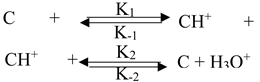
CH+ : fixed charged groups of AEL), K1;2: forward rate constants and K-1; -2: backward rate constants.
For the weak acid (AH), the reactions are
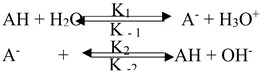
These protonation-deprotonation reactions of water splitting can be summarized by the following equation:

2.1.1. Cation Exchange Layer (CEL)
The positive type material of the cation exchange layer (CEL) is created by introducing an acceptor impurity, such as boron to silicon, which results in a shortage of valence electrons, or "holes”[16]. Due to this propriety, CEL allows only H+ to migrate toward the cathode. Different acids usually used in CEL are the groups of sulfonic acid and phosphoric acid groups in rare cases [19]. There are also other CEL based on poly (2,6-dimethyl1,4-phenylene oxide) as the organic component and (3-aminopropyl) triethoxysilane as the modified chitosan [20], inorganic hybridizing agent [21], polyetherketone [22] and sodium alginate [23]. Table 1 shows the types of polymers and ion exchange groups given in literature.
2.1.2. Anion Exchange Layer (AEL)
2.2. Ion-Exchange Membranes
Ion-exchange membranes are made of semi-permeable polymers with functional groups added to the polymer matrix to impart either positive or negative charges. According to the membrane fixed functional group, membranes for cations exchange (negatively charged functional groups) and membranes for anions exchange (positively charged functional groups) are two different forms of ions exchange [24]. The mobile ions so-called counter-ions have an opposite charges of fixed group charges on the polymer. The mobile ions so called co-ions have the same charges with that of fixed groups [25]. Figure 1a and Figure 1b show migrations of cations and anions through cation exchange membrane and anion exchange membrane; respectively under an electrical field.
2.2.1. Mass Transfer
The components of mass transfer in the electromembrane process are IEMs, concentration polarization films, bulk solution and electrodes. According to Kabay et al. [26], ions transport within the membrane or electrolyte is controlled by migration, diffusion and convection. The derivative of the Nernst Planck equation with a convective term is frequently used to describe the ion flux in solution or the membrane at constant state [27]:
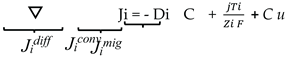 Ji: ionic flux towards the membrane surface (mol/m2 s 1), Di: ion coefficient diffusion (m2 /s), zi and Ti: ion's transport and valence numbers, respectively, F: Faraday constant (C/mol), j: current density (A/m2), c: ion's molar concentration (mol/m3) and u: fluid velocity parallel to the membrane surface (m/s).
2.1.2. Membrane Fouling and Scaling
The most important factor that limits ions separation and recovery in BMED system is fouling and scaring phenomena. Wang et al. [28] and Lindstrand et al. [29] reported that membrane fouling is a significant issue that can impact the electro-membrane process by decreasing flux, raising membrane resistance, and consuming more energy. Membrane fouling is known as the deposition of insoluble biomass, colloids and organic components within the membrane or on its surface, such as oil, carbohydrates, proteins, aromatic substances and humic acid while scaling is the precipitation of salts present in feed solution on the surface or in the channels of membrane [14,30]. The main scaling ions are sulfate, bicarbonate, calcium, magnesium, and barium. Guo et al. [31] and Shirazi et al. [32] revealed that some organics (such as natural organic matter, protein, Surfactants, polysaccharides) and inorganics (such as Fe2O3, SiO2, Al2O3, CaPO4, CaCO3, CaSO4) are the most widely distributed organic and inorganic foulants and scales. It has been established that particles which are larger than the membrane's pore size are unable to pass through the membrane and lead to its deposition on the membrane's surface. According to Oztekin & Altin [33], as time progresses, the build-up of foulants and scales on the membrane surface increases, resulting in the formation of a gel layer. The gel layer undergoes an increase with an increase in charge accumulation, subsequently becoming both thinner and denser. Oztekin & Altin [33] also reported that fouling potential is increased by high concentrations of salts in feed solution. The previous studies regarding membrane accumulation have more interested on membranes for anion exchange. Most of research works carried out have shown that fouling affects AEMs more than CEMs because of the negatively charged colloids in natural water [34].
The foulants which can affect AEMs are organic compounds such as natural organic compounds whereas colloidal materials, proteins, insoluble inorganic salts affect CEMs [33]. High hydrodynamic pressure loss and flow deterioration during the process are attributed to the presence of suspended solids, silicates and substances exhibiting low solubility, including iron hydroxide and calcium carbonate. The electrical resistance is increased by precipitation of compounds on the membrane surface and lead to physical damage of membrane structure [35]. The precipitation of inorganic salts results in the formation of crystals on the membrane surface and this phenomenon is reversible [36]. Various compounds which lead to different precipitation effect during electro-membrane process are heavy metals, alkaline metals; dissolved gases, inorganic and organic colloidal substances, dissolved organic compounds and biomass [35].
Lindstrand and al. [29] investigated the influence of different organic solutes on the fouling phenomenon on membrane, and observed that the resistance of CEMs was marginally increased, while AEMs were fouled by all solutes tested. It was also reported that the observed difference was attributed to the electrostatic interactive relation existing between the negative charges of the membrane and the negatively charged organic molecules.
Current density is another parameter which affects the fouling of IEMs by making fast fouling at higher current densities [37]. In general, fouling phenomenon in ED systems relies on the chemical and physical characteristics of the foulants, the characteristics of membranes, and also the solution properties. They affect the performance of the membrane by flux drop or increase in the electrical resistance of the membranes
2.1.4. Prevention and Mitigation of Membrane Deposition
Many researches have been conducted on the reduction of membrane fouling and some methods proposed are the induction of turbulence in the cell compartments, the preliminary treatment of the feed solution, the improvement of process conditions and membrane properties [33]. Electro-membrane process is more resilient to membrane fouling resulting from suspended particles than RO, MF, UF and NF [38], because of frequent electrode reversal, also known as EDR which can decrease fouling build-up on membranes [39,40]. Chemical cleaning and EDR operation can be used to eliminate the inorganic fouling. According to Lin et al [39], EDR is an efficient process in prevention of membrane fouling by regularly changing the electrode polarities. While ions are being transported, the substances aggregate and chemicals precipitate on the membrane's surface coverage. AEMs are easily fouled by foulants that deposit on the membrane surface because so many of them have negative charges. The dissociation of the particles from the membrane surface using EDR, greatly reduces fouling brought on it by particles aggregation and chemical deposition. However, all foulants cannot be cleaned by EDR or chemicals. Some substances are partially cleaned off by acid solution, creating reversible EDR fouling, whereas some cannot be removed, creating irreversible EDR fouling [39].
The selection of chemical compound to be applied for the purpose of membrane cleaning is contingent upon the membrane's type, the intensity of the contamination and the nature of the pollutants present. The following chemicals are typically advised by membrane producers: weak and strong acid solutions, alkali solution (e.g. NaOH solution), cleaning agents (detergents), complexing agents (e.g. EDTA), disinfectants (e.g. H2O2, NaOCl) and enzymes [34]. Also operational conditions can be considered to reduce fouling. Additionally, Wang et al. [28] investigated the impacts of hydraulic cleaning, acid cleaning, and mixed methods with ultrasound for particles removal on IEMs. The combination of acid cleaning and ultrasound treatment is the most effective cleaning method, which removes the foulants from the surface and inner parts of CEMs [28]. Table 3 shows the kinds of foulants, their charge characteristics, fouling avoidance techniques, and/or cleaning procedures.
3. Applications of BMED Process
3.1.. Acid and Base Production from Liquid Waste by BMED
BMED process appears more attractive in wastewater treatment due to its ability to move ions of a salt solution and to convert them into base and acid (figure 3). Many previous studies investigated the acid and base recovery from wastewater. Gao et al. [41] examined the recovery of hydrochloric acid and sodium hydroxide from sodium chloride contained in wastewater using a BMED system. They indicated that the initial concentration of sodium hydroxide had little or no effect on the acid production, whereas the current density has a significant impact. BMED has also been used to product and recover organic acids including, citric acid [42], acetic acid [43], lactobionic acid [44], succinic acid [45], malic acid [46], tartaric acid [47], propionic acid [48], gluconic acid [49], vitamin C [50], amino acids [51], formic acid [52] and salicylic acid [53]. The flow sheet depicted in Figure 3 shows BMED process for acid and base recovery.
Chen et al. [54] suggested a novel technology called BPM selective electrodialysis (BMSED) to separate Na+/Ca2+ and Cl−/SO42− ions found in concentrated saline solution. This process consists of a monovalent AEM and a monovalent CEM which only permit monovalent ions to migrate through in order to produce a high purity acid/base. The results of this study shown that the purity of HCl and NaOH were both close to 99.9% [54]. Table 4 shows acid and base produced from different salt solutions and liquid waste using BMED.
3.2. Nutrients Separation and Recovery from Wastewater by BMED
The growing urban, rural and industrial water supply increase the amount of wastewater containing different contaminants and nutrients [2]. The management of this wastewater has become one of the environmental and economic challenges. The contamination of surface waters and groundwater by these nutrients is a serious problem around the world. Excessive amount of nitrogen and phosphorous in water causes methemoglobinemia in infants [26] and eutrophication [60]; respectively.
3.2.1. Nitrogen Separation and Recovery from Wastewater by BMED
BMED has been utilized frequently in recent years to separate and recover ammonia from aqueous waste. Li et al. [61] treated simulated NH4Cl of wastewater by BMED and recovered HCl and NH3 solutions. Their findings showed that the energy consumption remained constant at 19 MJ/kg of nitrogen, whereas the ammonia removal efficiency ranged from 85% to 91%. Zhang et al. [62] have investigated the effects of humic acid, Mg2+, and Ca2+ on the extraction of ammonium from a leachate and their findings showed a significant effect with more than 86% of ammonium removal. Gao et al. [60] recovered ~77% nitrogen by a hybrid electrochemical process that combines membrane capacitive deionization (CDI) and BMED. Wu et al. [11] used BMED with monovalent anion exchange membrane to separate and recover NH4 +, PO43−, NO3− from wastewater. They indicated that the separation rates of NH4+, PO43−, and NO3− increased with current density. At 1.0 mA/cm2, the separation rates of NH4+ and NO3− after 140 min were 100% and 100%, while their recoveries were 79.1% and 34.2%, respectively. They explained that this difference in the separation and the concentration rates is caused by membrane adsorption during the process.
Recently, Cao et al. [63] recovered 78.3% of Nitrogen (NH4 +) from simulated wastewater by using BMED. They also noted that the separation and recovery rates of NH4+ increases both with time and current density. By increasing of current density, the amount of energy consumed steadily rises. The separation and recovery rates of ammonium carried out using different type of BMED process depend on the characteristics of ion exchange membrane, sample solution, treatment conditions and the configuration of the stack. Table 5 shows different separation and recovery rates of nitrogen reported in literature.
3.2.2. Phosphorus Separation and Recovery from Wastewater by BMED
BMED has attracted increasing attention as a sustainable approach for nutrient recovery, particularly in the context of phosphorus scarcity and the development of circular economy strategies for wastewater management [4,11]. It has been demonstrated through experimental studies that BMED is capable of effectively separating and concentrating phosphate ions (PO43-) from dilute wastewater streams. This, in turn, has been shown to improve the feasibility of subsequent phosphorus recovery processes, such as struvite precipitation or phosphoric acid production [11]. Furthermore, BMED has been successfully applied to the recovery of phosphorus from various aqueous matrices, including synthetic wastewater and industrial by-products, thereby highlighting its versatility and resource recovery potential [67].
Characteristics such as ion-exchange capacity, membrane selectivity, electrical resistance, water dissociation efficiency, and chemical stability directly affect phosphate transport and energy requirements. The utilisation of high-selectivity membranes has been demonstrated to reduce the co-transport of competing ions and enhance phosphorus concentration in the recovery compartment [4].
Additionnally, the performance of BMED in terms of phosphorus recovery is strongly dependent on the stack configuration. The arrangement of BPMs, AEMs, and CEMs determines ion migration pathways and phosphorus selectivity. As demonstrated by Wu et al. [11], BMED configuration incorporating selective membrane compartments was found to be an effective means of separating phosphate from competing ions, such as nitrate. This process served to enhance phosphorus enrichment, thus facilitating its subsequent recovery as struvite. The authors observed phosphorus transport efficiencies above 80%, thus demonstrating that stack design plays a critical role in nutrient separation. Table 6 shows different separation and recovery rates of phosphorus, membrane properties, BMED configuration and sample used as reported in literature.
Consequently, phosphorus recovery by BMED is not governed by a single factor but rather by the combined effects of membrane-stack configuration, membrane characteristics and wastewater composition, and process operating conditions, all of which must be carefully optimized to achieve high separation efficiency, phosphorus purity, and recovery performance.
4. Conclusions
BMED have a high potential in valorization and desalination of wastewater for its applications to recover dilute water and valuable components. The advantages associated with this process include the following: An increase in the quality of the product; more environmentally friendly process and an increase in the longevity of ion exchange membranes. BMED also exhibits certain advantageous properties, including the absence of a requirement for chemical reagents, high efficiency and a straightforward operational process, which explains why it has been widely employed in the fields of environmental protection and resource recovery. The energy consumption of BMED lower than that of conventional ED. It is evident that these properties afford BMED superior application prospects in comparison to other electrochemical technologies. However, the BMED system has been shown to be limited by a high expense of preparation, membrane deposition and ion loss during operation. Membrane fouling, which is caused by the accumulation of particles and chemical deposition, can be significantly mitigated through a process of dissociation from the membrane surface. It has been demonstrated that pre-treatment of the feed solution and good operating conditions are effective methods for resolving the problem of membrane fouling during operation. The issue of ion leakage can be resolved through the implementation of an acid-blocking membrane, the regulation of cell voltage, current density, and salt compartment solution pH to prevent or diminish the migration of H+. Hence, the efficiency of BMED is influenced by various parameters, including the feed conditions, the properties of the membrane, the electrical current density, and the configuration of the stack structure. This process technology has been used for nutrients separation and recovery from aqueous waste. The separation and recovery rates of ammonium and phosphate carried out using different type of BMED processes depend on the characteristics of ion exchange membrane, feed sample solution characteristics, process conditions and the configuration of the stack.
Author Contributions
All authors: conceptualization, E.N and S. N: investigation, writing—original draft preparation; S.B. and N.K.: review, editing and supervision; S.B.: funding acquisition and project administration. All authors have read and agreed to the published version of the manuscript.
Funding
This study was supported by the European Union through the African Research Initiative for Scientific Excellence (ARISE) pilot program under Grant No. DCI-PANAF/2020/420-028. The European Commission and the African Union Commission assist the African Academy of Sciences in implementing ARISE. The authors of this publication are responsible for its content, which should never be interpreted as representing the position of the African Union Commission, the African Academy of Sciences, or the European Union.
Acknowledgments
The authors are thankful to the University of Burundi for providing all administrative and research facilities required to perform the preparation of this review.
Conflicts of Interest
The authors declare no conflict of interest. The funders had no role in the design of the study; in the collection, analyses, or interpretation of data; in the writing of the manuscript; or in the decision to publish the results.:
Abbreviations
| AEMs | Anion-Exchange Membranes |
| AEL | Anion Exchange Layer |
| BMs | Bipolar Membranes |
| BMED | Bipolar Membrane Electrodialysis |
| BMED-MCDI | Bipolar Membrane Electrodialysis and Membrane Capacitive Deionization |
| SBMED | Selective Bipolar Membrane Eletrodialysis |
| CEMs | Cation-Exchange Membranes |
| CEL | Cation Exchange Layer |
| ED | Electrodialysis |
| IEMs | Ions Exchange Membranes |
| IL | Interface Layer |
| MF | Microfiltration |
| MEM | monovalent exchange membrane |
| RO | Reverse Osmosis |
| RED | Reverse Electrodialysis |
| UF | Ultrafiltration |
| ENP | Electroless Nickel-Plating |
| MC | Membrane Contractor |
| CP | Chemical Precipitation |
| RO | Reverse Osmosis |
| CD | Capacitive Deionization |
References
- Ezugbe, E.O.; Sudesh, R. Membrane technologies in general: A Review. Membranes 2020, 10, 1–27. [Google Scholar] [CrossRef] [PubMed]
- Gurreri, L.; Tamburini, A.; Cipollina, A.; Micale, G. Electrodialysis applications in wastewater treatment for environmental protection and resources recovery: A systematic review on progress and perspectives. Membranes 2020, 10, 1–93. [Google Scholar] [CrossRef] [PubMed]
- Liu, X.; Li, Q.; Jiang, C.; Lin, X.; Xu, T. Bipolar membrane electrodialysis in aqua-ethanol medium: Production of salicylic acid. J. Memb. Sci. 2015, 482, 76–82. [Google Scholar] [CrossRef]
- Luo, Y.; Liu, Y.; Shen, J.; Van der Bruggen, B. Application of Bipolar Membrane Electrodialysis in Environmental Protection and Resource Recovery: A Review. Membranes 2022, 12, 829. [Google Scholar] [CrossRef] [PubMed]
- Chen, T.; Bi, J.; Ji, Z.; Yuan, J.; Zhao, Y. Application of bipolar membrane electrodialysis for simultaneous recovery of high-value acid / alkali from saline wastewater : An in-depth review. Water Res. 2022, 226, 119274. [Google Scholar] [CrossRef] [PubMed]
- Bunani, S.; Abbt-braun, G.; Horn, H. Heavy Metal Removal from Aqueous Solutions Using a Customized Bipolar Membrane Electrodialysis Process. molecules 2024, 29, 1754. [Google Scholar] [CrossRef] [PubMed]
- Mehta, C. M.; Khunjar, W. O.; Nguyen, V.; Tait, S.; Batstone, D. J. Technologies to recover nutrients from waste streams: A critical review. Crit. Rev. Environ. Sci. Technol. 2015, 45, 385–427. [Google Scholar] [CrossRef]
- Abu Qdais, H. Environmental impacts of the mega desalination project: the Red-Dead Sea conveyor. Desalination 2008, 220, 16–23. [Google Scholar] [CrossRef]
- Lattemann, S.; Höpner, T. Environmental impact and impact assessment of seawater desalination. Desalination 2008, 220, 1–15. [Google Scholar] [CrossRef]
- Chen, W.; Grimberg, S.; Rogers, S.; Kim, T. Bipolar membrane electrodialysis for nutrient recovery from anaerobic digestion dewatering sidestream. Chem. Eng. J. 2024, 488, 150834. [Google Scholar] [CrossRef]
- Wu, X.; Cai, W.; Fu, Y.; Liu, Y.; Ye, X.; Qian, Q. Separation and Concentration of Nitrogen and Phosphorus in a Bipolar Membrane Electrodialysis System. Membranes 2022, 12, 1116–1129. [Google Scholar] [CrossRef] [PubMed]
- FRILETTE, V. J. Preparation and characterization of bipolar ion exchange membranes. Phys. Chem. 1956, 60, 435–439. [Google Scholar] [CrossRef]
- Wang, Y.; Huang, C.; Xu, T. Which is more competitive for production of organic acids, ion-exchange or electrodialysis with bipolar membranes? J. Memb. Sci. 2011, 374, 150–156. [Google Scholar] [CrossRef]
- Huang, C.; Xu, T. Electrodialysis with bipolar membranes for sustainable development. Environ. Sci. Technol. 2006, 40, 5233–5243. [Google Scholar] [CrossRef] [PubMed]
- Wilhelm, F. G. Bipolar Membrane Electrodialysis- Membrane Development and Transport Characteristics. PhD Thesis, University of Twente, 2001. [Google Scholar]
- Pärnamäe, R.; Mareev, S.; Nikonenko, V.; Melnikov, S.; Sheldeshov, N.; Zabolotskii, V.; Hamelers, H. V.M.; Tedesco, M. Bipolar membranes: A review on principles, latest developments, and applications. J. Memb. Sci. 2021, 617, 118538. [Google Scholar] [CrossRef]
- Xu, T.; Yang, W.; He, B. Water dissociation phenomena in a bipolar membrane. Sci. China Ser. B Chem. 1999, 42, 589–598. [Google Scholar] [CrossRef]
- Bunani, S.; Yoshizuka, K.; Nishihama, S.; Arda, M.; Kabay, N. Application of bipolar membrane electrodialysis (BMED) for simultaneous separation and recovery of boron and lithium from aqueous solutions. Desalination 2017, 424, 37–44. [Google Scholar] [CrossRef]
- Shi, S.; Pan, Y.; Lu, B.; Shen; Zheng, C.; Liu, G.C. Preparation and characterization of a bipolar membrane modified by copper phthalocyanine 16-carboxylic Acid and Acetyl Ferrocene. J. Macromol. Sci. Part B Phys. 2014, 53, 1431–1441. [Google Scholar] [CrossRef]
- Rajesh, A. M.; Kumar, M.; Shahi, V. K. Functionalized biopolymer based bipolar membrane with poly ethylene glycol interfacial layer for improved water splitting. J. Memb. Sci. 2011, 372, 249–257. [Google Scholar] [CrossRef]
- Wang, A.; Peng, S.; Wu, Y.; Huang, C.; Xu, T. A hybrid bipolar membrane. J. Memb. Sci. 2010, 365, 269–275. [Google Scholar] [CrossRef]
- Kumar, M.; Shahi, V. K. Heterogeneous-homogeneous composite bipolar membrane for the conversion of salt of homologous carboxylates into their corresponding acids and bases. J. Memb. Sci. 2010, 349, 130–137. [Google Scholar] [CrossRef]
- Chen, R. Y.; Chen, Z.; Zheng, X.; Chen, X.; Wu, S. Y. Preparation and characterization of mSA/mCS bipolar membranes modified by CuTsPc and CuTAPc. J. Memb. Sci. 2010, 355, 1–6. [Google Scholar] [CrossRef]
- Bunani, S. Recovery of lithium and boron from geothermal water by bipolar membrane electrodialysis (BMED ) and ultrapure water production using electrodeionization (edi). PhD Thesis, Ege University, Ismir, 2017. [Google Scholar]
- Cappelle, M. A.; Davis, T. A. Ion Exchange Membranes for Water Softening and High-Recovery Desalination. In in Emerging Membrane Technology for Sustainable Water Treatment; Elsevier B.V.: Amsterdam, Pays-bas, 2016; Volume Chap 7, pp. 163–179. [Google Scholar]
- Kabay, N.; Arar, Ö.; Bunani, S. Water Treatment by Electromembrane Processes.in Emerging Membrane Technology for Sustainable Water Treatment; Nicholas, H., Ranjindar, S., Eds.; Elsevier B.V.: Amsterdam, Pays-bas, 2016; Volume Chap 8, pp. 181–214. [Google Scholar]
- Malek, P.; Ortiz, J. M.; Richards, B. S.; Schäfer, A. I. Electrodialytic removal of NaCl from water: Impacts of using pulsed electric potential on ion transport and water dissociation phenomena. J. Memb. Sci. 2013, 435, 99–109. [Google Scholar] [CrossRef]
- Wang, Q.; Yang, P.; Cong, W. Cation-exchange membrane fouling and cleaning in bipolar membrane electrodialysis of industrial glutamate production wastewater. Sep. Purif. Technol. 2011, 79, 103–113. [Google Scholar] [CrossRef]
- Lindstrand, V.; Sundstrm, G.; Jnsson, A. Fouling of electrodialysis membranes by organic substances. Desalination 2000, 128, 91–102. [Google Scholar] [CrossRef]
- Mikhaylin, S.; Bazinet, L. Fouling on ion-exchange membranes : Classification, characterization and strategies of prevention and control. Adv. Colloid Interface Sci. 2016, 229, 34–56. [Google Scholar] [CrossRef] [PubMed]
- Guo, W.; Ngo, H.; Li, J. A mini-review on membrane fouling. Bioresour. Technol. 2012, 122, 27–34. [Google Scholar] [CrossRef] [PubMed]
- Shirazi, S.; Lin, C.; Chen, D. Inorganic Fouling of Pressure-Driven Membrane Processes: A Critical Review. Desalination 2010, 250, 236–248. [Google Scholar] [CrossRef]
- Oztekin; E. Altin, S. Wastewater treatment by electrodialysis system and fouling problems. Online J. Sci. Technol. 2016, 6, 91–99. [Google Scholar]
- Lee, H. J.; Moon, S. H.; Tsai, S. P. Effects of pulsed electric fields on membrane fouling in electrodialysis of NaC1 solution containing humate. Sep. Purif. Technol. 2002, 27, 89–95. [Google Scholar] [CrossRef]
- Andréa, M. B.; Marco, A. S. R.; Jane, Z. F. Electrodialysis and Water Reuse. In Topics in Mining, Metallurgy and Materials Engineering; Carlos, P. B., Ed.; Verlag Berlin Heidelberg: Springer, 2014. [Google Scholar]
- Guo, H.; Xiao, L.; Yu, S.; Yang, H.; Hu; Liu, J.; Tang, G.Y. Analysis of anion exchange membrane fouling mechanism caused by anion polyacrylamide in electrodialysis. Desalination 2014, 346, 46–53. [Google Scholar] [CrossRef]
- Lindstrand, V.; Jnsson, A.; Sundstrm, G. Organic fouling of electrodialysis membranes with and without applied voltage. Desalination 2000, 130, 73–84. [Google Scholar] [CrossRef]
- Zuo, K.; Wang, K.; DuChanois, R. M.; Fang, Q.; Deemer, E. M.; Huang, X.; Xin, R.; Said, I. A.; He, Z.; Feng; Shane Walker, Y.; Lou, W.; Elimelech, J.; Huang, M.; Li, X.Q. Selective membranes in water and wastewater treatment: Role of advanced materials. Mater. Today 2021, 50, 516–532. [Google Scholar] [CrossRef]
- Shi, L.; Xie, S.; Hu, Z.; Wu, G.; Morrison, L.; Croot, P.; Hu, H.; Zhan, X. Nutrient recovery from pig manure digestate using electrodialysis reversal: Membrane fouling and feasibility of long-term operation. J. Memb. Sci. 2019, 573, 560–569. [Google Scholar] [CrossRef]
- Allison, R. P. Electrodialysis reversal in water reuse applications. Desalination 1995, 103, 11–18. [Google Scholar] [CrossRef]
- Gao, X.; Yang, Y.; Fu, L.; Sun, Z.; Zheng, Y.; Gao, C. Regenerating spent acid produced by HZSM-5 zeolite preparation by bipolar membrane electrodialysis. Sep. Purif. Technol. 2014, 125, 97–102. [Google Scholar] [CrossRef]
- Luo, H.; Cheng, X.; Liu, G.; Zhou, Y.; Lu, Y.; Zhang, R.; Li, X.; Teng, W. Citric acid production using a biological electrodialysis with bipolar membrane. J. Memb. Sci. 2017, 523, 122–128. [Google Scholar] [CrossRef]
- Zhang, X.; Li, C.; Wang, Y.; Luo, J.; Xu, T. Recovery of acetic acid from simulated acetaldehyde wastewaters: Bipolar membrane electrodialysis processes and membrane selection. J. Memb. Sci. 2011, 379, 184–190. [Google Scholar] [CrossRef]
- Gutiérrez, L. F.; Bazinet, L.; Hamoudi, S.; Belkacemi, K. Production of lactobionic acid by means of a process comprising the catalytic oxidation of lactose and bipolar membrane electrodialysis. Sep. Purif. Technol. 2013, 109, 23–32. [Google Scholar] [CrossRef]
- Fu, L.; Gao, X.; Yang, Y.; Aiyong, F.; Hao, H.; Gao, C. Preparation of succinic acid using bipolar membrane electrodialysis. Sep. Purif. Technol. 2014, 127, 212–218. [Google Scholar] [CrossRef]
- Liu, G.; Luo, H.; Wang, H.; Wang, B.; Zhang, R.; Chen, S. Malic acid production using a biological electrodialysis with bipolar membrane. J. Memb. Sci. 2014, 471, 179–184. [Google Scholar] [CrossRef]
- Zhang, K.; Wang, M.; Gao, C. Ion conductive spacers for the energy-saving production of the tartaric acid in bipolar membrane electrodialysis. J. Memb. Sci. 2012, 387–388, 48–53. [Google Scholar] [CrossRef]
- Boyaval, P.; Seta, J.; Gavach, C. Concentrated propionic acid production by electrodialysis. Enzym. Microb. Technol. 1993, 15, 683–686. [Google Scholar] [CrossRef]
- Novalic, S.; Kongbangkerd, T.; Kulbe, K. D. Separation of gluconate with conventional and bipolar electrodialysis. Desalination 1997, 114, 45–50. [Google Scholar] [CrossRef]
- Yu, L.; Lin, A.; Zhang, L.; Jiang, W. Large scale experiment on the preparation of vitamin C from sodium ascorbate using bipolar membrane electrodialysis. Chem. Eng. Commun. 2002, 189, 237–246. [Google Scholar] [CrossRef]
- Jiang, C.; Wang, Q.; Zhang, Y.; Li, Y.; Wang, Y.; Xu, T. Separation of methionine from the mixture with sodium carbonate using bipolar membrane electrodialysis. J. Memb. Sci. 2016, 498, 48–56. [Google Scholar] [CrossRef]
- Ferrer, J. S. J.; Laborie, S.; Durand, G.; Rakib, M. Formic acid regeneration by electromembrane processes. J. Memb. Sci. 2006, 280, 509–516. [Google Scholar] [CrossRef]
- Rottiers, T.; Bruggen, V. B.; Pinoy, L. Production of salicylic acid in a three compartment bipolar membrane electrodialysis configuration. J. Ind. Eng. Chem. 2017, 54, 190–199. [Google Scholar] [CrossRef]
- Chen, B.; Jiang, C.; Wang, Y.; Fu, R.; Liu, Z.; Xu, T. Selectrodialysis with bipolar membrane for the reclamation of concentrated brine from RO plant. Desalination 2018, 442, 8–15. [Google Scholar] [CrossRef]
- Waktole, Y.; Lang, Q.; Yan, B.; Kuang, S.; Mao, D. Anion exchange membrane organic fouling and mitigation in salt valorization process from high salinity textile wastewater by bipolar membrane electrodialysis. Desalination 2019, 465, 94–103. [Google Scholar] [CrossRef]
- Ras, M.; Kanca, A.; Ata, O. N. Bipolar membrane electrodialysis for mixed salt water treatment : Evaluation of parameters on process performance. J. Environ. Chem. Eng. 2021, 9, 105750. [Google Scholar] [CrossRef]
- Ibáñez, R.; Pérez-gonzález, A.; Gómez, P.; Urtiaga, A. M.; Ortiz, I. Acid and base recovery from softened reverse osmosis ( RO ) brines: Experimental assessment using model concentrates. Desalination 2013, 309, 165–170. [Google Scholar] [CrossRef]
- Jiang, G.; Li, H.; Xu, M.; Ruan, H. Sustainable reverse osmosis, electrodialysis and bipolar membrane electrodialysis application for cold-rolling wastewater treatment in the steel industry. J. Water Process Eng. 2021, 40, 101968. [Google Scholar] [CrossRef]
- Xue, S.; Wu, C.; Wu, Y.; Zhang, C. An optimized process for treating sodium acetate waste residue: Coupling of diffusion dialysis or electrodialysis with bipolar membrane electrodialysis. Chem. Eng. Res. Des. 2017. [Google Scholar] [CrossRef]
- Gao, F.; Wang, L.; Wang, J.; Zhang, H.; Lin, S. Nutrient recovery from treated wastewater by a hybrid electrochemical sequence integrating bipolar membrane electrodialysis and membrane capacitive deionization. Environ. Sci. Water Res. Technol. 2020, 6, 383–391. [Google Scholar] [CrossRef]
- Li, Y. S. S.; Cao, H.; Wu, X.; Zhao, Z.; Wang, L. Bipolar membrane electrodialysis for generation of hydrochloric acid and ammonia from simulated ammonium chloride wastewater. Water Res. 2016, 89, 201–209. [Google Scholar] [CrossRef] [PubMed]
- Zhang, C.; Xu, X.; Ding, W.; Zeng, X. Recovery of ammonia nitrogen from landfill leachate using a biopolar membrane equipped electrodialysis system. Water Sci. Technol. 2020, 1–13. [Google Scholar] [CrossRef] [PubMed]
- Cao, Y.; Li, X.; Zhang, L. Construction of bipolar membrane electrodialysis reactor for removal and recovery of nitrogen and phosphorus from wastewater. Int. J. Electrochem. Sci. 2023, 18, 100051. [Google Scholar] [CrossRef]
- Mohammadi, M.; Guo, H.; Yuan, P.; Pavlovic, V.; Barber, J.; Kim, Y. Ammonia separation from wastewater using bipolar membrane electrodialysis. In Electrochemical Science Advance; 2021. [Google Scholar]
- Guo, H.; Yuan, P.; Pavlovic, V.; Barber, J.; Kim, Y. Ammonium sulfate production from wastewater and low-grade sulfuric acid using bipolar and cation-exchange membranes. J. Clean. Prod. 2020, 124888. [Google Scholar] [CrossRef]
- Hi, L.; Hu, Y.; Xie, S.; Wu, G.; Hu, Z.; Zhan, X. Recovery of nutrients and volatile fatty acids from pig manure hydrolysate using two-stage bipolar membrane electrodialysis. Chem. Eng. J. 2018, 334, 134–142. [Google Scholar] [CrossRef]
- Iizuka, A.; Ho, H. J.; Sugimoto, T.; Adachi, K.; Shibata, E. Simultaneous Separation and Recovery of Phosphorus from Aqueous Solution by Bipolar Membrane Electrodialysis. ISIJ Int. 2023, 63, 1172–1177. [Google Scholar] [CrossRef]
- Shi, L.; Xiao, L.; Hu, Z.; Zhan, X. Nutrient recovery from animal manure using bipolar membrane electrodialysis : Study on product purity and energy ef fi ciency. Water Cycle 2020, 1, 54–62. [Google Scholar]
- Chen, W.; Grimberg, S.; Rogers, S.; Kim, T. Bipolar membrane electrodialysis for nutrient recovery from anaerobic digestion dewatering sidestream. Chem. Eng. J. 2024, 488, 150834. [Google Scholar] [CrossRef]
- Qiu, Y.; Yao, L.; Li, J.; Miao, M.; Sotto, A.; Shen, J. Integration of Bipolar Membrane Electrodialysis with Ion-Exchange Absorption for High-Quality H3PO2 Recovery from NaH2PO2. ACS Omega 2019, 4, 3983−3989. [Google Scholar] [CrossRef] [PubMed]
- Li, Y.; Peng, Z.; Sun, Y.; Yao, J.; Liu, Y. Recovery of triethylamine and phosphoric acid from wastewater using a novel hybrid process of bipolar membrane electrodialysis and resin adsorption. Desalination 2024, 576, 117363. [Google Scholar] [CrossRef]
- Liu, Y.; Wu, X.; Wu, X.; Dai, L.; Ding, Ji; Ye, X.; Chen, R.; Ding, R.; Liu, J.; Jin, Y.; Bruggen, B. V. D. Recovery of nickel, phosphorus and nitrogen from electroless nickel-plating wastewater using bipolar membrane electrodialysis. J. Clean. Prod. 2023, vol. 382, 135326. [Google Scholar] [CrossRef]
- Jin, Y.; Li, Z.; Wang, G.; Zhou, Z.; Ho, S. H.; Li, L. P.; Chen, X.; Ding, R.; Liu, J.; Chen, R. Nutrient recovery as struvite from aquaculture wastewater by bipolar membrane electrodialysis with magnesite tailings. Sep. Purif. Technol. 2024, 330, 125581. [Google Scholar] [CrossRef]
- Wang, X.; Wang, Y.; Zhang, X.; Feng, H.; Li, C.; Xu, T. Phosphate Recovery from Excess Sludge by Conventional Electrodialysis ( CED ) and Electrodialysis with Bipolar Membranes. Ind. Eng. Chem. Res. 2013, 52, 15896−15904. [Google Scholar] [CrossRef]
Figure 2.
Principle of a BPM: (a) BPM under reverse bias, where water dissociates into H+ and OH-; (b) BPM under forward bias, where ions are transported into the membrane and to form water at the bipolar junction.
Figure 2.
Principle of a BPM: (a) BPM under reverse bias, where water dissociates into H+ and OH-; (b) BPM under forward bias, where ions are transported into the membrane and to form water at the bipolar junction.
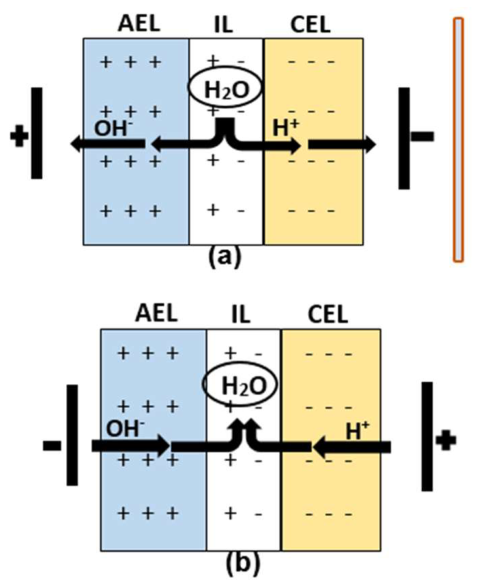
Figure 1.
(a) Migration of cations through the cation exchange membrane ; (b) Migration of anions through the anion exchange membrane.
Figure 1.
(a) Migration of cations through the cation exchange membrane ; (b) Migration of anions through the anion exchange membrane.
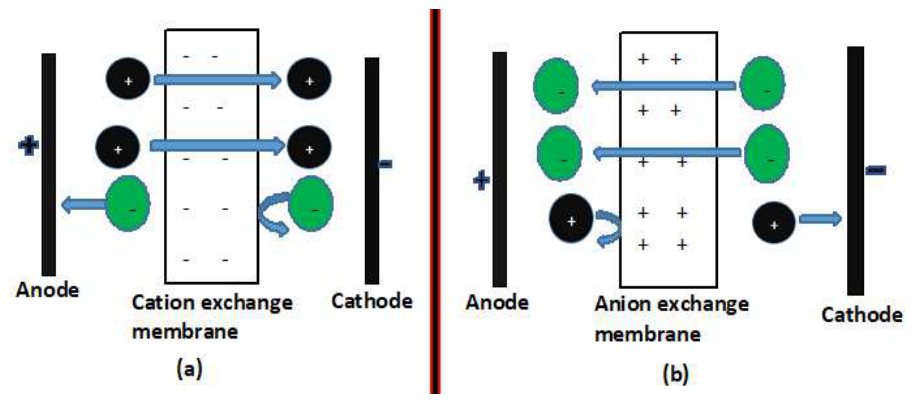
Figure 3.
Flow diagram of BMED for the recovery of acid and base from liquid waste.
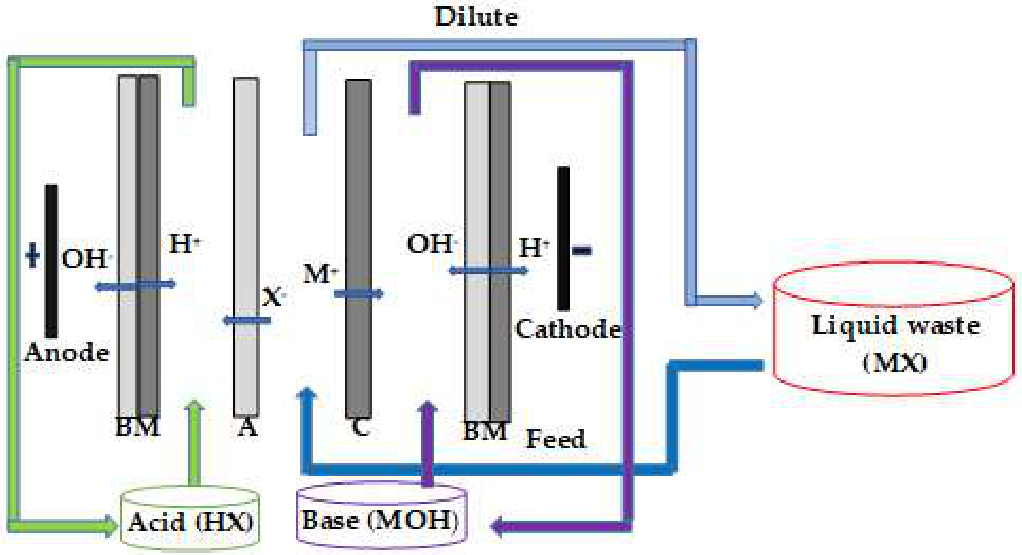

Table 1.
CEL types of BPMs [15].
Table 1.
CEL types of BPMs [15].
| Polymer(s) | Ion exchange group | Remarks |
| Poly-styrene-co-divinylbenzene | Sulfonic acid | Heterogeneous (poly-vinylchloride binder) |
| Poly-styrene-co-divinylbenzene | Phosphoric acid | Poly-ethylene binder |
| Nafion | Sulfonic acid | Homogeneous |
| Grafted perfluorinated polymer membranes | Sulfonic acid | - |
| Poly-butadiene-co-styrene | Sulfonic acid | - |
| Poly-phenylene oxide or poly-styrene | Sulfonic acid | Homogeneous |
| Poly-ether sulfone | Sulfonic acid | Homogeneous |
| Poly-sulfone | Sulfonic acid | Homogeneous |
Table 2.
CEL types of BPMs.
| Polymer(s) | Ion exchange group | Remarks |
| Poly-styrene-co-divinylbenzene | Tertiary and quaternary amines | Cross-linked resin, heterogeneous |
| Poly-sulfone | Di-amines | Cross-linked homogeneous |
| Poly-sulfone | Quaternary amines | Homogeneous |
| Poly-vinylidene fluoride blend with poly-vinyl benzyl chloride | Different diamines | Cross-linked |
| Poly-ether sulfone | Quaternary amines | Homogeneous |
| Poly-methyl methacylate-co-glycidyl methacrylate | Quaternary amines | - |
| Foulant type | Definition | Foulant formula | Charge properties | Cleaning methods |
| Scale | precipitates formed by the solution's less soluble salts | CaCO3, SrSO4, CaSO4.2H2O, SiO2, BaSO4 | Non | - Adjustment of pH levels, - Utilization of citric acid or EDTA |
| Molecular colloids | Stack of suspended material on membrane areas | SiO2,Fe(OH)3, Al(OH)3, Cr(OH)3 | Negative | - Pretreatment with MF, UF, higher flow rate, - Adjustment of pH levels, |
| Organics | Adsorption of organic species to membrane surfaces | Macromolecules, proteins, whey, polyelectrolytes, humate | Negative | -Pretreatment with MF, UF, activated carbon, - Clean with NaOH |
Table 4.
Acid and base production from liquid waste and salt solutions by BMED.
| BMED system | Wastewater type | Membrane properties | Acid production | Base production | References | |||
|
BMED: BM-AEM-CEM |
Saline textile wastewater (Na2SO4) |
Characteristics | BM | AEM | CEM |
66.9 % of SO42- converted in H2SO4 |
72.2 of Na+ converted in NaOH |
[55] |
| Thickness (μm) | - | 140 -160 | 180-210 | |||||
| Surface resistance (Ω/cm2) | - | 3.5 - 4.5 | 2.5-3.5 | |||||
| Transfer number | - | > 0.93 | > 0.93 | |||||
| IEC (meq/g) | - | 0.5-0.6 | 0.8-1.0 | |||||
| BMED: BM-AEM-CEM |
NH4Cl and NaCl | Thickness (μm) | 200-350 | 160-200 | 160-200 | 60 % of Cl- converted in HCl | 80 % of NH4+ and Na+ converted in NH4OH and NaOH | [56] |
| Surface resistance (Ω/cm2) | - | 2 | 2.5 | |||||
| Transfer number | >0.95 | > 0.95 | > 0.95 | |||||
| Water splitting voltage (%) | 0.8-1 | - | - | |||||
| BMED: BM-CEM-AEM |
RO brines | Resistance Ω(cm2) | - | < 8 | < 9 | 60-90% of HCl | 60-90% of NaOH | [57] |
| Transfer nº counter-ion | - | > 0.98 | > 0.98 | |||||
| Water splitting efficiency (%) | > 99 | - | - | |||||
| Exchange capacity (mval/g) | - | 1.8 | 2.2 | |||||
| Burst strength (kg cm−2) | 6 | - | - | |||||
| RO-ED-BMED | Cold-rolling wastewater | Tickness (μm) | 160-230 | 120-180 | 140-200 | 2.35 M H2SO4 | 2.03 M NaOH | [58] |
| Ion-exchange capacity (meq g -1) | - | 1.5-1.8 | 1.5-1.8 | |||||
| Area resistance (Ω cm2) | - | 2.0-3.5 | 1.8-3.8 | |||||
| Permeaselectivity (%) | - | > 96 | > 96 | |||||
| BMED: BM-AEM-CEM |
Solid waste residue (CH3COONa) | Thickness (mm) | 0.18-0.20 | 0.11-0.15 | 0.13-0.15 | 87.7% of CH3COOH | 99.0% of NaOH | [59] |
| Burst strength (MPa) | - | 0.16 | 0.16 | |||||
| Area resistance (Ω cm2) | < 3 | 1.5−3.0 | 2.5-3.0 | |||||
| Transport number (%) | - | >96 | >96 | |||||
| Chemical stability (pH) | 1-14 | - | - | |||||
Table 5.
Separation and recovery of nitrogen from wastewater using BMED.
| System | Wastewater type | Membrane characteristics | Nitrogen separation Rate ( %) | Nitrogen recovery Rate (%) | References | ||||
|
Proposed BMED |
Simulated wastewater |
Characteristics | BM | AEM | CEM | 96.5 | 78.30 | [63] | |
| Thickness (mm) | 0.16-0.23 | 0.12-0.20 | 0.16-0.23 | ||||||
| Surface resistance (Ω/cm2) | 2.0-2.8 | 1,5-2.0 | 1.8-2.4 | ||||||
| Transfer number (%) | 95-99 | >98 | 90-95 | ||||||
| IEC (meq/g) | 2.0-2.8 | 1.5-2.0 | 1.8-2.4 | ||||||
| SBMED | Thickness (μm) | 170-260 | 420 | 50.8 | 100 | 79.1 | [11] | ||
| Exchange capacity (mol/kg) | - | 2.2 | 0.95-1.01 | ||||||
| Synthetic wastewater | Selective transmission coefficient (%) | - | 90 | - | |||||
| Water decomposition efficiency (%) | >98 | - | - | ||||||
| Rupture strength (MPa) | 0.4-0.7 | 0.6 | |||||||
| Moisture content (%) | - | 42 | 5 ± 3.0 | ||||||
|
BMED-MCDI |
Synthetic wastewater |
Membrane type | Fumasep FBM | Neosepta AMX | Neosepta CMX |
- |
77 | [60] | |
| Membrane area (cm2) | 17.5 | 17.5 | 17.5 | ||||||
| Thickness (mm) | 0.5 | 0.5 | 0.5 | ||||||
|
BMED (five cells): BM-AEM-CEM |
Leachate |
Thickness(μm) | 180-220 | 90-100 | 140-150 |
86.17 |
72.55 |
[62] |
|
| IEC (meq/g) | 0.8-1.0 | 0.8-1.0 | 0.8–1.0 | ||||||
| Moisture content (%) |
45-55 | 15-20 | 35-40 | ||||||
| Surface resistance (Ω·cm2) |
- | 2.5-3.5 | 1.5-2.5 | ||||||
| Number of migrations | - | >0.94 | >0.98 | ||||||
|
BMED: BM-AEM-CEM |
Simulated NH4Cl wastewater |
Thickness (μm) | 0.24-0.26 | 0.24-0.26 | 0.3 | - | 63.6 | [61] | |
| IEC (meq/g) | - | 1.6-1.7 | 2±0.02 | ||||||
| Water content (%) |
- | 20-24 | 35 | ||||||
| Surface resistance (Ω·cm2) |
8-9 | 7-10 | ≤ 4.5 | ||||||
| Number of migrations | - | ≥96 | >98 | ||||||
| Burst strength (×105Pa) | 2.5-3.0 | - | - | ||||||
|
BMED: 5 Cell pairs (BM-CEM) and end AEM |
Product of wastewater treatment plant | Thickness (μm) | 1.1 | 0.5 | 0.6 | 95 | 87 | [64] | |
| IEC (meq/g) | - | ≥ 2.4 | ≥ 2.1 | ||||||
| Surface resistance (Ω·cm2) | - | 7.0 | 10.0 | ||||||
| Transport Number(%) | - | 82% | 95% | ||||||
| Burst strength (kPa) | > 2206.3 | 1034.2 | 1034.2 | ||||||
| pH operation range | 1-14 | < 10 | 1-14 | ||||||
|
BMED: BM-CEM |
Dewatering centrate and low-grade sulfuric H2SO4 |
Thickness (μm) | 1.1 | 0.5 | 0.6 | - | 88.4 | [65] | |
| IEC (meq/g) | - | ≥ 2.4 | ≥ 2.1 | ||||||
| Surface resistance (Ω·cm2) | - | 7.0 | 10.0 | ||||||
| Transport Number(%) | - | 82% | 95% | ||||||
| Burst strength (kPa) | > 2206.3 | 1034.2 | 1034.2 | ||||||
| pH operation range | 1-14 | < 10 | 1-14 | ||||||
| Two-stage BMED | pig manure hydrolysate | Thickness (mm) | 0.4 | < 0.45 | < 0.45 | - | 86 |
[66] | |
| Swell difference (%) | < 22 | < 50 | < 50 | ||||||
| Area resistance (Ω·cm2) | - | < 8 | < 8 | ||||||
| Transport number (%) | - | > 95 | > 95 | ||||||
| Selectivity (%) | > 90 | > 90 | |||||||
Table 6.
Separation and recovery of nitrogen from wastewater using BMED.
| BMED System | Wastewater type | Membrane properties | Phosphorus separation rate (%) | Phosphorus recovery Rate (%) | Refere-nces | ||||
|
Tree-compartment-BMED: BM-AEM-CEM-BM |
Synthetic wastewater imitating the liquid fraction of animal manure |
Characteristics | BM | AEM | CEM | - | 96 | [68] | |
| Thickness (mm) | < 0.50 | < 0.70 | < 0.70 | ||||||
| Specific conductivity(mS/cm2) | - | 109.7 | 117.3 | ||||||
| Water splitting voltage | 1.20 | - | - | ||||||
| IEC (meq/g) | 2.0-2.8 | 1.5-2.0 | 1.8-2.4 | ||||||
| Two-stage BMED | Pig manure hydrolysate | Thickness (mm) | 0.45 | < 0.45 | < 0.45 | - | 75 | [66] | |
| Swell difference (%) | < 22 | < 50 | < 50 | ||||||
| Area resistance (Ω·cm2) | - | < 8 | < 8 | ||||||
| Transport number of K+ (%) | - | > 95 | > 95 | ||||||
| Selectivity (%) | > 90 | > 90 | |||||||
| Three-compartment BMED-MC-CP | Synthetic AD dew atering sidestream comprising 50 mM NH4Cl, 50 mM NaCl, and NaH2PO4 (0.5–4.0 mM) | Membrane type | Fumasep FBM | Fumasep FAS-PET-75 | Fumasep FKB-PK-75 | - | > 80 | [69] | |
| Thickness (μm) | 340 | 340 | 340 | ||||||
| Membrane area (cm2) | 29.2 | 29.2 | 29.2 | ||||||
| BPMED-MCDI | Synthetic wastewater | Membrane type | Fumasep FBM | Neosepta AMX | Neosepta CMX | ~89 | - | [60] | |
| Membrane area (cm2) | 17.5 | 17.5 | 17.5 | ||||||
| Thickness (mm) | 0.5 | 0.5 | 0.5 | ||||||
| BMED with ion exchange absorption T-52H Resin | Synthetic solution of NaH2PO2 solution | Membrane type | Fumasep FBM | Neosepta AHA | Neosepta CMB | - | 80.06 | [70] | |
| IEC (mequiv·g−1) | - | 1.4-1.7 | 1.5-1.8 | ||||||
| Area resistance (Ωcm2) | <3.0 | 2.0-3.5 | 1.8-3.8 | ||||||
| Thickness (mm) | 0.20 | 0.12-0.18 | 0.14-0.20 | ||||||
| Transport number (%) | 98 | 95 | 97 | ||||||
| BMED combined with RA | Triethylammonium phosphate wastewater | Effective area of the membrane (cm 2) | 21 × 7 | 21 × 7 | 21 × 7 | - | 96 | [71] | |
| BMED: BM-AEM-CEM |
Electroless nickel-plating (ENP) wastewater | Effective membrane area (cm2) | 12 | 12 | 12 | 99.3 | 94.5 | [72] | |
| BMED with magnesite tailings added to the TTC | Simulated aquaculture wastewater containing NH4Cl, NaH2PO4 and NaCl | Surface area (cm2) | 37.5 | 37.5 | 37.5 | - | 97.9 | [73] | |
| Distance of between different membranes (cm) | 5 | 5 | 5 | ||||||
| BMED: BM-AEM-CEM |
Synthetic solution (Na3PO4·12H2O, Na2HPO4· 12H2O and NaH2PO4·2H2O) | Membrane type | Neosepta BP-1 | Neosepta AMX | Neosepta CMX | 95.8 | 80.3 | [74] | |
| Thickness (μm) | 200-350 | 120-180 | 220-260 | ||||||
| IEC (meq·g−1) | - | 1.4−1.7 | 1.5-1.8 | ||||||
| Area resistance (Ω cm2) | - | 2.0−3.5 | 2.0-3.5 | ||||||
| Voltage drop (V) | 1.2-2.2 | - | - | ||||||
| efficiency (%) | >98 | - | - | ||||||
Disclaimer/Publisher’s Note: The statements, opinions and data contained in all publications are solely those of the individual author(s) and contributor(s) and not of MDPI and/or the editor(s). MDPI and/or the editor(s) disclaim responsibility for any injury to people or property resulting from any ideas, methods, instructions or products referred to in the content. |
© 2026 by the authors. Licensee MDPI, Basel, Switzerland. This article is an open access article distributed under the terms and conditions of the Creative Commons Attribution (CC BY) license (http://creativecommons.org/licenses/by/4.0/).
Copyright: This open access article is published under a Creative Commons CC BY 4.0 license, which permit the free download, distribution, and reuse, provided that the author and preprint are cited in any reuse.