

Submitted:
10 September 2026
Posted:
11 September 2026
You are already at the latest version
Abstract
Wood modification has been developed as a non-biocidal concept to overcome inherent material limitations such as dimensional instability and biological durability. But sustainability assessment must extend beyond initial functional performance to include machinability, interface compatibility, repairability and end-of-life (EoL) cascade potential. This critical narrative review integrates the mechanisms, processing dynamics and circular-economy implications of 4 major modification routes: thermal treatment, acetylation, furfurylation and thermo-hydro-mechanical (THM) densification. We examined a purposive sample of 40 peer-reviewed articles including seminal citations between 1990-2007 and recent publications between 2021-2025. The synthesis shows that thermal modification and acetylation can enhance hygroscopic and di-mensional stability through different mechanisms, but with different trade-offs in mechanical toughness and secondary processing. Furfurylation can improve hardness and decay resistance, but also increase brittleness and recycling difficulties. THM densification improves the local load bearing capacity, but moisture-induced set-recovery is a major limitation. Cross-contamination in heterogeneous waste streams, residual chemical matrices, changed surface-energy interactions with adhesives, and limited standardization of sorting protocols are important barriers to circular material loops across the modification routes. A descriptive particleboard case-study dataset covering 0–70% secondary-wood fractions shows decreasing MOR, MOE and IB and increasing thickness swelling with increasing recycled content. These observations are presented as only study-specific descriptive evidence, and not as evidence of a universal recycling threshold or formal EN 312 P2 conformity, as the current experimental documentation does not contain sufficient information on independent panel replication and inferential statistical analysis. Future work should consider design for disassembly, digital material traceability and multi-criteria sustainability assessment.
Keywords:
wood modification
; thermal modification
; acetylation
; furfurylation
; densification
; machinability
; recycling
; circular economy
1. Introduction
Wood functions as an orthotropic lignocellulosic matrix, serving simultaneously as a renewable structural material, a persistent biogenic carbon sink, and an engineering substrate whose physical and mechanical behavior is intrinsically governed by moisture sorption, anatomical hierarchy, and environmental exposure conditions [1,2,3]. Conventional wood preservation strategies historically relied on biocidal impregnation to inhibit biological degradation [4,5]. Conversely, contemporary non-biocidal modification paradigms seek to alter the chemical availability of cell-wall hydroxyl (-OH) groups, reconfigure the macromolecular structural network, or induce localized bulk density augmentation [6,7,8]. In doing so, these processes enhance durability, swelling resistance, and dimensional stability without introducing persistent toxic leachates into terrestrial environments [8,9,10]. Seminal investigations into chemical acetylation, thermal modification regimes, and thermo-hydro-mechanical (THM) densification established the fundamental mechanisms through which cell-wall reconfiguration alters sorption isotherms, equilibrium moisture content (EMC), fungal decay kinetics, and mechanical stress-strain responses [1,6,11].
Over the past two decades, several wood modification technologies have successfully scaled from laboratory-scale proofs of concept to continuous industrial processing facilities [12,13,14]. Thermally treated timber, acetylated substrates, and furfurylated wood matrices are now routinely specified for demanding outdoor applications, including rainscreen façades, heavy-duty decking, architectural joinery, marine infrastructure, and dimensionally stable interior elements [12,14,15]. Concurrently, THM surface and full-section densification are increasingly utilized to upgrade low-density, fast-growing softwoods and hardwoods into high-value engineered components with enhanced surface hardness and structural load-bearing capacity [11,13,16]. Nevertheless, evaluating modified timber solely on the basis of its initial unaged mechanical properties presents an incomplete and potentially misleading life-cycle perspective [17,18]. Materials engineered for extended first-stage durability often display secondary processing recalcitrance—manifesting as altered chip-formation dynamics, accelerated cutting-tool wear, altered surface free energy, and adhesive incompatibility—which can severely hinder subsequent repair, remanufacturing, and material-to-material recycling [17,18,19].
Multi-tier cascading frameworks are needed to integrate modified wood products into a closed-loop circular economy [18,20]. Primary solid-wood components can be structurally reused, remanufactured and mechanically downsized into reconstituted wood-based panels or biocomposites before final thermal energy recovery [20,21,22]. Two major research imperatives for modified wood matrices in this transition are (1) Quantification of whether the environmental and economic benefits of extended service life outweigh the energy and processing burdens of modification [17,23,24] and (2) Understanding how modified cell-wall chemistry and structure affect comminution, dust generation, resin wetting and secondary bonding [19,21,22]. This article is a critical narrative review and not a systematic review or meta-analysis. The reference set was carefully chosen to include thermal modification, acetylation, furfurylation and THM densification and their impact on first-life performance, secondary machining, adhesive bonding, cascading and end-of-life. The original study record did not contain a reproducible database-by-database search log, boolean search strings, screening counts or formal risk-of-bias scoring, and therefore selection bias and incomplete coverage are stated limitations. So it is rather the comparison of mechanisms, reported performance trade-offs, methodological context and agreement or disagreement between studies as well as the distinction between demonstrated evidence and prospective recommendations that drives the critical appraisal. Importantly, the differences between published results are considered in relation to the wood species and its anatomy, severity of treatment, processing conditions, level of modification, and geometries of the specimens and characterization or testing methods rather than being considered as effects that are generally transferable. Thus, the contribution of the review is a first-life-to-end-of-life integrated decision perspective rather than a novel modification mechanism. Previous reviews have been mainly domain-specific, e.g., on wood modification [25,26,27], sustainability and end-of-life aspects [28,29], or recycled wood-based panels [30]. The present review links these domains to machinability, adhesive compatibility, material identification, cascading and EoL decision routes. The case study on particleboard is merely an empirical illustration of this integrated discussion, not a statistical validation of a universal recycling limit.
2. Mechanistic Foundations and Physical-Mechanical Properties of Modified Wood
2.1. Thermal Modification Mechanisms and Property Transformations
Thermal modification is a controlled thermochemical degradation process of the lignocellulosic matrices, which consists of exposing the matrices to high temperatures (160 °C-240 °C) in limited oxygen conditions, generally assisted by shielding media such as saturated steam, nitrogen or vegetable oils [8,28,31]. The macroscopic improvements in dimensional stability and decay resistance are mainly due to selective thermal degradation and transformation of hygroscopic hemicelluloses, changes in accessible hydroxyl functionality, and related changes in cell-wall structure and moisture sorption [1,3,32]. Simultaneously, the localized condensation reactions in the lignin network along with other structural changes result in a reorganization of the macromolecular architecture while restricting the reversible swelling of the cell wall as schematically illustrated in Figure 1 [10,33,34]. The degree of change in properties of wood is heterogeneous and dependent on wood anatomical features, initial density, treatment temperature and time and the heat transfer environment [29,31,33,34]. As such, the results of different studies of thermal modification should be compared according to species, treatment severity and test methodology and not interpreted as equivalent across materials.
The primary functional benefit of thermal treatment is a significant reduction of equilibrium moisture content (EMC) and anisotropic swelling, which enhances dimensional stability under different environmental relative humidity [3,10]. However, these benefits are accompanied by thermal mass loss and chemical changes in carbohydrate polymers that can compromise stress-transfer and fracture performance under severe treatment conditions [11,12]. Degradation of the amorphous carbohydrate rich matrix under harsh conditions can lead to micro-void formation and structural embrittlement resulting in reductions in fracture toughness, impact bending strength and tensile strength parallel to the grain [11,12]. The extent of these changes is a function of species, initial wood properties, and temperature-time history; therefore, a processing window should be defined for the intended end use, rather than assuming that higher treatment intensity is always better [35,36,37,38,39].
From a circular-economy and life-cycle perspective, thermally modified timber presents a distinct advantage because the process modifies the native structural polymers without impregnating persistent synthetic chemicals or heavy metals into the cell wall [14,17,31,40]. Nonetheless, secondary material cascading and end-of-life reprocessing reveal significant technical trade-offs [4,20,27]. The heightened brittleness of modified cell walls alters chip formation dynamics during mechanical comminution, frequently generating a larger proportion of fine dust particles and micro-cracked fibers that affect particle packing [19,27,41]. Furthermore, the reduction in surface free energy, accompanied by hydrophobic reorientation and altered surface pH, diminishes the thermodynamic wetting kinetics of conventional water-borne adhesives, necessitating tailored resin formulations or surface pretreatments for secondary bonding [26,39,42]. Quantitative life-cycle assessment (LCA) models confirm that the initial environmental energy investment of thermal processing can be ecologically and economically offset by extended operational service life and reduced chemical maintenance, although the net environmental benefit remains highly sensitive to the primary energy mix, reference baseline materials, and specific end-of-life disposal scenarios [13,17,20,24].
2.2. Acetylation Kinetics and Structural Behavior
Acetylation is mechanistically different from heat treatment. In the acetylation, the accessible hydroxyl (-OH) groups of hemicelluloses, lignin and amorphous cellulose react mainly with acetic anhydride to form covalently bound acetyl esters, with acetic acid as the reaction by-product. Thus the primary structural change is the substitution of hydroxyl functionality, in addition to cell-wall bulking, rather than thermally induced polymer degradation. Bulk increases the polymer matrix and decreases the accessibility of hydrophilic sites, thereby decreasing moisture sorption and swelling. The degree of modification depends on the reagent accessibility, wood anatomy, reaction conditions and the obtained weight percent gain (WPG). This difference is important in the comparison of acetylation with thermal treatment. The former mainly introduces a covalently bound substituent and increases the cell-wall volume, while the latter changes the native polymer network by degradation, deacetylation, lignin reactions and pore restructuring [1,4,6,43].
Recent mechanistic investigations have shifted the research focus from macroscopic proof-of-concept validations to spatial acetyl group distribution, micro-scale moisture-matrix interactions, and localized fungal decay resistance mechanisms [21,44,45]. High-resolution spectroscopic mapping and X-ray microtomography reveal that fungal protection—particularly against brown-rot degradation-is not merely dictated by physically preventing hyphal penetration into the lumen, but by altering the chemical availability of cell-wall moisture below the critical threshold required for enzymatic or non-enzymatic Fenton-type oxidative radical diffusion [6,44,46]. When evaluated in engineered wood elements, such as acetylated birch or radiata pine plywood, structural performance remains strongly anisotropic and strictly governed by grain orientation, veneer quality, and lay-up configuration [4,23,47]. Consequently, chemical acetylation cannot be viewed as a substitute for rigorous structural dimensioning, but rather as a foundational material upgrade that preserves structural stiffness under extreme ambient moisture fluctuations [23,47,48].
From a circular economy perspective, incorporating acetylated timber into secondary material cascades presents unique technical considerations [18,22,49]. Key industrial challenges include managing residual trace acetic acid, avoiding corrosion of metal fasteners or processing equipment during mechanical comminution, and overcoming altered interfacial wettability [4,19,50]. The esterified hydrophobic surface lowers polarity and surface free energy, which alters the curing kinetics of traditional water-borne thermosetting resins (such as UF or MUF) and necessitates the adoption of emulsion polymer isocyanates (EPI) or polyurethane (PUR) adhesives for secondary structural bonding [4,32,51]. Although the extended operational service life of acetylated products significantly postpones waste generation [17,18,52], the lack of rapid sensor-based sorting technologies to distinguish acetylated fractions from unmodified wood in mixed demolition waste streams remains a critical barrier to optimizing secondary particleboard panel manufacturing and cascading efficiency [20,22,33].
2.3. Furfurylation
Furfurylation performance depends on the location of furfuryl alcohol and the resulting poly (furfuryl alcohol) (PFA) and the degree of polymerization. Diffusion of furfuryl alcohol into accessible regions of the cell wall depends on the cell wall permeability and treatment conditions. PFA is produced by acid-catalysed polymerization but the product should not be automatically assumed to be a uniformly cross-linked network throughout the cell wall. The relative proportion of lumen filling, cell-wall penetration and polymer formation is strongly influenced by wood species and permeability, initial moisture content, furfuryl-alcohol concentration, catalyst type and amount, impregnation procedure, cure temperature/time and the ratio of PFA deposition to cell-wall. Interactions with lignin and carbohydrates also depend on the formulation and the conditions. Claims of catalyst-induced lignin depolymerization or extensive covalent cross-linking should therefore be based on direct chemical evidence and not just inferred from weight gain or water resistance. In a mechanistic interpretation, physical deposition/penetration has to be distinguished from demonstrable chemical bonding and network formation [9,21,53,54].
Figure 2.
Schematic illustration of the in situ polymerization mechanism of furfuryl alcohol and cell-wall modification. No generative artificial intelligence (AI) tools were used to generate, draw, modify, or edit this figure.
Figure 2.
Schematic illustration of the in situ polymerization mechanism of furfuryl alcohol and cell-wall modification. No generative artificial intelligence (AI) tools were used to generate, draw, modify, or edit this figure.
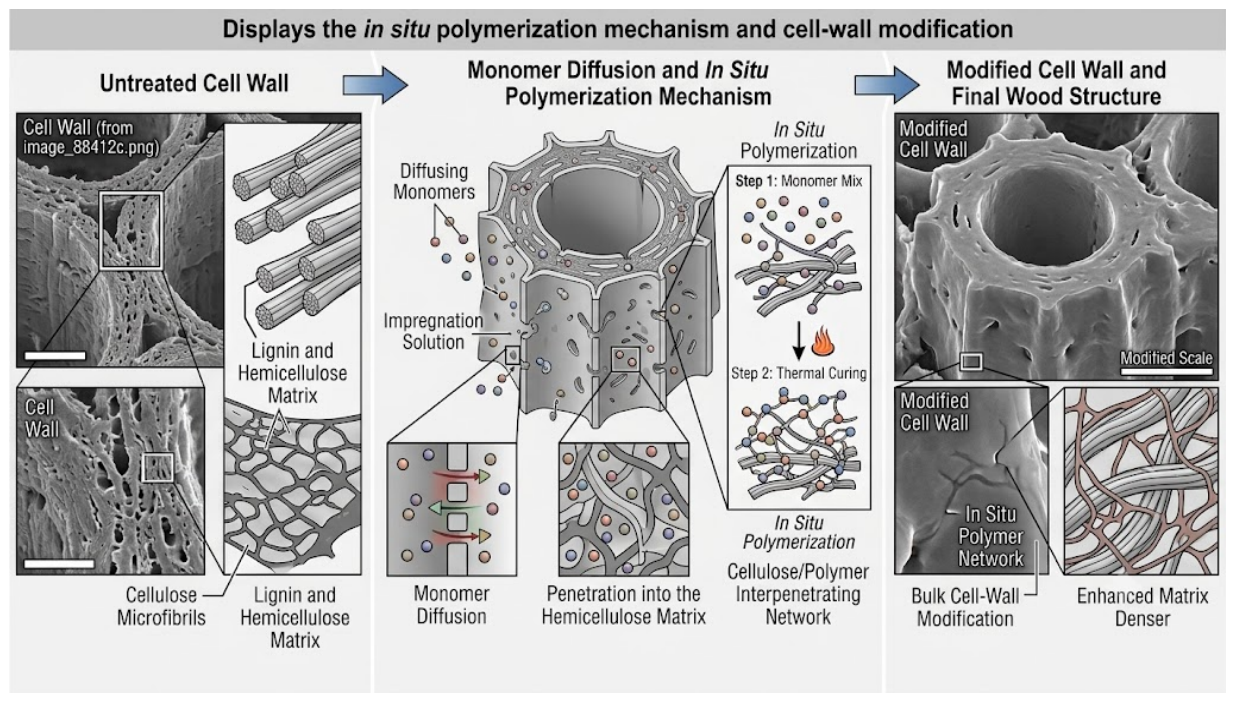
Recent studies have provided a more detailed understanding of the interactions between poly(furfuryl alcohol) and the main wood polymers, including cellulose, hemicelluloses, and lignin. The extent of polymer formation within the cell wall, rather than only polymer deposition in the lumen, has been recognized as a critical factor controlling the final performance of furfurylated wood. Controlled cell-wall modification improves water resistance and biological durability while maintaining a more favourable balance between stiffness and toughness [16,19,22]. Novel impregnation strategies have also been proposed to achieve a more uniform distribution of furfuryl alcohol and reduce excessive resin deposition in cell cavities, thereby improving modification efficiency and reducing chemical consumption [53,54].
One of the main limitations associated with conventional furfurylation is the increase in hardness accompanied by reduced fracture toughness and increased brittleness. To overcome this drawback, recent research has focused on the development of hybrid furfurylation systems incorporating bio-based plasticisers and toughening agents. The addition of epoxidised soybean oil, for example, has demonstrated the ability to improve the toughness and mechanical behaviour of furfurylated wood by introducing more flexible phases into the polymer network and improving stress dissipation mechanisms [21]. Such approaches indicate that the poly (furfuryl alcohol) matrix can be engineered to achieve not only improved durability but also enhanced mechanical reliability in structural applications.
Besides mechanical improvements, multifunctional furfurylation systems have been investigated to broaden the application range of modified wood. The addition of inorganic nanoparticles, phosphorus-containing compounds, and other functional additives has shown promise to improve the fire resistance, thermal stability, and resistance to environmental stresses [18,24,55]. Furthermore, recent studies have demonstrated that fur-furylation may provide an effective protection against marine wood-boring organisms and may represent a feasible alternative to traditional preservative systems based on biocides [56]. However, more complex formulations can bring challenges in terms of material transparency, recyclability and environmental assessment at end-of-life.
Surface performance and weathering behaviour are also important factors determining the suitability of furfurylated wood for exterior applications. Recent investigations have demonstrated that furfurylation can significantly influence surface chemistry, wettability, and resistance to ultraviolet-induced degradation, although the magnitude of these effects depends strongly on wood species, treatment intensity, and polymer distribution within the material structure [56]. Therefore, optimisation of treatment parameters remains essential to achieve a balance between durability enhancement and preservation of desirable surface properties.
From the perspective of sustainable material development, furfurylated wood presents both significant opportunities and challenges. The extended service life achieved through improved resistance to moisture, fungi, and dimensional instability contributes to resource efficiency by reducing replacement frequency and increasing the functional lifespan of wood products. Nevertheless, the sustainability performance of furfurylated wood must be evaluated using a life-cycle perspective that considers raw material origin, chemical production, processing energy, service-life extension, and end-of-life scenarios. Recent life-cycle assessment studies emphasise that modified wood products can contribute to circular economy strategies when renewable feedstocks, low-impact modification processes, and appropriate cascading pathways are integrated into product design [57,58].
Future development of furfurylated wood should therefore move beyond the optimization of individual material properties and focus on the design of circular, transparent, and environmentally responsible modification systems. Products with clearly defined chemical compositions, reduced dependence on hazardous additives, and established reuse, recycling, or energy recovery pathways are expected to achieve better sustainability performance compared with complex multicomponent systems lacking clear end-of-life strategies [59].
2.4. Thermo-Hydro-Mechanical Modification and Densification
Wood densification reduces porosity and increases bulk density through the combined action of heat, moisture, and mechanical pressure. In foundational studies, Navi and Girardet [4] demonstrated that thermo-hydro-mechanical (THM) treatment simultaneously alters cell geometry and the viscoelastic behavior of wood polymers. The primary technological objective of densification is to enhance surface hardness, wear resistance, and localized load-bearing capacity in low-density wood species without inducing unacceptable set-recovery upon re-wetting.
Comprehensive process reviews distinguish between full-section and surface densification, with surface treatments often proving more resource-efficient as material enhancement is strategically concentrated in high-stress outer zones [31]. Continuous belt-press systems highlight the potential for industrial scaling and uniform quality control, while investigations into thermally fixed compression focus on ensuring long-term deformation permanence [17,34].
The main advantage of THM densification from the viewpoint of a circular economy is a low dependence on exogenous chemical additives. The key technical trade-offs, however, are the high energy intensity of processing, potential for interfacial delamination or set-recovery, and non-uniform density profiles during end-of-life reprocessing. Mechanical comminution of a surface-densified timber component results in a heterogeneous mixture of wood particles with varying structural densities, which complicates particle sorting, classification, and resin distribution in secondary panel manufacturing. Table 1 provides a comparative synthesis of the main performance indicators, operational trade-offs and circularity implications of THM densification compared to thermal modification, acetylation and fur-furylation. Table 2 provides a mechanism-comparison and validation matrix for the principal wood modification methods, summarizing the relationships among modification mechanisms, key performance responses, validation approaches, and the main technical trade-offs.
3. Machinability, Surface Behaviour and Joining
3.1. Cutting, Roughness and Tool Wear
Modification changes the relationship among density, brittleness, friction and chip-formation mechanisms. In thermally modified wood, lower toughness may facilitate material separation under certain cutting regimes, while simultaneously increasing edge chipping and the amount of fine dust. In densified wood, the higher local density increases cutting forces and the susceptibility of the cutting edge to thermal loading. Furfurylated products may be harder and more abrasive, whereas acetylated material requires control of contact with metals when residual acidity is present.
There is no single parameter that can be relied upon to assess surface roughness. Ra expresses the mean profile deviation but does not describe isolated deep defects. It is therefore useful to combine Ra, Rz, visual analysis and the proportion of torn fibers. Contemporary techniques such as optical scanning, digital image processing and predictive models linking anatomy, cutting speed, feed rate and tool geometry [19] are increasingly being used. Therefore, the use of standard CNC parameters, developed for untreated wood, should not be transferred to modified wood without verification.
An industrially relevant recommendation is to develop material-specific libraries of machining regimes. Such a library should include species and degree of modification, moisture content, density, grain orientation, tooling, cutting speed and feed rate. A digital material passport could transfer these data from the producer to subsequent repair or recycling operations, thereby reducing rejects and the risk of applying an unsuitable process.
3.2. Bonding and Surface Finishing
Bonding is a matter of wettability, penetration, chemical compatibility and cohesion of the surface layer. The reduced availability of -OH groups after acetylation and thermal modification may lower the surface free energy. The actual contact area is determined by porosity and adhesive viscosity. A classic study of acetylated wood showed that the adhesive and the conditioning regime should be adapted to the modified substrate [1]. Recent tests on thermally modified yellow poplar have shown that satisfactory bonds can be achieved but that strength is strongly affected by surface preparation and adhesive type [32].
For structural and automotive composites, combinations of mechanical and adhesive joining are being developed. A surface-densified or thermally modified zone may provide greater stiffness but may also produce a different fracture mechanism [34]. For coatings, the key issues are UV stability, colour change, microcracking and adhesion after moisture cycling. Modification often reduces substrate swelling, which benefits the coating, but darker colour and altered chemistry require a different primer formulation.
From a recycling perspective, the adhesive may present a greater challenge than the wood modification itself. PUR, PVAc, UF, MUF and epoxy systems differ in their separability and in their behaviour during comminution or thermal recovery. Product design should therefore favour reversible mechanical joints wherever possible, limit the number of incompatible adhesives and clearly identify the chemical systems employed.
4. Integration into the Circular Economy
4.1. Extended Service Life Is Not Equivalent to Full Circularity
Extending service life reduces replacement frequency and can significantly improve the environmental profile of a product. Circularity, however, involves more than durability: it also requires maintainability, reuse, disassembly, identification, recycling and retention of secondary-material quality. LCA results for thermally modified façades show that conclusions depend on the system boundary, energy source and assumed service life [13,20,24]. It is therefore methodologically unjustified to claim that one modification is invariably more sustainable without defining the scenario.
The greatest value is retained through the direct reuse of components, particularly when their cross-section, length and mechanical integrity remain intact. The next level is remanufacturing, in which a component is shortened, re-machined or incorporated into a new product. Only thereafter should the material be reduced to particles or fibres; this route sacrifices part of the embedded value but retains the material within the technosphere. Energy recovery should be the final option for fractions that no longer meet safety and technical requirements.
4.2. Particleboards and Fibre-Based Materials
The recycling of panels represents an important industrial route for the processing of secondary wood but its suitability depends on the quality of collection, removal of metals and mineral contaminants, identification of coatings and impregnation treatments, comminution, fractionation, drying and emission control. The literature available indicates that particle heterogeneity, cured legacy adhesive and contaminants can have a strong influence on internal bond strength, swelling and new-resin demand [60]. These findings are indicative of specific recycling pathways and should not be seen as a quantitative measure of circularity for all modified-wood systems.
Research on recycled thermally modified wood shows that this fraction can be incorporated into particleboard, although its layer distribution and proportion must be optimised [15]. A recent study of a closed material cycle in door production demonstrates the practical relevance of this approach: a panel containing 50% production residue met the P2 requirements and was reincorporated into a prototype door [35]. This finding supports an industrial model based on local closed loops in which the origin of the waste is known and contamination is controlled.
MDF recycling is more demanding because it requires fibres of sufficient quality and must address the presence of cured adhesive. Thermo-mechanical defibration can restore part of the fibrous structure, but fibre shortening and formaldehyde emissions require process control. For modified fractions, it is also necessary to determine how thermal degradation, acetyl groups or furfuryl polymers affect refining and bonding.
4.3. Wood-Polymer and Additively Manufactured Composites
Fine fractions that are unsuitable for panels may be used as fillers in wood-polymer composites (WPCs) or biopolymer composites. Thermally modified wood flour has lower hygroscopicity, which may improve the dimensional stability of the composite, but its reduced polarity alters compatibility with the polymer matrix. Additive manufacturing offers the possibility of using controlled fractions in PLA systems, in which nanoparticles and modified fibres can tailor mechanical and thermal properties [41].
This route, however, is not automatically circular. Incorporating wood into plastics may complicate the subsequent recycling cycle if the polymer, additives and fibrous phase are incompatible with established waste streams. An advantage exists when a clearly defined secondary fraction is used, the product has an extended service life and mechanical recycling of the same composite has been planned.
4.4. Priority End-of-Life Scenarios
A prioritized hierarchy of material cascading can support the integration of modified wood products into a circular economy where solid-wood components are first considered for structural reuse and remanufacturing and then mechanically downsized into reconstituted panels or biocomposites, with thermal energy recovery reserved for fractions that cannot be safely or technically retained as materials [61,62]. The technical restrictions in this hierarchy are different because of the different physicochemical properties of thermally, chemically and mechanically modified wood [63]. Table 3 presents a structured hierarchy of recommended end-of-life scenarios based on material value retained, technical requirements, and main risks. This hierarchy is a prospective decision framework, rather than an experimentally verified ranking for each product system.
Direct structural reuse represents the highest value retention pathway, primarily applicable to large-section engineered wood components with comprehensive performance documentation. For modified wood, this necessitates detailed knowledge of the initial processing parameters (e.g., degree of mass loss or weight percent gain) via digital material traceability systems and a robust non-destructive mechanical assessment to confirm that service-life environmental exposure hasn’t induced prohibitive reductions in structural stiffness or toughness [62,63]. Following structural reuse, remanufacturing and localized repair offer significant value retention. However, this pathway is often constrained by the altered machinability and adhesive-bonding dynamics inherent to modified substrates, which demand specialized cutting tools to mitigate edge chipping and tailored resin systems to ensure durable secondary bonding [64].
When structural reuse or repair is no longer feasible, mechanical cascading into wood-based panels, such as particleboard or medium-density fiberboard (MDF), becomes the preferred medium-value scenario [61,65]. The utilization of recovered modified fractions requires stringent sensor-based sorting to ensure feedstock homogenization and precise decontamination to manage residual chemical matrices (e.g., residual acetic acid or polymerized furfuryl alcohol) [63]. Integrating these secondary fractions can alter the critical physical and mechanical properties of the panel, specifically affecting internal bond (IB) strength and modulus of rupture (MOR), often necessitating advanced resin system tailoring and multi-layer particle optimization, as highlighted by recent investigations on high-ratio recycled wooden composites [65,66]. Finally, biocomposite manufacturing provides a downstream cascading option, though care must be taken to avoid locking the material into difficult-to-recycle multimaterial systems. Energy recovery, despite its established industrial scale, remains the lowest-priority option from a material perspective, reserved only for non-recyclable fractions, and requires strict emission controls to manage problematic volatile compounds and ash composition during thermochemical conversion [60,61].
4.5. Standardisation, Traceability and the Safety of Secondary Raw Materials
The greatest barrier to industrial circularity is not merely comminution technology, but the absence of reliable information about the composition, previous treatment history, and potential contamination of used wood products. Visual inspection alone is often insufficient to distinguish between thermally modified, acetylated, furfurylated, preservative-treated, or coated wood materials. Consequently, uncontrolled mixing of different material streams may result in incompatible processing conditions, reduced quality of recycled products, and increased risks associated with emissions during mechanical recycling, thermal conversion, or further material processing. Recent circular economy strategies emphasise that reliable material identification and digital information systems are essential prerequisites for maintaining material value and enabling safe cascading use of wood resources [67].
A digital product passport (DPP) represents a promising instrument for improving transparency throughout the entire life cycle of wood-based products. Such a system should include information regarding wood species, modification technology and treatment intensity, adhesives, coatings, additives, manufacturing date, repair possibilities, previous applications, and recommended end-of-life pathways. The integration of product-level information with automated sorting technologies, databases, and traceability platforms could significantly improve the separation efficiency of secondary wood streams and reduce uncertainty regarding recycled material quality [67,68].
A standardized input protocol is necessary for secondary raw materials to enter recycling chains. Such protocols should include separation of metals, plastics, glass and mineral contaminants; screening for hazardous substances such as halogenated compounds, heavy metals and legacy preservatives; classification according to particle size distribution; and determination of key physical parameters including moisture content, density and adhesive content. Other identification parameters of chemically and thermally modified wood may include spectroscopic fingerprints, color variation, extractive composition, pH changes and thermal degradation behavior. The combination of fast sensor-based technologies (e.g., near-infrared spectroscopy, hyperspectral imaging, and machine-learning-assisted classification) with laboratory verification offers a path for selective recovery of valuable wood fractions rather than premature diversion to energy recovery [67]. Therefore, a practical multi-spectral/multivariate validation roadmap should be based on a two-stage identification strategy. Stage 1 – Rapid non-destructive screening (NIR/hyperspectral imaging, and where appropriate color and high frequency dielectric measurements) to classify material into broad modification families Stage 2 offers orthogonal evidence for treatment-specific confirmation using XRF, thermal analysis (TGA/DTG or DSC), pH, density/moisture measurements and targeted laboratory chemistry. Multivariate models should be trained on authenticated reference materials of wood which is untreated, thermally modified, acetylated, furfurylated, coated, preservative treated wood and relevant adhesive/resin systems. NIR or high frequency spectroscopy should not be presented as inherently capable of uniquely identifying every modification route. Their reliability is dependent on calibration, wood species, aging, surface coatings, moisture and treatment intensity. Ambiguous classifications or safety-critical classifications still need laboratory chemical verification. The classification result can be connected to a Digital Product Passport, allowing backward traceability from the recovered particle to the original species, the modification route, the treatment intensity, the adhesive/coating system and the recommended EoL pathway. Section 5 presents a descriptive particleboard case-study dataset with 0%, 30%, 50% and 70% secondary wood fractions for the purpose of contextualizing the theoretical parameters of wood cascading with measurable indicators. To evaluate the technical performance of particleboards produced with recycled wood fractions, 10 experimental panels (n = 10) were manufactured for each formulation variant (N = 40 in total). All specimens were conditioned at 20 °C and 65% relative humidity prior to physical and mechanical testing according to EN 322. Results are presented as mean values and their corresponding standard deviations (Mean ±SD) due to the observational and screening nature of this industrial trial. This descriptive approach emphasizes practical performance trends across the formulations tested to demonstrate technical feasibility, without making formal inferential claims.
5. Recycled Wood Fraction in Particleboard
Section 5 presents an empirical case study of particleboard to contextualize the literature synthesis with measurable material-performance data. The case study is an original experimental part of the manuscript which was used to demonstrate the effect of increasing secondary-wood content on panel properties. It is not meant to validate a universal recycling threshold for all particleboard systems or all modified-wood waste streams. Laboratory three-layer particleboards of nominal thickness 16 mm and target density 680 kg/m 3 were prepared with 0%, 30%, 50% and 70% secondary wood particles in the core and face layers. The secondary wood feedstock was purchased directly from industrial particleboard processing streams according to Grades A1 and A2 as defined in European waste wood classifications (RAL-GZ 991 and EN 14961) representing non-hazardous, untreated or lightly processed wood fractions. The secondary wood feedstock was systematically decontaminated using magnetic and eddy-current separators, comminuted and classified by mechanical sieving (EN ISO 17827-1) before the application of the resin. Mostly fine particle fractions (0.5–1.5 mm) were assigned to the face layers (~30% mass share) for the surface quality and coarser fractions (1.5–4.0 mm) formed the structural core layer (~70% mass share). The furnish was dried to a target operational moisture content of 3-5% (determined gravimetrically according to EN 322). The adhesive system was a commercially available liquid urea formaldehyde (UF) resin (approx. 65% solids content) applied at 10% dry resin on a dry wood basis (dosed to 9–10% for core particles and 10–11% for face particles in order to compensate for the larger specific surface area of fine particles). The hot pressing was done with a platen temperature of 190 °C, a specific pressure profile of 2.5 N/mm² and a pressing factor of 15 s/mm of target thickness. For each experimental formulation 10 copies of each panel (n = 10) of size 500 × 500 mm were produced (N = 40 panels overall). Prior to any destructive testing all specimens were conditioned for 72 hours in a climate chamber at 20oC±2 oC and 65% ± 5% relative humidity until constant mass was reached, as per EN 322 .Tests were undertaken in an accredited wood laboratory using a Zwick/Roell universal testing machine following standard test procedures of the European standards (EN 310, EN 319, EN 317 and EN 323) [80] for modulus of rupture (MOR), modulus of elasticity (MOE), internal bond strength perpendicular to the plane, thickness swelling after 24 h in total water immersion at 20 °C and volumetric density, respectively. The experimental results for the substitution rates tested are presented in Table 4.
The 50% replacement variant produced about 86% and 81% of the original MOR and MOE and internal bond strength, respectively, compared with the virgin control panels (0%), as shown in Table 3. At the highest substitution level of 70%, the property retention was 71% for MOR, 72% for MOE and 63% for IB. The thickness swelling increased to 14.7%. The data show that mechanical property retention decreases and thickness swelling increases with increasing recycled content. Descriptive evaluation of the physical and mechanical properties points to clear performance trends across the tested formulations. In particular, particleboard samples made with 70% recycled wood content showed the highest standard deviations and coefficient of variation (CV% for IB was greater than 33%). The increase in variation is attributed to the loss of internal mass homogeneity from agglomeration of fine particles and reduced resin coverage per unit surface area at high recycle ratios.
The reported mean values were compared to the cited EN 312 P2 requirements for non-structural interior boards in the source data set (MOR ≥11.0 N/mm2, IB ≥ 0.35 N/mm2, TS ≤ 16.0%). Although all group means formally satisfy these baseline standard thresholds, the present study does not claim formal product certification or universal EN 312 P2 conformity, as industrial adoption requires panel-level batch replication and continuous quality control across variable waste streams. Therefore, the pre-sent results should be interpreted to mean that approximately 50% recycled content represents a promising, study-specific operating point within the tested formulations, rather than a general technical threshold. The reduced MOR, MOE, and IB, alongside increased thickness swelling at higher substitution, highlight the need for process optimization such as multi-layer particle grading, core/surface layer ratio adjustment, or resin system modification. A specific level of recycled content must be evaluated relative to feedstock origin, particle geometry, adhesive system, panel construction, and applicable product acceptance criteria.
6. Critical Discussion and Future Perspectives
6.1. Thermodynamic and Structure-Property Trade-Offs Across Modification Routes
The comparative evaluation of thermal modification, acetylation, furfurylation, and THM densification demonstrates that no single modification route provides a universal optimization strategy for all performance criteria [69]. The primary governing mechanism in non-biocidal modification involves altering cell-wall chemistry to suppress equilibrium moisture content (EMC) and anisotropic dimensional movement [69,70]. However, thermodynamic stability gains are intrinsically coupled with trade-offs in structural toughness [69].
Thermal degradation selectively depletes hemicellulosic polymers, leading to micro-void formation and reduced energy dissipation mechanisms during fracture, which severely compromises impact bending strength and tensile capacity parallel to the grain [69]. Acetylation alters cell wall moisture through steric hindrance and esterification without substantially degrading the cellulose degree of polymerization (DP), maintaining a higher proportion of structural toughness [71,72]. Furfurylation forms an interpenetrating poly(furfuryl alcohol) (PFA) polymer network within the cell wall matrix, significantly augmenting surface hardness and fungal resistance, yet inducing a distinctly brittle failure mode [73,74]. Thermo-hydro-mechanical (THM) densification exploits viscoelastic compression of lignocellulosic cell walls to increase local mass density and load-bearing capacity; however, mitigating viscoelastic set-recovery upon moisture exposure remains the critical thermodynamic hurdle [75,76].
6.2. Interfacial Physics, Secondary Processing, and Machinability Dynamics
A major critical gap in modified timber literature is the failure to systematically link initial modification intensity with downstream machinability and secondary adhesive bonding physics [70]. Substrate modification directly alters cutting mechanics: embrittled cell walls generate higher proportions of fine micro-cracked dust and localized edge chipping, while densified or furfurylated matrices increase cutting forces and tool thermal loading [70].
Hydroxyl substitution or attenuation, esterification and hydrophobic polymer deposition can modify surface polarity and surface free energy from the interfacial bonding point of view, which will affect adhesive wetting and bonding of modified wood [4,26,50,51]. Thus, the wetting and bonding properties of conventional water-based thermosetting resins may be altered on some modified substrates depending on the modification method, the surface condition, and the adhesive formulation [50,51]. This means that durable secondary bonding may require appropriate surface preparation or adhesive selection, including systems such as pMDI or PUR, based on the particular substrate and application. The bonding responses may vary between different modified woods due to differences in surface chemistry, roughness, treatment intensity, moisture condition and adhesive formulation, so these relationships should not be generalized for all modified woods.
6.3. Circular Economy Integration: Cascading Barriers and Techno-Economic Imperatives
- −
- To distinguish evidence from recommendation, the circular-economy discussion is organized into three evidence levels: (i) demonstrated observations reported by the literature or the particleboard case study; (ii) authors’ synthesis and interpretation of recurring trade-offs; and (iii) prospective strategies requiring further experimental, industrial, or life-cycle validation. The hierarchy below therefore identifies plausible barriers and decision priorities, but does not imply that digital traceability, sensor sorting, or design-for-disassembly has been experimentally validated by the present manuscript.
- −
- −
- Dust Generation and Particle Aspect Ratio: Comminution of brittle, modified cell walls yields lower aspect ratio particles (slender ratio), reducing mechanical interlocking in secondary particleboards [77].
- −
- Traceability Deficits: The absence of rapid, non-destructive identification systems at recovery facilities prevents targeted stream separation, often leading to unnecessary downcycling or thermochemical conversion [79].
6.4. Proposed Methodological Framework for Closed-Loop Cascading
To resolve these bottlenecks, future research must move away from isolated single-parameter evaluations toward multi-criteria optimization frameworks that evaluate the complete life-cycle continuum [79,81]:
Circular Eco-Efficiency = f (Service Life Extension, Machinability Index, Interfacial Bondability, Cascading Recyclabilit)
Advanced characterization could combine explainable machine-learning models with spectroscopic fingerprinting (FTIR, NIR) and Digital Product Passports (DPP) to allow for automated, sensor-based sorting at end-of-life [78]. These approaches are recommendations for the future and have not been experimentally confirmed as the results of the present study. Moreover, design-for-disassembly protocols could be incorporated into the design of the first product to minimize the risk of adhesive matrices and chemical modification pathways entrapping lignocellulosic resources into hard-to-recycle multimaterial waste streams [72,73]. Their efficiency should be assessed in pilot scale trials and multi-criteria environmental, technical and economic assessment. The proposed framework should therefore be considered as a validation chain rather than as a single sensor solution: authenticated reference materials → rapid spectral screening -multivariate classification → orthogonal XRF/thermal/pH measurements → targeted laboratory chemical verification → DPP update and EoL decision. This approach directly links modification chemistry with circular-economy sorting and minimizes the risk of the wrong mixing of chemically distinct secondary wood streams.
7. Conclusions
This critical narrative review synthesizes evidence for thermal treatment, acetylation, furfurylation and THM densification, showing that increased dimensional stability and durability are accompanied by process-specific trade-offs in toughness, machinability, surface energetics, adhesive compatibility and end-of-life processing. The literature synthesis indicates that a long service life does not in itself indicate a circular product. Successful cascading requires also material identification, contamination control, compatible bonding strategies and retention of second-arymaterial quality. The case-study data set on particleboard provides descriptive evidence that increasing the content of secondary wood is associated with gradual decreases in MOR, MOE and IB, and an increase in thickness swelling. Statistical significance, an optimized recycled-content level, a universal threshold or formal EN 312 P2 conformity cannot be established from these observations, since independent panel replication and inferential statistical information is not available in the current experimental documentation. Thus, the ~50% formulation is considered as one of the tested conditions of the descriptive dataset only. Therefore, experimental observations, literature synthesis, author interpretation and future recommendations are deliberately separated. Future strategies should validate digital traceability, sensor-based sorting, design-for-disassembly and multi-criteria sustainability assessment.
Author Contributions
writing-original draft preparation, R.H; writing-review and editing, L.F, E.J, M.B. All authors have read and agreed to the published version of the manuscript.
Funding
This research was funded by Federal Ministry of Research, Technology and Space: (BMFTR) under grant number 03XP0548C.
Data Availability Statement
Conflicts of Interest
The authors declare no conflicts of interest.
References
- Tjeerdsma BF, Boonstra M, Pizzi A, Tekely P, Militz H. Characterisation of thermally modified wood: molecular reasons for wood performance improvement. Holz als Roh- und Werkstoff. 1998;56:149-153. [CrossRef]
- Navi P, Girardet F. Effects of thermo-hydro-mechanical treatment on the structure and properties of wood. Holzforschung. 2000;54(3):287-293. [CrossRef]
- Bekhta P, Niemz P. Effect of high temperature on the change in color, dimensional stability and mechanical properties of spruce wood. Holzforschung. 2003;57(5):539-546. [CrossRef]
- Vick CB, Rowell RM. Adhesive bonding of acetylated wood. International Journal of Adhesion and Adhesives. 1990;10(4):263-272. [CrossRef]
- Plackett DV, Dunningham EA, Singh AP. Accelerated weathering of acetylated radiata pine. Holz Roh Werkst. 1992;50:135–40. [CrossRef]
- Larsson-Brelid P, Simonson R, Bergman O, Nilsson T. Resistance of acetylated wood to biological degradation. Holz als Roh- und Werkstoff. 2000;58:331-337. [CrossRef]
- Rapp AO, Sailer M. Heat treatment of wood in Germany - state of the art. In: Proceedings of the Seminar Production and Development of Heat Treated Wood in Europe; Helsinki, Finland; 20 November 2000.
- Militz H. Thermal treatment of wood: European processes and their background. In: Proceedings of the 33rd Annual Meeting of the International Research Group on Wood Preservation; Cardiff, Wales; 2002. IRG/WP 02-40241.
- Lande S, Westin M, Schneider M. Properties of furfurylated wood. Scandinavian Journal of Forest Research. 2004;19(Suppl 5):22-30. [CrossRef]
- Xu J, Zhang Y, Shen Y, Li C, Wang Y, Ma Z, Sun W. New perspective on wood thermal modification: relevance between the evolution of chemical structure and physical-mechanical properties, and online analysis of release of VOCs. Polymers. 2019;11(7):1145. [CrossRef]
- Yildiz S, Gezer ED, Yildiz UC. Mechanical and chemical behavior of spruce wood modified by heat. Building and Environment. 2006;41(12):1762-1766. [CrossRef]
- Boonstra MJ, Van Acker J, Tjeerdsma BF, Kegel EV. Strength properties of thermally modified softwoods and its relation to polymeric structural wood constituents. Annals of Forest Science. 2007;64:679-690. [CrossRef]
- Kooche Baghy P, Avramidis S. Thermo-hydro-mechanical densification of hemlock. International Wood Products Journal. 2021;12(4):231-239. [CrossRef]
- Buryova D, Sedlak P. Life cycle assessment of coated and thermally modified wood facades. Coatings. 2021;11(12):1487. [CrossRef]
- Eastin I, Keoleian GA. Life cycle carbon accounting of thermally modified wood in the US Inland Northwest. ACS Sustainable Chemistry & Engineering. 2022;10(31):10252-10259. [CrossRef]
- Giebler E. Dimensionsstabilisierung von Holz durch eine Feuchte/Wärme/Druck-Behandlung [Dimensional stability of wood by a moisture/heat/pressure treatment]. Holz als Roh- und Werkstoff 41 (3): 87-94. 1983.
- Aro, M.D. Life-cycle assessment of thermally-modified southern pine decking, PhD thesis. Faculty of the University of Minnesota, United States. 2018.
- Ghobadi M, Sepasgozar SME. Circular economy strategies in modern timber construction as a potential response to climate change. J Build Eng. 2023;76:107229. [CrossRef]
- Zhong ZW. Surface roughness of machined wood and advanced engineering materials and its prediction: A review. Advances in Mechanical Engineering. 2021;13. [CrossRef]
- Borysiuk P, Chrzanowski Ł, Auriga R, Boruszewski P. Thermally modified wood as raw material for particleboard production. Chip Chipless Woodwork. Process. 2016, 10, 241–245.
- Tiantian Yang, Dan Luo, Lingcheng Wang, Yuanqiang Liu, Changtong Mei. Improving fast-growing poplar wood with furfuryl alcohol and a hyperbranched polymer. Cellulose 2024, 31 (10) , 6485-6499. [CrossRef]
- Azambuja RR, Castro VG, Trianoski R, Iwakiri S (2018a) Recycling wood waste from construction and demolition to produce particleboards. Maderas Ciencia y Tecnologia 20(4):681–690. [CrossRef]
- Godinho D, Ferreira C, Lourenco A, Araujo SO, Quilho T, Diamantino TC, Gominho J. The behavior of thermally modified wood after exposure in maritime/industrial and urban environments. Heliyon. 2024;10(3):e25020. [CrossRef]
- Zhang J, Duan H, Zou J, Cao J, Wan C, Zhang C, Ma H (2021) A DOPO derivative constructed by sulfaguanidine and thiophene toward enhancing fire safety, smoke suppression, and mechanical properties of epoxy resin. Macromol Mater Eng 306(12):2100569. [CrossRef]
- Rowell RM. Acetylation of wood: Journey from lab to application. Forests. 2014;5(4):737-768. [CrossRef]
- Gérardin, P. (2016). “New alternatives for wood preservation based on thermal and chemical modification of wood – A review,” Annals of Forest Science 73, 559-570. [CrossRef]
- Mantanis GI. Chemical modification of wood by acetylation or furfurylation: A review of the present scaled-up technologies. BioResources. 2017;12(2):4478-4506. [CrossRef]
- Goldhahn C, Cabane E, Chanana M. Sustainability in wood materials science: an opinion about current material development techniques and the end of lifetime perspectives. Philos Trans A Math Phys Eng Sci. 2021;379(2206):20200339. [CrossRef]
- Schubert M, Panzarasa G, Burgert I. Sustainability in wood products: a new perspective for handling natural diversity. Chem Rev. 2023;123(2):845–902. [CrossRef]
- Nguyen, D. L., Luedtke, J., Nopens, M., & Krause, A. (2023). Production of wood-based panel from recycled wood resource: a literature review. European Journal of Wood and Wood Products, 81, 557–570.
- Ayanleye S, Udele K, Nasir V, Zhang X, Militz H. Durability and protection of mass timber structures: a review. J Build Eng. 2022;46:103731. [CrossRef]
- Masoumi A, Zambrano Balma FX, Bond B. Adhesive bonding performance of thermally modified yellow poplar. BioResources. 2023;18(4):8151-8162. [CrossRef]
- Abdul Halip, J.; SaifulAzry Osman Al-Edrus, S.; Hua Lee, S.; Md Tahir, P.; Yuziah Mohd Yunus, N.; Sapuan Salit, M.; Ilyas Rushdan, A., 2022: Effects of planting density of rubber tree clone (RRIM 2020 Clone and RRIM 2025 Clone) wood to particleboard properties. Journal of Renewable Materials, 10: 1951-1960. [CrossRef]
- Tang J, Zhan T, Li Z, Jiang J, Lyu J. Optimization of dimensional stability and mechanical performance of thermally modified wood using cyclic-gradient thermal treatment. Construction and Building Materials. 2025;458:139596. [CrossRef]
- Schaubroeck S, Dewil R, Allacker K. Circularity and LCA - material pathways: Cascade potential and cascade environmental impact of an in-use building product. IOP Conf Ser Earth Environ Sci. 2022;1122(1):012041. [CrossRef]
- Ueda R, Sawata K, Takanashi R, Sasaki Y, Sasaki T. Degradation of shear performance of screwed joints caused by wood decay. J Wood Sci. 2020;66:42. [CrossRef]
- Chu D, Hasanagić R, Hodžić A, Kržišnik D, Hodžić D, Bahmani M, Petrič M, Humar M. Application of temperature and process duration as a method for predicting the mechanical properties of thermally modified timber. Forests. 2022;13(2):217. [CrossRef]
- Kitek Kuzman, M., et al., 2024. Architectural perspectives on wood reuse within circular construction: A south–central European study. Buildings, 14 (3), 560. [CrossRef]
- Esteves BM, Pereira HM. Wood modification by heat treatment: A review. BioResources. 2009;4(1):370-404.
- Hill CA. Wood modification: chemical, thermal and other processes. John Wiley & Sons; 2006. [CrossRef]
- Tjeerdsma, B.F., Militz, H. Chemical changes in hydrothermal treated wood: FTIR analysis of combined hydrothermal and dry heat-treated wood. Holz Roh Werkst 63, 102–111 (2005). [CrossRef]
- Wikberg H, Maunu SL. Characterisation of thermally modified hard- and softwoods by 13C CPMAS NMR. Carbohydrate Polymers. 2004;58(4):461-466. [CrossRef]
- Sandberg D, Kutnar A, Mantanis G. Wood modification technologies: a review. iForest. 2017;10(6):895-908. [CrossRef]
- Arnold M. Effect of thermal modification on the impact bending strength of beech and spruce. Holz als Roh- und Werkstoff. 2010;68:399-407. [CrossRef]
- Li N, Wang W. Prediction of mechanical properties of thermally modified wood based on TSSA-BP model. Forests. 2022;13(2):160. [CrossRef]
- Hasanagić R. Optimization of thermal modification of wood by genetic algorithm and classical mathematical analysis. J For Sci. 2022;68(1):1–12. [CrossRef]
- Candelier, K.; Dibdiakova, J. A review on life cycle assessments of thermally modified wood. Holzforschung 2021, 75, 199–224.
- Ringman R, Larsson-Brelid P, Pilgård A. Brown rot decay resistance of acetylated wood in relation to cell wall moisture content. International Biodeterioration & Biodegradation. 2014;94:42-48. [CrossRef]
- Beck G, Strohbusch S, Larnøy E, Militz H, Hill CAS. Accessibility of hydroxyl groups in anhydride modified wood as measured by deuterium exchange and saponification. Holzforschung. 2018;72(1):17-23. [CrossRef]
- Unbehaun H, Dittler B, Kühne G, Wagenführ A. Investigation into the biotechnological modification of wood and its application in the wood-based material industry. Acta Biotechnol. 2000;20(3–4):305–312. [CrossRef]
- Rowell RM. Mechanism of exterior coating performance of acetylated wood. In: Lignocellulosic Fibre and Biomass-Based Composite Materials. Cambridge: Woodhead Publishing; 2017. [CrossRef]
- Bongers F, Alexander J, Jorissen A, Blaß HJ. Acetylated wood in structural applications. In: Proceedings of the European Conference on Wood Modification 2010; 2010.
- Fritz C, Garay R. Advancing sustainable timber protection: a comparative study of international wood preservation regulations and Chile’s framework under environmental, social, and governance and Sustainable Development Goal perspectives. Buildings. 2025;15(9):1564. [CrossRef]
- Frihart CR, Brandon R, Ibach RE. Selectivity of bonding for modified wood: Adhesives and performance. Journal of Adhesion Science and Technology. 2020;34(12):1285-1308.
- Luan, Y., Fang, C. H., Ma, Y. F., & Fei, B. H. (2022). Wood mechanical densification: a review on processing. Materials and Manufacturing Processes, 37(4), 359–371.
- Sander C, Beckers E, Militz H, Veenendaal R. Analysis of acetylated wood by electron microscopy. Wood Sci Technol. 2003;37(1):39–46. [CrossRef]
- Liu M, Yang Y, Liu Y, Yao L. Precise improvement of wood properties by solution quantitative adsorption furfurylation based on cell wall modification. BioResources. 2025;20(3):5487–5500.
- Martin LS, Jelavić S, Cragg SM, Thygesen LG. Furfurylation protects timber from degradation by marine wood boring crustaceans. Green Chemistry. 2021;23:8003. [CrossRef]
- Mishra K, Somal M. Comparative surface performance of furfurylated hardwood and softwood: insights into accelerated UV-weathering resistance, chemistry and wettability. Journal of Wood Chemistry and Technology. 2025. [CrossRef]
- Silva, V. U., Nascimento, M. F., Oliveira, P. R., et al. (2021). Circular vs. linear economy of building materials: A case study for particleboards made of recycled wood and biopolymer vs. conventional particleboards. Construction and Building Materials, 285, 122906.
- Morelli J. 2011 Environmental sustainability: a definition for environmental professionals. Journal of Environmental Sustainability 1, 2. [CrossRef]
- IUFRO / SWST (2024). Digital Traceability and Sensor-Based Sorting of Modified Timber Fractions in Circular Bioeconomy Chains. Joint Conference Proceedings on Wood Valorisation, Tallinn.
- Brischke C, Ziegeler N, Bollmus S. Abrasion resistance of thermally and chemically modified timber. Drv Ind. 2019;70(4):335–344. [CrossRef]
- DataIntelo (2025). Global Engineered Wood and Particleboard Recycled Feedstock Market Report 2025–2034. Market Intelligence & Technology Review.
- Vidholdová Z, Satinová V, Reinprecht L. The effect of particles from rotten spruce logs and recycled wooden composites on changes in the bio-resistance of three-layer particleboards against the decaying fungus Coniophora puteana and mixture of moulds. Forests. 2024;15(11):2043. [CrossRef]
- Dias M, Li H, Zhou X, et al. Digital product passport for circular construction: a framework based on life cycle perspective. In: Proceedings of the IEEE 1st International Conference on Application of Information Technologies in Engineering, Management and Science (ICAI-TEMS); 2025.
- Swarnakar V, Khalfan M. Circular economy in construction and demolition waste management: an in-depth review and future perspectives in the construction sector. Smart Sustain Built Environ. 2024. [CrossRef]
- Vis M, Mantau U, Allen B. Cascades: study on the optimised cascading use of wood. Brussels: European Commission, Directorate-General for Internal Market, Industry, Entrepreneurship and SMEs; 2016. [CrossRef]
- Liu, Y., Rahimi, S., Avramidis, S., & Nasir, V. (2024). Stiffness and hardness of thermally modified timber assessed with explainable machine learning. Construction and Building Materials, 452, 138956.
- Ponzecchi, A., Alfredsen, G., Fredriksson, M., Thybring, E. E., & Thygesen, L. G. (2024). Localization and characterisation of brown rot in two types of acetylated wood. Cellulose, 31, 1875–1890.
- Wang, Y., Wang, T., Crocetti, R., & Walinder, M. (2022). Experimental investigation on mechanical properties of acetylated birch plywood and its angle-dependence. Construction and Building Materials, 344, 128277.
- Dong, Y., Fu, Z., Yan, Y., Shi, J., Hughes, M., Zhan, X., & Li, J. (2024). Improving the flame retardancy of furfurylated wood by introducing DOPO. Wood Science and Technology, 58, 273–293.
- Liu, M., Lyu, S., et al. (2021). Improvement of toughness and mechanical properties of furfurylated wood by biosourced epoxidized soybean oil. ACS Sustainable Chemistry & Engineering, 9(24), 8142–8155.
- Bao, M.Z.; Huang, X.A.; Jiang, M.L.; Yu, W.J.; Yu, Y.L. Effect of Thermo-Hydro-Mechanical Densification on Microstructure and Properties of Poplar Wood (Populus tomentosa). J. Wood Sci. 2017, 63, 591–605. [CrossRef]
- Scharf A, Neyses B, Sandberg D. Continuous densification of wood with a belt press: the process and properties of the surface-densified wood. Wood Material Science & Engineering. 2023;18(5):1573-1586. [CrossRef]
- Adamopoulos, S., Bastani, A., Gascon-Garrido, P., Militz, H., and Mai, C. (2012). “Adhesive bonding of beech wood modified with a phenol formaldehyde compound,” Eur. J. Wood Prod. 70, 897-901.
- Pędzik M, Kwidziński Z, Rogoziński T. Particles from residue wood-based materials from door production as an alternative raw material for production of particleboard. Drv Ind. 2022;73(3):269–278. [CrossRef]
- Izdinsky, J., Vidholdova, Z., & Reinprecht, L. (2021). Particleboards from recycled thermally modified wood. Forests, 12(11), 1462.
- Jančíková V, Jablonský M. Thermal modification of wood—a review. Sustain Chem. 2025;6(3):19. [CrossRef]
- Japić, E. Integracija ponovne upotrebe materijala na bazi drveta u funkciji održivog razvoja (Integration of the Reuse of Wood-Based Materials for Sustainable Development); Magistarski rad (Master’s Thesis), Technical Faculty), University of Bihać: Bihać, Bosnia and Herzegovina, 4 September 2026.
- Hasanagić, R., Japić, E., Fathi, L., & Bahmani, M. (2026). Integrating wood-based material reuse into the circular economy of the wood industry in Bosnia and Herzegovina. Wood Material Science & Engineering. [CrossRef]
Figure 1.
Schematic representation of the experimental procedure for thermal modification of wood.
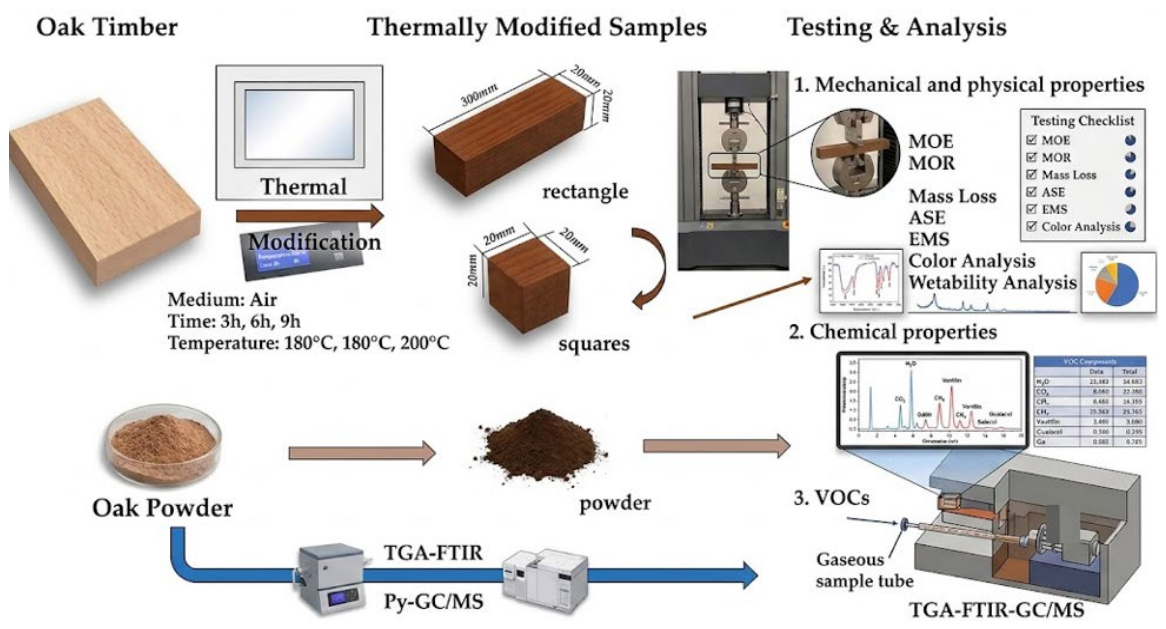

Table 1.
Comparative matrix of performance and circular economy implications of the main modification techniques. The circularity column is interpretive and should not be taken as a quantitative measure of circularity.
Table 1.
Comparative matrix of performance and circular economy implications of the main modification techniques. The circularity column is interpretive and should not be taken as a quantitative measure of circularity.
| Technique | Dominant mechanism | Primary benefit | Typical trade-off | Machining and bonding | Circularity interpretation (qualitative) |
|---|---|---|---|---|---|
| Thermal modification | Hemicellulose degradation; lignin reorganisation; fewer sorption sites | Lower hygroscopicity; improved stability and durability | Loss of toughness/MOR under severe regimes; darkening | Greater brittleness and dust; wettability must be controlled | Good potential for mechanical recycling depending on control of fractions, and contamination and compatibility of adhesives. |
| Acetylation | Esterification of -OH groups and cell-wall bulking | Very high dimensional stability and biological durability | Reagent cost; residual acid; corrosion | Altered surface energy; adhesive selection required | Extended service life is good, but residual chemistry and reliable identification/sorting are still required for controlled cascading. |
| Furfurylation | Polymerisation of furfuryl alcohol in the lumen and cell wall | Hardness, durability and stability | Brittleness, dark colour and complex composition | Greater tool wear and altered adhesion are possible | Recycling may be possible; formula-tion complexity, additives and feed-stock separation determine downstream suitability and safety . |
| THM / densification | Plastic-viscoelastic cell compression and thermal fixation | Hardness and load-bearing capacity of low-density species | Set-recovery; non-uniform density; energy demand | Higher cutting forces; local differences in machining | Low dependence on foreign chemicals but density heterogeneity related to densification requires classification and process adaptation. |
Table 2.
Mechanism-comparison and validation matrix for the principal wood modification methods.
| Method | Dominant chemical/physical change | Principal location | Mass change | Pore/microstructure change | EMC / sorption | Reversibility / recovery | Representative validation |
|---|---|---|---|---|---|---|---|
| Thermal modification | Hemicellulose degradation/deacetylation; carbohydrate cleavage; lignin condensation/reorganization | Cell wall, especially amorphous carbohydrate-rich regions | Usually decreases | Treatment-dependent loss/redistribution of microvoids and changes in pore accessibility | Generally decreases | Chemical degradation is largely irreversible; moisture-induced dimensional response remains partly reversible | FTIR; solid-state NMR; TGA/DSC; DVS; DMA; XPS; micro-CT/micropore analysis |
| Acetylation | Esterification of accessible –OH groups; acetyl substitution and cell-wall bulking | Cell wall polymers accessible to reagent | Usually increases (weight percent gain) | Bulking/expansion; altered free volume and sorption-site accessibility | Strongly decreases | Esterification is effectively irreversible under service conditions; swelling response remains environmentally reversible | FTIR; solid-state NMR; DVS; dimensional analysis; XPS; microscopy |
| Furfurylation | Acid-catalysed polymerization of furfuryl alcohol to PFA; distribution depends on impregnation and curing | Cell lumen and, critically, the cell wall | Usually increases | Pore filling and/or cell-wall polymer deposition; distribution is species- and process-dependent | Generally decreases | PFA network is not readily reversible; set and degradation depend on formulation | FTIR; solid-state NMR; TGA/DSC; DVS; microscopy/micro-CT; chemical extraction where applicable |
| THM densification | Heat/moisture-assisted plasticization and mechanical compression; limited chemical modification | Cell wall and lumina, with strong anatomical dependence | Mass approximately conserved apart from processing losses | Porosity decreases and density increases; profile may be heterogeneous | Often decreases initially, but moisture-induced set-recovery may occur | Dimensional recovery is potentially reversible upon moisture exposure unless thermally fixed | Density profile; microscopy/micro-CT; DVS; DMA; mechanical recovery tests |
Table 3.
Hierarchy of recommended end-of-life scenarios for modified wood.
| Scenario | Retained value | Technical prerequisite | Principal risk | Priority |
|---|---|---|---|---|
| Direct reuse | Highest | Documented composition; preserved cross-section; visual and mechanical assessment | Hidden damage; unknown modification | 1 |
| Remanufacturing / repair | Very high | Machinability, replaceable joints and available documentation | Edge chipping, difficult bonding and dimensional constraints | 2 |
| Particleboard / MDF | Medium | Sorting, decontamination, fractionation and compatible adhesive | Reduction in IB/MOR; emissions; mixing of chemical systems | 3 |
| WPC / biocomposite | Medium to low | Controlled fine fraction and compatible matrix | Lock-in within a difficult-to-recycle multimaterial system | 4 |
| Energy recovery | Lowest material value | Control of emissions and ash composition | Loss of material value; problematic additives | 5 |
Table 4.
Mean values of physical and mechanical properties of experimental particleboard panels (presented descriptively). [80].
Table 4.
Mean values of physical and mechanical properties of experimental particleboard panels (presented descriptively). [80].
| Recycled content | MOR (N/mm²) | MOE (N/mm²) | IB (N/mm²) | TS 24 h (%) | Density (kg/m³) |
|---|---|---|---|---|---|
| 0% | 18.5 ± 1.2 | 2380 ± 120 | 0.62 ± 0.08 | 8.2 ± 0.6 | 682 ± 12 |
| 30% | 17.8 ± 1.4 | 2290 ± 145 | 0.58 ± 0.09 | 9.5 ± 0.8 | 675 ± 15 |
| 50% | 15.9 ± 1.7 | 2050 ± 180 | 0.50 ± 0.11 | 11.3 ± 1.1 | 668 ± 18 |
| 70% | 13.2 ± 2.1 | 1720 ± 210 | 0.39 ± 0.13 | 14.7 ± 1.5 | 655 ± 22 |
Disclaimer/Publisher’s Note: The statements, opinions and data contained in all publications are solely those of the individual author(s) and contributor(s) and not of MDPI and/or the editor(s). MDPI and/or the editor(s) disclaim responsibility for any injury to people or property resulting from any ideas, methods, instructions or products referred to in the content. |
© 2026 by the authors. Licensee MDPI, Basel, Switzerland. This article is an open access article distributed under the terms and conditions of the Creative Commons Attribution (CC BY) license (http://creativecommons.org/licenses/by/4.0/).
Copyright: This open access article is published under a Creative Commons CC BY 4.0 license, which permit the free download, distribution, and reuse, provided that the author and preprint are cited in any reuse.