
Submitted:
10 September 2026
Posted:
11 September 2026
You are already at the latest version
Abstract
Evidence is mixed regarding when people rely on artificial intelligence (AI) rather than human advice, and advice-taking from AI remains uncharacterized in crisis-related decision scenarios. Across two preregistered studies, we used the judge-advisor system and Weight of Advice to examine how decision context, advisor presentation, and advice framing shape advice taking. In Study 1, participants made decisions in ordinary scenarios and crisis scenarios. Advice-taking was higher in crisis scenarios than in ordinary scenarios, and AI advice received greater uptake than human advice in the crisis condition. In Study 2, which focused on crisis scenarios, advisor type (human, anthropomorphic AI, non-anthropomorphic AI) and advice framing (avoidance-oriented vs. approach-oriented) were varied between participants. Results revealed a crossover interaction: avoidance-oriented advice received greater uptake from anthropomorphic AI than from non-anthropomorphic AI, whereas approach-oriented advice received greater uptake from non-anthropomorphic AI than from anthropomorphic AI. These findings suggest that AI advice-taking in crisis decision scenarios is shaped by both context and communication design. Anthropomorphism does not uniformly increase the persuasiveness of AI advice; instead, its effect depends on how the advice is framed.
Keywords:
AI advice‐taking
; crisis scenarios
; anthropomorphism
; advice framing
; judge‐advisor system
1. Introduction
As artificial intelligence (AI) permeates daily life, it increasingly functions as an advisor (Mendel et al., 2025; Lee et al., 2026). Yet most evidence on advice-taking from AI comes from routine settings. Crisis contexts, which are marked by urgency and unpredictability (Bundy et al., 2017), are pivotal because they intensify reliance on external advice and recalibrate how decision-makers trade off speed, accuracy, and accountability. Understanding whether, and when, people rely on AI rather than human advice in crisis-related decision settings is important for clarifying the contextual boundaries of AI advice-taking. Prior research has split between algorithm appreciation and algorithm aversion. In the former, people heed AI system for its efficiency and reliability; in the latter, they prefer human judgment even when algorithms are more accurate (Talebi et al., 2025; Jussupow et al., 2024). We argue that these divergent findings reflect moderating conditions, including the decision contexts, inferences about the AI system, and the framing of outputs, which are likely to be especially consequential in crises. In particular, two additional factors may be especially relevant once advice is sought in crisis-related settings. One concerns the way the advisor is presented. Anthropomorphic cues can shape how AI systems are perceived, including whether they appear more socially engaging or more human-like (Van Pinxteren et al., 2019). The other concerns the way the advice itself is framed. Advice framing may alter how advice is interpreted and how persuasive it appears (Kim & Song, 2023). Rather than assuming a single overarching mechanism, the present research examines whether these two classes of factors jointly shape advice taking from AI in crisis-related scenarios. In addition, crisis-related decisions provide a theoretically important context for studying AI advice-taking because they combine uncertainty, urgency, and perceived threat. In such situations, decision-makers often have limited time and cognitive resources to evaluate alternatives, making external advice especially influential. At the same time, crisis decisions may generate competing needs: individuals may seek objective and efficient guidance, but they may also desire reassurance, empathy, and social connection. This makes crisis-related settings a useful context for examining when AI advice is followed and when humanlike cues in AI advisors become more or less persuasive.
This leads to our core questions: (i) do people rely on AI advice differently from human advice under crisis conditions, and (ii) does advice-taking depend on how AI anthropomorphic cues and advice framing are combined in crisis scenarios?
2. Literature Review and Hypotheses Development
2.1. Advice-Taking Under Crisis
People often turn to advice when facing uncertainty, as advice can help reduce ambiguity and validate decisions (Pescetelli & Yeung, 2021; Hadar & Fischer, 2008). Among various uncertain situations, crisis contexts represent a particularly intense form, typically characterized by time pressure, high stakes, emotional arousal, and perceived threat or loss of control. These heightened conditions may fundamentally alter how individuals process and respond to advice, especially from non-human sources like AI. Despite their theoretical importance, crisis contexts remain understudied in the domain of advice-taking, leaving questions about how decision environments modulate individuals’ receptiveness to AI-generated advice. Understanding this distinction is essential for evaluating the contextual boundaries of AI’s influence. Crises, such as natural disasters, pandemics, or security threats, are characterized by extreme uncertainty, urgency, and potentially severe consequences (Bundy et al., 2017; Drennan et al., 2014). These high-stakes scenarios place considerable cognitive and emotional demands on individuals, increasing reliance on heuristics and narrowing attentional resources, as suggested by the concept of bounded rationality (Simon, 1955). Though several prior studies have paid attention to examining how people take AI’s advice in risky contexts (e.g., decisions involving financial uncertainty or medical trade-offs) (Longoni et al., 2019; Larkin et al., 2022), such risky contexts typically involve known probabilities or calculable outcomes, and it do not fully capture the temporal urgency, emotional volatility, and existential stakes that define crises (Bundy et al., 2017). Crisis contexts are not merely high-risk environments; they uniquely involve extreme uncertainty, urgency, and intense emotional arousal (Sayegh et al., 2004; Reale et al., 2023). As such, findings from research on risk-based decisions cannot be directly generalized in crisis contexts. This distinction underscores the importance of specifically investigating how people respond to AI-generated advice under crisis contexts, where the psychological dynamics of decision-making may be different from risky decision-making.
Prior research suggests that crisis contexts, characterized by elevated uncertainty, urgency, and emotional intensity, amplify individuals’ reliance on external advice sources. It is because people under stress and cognitive overload are more likely to defer to available guidance, especially when the perceived stakes are high and time for deliberation is limited (Brinks & Ibert, 2023). Notably, AI advisors differ fundamentally from human advisors in ways that may render them particularly advantageous in crisis contexts. Unlike human counterparts, AI systems are typically perceived as more objective, data-driven, and unaffected by emotional fluctuations, attributes that can be especially valued when decisions must be made swiftly and under pressure (Logg et al., 2019). Accordingly, we proposed that:
Hypothesis 1.
Compared with ordinary scenarios, participants were expected to show greater advice-taking in crisis scenarios. Consistent with the preregistered expectation, we further anticipated that relative advantage of AI over human advice would be more evident in crisis scenarios than in ordinary scenarios (H1).
While crisis contexts provide a critical contextual lens for understanding how people take advice from AI, contextual factors alone may not fully explain when and why individuals accept or reject AI-generated advice. For advice to be effective, contextual factors are important, but equally critical are the characteristics of the advice source (i.e., the advisor) (Pescetelli & Yeung, 2021) and the way the advice is framed (Barnes et al., 2024), both of which play key roles in shaping people’s advice-taking behavior. To develop a more comprehensive account of how individuals take advice from AI, it is therefore necessary to consider characteristics intrinsic to the AI advisor itself, as well as the representational style in which its advice is delivered.
2.2. Anthropomorphism of AI Advisor
In addition to contextual factors such as crisis contexts, the characteristics of the AI advisor itself can potentially influence advice-taking (Pescetelli & Yeung, 2021). Among the various attributes that influence people’s responses to AI systems, anthropomorphism, the extent to which an AI agent is perceived as having human-like qualities (Blut et al., 2021), stands out as particularly consequential in shaping trust and social engagement (Troshani et al., 2021; Xie & Xiao, 2026), especially in crisis contexts where emotional intensity and uncertainty heighten people’s sensitivity to perceived empathy. As AI becomes increasingly embedded in interactive roles, designers often incorporate anthropomorphic cues (e.g., human names, facial avatars, conversational language) to foster social engagement and trust (Chi & Hoang Vu, 2023). These anthropomorphic (human-like) elements may affect how people perceive and respond to AI’s advice.
Prior research on anthropomorphism suggests that, under certain conditions, attributing human-like qualities to AI agents can enhance trust by evoking perceived warmth and empathy, while simultaneously allowing the agent to retain its data-driven, analytical strengths. This unique combination of emotional resonance and informational competence may make anthropomorphic AI particularly persuasive in contexts where both social reassurance and credible guidance are needed (Sew et al., 2025). For example, AI systems given human names, facial avatars, or conversational language styles have been found to boost user trust in domains such as autonomous driving, virtual assistants, and customer service (Rheu et al., 2021). When an AI appears more human-like, people are more likely to ascribe it with intention or even a “mind,” which may reduce psychological resistance to its recommendations and foster greater acceptance (Shank et al., 2019). However, the effectiveness of anthropomorphic cues is not uniform and may be moderated by contextual factors (Kim & Song, 2023). For example, Erebak and Turgut (2019) found that anthropomorphism of AI did not affect trust in a context characterized by low stakes but high responsibility, such as a nursing task. Based on these prior studies, we can see that empirical findings on the effects of AI anthropomorphism have been inconsistent. These contrasting outcomes raise questions about how anthropomorphic design operates in different decision contexts. Specifically, in crisis contexts, where emotional stress, cognitive overload, and the need for dependable guidance are elevated (Covello, 2021), it remains unexplored whether an anthropomorphic AI advisor will be perceived as more trustworthy or more unsettling. Human-like AI cues may foster empathy and safety, but may also reduce credibility if perceived as inauthentic in crises. To date, no study has directly examined how the anthropomorphism of an AI advisor influences advice-taking under crisis.
Therefore, the present research also addresses this question by investigating whether the level of anthropomorphism in an AI advisor affects individuals’ willingness to take its advice during a crisis context.
2.3. Advice Framing
Beyond advisor-related cues, the way advice is framed may also shape advice-taking (Barnes et al., 2024; Chang, 2025). Prior work on persuasion has shown that message effectiveness depends not only on what is communicated, but also on how it is framed (Smith & Petty, 1996). In the present research, we distinguish between two forms of advice framing based on prior evidence: one emphasizes avoiding negative outcomes (i.e., avoidance-oriented advice), whereas the other emphasizes attaining favorable outcomes (i.e., approach-oriented advice) (Jeong et al., 2011; Sherman & Updegraff, 2006). Although both forms of advice are intended to guide decision-making, they foreground different aspects of the situation and may therefore influence how persuasive the advice appears.
This distinction may be especially relevant in crisis scenarios, where individuals often experience heightened threat, uncertainty, and emotional stress (Dionne et al., 2018). Under such conditions, advice framed around avoiding harm may become particularly salient because it directly addresses concerns about safety and loss prevention. By contrast, advice framed around attaining favorable outcomes can be interpreted as more opportunity-oriented or instrumentally focused (Jang & Feng, 2018). Thus, even when both persuasive messages recommend the same option, differences in framing may alter how the advice is received or how readily it is adopted.
Importantly, advice framing may not operate independently of the advisor’s presentation. Anthropomorphic AI agents are more likely to be perceived as warm, understanding, and emotionally responsive (Yang et al., 2022), which may make them especially compatible with advice framed around avoiding harm. In contrast, less anthropomorphic AI may appear more impersonal, analytical, and instrumental, which may make it better matched to advice framed around attaining favorable outcomes. The present research therefore examines whether different forms of advice framing interact with AI anthropomorphic cues in shaping advice uptake in crisis scenarios. Accordingly, we hypothesized that advisor anthropomorphism and advice framing would interact in shaping advice-taking in crisis scenarios.The direction of this prediction follows from the presumed compatibility between the social meaning of the advisor cue and the emphasis of the advice. Advice framed around avoiding harm directly highlights safety, threat reduction, and protection from negative outcomes. Such advice may be especially compatible with anthropomorphic AI, whose humanlike cues may signal warmth, understanding, and emotional responsiveness. In contrast, advice framed around attaining favorable outcomes highlights instrumental goal pursuit and successful resolution. Such advice may be more compatible with non-anthropomorphic AI, whose impersonal presentation may signal analytical precision, objectivity, and competence.
Hypothesis 2.
In crisis scenarios, advisor anthropomorphism and advice framing were expected to interact in shaping advice-taking. Specifically, advice framed around avoiding harm (avoidance-oriented) was expected to be taken more from anthropomorphic AI than from non-anthropomorphic AI, whereas advice framed around attaining favorable outcomes (promotion-oriented) was expected to be taken more from non-anthropomorphic AI than from anthropomorphic AI (H2).
3. Overview of Research
We tested these two hypotheses in two registered studies (AsPredicted #221944, https://aspredicted.org/s4c5-b9jn.pdf). Study 1 examined whether advice-taking differed between AI and human advisors across ordinary scenarios and crisis scenarios. Study 2 focused on crisis scenarios and examined whether advice uptake varied as a function of AI anthropomorphism and advice framing. Both studies used the Judge-Advisor System (JAS) and Weight of Advice (WOA) as the primary index of advice taking. The JAS paradigm is a widely adopted methodological framework in the advice-taking literature, providing a rigorous means to capture how individuals integrate advice into their decision-making, that is, the degree to which they are persuaded by the advice (Pescetelli & Yeung, 2021). In this paradigm, participants first make an independent judgment, then receive advice from an external advisor, and subsequently make a final decision. The influence of advice is quantified using the WOA metric, which reflects the extent to which individuals adjust their final judgments toward the advice. WOA is calculated within a range from 0 to 1, with higher values (i.e., closer to 1) indicating greater influence of advice on participants’ final decisions.
4. Study 1
To empirically test whether people respond differently to AI versus human advisors depending on the decision context (crisis context vs. ordinary context), Study 1 examined whether people were more likely to take advice from AI than from a human advisor in ordinary versus crisis scenarios. By employing a 2 (Advisor: AI vs. Human, between-subjects factor) × 2 (Context: crisis vs. non-crisis scenarios, within-subjects factor) mixed design, we systematically explored how these two key factors shape individuals’ willingness to take advice.
4.1. Method
4.1.1. Participants
According to the mixed factorial design with 2 × 2 factors, a power analysis using G*Power 3.1 indicated a minimum sample of 54 for detecting a medium effect (f = 0.25) in a repeated-measures design with power .90 and α = .05 (Faul et al., 2009). To ensure a sufficient sample size after invalid data exclusion, we recruited 121 participants. The majority of participants were recruited from [authors’ institution]. After excluding 4 participants for failing attention checks. The final sample for analysis was N = 117 (49 males, 68 females, Mage = 20.31 years, SD = 1.97). After completion of the experiment, participants received monetary compensation (10 RMB).
The study protocol was reviewed and approved by the Institutional Review Board (IRB) of the [first author’s institution]. All procedures were conducted in accordance with the ethical standards of the responsible committee and with the Declaration of Helsinki. Prior to participation, all participants provided written informed consent.
4.1.2. Materials and Manipulations
Crisis Scenarios and Non-Crisis Scenarios
The experimental context materials were classified into two categories: crisis-related scenarios and non-crisis-related (i.e., ordinary) scenarios. The crisis scenarios used in this experiment were selected based on categories outlined in the Chinese National Overall Emergency Response Plan for Public Emergencies (2006) issued by the State Council of the People’s Republic of China (https://english.mee.gov.cn/Resources/Plans/Plans/201712/P020171213583270295545.pdf accessed on). These scenarios were compiled into task materials representing crisis contexts. In contrast, non-crisis scenarios were drawn from everyday situations such as ordinary purchases and travel, and were similarly developed into scenario materials.
To ensure that the crisis scenarios were perceived as significantly more crisis-relevant than the non-crisis scenarios, a pretest was conducted. Before the main experiment, 30 undergraduates (15 males and 15 females, Mage = 20.18 years) completed a material evaluation task using the Crisis Context Rating Scale (i.e., participants indicated “To what extent did you feel urgent/ uncertain/harmful/threatening/loss of control/stressful in these scenarios?” on a 7-point Likert scale, α = .841). Sixty situational descriptions were rated for perceived crisis severity. A paired samples t-test confirmed that the crisis scenarios (M = 5.82, SD = 0.47) were rated significantly higher in crisis severity level than the non-crisis scenarios (M = 1.36, SD = 0.30), t(29) = 37.87, p < .001, Cohen’s d = 11.36. Finally, based on these results, 30 crisis and 30 non-crisis scenarios were selected for use in this study. To illustrate the differences between the two types of context materials, one example from each condition is presented below:
Example of a Crisis Scenario
“You live on the 13th floor of an apartment building. One night, a fire suddenly breaks out in a unit on the 12th floor. Due to dry weather conditions, the fire spreads rapidly. Thick smoke is rising, and you must quickly find a way to escape. If you go upstairs to the rooftop, you may be temporarily safe, but it is uncertain whether the fire will reach the top floor before rescue teams arrive. If you go downstairs, you may be able to escape the building, but thick smoke and limited visibility make it unclear how far the fire has spread. Going down could expose you to severe burns or even suffocation.”
Example of a Non-Crisis Scenario
“The weekend is coming, and you plan to spend some time outdoors to relax. You’ve carefully prepared two alternative plans and now need to choose one. The first option is to go hiking in the nearby mountains, where you can enjoy the tranquility and beauty of nature. It’s a good opportunity to exercise and temporarily escape the noise of the city. The second option is to visit an amusement park in the city, where you can experience the thrill of exciting rides and enjoy the carefree joy reminiscent of childhood.”
AI/Human Advisor Manipulation
To manipulate the type of advisor, participants were randomly assigned to either a human advisor condition or an AI advisor condition.
In the human advisor condition, participants were shown a silhouette image of a purported human (used to preserve anonymity) and read a brief description indicating that this putative person had previously participated in a study involving crisis or ordinary decision scenarios, and had provided judgments on similar situations. Based on this person’s prior engagement with such tasks, the person was presented as qualified to offer relevant advice.
In the AI advisor condition, participants were shown a stylized illustration of an AI system and read a description explaining that the advisor was an AI model trained to make complex decisions using large-scale data, algorithms, and predictive analysis. The description emphasized that such AI systems are widely applied in fields involving high-stakes decisions, such as healthcare, finance, or transportation.
In both conditions, the advisor was presented as the source of the advice that followed.
4.1.3. Procedure
Study 1 was conducted in a dedicated offline laboratory environment, where all procedures were implemented using E-Prime 3.0 software (Psychology Software Tools, Inc., Pittsburgh, PA) on computers. See Figure 1 for the illustration of the experimental procedure.
Upon arrival, each participant first received the task instructions: “On each round, you will read different scenarios involving a crisis context and a non-crisis context and indicate your initial option preference on a 9-point Likert scale. Options A and B will be presented, and you will rate your preference by entering a number from 1 to 9 on the keyboard. An advisor’s advice will appear after your initial choice; please read the advice and then indicate your final option preference.”
Afterward, all participants were randomly assigned to one of two conditions: reading the advice from a human advisor (n = 57) or an AI advisor (n = 60). In this experiment, each trial began with a fixation cross presented for 500 ms, followed by the display of a scenario. After reading the scenario, participants pressed the space bar to proceed to the rating interface, where they were asked to make an initial option preference based on their own judgment (Note that the positions of Options A and B on the response scale were counterbalanced within participants across trials). In particular, to approximate the urgency associated with crisis scenarios, initial judgments in the crisis condition were made under a 1-s response window, whereas responses in ordinary scenarios were unrestricted. Accordingly, Study 1 operationalized crisis-related decision-making using crisis scenarios paired with more constrained deliberation (Note: Trials in which no valid response was recorded within the time limit were treated as missing values and excluded from the analysis. On average, 1.6 trials (5.3%) per participant were excluded in the crisis condition. No imputation was performed; only valid trials were included in the final analysis. In the non-crisis condition, no time limit was imposed, and all trials remained.). After that, a piece of advice was presented, ostensibly coming from either an AI system or a human participant, depending on the condition. The presentation of advice was self-paced; then participants advanced to the final decision stage, where participants were asked to either maintain or revise their option preference.
The entire experiment consisted of two task blocks (crisis block and non-crisis block), each with 30 trials, resulting in a total of 60 trials. The order of the two blocks was randomized across participants. A self-paced break was provided between the two blocks.
In addition, as a manipulation check, after completing each trial, participants were asked to rate the perceived crisis intensity of the scenarios using a single item: “How much of a crisis do you think the situation described in the task material is?” Responses were recorded on a 5-point Likert scale ranging from 1 (very high) to 5 (very low), with lower scores indicating stronger perceived crisis severity.
4.1.4. Data Recording and Analysis
Data (including decision time and option preference rating, see the decision time analysis in Supplementary Materials) were recorded via E-prime 3.0 software. Data analysis was conducted using SPSS version 26.0 (SPSS, Inc., Chicago, IL). Particularly, we computed the WOA scores for each trial as the degree of shift from the participant’s initial option preference toward the advisor’s advice based on prior studies (Hütter & Ache, 2016), following the formula:
In the formula, final decision refers to the participant’s final option preference, initial decision refers to the participant’s initial option preference before receiving advice, and advice refers to the advisor’s recommendation. Both the numerator and denominator were expressed in absolute values. WOA ranged from 0 (completely ignoring the advice) to 1 (fully adopting the advice). Each scenario involved two decision options, labeled A and B, and the recommended option was counterbalanced across trials. Because the positions of Options A and B on the 9-point response scale were also counterbalanced, advice was coded according to the response-scale orientation on each trial. Specifically, advice was coded as 9 when the advised option appeared on the high end of the scale and as 1 when the advised option appeared on the low end of the scale. In the latter case, responses were reverse-scored before calculating WOA, so that all trials were placed on a common metric and higher WOA values consistently indicated greater movement toward the advice. Note that trials in which the participant’s initial decision exactly matched the advisor’s recommendation produced a zero denominator in the WOA formula. Because no movement toward the advice could be estimated in such trials, they were treated as non-informative for WOA calculation and excluded from trial-level WOA averaging. Finally, WOA scores were then averaged across trials for each participant in each condition and used as the dependent variable.
4.2. Results of Study 1
4.2.1. Manipulation Checks
Each participant rated the perceived crisis severity for two different types of scenarios. A significant difference was found in perceived crisis severity between the non-crisis and crisis scenarios, t(117) = 27.09, p < .001, Cohen’s d = 3.65. The ordinary scenarios were rated significantly higher (M = 4.09, SD = .72) than the crisis scenarios (M = 1.80, SD = .52), with lower scores indicating greater perceived crisis severity level.
4.2.2. WOA Results
A repeated-measures ANOVA 2 (Contexts: ordinary vs. crisis contexts, within-subject factor) ×2 (Advisor: AI vs. Human advisor, between-subject factor) was conducted on the WOA scores. The results revealed a significant main effect of contexts, F(1, 115) = 202.64, p < .001, η2p = .638. Participants showed significantly greater advice-taking in the crisis contexts (M = .51, SD = .21) than in the non-crisis contexts (M = .27, SD = .14). The main effect of advisor type was not significant, F(1, 115) = 1.17, p = .282, η2p = .010, indicating no difference in WOA scores between the AI and human advisor conditions overall.
Importantly, there was a significant interaction between context and advisor type, F(1, 115) = 13.40, p < .001, η2p = .104. Simple effects analysis showed that in the ordinary contexts, the difference in advice-taking between the human and AI advisor conditions was not significant (F(1, 115) = 1.40, p = .24, η2p = .012). In contrast, in the crisis condition, participants in the AI-advisor condition showed higher WOA scores than those in the human-advisor condition. This pattern was broadly consistent with the preregistered expectation, F(1, 115) = 5.95, p = .016, η2p = .049. See Figure 2 for the results of Study 1.
4.3. Discussion of Study 1
Study 1 shows that advice-taking is context-dependent. Consistent with H1, participants adopted external advice more often in crisis than in non-crisis scenarios, consistent with bounded rationality (Simon, 1955, 1990). Moreover, while AI and human advice were equally adopted in non-crisis contexts, participants showed greater receptivity to AI in crises, likely because AI is viewed as objective and less emotionally biased (Myers & Everett, 2025). These findings extend prior work on algorithm preference and highlight AI’s relative advantage in urgent, complex decisions. Building on this, Study 2 examines how two factors, AI anthropomorphism and the advice framing, further shape advice-taking in crisis contexts.
5. Study 2
To test H2, Study 2 examined how AI anthropomorphism and advice framing jointly influence advice-taking in crisis scenarios. Based on the findings in Study 1, this study focused exclusively on crisis contexts to explore how these factors interact under crisis contexts. Specifically, here we included a human advisor condition as a baseline for comparison to evaluate whether observed effects were uniquely attributable to AI advisor characteristics. Therefore, focusing exclusively on crisis contexts, we employed a 3 (Advisor type: Human vs. Anthropomorphic AI vs. Non-anthropomorphic AI) × 2 (Advice framing: avoidance-oriented vs. approach-oriented) between-subjects factorial design to examine how advisor characteristics and advice framing influence people’s advice-taking. Notably, Study 2 was conducted as an online experiment via the TC-Lab platform (https://www.testcloudlab.com/testcloud-study) to facilitate data collection to ensure diversity in participant sample sources.
5.1. Method
5.1.1. Participants
A power analysis using G*Power 3.1 for a 2 × 3 between-subjects ANOVA indicated that a sample size of 206 was needed to detect a medium effect (f = 0.25) with 90% power. To account for potential online data quality issues, we recruited 297 participants through the TC-Lab online platform. After applying exclusion criteria similar to those used in Study 1, 36 participants were removed (26 participants were excluded for failing to complete the entire experiment, 10 participants were excluded for failing the attention checks), resulting in a final sample of 261 valid cases (114 males, 147 females; Mage = 22.26 years, SD = 3.41). All participants received monetary compensation after completing the experiment (10 RMB).
The study protocol was reviewed and approved by the Institutional Review Board (IRB) of the [first author’s institution]. All procedures were conducted in accordance with the ethical standards of the responsible committee and with the Declaration of Helsinki. Prior to participation, all participants provided written informed consent.
5.1.2. Materials and Manipulations
Advisor Manipulation
As in Study 1, the advisor type was manipulated through both textual and visual cues on the advice interface (see Figure 3 for the illustration).
The human advisor manipulation was the same as in Study 1.
Importantly, we manipulated AI anthropomorphism in both instruction and procedural stimuli. For instruction, based on a recent study (Dang & Liu, 2024), the characteristics anthropomorphic AI vs. non-anthropomorphic AI was emphasized the non-anthropomorphic AI was described as “an artificial intelligence model that has not yet reached human-level emotional understanding” (i.e., a pure analytical engine), whereas the anthropomorphic AI was described as “an AI assistant that can understand complex human emotions at a human level”.
For procedural stimuli, in the non-anthropomorphic AI condition, the advisor was described as an AI with an impersonal designation. We emphasized its analytical nature in materials. For example: “AI Advisor (Model HRA): Using an algorithm of “big data” about crisis, it looks like choosing Option A increases your chance of escaping safely, so the algorithm analysis recommends Option A.”. By contrast, in the anthropomorphic AI condition, the advisor was described as an AI with a more personable identity, a human name and conversational style, while still indicating it’s an AI. The anthropomorphic AI spoke in the first person, used a greeting, and generally mimicked a polite human advisor tone. For example: “AI Assistant (Archie): I am your AI assistant Archie. I totally understand your feelings in the crisis context. I’ve carefully analyzed the data about the crisis; it looks like choosing Option A increases your chance of escaping safely, so I suggest you choose A.”
The Advice Framing Manipulation
To manipulate the advice framing in crisis contexts, the content was framed to emphasize either a prevention focus (risk avoidance) or a promotion focus (positive outcomes or improvements). The specific recommended option (either Option A or B) remained constant across conditions to control for content differences.
In crisis contexts, avoidance-oriented advice was framed to emphasize minimizing risk and avoiding negative consequences. For example:
“Choosing Option A can reduce the risk of being injured in the fire.”
“Option A helps avoid potentially life-threatening outcomes.”
In the approach-oriented advice condition within crisis scenarios, the advice emphasized attaining favorable outcomes, such as safety or effective resolution. For example:
“Choosing Option A increases your chance of escaping safely.”
“Option A helps maximize the likelihood of survival.”
5.1.3. Procedure
Procedures of Study 2 were implemented using the TC-Lab platform online (see Figure 1B for the procedural illustration). The procedure in Study 2 followed the same structure as in Study 1, except that all scenarios involved crisis contexts. After providing informed consent, all participants first received the task instructions, and then were randomly assigned to one of six experimental conditions, i.e., human advisor with avoidance-oriented advice (n = 44), human advisor with approach-oriented advice (n = 40), anthropomorphic AI with avoidance-oriented advice (n = 45), anthropomorphic AI with approach-oriented advice (n = 40), non-anthropomorphic AI with avoidance-oriented advice (n = 46), and non-anthropomorphic AI with approach-oriented advice (n = 46). The entire experiment consisted of 30 trials (i.e., participants were required to make decisions in 30 crisis contexts) (Note: As in Study 1, trials in which no valid response was recorded within the time limit were treated as missing values and excluded from the analysis. On average, 1.3 trials (4.3%) per participant were excluded in the crisis condition.).
Notably, to ensure the effectiveness of the experimental manipulations in Study 2, several manipulation checks were conducted at different stages of the task as follows:
First, before the main task, participants also completed a pre-task emotional baseline assessment using the six-item scale adapted by Li et al. (2016). The scale included four negative emotion items (uneasy, stressed, anxious, nervous) and two neutral items (calm, relaxed). For each item, participants answered the question, “How [uneasy/stressed/anxious/nervous/calm/relaxed] do you feel right now?” on a 7-point Likert scale ranging from 1 (“strongly disagree”) to 7 (“strongly agree”). To examine the effectiveness of crisis contexts, after the presentation of each scenario in every trial, participants’ emotional responses were assessed via the same six-item scale before any advice was shown. Because the same crisis scenarios were used as in Study 1, we did not reassess participants’ perceptions of crisis severity in Study 2. This procedure differed from Study 1’s manipulation check, which verified the effectiveness of the crisis context manipulation at the emotional level. Compared to Study 1, which relied on subjective evaluations of scenario intensity, the present study adopted a more direct and sensitive method by assessing participants’ emotional states immediately after each scenario. Crises are typically associated with heightened stress-related emotion levels (Benjamin et al., 2021; Janka et al., 2015). If the manipulation is successful, participants should report higher levels of negative emotions under crisis scenarios. Thus, measuring emotional responses also offers a psychologically grounded check of the crisis manipulation’s salience.
Second, immediately after reading the advisor’s advice in each trial, participants rated the perceived advice framings. This item, adapted from Baek and Kim (2023), asked: “You think the advice provided by the advisor focused on…”, with responses recorded on a 7-point Likert scale from 1 (“avoiding risk”) to 7 (“gaining security”). Lower scores indicated a more avoidance-oriented framing, while higher scores reflected an approach-oriented message.
Finally, after completing all trials, participants assessed the perceived anthropomorphism of the advisor. They rated four items adapted from Dang and Liu (2024): “I think the advisor has their own thoughts”, “I think the advisor has consciousness”, “I think the advisor can feel emotions”, and “I think the advisor can express emotions.” Ratings were indicated on a 7-point Likert scale ranging from 1 (“strongly disagree”) to 7 (“strongly agree”). These items captured the extent to which participants viewed the advisor (whether AI or human) as possessing human qualities. Because each participant interacted with only one advisor throughout the experiment, it was unnecessary to assess perceived anthropomorphism after each trial.
5.2. Results of Study 2
5.2.1. Manipulation Checks
Manipulation Checks for Crisis Contexts
This check was based on the average emotional ratings across all trials after reading the crisis scenarios, compared to the baseline averages measured before the main task. As shown in Table 1, paired-sample t-tests showed that participants reported lower pre-task levels of uneasiness, stress, anxiety, and nervousness compared to post-task levels after reading crisis scenarios. Conversely, ratings for calmness and relaxation significantly decreased after reading crisis scenarios. Consistent with previous studies, these results confirm that participants experienced increased emotional stress while making decisions in crisis scenarios (Benjamin et al., 2021; Janka et al., 2015), suggesting that the manipulation of crisis contexts was successful.
Manipulation Checks for Anthropomorphism
This check was based on participants’ anthropomorphism ratings for each advisor (Human vs. Anthropomorphic AI vs. Non-anthropomorphic AI) condition, which were measured once after completing all trials in the corresponding condition. A one-way ANOVA was conducted on participants’ perceived anthropomorphism scores across the three advisor conditions. Results revealed the differences across three advisor types were significant, F(2, 258) = 26.86, p < .001, ƞ2p = .17. Post-hoc comparisons indicated that perceived anthropomorphism was significantly higher in the human advisor condition than in the machinelike AI condition (Mhuman = 5.14, SD = 1.04 vs. Mnon-anthropomorphic AI = 3.74, SD = 1.35; p < .001,), and also higher than in the anthropomorphic AI condition (Manthropomorphic AI= 4.29, SD = 1.04; p < .001). Additionally, participants rated the anthropomorphic AI as significantly more humanlike than the non-anthropomorphic AI (p = .014). These results confirm the effectiveness of the anthropomorphism manipulation.
Manipulation Check for Advice Framing
Participants rated the perceived orientation of the advice framing. An independent samples t-test revealed a significant difference in advice framings ratings between the avoidance-oriented and approach-oriented advice conditions, t(259) = 8.10, p < .001, Cohen’s d = 1.01. Participants in the avoidance-oriented advice condition (M = 3.19, SD = 2.06) reported significantly lower scores than those in the approach-oriented condition (M = 5.16, SD = 1.84). One-sample t-tests against the scale midpoint further showed that the avoidance-oriented condition was rated significantly below the midpoint, t(134) = -4.57, p < .001, whereas the approach-oriented condition was rated significantly above the midpoint, t(125) = 7.08, p < .001. These results provide additional evidence that the two framing conditions were perceived in the intended directions.
5.2.2. WOA Results
As in Study 1, the WOA scores were also averaged across trials for each participant. A two-way ANOVA with 3 × 2 on WOA scores. Follow-up simple-effects analyses were conducted for significant interactions, and all post hoc pairwise comparisons were Bonferroni-corrected to control for multiple testing. The results revealed that no significant main effect of advisor type was observed, F(2, 255) = .24, p = .791, ƞ2p = .002. Similarly, there was no significant main effect of advice framings, F(1, 255) = .002, p = .968, ƞ2p < .001.
Importantly, a significant interaction was found between advisor and advice framings, F(2, 255) = 6.78, p = .001, η2p = .050. Further, simple effects analysis showed within the avoidance-oriented framing condition, the differences in WOA scores across three advisor types was significant, F(2, 255) = 3.53, p = .031, η2p = .027, suggesting that participants were more likely to take advice from an anthropomorphic AI advisor (M = .44, SD = .18) than from a non-anthropomorphic AI (M = .35, SD = .17, p = 0.030). However, advice from the human advisor was not significantly more persuasive than advice from either type of AI (vs. non-anthropomorphic AI: p = .230; vs. anthropomorphic AI: p = .987) in crisis contexts: although the human advisor scored between the two AI conditions, the difference was not large enough to yield significance. In contrast, the anthropomorphic AI advisor showed a salient advantage over the non-anthropomorphic AI advisor under the avoidance-oriented advice condition, leading to a significant difference between the two.
In contrast, within the approach-oriented framing condition, although the difference in WOA scores across the three advisor types was also significant, F(2, 255) = 3.44, p = .034, η2p = .026, the differences followed a distinct pattern in the avoidance-oriented framing condition. Specifically, advice from the non-anthropomorphic AI (M = .45, SD = .14) led to significantly greater advice-taking than advice from the anthropomorphic AI (M = .35, SD = .14, p = .029). This suggests that when the advice’ s goal as achieving gains, a non-anthropomorphic AI was more persuasive than one with anthropomorphic characteristics. Again, the human advisor’s influence did not differ significantly from either AI type in the approach-oriented advice condition (vs. non-anthropomorphic AI: p = .981; vs. anthropomorphic AI: p = .326), suggesting no inherent advantage of human’s advice in this setting. See Figure 4 for the results of Study 1.
5.3. Discussion of Study 2
Study 2 examined how AI anthropomorphism and advice framing jointly affect advice-taking in crises. Results supported H2, showing an interaction: avoidance-oriented advice was more persuasive when delivered by anthropomorphic AI, as its human-like features provide reassurance in risk-avoidance contexts (Mikulincer et al., 2014). In contrast, approach-oriented advice was more effective from non-anthropomorphic AI, whose impersonal framing signals competence and objectivity (Cesario et al., 2004).
These findings suggest when the advice framing (e.g., avoidance-oriented vs. approach-oriented) matches the perceived characteristics of the AI advisor, individuals are more likely to take the advice. An anthropomorphic AI is more effective at delivering avoidance-oriented messages because its human-like warmth and social cues align with the emotional and relational needs of loss-avoidant decision-making. In contrast, a non-anthropomorphic AI strengthens approach-oriented messages by emphasizing objectivity and instrumental efficiency, which support gain-oriented goals.
6. General Discussion
The present research examined advice taking from AI and human advisors in crisis-related decision settings. Across two preregistered studies, we found that advice-taking was higher in crisis scenarios than in ordinary scenarios, and that advice taking in crisis scenarios depended in part on the combination of AI anthropomorphic cues and advice framing..
6.1. Advice Taking from AI Was Greater Under the Crisis Condition
Consistent with H1, Study 1 revealed that participants were more receptive to advice in crisis contexts compared to non-crisis contexts. Specifically, participants showed higher WOA scores when making decisions in crisis scenarios compared to non-crisis contexts. This finding aligns with prior evidence showing that people experience heightened uncertainty, cognitive overload, and psychological stress in crisis contexts, increasing reliance on external advice (Levine et al., 2022; Sweeny, 2008). Notably, participants showed greater receptiveness to AI advisors than to human advisors in crisis contexts. This finding contributes to the debate on algorithm aversion versus algorithm appreciation (Talebi et al., 2025). AI advisors are not subject to emotional fluctuations and rely on large-scale data analysis, enhancing their perceived objectivity and consistency (Logg et al., 2019). In crisis contexts, typically marked by high stakes, emotional strain, and heightened uncertainty (Sayegh et al., 2004), these qualities make AI advisors appear more dependable than emotionally influenced human judgments.
6.2. Anthropomorphism and Advice Framing Shaped AI Advice Taking
Study 2 directly addressed H2 by examining the joint effect of AI anthropomorphism and advice framing on advice-taking in crisis scenarios. The key finding was not a simple advantage of anthropomorphic AI or non-anthropomorphic AI, but a crossover interaction between advisor presentation and advice framing. When advice emphasized avoiding harm, anthropomorphic AI elicited greater advice-taking than non-anthropomorphic AI. In contrast, when advice emphasized attaining favorable outcomes, non-anthropomorphic AI elicited greater advice-taking than anthropomorphic AI. This suggests that anthropomorphism is not inherently beneficial or detrimental for AI advice-taking. Rather, its effect depends on whether the social cues conveyed by the AI advisor are compatible with the framing of the advice.
This pattern may reflect different affordances of anthropomorphic and non-anthropomorphic AI presentations. In harm-avoidance contexts, anthropomorphic cues may make the advisor appear warmer, more understanding, and more emotionally responsive, thereby increasing the appeal of advice centered on safety and risk reduction (Kim & Hur, 2024; Yang et al., 2022). In favorable-outcome contexts, however, a less anthropomorphic AI may better fit advice that emphasizes instrumental goal attainment, because its impersonal presentation can signal analytical precision and competence (McKee et al., 2023; Castelo et al., 2019). In addition, the intermediate position of the human advisor is also theoretically informative. It suggests that the observed crossover pattern was not simply a contrast between human and AI advisors. Instead, the pattern appears to depend on the specific presentation of AI advisors. Human advisors may simultaneously convey social warmth and experiential judgment, but in the present design they were not tailored to either framing condition. By contrast, AI advisors were presented in more differentiated forms, either anthropomorphic or non-anthropomorphic, which may have made the compatibility between advisor presentation and advice framing more salient. This may explain why the human advisor showed a relatively stable, intermediate pattern across framing conditions.
6.3. Theoretical and Practical Implications
Building on these two studies, these results contribute both theoretically and practically to the research on advice-taking, human-AI interaction, and crisis decision-making. Theoretically, this research extends existing theories of advice-taking by integrating AI advisors into a domain traditionally focused on human-to-human interaction (Mayer et al., 2023). Importantly, this study also shows that the effectiveness of approach- and avoidance-oriented advice depends not only on how the message itself is framed, but also on how well the delivery styles and identity cues of the AI advisor align with the motivational orientation of the advice. In other words, when the advice framing and the AI’s presentation are aligned, such as avoidance-oriented advice from a human-like AI, people experience greater advice persuasion. This reflects a deeper form of motivational congruence that bridges communication design with social-cognitive processing.
Practically, from the perspective of AI design, our findings have direct applications for AI-based decision support systems in critical domains such as emergency response, public health, and defense. One major concern is that AI advisors should not adopt a “one-size-fits-all” approach. Instead, their design should be context-sensitive, both in appearance and in message delivery. For example, in public emergency systems requiring quick evacuation decisions, anthropomorphic AI delivering avoidance-oriented messages might better reassure individuals and increase compliance. Conversely, for emergency planning involving strategic resource allocation or proactive mitigation measures, a non-anthropomorphic AI presenting approach-oriented, analytically driven advice may be more persuasive.
6.4. Limitations
Several limitations should be acknowledged. First, in Study 1, crisis scenarios were paired with a constrained response window, whereas ordinary scenarios were not. Thus, the findings should be interpreted as reflecting crisis-like high-pressure decision conditions rather than a pure effect of crisis context. Future research should independently manipulate crisis content and time pressure to clarify their respective effects. Second, Study 1 used a within-subjects manipulation of context. Although this design increased statistical sensitivity and controlled for individual differences in baseline advice reliance, it may also have introduced carryover effects, order effects, or demand characteristics. Future studies should test the same question using between-subjects designs. Third, although the pretest confirmed that crisis scenarios were perceived as more crisis-relevant than ordinary scenarios, the two types of scenarios may have differed in other dimensions, such as emotional valence, vividness, consequence severity, familiarity, or personal relevance. Future work should better match or separately measure these features. Fourth, the present studies did not directly test the psychological mechanisms underlying the observed effects. In Study 1, the AI advantage in the crisis condition may reflect an informational-reliance pathway, but a competing social-reassurance pathway favoring human advice cannot be ruled out. In Study 2, the crossover pattern between AI anthropomorphism and advice framing may involve perceived warmth, reassurance, objectivity, competence, or trust. These mechanisms should be measured directly in future research. Finally, both studies relied on vignette-based repeated-judgment tasks. Although this approach provides experimental control, it differs from real-world crisis decision-making, which often involves stronger consequences, dynamic information, social accountability, and genuine emotional involvement. Therefore, the practical implications of the present findings should be regarded as preliminary.
7. Conclusions
Across two preregistered studies, we found that advice taking from AI varied across the decision conditions and depended in part on how AI advisors were presented and how their advice was framed. In Study 1, AI advice received greater taking than human advice in the crisis condition used here. In Study 2, anthropomorphic AI was associated with greater taking for avoidance-oriented advice, whereas non-anthropomorphic AI was associated with greater taking for approach-oriented advice. These findings provide preliminary evidence that AI advice-taking in crisis scenarios is context- and presentation-sensitive.
Supplementary Materials
The following supporting information can be downloaded at the website of this paper posted on Preprints.org, Figure S1: title; Table S1: title; Video S1: title.
Authors contribution
J. Li: conceptualization & review design (lead), review & editing; T. Tan & J. Li: conceptualization, draft writing, review & editing; T. Tan & J. Li: conceptualization, data analysis, writing, review & editing. All authors approved the final version of the article.
Funding
This research was supported by MOE (Ministry of Education in China) Liberal Arts and Social Sciences Foundation (grant number: 25YJC190013), and the Natural Science Foundation of Hunan Province (grant number: 2025JJ50160).
Institutional Review Board Statement
The study was conducted in accordance with the Declaration of Helsinki, and approved by the Institutional Review Board/Ethics Committee of Hunan Normal University (Approval Code: 2025-064, Approval Date: 4 March 2025).
Informed Consent Statement
Informed consent was obtained from all subjects involved in the study.
Data Availability Statement
Data and materials are available on OSF: https://osf.io/49hgf/?view_only=027a08ba5616440da178f002ae385e46.
Conflicts of Interest
The authors declare that they have no competing financial interests or personal relationships that could have appeared to influence the work reported in this paper.
References
- Aaker, J. L.; Lee, A. Y. “I” seek pleasures and “we” avoid pains: The role of self-regulatory goals in information processing and persuasion. J. Consum. Res. 2001, 28(1), 33–49. [Google Scholar] [CrossRef]
- Baek, T. H.; Kim, M. AI robo-advisor anthropomorphism: The impact of anthropomorphic appeals and regulatory focus on investment behaviors. J. Bus. Res. 2023, 164, 114039. [Google Scholar] [CrossRef]
- Barnes, A. J.; Zhang, Y.; Valenzuela, A. AI and culture: Culturally dependent responses to AI systems. Curr. Opin. Psychol. 2024, 58, 101838. [Google Scholar] [CrossRef]
- Benjamin, A.; Kuperman, Y.; Eren, N.; Rotkopf, R.; Amitai, M.; Rossman, H.; Nuttman-Shwartz, O. Stress-related emotional and behavioural impact following the first COVID-19 outbreak peak. Mol. Psychiatry 2021, 26(11), 6149–6158. [Google Scholar] [CrossRef] [PubMed]
- Blut, M.; Wang, C.; Wünderlich, N. V.; Brock, C. Understanding anthropomorphism in service provision: a meta-analysis of physical robots, chatbots, and other AI. J. Acad. Mark. Sci. 2021, 49(4), 632–658. [Google Scholar] [CrossRef]
- Brinks, V.; Ibert, O. Experts in crisis: The wide spectrum of advisors for coping with extreme events. Int. J. Disaster Risk Reduct. 2023, 92, 103696. [Google Scholar] [CrossRef]
- Bundy, J.; Pfarrer, M. D.; Short, C. E.; Coombs, W. T. Crises and crisis management: Integration, interpretation, and research development. J. Manag. 2017, 43(6), 1661–1692. [Google Scholar] [CrossRef]
- Castelo, N.; Bos, M. W.; Lehmann, D. R. Task-dependent algorithm aversion. J. Mark. Res. 2019, 56(5), 809–825. [Google Scholar] [CrossRef]
- Cesario, J.; Grant, H.; Higgins, E. T. Regulatory Fit and Persuasion: Transfer From “Feeling Right.”. J. Personal. Soc. Psychol. 2004, 86(3), 388–404. [Google Scholar] [CrossRef] [PubMed]
- Chang, X. The impact of phrasing on advice-taking under gain and loss frames in a reinforcement learning paradigm. Front. Psychol. 16 2025, 1693546. [Google Scholar] [CrossRef] [PubMed]
- Chi, N. T. K.; Hoang Vu, N. Investigating the customer trust in artificial intelligence: The role of anthropomorphism, empathy response, and interaction. CAAI Trans. Intell. Technol. 2023, 8(1), 260–273. [Google Scholar] [CrossRef]
- Covello, V. T. Communicating in risk, crisis, and high stress situations: evidence-based strategies and practice; John Wiley & Sons, 2021. [Google Scholar]
- Dang, J.; Liu, L. Extended artificial intelligence aversion: People deny humanness to artificial intelligence users. J. Personal. Soc. Psychol. Advance online publication.. 2024. [Google Scholar] [CrossRef] [PubMed]
- Dionne, S. D.; Gooty, J.; Yammarino, F. J.; Sayama, H. Decision making in crisis: A multilevel model of the interplay between cognitions and emotions. Organ. Psychol. Rev. 2018, 8(2-3), 95–124. [Google Scholar]
- Drennan, L. T.; McConnell, A.; Stark, A.; Drennan, L. T. Risk and crisis management in the public sector; Routledge, 2014. [Google Scholar]
- Erebak, S.; Turgut, T. Caregivers’ attitudes toward potential robot coworkers in elder care. Cogn. Technol. Work 2019, 21(2), 327–336. [Google Scholar] [CrossRef]
- Faul, F.; Erdfelder, E.; Buchner, A.; Lang, A.-G. Statistical power analyses using G* Power 3.1: Tests for correlation and regression analyses. Behav. Res. Methods 2009, 41(4), 1149–1160. [Google Scholar] [CrossRef] [PubMed]
- Hadar, L.; Fischer, I. Giving advice under uncertainty: What you do, what you should do, and what others think you do. J. Econ. Psychol. 2008, 29(5), 667–683. [Google Scholar] [CrossRef]
- Higgins, E. T. Promotion and Prevention: Regulatory Focus as A Motivational Principle. In Advances in Experimental Social Psychology; Zanna, M. P., Ed.; Academic Press, 1998; Vol. 30, pp. 1–46. [Google Scholar] [CrossRef]
- Hütter, M.; Ache, F. Seeking advice: A sampling approach to advice taking. Judgm. Decis. Mak. 2016, 11(4), 401–415. [Google Scholar] [CrossRef]
- Jang, J.; Feng, B. The effects of gain-and loss-framed advice messages on recipients’ responses to advice. J. Lang. Soc. Psychol. 2018, 37(2), 181–202. [Google Scholar] [CrossRef]
- Janka, A.; Adler, C.; Fischer, L.; Perakakis, P.; Guerra, P.; Duschek, S. Stress in crisis managers: evidence from self-report and psychophysiological assessments. J. Behav. Med. 2015, 38(6), 970–983. [Google Scholar] [CrossRef] [PubMed]
- Jeong, E. S.; Shi, Y.; Baazova, A.; Chiu, C.; Nahai, A.; Moons, W. G.; Taylor, S. E. The relation of approach/avoidance motivation and message framing to the effectiveness of charitable appeals. Soc. Influ. 2011, 6(1), 15–21. [Google Scholar] [CrossRef]
- Jussupow, E.; Benbasat, I.; Heinzl, A. An integrative perspective on algorithm aversion and appreciation in decision-making. MIS Q. 2024, 48(4), 1575–1590. [Google Scholar] [CrossRef]
- Kareklas, I.; Carlson, J. R.; Muehling, D. D. The role of regulatory focus and self-view in “green” advertising message framing. In Green Advertising and the Reluctant Consumer; Routledge, 2016; pp. 19–33. [Google Scholar]
- Kim, T.; Song, H. Communicating the Limitations of AI: The Effect of Message Framing and Ownership on Trust in Artificial Intelligence. Int. J. Human–Computer Interact. 2023, 39(4), 790–800. [Google Scholar] [CrossRef]
- Kim, W. B.; Hur, H. J. What makes people feel empathy for AI chatbots? Assessing the role of competence and warmth. Int. J. Human–Computer Interact. 2024, 40(17), 4674–4687. [Google Scholar] [CrossRef]
- Larkin, C.; Drummond Otten, C.; Árvai, J. Paging Dr. JARVIS! Will people accept advice from artificial intelligence for consequential risk management decisions? J. Risk Res. 2022, 25(4), 407–422. [Google Scholar] [CrossRef]
- Lee, A. Y.; Aaker, J. L. Bringing the Frame Into Focus: The Influence of Regulatory Fit on Processing Fluency and Persuasion. J. Personal. Soc. Psychol. 2004, 86(2), 205–218. [Google Scholar] [CrossRef] [PubMed]
- Lee, J. C.; Jiang, S.; Tang, Y. Examining the impacts of artificial intelligence characteristics on user resistance to financial robo-advisors. Inf. Technol. People 2026, 39(3), 1117–1153. [Google Scholar] [CrossRef]
- Levine, S. S.; Prietula, M. J.; Majchrzak, A. Advice in Crisis: Principles of Organizational and Entrepreneurial Resilience. J. Organ. Des. 2022, 11(4), 145–168. [Google Scholar] [CrossRef]
- Li, H.; Huang, L.; Zhang, Y.; Ni, S. Effects of intuition and deliberation on escape judgment and decision-making under different complexities of crisis situations. Saf. Sci. 2016, 89, 106–113. [Google Scholar] [CrossRef]
- Logg, J. M.; Minson, J. A.; Moore, D. A. Algorithm appreciation: People prefer algorithmic to human judgment. Organ. Behav. Hum. Decis. Process. 2019, 151, 90–103. [Google Scholar] [CrossRef]
- Longoni, C.; Bonezzi, A.; Morewedge, C. K. Resistance to medical artificial intelligence. J. Consum. Res. 2019, 46(4), 629–650. [Google Scholar] [CrossRef]
- Mayer, B.; Fuchs, F.; Lingnau, V. Decision-making in the era of AI support—How decision environment and individual decision preferences affect advice-taking in forecasts. J. Neurosci. Psychol. Econ. 2023, 16(1), 1. [Google Scholar] [CrossRef]
- Mendel, T.; Mandal, S.; Nov, O.; Wiesenfeld, B. M. Who is Responsible, the Advisor or the AI? Understanding the Effects of Advisors Disclosing Their AI Use on Their Perceived Responsibility and AI Reliance. Proc. ACM Hum.-Comput. Interact. 2025, 9(7), 1–30. [Google Scholar] [CrossRef]
- McKee, K. R.; Bai, X.; Fiske, S. T. Humans perceive warmth and competence in artificial intelligence. iScience 2023, 26(8). [Google Scholar] [CrossRef] [PubMed]
- Mikulincer, M.; Shaver, P.; Cassidy, J.; Shaver, P. Adult attachment and emotion regulation. In Handbook of emotion regulation; 2014; pp. 237–250. [Google Scholar]
- Myers, S.; Everett, J. A. C. People expect artificial moral advisors to be more utilitarian and distrust utilitarian moral advisors. Cognition 2025, 256, 106028. [Google Scholar] [CrossRef]
- Noort, G. V.; Kerkhof, P.; Fennis, B. M. The persuasiveness of online safety cues: The impact of prevention focus compatibility of Web content on consumers’ risk perceptions, attitudes, and intentions. J. Interact. Mark. 2008, 22(4), 58–72. [Google Scholar] [CrossRef]
- Pescetelli, N.; Yeung, N. The role of decision confidence in advice-taking and trust formation. J. Exp. Psychol. General. 2021, 150(3), 507–526. [Google Scholar] [CrossRef] [PubMed]
- Reale, C.; Salwei, M. E.; Militello, L. G.; Weinger, M. B.; Burden, A.; Sushereba, C.; Anders, S. Decision-making during high-risk events: a systematic literature review. J. Cogn. Eng. Decis. Mak. 2023, 17(2), 188–212. [Google Scholar] [CrossRef] [PubMed]
- Rheu, M.; Shin, J. Y.; Peng, W.; Huh-Yoo, J. Systematic review: Trust-building factors and implications for conversational agent design. Int. J. Human–Computer Interact. 2021, 37(1), 81–96. [Google Scholar] [CrossRef]
- Sayegh, L.; Anthony, W. P.; Perrewé, P. L. Managerial decision-making under crisis: The role of emotion in an intuitive decision process. Hum. Resour. Manag. Rev. 2004, 14(2), 179–199. [Google Scholar] [CrossRef]
- Sew, C.; Pareek, S.; Govers, J.; Schömbs, S.; Kelly, R. M.; Goncalves, J. The Impact of Human-Likeness and Self-Disclosure on Message Acceptance in Virtual AI Influencers. In Proceedings of the 2025 ACM Designing Interactive Systems Conference, 2025. [Google Scholar]
- Shank, D. B.; Graves, C.; Gott, A.; Gamez, P.; Rodriguez, S. Feeling our way to machine minds: People’s emotions when perceiving mind in artificial intelligence. Comput. Hum. Behav. 2019, 98, 256–266. [Google Scholar] [CrossRef]
- Sherman, D. K.; Mann, T.; Updegraff, J. A. Approach/avoidance motivation, message framing, and health behavior: Understanding the congruency effect. Motiv. Emot. 2006, 30(2), 165. [Google Scholar] [CrossRef] [PubMed]
- Simon, H. A. A behavioral model of rational choice. Q. J. Econ. 1955, 99–118. [Google Scholar] [CrossRef]
- Simon, H. A. Bounded rationality. In Utility and probability; Springer, 1990; pp. 15–18. [Google Scholar]
- Slovic, P.; Finucane, M. L.; Peters, E.; MacGregor, D. G. Risk as analysis and risk as feelings: Some thoughts about affect, reason, risk and rationality. In The feeling of risk; Routledge, 2013; pp. 21–36. [Google Scholar]
- Smith, S. M.; Petty, R. E. Message framing and persuasion: A message processing analysis. Personal. Soc. Psychol. Bull. 1996, 22(3), 257–268. [Google Scholar] [CrossRef]
- Sweeny, K. Crisis decision theory: decisions in the face of negative events. Psychol. Bull. 2008, 134(1), 61–76. [Google Scholar] [CrossRef] [PubMed]
- Talebi, A.; Mukherjee, S.; Gera, N.; Kaur, K.; Das, G. Unveiling coping mechanisms in marketplace discrimination: The allure of artificial intelligence recommendations. J. Product. Innov. Manag. 2025. [Google Scholar] [CrossRef]
- Troshani, I.; Rao Hill, S.; Sherman, C.; Arthur, D. Do we trust in AI? Role of anthropomorphism and intelligence. J. Comput. Inf. Syst. 2021, 61(5), 481–491. [Google Scholar] [CrossRef]
- Van Pinxteren, M. M.; Wetzels, R. W.; Rüger, J.; Pluymaekers, M.; Wetzels, M. 2019.
- Trust in humanoid robots: implications for services marketing. J. Serv. Mark. 33(4), 507–518. [CrossRef]
- Xie, W.; Xiao, Q. “Your First Colleague Might Be an AI”: Bridging Functional Value and Affective Trust for Theorizing AI Avatars in New-Employee Organizational Socialization. Int. J. Human–Computer Interact. 2026, 1–31. [Google Scholar] [CrossRef]
- Yang, Y.; Liu, Y.; Lv, X.; Ai, J.; Li, Y. Anthropomorphism and customers’ willingness to use artificial intelligence service agents. J. Hosp. Mark. Manag. 2022, 31(1), 1–23. [Google Scholar] [CrossRef]
Figure 1.
Procedure Flow of trial in Study 1. In each trial, each participant read both a crisis and an ordinary scenario (within-subject factor). After indicating their initial preference decision, they received advice from either a human or AI advisor (between-subject factor), and then provided their final decision.
Figure 1.
Procedure Flow of trial in Study 1. In each trial, each participant read both a crisis and an ordinary scenario (within-subject factor). After indicating their initial preference decision, they received advice from either a human or AI advisor (between-subject factor), and then provided their final decision.
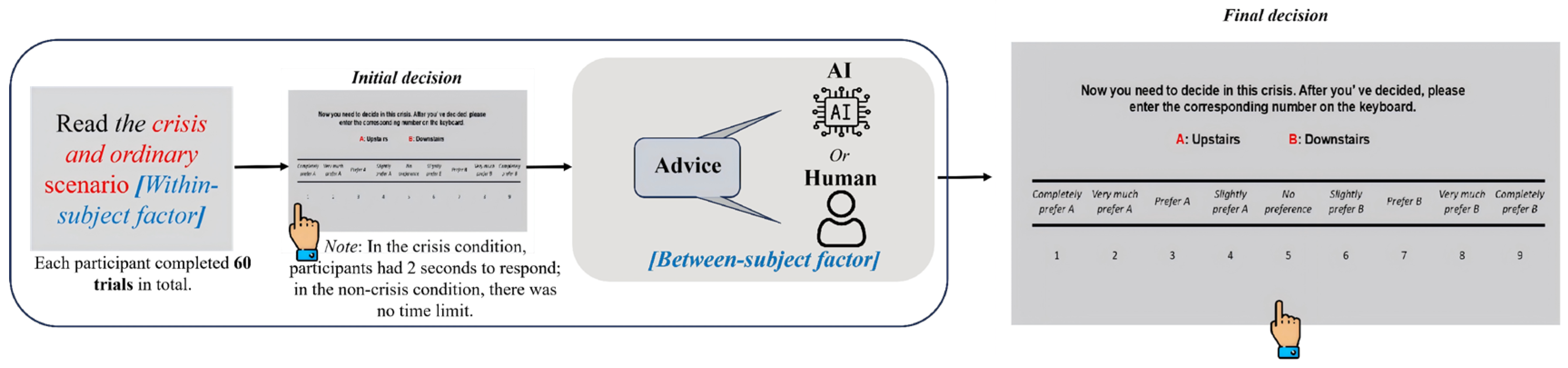
Figure 2.
The raincloud plot illustrates the weight of advice (WOA) as a function of contextual condition (non-crisis vs. crisis contexts) and advisor (human vs. AI). WOA scores range from 0 to 1, with higher values indicating greater reliance on the advisor’s advice. Note. Dots depict jittered individual datapoints. Boxplots display the median, first, and third quartiles. Black circles depict mean values. Error bars depict 90% confidence intervals. Colored fields show the response distribution. ∗p < .05.
Figure 2.
The raincloud plot illustrates the weight of advice (WOA) as a function of contextual condition (non-crisis vs. crisis contexts) and advisor (human vs. AI). WOA scores range from 0 to 1, with higher values indicating greater reliance on the advisor’s advice. Note. Dots depict jittered individual datapoints. Boxplots display the median, first, and third quartiles. Black circles depict mean values. Error bars depict 90% confidence intervals. Colored fields show the response distribution. ∗p < .05.
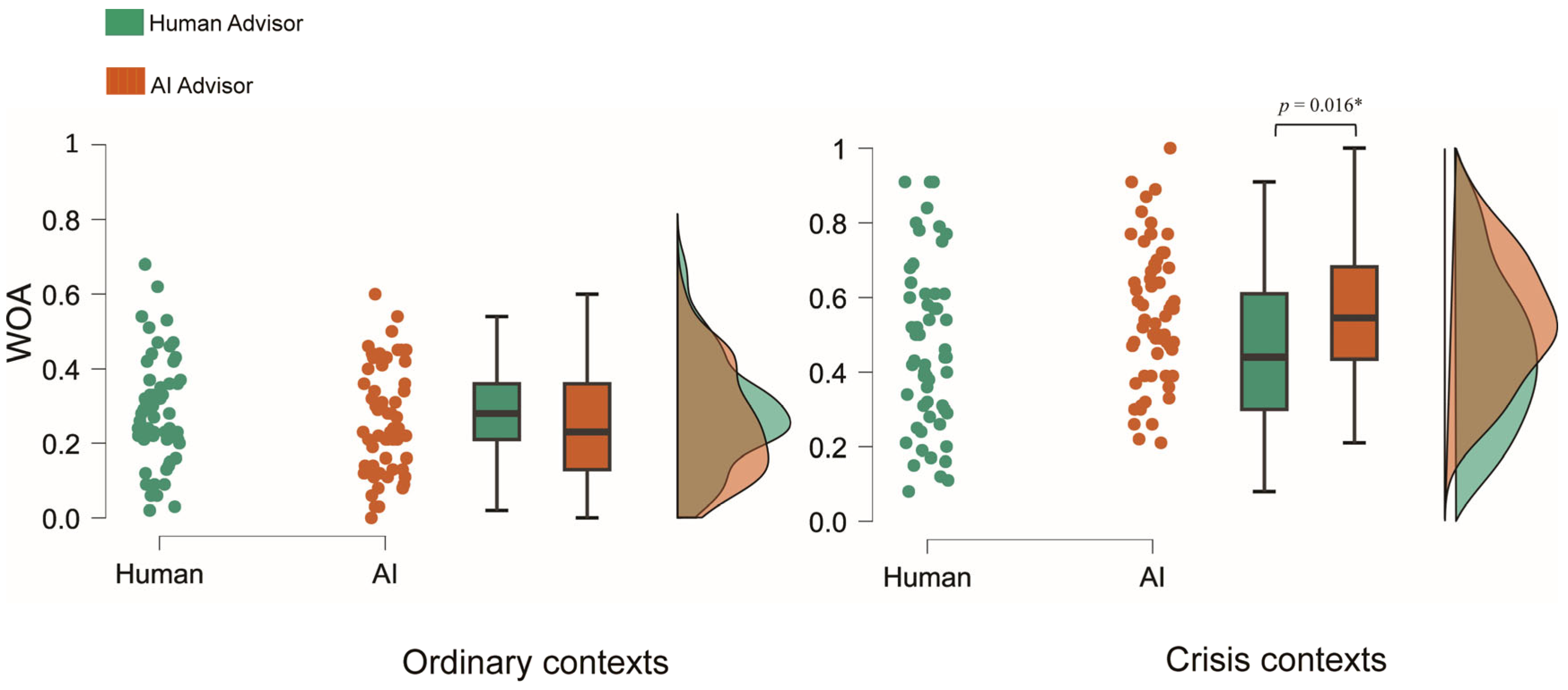
Figure 3.
(A) Study 2: In each trial, participants only read a crisis scenario. After indicating their initial decision, they received advice that varied in advice framing and anthropomorphism (both between-subject factors), and then indicated their final decision. (B) Example of Advisor Anthropomorphism Manipulation: Illustrative examples of advice from different advisors. Human advisors (Hua Li) provided experiential-based advice. Non-anthropomorphic AI advice emphasized data analysis without human-like features. Anthropomorphic AI (Archie) used personalized and empathetic language to simulate human-like interaction.
Figure 3.
(A) Study 2: In each trial, participants only read a crisis scenario. After indicating their initial decision, they received advice that varied in advice framing and anthropomorphism (both between-subject factors), and then indicated their final decision. (B) Example of Advisor Anthropomorphism Manipulation: Illustrative examples of advice from different advisors. Human advisors (Hua Li) provided experiential-based advice. Non-anthropomorphic AI advice emphasized data analysis without human-like features. Anthropomorphic AI (Archie) used personalized and empathetic language to simulate human-like interaction.
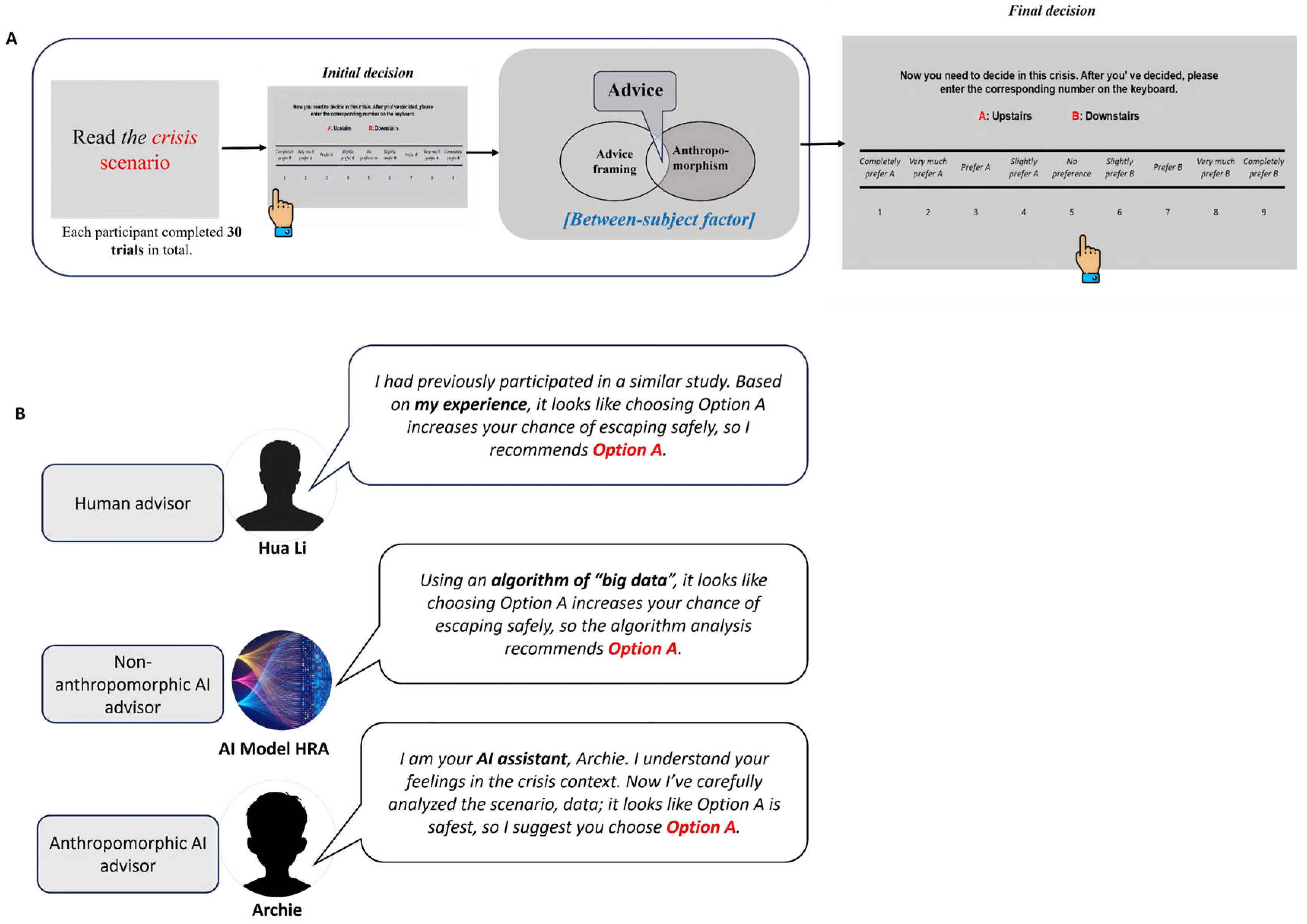
Figure 4.
The raincloud plot illustrates the weight of advice (WOA) as a function of advisor type (human, non-anthropomorphic AI, anthropomorphic AI) and advice framings (avoidance-oriented vs. approach-oriented), specifically under crisis conditions. Note. Dots depict jittered individual datapoints. Boxplots display the median, first, and third quartiles. Black circles depict mean values. Error bars depict 90% confidence intervals. Colored fields show the response distribution. ∗p < .05.
Figure 4.
The raincloud plot illustrates the weight of advice (WOA) as a function of advisor type (human, non-anthropomorphic AI, anthropomorphic AI) and advice framings (avoidance-oriented vs. approach-oriented), specifically under crisis conditions. Note. Dots depict jittered individual datapoints. Boxplots display the median, first, and third quartiles. Black circles depict mean values. Error bars depict 90% confidence intervals. Colored fields show the response distribution. ∗p < .05.
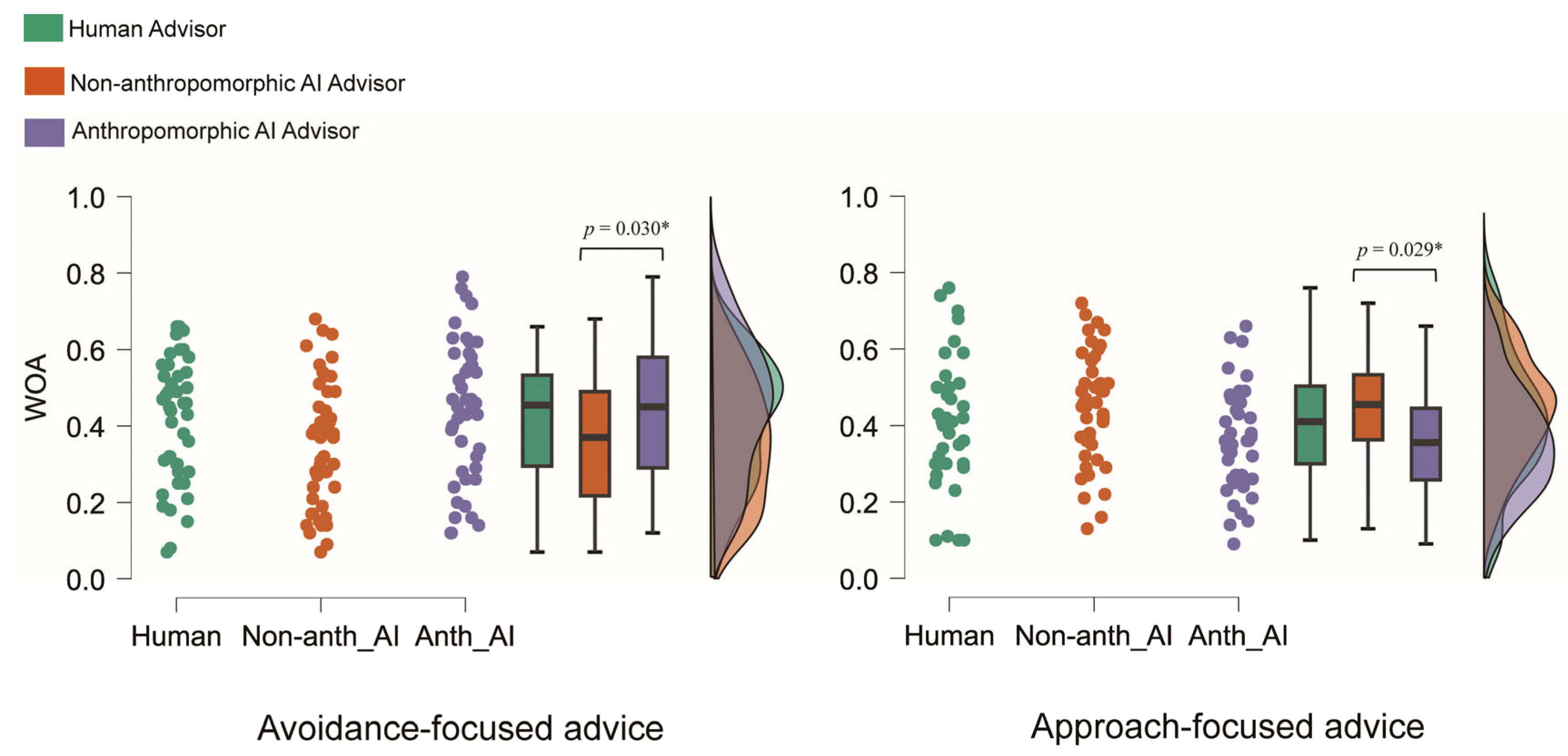

Table 1.
Comparison of emotional ratings before and after reading the crisis scenarios.
| Emotions | pre-task level | post-task level | t | p |
|---|---|---|---|---|
| uneasiness | 2.73 ± 1.62 | 3.40 ± 1.73 | -6.79 | < .001 |
| stress | 2.62 ± 1.60 | 3.26 ± 1.77 | -5.93 | < .001 |
| anxiety | 3.24 ± 1.82 | 3.54 ± 1.84 | -3.03 | .003 |
| nervousness | 2.92 ± 1.71 | 3.56 ± 1.80 | -6.12 | < .001 |
| calmness | 4.85 ± 1.64 | 4.25 ± 1.85 | 5.37 | < .001 |
| relaxation | 4.78 ± 1.80 | 4.18 ± 1.99 | 5.59 | < .001 |
Disclaimer/Publisher’s Note: The statements, opinions and data contained in all publications are solely those of the individual author(s) and contributor(s) and not of MDPI and/or the editor(s). MDPI and/or the editor(s) disclaim responsibility for any injury to people or property resulting from any ideas, methods, instructions or products referred to in the content. |
© 2026 by the authors. Licensee MDPI, Basel, Switzerland. This article is an open access article distributed under the terms and conditions of the Creative Commons Attribution (CC BY) license (http://creativecommons.org/licenses/by/4.0/).
Copyright: This open access article is published under a Creative Commons CC BY 4.0 license, which permit the free download, distribution, and reuse, provided that the author and preprint are cited in any reuse.