

Submitted:
08 September 2026
Posted:
11 September 2026
You are already at the latest version
Abstract
This study adapted and evaluated the construct validity of the Levenson Self-Report Psychopathy (LRSP) scale among Mexican school-attending adolescents, addressing the limited research on emotional processing difficulties, antisocial behavior, and long-term psychosocial adjustment in this population. A cross-sectional sample of 1010 adolescents aged 14 to 19 years from both urban and rural educational institutions. Exploratory factor analysis and structural equation modeling were used to assess the factorial structure and measurement invariance by sex. Results indicated a two-factor structure, representing primary and secondary psychopathic traits, with satisfactory fit indices (CFI = 0.960, RMSEA = 0.045), acceptable reliability (α Ordinal = 0.838 and 0.673), discriminant validity (MSV = 0.019, ASV = 0.000), and convergent validity, particularly for the first dimension (CR = 0.83). Invariance analyses confirmed configural, metric, and scalar equivalence between male and female participants. A significant difference in latent means by sex was observed, with girls scoring higher than boys on the secondary psychopathic traits after establishing scalar invariance. The adapted LSRP for Mexican adolescents demonstrates robust psychometric properties and constitutes a valuable instrument for examining personality characteristics associated with psychosocial risk, as well as for guiding the development of preventive strategies and early interventions in educational and community contexts.
Keywords:
psychopathic traits
; adolescence
; psychometrics
; validation
; LSRP
; personality assessment
; measurement invariance
1. Introduction
The National Survey on Discrimination in Mexico indicates that 3 out of 10 adolescents aged 12 to 17 (28.1%) report having felt bullied, with a higher prevalence among those from low socioeconomic backgrounds [1]. Exposure to violence can have lasting and generalizable consequences on an adolescent’s psychosocial adjustment, defined as a lack of adaptability to the transitional stages of life, affecting their future psychosocial and occupational well-being in adulthood [2]. At the level of the nervous system, exposure to violence in adolescence leads to hyperactivity in the sympathetic nervous system, similar to experiences involving fight-or-flight responses. Furthermore, scientific evidence points to a morphological reduction in the cerebral cortex in infants exposed to constant stress resulting from exposure to violence [3,4]. Adolescence is a stage in which the individual is immersed in a series of cognitive, physical, affective, and social changes and is vulnerable to engaging in risky behaviors. It is characterized by a strong need for psychosocial belonging, involving voluntary and involuntary actions that can lead to harmful consequences, such as violent interpersonal behaviors and breaking rules, undermining the rights of others, based on a low capacity for adaptation to the social context, even resulting in criminal acts and alterations of mental health, such as antisocial personality disorder and psychopathy [5,6,7,8].
Psychopathy is characterized by impaired empathy, narcissism, lack of remorse, fear, and insensitivity to the adverse circumstances of others, with a dominant innate factor. Secondary psychopathic traits are defined by a lack of cognitive coping (management of stimulating affective information), impulsivity, irresponsibility, aggressiveness (hyperaccessibility to negative emotions), difficulty forming and maintaining interpersonal relationships, anxiety, few long-term goals, substance and alcohol abuse, risky and antisocial sexual behaviors, resulting from maladaptive factors in the environment and low-income family relationships, rejection and inadequate parental upbringing, and adverse social contexts such as continuous exposure to violence. The prevalence of these personality traits ranges from 1% to 3% of the world’s population; among adolescents, it is 2.68%, with a ratio of three males to one female [9,10,11,12,13].
Instruments developed to measure psychopathic traits in adolescents from a Latino school population are registered only in the United States. Horan et al.[14] conducted a study of invariance by ethnicity and sex in the LRSP model of primary and secondary psychopathic traits, finding adequate configural invariance, metric invariance, and concurrent and divergent validity. However, the model showed weak goodness-of-fit indices.
Other international research has validated the YPI scale [15] in Spanish and Portuguese samples from prison and school settings. In the first study, Ivanova-Serokhvostova et al. [16] reported a psychopathy factor structure comprising four dimensions (interpersonal, affective, behavioral, and antisocial) with adequate internal consistency and convergent and divergent validity. The second study observed invariance of the model across gender and prison and school settings, as well as convergent validity with a significant relationship between the instrument and symptoms of behavioral disturbance, drug and alcohol abuse, and risky sexual behavior [17]. However, both studies have significant methodological limitations; the first showed multicollinearity among factors, and the second lacked rigor in using correlation matrices and factor extraction for ordinal qualitative data.
Scientific literature on instrument validation for Latin American populations remains limited. Internationally, the Youth Psychopathic Traits Inventory (YPI) [15] is a reference instrument; however, it is lengthy (50 items) and lacks validation in Latin American populations. Furthermore, early assessment of psychopathic traits is fundamental to designing future preventive interventions [18]. Therefore, the purpose of this research was to adapt and validate the LSRP in a sample of Mexican School-attending mid- and late-adolescents, evaluating its psychometric properties in terms of construct validity, internal consistency, and convergent and divergent validity, as well as the invariance of the measurement model according to sex.
2. Materials and Methods
2.1. Participants
Through a cross-sectional study, a non-probabilistic sample of n =1010, early and late adolescents (female n = 643 and male n = 367) was evaluated with a psychopathic traits instrument, their age range was from to 14-19 years old (M = 17.35, SD =1.43 for sample 1 and, M = 17.34, SD = 1.40, years for sample 2), n = 505 participants for each sample were included in this analysis. All participants were literate (9 to 14 years of schooling) and came from urban and rural areas in Hidalgo and Mexico States, Mexico (Table 1).
2.2. Instrument
The Levenson Self-Report Psychopathic Scale (LRSP) was designed to assess psychopathic traits and has been culturally adapted and validated for the Mexican adult population in jail conditions [19]. The original instrument was developed to evaluate community and non-clinical samples [14] and consists of 26 items rated on a four-point Likert scale from Strongly Disagree to Strongly Agree. The original model comprises primary and secondary traits [20]. The Mexican adaptation includes three dimensions: egocentric (items 1, 2, 3, 4, 5, 6, 7, 8, 9, and 11; ω = 0.746), antisocial (items 15, 16, 17, 18, and 19; ω = 0.683), and affective factors (items 10, 12, 13, and 14; ω = 0.631).
2.3. Procedure
We collaborated with two educational institutions (in the States of Mexico and Hidalgo) to evaluate and collect information. The researchers obtained informed consent from adult adolescents and from the parents or guardians of minor adolescents and ultimately obtained informed assent from them.
The study adhered to the ethical principles and regulations of the Declaration of Helsinki [21] and the Mexican Health Research Law, Articles 16 and 17, thereby safeguarding participants’ privacy and confidentiality and classifying the study as low risk [22]. The study was part of a larger research project approved by the Investigation and Bioethics Committee of the Autonomous University of the State of Hidalgo (Protocol code: Uq/6V%#-yn). We reviewed the English translation using the Grammarly app.
2.4. Statistical Analysis
To establish the construct validity and dimensionality of the psychopathic instrument, we conducted a multivariate procedure that included an exploratory factor analysis (EFA) using the open-source stats FACTOR software (version 12.06.08) and an SEM analysis to confirm the theoretical model and assess the instrument’s internal consistency JAMOVI (R Integration) software was used.
For the EFA on the first sample, we conducted a sample adequacy analysis using the Kaiser-Meyer-Olkin test and Bartlett’s test of sphericity to assess whether the correlation matrix deviated from an identity matrix. To define, which factorial extraction method to use, we get and evaluate the values for each item with the asymmetry and kurtosis indexes (< 1) and all items together with Mardia’s test, this analysis suggested a non-linear model using a polychoric matrix and the factorial extraction method of robust diagonally weighted least squares (DWLS) recommended for non-normal distribution and ordinal data like Likert-type scales, finally we use Promin rotation for factor simplicity extraction [23,24].
Likewise, for EFA, we conduct a parallel analysis using minimum-rank factor analysis to reduce data and determine the number of dimensions in the psychopathic test. To decide which data model fits well with the hypothesized model, as recommended by Hu and Bentler [25] multiple fit indices were used, considering, robust mean and variance adjusted chi-square statistic, approximate fit indexes like root mean square error of approximation (RMSEA [<0.06-0.08]), goodness of fit index (absolute fit index GFI [≥0.95]), comparative fit index (incremental fit index CFI [≥0.95]), and the standardized root mean square residual (the mean absolute correlation residual SRMR[<0.08]) [26].
For the SEM model, we used the robust weighted least squares method (WLSMV), considering robust adjusted goodness indexes (chi-square test, SRMR, RMSEA, CFI, and TLI indexes); the justification for the use of this method was because of the nature of the items as ordinal variables, lack of multivariate normality, and size of the second sample. For the invariance model, we conducted a multigroup analysis to assess configural, metric, and scalar invariance, using the criteria of Cheung & Rensvold [27] and Khademi et al. [28] (ΔCFI ≤ -0.010 and ΔRMSEA ≤ 0.015). Finally, to test convergent and divergent validity, we assess composite reliability (CR), Average Variance Extracted (AVE), Maximum Shared Variance (MSV), and Average Shared Variance (ASV) [29,30].
3. Results
To ensure the equivalence of the subsamples used in the EFA (n = 505) and SEM (n = 505) analyses, we used the Solomon method to divide the data into equivalent representative subsamples (communality ratio = 0.981; [31]). Regarding sampling adequacy and the comparison of the observed covariance matrix with the identity matrix, the KMO coefficient was 0.851, and the Bartlett index (136) = 2518.1, p = 0.001, indicating that the data were adequate for exploratory factor analysis.
Multinormality of the 19 items associated with the psychopathic traits construct was assessed, yielding a Mardia multivariate skewness index (Coeff= 22.45, skewness = 1893.81, p = 1.00; Coeff = 346.6, kurtosis = 10.45, p = 0.001), indicating a non-normal multivariate distribution and therefore the use of a polychoric correlation matrix. To determine the number of factors, we used parallel low-rank approximation, which identified two underlying factors (F1 = 33.22 and F2 = 14.33) that explained 47.55% of the variance in the psychopathic traits construct. Likewise, items 4 and 10 (MSA = 0.629 and 0.667) were excluded because their sampling adequacy index (MSA) was < 0.70 [32] (Table 2).
We retain the 2-factor model excluding items 4 and 10; however, the goodness-of-fit indices suggested a better fit for the 3-factor model and the 3-factor model without items 4 and 10. This is because, in the 3-factor model, two items had overlapping factor loadings across two factors. Regarding the 3-factor model without items 4 and 10, only two items formed a dimension, failing to meet the theoretical assumption that at least three items must constitute a factor to be considered a dimension [23].
In the confirmatory phase with the second sample, we evaluated the 17-item model using the WLSMV estimator. Based on the factor loadings in this second sample, 3 items were identified and omitted because their loadings fell below 0.4.
After removing the items, the initial model fit was suboptimal because of significant residual covariance. To correct this, a sequential analysis of the modification indices (MI) and the expected change in the standardized parameter (sEPC all) was performed. This procedure revealed three inverse-order residual covariances with respect to items p2 and p3 (items associated with Machiavellian behavior [MI=49.7, sEPC =-0.493]), p8 and p11 (items associated with interpersonal manipulation MI=18.6, sEPC =- 0.435]), and p16 and p17 (items related to boredom propensity MI=22.6, sEPC =- 0.437]), due to their semantic redundancy. Resulting in a reweighted model with significant model fit indices χ2(73) = 104, p=0.009; SRMR robust = 0.042; RMSEA robust = 0.045, p =0.714 (95% CI=0.029-0.059); CFI robust =0.960 and TLI robust =0.951 (Figure 1 and Table 3).
To assess scale invariance, we conducted a multigroup confirmatory factor analysis across sex. The configural model (model 1) yielded a similar factor structure for females and males, with χ2(146) = 186, p = 0.015, CFI = 0.919, RMSEA = 0.061 (p = 0.126), SRMR = 0.054. For metric invariance (model 2), which controlled factor loadings, an adequate fit was observed (χ2(251) = 507, CFI = 0.938, TLI = 0.933, RMSEA = 0.064, SRMR = 0.085). Scalar invariance (model 3), which controlled for factor loadings, intercepts, and thresholds, also indicated a good overall fit (χ2(283) = 529, CFI = 0.941). According to Cheung et al. [27] and Khademi et al. [28], the changes in the comparative fit indices fall within the normative criteria (ΔCFI and ΔTLI = 0.01) (Table 4).
After confirming the scalar invariance of the instrument, a comparison was made between the latent means of the groups (men and women) in each of the factors, obtaining a significant difference in the latent mean for the second factor (SPT) (M = 0.106, z = 1.993, p = 0.046, 95% CI [0.002-0.210]), determining that women present higher levels in the SPT factor compared to men. With respect to the first PPT factor, no differences were observed between the sexes (M = 0.091, z = 1.456, p = 0.145).
With respect to convergent validity, the first factor, representing PPT, showed adequate composite reliability scores (CR= 0.83), exceeding the minimum criterion established by Fornell and Larcker [30], which compensates for the low average variance extracted (AVE=0.3). In contrast, the SPT factor exhibited lower composite reliability (CR = 0.64) and AVE (0.27), affecting convergent validity. Nevertheless, discriminant validity was supported because the AVE exceeded both the maximum shared variance (MSV) and the average shared variance (ASV). Table 5 presents detailed values for convergent and discriminant validity. Regarding internal consistency, the ordinal reliability coefficients were α Ordinal = 0.838 for the PPT factor and α = 0.673 for the SPT factor.
4. Discussion
The objective of this research was fulfilled by determining the psychometric properties of the psychopathic traits instrument of Levenson et al. [20], considering the version of the cultural adaptation in Mexico by Amador-Zavala et al. [19] in adolescents from rural and urban areas of Mexico, observing a bifactorial structure with adequate goodness of fit indices and acceptable internal consistency for the two factors of secondary and primary psychopathic traits (F1/ α Ordinal=0.838 and F2/ α Ordinal= 0.673), likewise, adequate convergent validity for one factor (CR = 0.83); and reduced for another (CR = 0.64), however, adequate discriminant validity in both factors.
Horan et al. [14] conducted a study similar to the present one, in which they evaluated psychopathic traits in Hispanic and Black adolescents with the LSRP test and a self-report of callousness and lack of empathy answered by parents in New York public schools, considering configural and metric invariance. The findings observed in the multigroup analysis were similar to this study, determining an equivalent invariance by sex and ethnicity (black and Latino adolescents), however, a reduced CFI index in both variables (Sex χ2/df = 1.81, CFI = 0.71, RMSEA = 0.05; Ethnicity= χ2/df = 1.77, CFI = 0.69, RMSEA = .05), with a difference in metric invariance within the critical limits (ΔCFI = 0.001 and 0.003), indicating that the factor loadings were similar between the groups with respect to sex and ethnicity, compared to our study, in the present a CFI goodness of fit index of invariance above 0.90 was obtained, adequate according to the associated literature [34].
In a similar study, Ivanova- Serokhvostova et al. [16] validated and adapted the Psychopathy Checklist, Youth Version, in a Spanish population (15-22 years old) in prison and on parole, determining a four-dimensional factor structure (interpersonal, affective, behavioral, and antisocial), showing model invariance in both conditions. The main limitation of that study was the questionable large magnitude of the covariances between the dimensions and the general construct of psychopathy (CoV = 0.83-0.96), due to the lack of a clear division between factors, indicating multicollinearity and redundancy among them, and therefore a lack of discriminant validity [29]. In the present study, the PPT and SPT factors were clearly differentiated, with a covariance of 0.44 and adequate discriminant validity.
Similarly, Pechorro et al. [17] adapted the YPI test for adolescents of Portuguese origin in public school settings and juvenile detention centers, determining an equivalence in the invariance of the model according to sex (S-Bχ2(74) = 262.5374, CFI= 0.98, RMSEA= 0.08) and the schooled vs. detention center condition (S-Bχ2(74)= 181.12, CFI= 0.98, RMSEA= 0.07). However, methodological limitations were observed, such as the lack of mention of the use of a correlation matrix and factor extraction, which was not reported but inferred by the version of the program used, which does not consider analyses for qualitative and ordinal data, unlike this study, which rigorously considered the analyses relevant to the type of sample obtained.
Regarding the results of the latent mean in this study, it was observed that adolescent women (mainly from the southern area of the country where the economy is precarious) score higher in the dimension of secondary psychopathic traits, similar to what was found by Neumann et al. [35] in a study with a large international sample of adult population (n= 33,016), observing that women in North America (including Mexico), Oceania and Western Europe present high levels of psychopathic traits associated with the Lifestyle dimension, characteristic of the SPT factor.
Regarding the study’s limitations, the instrument showed low average extracted variance for both factors (AVE < 0.50). However, the PPT factor showed adequate composite reliability (CR = 0.83), and the SPT factor showed acceptable reliability (CR = 0.64). According to Malhotra [36], a CR between 0.6 and 0.7 is acceptable if the model estimation is good. He also indicates that the CR coefficient itself is a more reliable index than the AVE. Finally, the satisfactory indices across the three levels of invariance support the model structure, given the factor loadings and intercepts.
5. Conclusions
In Mexico and Latin America, there is an increase in the prevalence of adolescents who commit violent acts, exhibit behavioral and delinquent behavior, and engage in bullying, primarily at the upper secondary and higher education levels, considering adverse contexts and social competition within the school environment. Early identification of psychopathic traits at this developmental stage will be a valuable tool for identifying these traits and creating future primary interventions, preventing their evolution into a mental disorder. This tool is also useful in research to deepen our understanding of psychopathic traits, their interactions with culture, and their impact on society [1,37].
Author Contributions
Conceptualization, L.L. and A.L.; methodology, L.L.; software, L.L.; validation, L.L.; investigation, L.L. and A.V.; resources, L.L.; data curation L.L.; writing—original draft preparation, L.L.; writing—review and editing, L.L., A.V., L. B., R.G. and A.L.; visualization, L.L and A.V.; supervision, L.L.; project administration, L.L.; All authors have read and agreed to the published version of the manuscript.
Funding
This research received no external funding.
Institutional Board Statement
The study formed part of a broader research project approved by the Bioethics and Investigation Committee of the Institute of the Health Sciences at the Autonomous University of the State of Hidalgo (UAEH) under protocol code 295, approved February 28 of 2025. The study adhered to the ethical principles and regulations established in the Declaration of Helsinki (WMA, 2025) and Articles 16 and 17 of the Mexican Health Research Law. The study maintained participants’ privacy and confidentiality and was classified as low risk (Official Gazette of the Federation, 2014).
Informed Consent Statement
Informed consent was obtained from all subjects involved in the study.
Data Availability Statement
The data presented in this study are available on request from the corresponding author, as access is restricted due to privacy and legal considerations outlined in the consent form, which addresses confidentiality and privacy guidance.
Acknowledgments
We acknowledge the support of Lavinia Enid Espinosa Heredia, M.A., for facilitating the collaboration with the Autonomous University of Chapingo, which enabled the completion of part of this research. The authors have reviewed and edited the output and take full responsibility for the content of this publication.
Conflicts of Interest
The authors declare no conflicts of interest.
Abbreviations
The following abbreviations are used in this manuscript:
| ASV | Average shared variance |
| AVE | Average variance extracted |
| CFI | Comparative fit index |
| CR | Composite reliability |
| DWLS | Diagonally weighted least squares |
| EFA | Exploratory factor analysis |
| LRSP | Levenson Self-Report Psychopathic Scale |
| MSV | Maximum shared variance |
| PPT | Primary psychopathic traits |
| RMSEA | Root mean square error of approximation |
| SEM | Structural Equation Model |
| sEPC | Expected change in the standardized parameter |
| SPT | Secondary psychopathic traits |
| SRMSR | Standardized root mean square residual |
| TLI | Tucker-Lewis index |
| WLSMV | Weighted least square method |
References
- Instituto Nacional de Estadística y Geografía (INEGI). National Survey on Discrimination (ENADIS) 2022. Available online: https://www.inegi.org.mx/programas/enadis/2022/ (accessed on 13 August 2026). (In Spanish).
- Espinoza, C.N.; Goering, M.; Mrug, S. Disclosure of Exposure to Violence in Urban Adolescents. J Interpers Violence 2024, 39, 1161–1189. [CrossRef]
- Pinel, J.P.J.; Barnes, S.J. Biopsychology; Eleventh edition, global edition.Pearson: Harlow, London, New York, Munich, 2022; ISBN 978-1-292-35193-3.
- Van der Kolk, B.A. The Body Keeps the Score: Brain, Mind, and Body in the Healing of Trauma; Unabridged.; Books on Tape: New York, 2021; ISBN 978-0-593-41270-1.
- García, E.R.; Muñoz, N.R.; Ramírez, K.G.; Mérida, R.A.H. Risk behavior in adolescents. Rev Cub Med Mil 2015, 44, 218–229.
- Paul, P.; Bennett, C.N. Review of Neuropsychological and Electrophysiological Correlates of Callous-Unemotional Traits in Children: Implications for EEG Neurofeedback Intervention. Clin EEG Neurosci 2021, 52, 321–329. [CrossRef]
- Pfeifer, J.H.; Berkman, E.T. The Development of Self and Identity in Adolescence: Neural Evidence and Implications for a Value-Based Choice Perspective on Motivated Behavior. Child Development Perspectives 2018, 12, 158–164. [CrossRef]
- Tate, C.; Kumar, R.; Murray, J.M.; Sanchez-Franco, S.; Sarmiento, O.L.; Montgomery, S.C.; Zhou, H.; Ramalingam, A.; Krupka, E.; Kimbrough, E.; et al. The Personality and Cognitive Traits Associated with Adolescents’ Sensitivity to Social Norms. Sci Rep 2022, 12, 15247. [CrossRef]
- Davis, A.C.; Brittain, H.; Arnocky, S.; Vaillancourt, T. Longitudinal Associations Between Primary and Secondary Psychopathic Traits, Delinquency, and Current Dating Status in Adolescence. Evol Psychol 2022, 20, 14747049211068670. [CrossRef]
- Kyranides, M.N.; Neofytou, L. Primary and Secondary Psychopathic Traits: The Role of Attachment and Cognitive Emotion Regulation Strategies. Personality and Individual Differences 2021, 182, 111106. [CrossRef]
- Luján Martínez, A.; Álvarez López, J.A.; Pérez López, M.L.; Shejet, F.O. Distinctive aspects of primary and secondary psychopathy traits: An updated review. Edupsykhé 2023, 20, 5–21,(In Spanish). [CrossRef]
- Perenc, L.; Radochoński, M. Prevalence of Psychopathic Traits in a Large Sample of Polish Adolescents from Rural and Urban Areas. Ann Agric Environ Med. 2016, 23, 368–372. [CrossRef]
- Pisano, S.; Muratori, P.; Gorga, C.; Levantini, V.; Iuliano, R.; Catone, G.; Coppola, G.; Milone, A.; Masi, G. Conduct Disorders and Psychopathy in Children and Adolescents: Aetiology, Clinical Presentation and Treatment Strategies of Callous-Unemotional Traits. Ital J Pediatr 2017, 43, 84. [CrossRef]
- Horan, J.M.; Brown, J.L.; Jones, S.M.; Aber, J.L. Assessing Invariance across Sex and Race/Ethnicity in Measures of Youth Psychopathic Characteristics. Psychological Assessment 2015, 27, 657–668. [CrossRef]
- Psychopaths: Current International Perspectives; Blaauw, E., Sheridan, L., Eds.; Netherlands: Elsevier, 2002; ISBN 978-90-5749-962-3.
- Ivanova-Serokhvostova, A.; Molinuevo, B.; González, L.; Hilterman, E.L.B.; Pardo, Y.; Pera-Guardiola, V.; Bonillo, A.; Batalla, I.; Torrubia, R.; Forth, A. Psychometric Properties of the Spanish Version of the Psychopathy Checklist: Youth Version. Curr Psychol 2023, 42, 22200–22216. [CrossRef]
- Pechorro, P.; Houghton, S.; Simões, M.R.; Carroll, A. The Adapted Self-Report Delinquency Scale for Adolescents: Validity and Reliability Among Portuguese Youths. Int J Offender Ther Comp Criminol 2019, 63, 837–853. [CrossRef]
- Lavigne, S.B.; Pontinen, H.M. Youth Psychopathic Traits Inventory (YPI). In Encyclopedia of Personality and Individual Differences; Zeigler-Hill, V., Shackelford, T.K., Eds.; Springer International Publishing: Cham, 2017; pp. 1–3 ISBN 978-3-319-28099-8.
- Amador-Zavala, L.O.; Padrós-Blázquez, F.; Palacios-Salas, P.; Méndez-Sánchez, C.; Sánchez-Loyo, L.M.; Reynoso-González, O.U. Propiedades Psicométricas de la Escala de Psicopatía de Levenson en Población General y Penitenciaria [Psychometric Properties of the Levenson Psychopathy Scale in General and Penitentiary Population]. Anuario de Psicología Jurídica 2023, 33, 17–26, (In Spanish). [CrossRef]
- Levenson, M.R.; Kiehl, K.A.; Fitzpatrick, C.M. Assessing Psychopathic Attributes in a Noninstitutionalized Population. Journal of Personality and Social Psychology 1995, 68, 151–158. [CrossRef]
- World Medical Association World Medical Association Declaration of Helsinki: Ethical Principles for Medical Research Involving Human Participants. JAMA 2025, 333, 71. [CrossRef]
- Ministry of Health (Mexico) Regulation of the General Health Law on Health Research. Available online: https://salud.gob.mx/unidades/cdi/nom/compi/rlgsmis.html (accessed on 13 August 2026). (In Spanish).
- Lloret-Segura, S.; Ferreres-Traver, A.; Hernández-Baeza, A.; Tomás-Marco, I. El Análisis Factorial Exploratorio de Los Ítems: Una Guía Práctica, Revisada y Actualizada [Exploratory item factor analysis: A practical guide revised and updated]. analesps 2014, 30, 1151–1169, (In Spanish). [CrossRef]
- Lorenzo-Seva, U. Promin: A Method for Oblique Factor Rotation. Multivariate Behavioral Research 1999, 34, 347–365. [CrossRef]
- Hu, L.; Bentler, P.M. Fit Indices in Covariance Structure Modeling: Sensitivity to Underparameterized Model Misspecification. Psychological Methods 1998, 3, 424–453. [CrossRef]
- Schreiber, J.B.; Nora, A.; Stage, F.K.; Barlow, E.A.; King, J. Reporting Structural Equation Modeling and Confirmatory Factor Analysis Results: A Review. The Journal of Educational Research 2006, 99, 323–338. [CrossRef]
- Cheung, G.W.; Rensvold, R.B. Evaluating Goodness-of-Fit Indexes for Testing Measurement Invariance. Structural Equation Modeling: A Multidisciplinary Journal 2002, 9, 233–255. [CrossRef]
- Khademi, A.; Wells, C.S.; Oliveri, M.E.; Villalonga-Olives, E. Examining Appropriacy of CFI and TLI Cutoff Value in Multiple-Group CFA Test of Measurement Invariance to Enhance Accuracy of Test Score Interpretation. Sage Open 2023, 13, 21582440231205354. [CrossRef]
- Cheung, G.W.; Cooper-Thomas, H.D.; Lau, R.S.; Wang, L.C. Reporting Reliability, Convergent and Discriminant Validity with Structural Equation Modeling: A Review and Best-Practice Recommendations. Asia Pac J Manag 2024, 41, 745–783. [CrossRef]
- Fornell, C.; Larcker, D.F. Evaluating Structural Equation Models with Unobservable Variables and Measurement Error. Journal of Marketing Research 1981, 18, 39. [CrossRef]
- Lorenzo-Seva, U. SOLOMON: A Method for Splitting a Sample into Equivalent Subsamples in Factor Analysis. Behav Res 2021, 54, 2665–2677. [CrossRef]
- Chen, F.F. Sensitivity of Goodness of Fit Indexes to Lack of Measurement Invariance. Structural Equation Modeling: A Multidisciplinary Journal 2007, 14, 464–504. [CrossRef]
- Gaskin, J.E.; Lowry, P.B.; Rosengren, W.; Fife, P.T. Essential Validation Criteria for Rigorous Covariance-Based Structural Equation Modeling. Information Systems Journal 2025, 35, 1630–1661. [CrossRef]
- Hoyle, R.H. Structural Equation Modeling: Concepts, Issues, and Applications; 1st ed.; SAGE Publications: Thousand Oaks, 1995; ISBN 978-1-5063-1953-7.
- Neumann, C.S.; Schmitt, D.S.; Carter, R.; Embley, I.; Hare, R.D. Psychopathic Traits in Females and Males across the Globe. Behavioral Sci & The Law 2012, 30, 557–574. [CrossRef]
- Malhotra, N.K. Marketing Research: An Applied Orientation; 6. ed.; Prentice Hall: Upper Saddle River, NJ, 2010; ISBN 978-0-13-608543-0.
- Brazil, K.J.; Farrell, A.H.; Boer, A.; Volk, A.A. Adolescent Psychopathic Traits and Adverse Environments: Associations with Socially Adaptive Outcomes. Dev Psychopathol 2025, 37, 477–489. [CrossRef]
Figure 1.
Path diagram for general structural equation model (SEM) of psychopathic traits. PPT: Primary Psychopathic Traits Factor, SPT: Secondary Psychopathic Traits Factor. Bidirectional linear curves represent controlled residual covariances, reported as the expected change in the fully standardized parameter: items 2-3 (sEPC = -0.483), items 8-11 (sEPC = -0.435), and items (sEPC = -0.437). All standardized factor loadings were significant (p < 0.001).
Figure 1.
Path diagram for general structural equation model (SEM) of psychopathic traits. PPT: Primary Psychopathic Traits Factor, SPT: Secondary Psychopathic Traits Factor. Bidirectional linear curves represent controlled residual covariances, reported as the expected change in the fully standardized parameter: items 2-3 (sEPC = -0.483), items 8-11 (sEPC = -0.435), and items (sEPC = -0.437). All standardized factor loadings were significant (p < 0.001).
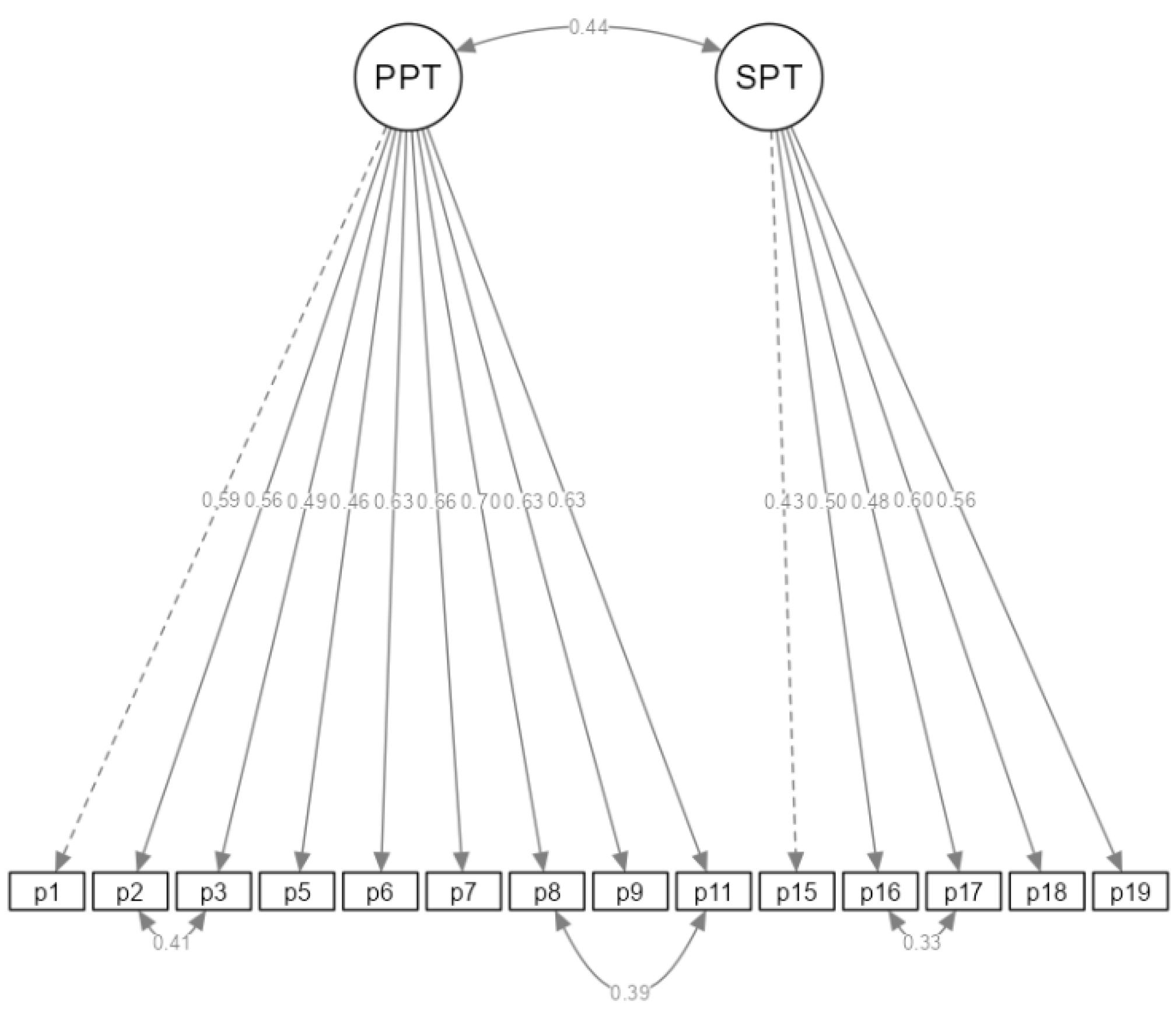

Table 1.
Sociodemographic data from early and late adolescents.
| Variable | EFA (n=505) | CFA (n=505) | Total, Sample (N= 1010) |
||||
|---|---|---|---|---|---|---|---|
| (f) | (%) | (f) | (%) | (f) | (%) | ||
| Sex | Men | 179 | 35.4 | 188 | 37.2 | 367 | 36.3 |
| Women | 326 | 64.6 | 317 | 62.8 | 643 | 63.7 | |
|
Age |
f | % | f | % | f | % | |
| 14 | 2 | 0.4 | 4 | 0.8 | 6 | 0.6 | |
| 15 | 54 | 10.7 | 46 | 9.1 | 100 | 9.9 | |
| 16 | 128 | 25.3 | 128 | 25.3 | 256 | 25.3 | |
| 17 | 56 | 11.1 | 71 | 14.1 | 127 | 12.6 | |
| 18 | 109 | 21.6 | 109 | 21.6 | 218 | 21.6 | |
| 19 | 156 | 30.9 | 147 | 29.1 | 303 | 30 | |
| Mean (SD) | Mean (SD) | Mean (SD) | |||||
| 17.35 (1.43) | 17.34 (1.40) | 17.35 (1.41) | |||||
|
Middle and Higher Education |
(f) | (%) | (f) | (%) | (f) | (%) | |
| Psychology | 88 | 17.4 | 91 | 18 | 179 | 17.7 | |
| Medicine | 6 | 1.2 | 2 | 0.4 | 8 | 0.8 | |
| Nursing | 78 | 15.4 | 89 | 17.6 | 167 | 16.5 | |
| Nutriology | 30 | 5.9 | 23 | 4.6 | 53 | 5.2 | |
| Gerontology | 19 | 3.8 | 28 | 5.5 | 47 | 4.7 | |
| Odontology | 32 | 6.3 | 25 | 5 | 57 | 5.6 | |
| Pharmacy | 21 | 4.2 | 17 | 3.4 | 38 | 3.8 | |
| HSla | 231 | 45.7 | 230 | 45.5 | 461 | 45.6 | |
| Schooling average | Mean (SD) | Mean (SD) | Mean (SD) | ||||
| 13.5(1.09) | 13.5(1.1) | 13.5(1.05) | |||||
| (f) | (%) | (f) | (%) | (f) | (%) | ||
| Manual dominance | Right | 467 | 92.5 | 468 | 92.7 | 935 | 92.6 |
| Left | 36 | 7.1 | 35 | 6.9 | 71 | 7.0 | |
| Ambidextrous | 2 | 0.4 | 2 | 0.4 | 4 | 0.4 | |
EFA: Exploratory Factorial Analysis; CFA: Confirmatory Factorial Analysis; HSl: High School level.a ; f: frequency; SD: Standard Deviation. The sociodemographic data corresponds to early university students in late adolescence and to mid-stage adolescents in high school.
Table 2.
Comparison between three models of psychopathic traits in adolescents.
| Model | χ2 (df) | RMSEA | CI(95%) | GFI | CI(95%) | CFI | CI(95%) | SRMR | CI(95%) | BIC |
|---|---|---|---|---|---|---|---|---|---|---|
| One Factor | 769.09 (152) *** | 0.090 | (0.079-0.095) | 0.958 | (0.944-0.979) | 0.848 | (0.799-0.899) | 0.105 | (0.098-0.110) | 1005.70 |
| Two Factors | 369.44 (134) *** | 0.059 | (0.053-0.059) | 1.00 | (1.00-1.00) | 0.942 | (0.931-0.963) | 0.068 | (0.064-0.069) | 724.35 |
| Two Factors without items 4 and 10 | 229.88 (103) *** | 0.049 | (0.048-0.049) | 1.00 | (1.00-1.00) | 0.967 | (0.963-0.982) | 0.055 | (0.053-0.055) | 547.43a |
| Three Factors | 235.52 (117) *** | 0.045 | (0.040-0.045) | 1.00 | (1.00-1.00) | 0.971 | (0.968-0.984) | 0.052 | (0.051-0.052) | 708.73 |
| Three Factors without items 4 and 10 | 142.839 (88) *** | 0.035 | (0.010-0.050) | 1.00 | (1.00-1.00) | 0.986 | (0.985-0.991) | 0.042 | (0.042-0.042) | 566.24 |
χ2: Chi-square; df: degrees of freedom; CI: Confidence Interval; RMSEA: root mean square error of approximation; GFI: goodness of fit index; CFI: comparative fit index; SRMR: standardized root mean square residual; BIC: Bayesian information criterion. SRMR values under 0.05-0.08 represent good fit [25]. Models were compared to determine the optimal factorial structure using the BIC. The two-factor model, excluding items 4 and 10, had the lowest BIC. Kass & Raftery [33] indicate that a model difference exceeding ten points is significant; in our analysis, the BIC difference between the two-factor and three-factor models, both excluding items 4 and 10, shows that the two-factor model is more parsimonious a. ***p < 0.001.
Table 3.
Standardized factor loadings of the final model of psychopathic traits.
| Factor/Item | Load (β) | SE |
|---|---|---|
| PPT | ||
| 1 (1) *. El éxito se basa en la supervivencia del más fuerte. No me preocupan los fracasados [Success is based on the survival of the fittest. I am not worried about failures]. | 0.586 | - |
| 2 (2). Para mí, lo mejor es tener todo lo que yo pueda conseguir sin que me atrapen [For me, the best thing is to have everything I can get without getting caught]. | 0.559 | 0.086 |
| 3 (3). En el mundo de hoy, siento que para tener éxito puedo hacer lo que quiera sin que me atrapen [In today’s world, I feel that to be successful. I can do whatever I want without getting caught]. | 0.486 | 0.093 |
| 4 (5). Mi meta más importante es tener mucho dinero [My most important goal is to have a lot of money]. | 0.460 | 0.083 |
| 5 (6). Dejo que otros se preocupen por los valores superiores: yo solo me preocupo por el resultado final [I let others worry about higher values: I only worry about the end result]. | 0.630 | 0.094 |
| 6 (7). La gente que es tan tonta para dejarse estafar, normalmente se lo merece [People who are foolish enough to be scammed usually deserve it]. | 0.656 | 0.092 |
| 7 (8). Le digo a las personas lo que quieren oír para que hagan lo que yo quiero [I tell people what they want to hear so they will do what I want]. | 0.705 | 0.096 |
| 8 (9). Me parecen impresionantes los engaños inteligentes, son de admirarse [I find clever deceptions impressive; they are admirable]. | 0.628 | 0.094 |
| 9 (11). Disfruto manipulando los sentimientos de la gente [I enjoy manipulating people’s feelings] | 0.628 | 0.098 |
| SPT | ||
| 10 (15). Me encuentro metido/a en los mismos problemas, una y otra vez [I find myself caught up in the same problems, over and over again]. | 0.430 | - |
| 11 (16). Me aburro con frecuencia [I get bored often]. | 0.500 | 0.200 |
| 12 (17). Rápidamente, pierdo el interés en las tareas que empiezo [I quickly lose interest in the tasks I start]. | 0.483 | 0.203 |
| 13 (18). He estado en muchas peleas de gritos con otras personas [I’ve been in many shouting matches with other people]. | 0.599 | 0.224 |
| 14 (19). Cuando me siento frustrado/a, frecuentemente me desahogo enojándome mucho [When I feel frustrated, I often vent by getting very angry]. | 0.563 | 0.218 |
* Number of items along with their original counts from the Levenson instrument version [20]. β: standardized coefficient; SE: Standard Error. All loadings were significant at p < .001.
Table 4.
Fit indices of factorial invariance models.
| Model | χ2 | df | CFIr | TLIr | RMSEAr | SRMRr | Δ CFI | Δ RMSEA |
|---|---|---|---|---|---|---|---|---|
| M1.Configurable | 186 | 146 | 0.919 | 0.898 | 0.061 | 0.054 | -- | -- |
| M2.Metric | 223 | 158 | 0.914 | 0.901 | 0.060 | 0.059 | -0.005 | -0.001 |
| M3. Scalar | 240 | 184 | 0.956 | 0.957 | 0.000 | 0.069 | -0.060 | 0.000 |
χ2: Chi-square; df: degrees of freedom; CFIr: comparative fit index robust; TLIr: Tucker-Lewis index robust; RMSEAr: root mean square error of approximation robust; Δ: incremental change between the current and previous models. Invariance analyses were conducted maintaining the residual covariances of items 2–3, 8–11, and 16–17 at all invariance levels. Parameter criteria of ΔCFI ≤ -0.01 and ΔRMSEA ≤ 0.015 were applied to determine measurement invariance [27,32].
Table 5.
Criterion validity for two factors derived from adolescents’ psychopathic traits.
| Factor | CR | AVE | MSV | ASV |
|---|---|---|---|---|
| PPT | 0.83 | 0.36 | 0.19 | 0.000 |
| SPT | 0.64 | 0.27 | 0.19 | 0.000 |
CR: composite reliability; AVE: average variance extracted; MSV: maximum shared variance; ASV: average shared variance. According to Gaskin et al. [33], the criteria for convergent validity are CR > 0.70, CR > AVE, and AVE > 0.50, and for divergent validity are MSV < AVE and ASV < AVE.
Disclaimer/Publisher’s Note: The statements, opinions and data contained in all publications are solely those of the individual author(s) and contributor(s) and not of MDPI and/or the editor(s). MDPI and/or the editor(s) disclaim responsibility for any injury to people or property resulting from any ideas, methods, instructions or products referred to in the content. |
© 2026 by the authors. Licensee MDPI, Basel, Switzerland. This article is an open access article distributed under the terms and conditions of the Creative Commons Attribution (CC BY) license (http://creativecommons.org/licenses/by/4.0/).
Copyright: This open access article is published under a Creative Commons CC BY 4.0 license, which permit the free download, distribution, and reuse, provided that the author and preprint are cited in any reuse.