

Submitted:
09 September 2026
Posted:
10 September 2026
You are already at the latest version
Abstract
Criminal extortion and protection fees have emerged as significant threats to the sustainability of township businesses in South Africa, undermining entrepreneurship, formalisation, investment, and local economic development. While FinTech has transformed financial inclusion and digital transactions globally, its potential to disrupt cash-based extortion economies and strengthen the resilience of township enterprises remains largely unexplored. This paper investigates how FinTech innovations, including blockchain-enabled payment systems, mobile money, digital payment technologies, and complementary community-based digital platforms, can enhance economic resilience by reducing vulnerabilities associated with cash-based transactions and extortion. Drawing on the diffusion of innovation theory, this qualitative systematic literature review examined the opportunities, challenges, and institutional conditions influencing the adoption of these technologies within township economies. The findings suggest that FinTech innovations have the potential to reduce cash dependency, enhance transaction transparency, strengthen financial inclusion, improve collective reporting mechanisms, and build community resilience against extortion networks. However, their effectiveness depends on complementary investments in digital literacy, affordable digital infrastructure, institutional trust, enabling regulatory frameworks, and multi-stakeholder collaboration. The paper contributes to digital governance and FinTech scholarship by reframing technology adoption not only as a financial inclusion strategy but also as a governance mechanism that can enhance transparency, accountability, collective reporting, and economic security within vulnerable local economies. It further demonstrates how FinTech-enabled digital financial ecosystems can support the long-term sustainability of township economies through enhanced business resilience, secure digital transactions, and inclusive local economic development.
Keywords:
FinTech
; blockchain
; digital payments
; mobile money
; township enterprises
; protection fees
; economic resilience
; sustainable development
1. Introduction
Township businesses, often categorised as part of the informal economy, are a hallmark of resilience and resourcefulness in the face of socio-economic adversity in most African countries [1,2,3]. These businesses provide essential goods and services, create employment opportunities, and contribute to the local circulation of income. However, they are characterised by informality, which often excludes them from formal support mechanisms, such as access to credit, infrastructure, and legal protections [4,5]. This exclusion makes them particularly vulnerable to external threats, including criminal exploitation.
According to Ragolane and Khoza [6], the phenomenon of extortion and protection fees in South Africa’s townships has its origins in the interplay of socio-economic inequalities, ineffective governance, and the remnant of apartheid spatial planning. Under apartheid, black South Africans were relocated to townships, which were designed to serve as labour reservoirs for urban industries. These areas were systematically deprived of infrastructure, economic opportunities, and law enforcement presence, creating conditions of economic marginalisation and social instability [7,8].
Despite various post-apartheid initiatives aimed at addressing historical injustices, many townships continue to experience persistent challenges, including high unemployment rates, widespread poverty, and elevated crime levels. These conditions continue to provide fertile ground for the emergence of criminal networks that capitalise on the absence of strong state institutions and the economic vulnerability of residents [9]. Therefore, the practice of extortion, wherein criminal groups demand regular payments in exchange for “protection” from harm, has become a widespread phenomenon. Bezuidenhout [10] further suggests that businesses that refuse to comply with extortion demands are often subjected to threats, vandalism, or even physical violence, creating a climate of fear and coercion.
Beyond improving financial inclusion and payment efficiency, FinTech innovations have the potential to contribute to sustainable development by strengthening the resilience of township enterprises and supporting inclusive local economic development while promoting secure and transparent business environments, enhancing institutional trust. These contributions align with Sustainable Development Goals (SDGs) 8 (decent work and economic growth), 9 (industry, innovation and infrastructure), and 10 (reduced inequalities) [11]. In this context, digital financial technologies should be viewed not only as technological innovations but also as strategic enablers of sustainable township economies [3].
The nature and scale of extortion vary across different townships. In some areas, informal businesses are targeted individually, while in others, extortion is more organised, with networks controlling entire streets or sectors [12]. The payments demanded can range from small daily amounts to substantial monthly sums, depending on the size and perceived profitability of the business. These fees not only reduce the financial viability of affected businesses but also discourage investment and entrepreneurship, perpetuating cycles of economic stagnation.
Ragolane et al. [6] further highlight that the efforts to address the issue of protection fees have faced significant challenges, as law enforcement agencies often lack the resources and capacity to effectively combat organised crime in townships. Additionally, the fear of retaliation prevents many business owners from reporting attempts of extortion, further entrenching the power of criminal networks [13]. Community-based initiatives, while effective in some cases, are often limited in scale and sustainability, highlighting the need for systemic solutions that address the root causes of the problem.
FinTech innovations offer a promising pathway for disrupting the dynamics of extortion in township economies by reducing cash dependency, strengthening transaction security, and improving financial inclusion. Blockchain-enabled payment systems, for example, can reduce reliance on cash, making it more difficult for criminal groups to extort businesses through cash-based transactions [14]. Similarly, mobile and digital payment solutions can enhance transaction transparency and support safer commercial activities within township economies [1]. Beyond FinTech, complementary digital technologies, such as smart security solutions (e.g., surveillance systems and alarm networks), can deter criminal activity and improve law enforcement responsiveness [15]. In addition, community-based digital alert platforms facilitate collective action and strengthen residents’ capacity to report and resist extortion attempts [16].
FinTech innovations and complementary digital technologies, supported by effective governance arrangements, enabling policies, and community-driven approaches, can strengthen the resilience of township businesses against protection fees and promote sustainable economic development. However, adopting such technologies should be accompanied by adaptive strategies that prioritise people’s safety through inclusive digital governance frameworks [17]. While FinTech innovations offer significant opportunities for financial inclusion and resilience, they may also deepen existing digital inequalities in contexts characterised by limited digital literacy, inadequate infrastructure, and weak governance systems [18]. The challenges associated with implementing these solutions cannot be overlooked. Barriers such as digital literacy gaps, high initial costs, and inadequate institutional frameworks must be addressed to ensure the effectiveness and sustainability of technological interventions [19]. Policy measures, such as promoting technology access, supporting digital literacy programs, and fostering partnerships among businesses, government, and civil society, are critical to overcoming these barriers.
To address the noted gap, this study aims to investigate the role of FinTech innovations in mitigating extortion and protection fees on township businesses in South Africa while examining how these technologies can contribute to sustainable local economic development through enhanced business resilience, financial inclusion, secure digital transactions, and strengthened institutional trust. Therefore, the following research questions were developed to guide the review:
- What are the dynamics of extortion and protection fees in township economies and their impact on the sustainability of small and informal enterprises?
- How effective are FinTech innovations, including blockchain-enabled payments, mobile money, and community-based digital platforms, in reducing protection fees and strengthening the economic resilience of township businesses in comparable local and global socio-economic contexts?
- What policy, governance, and stakeholder collaboration approaches are identified in the literature as enabling FinTech innovations to strengthen township businesses’ resilience to extortion?
2. Theoretical background
In this study, the Diffusion of Innovation (DOI) theory was employed as the primary interpretation frame. García-Avilés [20] describes how DOI was initially developed by Rogers over many decades (1931–2004), with multiple versions that improved the conceptual framework. The theory revolves around how new ideas, practices, or technologies spread and are gradually adopted in a social system [21]. Central to DOI is the recognition that adoption is not instantaneous but rather unfolds in a sequence of distinct phases: knowledge, persuasion, decision, implementation, and confirmation, each facilitated by the perceived characteristics of the innovation, including relative advantage, compatibility, complexity, trialability, and observability [22].
In the case of FinTech innovations, DOI offers a theory-supporting framework to understand how technologies permeate the township business environment and shape the stakeholders’ behaviour. FinTech innovations frequently disrupt traditional patterns with the emergence of new patterns of production, service provision, or value generation. Therefore, adoption patterns are heterogeneous and subject to factors such as organisational competence, risk awareness, and industry-level structural characteristics [23]. Diffusion of innovation is generally suited to this research because it explains both the sequential stages of technology adoption and the broader strategic, economic, and social dynamics of protection fees within the diffusion process [20].
3. Materials and Methods
This study employed a qualitative systematic literature review to investigate the role of FinTech innovations in facilitating economic resilience and protection against protection fees for township enterprises. A systematic review was employed due to its rigorous, transparent, and reproducible approach to synthesising fragmented knowledge [24]. This methodology has gained increased visibility in the social sciences after 2000, as it is particularly valuable in combining evidence in situations that are sensitive, complicated, or underdeveloped [25,26].
Systematic reviews utilise a formal process to enhance academic dependability and restrict bias [28]. According to Kitchenham [28], this process is divided into three general phases: planning, execution, and reporting. Throughout the present study, the review process was utilised via an eight-step process [28] that involved formulation of the research questions, development of the review protocol, literature search, screening of studies, quality appraisal, data extraction, thematic synthesis, and reporting of findings. The research question was developed using the SPIDER framework [29], which is particularly well-suited to qualitative and mixed-methods research. The elements of the framework were as follows:
- Sample (S): Township-based entrepreneurs and small businesses operating in informal or semi-formal economic contexts.
- Phenomenon of Interest (PI): Adoption and diffusion of FinTech innovations, and the mediating influence of protection fees or related structural mechanisms.
- Design (D): Empirical studies employing qualitative, quantitative, or mixed-methods approaches.
- Evaluation (E): Outcomes related to adoption behaviour, barriers and enablers of diffusion, business performance, stakeholder perceptions, and institutional responses.
- Research type (R): Peer-reviewed journal articles, policy-oriented studies, and empirical reports.
The primary databases used for this review were Scopus and Web of Science, due to their extensive coverage of peer-reviewed literature and strong multidisciplinary indexing [30]. These served as the foundation of the systematic search and provided the core dataset for analysis. To minimise the risk of overlooking relevant material, Google Scholar and Gemini were used as secondary, supplementary search tools. Google Scholar enabled the identification of additional peer-reviewed and citation-linked studies not indexed in the main databases [31]. At the same time, Gemini, an AI-driven search tool, facilitated access to diverse research outputs across multiple platforms [32]. These supplementary searches captured forms of grey literature and practice-oriented reports that are often absent from traditional databases. This included key sources from the Global Initiative Against Transnational Organised Crime (GI-TOC), FinMark Trust, and INTERPOL. Such sources were critical in ensuring that the review incorporated empirical and practical insights not commonly represented in academic publications.
The search strategy employed a combination of keywords relating to township enterprises, FinTech innovations, and protection fees, with date restrictions from 2016 to 2026. Table 1 summarises the search strategy and results.
Overall, the search initially yielded 8 704 records. After title/abstract screening, 114 full-text articles were screened against the inclusion criteria, resulting in the final sample of 48 studies. The study selection process adhered to PRISMA guidelines [33] for transparency and reproducibility , as illustrated in Figure 1.
From Google Scholar, 1,270 records were retrieved. The top ten pages of results were screened for relevance, yielding 104 studies. From title and abstract screening, 75 were excluded, and 29 remained for full-text review. Of these, 14 were in accordance with the objectives: 9 were completely relevant and included. A Web of Science search yielded 313 records. After title and abstract screening, 59 were selected. These were then reduced to 33 at full-text review, and 12 were finally selected for inclusion in the final sample.
AI-assisted search was also conducted, which led to 14 records being retrieved. After screening, 9 were excluded for irrelevance, leaving 5 for full-text review. All 5 were fully relevant and included. This AI-assisted search and citation tracking were useful for locating additional studies that complemented the core dataset and ensured broader coverage of the research objectives. On the other hand, the Scopus search produced 7,107 records. After title screening, 108 were retained for abstract assessment, with 47 being progressed to full-text assessment. Ultimately, 22 studies met the inclusion criteria and were part of the final sample.
The study included reports and articles on the use of digital technologies, FinTech, mobile money, or other tools in township or informal South African enterprises, especially concerning extortion and protection fees. Peer-reviewed articles and grey literature, including GI-TOC, FinMark Trust, and INTERPOL, were used to obtain empirical and practical facts that are not widely addressed in academic literature. Table 2 outlines the inclusion and exclusion criteria applied to the reviewed literature studies.
Methodological quality was assessed using the Critical Appraisal Skills Programme (CASP) checklists as advised by Dalton, Booth, Noyes, and Sowden [34], for rigour, credibility, and relevance. Only studies with a minimum quality threshold were included in the review. Additionally, data were extracted using a systematic template guided by SPIDER categories, such as study context, study design, participants, type of technology, barriers/enablers, and evidence on protection fees. Thematic synthesis was conducted in accordance with Clarke and Braun’s [35] six-phase process, facilitating systematic coding and organisation of qualitative data. Data analysis was inductive to allow for emergent thought processes to emerge [36].
4. Results
This systematic review investigated how Fintech innovations can be used to mitigate extortion and protection fees for businesses in the townships of South Africa. This section presents the study’s findings, which are discussed through an integrated analysis and examined through the lens of DOI theory, which places adoption concerns of relative advantage, compatibility, complexity, trialability, and observability at its centre [21]. The results are structured around the research questions posed in section 1, which have been used to formulate broad categories linked to the identified themes, illustrated in Table 3, followed by the analysis.
4.1. Focus area 1: Dynamics of Extortion and Protection Fees
4.1.1. Extortion as Informal Taxation
Extortion and paying for protection in South African townships represent rampant systems of informal taxation that shape entrepreneurial behaviour and firm survival [37]. They are not isolated criminal acts but rather systemic structures of coercion, occasionally enforced by organised groups such as the “construction mafia” or facilitated by collusive pacts with local authorities. The payments reduce working capital, restrict the possibility of reinvestment, and create continuous uncertainty, deterring entrepreneurial creativity and growth [38].
Informal taxation processes extend beyond simple fiscal extractions. Observations from comparative studies in Kenya reveal how “levies” based on kinship within microenterprise organisations constrain growth and formalisation, as with township patterns [38]. Similarly, Onyango [39] refers to the role of bureaucratic cartels in routinising coercion within the state structure, highlighting how extortion becomes systematised rather than episodic. By doing so, extortion acts both as an economic drain and as a second-governing regime that establishes the economic rules of the game. This aligns with Kempe’s [40] argument on how the informal economy can reproduce parallel rules and corruption.
By requiring businesses to remain informal as a means of reducing exposure, extortion indirectly limits access to finance, state support, and technology upgrading possibilities. It is thus an innovation constraint and a constraint on long-run economic transformation. Rent-seeking dynamics exacerbate this process, with “coercive taxation” acting as a barrier to technological upgrading [41]. Diffusion of innovation theory suggests that, to challenge it, interventions that enhance perceived benefits and reduce adoption risks of new technology, like cashless payments, blockchain-based record-keeping, and digital monitoring technology capable of disrupting extortion-based taxation networks, are required.
4.1.2. Extortion as Parallel Governance
Township economy extortion also functions as parallel governance, supplementing gaps in poor state institutions [37]. The networks establish rules, norms, and enforcement instruments to which companies must submit, in effect, quasi-institutions. Compliance is enforced using threats, violence, or intimidation, with “protection” fees serving as both a regulatory mechanism and a social control mechanism.
The structural and racialised nature of this governance is highlighted by MacLeavy and Pitts [42], who illustrate how informal coercion merges with labour exploitation and market exclusion. Extortion thus generates predictability but at the cost of solidifying dependency upon coercive actors. The same tendencies are observable in [39], where mafia-like behaviour in state institutions mirrors township dynamics by institutionalising informal coercion. Similarly, Bu, Luo, and Zhang [43] emphasise how crime and informality distort firm commitment, further entrenching governance by coercion.
Calling extortion governance has both conceptual and pragmatic implications. It indicates township economies are not governed in a vacuum but by hybrid systems in which state and criminal ones co-exist side by side. For diffusion of innovation, this means interventions cannot simply bypass these informal institutions; rather, they must navigate through them strategically. Community warning systems, people-security platforms, or technology-facilitated monitoring tools offer channels to decouple from coercive actors without losing social legitimacy.
4.1.3. Business Sustainability Impacts
Empirical evidence consistently demonstrates the negative impact of extortion on business performance. Mohan [44] shows how criminal enterprise undermines profitability and investment prospects, while Grote and Neubacher [45] demonstrate how extortion erodes confidence, limiting informal enterprise growth. In South African townships, extortion is frequently cited as a significant impediment that disrupts cash flow, limits market access, and undermines long-term sustainability. Caribbean studies confirm the same effect of violent crime on firm performance in fragile economies [44], while rural contexts in developing countries also reveal similar cycles of underdevelopment sustained by crime [45].
Mhlongo and Daya [46] note that township entrepreneurs, as much as they are constrained by structural handicaps such as poor infrastructure and scarce finance, are burdened by an additional weight of criminal taxation. In the same vein, De Chiara and Manna [47] conclude that violent crime discourages growth, repels external investment, and maintains township economies in cycles of underdevelopment. Studies of immigrant small retailers in Mangaung further illustrate how localised extortion pressures intersect with entrepreneurial vulnerabilities [48].
Extortion, therefore, seems to function as both an economic restraint through limiting profitability and deterring investment, and as a social control mechanism, affecting the way entrepreneurs interact with governmental systems and society. Notably, in the DOI framework, such environments of uncertainty and coercion preclude innovation adoption by discouraging perceptions of benefit, compatibility, and ease. By contrast, risk-reducing interventions such as electronic payments, open transaction systems, and transparent innovation success stories can balance these limitations to position innovation diffusion on centre stage as a major avenue to resilience in extortion-prone economies.
4.2. Focus area 2: FinTech Innovations for Mitigating Protection Fees
FinTech has transformed the delivery of financial services by integrating digital technologies into payments, savings, lending, insurance, and investment. Through innovations such as mobile banking, electronic wallets, digital payments, and blockchain, FinTech has improved access to financial services while promoting efficiency, transparency, and security, particularly among underserved populations and small enterprises [49]. In developing economies, FinTech is increasingly recognised as a catalyst for financial inclusion and economic resilience by reducing reliance on cash-based transactions and expanding access to formal financial systems [50,51].
The effectiveness of FinTech depends on the broader FinTech ecosystem, which comprises financial institutions, technology providers, mobile network operators, regulators, businesses, and consumers working within an enabling digital and regulatory environment [52,53]. These ecosystems facilitate inclusive finance by improving access to affordable financial services, enhancing transaction security, and supporting business participation in the formal economy. However, the benefits of FinTech remain uneven where digital infrastructure, affordability, institutional trust, and digital literacy are limited, particularly in marginalised communities [19,54].
Digital finance and payment innovation have become central components of modern FinTech ecosystems. Mobile banking, electronic wallets, Quick Response (QR) code payments, and other digital payment platforms reduce transaction costs, improve financial transparency, and minimise the risks associated with handling physical cash [55]. For township businesses, where cash transactions remain dominant, these innovations provide opportunities to reduce cash dependency, improve financial security, and limit exposure to protection fees and other forms of economic exploitation. Against this backdrop, FinTech innovations provide practical mechanisms for strengthening the resilience of township businesses. By promoting financial inclusion, secure digital transactions, and payment innovation, FinTech has the potential to reduce cash-based vulnerabilities while supporting sustainable local economic development. The following sections examine specific FinTech innovations mobile money, digital payment systems, and blockchain-enabled financial technologies and evaluate their potential contribution to mitigating protection fees in township economies.
4.2.1. Mobile Money and Fintech Inclusion
Mobile money and FinTech inclusion are particularly relevant in contexts where financial exclusion reinforces cash dependency, making small businesses especially vulnerable to extortion [37]. Globally, mobile money has transformed financial habits in low-income economies by improving transactional security and reducing the circulation of hard cash. The M-Pesa case in Kenya is one such example, illustrating how simple, low-cost mobile-based financial services can increase financial inclusion, reduce the circulation of cash, and decrease the vulnerability of businesses as targets of extortion [57,58].
In South Africa, Capitec’s low-cost digital bank model demonstrates how fintech products can expand into township economies, lowering barriers to entry while opening safer and more convenient transaction spaces [59]. By reducing the circulation of cash, these innovations restrict space for protection fees to be demanded. There are, nonetheless, persistent challenges. Asymmetric access to devices, expensive mobile data, and persistent digital literacy gaps constrain intensive use, subjecting many township enterprises to extortion pressure only partially [60].
4.2.2. Digital Payment Innovation and Blockchain-Enabled Financial Systems
Digital payment systems and blockchain technologies further expand opportunities for reducing extortion by creating secure, transparent, and tamper-resistant financial transactions. Digital payment platforms minimise reliance on cash, while blockchain provides immutable transaction records that limit opportunities for anonymous payments to extortion networks [14].
Comparative experiences reinforce this potential. In Kenya, M-Pesa has normalised mobile transactions across society, while in South Africa retail groups such as Shoprite have introduced cashless payment systems in township stores, enabling micro-entrepreneurs and consumers to participate in safer commercial transactions [57,61]. Beyond facilitating cashless transactions, digital payment innovations have transformed the way small businesses receive and manage commercial payments. Merchant payment solutions, such as QR code payments, mobile wallets, and contactless payment technologies, enable businesses to accept secure electronic payments without relying on physical cash [55]. These payment mechanisms improve transaction efficiency, enhance financial transparency, and generate verifiable digital transaction records that reduce opportunities for informal cash-based exchanges. For township businesses, merchant payment systems can reduce cash exposure within business premises, thereby lowering the likelihood of becoming targets for robbery and protection-fee demands. Furthermore, interoperable payment platforms enable customers to transact seamlessly across different financial service providers, strengthening financial inclusion while supporting the growth of local enterprises [62].
Designed for township businesses, blockchain-enabled payment systems could reduce cash exposure by minimising physical cash handling, where protection fees are typically demanded. Such systems could also create immutable transaction ledgers that restrict unauthorised financial demands. Evidence from rWallet in migration settings demonstrates blockchain’s effectiveness in fragile environments [63]. Likewise, evidence from China illustrates how technologically constrained firms developed innovative anti-extortion mechanisms [64]. African applications aimed at combating money laundering similarly validate blockchain’s potential in disrupting criminal financial activities [65].
Beyond reducing extortion, blockchain-enabled financial systems may improve access to micro-credit and savings, reducing dependence on informal and predatory lending. However, their effectiveness depends on enabling conditions, including reliable infrastructure, supportive regulatory frameworks, and public trust in financial and state institutions. As Sithole and Mbukanma [66] argue, without addressing these structural barriers, blockchain adoption risks reinforcing existing inequalities.
4.2.3. Crowdsourced Digital Reporting and Community Security Platforms
Although financial technologies reduce cash-based vulnerabilities, extortion also flourishes where policing capacity is weak, and victims fear reporting incidents. Crowdsourced digital reporting platforms provide complementary mechanisms by enabling anonymous reporting, collective monitoring, and stronger community participation.
In South Africa, the Namola application demonstrates how mobile technologies can strengthen relationships between citizens and emergency services, helping bridge trust deficits between communities and law enforcement. Comparative evidence from Nairobi's Kibera settlement illustrates how integrated digital reporting systems improve security responses within informal settlements [67]. Experiences from Southeast Asia and Latin America further suggest that crowdsourced reporting platforms can document extortion demands, improve evidence collection, and generate collective pressure against criminal networks [68].
Within township economies, these platforms can reduce fear of retaliation through anonymous reporting, connect businesses to community-based early warning systems, and generate digital evidence that strengthens law enforcement responses. Nevertheless, concerns remain regarding privacy, misuse of information, and inconsistent institutional responses to community-generated intelligence.
4.2.4. Digital Platforms for Collective Bargaining and Community Solidarity
Beyond financial transactions and reporting systems, digital platforms strengthen collective resilience by enhancing collaboration among township businesses. WhatsApp groups, online forums, and digital cooperatives enable entrepreneurs to exchange information, issue warnings, coordinate responses [1], and collectively resist protection-fee demands.
In South Africa, township digital cooperatives have demonstrated how resource pooling and collective purchasing can improve market access while strengthening resilience against predatory networks [68]. Internationally, platform cooperativism has similarly empowered marginalised entrepreneurs by strengthening collective bargaining power and reducing dependence on exploitative intermediaries [69].
Within township economies, these digital platforms shift power from isolated businesses towards organised collective action, reducing the influence of extortion networks. Their effectiveness, however, depends on high levels of participation, trust, and sustained collaboration. Risks also remain, including the potential misuse of social media platforms for criminal activities [70].
Collectively, FinTech innovations and complementary digital technologies provide township entrepreneurs with multiple mechanisms for resisting protection fees. Mobile money, digital payment systems, and blockchain technologies reduce cash-based vulnerabilities by improving financial security and transaction transparency. Crowdsourced reporting platforms strengthen accountability and facilitate safer engagement with law enforcement, while digital cooperatives enhance solidarity and collective bargaining among township businesses.
However, from a DOI perspective, the adoption of FinTech innovations and complementary digital technologies within township economies remains uneven due to infrastructural deficits, affordability constraints, and mistrust of formal financial systems. This uneven diffusion creates a dual economy in which digitally included entrepreneurs benefit from greater security, financial efficiency, and resilience, while digitally excluded businesses remain vulnerable to protection fees.
DOI further suggests that innovation adoption is both an individual and social process. When FinTech innovations are embedded within community-based structures such as digital cooperatives, collective reporting platforms, and local business networks, diffusion becomes more inclusive through peer learning, trust-building, and shared experiences. Consequently, FinTech innovations are most effective when supported by strong community institutions and broader developmental strategies that promote inclusive adoption rather than reinforcing existing socio-economic inequalities.
- Focus area 3: Policy and Practice Recommendations
- Strengthen Institutional and Policy Support: By offering clear rules, legal frameworks, and trusted collaborations, policy measures will reduce perceived risk as suggested by Singh [72], and entrepreneurs may feel more secure in tackling FinTech innovations, thereby increasing trialability and creating peer emulation.
- Promote Digital Literacy and Capacity Building: Targeted training programs, combined with peer demonstrations and local promoters, may enhance understanding and usability of technology [72]. This addresses complexity and compatibility, enabling broader participation beyond early adopters.
- Empower Communities: Community-based digital alert platforms and cooperative approaches leverage social networks, enhancing social proof and collective adoption. Alignment with local values, such as Ubuntu-inspired systems, strengthens compatibility and fosters collective resilience [75].
- Integrate Technology with Economic Policy: Embedding digital adoption within broader development strategies ensures infrastructure, legal, and economic support. Coupled with incentives for early adopters, this enhances observability and provides sustained momentum for the innovation’s diffusion [76,77].
These findings demonstrate that FinTech innovations can contribute to sustainable township development by reducing cash dependency, improving financial transparency, strengthening institutional trust, and enhancing the resilience of township enterprises. However, achieving these sustainability outcomes depends on complementary investments in digital literacy, enabling governance frameworks, accessible digital infrastructure, and multi-stakeholder collaboration to ensure that technological Innovations support inclusive and sustainable local economic development.
5. Conclusions
The findings of this paper confirm that extortion in South African townships is not an isolated crime but a systemic barrier that undermines enterprise sustainability and entrenches alternative forms of governance. Nonetheless, FinTech innovations provide practical pathways for strengthening the resilience of township businesses by reducing cash dependency, increasing transaction transparency, improving financial inclusion, and limiting opportunities for protection-fee collection. Yet adoption remains constrained by digital literacy gaps, affordability challenges, and weak institutional support, even as community networks and trusted intermediaries demonstrate potential to accelerate uptake.
The study also extends sustainability scholarship by positioning criminal extortion as a sustainable development challenge rather than solely a law enforcement concern. In doing so, it demonstrates that technological innovation, when supported by appropriate governance and institutional arrangements, can contribute to more resilient and inclusive township economies while expanding current debates on sustainable local economic development in the Global South.
From a policy perspective, addressing extortion through technology requires more than innovation alone. It demands institutional strengthening to build trust, subsidised access to reduce cost barriers, targeted digital literacy programs to broaden inclusion, and community-centred approaches that align with local socio-cultural realities. Without these enabling conditions, technologies risk reinforcing dual economies, leaving the most marginalised entrepreneurs exposed.
Therefore, from a policy perspective, combating extortion through technology requires more than technological creativity. It requires institutional empowerment to build trust, subsidised provision to bypass cost barriers, dedicated digital skills programs to make broader inclusion available, and community-based strategies tailored to local socio-cultural environments. In their absence, technologies have a high potential to reinforce dual economies, endangering the most vulnerable entrepreneurs. It is only when technological solutions are embedded in institutional, social, and economic reforms that township SMMEs can shift from survival towards sustainable growth and formalisation.
While the study addressed a niche related to digital technologies’ innovation in combating crimes affecting township economies, it has some limitations. This SLR relied exclusively on existing literature. Therefore, it does not provide direct empirical evidence on the effectiveness of FinTech and digital technologies in addressing extortion and related criminal challenges faced by township businesses. This study also focused on South African township economies, which limits the generalisability of the findings to other contexts with different institutional, technological, and governance environments. Nevertheless, the literature linking FinTech adoption, township economies, and protection fees remains limited, reflecting the emerging nature of this research area that needs to be addressed by African studies. The findings highlight the need for future empirical research to examine how FinTech and other digital innovations can enhance the resilience of township enterprises against extortion and contribute to sustainable local economic development, as well as addressing digital governance.
Acknowledgements
During the preparation of this manuscript, the author(s) used Gemini 3.10 for assistance with additional searches of articles related to the topic, ChatGPT (GPT-5.5, OpenAI) for language refinement and literature exploration; Claude Sonnet 5 (Anthropic) for assistance with data cleaning and literature screening; and Grammarly for editing. The authors have reviewed and verified all outputs and take full responsibility for the content of this publication.
Institutional Review Board Statement
Not applicable.
Informed Consent Statement
Not applicable.
Data Availability Statement
The data supporting the findings of this study are available within the article. All data points used for this analysis were extracted from the primary studies, which are publicly available and fully cited in the References section of this paper.
Conflicts of Interest
The authors declare no conflicts of interest, and the study was not funded.
References
- Msowoya, R. E.; Luiz, J. M. Refugee entrepreneurs, orchestration and improvisational supply chain resilience: contesting spatial boundaries and reshaping economies. Int. J. Oper. Prod. Manag. 2026, 1–30. [Google Scholar] [CrossRef]
- Kgaphola, M.; Tawodzera, G.; Tengeh, R. An assessment of the structure and operations of spaza shops in a selected township in South Africa. Socioeconomica– Sci. J. Theory Pract. Socio-Econ. Dev. 2019, 8(15), 45–59. [Google Scholar] [CrossRef]
- Ebrahim, A.Q.; Van den Berg, C.L. ‘The barriers to technology adoption among businesses in the informal economy in Cape Town’. South Afr. J. Inf. Manag. 2024, 26(1), a1872. [Google Scholar] [CrossRef]
- Krammer, S. M. S. Greasing the bottom of the pyramid? The role of bribery, informality, and financial access for African innovators. Ind. Innov. 2026, 33(5), 590–611. [Google Scholar] [CrossRef]
- Phil-Ugochukwu, A. Informal financial savings practices to facilitate formal financial inclusion. World J. Adv. Res. Rev. 2024, 24, 1970–1979. [Google Scholar] [CrossRef]
- Ragolane, M.; Khoza, Nthabiseng. Challenges faced by the government in addressing organised crime in South Africa: a policy framework analysis. Int. J. Bus. Ecosyst. Strategy 2024, 6, 252–265. [Google Scholar] [CrossRef]
- Strauss, M. A historical exposition of spatial injustice and segregated urban settlement in South Africa. Fundamina 2019, 25(2), 135–168. [Google Scholar] [CrossRef]
- Kibido; S, E. The Apartheid City in South Africa. Vrede – The case of a racially segregated urban morphology. 2022. Available online: file:///C:/Users/sibum/Downloads/content-1.pdf (accessed on 12 March 2025).
- Mugambiwa, S.S.; Rakubu, K.A. Shadows of fear: Extortion and protection racketeering amidst organised crime in South Africa. Edelweiss Appl. Sci. Technol. 2024a, 8(4), 2122–2129. [Google Scholar] [CrossRef] [PubMed]
- Bezuidenhout, C. ‘Government must prioritise prosecution of extortion crimes. 2024. Available online: https://www.up.ac.za/news/post_3274456-up-expert-opinion-government-must-prioritise-prosecution-of-extortion-crimes (accessed on 5 October 2025).
- United Nations. The Sustainable Development Goals report 2025; United Nations, 2025; Available online: https://unstats.un.org/sdgs/report/2025/.
- Lewis, D.; Kebede, G.; Brown, A.; Mackie, P. Urban Crises and the Informal Economy: Surviving, Managing, Thriving in Post-Conflict Cities. 2019. Available online: https://unhabitat.org/sites/default/files/documents/2020 (accessed on 22 March 2025).
- Gastrow, P. Lifting the veil on extortion in Cape Town. 2021. Available online: https://globalinitiative.net/wp-content/uploads/2021/04/Lifting-the-veil-on-extortion-in-Cape-Town-GITOC.pdf (accessed on 23 July 2025).
- Sarker, S.; Henningsson, S.; Jensen, T.; Hedman, J. The Use of Blockchain As A Resource For Combating Corruption In Global Shipping: An Interpretive Case Study. J. Manag. Inf. Syst. 2021, 38(2), 338–373. [Google Scholar] [CrossRef]
- Slobogin, C.; Brayne, S. Surveillance Technologies and Constitutional Law. Annu. Rev. Criminol. 2023, 6, 219–240. [Google Scholar] [CrossRef] [PubMed]
- Adam, I.; Fazekas, M. Are emerging technologies helping win the fight against corruption? A review of the state of evidence. Inf. Econ. Policy 2021, 57. [Google Scholar] [CrossRef]
- United Nations Development Programme. A shared vision for digital technology and governance: The role of governance in ensuring digital technologies contribute to development and mitigate risk; UNDP, 2024; Available online: https://www.undp.org/publications/dfs-shared-vision-digital-technology-and-.
- Kufo, A.; Gjeçi, A.; Çera, G.; Cenolli, K. Breaking Barriers: How Fintech Expands Access to Finance? J. Risk Financ. Manag. 2026, 19(4), 297. [Google Scholar] [CrossRef]
- Nirmani, P. Barriers to digital participation in developing countries: Identifying technological, social, and cultural obstacles to community involvement. GSC Adv. Res. Rev. 2025, 23, 61–71. [Google Scholar] [CrossRef]
- García-Avilés, J. Diffusion of Innovation. In book: The International Encyclopedia of Media Psychology; John Wiley & Sons: Publisher, 2020; pp. 1–8. [Google Scholar] [CrossRef]
- Rogers, E. M. Diffusion of innovations, 5th ed.; Free Press: New York, NY, 2003. [Google Scholar]
- Guo, Q.; Huang, W. Analysing the Diffusion of Innovations Theory. Sci. Soc. Res. 2024, 6, 95–98. [Google Scholar] [CrossRef]
- Kraus, S.; Durst, S.; Ferreira, J. J.; Veiga, P.; Kailer, N.; Weinmann, A. Digital transformation in business and management research: An overview of the current status quo. In International Journal of Information Management; Elsevier, 2022; vol. 63(C). [Google Scholar]
- Shaheen, N.; Shaheen, A.; Ramadan, A.; Hefnawy, M. T.; Ramadan, A.; Ibrahim, I. A.; Hassanein, M. E.; Ashour, M. E.; Flouty, O. Appraising systematic reviews: a comprehensive guide to ensuring validity and reliability. Front. Res. Metr. Anal. 2023, 8, 1268045. [Google Scholar] [CrossRef] [PubMed]
- Xiao, Y.; Watson, M. Guidance on Conducting a Systematic Literature Review. J. Plan. Educ. Res. 2019, 39(1), 93–112. [Google Scholar] [CrossRef]
- Zhang, X.; Li, Q.; Wang, L. The evolution of systematic literature review methodologies in computer science. ACM Comput. Surv. 2022, 55(7), 1–39. [Google Scholar] [CrossRef] [PubMed]
- Okoli, C.; Schabram, K. A guide to conducting a systematic literature review of information systems research. 2010. [Google Scholar] [CrossRef]
- Kitchenham, B. Procedures for performing systematic review. 2004. Available online: http://www.idi.ntnu.no/emnee/empsc/papers/kitchenham_2004.pdf (accessed on 19 January 2025).
- Cooke, A.; Smith, D.; Booth, A. Beyond PICO: the SPIDER tool for qualitative evidence synthesis. Qual. Health Res. 2012, 22(10), 1435–1443. [Google Scholar] [CrossRef] [PubMed]
- Snyder, H. Literature review as a research methodology: An overview. Guidel. J. Bus. Res. 2019, 104, 333–339. [Google Scholar] [CrossRef]
- Halevi, G.; Moed, H.; Bar-Ilan, J. Suitability of Google Scholar as a source of scientific information and as a source of data for scientific evaluation: Review of the Literature. J. Inf. 2017, 11, 823–834. [Google Scholar] [CrossRef]
- Naranjo, J. E.; Llumiquinga, M. M.; Vaca, W. D.; Espin, C. X. Generative AI vs. Traditional Databases: Insights from Industrial Engineering Applications. Publications 2025, 13(2), 14. [Google Scholar] [CrossRef]
- Moher, D.; Liberati, A.; Tetzlaff, J.; Altman, D. G.; PRISMA Group. Preferred reporting items for systematic reviews and meta-analyses: the PRISMA statement. PLoS Med. 2009, 6(7), e1000097. [Google Scholar] [CrossRef] [PubMed]
- Dalton, J.; Booth, A.; Noyes, J.; Sowden, A. J. Potential value of systematic reviews of qualitative evidence in informing user-centred health and social care: findings from a descriptive overview. J. Clin. Epidemiol. 2017, 88, 37–46. [Google Scholar] [CrossRef] [PubMed]
- Clarke, V.; Braun, V. Thematic analysis. J. Posit. Psychol. 2016, 12(3), 297–298. [Google Scholar] [CrossRef]
- Naeem, M.; Ozuem, W.; Howell, K.; Ranfagni, S. A Step-by-Step Process of Thematic Analysis to Develop a Conceptual Model in Qualitative Research. Int. J. Qual. Methods 2023, 22. [Google Scholar] [CrossRef]
- Global Initiative Against Transnational Organised Crime (GI-TOC). Strategic Organised Crime Risk-Assessment South Africa. 2022. Available online: https://globalinitiative.net/wp-content/uploads/2022/09/GI-TOC-Strategic-Organized-Crime-Risk-Assessment-South-Africa.pdfailable (accessed on 11 March 2025).
- Squires, M. Kinship Taxation as an Impediment to Growth: Experimental Evidence from Kenyan Microenterprises. Econ. J. 2024, 134(662), 2558–2579. [Google Scholar] [CrossRef]
- Onyango, G. How Mafia-Like Bureaucratic Cartels or Thieves in Suits Run Corruption Inside the Bureaucracy, or How Government Officials Swindle Citizens in Kenya! Deviant Behav. 2023, 45(5), 689–707. [Google Scholar] [CrossRef]
- Kempe, R.H. Revisiting the Corruption and Sustainable Development Nexus In Africa. In Advances in African Economic and Political Development in Corruption, Sustainable Development and Security Challenges; Springer, 2023; pp. 57–83. [Google Scholar]
- Ngo, C. N.; McCann, C. R. Rethinking rent seeking for technological change and development. In Journal of Evolutionary Economics; Springer, 2019; vol. 29, 2, pp. 721–740. [Google Scholar]
- MacLeavy, F.; Pitts, H. A Future of Racial Capitalism; Reproducing Coercion Through New Digital Labour in South Africa, 2024. [Google Scholar]
- Bu, J.; Luo, Y.; Zhang, H. The dark side of informal institutions: How crime, corruption, and informality influence foreign firms’ commitment. Glob. Strategy J. 2021, 12, 209–244. [Google Scholar] [CrossRef]
- Mohan, P.S. Violent Crime and Firm Performance: Evidence from the Caribbean. International J. Econ. Bus. 2021, 28(2), 309–327. [Google Scholar] [CrossRef]
- Grote, U.; Neubacher, F. Rural Crime in Developing Countries: Theoretical Framework, Empirical Findings, Research Needs. SSRN Electron. J. 2016. [Google Scholar] [CrossRef]
- Mhlongo, T.; Daya, P. Challenges faced by small, medium, and micro enterprises in Gauteng: A case for entrepreneurial leadership as an essential tool for success. South. Afr. J. Entrep. Small Bus. Manag. 2023. [Google Scholar] [CrossRef]
- De Chiara, A.; Manna, E. Corruption, regulation, and investment incentives. European Economic Review 2022. [Google Scholar] [CrossRef]
- Moloi, L.; Mosweunyane, L.; Chipunza, C. Assessing immigrant entrepreneurs’ contribution to entrepreneurial development: A case of small retailers in the Mangaung, Free State province. S. Afr. J. Entrep. Small Bus. Manag. 2022. [Google Scholar] [CrossRef]
- Singh, A.; Sharma, D. Fintech and financial inclusion: Transforming underserved access to financial services. Int. J. Tour. Hotel Manag. 2023, 5, 7–11. [Google Scholar] [CrossRef]
- Đặng, T. N. H.; Boratyńska, K. The Role of Fintech in Enhancing Financial Innovation in Asia: Sustainable Development Approach. Sustainability 2026, 18(2), 773. [Google Scholar] [CrossRef]
- Mashoene, M.; Tweneboah, G.; Schaling, E. FinTech and financial inclusion in emerging and developing economies: a system GMM model. Cogent Soc. Sci. 2025, 11(1). [Google Scholar] [CrossRef]
- Vijayagopal, P.; Jain, B.; Ayinippully Viswanathan, S. Regulations and Fintech: A Comparative Study of the Developed and Developing Countries. J. Risk Financ. Manag. 2024, 17(8), 324. [Google Scholar] [CrossRef]
- Bhattacharjee, D.; Srivastava, D.N.; Mishra, P.A.; Adhav, D.S.; Singh, M.N. The Rise Of Fintech: Disrupting Traditional Financial Services. Educ. Adm. Theory Pract. 2024, 30, 89–97. [Google Scholar] [CrossRef]
- World Bank. Financial Inclusion. 2023. Available online: https://www.worldbank. (accessed on 29 October 2025).
- Kalsum, U.; Wakil, A. The Influence of Payment System Digitalisation on Consumer Transaction Efficiency in Urban Areas. Nomico Journal. 2025. Available online: https://www.researchgate.net/deref/.
- Ozili, P. K. Digital financial inclusion research and developments around the world. In Encyclopedia of Monetary Policy, Financial Markets and Banking; Apergis, N., Ed.; Elsevier, Academic Press, 2025; vol. 4, pp. 316–322. [Google Scholar] [CrossRef]
- Van Hove, L.; Antoine, D. M-PESA and Financial Inclusion in Kenya: Of Paying Comes Saving? Sustainability 2019, 11(no. 3), 568. [Google Scholar] [CrossRef]
- Ndung’u, N. A digital financial services revolution in Kenya: The M-Pesa case study; African Economic Research Consortium: Nairobi, Kenya, 2021; pp. 23–44. [Google Scholar]
- Makhaya, T.; Nhundu, N. Competition, barriers to entry and inclusive growth in retail banking: Capitec case study. Afr. J. Inf. Commun. 2016, 111–137. [Google Scholar] [CrossRef]
- World Bank. The Little Data Book on Financial Inclusion 2022. © World Bank. 2022. Available online: http://hdl.handle.net/10986/38148.
- FinMark Trust. The profile of retail payment services and models in South Africa. 2022. Available online: https://finmark.org.za/system/documents/files/000/000/ (accessed on 23 May 2025).
- Ojha, D. The Impact of digital payment systems on financial inclusion: A global perspective with a focus on India. J. Vis. Perform. Arts 2024, 5. [Google Scholar] [CrossRef]
- Visvizi, A.; Higinio, M.; Varela-Guzman, Erick G. The Case of rWallet: A Blockchain-Based Tool to Navigate Some Challenges Related to Irregular Migration. Comput. Hum. Behav. 2023, 139, 107548. [Google Scholar] [CrossRef]
- Jin, Y.; Sheng, Z.; Jochen, B. Anti-Extortion Mechanism of Indigenous Innovation by Technologically Backward Firms: Evidence from China. Technol. Anal. Strateg. Manag. 2020, 33(5), 568–85. [Google Scholar] [CrossRef]
- Chitimira, H.; Torerai, E.; Jana, V.L.M. Leveraging Artificial Intelligence to Combat Money Laundering and Related Crimes in the South African Banking Sector. Potchefstroom Electron. Law J. (PELJ) 2024, 27(1), 1–30. [Google Scholar] [CrossRef]
- Sithole, V. L.; Mbukanma, I. Prospects and Challenges to ICT Adoption in Teaching and Learning at Rural South African Universities: A Systematic Review. Res. Soc. Sci. Technol. 2024, 9(3), 178–193. [Google Scholar] [CrossRef]
- De Filippi, F.; Cocina, G. G.; Martinuzzi, C. Integrating Different Data Sources to Address Urban Security in Informal Areas. The Case Study of Kibera, Nairobi. Sustainability 2020, 12(6), 2437. [Google Scholar] [CrossRef]
- Moncada. Resisting Extortion: Victims, Criminals, and States in Latin America. 2022. [Google Scholar] [CrossRef]
- Aamohammed, Chandra; Behera, Emmanuel; Ok; Ok, Emmanuel. Cooperatives and Farmer Organisations: The role of cooperatives in enhancing farmers' bargaining power and access to resources. 2025. [Google Scholar]
- Christiaens, T. Platform cooperativism and freedom as non-domination in the gig economy. Eur. J. Political Theory (Original work published 2025. 2024, 24(2), 176–199. [Google Scholar] [CrossRef]
- Alnaqbi, H. H.; Ali, E. A. M. Social media impact on societal security. Front. Sociol. 2025, 10, 1508542. [Google Scholar] [CrossRef] [PubMed]
- Singh, I. The Choice of Contract-enforcement Institutions: A Review. J. Interdiscip. Econ. 2022, 0(0). [Google Scholar] [CrossRef]
- Rodríguez-Lesmes, P.; Gutiérrez, L.H.; Urueña-Mejía, J.C. The role of local promoters in helping microentrepreneurs engage in digital business training. Eurasian Bus. Rev. 2025, 15, 205–242. [Google Scholar] [CrossRef]
- Nicholas, E.; Przemyslaw, J. Mobile Money in Tanzania. In Working Paper 15-03; New York University, Leonard N. Stern School of Business, Department of Economics, 2015. [Google Scholar]
- Baker, L. Everyday experiences of digital financial inclusion in India’s micro-entrepreneur’ paratransit services. Environ. Plan. A Econ. Space 2021, 53(7), 1810–1827. [Google Scholar] [CrossRef]
- Rodima-Taylor, Daivi. Platformising Ubuntu? FinTech, Inclusion, and Mutual Help in Africa. J. Cult. Econ. 2022, 15(4), 416–35. [Google Scholar] [CrossRef]
- Faruque, M. D. O.; Chowdhury, S.; Rabbani, G.; Nure, A. Technology Adoption and Digital Transformation in Small Businesses: Trends, Challenges, and Opportunities. Int. J. Multidiscip. Res. 2024, 6. [Google Scholar] [CrossRef]
Figure 1.
PRISMA flow diagram adapted from [33].
Figure 1.
PRISMA flow diagram adapted from [33].
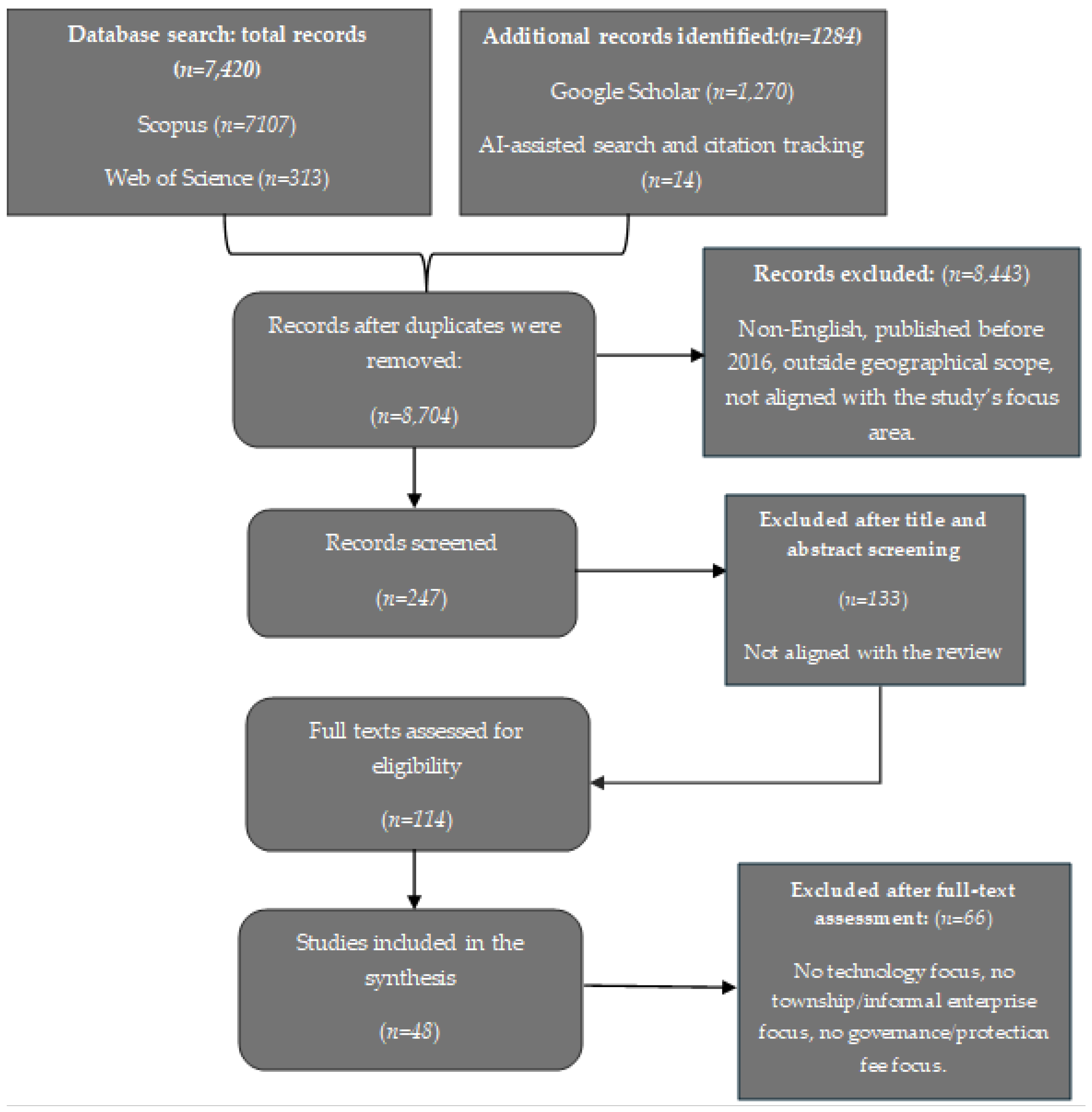

Table 1.
Search Strategy and Results.
| Search Engine | Search string, query used | Results | After Screening | Full-text reviewed | Final Sample |
| Scopus | ((“township business*” OR “township enterprise*” OR “township entrepreneur*” OR “informal sector” OR “informal economy” OR “street vendor*” OR “spaza shop*” OR “small business*” OR “SME*” OR “SMME*” OR “micro-enterprise*” OR “survivalist business*” OR “entrepreneurship” OR “developing countr*”) AND (“transformative technolog*” OR “emerging technolog*” OR “digital innovation*” OR “technological innovation*” OR “technological change” OR “ICT*” OR “blockchain” OR “smart technolog*” OR “digital platform*” OR “FinTech” OR “mobile technolog*” OR “mobile money” OR “digital adoption” OR “innovation diffusion” OR “innovation adoption” OR “technology adoption” OR “ICT4D”) AND (“protection fee*” OR “extortion” OR “racketeering” OR “gang violence” OR “organised crime” OR “organized crime” OR “criminal governance” OR “illegal taxation” OR “informal taxation” OR “street tax*” OR “extortion payment*” OR “safety fee*” OR “security fee*” OR “protection racket*” OR “coercion” OR “violence” OR “informal governance”) AND (“South Africa” OR “Sub-Saharan Africa” OR “developing countr*”) ) AND PUBYEAR > 2009 AND PUBYEAR < 2026 AND PUBYEAR > 2009 AND PUBYEAR < 2026 | 7107 | 108 abstracts screened | 47 | 22 |
| Web of Science | TS=((“township business*” OR “township enterprise*” OR “township entrepreneur*” OR “informal sector” OR “informal economy” OR “street vendor*” OR “spaza shop*” OR “small business*” OR “SME*” OR “SMME*” OR “micro-enterprise*” OR “micro business*” OR “survivalist business*” OR “entrepreneurship” OR “developing countr*”) AND (“transformative technolog*” OR “emerging technolog*” OR “digital innovation*” OR “technological innovation*” OR “technological change” OR “ICT*” OR “blockchain” OR “smart technolog*” OR “digital platform*” OR “FinTech” OR “mobile technolog*” OR “mobile money” OR “digital adoption” OR “digital technolog*” OR “innovation diffusion” OR “innovation adoption” OR “technology adoption” OR “ICT4D” OR “innovation*”) AND (“protection fee*” OR “extortion” OR “racketeering” OR “gang violence” OR “organised crime” OR “organized crime” OR “criminal governance” OR “illegal taxation” OR “informal taxation” OR “street tax*” OR “extortion payment*” OR “safety fee*” OR “security fee*” OR “protection racket*” OR “crime” OR “coercion” OR “violence” OR “informal governance”) AND (“South Africa” OR “Sub-Saharan Africa” OR “developing countr*”) and Crime (OR – Search within topic) and Developing Countries (Search within topic) and 2010-2025 (Publication Years |
313 | 59 abstracts screened | 33 | 12 |
| Artificial Intelligence (AI)-assisted search | (1) Show studies on township businesses OR informal economy OR micro-enterprises AND transformative or digital technologies (FinTech, mobile money, blockchain, ICT) AND protection fees, extortion, or informal taxation in South Africa or developing countries (2) give me the actual list of journals (3) Please list them in a table (4) give me more (5) table as well | 14 | 5 full-text screened | 5 | 5 |
| Google Scholar | (“township business” OR “informal economy” OR spaza shop” OR “street vendor” OR “SMME” OR “micro enterprise”) AND (“digital technology” OR “emerging technology” OR “innovation adoption” OR “mobile money” OR “FinTech” OR “ICT”) AND (“protection fee” OR extortion OR “organized crime” OR “informal taxation” OR “gang violence”) | 1270 | 75 abstracts screened | 29 | 9 |
Source. Researcher’s construction.
Table 2.
Inclusion and exclusion criteria .
| Inclusion | Exclusion |
| Publications focusing on South Africa | Publications not focusing on the South African context. |
| Publications written in English, published between 2016 and 2026, and accessible in full text. | Non-English publications, studies not accessible in full text, and publications published before 2016 |
| Studies examining digital technology adoption, digital innovation, ICT use, FinTech, digital financial inclusion, or technology-enabled business practices among township enterprises and informal businesses. | Studies unrelated to township enterprises, informal businesses, entrepreneurship, or digital technologies |
| Studies addressing protection fees, extortion, criminal governance, informal governance, informal taxation, business security, coercion, or related institutional constraints affecting township enterprises. | Publications not addressing governance, security, institutional constraints, or business operating environments. |
| Peer-reviewed journal articles, conference papers, book chapters, and relevant grey literature. | Editorials, opinion pieces, news articles, and non-scholarly publications. |
Source. Researcher’s construction.
Table 3.
Review focus area and themes .
| Focus area | Themes |
| Dynamics of Extortion and Protection Fees | Extortion as Informal Taxation |
| Extortion as Parallel Governance | |
| Impact on Business Sustainability | |
| FinTech Innovations for Mitigating Protection Fees | Mobile Money and Fintech Inclusion |
| Digital Payment Innovation and Blockchain-Enabled Financial Systems | |
| Crowdsourced Digital Reporting and Community Security Platforms | |
| Digital Platforms for Collective Bargaining and Community Solidarity | |
| Policy & Practice Recommendations | Strengthen Institutional and Policy Frameworks |
| Promote Digital Literacy and Capacity Building | |
| Facilitate Affordable Access to Technology | |
| Encourage Digital Payment Adoption | |
| Community Empowerment | |
| Integrate Technology Adoption with Economic Policy |
Source: (Researcher’s construction).
Disclaimer/Publisher’s Note: The statements, opinions and data contained in all publications are solely those of the individual author(s) and contributor(s) and not of MDPI and/or the editor(s). MDPI and/or the editor(s) disclaim responsibility for any injury to people or property resulting from any ideas, methods, instructions or products referred to in the content. |
© 2026 by the authors. Licensee MDPI, Basel, Switzerland. This article is an open access article distributed under the terms and conditions of the Creative Commons Attribution (CC BY) license (http://creativecommons.org/licenses/by/4.0/).
Copyright: This open access article is published under a Creative Commons CC BY 4.0 license, which permit the free download, distribution, and reuse, provided that the author and preprint are cited in any reuse.