

Submitted:
09 September 2026
Posted:
10 September 2026
You are already at the latest version
Abstract
Contemporary democracies face an apparent paradox: while numerous indicators point to a decline in political trust and democratic functioning, political participation remains relatively stable and is even increasing in some contexts. This study proposes a psychosocial and institutional framework to explain this paradox by jointly analysing political trust, generalized social trust, external political efficacy, and satisfaction with human development as predictors of both institutional and extra-institutional political participation. It also analyses the role of democratic quality as a contextual factor that moderates these relationships. Data from the eleventh wave of the European Social Survey (ESS) were analysed using structural equation modelling and multigroup analysis across countries with varying levels of democratic quality according to the Democracy Index. The results show that generalized social trust and external political efficacy are positively associated with both forms of participation, whereas political trust is positively associated only with institutional participation. All three variables are positively related to satisfaction with human development, which in turn shows a negative association with both forms of participation and acts as a mediating variable. Furthermore, democratic quality moderates these relationships: in flawed democracies, the associations between generalized trust and institutional participation, and between political trust and extra-institutional participation, disappear. Overall, the findings show that political participation depends on the interaction among psychosocial factors, contextual factors, and democratic institutions, integrating insights from political sociology, the social psychology of participation, and relative deprivation theory.
Keywords:
political participation
; political trust
; external political efficacy
; generalized trust
; satisfaction with human development
; democratic political engagement
1. Introduction
Contemporary democracies face an apparent paradox. On the one hand, various studies have documented persistent signs of decline across central dimensions of democratic functioning, including institutional performance, public trust in political institutions, and key indicators of democratic quality (Dalton, 2004; Dryzek et al., 2019; Norris, 2022). On the other hand, political participation has not disappeared. On the contrary, various forms of political engagement have remained relatively stable and have even increased in certain democratic contexts (Democracy Index, 2023; Herre et al., 2013). This coexistence of a perceived decline in democratic functioning and the persistence of participation poses a central question for the social sciences: under what conditions do citizens continue to participate politically, and what factors are associated with different forms of political commitment in contemporary democracies?
Addressing this question requires acknowledging that political participation is not a homogeneous phenomenon. For decades, the literature has distinguished between institutional forms of participation—linked to the formal channels of the representative system, such as voting, contacting political representatives, or participating in political parties— and extra-institutional forms, which seek to influence public decisions from outside traditional institutional channels (Hooghe & Marien, 2013; Kaase, 1999; Häggblom, 2024). Within the latter category, the literature distinguishes between normative actions, conducted within legal boundaries, and non-normative actions, which involve the violation of existing social or legal norms (Becker & Tausch, 2015). In a context of growing disaffection with democratic institutions and the questioning of their legitimacy (Norris, 2022; OECD, 2024), it is particularly relevant to understand the conditions that favour the forms of participation through which citizens attempt to influence collective decisions within the framework of functioning democracies. Therefore, this study focuses on institutional participation and normative extra-institutional participation.
Social psychology has developed robust models to explain collective mobilization and action oriented toward social change. From the relative deprivation tradition to the Social Identity Model of Collective Action (SIMCA), the literature has demonstrated that perceptions of injustice, efficacy, and social identification are central processes for understanding why groups mobilize collectively, particularly when they perceive a situation as illegitimate or unfair (Burns & Runciman, 1996; Walker & Smith, 2001; Van Zomeren et al., 2008). Subsequent reviews have expanded this framework by distinguishing between normative and non-normative forms of action, showing that emotions such as anger and contempt can lead to different forms of political mobilization (Becker & Tausch, 2015). Furthermore, this tradition has shown that participation also depends on the political context in which the actions occur (Ayanian et al., 2021).
However, these models have primarily been developed to explain anti-establishment collective mobilization, specifically mobilization aimed at transforming a social order perceived as unjust. We know much less about the psychosocial and institutional conditions associated with forms of political participation that, while still expressing discontent or demands for change, or exerting pressure on institutions, remain framed within normative democratic repertoires. Therefore, it is necessary to advance toward models that allow for a joint understanding of institutional participation and normative extra-institutional participation in contemporary democratic systems.
To this end, it is necessary to incorporate variables that capture different dimensions of the relationship between citizens, institutions, and the political community. A review of the literature points to three key variables: (a) political trust, (b) generalized social trust, and (c) external political efficacy. Political trust has been conceptualized as a form of support for the institutions and actors of the political system (Dalton, 2004; Easton, 1975). Generalized social trust reflects expectations of cooperation toward most people and constitutes a central component of social capital and democratic life (Newton & Zmerli, 2011; Putnam, 2001). External political efficacy refers to the perception that the political system offers opportunities for individuals to have a voice and influence political outcomes (Campbell et al., 1954; Lai & Beh, 2025; Lane, 1959). However, empirical evidence regarding these variables does not present a uniform pattern. Various studies indicate that higher levels of political trust and external political efficacy are associated with greater institutional participation, particularly in behaviours such as voting or involvement in formal political activities (Hooghe & Marien, 2013; Häggblom, 2024). At the same time, other studies suggest that low levels of political trust can be linked to forms of extra-institutional participation, such as protesting or boycotting, to the extent that they express dissatisfaction with the functioning of the political system (Braun & Hutter, 2016). Furthermore, some studies indicate that the relationship between political trust and participation may be non-linear or contingent upon the institutional context (Häggblom, 2024; Hooghe & Marien, 2013). Generalized social trust also displays complex associations with participation: while it can foster political cooperation, its effects appear to depend on the type of participation under consideration and the institutional environment in which it occurs (Gaidytė & Muis, 2021; Suh & Reynolds-Stenson, 2018). Taken together, these findings suggest that the relationship between trust, efficacy, and political participation depends both on the mode of participation analysed and on the democratic context in which citizens are embedded.
One possible explanation for this plurality of findings lies in how individuals perceive and evaluate their social and economic conditions. The relative deprivation tradition and grievance-based approaches have shown that political participation can intensify when individuals perceive a decline in their living conditions or discrepancies between their expectations and what they consider to be a legitimate or fair situation (Burns & Runciman, 1966; Walker & Smith, 2001; Fransson & Oskarson, 2020; Girardi, 2026; Gurr, 2016). From this perspective, it is not merely objective conditions that matter, but rather individuals’ subjective interpretations of their environment. Evaluations of key dimensions of social development, such as the economy, education, or healthcare, can be understood as subjective evaluations of the context in which democratic life unfolds. These evaluations may activate demands for change or, conversely, diminish the motivation to engage politically when conditions are perceived as satisfactory. In addition to these individual-level evaluations, the institutional context can alter how citizens’ attitudes and perceptions translate into political participation. The literature has highlighted that the quality, openness, and functioning of democratic institutions condition participatory opportunities as well as the relationship between trust, efficacy, and political action (Marien & Hooghe, 2011; Rothstein & Stolle, 2003; Suh & Reynolds-Stenson, 2018). However, studies that simultaneously integrate psychosocial factors, subjective evaluations of the social context, and the characteristics of the political system remain scarce—particularly those that maintain an explicit distinction between institutional and normative extra-institutional participation. This limitation hinders our understanding of why certain variables exhibit positive, negative, or contingent effects depending on the form of participation and the democratic context under study.
This study addresses this gap by proposing a psychosocial and institutional framework of democratic political engagement. Specifically, it jointly analyses political trust, generalized social trust, external political efficacy, and satisfaction with human development (conceptualized as a subjective evaluation of the social context) in relation to both institutional participation and normative extra-institutional participation. Additionally, it analyses the role of democratic quality as a contextual factor that potentially moderates these relationships, distinguishing between countries with high and low levels of democratic quality according to the Democracy Index (Economist Intelligence Unit, 2023). Using data from the eleventh wave of the European Social Survey across a broad sample of European countries, this study seeks to advance our understanding of the psychosocial and institutional conditions associated with distinct forms of political participation, thereby contributing to an integrative framework for the study of political engagement in contemporary European democracies.
1.1. Political Participation
Political participation can be understood as the way in which citizens leverage the opportunities provided by the state to influence political decision-making, whether at local, national, or even international levels (Kaase, 1999). These opportunities are not limited to the formal mechanisms established by political institutions but rather encompass a broader array of actions through which citizens attempt to affect public decision-making processes. Broadly speaking, the various forms of political participation can be categorized into institutional participation and extra-institutional participation. The former refers to those forms of involvement directly channelled and regulated by political institutions, such as voting or participating in political parties and electoral campaigns (Hooghe & Marien, 2013; Kaase, 1999). These forms represent the classic participatory mechanisms that liberal representative democratic systems afford citizens, and they have been extensively examined in traditional political science and political sociology (Devine, 2024; Häggblom, 2024; Li & Yu, 2023).
Conversely, extra-institutional forms of political participation include those activities that, while not directly organized by the state, seek to influence public decisions through alternative avenues, such as protests, demonstrations, boycotts, or collective mobilization (Häggblom, 2024; Kaase, 1999). These forms of participation do not operate outside the political system; instead, they interact with existing institutions by pressuring them, challenging them, or seeking to shape the political agenda through non-electoral channels (Häggblom, 2024). In this sense, institutional and extra-institutional participation do not constitute mutually exclusive spheres, but rather complementary forms of political involvement. In the current democratic context, the opportunities and constraints citizens face when participating politically, as well as the intensity with which they resort to one form or the other, are crucial for understanding their relationship with the state and democratic institutions (De Blok & Kumlin, 2022; Häggblom, 2024).
However, among the multiple factors that influence citizens’ choice of one form of political participation over another, psychosocial factors play a central role. To participate actively in politics, citizens must perceive that their actions can yield meaningful outcomes, whether through institutional mechanisms or through extra-institutional forms of pressure and mobilization. This perception is closely linked to political trust, generalized social trust, and the expectation that political institutions themselves can respond (Gaidytė & Muis, 2021; Häggblom, 2024; Hooghe & Marien, 2013). Likewise, subjective evaluations of the material and social context, such as satisfaction with human development, can foster or hinder the inclination to participate, moderating the relationship between psychosocial factors and different forms of political participation (Girardi, 2026; Lai & Beh, 2025).
Additionally, the actions that enable political participation, regardless of their mode, frequently entail collaborative processes; this implies that individuals must trust the people with whom they interact and engage politically (Gaidytė & Muis, 2021). Furthermore, to activate the behavioural mechanisms underlying participation, citizens must consider the responsiveness of the political institutions to which they direct their demands, evaluating both their external political efficacy and their level of satisfaction or dissatisfaction with their living conditions (Gaidytė & Muis, 2021). Finally, the quality, flexibility, and operational capacity of democratic institutions serve as key contextual factors that can moderate the relationships between psychosocial factors and different forms of political participation (Gaidytė & Muis, 2021; Suh & Reynolds-Stenson, 2018). Consequently, building a theoretical and empirical model that captures the nature of political participation and its various forms requires analysing these factors jointly.
1.2. Political Trust
One of the classic conceptualizations of political trust places it within the broader framework of political support, understood as the set of attitudes and beliefs that citizens hold toward the political system, its institutions, and its actors (Easton, 1975; Dalton, 2004; Norris, 2022). From this perspective, political trust represents a specific form of support that connects general orientations toward the regime with the evaluation of its main actors and institutions. In this sense, trust is inherently relational, as it involves an evaluation directed at specific objects, such as parliament, the government, parties, or politicians, and sometimes including non-representative institutions such as the legal system and public services (Devine, 2024).
There is some debate in the literature regarding the relationship between political trust and political participation. Some scholars argue that high trust can be viewed as a prerequisite for participation, but that low trust can also act as a motivator for protest behaviour and other extra-institutional forms of participation (Devine, 2024; Hooghe & Marien, 2013). A common observation in the literature is that low political trust contributes to higher rates of extra-institutional participation and lower rates of institutional participation (Braun & Hutter, 2016; Häggblom, 2024; Hooghe & Marien, 2013). Other authors clarify that additional variables may moderate the relationship between political trust and types of participation, particularly the nature and quality of democratic institutions (Marien & Hooghe, 2011). Notably, the relationship between political trust and voting behaviour is quite consistent, with higher political trust predicting higher turnout rates (Devine, 2024; Hooghe & Marien, 2013; Kaase, 1999). A recent meta-analysis found that trust had no effect on extra-institutional political participation, such as protesting, but did have a small positive effect on voting rates (Devine, 2024).
In parallel, Häggblom (2024) shows that the relationship between trust in government and political participation is non-linear, following a curvilinear pattern characterized by an increase in participation from low levels of trust up to an intermediate point, beyond which it tends to decrease. This pattern suggests that intermediate levels of trust are associated with greater political activation, while very high levels of trust may translate into lower levels of involvement, in line with the complacency hypothesis. However, this pattern does not manifest uniformly; rather, it varies depending on the form of participation considered. In the case of institutional participation, especially voting, the inverted U-shaped pattern is clearer, with a drop in participation at the highest levels of trust. Conversely, for extra-institutional forms, the relationship tends to be weaker and, in some cases, closer to a negative linear pattern, where higher levels of trust are associated with lower levels of involvement. These findings add nuance to the classic interpretation that directly links trust to institutional participation and distrust to protest, and they show that this relationship depends on both the level of trust and the type of participation. Finally, although the study acknowledges the potential influence of institutional context on these processes, it does not systematically analyse how the relationship varies across different political environments, leaving room for research that explicitly integrates contextual factors alongside psychosocial variables.
Other studies suggest that the relationship between political trust and participation may be conditioned by how individuals perceive and evaluate their material conditions, as well as by their expectations of change within their environment. Along these lines, recent studies show that subjective perceptions of risk or vulnerability can activate participation to the extent that individuals consider it plausible to influence their situation, although these effects do not manifest uniformly; again, they vary depending on the form of participation considered (Weiss, 2024). Accordingly, individuals’ evaluations regarding the state of fundamental dimensions of social development may constitute a key mechanism through which these perceptions translate into specific forms of political involvement. Likewise, the literature has highlighted that these dynamics depend on the institutional context, as the quality and responsiveness of democratic institutions shape the conditions under which citizens’ attitudes translate into political action (Rothstein & Stolle, 2003). In particular, evidence suggests that the effect of trust on participation is not uniform but is instead reinforced in contexts with more effective and less restrictive institutions, which reduce the uncertainty associated with collective action and make its translation into political behaviour more likely (Suh & Reynolds-Stenson, 2018). These approaches point to the need to analyse the relationship between political trust and participation by incorporating subjective evaluations of the socio-economic context and the role of the institutional environment, paying close attention to differences across forms of participation and the conditions under which these relationships strengthen or weaken.
1.3. Generalized Trust
When defining social or interpersonal trust, the literature distinguishes between two main dimensions (Gaidytė & Muis, 2021). First, generalized social trust refers to the belief that most people can be trusted, even those we do not personally know. In contrast, particularized social trust refers to trust placed in known individuals or in people perceived as members of socially proximate groups, such as family, neighbours, friends, or those who share traits such as ethnicity, religion, or social class (Newton & Zmerli, 2011; Suh & Reynolds-Stenson, 2018).
From the perspective of self-categorization theory, trust can be understood as a relational phenomenon closely linked to processes of social self-definition and the breadth of the categories through which individuals cognitively organize their social world (Turner, 1988). The theory proposes that individuals tend to perceive themselves and others in terms of group membership, and that expectations of cooperation, solidarity, and influence are higher among those perceived as members of the same social group. As such, generalized social trust may be fostered when individuals define themselves through more inclusive or superordinate categories that expand the boundaries of “us,” allowing for the inclusion of a larger number of individuals within the reference community. Conversely, particularized social trust emerges when self-definition relies primarily on more specific and exclusive categories, such that expectations of cooperation and trust remain restricted to groups that are socially proximate or perceived as similar (Turner, 1988; Glanville & Shi, 2020). From this viewpoint, generalized social trust can constitute a key resource for democratic political participation, as it facilitates cooperation with strangers, fosters a sense of belonging to a broader political community, and can increase citizens’ willingness to engage in actions oriented toward the collective interest.
Focusing on generalized trust, empirical evidence regarding its relationship with political participation yields mixed findings that vary according to the form of participation considered. Initial studies found a positive association between social trust and extra-institutional forms of political participation, albeit without clearly establishing the direction of this relationship—that is, whether trust acts as an antecedent to participation or whether political engagement itself helps generate trust (Kaase, 1999). More recent research has nuanced this relationship by showing that generalized trust can foster extra-institutional participation contingent upon the institutional context. In particular, Suh & Reynolds-Stenson (2018) found that trust in others, especially toward outgroups, is positively associated with protest participation, though the effect depends on institutional functioning and state repression levels. Gaidytė & Muis (2021) found that generalized social trust relates differently to institutional and extra-institutional participation. Regarding institutional participation, generalized trust is positively associated with voting through its relationship with external political efficacy. In the extra-institutional domain, however, the relationship is more complex: while generalized trust increases external efficacy—and thus may indirectly foster protest—it is also positively associated with political trust, which tends to suppress extra-institutional participation. Consequently, the total effect of generalized trust on protest remains weak or non-significant.
These results indicate that the relationship between generalized social trust and political participation is not univocal; rather, it varies depending on both the form of participation (institutional or extra-institutional) and the mechanisms through which it is channelled. Evidence suggests that this relationship operates largely through intermediate variables, such as external political efficacy, which connects trust in others with perceived influence over the political system (Gaidytė & Muis, 2021). However, existing studies tend to focus on direct associations or partial models, without systematically integrating the role of subjective evaluations of the socio-economic context or jointly analysing differences between institutional and extra-institutional participation.
1.4. External Political Efficacy
Political efficacy as a theory was introduced by Campbell et al. (1954) and it refers to the feeling and/or perception that individual political action has or can have an impact on political processes—that is, that fulfilling one’s civic duties is worthwhile. According to this definition, the subject of political efficacy is the citizen, and the object is political change (Campbell et al., 1954, 1971). Campbell et al. conceptualize political efficacy as an intrinsically subjective perception of politics and a self-perception regarding one’s own political competence (Campbell et al., 1954, 1971). Lane (1959) distinguishes two distinct components within political efficacy. First, internal political efficacy refers to individuals perceiving themselves as having the competence to influence political decision-making. Second, external political efficacy is defined as the perception that political institutions are responsive to citizens’ demands (Lane, 1959). However, contemporary measurements often operationalize this dimension through the perception that individuals have a voice and influence within the political system (Lai & Beh, 2025).
It is also worth noting that the literature has conceptualized political efficacy across different levels of analysis: individual and group. While research on political participation has tended to focus on individual perceptions of political influence and institutional responsiveness (Campbell et al., 1954; Lane, 1959), the social psychology of collective action has emphasized group efficacy, understood as the belief that one’s group possesses the capacity to bring about social or political change (Van Zomeren et al., 2008). Both dimensions share the core idea that action is associated with political consequences, yet they differ in both their level of analysis and underlying mechanisms. Collective efficacy refers to the belief that one’s ingroup has the capacity to achieve shared goals and foster political change, while individual external political efficacy refers to the perception that individuals can influence political processes because the system offers opportunities and institutional responsiveness. This study focuses on individual external political efficacy, given that the measures available in the European Social Survey evaluate the extent to which people perceive that citizens like themselves can have a voice and exert influence within the political system.
The literature suggests that higher levels of external political efficacy are associated with political participation by enhancing the perception that civic action can be influential or meaningful (Lai & Beh, 2025). Various studies indicate that individuals with higher external political efficacy show a greater likelihood of participating in both direct (e.g., voting or attending rallies) and indirect forms (such as discussing political issues on social media or disseminating specific political discourses) (Mead, 2018). Conversely, low levels of external political efficacy can undermine political commitment and reduce the willingness to engage in political activities (Etzel, 2023).
From a political opportunity structure perspective, scholars suggest that when citizens perceive accessible and responsive institutional channels to influence public decisions, collective demands tend to be channeled more frequently through institutional mechanisms, which may correspond with less frequent reliance on extra-institutional forms of participation (McAdam, 1999; Tarrow, 2011; Tilly & Tarrow, 2015). However, recent empirical evidence does not show a uniform pattern. Some research indicates that external political efficacy relates primarily to institutional participation, as individuals with higher levels of external efficacy are more likely to engage in formal political activities due to perceiving greater influence opportunities within the political system (Gaidytė & Muis, 2021; Mahlangu & Schulz-Herzenberg, 2022). Consistent with this, other studies point out that the relationship between external political efficacy and extra-institutional participation is less consistent, varying considerably depending on participants’ age and the characteristics of the sociopolitical context (Alscher & Jana, 2025).
Taken together, previous literature suggests that external political efficacy is related to political participation, but that the magnitude and even the direction of this relationship may depend on the form of participation. While the association appears relatively consistent in the case of institutional participation, findings are more ambiguous regarding extra-institutional forms of participation (Gaidytė & Muis, 2021; Alscher & Jana, 2025). This variability suggests that external political efficacy does not function in isolation; rather, it interacts with other factors that shape how individuals interpret their social and political environment. Accordingly, both individuals’ subjective evaluations of the socio-economic conditions of their environment and the characteristics of the democratic context in which they act may play a key role in the relationship between political efficacy and participation.
1.5. Satisfaction with Human Development
The relationship between material conditions and political participation has traditionally been addressed from perspectives that highlight the role of subjective perceptions in activating political action. In this regard, one of the most fruitful approaches stems from the tradition of relative deprivation and grievance-based perspectives. Political participation may intensify when individuals perceive a discrepancy between their expectations and their living conditions, particularly when they consider such a situation to be unfair or susceptible to change (Girardi, 2026; Gurr, 2016; Kern et al., 2015). From this perspective, it is not merely objective conditions that relate to participation, but rather how these conditions are interpreted and evaluated by citizens (Burns & Runciman, 1966; Gurr, 2016; Walker & Smith, 2001).
Subsequent developments have not replaced this perspective; instead, they have tended to integrate it with other psychosocial processes relevant to political action. Thus, later models have incorporated pragmatic and institutional aspects of political participation (Klandermans, 1997), as well as variables related to social identity, emotions, and efficacy perceptions (Becker & Tausch, 2015; Van Zomeren et al., 2008). Consequently, relative deprivation remains a fundamental starting point for understanding how individuals interpret their social situation and how such interpretations may translate into different forms of political action.
In this context, the notion of human development has traditionally been operationalized through aggregate indicators, such as GDP, per capita income, or the Gini index, and more broadly through the Human Development Index (HDI), which incorporates dimensions such as health, education, and economic conditions (Ghislandi et al., 2019). However, these approaches primarily capture the macro-level of development and do not directly incorporate individuals’ subjective evaluations of their own social environment. Various studies have highlighted the need to consider these subjective assessments of human development as a relevant construct. In this regard, citizens’ evaluations of dimensions such as the economy, health, or education tend to be interrelated and can be conceptualized as distinct dimensions of a single comprehensive assessment of social development (Fransson & Oskarson, 2020; Gonzálvez-Gallego & Nieto-Torrejón, 2021).
These evaluations capture how individuals interpret their living conditions relative to their expectations, in line with the relative deprivation tradition (Klandermans et al., 2008; van Stekelenburg & Klandermans, 2013). From this perspective, satisfaction with human development can be understood as a subjective evaluation of the socio-economic conditions in which democratic life unfolds. As such, it constitutes a potentially key psychosocial mechanism for understanding political action, to the extent that it may be linked with perceptions of injustice, evaluations of the functioning of the system, and the disposition to engage in different forms of political participation. Thus, lower levels of satisfaction may correspond with increased demands for political change, whereas more positive evaluations may relate to more favourable perceptions regarding the functioning of the social and political environment. Nevertheless, the specific direction of these relationships may depend on the form of participation considered and the institutional context in which it occurs (Girardi, 2026; Kern et al., 2015).
Despite the theoretical relevance, the literature has tended to analyse evaluations of the socio-economic context separately from psychosocial variables linked to the relationship between citizens and institutions, such as political trust, generalized social trust, or external political efficacy. Consequently, studies that integrate these dimensions into a single analytical framework remain very scarce—particularly those that also account for differences between institutional and normative extra-institutional participation, as well as the potential role of democratic quality as a contextual factor that may moderate these relationships. This gap limits our understanding of the mechanisms through which perceptions and evaluations of the social environment translate into distinct forms of civic political engagement.
1.6. Current Study
This study addresses this gap by proposing a psychosocial and institutional framework of democratic political engagement. Specifically, it jointly analyses political trust, generalized social trust, external political efficacy, and satisfaction with human development as a subjective evaluation of socio-economic conditions. It also examines how these factors relate to both institutional political participation and normative extra-institutional participation. This approach allows for the integration of different psychosocial mechanisms linked to the relationship between citizens, the social context, and political institutions, which have typically been studied in isolation.
Additionally, the study incorporates democratic quality as a contextual factor that potentially moderates these relationships. In particular, the model is tested comparatively across countries with high and low levels of democratic quality, according to the classification established by the Democracy Index (Economist Intelligence Unit, 2023). This strategy enables an analysis of whether the strength and direction of the relationships between psychosocial variables and political participation differ depending on the democratic environment in which individuals are embedded.
The objective of this study is to analyse the relationship between these psychosocial factors and different forms of political participation—both institutional and extra-institutional—while accounting for the democratic context of the countries analysed (Devine, 2024; Häggblom, 2024). Specifically, it aims to identify differential patterns in how political trust, generalized social trust, external political efficacy, and satisfaction with human development relate to both forms of participation. From these objectives, the following hypotheses are derived:
Political Trust and Participation
H1.
Higher political trust is positively related to institutional political participation.
H2.
Higher political trust is negatively related to extra-institutional political participation.
Social Trust and Political Participation
H3.
Higher social trust is positively related to institutional political participation.
H4.
Higher social trust is positively related to extra-institutional political participation.
External Political Efficacy and Political Participation
H5.
Higher external political efficacy is positively related to institutional participation.
H6.
Higher external political efficacy is negatively related to extra-institutional political participation.
Intermediate Relationships with Satisfaction with Human Development
H7.
Political trust is positively related to satisfaction with human development.
H8.
Generalized trust is positively related to satisfaction with human development.
H9.
External political efficacy is positively related to satisfaction with human development.
H10.
Satisfaction with human development is positively related to institutional participation.
H11.
Satisfaction with human development is negatively related to extra-institutional participation.
When testing these hypotheses, national democratic quality is introduced as a moderating variable to determine whether the structural paths differ systematically across political contexts. Figure 1 illustrates the proposed conceptual model.
Multigroup Variable
H12.
National democratic quality moderates the relationships between the psychosocial factors and institutional political participation, showing different patterns in contexts of high versus low democratic quality.
H13.
National democratic quality moderates the relationships between psychosocial factors and extra-institutional political participation, showing different patterns in contexts of high versus low democratic quality.
2. Methodology
This study uses a correlational methodology based on pre-processed secondary data.
2.1. Sample
The sample used in this study is drawn from Round 11 (Version 2.0) of the European Social Survey (ESS ERIC, 2024). The dataset comprises 40,156 individuals aged 15 and older residing in private households across 24 countries, including both EU member states (Austria, Belgium, Croatia, Cyprus, Finland, France, Germany, Greece, Hungary, Ireland, Italy, Lithuania, the Netherlands, Poland, Portugal, Slovakia, Slovenia, Spain, and Sweden) and non-EU countries (Iceland, Norway, Serbia, Switzerland, and the United Kingdom). Individuals were included regardless of their nationality, citizenship, language, or legal status (ESS ERIC, 2025).
This dataset was selected for its large size, the robust methodology used by its developers, and the transparency and accessibility of the published data (most recent ESS wave: https://ess.sikt.no/en/datafile/242aaa39-3bbb-40f5-98bf-bfb1ce53d8ef?tab=0; data used in this study: https://github.com/exdsgift/ess11-eda). The survey measures attitudes, beliefs, and behavioural patterns across diverse populations. It includes questions on various core topics repeated from previous rounds, in addition to two modules specifically developed for Round 11. Survey topics are grouped into: Social conditions and indicators, social behaviour and attitudes, Health and general well-being, Political behaviour and attitudes, Political ideology, Minorities, Cultural and national identity, Media, Equality, inequality and social exclusion, Language and Linguistics, Religion and values, Gender and gender roles, Food and nutrition, Substance use (drugs, alcohol, and tobacco), and Occupational health.
All variables represent individual-level measurements (ESS ERIC, 2025). The sample comprises 46.7% men and 53.3% women, with a mean age of 51.6 years (SD = 18.7). Although statistically significant differences exist between men and women regarding age in years (Men: M = 51.26, SD = 18.68; Women: M = 52.07, SD = 18.77; t = -4.293, p <0.001), the magnitude of these differences is negligible (Cohen’s d = 0.043).
2.2. Measurement
To test the hypotheses, several items were grouped according to their underlying theoretical constructs, as detailed below and summarized in Table 1.
Political Participation (IP vs. EIP)
The political participation items selected for analysis were categorized into two distinct dimensions: Institutional Participation: contplt, donprty, and vote; Extra-Institutional Participation: badge, sgnptit, pbldmna, bctprd, pstplpnl, and volunfp. All participation items represent dichotomous responses originally coded as 1 (“Yes”) and 2 (“No”). To facilitate analysis, these items were recoded to 0 (“No”) and 1 (“Yes”).
Political Trust (PT)
To build the latent variable for political trust, three ordinal items measuring political trust were grouped: trstprl, trstplt, and trstprt. Each item is measured on a scale ranging from 0 (“No trust at all”) to 10 (“Complete trust”).
Generalized Trust (GT)
This construct comprises three ordinal items measuring generalized trust: ppltrst, pplfair, and pplhlp. All three items are measured on a scale ranging from 0 (“You can’t be too careful”) to 10 (“Most people can be trusted”).
External Political Efficacy (EPE)
This latent variable is formed from two ordinal items measuring external political efficacy: psppsgva and psppipla. The two items are coded from 1 (“Not at all”), 2 (“Very little”), 3 (“Some”), 4 (“A lot”), to 5 (“A great deal”).
Satisfaction with Human Development (ST)
This construct represents individuals perceived satisfaction with human development, following a structure analogous to the Human Development Index (HDI) across economic, health, and educational domains. The corresponding items are: stfeco, stfedu, and stfhlth. The items are measured on a scale ranging from 0 (“Extremely bad”) to 10 (“Extremely good”).
Multigroup Variable: Full Democracy vs. Flawed Democracy
The multigroup variable democratic regime type was incorporated into the analysis to examine the potential moderating role of national democratic context. This variable groups individuals based on whether their country scores between 8.0 and 10.0 points (“Full Democracy”) or between 6.0 and 7.9 points (“Flawed Democracy”) on the Democracy Index produced by The Economist (Democracy Index, 2023). Thirteen countries classified as full democracies are represented: Austria, Finland, France, Germany, Greece, Ireland, Iceland, the Netherlands, Norway, Spain, Sweden, Switzerland, and the United Kingdom). Alongside twelve countries classified as flawed democracies: Belgium, Croatia, Cyprus, Czechia, Hungary, Italy, Lithuania, Poland, Portugal, Serbia, Slovakia, and Slovenia (Democracy Index, 2023).
2.3. Statistical Analysis
Two structural equation models (SEMs) were estimated: a baseline (single-group) model and a multigroup model incorporating democratic regime as a grouping variable. Given the presence of several dichotomous variables, the Diagonally Weighted Least Squares (DWLS) estimation method was used, applying NLMINB optimization alongside robust standard errors and a mean-adjusted, scaled, and shifted test statistic.
First, the baseline model was estimated. Then, the multigroup variable (democratic regime) was introduced. In this multigroup model, equality constraints were applied to factor loadings and thresholds to test the assumptions of metric and scalar invariance, respectively, enabling the subsequent comparison of path coefficients across groups. Following this, regression equality constraints were imposed to determine whether the differences in path coefficients between groups were statistically significant. Because the software used does not directly test differences in indirect relationships across groups, a simple Wald test (assuming covariance between the compared parameters is equal to zero) was used as an approximation. Pairwise deletion was used to handle missing data. All models were estimated using the SEM module within the statistical software environment Jamovi (version 2.3.28).
2.4. Ethical Considerations
The present study relies exclusively on the secondary analysis of data from the European Social Survey (ESS), a European research infrastructure that collects information using standardized procedures for informed consent, confidentiality, and data protection in accordance with current ethical regulations in participating countries. The analysis conducted involves neither direct contact with participants nor access to identifiable information, using solely anonymized datasets accessible for research purposes. The project was evaluated and approved by the Research Ethics Committee of the University of Malaga (CEUMA), under approval code CEUMA:85-2026-H. All phases of the study were carried out in accordance with the ethical principles established for research involving human subjects, European data protection regulations, and the institutional guidelines of the University of Malaga.
3. Results
3.1. Simple Structural Equation Model
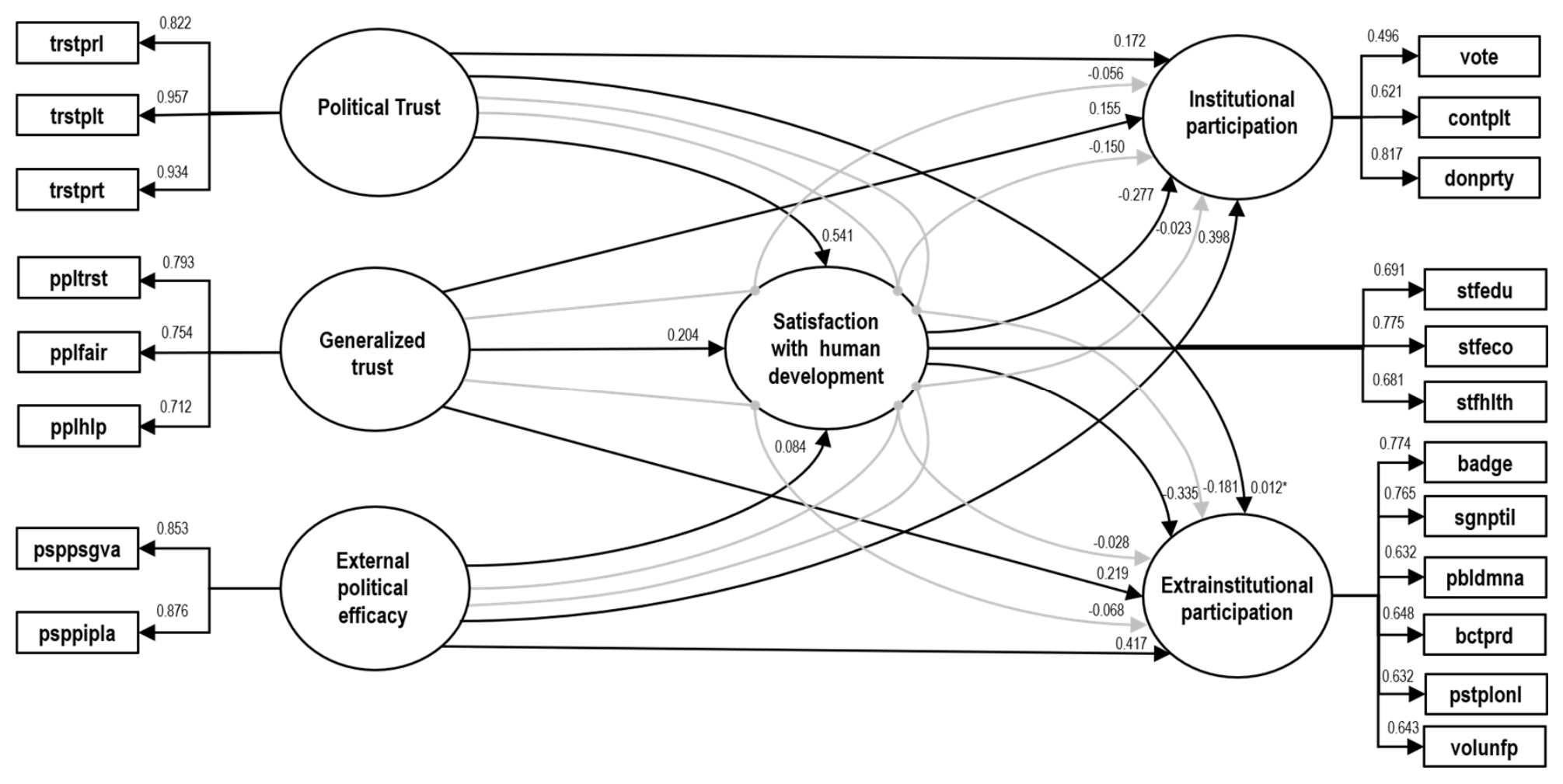
To test hypotheses H1 through H11, an initial structural equation model was estimated. This model aims to estimate the constructs of Institutional and Extra-Institutional Participation from the predictive latent factors of External Political Efficacy, Interpersonal Trust, and Political Trust, alongside the intermediary variable Satisfaction with Human Development. The model reached convergence after 50 iterations, with 142 free parameters and 40,156 valid observations. The model yielded a fit statistic of χ2 = 10,390.480; df = 155; p < 0.001. The model also yielded the following fit statistics: CFI = 0.996; TLI = 0.994; RMSEA = 0.041; SRMR = 0.049. Overall, these statistics show an acceptable fit to the statistical structure of the data. The model also yielded an R2 = 0.231 for the estimation of institutional participation, and an R2 = 0.201 for extra-institutional participation, demonstrating highly comparable levels of explained variance across both forms of participation. Additionally, the model yielded an R2 = 0.541 for the latent variable Satisfaction with Human Development (ST).
The grouping of variables related to institutional participation yielded an ordinal α of 0.652, indicating limited internal consistency. This lower reliability may be attributed to items with low factor loadings (vote and contplt). In contrast, the extra-institutional participation construct reported an original α of 0.837, reflecting good internal consistency with all items demonstrating acceptable factor loadings. The political trust latent variable reached an ordinal α of 0.925, demonstrating very high internal consistency supported by high factor loadings across its items. Likewise, generalized trust showed acceptable internal consistency (ordinal α = 0.796) along with high factor loadings. External political efficacy showed high internal consistency (ordinal α = 0.856) with markedly high factor loadings on its items. Finally, satisfaction with human development reported an ordinal α of 0.752, showing moderate internal consistency in line with the moderate factor loadings of its items (see Table 2).
Next, the relationships between the latent variables are presented (see Table 3). Hypothesis 1 (H1) suggests that high levels of political trust are associated with high levels of institutional participation; that is, individuals who report greater trust in political institutions tend to engage in institutional participation activities, such as voting. The results support this hypothesis (β = 0.172, p < .001).
Hypothesis 2 (H2) proposes that political trust is negatively associated with extra-institutional participation, meaning that individuals who report a lack of trust in the political system tend to participate through extra-institutional means, such as boycotts or strikes. However, the statistical analyses did not yield significant evidence to support this hypothesis (β = 0.013, p = .327).
Hypothesis 3 (H3) proposes that generalized trust is positively associated with institutional participation, indicating that individuals who report trusting others are more likely to participate through institutional methods compared to those who report higher levels of distrust. This hypothesis found significant support in the analyses (β = 0.155, p < .001).
Hypothesis 4 (H4) proposes that high levels of generalized trust are associated with high levels of extra-institutional participation; individuals with greater trust in others show a higher predisposition to engage in extra-institutional behaviours, such as joining strikes. The results align with this hypothesis (β = 0.219, p < .001).
Hypothesis 5 (H5) proposes that external political efficacy has a direct positive relationship with institutional participation, meaning that individuals who report a more positive perception of political institutions’ responsiveness tend to participate within those institutions, such as by voting or engaging with political parties. This hypothesis was supported by the analyses (β = 0.398, p < .001).
Finally, Hypothesis 6 (H6) proposes that external political efficacy is negatively associated with extra-institutional participation, suggesting that individuals who report a more negative perception of institutional responsiveness tend to participate politically through extra-institutional activities. However, the statistical results yielded evidence contrary to this hypothesis (β = 0.398, p < .001), showing that these two variables actually share a positive association similar to the relationships discussed above.
On the other hand, Hypothesis 7 (H7) emphasized that political trust has a positive relationship with satisfaction with human development. Individuals who report trusting political institutions tend to positively evaluate the state of the economic, healthcare, and educational sectors of their country. This hypothesis was confirmed by the preceding statistical analyses (β = 0.541, p < .001).
Hypothesis 8 (H8) proposed that high levels of generalized trust are associated with high levels of satisfaction with human development; that is, individuals who claim to trust others tend to be more satisfied with human development in their country. This hypothesis aligns with the reported results (β = 0.204, p < .001).
Hypothesis 9 (H9) proposed that external political efficacy is positively associated with satisfaction with human development, meaning that individuals who hold a positive perception of their ability to influence political institutions tend to be more satisfied with their country’s human development. This hypothesis was supported by the results (β = 0.084, p < .001).
Hypothesis 10 (H10) proposed a positive association between satisfaction with human development and institutional participation, meaning that individuals who report being satisfied with their country’s human development tend to participate in politics through institutional mechanisms. However, this hypothesis was contradicted by the statistical analyses (β = -0.277, p < .001), revealing an inverse relationship between the two variables.
Finally, Hypothesis 11 (H11) proposes that satisfaction with human development is negatively associated with extra-institutional participation. This hypothesis was confirmed by the subsequent results (β = -0.335, p < .001).
Nevertheless, when including satisfaction with human development as an intermediate variable between predictor and dependent variables, the potential indirect relationships between these variables must be tested. All indirect relationships were found to be significant and negative. Political trust is the variable with the strongest indirect relationship with both institutional participation (β = -0.150, p < .001) and extra-institutional participation (β = -0.181, p < .001). On the other hand, generalized trust reported weaker indirect relationships with institutional participation (β = -0.056, p < .001) and extra-institutional participation (β = -0.068, p < .001). Lastly, the indirect relationships between external political efficacy and both types of participation are weak, despite being significant (Institutional: β = -0.026, p < .001; Extra-institutional: β = -0.031, p < .001).
Finally, several correlations between latent variables in the model were identified, which were not included in the hypotheses but present interesting results.
First, the analyses show a positive correlation between external political efficacy and generalized trust (β = 0.418, SE = 0.005, z = 82.853, p < .001). A positive perception of political institutions’ response mechanisms is associated with citizens’ trust in one another. Second, external political efficacy correlates positively with political trust (β = 0.622, SE = 0.003, z = 179.214, p < .001). This means that individuals who have greater external political efficacy report high trust in traditional political institutions. Third, generalized trust positively correlates with political trust (β = 0.467, SE = 0.004, z = 114.615, p < .001), indicating that individuals who claim to trust others also tend to trust political institutions. Fourth and finally, the dependent variables analysed in this study present a substantial positive correlation (β = 0.808, SE = 0.011, z = 70.839, p < .001). This shows that individuals who participate politically using institutional procedures also engage in extra-institutional procedures.
Figure 2.
Statistical representations of the general model. Note: gray lines represent indirect relationships (non-causal). All standardized coefficients are significant except for those marked with a *.
Figure 2.
Statistical representations of the general model. Note: gray lines represent indirect relationships (non-causal). All standardized coefficients are significant except for those marked with a *.
3.2. Multigroup Structural Equation Model: Democratic Regime
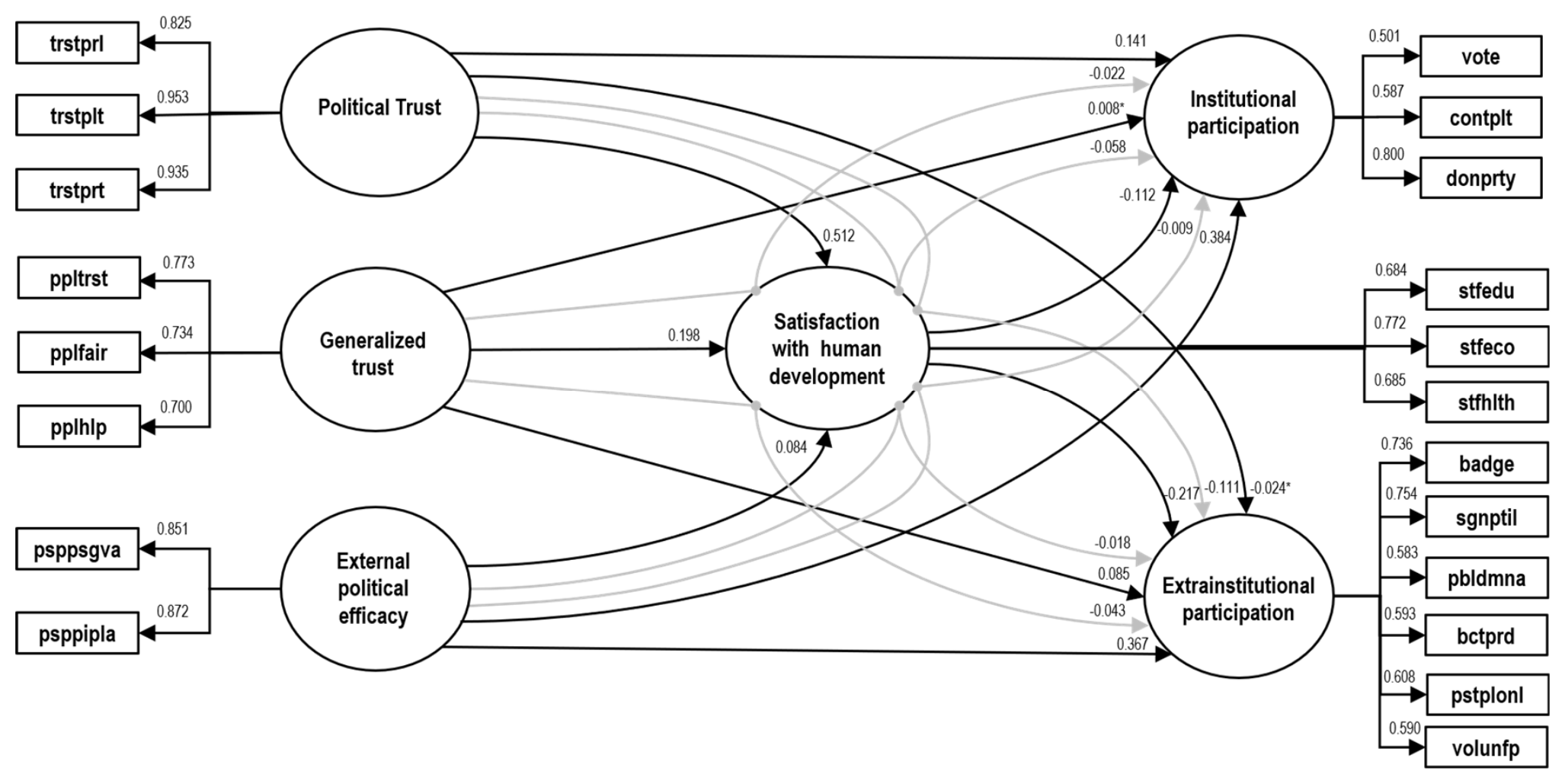
To test the last two hypotheses, H12 and H13, a second structural equation model similar to the previous one was reported, incorporating the multigroup variable into the analysis: the type of democratic regime, which divides the subjects based on whether they live in a country classified as a full democracy or a flawed democracy. The unconstrained model is convergent, with 66 iterations, 284 free parameters, and 40,156 valid observations. The model shows a goodness of fit of χ2 = 11,188.199, df = 310, p < .001. The analysis also reported a CFI = 0.995, TLI = 0.994, RMSEA = 0.042, and SRMR = 0.051. These statistics show values associated with an acceptable fit to the correlational structure of the data. Loading and threshold constraints were applied to test for metric and scalar invariance between groups, respectively. This new constrained model is convergent, with 215 iterations, 316 free parameters, and 40,156 valid observations. Furthermore, the model showed a goodness of fit of χ2 = 14,319.062, df = 405, p < .001. The analysis also showed a CFI = 0.993, TLI = 0.994, RMSEA = 0.041, and SRMR = 0.054. Since ∆CFI ≤ 0.01, configurational, metric, and scalar invariance are accepted, indicating that the latent constructs were measured equivalently across all groups (Cheung & Rensvold, 2002). The R2 values show the proportion of variance predicted by the model for each democratic regime and type of participation. In countries with a full democratic regime, institutional participation represents R2 = 0.247, while extra-institutional participation shows an R2 = 0.197, in addition to an R2 = 0.545 for satisfaction with human development. In countries with a flawed democracy, institutional participation presents an R2 = 0.184, while extra-institutional participation shows an R2 = 0.123, along with an R2 = 0.440 for satisfaction with human development.
The results from the multigroup analysis show that the relationship between psychosocial factors and political participation presents differentiated patterns depending on the level of democratic quality, regarding both its direct and indirect effects. First, in terms of direct effects, the results indicate that in full democracies, psychosocial factors (political trust, generalized trust, and external political efficacy) are positively and significantly associated with both institutional and extra-institutional participation. That is, in countries with high democratic quality, higher levels of political trust, trust in others, and the perceived ability to influence institutions are related to a greater propensity to participate through both institutional mechanisms (voting, party donations, etc.) and extra-institutional mechanisms (demonstrations, boycotts). These relationships are, in general, stronger than in flawed democracies, where some associations weaken notably or even cease to be significant.
First, satisfaction with human development showed significant negative associations with both institutional and extra-institutional participation. In both groups, satisfaction exhibited a stronger negative relationship with institutional participation than with extra-institutional participation. Specifically, in full democracies, individuals who feel more satisfied with the state of human development in their country are less likely to participate politically through either mechanism. In flawed democracies, this negative association is weaker for both types of participation, although both relationships remain negative and significant.
Second, external political efficacy exhibited significant and positive associations with both institutional and extra-institutional participation, showing similar intensity. In both full and flawed democracies, citizens who hold a more positive perception of their political institutions’ responsiveness participate more frequently through both institutional and extra-institutional channels.
Third, generalized trust showed a positive relationship with institutional participation in countries with high democratic quality. In full democracies, individuals who report trusting others participate more through democratic institutions, whereas in flawed democracies, there is no significant relationship between this trust and institutional participation. On the other hand, generalized trust showed a significant positive relationship with extra-institutional participation, displaying similar intensity across both contexts. Thus, while trust in others promotes extra-institutional actions regardless of regime type, its positive effect on institutional participation occurs exclusively in full democracies.
Fourth, political trust had a positive relationship with institutional participation, and this relationship was stronger in full democracies. In these countries, political trust had a very small positive relationship with extra-institutional participation, whereas in flawed democracies, this relationship ceased to be significant. This means that in both full and flawed democracies, individuals who report higher trust in political institutions participate more politically at institutional level, although this association is considerably weaker in flawed democracies. Finally, in full democracies, individuals with higher trust also participate more in extra-institutional forms (although this relationship is much weaker), whereas there is no significant relationship between political trust and extra-institutional participation in flawed democracies.
Finally, the three exogenous constructs showed positive and statistically significant associations with satisfaction with human development in both groups. External efficacy and satisfaction have a positive and significant relationship in both full and flawed democracies, with these differences between democracy types being statistically significant, but of little practical relevance. As for the relationship between generalized trust and satisfaction, this is positive and significant in both full and flawed democracies, being very similar in intensity. Lastly, the association between political trust and satisfaction is positive, significant, and very strong in both full and flawed democracies.
In addition to the direct associations, statistically significant indirect associations were observed between external efficacy, generalized trust, and political trust, and both institutional and extra-institutional participation, with satisfaction acting as a mediating variable in both groups. Regarding institutional participation, the indirect association between external efficacy and participation was negative and significant in both groups, although stronger in full democracies than in flawed democracies. A similar pattern was observed in the indirect relationships between generalized trust and institutional participation, being somewhat stronger in full democracies than in flawed democracies. As for the indirect relationship between political trust and institutional participation, it is considerably stronger in full democracies than in flawed democracies. Regarding extra-institutional participation, the indirect relationship between external political efficacy and this type of participation was significant in both types of countries, but stronger in full democracies than in flawed democracies. Similarly, the indirect association between generalized trust and extra-institutional participation is stronger in full democracies than in flawed democracies. Finally, the indirect association between political trust and extra-institutional participation was stronger in full democracies than in flawed democracies, indicating differentiated relational patterns according to the democratic quality of the countries studied.
Overall, the results indicate that all relationships specified in the model, whether direct or indirect, are statistically significant in at least one of the groups. Although the model’s configuration is common to both groups and the measurement is equivalent, the strength of the associations between the latent constructs shows systematic variations, suggesting distinct relational patterns between the groups analysed. Consequently, the results provide partial support for Hypotheses 12 and 13 (H12 and H13), as there are considerable between-group differences in some of the relationships among the analysed latent variables. Notably, these relationships tend to be stronger in countries with full democracies than in those with more flawed political systems.

Table 4.
Parameters model (multi-group mode with equality restrictions loadings and threshold).
| Estimate | SE | β | z | p | Difference (Estimate) | X2 (df=1)** | P | ||||||
|---|---|---|---|---|---|---|---|---|---|---|---|---|---|
| Full | Flawed | Full | Flawed | Full | Flawed | Full | Flawed | Full | Flawed | Full-Flawed | Full-Flawed | Full-Flawed | |
| ST⇒IP | -0.320 | -0.086 | 0.019 | 0.018 | -0.412 | -0.112 | -16.981 | -4.871 | <.001 | <.001 | -0.234 | 37.739 | <.001 |
| EPE⇒IP | 0.438 | 0.432 | 0.022 | 0.024 | 0.380 | 0.384 | 19.921 | 18.016 | <.001 | <.001 | 0.006 | 14.601 | <.001 |
| GT⇒IP | 0.272 | 0.008 | 0.020 | 0.018 | 0.236 | 0.008 | 13.504 | 0.434 | <.001 | 0.664 | 0.264 | 9.399 | 0.002 |
| PT⇒IP | 0.232 | 0.151 | 0.026 | 0.023 | 0.201 | 0.141 | 8.981 | 6.445 | <.001 | <.001 | 0.081 | 27.587 | <.001 |
| ST⇒EIP | -0.328 | -0.578 | 0.015 | 0.080 | -0.437 | -0.217 | -22.473 | -7.199 | <.001 | <.001 | 0.25 | 81.732 | <.001 |
| EPE⇒EIP | 0.438 | 1.428 | 0.017 | 0.161 | 0.393 | 0.367 | 25.697 | 8.890 | <.001 | <.001 | -0.99 | 214.284 | <.001 |
| GT⇒EIP | 0.256 | 0.305 | 0.015 | 0.062 | 0.230 | 0.085 | 16.629 | 4.917 | <.001 | <.001 | -0.049 | 14.389 | <.001 |
| PT⇒EIP | 0.058 | -0.088 | 0.020 | 0.067 | 0.052 | -0.024 | 2.908 | -1.323 | 0.004 | 0.186 | 0.146 | 101.072 | <.001 |
| EPE⇒ST | 0.108 | 0.122 | 0.014 | 0.015 | 0.073 | 0.084 | 7.964 | 8.279 | <.001 | <.001 | -0.014 | 267.054 | <.001 |
| GT⇒ST | 0.290 | 0.268 | 0.011 | 0.011 | 0.195 | 0.198 | 25.825 | 23.584 | <.001 | <.001 | 0.022 | 135.320 | <.001 |
| PT⇒ST | 0.848 | 0.715 | 0.015 | 0.014 | 0.571 | 0.512 | 55.924 | 50.834 | <.001 | <.001 | 0.133 | 400.633 | <.001 |
| EPE ⇒ ST ⇒ IP | -0.034 | -0.011 | 0.005 | 0.003 | -0.030 | -0.009 | -7.067 | -4.062 | <.001 | <.001 | -0.023 | 15.60 | <.001 |
| EPE ⇒ ST ⇒ EIP | -0.035 | -0.071 | 0.005 | 0.013 | -0.032 | -0.018 | -7.344 | -5.356 | <.001 | <.001 | 0.036 | 7.68 | 0.006 |
| GT ⇒ ST ⇒ IP | -0.093 | -0.023 | 0.007 | 0.005 | -0.080 | -0.022 | -14.020 | -4.757 | <.001 | <.001 | -0.07 | 66.30 | <.001 |
| GT ⇒ ST ⇒ EIP | -0.095 | -0.155 | 0.006 | 0.022 | -0.085 | -0.043 | -16.536 | -6.879 | <.001 | <.001 | 0.06 | 7.08 | 0.008 |
| PT ⇒ ST ⇒ IP | -0.271 | -0.062 | 0.016 | 0.013 | -0.235 | -0.058 | -16.540 | -4.881 | <.001 | <.001 | -0.209 | 134.50 | <.001 |
| PT ⇒ ST ⇒ EIP | -0.278 | -0.413 | 0.013 | 0.058 | -0.249 | -0.111 | -21.537 | -7.183 | <.001 | <.001 | 0.135 | 5.16 | 0.023 |
*Note: Contrasts for indirect relationships were performed using a more conservative approximation for technical reasons. **Nota. PT: political trust; GT: generalized trust; EPE: external political efficacy; DT: satisfaction with human development; IP: institutional political participation; EIP: extra-institutional political participation.
As in the previous section, several correlations were reported among the latent variables examined in this study. External political efficacy had a positive correlation with generalized trust in both countries with full democracies (Estimate = 0.399, SE = 0.007, β = 0.399, z = 58.497, p < .001) and those with flawed democracies (Estimate = 0.363, β = 0.324, SE = 0.012, z = 30.948, p < .001). This means that in both full and flawed democracies individuals who positively perceive the responsiveness of their political institutions tend to trust others more. A similar pattern occurs between external political efficacy and political trust. This holds true in both countries with full democracies (Estimate = 0.654, SE = 0.004, β = 0.654, z = 151.405, p < 0.001) and those with flawed democracies (Estimate = 0.579, SE = 0.013, β = 0.535, z = 46.150, p < .001). In both types of democracies, individuals who hold a positive view of their institutions’ responsiveness tend to place greater trust in those institutions. In turn, generalized trust had a positive correlation with political trust in full democracies (Estimate = 0.505, SE = 0.005, β = 0.505, z = 93.944, p < .001) and in flawed democracies (Estimate = 0.430, SE = 0.011, β = 0.367, z = 38.245, p < .001). In both forms of democracy, individuals who trust others tend to trust political institutions more. Finally, both types of political participation share a substantial correlation with each other in full democracies (Estimate = 0.812, SE = 0.016, β = 0.812, z = 52.104, p < .001) and flawed democracies (Estimate = 3.074, SE = 0.341, β = 0.805, z =9.023, p < .001). This means that individuals who participate through institutional mechanisms also tend to participate using extra-institutional methods.
Figure 3.
Statistical diagram of the model for full democracies. Note: gray lines represent indirect relationships (non-causal). All standardized coefficients are significant.
Figure 3.
Statistical diagram of the model for full democracies. Note: gray lines represent indirect relationships (non-causal). All standardized coefficients are significant.
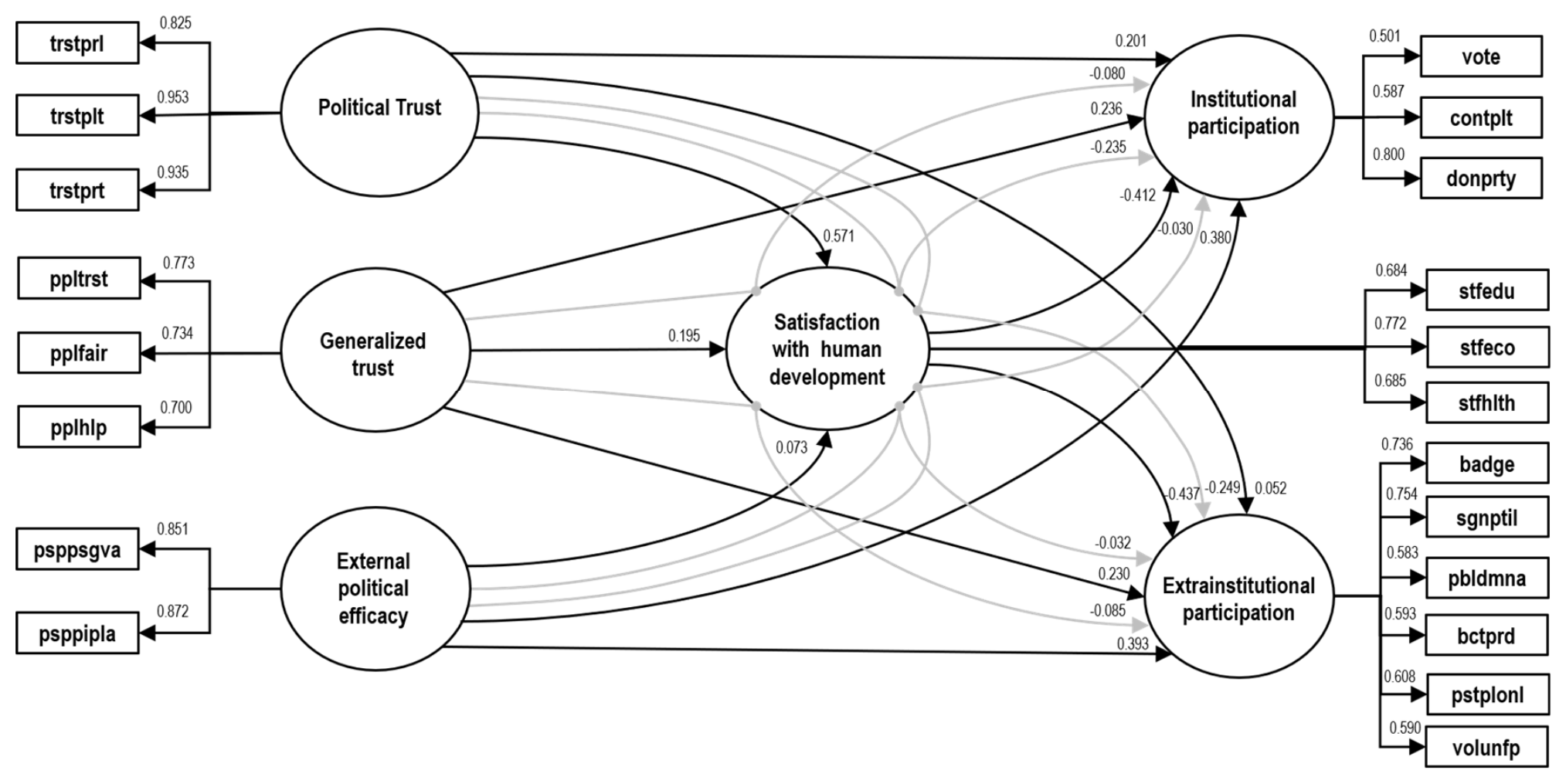
Figure 4.
Statistical diagram of the model for flawed democracies. Note: gray lines represent indirect relationships (non-causal). All standardized coefficients are significant except for those marked with a *.
Figure 4.
Statistical diagram of the model for flawed democracies. Note: gray lines represent indirect relationships (non-causal). All standardized coefficients are significant except for those marked with a *.
4. Discussion and Conclusion
The main objective of this study is to contribute to the literature on when and how citizens participate in the political sphere, addressing one of its central tensions: the coexistence of declining democratic quality and sustained levels of political participation. This democratic paradox, widely documented in the European context, has yielded contradictory empirical findings regarding the role of the main psychosocial factors analysed—political trust, generalized trust, external political efficacy, and satisfaction with human development—in driving political participation.
Against the pluralistic and fragmented backdrop outlined in the introduction, this study proposes an integrative model that links psychosocial and contextual factors, explicitly differentiating between institutional and extra-institutional participation, and incorporating democratic quality as a modulating structural condition. The results of the study allow us to examine the extent to which the relationships proposed in the theoretical framework are empirically reflected in the proposed model.
First, the data concerning political trust allow for a more nuanced understanding of some of the most relevant debates in recent literature. In line with the arguments of Devine (2024), Hooghe and Marien (2013), and Häggblom (2024), Hypothesis 1 (H1) received empirical support, showing that greater political trust is associated with higher levels of institutional participation. Individuals with higher trust in parliament, political parties, and politicians are more likely to vote, contact public representatives, or collaborate with political organizations. Hypothesis 2 (H2), however, was not confirmed, as political trust did not show a significant relationship with extra-institutional participation. This finding challenges the reductionist association between protest and institutional distrust (Braun & Hutter, 2016; Häggblom, 2024; Hooghe & Marien, 2013) and suggests that political trust alone is insufficient to explain this form of participation. Indeed, for decades, Social Psychology has demonstrated that extra-institutional participation is primarily driven by other psychosocial mechanisms, such as social identity, relative deprivation, group emotions—especially anger—and perceptions of collective efficacy (Becker & Tausch, 2015; Van Zomeren et al., 2008; Walker & Smith, 2001).
Regarding generalized trust, the results support both proposed hypotheses: trusting others is associated with higher levels of political participation across both types (Hypotheses 3 and 4). This finding aligns with previous studies identifying interpersonal trust as a fundamental resource for social cooperation and collective action (Gaidytė & Muis, 2021; Kaase, 1999; Suh y Reynolds-Stenson, 2018).
Furthermore, the results concerning external political efficacy indicate that individuals who perceive they have opportunities to voice their opinions and exert influence within the political system participate more frequently through both institutional channels and normative extra-institutional forms. Thus, only one of the hypotheses formulated in this regard is supported: external political efficacy shows a positive relationship with institutional participation (Hypothesis 5), aligning with the notion that the perceived ability to influence public affairs fosters engagement in formal participatory channels (Etzel, 2023; Alscher & Jana, 2025). However, the anticipated negative relationship with extra-institutional participation (Hypothesis 6) was not confirmed. This suggests that the perceived ability to influence politics is not necessarily associated with lower extra-institutional mobilization, despite what some theoretical approaches have proposed (McAdam, 1999; Tarrow, 2011; Tilly & Tarrow, 2015).
These results show that institutional and extra-institutional participation share some psychosocial antecedents but also present differentiated relational patterns. External political efficacy emerges as the strongest direct predictor of both types of participation; therefore, it constitutes an important driver of political engagement, regardless of the participation channel used. This result is especially relevant for democratic innovation initiatives, which specifically seek to strengthen citizens’ capacity to influence political decision-making (Alscher & Jana, 2025). However, as previously indicated, political trust behaves differently across each type of participation, which is not the case for generalized trust. In summary, these results indicate that institutional and extra-institutional participation share some explanatory mechanisms, but do not respond identically to the different psychosocial factors considered.
Fourth, one of the main theoretical advancements of the present study lies in the incorporation of satisfaction with human development as a mediating psychosocial dimension in the relationship between political trust, generalized social trust, external political efficacy, and political participation (Girardi, 2026; Kern et al., 2015). The results show that political trust, generalized trust, and external political efficacy are positively associated with a more favourable assessment of the state of the country’s economy, education, and healthcare, supporting Hypotheses 7, 8, and 9 (H7, H8, and H9). In turn, this subjective assessment of human development is negatively related to both institutional and extra-institutional participation, confirming Hypothesis 11 (H11) but not Hypothesis 10 (H10).
Consequently, the three psychosocial variables generate negative indirect effects on both types of participation through satisfaction with human development. Thus, while generalized social trust and external political efficacy present positive direct effects on institutional and extra-institutional participation, political trust does so only on institutional participation. Simultaneously, all three variables show negative indirect effects mediated by satisfaction with human development. This pattern highlights that the relationship between psychosocial factors and political participation cannot be understood solely through direct effects, but also incorporates indirect mechanisms linked to how citizens subjectively evaluate their social and economic context. This dual pathway of influence offers a possible explanation for the heterogeneous empirical evidence found in previous studies regarding the relationship between trust, efficacy, and political participation (Devine, 2024), as the same variable can present direct and indirect effects of opposite signs on participation depending on the psychological mechanisms involved.
From a theoretical perspective, these results are consistent with relative deprivation theory, according to which political mobilization depends less on objective conditions than on the way individuals evaluate those conditions in relation to their expectations and perceptions of justice (Burns & Runciman, 1966; Gurr, 2016; Walker & Smith, 2001). Along these lines, lower satisfaction with human development can be interpreted as a negative evaluation of the system’s functioning that fosters political involvement. This interpretation is also consistent with later developments in Social Psychology derived from Social Identity Theory, particularly with the Social Identity Model of Collective Actions (SIMCA) and its revisions, which identifies the perception of group injustice as one of the main antecedents of political mobilization, especially through extra-institutional forms of participation (Van Zomeren et al., 2008; Becker & Tausch, 2015). However, the present study expands upon these approaches by showing that this mechanism is not limited to extra-institutional participation, but is also observed in institutional participation. Complementarily, the results are also compatible with System Justification Theory (Jost & Banaji, 1994; Jost et al., 2004), according to which people tend to accept and legitimize the social order when they perceive that the system is functioning properly. From this perspective, a favourable assessment of human development may reduce the perceived need to intervene politically to promote change, thereby favouring the maintenance of the status quo. Overall, these findings allow for a reinterpretation of the apparent democratic paradox that motivated this study: the very subjective evaluations of the social and economic context that reflect discontent with the system’s functioning can constitute a major driver of political participation when they are negative, whereas a more favourable assessment of human development can contribute to reducing political involvement. Thus, the study integrates citizen mobilization and demobilization processes into a single explanatory framework, showing that both depend on how individuals subjectively interpret the context in which they live and the consequences they attribute to that evaluation for political action (Gaidytė & Muis, 2021; Kern et al., 2015).
Finally, the incorporation of the country’s democratic quality as a contextual variable allows us to address a question that remained open in the literature: under what conditions the relationships between psychosocial factors and political participation strengthen, weaken, or disappear (Rothstein & Stolle, 2003; Suh & Reynolds-Stenson, 2018). In general terms, the results partially support Hypotheses 12 and 13 (H12 and H13) by showing that democratic quality modulates several of the relationships proposed in the model, although this effect is not observed uniformly across all psychosocial factors. While some associations remain practically unchanged between full and flawed democracies, others intensify notably or even cease to be significant. This highlights that the institutional context conditions the translation of specific psychosocial resources into political behaviour.
External political efficacy constitutes the clearest example of a relationship that remains robust across institutional contexts. In both full and flawed democracies, it maintains positive associations of very similar magnitude with both institutional and extra-institutional participation, confirming its role as the primary direct predictor of both forms of participation. These results reinforce the notion that the perception of being heard and having the ability to influence politics is a psychosocial resource linked to political engagement, regardless of the democratic quality of the context.
In contrast, political trust and generalized social trust show a much greater dependence on the institutional context. In the case of political trust, its positive association with institutional participation is maintained across both types of regimes, although it is stronger in full democracies. However, its relationship with extra-institutional participation only reaches statistical significance in full democracies, disappearing entirely in flawed democracies. Similarly, generalized social trust maintains a positive relationship with both forms of participation in full democracies, whereas in flawed democracies, it ceases to be significantly associated with institutional participation. Overall, these results indicate that trust-related resources seem to translate into political behaviour more easily when democratic institutions offer greater guarantees of effective functioning. This aligns with theoretical approaches that highlight the role of the institutional context in activating citizen participation (Rothstein & Stolle, 2003; Suh & Reynolds-Stenson, 2018).
The multigroup analysis also shows that satisfaction with human development plays a differential role depending on democratic quality. Although it maintains a negative relationship with both forms of participation across both groups, this effect is considerably stronger in full democracies. Similarly, the indirect effects of political trust, generalized trust, and external political efficacy on participation—mediated by satisfaction with human development—are systematically stronger in full democracies. These results suggest that subjective evaluations of the social and economic context acquire greater explanatory weight when individuals live in more consolidated democratic systems, where perceptions regarding the functioning of society appear to play a more prominent role in the decision to engage in politics.
Overall, the present study makes three main contributions to the literature on political participation. First, it identifies satisfaction with human development as a key psychosocial mechanism that connects political trust, generalized social trust, and external political efficacy with political participation. Rather than merely constituting an additional variable, the results show that the way citizens subjectively evaluate the state of the economy, education, and healthcare transforms the relationship between these psychosocial factors and political behaviour. Second, the study shows that the relationships between trust, efficacy, and participation are not unidirectional; instead, they combine direct and indirect effects that can operate in opposite directions, offering a plausible explanation for the heterogeneity of results found in previous literature. Finally, the incorporation of democratic quality as a contextual variable shows that these psychological processes do not develop independently of the institutional environment; rather, certain relationships intensify, weaken, or even disappear depending on the quality of the democratic regime.
From a theoretical perspective, these results establish a dialogue among several of the main traditions in Political Social Psychology. The findings support the propositions of relative deprivation theory by showing that participation depends fundamentally on the subjective evaluation of the social context (Burns & Runciman, 1966; Gurr, 2016; Walker & Smith, 2001). Furthermore, they expand upon the developments derived from Social Identity Theory and the Social Identity Model of Collective Action (SIMCA), indicating that the mechanisms associated with the perception of grievance do not seem to be limited to extra-institutional participation (Becker & Tausch, 2015; Van Zomeren et al., 2008), but also contribute to understanding institutional participation. Lastly, the results are also compatible with System Justification Theory (Jost & Banaji, 1994; Jost et al., 2004), showing that a more favourable assessment of human development is associated with a reduced need to promote political change. Far from representing incompatible perspectives, the present study suggests that these traditions can be understood as complementary processes that help explain both political mobilization and demobilization.
The present study has certain limitations that should be taken into account when interpreting the results. First, the use of secondary data from the European Social Survey, while allowing for the analysis of a large and comparative sample of European countries, limits the inclusion of specific relevant psychosocial constructs. In particular, it was not possible to include variables related to social identity, collective efficacy, or group-based emotions—especially anger and contempt—which are considered central mechanisms in contemporary models of collective actions (Becker & Tausch, 2015; Drury & Reicher, 2000; Van Zomeren et al., 2008). Second, the study is restricted to normative forms of political participation; therefore, the conclusions cannot be directly extrapolated to non-normative forms of participation, the measurement of which is particularly complex in cross-national comparative studies. Finally, the cross-sectional nature of the data precludes establishing causal relationships between the analysed variables. As a result, the identified direct and indirect effects should be interpreted as structural associations compatible with the proposed theoretical model, rather than as definitive causal relationships.
These limitations open up several avenues for future research. First, it would be beneficial to conduct longitudinal and experimental studies that allow for the analysis of the possible bidirectionality of the relationships among the studied variables, as well as to verify the temporal stability of the identified mechanisms. Second, from a psychosocial perspective, it is particularly promising to delve into the social categorization processes (Turner et al., 1987; Turner, 1988) that might underlie generalized social trust. The measure used refers to trust in “most people”, which raises the possibility that the responses reflect relatively broad and inclusive social categories. Although the data from the present study do not allow us to identify which social category participants use when answering this type of question, analysing this mechanism would allow for a closer connection between the literature on generalized trust and psychosocial models of social identity and collective action.
Finally, future research could also incorporate variables related to procedural justice and perceptions of fairness regarding institutional functioning. In this regard, recent studies show that subjective evaluations of the fairness of political procedures can influence political trust even when citizens are not direct beneficiaries of public decisions (De Blok & Kumlin, 2022). Integrating these perceptions alongside satisfaction with human development, social identity, and collective efficacy would allow for progress toward more comprehensive models of the psychological processes that connect system evaluations with political participation.
Ultimately, understanding when and how citizens participate requires moving beyond institutional factors or political attitudes considered in isolation. The results of the present study show that political participation emerges from the interaction among psychosocial resources, the way the social context is evaluated, and the democratic quality of the institutional environment in which these perceptions acquire meaning.
Acknowledgments
This research was funded by: PID2023-147438OB-I00. Ministerio de Ciencia, Innovación y Universidades. Convocatoria Generación de Conocimiento 2023. B3-2023/33. Vicerrectorado de Investigación y Transferencia. II Plan Propio de Investigación, Transferencia y Divulgación Científica de la Universidad de Málaga. PPRO-HUM590-G-2023 (HUM590-G-FEDER).
References
- Ayanian, A. H.; Tausch, N.; Acar, Y. G.; Chayinska, M.; Cheung, W.-Y.; Lukyanova, Y. Resistance in repressive contexts: A comprehensive test of psychological predictors. J. Personal. Soc. Psychol. 2021, 120(4), 912–939. [Google Scholar] [CrossRef]
- Braun, D.; Hutter, S. Political trust, extra-representational participation and the openness of political systems. Int. Political Sci. Rev. 2016, 37(2), 151–165. [Google Scholar] [CrossRef]
- Campbell, A.; Gurin, G.; Miller, W. E. The voter decides (pp. xiii, 242); Row, Peterson, and Co, 1954. [Google Scholar]
- Campbell, A.; Gurin, G.; Miller, W. E. The voter decides (Repr); Greenwood, 1971. [Google Scholar]
- Cheung, G. W.; Rensvold, R. B. Evaluating Goodness-of-Fit Indexes for Testing Measurement Invariance. Struct. Equ. Model. A Multidiscip. J. 2002, 9(2), 233–255. [Google Scholar] [CrossRef]
- De Blok, L.; Kumlin, S. Losers’ Consent in Changing Welfare States: Output Dissatisfaction, Experienced Voice and Political Distrust. Political Stud. 2022, 70(4), 867–886. [Google Scholar] [CrossRef]
- Democracy Index 2023. Economist Intelligence Unit. n.d. Available online: https://www.eiu.com/n/campaigns/democracy-index-2023/.
- Devine, D. Does Political Trust Matter? A Meta-analysis on the Consequences of Trust. Political Behav. 2024, 46(4), 2241–2262. [Google Scholar] [CrossRef]
- European Social Survey European Research Infrastructure (ESS ERIC). ESS11—Integrated file, edition 3.0 [Dataset]. Sikt – Nor. Agency Shar. Serv. Educ. Res. 2025. [Google Scholar] [CrossRef]
- Gaidytė, T.; Muis, J. Examining political participation in Lithuania: The direct and mediated effects of social trust. Balt. J. Political Sci. 2021, (9–10), 41–71. [Google Scholar] [CrossRef]
- Girardi, E. Precarity and political protest. West Eur. Politics 2026, 49(1), 138–162. [Google Scholar] [CrossRef]
- Häggblom, E. The Trade-Off Between Political Trust and Political Participation. Political Stud. Rev. 2024, 14789299241304611. [Google Scholar] [CrossRef]
- Hooghe, M.; Marien, S. A comparative analysis of the relation between political trust and forms of political participation in europe. Eur. Soc. 2013, 15(1), 131–152. [Google Scholar] [CrossRef]
- Kaase, M. Interpersonal trust, political trust and non-institutionalised political participation in Western Europe. West Eur. Politics 1999, 22(3), 1–21. [Google Scholar] [CrossRef]
- Lai, R.; Beh, L.-S. The Impact of Political Efficacy on Citizens’ E-Participation in Digital Government. Adm. Sci. 2025, 15(1), 17. [Google Scholar] [CrossRef]
- Lane, R. E. Political Life: Why People Get Involved in Politics. Miss. Val. Hist. Rev. 1959, 46(2), 356. [Google Scholar] [CrossRef]
- Li, Y.; Yu, X. Trust, political knowledge and institutionalized political participation: Evidence from China. Curr. Psychol. 2023, 42(18), 15019–15029. [Google Scholar] [CrossRef]
- Marien, S.; Hooghe, M. Does political trust matter? An empirical investigation into the relation between political trust and support for law compliance: does political trust matter? Eur. J. Political Res. 2011, 50(2), 267–291. [Google Scholar] [CrossRef]
- Norris, P. In Praise of Skepticism: Trust but Verify, 1st ed.; Oxford University PressNew York, 2022. [Google Scholar] [CrossRef]
- OECD. OECD Survey on Drivers of Trust in Public Institutions – 2024 Results: Building Trust in a Complex Policy Environment; OECD Publishing, 2024. [Google Scholar] [CrossRef]
- Suh, H.; Reynolds-Stenson, H. A Contingent Effect of Trust? Interpersonal Trust and Social Movement Participation in Political Context*. Soc. Sci. Q. 2018, 99(4), 1484–1495. [Google Scholar] [CrossRef]
Figure 1.
Diagram of the proposed conceptual model. Note: Gray lines represent indirect relationships.
Figure 1.
Diagram of the proposed conceptual model. Note: Gray lines represent indirect relationships.
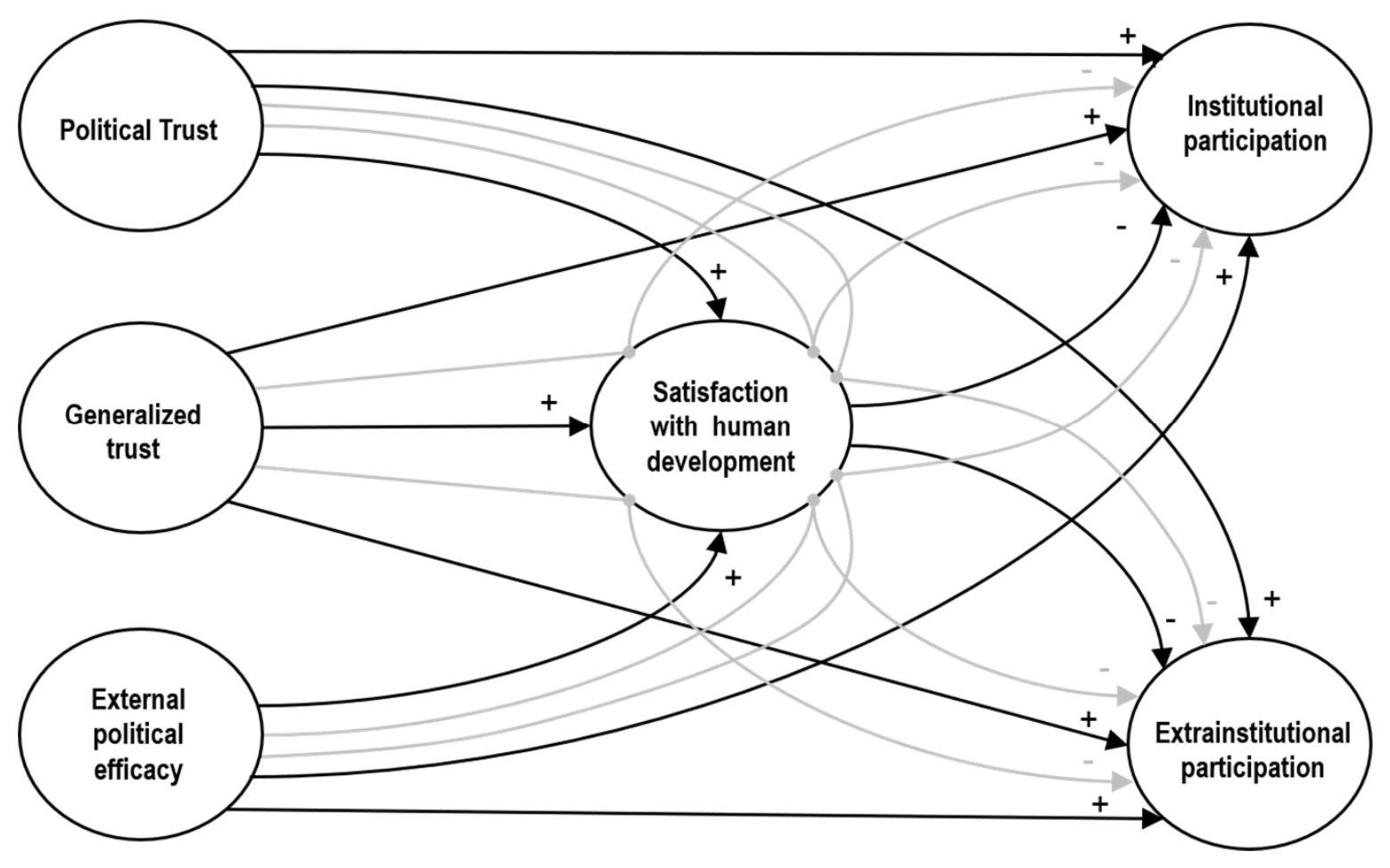
Table 1.
Summary of variables and items used.
| Variables | Construct | Item or question |
|---|---|---|
| contplt | Institutional Participation (IP) |
There are different ways of trying to improve things in [country] or help prevent things from going wrong. During the last 12 months, have you done any of the following? Have you... ...contacted a politician, government or local government official? |
| donprty | There are different ways of trying to improve things in [country] or help prevent things from going wrong. During the last 12 months, have you done any of the following? Have you...donated to or participated in a political party or pressure group? | |
| vote | Voted last national election | |
| badge | Extra-Institutional Participation (EIP) |
There are different ways of trying to improve things in [country] or help prevent things from going wrong. During the last 12 months, have you done any of the following? Have you... ...worn or displayed a campaign badge/sticker? |
| sgnptit | There are different ways of trying to improve things in [country] or help prevent things from going wrong. During the last 12 months, have you done any of the following? Have you... ...signed a petition? | |
| pbldmna | And still thinking about different ways of trying to improve things in [country] or help prevent things from going wrong, during the last 12 months, have you done any of the following? Have you... ...taken part in a public demonstration? | |
| bctprd | And still thinking about different ways of trying to improve things in [country] or help prevent things from going wrong, during the last 12 months, have you done any of the following? Have you.... ...boycotted certain products? | |
| pstplonl | And still thinking about different ways of trying to improve things in [country] or help prevent things from going wrong, during the last 12 months, have you done any of the following? Have you... ...posted or shared anything about politics online, for example on blogs, via email or on social media such as Facebook or Twitter? | |
| volunfp | And still thinking about different ways of trying to improve things in [country] or help prevent things from going wrong, during the last 12 months, have you done any of the following? Have you... ...volunteered for a not-for-profit or charitable organization? | |
| trstprl | Political Trust (PT) |
Using this card, please rank from 0 to10 how much you personally trust each of the institutions I read out. 0 means you do not trust an institution at all, and 10 means you have complete trust. Firstly... ...[country]’s parliament? |
| trstplt | Using this card, please rank from 0 to 10 how much you personally trust each of the institutions I read out. 0 means you do not trust an institution at all, and 10 means you have complete trust. Firstly... ...politicians? | |
| trstprt | Using this card, please rank from 0 to 10 how much you personally trust each of the institutions I read out. 0 means you do not trust any institution at all, and 10 means you have complete trust. Firstly... ...political parties? | |
| ppltrst | Generalized trust (GT) |
Using this card, generally speaking, would you say that most people can be trusted, or that you can’t be too careful in dealing with people? Please give a score of 0 to 10, where 0 means you can’t be too careful and 10 means that most people can be trusted. |
| pplfair | Using this card, do you think that most people would try to take advantage of you if they got the chance, or would they try to be fair? | |
| pplhlp | Would you say that most of the time people try to be helpful or that they are mostly looking out for themselves? | |
| psppsgva | External political efficacy (EPE) |
How much would you say the political system in [country] allows people like you to have a say in what the government does? |
| psppipla | And how much would you say that the political system in [country] allows people like you to have an influence on politics? | |
| stfeco | Satisfaction with human development (ST) |
Overall, how satisfied are you with the present state of the economy in [country]? |
| stfedu | Now, using this card, please say what you think overall about the current state of education in [country]? | |
| stfhlth | Still using this card, please say what you think overall about the current state of health services in [country]? |
Table 2.
Measurement model.
| 95% Confidence Intervals | |||||||||
|---|---|---|---|---|---|---|---|---|---|
| Indicators | Latent variables | Ordinal α | Estimate | SE | Lower | Upper | β | z | p |
| psppsgva | EPE | 0.856 | 0.853 | 0.003 | 0.848 | 0.859 | 0.853 | 300.133 | <.001 |
| psppipla | 0.876 | 0.003 | 0.871 | 0.881 | 0.876 | 315.615 | <.001 | ||
| ppltrst | GT | 0.796 | 0.793 | 0.003 | 0.788 | 0.799 | 0.793 | 278.785 | <.001 |
| pplfair | 0.754 | 0.003 | 0.749 | 0.760 | 0.754 | 260.231 | <.001 | ||
| pplhlp | 0.712 | 0.003 | 0.706 | 0.718 | 0.712 | 236.517 | <.001 | ||
| trstprl | PT | 0.925 | 0.822 | 0.002 | 0.819 | 0.825 | 0.822 | 509.046 | <.001 |
| trstplt | 0.957 | 0.001 | 0.955 | 0.958 | 0.957 | 1.097.258 | <.001 | ||
| trstprt | 0.934 | 0.001 | 0.932 | 0.936 | 0.934 | 980.968 | <.001 | ||
| vote | IP | 0.652 | 0.435 | 0.010 | 0.415 | 0.454 | 0.496 | 43.897 | <.001 |
| contplt | 0.545 | 0.009 | 0.528 | 0.562 | 0.621 | 63.838 | <.001 | ||
| donprty | 0.717 | 0.010 | 0.697 | 0.737 | 0.817 | 70.158 | <.001 | ||
| badge | EIP | 0.837 | 0.692 | 0.008 | 0.677 | 0.707 | 0.774 | 89.933 | <.001 |
| sgnptil | 0.684 | 0.006 | 0.672 | 0.697 | 0.765 | 106.377 | <.001 | ||
| pbldmna | 0.565 | 0.008 | 0.549 | 0.580 | 0.632 | 71.677 | <.001 | ||
| bctprd | 0.579 | 0.007 | 0.566 | 0.593 | 0.648 | 84.125 | <.001 | ||
| pstplonl | 0.565 | 0.007 | 0.551 | 0.579 | 0.632 | 80.615 | <.001 | ||
| volunfp | 0.575 | 0.007 | 0.561 | 0.589 | 0.643 | 79.742 | <.001 | ||
| stfedu | ST | 0.752 | 0.482 | 0.003 | 0.476 | 0.487 | 0.691 | 172.273 | <.001 |
| stfeco | 0.540 | 0.003 | 0.533 | 0.547 | 0.775 | 156.002 | <.001 | ||
| stfhlth | 0.474 | 0.003 | 0.469 | 0.480 | 0.681 | 172.434 | <.001 | ||
Note. PT: political trust; GT: generalized trust; EPE: external political efficacy; SHPI: Satisfaction with human development; IP: Institutional participation; EIP: Extra-institutional political participation.
Table 3.
Parameters estimates.
| β 95% Confidence Intervals | |||||||
|---|---|---|---|---|---|---|---|
| Relation | Estimate | SE | β | Lower | Upper | z | p |
| ST⇒IP | -0.220 | 0.013 | -0.277 | -0.308 | -0.246 | -16.665 | < .001 |
| EPE⇒IP | 0.453 | 0.016 | 0.398 | 0.373 | 0.423 | 27.617 | < .001 |
| GT⇒IP | 0.177 | 0.014 | 0.155 | 0.131 | 0.179 | 12.539 | < .001 |
| PT⇒IP | 0.196 | 0.018 | 0.172 | 0.142 | 0.201 | 11.138 | < .001 |
| ST⇒EIP | -0.261 | 0.011 | -0.335 | -0.360 | -0.311 | -24.825 | < .001 |
| EPE⇒EIP | 0.466 | 0.013 | 0.417 | 0.396 | 0.437 | 36.013 | < .001 |
| GT⇒EIP | 0.245 | 0.011 | 0.219 | 0.200 | 0.238 | 21.614 | < .001 |
| PT⇒EIP | 0.013 | 0.014 | 0.012 | -0.012 | 0.036 | 0.980 | 0.327 |
| EPE⇒ST | 0.120 | 0.010 | 0.084 | 0.070 | 0.097 | 12.264 | < .001 |
| GT⇒ST | 0.292 | 0.008 | 0.204 | 0.193 | 0.214 | 36.437 | < .001 |
| PT⇒ST | 0.776 | 0.010 | 0.541 | 0.529 | 0.552 | 76.671 | < .001 |
| EPE ⇒ ST ⇒ IP | -0.026 | 0.003 | -0.023 | -0.028 | -0.019 | -9.607 | < .001 |
| EPE ⇒ ST ⇒ EIP | -0.031 | 0.003 | -0.028 | -0.033 | -0.023 | -10.697 | < .001 |
| GT ⇒ ST ⇒ IP | -0.064 | 0.004 | -0.056 | -0.063 | -0.049 | -15.031 | < .001 |
| GT ⇒ ST ⇒ EIP | -0.076 | 0.004 | -0.068 | -0.075 | -0.062 | -20.184 | < .001 |
| PT ⇒ ST ⇒ IP | -0.171 | 0.010 | -0.150 | -0.167 | -0.133 | -16.480 | < .001 |
| PT ⇒ ST ⇒ EIP | -0.203 | 0.008 | -0.181 | -0.195 | -0.168 | -24.095 | < .001 |
Note. PT: political trust; GT: generalized trust; EPE: external political efficacy; SHPI: Satisfaction with human development; IP: Institutional participation; EIP: Extra-institutional political participation.
Disclaimer/Publisher’s Note: The statements, opinions and data contained in all publications are solely those of the individual author(s) and contributor(s) and not of MDPI and/or the editor(s). MDPI and/or the editor(s) disclaim responsibility for any injury to people or property resulting from any ideas, methods, instructions or products referred to in the content. |
© 2026 by the authors. Licensee MDPI, Basel, Switzerland. This article is an open access article distributed under the terms and conditions of the Creative Commons Attribution (CC BY) license (http://creativecommons.org/licenses/by/4.0/).
Copyright: This open access article is published under a Creative Commons CC BY 4.0 license, which permit the free download, distribution, and reuse, provided that the author and preprint are cited in any reuse.