

Submitted:
10 September 2026
Posted:
10 September 2026
You are already at the latest version
Abstract
Next-generation plant-based foods are designed to reproduce the technological, sensory, and culinary functions of animal-derived products, yet their development entails trade-offs among functionality, nutritional quality, degree of processing, acceptance, sustainability, and scalability. This critical narrative review integrated 63 publications retrieved through a structured search of five databases, with emphasis on protein ingredients, high-moisture extrusion, shear-based technologies, fermentation, lipid structuring, and 3D printing. The evidence indicated that high-moisture extrusion is the most mature platform for generating anisotropic structures, whereas fermentation, enzymatic treatments, and lipid systems broaden the control of aroma, digestibility, and juiciness. Nevertheless, a closer resemblance to animal foods frequently requires refined ingredients, hydrocolloids, and intensive processing, which may increase costs, labeling complexity, and nutritional heterogeneity. Environmental advantages likewise depended on the raw material, the energy mix, the functional unit, packaging, and logistics. We propose an integrated framework in which composition and processing determine microstructure, which in turn links technological, nutritional, sensory, and environmental performance. Advancing the field requires comparable metrics, validation in final matrices, and the simultaneous assessment of performance, cost, and impact. The central contribution of this review lies not in identifying a superior technology, but in proposing a decision-making model grounded in the interaction among product function, ingredient selection, processing, and multidimensional validation.
Keywords:
alternative proteins
; plant-based foods
; food matrix engineering
; high-moisture extrusion
; fermentation
; protein quality
; sensory analysis
; sustainability
1. Introduction
Next-generation plant-based foods are products formulated to replace or reproduce the technological, sensory, and culinary functions of animal-derived foods. This category differs from predominantly plant-based dietary patterns composed of fresh or minimally processed foods; consequently, the benefits associated with plant-based diets cannot be automatically extended to all commercial analogues [3,4,5,9]. This distinction is central to a scientific assessment that simultaneously considers composition, processing, and consumption context.
The scientific challenge is not limited to exchanging one protein source for another. Meat, milk, and eggs are organized biological matrices whose properties arise from interactions among proteins, lipids, water, and colloidal or fibrous structures [9,19,35,36,61]. Plant proteins differ in amino acid composition, solubility, emulsifying capacity, gelation, water-holding capacity, and thermal response [11,12,13,18,25]. Developing plant-based products therefore requires the integration of ingredient science, process engineering, food chemistry, nutrition, and sensory science.
High-moisture extrusion remains the leading industrial platform for producing anisotropic structures in meat analogues [24,25,26,30,32]. Shear-based technologies and 3D printing broaden the control over structural orientation and the spatial distribution of fat, although they still face throughput and scale-up limitations [31,32,33]. In parallel, traditional fermentation, biomass fermentation, and precision fermentation have been explored to modulate aroma, functionality, digestibility, and properties that are difficult to reproduce with plant matrices alone [27,28,29].
Technological advances, however, do not automatically imply nutritional superiority. Meat analogues may contain less saturated fat and more fiber than certain processed meat products, but they may also contain high levels of sodium, tropical oils, and additives [37,38,58]. Protein quality depends on the amino acid profile and digestibility [15,39,40], whereas the adequacy of iron, zinc, calcium, vitamin B12, iodine, and long-chain fatty acids depends on formulation, fortification, and bioavailability [42,43,44,45,62,63].
Consumer acceptance depends on flavor, texture, familiarity, price, convenience, and health perception [2,53,54,55]. To narrow the sensory gap relative to conventional products, formulations may require flavorings, pigments, hydrocolloids, and structured fats [25,27,34,35,36]. These solutions can improve performance, but they may also increase cost, formulation complexity, and the perception of ultra-processing [5,56,57,58].
Environmental advantages should likewise not be presumed for the entire category. Life cycle assessments frequently indicate lower emissions and land use for plant-based alternatives compared with beef [6,49,50,51,52], but the results depend on the raw material, the functional unit, the energy mix, processing, packaging, and logistics [6,52]. Transparent, product-specific comparisons are therefore essential.
Although reviews are available on ingredients, extrusion, fermentation, nutrition, sensory properties, and sustainability [9,21,24,25,26,27,28,29,35,36,58,61,62], integration across these dimensions remains limited. In particular, few syntheses explicitly address the trade-offs generated by formulation decisions: improving fibrousness may raise energy demand; increasing juiciness may worsen the lipid profile; shortening the ingredient list may compromise stability; and fortification does not guarantee bioavailability.
This review aims to critically integrate the evidence on ingredients, processing, and performance of next-generation plant-based foods. Its central contribution is to propose an interpretation grounded in the relationship among composition, processing, microstructure, and technological, nutritional, sensory, and environmental outcomes, distinguishing consolidated technologies from emerging approaches and identifying priorities for research and development.
2. Search Strategy and Literature Synthesis
2.1. Design and Guiding Question
We conducted a critical narrative review with a structured search strategy. This design was selected because the research question brings together heterogeneous evidence on composition, physicochemical characterization, processing, digestibility, sensory evaluation, consumer behavior, and life cycle assessment, whose methodological designs vary considerably. A structured critical narrative review was chosen because the objective was not to estimate an average effect or to compare interventions, but to integrate evidence of diverse nature in order to build a conceptual model for plant-based food design. The detailed description of the search, the eligibility criteria, and the synthesis process ensured transparency and methodological traceability.
The guiding question was: how do ingredient sources and processing technologies jointly affect the technological, nutritional, sensory, and environmental performance of next-generation plant-based foods, and which trade-offs constrain their acceptance and scalability? This study was conducted as a critical narrative review, whose purpose was to integrate heterogeneous evidence and develop a conceptual framework rather than to estimate quantitative effects or perform a systematic synthesis.
2.2. Information Sources and Search Period
The literature search was performed between April and May 2026 in PubMed/MEDLINE, Scopus, Web of Science Core Collection, ScienceDirect, and SciELO. Within the main corpus, we prioritized works published between January 2021 and May 2026, a period selected to represent the most recent phase of technological expansion in high-moisture extrusion, precision fermentation, 3D printing, and next-generation formulations. Earlier studies were included when required to substantiate concepts, describe consolidated technologies, or present methods and references without recent substitutes.
2.3. Search Strategy
We combined controlled descriptors and free terms in English, Portuguese, and Spanish. The conceptual blocks covered: (i) product or matrix, such as “plant-based food”, “meat analogue”, “milk alternative”, “egg analogue”, and “fish analogue”; (ii) ingredient, such as “plant protein”, “pea protein”, “soy protein”, “pulse protein”, “microalgae”, “mycoprotein”, and “precision fermentation”; (iii) process, such as “high-moisture extrusion”, “texturization”, “shear cell”, “fermentation”, “3D printing”, and “structured fat”; and (iv) outcome, such as “DIAAS”, “digestibility”, “bioavailability”, “sensory acceptance”, “life cycle assessment”, “ultra-processed food”, and “consumer acceptance”. Terms were combined with AND and OR, and the strategy was adapted to the syntax of each database.
For each database, we recorded the fields searched, the filters applied, and the date of the last run. The exported search history was retained by the authors, ensuring the traceability of the selection process.
2.4. Eligibility Criteria

Table 1.
Eligibility criteria applied in the selection of publications.
| Category | Criteria |
|---|---|
| Inclusion | Original articles, systematic reviews, meta-analyses, umbrella reviews, and highly relevant narrative reviews; publications in English, Portuguese, or Spanish; studies on ingredients, processes, composition, digestibility, sensory properties, sustainability, regulation, or acceptance directly related to formulated plant-based products. |
| Exclusion | Editorials, letters, conference abstracts, dissertations, and theses; commercial or advocacy reports used as primary evidence; studies on plant-based diets without a direct link to formulated products; works focused exclusively on insects or cultivated meat; publications lacking sufficient methodological information to support the statement used. |
| Supplementary use | Official documents and technical reports with transparent methodology were admitted for regulatory, market, or environmental context, but did not replace scientific studies in supporting the core conclusions. |
2.5. Selection, Extraction, and Organization of the Evidence
Retrieved records were exported and deduplicated. In the initial screening, titles and abstracts were assessed; potentially eligible texts were subsequently read in full. A structured literature search was performed in PubMed/MEDLINE, Scopus, Web of Science Core Collection, ScienceDirect, and SciELO. The selection of publications considered conceptual relevance, methodological contribution, and explanatory capacity for the proposed integrated framework.
Data extraction was organized in a matrix containing, where applicable: product type; protein source; structuring ingredients; processing technology and conditions; study scale; physicochemical outcomes; nutritional composition; method for assessing digestibility or bioaccessibility; sensory method; comparator; environmental indicators; main limitations; and level of technological maturity. We distinguished commercial studies, laboratory prototypes, in vitro experiments, human trials, and environmental assessments in order to avoid inferences across non-equivalent levels of evidence.
The synthesis was performed through thematic integration and critical comparison. Evidence was grouped into: (i) the protein transition and product requirements; (ii) ingredients and technological platforms; (iii) nutritional performance and bioaccessibility; (iv) sensory and functional performance; (v) sustainability; (vi) formulation and processing trade-offs; (vii) acceptance, labeling, and regulation; and (viii) research agenda. Within each axis, we prioritized convergences, inconsistencies, methodological limitations, and implications for industrial development.
2.6. Critical Appraisal and Methodological Limitations
Because this is a critical narrative review of heterogeneous evidence, a single risk-of-bias instrument was not applied; instead, the critical appraisal considered the adequacy of the design to the research question, the presence of an appropriate comparator, and the sufficiency of the description of processing and experimental conditions. In the interpretation, we considered the adequacy of the design to the question, the presence of a comparator, the description of processing, sample representativeness, validation of the analytical methods, the scale of the experiment, and the transparency of the assumptions underlying environmental assessment. Systematic reviews and primary studies were used in a complementary manner, and conceptual double counting of the same evidence was avoided.
The main limitations of this review were the heterogeneity of formulations and methods, the rapid evolution of the sector, the predominance of laboratory prototypes among emerging technologies, the scarcity of long-term clinical trials, the diversity of functional units in life cycle assessments, and the risk of publication bias. The frequent unavailability of industrial data on cost, yield, and scale also constrained comparisons of technological maturity.
3. From the Protein Transition to the Integrated Design Paradigm of Plant-Based Foods
3.1. The Protein Transition as a Food Matrix Engineering Problem
The development of next-generation plant-based foods represents a food matrix engineering problem rather than the mere substitution of raw materials. Comprehensive reviews of meat, milk, egg, and seafood analogues show that the presence of plant proteins alone does not guarantee structure, stability, culinary behavior, or sensory perception comparable to those of animal-derived foods [9,34,35,36,61,63]. In meat matrices, the eating experience results from the hierarchical organization of muscle fibers, connective tissue, water, and fat; in dairy and egg systems, it depends on specific colloidal and interfacial properties such as emulsification, gelation, foaming capacity, and coagulation [9,19,35,36]. Consequently, the final product must be designed from the interaction among composition, processing, and structural architecture.
The literature on pea, soy, and other legume proteins demonstrates that properties such as solubility, emulsifying capacity, water-holding capacity, and gelation vary with protein composition, degree of purification, and processing history [11,12,13,18]. These properties provide a basis for ingredient selection, but they do not, on their own, predict food performance. The functionality observed in an isolate or concentrate may be profoundly altered when the ingredient is combined with starches, fibers, hydrocolloids, lipids, and salts and subjected to heating, shear, or fermentation [25,30,35,36]. Technological performance should therefore be interpreted as an emergent property of the food matrix.
This interpretation is particularly relevant for meat analogues. Texturization requires protein denaturation, aggregation, and reorganization into anisotropic structures; the outcome depends on the protein source, moisture content, specific mechanical energy, temperature, and cooling die geometry [24,25,26,30,31,32]. Accordingly, the same raw material may yield distinct structures when processed under different conditions, and different raw materials may require specific operating windows to achieve adequate fibrousness, elasticity, and cohesiveness [24,25,26,30,32].
In dairy and egg products, the challenge takes a different form. Plant-based beverages and cheeses must reconcile emulsion stability, dispersibility, melting, foaming capacity, and gelation, whereas egg analogues must reproduce emulsifying and coagulation properties [9,19,36,61]. In these categories, the use of starches, hydrocolloids, and oils may compensate for the functional limitations of plant proteins, but it may also increase the degree of formulation and generate products with low protein density or high saturated fat and sodium content [19,36,37,38,41,61].
The protein transition should therefore be understood as a shift in the way foods are designed. The goal is not merely to replace the protein source, but to build systems in which ingredients and processes are selected according to the required technological function, the desired nutritional profile, the sensory experience, and industrial feasibility [9,35,61,62].
3.2. Performance as an Emergent Property
The performance of a plant-based food emerges from a chain of relationships among ingredients, processing, microstructure, and consumer response. At the molecular scale, proteins, polysaccharides, and lipids interact through hydrophobic forces, hydrogen bonds, disulfide bridges, and electrostatic associations; at the microstructural scale, these interactions determine the continuity of the protein phase, water retention, fat distribution, and anisotropy [24,25,26,30,31,32]. At the macroscopic scale, microstructure translates into texture, juiciness, stability, aroma release, and behavior during preparation [25,30,34,35,36].
This chain helps explain why results obtained with isolated ingredients cannot be extrapolated directly to commercial products. Protein quality, for instance, depends on the amino acid profile and digestibility, but it may also be modified by aggregation, interaction with antinutrients, and processing intensity [15,39,40,44,62]. Similarly, the bioavailability of iron, zinc, and calcium is not determined solely by the amount declared on the label; it depends on the chemical form used, the presence of phytates and other matrix components, and the processing strategies employed to mitigate their effects [42,43,44,45,62].
Sensory properties also result from this emergent behavior. The perception of juiciness depends not only on fat content but on its distribution, melting point, stability during cooking, and interaction with the protein phase [25,35,36]. Flavor and aroma perception depends both on the presence of desirable compounds and on the reduction of off-flavors associated with legumes, microalgae, and minimally refined ingredients [20,21,22,27,34]. Developing competitive products therefore requires evaluating the entire matrix rather than isolated attributes.
Sustainability follows the same logic. Life cycle assessment studies indicate frequent environmental advantages of plant-based alternatives over beef, but the results depend on the raw material, the functional unit, the system boundary, the energy mix, processing, and packaging [6,49,50,51,52]. Thus, an ingredient with a low agricultural impact may yield a less favorable product if it requires high energy demand, long-distance transport, or an intensive cold chain. Environmental performance is likewise a property of the complete system.
3.3. Proposed Integrated Framework
Building on the convergence of this evidence, the present review proposes an integrated framework for the development of plant-based foods. The model organizes the field into six interdependent levels: (i) product objectives; (ii) ingredient selection; (iii) processing technology; (iv) matrix microstructure; (v) technological, nutritional, sensory, and environmental performance; and (vi) acceptance and scalability. The framework should not be interpreted as a rigid linear sequence, but as a feedback system: sensory, cost, stability, or sustainability outcomes drive adjustments in formulation and processing [9,25,26,30,35,58,61,62].
Figure 1.
Proposed integrated framework for the development of plant-based foods. Microstructure links ingredient and processing decisions to technological, nutritional, sensory, and environmental performance, with feedback based on acceptance and scalability.
Figure 1.
Proposed integrated framework for the development of plant-based foods. Microstructure links ingredient and processing decisions to technological, nutritional, sensory, and environmental performance, with feedback based on acceptance and scalability.
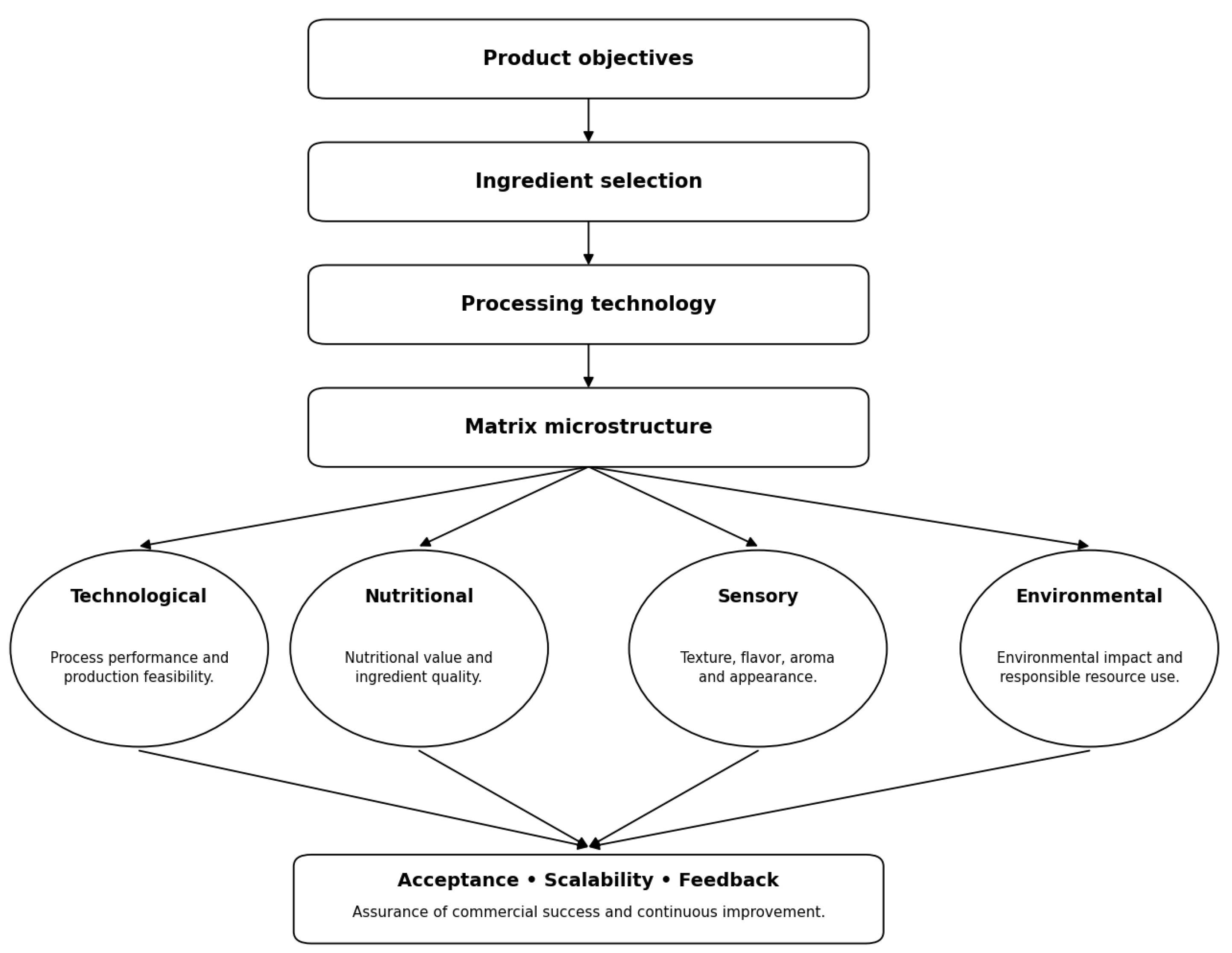
Within this model, microstructure occupies a central position because it connects formulation decisions to the outcomes observed in the final product. It is the interface between thermo-mechanical, fermentative, or enzymatic processes and attributes such as texture, digestibility, stability, and the release of volatile compounds [24,25,26,27,30,31,32]. This centrality justifies organizing the following sections by function and mechanism rather than by lists of ingredients or technologies.
3.4. Trade-Offs as a Design Principle
The development of plant-based foods entails unavoidable trade-offs. High-moisture extrusion improves fibrousness and cohesiveness but increases operational complexity and thermal and mechanical demand [26,30,32]. Hydrocolloids and starches improve stability, water retention, and sliceability, yet they may lengthen the ingredient list and reduce the perception of naturalness [25,35,36]. Solid fats increase juiciness and culinary realism but may raise saturated fat content [37,38,61].
Fortification corrects inadequacies in vitamin B12, calcium, iron, zinc, iodine, or omega-3 fatty acids, but its effectiveness depends on stability, chemical form, and bioavailability [42,43,44,45,62]. Formulations with a lower degree of refining may preserve fibers and phytochemicals, but they also exhibit greater technological variability and a higher content of compounds responsible for off-flavors or reduced digestibility [11,12,13,18,44].
Figure 2.
Conceptual map of the main trade-offs in the development of plant-based foods. Improved performance in one dimension may impose technological, nutritional, economic, or perceptual costs in another.
Figure 2.
Conceptual map of the main trade-offs in the development of plant-based foods. Improved performance in one dimension may impose technological, nutritional, economic, or perceptual costs in another.
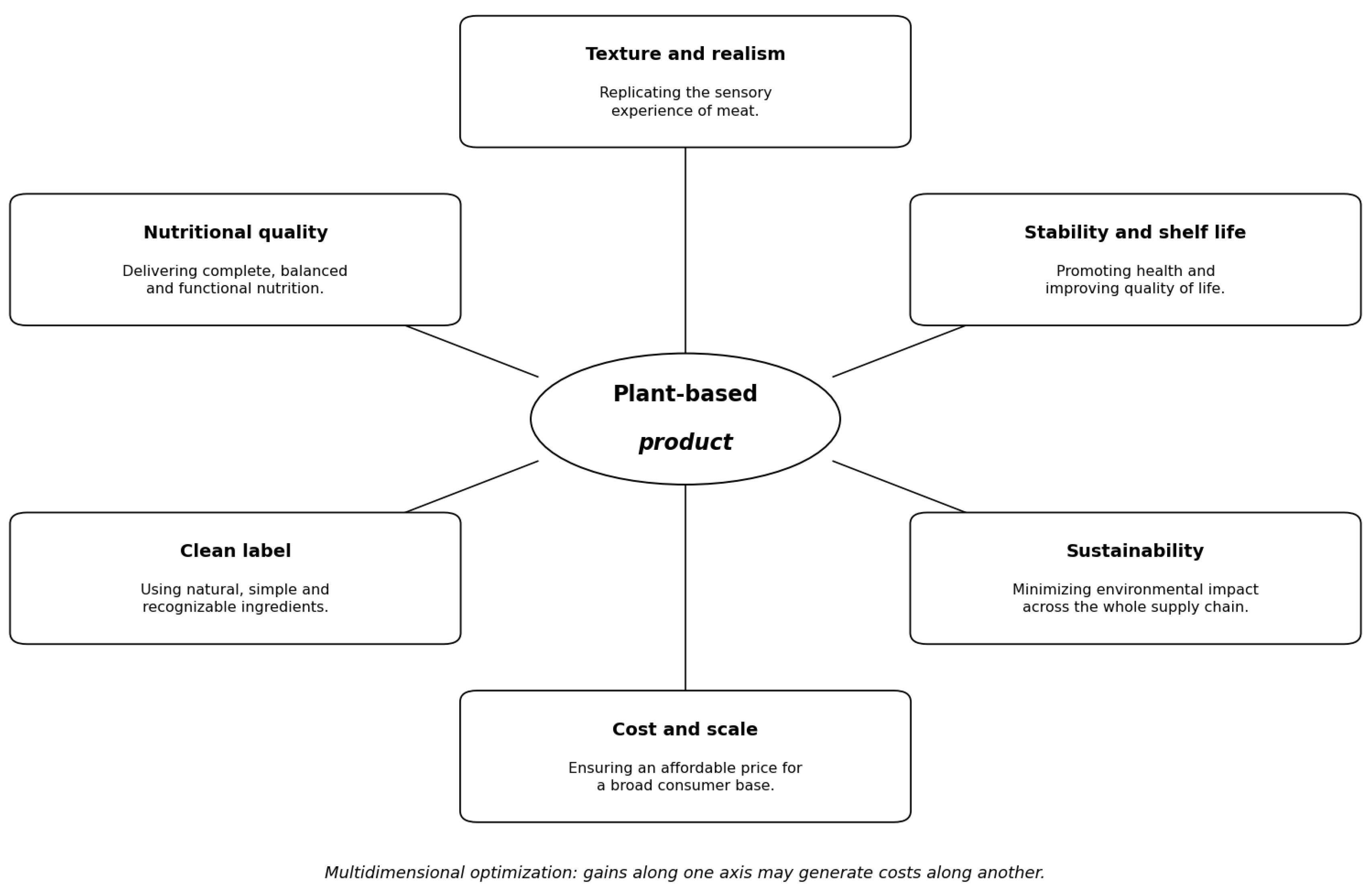
These conflicts indicate that the ideal product is not the one that maximizes a single attribute, but the one that balances performance requirements within a context of use. This perspective underpins the analysis of ingredients and technologies in the following sections.
Table 2.
Performance requirements and main trade-offs in the design of plant-based foods.
| Objective | Predominant strategies | Expected benefit | Main trade-off | References |
|---|---|---|---|---|
| Fibrous structure | High-moisture extrusion; shear cell | Anisotropy, chewiness, and cohesiveness | Energy demand, standardization, and scalability | [24,25,26,30,31,32] |
| Juiciness | Structured fats; emulsions; hydrocolloids | Oral lubrication and water retention | Saturated fat, oxidation, and formulation complexity | [25,35,36,37,38] |
| Aroma and flavor | Fermentation; Maillard reactions; flavor maskers | Off-flavor reduction and greater sensory familiarity | Cost, stability, and ingredient list | [27,34] |
| Protein quality | Blends, fermentation, enzymes, and fortification | Improved amino acid profile and digestibility | Additional processing and the need for validation in the final matrix | [15,39,40,62] |
| Micronutrients | Fortification and reduction of antinutrients | Greater adequacy of B12, iron, zinc, calcium, and omega-3 | Bioavailability, stability, and interaction with the matrix | [42,43,44,45,62] |
| Sustainability | Local ingredients; process efficiency; product-specific LCA | Lower environmental impact | Dependence on functional unit, energy, packaging, and logistics | [6,49,50,51,52] |
4. Ingredients and Food Matrix Engineering
Under the integrated framework, this section treats ingredients as the first functional layer of the system: they define the space of possibilities, but their performance materializes only after processing and microstructural organization.
4.1. Structuring Proteins
Structuring proteins provide the continuous phase required to form gels, fibers, and emulsions. Soy and pea remain among the most widely used raw materials because of their availability, protein content, and functionality, but they display distinct profiles of solubility, gelation, emulsification, and flavor [11,12,13,17,18]. Soy offers extensive industrial experience and a high texturization capacity; pea has gained ground because of its lower association with common allergens, its relatively neutral sensory profile, and its suitability for isolates and concentrates [11,12,13].
Other legumes, such as chickpea, faba bean, lentil, and mung bean, expand protein diversity and may contribute fibers, oligosaccharides, and bioactive compounds [18,47]. However, their industrial adoption depends on raw material standardization, the removal of undesirable flavors, and an understanding of how their protein fractions respond to extrusion, gelation, and fermentation [18,24,30].
Cereal and pseudocereal proteins are particularly useful in blends because of amino acid complementarity and their viscoelastic properties. Wheat, for example, contributes network formation through gluten, whereas rice, oat, quinoa, and amaranth may broaden the nutritional and sensory profile of formulations [19,35,36,44,45]. The main limitation is that blends that are successful in terms of composition do not always display adequate rheological behavior, requiring adjustment of ratios and processing conditions.
4.2. Lipids, Hydrocolloids, and Continuous-Phase Components
Lipids perform structural and sensory functions that go beyond energy supply. In meat analogues, they contribute to juiciness, oral lubrication, and the perception of marbling; in dairy products, they participate in creaminess, emulsion stability, and melting behavior [35,36]. Liquid oils present a potentially more favorable lipid profile but a lower capacity to reproduce the phase transition of animal fats; tropical oils provide solid structure but may raise saturated fat content [37,38,61].
Hydrocolloids such as methylcellulose, carrageenans, alginates, xanthan gum, and gellan gum are used to increase water retention, viscosity, and stability, particularly in burgers, cheeses, and plant-based beverages [25,35,36]. Despite their effectiveness, the extensive use of these ingredients is associated with more complex formulations and with the clean-label debate. This has stimulated the search for fibers, modified proteins, and gelling systems capable of performing similar functions with reduced dependence on conventional additives.
4.3. Microalgae and Next-Generation Ingredients
Microalgae such as Arthrospira, Chlorella, Tetraselmis, and Nannochloropsis provide proteins, pigments, and lipids of interest, including carotenoids and polyunsaturated fatty acids [20,21,22]. Their technological potential includes protein fortification, natural coloring, and the supply of DHA and EPA, whereas their main obstacles are cost, flavor, intense color, digestibility, and regulatory limits [20,21,22].
The incorporation of microalgae requires a dose- and function-oriented approach. Low concentrations may provide pigments or bioactive compounds without excessively compromising the sensory profile, whereas high levels increase nutritional value but intensify off-flavors and color changes [20,21,22]. Fermentation, encapsulation, and combination with aromatic matrices therefore become relevant strategies.
4.4. Ingredients Obtained Through Fermentation and Biotechnology
Traditional fermentation modifies the flavor, aroma, acidity, and digestibility of plant matrices and has consolidated applications in beverages, yogurts, cheeses, and fermented meat products [27]. Biomass fermentation produces microbial cells rich in proteins and fibers, whereas precision fermentation uses microorganisms as platforms to produce specific proteins, enzymes, vitamins, and lipids [28,29].
The main advantage of precision fermentation is the supply of ingredients with functionality that is difficult to reproduce with plant proteins alone, such as casein-, whey-, or egg-like proteins [28,29]. However, the costs of fermentation, purification, scale-up, and regulation still constrain its adoption. Hybrid applications, in which small amounts of fermentation-derived ingredients complement plant matrices, may therefore offer a more realistic route to improving performance without fully replacing the plant base.
In summary, the literature converges in recognizing that ingredient diversification expands the formulation space but does not eliminate the dependence on processing. The main divergence among studies stems from the use of raw materials with different degrees of purification, varietal origins, and thermal histories, which hinders direct comparisons of functionality, digestibility, and sensory performance [11,12,13,18,20,21,22,27,28,29]. Under the framework proposed in this review, ingredients should be treated as carriers of functional potential whose expression depends on the applied technology and the microstructure constructed. For industry, this implies replacing selection based solely on protein content with screening approaches that integrate rheology, stability, flavor, digestibility, and cost under realistic processing conditions.
5. Processing Technologies as Structural Engineering Tools
Within the proposed framework, processing technologies constitute the conversion mechanism between the functional potential of ingredients and the architecture of the food matrix.
5.1. Low- and High-Moisture Extrusion
Thermoplastic extrusion is the most consolidated technology for texturizing plant proteins [24,25,26,30]. At low moisture, it yields dry, rehydratable textured vegetable proteins suitable for ground products; at high moisture, it enables the formation of anisotropic structures more closely resembling whole muscle tissues [24,25,26].
The texturization mechanism involves protein denaturation, aggregation, and alignment under temperature and shear, followed by stabilization during cooling [26,30,32]. Structure formation depends on the relative viscosity of the phases, the protein-to-polysaccharide ratio, water content, specific mechanical energy, and die geometry [25,26,30,32]. For this reason, transferring processing conditions between different proteins is limited.
Despite its industrial maturity, extrusion faces challenges related to energy consumption, quality control, and the reproduction of complex tissues. Combining it with enzymatic pretreatments, fermentation, or lipid structuring may improve texture and reduce off-flavors, but it increases process complexity [27,30,58].
5.2. Shear Cell and Shear-Based Technologies
Shear cell technologies organize proteins through controlled shear in closed systems and can produce fibrous structures with less dependence on extrusion screws and dies [31,32]. These platforms are valuable for studying structure formation mechanisms and testing raw materials, but they still present limitations in throughput and scalability.
5.3. D Printing and Spatial Architecture
3D printing expands control over the spatial distribution of proteins, water, and fat and allows the development of geometries and internal gradients that are difficult to obtain through conventional processes [33]. Its main potential lies in high-value products, whole cuts, and personalized formulations.
However, the technology depends on food inks with specific rheological properties, stability after deposition, and adequate behavior during cooking [33]. Production speed, standardization, and cost still limit its large-scale application. 3D printing should therefore be regarded as an emerging platform rather than an immediate substitute for extrusion.
5.4. Fermentation as a Functional and Sensory Modification Step
Fermentation can be integrated before, during, or after structuring. As a pretreatment, it can reduce compounds responsible for off-flavors and modify protein functionality; as a subsequent step, it can develop aroma, acidity, and texture [27,48].
Fermentation does not necessarily replace texturization, but it can enhance its performance. The combination of fermentation and thermo-mechanical processing is particularly promising for meat and dairy analogues, although the literature still lacks comparative studies at pilot and industrial scale [27,29].
5.5. Critical Synthesis of the Technological Platforms
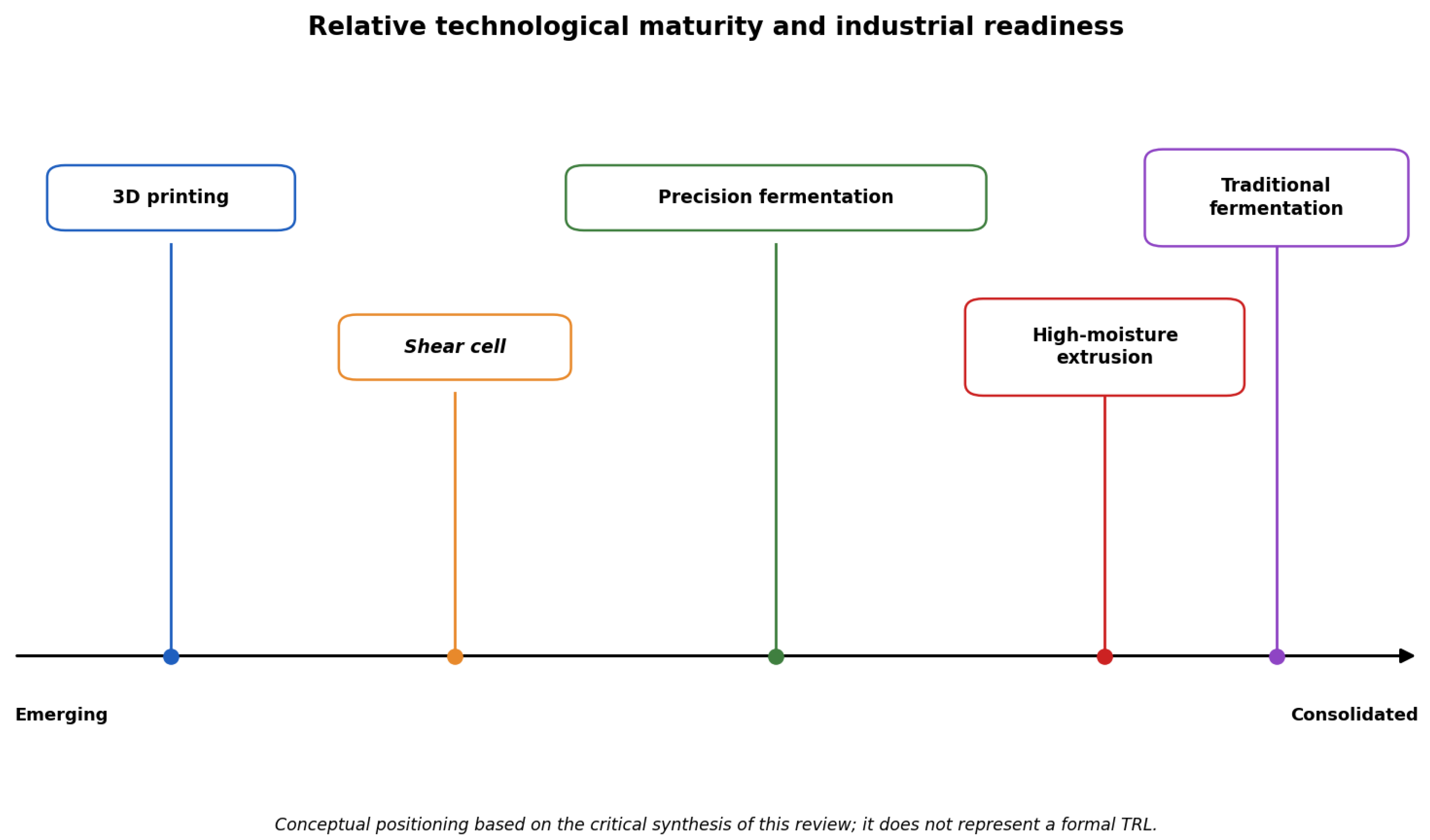
High-moisture extrusion displays the highest industrial maturity among structuring technologies [24,25,26,30,32]. The shear cell has high experimental value but lower throughput [31,32]. 3D printing offers spatial control and personalization but remains constrained by speed and cost [33]. Fermentation acts transversally, modifying functionality, aroma, and digestibility [27,28,29]. Rather than selecting a single technology, the development of the next generation of products is likely to depend on hybrid platforms in which each process is employed to solve a specific limitation of the matrix.
Table 3.
Comparison of the main technological platforms for plant-based foods.
| Technology | Main function | Maturity | Advantages | Limitations | References |
|---|---|---|---|---|---|
| Low-moisture extrusion | Dry, rehydratable textured vegetable protein | High | Throughput, stability, and cost | Texture limited to ground products | [24,25,26] |
| High-moisture extrusion | Anisotropic structures | High | Industrial scale and fibrousness | Energy, process control, and raw material dependence | [24,25,26,30,32] |
| Shear cell | Organization through controlled shear | Medium/experimental | Process control and mechanistic study | Low throughput and scalability | [31,32] |
| 3D printing | Spatial architecture and personalization | Low/emerging | Complex geometries and gradients | Speed, cost, and rheological requirements | [33] |
| Traditional fermentation | Aroma, acidity, and functionality | High | Off-flavor reduction and sensory development | Variability and the need for control | [27,48] |
| Precision fermentation | Specific proteins and ingredients | Medium/expanding | High molecular functionality | Cost, purification, scale, and regulation | [28,29] |
Despite the consensus that high-moisture extrusion displays the highest industrial maturity, comparability across studies remains limited by differences in screw geometry, specific mechanical energy, blend composition, and characterization methods [24,25,26,30,31,32]. Shear cell and 3D printing offer greater experimental and spatial control but still lack validation in terms of throughput, repeatability, and cost [31,32,33]. Fermentation provides robust evidence for the modulation of aroma and functionality, although its effects depend strongly on the strain, the substrate, and the cultivation conditions [27,28,29]. Taken together, these limitations indicate that the next step for the field is not merely to develop new processes, but to harmonize metrics and demonstrate performance at pilot and industrial scale.
Figure 3.
Relative technological maturity of the main platforms discussed in this review. The positioning is conceptual and does not represent a formal Technology Readiness Level (TRL) classification.
Figure 3.
Relative technological maturity of the main platforms discussed in this review. The positioning is conceptual and does not represent a formal Technology Readiness Level (TRL) classification.
6. Nutritional Performance and Bioaccessibility
The nutritional dimension should be interpreted as an outcome of the final matrix rather than as the simple sum of the nutrients of the ingredients.
6.1. Protein Quality: Composition, Digestibility, and Metabolic Response
Plant-based products do not constitute a nutritionally homogeneous category. Their protein value depends on total protein content, the profile of indispensable amino acids, ileal digestibility, and the context of the food matrix [15,39,40,62]. Animal proteins frequently display higher DIAAS scores, whereas plant proteins may be limited in lysine, methionine, or other amino acids depending on the source [39]. Nevertheless, complementary combinations of legumes and cereals, amino acid fortification, fermentation, and enzymatic treatments can reduce these differences [15,39,40,62].
The interpretation of protein quality must, however, avoid extrapolating from isolated ingredients to complete products. Processing can improve digestibility through protein denaturation and the inactivation of inhibitors, but it can also induce excessive aggregation or interactions with other matrix components [15,39,40,62]. The net effect therefore depends on process intensity, food composition, and the physical form of the product.
Evidence on the anabolic response also warrants caution. Reviews of plant proteins indicate that the amount ingested, the amino acid profile—especially leucine—and the distribution across the day influence muscle protein synthesis [15,40]. This means that nutritional equivalence cannot be inferred solely from the protein content declared on the label, particularly for older adults, athletes, and other groups with higher protein requirements.
6.2. Micronutrients, Fortification, and Stability
Vitamin B12, vitamin D, calcium, iron, zinc, iodine, and long-chain omega-3 fatty acids are the micronutrients most frequently discussed in the formulation of plant-based alternatives [42,43,62]. The need for fortification varies by category: plant-based beverages may require calcium and vitamins; seafood analogues require attention to EPA, DHA, and vitamin B12; and meat products may benefit from fortification with iron, zinc, and vitamin B12 [41,42,43,62,63].
The simple addition of nutrients does not guarantee biological equivalence. Stability during processing and storage, the chemical form used, the homogeneity of fortification, and interaction with the matrix determine the amount effectively available to the consumer [42,43,44,45,62]. Phytates, tannins, polyphenols, and oxalates can reduce mineral absorption, whereas fermentation, germination, phytase, and organic acids can attenuate this effect [44,45].
This body of evidence reinforces the need to assess bioaccessibility and bioavailability rather than proximate composition alone. Products formulated for vulnerable groups should be tested under realistic consumption conditions, considering portion size, matrix, preparation, and concomitant intake of other foods.
6.3. Sodium, Saturated Fat, Fiber, and Additives
Market surveys show that meat analogues frequently contain less saturated fat and more fiber than certain processed meat products, but they may also present high sodium levels and wide variability across brands [37,38]. Cheese analogues and some plant-based beverages may display low protein content and high saturated fat content, depending on the use of coconut or palm oils [36,41,61].
The plant-based claim should therefore not be treated as an automatic marker of healthfulness. Assessment should consider protein density, fat profile, sodium, fiber, degree of fortification, and portion size [37,38,41,61]. This product-by-product approach is more informative than binary comparisons between animal and plant origin.
The presence of additives and classification under the NOVA system introduce a second layer of analysis. Many analogues are classified as ultra-processed because of the number of ingredients and the intensity of processing [5,56,57,58]. The debate nevertheless remains open as to whether this classification adequately captures differences in nutritional profile, technological function, and environmental impact [56,57].
6.4. Functional Potential and the Use of Less Refined Matrices
Wholemeal legume flours, pseudocereals, oats, microalgae, and by-products can increase the content of fiber, beta-glucans, polyphenols, carotenoids, and other bioactive compounds [19,20,21,22,23,46,47,48]. These ingredients broaden the functional potential of products, but they may also intensify off-flavors, reduce digestibility, or compromise texture.
Formulating functional foods by design requires demonstrating that bioactive compounds remain stable and bioaccessible after processing. The presence of a functional ingredient is not sufficient to infer clinical benefit; digestion and bioavailability studies and, ideally, human trials are required [20,21,22,23,46,47].
Nutritional evidence is more consistent for composition and protein quality than for long-term clinical outcomes. Market surveys document wide variability across categories and brands [37,38,41], whereas reviews of DIAAS, digestibility, and anabolic response support the need to assess indispensable amino acids and the final matrix [15,39,40,62]. In contrast, human trials comparing formulated products rather than isolated ingredients remain scarce. This gap constrains claims of nutritional equivalence and reinforces the priority of studies on bioaccessibility, absorption, and metabolic response using realistic consumption portions.
Table 4.
Main nutritional dimensions of plant-based foods and assessment priorities.
| Dimension | Risk or opportunity | Strategies | Recommended indicator | References |
|---|---|---|---|---|
| Protein quality | Limiting amino acids and variable digestibility | Blends, enzymes, fermentation, and fortification | DIAAS, ileal digestibility, and metabolic response | [15,39,40,62] |
| Micronutrients | Low density or bioavailability | Fortification, phytase, germination, and suitable chemical forms | Bioaccessibility, stability, and absorption studies | [42,43,44,45,62] |
| Lipid profile | Use of tropical fats and oxidation | Oleogels, emulsions, and unsaturated oils | Saturated fat, oxidative stability, and thermal behavior | [37,38,61] |
| Sodium | High levels in processed products | Gradual reduction and flavor modulation | mg per portion and within-category comparison | [37,38] |
| Fiber and bioactive compounds | Functional opportunity with sensory risk | Wholemeal matrices, microalgae, and by-products | Stability, bioaccessibility, and clinical effect | [19,20,21,22,23,46,47,48] |
7. Sensory and Functional Performance
Sensory performance represents the perceptual translation of the microstructure built during processing.
7.1. Texture, Anisotropy, and Culinary Behavior
Texture is one of the main determinants of the acceptance of meat analogues and depends on anisotropy, cohesiveness, elasticity, chewiness, and water retention [24,25,26,30,31,32,33,34]. Ground products tolerate less organized structures, whereas whole-muscle analogues require orientation across multiple scales and a controlled distribution of fat.
High-moisture extrusion remains the leading technology for generating fibrousness at industrial scale [24,25,26,30,32]. Reproducing whole muscles nevertheless remains difficult because meat combines fibers, connective tissue, and intramuscular fat in a hierarchical architecture. Shear cell and 3D printing may expand structural control but still face limitations of scale and throughput [31,32,33].
Behavior during preparation is also critical. Water loss, shrinkage, crust formation, fat release, and stability during freezing and reheating affect the eating experience. Instrumental measurements should therefore be interpreted together with culinary and sensory tests.
7.2. Aroma, Flavor, and Off-Flavors
Legume and microalgal proteins may carry green, earthy, bitter, or marine notes that limit acceptance [20,21,22,27,34]. The intensity of these off-flavors depends on the raw material, lipid oxidation, processing, and storage.
7.3. Color, Appearance, and Familiarity
Appearance acts before tasting and influences the expectation of flavor and quality. Betalains, carotenoids, natural pigments, and fermentation-derived heme are used to reproduce raw color and the changes that occur during heating [27,34].
Color stability is a challenge because natural pigments may degrade with pH, light, oxygen, and temperature. Solutions must consider not only initial intensity but also behavior during storage and cooking.
7.4. Sensory Evaluation and Consumer Behavior
Reviews of the acceptance of alternative proteins show that flavor, texture, familiarity, and price exert a more consistent influence on purchase intention than environmental arguments alone [2,53,54,55]. Flexitarian consumers are particularly relevant because they compare the product directly with animal references.
Simple hedonic tests are useful but insufficient to guide advanced innovation. Studies employing descriptive analysis, segmented consumers, context of use, and repeated consumption provide more robust information on actual acceptance. Combining instrumental and sensory measurements is necessary to relate microstructure, texture, and perception. Labeling, nomenclature, and the perception of naturalness also modulate the sensory response. A technically efficient formulation may be rejected if consumers perceive an excess of additives or low transparency [2,56,57,58].
Table 5.
Sensory attributes, technological causes, and improvement strategies.
| Attribute | Main cause | Strategies | Limitation | References |
|---|---|---|---|---|
| Fibrousness | Absence of hierarchical organization | HME, shear cell, protein blends | Scale and microstructural control | [24,25,26,30,31,32] |
| Juiciness | Low water and fat retention | Oleogels, emulsions, hydrocolloids | Lipid profile and clean label | [25,35,36,37,38] |
| Off-flavors | Oxidation and volatile compounds from legumes/microalgae | Fermentation, washing, enzymes, and flavor maskers | Cost and stability | [20,21,22,27,34] |
| Color | Unstable pigments and inadequate thermal response | Betalains, carotenoids, and fermentation-derived heme | Stability to pH, light, and heat | [27,34] |
| Acceptance | Familiarity, price, and expectation | Testing with target consumers in real contexts | Cultural variability | [2,53,54,55] |
The sensory literature converges in identifying flavor, texture, familiarity, and price as central determinants of adoption [2,53,54,55], but results diverge when countries, age segments, and levels of familiarity are compared. Part of this heterogeneity arises from differing test protocols, the absence of animal comparators, and the predominant use of single-time assessments. To mitigate this problem, future studies should combine descriptive analysis, hedonic tests, repeated consumption, and consumer segmentation, and should relate instrumental measurements to specific perceptions. For industry, the implication is clear: instrumental gains in texture or color are valuable only when they translate into perceptible improvement and repeat purchase.
8. Sustainability, Comparability, and the Limits of the Evidence
Environmental performance occupies the systemic level of the framework and depends on all previous decisions, from the origin of the ingredients to packaging, distribution, and use.
8.1. Life Cycle Assessment Evidence
Life cycle assessment studies frequently show lower greenhouse gas emissions and lower land use for plant-based alternatives compared with beef [6,49,50,51,52]. These advantages are more consistent when the comparison involves products of similar function and when the functional unit is mass or portion.
8.2. Processing, Energy, and Packaging
Processing is often treated as a secondary component of the environmental footprint, but it may be relevant in high-moisture extrusion, drying, fermentation, ingredient purification, and the cold chain [26,29,32,52]. Emerging technologies should be assessed at realistic scale, since laboratory data may underestimate energy consumption and losses.
Packaging and shelf life also affect the outcome. More complex packaging may increase direct impact but reduce waste; likewise, more intensive processing may improve stability and safety. The analysis must consider the complete system rather than the production stage in isolation.
8.3. Local Ingredients, Circularity, and Biodiversity
The use of local ingredients and by-products can reduce transport and enhance circularity, but the benefit depends on availability, stability, pretreatment requirements, and the alternative fate of the co-product [48,58]. The valorization of okara, oilseed cakes, and brans is promising when it replaces disposal and does not displace higher-value uses.
In Brazil, the availability of legumes, cereals, oilseeds, and plant biodiversity creates opportunities for regional supply chains. However, life cycle assessments specific to Brazilian ingredients and processes are lacking, which limits robust environmental claims.
8.4. Sustainability as a Verifiable, Not Presumed, Attribute
Plant origin should not be used as an automatic synonym for sustainability. Environmental claims must be linked to defined indicators, boundaries, and scenarios [6,52]. Such caution reduces the risk of greenwashing and improves communication with consumers and regulators.
The methodological priority is to harmonize functional units, incorporate nutritional quality, report uncertainties, and publish transparent inventories. Without these elements, comparisons across studies remain limited.
Table 6.
Sources of variability in environmental assessments of plant-based foods.
| Factor | How it changes the outcome | Good practice | References |
|---|---|---|---|
| Functional unit | Mass, portion, protein, and nutrients yield different conclusions | Report multiple units and justify the choice | [39,50,52,62] |
| System boundary | Including or excluding packaging, refrigeration, and co-products modifies impacts | Clearly describe the stages included | [6,52] |
| Energy mix | Intensive processes vary with electricity and fuel sources | Use regional data and sensitivity analysis | [26,29,32,52] |
| Agricultural origin | Yield, fertilizers, and land use vary by location | Use territory-specific inventories | [49,50,51,52] |
| Shelf life and waste | More stable products may reduce losses | Include waste and preservation scenarios | [52] |
| Nutritional quality | Comparison by mass may ignore nutrient density | Add complementary nutritional metrics | [39,50,62] |
There is strong convergence regarding the environmental advantage of plant-based alternatives over beef in terms of emissions and land use [6,49,50,51,52], but lower consistency when the comparison involves other animal proteins, different functional units, or energy-intensive technologies. The divergences reflect above all system boundaries, agricultural inventories, and assumptions about packaging, refrigeration, and co-products [6,52]. General environmental claims should therefore be replaced by product- and territory-specific results. The practical implication is that sustainable innovation requires integrating life cycle assessment into development from the earliest stages rather than using it only as subsequent validation.
9. Trade-Offs and Integration of the Evidence
9.1. From Isolated Optimization to Multidimensional Performance
The synthesis of the evidence shows that the performance of plant-based foods cannot be reduced to a single indicator. Formulation and processing determine microstructure, which in turn conditions texture, water retention, digestibility, stability, and the release of aroma compounds [24,25,26,27,30,31,32,35,36]. At the same time, choices intended to improve one of these attributes may impair another. The most appropriate unit of analysis is therefore neither the isolated ingredient nor the technology in the abstract, but the ingredient–process–product system.
This principle is evident in the structuring of meat analogues. High-moisture extrusion increases anisotropy and cohesiveness but requires strict control of moisture, temperature, shear, and cooling [24,25,26,30,32]. The use of hydrocolloids and solid fats can enhance juiciness and stability, yet it may also lengthen the ingredient list and raise saturated fat content [25,35,36,37,38]. Sensory realism must therefore be evaluated together with nutritional composition, cost, and the perception of naturalness.
The same reasoning applies to fortification. The addition of calcium, iron, zinc, vitamin B12, or omega-3 fatty acids can correct compositional gaps, but the benefit depends on nutrient stability, chemical form, the presence of antinutrients, and the portion effectively consumed [42,43,44,45,62,63]. Fortification without bioaccessibility assessment may produce nominal equivalence on the label without biological equivalence.
In the environmental dimension, replacing animal ingredients with plant ingredients frequently reduces emissions and land use, particularly in comparison with beef [6,49,50,51,52]. However, intensive purification, fermentation, extrusion, refrigeration, and packaging may alter the final balance [26,29,32,52]. Sustainability should therefore be treated as a verifiable outcome of the system rather than as an attribute presumed from plant origin.
9.2. Integrated Framework for the Design of Plant-Based Foods
Building on these relationships, this review proposes an integrated framework comprising six interdependent stages: definition of the product objective; functional ingredient selection; choice of processing platform; construction and characterization of the microstructure; multidimensional validation; and evidence-driven reformulation. The model is iterative: outcomes of texture, composition, acceptance, cost, or environmental impact feed back into formulation decisions.
Microstructure occupies a central position in the framework because it translates the interaction between ingredients and processing into observable properties. In meat analogues, it organizes protein, aqueous, and lipid phases; in plant-based beverages and cheeses, it controls colloidal stability, gelation, and melting [9,24,25,26,30,31,32,33,34,35,36]. Validation should combine instrumental methods, nutritional analyses, sensory tests, and environmental indicators, preventing the optimization of one dimension from concealing losses in another.
The framework does not establish a universal sequence for all categories. Its purpose is to provide a common language for comparing products and technologies. The relative importance of each indicator depends on the intended use: fibrousness is central for whole-muscle analogues; foaming capacity and thermal stability are critical for beverages; melting and elasticity dominate cheese development; and digestibility and fortification may be priorities in products intended for vulnerable groups [9,19,36,61,62,63].
Table 7.
Proposed integrated framework for the development and evaluation of plant-based foods.
| Stage | Guiding question | Main indicators | Resulting decision |
|---|---|---|---|
| Product objective | Which food function and context of use will be addressed? | Category, consumer, preparation, target price | Product specification |
| Ingredient selection | Which components provide the required functions? | Composition, functionality, allergenicity, availability | Preliminary formulation |
| Processing | Which route builds the desired structure? | Temperature, shear, fermentation, energy, and yield | Process window |
| Microstructure | Does the resulting matrix explain the observed performance? | Anisotropy, phase distribution, porosity, water retention | Ingredient–process adjustment |
| Multidimensional validation | Does the product balance technology, nutrition, sensory properties, and environment? | Texture, composition, bioaccessibility, acceptance, LCA | Prototype selection |
| Scale-up and feedback | Is performance maintained at industrial scale? | Cost, stability, reproducibility, and shelf life | Reformulation or scale-up |
9.3. Implications for Research and Industry
For research, the framework suggests that studies focused on a single indicator have limited usefulness when they do not adequately describe formulation and processing. Comparisons among proteins or technologies should control for composition, report operating conditions, and include measurements that connect microstructure and performance.
For industry, the main implication is that innovation should not be driven by the direct substitution of ingredients. Raw material selection must consider availability, variability, functionality, cost, environmental impact, and regulatory suitability. Hybrid platforms combining extrusion, fermentation, enzymatic modification, and lipid structuring may be more effective than attempting to solve all limitations with a single process [27,28,29,30]. For regulators and health professionals, the model reinforces the need to evaluate products individually. The plant-based claim does not, in itself, convey protein quality, sodium content, degree of fortification, bioavailability, or environmental impact [37,38,39,40,41,42,43,44,45,56,57,58,62].
Table 8.
Relative maturity of the evidence and main limitations of the field.
| Domain | Relative maturity | Predominant evidence base | Critical limitation |
|---|---|---|---|
| High-moisture extrusion | High | Technical reviews and experimental studies | Low comparability across equipment and formulations |
| Traditional fermentation | High | Consolidated applications and reviews | Strong dependence on strain and substrate |
| Precision fermentation | Moderate | Reviews and emerging industrial cases | Cost, purification, regulation, and scarce independent data |
| Shear cell | Moderate | Laboratory and pilot studies | Low throughput and limited industrial validation |
| 3D printing | Low to moderate | Prototypes and reviews | Speed, scale, and post-processing stability |
| Nutritional quality | Moderate | Composition, DIAAS, and in vitro studies | Few clinical trials using final products |
| Sensory performance | Moderate | Hedonic tests and consumer studies | Heterogeneous protocols and limited longitudinal assessment |
| Sustainability | Moderate to high | Life cycle assessments | Non-harmonized functional units and boundaries |
10. Research Agenda and Perspectives
10.1. Methodological Standardization and Comparability
The most immediate priority is to harmonize comparison methods. Technology studies should report detailed composition, processing history, and operating conditions; nutritional studies should distinguish protein content, digestibility, and amino acid quality; sensory assessments should report sample profile, context of use, and comparator; and environmental assessments should make boundaries, functional unit, and uncertainty explicit [26,30,32,39,52].
Adopting minimum sets of indicators would allow studies to be compared and quantitative syntheses to be performed. For meat analogues, such a set could include anisotropy, shear force, cooking loss, water retention, protein content, sodium, and acceptance. For beverages and cheeses, stability, viscosity, foaming capacity, melting, composition, and fortification would be central [19,36,41,61].
10.2. Nutritional Validation in Final Matrices
Clinical evidence on the prolonged consumption of plant-based analogues remains scarce. Most nutritional conclusions derive from label composition, ingredient studies, or plant-based dietary patterns [3,4,5,37,38,39,40,41,42,43]. Future studies should evaluate complete products, realistic portions, and outcomes of digestibility, satiety, glycemic response, lipid metabolism, and micronutrient adequacy.
Groups with specific requirements, such as children, older adults, pregnant women, athletes, and people with dietary restrictions, warrant particular attention. In these groups, low protein density, inadequate fortification, or limited bioavailability may have greater clinical relevance [15,39,40,41,42,43,44,62].
10.3. Hybrid Platforms, Digitalization, and Scalability
The next generation of products will probably combine processes. Extrusion may provide the main structure; fermentation may reduce off-flavors and modify functionality; lipid systems may control juiciness; and precision fermentation ingredients may supply specific functions [25,26,27,28,29,30,35,36]. The hypothesis that such hybrid platforms are superior nevertheless requires comparative validation at pilot and industrial scale.
Predictive modeling, machine learning, and multi-omics techniques may accelerate the selection of ingredients and process conditions, but they depend on standardized, high-quality databases. Models trained on heterogeneous or poorly described results tend to reproduce the methodological limitations of the literature.
Scalability should be incorporated from the outset. Processes that are promising in the laboratory may fail because of low throughput, purification cost, raw material variability, or control difficulties. Techno-economic and environmental studies should accompany the transition from bench to pilot scale.
10.4. Opportunities for Brazil
Brazil holds a potential advantage owing to its diversity of legumes, cereals, oilseeds, and agro-industrial co-products. However, converting this availability into innovation requires functional characterization, standardized supply chains, safety assessment, and life cycle studies specific to the national context.
Biodiversity-derived ingredients should be evaluated without presuming superiority. Priorities include composition, allergenicity, antinutrients, behavior during processing, sensory acceptance, and agronomic feasibility. Integration with family farming and the regional bioeconomy may broaden social benefits, provided it is based on transparent and economically sustainable supply chains.
11. Conclusions
The next generation of plant-based foods will probably not be defined by the discovery of a single protein or technology, but by the capacity to integrate materials science, food engineering, biotechnology, nutrition, sensory analysis, and environmental assessment into a rational development process. To convert this potential into better products, the field still needs to advance from proof of concept to comparative studies, industrial-scale validation, and more transparent clinical and environmental evidence.
The proposed framework organizes development into an iterative sequence: product objectives, ingredient selection, processing, microstructure, performance, acceptance, and scalability. Its main implication is to replace the logic of isolated mimicry with an integrated design process in which trade-offs are identified from the outset and tested with comparable metrics.
The available evidence is more robust for high-moisture extrusion, traditional fermentation, and compositional characterization, while remaining less mature for 3D printing, commercial-scale precision fermentation, bioavailability in final matrices, and environmental impacts adjusted for nutritional quality. Conclusions about technological, nutritional, or environmental superiority should therefore be formulated conditionally and on a product-specific basis.
This review demonstrates that the performance of plant-based foods is not determined by isolated ingredients or technologies, but emerges from the interaction among composition, processing, microstructure, and consumption context. This interpretation explains the high heterogeneity across commercial products and experimental results and supports the need for multidimensional assessment.
Author Contributions
Conceptualization, G.S.O. and J.F.B.S.J.; methodology, G.S.O., H.T.W., L.S.O. and A.C.S.K.; investigation and literature screening, G.S.O., H.T.W., L.S.O. and A.C.S.K.; formal analysis and interpretation, G.S.O., Y.F. and A.S.S.; writing—original draft preparation, G.S.O.; writing—review and editing, J.F.B.S.J., H.T.W., L.S.O., A.C.S.K., Y.F. and A.S.S.; visualization, G.S.O.; supervision, J.F.B.S.J. All authors have read and agreed to the published version of the manuscript.
Funding
This research received no external funding.
Institutional Review Board Statement
Not applicable.
Informed Consent Statement
Not applicable.
Data Availability Statement
No new data were created or analyzed in this study. Data sharing is not applicable to this article.
Acknowledgments
The authors thank the Graduate Program in Nutrition and Health at the Federal University of Espírito Santo for institutional support. During the preparation of this manuscript, the authors used Claude (Anthropic) to support text organization, language editing, and the initial drafting of conceptual figures. The authors reviewed and edited all AI-assisted content and take full responsibility for the final version of the manuscript.
Conflicts of Interest
The authors declare no conflicts of interest.
References
- Aschemann-Witzel, J.; Gantriis, R.F.; Fraga, P.; Perez-Cueto, F.J.A. Plant-based food and protein trend from a business perspective: Markets, consumers, and the challenges and opportunities in the future. Crit. Rev. Food Sci. Nutr. 2021, 61, 3119–3128. [Google Scholar] [CrossRef]
- Onwezen, M.C.; Bouwman, E.P.; Reinders, M.J.; Dagevos, H. A systematic review on consumer acceptance of alternative proteins: Pulses, algae, insects, plant-based meat alternatives, and cultured meat. Appetite 2021, 159, 105058. [Google Scholar] [CrossRef]
- Wang, Y.; Liu, B.; Han, H.; Hu, Y.; Zhu, L.; Rimm, E.B.; et al. Associations between plant-based dietary patterns and risks of type 2 diabetes, cardiovascular disease, cancer, and mortality—A systematic review and meta-analysis. Nutr. J. 2023, 22, 46. [Google Scholar] [CrossRef]
- Quek, J.; Lim, G.; Lim, W.H.; Ng, C.H.; So, W.Z.; Toh, J.; et al. The association of plant-based diet with cardiovascular disease and mortality: A meta-analysis and systematic review of prospective cohort studies. Front. Cardiovasc. Med. 2021, 8, 756810. [Google Scholar] [CrossRef]
- Touvier, M.; Da Costa Louzada, M.L.; Mozaffarian, D.; Baker, P.; Juul, F.; Srour, B. Ultra-processed foods and cardiometabolic health: Public health policies to reduce consumption cannot wait. BMJ 2023, 383, e075294. [Google Scholar] [CrossRef]
- Saget, S.; Costa, M.; Santos, C.S.; Vasconcelos, M.W.; Gibbons, J.; Styles, D.; et al. Life cycle assessment of plant-based vs. beef burgers: A case study in the UK. Sustainability 2024, 16, 4417. [Google Scholar] [CrossRef]
- Dagevos, H. Finding flexitarians: Current studies on meat eaters and meat reducers. Trends Food Sci. Technol. 2021, 114, 530–539. [Google Scholar] [CrossRef]
- Alae-Carew, C.; Green, R.; Stewart, C.; Cook, B.; Dangour, A.D.; Scheelbeek, P.F.D. The role of plant-based alternative foods in sustainable and healthy food systems: Consumption trends in the UK. Sci. Total Environ. 2022, 807, 151041. [Google Scholar] [CrossRef]
- McClements, D.J.; Grossmann, L. The science of plant-based foods: Constructing next-generation meat, fish, milk, and egg analogs. Compr. Rev. Food Sci. Food Saf. 2021, 20, 4049–4100. [Google Scholar] [CrossRef]
- Sukhera, J. Narrative reviews: Flexible, rigorous, and practical. J. Grad. Med. Educ. 2022, 14, 414–417. [Google Scholar] [CrossRef]
- Boukid, F.; Rosell, C.M.; Castellari, M. Pea protein ingredients: A mainstream ingredient to (re)formulate innovative foods and beverages. Trends Food Sci. Technol. 2021, 110, 729–742. [Google Scholar] [CrossRef]
- Lu, Z.X.; He, J.F.; Zhang, Y.C.; Bing, D.J. Composition, physicochemical properties of pea protein and its application in functional foods. Crit. Rev. Food Sci. Nutr. 2020, 60, 2593–2605. [Google Scholar] [CrossRef]
- Shanthakumar, P.; Klepacka, J.; Bains, A.; Chawla, P.; Dhull, S.B.; Najda, A. The current situation of pea protein and its application in the food industry. Molecules 2022, 27, 5354. [Google Scholar] [CrossRef]
- Das, P.; Nath, P.C.; Singh, R.; Mohanta, Y.K. Recent advances in extrusion technology for plant-based meat analogues: Composition, development, and challenges. Eur. Food Res. Technol. 2026, 252, 28. [Google Scholar] [CrossRef]
- Pinckaers, P.J.M.; Trommelen, J.; Snijders, T.; van Loon, L.J.C. The anabolic response to plant-based protein ingestion. Sports Med. 2021, 51, 59–74. [Google Scholar] [CrossRef]
- Bryant, C.J. Plant-based animal product alternatives are healthier and more environmentally sustainable than animal products. Future Foods 2022, 6, 100174. [Google Scholar] [CrossRef]
- Ferawati, F.; Hefni, M.; Östbring, K.; Witthöft, C. The application of pulse flours in the development of plant-based cheese analogues: Proximate composition, color, and texture properties. Foods 2021, 10, 2208. [Google Scholar] [CrossRef]
- Anyiam, P.N.; Phongthai, S.; Grossmann, L.; Jung, Y.H.; Sai-Ut, S.; Onsaard, E.; Rawdkuen, S. Potential plant proteins for functional food ingredients: Composition, utilization and its challenges. NFS J. 2025, 38, 100216. [Google Scholar] [CrossRef]
- Paul, A.A.; Kumar, S.; Kumar, V.; Sharma, R. Milk analog: Plant based alternatives to conventional milk, production, potential and health concerns. Crit. Rev. Food Sci. Nutr. 2020, 60, 3005–3023. [Google Scholar] [CrossRef]
- Niccolai, A.; Chini Zittelli, G.; Rodolfi, L.; Biondi, N.; Tredici, M.R. Microalgae of interest as food source: Biochemical composition and digestibility. Algal Res. 2022, 65, 102742. [Google Scholar] [CrossRef]
- Mosibo, O.K.; Ferrentino, G.; Udenigwe, C.C. Microalgae proteins as sustainable ingredients in novel foods: Recent developments and challenges. Foods 2024, 13, 733. [Google Scholar] [CrossRef]
- Caporgno, M.P.; Mathys, A. Trends in microalgae incorporation into innovative food products with potential health benefits. Front. Nutr. 2021, 8, 680534. [Google Scholar]
- de Marco Castro, E.; Calder, P.C.; Roche, H.M. β-1,3/1,6-Glucans and immunity: State of the art and future directions. Mol. Nutr. Food Res. 2021, 65, e1901071. [Google Scholar] [CrossRef]
- Sha, L.; Xiong, Y.L. Plant protein-based alternatives of reconstructed meat: Science, technology, and challenges. Trends Food Sci. Technol. 2020, 102, 51–61. [Google Scholar] [CrossRef]
- Kyriakopoulou, K.; Keppler, J.K.; van der Goot, A.J. Functionality of ingredients and additives in plant-based meat analogues. Foods 2021, 10, 600. [Google Scholar] [CrossRef]
- Wittek, P.; Karbstein, H.P.; Emin, M.A. High-moisture extrusion of plant proteins: Fundamentals of texturization and applications. Annu. Rev. Food Sci. Technol. 2024, 15, 543–566. [Google Scholar] [CrossRef]
- Boukid, F.; Hassoun, A.; Zouari, A.; Tülbek, M.Ç.; Mefleh, M.; Aït-Kaddour, A.; et al. Fermentation for designing innovative plant-based meat and dairy alternatives. Foods 2023, 12, 1005. [Google Scholar] [CrossRef]
- Eibl, R.; Senn, Y.; Gubser, G.; Jossen, V.; van den Bos, C.; Eibl, D. Cellular agriculture: Opportunities and challenges. Annu. Rev. Food Sci. Technol. 2021, 12, 51–73. [Google Scholar] [CrossRef]
- Augustin, M.A.; Hartley, C.J.; Maloney, G.; Tyndall, S. Innovation in precision fermentation for food ingredients. Crit. Rev. Food Sci. Nutr. 2024, 64, 6218–6238. [Google Scholar] [CrossRef]
- Zhang, Y.; Wang, Y.; Wu, Z.; Cao, Q.; Liu, B. Texturization of plant protein-based meat alternatives: Processing, base proteins, and other constructional ingredients. Future Foods 2023, 8, 100277. [Google Scholar] [CrossRef]
- Dekkers, B.L.; Boom, R.M.; van der Goot, A.J. Structuring processes for meat analogues. Trends Food Sci. Technol. 2018, 81, 25–36. [Google Scholar] [CrossRef]
- Cornet, S.H.V.; Snel, S.J.E.; Schreuders, F.K.G.; van der Sman, R.G.M.; Beyrer, M.; van der Goot, A.J. Thermo-mechanical processing of plant proteins using shear cell and high-moisture extrusion cooking. Crit. Rev. Food Sci. Nutr. 2022, 62, 3264–3280. [Google Scholar] [CrossRef]
- Ramachandraiah, K. Potential development of sustainable 3D-printed meat analogues: A review. Sustainability 2021, 13, 938. [Google Scholar] [CrossRef]
- Ismail, I.; Hwang, Y.H.; Joo, S.T. Meat analog as future food: A review. J. Anim. Sci. Technol. 2020, 62, 111–120. [Google Scholar] [CrossRef]
- McClements, D.J.; Grossmann, L. A brief review of the science behind the design of healthy and sustainable plant-based foods. npj Sci. Food 2021, 5, 17. [Google Scholar] [CrossRef]
- Grossmann, L.; McClements, D.J. The science of plant-based foods: Approaches to create nutritious and sustainable plant-based cheese analogs. Trends Food Sci. Technol. 2021, 118, 207–229. [Google Scholar] [CrossRef]
- Alessandrini, R.; Brown, M.K.; Pombo-Rodrigues, S.; Bhageerutty, S.; He, F.J.; MacGregor, G.A. Nutritional quality of plant-based meat products available in the UK: A cross-sectional survey. Nutrients 2021, 13, 4225. [Google Scholar] [CrossRef]
- Cutroneo, S.; Angelino, D.; Tedeschi, T.; Pellegrini, N.; Martini, D. Nutritional quality of meat analogues: Results from the Food Labelling of Italian Products (FLIP) project. Front. Nutr. 2022, 9, 852831. [Google Scholar] [CrossRef]
- Herreman, L.; Nommensen, P.; Pennings, B.; Laus, M.C. Comprehensive overview of the quality of plant- and animal-sourced proteins based on the digestible indispensable amino acid score. Food Sci. Nutr. 2020, 8, 5379–5391. [Google Scholar] [CrossRef]
- Berrazaga, I.; Micard, V.; Gueugneau, M.; Walrand, S. The role of the anabolic properties of plant- versus animal-based protein sources in supporting muscle mass maintenance: A critical review. Nutrients 2019, 11, 1825. [Google Scholar] [CrossRef]
- Chalupa-Krebzdak, S.; Long, C.J.; Bohrer, B.M. Nutrient density and nutritional value of milk and plant-based milk alternatives. Int. Dairy J. 2018, 87, 84–92. [Google Scholar] [CrossRef]
- Craig, W.J.; Mangels, A.R.; Fresán, U.; Marsh, K.; Miles, F.L.; Saunders, A.V.; et al. The safe and effective use of plant-based diets with guidelines for health professionals. Nutrients 2021, 13, 4144. [Google Scholar] [CrossRef]
- Bakaloudi, D.R.; Halloran, A.; Rippin, H.L.; Oikonomidou, A.C.; Dardavesis, T.I.; Williams, J.; et al. Intake and adequacy of the vegan diet. A systematic review of the evidence. Clin. Nutr. 2021, 40, 3503–3521. [Google Scholar] [CrossRef]
- Gibson, R.S.; Raboy, V.; King, J.C. Implications of phytate in plant-based foods for iron and zinc bioavailability, setting dietary requirements, and formulating programs and policies. Nutr. Rev. 2018, 76, 793–804. [Google Scholar] [CrossRef]
- Singh, U.; Praharaj, C.S.; Singh, S.S.; Singh, N.P. Biofortification of Food Crops; Springer: New Delhi, India, 2016. [Google Scholar] [CrossRef]
- Petropoulou, K.; Salt, L.J.; Edwards, C.H.; Warren, F.J.; Garcia-Perez, I.; Chambers, E.S.; et al. A natural mutation in Pisum sativum L. (pea) alters starch assembly and improves glucose homeostasis in humans. Nat. Food 2020, 1, 693–704. [Google Scholar] [CrossRef]
- Hou, D.; Yousaf, L.; Xue, Y.; Hu, J.; Wu, J.; Hu, X.; et al. Mung bean (Vigna radiata L.): Bioactive polyphenols, polysaccharides, peptides, and health benefits. Nutrients 2019, 11, 1238. [Google Scholar] [CrossRef]
- Vong, W.C.; Liu, S.Q. Bioconversion of okara by Yarrowia lipolytica into an okara-based sauce. Food Res. Int. 2020, 127, 108740. [Google Scholar] [CrossRef]
- Willett, W.; Rockström, J.; Loken, B.; Springmann, M.; Lang, T.; Vermeulen, S.; et al. Food in the Anthropocene: The EAT-Lancet Commission on healthy diets from sustainable food systems. Lancet 2019, 393, 447–492. [Google Scholar] [CrossRef]
- Springmann, M.; Spajic, L.; Clark, M.A.; Poore, J.; Herforth, A.; Webb, P.; et al. The healthiness and sustainability of national and global food based dietary guidelines: Modelling study. BMJ 2020, 370, m2322. [Google Scholar] [CrossRef]
- Sun, Z.; Scherer, L.; Tukker, A.; Spawn-Lee, S.A.; Bruckner, M.; Gibbs, H.K.; et al. Dietary change in high-income nations alone can lead to substantial double climate dividend. Nat. Food 2022, 3, 29–37. [Google Scholar] [CrossRef]
- Detzel, A.; Krüger, M.; Busch, M.; Blanco-Gutiérrez, I.; Varela, C.; Manners, R.; et al. Life cycle assessment of animal-based foods and plant-based protein-rich alternatives: A methodological literature review. J. Sci. Food Agric. 2022, 102, 5098–5110. [Google Scholar] [CrossRef]
- Hoek, A.C.; Pearson, D.; James, S.W.; Lawrence, M.A.; Friel, S. Healthy and environmentally sustainable food choices: Consumer responses to point-of-purchase actions. Food Qual. Prefer. 2017, 58, 94–106. [Google Scholar] [CrossRef]
- Graça, J.; Godinho, C.A.; Truninger, M. Reducing meat consumption and following plant-based diets: Current evidence and future directions to inform integrated transitions. Trends Food Sci. Technol. 2019, 91, 380–390. [Google Scholar] [CrossRef]
- Possidónio, C.; Prada, M.; Graça, J.; Piazza, J. Consumer perceptions of conventional and alternative protein sources: A mixed-methods approach with meal and product framing. Appetite 2021, 156, 104860. [Google Scholar] [CrossRef]
- Astrup, A.; Monteiro, C.A. Does the concept of “ultra-processed foods” help inform dietary guidelines, beyond conventional classification systems? YES/NO. Am. J. Clin. Nutr. 2022, 116, 1480–1488. [Google Scholar] [CrossRef]
- Messina, M.; Messina, V. NOVA fails to appreciate the value of plant-based meat and dairy alternatives in the diet. J. Food Sci. 2025, 90, e70039. [Google Scholar] [CrossRef]
- Andreani, G.; Sogari, G.; Marti, A.; Froldi, F.; Dagevos, H.; Martini, D. Plant-based meat alternatives: Technological, nutritional, environmental, market, and social challenges and opportunities. Nutrients 2023, 15, 452. [Google Scholar] [CrossRef]
- Marrone, G.; Guerriero, C.; Palazzetti, D.; Lido, P.; Marolla, A.; Di Daniele, F.; et al. Vegan diet health benefits in metabolic syndrome. Nutrients 2021, 13, 817. [Google Scholar] [CrossRef]
- Tziva, M.; Negro, S.O.; Kalfagianni, A.; Hekkert, M.P. Understanding the protein transition: The rise of plant-based meat substitutes. Environ. Innov. Soc. Transit. 2020, 35, 217–231. [Google Scholar] [CrossRef]
- McClements, D.J. Novel animal product substitutes: A new category of plant-based alternatives to meat, seafood, egg, and dairy products. Compr. Rev. Food Sci. Food Saf. 2024, 23, e13330. [Google Scholar] [CrossRef]
- McClements, I.F.; McClements, D.J. Designing healthier plant-based foods: Fortification, digestion, and bioavailability. Food Res. Int. 2023, 169, 112853. [Google Scholar] [CrossRef]
- Zhong, C.; Feng, Y.; Xu, Y. Production of fish analogues from plant proteins: Potential strategies, challenges, and outlook. Foods 2023, 12, 614. [Google Scholar] [CrossRef]
Disclaimer/Publisher’s Note: The statements, opinions and data contained in all publications are solely those of the individual author(s) and contributor(s) and not of MDPI and/or the editor(s). MDPI and/or the editor(s) disclaim responsibility for any injury to people or property resulting from any ideas, methods, instructions or products referred to in the content. |
© 2026 by the authors. Licensee MDPI, Basel, Switzerland. This article is an open access article distributed under the terms and conditions of the Creative Commons Attribution (CC BY) license (http://creativecommons.org/licenses/by/4.0/).
Copyright: This open access article is published under a Creative Commons CC BY 4.0 license, which permit the free download, distribution, and reuse, provided that the author and preprint are cited in any reuse.