

Submitted:
10 September 2026
Posted:
10 September 2026
You are already at the latest version
Abstract
(1) Background: Generative and, increasingly, agentic artificial intelligence (AI) are reshaping how firms create, deliver, and capture value. Yet business model innovation (BMI) research largely assumes that humans design business models and digital technologies support their decisions. The capacity of AI systems to generate value-bearing artifacts and undertake goal-directed action challenges this assumption. (2) Approach: Integrating research on business models, dynamic capabilities, and AI in management, this concept paper develops a framework that distinguishes three logics of AI-enabled BMI: a supporting logic (AI as instrument), a generative logic (AI as co-creator), and an agentic logic (AI as economic actor). It explains how these logics vary in the locus of agency and the tempo of innovation. (3) Contribution: The paper advances six propositions showing how generative and agentic AI redistribute agency in value creation, delivery, and capture, while shifting BMI from episodic redesign toward continuous and potentially autonomous adaptation. (4) Conclusions: It develops a research agenda spanning value architectures, human–AI configurations, governance and legitimacy, organizational capabilities, and measurement, thereby providing a theoretically grounded and empirically tractable foundation for research on AI-enabled BMI.
Keywords:
generative AI
; agentic AI
; business model innovation
; value creation
; value capture
; large language models
; autonomous agents
; dynamic capabilities
; digital strategy
; research agenda
1. Introduction
The public release of ChatGPT in late 2022 accelerated the diffusion of artificial intelligence (AI) across economic activity. Controlled studies soon reported substantial productivity gains in professional writing [1], customer support [2], and complex knowledge work [3]. This wave differs from earlier forms of AI not simply because the underlying models are more capable, but because they are general-purpose and widely accessible. Systems based on the transformer architecture [4] and trained at scale as foundation models [5] can be adapted through natural-language interaction to an open-ended range of tasks. The strategic question is therefore no longer limited to whether AI improves existing activities. It is whether, and through what mechanisms, AI changes the architecture through which firms create, deliver, and capture value. That is, their business models (BMs) and how existing business models are transformed and new ones are innovated [6,7].
The business model innovation (BMI) literature provides a mature vocabulary for describing this architecture and its transformation [8,9]. However, it generally rests on an increasingly contestable premise: human managers sense opportunities and redesign the business model, while information technology supplies information or executes predefined decisions. Analytical and predictive AI, together with the big-data-analytics capabilities through which firms deploy them, remain broadly consistent with this premise because they inform and accelerate a fundamentally human design process [10,11,12]. Generative AI challenges it by producing novel artifacts in the forms of text, code, designs, and offers, that may themselves constitute elements of a value proposition [13,14,15]. Agentic AI extends the challenge. By combining large language models with planning, memory, and tool use, agentic systems can pursue goals over time and undertake consequential actions with limited human intervention [16,17]. Parts of a business model may therefore be not only designed with AI but also operated or even transformed by it [18,19].
Recent research has begun to examine these developments, but it remains fragmented by technology and function. For example, GenAI in marketing [15], innovation management [14], and start-up growth [20], and is dominated by productivity and use-case perspectives. The most systematic treatment of GenAI from a BMI perspective, by Kanbach et al. [13], predates the rapid development of agentic systems and does not theorize autonomous action. Consequently, the extant literature lacks an integrated account of the deeper shift implied by generative and agentic AI: a change not only in the tools used for BMI, but also in who exercises agency, which business-model components they can alter, and how rapidly such alterations occur.
This paper aims to address this gap. As a concept paper, it seeks theoretical clarification and agenda development rather than empirical testing. It makes three contributions. First, it identifies three logics through which AI participates in BMI: a supporting logic (AI as instrument), a generative logic (AI as co-creator), and an agentic logic (AI as economic actor). It differentiates these logics along two dimensions: the locus of agency and the tempo of innovation. Second, it advances six propositions explaining how generative and agentic AI redistribute agency across value creation, delivery, and capture, and how they compress BMI from episodic redesign toward continuous and potentially autonomous adaptation. Third, it translates this framework into a novel research agenda focused on value architectures, human–AI configurations, governance and legitimacy, capabilities, and measurement. The agenda foregrounds theoretically meaningful questions that can be investigated using the computational and data-intensive methods central to this journal’s readership.
The remainder of the paper proceeds as follows. Section 2 reviews the conceptual background on business model innovation and on the progression from analytical to generative and agentic AI. Section 3 develops the three-logics framework. Section 4 formalizes the shift in agency and tempo through six propositions. Section 5 sets out the research agenda. Section 6 discusses theoretical and practical implications and boundary conditions, and Section 7 concludes.
2. Conceptual Background
This section establishes the two conceptual foundations of the argument: business model innovation and its microfoundations, and the progression from analytical to generative and agentic AI. Rather than offering an exhaustive review, it defines the constructs and relationships required to develop the framework.
2.1. Business Model Innovation: Value Creation, Delivery, and Capture
A business model describes the architecture through which a firm creates value for stakeholders, delivers it to customers, and captures a share of it as profit [6,7]. Across otherwise divergent definitions, the literature converges on these three functions: value creation, delivery, and capture as the model’s constitutive elements [8]. Business model innovation, correspondingly, is a novel and non-trivial reconfiguration of one or more of these elements, ranging from incremental adjustment of a value proposition to architectural change in how value is captured [9,21,22].
Two features of this literature are central to the present argument. First, the dynamic-capabilities perspective provides a dominant microfoundational account of BMI by emphasizing the capacities to sense opportunities, seize them through reconfigured offerings, and transform the resource base [23,24]. These activities are conventionally treated as managerial and organizational accomplishments. Second, service-dominant logic and value-co-creation research show that value is co-created with customers and partners rather than delivered unilaterally [25], and that value creation increasingly occurs within ecosystems rather than individual firms [26]. Both premises require reconsideration once non-human actors can participate in sensing, offer generation, co-creation, and execution.
2.2. From Analytical to Generative and Agentic AI
It is useful to distinguish three capability regimes of AI relevant to business models. The first is analytical (or predictive) AI: systems that detect patterns, forecast, and classify. Operationalized in firms as big-data-analytics capabilities, analytical AI has been robustly linked to firm performance and to the redesign of business model elements, typically as an antecedent that informs human decision-making [10,11,12]. Its role in BMI is instrumental: it improves the quality and speed of a design activity that remains human.
The second regime is generative AI. Foundation models trained on broad data [5] and accessed through natural language produce novel content, text, images, code, and structured offers. Generativity changes the relationship between AI and the business model in kind, not only degree: the system’s outputs can constitute elements of the value proposition rather than merely informing their design [13,14]. Early evidence documents this generativity reshaping content-intensive functions such as marketing [15] and even the tactics through which young firms pursue growth [20], while raising the prospect that generative entry lowers barriers and alters competitive dynamics [27].
The third regime is agentic AI. By combining large language models with planning, memory, and the capacity to use external tools and act in digital environments, agentic systems can pursue goals over extended horizons with reduced human oversight [16,17]. Here, agency does not imply sentience; it refers to the capacity to select and execute actions in pursuit of specified goals. This action capacity is also the source of distinctive governance risks as agentic systems scale [18,19]. The distinction between generativity and agency is therefore fundamental: a generative system produces or recommends; an agentic system can decide and act within delegated boundaries. Table 1 organizes the argument around this progression from an instrument, to a co-creator, to an economic actor.
3. Three Logics of AI in Business Model Innovation
The central claim of this paper is that deeper AI capabilities alter the role of AI in BMI from instrument, to co-creator, to economic actor. Each role embodies a distinct logic of value creation, delivery, and capture. The three logics are cumulative rather than mutually exclusive: a firm may simultaneously apply them to different activities or business-model components. Analytically separating them nevertheless reveals what changes as AI moves from informing decisions to generating value-bearing artifacts and, ultimately, executing goal-directed action. Figure 1 positions the three logics along the locus of agency and the tempo of innovation, the two dimensions formalized in Section 4.
3.1. The Supporting Logic: AI as Instrument
Under the supporting logic, AI functions as an instrument that augments human business-model designers. Analytical capabilities improve sensing by identifying demand signals, segment changes, and operational inefficiencies, and they inform decisions about seizing opportunities and transforming the model [10,12]. The underlying design authority, however, remains human. This logic corresponds to the augmentation side of the automation–augmentation paradox, in which machines extend rather than displace managerial judgment [28,29]. Its defining feature is therefore continuity: humans retain agency and undertake BMI episodically, albeit with better and faster information.
3.2. The Generative Logic: AI as Co-Creator
Under the generative logic, AI becomes a co-creator. Because generative systems produce novel artifacts, they can participate directly in constructing value propositions—for example, by drafting offers, designing interfaces, generating code, and personalizing content at scale [13,14,15]. They may also expand the search space of feasible business-model configurations beyond the options produced through unaided human ideation. Agency consequently becomes hybrid: humans specify objectives and constraints, evaluate outputs, and authorize implementation, while AI generates candidate designs. Value capture may also change as previously bespoke, labor-intensive offerings become scalable and inexpensive to personalize [20]. Nevertheless, generation remains distinct from execution; a human or conventional system still mediates between an AI-produced proposal and consequential action.
3.3. The Agentic Logic: AI as Economic Actor
Under the agentic logic, AI becomes an economic actor: it not only proposes but also acts by executing tasks, transacting, negotiating, and operating bounded parts of a business model over time [16,17]. Agency shifts further toward the machine, while adaptation may become continuous as agents monitor conditions and adjust their actions without awaiting a discrete human redesign cycle. The corresponding value-capture logic moves beyond monetizing human-produced outputs toward orchestrating and governing autonomous action, for example, through outcome-based pricing, agent-mediated transactions, or infrastructure and guardrails that enable trusted agent operation. Although still nascent in practice, this logic is theoretically consequential because it makes governance, accountability, and legitimacy constitutive features of the business model rather than peripheral compliance concerns [18,19,30].
4. The New Logic: Shifting Agency and Tempo in Business Model Innovation
The three logics vary along two dimensions. The locus of agency captures whether business-model design and operation are performed primarily by humans, human–AI configurations, or machines. The tempo of innovation captures whether reconfiguration occurs episodically, iteratively at an accelerated rate, or continuously. The supporting logic remains close to the conventional human-led and episodic model; the generative logic distributes agency across humans and AI while accelerating iteration; and the agentic logic delegates bounded action to machines and makes continuous adaptation possible. The six propositions below specify the mechanisms and consequences associated with movement along these dimensions. They are offered as testable theoretical claims, not as settled conclusions.
Proposition 1.
Generative AI shifts the locus of business-model ideation from human designers to human–AI configurations, expanding the set of feasible designs that firms can generate and evaluate.
The generative capacity of foundation models distinguishes them from analytical AI: they can produce candidate artifacts and configurations rather than only classify or evaluate existing options [5]. In BMI, this capability can enlarge the pool of value propositions and activity-system designs available for consideration, as suggested by research on GenAI in innovation management, marketing, and business models [13,14,15]. Experimental evidence likewise indicates that knowledge workers using large language models can produce more numerous and higher-quality outputs, particularly when their initial expertise is lower [2,3]. This shift is hybrid rather than substitutive because humans remain responsible for specifying constraints, curating alternatives, and judging strategic fit [28]. Its effects may also differ across levels of analysis: generative assistance can increase individual novelty while reducing diversity across actors [31]. Thus, an expanded firm-level design space may coexist with convergence across an industry. This is an important a tension that future research should explore and examine further.
Proposition 2.
Agentic AI transfers bounded elements of value delivery and capture from human execution to autonomous machine action, enabling operating models to adapt between formal redesign cycles.
Whereas Proposition 1 concerns ideation, Proposition 2 concerns execution. Agentic systems combine language models with planning, memory, and tool use, enabling goal-directed action in digital environments with limited intervention [16,17]. Firms may therefore delegate discrete components of value delivery and capture such as personalized service, dynamic pricing, procurement, or marketplace operations to autonomous or semi-autonomous agents [18,19]. Because these agents can monitor conditions and modify actions between managerial planning cycles, business-model adaptation need not await a formal redesign initiative. This extends digitally enabled adaptation [32,33] from rapid human-directed change to bounded autonomous adjustment. The qualification “bounded” is essential: both the evidence base and prudent governance favor selective delegation while humans retain authority over high-consequence decisions [28].
Proposition 3.
Greater machine agency accelerates the tempo of BMI from episodic redesign toward continuous adaptation, compressing the sense–seize–transform cycle and blurring the distinction between operating and innovating a business model.
The dynamic-capabilities perspective conceptualizes BMI through sensing opportunities, seizing them, and transforming the resource base [23,24]. BMI research has generally treated these activities as episodic managerial accomplishments [9,22]. When generative systems accelerate sensing and ideation, and agentic systems execute and adjust activities between human decision cycles, the interval between reconfigurations contracts. At the limit, the sense–seize–transform sequence becomes quasi-continuous. Operating the model and innovating it then become less separable because adaptation occurs through routine operation rather than discrete redesign projects. Dynamic capabilities do not become obsolete; rather, some of their microfoundations migrate from managers and organizational routines to human–AI and machine processes. This relocation creates the type of phenomenon-driven theoretical problem that AI poses for organization theory [34].
Proposition 4.
Under the agentic logic, value capture shifts from monetizing human-produced outputs toward orchestrating, governing, and monetizing autonomous action through mechanisms such as outcome-based and agent-mediated pricing.
If agents create and deliver value, established assumptions about value capture require reconsideration. Classical accounts locate value capture in business-model design and the firm’s position within a broader value architecture [6,8]. Agentic AI produces two plausible shifts. First, as generative production reduces the marginal cost of personalized output, capture based on selling discrete, labor-intensive outputs may weaken in favor of outcome-based and recurring orchestration models. Second, as agents transact for firms and customers, value may migrate toward organizations that coordinate agent interactions and control the infrastructure, data, standards, and guardrails governing those interactions. This extends ecosystem-orchestration and value-co-creation arguments to settings in which some participants are non-human [25,26]. Governing autonomous economic action may therefore become both a compliance obligation and a monetizable capability [19]. As with earlier technological transitions, appropriability will depend on control of complementary assets surrounding the core technology [24,35].
Proposition 5.
The performance effects of generative and agentic BMI depend on complementary human, organizational, and governance capabilities; without them, uneven system competence can destroy rather than create value.
Generative systems exhibit a “jagged” competence frontier: they may perform some tasks at or above expert level yet fail on adjacent tasks that appear similarly difficult. Field evidence shows that outcomes depend heavily on task selection and the configuration of human oversight; users who relied on AI beyond its competence frontier performed worse than those without it [3]. The returns to generative and agentic BMI are therefore contingent, not automatic. They depend on human capabilities in curation, evaluation, and judgment about safe delegation [28,29], as well as the analytical and organizational capabilities that condition returns to data-intensive technologies [10,11]. A complementary-assets perspective further suggests that, as foundation models become broadly accessible, advantage will accrue to firms that assemble distinctive data, routines, expertise, and governance around them [35]. Without these complements, the same systems may erode reliability, trust, and ultimately value.
Proposition 6.
As machine agency increases, accountability and legitimacy risks constrain the sustainability of agentic business models; the capability to govern autonomous action therefore becomes a potential source of competitive advantage.
The sustainability of agentic business models depends on whether autonomous action can be governed credibly. Greater agency increases exposure to misaligned, untraceable, or harmful actions because agentic systems can act over extended horizons with limited supervision [18]. Emerging governance frameworks consequently emphasize interruptibility, monitoring, attribution, and clearly assigned responsibility [19]. These are not merely technical requirements. AI-ethics research shows broad convergence around transparency, fairness, responsibility, and privacy [30,36], while substantial challenges remain in translating such principles into organizational practice [37]. This is a persistent implementation gap. Because stakeholder-conferred legitimacy conditions access to customers, partners, regulators, and data, it also conditions value capture. Firms able to demonstrate accountability, sustain trust, and comply with evolving regulation may therefore deploy agentic models more durably than firms that treat governance as an afterthought.
5. Toward an Agenda for Future Research
The framework proposed here opens a research frontier organized here into five themes. Each theme connects theoretically consequential questions with methods and data capable of testing them, as summarized in Table 2. Several themes invite computational and data-intensive designs that can move the field from conceptual claims toward cumulative evidence.
5.1. Reconfiguring Value Creation and Capture
The first theme concerns how generative and agentic AI alter the three functions of a business model. If generative systems co-create value propositions and agentic systems execute value delivery and capture, taxonomies developed for pre-AI business models require extension [8,13]. Research should examine how capture mechanisms change as the marginal cost of personalization declines, when outcome-based and agent-mediated pricing become viable, and how value migrates across ecosystem positions when autonomous agents transact for firms and customers [25,26].
5.2. The Locus of Agency and Human–AI Configuration
The second theme concerns how organizations allocate agency across people and machines. The automation–augmentation paradox [28] and research on AI-enabled decision structures [29] provide useful foundations, but agentic systems raise additional questions: which design and operating decisions can be delegated safely, how oversight can be maintained without eliminating the speed benefits of delegation, and how task allocation should respond to the jagged and changing frontier of machine competence [3].
5.3. Governance, Accountability, and Legitimacy of Autonomous Models
The third theme concerns the governance of business models in which machines act. Increasing agency can amplify misalignment, diffuse accountability, and weaken stakeholder legitimacy [18,19]. AI-governance research documents both convergence around principles such as transparency, fairness, and responsibility and a persistent gap between principles and organizational practice [30,36]. Research should therefore investigate how accountability is embedded in agentic architectures, how regulation shapes feasible business-model configurations, and how firms acquire legitimacy when non-human systems participate directly in value creation and delivery.
5.4. Capabilities, Learning, and Organizational Design
The fourth theme concerns the capabilities and organizational arrangements required to benefit from generative and agentic AI. Extending capability-based explanations [10,11,24], research should examine competencies in curation, evaluation, data stewardship, and agent governance; the ways organizations learn with continuously adapting systems; and changes to roles, routines, decision rights, and controls as agency moves toward machines [34].
5.5. Measurement, Data, and Methods
The fifth theme concerns measurement and method. The field requires constructs for agency allocation, BMI tempo, and generative and agentic capability that extend beyond broad firm-level survey measures [10]. It also offers opportunities for computational inquiry: large-scale text analysis of firms’ AI-enabled value propositions; multi-agent simulations of agent-mediated markets and pricing; longitudinal process designs that capture continuous adaptation; and field experiments, building on early productivity studies [1,2,3], that identify when AI-enabled BMI creates, redistributes, or destroys value.
6. Discussion and Implications
The framework has implications for theory and practice, but its claims also require explicit boundary conditions.
6.1. Theoretical Implications
The paper’s principal theoretical contribution is to relax a largely implicit assumption in BMI research: humans innovate business models while technology supports them. When generative systems co-create offers and agentic systems operate bounded parts of a model, the locus of agency and the tempo of innovation become variables rather than background constants. This reframing extends dynamic-capabilities theory by asking how sensing, seizing, and transforming change when they are partly performed by machines [24,34]. It also links three conversations that have largely developed in parallel: strategy and BMI [9], information systems and analytics capabilities [10], and AI governance and ethics [18,30]. The three-logics framework is therefore a foundation for theory development rather than a claim to a complete theory.
6.2. Practical Implications
For managers, the framework suggests that advantage will depend less on access to increasingly commoditized models than on the complements assembled around them: proprietary data, well-designed human–AI configurations, appropriate decision rights, effective governance, and value-capture mechanisms suited to co-created and agent-operated offerings [3,28]. The shift toward machine agency should be treated as a portfolio of deliberate delegation choices across business-model activities, not as an all-or-nothing adoption decision. Organizations should match autonomy to task risk and system competence, preserve escalation paths for consequential decisions, and build accountability and oversight as strategic capabilities rather than downstream controls.
6.3. Boundary Conditions and Cautions
The argument is subject to important boundaries. The agentic logic is currently more visible in prototypes and demonstrations than in durable, profitable business models; claims about autonomous value capture are therefore partly prospective. Effects are also likely to vary with task decomposability, data quality, model reliability, organizational complements, stakeholder tolerance, and institutional and regulatory conditions. The jagged frontier of machine competence [3], unresolved governance and legitimacy challenges [18,36], and the possibility that generative entry may compress rather than create rents [27] caution against technological determinism. The propositions should accordingly be treated as theoretically motivated conjectures whose scope conditions require empirical specification.
7. Conclusions
Generative and agentic AI may do more than make BMI faster or less costly: they may change who innovates, which business-model components can be reconfigured, and how frequently such reconfiguration occurs. This paper distinguishes supporting, generative, and agentic logics of AI-enabled BMI and explains their differences through the locus of agency and the tempo of innovation. Its six propositions describe how AI can redistribute agency across value creation, delivery, and capture, while its research agenda identifies priorities concerning value architectures, human–AI configurations, governance, capabilities, and measurement. The progression from instrument, to co-creator, to economic actor connects strategy, information-systems, and governance research while exposing new questions of accountability and legitimacy. Whether agentic AI produces sustainable business models remains an empirical question. Providing sharper constructs and testable claims with which to answer it is the central purpose of this paper.
Author Contributions
Conceptualization, A.N. and Z.S.; methodology, A.N.; formal analysis, A.N. and Z.S.; writing—original draft preparation, A.N.; writing—review and editing, A.N. and Z.S.; visualization, A.N. All authors have read and agreed to the published version of the manuscript.
Funding
This research received no external funding.
Institutional Review Board Statement
Not applicable.
Informed Consent Statement
Not applicable.
Data Availability Statement
No new data were created or analyzed in this study. Data sharing is not applicable to this article.
Acknowledgments
During the preparation of this manuscript, the authors used a generative AI assistant for language editing and reference organization. The authors reviewed and edited all outputs and take full responsibility for the content of the publication.
Conflicts of Interest
The authors are Guest Editors of the Special Issue in which this article is considered for publication. To manage this conflict, the manuscript will be handled by an independent editor with no involvement from the authors in decisions concerning it, and will be subjected to the journal’s standard peer-review process. The authors declare no other conflicts of interest.
References
- Noy, S.; Zhang, W. Experimental Evidence on the Productivity Effects of Generative Artificial Intelligence. Science 2023, 381, 187–192. [CrossRef]
- Brynjolfsson, E.; Li, D.; Raymond, L. Generative AI at Work. Q. J. Econ. 2025, 140, 889–942. [CrossRef]
- Dell’Acqua, F.; McFowland, E., III; Mollick, E.; Lifshitz-Assaf, H.; Kellogg, K.C.; Rajendran, S.; Krayer, L.; Candelon, F.; Lakhani, K.R. Navigating the Jagged Technological Frontier: Field Experimental Evidence of the Effects of Artificial Intelligence on Knowledge Worker Productivity and Quality. Organization Science 2026, Articles in Advance. [CrossRef]
- Vaswani, A.; Shazeer, N.; Parmar, N.; Uszkoreit, J.; Jones, L.; Gomez, A.N.; Kaiser, Ł.; Polosukhin, I. Attention Is All You Need. In Advances in Neural Information Processing Systems 30 (NeurIPS 2017), Long Beach, CA, USA, 4–9 December 2017; pp. 5998–6008.
- Bommasani, R.; Hudson, D.A.; Adeli, E.; Altman, R.; Arora, S.; von Arx, S.; Bernstein, M.S.; Bohg, J.; Bosselut, A.; Brunskill, E.; et al. On the Opportunities and Risks of Foundation Models. arXiv 2021, arXiv:2108.07258.
- Teece, D.J. Business Models, Business Strategy and Innovation. Long Range Plann. 2010, 43, 172–194. [CrossRef]
- Amit, R.; Zott, C. Value Creation in E-Business. Strateg. Manag. J. 2001, 22, 493–520. [CrossRef]
- Zott, C.; Amit, R.; Massa, L. The Business Model: Recent Developments and Future Research. J. Manag. 2011, 37, 1019–1042. [CrossRef]
- Foss, N.J.; Saebi, T. Fifteen Years of Research on Business Model Innovation: How Far Have We Come, and Where Should We Go? J. Manag. 2017, 43, 200–227. [CrossRef]
- Mikalef, P.; Pappas, I.O.; Krogstie, J.; Giannakos, M. Big Data Analytics Capabilities: A Systematic Literature Review and Research Agenda. Inf. Syst. E-Bus. Manag. 2018, 16, 547–578. [CrossRef]
- Gupta, M.; George, J.F. Toward the Development of a Big Data Analytics Capability. Inf. Manag. 2016, 53, 1049–1064. [CrossRef]
- Ciampi, F.; Demi, S.; Magrini, A.; Marzi, G.; Papa, A. Exploring the Impact of Big Data Analytics Capabilities on Business Model Innovation: The Mediating Role of Entrepreneurial Orientation. J. Bus. Res. 2021, 123, 1–13. [CrossRef]
- Kanbach, D.K.; Heiduk, L.; Blueher, G.; Schreiter, M.; Lahmann, A. The GenAI Is Out of the Bottle: Generative Artificial Intelligence from a Business Model Innovation Perspective. Rev. Manag. Sci. 2024, 18, 1189–1220. [CrossRef]
- Mariani, M.; Dwivedi, Y.K. Generative Artificial Intelligence in Innovation Management: A Preview of Future Research Developments. J. Bus. Res. 2024, 175, 114542. [CrossRef]
- Kshetri, N.; Dwivedi, Y.K.; Davenport, T.H.; Panteli, N. Generative Artificial Intelligence in Marketing: Applications, Opportunities, Challenges, and Research Agenda. Int. J. Inf. Manag. 2024, 75, 102716. [CrossRef]
- Wang, L.; Ma, C.; Feng, X.; Zhang, Z.; Yang, H.; Zhang, J.; Chen, Z.; Tang, J.; Chen, X.; Lin, Y.; et al. A Survey on Large Language Model Based Autonomous Agents. Front. Comput. Sci. 2024, 18, 186345. [CrossRef]
- Xi, Z.; Chen, W.; Guo, X.; et al. The Rise and Potential of Large Language Model Based Agents: A Survey. Sci. China Inf. Sci. 2025, 68, 121101. [CrossRef]
- Chan, A.; Salganik, R.; Markelius, A.; Pang, C.; Rajkumar, N.; Krasheninnikov, D.; Langosco, L.; He, Z.; Duan, Y.; Carroll, M.; et al. Harms from Increasingly Agentic Algorithmic Systems. In Proceedings of the 2023 ACM Conference on Fairness, Accountability, and Transparency (FAccT ’23), Chicago, IL, USA, 12–15 June 2023; ACM: New York, NY, USA, 2023; pp. 651–666. [CrossRef]
- Shavit, Y.; Agarwal, S.; Brundage, M.; Adler, S.; O’Keefe, C.; Campbell, R.; Lee, T.; Mishkin, P.; Eloundou, T.; Hickey, A.; et al. Practices for Governing Agentic AI Systems; OpenAI: San Francisco, CA, USA, 2023.
- Rezazadeh, A.; Kohns, M.; Bohnsack, R.; António, N.; Rita, P. Generative AI for Growth Hacking: How Startups Use Generative AI in Their Growth Strategies. J. Bus. Res. 2025, 192, 115320. [CrossRef]
- Massa, L.; Tucci, C.L.; Afuah, A. A Critical Assessment of Business Model Research. Acad. Manag. Ann. 2017, 11, 73–104. [CrossRef]
- Chesbrough, H. Business Model Innovation: Opportunities and Barriers. Long Range Plann. 2010, 43, 354–363. [CrossRef]
- Teece, D.J. Explicating Dynamic Capabilities: The Nature and Microfoundations of (Sustainable) Enterprise Performance. Strateg. Manag. J. 2007, 28, 1319–1350. [CrossRef]
- Teece, D.J. Profiting from Innovation in the Digital Economy: Enabling Technologies, Standards, and Licensing Models in the Wireless World. Res. Policy 2018, 47, 1367–1387. [CrossRef]
- Vargo, S.L.; Lusch, R.F. Evolving to a New Dominant Logic for Marketing. J. Mark. 2004, 68, 1–17. [CrossRef]
- Adner, R. Ecosystem as Structure: An Actionable Construct for Strategy. J. Manag. 2017, 43, 39–58. [CrossRef]
- Norbäck, P.-J.; Persson, L. Why Generative AI Can Make Creative Destruction More Creative but Less Destructive. Small Bus. Econ. 2024, 63, 349–377. [CrossRef]
- Raisch, S.; Krakowski, S. Artificial Intelligence and Management: The Automation–Augmentation Paradox. Acad. Manag. Rev. 2021, 46, 192–210. [CrossRef]
- Shrestha, Y.R.; Ben-Menahem, S.M.; von Krogh, G. Organizational Decision-Making Structures in the Age of Artificial Intelligence. Calif. Manag. Rev. 2019, 61, 66–83. [CrossRef]
- Jobin, A.; Ienca, M.; Vayena, E. The Global Landscape of AI Ethics Guidelines. Nat. Mach. Intell. 2019, 1, 389–399. [CrossRef]
- Doshi, A.R.; Hauser, O.P. Generative AI Enhances Individual Creativity but Reduces the Collective Diversity of Novel Content. Sci. Adv. 2024, 10, eadn5290. [CrossRef]
- Vial, G. Understanding Digital Transformation: A Review and a Research Agenda. J. Strateg. Inf. Syst. 2019, 28, 118–144. [CrossRef]
- Verhoef, P.C.; Broekhuizen, T.; Bart, Y.; Bhattacharya, A.; Qi Dong, J.; Fabian, N.; Haenlein, M. Digital Transformation: A Multidisciplinary Reflection and Research Agenda. J. Bus. Res. 2021, 122, 889–901. [CrossRef]
- von Krogh, G. Artificial Intelligence in Organizations: New Opportunities for Phenomenon-Based Theorizing. Acad. Manag. Discov. 2018, 4, 404–409. [CrossRef]
- Teece, D.J. Profiting from Technological Innovation: Implications for Integration, Collaboration, Licensing and Public Policy. Res. Policy 1986, 15, 285–305. [CrossRef]
- Floridi, L.; Cowls, J.; Beltrametti, M.; Chatila, R.; Chazerand, P.; Dignum, V.; Luetge, C.; Madelin, R.; Pagallo, U.; Rossi, F.; et al. AI4People—An Ethical Framework for a Good AI Society: Opportunities, Risks, Principles, and Recommendations. Minds Mach. 2018, 28, 689–707. [CrossRef]
- Mittelstadt, B. Principles Alone Cannot Guarantee Ethical AI. Nat. Mach. Intell. 2019, 1, 501–507. [CrossRef]
Figure 1.
The three logics of AI in business model innovation, positioned by the locus of agency (horizontal axis) and the tempo of innovation (vertical axis). As AI capability deepens, the locus of agency shifts from human to human–AI hybrid, to machine, and the tempo of innovation shifts from episodic, to accelerated, to continuous or real-time.
Figure 1.
The three logics of AI in business model innovation, positioned by the locus of agency (horizontal axis) and the tempo of innovation (vertical axis). As AI capability deepens, the locus of agency shifts from human to human–AI hybrid, to machine, and the tempo of innovation shifts from episodic, to accelerated, to continuous or real-time.
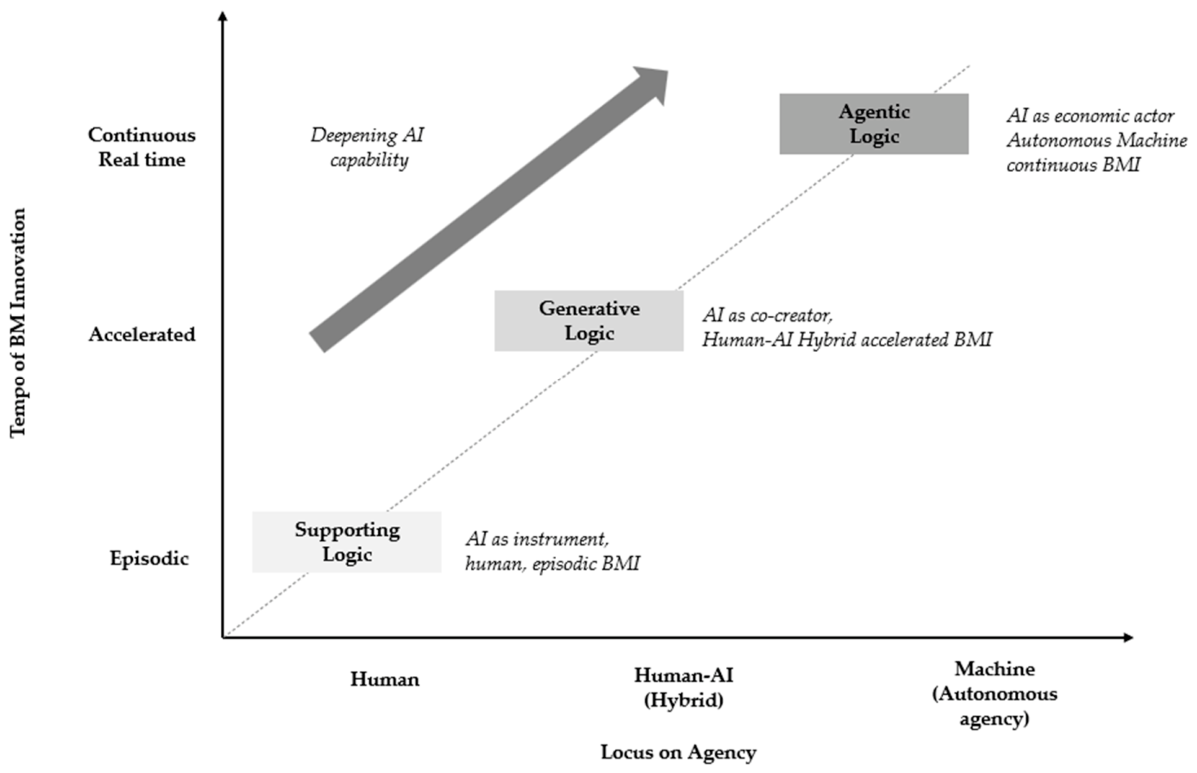

Table 1.
Three logics of AI in business model innovation.
| Dimension | Supporting logic (AI as instrument) | Generative logic (AI as co-creator) | Agentic logic (AI as economic actor) |
| Role in BMI | Augments human sensing and analysis | Participates in generating value propositions | Executes and operates parts of the model |
| Value creation | Better-informed human design | Human–AI co-creation of scalable, personalized offers | Autonomous creation and delivery of value |
| Value capture | Efficiency and improved decisions | Personalization at low marginal cost | Orchestration and monetization of autonomous action |
| Locus of agency | Human | Human–AI hybrid | Predominantly machine (bounded) |
| Tempo of innovation | Episodic, with faster analysis | Accelerated and iterative | Continuous or real-time |
| Illustrative technologies | Predictive analytics, BDA capabilities | LLMs, foundation models, generative design | Tool-using autonomous agents, multi-agent systems |
| Representative work | [10,11,12] | [13,14,15] | [16,17,18] |
Table 2.
A research agenda for generative and agentic AI in business model innovation.
| Research theme | Illustrative research questions | Promising methods and data |
| Value creation and capture | How do capture mechanisms change as personalization approaches zero marginal cost? When do outcome-based and agent-mediated models become viable? |
Case studies; business-model taxonomy building; econometric analysis of pricing and margins |
| Agency and human–AI configuration | Which design and operating decisions can be delegated safely? How can oversight be preserved without eliminating speed? |
Field and lab experiments; configurational (fsQCA) analysis; design-science artifacts |
| Governance, accountability, legitimacy | How can accountability be embedded in agentic architectures? How does regulation shape viable configurations and stakeholder legitimacy? | Multiple-case comparison; policy and regulatory analysis; stakeholder and legitimacy studies |
| Capabilities and organizational design | Which capabilities in curation, evaluation, data stewardship, and agent governance matter? How do roles and decision rights change? | Survey scale development; longitudinal and process studies; qualitative capability mapping |
| Measurement, data, and methods | How can agency allocation, BMI tempo, and generative or agentic capability be measured reliably and at scale? | Large-scale text mining; multi-agent simulation; panel construction; field experiments |
Disclaimer/Publisher’s Note: The statements, opinions and data contained in all publications are solely those of the individual author(s) and contributor(s) and not of MDPI and/or the editor(s). MDPI and/or the editor(s) disclaim responsibility for any injury to people or property resulting from any ideas, methods, instructions or products referred to in the content. |
© 2026 by the authors. Licensee MDPI, Basel, Switzerland. This article is an open access article distributed under the terms and conditions of the Creative Commons Attribution (CC BY) license (http://creativecommons.org/licenses/by/4.0/).
Copyright: This open access article is published under a Creative Commons CC BY 4.0 license, which permit the free download, distribution, and reuse, provided that the author and preprint are cited in any reuse.