
Submitted:
08 September 2026
Posted:
10 September 2026
You are already at the latest version
Abstract
Intimate partner violence (IPV) against women is a prevalent public health and human rights concern. However, evidence regarding the role of resilience remains limited. The aim of this study was to examine the association between resilience and IPV. Additionally, we examined the association between several sociodemographic characteristics and IPV. A cross-sectional study was conducted in Greece in August 2026 using a convenience sample. IPV was assessed with the Woman Abuse Screening Tool, while resilience was measured using the Brief Resilience Scale. Sociodemographic characteristics included age, marital status, children, educational level, employment status, and financial status. Multivariable analysis showed that resilience was associated with lower levels of IPV. Age moderated the association between resilience and IPV; with stronger associations observed among Generation X and Millennials than among Generation Z. Younger age was associated with higher levels of IPV. Women with children, lower educational attainment, and unemployment reported significantly higher IPV scores. In conclusion, resilience is independently associated with lower levels of IPV. The protective effect of resilience appears to strengthen with increasing age. Moreover, younger age, parenthood, lower educational attainment, and unemployment are associated with greater IPV exposure. Resilience-building interventions may be particularly beneficial in efforts to prevent and address IPV.
Keywords:
intimate partner violence
; domestic violence
; abuse
; women
; resilience
; predictors
; factors
1. Introduction
Intimate partner violence (IPV) is one of the most prevalent forms of violence against women and constitutes a major public health, human rights, and social justice concern worldwide (Oram et al., 2022). The World Health Organization estimates that approximately one in three women experience physical and/or sexual violence during their lifetime, most often perpetrated by a current or former intimate partner (World Health Organization, 2026). IPV encompasses emotional, physical, and sexual violence, as well as coercive and controlling behaviors that undermine women's autonomy, safety, and well-being (Khan & Akram, 2025). Exposure to IPV has been consistently associated with a wide range of adverse physical and psychological outcomes, including injuries, chronic health conditions, depression, anxiety, post-traumatic stress disorder, suicidal ideation, substance misuse, and reduced quality of life (Choudhury et al., 2025; Gallegos et al., 2021; Lohmann et al., 2024; Spencer, 2026).
Although earlier IPV research primarily focused on risk factors (Bellot et al., 2024; Capaldi et al., 2012; Khan & Akram, 2025; Song et al., 2026; Yakubovich et al., 2018) and negative outcomes (Choudhury et al., 2025; Gallegos et al., 2021; Lohmann et al., 2024; Spencer, 2026), contemporary scholarship should seek to recognize protective factors against IPV. Within this context, resilience has emerged as a central construct. Resilience is generally defined as the capacity to maintain or regain positive functioning despite exposure to significant adversity, trauma, or stress (American Psychological Association, 2026; Reid & Botterill, 2013). Theoretical work conceptualized resilience as a protective mechanism that enables individuals to achieve positive adaptation under conditions of risk (Pearson et al., 2025; Rutter, 1987; Southwick et al., 2014). Subsequent advances defined resilience as a dynamic developmental process shaped by ongoing interactions between individuals and their environments rather than as a stable personal trait (Luthar et al., 2000; Masten, 2001; Ungar, 2011).
Additionally, the Resilience Theory proposes that adaptive outcomes in the face of adversity are facilitated by the presence of protective resources operating at individual, interpersonal, and environmental levels. According to this theory, resilience develops through the mobilization of psychological strengths, coping skills, social support, self-efficacy, and other protective factors that buffer the impact of stressors and promote successful adaptation (Luthar et al., 2000; Masten, 2001; Ungar, 2011). Applied to IPV, Resilience Theory could suggest that women with greater resilience may be more capable of utilizing adaptive coping strategies, seeking support from social networks, recognizing abusive relationship patterns, and managing the psychological consequences of victimization. Empirical evidence supports this perspective, demonstrating that resilience is associated with lower psychological distress, reduced trauma-related symptoms, improved well-being, and greater recovery among women who have experienced IPV (Castiglioni et al., 2023; Fernández Álvarez et al., 2022; Howell et al., 2018).
Our study is further informed by the Social-Ecological Model, which conceptualizes IPV as a multidimensional phenomenon resulting from the interaction of factors operating at individual, relational (interpersonal), community, and societal (structural) levels (Heise, 1998; Ogolsky et al., 2026). The Social-Ecological Model suggests that IPV cannot be attributed to a single cause but rather emerges from a complex interplay of personal characteristics, relationship dynamics, social environments, and structural influences. In particular, individual-level factors include personal history (e.g., childhood exposure to abuse or trauma), mental health issues (e.g., depression, substance use), psychological resources (e.g., anger management, resilience), and sociodemographic factors (e.g., age, educational level). Within this framework, resilience may represent an important individual-level protective factor, whereas sociodemographic characteristics reflect influences operating across multiple ecological levels. Factors such as age, marital status, parenthood, educational attainment, employment status, and economic status may affect women's vulnerability to IPV.
Furthermore, the Life Course Theory posits that human development is shaped by age-graded transitions, social roles, historical contexts, and the accumulation of experiences across the lifespan (Elder, 1998). Central to this perspective is the assumption that psychological resources, coping capacities, and adaptive processes evolve over time. Individuals acquire experiences and develop strategies that influence how they respond to future challenges, meaning that resilience itself may change across different stages of life. Older women may possess greater emotional regulation skills, stronger social networks, increased economic independence, and more extensive life experience, all of which may enhance the effectiveness of resilience in negative outcomes such as IPV. Conversely, younger women may face developmental, economic, and relational challenges that reduce the protective benefits of resilience.
From an integrated theoretical perspective, Resilience Theory, Life Course Theory, and the Social-Ecological Model collectively suggest that resilience should be associated with lower levels of IPV, and this association may vary according to age. Examining resilience and sociodemographic factors simultaneously may therefore provide a more comprehensive understanding of women's experiences of IPV and identify potential targets for prevention and intervention efforts.
Despite the considerable public health burden of IPV against women, evidence regarding its predictors in Greece remains scarce. To the best of our knowledge, no study has comprehensively examined the factors associated with IPV among women in the Greek population. Furthermore, although resilience has been increasingly recognized as a protective psychological resource that may help individuals cope with adversity, the evidence examining its association with IPV against women is limited. Moreover, little is known about whether the protective role of resilience varies across different age groups. In this context, important gaps remain in understanding the factors associated with IPV among Greek women and the potential role of resilience. The present study aimed to investigate the association between resilience, sociodemographic characteristics and IPV against women in Greece. Additionally, this study examined whether age moderates the association between resilience and IPV, thereby providing insight into potential age-related differences in the protective effect of resilience against experiences of IPV. In brief, we formulated the following hypotheses:
Hypothesis 1.
Higher levels of resilience will be associated with lower levels of IPV.
Hypothesis 2.
Age will moderate the association between resilience and IPV, such that the strength of the association between resilience and IPV will differ across age groups.
Hypothesis 3.
Sociodemographic characteristics such as age, marital status, parenthood, educational level, employment status, and financial status will be associated with levels of IPV.
2. Materials and Methods
2.1. Study Design
A cross-sectional study was conducted in Greece in August 2026 using an online survey design. Data were collected through a structured questionnaire created with Google Forms and disseminated via various social media platforms, such as Facebook, Instagram, TikTok, and LinkedIn. The study targeted women with internet access who were active users of social media. The survey link was shared on publicly accessible online pages and circulated through both personal and professional networks on social media platforms. To increase participant engagement and broaden the survey’s reach, recruitment posts were reposted periodically over a four-day period. No monetary compensation or other incentives were offered for participation. Participation was voluntary, and respondents self-selected into the study by accessing the survey link and completing the questionnaire. Inclusion criteria required participants to be female, to have been involved in an intimate relationship for at least the previous 12 months, and to provide informed consent prior to participation. A non-probability convenience sampling approach was employed; consequently, the final sample consisted of women recruited through convenience sampling. The study was conducted and reported in accordance with the Strengthening the Reporting of Observational Studies in Epidemiology (STROBE) guidelines (Von Elm et al., 2008).
To minimize the risk of selection bias, the participant information sheet presented the study as an investigation of intimate partner relationships rather than explicitly identifying its focus on abusive behaviors toward women. This strategy was implemented to promote participation among women irrespective of their experiences with violence, thereby reducing the likelihood of selectively attracting individuals with a history of victimization. By encouraging a more diverse range of participants, the approach aimed to enhance the representativeness of the sample and mitigate the potential overrepresentation of violence survivors. Consequently, the risk of overestimating the prevalence of abusive behaviors within the study population was reduced.
Sample size estimation was conducted using G*Power software (version 3.1.9.2). Based on a multivariable analytical model comprising seven variables, the minimum required sample size was calculated assuming a conservative small effect size (Cohen’s effect size = 0.03), a significance level (α) of 0.05, and a statistical power of 99%. Under these assumptions, a minimum sample of 436 women was required.
2.2. Measurements
Data on women sociodemographic characteristics were collected, including age (continuous variable), marital status (living alone/married/living with partner), children (continuous variable), educational level (elementary school/high school/college degree), and employment status (employees or not) were measured. Perceived financial status was assessed using a self-reported scale ranging from 0 (very poor) to 10 (excellent).
Resilience was assessed using the Brief Resilience Scale (BRS), a six-item self-report measure designed to evaluate an individual’s ability to recover from stress and adversity (Smith et al., 2008). Responses were rated on a five-point Likert scale, ranging from strongly disagree (1) to strongly agree (5). Total BRS scores range from 1 to 5, with higher scores reflecting greater levels of resilience. The validated Greek version of the scale was employed in the present study (Kyriazos et al., 2018). In the current sample, the BRS demonstrated satisfactory internal consistency, with a Cronbach’s alpha coefficient of 0.754.
We used the Woman Abuse Screening Tool (WAST) to measure levels of women violence by their partner (Brown et al., 1996, 2000). The WAST enables the detection of emotional, physical, and sexual violence among women in intimate relationships, allowing for early intervention and referral to specialized support and assistance services. The WAST includes eight items with answers on a three-point Likert scale; never (0), sometimes (1), often (2). Total score ranges from 0 to 16. We used the valid Greek version of the WAST (Vivilaki et al., 2010). The Cronbach's alpha for the WAST was 0.746 in our sample indicating good reliability.
2.3. Ethical Issues
The study protocol received ethical approval from the Ethics Committee of the Faculty of Nursing, National and Kapodistrian University of Athens (Approval No. 82/17.06.2026). The study was conducted in accordance with the ethical principles outlined in the Declaration of Helsinki (World Medical Association, 2013). Participation was voluntary and anonymous. Prior to enrolment, potential participants were provided with detailed information regarding the study objectives, procedures, voluntary nature of participation, and their right to withdraw from the study at any time without penalty. Electronic informed consent was obtained from all participants before access to the questionnaire was granted, through the selection of an “I agree to participate” option.
2.4. Statistical Analysis
Categorical variables are summarized using absolute (n) and relative (%) frequencies, whereas continuous variables were described using means, standard deviations (SD), medians, interquartile ranges (IQR), minimum values and maximum values. The distribution of continuous variables was assessed using the Kolmogorov-Smirnov test in conjunction with visual inspection of Q-Q plots, confirming normality. We used BRS score and sociodemographic variables as independent variables. We used the WAST score as the dependent variable. Initially, univariate associations were examined through univariate linear regression. Subsequently, a final multivariable linear regression model was constructed to estimate the independent effect of predictors, adjusting for potential confounding factors. Moderation analysis was performed to examine if age is a moderator in the association between resilience and WAST scores. In that case, to avoid multicollinearity, we centered the independent variable (resilience) and the moderator variable (age) (Iacobucci et al., 2017). In particular, “centered” variable of resilience was obtained by subtracting the mean resilience score from each individual resilience score value. Similarly, “centered” variable of age was obtained by subtracting the mean age from each individual age. Statistically significant regression coefficient for the interaction term indicated the presence of moderation. Additionally, slope analysis was performed to clarify the direction and magnitude of the moderating effects introduced by age (Aiken & West, 1991). In that case, we categorized women into generational groups: Generation Z (1997-2012), Millennials (1981-1996), and Generation X (1965-1980) (Dimock, 2019). Regression findings are presented as unadjusted and adjusted unstandardized regression coefficients (B), corresponding 95% confidence intervals (CIs), standardized beta coefficients, p-values, adjusted R2, and variance inflation factors (VIFs). VIFs greater than five is cause for concern, and VIFs greater than ten indicate a serious collinearity problem (Vittinghoff et al., 2012). VIFs in the final multivariable model ranged from 1.128 to 1.637 (see results) satisfying the suggested guidelines. The assumptions underlying multivariable linear regression were further evaluated through graphical diagnostics. Histograms of standardized residuals were examined to assess residual normality, while scatterplots of residuals against predicted values were inspected to evaluate homoscedasticity and linearity. Statistical significance was defined as a two-sided p-value < 0.05. All analyses were conducted using IBM SPSS Statistics for Windows, version 28.0 (IBM Corp., Armonk, NY, USA).
3. Results
3.1. Sociodemographic Characteristics
A comprehensive overview of the women sociodemographic characteristics is provided in Table 1. The study sample consisted of 503 women. Women had a mean age of 36.53 years (SD = 9.48), with a median age of 37 years (IQR = 16). Ages ranged from 19 to 74 years. Regarding marital status, the majority of women were either married or cohabiting with a partner (60.6%), while 39.4% were living alone. Additionally, 44.9% of the women reported having children. In terms of educational attainment, 50.5% of participants held a college degree, whereas 49.5% had completed secondary education (high school). Most women (92.4%) were employed at the time of the study. Self-reported financial status yielded a mean score of 6.36 (SD = 1.54), with a median score of 7 (IQR = 2). Reported financial status ranged from 0 to 10.
3.2. Study Scales
The mean WAST score was 4.80 (SD = 4.04), with a median value of 3 (IQR = 6). WAST scores ranged from 0 to 12. Skeweness for the WAST score was 0.716, while kurtosis was -0.897. The mean BRS score was 3.41 (SD = 0.78), with a median value of 3.50 (IQR = 1.17). BRS scores ranged from 1.33 to 5.
3.3. Dependent Variable: Intimate Partner Violence Against Women
Univariate linear regression analyses examining the association between sociodemographic variables, resilience, and WAST scores are presented in Table 2.
Table 3 shows the final multivariable linear regression model with score on the WAST as the dependent variable.
Regarding sociodemographic characteristics, we found that age, children, educational level and employment status are associated with WAST scores. In particular, younger age was associated with higher WAST scores (adjusted B = -0.085; 95% CI: -0.123 to -0.048; p < 0.001). Also, women with children reported significantly higher abuse scores than those without children (adjusted B = 1.163; 95% CI: 0.641 to 2.086; p < 0.001). Lower educational level was associated with higher WAST scores since women without a college degree have abuse scores that are approximately 4.1 points higher than women with a college degree (adjusted B = 4.077; 95% CI: 3.448 to 4.707; p < 0.001). Additionally, unemployed women have abuse scores approximately 1.5 points higher than employed women (adjusted B = 1.499; 95% CI: 0.324 to 2.674; p = 0.013).
Multivariable analysis identified that lower resilience is independently associated with higher abuse scores (adjusted B = -0.918; 95% CI: -1.317 to -0.518; p < 0.001). In other words, women with lower levels of resilience have also experienced higher levels of IPV. Specifically, each one-point decrease in resilience was associated with a 0.918-point increase in WAST scores.
Interaction between age and resilience was statistically significant, and, thus, the effect of resilience on WAST scores depends on age (adjusted B = -0.051; 95% CI: -0.091 to -0.011; p = 0.012). In the final multivariable model without the interaction term, 36.7% of the variance in the WAST scores was explained by the independent variables (adjusted R2 = 36.7%, p-value for ANOVA < 0.001). By adding the interaction term (age X resilience), an additional 0.6% of the variance was explained, increasing the total explained variance to 37.3% (adjusted R2 = 37.3%, p-value for ANOVA < 0.001). This finding showed that age moderates the association between resilience and WAST scores. Our findings indicated that the protective effect of resilience becomes stronger as age increases. In particular, multivariable linear regression analysis showed a stronger association between resilience and WAST scores among Generation X (adjusted B = -1.621; 95% CI: -2.434 to -0.809; p < 0.001, adjusted R2 = 39.7%), and millennials (adjusted B = -1.001; 95% CI: -1.538 to -0.464; p < 0.001, adjusted R2 = 49.7%) compared to Generation Z (adjusted B = -0.767; 95% CI: -1.596 to 0.063; p = 0.070, adjusted R2 = 23.0%). Also, simple slopes analysis showed the direction of the moderating effect of age on the association between resilience and WAST scores (Figure 1). As Figure 1 shows, all lines slope downward, while the downward slopes for Generation X and millennials are steepest, and the downward slope for Generation Z is weakest.
Supplementary Figure S1 demonstrates that the assumption of multivariate normality was covered, as the residuals align with a normal distribution, while Supplementary Figure S2 supports the assumptions of homoscedasticity and linearity for the final multivariable model.
4. Discussion
The present study examined the association between resilience and IPV among Greek women, investigated the moderating role of age in this association, and explored the associations between several sociodemographic characteristics and IPV.
Multivariable analysis showed that resilience is independently associated with lower levels of IPV. Specifically, women reporting lower resilience exhibited significantly higher WAST scores, even after adjustment for age, parenthood, educational attainment, employment status, marital status, and financial status. We should notice that our findings extend previous resilience research in IPV, which has predominantly focused on psychological adjustment among IPV survivors. This distinction is important because it highlights the potential role of resilience not only in recovery following IPV but also in reducing vulnerability to abusive relationship experiences. Previous studies have shown that resilient women survivors of IPV are more likely to demonstrate adaptive coping strategies, maintain self-efficacy, mobilize social support, and preserve psychological functioning despite exposure to IPV. In particular, the existing literature has examined resilience as a factor associated with lower depression, anxiety, post-traumatic stress symptoms, and emotional distress among women who have already experienced IPV (Akinbode & Carter, 2026; K. M. Anderson et al., 2022; Fernández Álvarez et al., 2022; Howell et al., 2018; Tini & Sakiz, 2026; Yıldız-Akyol & Öztemel, 2025). Several mechanisms may explain the observed association between resilience and IPV. Women with higher resilience may possess greater emotional regulation capacities, stronger problem-solving abilities, and higher confidence in their ability to manage challenging interpersonal situations. These characteristics may facilitate the recognition of unhealthy relationship dynamics, increase help-seeking behaviors, and strengthen the capacity to establish personal boundaries. Furthermore, resilient individuals often maintain stronger social connections and support networks, which may provide both emotional and practical resources when responding to abusive relationships. Collectively, these factors may reduce vulnerability to coercive and controlling behaviors and contribute to lower levels of IPV exposure (Howell et al., 2018; Mantler et al., 2022; Moeller-Saxone et al., 2015).
Our findings showed that younger age was independently associated with higher levels of IPV. Moreover, moderation analysis identified the moderating effect of age on the association between resilience and IPV. Although higher resilience was associated with lower IPV scores across the sample, the magnitude of this association became progressively stronger with increasing age. In particular, resilience demonstrated the strongest protective association among Generation X women, a moderate association among Millennials, and the weakest association among Generation Z women. These results suggest that the protective benefits of resilience are not uniform across the lifespan and may depend upon age-related developmental and social processes. A life-course perspective may help explain these findings. Resilience develops through the accumulation of experiences, skills, and resources over time (Howell et al., 2018; Rutter, 2012). Older women may have had greater opportunities to develop adaptive coping mechanisms, emotional regulation strategies, interpersonal competence, and self-efficacy through exposure to diverse life challenges. As a result, resilience may be more readily translated into protective behaviors that reduce vulnerability to abusive relationships. For example, resilient older women may be more likely to recognize early warning signs of abuse, challenge controlling behaviors, seek professional assistance, or leave harmful relationships when necessary. These accumulated psychosocial resources may strengthen the protective impact of resilience against IPV (Mantler et al., 2022; Moeller-Saxone et al., 2015). On the other hand, younger women may experience barriers that limit the extent to which resilience can protect against IPV. Compared with older women, younger women often have less relationship experience, reduced economic independence, and smaller social support networks. Younger women may also encounter greater peer influence, stronger emotional dependence within relationships, and difficulties identifying subtle forms of psychological abuse. Consequently, even resilient younger women may remain vulnerable to IPV because resilience alone may be insufficient to offset broader developmental and social risk factors. This interpretation is supported by research demonstrating that younger age is consistently associated with elevated risk of IPV and that developmental context plays an important role in shaping resilience trajectories (Aksoy et al., 2023; Coll et al., 2023; Johns et al., 2020; Ma et al., 2023; Stöckl et al., 2014).
In our study, women with children reported significantly higher IPV scores than women without children. Evidence supports this finding since women with children have higher probability of experiencing IPV (Molina et al., 2025; Peek-Asa et al., 2017). Several explanations may account for this association. Parenthood may increase financial dependence, relationship complexity, and barriers to relationship dissolution (D. K. Anderson & Saunders, 2003; Doss et al., 2009; Thielemans & Mortelmans, 2022). Women with children may remain in abusive relationships because of concerns regarding their children's wellbeing, economic security, housing stability, and potential custody-related challenges following separation (Lapierre, 2010). Mothers experiencing IPV frequently face difficult decisions balancing their own safety against concerns about disrupting their children's lives and financial circumstances. Moreover, women with caregiving responsibilities may have fewer opportunities to seek support services or leave abusive relationships due to practical and economic constraints (Kaittila et al., 2024). Research has additionally demonstrated that parenting-related stressors, financial strain, and increased family demands may contribute to relationship conflict and psychological distress, potentially exacerbating abusive relationship dynamics (Lapierre, 2010).
Additionally, we found a negative association between educational attainment and levels of IPV. Literature supports this finding since several studies found that higher educational level decreases levels of IPV (Ackerson et al., 2008; Amegbor & Rosenberg, 2019; Armah-Ansah et al., 2025; Molina et al., 2025; Sanz-Barbero et al., 2019; Stöckl et al., 2014; Weitzman, 2018). Similarly, a meta-analysis of prospective longitudinal studies showed that lower parental education and socioeconomic disadvantage were significant risk factors for subsequent IPV (Yakubovich et al., 2018). Education may provide protective benefits through several pathways, including increased economic opportunities, greater health literacy, enhanced access to resources, and stronger empowerment in interpersonal relationships. Higher educational attainment may also contribute to increased awareness of abusive behaviors and available support services, thereby reducing vulnerability to IPV.
Moreover, unemployed women reported significantly higher IPV levels than employed women. Our finding is supported by the literature since several studies in United Kingdom, USA, Germany, Brazil, and South Africa show the negative impact of women’s unemployment on IPV (Anderberg et al., 2016; Bhalotra et al., 2025; Mmaphuti Percy & Rossaline Ndhlovu, 2025; Molina et al., 2025; Moore et al., 2024; Peterson, 2011) Employment may represent an important protective factor because it enhances financial independence, social integration, self-esteem, and access to external support networks. In contrast, unemployment may increase economic dependence on abusive partners and reduce opportunities to seek support or exit violent relationships.
Several limitations should be considered when interpreting the findings of this study. First, the cross-sectional design precludes any conclusions regarding causality or temporal associations between resilience and IPV. Although lower resilience was associated with higher levels of IPV, it remains unclear whether low resilience increases vulnerability to IPV, whether exposure to IPV diminishes resilience, or whether the association is bidirectional. Longitudinal studies are therefore needed to clarify the directionality of these associations. Second, the study employed a non-probability convenience sampling strategy and recruited women through social media platforms. Consequently, women without internet access, those who do not actively use social media, and women less willing to participate in online surveys may have been underrepresented. Although efforts were made to minimize selection bias by describing the survey as a study of intimate partner relationships rather than abuse, the possibility of sampling bias cannot be completely excluded. Accordingly, the representativeness of the sample and the generalizability of the findings to the broader population of women in Greece may be limited. Third, all study variables were assessed through self-report measures, making the findings susceptible to recall bias and social desirability bias. Given the sensitive nature of IPV, some women may have underreported abusive experiences, potentially resulting in an underestimation of the true burden of violence. Fourth, the study was conducted exclusively in Greece. Cultural norms regarding gender roles, family relationships, social support, and help-seeking behaviors vary substantially across countries. Consequently, caution is warranted when generalizing these findings to women living in different sociocultural contexts. Similar studies in other countries could provide essential evidence on the association between resilience and IPV. Fifth, resilience was assessed using a global measure of the ability to "bounce back" from adversity. Resilience is a multidimensional construct encompassing psychological, interpersonal, community, and cultural dimensions. Future studies employing more comprehensive resilience frameworks may provide deeper insight into the specific resilience mechanisms that protect against IPV. Finally, although several sociodemographic characteristics were measured and considered during statistical analyses, several other predictors remain possible. Important factors such as mental health status, depression, anxiety, social support, substance use, childhood adversity, relationship characteristics, previous victimization experiences, partner-related factors, and personality traits were not assessed and may have influenced levels of IPV among women.
5. Conclusions
This study demonstrates that resilience is independently associated with lower levels of IPV against women in Greece. Women who were younger, had children, had lower educational attainment, and were unemployed reported significantly higher levels of IPV, highlighting the importance of sociodemographic factors in shaping vulnerability to IPV. Importantly, age moderates the association between resilience and IPV, indicating that the protective effect of resilience varies across generations. The association between higher resilience and lower abuse scores was strongest among Generation X women and Millennials, whereas it was weaker among Generation Z women. These findings suggest that resilience may function as a particularly important protective resource against IPV among older women.
Overall, the results underscore the need for prevention and intervention strategies that strengthen resilience while addressing broader social determinants associated with IPV risk. Public health initiatives and support services should adopt age-sensitive approaches, recognizing that the role of resilience in mitigating IPV may differ across generational groups. Longitudinal studies are warranted to clarify causal pathways and to further examine how resilience can be enhanced to reduce the burden of IPV among women.
Supplementary Materials
The following supporting information can be downloaded at the website of this paper posted on Preprints.org. Figure S1: Histogram of the residuals with score on the Woman Abuse Screening Tool as the dependent variable in the final multivariable linear regression model including interaction term (age X resilience); Figure S2: Scatterplot of residuals versus predicted values with score on the Woman Abuse Screening Tool as the dependent variable in the final multivariable linear regression model including interaction term (age X resilience).
Author Contributions
Conceptualization, A.Ka., I.M. and P.G.; methodology, A.Ka., I.M., M.S and P.G.; software, A.Ka. and P.G.; validation, A.Ka., I.M., M.S., P.S. and P.G.; formal analysis, A.Ka. and P.G.; investigation, A.Ka., I.M., M.S., P.P., P.S., I.D., A.Ko., M.T., A.T. and P.G; resources, A.Ka., I.M., M.S., P.P., P.S., I.D., A.Ko., M.T., A.T. and P.G.; data curation, A.Ka., I.M., M.S., P.P., P.S., I.D., A.Ko., M.T., A.T. and P.G.; writing—original draft preparation, A.Ka., I.M., M.S., P.P., P.S., I.D., A.Ko., M.T., A.T. and P.G.; writing—review and editing, A.Ka., I.M., M.S., P.P., P.S., I.D., A.Ko., M.T., A.T. and P.G.; visualization, A.Ka., I.M., M.S. and P.G.; supervision, I.M. and P.G.; project administration, I.M. and P.G. All authors have read and agreed to the published version of the manuscript.
Funding
The research is conducted in the operating framework of the University of Thessaly Innovation, Technology Transfer Unit and Entrepreneurship Center "One Planet Thessaly", under the “University of Thessaly Grants for Scientific Publication Support” action and is funded by the Special Account of Research Grants of the University of Thessaly.
Institutional Review Board Statement
The study was conducted in accordance with the Declaration of Helsinki, and approved by the Ethics Committee of the Faculty of Nursing, National and Kapodistrian University of Athens (Approval No. 82/17.06.2026).
Informed Consent Statement
Informed consent was obtained from all subjects involved in the study.
Data Availability Statement
The original data presented in the study are openly available in FigShare at https://doi.org/10.6084/m9.figshare.33343584.
Acknowledgments
The research is conducted in the operating framework of the University of Thessaly Innovation, Technology Transfer Unit and Entrepreneurship Center "One Planet Thessaly", under the “University of Thessaly Grants for Scientific Publication Support” action and is funded by the Special Account of Research Grants of the University of Thessaly.
Conflicts of Interest
The authors declare no conflicts of interest.
Abbreviations
The following abbreviations are used in this manuscript:
| BRS | Brief Resilience Scale |
| CI | Confidence interval |
| IPV | Intimate partner violence |
| IQR | Interquartile range |
| SD | Standard deviation |
| STROBE | Strengthening the Reporting of Observational Studies in Epidemiology |
| VIF | Variance inflation factor |
| WAST | Woman Abuse Screening Tool |
References
- Ackerson, L. K.; Kawachi, I.; Barbeau, E. M.; Subramanian, S. V. Effects of individual and proximate educational context on intimate partner violence: A population-based study of women in India. Am. J. Public Health 2008, 98(3), 507–514. [Google Scholar] [CrossRef]
- Aiken, L. S.; West, S. G. Multiple regression: Testing and interpreting interactions; SAGE, 1991. [Google Scholar]
- Akinbode, T. D.; Carter, M. L. Exploring the Resilience, Strengths, Coping Strategies, and Cultural Influences in African Families Impacted by Intimate Partner Violence: A Scoping Review. Trauma Violence Abus. 2026, 27(2), 377–390. [Google Scholar] [CrossRef]
- Aksoy, D.; Simões, C.; Favre, C. A. Exposure to Intimate-Partner Violence and Resilience Trajectories of Adolescents: A Two-Wave Longitudinal Latent Transition Analysis. Int. J. Environ. Res. Public Health 2023, 20(9), 5676. [Google Scholar] [CrossRef]
- Amegbor, P. M.; Rosenberg, M. W. What geography can tell us? Effect of higher education on intimate partner violence against women in Uganda. Appl. Geogr. 2019, 106, 71–81. [Google Scholar] [CrossRef]
- American Psychological Association. (2026). Resilience. APA Dictionary of Psychology. https://dictionary.apa.org/resilience.
- Anderberg, D.; Rainer, H.; Wadsworth, J.; Wilson, T. Unemployment and Domestic Violence: Theory and Evidence. Econ. J. 2016, 126(597), 1947–1979. [Google Scholar] [CrossRef]
- Anderson, D. K.; Saunders, D. G. Leaving An Abusive Partner: An Empirical Review of Predictors, the Process of Leaving, and Psychological Well-Being. Trauma Violence Abus. 2003, 4(2), 163–191. [Google Scholar] [CrossRef]
- Anderson, K. M.; Tsuyuki, K.; Fernandez DeSoto, A.; Stockman, J. K. The Effect of Adverse Mental Health and Resilience on Perceived Stress by Sexual Violence History. Int. J. Environ. Res. Public Health 2022, 19(8), 4796. [Google Scholar] [CrossRef]
- Armah-Ansah, E. K.; Adejumo, S. A.; Ezekobe, E. E.; Jalili, A.; Ahmed, S.; Oko-Oboh, E.; Budu, E.; Oga-Omenka, C. A socio-ecological analysis of intimate partner violence among women of reproductive age in Nigeria: A multilevel analysis of data from 2008 to 2018 Nigeria demographic and health surveys. BMC Public Health 2025, 25(1), 3971. [Google Scholar] [CrossRef]
- Bellot, A.; Muñoz-Rivas, M. J.; Botella, J.; Montorio, I. Factors Associated with Revictimization in Intimate Partner Violence: A Systematic Review and Meta-Analysis. Behav. Sci. 2024, 14(2), 103. [Google Scholar] [CrossRef]
- Bhalotra, S.; Britto, D. G. C.; Pinotti, P.; Sampaio, B. Job Displacement, Unemployment Benefits and Domestic Violence. Rev. Econ. Stud. 2025, 92(6), 3649–3681. [Google Scholar] [CrossRef]
- Brown, J. B.; Lent, B.; Brett, P. J.; Sas, G.; Pederson, L. L. Development of the Woman Abuse Screening Tool for use in family practice. Fam. Med. 1996, 28(6), 422–428. [Google Scholar]
- Brown, J. B.; Lent, B.; Schmidt, G.; Sas, G. Application of the Woman Abuse Screening Tool (WAST) and WAST-short in the family practice setting. J. Fam. Pract. 2000, 49(10), 896–903. [Google Scholar]
- Capaldi, D. M.; Knoble, N. B.; Shortt, J. W.; Kim, H. K. A Systematic Review of Risk Factors for Intimate Partner Violence. Partn. Abus. 2012, 3(2), 231–280. [Google Scholar] [CrossRef]
- Castiglioni, M.; Caldiroli, C. L.; Manzoni, G. M.; Procaccia, R. Does resilience mediate the association between mental health symptoms and linguistic markers of trauma processing? Analyzing the narratives of women survivors of intimate partner violence. Front. Psychol. 2023, 14, 1211022. [Google Scholar] [CrossRef]
- Choudhury, A. A.; Martland, N.; Luzon, O. Women’s Experiences of Coercive Control in Intimate Partner Relationships: A Qualitative Systematic Review. J. Fam. Violence 2025. [Google Scholar] [CrossRef]
- Coll, C. V. N.; Wendt, A.; Santos, T. M.; Bhatia, A.; Barros, A. J. D. Cross-National Associations between Age at Marriage and Intimate Partner Violence among Young Women: An Analysis of Demographic and Health Surveys from 48 Countries. Int. J. Environ. Res. Public Health 2023, 20(4), 3218. [Google Scholar] [CrossRef]
- Dimock, M. (2019, January 17). Defining generations: Where Millennials end and Generation Z begins. Pew Research Center. https://www.pewresearch.org/short-reads/2019/01/17/where-millennials-end-and-generation-z-begins/.
- Doss, B. D.; Rhoades, G. K.; Stanley, S. M.; Markman, H. J. The effect of the transition to parenthood on relationship quality: An 8-year prospective study. J. Personal. Soc. Psychol. 2009, 96(3), 601–619. [Google Scholar] [CrossRef]
- Elder, G. H. The Life Course as Developmental Theory. Child Dev. 1998, 69(1), 1–12. [Google Scholar] [CrossRef]
- Fernández Álvarez, N.; Fontanil Gómez, Y.; Alcedo Rodríguez, Á. Resilience and associated factors in women survivors of Intimate Partner Violence: A systematic review. An. De Psicol. 2022, 38(1), 177–190. [Google Scholar] [CrossRef]
- Gallegos, A. M.; Trabold, N.; Cerulli, C.; Pigeon, W. R. Sleep and Interpersonal Violence: A Systematic Review. Trauma Violence Abus. 2021, 22(2), 359–369. [Google Scholar] [CrossRef]
- Heise, L. L. Violence Against Women: An Integrated, Ecological Framework. Violence Against Women 1998, 4(3), 262–290. [Google Scholar] [CrossRef]
- Howell, K. H.; Thurston, I. B.; Schwartz, L. E.; Jamison, L. E.; Hasselle, A. J. Protective Factors associated with Resilience in Women Exposed to Intimate Partner Violence. Psychol. Violence 2018, 8(4), 438–447. [Google Scholar] [CrossRef]
- Iacobucci, D.; Schneider, M. J.; Popovich, D. L.; Bakamitsos, G. A. Mean centering, multicollinearity, and moderators in multiple regression: The reconciliation redux. Behav. Res. Methods 2017, 49(1), 403–404. [Google Scholar] [CrossRef]
- Johns, M. M.; Lowry, R.; Haderxhanaj, L. T.; Rasberry, C. N.; Robin, L.; Scales, L.; Stone, D.; Suarez, N. A. Trends in Violence Victimization and Suicide Risk by Sexual Identity Among High School Students—Youth Risk Behavior Survey, United States, 2015-2019. MMWR Suppl. 2020, 69(1), 19–27. [Google Scholar] [CrossRef]
- Kaittila, A.; Hakovirta, M.; Kainulainen, H. Types of Economic Abuse in Postseparation Lives of Women Experiencing IPV: A Qualitative Study from Finland. Violence Against Women 2024, 30(2), 426–444. [Google Scholar] [CrossRef]
- Khan, A.; Akram, M. Understanding and addressing intimate partner violence: A comprehensive review. Philos. Ethics Humanit. Med. PEHM 2025, 20(1), 43. [Google Scholar] [CrossRef]
- Kyriazos, T. A.; Stalikas, A.; Prassa, K.; Galanakis, M.; Yotsidi, V.; Lakioti, A. Psychometric Evidence of the Brief Resilience Scale (BRS) and Modeling Distinctiveness of Resilience from Depression and Stress. Psychology 2018, 09(07), 1828–1857. [Google Scholar] [CrossRef]
- Lapierre, S. More Responsibilities, Less Control: Understanding the Challenges and Difficulties Involved in Mothering in the Context of Domestic Violence. Br. J. Soc. Work 2010, 40(5), 1434–1451. [Google Scholar] [CrossRef]
- Lohmann, S.; Cowlishaw, S.; Ney, L.; O’Donnell, M.; Felmingham, K. The Trauma and Mental Health Impacts of Coercive Control: A Systematic Review and Meta-Analysis. Trauma Violence Abus. 2024, 25(1), 630–647. [Google Scholar] [CrossRef]
- Luthar, S. S.; Cicchetti, D.; Becker, B. The Construct of Resilience: A Critical Evaluation and Guidelines for Future Work. Child Dev. 2000, 71(3), 543–562. [Google Scholar] [CrossRef]
- Ma, N.; Chen, S.; Kong, Y.; Chen, Z.; Geldsetzer, P.; Zeng, H.; Wu, L.; Wehrmeister, F. C.; Lu, C.; Subramanian, S. V.; Song, Y.; Li, Z. Prevalence and changes of intimate partner violence against women aged 15 to 49 years in 53 low-income and middle-income countries from 2000 to 2021: A secondary analysis of population-based surveys. Lancet. Glob. Health 2023, 11(12), e1863–e1873. [Google Scholar] [CrossRef]
- Mantler, T.; Shillington, K. J.; Yates, J.; Tryphonopoulos, P.; Jackson, K. T.; Ford-Gilboe, M. Resilience is more than Nature: An Exploration of the Conditions that Nurture Resilience Among Rural Women who have Experienced IPV. J. Fam. Violence 2022, 1–11. [Google Scholar] [CrossRef]
- Masten, A. S. Ordinary magic: Resilience processes in development. Am. Psychol. 2001, 56(3), 227–238. [Google Scholar] [CrossRef]
- Mmaphuti Percy, D.; Rossaline Ndhlovu, G. The impact of women’s unemployment and income disparities on intimate partner violence. Environ. Soc. Psychol. 2025, 10(4). [Google Scholar] [CrossRef]
- Moeller-Saxone, K.; Davis, E.; Stewart, D. E.; Diaz-Granados, N.; Herrman, H. Promoting resilience in adults with experience of intimate partner violence or child maltreatment: A narrative synthesis of evidence across settings. J. Public Health 2015, 37(1), 125–137. [Google Scholar] [CrossRef]
- Molina, S.; Wagner, L.; Kreyenfeld, M. Women’s economic independence and physical intimate partner violence (IPV) during separation. PLoS ONE 2025, 20(6), e0326529. [Google Scholar] [CrossRef]
- Moore, B. C.; Clements, C.; Turton, E. Intimate Partner Violence Victimization, Mental Health, and Unemployment: Year One of the Covid-19 Pandemic. Violence Against Women 2024, 30(14), 3474–3497. [Google Scholar] [CrossRef]
- Ogolsky, B. G.; Hardesty, J. L.; Carter, M. L. The social-ecological framework for understanding intimate partner violence. Curr. Opin. Psychol. 2026, 68, 102256. [Google Scholar] [CrossRef]
- Oram, S.; Fisher, H. L.; Minnis, H.; Seedat, S.; Walby, S.; Hegarty, K.; Rouf, K.; Angénieux, C.; Callard, F.; Chandra, P. S.; Fazel, S.; Garcia-Moreno, C.; Henderson, M.; Howarth, E.; MacMillan, H. L.; Murray, L. K.; Othman, S.; Robotham, D.; Rondon, M. B.; …; Howard, L. M. The Lancet Psychiatry Commission on intimate partner violence and mental health: Advancing mental health services, research, and policy. Lancet. Psychiatry 2022, 9(6), 487–524. [Google Scholar] [CrossRef]
- Pearson, E.; Sharp, L.; Hampton, L. Resilience in context: A synthesis of theories and practices for educational psychologists. Educ. Psychol. Pract. 2025, 41(4), 439–456. [Google Scholar] [CrossRef]
- Peek-Asa, C.; Saftlas, A. F.; Wallis, A. B.; Harland, K.; Dickey, P. Presence of children in the home and intimate partner violence among women seeking elective pregnancy termination. PLoS ONE 2017, 12(10), e0186389. [Google Scholar] [CrossRef]
- Peterson, R. R. Employment, Unemployment, and Rates of Intimate Partner Violence: Evidence from the National Crime Victim Surveys. In Sociology of Crime, Law and Deviance; Deflem, M., Ed.; Emerald Group Publishing Limited, 2011; pp. 171–193. [Google Scholar] [CrossRef]
- Reid, R.; Botterill, L. C. The Multiple Meanings of ‘Resilience’: An Overview of the Literature. Aust. J. Public Adm. 2013, 72(1), 31–40. [Google Scholar] [CrossRef]
- Rutter, M. Psychosocial resilience and protective mechanisms. Am. J. Orthopsychiatry 1987, 57(3), 316–331. [Google Scholar] [CrossRef]
- Rutter, M. Resilience as a dynamic concept. Dev. Psychopathol. 2012, 24(2), 335–344. [Google Scholar] [CrossRef]
- Sanz-Barbero, B.; Barón, N.; Vives-Cases, C. Prevalence, associated factors and health impact of intimate partner violence against women in different life stages. PLoS ONE 2019, 14(10), e0221049. [Google Scholar] [CrossRef]
- Smith, B. W.; Dalen, J.; Wiggins, K.; Tooley, E.; Christopher, P.; Bernard, J. The brief resilience scale: Assessing the ability to bounce back. Int. J. Behav. Med. 2008, 15(3), 194–200. [Google Scholar] [CrossRef]
- Song, B.; Li, Y.; Liang, Z. Understanding Risk and Protective Factors of Intimate Partner Violence Among Sexual Minority Women: A Systematic Review. Trauma Violence Abus. 2026, 15248380261429513. [Google Scholar] [CrossRef]
- Southwick, S. M.; Bonanno, G. A.; Masten, A. S.; Panter-Brick, C.; Yehuda, R. Resilience definitions, theory, and challenges: Interdisciplinary perspectives. Eur. J. Psychotraumatology 2014, 5(1), 25338. [Google Scholar] [CrossRef]
- Spencer, C. M. Intimate partner violence against women. Curr. Opin. Psychol. 2026, 68, 102222. [Google Scholar] [CrossRef]
- Stöckl, H.; March, L.; Pallitto, C.; Garcia-Moreno, C.; WHO Multi-country Study Team. Intimate partner violence among adolescents and young women: Prevalence and associated factors in nine countries: a cross-sectional study. BMC Public Health 2014, 14, 751. [Google Scholar] [CrossRef]
- Thielemans, G.; Mortelmans, D. Poverty Risks after Relationship Dissolution and the Role of Children: A Contemporary Longitudinal Analysis of Seven OECD Countries. Soc. Sci. 2022, 11(3), 138. [Google Scholar] [CrossRef]
- Tini, Ç.; Sakiz, H. Resilience among women survivors of intimate partner violence: Coping, meaning-making, and well-being. Camb. Prism. Glob. Ment. Health 2026, 13, e151. [Google Scholar] [CrossRef]
- Ungar, M. The social ecology of resilience: Addressing contextual and cultural ambiguity of a nascent construct. Am. J. Orthopsychiatry 2011, 81(1), 1–17. [Google Scholar] [CrossRef]
- Vittinghoff, E.; Glidden, D. V.; Shiboski, S. C.; McCulloch, C. E. Regression Methods in Biostatistics: Linear, Logistic, Survival, and Repeated Measures Models; Springer US, 2012. [Google Scholar] [CrossRef]
- Vivilaki, V. G.; Dafermos, V.; Daglas, M.; Antoniou, E.; Tsopelas, N. D.; Theodorakis, P. N.; Brown, J. B.; Lionis, C. Identifying Intimate Partner Violence (IPV) during the postpartum period in a Greek sample. Arch. Women’s Ment. Health 2010, 13(6), 467–476. [Google Scholar] [CrossRef]
- Von Elm, E.; Altman, D. G.; Egger, M.; Pocock, S. J.; Gøtzsche, P. C.; Vandenbroucke, J. P. The Strengthening the Reporting of Observational Studies in Epidemiology (STROBE) statement: Guidelines for reporting observational studies. J. Clin. Epidemiol. 2008, 61(4), 344–349. [Google Scholar] [CrossRef]
- Weitzman, A. Does Increasing Women’s Education Reduce Their Risk of Intimate Partner Violence? Evidence from an Education Policy Reform. Criminol. An. Interdiscip. J. 2018, 56(3), 574–607. [Google Scholar] [CrossRef]
- World Health Organization. (2026). Violence against women. https://www.who.int/news-room/fact-sheets/detail/violence-against-women.
- World Medical Association. World Medical Association Declaration of Helsinki: Ethical Principles for Medical Research Involving Human Subjects. JAMA 2013, 310(20), 2191. [Google Scholar] [CrossRef]
- Yakubovich, A. R.; Stöckl, H.; Murray, J.; Melendez-Torres, G. J.; Steinert, J. I.; Glavin, C. E. Y.; Humphreys, D. K. Risk and Protective Factors for Intimate Partner Violence Against Women: Systematic Review and Meta-analyses of Prospective-Longitudinal Studies. Am. J. Public Health 2018, 108(7), e1–e11. [Google Scholar] [CrossRef]
- Yıldız-Akyol, E.; Öztemel, K. From Abuse to Resilience in Romantic Relationships of Women: A Model Testing Study. J. Fam. Violence 2025, 40(8), 1563–1578. [Google Scholar] [CrossRef]
Figure 1.
Simple slopes analysis with score on the Woman Abuse Screening Tool as the dependent variable, score on the Brief Resilience Scale as the independent predictor, and age generations as the moderator.
Figure 1.
Simple slopes analysis with score on the Woman Abuse Screening Tool as the dependent variable, score on the Brief Resilience Scale as the independent predictor, and age generations as the moderator.
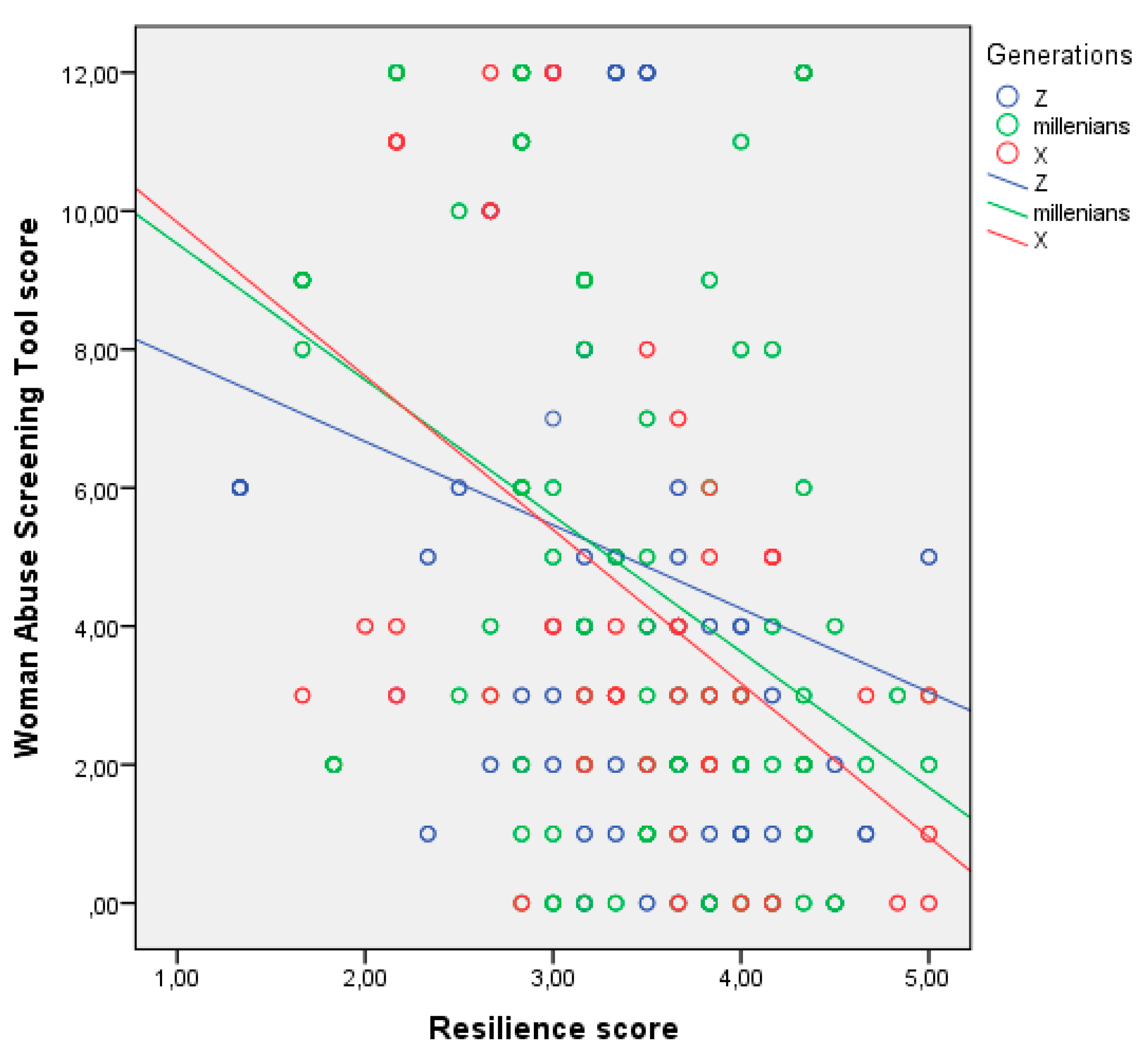

Table 1.
Sociodemographic characteristics of the sample.
| Characteristics | N | % |
| Age, mean, standard deviation | 36.53 | 9.48 |
| Marital status | ||
| Living alone | 198 | 39.4 |
| Married | 222 | 44.1 |
| Living with partner | 83 | 16.5 |
| Children | ||
| None | 277 | 55.1 |
| One | 70 | 13.9 |
| Two | 126 | 25.0 |
| Three | 30 | 6.0 |
| Educational level | ||
| High school | 249 | 49.5 |
| College degree | 254 | 50.5 |
| Employees | ||
| No | 38 | 7.6 |
| Yes | 465 | 92.4 |
| Financial status, mean, standard deviation | 6.36 | 1.54 |
Table 2.
Univariate linear regression analyses with score on the Woman Abuse Screening Tool as the dependent variable.
Table 2.
Univariate linear regression analyses with score on the Woman Abuse Screening Tool as the dependent variable.
| Independent variables | Unadjusted unstandardized B coefficient | 95% confidence interval for B | P-value |
|---|---|---|---|
| Age | -0.011 | -0.048 to 0.026 | 0.564 |
| Married/living with partner vs. living alone | 0.592 | -0.133 to 1.316 | 0.109 |
| Children (yes vs. no) | 0.944 | 0.235 to 1.653 | 0.009 |
| High school vs. College degree | 4.390 | 3.794 to 4.987 | <0.001 |
| Non employees | 0.213 | -1.130 to 1.556 | 0.756 |
| Financial status | -0.010 | -0.241 to 0.221 | 0.932 |
| Resilience | -1.786 | -2.211 to -1.361 | <0.001 |
Table 3.
Final multivariable linear regression model with score on the Woman Abuse Screening Tool as the dependent variable.
Table 3.
Final multivariable linear regression model with score on the Woman Abuse Screening Tool as the dependent variable.
| Independent variables | Adjusted unstandardized B coefficient | 95% confidence interval for B | P-value | Standardized beta coefficient | Variance influence factor |
|---|---|---|---|---|---|
| Age | -0.085 | -0.123 to -0.048 | <0.001 | -0.200 | 1.635 |
| Married/living with partner vs. living alone | 0.426 | -0.223 to 1.075 | 0.198 | 0.051 | 1.276 |
| Children (yes vs. no) | 1.363 | 0.641 to 2.086 | <0.001 | 0.168 | 1.637 |
| High school vs. College degree | 4.077 | 3.448 to 4.707 | <0.001 | 0.504 | 1.257 |
| Non employees | 1.499 | 0.324 to 2.674 | 0.013 | 0.098 | 1.224 |
| Financial status | -0.118 | -0.325 to 0.089 | 0.263 | -0.045 | 1.287 |
| Resilience | -0.918 | -1.317 to -0.518 | <0.001 | -0.178 | 1.243 |
| Interaction age X resilience | -0.051 | -0.091 to -0.011 | 0.012 | -0.094 | 1.128 |
Adjusted R2 for the final multivariable model without the interaction term = 36.7%; p-value for ANOVA < 0.001. Adjusted R2 for the final multivariable model with the interaction term = 37.3%; p-value for ANOVA < 0.001.
Disclaimer/Publisher’s Note: The statements, opinions and data contained in all publications are solely those of the individual author(s) and contributor(s) and not of MDPI and/or the editor(s). MDPI and/or the editor(s) disclaim responsibility for any injury to people or property resulting from any ideas, methods, instructions or products referred to in the content. |
© 2026 by the authors. Licensee MDPI, Basel, Switzerland. This article is an open access article distributed under the terms and conditions of the Creative Commons Attribution (CC BY) license (http://creativecommons.org/licenses/by/4.0/).
Copyright: This open access article is published under a Creative Commons CC BY 4.0 license, which permit the free download, distribution, and reuse, provided that the author and preprint are cited in any reuse.