
Submitted:
27 August 2026
Posted:
09 September 2026
You are already at the latest version
Abstract
Lithium-ion battery degradation limits the performance, safety, cost, and service life of consumer electronics, electric vehicles, industrial systems, and grid-energy storage. This review synthesizes the electrochemical, mechanical, thermal, and transport processes that govern battery ageing and links them to health assessment, lifetime prediction, and battery-management decisions. A mechanism-to-decision framework is used to distinguish degradation mechanisms, degradation modes, and cell-level outcomes. The review examines solid-electrolyte-interphase growth, lithium plating, particle fracture, cathode reconstruction, transition-metal dissolution, electrolyte decomposition, separator damage, and electrode cross-talk. These processes contribute to lithium loss, active-material loss, electrolyte depletion, stoichiometric imbalance, impedance growth, capacity fade, and power fade. The effects of temperature, state of charge, depth of discharge, current rate, ageing history, chemistry, and cell design are assessed, with emphasis on coupled mechanisms, spatial non-uniformity, path dependence, and knee-point ageing. The review also discusses state-of-health estimation, remaining-useful-life prediction, mitigation strategies, and digital-twin approaches. Capacity alone is insufficient because similarly aged cells may differ in resistance, safety margin, and future lifetime. Future research should prioritize realistic pack-level datasets, uncertainty-aware prediction, standardized testing, operando diagnostics, transferable models, and decision-oriented battery management.
Keywords:
lithium-ion battery
; degradation mechanisms
; capacity fade
; state of health
; diagnostics
; lifetime prediction
; remaining useful life
; digital twin
1. Introduction
Lithium-ion batteries are extensively used in consumer electronics, electric vehicles, industrial equipment and grid-energy storage due to their high energy density, efficiency and low self-discharge. With growing use, degradation is emerging as a major economic, performance and safety issue. Loss of capacity results in less usable energy. Resistance growth limits power capability and increases heat generation. Uncertainty about the state of a battery also influences decisions on warranty, maintenance, second-life use and recycling [1,4,5,7].
The causes for battery degradation are more complicated than a simple reaction since that process happens due to the interaction of electrochemical, mechanical, thermal, and transport processes at the same time. Among the various processes influencing that phenomenon, we can mention solid-electrolyte-interface growth, lithium plating, particle failure, transition-metal dissolution, electrolyte destruction, and the failure of the electrical contact [1,2,3,7,19,21]. The mechanisms of battery degradation depend on many factors – temperature, state of charge, current rate, cyclation cycle, chemistry of the cells, etc. Hence, cells having similar capacity may have dissimilar resistance, degradation processes, safety factor, and lifetime.
Consequently, the evaluation of battery health cannot rely on capacity retention alone since other sophisticated factors must be analyzed which would include issues such as capacity fade, power fade, state of health, and remaining useful life [1,7,9,11,38]. The methodology of assessment implies establishing connections between the factors influencing the operation, process of operation, and the consequences to control and lifetime.
This review builds the mentioned connections in a degradation-to-decision ratio and enlarges the definitions of the primary degradation terms and evaluation of the degradation of the negative electrode, positive electrode, electrolyte, and separator, interaction of all the studied mechanisms. The influences of temperature, state of charge, cycling conditions, chemistry, and cell structure are discussed as well as the opportunities of mitigation and perspectives of further investigations.
2. Review Methodology
The present study makes use of structured narrative review approach to summarize literature on lithium-ion battery degradation. The literature can be broadly categorized into reviews of degradation mechanisms, electrochemistry and material aspects related studies, stress factor experiments, studies on ageing models, and those related to battery health, RUL prediction, battery management strategies, etc. The papers have been reviewed by the present study on account of differences in the chemistry of battery, cell configuration, ageing regime, operating conditions, variables recorded, mechanism of damage in question, effects at the cell level, the model used, verification forms and limitations mentioned [1,2,3,4,5,6,7,8,9,10,11,12,13,14,15,16,17,18,19,20,21,22,23,24,25,26,27,28,29,30,31,32,33,34,35,36,37,38,39,40,41,42,43].
The synthesis employs a mechanism-to-decision framework. Initially, the physical and chemical mechanisms were categorized into mechanism types but separate from degradation types, which include such instances as loss of lithium inventory, loss of active materials, electrolyte loss, stoichiometric drift, and increase in impedance. After this, the mechanisms were then correlated to operating stress factors, measurable metrics, health, estimates of lifespan, and mitigation methods.
To evaluate the transferability of results, considerations were given to the sample size, specificity of chemistry, range of operating conditions, the protocol used in the laboratory, calibration of the models, and final definition of the life span. A statistical meta-analysis was, therefore, avoided, as various chemistries, formats, current profiles, temperature, diagnostics, and performance indicators were used in the studies under review. Hence, the findings were reported in the context of studies while the comparison tables indicate common mechanisms, operating stress trends, diagnostic patterns, and limitations of the solutions.
3. Fundamentals of Lithium-Ion Battery Degradation
Lithium-ion cells comprise a positive electrode, a negative electrode, a conduction electrolyte for ions, a porous separator and metallic current collectors [1,5,7]. When the cell is being charged, lithium ions leave a positive electrode and go through the electrolyte and separator and intercalate, or alloy, in the negative electrode while electrons move through the external circuit. The process is reversed during discharge [1,5]. Stable operation is based on reversible ion movement, continuity of electricity, proper reactions at the interface and mechanical compliance with periodic changes in contents [1,19,21].
Degradation can be seen as comprising three linked aspects [1]. A degradation mechanism refers to the concrete physical or chemical process responsible for the degradation event, for example: SEI formation, lithium deposition, particle fragmentation, metal dissolution or electrolyte decomposition [1,7,19]. The degradation modes classify the various mechanisms according to their impact on the thermodynamic or thermokinetic operation of the cell. The major modes are lithium loss, loss of active material at both electrodes, stoichiometric redistribution between electrodes, as well as electrolyte loss and impedence increase [1,7,8]. Capacity and power fade are the operational result measured at the cell or battery pack level [1,5,7].
Capacity loss is the decrement in capacity that can be reversibly stored and delivered at stated voltage, current, and temperature conditions [1,7]. A possible cause of capacity loss is the binding of lithium in the form of interphase materials, the inability of the active matter to conduct electricity or ions, or the limitation of the usable voltage window by imbalanced electrodes [1,7,19]. Power loss is the reduction in power that can be obtained and is closely related to the rise of ohmic, charge transfer, and diffusion resistance [1,7,12]. The thermal limits and uneven current distribution are also contributing factors in this respect as well [10,16,21]. The battery may have a small capacity loss but a large loss in power [2,10,21].
State of health is understood as a normalized assessment of the current condition when compared to the defined point of life at the beginning of life and sometimes also at the end of life [9,11,38]. The capacity-based state of health is frequently expressed as:
Health indicators based on resistance or impedances should clearly describe the conditions of measurements such as temperature, state of charge, frequency, and pulse duration [11,12,29]. However, a single value of may be sufficient for making decisions about control and warranty, but it loses the information about multiple underlying degradation states. That is, two batteries can have the same capacity-based but vary in resistance, past plating history, gas generation, or safety margin [1,11,16,21]. Therefore, modern state estimation algorithms increasingly utilize several health indicators or characteristics that are not only the capacity ratio [11,29,34,38]. Remaining useful life is measured in terms of hours, cycles, or some other equivalent metric that indicates the time that there is until the end of life criterion, which must be defined [9,31,38,43]. If the cycle-based method is used to measure the remaining useful life of an item then it can be written as:
End of life can be defined in terms of an efficiency measure, a limit to resistance, a failure to fulfill power needs, or an issue arising from safety reasons [9,39,43]. As future temperature, present current and state of charge are unknown, estimated should be communicated with a specified operational profile including a degree of uncertainty or prediction interval rather than just as a point estimate [31,32,38,40].
Battery ageing is typically divided into two categories: calendar ageing and cycle ageing. Calendar ageing happens during idle state and is primarily caused by time passing, temperature and electrode potential, which includes the charge state during storage [1,2,7,30]. Meanwhile, cycle ageing causes current-dependent concentration gradients, mechanical stress, heating and repeated breaking of interface [1,2,3,7,21]. In reality, both forms take place together since batteries experience both types of ageing process.
4. Degradation Mechanisms in Lithium-Ion Batteries
The primary process of degradation is determined by the chemistry of the electrodes, the formulation of the electrolytes, the design of the cells, and the history of their usage [1,2,5,7,16,21,23]. However, the processes can be categorized by their initial point of origin and method of propagation. The process of degradation can either begin at the negative electrode, positive electrode, electrolyte, or separator, and then go on to analyze how this process propagates across the electrodes [1,19,22,27].
4.1. Anode Degradation
Graphite negative electrodes work near the potential of lithium metal, ensuring high cell voltage but putting the electrolyte outside its thermodynamic stability region. When used for the first time, the electrolyte is reduced, forming the solid electrolyte interface (). is thus composed of materials that prevent further solvent reduction but allow ion conduction. The formation of requires lithium that can be cycled, whereas its continuous formation can cause the electrolyte to lose lithium throughout cycling and storage process [1,4,13,14,15].
The growth of accelerates at high temperature, significant lithiation of the anode material, and the introduction of new surfaces to the electrolyte environment. The common diffusion model calculates that expands at the square-root-of-time rate, while the fracture of the particles allows acquiring the new surface for further intermediate formation. This implies that the composition, thickness, porosity, and mechanical stability are subject to constant change. The situation is not so severe for silicon-containing anodes because of the drastic volume change in the materials undergoing the formation of the intermediate due to continuous destruction of the [1,2,13,14,15].
Lithium plating can happen when lithium moves to the anode more quickly than it can be intercalated or when the local anode voltage reaches the potential of lithium metal. The chances of this happening arise from several factors such as low temperatures, high charging currents, being sufficiently charged, low anode capacity, uneven distribution of current, and clogged pores. Some of the deposited lithium may be removed; however, chemical reactions can occur that lead to the formation of additional solid-electrolyte interface () or dead lithium that cannot conduct electricity. In addition, dendritic formations can ruin the separator and risk shorting the battery [1,16,17,18,19].
Mechanical degradation includes particle fragmentation, binder degradation, loss of connection, and delamination of parts. Even if graphite experiences lower volume change, than silicon does, the cycling process and uneven current flow may still bring stress caused by this cycling. On the contrary, silicon has higher performance, but it suffers from extreme expansion that causes cracking, loss of connection, etc. Thus, mechanical and electrical degradation go in hand [1,2,4,19].
The degradation of the anode is influenced by the substances produced at the positive electrode too. Dissolved manganese, nickel, and cobalt can move through the electrolyte and settle on the graphite, changing the chemistry of and increasing film, charge-transfer, and diffusion resistance. Initially, lithium loss associated with processes mostly determines anode degradation; while later, resistance as a result of the effect of transition metals becomes more significant with cycling[1,4,22,23,26,27].
4.2. Cathode Degradation
The degradation of positive electrodes is greatly dependent upon their chemical structure. Layered oxides like and have high energy densities, but severe delithiation and high voltage operations compromise their structures, both superficially and in bulk. Transition from layered structure to other spinel-like or rock-salt structures inhibits Li-ion diffusion processes and reduces the amount of active material that is available for reactions. Oxygen evolution leads to oxidative breakdown of electrolyte, gas generation, and transition metal dissolution with particular danger for Ni-containing materials due to high reactivity of materials to interface processes and ion ordering [1,3,6,22,23].
The dissolution of transitions metals removes active materials from positive electrodes and causes interference with the anodes. The production of HF and other acids resulting from breakdown, presence of moisture, and electrolyte oxidation contribute to the damage of positive electrode surfaces. Dissolved metal ions can redeposit on the cathode, or migrate towards the anode and influence its solid electrolyte interphase () negatively by increasing resistance level and initiating several undesirable chemical reactions [1,4,22,23,27].
The cathode-electrolyte interphase serves as a passivating agent, which is distinct from anode . A stable prevents the further oxidation of the electrolyte while a damaged, heterogeneous, or quick blocks Li transport and uses the electrolyte. The stability of depends on different factors including the battery chemistry, operating voltage of the battery, and components of electrolyte [1,6,22,23].
The cracking of particles may occur due to anisotropic strain, gradients of concentration, design of particles, and phase change processes. The cracks prevent any material from being part of the electrochemical interactions and expose the inner parts to restructuring and further growth of . The degradation of the cathode is not constant across the surface, given that current density, temperature, and condition of electrodes vary across the cell [1,3,23,24].
Lithium iron phosphate is more stable in terms of structure and temperature than Ni-rich layered oxides; however, it is still prone to issues around contact loss, degradation of the electrolyte, loss of lithium inventory, and imbalance in the cell. Thus, chemistry has changed the significance of the modes of degradation but has not eliminated them. Particle morphology, electrode porosity, electronic networks, coatings, electrolyte composition, cell structure, etc., enable us to trace how the degradation of the material turns into the degradation of its performance [1,2,5,6,16,21].
4.3. Electrolyte and Separator Degradation
The electrolyte transports lithium ions and participates in the formation of both electrode interphases. Conventional carbonate electrolytes containing lithium hexafluorophosphate are metastable across the full cell-voltage range. Reduction at the anode, oxidation at the cathode, salt decomposition, moisture-induced hydrofluoric-acid formation, and reactions with released oxygen or transition metals consume solvent and salt. These reactions change ionic conductivity, form resistive deposits, and generate gases that increase internal pressure. Electrolyte loss can occur through chemical consumption and local loss of wetting. Even when the total electrolyte quantity remains sufficient, pore blockage or gas accumulation can create transport-limited regions. Changes in salt concentration also affect electrolyte viscosity and ionic conductivity. Because the electrolyte connects both electrodes, soluble products formed at one interface can migrate and alter the other, making electrolyte degradation an important route for electrode cross-talk [2,3,4,5,6,22,23,27].
The separator must maintain electronic isolation while permitting ionic transport. Thermal shrinkage, mechanical puncture, pore blockage, contamination, and uneven wetting increase local resistance or short-circuit risk. Lithium dendrites can penetrate the separator, while mechanical loading, manufacturing defects, particle accumulation, and cell swelling can also damage or obstruct it [5,16].
Gas generation changes internal pressure, mechanical contact, and thermal safety. Carbon dioxide, carbon monoxide, hydrogen, and light hydrocarbons can form under high-voltage or thermal stress. In pouch cells, gas-related swelling can alter compression and contact, while in rigid cells it increases internal pressure and safety risk. Gas analysis is therefore both a mechanistic diagnostic and a safety-relevant measurement [5,21,23]. Figure 1 brings these anode, cathode, and electrolyte/separator processes together in a single cross-sectional schematic, showing where and films form and thicken, where particle cracking occurs at each electrode, how lithium dendrites can bridge toward the separator, and how dissolved transition-metal ions migrate between electrodes to create cross-talk.
4.4. Interaction between Degradation Mechanisms
The main limitation of describing degradation mechanisms separately is that they often reinforce or suppress one another [1,19]. Particle fracture exposes fresh electrode surface, promoting further or formation [1,22]. Interphase growth consumes electrolyte, reduces porosity, and increases local transport resistance, which can promote lithium plating [18,19]. Plated lithium may form dead lithium and additional interphase products [1,18], while transition-metal dissolution from the cathode can alter anode-interphase growth [4,27]. Loss of lithium inventory also shifts electrode stoichiometry and may raise the positive-electrode potential at the end of charge, accelerating cathode degradation [1,19].
Positive feedback can produce nonlinear ageing and knee behavior [1,19,43]. Loss of active area increases local current density, concentration gradients, and mechanical stress [1,19]. Increasing resistance raises heat generation and promotes temperature non-uniformity [7,21]. When porosity loss or transport limitation becomes severe, degradation may shift from gradual capacity fade to an accelerated regime [19,43].
This self-reinforcing cycle is summarized in Figure 2: particle fracture exposes fresh surface, fresh surface accelerates or regrowth, regrowth raises resistance and local heat generation, and that heat and current concentration in turn promote further fracture reinforcing the loop until the cell transitions from gradual fade into the knee region.
Negative feedback can also occur. A thicker / may restrict solvent transport and slow its own growth [1,13]. /-related lithium loss may raise the anode potential and reduce plating tendency under some conditions [1,19]. Therefore, the dominant degradation mechanism can change with age [8,27], and the sequence of operating stresses can influence the final degradation state [1,19].
Path dependence is particularly important under variable-duty operation [1,8,19]. Different sequences of fast charging, elevated-temperature exposure, cycling, and rest may produce different ageing outcomes even when total time and energy throughput are similar [1,7,19]. Models that treat calendar and cycling ageing as independent additive terms may therefore miss important interaction and history effects [19,30]. Mechanism-aware models supported by diverse operating data are needed to capture changes in the dominant degradation pathway [7,8,30].
5. Factors Influencing Lithium-Ion Battery Degradation
External stress factors do not correspond one-to-one to degradation mechanisms. One stress factor may trigger different mechanisms, and one mechanism may be affected by more than one coupled operating conditions. Their effects depend on the cell chemistry, cell architecture, operating history and the range over which each of these factors is studied [1,2,7,16,19,20,21]. The most transferable conclusion from the reviewed corpus is that interactions matter: temperature changes reaction kinetics and transport, state of charge changes electrode potentials, current generates concentration gradients and heat, and cell geometry, pressure, cooling configuration, and tab arrangement determine where those stresses become concentrated [1,2,3,16,19,20,21].
5.1. Temperature
Temperature affects the kinetics of reactions, ion transport, mechanical response, heat generation, and heat dissipation. Higher temperature typically accelerates SEI growth, cathode-electrolyte interfacial reactions, electrolyte decomposition, transition-metal dissolution, gas generation and calendar ageing [1,2,3,5,6,7,21,22,23,26,27]. At sufficiently high temperatures polymer separators may shrink or melt, decreasing the safety margin available. Arrhenius type relations are often used to describe the temperature dependence of ageing [2,7,28,30] but the fitted activation energy may not be valid for a change in the dominant degradation mechanism or temperature regime [1,2,19,30].
Low temperature results in increases in electrolyte viscosity, decreases in ionic conductivity and lithium diffusion in electrolyte and active materials, and increases in interfacial resistance and polarization. Fast charging is particularly dangerous because the charge-transfer and solid-state diffusion may not be able to accommodate the incoming lithium, causing the anode potential to enter the lithium-plating region. Thus, charging conditions that are acceptable at near room temperature may be prone to plating at cold conditions [1,3,7,10,17,18,19]. Thus, high- and low-temperature extremes promote degradation via different dominant mechanisms [1,2,3,7,19,21]. Figure 3 summarizes this dual-mechanism relationship: degradation rate is elevated at both temperature extremes, driven by lithium-plating risk in the cold regime and by accelerated parasitic reactions or growth, electrolyte decomposition, transition-metal dissolution in the hot regime, with a minimum near ordinary room temperature.
There are significant spatial gradients, and the cell-average temperature is not sufficient. Temperature gradients through the thickness, surface and cell to cell may lead to heterogeneous current distribution, local differences, lithium plating and non-uniform ageing [16,18,21]. Therefore degradation can be changed by cooling configuration, thermal contact area, tab arrangement, bus bar design and module layout even at the same nominal ambient temperature [5,16,18,21]. Thermal management shall take care of the absolute operating temperature and the spatial non-uniformity of temperature [5,21].
5.2. State of Charge and Depth of Discharge
The high state of charge elevates the cathode potential and reduces the graphite-anode potential to approach the lithium-plating potential, resulting in acceleration of electrolyte oxidation, cathode-surface reconstruction, transition-metal dissolution, and anode-side reactions [1,2,3,6,19,22,23]. So, long-term storage at high is a severe calendar aging stress [2,3,4,7]. The reduced anode potential margin at near full charge further increases the risk of lithium plating under fast charging or local transport limitations [16,18,19]. Severe pack-level failure risks at very low or during over-discharge and current-collector corrosion may occur [2,3,5,16].
The amplitude of the change in composition, phase transition, electrode expansion and mechanical strain during cycling is a joint function of the depth of discharge and the selected window [1,2,19,20]. Higher usually leads to increased charge throughput per cycle and can promote plating, particle fatigue, and loss of active material [2,19,20]. However, alone is not enough: cycling in a high- window might lead to a degradation of an order of magnitude or higher than cycling over a comparable swing at a lower mean [2,19]. Figure 4 illustrates this schematically: at an equal 50% depth of discharge, shifting the cycling window from 0–50% (mean 25%) to 50–100% (mean 75%) can raise the relative degradation rate by an order of magnitude or more, showing that depth of discharge alone does not determine ageing severity.
windows can also affect the observability of degradation modes, as voltage-based diagnostic features depend on the working profile and on the part of the voltage-capacity curve that is accessible for analysis [2,8,29,34]. Therefore, the incremental-capacity and differential-voltage features may be incomplete or less informative for narrow-window operation. The full characterization cycles can themselves alter the measured capacity and resistance by changing cell kinetics and active electrode area [28]. Test design must therefore balance diagnostic information against characterization-induced perturbation [28].
5.3. Charging and Discharging Rates
High charge rate increases the concentration gradients and anode over potential, which leads to lithium plating especially at low temperature or high . Figure 5 illustrates this schematically: the anode surface potential during charge falls further below the lithium-plating threshold (0 V vs Li/Li+) as charge rate increases, and this onset shifts to a much lower C-rate at C than at C, reflecting the anode’s reduced potential margin at low temperature. High discharge rate increases polarization, heat generation & mechanical stress Both can lead to increased non-uniformity and power fade, but their relative effect depends on the thermal management and cell architecture [1,3,16,17,18,19,20,21].
One cannot judge fast-charging protocols by nominal C-rate alone. The current profile is dependent on the state, the duration of constant voltage, the charge cut-off current, rest periods, the temperature, and the available anode capacity [3,18,20]. Experiments with stress factors show the parameters in the constant-voltage phase can play an influencing role by defining the time the cell stays near max voltage, and how fully the cell is charged [20].
The ageing can decrease or increase compared to constant current cycling for pulsed and dynamic loads, depending on rest periods, thermal response and the activated degradation mechanism [1,3,21]. The vehicle operation involves regenerative charging, transient high power events and idle periods [1,3,7]. Therefore, laboratory protocols should emulate realistic operational combinations and load-profile variability rather than assume that equal ampere-hour throughput leads to equivalent degradation [1,3,19,20,39,40].
5.4. Calendar Ageing and Cycle Ageing
Time, temperature and electrode potential govern the calendar ageing without any external cycling. Semi-empirical expressions typically include an Arrhenius term for temperature, a function of state of charge, and a time exponent. These models are useful for planning, but can be distorted by periodic characterization cycles which change the apparent capacity and resistance [28,30].
Charge throughput, C-rate, depth of discharge, temperature and voltage-window effects are involved in cycle ageing [2,3,20,30]. Experimentally, it is difficult to distinguish between calendar and cycle ageing because rest and characterization periods are included in cycling protocols and because the applied current also changes cell temperature [1,21,28,30]. Adding independent calendar and cycling losses is computationally convenient but can miss interactions, path dependence and changes in the dominant degradation mechanism [1,19,30].
Hence, a robust model should track operating exposure continuously [1,3,19,30]. Time at high electrode potential, time at high temperature, charge accepted under plating-prone conditions, and cumulative strain or charge throughput may be more mechanistically meaningful than total cycle count [1,2,3,16,17,18,19,20,21,30]. Equivalent full cycles remain a useful figure-of-merit to normalize, but do not uniquely determine ageing. Degradation also depends on temperature, , C-rate, , cell-history and mechanism interactions [1,19,20,30]. Figure 6 illustrates this schematically: two duty profiles that accumulate the same number of equivalent full cycles diverge sharply in capacity retention depending on their operating temperature and , with the more aggressive profile crossing the 80% end-of-life threshold roughly 200 equivalent full cycles before the benign profile would.
5.5. Battery Chemistry and Cell Design
Chemistry controls potential, thermal stability, diffusivity, volume change and interfacial reactivity [1,2,3,5,6,10,22,23]. Nickel-rich layered oxides are high capacity but require more stringent control on high voltage surface and electrolyte degradation [3,6,22,23]. has high thermal stability and good cycle life, but its low and relatively flat voltage profile leads to different diagnostic and state-estimation conditions [2,5]. Graphite is a well-established anode material and silicon additions improve specific capacity, but at the expense of large volume changes, mechanical stress and repeated interphase disruption [1,2,7,10]. suppresses many low potential anode reactions and has low volume change, but its higher electrode potential leads to lower full cell voltage and energy density [2].
Cell design controls chemistry expression. Local current, transport, temperature, stress and degradation are impacted by N/P ratio, electrode loading, porosity, particle size, binder and conductive network, separator properties, electrolyte quantity, current-collector and tab design, compression and cooling configuration [1,2,5,10,16,18,21,23,25]. Manufacturing variability can lead to significant lifetime scatter for nominally identical cells, hence statistical sample size and cell-to-cell variation are critical aspects of experimental validation [1].
The form factor matters, too. Cylindrical, pouch and prismatic cells have different mechanical constraints, cooling surfaces, internal current paths, susceptibility to pressure and swelling and spatial gradients that develop during operation [5,16,21]. Radial, axial or through-thickness gradients can occur in cylindrical and wound cells, whereas pouch and prismatic cells are susceptible to compression, swelling and non-uniform surface cooling [16,21]. Figure 7 summarizes these geometric differences: the cylindrical/wound format develops radial and axial gradients from the cell core outward, while the pouch and prismatic formats are instead shaped by external compression, swelling, and typically one-sided cooling contact.
6. Strategies for Reducing Battery Degradation
The most effective degradation mitigation will be that which addresses the dominant degradation mechanism, not merely transferring damage elsewhere. The objective is not necessarily to minimize degradation per cycle, but may be to minimize lifecycle cost, conserve power, meet safety limits or maximize useful energy delivered. Hence, material design, cell design, thermal management, charging control and operational policy must be coordinated [3,5,7,9].
Optimized charging. The charging current shall be adjusted to the temperature, , estimated anode potential, resistance and age. Multi-stage constant-current protocols, model-predictive charging, and plating-aware limits can help to mitigate high current exposure near full charge. Preheating or current reduction must precede cold charging. The charge termination and constant-voltage duration should be selected based on the desired range and not always maximizing the stored energy [17,18,20,31].
Thermal management. A battery thermal-management system is expected to keep the cells in a moderate operating-temperature range and minimize the harmful temperature gradients [5,21]. Local temperature, current distribution, lithium plating and degradation are influenced by cooling medium, cooling location, coolant channel design, cell geometry and mechanical contact pressure [5,16,21]. Heating or pre-heating is also important during fast charging at low temperatures, because low temperatures will reduce lithium-ion transport and increase the risk of lithium plating [7,21]. The thermal-control requirements should be revised by taking into account the resistance and ageing information because the cell resistance and the irreversible heat generation increase with degradation [5,21].
Suitable operating windows. Long-term operation or storage at high accelerates calendar aging, electrode/electrolyte side reactions and degradation related to high-voltage operation [3,4,7,19]. The reduction in over-discharge also reduces the risk of current-collector damage and failure at the pack level [4,5]. Time-shifted charging and pre-conditioning can keep the battery at a lower-aging when parked and finish charging shortly before the scheduled departure [30]. The optimal window depends on the battery state, the use profile, the storage time and the degradation mechanisms triggered in the defined window, so a single target is not suitable for all applications [19,30].
Battery-management-system control. The should include state estimation, fault diagnosis, cell balancing, charge control, thermal and safety management [4,5,7]. Operating limits should be updated as resistance, heat generation, power capability and thermal-management requirements change with battery ageing [4,21]. Uncertainty-aware health and degradation predictions can be leveraged to make more conservative and adaptive control decisions [29,40]. Cloud-connected and digital-twin frameworks can help in training and updating models across battery populations, and computationally efficient prediction models can be deployed locally in the [34,39]. For diagnostic scheduling, the trade-off between information gain and the risk that characterization procedures themselves may alter the measured capacity, resistance or degradation behaviour [28] should be taken into account.
Material and cell-design improvements. Stable artificial interphases, electrolyte additives, high-voltage resistant solvents and salts, cathode coatings, single-crystal or crack-resistant particles, optimized silicon architecture, robust binders and separator improvements can suppress some of these mechanisms. Co-optimize the loading of electrodes, porosity, N/P ratio, amount of electrolyte, tab design, compression, and cooling interfaces. Design for sensing and data access can also improve lifetime prediction, even in the absence of direct slowing of degradation [5,6,10,13,14,15,22,23].
7. Conclusions and Future Directions
Lithium-ion battery degradation is governed by interacting electrochemical, structural, thermal, and mechanical processes. growth, lithium plating, particle fracture, cathode reconstruction, transition-metal dissolution, electrolyte decomposition, and separator damage contribute to loss of lithium inventory, loss of active material, electrolyte loss, stoichiometric imbalance, and impedance rise. These degradation modes appear externally as capacity fade, power fade, heat generation, swelling, and reduced safety margin.
Temperature, state of charge, depth of discharge, current rate, exposure time, chemistry, and cell design jointly determine the dominant degradation pathway. High-temperature and high- exposure accelerate parasitic reactions, whereas fast charging at low temperature increases lithium-plating risk. Calendar and cycle ageing cannot always be treated independently because spatial non-uniformity, operating sequence, and interactions among mechanisms influence battery ageing throughout its life. Diagnostic and modelling approaches should therefore be selected according to the required decision, available measurements, prediction horizon, and computational constraints.
Based on the reviewed literature, the following challenges and future research directions are identified:
Coupled degradation modelling: Future models should capture interactions among growth, lithium plating, particle fracture, electrolyte consumption, cathode degradation, and thermal non-uniformity. Reduced and identifiable multi-physics models are needed to represent dominant feedback and path dependence without excessive parameter or computational requirements.
Operando and spatially resolved characterization: Operando imaging, spectroscopy, thermal mapping, strain sensing, and electrochemical measurements should be combined to distinguish causal degradation mechanisms from correlated changes. Designed stress sequences are also required to determine how the order of temperature, current, , and rest exposure affects ageing.
Real-world battery-pack datasets: Public datasets are mainly based on laboratory cells and fixed protocols. Future datasets should include cell-level voltage, temperature, current distribution, balancing activity, thermal-control operation, service events, sensor uncertainty, and operating history across different climates, users, batches, and manufacturers.
Validation under practical operating conditions: Constant-current full-cycle tests do not reproduce partial cycling, regenerative charging, irregular rest periods, seasonal temperature variation, vibration, pack gradients, and cell imbalance. Models and mitigation strategies should therefore be validated using realistic mission profiles and pack-level operation.
Uncertainty-aware and transferable prediction: and models should report calibrated prediction intervals and distinguish measurement noise, cell-to-cell variation, parameter uncertainty, future-duty uncertainty, and model inadequacy. Generalization should be tested across unseen chemistries, formats, manufacturers, and cycling protocols using transfer learning, domain adaptation, physics-informed features, and out-of-distribution detection.
Computationally efficient implementation: High-fidelity electrochemical-mechanical models are difficult to apply in real-time , while complex deep-learning models may require substantial memory and computation. Reduced-order models, surrogate models, hybrid physics-data approaches, adaptive model fidelity, and cloud-edge computing should be evaluated using actual embedded-hardware and communication constraints.
Standardized testing and reporting: Standard protocols are needed for definitions, and end-of-life thresholds, / processing, measurement conditions, knee-point identification, uncertainty reporting, and performance metrics. Benchmark datasets should include raw measurements, cell metadata, failed-cell records, uncertainty information, and clearly separated training and testing domains.
Decision-oriented battery management: Future digital twins and prognostic systems should connect degradation prediction directly with charging control, thermal management, power derating, maintenance, warranty, second-life qualification, and recycling decisions. Progress should be assessed not only by prediction accuracy, but also by whether the method improves safety, extends useful life, and supports better lifecycle decisions.
Funding
This research received no external funding.
Abbreviations
The following abbreviations are used in this manuscript:
| BMS | Battery management system |
| CEI | Cathode-electrolyte interphase |
| DoD | Depth of discharge |
| EIS | Electrochemical impedance spectroscopy |
| EoL | End of life |
| ICA | Incremental capacity analysis |
| LAM | Loss of active material |
| LIB | Lithium-ion battery |
| LLI | Loss of lithium inventory |
| LFP | Lithium iron phosphate |
| NMC | Nickel-manganese-cobalt oxide |
| RUL | Remaining useful life |
| SEI | Solid-electrolyte interphase |
| SoC | State of charge |
| SoH | State of health |
Data Availability Statement
No new experimental dataset was generated for this review. The evidence base consists of the publications cited in the References section.
Acknowledgments
We acknowledge our colleagues at GreyB for their valuable discussions and feedback on the literature synthesis and presentation of lithium-ion battery degradation mechanisms.
Use of Artificial Intelligence
During the preparation of this work, the author(s) used Claude.ai, ChatGPT in order to assist in drafting the literature review section]. The author(s) reviewed and edited the content as needed and take(s) full responsibility for the content of the publication.
Conflicts of Interest
The author(s) declare that no competing interests exist.
References
- Edge JS, O’Kane S, Prosser R, Kirkaldy ND, Patel AN, Hales A, et al. Lithium ion battery degradation: What you need to know. Phys Chem Chem Phys. 2021; 23:8200–8221. [CrossRef]
- Vermeer W, Chandra Mouli GR, Bauer P. A comprehensive review on the characteristics and modeling of lithium-ion battery aging. IEEE Trans Transp Electrif. 2022; 8(2):2205–2232. [CrossRef]
- Guo J, Li Y, Pedersen K, Stroe DI. Lithium-ion battery operation, degradation, and aging mechanism in electric vehicles: An overview. Energies. 2021; 14(17):5220. [CrossRef]
- Roy PK, Shahjalal M, Shams T, Fly A, Stoyanov S, Ahsan M, et al. A critical review on battery aging and state estimation technologies of lithium-ion batteries: Prospects and issues. Electronics. 2023; 12(19):4105. [CrossRef]
- Kaliaperumal M, Dharanendrakumar MS, Prasanna S, Abhishek KV, Chidambaram RK, Adams S, et al. Cause and mitigation of lithium-ion battery failure: A review. Materials. 2021; 14(19):5676. [CrossRef]
- Xu J. Critical review on cathode-electrolyte interphase toward high-voltage cathodes for Li-ion batteries. [CrossRef]
- Timilsina L, Badr PR, Hoang PH, Ozkan G, Papari B, Edrington CS. Battery degradation in electric and hybrid electric vehicles: A survey study. IEEE Access. 2023; 11:42431–42462. [CrossRef]
- Xu R, Wang Y, Chen Z. Data-driven battery aging mechanism analysis and degradation pathway prediction. Batteries. 2023; 9(2):129. [CrossRef]
- Fanoro M, Bozanic M, Sinha S. A review of the impact of battery degradation on energy management systems with a special emphasis on electric vehicles. Energies. 2022; 15(16):5889. [CrossRef]
- Sun J, Ye L, Zhao X, Zhang P, Yang J. Electronic modulation and structural engineering of carbon-based anodes for low-temperature lithium-ion batteries: A review. Molecules. 2023; 28(5):2108. [CrossRef]
- Rauf H, Khalid M, Arshad N. Machine learning in state of health and remaining useful life estimation: Theoretical and technological development in battery degradation modelling. [CrossRef]
- Wang LF, Geng MM, Ding XN, Fang C, Zhang Y, Shi SS, et al. Research progress of the electrochemical impedance technique applied to the high-capacity lithium-ion battery. https://dx.doi.org/10.1007/s12613-020-2218-6.
- Pantenburg I, Cronau M, Boll T, Duncker A, Roling B. Challenging prevalent solid electrolyte interphase (SEI) models: An atom probe tomography study on a commercial graphite electrode. ACS Nano. 2023;17:21531–21538. [CrossRef]
- Kobbing L, Latz A, Horstmann B. Growth of the solid-electrolyte interphase: Electron diffusion versus solvent diffusion. [CrossRef]
- Alzate-Vargas L, Blau SM, Spotte-Smith EWC, Allu S, Persson KA, Fattebert JL. Insight into SEI growth in Li-ion batteries using molecular dynamics and accelerated chemical reactions. J Phys Chem C. 2021;125(34):18588–18596. [CrossRef]
- Smith AJ, Fang Y, Mikheenkova A, Ekstrom H, Svens P, Ahmed I, et al. Localized lithium plating under mild cycling conditions in high-energy lithium-ion batteries. J Power Sources. 2023;573:233118. [CrossRef]
- Zhang G, Wei X, Han G, Dai H, Zhu J, Wang X, et al. Lithium plating on the anode for lithium-ion batteries during long-term low temperature cycling. [CrossRef]
- Ren Y, Widanage D, Marco J. A plating-free charging scheme for battery module based on anode potential estimation to prevent lithium plating. Batteries. 2023;9:294. [CrossRef]
- Luo G, Zhang Y, Tang A. Capacity degradation and aging mechanisms evolution of lithium-ion batteries under different operation conditions. Energies. 2023;16:4232. [CrossRef]
- Saxena S, Roman D, Robu V, Flynn D, Pecht M. Battery stress factor ranking for accelerated degradation test planning using machine learning. Energies. 2021;14:723. [CrossRef]
- Spitthoff L, Wahl MS, Lamb JJ, Shearing PR, Vie PJS, Burheim OS. On the relations between lithium-ion battery reaction entropy, surface temperatures and degradation. Batteries. 2023;9:249. [CrossRef]
- Huang D, Engtrakul C, Nanayakkara S, Mulder DW, Han SD, Zhou M, et al. Understanding degradation at the lithium-ion battery cathode/electrolyte interface: Connecting transition-metal dissolution mechanisms to electrolyte composition. ACS Appl Mater Interfaces. 2021;13:11930–11939. [CrossRef]
- Dose WM, Temprano I, Allen JP, Bjorklund E, O’Keefe CA, Li W, et al. Electrolyte reactivity at the charged Ni-rich cathode interface and degradation in Li-ion batteries. ACS Appl Mater Interfaces. 2022;14:13206–13222. [CrossRef]
- Wang H, Whitacre JF. Inhomogeneous aging of cathode materials in commercial 18650 lithium ion battery cells. J Energy Storage. 2021;35:102244. [CrossRef]
- Fathiannasab H, Zhu L, Chen Z. Chemo-mechanical modeling of stress evolution in all-solid-state lithium-ion batteries using synchrotron transmission X-ray microscopy tomography. J Power Sources. 2021;483:229028. [CrossRef]
- Son SB, Zhang Z, Gim J, Johnson CS, Tsai Y, Kalensky M, et al. Transition metal dissolution in lithium-ion cells: A piece of the puzzle. J Phys Chem C. 2023;127:941–951. [CrossRef]
- Lee YK. Effect of transition metal ions on solid electrolyte interphase layer on the graphite electrode in lithium ion battery. J Power Sources. 2021;490:229270. [CrossRef]
- Krupp A, Beckmann R, Diekmann T, Ferg E, Schuldt F, Agert C. Calendar aging model for lithium-ion batteries considering the influence of cell characterization. J Energy Storage. 2022;45:103506. [CrossRef]
- Che Y, Zheng Y, Forest FE, Sui X, Hu X, Teodorescu R. Predictive health assessment for lithium-ion batteries with probabilistic degradation prediction and accelerating aging detection. Reliab Eng Syst Saf. 2024;241:109603. [CrossRef]
- Bui TMN, Sheikh M, Dinh TQ, Gupta A, Widanage DW, Marco J. A study of reduced battery degradation through state-of-charge pre-conditioning for vehicle-to-grid operations. IEEE Access. 2021;9:155871–155896. [CrossRef]
- Guo W, He M. An optimal relevance vector machine with a modified degradation model for remaining useful lifetime prediction of lithium-ion batteries. Appl Soft Comput. 2022;124:108967. [CrossRef]
- Zhao J, Zhu Y, Zhang B, Liu M, Wang J, Liu C, et al. Method of predicting SOH and RUL of lithium-ion battery based on the combination of LSTM and GPR. Sustainability. 2022;14:11865. [CrossRef]
- Pang B, Chen L, Dong Z. Data-driven degradation modeling and SOH prediction of Li-ion batteries. Energies. 2022;15:5580. [CrossRef]
- Li W, Li Y, Garg A, Gao L. Enhancing real-time degradation prediction of lithium-ion battery: A digital twin framework with CNN-LSTM-attention model. Energy. 2024;286:129681. [CrossRef]
- Jafari S, Byun YC. A CNN-GRU approach to the accurate prediction of batteries’ remaining useful life from charging profiles. Computers. 2023;12:219. [CrossRef]
- Cui S, Joe I. A dynamic spatial-temporal attention-based GRU model with healthy features for state-of-health estimation of lithium-ion batteries. IEEE Access. 2021;9:27374–27388. [CrossRef]
- Nan J, Deng B, Cao W, Tan Z. Prediction for the remaining useful life of lithium-ion battery based on RVM-GM with dynamic size of moving window. World Electr Veh J. 2022;13:25. [CrossRef]
- Chen Z, Shi N, Ji Y, Niu M, Wang Y. Lithium-ion batteries remaining useful life prediction based on BLS-RVM. Energy. 2021;234:121269. [CrossRef]
- Li W, Sengupta N, Dechent P, Howey D, Annaswamy A, Sauer DU. One-shot battery degradation trajectory prediction with deep learning. J Power Sources. 2021;506:230024. [CrossRef]
- Lu J, Xiong R, Tian J, Wang C, Hsu CW, Tsou NT, et al. Battery degradation prediction against uncertain future conditions with recurrent neural network enabled deep learning. Energy Storage Mater. 2022;50:139–151. [CrossRef]
- Ren L, Dong J, Wang X, Meng Z, Zhao L, Deen MJ. A data-driven Auto-CNN-LSTM prediction model for lithium-ion battery remaining useful life. IEEE Trans Ind Inform. 2021;17(5):3478–3487. [CrossRef]
- Costa N, Sanchez L, Ansean D, Dubarry M. Li-ion battery degradation modes diagnosis via convolutional neural networks. J Energy Storage. 2022;55:105558. [CrossRef]
- Haris M, Hasan MN, Qin S. Degradation curve prediction of lithium-ion batteries based on knee point detection algorithm and convolutional neural network. IEEE Trans Instrum Meas. 2022;71:3514810. [CrossRef]
Figure 1.
Schematic cross-section of a lithium-ion cell showing the principal degradation processes at the anode, cathode, separator, and electrolyte, including SEI and CEI film growth, particle cracking at both electrodes, lithium dendrite formation, and transition-metal-ion migration linking the two electrodes.
Figure 1.
Schematic cross-section of a lithium-ion cell showing the principal degradation processes at the anode, cathode, separator, and electrolyte, including SEI and CEI film growth, particle cracking at both electrodes, lithium dendrite formation, and transition-metal-ion migration linking the two electrodes.
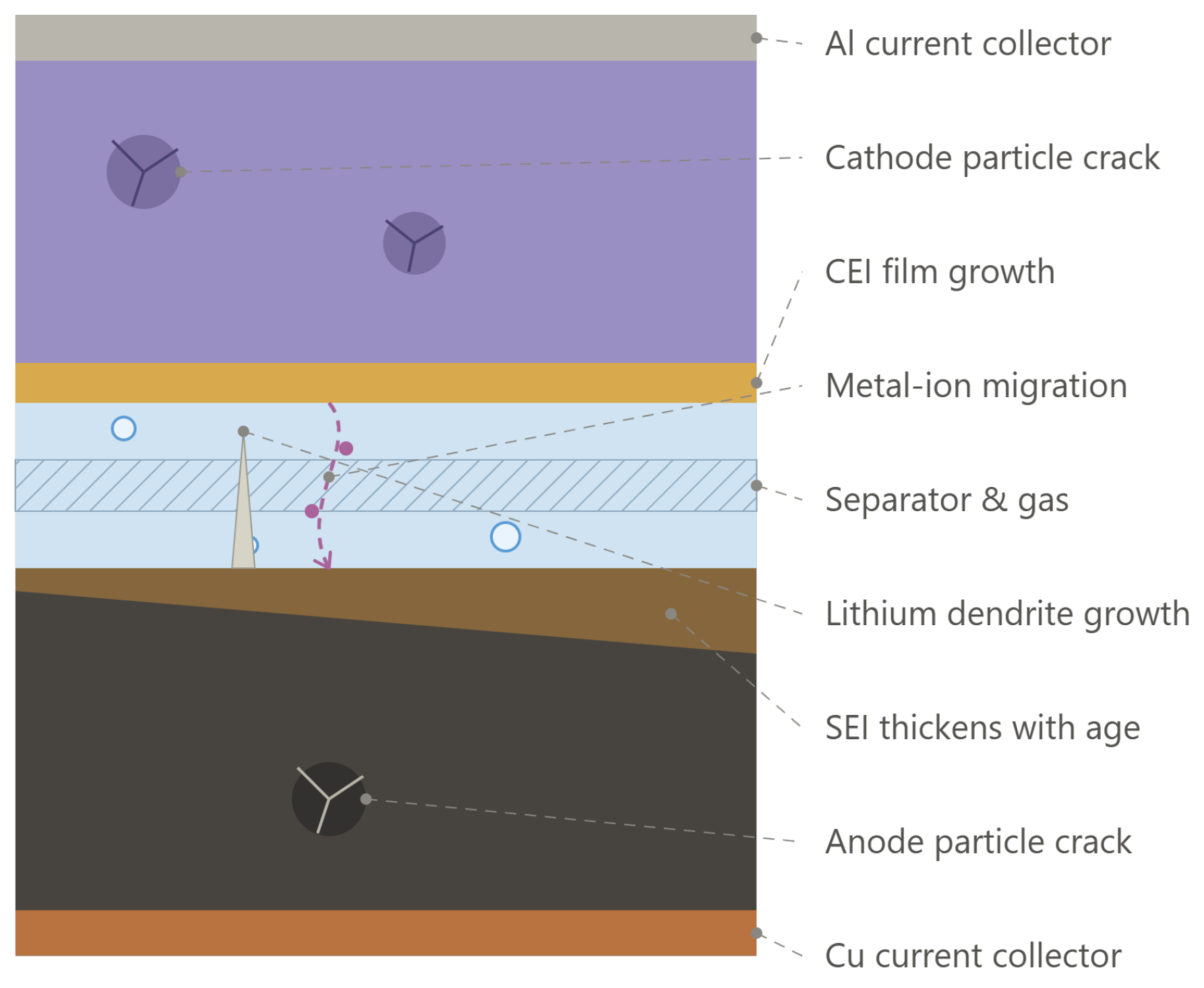
Figure 2.
Positive feedback loop linking particle fracture, fresh-surface exposure, interphase ( or ) regrowth, and resistance/heat generation, illustrating the mechanism by which coupled degradation can shift a cell from gradual capacity fade into accelerated knee-region degradation.
Figure 2.
Positive feedback loop linking particle fracture, fresh-surface exposure, interphase ( or ) regrowth, and resistance/heat generation, illustrating the mechanism by which coupled degradation can shift a cell from gradual capacity fade into accelerated knee-region degradation.

Figure 3.
Schematic relationship between operating temperature and relative degradation rate, showing plating-dominated acceleration at low temperature, parasitic-reaction-dominated acceleration at high temperature, and a minimum near 20–25°C.
Figure 3.
Schematic relationship between operating temperature and relative degradation rate, showing plating-dominated acceleration at low temperature, parasitic-reaction-dominated acceleration at high temperature, and a minimum near 20–25°C.

Figure 4.
Schematic relative degradation rate for three cycling windows sharing the same 50% depth of discharge but different mean state of charge, illustrating that a higher mean accelerates degradation even when the swing amplitude is unchanged.
Figure 4.
Schematic relative degradation rate for three cycling windows sharing the same 50% depth of discharge but different mean state of charge, illustrating that a higher mean accelerates degradation even when the swing amplitude is unchanged.

Figure 5.
Schematic anode potential during charge as a function of charge rate (C-rate) at C and C, showing that lithium plating (potential below 0 V vs Li/Li+) is reached at a substantially lower C-rate under cold conditions.
Figure 5.
Schematic anode potential during charge as a function of charge rate (C-rate) at C and C, showing that lithium plating (potential below 0 V vs Li/Li+) is reached at a substantially lower C-rate under cold conditions.
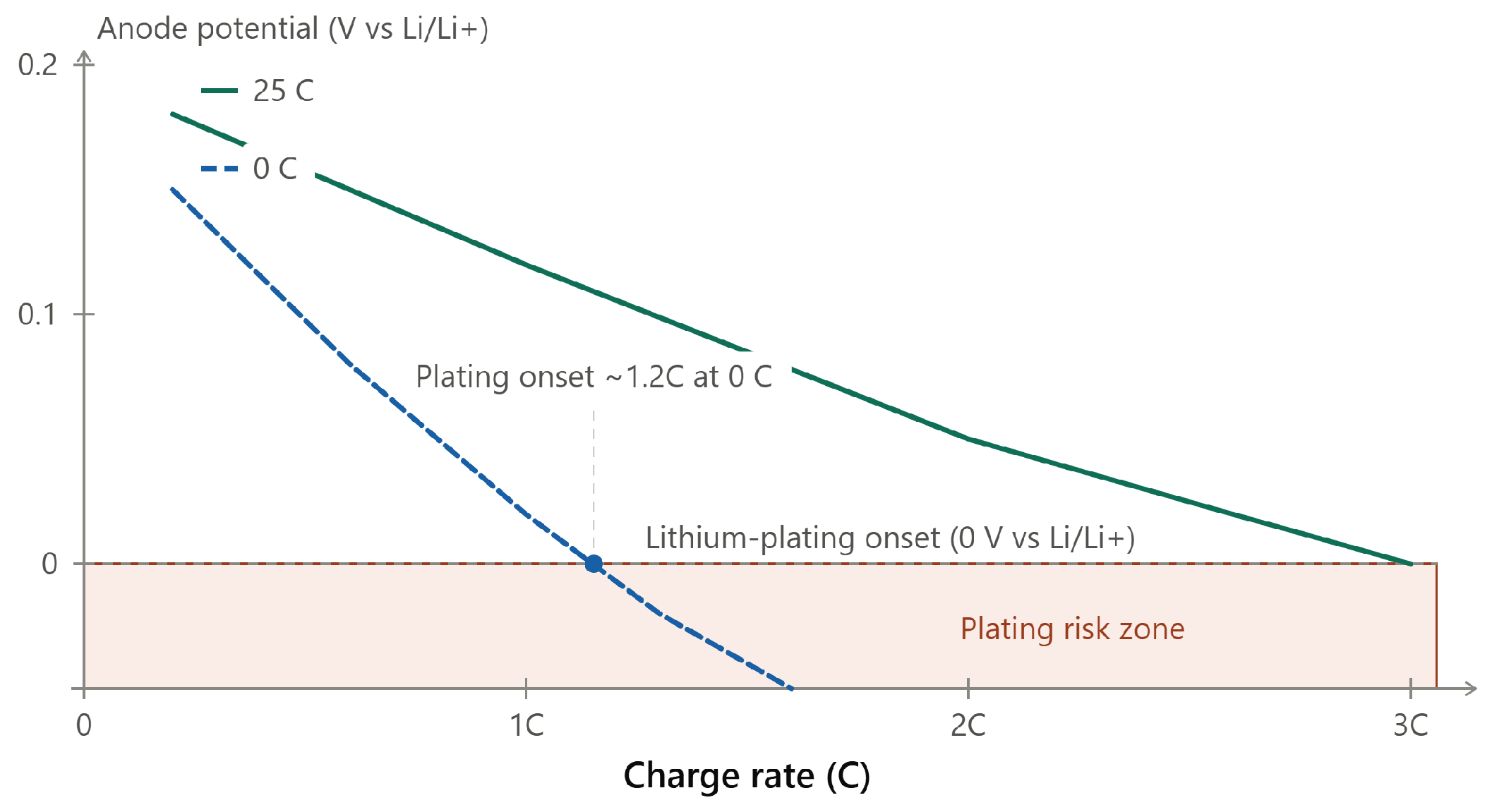
Figure 6.
Schematic capacity retention versus equivalent full cycles () for a benign (moderate temperature/) and an aggressive (high temperature/, fast-charge) duty profile, showing that count alone does not determine end-of-life.
Figure 6.
Schematic capacity retention versus equivalent full cycles () for a benign (moderate temperature/) and an aggressive (high temperature/, fast-charge) duty profile, showing that count alone does not determine end-of-life.

Figure 7.
Schematic comparison of cylindrical, pouch, and prismatic cell cross-sections, showing the core-to-surface gradient characteristic of wound cells versus the compression, swelling, and non-uniform cooling exposure of pouch and prismatic formats.
Figure 7.
Schematic comparison of cylindrical, pouch, and prismatic cell cross-sections, showing the core-to-surface gradient characteristic of wound cells versus the compression, swelling, and non-uniform cooling exposure of pouch and prismatic formats.

Disclaimer/Publisher’s Note: The statements, opinions and data contained in all publications are solely those of the individual author(s) and contributor(s) and not of MDPI and/or the editor(s). MDPI and/or the editor(s) disclaim responsibility for any injury to people or property resulting from any ideas, methods, instructions or products referred to in the content. |
© 2026 by the authors. Licensee MDPI, Basel, Switzerland. This article is an open access article distributed under the terms and conditions of the Creative Commons Attribution (CC BY) license.
Copyright: This open access article is published under a Creative Commons CC BY 4.0 license, which permit the free download, distribution, and reuse, provided that the author and preprint are cited in any reuse.