

Submitted:
08 September 2026
Posted:
09 September 2026
You are already at the latest version
Abstract
Background/Objectives: Self-determination theory posits that the satisfaction of three basic psychological needs, autonomy, competence and relatedness, underpins employees' motivation and well-being. In nursing, need satisfaction has been associated with work engagement, job satisfaction, quality of care and patient safety, yet no validated Greek-language instrument is available for its assessment. This study aimed to translate the Basic Psychological Need Satisfaction at Work Scale into Greek and to examine its psychometric properties in hospital nurses. Methods: A cross-sectional study was conducted between March and June 2026 with a convenience sample of 250 registered nurses from five Greek public hospitals. Construct validity was assessed through confirmatory factor analysis and measurement invariance across gender was tested at the configural and metric levels. Known-groups validity was examined against work in understaffed departments, and concurrent validity against the Gaslighting at Work Scale and the Job Crafting Scale. Reliability was evaluated using Cronbach's alpha, McDonald's omega, and test–retest intraclass correlation coefficients over a one-week interval in 40 nurses. Results: The original three-factor structure of the scale was confirmed (x²/df = 2.078, RMSEA = 0.043, GFI = 0.952, AGFI = 0.929, TLI = 0.940, CFI = 0.956). Configural and metric invariance across gender was supported (p = 0.849). Nurses in understaffed departments reported lower autonomy (p < 0.001) and competence (p = 0.031). All three factors correlated negatively with both gaslighting dimensions and positively with approach-oriented job crafting. Cronbach's alpha was 0.800 for the total scale and ranged from 0.626 to 0.844 across factors, while intraclass correlation coefficients ranged from 0.967 to 0.973. Conclusions: The Greek version is a valid and reliable measure of basic psychological need satisfaction for use with hospital nurses in research and in unit-level assessment of managerial interventions.
Keywords:
basic psychological need
; Greek
; nurse
; psychometrics
; satisfaction
; self-determination theory
; translation
; validation
1. Introduction
Self-determination theory (SDT) is a macro-theory of human motivation grounded in an organismic–dialectical metatheory. It posits that people possess inherent propensities toward psychological growth, the internalization of social values, and the integration of experience into a coherent sense of self, and that these propensities are optimally expressed when social environments support their basic psychological needs [1,2]. Central to self-determination theory is the concept of basic psychological needs assumed to be innate and universal. Within SDT, basic psychological needs are defined as “innate psychological nutriments that are essential for ongoing psychological growth, integrity, and well-being” [1]. Three such needs have been identified: autonomy, referring to the experience of volition and self-endorsement of one’s actions; competence, referring to effectiveness and mastery in one’s interactions with the environment; and relatedness, referring to connection, belonging, and mutual care.
In work settings, basic psychological need satisfaction and the quality of work motivation constitute central, although not exclusive, explanatory pathways linking contextual characteristics, such as managerial autonomy support, job design, leadership, and compensation practices, to employee performance and well-being [3,4]. A meta-analysis of 99 studies comprising 119 independent samples largely supported the unique contribution of autonomy, competence, and relatedness to intrinsic motivation and several indicators of well-being and job attitudes [5]. The same meta-analysis recommended examining the three needs separately rather than combining them into a single composite score, because they are not interchangeable and display partly distinct nomological networks.
Nursing is practiced in an environment of exceptional physical, emotional, and psychological demand. High patient-to-nurse ratios, rotating shift work, the care of emergency and critically ill patients, the acute pressures imposed by pandemic conditions, and sustained involvement with chronically ill patients and with children facing life-threatening illness together produce a work context of considerable complexity. Such occupational stressors have been associated with adverse outcomes for nurses at both the professional and the personal level, and, in turn, with deterioration in the quality and safety of patient care [6,7,8,9,10,11]. Working conditions of this intensity would be expected to be offset by robust organizational support. The available evidence suggests otherwise, as nurses frequently report inadequate organizational support, exposure to abusive leadership behaviors, and organizational failure to secure the resources required for the safe and effective delivery of nursing care [12,13,14].
Conversely, a supportive work environment offers multiple benefits for both nurses and patients. A growing body of empirical studies has explicitly measured autonomy, competence and relatedness satisfaction in healthcare professionals and positioned managerial and leadership factors as their antecedents. In a survey of Chinese nurses, the practice environment, operationalized through nurse participation in hospital affairs, nurse manager ability, leadership and support, staffing and resource adequacy, and collegial nurse–physician relationships, was positively related to work engagement, and this association was fully mediated by basic psychological need satisfaction and organizational commitment, with the two mediators jointly accounting for 47% of the variance in engagement [15]; the same group has similarly reported that need satisfaction transmits the effect of perceived organizational support on nurses' engagement [16]. Among French oncology nurses, satisfaction of the three needs partially mediated the effects of perceived supervisor support, value congruence and staffing adequacy on job satisfaction, which was in turn positively associated with self-reported quality of care and negatively associated with turnover intentions [17]. Need satisfaction has also been shown to mediate the association between strength use at work and lower depressive symptoms in nurses [18] and to underpin career satisfaction and career commitment in a self-determination framework [19], while longitudinal evidence indicates that need satisfaction and need frustration constitute distinct pathways to nurses' optimal and impaired functioning [20]. Grinberg et al. [21] assessed the unique contribution of each need among 152 occupational and physical therapists, differentiating relatedness towards co-workers from relatedness towards patients. Mental well-being was predicted by competence and by both forms of relatedness; job satisfaction by autonomy and competence; and work meaning by autonomy, competence and relatedness towards patients. Autonomy and competence were additionally associated with lower compassion fatigue. These healthcare-specific results align with meta-analytic evidence that leader autonomy support [22] and interpersonal supports for all three needs [23] are reliably associated with need satisfaction, well-being and performance, and with cross-national findings that engaging leadership operates on engagement through need satisfaction [24].
Evidence connecting needs satisfaction to patient-level outcomes remains thinner than that for clinician well-being, but it is converging. Working along the motivational sequence, Qiu et al. [25] found that nurses' self-determined motivation predicted patient safety competency through psychological contract and psychological capital, positioning motivational quality, rather than knowledge or training alone, as a determinant of safety capability. A comparable conclusion emerges from pharmacovigilance research, where in a cross-sectional survey of 534 Taiwanese physicians, pharmacists and nurses, basic psychological need satisfaction was directly and positively associated with intention to report adverse drug reactions, and exerted additional indirect effects through motivational and normative pathways, whereas knowledge and normative beliefs were negatively associated with intention and perceived behavioral control was unrelated to it [26]. This suggests that interventions relying on education or normative pressure may be insufficient to sustain safety-relevant behavior, and that need-supportive conditions may be the more durable lever. The reverse pathway is equally instructive, as nurse managers' toxic leadership behaviors, which by definition thwart these needs, have been associated with more nurse-reported adverse events and poorer quality of care [27]. A meta-analytic structural equation model of 192 articles supports the underlying mechanism, showing that perceived need support from leaders relates to adaptive workplace outcomes, including performance, through need satisfaction and autonomous motivation [28].
The literature has highlighted the important role of satisfying nurses’ psychological needs in promoting their occupational well-being and supporting the provision of high-quality healthcare services. These findings underscore the need to investigate the extent to which such needs are fulfilled, as well as the factors that may be positively or negatively associated with their satisfaction. In this context, the aim of the present study was to translate and validate the Basic Psychological Need Satisfaction at Work Scale for use in the Greek nursing population.
2. Materials and Methods
2.1. Study Design
A cross-sectional study was conducted between March to June 2026 involving a convenience sample of 250 registered nurses, both male and female, recruited from five public general hospitals within the Greek secondary and a tertiary healthcare sector. The study achieved a response rate of 66.7% (250 out of 375). Information regarding the study objectives and procedures was made available through the official websites of the participating hospitals, accompanied by invitations to participate. In addition, printed notices were displayed across all hospital departments to enhance recruitment efforts. Prior to participation, potential respondents were fully informed about the study procedures, as well as the voluntary and anonymous nature of their involvement at every stage of the research process. Written informed consent was obtained from all participants before data collection commenced. The study was carried out in compliance with the ethical principles outlined in the Declaration of Helsinki [29]. Ethical approval for the research protocol was granted by the Ethics Committee of the Department of Nursing, University of Thessaly (Approval No 5, 25 February 2026).
2.2. Measurements
2.2.1. Demographic Characteristics
We collected the following demographic data of the nurses: sex (males or females), age (continuous variable), and work in understaffed department (no or yes).
2.2.2. Basic Psychological Need Satisfaction at Work Scale
The scale consists of 21 items assessing the satisfaction of basic psychological needs at work, specifically the needs for competence, autonomy, and relatedness [1,30,31,32]. Each need constitutes a separate subscale comprising of seven items (Autonomy), six items (Competence) and eight items (Relatedness) respectively. Responses are rated on a 7-point Likert scale ranging from 1 (“not at all true”) to 7 (“very true”). Within each subscale, three negatively worded items are reverse scored. Subscale scores are calculated by averaging the item responses after reverse-scoring the three negatively worded items. Higher scores indicate a greater degree of need satisfaction.
The source questionnaire was in English and the target version was in Greek [33]. The original questionnaire was first translated into Greek by two independent translators (forward translation). The two translations were then merged to produce the final form of the translated questionnaire, and any discrepancies between them were resolved at this stage. In the next step, a translator with comparable translation experience translated the Greek questionnaire back into the language of the original instrument (backward translation). Finally, an expert committee comprising the members of the research team reviewed the translation and cross-cultural adaptation process and confirmed the semantic, idiomatic and conceptual equivalence of the Greek version with the original instrument.
2.2.3. Gaslighting at Work Scale
Perceived workplace gaslighting was measured with the Gaslighting at Work Scale (GWS) [34], an eleven-item instrument comprising two dimensions: loss of self-trust (five items) and abuse of power (six items). Responses were recorded on a five-point Likert scale ranging from 1 (never) to 5 (always). Mean scores were computed across the relevant items for the total scale and for each subscale, yielding a possible range of 1 to 5, with elevated values reflecting a greater perceived frequency of gaslighting behaviors on the part of the supervisor. The Greek version of the GWS was utilized [35].
2.2.4. Job Crafting Scale
Job crafting was measured with the scale of Petrou et al. [36]. The scale consists of 11 items grouped into three subscales: seeking resources (4 items), with an example item being “I ask others for feedback on my job performance”; seeking challenges (3 items), with an example item being “I ask for more tasks if I finish my work”; and reducing demands (4 items), including items such as “I try to ensure that my work is emotionally less intense.” Participants are asked to indicate, on a 5-point Likert scale ranging from 1 (never) to 5 (always), how often they engage in each of these behaviors at work. The score for each dimension is calculated as the mean of its respective items and ranges from 1 to 5, with higher scores indicating greater engagement in the corresponding job crafting behavior. For the present study, the validated Greek version of the scale was used [37].
2.3. Statistical Analysis
Descriptive statistics were employed to summarize the study variables. Continuous variables were presented as means, standard deviations, medians, interquartile ranges, minimum and maximum values, whereas categorical variables were described using frequencies and percentages. To assess the distributional properties of the Basic Psychological Need Satisfaction at Work Scale, skewness and kurtosis values were calculated. Values ranging between -1.00 and 1.00 are considered indicative of an approximately normal distribution [38].
The factorial validity of the Greek version of the Basic Psychological Need Satisfaction at Work Scale was evaluated through confirmatory factor analysis (CFA) to verify its proposed three-factor structure. We applied the Maximum Likelihood method with 200 bootstrap resamples. Model fit was assessed using multiple goodness-of-fit indices, including the chi-square to degrees of freedom ratio (x²/df), the root mean square error of approximation (RMSEA), the goodness-of-fit index (GFI), the adjusted goodness-of-fit index (AGFI), the Tucker-Lewis index (TLI), the incremental fit index (IFI), the normed fit index (NFI), and the comparative fit index (CFI). Acceptable model fit was defined by x²/df values below 5.0, RMSEA values below 0.10, and values greater than 0.90 for all remaining fit indices [39,40,41]. Standardized factor loadings were also calculated to evaluate the associations between the three factors and the 21 items of the scale. Measurement invariance across gender was further examined through tests of configural and metric invariance. Configural invariance was assessed based on the aforementioned model fit indices, whereas metric invariance was evaluated using statistical significance testing, with p-values greater than 0.05 indicating support for metric equivalence across male and female participants. All CFA procedures were conducted using AMOS version 21 (Amos Development Corporation, Wexford, PA, USA).
To investigate the known-groups validity of the Basic Psychological Need Satisfaction at Work Scale, association between scores on the three factors (i.e., autonomy, competence and relatedness) and work in understaffed departments was examined. Independent-samples t-tests were performed to explore differences in scores according to work in understaffed departments since the scores followed the normal distribution.
Moreover, we examined the concurrent validity of the Basic Psychological Need Satisfaction at Work Scale by estimating Pearson’s correlation coefficient between the scale and the Gaslighting at Work Scale, and the Job Crafting Scale. We expected a negative correlation between the Basic Psychological Need Satisfaction at Work Scale and the two factors of the Gaslighting at Work Scale (i.e., loss of self-trust and abuse of power). Additionally, we expected a positive correlation between the Basic Psychological Need Satisfaction at Work Scale and the factors “seeking resources” and “seeking challenges” of the Job Crafting Scale. On the other hand, we expected a negative correlation between the Basic Psychological Need Satisfaction at Work Scale and the factor “reducing demands” of the Job Crafting Scale.
The internal consistency reliability of the Basic Psychological Need Satisfaction at Work Scale was assessed using Cronbach’s alpha and McDonald’s omega. Values of Cronbach’s alpha and McDonald’s omega exceeding 0.60 were considered indicative of internal consistency. Moreover, we calculated the intraclass correlation coefficients between the two Basic Psychological Need Satisfaction at Work Scale measurements in a test-retest study including 40 nurses. In particular, 40 nurses completed the Basic Psychological Need Satisfaction at Work Scale two times through a week interval. We applied the two-way mixed model with an absolute agreement approach. In this case, we calculated the intraclass correlation coefficients, 95% confidence intervals, and p-values.
Statistical significance was established at a two-tailed p-value of less than 0.05. All statistical analyses were performed using IBM SPSS Statistics version 21.0 (IBM Corp., Armonk, NY, USA).
3. Results
3.1. Sample
The study sample included 250 nurses. Among them, 88.8% (n=222) were females, while 11.2% (n=28) were males. Mean age was 47.5 years (standard deviation = 8.7), with a median value of 49 years, a minimum age of 24 years, and a maximum age of 64 years. In our sample, 78.4% (n=196) of nurses reported that have been working in understaffed departments.
3.2. Basic Psychological Need Satisfaction at Work Scale
Descriptive statistics for the Basic Psychological Need Satisfaction at Work Scale are shown in Table 1. Mean score for the factors “autonomy”, competence, and “relatedness” were 4.23, 5.23, and 5.05, respectively. The skewness values ranged from -0.24 to -0.16, while the kurtosis values ranged from -0.65 to -0.06, indicating the presence of normal distribution among the three factors.
3.3. Validity Analysis
The CFA supported the three-factor structure of the Greek version of the Basic Psychological Need Satisfaction at Work Scale since all indices have acceptable values (Figure 1). In particular, x2/df was 2.078, RMSEA was 0.043, GFI was 0.952, AGFI was 0.929, TLI was 0.940, IFI was 0.957, NFI was 0.920, and CFI was 0.956. Additionally, the standardized regression weights between the three factors and the 21 items ranged from 0.16 to 0.75 (p-value < 0.001 in all cases).
Subsequently, measurement invariance across gender groups (males and females) was examined. The assessment of configural invariance indicated that the three-factor confirmatory factor analysis model demonstrated an excellent fit in both groups, supporting the equivalence of the underlying factor structure. Specifically, the model yielded the following fit indices: x2/df = 1.746, RMSEA = 0.035, GFI = 0.927, AGFI = 0.902, TLI = 0.919, IFI = 0.940, NFI = 0.902, and CFI = 0.956. Furthermore, metric invariance was established across gender, as evidenced by the non-significant difference test (p = 0.849), indicating that factor loadings were equivalent for male and female participants.
Table 2 shows the known-groups validity of the Basic Psychological Need Satisfaction at Work Scale. Nurses in understaffed departments had significant lower scores on autonomy (p-value < 0.001), and competence (p-value = 0.031). Moreover, nurses in understaffed departments showed lower score on relatedness but this association was not significant (p-value = 0.434).
Additionally, concurrent validity of the Basic Psychological Need Satisfaction at Work Scale was very good (Table 3). In particular, we found statistically significant negative correlations between the three factors of the Basic Psychological Need Satisfaction at Work Scale and the two factors of the Gaslighting at Work Scale (p-value < 0.001 in all cases). In other words, nurses that have been experiencing workplace gaslighting from their supervisors have also experiencing less needs satisfaction at their work. Moreover, our findings showed a positive correlation between the three factors of the Basic Psychological Need Satisfaction at Work Scale and the factors “seeking resources” and “seeking challenges” of the Job Crafting Scale. Also, we found a negative correlation between the three factors of the Basic Psychological Need Satisfaction at Work Scale and the factor “reducing demands” of the Job Crafting Scale. In other words, higher levels of job crafting among nurses were correlated with higher levels of needs satisfaction at work.
3.4. Reliability Analysis
Table 4 shows the reliability analysis for the Basic Psychological Need Satisfaction at Work Scale. Cronbach’s alpha and McDonald’s omega for the scale was 0.800 and 0.812, respectively indicating good internal reliability. Moreover, Cronbach’s alpha and McDonald’s omega for the three factors ranged from 0.626 to 0.844, exceeding the threshold of 0.600.
We found that the Basic Psychological Need Satisfaction at Work Scale had very good repeatability since intraclass correlation coefficient for the test-retest was 0.972 (p-value < 0.001) for the factor “autonomy”, 0.973 (p-value < 0.001) for the factor “competence”, and 0.967 (p-value < 0.001) for the factor “relatedness”. Table 5 shows the intraclass correlation coefficients for the test-retest study of the Basic Psychological Need Satisfaction at Work Scale.
4. Discussion
To the best of our knowledge, the present study is the first to examine the psychometric properties of the Greek version of the Basic Psychological Need Satisfaction at Work Scale, and its findings support the use of the instrument for the assessment of autonomy, competence and relatedness satisfaction among hospital nurses. Confirmatory factor analysis reproduced the theoretically specified three-factor structure, with all fit indices meeting conventional criteria, and all 21 items loaded significantly on their intended factor, in agreement with previous psychometric evaluations of the instrument [42,43]. The measurement structure was equivalent across gender, since configural invariance was supported and the test of metric invariance was non-significant, indicating that male and female nurses ascribe comparable meaning to the items and that the associations of the three factors with external variables can be interpreted on a common metric in both groups [41]. Evidence of construct validity was obtained from two independent sources. Known-groups comparisons showed lower autonomy and competence scores among nurses employed in understaffed departments, in line with the expectation that resource-constrained settings restrict volitional action and the experience of effectiveness at work. Concurrent validity was supported by the pattern of correlations with theoretically related constructs: all three factors were negatively associated with both dimensions of workplace gaslighting and with the "reducing demands" dimension of job crafting, and positively associated with "seeking resources" and "seeking challenges", consistent with the premise that need satisfaction is undermined by controlling and manipulative supervisory behavior and is sustained by approach-oriented, self-initiated modification of one's own job [1,5]. Internal consistency was good for the scale as a whole and for the autonomy subscale, whereas the competence and relatedness subscales only marginally exceeded the adopted threshold, an issue that has also been documented in other language versions of the instrument and is considered further below. Finally, the Greek version demonstrated excellent temporal stability over a one-week interval, with intraclass correlation coefficients of 0.972 for autonomy, 0.973 for competence and 0.967 for relatedness, all exceeding the value of 0.90 that denotes excellent test–retest reliability [44].
The psychometric profile obtained in the present study is broadly consistent with that reported for other versions of the instrument, including the pattern of its weaknesses. The 21-item scale was developed and disseminated without the formal validation procedures that are now considered standard, and it has since been criticized for limited content validity and for unstable reliability and intercorrelations of its subscales [45]. Successive psychometric evaluations have nevertheless converged on consistent observations. The three-factor conceptualization is supported: in the Swedish version, examined in a sample of 1,200 employees, a three-factor solution was preferred over the alternative structures previously proposed for related versions of the scale, and each need made a unique contribution to the prediction of psychological well-being [42]. A three-factor structure has likewise been supported for the French-language Basic Psychological Needs at Work Scale, developed as an alternative instrument and shown to be invariant across Canadian and French samples [46], and for the Dutch Work-related Basic Need Satisfaction Scale [47].
4.1. Implications for Nursing Management
Beyond its psychometric contribution, the Greek version of the scale offers nursing management a concise instrument for monitoring a modifiable determinant of the nursing work experience. The mean scores obtained here are informative in themselves: satisfaction of the need for autonomy was the lowest of the three, while competence and relatedness were considerably higher, indicating that the constraint most keenly felt by Greek nurses concerns volition and self-endorsed action rather than professional efficacy or collegial connection. The known-groups findings point in the same direction, since nurses in understaffed departments reported lower autonomy and competence but comparable relatedness. This pattern is consistent with evidence identifying work overload, determined primarily by workload, time pressure and staffing levels, as a key job demand in nursing, and autonomy as a key job resource [48], and suggests that inadequate staffing is associated primarily with the erosion of discretion and mastery. The absence of a corresponding difference in relatedness may indicate that collegial bonds are less sensitive to staffing constraints, although the evidence on the differential association of job demands with the three needs is not consistent, and this observation requires replication.
Two further associations are directly actionable. Perceived gaslighting by supervisors was negatively associated with all three needs, which places supervisory conduct, and not merely workload, among the organizational conditions relevant to need satisfaction; this is consistent with meta-analytic evidence that leader autonomy support and interpersonal need support are reliably related to need satisfaction, well-being and performance [22,23]. Conversely, approach-oriented job crafting was positively associated with need satisfaction, indicating that the latitude afforded to nurses to seek resources and challenges within their roles may be a practicable point of intervention. Administered at unit level, the instrument could therefore support the identification of departments in which need satisfaction is compromised and assist in evaluating the effect of managerial initiatives, provided that its cross-sectional application is interpreted with the caution outlined below.
4.2. Limitations
Several limitations should be considered when interpreting these findings. First, a convenience sample of 250 nurses from five public hospitals was recruited, which restricts the generalizability of the results to the wider Greek nursing workforce and to nurses employed in the private sector. Also, women comprised 88.8% of the sample, and the small number of male participants (n = 28) limits the statistical power of the invariance analyses. Internal consistency was only marginally acceptable for the competence and relatedness subscales. Moreover, the correlation between the autonomy and competence factors was very high, so that the discriminant validity of these two dimensions was not established in the present sample and requires confirmation in larger and more heterogeneous samples. Finally, concurrent validity was assessed against two self-reported constructs only, and future research should examine the association of need satisfaction with clinician- and patient-level outcomes, and should compare the performance of the present instrument with alternative measures of need satisfaction at work.
5. Conclusions
The present study provides the first evidence on the psychometric properties of the Greek version of the Basic Psychological Need Satisfaction at Work Scale. The instrument reproduced the theoretically expected three-factor structure with satisfactory fit, proved equivalent across gender at the configural and metric levels, and demonstrated excellent temporal stability over a one-week interval. Its construct validity was supported both by the expected differences between nurses working in adequately and inadequately staffed departments and by its coherent pattern of associations with workplace gaslighting and job crafting. Internal consistency was good for the scale as a whole and for the autonomy subscale, and acceptable, though modest, for the competence and relatedness subscales, in line with what has been reported for other language versions of this instrument. Taken together, these findings indicate that the Greek version is a reliable and valid measure of basic psychological need satisfaction at work for use with hospital nurses, and that it can serve both research on the motivational determinants of the nursing work experience and the assessment of the effects of managerial and organizational interventions at unit level. Further work in larger and more heterogeneous samples is warranted to establish scalar invariance, to examine the discriminant validity of the autonomy and competence dimensions, and to evaluate the performance of the instrument against clinician- and patient-level outcomes.
Author Contributions
Conceptualization, I.M., E.F., K.T., and I.V.P.; methodology, E.F., I.V.P., K.T., and I.M.; software, E.F., and P.G.; validation, E.F., I.V.P., K.T., P.G., T.P., E.C.F., A.K., and I.M.; formal analysis, E.F., and P.G.; investigation, E.F., I.V.P., K.T., P.G., T.P., E.C.F., A.K., and I.M.; resources, E.F., I.V.P., K.T., P.G., T.P., E.C.F., A.K., and I.M.; data curation, E.F., and P.G.; writing—original draft preparation, E.F., I.V.P., K.T., P.G., T.P., E.C.F., A.K., and I.M.; writing—review and editing, E.F., I.V.P., K.T., P.G., T.P., E.C.F., A.K., and I.M.; supervision, I.M.; project administration, E.F., I.V.P., K.T., and I.M. All authors have read and agreed to the published version of the manuscript.
Funding
The research is conducted in the operating framework of the University of Thessaly Innovation, Technology Transfer Unit and Entrepreneurship Center "One Planet Thessaly", under the “University of Thessaly Grants for Scientific Publication Support” action and is funded by the Special Account of Research Grants of the University of Thessaly.
Institutional Review Board Statement
The study was conducted in accordance with the Declaration of Helsinki, and approved by the Ethics Committee of the Department of Nursing, University of Thessaly, Greece (Approval No 5, 25 February 2026).
Informed Consent Statement
Informed consent was obtained from all subjects involved in the study.
Data Availability Statement
The data presented in this study are available on request from the corresponding author.
Acknowledgments
The research is conducted in the operating framework of the University of Thessaly Innovation, Technology Transfer Unit and Entrepreneurship Center "One Planet Thessaly", under the “University of Thessaly Grants for Scientific Publication Support” action and is funded by the Special Account of Research Grants of the University of Thessaly.
Conflicts of Interest
The authors declare no conflicts of interest.
Public Involvement Statement
There was no public involvement in any aspect of this research.
Guidelines and Standards Statement
This manuscript was drafted in accordance with the Strengthening the Reporting of Observational Studies in Epidemiology (STROBE) statement for cross-sectional studies.
Use of Artificial Intelligence
Artificial intelligence (AI) or AI-assisted tools used in the preparation of the manuscript exclusively for language translation, language editing and grammar.
Abbreviations
The following abbreviations are used in this manuscript:
| AGFI | Adjusted goodness-of-fit index |
| CFA | Confirmatory factor analysis |
| CFI | Comparative fit index |
| GWS | Gaslighting at Work Scale |
| GFI | Goodness-of-fit index |
| IFI | Incremental fit index |
| NFI | Normed fit index |
| RMSEA | Root mean square error of approximation |
| SDT | Self-determination theory |
| STROBE | Strengthening the Reporting of Observational Studies in Epidemiology |
| TLI | Tucker-Lewis index |
References
- Deci, E.L.; Ryan, R.M. The “What” and “Why” of Goal Pursuits: Human Needs and the Self-Determination of Behavior. Psychol. Inq. 2000, 11, 227–268. [Google Scholar] [CrossRef]
- Ryan, R.M.; Deci, E.L. Self-Determination Theory and the Facilitation of Intrinsic Motivation, Social Development, and Well-Being. Am. Psychol. 2000, 55, 68–78. [Google Scholar] [CrossRef] [PubMed]
- Gagné, M.; Deci, E.L. Self-Determination Theory and Work Motivation. J. Organ. Behav. 2005, 26, 331–362. [Google Scholar] [CrossRef]
- Deci, E.L.; Olafsen, A.H.; Ryan, R.M. Self-Determination Theory in Work Organizations: The State of a Science. Annu. Rev. Organ. Psychol. Organ. Behav. 2017, 4, 19–43. [Google Scholar] [CrossRef]
- Van den Broeck, A.; Ferris, D.L.; Chang, C.-H.; Rosen, C.C. A Review of Self-Determination Theory’s Basic Psychological Needs at Work. J. Manag. 2016, 42, 1195–1229. [Google Scholar] [CrossRef]
- Yang, N.; Ng, Y.X.; Yeoh Lui, C.X.; Woo, B.F.Y.; Liaw, S.Y. Factors Influencing Nurses’ Work–Life Balance: A Systematic Review of Challenges, Opportunities and Strategic Solutions for Healthcare Practice and Policy. J. Nurs. Manag. 2026, 2026, 5981858. [Google Scholar] [CrossRef] [PubMed]
- Gurses, A.P.; Carayon, P.; Wall, M. Impact of Performance Obstacles on Intensive Care Nurses’ Workload, Perceived Quality and Safety of Care, and Quality of Working Life. Health Serv. Res. 2009, 44, 422–443. [Google Scholar] [CrossRef] [PubMed]
- Guttormson, J.L.; Calkins, K.; McAndrew, N.; Fitzgerald, J.; Losurdo, H.; Loonsfoot, D. Critical Care Nurse Burnout, Moral Distress, and Mental Health During the COVID-19 Pandemic: A United States Survey. Heart Lung 2022, 55, 127–133. [Google Scholar] [CrossRef] [PubMed]
- Han, Y.; Yun, H.; Hwang, E. Emergency Nurses’ Experiences Caring for Patients in Mental Health Crisis: Current Challenges and Future Directions. J. Adv. Nurs. 2026, 82, 7484–7494. [Google Scholar] [CrossRef] [PubMed]
- Galanis, P.; Moisoglou, I.; Katsiroumpa, A.; Gallos, P.; Kalogeropoulou, M.; Meimeti, E.; Vraka, I. Workload Increases Nurses’ Quiet Quitting, Turnover Intention, and Job Burnout: Evidence from Greece. AIMS Public Health 2025, 12, 44–55. [Google Scholar] [CrossRef] [PubMed]
- Galanis, P.; Moisoglou, I.; Katsiroumpa, A.; Vraka, I.; Siskou, O.; Konstantakopoulou, O.; Meimeti, E.; Kaitelidou, D. Increased Job Burnout and Reduced Job Satisfaction for Nurses Compared to Other Healthcare Workers after the COVID-19 Pandemic. Nurs. Rep. 2023, 13, 1090–1100. [Google Scholar] [CrossRef] [PubMed]
- Lake, E.T.; Sanders, J.; Duan, R.; Riman, K.A.; Schoenauer, K.M.; Chen, Y. A Meta-Analysis of the Associations Between the Nurse Work Environment in Hospitals and 4 Sets of Outcomes. Med. Care 2019, 57, 353–361. [Google Scholar] [CrossRef] [PubMed]
- Moisoglou, I.; Katsiroumpa, A.; Papathanasiou, I.V.; Konstantakopoulou, O.; Yfantis, A.; Katsapi, A.; Galanis, P. Association Between Workplace Gaslighting and Perceived Quality of Care, Patient Safety and Quiet Quitting: A Cross-Sectional Study Among Nurses in Greece. Healthcare 2026, 14, 450. [Google Scholar] [CrossRef] [PubMed]
- Zheng, J.; Feng, S.; Gao, R.; Gong, X.; Ji, X.; Li, Y.; Wang, X.; Xue, B. The Relationship between Organizational Support, Professional Quality of Life, Decent Work, and Professional Well-Being among Nurses: A Cross-Sectional Study. BMC Nurs. 2024, 23, 425. [Google Scholar] [CrossRef] [PubMed]
- Ni, Y.; Wen, Y.; Xu, Y.; He, L.; You, G. The Relationship between Work Practice Environment and Work Engagement among Nurses: The Multiple Mediation of Basic Psychological Needs and Organizational Commitment a Cross-Sectional Survey. Front. Public Health 2023, 11. [Google Scholar] [CrossRef] [PubMed]
- Ni, Y.; Wu, D.; Bao, Y.; Li, J.; You, G. The Mediating Role of Psychological Needs on the Relationship between Perceived Organizational Support and Work Engagement. Int. Nurs. Rev. 2023, 70, 204–210. [Google Scholar] [CrossRef] [PubMed]
- Gillet, N.; Fouquereau, E.; Coillot, H.; Cougot, B.; Moret, L.; Dupont, S.; Bonnetain, F.; Colombat, P. The Effects of Work Factors on Nurses’ Job Satisfaction, Quality of Care and Turnover Intentions in Oncology. J. Adv. Nurs. 2018, 74, 1208–1219. [Google Scholar] [CrossRef] [PubMed]
- Bai, C.; Bai, B.; Kong, F. Strength Use and Nurses’ Depressive Symptoms: The Mediating Role of Basic Psychological Needs Satisfaction. J. Nurs. Manag. 2021, 29, 1660–1667. [Google Scholar] [CrossRef] [PubMed]
- Onyishi, I.E.; Enwereuzor, I.K.; Ogbonna, M.N.; Ugwu, F.O.; Amazue, L.O. Role of Career Satisfaction in Basic Psychological Needs Satisfaction and Career Commitment of Nurses in Nigeria: A Self-Determination Theory Perspective. J. Nurs. Scholarsh. 2019, 51, 470–479. [Google Scholar] [CrossRef] [PubMed]
- Trépanier, S.-G.; Fernet, C.; Austin, S. Longitudinal Relationships between Workplace Bullying, Basic Psychological Needs, and Employee Functioning: A Simultaneous Investigation of Psychological Need Satisfaction and Frustration. Eur. J. Work Organ. Psychol. 2016, 25, 690–706. [Google Scholar] [CrossRef]
- Grinberg, E.; Nachoum, R.; Kanat-Maymon, Y. The Effect of Basic Psychological Needs on Healthcare Professionals’ Work-Related Psychological Outcomes. WORK 2025, 80, 1634–1639. [Google Scholar] [CrossRef] [PubMed]
- Slemp, G.R.; Kern, M.L.; Patrick, K.J.; Ryan, R.M. Leader Autonomy Support in the Workplace: A Meta-Analytic Review. Motiv Emot. 2018, 42, 706–724. [Google Scholar] [CrossRef] [PubMed]
- Slemp, G.R.; Field, J.G.; Ryan, R.M.; Forner, V.W.; Van den Broeck, A.; Lewis, K.J. Interpersonal Supports for Basic Psychological Needs and Their Relations with Motivation, Well-Being, and Performance: A Meta-Analysis. J. Personal. Soc. Psychol. 2024, 127, 1012–1037. [Google Scholar] [CrossRef] [PubMed]
- Rahmadani, V.G.; Schaufeli, W.B.; Ivanova, T.Y.; Osin, E.N. Basic Psychological Need Satisfaction Mediates the Relationship between Engaging Leadership and Work Engagement: A Cross-National Study. Hum. Resour. Dev. Q. 2019, 30, 453–471. [Google Scholar] [CrossRef]
- Qiu, Y.; Yang, Y.; Wang, J.; Wang, Q.; Zhao, S.; Ding, X. The Influence of Self-Determined Motivation on Patient Safety Competency among Nurses: The Chain Mediating Effect of Psychological Contract and Psychological Capital. Nurse Educ. Today 2025, 152, 106758. [Google Scholar] [CrossRef] [PubMed]
- Wang, W.-J.; Hsu, S.-H.; Huang, S.-H.; Tsai, C.-C.; Keller, J.J.; Wang, L.-H.; Tang, K.-P. Psychological Need Satisfaction and Adverse Drug Reaction Reporting Intention: An Integrated Model among Healthcare Professionals. Res. Soc. Adm. Pharm. 2026, 22, 936–945. [Google Scholar] [CrossRef] [PubMed]
- Labrague, L.J. Influence of Nurse Managers’ Toxic Leadership Behaviours on Nurse-Reported Adverse Events and Quality of Care. J. Nurs. Manag. 2021, 29, 855–863. [Google Scholar] [CrossRef] [PubMed]
- Hagger, M.S.; McAnally Star, K. Self-Determination Theory and Workplace Outcomes: A Meta-Analysis. Stress Health 2026, 42, e70151. [Google Scholar] [CrossRef] [PubMed]
- World Medical Association World Medical Association Declaration of Helsinki: Ethical Principles for Medical Research Involving Human Subjects. JAMA 2013, 310, 2191–2194. [CrossRef] [PubMed]
- Deci, E.L.; Ryan, R.M.; Gagné, M.; Leone, D.R.; Usunov, J.; Kornazheva, B.P. Need Satisfaction, Motivation, and Well-Being in the Work Organizations of a Former Eastern Bloc Country: A Cross-Cultural Study of Self-Determination. Pers. Soc. Psychol. Bull. 2001, 27, 930–942. [Google Scholar] [CrossRef]
- Ilardi, B.C.; Leone, D.; Kasser, T.; Ryan, R.M. Employee and Supervisor Ratings of Motivation: Main Effects and Discrepancies Associated with Job Satisfaction and Adjustment in a Factory Setting. J. Appl. Soc. Psychol. 1993, 23, 1789–1805. [Google Scholar] [CrossRef]
- Kasser, T.; Davey, J.; Ryan, R.M. Motivation and Employee-Supervisor Discrepancies in a Psychiatric Vocational Rehabilitation Setting. Rehabil. Psychol. 1992, 37, 175–188. [Google Scholar] [CrossRef]
- Galanis, Petros. Translation and Cross-Cultural Adaptation Methodology for Questionnaires in Languages Other than Greek. Arch. Hell. Med. 2019, 36, 124–135. [Google Scholar]
- Katsiroumpa, A.; Moisoglou, I.; Konstantakopoulou, O.; Tsiachri, M.; Kolisiati, A.; Galanis, P. The Gaslighting at Work Scale: Development and Initial Validation. J. Workplace Behav. Health 2026, 41, 642–664. [Google Scholar] [CrossRef]
- Katsiroumpa, A.; Moisoglou, I.; Tsiachri, M.; Lamprakopoulou, K.; Galani, O.; Tsakalaki, A.; Galanis, P. Gaslighting at Work Scale: Determination of an Optimal Cut-Off Point. Int. J. Caring Sci. 2025, 18, 614–621. [Google Scholar]
- Petrou, P.; Demerouti, E.; Schaufeli, W.B. Job Crafting in Changing Organizations: Antecedents and Implications for Exhaustion and Performance. J. Occup. Health Psychol. 2015, 20, 470–480. [Google Scholar] [CrossRef] [PubMed]
- Demerouti, E.; Xanthopoulou, D.; Petrou, P.; Karagkounis, C. Does Job Crafting Assist Dealing with Organizational Changes Due to Austerity Measures? Two Studies among Greek Employees. Eur. J. Work Organ. Psychol. 2017, 26, 574–589. [Google Scholar] [CrossRef]
- Hair, J.; Black, W.; Babin, B.; Anderson, R. Multivariate Data Analysis, 7th ed.; Prentice Hall: New Jersey, 2017. [Google Scholar]
- Baumgartner, H.; Homburg, C. Applications of Structural Equation Modeling in Marketing and Consumer Research: A Review. Int. J. Res. Mark. 1996, 13, 139–161. [Google Scholar] [CrossRef]
- Hu, L.; Bentler, P.M. Fit Indices in Covariance Structure Modeling: Sensitivity to Underparameterized Model Misspecification. Psychol. Methods 1998, 3, 424–453. [Google Scholar] [CrossRef]
- Brown, T.A. Confirmatory Factor Analysis for Applied Research, Second Edition; Guilford Publications, 2015; ISBN 978-1-4625-1779-4. [Google Scholar]
- Eriksson, M.; Boman, E. Short Is Beautiful: Dimensionality and Measurement Invariance in Two Length of the Basic Psychological Need Satisfaction at Work Scale. Front. Psychol. 2018, 9. [Google Scholar] [CrossRef] [PubMed]
- Johnston, M.M.; Finney, S.J. Measuring Basic Needs Satisfaction: Evaluating Previous Research and Conducting New Psychometric Evaluations of the Basic Needs Satisfaction in General Scale. Contemp. Educ. Psychol. 2010, 35, 280–296. [Google Scholar] [CrossRef]
- Koo, T.K.; Li, M.Y. A Guideline of Selecting and Reporting Intraclass Correlation Coefficients for Reliability Research. J. Chiropr. Med. 2016, 15, 155–163. [Google Scholar] [CrossRef] [PubMed]
- Olafsen, A.H.; Halvari, H.; Frølund, C.W. The Basic Psychological Need Satisfaction and Need Frustration at Work Scale: A Validation Study. Front. Psychol. 2021, 12. [Google Scholar] [CrossRef] [PubMed]
- Brien, M.; Forest, J.; Mageau, G.A.; Boudrias, J.-S.; Desrumaux, P.; Brunet, L.; Morin, E.M. The Basic Psychological Needs at Work Scale: Measurement Invariance between Canada and France. Appl. Psychol. Health Well-Being 2012, 4, 167–187. [Google Scholar] [CrossRef] [PubMed]
- Van den Broeck, A.; Vansteenkiste, M.; De Witte, H.; Soenens, B.; Lens, W. Capturing Autonomy, Competence, and Relatedness at Work: Construction and Initial Validation of the Work-Related Basic Need Satisfaction Scale. J. Occup. Organ. Psychol. 2010, 83, 981–1002. [Google Scholar] [CrossRef]
- Broetje, S.; Jenny, G.J.; Bauer, G.F. The Key Job Demands and Resources of Nursing Staff: An Integrative Review of Reviews. Front. Psychol. 2020, 11. [Google Scholar] [CrossRef] [PubMed]
Figure 1.
Confirmatory factor analysis for the Greek version of the Basic Psychological Need Satisfaction at Work Scale.
Figure 1.
Confirmatory factor analysis for the Greek version of the Basic Psychological Need Satisfaction at Work Scale.
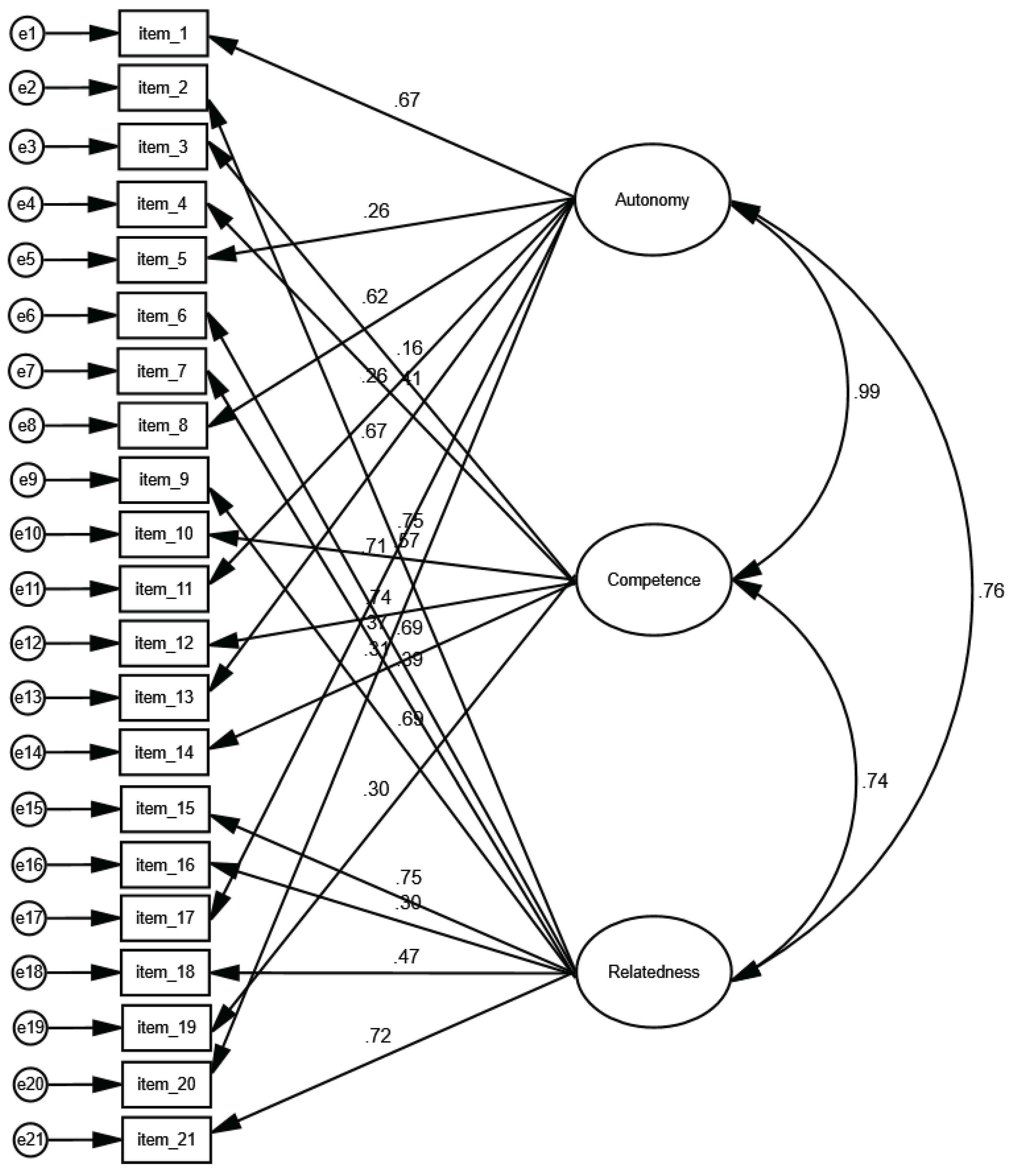

Table 1.
Descriptive statistics for the Basic Psychological Need Satisfaction at Work Scale.
| Factor | Mean | Standard deviation | Median | Interquartile range | Skewness | Kurtosis |
| Autonomy | 4.23 | 0.97 | 4.29 | 1.29 | -0.21 | -0.06 |
| Competence | 5.23 | 0.97 | 5.33 | 1.50 | -0.16 | -0.65 |
| Relatedness | 5.05 | 1.06 | 5.13 | 1.63 | -0.24 | -0.51 |
Table 2.
Known-groups validity of the Basic Psychological Need Satisfaction at Work Scale.
| Factor | Understaffed department | P-valuea | |||
| No | Yes | ||||
| Mean | Standard deviation | Mean | Standard deviation | ||
| Autonomy | 4.64 | 0.80 | 4.11 | 0.98 | <0.001 |
| Competence | 5.48 | 0.99 | 5.16 | 0.95 | 0.031 |
| Relatedness | 5.15 | 1.09 | 5.02 | 1.05 | 0.434 |
a independent samples t-test.
Table 3.
Concurrent validity of the Basic Psychological Need Satisfaction at Work Scale.
| Scale | Basic Psychological Need Satisfaction at Work Scale | |||||
| Autonomy | Competence | Relatedness | ||||
| Pearson’s correlation coefficient | P-value | Pearson’s correlation coefficient | P-value | Pearson’s correlation coefficient | P-value | |
| Gaslighting at Work Scale | ||||||
| Loss of self-trust | -0.28 | <0.001 | -0.23 | <0.001 | -0.25 | <0.001 |
| Abuse of power | -0.33 | <0.001 | -0.31 | <0.001 | -0.24 | <0.001 |
| Job Crafting Scale | ||||||
| Seeking resources | 0.30 | <0.001 | 0.31 | <0.001 | 0.28 | <0.001 |
| Seeking challenges | 0.14 | 0.030 | 0.13 | 0.040 | 0.14 | 0.029 |
| Reducing demands | -0.18 | 0.005 | -0.20 | 0.002 | -0.16 | 0.009 |
Table 4.
Reliability analysis for the Basic Psychological Need Satisfaction at Work Scale.
| Factor | Cronbach’s alpha | McDonald’s omega |
| Autonomy | 0.844 | 0.839 |
| Competence | 0.638 | 0.641 |
| Relatedness | 0.626 | 0.639 |
| Basic Psychological Need Satisfaction at Work Scale | 0.800 | 0.812 |
Table 5.
Intraclass correlation coefficients for the test-retest study of the Basic Psychological Need Satisfaction at Work Scale.
Table 5.
Intraclass correlation coefficients for the test-retest study of the Basic Psychological Need Satisfaction at Work Scale.
| Factor | Intraclass correlation coefficient | 95% confidence interval | P-value |
| Autonomy | 0.972 | 0.946 to 0.985 | <0.001 |
| Competence | 0.973 | 0.947 to 0.986 | <0.001 |
| Relatedness | 0.967 | 0.938 to 0.983 | <0.001 |
Disclaimer/Publisher’s Note: The statements, opinions and data contained in all publications are solely those of the individual author(s) and contributor(s) and not of MDPI and/or the editor(s). MDPI and/or the editor(s) disclaim responsibility for any injury to people or property resulting from any ideas, methods, instructions or products referred to in the content. |
© 2026 by the authors. Licensee MDPI, Basel, Switzerland. This article is an open access article distributed under the terms and conditions of the Creative Commons Attribution (CC BY) license (http://creativecommons.org/licenses/by/4.0/).
Copyright: This open access article is published under a Creative Commons CC BY 4.0 license, which permit the free download, distribution, and reuse, provided that the author and preprint are cited in any reuse.