

Submitted:
08 September 2026
Posted:
09 September 2026
You are already at the latest version
Preprints on COVID-19 and SARS-CoV-2
Abstract
The most crucial environmental issue threatening public health is air pollution, which is strongly associated with respiratory, cardiovascular, and infectious diseases. Increased concentrations of air pollutants, particularly from industrial activities, fossil fuel combustion, and transportation, have become a major global concern. Fine particulate matter emitted from diesel vehicles, biomass burning, and coal combustion has been identified as one of the most important contributors to adverse health outcomes. Previous studies have demonstrated that meteorological conditions and air pollutant concentrations may influence the transmission dynamics and severity of respiratory viral infections, including COVID-19. The COVID-19 pandemic provided a unique global-scale environmental experiment by temporarily reducing anthropogenic activities, including transportation and industrial processes, through lockdown measures. These restrictions resulted in short-term improvements in outdoor air quality and reductions in greenhouse gas emissions in many regions. However, these temporary improvements also highlighted the need for long-term structural strategies rather than short-term reductions in human activities to mitigate climate change. In this review, the interactions among air pollution, climatological parameters, and COVID-19 transmission are critically evaluated, and the impacts of COVID-19-related lockdown measures on outdoor air quality are summarized. Furthermore, the potential implications of the pandemic experience for future environmental health strategies and climate change mitigation policies are discussed. The findings of this review provide valuable insights into the relationship between human activities, environmental quality, and public health, emphasizing the importance of integrated approaches to address future environmental challenges.
Keywords:
air pollution
; public health
; climate change
; COVID-19
; lockdown measures
; environmental health
1. Introduction
There is no doubt that the most important environmental problem threatening the whole world today and in the next century is global climate change in particular caused by the increase in the concentrations of greenhouse gases (GHGs) such as carbon dioxide (CO2), methane (CH4), nitrous oxides (NOX), other fluorinated gases released into the atmosphere as a result of the burning of fossil fuels especially during energy production. Not only fuel-fired thermal power plants and industries that cause GHG emissions are responsible for this global environmental phenomenon, but also urbanization, deforestation, land degradation, and agricultural and mining activities are of great importance by being GHG sources. Global climate change has numerous negative effects on human beings, and undoubtedly its effects on public health have gained great attention (Akan et al., 2020; Agache et al., 2022; Akan et al., 2023). Considering the increased exposure to air pollutants including carbon monoxide (CO), nitrogen dioxide (NO2), sulfur dioxide (SO2), ground-level or tropospheric ozone (O3), particulate matters (PM10: aerodynamic diameter smaller than 10 µm and PM2.5: aerodynamic diameter smaller than 2.5 µm) due to global climate change, some important diseases, such as asthma, lung inflammation, heart ischemic, vector-borne infectious diseases affecting the cardiovascular and respiratory system and immune system were observed (Agache et al., 2022; Franchini and Mannucci, 2015).
In recent years, increasing attention has been given to the interactions between environmental changes and public health risks, particularly after the COVID-19 pandemic demonstrated the vulnerability of societies to environmental and biological stressors. The pandemic has also provided a unique opportunity to evaluate the connection between anthropogenic activities, environmental changes, and public health outcomes, highlighting the importance of integrated environmental health strategies for future global challenges. In this context, many previous studies indicated that outdoor air pollutant concentrations, such as CO, NO2, SO2, O3, PM2.5, and PM10, as well as climatological parameters including ambient temperature, atmospheric pressure, relative humidity, wind speed, gust, cloud conditions, were associated with the transmission of COVID-19 incidence (Akan, 2022; Li et al., 2020; Zoran et al., 2020; Taniş and Karakaya, 2021; Wu et al., 2020; Tang et al., 2020). To prevent the spread of this virus, which caused significant global health impacts, many strict lockdown measures restricting human mobility, such as public, airport, and ship transport limitations, were implemented on regional or national scales by decision-makers. These measures, although primarily introduced as public health interventions, also provided an unprecedented opportunity to evaluate the relationship between anthropogenic activities and environmental quality. Previous studies examined the effects of COVID-19-related lockdown measures on regional air pollution by comparing air pollutant concentrations obtained from monitoring stations or remotely sensed data with previous years’ observations. Most of these studies demonstrated improvements in air quality during quarantine periods, highlighting the strong influence of transportation and industrial activities on atmospheric pollution (Akan and Coccia, 2022; Bray et al., 2021; Filonchyk et al., 2021; Sannino et al., 2021; Cucciniello et al., 2022). More recent systematic reviews and global-scale assessments have further confirmed that COVID-19-related restrictions resulted in significant reductions in major pollutants, particularly NO2, PM2.5, PM10, CO, and NOx, while also emphasizing the role of mobility reduction and industrial activity changes in improving air quality (Navaratnam et al., 2024; Zheng et al., 2025). Correspondingly, this review paper critically evaluates the associations among climate parameters, air pollutants, and SARS-CoV-2 transmission, as well as the impacts of COVID-19-related lockdown restrictions on outdoor air quality. Furthermore, this review highlights the lessons learned from the pandemic by examining the relationships between human activities, environmental quality, and climate change mitigation strategies. The current state of knowledge is discussed from three main perspectives: (i) the influence of air pollutants and climatological conditions on COVID-19 transmission, (ii) the impacts of COVID-19-related lockdown measures on outdoor air quality, and (iii) the implications of pandemic-related environmental changes for future environmental health and climate policies. The conceptual framework illustrating the scope and main components of this review is presented in Figure 1.
2. Associations Among Air Pollution, Climatological Parameters, and the COVID-19 Outbreak
COVID-19 has been one of the most influential global health challenges in recent years, affecting various aspects of human life due to the substantial changes in social, economic, and environmental systems following the emergence of the SARS-CoV-2 virus. Since its first identification in December 2019 and subsequent rapid global spread, the COVID-19 pandemic has not only placed significant pressure on healthcare systems but also caused considerable socioeconomic impacts, particularly on trade, production, manufacturing, air and land transportation, shipping, and service sectors associated with social activities (Skirienė and Stasiškienė, 2021). Investigations into the factors influencing SARS-CoV-2 transmission have demonstrated that environmental conditions, including meteorological parameters and air pollution levels, together with demographic, socioeconomic, behavioral characteristics, and non-pharmaceutical interventions, played important roles in the spread and severity of the pandemic across different regions (Aboura et al., 2022; Weaver et al., 2022). Many previous studies have revealed that climatic parameters, such as temperature, relative humidity, wind speed, precipitation, atmospheric pressure, gust, cloud, sun hour, and air pollutants including CO, NO2, SO2, O3, PM2.5, and PM10 have a significant contribution to the spread of respiratory infectious diseases (Bolaño-Ortiz et al., 2020; Somayaji et al., 2020). Faruk and co-workers (2022) evaluated the associations between meteorological factors and COVID-19 transmission considering previously published manuscripts. They stressed that the most significant associations with the spread of COVID-19 are mostly based on two environmental factors: temperature and humidity. Moreover, air pollution leads to an increase in the number of COVID-19 confirmed cases depending on PM10, PM2.5, and O3 concentrations. Han and co-workers (2022) explored globally the factors affecting the transmission of COVID-19 incidence examining data from 188 countries and related to meteorological parameters, outdoor air pollutants, and socioeconomic aspects for the period between March and November 2020. They found that the spread of the SARS-CoV-2 virus was negatively correlated with meteorological variables and positively correlated with air pollutants and socioeconomic characteristics. In another study, Aboura (2022) evaluated the relationship between climate parameters including ambient temperature, relative humidity, precipitation, and wind speed, and the number of cases and deaths in 134 countries related to the SARS-CoV-2 virus for the period 1 January 2020 to 23 March 2021, considering control parameters, such as government interventions, total population, and population density. The results obtained on a global scale have exhibited that relative humidity causes a decrease in case and death rates in both high and low regimes, while temperature and wind parameters decrease mortality rates. Another remarkable result of the study is that relative humidity is more effective in confirmed cases and wind on deaths. Moreover, another study conducted by Sun and coworkers (2022) evaluated the effects of meteorological factors including air temperature, relative humidity, wind speed, and surface pressure on the epidemic using regression models. They stated that ambient temperature is both significantly and positively correlated with the transmission of the COVID-19 outbreak. It is clear that from multiple studies exploring the associations between air pollutant concentrations, meteorological parameters, and the spread rate of COVID-19, people who are exposed to air pollutants in high concentrations and to diverse climatological conditions, such as low wind speed preventing the dispersion of air pollutants that remain stagnant in the air with the content of bacteria and viruses, are under the risk for capturing to infectious diseases, such as SARS-CoV-2 (Coccia, 2020, Coccia, 2021; Akan, 2022; Huang et al., 2022). In addition to the studies summarized here so far, some of the studies expressing the effects of meteorological parameters and air pollutant concentrations on the transmission of the SARS-CoV-2 virus considering different periods in different countries are presented in Table 1.
The studies summarized in Table 1 demonstrate that the association between environmental parameters and COVID-19 transmission is complex and influenced by multiple interacting factors. Although several studies have reported significant relationships between air pollutants, particularly particulate matter and NO₂, and COVID-19 incidence, the magnitude and direction of these associations differ depending on geographical location, meteorological conditions, population characteristics, and implemented control measures. Recent investigations have further emphasized the importance of considering nonlinear relationships, delayed effects, and potential causal mechanisms when evaluating the influence of environmental factors on infectious disease dynamics. Overall, these findings highlight the close interaction between atmospheric conditions, human activities, and public health risks, supporting the consideration of COVID-19 as an important environmental health indicator.
3. Impacts of Lockdown Measures Based on COVID-19 Outbreak on Outdoor Air Quality
To prevent the transmission of the COVID-19 virus from person to person on a national scale, countries implemented various measures to reduce human activities in society across different regions and periods while controlling the health impacts of the epidemic and improving urban air quality (Anil and Alagha, 2021; Islam et al., 2021; Munir et al., 2021; Mor et al., 2021). While strict lockdown measures imposed by governments to combat the transmission of COVID-19 impact the countries’ economies adversely, they can also improve air quality by reducing anthropogenic emissions from sources such as diesel-fueled vehicles, power plants, cement and iron-steel factories (Ray et al., 2022). COVID-19-based restrictions have shown that reductions in human activities can temporarily decrease greenhouse gas emissions and atmospheric pollution, providing valuable insights into the relationship between societal activities and environmental quality (Siddique et al., 2021).
Akan and Coccia (2022) explored globally how lockdown measures taken by governments to prevent the spread of the COVID-19 outbreak influenced air quality levels by evaluating average changes in air pollutant concentrations across 300 cities in 19 countries of five geoeconomic regions. They concluded that air pollutant concentrations generally decreased during the lockdown periods, but the variation in each country was different from one another, especially due to their differences in geographical, economic, and industrial characteristics. Another study performed by Skirienė and Stasiškienė (2021) investigated how lockdown strategies influenced air quality changes during three periods: i) pre-lockdown from Jan to Feb 2020, ii) I period from Mar to Apr 2020 including lockdown measures applied nationally, iii) II period covering only May 2020, when countries started to relax measures by comparing the data with the same periods from 2018–2019 years for five European countries: the United Kingdom, Spain, France, and Sweden, as well as the Northern Italy region. Results showed that NO2, PM2.5, and PM10 emissions were reduced by 20–40% in 2020 because of the decline in industrial and mobility actions. A study carried out in the Kolkata Metropolitan Area, India, to determine the possible influence of the reductions in mobility activities based on lockdown restrictions on air pollutants concentration indicated that the concentrations of air pollutants showed significant reductions contributing to improvements in air quality index (AQI) by 54.94% during the lockdown months (Chowdhuri et al., 2022).
In another study carried out in cities of India, including Delhi, Mumbai, Kolkata, and Chennai, enforced lockdown measures from March 24, 2020, to May 17, 2020, to comprehend the influence of restrictions on air quality improvements, it was found that air pollutants levels and aerosol concentration were reduced by the range of -37.13% and -54.94% for all examined cities compared to previous years. Moreover, the variation in PM2.5 concentration in these megacities demonstrated the highest decline, directly related to restricted vehicular movement (Pal et al., 2022). In the study conducted in Wuhan during the COVID-19 pandemic lockdown and the post-pandemic period, it was observed that PM2.5 concentrations were reduced by 9.57–18.67% from a momentum effect and by 7.07–27.60% from a spillover effect through the spatiotemporal model (Gao et al., 2022). On the other hand, another study conducted by Jakob et al. (2022) evaluated the variations in the concentration of air pollutants based on lockdown restrictions in Jakarta, Indonesia. Since the results indicated that the concentrations of PM10 and PM2.5 did not change significantly because of the lockdown measures, meteorological factors impacting air quality should also be considered. Furthermore, in the study conducted in downtown Toronto, Canada, it was found that even if a significant reduction in traffic density was observed, the reduction in the concentration of PM2.5 remained negligibly low (Jeong et al., 2022). Moreover, Das et al. (2022) compared the effects of lockdown measures applied on a regional and national scale on air quality. They indicated that regional lockdown in 2021 improved air quality by 32% more than the national lockdown in 2020. In another study focusing on the impact of the lockdown imposed in India nationally from March 25, 2020, to prevent the spread of COVID-19 disease on the anthropogenic emission sources by analyzing a multi-scale (national-regional-city), it was found that a significant reduction in surface measurements of NO2 (46–61%) and fine particulate matter (42–60%) during the lockdown period. Other species, namely coarse particulate matter (24–62%) and ozone (22–56%), also showed a substantial reduction, whereas CO exhibited a moderate decline in the range of 16-46%. However, SO2 levels did not exhibit any defined reduction trend but increased in Mumbai, Bengaluru, and Kolkata (Sathe et al., 2021).
Lockdown measures generally improved air quality by reducing transportation and industrial emissions; however, the magnitude of these improvements varied significantly among regions depending on emission sources, meteorological conditions, and local characteristics. To stress the influence of lockdown measures applied regionally or nationally by counties on air quality improvements, Table 2 demonstrates significant results of the previous studies from different countries.
Overall, the studies summarized in Table 2 demonstrate that COVID-19-related lockdown measures generally resulted in short-term improvements in outdoor air quality, particularly through reductions in transportation, industrial activities, and other anthropogenic emissions. However, the magnitude and direction of these changes varied considerably among regions and pollutants, depending on local emission sources, geographical characteristics, meteorological conditions, and the intensity and duration of lockdown measures. Recent studies have further demonstrated that these effects should be interpreted cautiously, as observed changes in pollutant concentrations may also reflect seasonal variability, atmospheric processes, and natural emission sources. Therefore, the environmental improvements observed during the pandemic should not be interpreted as evidence of a permanent reduction in air pollution, but rather as an important environmental health lesson demonstrating the sensitivity of air quality to changes in human activities.
Although many studies have reported that lockdown measures improved air quality, Jakob et al. (2022), on the other hand, stated that the decrease in pollutant concentrations observed during the quarantine period was not necessarily related to the restrictive measures, as seasonal changes may also have contributed to the observed variations. In this context, considering that quarantine restrictions may provide insights for future policy actions, such as the preparation of national strategies and the development of new technologies to combat air pollution and climate change, future studies should not only evaluate changes in pollutant concentrations using empirical measurements, various models, and remote sensing data, but also examine seasonal variations in pollutant concentrations over longer periods.
4. The Impacts of the COVID-19 Pandemic on Climate Change
To reduce human-to-human transmission of COVID-19, temporary lockdowns at various scales were imposed during different periods of the pandemic to control the spread of the virus. The considerable reductions in economic production and transportation activities contributed to a sharp decline in major GHG emissions, particularly CO2. In China, CO2 emissions were reduced by 23% due to lockdown measures applied nationally limiting thanks industrial, commercial, and transportation activities by February 2020. According to a report published by the International Energy Agency in 2020, in the first quarter of 2020, CO2 emissions were reduced by 5% depending on the decrease in energy demand compared to the previous year’s data. Considering the reductions in CO2 emissions based on several areas, they were in the range of 1.4-19.3%, depending on the countries and regions in the power sector as well as they were recorded as 5.5% in heavy industry and manufacturing sources (Nguyen et al. 2021; Liu et al., 2020). In the transportation area, by the end of March 2020, due to the reduction of flights by 85%, global aviation emissions recorded remarkable drops compared with 2019 (Quéré et al. 2020; Nguyen et al. 2021).
In another study conducted by Kumar et al. (2022) investigating how international air transportation and industrialization restrictions based on the COVID-19 pandemic impact CO2 emissions, comparisons of daily CO2 emission data between 2019 and 2020 for 69 countries indicated a 17% reduction. The studies conducted by Liu et al. 2020 explored how the diminishing of human activities due to COVID-19 lockdown measures affects energy demand and CO2 emissions. They found that the COVID-related decreases in CO2 emissions (as a total of 938 Mt CO2) were as follows: 15.5%, 6.4%, 4.4%, 28.9%, 2.7%, and 15% caused by road transportation, power, industry, aviation, residential buildings, and international shipping, respectively. A study conducted by Gillingham et al. (2020) explored the importance of limitations based on COVID-19 incidence associated with less traffic- and industrial-based emissions on the air quality of the USA. Results pointed out that CO2, NOx, and PM emissions were reduced by 15, 12, and 1%, respectively.
Monteiro (2022) aimed to determine the changes in GHG emissions including CO2, CH4, and air pollutant (CO) concentration comparing lockdown-period impact with the data from previous years for North American cities. Results indicated that CO2 and CO emissions showed much more reductions because of decreasing in traffic density rather than CH4 emissions associated with characteristics of cities. The mitigation in the concentration of air pollutants is significantly attributed to the changes in traffic trends compared to changes in meteorology and biology. Ray et al. (2022) investigated how COVID-19 lockdown measures affect carbon emissions by evaluating data from different countries on a global scale. Following their results, the strict lockdown measures have been playing a significant role in the mitigation of carbon emissions.
Hickman et al. (2023) investigated how the atmospheric composition and climate impacts of COVID-19 pandemic responses depend on background emissions, climate conditions, and the season in which lockdowns occurred. Using the ModelE Earth system model, they evaluated atmospheric and climate responses to lockdown-related emission perturbations occurring in different decades and seasons. The results showed that global COVID-19-related anomalies in aerosols and trace gases differed by up to an order of magnitude or more when lockdowns occurring in 1980, 2008, 2020, and 2051 were compared. Regional atmospheric composition anomalies were generally largest when emissions were close to their historical peak, with the largest responses occurring in different periods depending on the region. Regional aerosol direct-effect anomalies were almost always below 0.1 W/m2 during the first pandemic year, whereas larger anomalies were obtained in some historical scenarios. The study also demonstrated that shifting the onset of COVID-19 by 3, 6, or 9 months could alter global atmospheric composition by approximately 2–25%. However, changes in surface temperature and precipitation were not systematically related to local changes in atmospheric composition. These findings indicate that the atmospheric and climatic consequences of temporary emission reductions are strongly dependent on the background emission conditions, timing, season, and regional characteristics.
In summary, strict measures, including lockdowns and reductions in industrial activities and traffic density, resulted in substantial short-term reductions in CO2 and other greenhouse gas emissions at regional, national, and global scales. However, these reductions were primarily associated with temporary decreases in economic and transportation activities and therefore should not be interpreted as evidence of a sustained reversal in global climate change trends.
Liang et al. (2023) examined the spatiotemporal characteristics and co-effects of changes in air quality and CO2 emissions during the COVID-19 lockdown in China. The study analyzed 324 prefecture-level cities during the period from January 24 to April 30, 2020, using a regression discontinuity in time approach. During the major lockdown period, SO2, NO2, and CO2 concentrations decreased by 5.6%, 16.6%, and 25.1%, respectively, at the national scale. The reductions in CO2 and NO2 were particularly pronounced in southern regions, indicating considerable spatial heterogeneity in the response to lockdown measures. However, from March onward, the improvement effects on air quality and CO2 emissions weakened, and pollutant concentrations began to rebound. These findings demonstrate that lockdown measures can produce substantial short-term reductions in CO2 emissions, although such effects may diminish as economic and human activities resume.
Wang et al. (2024) reviewed the responses of short-lived atmospheric pollutants and climate forcers to the large-scale emission reductions associated with COVID-19 lockdowns. The review focused particularly on aerosols, ozone (O3), nitrogen oxides (NOx), and methane (CH4), providing an assessment of their atmospheric and climatic responses at regional and global scales. The authors reported that reductions in transportation-related emissions generally decreased near-surface particulate matter and ozone concentrations, although the magnitude and even the direction of these changes varied among regions because of atmospheric oxidation capacity and anomalous meteorological conditions.
Zeppini and van den Bergh (2025) investigated the long-term climate implications of the COVID-19 pandemic by developing a global energy competition model that jointly considered lockdown measures, economic stimulus programs, climate policies, and CO2 emissions. Unlike studies focusing primarily on the short-term emission reductions observed during lockdown periods, their analysis examined how the pandemic could influence long-term emission pathways. The results indicated that, in the absence of countervailing climate policies, the COVID-19 pandemic could increase long-term emissions. In contrast, when a carbon tax was already in place, the pandemic scenario resulted in lower emissions than scenarios without the pandemic or without climate policy. The combination of economic stimulus and carbon taxation produced the strongest long-term emission reductions, indicating that the climatic consequences of a pandemic depend not only on temporary changes in human activities but also on the policy framework implemented during the recovery period.
Taken together, the evidence indicates that the COVID-19 pandemic provided a unique opportunity to observe how rapid changes in human activities can influence greenhouse gas emissions and atmospheric composition. Although lockdown measures resulted in substantial short-term reductions in CO2 and other emissions, these reductions were insufficient to produce a sustained reversal in long-term climate change trends. The subsequent recovery of economic, industrial, and transportation activities further demonstrated the limitations of temporary restrictions as a climate mitigation strategy. Therefore, one of the most important lessons from the pandemic is that lasting climate benefits require structural changes in energy systems, transportation, industrial production, and climate policy rather than temporary reductions in human mobility and economic activity.
5. Concluding Remarks
The inevitable fact is that climate change is the most serious environmental problem threatening public health in the 21st century. While there is a need to understand how and to what extent climate change is affecting public health, from respiratory diseases, heart diseases, and mental illnesses to infectious diseases, it is necessary to urgently identify and take the necessary measures at the individual and societal level, as well as to put into effect the laws and policies to be implemented by states. The positive effects of partial and full quarantine measures applied during the pandemic on air quality, which were explained in detail in this review paper by presenting an extensive and comprehensive literature review, provide valuable evidence for understanding how changes in human activities can influence environmental quality and may inform the scope of countries’ commitments to combat global climate change. Correspondingly, the dissemination of post-combustion CO2 capture technologies that can capture the CO2 emissions released into the atmosphere from the flue gas of coal-fired thermal power plants used for electrical energy production, as well as the implementation of government policies that will support the preference of electric vehicles and motorcycles instead of the use of fossil-fuel combustion-powered vehicles, are just a few of the steps that will make significant contributions to the fight against climate change not only on a national scale but also on a global scale.
This review has several limitations. First, considerable heterogeneity was observed among the reviewed studies in terms of study periods, geographical coverage, environmental parameters, data sources, and statistical or modeling approaches, which limit direct quantitative comparisons among their findings. Second, many studies conducted during the early stages of the pandemic relied on short observation periods and were therefore potentially influenced by seasonal variations, meteorological conditions, and other confounding factors. Third, the reviewed literature predominantly focused on the initial lockdown periods, whereas fewer studies evaluated the longer-term environmental consequences following the relaxation of restrictions. Finally, because this review did not perform a formal meta-analysis, the magnitude of associations reported across individual studies should be interpreted in the context of their respective methodological approaches and study settings.
Overall, the evidence reviewed in this study highlights that the COVID-19 pandemic should be regarded not only as a global public health crisis but also as an important environmental health indicator, providing valuable lessons for developing integrated and long-term strategies to address air pollution, climate change, and future environmental health challenges.
Funding
This study has no specific grant from any funding agency in the official or commercial.
Institutional Review Board Statement
Not applicable.
Informed Consent Statement
Not applicable.
Data Availability Statement
The data that support the findings of this study are available on request from the corresponding author.
Acknowledgments
During the preparation of this manuscript, the authors used language editing tools to improve language, clarity, and readability. All suggestions were critically reviewed and edited by the author, who take full responsibility for the content of the publication.
Conflicts of Interest
The authors declare no conflict of interest.
References
- Aboura, S. The influence of climate factors and government interventions on the Covid-19 pandemic: Evidence from 134 countries. Environmental Research 2022, 208, 112484. [Google Scholar] [CrossRef] [PubMed]
- Agache, I.; Sampath, V.; Aguilera, J.; Akdis, C. A.; Akdis, M.; Barry, M.; Bouagnon, A.; Chinthrajah, S.; Collins, W.; Dulitzki, C. Climate change and global health: a call to more research and more action. Allergy 2022, 77(5), 1389–1407. [Google Scholar] [CrossRef] [PubMed]
- Akan, A.P. Transmission of COVID-19 pandemic (Turkey) associated with short-term exposure of air quality and climatological parameters. Environmental Science and Pollution Research 2022, 29(27), 41695–41712. [Google Scholar] [CrossRef] [PubMed]
- Akan, A. P.; Chau, J.; Sirkar, K. K. Post-combustion CO2 capture and recovery by pure activated methyldiethanolamine in crossflow membrane contactors having coated hollow fibers. Separation and Purification Technology 2020, 244, 116427. [Google Scholar] [CrossRef]
- Akan, A.P.; Chau, J.; Gullu, G.; Sirkar, K. K. Life Cycle Assessment of Post-Combustion CO2 Capture and Recovery by Hydrophobic Polypropylene Cross-Flow Hollow Fiber Membrane Contactors with Activated Methyldiethanolamine. Atmosphere 2023, 14(3), 490. [Google Scholar] [CrossRef]
- Akan, A.P.; Coccia, M. Changes of Air Pollution between Countries Because of Lockdowns to Face COVID-19 Pandemic. Applied Sciences 2022, 12(24), 12806. [Google Scholar] [CrossRef]
- Alharbi, B. H.; Alhazmi, H. A.; Aldhafeeri, Z. M. Air Quality of Work, Residential, and Traffic Areas during the COVID-19 Lockdown with Insights to Improve Air Quality. International Journal of Environmental Research and Public Health 2022, 19(2), 727. [Google Scholar] [CrossRef] [PubMed]
- Anil, I.; Alagha, O. The impact of COVID-19 lockdown on the air quality of Eastern Province, Saudi Arabia. Air Quality, Atmosphere & Health 2021, 14(1), 117–128. [Google Scholar] [CrossRef] [PubMed]
- Ashraf, S.; Pausata, F. S.; Leroyer, S.; Stevens, R.; Munoz-Alpizar, R. Impact of reduced anthropogenic emissions associated with COVID-19 lockdown on PM2. 5 concentration and Canopy Urban Heat Island in Canada. GeoHealth 2025, 9(2), e2023GH000975. [Google Scholar] [CrossRef] [PubMed]
- Atiaga, O.; Páez, F.; Jácome, W.; Castro, R.; Collaguazo, E.; Nunes, L. M. COVID-19 pandemic impacted differently air quality in Latin American cities. Air Quality, Atmosphere & Health 2025, 18(7), 1919–1929. [Google Scholar]
- Bolaño-Ortiz, T. R.; Camargo-Caicedo, Y.; Puliafito, S. E.; Ruggeri, M. F.; Bolaño-Diaz, S.; Pascual-Flores, R.; Saturno, J.; Ibarra-Espinosa, S.; Mayol-Bracero, O. L.; Torres-Delgado, E.; Cereceda-Balic, F. Spread of SARS-CoV-2 through Latin America and the Caribbean region: A look from its economic conditions, climate and the air pollution indicators. Environmental Research 2020, 191, 109938. [Google Scholar] [CrossRef] [PubMed]
- Bray, C. D.; Nahas, A.; Battye, W. H.; Aneja, V. P. Impact of lockdown during the COVID-19 outbreak on multi-scale air quality. Atmospheric Environment 2021, 254, 118386. [Google Scholar] [CrossRef] [PubMed]
- Celik, E.; Gul, M. How Covid-19 pandemic and partial lockdown decisions affect air quality of a city? The case of Istanbul, Turkey. Environment, Development and Sustainability 2022, 24(2), 1616–1654. [Google Scholar] [CrossRef] [PubMed]
- Chowdhuri, I.; Pal, S. C.; Arabameri, A.; Ngo, P. T. T.; Roy, P.; Saha, A.; Ghosh, M.; Chakrabortty, R. Have any effect of COVID-19 lockdown on environmental sustainability? A study from most polluted metropolitan area of India. Stochastic Environmental Research and Risk Assessment 2022, 36(1), 283–295. [Google Scholar] [CrossRef] [PubMed]
- Coccia, M. An index to quantify environmental risk of exposure to future epidemics of the COVID-19 and similar viral agents: Theory and practice. Environmental Research 2020, 191, 110155. [Google Scholar] [CrossRef] [PubMed]
- Coccia, M. Effects of the spread of COVID-19 on public health of polluted cities: results of the first wave for explaining the deja vu in the second wave of COVID-19 pandemic and epidemics of future vital agents. Environmental Science and Pollution Research 2021, 28, 19147–19154. [Google Scholar] [CrossRef] [PubMed]
- Cucciniello, R.; Raia, L.; Vasca, E. Air quality evaluation during COVID-19 in Southern Italy: The case study of Avellino city. Environmental Research 2022, 203, 111803. [Google Scholar] [CrossRef] [PubMed]
- Das, P.; Mandal, I.; Pal, S.; Mahato, S.; Talukdar, S.; Debanshi, S. Comparing air quality during nationwide and regional lockdown in Mumbai Metropolitan City of India; Geocarto International, 2022; pp. 1–24. [Google Scholar] [CrossRef]
- Faruk, M. O.; Rahman, M. S.; Jannat, S. N.; Arafat, Y.; Islam, K.; Akhter, S. A review of the impact of environmental factors and pollutants on covid-19 transmission. Aerobiologia 2022, 38(3), 277–286. [Google Scholar] [CrossRef] [PubMed]
- Filonchyk, M.; Hurynovich, V.; Yan, H. Impact of COVID-19 lockdown on air quality in the Poland, Eastern Europe. Environmental Research 2021, 198, 110454. [Google Scholar] [CrossRef] [PubMed]
- Franchini, M.; Mannucci, P. M. Impact on human health of climate changes. European Journal of Internal Medicine 2015, 26(1), 1–5. [Google Scholar] [CrossRef] [PubMed]
- Gao, M.; Yang, H.; Xiao, Q.; Goh, M. COVID-19 lockdowns and air quality: Evidence from grey spatiotemporal forecasts. Socio-Economic Planning Sciences 2022, 101228. [Google Scholar] [CrossRef] [PubMed]
- Gillingham, K. T.; Knittel, C. R.; Li, J.; Ovaere, M.; Reguant, M. The Short-run and Long-run Effects of Covid-19 on Energy and the Environment. Joule 2020, 4(7), 1337–1341. [Google Scholar] [CrossRef] [PubMed]
- Gorrochategui, E.; Hernandez, I.; Pérez-Gabucio, E.; Lacorte, S.; Tauler, R. Temporal air quality (NO2, O3, and PM10) changes in urban and rural stations in Catalonia during COVID-19 lockdown: An association with human mobility and satellite data. Environmental Science and Pollution Research 2022, 29(13), 18905–18922. [Google Scholar] [CrossRef] [PubMed]
- Han, Y.; Zhao, W.; Pereira, P. Global COVID-19 pandemic trends and their relationship with meteorological variables, air pollutants and socioeconomic aspects. Environmental Research 2022, 204, 112249. [Google Scholar] [CrossRef] [PubMed]
- Hickman, J. E.; Bauer, S. E.; Faluvegi, G. S.; Tsigaridis, K. Emissions background, climate, and season determine the impacts of past and future pandemic lockdowns on atmospheric composition and climate. Earth’s Future 2023, 11(5), e2022EF002959. [Google Scholar] [CrossRef]
- Hoang, A. T.; Huynh, T. T.; Nguyen, X. P.; Nguyen, T. K. T.; Le, T. H. An analysis and review on the global NO2 emission during lockdowns in COVID-19 period. Energy Sources, Part A: Recovery, Utilization, and Environmental Effects 2025, 47(1), 6008–6028. [Google Scholar] [CrossRef]
- Huang, H.; Lin, C.; Liu, X.; Zhu, L.; Avellán-Llaguno, R. D.; Lazo, M. M. L.; Ai, X.; Huang, Q. The impact of air pollution on COVID-19 pandemic varied within different cities in South America using different models. Environmental Science and Pollution Research 2022, 29, 543–552. [Google Scholar] [CrossRef] [PubMed]
- Islam, M. S.; Tusher, T. R.; Roy, S.; Rahman, M. Impacts of nationwide lockdown due to COVID-19 outbreak on air quality in Bangladesh: a spatiotemporal analysis. Air Quality, Atmosphere & Health 2021, 14(3), 351–363. [Google Scholar] [CrossRef] [PubMed]
- Jakob, A.; Hasibuan, S.; Fiantis, D. Empirical evidence shows that air quality changes during COVID-19 pandemic lockdown in Jakarta, Indonesia are due to seasonal variation, not restricted movements. Environmental Research 2022, 208, 112391. [Google Scholar] [CrossRef] [PubMed]
- Jeong, C. H.; Yousif, M.; Evans, G. J. Impact of the COVID-19 lockdown on the chemical composition and sources of urban PM2.5. Environmental Pollution 2022, 292, 118417. [Google Scholar] [CrossRef] [PubMed]
- Kumar, A.; Singh, P.; Raizada, P.; Hussain, C. M. Impact of COVID-19 on greenhouse gases emissions: A critical review. Science of The Total Environment 2022, 806, 150349. [Google Scholar] [CrossRef] [PubMed]
- Kutralam-Muniasamy, G.; Pérez-Guevara, F.; Roy, P. D.; Elizalde-Martínez, I.; Shruti, V.C. Impacts of the COVID-19 lockdown on air quality and its association with human mortality trends in megapolis Mexico City. Air Quality, Atmosphere & Health 2021, 14(4), 553–562. [Google Scholar] [CrossRef] [PubMed]
- Liang, W.; Wang, H.; Xue, H.; Chen, Y.; Zhong, Y. Spatiotemporal characteristics and co-effects of air quality and carbon dioxide emissions changes during the COVID-19 epidemic lockdown measures in China. Journal of Cleaner Production 2023, 414, 137755. [Google Scholar] [CrossRef] [PubMed]
- Liu, Z.; Ciais, P.; Deng, Z.; Lei, R.; Davis, S. J.; Feng, S.; Zheng, B.; Cui, D.; Dou, X.; Zhu, B.; Guo, R.; Ke, P.; Sun, T.; Lu, C.; He, P.; Wang, Y.; Yue, X.; Wang, Y.; Lei, Y.; Zhou, H.; Cai, Z.; Wu, Y.; Guo, R.; Han, T.; Xue, J.; Boucher, O.; Boucher, E.; Chevallier, F.; Tanaka, K.; Wei, Y.; Zhong, H.; Kang, C.; Zhang, N.; Chen, B.; Xi, F.; Liu, M.; Bréon, F. M.; Lu, Y.; Zhang, Q.; Guan, D.; Gong, P.; Kammen, D. M.; He, K.; Schellnhuber, H. J. Near-real-time monitoring of global CO2 emissions reveals the effects of the COVID-19 pandemic. Nature Communications 2020, 11(1), 1–12. [Google Scholar] [CrossRef] [PubMed]
- Li, H.; Xu, X.-L.; Dai, D.-W.; Huang, Z.-Y.; Ma, Z.; Guan, Y.-J. Air pollution and temperature are associated with increased COVID19 incidence: A time series study. International Journal of Infectious Diseases 2020, 97, 278–282. [Google Scholar] [CrossRef] [PubMed]
- Ma, R.; Zhang, Y.; Zhang, Y.; Li, X.; Ji, Z. The Relationship between the Transmission of Different SARS-CoV-2 Strains and Air Quality: A Case Study in China. International Journal of Environmental Research and Public Health 2023, 20(3), 1943. [Google Scholar] [CrossRef] [PubMed]
- Monteiro, V. C.; Miles, N. L.; Richardson, S.; Turnbull, J.; Karion, A.; Kim, J.; Mitchell, L.; Lin, J. C.; Sargent, M.; Wofsy, S.; Vogel, F.; Davis, K. J. The impact of the COVID-19 lockdown on greenhouse gases: a multi-city analysis of in situ atmospheric observations. Environmental Research Communications 2022, 4, 041004. [Google Scholar] [CrossRef]
- Mor, S.; Kumar, S.; Singh, T.; Dogra, S.; Pandey, V.; Ravindra, K. Impact of COVID-19 lockdown on air quality in Chandigarh, India: understanding the emission sources during controlled anthropogenic activities. Chemosphere 2021, 263, 127978. [Google Scholar] [CrossRef] [PubMed]
- Munir, S.; Coskuner, G.; Jassim, M. S.; Aina, Y. A.; Ali, A.; Mayfield, M. Changes in air quality associated with mobility trends and meteorological conditions during COVID-19 lockdown in Northern England, UK. Atmosphere 2021, 12(4), 504. [Google Scholar] [CrossRef]
- Namdar-Khojasteh, D.; Yeghaneh, B.; Maher, A.; Namdar-Khojasteh, F.; Tu, J. Assessment of the relationship between exposure to air pollutants and COVID-19 pandemic in Tehran city, Iran. Atmospheric Pollution Research 2022, 13(7), 101474. [Google Scholar] [CrossRef] [PubMed]
- Navaratnam, A. M.; Williams, H.; Sharp, S. J.; Woodcock, J.; Khreis, H. Systematic review and meta-analysis on the impact of COVID-19 related restrictions on air quality in low-and middle-income countries. Science of the total environment 2024, 908, 168110. [Google Scholar] [CrossRef] [PubMed]
- Nguyen, X. P.; Hoang, A. T.; Ölçer, A. I.; Huynh, T. T. Record decline in global CO2 emissions prompted by COVID-19 pandemic and its implications on future climate change policies. Energy Sources, Part A: Recovery, Utilization and Environmental Effects 2021, 1–4. [Google Scholar] [CrossRef]
- Pal, S. C.; Chowdhuri, I.; Saha, A.; Ghosh, M.; Roy, P.; Das, B.; Chakrabortty, R.; Shit, M. COVID-19 strict lockdown impact on urban air quality and atmospheric temperature in four megacities of India. Geoscience Frontiers 2022, 101368. [Google Scholar] [CrossRef] [PubMed]
- Parvin, R. A Statistical Investigation into the COVID-19 Outbreak Spread. Environmental Health Insights 2023, 17, 11786302221147455. [Google Scholar] [CrossRef] [PubMed]
- Pramanik, M.; Udmale, P.; Bisht, P.; Chowdhury, K.; Szabo, S.; Pal, I. Climatic factors influence the spread of COVID-19 in Russia. International Journal of Environmental Health Research 2022, 32(4), 723–737. [Google Scholar] [CrossRef] [PubMed]
- Quéré, C. L.; Jackson, R. B.; Jones, M. W.; Smith, A. J. P.; Abernethy, S.; Andrew, R. M.; Anthony, J.D.-G.; Willis, D. R.; Shan, Y.; Canadell, J. G.; Friedlingstein, P.; Creutzig, F.; Peters, G. P. Temporary reduction in daily global CO2 emissions during the COVID-19 forced confinement. Nature Climate Change 2020, 10, 647–653. [Google Scholar] [CrossRef]
- Ray, R. L.; Singh, V. P.; Singh, S. K.; Acharya, B. S.; He, Y. What is the impact of COVID-19 pandemic on global carbon emissions? Science of The Total Environment 2022, 816, 151503. [Google Scholar] [CrossRef] [PubMed]
- Sannino, A.; D’Emilio, M.; Castellano, P.; Amoruso, S.; Boselli, A. Analysis of air quality during the COVID-19 pandemic lockdown in Naples (Italy). Aerosol and Air Quality Research 2021, 21, 200381. [Google Scholar] [CrossRef]
- Sathe, Y.; Gupta, P.; Bawase, M.; Lamsal, L.; Patadia, F.; Thipse, S. Surface and satellite observations of air pollution in India during COVID-19 lockdown: Implication to air quality. Sustainable Cities and Society 2021, 66, 102688. [Google Scholar] [CrossRef] [PubMed]
- Sbai, S. E.; Mejjad, N.; Norelyaqine, A.; Bentayeb, F. Air quality change during the COVID-19 pandemic lockdown over the Auvergne-Rhône-Alpes region, France. Air Quality, Atmosphere & Health 2021, 14(5), 617–628. [Google Scholar] [CrossRef] [PubMed]
- Shi, T.; Zhou, B.; Qi, A.; Wang, K.; Ao, Y.; Li, C.; Zhang, Y. Causal links between pandemics and weather and air pollution in 39 cities, 2020–2021. Atmospheric Pollution Research 2025, 102730. [Google Scholar]
- Siddique, A.; Shahzad, A.; Lawler, J.; Mahmoud, K. A.; Lee, D. S.; Ali, N.; Bilal, M.; Rasool, K. Unprecedented environmental and energy impacts and challenges of COVID-19 pandemic. Environmental Research 2021, 193, 110443. [Google Scholar] [CrossRef] [PubMed]
- Skirienė, A. F.; Stasiškienė, Ž. COVID-19 and air pollution: Measuring pandemic impact to air quality in five European countries. Atmosphere 2021, 12(3), 290. [Google Scholar] [CrossRef]
- Somayaji, R.; Neradilek, M. B.; Szpiro, A. A.; Lofy, K. H.; Jackson, M. L.; Goss, C. H.; Duchin, J. S.; Neuzil, K. M.; Ortiz, J. R. Effects of Air Pollution and Other Environmental exposures on estimates of severe influenza illness, Washington, USA. Emerging Infectious Diseases 2020, 26(5), 920–929. [Google Scholar] [CrossRef] [PubMed]
- Sun, C.; Chao, L.; Li, H.; Hu, Z.; Zheng, H.; Li, Q. Modeling and Preliminary Analysis of the Impact of Meteorological Conditions on the COVID-19 Epidemic. International Journal of Environmental Research and Public Health 2022, 19(10), 6125. [Google Scholar] [CrossRef] [PubMed]
- Tanis, C.; Karakaya, K. Investigating the impacts of air quality and weather indicators on the spread of SARS-COV-2 in Istanbul, Turkey. Thermal Science 2021, 25(4 Part A), 2755–2765. [Google Scholar] [CrossRef]
- Tang, X.; Wu, C.; Li, X.; Song, Y.; Yao, X.; Wu, X.; Duan, Y.; Zhang, H.; Wang, Y.; Qian, Z.; Cui, J.; Lu, J. On the origin and continuing evolution of SARS-CoV-2. National Science Review 2020, 7(6), 1012–1023. [Google Scholar] [CrossRef] [PubMed]
- Upadhyay, A.; Mahapatra, P. S.; Singh, P. K.; Dahal, S.; Pokhrel, S.; Bhujel, A.; Joshi, I. B.; Paudel, S. P.; Puppala, S. P.; Adhikary, B. Learnings from COVID-19 Forced Lockdown on Regional Air Quality and Mitigation Potential for South Asia. Aerosol and Air Quality Research 2022, 22, 210376. [Google Scholar] [CrossRef]
- Weaver, A. K.; Head, J. R.; Gould, C. F.; Carlton, E. J.; Remais, J. V. Environmental factors influencing COVID-19 incidence and severity. Annual Review of Public Health 2022, 43, 271–291. [Google Scholar] [CrossRef] [PubMed]
- Wang, Y.; Zhang, C.; Pennington, E. A.; He, L.; Yang, J.; Yu, X.; Liu, Y.; Seinfeld, J. H. Short-lived air pollutants and climate forcers through the lens of the COVID-19 pandemic. Reviews of Geophysics 2024, 62(4), e2022RG000773. [Google Scholar] [CrossRef]
- Wetchayont, P.; Hayasaka, T.; Khatri, P. Air quality improvement during COVID-19 lockdown in Bangkok metropolitan, Thailand: Effect of the long-range transport of air pollutants. Aerosol and Air Quality Research 2021, 21, 200662–200662. [Google Scholar] [CrossRef]
- Wu, X.; Nethery, R. C.; Sabath, B. M.; Braun, D.; Dominici, F. Exposure to Air Pollution and COVID-19 Mortality in the United States. MedRxiv 2020, 2020–04. [Google Scholar] [CrossRef] [PubMed]
- Zeppini, P.; van den Bergh, J. C. Did COVID-19 help or harm the climate? Modeling long-run emissions under climate and stimulus policies: P. Zeppini and J. C JM van den Bergh. Journal of Evolutionary Economics 2025, 35(4), 721–757. [Google Scholar]
- Zheng, M.; Liu, F.; Wang, M. Assessing the COVID-19 lockdown impact on global air quality: A transportation perspective. Atmosphere 2025, 16(1), 113. [Google Scholar] [CrossRef]
- Zoran, M. A.; Savastru, R. S.; Savastru, D. M.; Tautan, M. N. Assessing the relationship between surface levels of PM2.5and PM10 particulate matter impact on COVID-19 in Milan, Italy. Science of the Total Environment 2020, 738, 139825. [Google Scholar] [CrossRef]
- Zoran, M.A.; Savastru, R.S.; Savastru, D.M.; Tautan, M.N. Impacts of exposure to air pollution, radon and climate drivers on the COVID-19 pandemic in Bucharest, Romania: A time series study. Environmental Research 2022, 212, 113437. [Google Scholar] [CrossRef] [PubMed]
- Zoran, M.; Radvan, R.; Savastru, D.; Tautan, M. Urban Air Pollution Exposure Impact on COVID-19 Transmission in a Few Metropolitan Regions. Sustainability 2024, 16(14), 6119. [Google Scholar] [CrossRef]
Figure 1.
Conceptual framework illustrating the relationships between COVID-19, air pollution, climate parameters, and environmental health implications.
Figure 1.
Conceptual framework illustrating the relationships between COVID-19, air pollution, climate parameters, and environmental health implications.
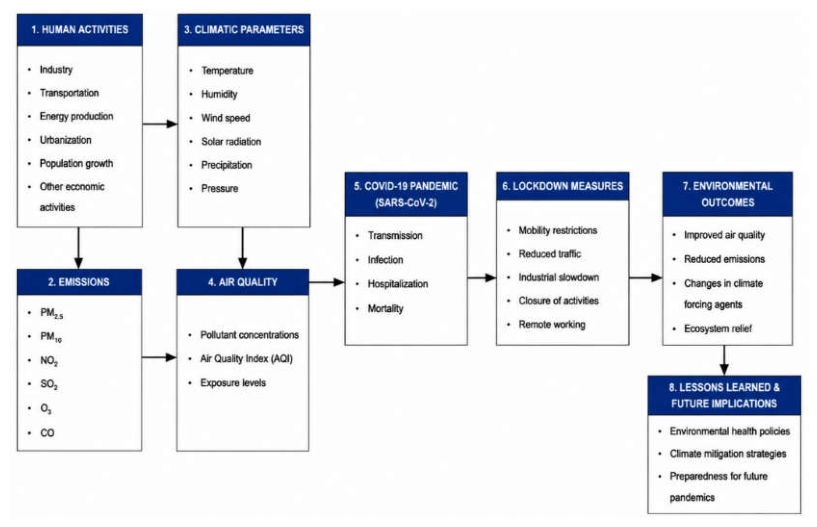

Table 1.
Literature studies on associations between environmental parameters and the spread of COVID-19 incidence.
Table 1.
Literature studies on associations between environmental parameters and the spread of COVID-19 incidence.
| Reference | Country | Parameters | Main findings |
|---|---|---|---|
| Pramanik et al. 2020 | Russia | Meteorological Parameters: temperature, relative humidity, temperature seasonality, sunshine, wind speed, diurnal temperature range, mean temperature of driest quarter | The results show that relationship between the COVID-19 transmission and meteorological parameters is based on the climatic conditions of the region. In other words; temperature seasonality has a vital significance on COVID-19 transmission in both the humid continental and the sub-arctic regions, the diurnal temperature range is an important parameter in only the sub-arctic region. |
| Akan, 2022 | Turkey | Meteorological Parameters: Dew point, Relative humidity, Atmospheric pressure, Ambient temperature, Wind speed, Gust, Precipitation, and Cloud Air Pollutants: CO, NO2, SO2, O3, PM2.5 and PM10 |
The results showed that air pollution and weather parameters are significantly associated with the spread of the SARS-CoV-2 virus. In particular, regions with high air pollution and low wind speed have been identified as more favorable places for virus spread. |
| Huang et al., 2022 | South Africa | Air Pollutants: CO, NO2, SO2, O3, PM2.5 and PM10 | The findings reveal that there is a significant and positive correlation between all air pollutants and COVID-19 infection. |
| Zoran et al., 2022 | Romania | Climate Parameters: air temperature, relative humidity, atmospheric pressure, wind speed, surface solar irradiation Air Pollutants: CO, NO2, SO2, O3, PM2.5 and PM10 |
The results appeared that air pollution at a high level increases the risk of COVID-19 incidence and mortality. Positive correlations were observed for all air pollutants except for tropospheric O3 with COVID-19 rates during the entire pandemic period. |
| Namdar-Khojasteh et al., 2022 | Iran | Air Pollutants: NO, NO2, NOx, CO, SO2, O3, PM2.5 and PM10 | The results show that air pollution resulting from high concentrations of CO, NO, and NOx triggered COVID-19 cases during the short-term period; PM2.5 during the long-term period but O3, SO2, PM10, and NO2 did not show significant correlations with the COVID-19 incidence for both short- and long-term periods |
| Ma et al., 2023 | China | Air Pollutants: CO, NO2, SO2, O3, PM2.5 and PM10 | They concluded that PM2.5, PM10, and NO2 pollutants were positively correlated with confirmed cases of COVID-19. |
| Parvin, 2023 | Bangladesh | Climatological Parameters: average temperature, wind speed, and relative humidity Air Pollutants: particulate PM2.5, and carbon emissions |
Results indicated that wind speed, temperature, and carbon emissions were positively correlated with the transmission of the SARS-CoV-2 virus but PM2.5 showed a negatively association with COVID-19 widespread. |
| Zoran et al., 2024 | Germany, United Kingdom, Spain, France | Air Pollutants: NO2, O3, PM2.5, PM10 and aerosol optical depth (AOD) |
Results indicated that aerosol-related pollutants (PM2.5, PM10, and AOD) showed positive associations with COVID-19 spreading and severity. Meteorological factors, including temperature, humidity, and wind conditions, influenced the variability of COVID-19 transmission among metropolitan regions. |
| Shi et al., 2026 | 39 cities worldwide | Climatological Parameters: temperature, humidity Air Pollutants: NO2, PM2.5, PM10, CO, O3 |
Using causal analysis approaches, the study demonstrated nonlinear relationships between environmental factors and COVID-19 cases and mortality. Temperature and humidity showed dominant causal effects, while NO₂, PM₂.₅, and O₃ were associated with increased COVID-19 cases and deaths. |
Table 2.
A literature review showing the impact of lockdown measures on countries’ air quality.
| Reference | City/Country | Parameters | Periods | Main findings |
|---|---|---|---|---|
| Hoang et al., 2021 | Global (China, USA, Europe and other regions) | NO2 | 2020 lockdown period; comparison with the same period of 2019 | Lockdown measures substantially reduced NO₂ concentrations worldwide. The study estimated an approximately 20% reduction in global NO₂ emissions in 2020. |
| Kutralam-Muniasamy et al., 2021 | Mexico, Latin America |
CO, NO2, O3, SO2, PM10, and PM2.5 | The lockdown (Apr–May) and pre-lockdown (Jan–Mar) periods. | Concentrations of NO2, SO2, and PM10 were reduced in the range of -11% and -55%, while CO, PM2.5, and O3 showed an increase between +1.1% and +63%. |
| Mor et al., 2021 | Chandigarh, India | NO2, NO, NOx, SO2, O3, NH3, CO, PM10, PM2.5 and volatile organic carbons (VOCs) | Four lockdown periods: i) before lockdown, ii) the first phase of lockdown iii) the second phase of lockdown iv) the third phase of lockdown | Concentrations of all pollutants showed significant reductions during the first two phases, while they increased during the third phase. The concentrations of SO2, O3, and m,p-xylene showed increasing trends. |
| Sbai et al., 2021 | Lyon, France | NO2, NO, PM10, PM2.5, O3, VOC, CO, SO2, and isoprene | Mar 17- May 11, 2020 | NO2, NO, and CO levels decreased in the range of 62% - 78% due to a significant decrease in traffic emissions, while O3, PM10, and PM2.5 were increased in the range of 23% and 105%. |
| Wetchayont et al., 2021 | Bangkok, Thailand | CO, O3, NO2, SO2, and PM2.5 | The periods from Jan 2020 to Jun 2020 |
During the lockdown period, PM2.5, O3, and CO concentrations showed decreasing trends, while NO2 and SO2 concentrations showed increasing ones. |
| Alharbi et al., 2022 | Riyadh, Saudi Arabia | NO, NO2, NOx, SO2, CO, O3, PM10, and PM2.5 | Three measurement periods: i)between Apr 2020 and Jun 2020 ii)from Mar 2020 to Jun 2020 iii)from Mar 2019 to Jun 2019 |
The average concentrations of NO, NO2, NOx, and CO decreased during the lockdown period by highest 73%, 133%, and 222% at the work site, traffic site, and residential site, respectively, but O3 showed an increasing trend. |
| Celik and Gul, 2022 | Istanbul, Turkey | PM10, SO2, CO, NO2, NO, NOx, and O3 | Two different periods: from Mar 2019 to May 2019 and Mar 2020 to May 2020 | A remarkable decrease in concentration levels of PM10, NO2, NO, and NOx was recorded during the pandemic compared to the pre-lockdown periods in Istanbul. On the other hand, a partial increase in O3 concentration is obtained by comparing before and during the partial lockdown period. |
| Gorrochategui et al., 2022 | Barcelona- Catalonia, Spain | NO2, O3, and PM10 | Two periods: i) from 15th Feb to 31st Aug and ii) the month of April for the 3 years (2018, 2019, and 2020) | NO2 levels and PM10 showed a reduction in rural areas, but O3 levels increased in urban ones due to the decline in NOx during the lockdown |
| Upadhyay et al., 2022 | South Asia | AOD, CO, NO2, O3, SO2, PM10, and PM2.5 | March and April 2020 | Results indicated the reductions in the concentration of pollutants including NO2, SO2, and PM2.5 in especially regions with high-level of air pollution. |
| Ashraf et al., 2025 | Canada | PM2.5 | 2000–2021; COVID-19 lockdown and post-lockdown analysis focused on 2020 | Reduced anthropogenic emissions during COVID-19 lockdowns resulted in significant PM₂.₅ reductions in major Canadian cities. Peak reductions ranged between 42% and 53% compared with long-term reference conditions, indicating the sensitivity of urban air quality to changes in human activities. |
| Atiaga et al., 2025 | Mexico, Chile, Peru, Ecuador (Mexico City, Santiago de Chile, Lima, Quito) | NO2, SO2, O3 | December 2018–December 2023; pre-lockdown, lockdown, and post-lockdown periods | Lockdowns generally resulted in decreased NO2 concentrations, whereas the effects on SO2 and O3 were inconsistent. Considerable spatial variability was observed among the four cities, with local weather patterns and urban characteristics influencing pollutant levels. |
Disclaimer/Publisher’s Note: The statements, opinions and data contained in all publications are solely those of the individual author(s) and contributor(s) and not of MDPI and/or the editor(s). MDPI and/or the editor(s) disclaim responsibility for any injury to people or property resulting from any ideas, methods, instructions or products referred to in the content. |
© 2026 by the authors. Licensee MDPI, Basel, Switzerland. This article is an open access article distributed under the terms and conditions of the Creative Commons Attribution (CC BY) license (http://creativecommons.org/licenses/by/4.0/).
Copyright: This open access article is published under a Creative Commons CC BY 4.0 license, which permit the free download, distribution, and reuse, provided that the author and preprint are cited in any reuse.