
Submitted:
06 September 2026
Posted:
09 September 2026
You are already at the latest version
Abstract
The post‑pandemic era has witnessed that office politics has become increasingly concealed and digitalized under remote‑work arrangements, imposing substantial impacts on employees’ psychological states and behavioral responses. Grounded in the cognitive appraisal theory of stress, this study constructs a moderated‑mediation model to explore how perceived office politics evokes work withdrawal behaviors among remote employees. Questionnaire data were collected from 412 remote employees, and hypotheses were tested via hierarchical regression and bootstrapping approaches. Results show that perceived office politics positively predicts emotional exhaustion and work‑withdrawal behaviors. Emotional exhaustion fully mediates the association between perceived office politics and work withdrawal. Furthermore, remote‑work frequency positively moderates the link between perceived office politics and emotional exhaustion, such that this relationship is stronger for employees engaging in high‑frequency remote work. Our findings indicate that, although digital work settings reduce face‑to‑face interpersonal conflicts, information asymmetry in distributed teams may amplify stress‑related psychological costs and trigger employees’ “invisible withdrawal”. This study offers empirical evidence for understanding the psychological consequences of transformed workplace politics in modern organizations and yields practical implications for organizational intervention in remote and hybrid contexts.
Keywords:
perceived office politics
; remote work
; emotional exhaustion
; work withdrawal behavior
; cognitive appraisal theory of stress
1. Introduction
The COVID-19 pandemic has reshaped global work landscapes and accelerated the widespread adoption of remote and hybrid work arrangements across industries (Kniffin et al., 2021). What began as a public health emergency measure has evolved into a persistent structural shift: numerous organizations have retained flexible remote work policies even after pandemic related restrictions were lifted (Li et al., 2025). Beyond altering where and how tasks are accomplished, this transition has reshaped interpersonal dynamics and political processes embedded within organizational life (Zheng et al., 2026).
Office politics refers to informal, often covert interpersonal processes through which individuals pursue self interested goals, manipulate decision making, and navigate organizational hierarchies (Chang et al., 2009). Traditional scholarship on office politics has largely emphasized face to face interactions, informal offline networks, and observable impression management or coalition building behaviors (Ferris et al., 2002). However, the rise of remote work has fundamentally transformed the contexts where political behaviors unfold. Physical separation, diminished informal in person interactions, and the predominance of digital communication channels render office politics less visible yet potentially more insidious (Golden et al., 2008).
As highlighted in the call for papers for this special issue, a common assumption holds that remote work environments may mitigate traditional office politics, workplace bullying, and other detrimental interpersonal dynamics. Nevertheless, accumulating evidence suggests that office politics have not vanished; rather, they have adapted into new digital forms (Kim & Shin, 2026). Information asymmetry becomes more salient for remote employees, who have limited access to informal communication channels that transmit critical organizational knowledge (Allen et al., 2015). Proximity bias—managers’ tendency to prioritize physically present staff—has emerged as a prominent concern: remote workers frequently report being overlooked for promotions, excluded from key conversations, and disadvantaged in performance evaluations (Williamson et al., 2024). These “invisible” political dynamics may paradoxically exert stronger psychological harm because employees struggle to identify, interpret, and respond to unseen political maneuvers (Tahir et al., 2024). Moreover, deficient internal organizational communication and insufficient adaptive leadership for distributed teams further exacerbate such risks, a theme emphasized within this special issue.
Despite these practical concerns, empirical research regarding the psychological and behavioral outcomes of office politics within remote work settings remains limited. Most existing studies on perceived organizational politics are situated in conventional on site office environments (Chang et al., 2009; Miller et al., 2008). Less is known about how remote work conditions reshape political perceptions and subsequent employee responses, especially work withdrawal behaviors such as disengagement, mental disconnection, and turnover intentions (Rosen et al., 2009).
The cognitive appraisal theory of stress offers a suitable theoretical lens to fill this research gap (Lazarus & Folkman, 1987). From this perspective, individuals do not react directly to external environmental stimuli; instead, responses are shaped by cognitive appraisal processes that evaluate whether a given situation represents a threat, challenge, or benign circumstance (Zhan et al., 2024). When employees appraise office politics as a threat to their well-being, career prospects, or social standing, they experience stress driven resource depletion, which may ultimately manifest in self protective withdrawal behaviors (Jiang et al., 2021; Lazarus, 1991).
Against this background, the present study investigates the relationship between perceived office politics and work withdrawal behaviors among remote employees. We examine the mediating role of emotional exhaustion and the boundary condition of remote work frequency. Specifically, we propose that perceived office politics in remote contexts—fueled by information asymmetry and limited transparency—boosts emotional exhaustion, which sequentially fosters work withdrawal responses. In addition, we posit that remote work frequency amplifies this psychological process: employees working remotely for more days per week are more vulnerable to the psychological toll brought by invisible political dynamics.
This study makes several contributions to the literature of workplace behavior aligned with the scope of this special issue. First, it extends perceived organizational politics research to remote work contexts, responding to calls for investigating transformed office politics dynamics in post pandemic distributed organizations. Second, drawing on cognitive appraisal theory of stress, it unpacks the underlying psychological mechanism linking political perceptions to withdrawal behaviors. Third, we identify remote work frequency as a critical contextual moderator that shapes the strength of the stress process. Fourth, our findings provide actionable practical insights for organizations seeking to mitigate adverse outcomes of invisible office politics, improve internal communication quality, and sustain employee well-being within remote hybrid arrangements.
2. Theoretical Background and Hypothesis Development
2.1. Perceived Office Politics in Remote Work Contexts
Perceived organizational politics describes employees’ subjective perceptions regarding the prevalence of self serving behaviors, influence tactics, and pursuit of personal interests at the expense of collective organizational objectives (Ferris & Kacmar, 1992; Hochwarter et al., 2007). Distinct from objective observations of political acts, perceived office politics captures individual attributions and interpretations of workplace environments; subjective perception, rather than objective reality, drives psychological and behavioral reactions (Hochwarter et al., 2004).
Prior conventional setting research documents various negative outcomes of high perceived politics: lowered job satisfaction, heightened turnover intentions, reduced organizational commitment, and impaired task performance (Ferris et al., 2002; Vigoda-Gadot, 2007). These effects are typically interpreted from stress and resource depletion perspectives: navigating political environments consumes substantial cognitive and emotional resources and impairs employees’ capacity for positive work engagement (Hochwarter et al., 2004). Recent work further confirms that perceived organizational politics correlates positively with emotional exhaustion and job burnout, with resentment functioning as a key mediator (Kulachai, 2025; Tahir et al., 2024).
Remote work introduces novel facets to perceived office politics. Physical separation from supervisors and colleagues restricts access to informal information sharing channels (Golden et al., 2008). Such information asymmetry cultivates perceptions of exclusion, favoritism, and inequity: remote employees may feel left out of critical conversations and developmental opportunities (Allen et al., 2015; Williamson et al., 2024). Diminished visibility also makes it harder for employees to detect and interpret political events, elevating uncertainty and anxiety about their standing within organizational hierarchies (Tahir et al., 2024).
Scholars note that remote work does not eliminate office politics but transforms its manifestation (Kim & Shin, 2026). Political maneuvers shift from observable face to face interactions toward digital only channels: exclusion from email threads, selective information sharing during virtual meetings, and private message behind the scenes networking (Leonardi et al., 2010). These “invisible” political dynamics can be particularly stressful because they are difficult to recognize, interpret, and counteract, leaving employees feeling powerless and vulnerable (Tahir et al., 2024). Poor internal communication and insufficient remote adapted leadership further amplify these risks.
2.2. Cognitive Appraisal Theory of Stress
The cognitive appraisal theory of stress developed by Lazarus and Folkman (1987) constitutes a foundational framework for understanding individual responses to environmental stressors. Stress is not an intrinsic property of situations but emerges through person environment interaction mediated by cognitive appraisal (Zhan et al., 2024; Zheng et al., 2026).
Two core appraisal stages are distinguished. In primary appraisal, individuals judge whether a situation bears relevance for their well-being and whether it represents threat, challenge, or benign conditions (Lazarus & Folkman, 1987). Threat appraisal occurs when individuals anticipate potential harm, loss, or damage to self esteem, social status, or personal goals (Folkman et al., 1986). In secondary appraisal, people evaluate their coping resources and feasible response options for handling the perceived threat (Lazarus & Folkman, 1987). When individuals perceive inadequate coping resources for managing threats, stress reactions and maladaptive coping strategies become more probable (Zheng et al., 2026).
Applying this framework to perceived office politics: employees who perceive a highly political work environment are prone to threat appraisals (Cropanzano et al., 1997). Political contexts signal that rewards and opportunities are allocated based on influence and connections instead of merit, which threatens employees’ fairness perceptions, self worth, and career expectations (Chang et al., 2009). Such threat appraisal triggers stress related resource depletion, especially when employees feel they have limited agency over prevailing political dynamics (Wright & Cropanzano, 1998).
Remote work conditions may intensify threat appraisals. Information asymmetry and low visibility raise uncertainty regarding organizational processes and one’s own position within the organization (Tahir et al., 2024). Heightened uncertainty strengthens threat perceptions and erodes confidence in one’s capacity to navigate organizational politics (Lazarus, 1991). When remote workers perceive exclusion from informal networks and lack influence over decisions affecting them, they are inclined to appraise the environment as highly threatening and resource draining (Lazarus & Folkman, 1987).
Recent studies adopting cognitive-appraisal perspectives on workplace dynamics demonstrate that threat versus challenge appraisals of organizational stressors powerfully shape subsequent emotional and behavioral outcomes (Hayashi, 2024; Zhan et al., 2024; Zheng et al., 2026). In the domain of office politics, threat appraisals are especially likely when political dynamics lie outside personal control and endanger career prospects (Cropanzano et al., 1997; Chang et al., 2009).
2.3. Perceived Office Politics and Emotional Exhaustion
Emotional exhaustion represents the core burnout dimension, characterized by feelings of being emotionally overextended and depleted of psychological resources, and serves as a central indicator of occupational stress (Maslach et al., 2001; Schaufeli & Bakker, 2004).
Cumulative evidence documents a positive association between perceived organizational politics and emotional exhaustion (Hochwarter et al., 2004; Rosen et al., 2009; Vigoda-Gadot & Talmud, 2010). Political work environments are inherently stressful: employees must devote considerable cognitive and emotional energy to decode hidden agendas, manage impressions, and navigate ambiguous social dynamics (Ferris et al., 2002). Sustained investment of psychological resources gradually leads to emotional exhaustion (Schaufeli & Bakker, 2004). The conservation of resources (COR) theory (Hobfoll, 1989) provides complementary reasoning: individuals strive to obtain and protect valued resources including emotional energy, social support, and self esteem (Hobfoll, 2001). Perceived politics forces resource expenditure for monitoring and responding to political events; prolonged resource loss eventually produces emotional exhaustion (Rosen et al., 2009). Recent empirical work further supports the predictive effect of perceived organizational politics on emotional exhaustion (Kulachai, 2025).
Within remote work settings, this link may become more pronounced. Existing research indicates that limited teleworking options correlate with elevated emotional exhaustion and burnout symptoms (Abuladze et al., 2025). Diminished transparency and amplified information asymmetry in remote arrangements can reinforce perceptions of unfairness and exclusion and raise the emotional burden brought by organizational politics (Tahir et al., 2024). Moreover, remote employees have less access to the informal social support that onsite colleagues can draw upon to buffer political stress (Charalampous et al., 2019).
We therefore propose:
H1.
Perceived office politics is positively associated with emotional exhaustion among remote employees.
2.4. Emotional Exhaustion and Work Withdrawal Behavior
Work withdrawal behaviors encompass a spectrum of actions representing psychological or physical disengagement from work roles, including cognitive disengagement, lateness, absenteeism, and turnover intentions (Lehman & Simpson, 1992). Withdrawal constitutes a coping strategy for reducing exposure to stressful job conditions and conserving remaining psychological resources (Nauman et al., 2021).
Emotional exhaustion is a well established antecedent of work withdrawal responses (Schaufeli & Bakker, 2004). When emotionally depleted, employees lack sufficient psychological energy to sustain work engagement (Bakker & Demerouti, 2017). As a protective coping response, they reduce task investment, psychologically disengage, or physically withdraw via absenteeism or turnover (Grandey & Cropanzano, 1999). Recent hybrid work research confirms that emotional exhaustion mediates between hybrid work stressors and psychological withdrawal (Chu et al., 2024).
Multiple mechanisms underpin this relationship. First, resource depletion impairs self regulatory capacity and persistence in the face of work demands (Zheng et al., 2026). Second, exhaustion undermines perceived competence and self efficacy for effective job performance (Bakker & Demerouti, 2017). Third, withdrawal serves as self protection to avoid further emotional distress and resource loss (Wright & Cropanzano, 1998).
Notably, withdrawal manifests distinctively in remote work contexts. Psychological withdrawal (reduced effort, disengagement during virtual meetings, delayed replies to messages) is far less observable to supervisors and teammates than in physical offices (Rurkkhum & Detnakarin, 2024). Behaviors resembling “quiet quitting” (minimum requirement performance) or mental vacationing may occur without formal leave records, making detection challenging for distributed organizations.
Based on this reasoning, we propose the following hypothesis:
H2.
Emotional exhaustion is positively associated with work withdrawal behavior among remote employees.
2.5. The Mediating Role of Emotional Exhaustion
Integrating above arguments, we hypothesize that emotional exhaustion mediates the perceived office politics → work withdrawal relationship. Perceived politics acts as a stressful situational cue that triggers threat appraisal and depletes emotional resources (Hochwarter et al., 2004). Resource depletion then lowers sustained work engagement and motivates withdrawal as a coping strategy (Rosen et al., 2009).
The cognitive appraisal theory of stress supports this mediation logic. Primary appraisal interprets office politics as a threat to well being and career interests; secondary appraisal evaluates personal coping resources, which may be perceived as insufficient for handling political threats. This appraisal chain generates emotional exhaustion, which in turn fosters withdrawal aimed at minimizing stress exposure and preserving remaining resources.
Prior empirical work provides partial support for this mediation pathway: emotional exhaustion mediates perceived politics effects on turnover intentions, OCB, and job performance (Chang et al., 2009; Hochwarter et al., 2004; Rosen et al., 2009). Recent research also shows job burnout mediates perceived organizational politics and counterproductive work behavior links (Kulachai, 2025). Nevertheless, few studies test this mediation specifically within remote work environments, where political perceptions and outcomes may differ.
We therefore propose:
H3.
Emotional exhaustion mediates the relationship between perceived office politics and work withdrawal behavior among remote employees.
2.6. The Moderating Role of Remote Work Frequency
Remote work frequency refers to the proportion of weekly working time spent off site rather than in person offices, and it may moderate the focal associations in our model. Employees with higher remote work frequency experience stronger information asymmetry, lower visibility, and fewer opportunities to access informal organizational networks (Allen et al., 2015; Golden et al., 2008). Such contextual conditions can amplify the psychological consequences of perceived office politics.
We propose that remote work frequency strengthens the positive link between perceived office politics and emotional exhaustion. High frequency remote workers have fewer chances for informal supervisor colleague interactions to gather contextual information, interpret political events, and build coping strategies (Gajendran et al., 2015). Reduced transparency intensifies feelings of exclusion and unfairness and augments the emotional toll of political perceptions (Tahir et al., 2024).
In addition, high frequency remote workers have fewer in person social resource buffers against political stress. Physical proximity facilitates social support relationships that help employees navigate workplace politics; remote workers may lack such buffers and become more susceptible to politics driven emotional strain (Charalampous et al., 2019). Existing research demonstrates remote work frequency shapes boundary crossing experiences and moderates the connection between work related communication and emotional exhaustion (Hayashi, 2024).
Proximity bias literature offers indirect corroboration: remote employees often suffer disadvantages in evaluation, promotion, and developmental opportunities, which can heighten political related stress (Golden & Fromen, 2011; Williamson et al., 2024). These disadvantages are more salient for those who spend more time away from the physical office (Choudhury et al., 2021).
Thus, we hypothesize:
H4.
Remote work frequency positively moderates the relationship between perceived office politics and emotional exhaustion, such that the relationship is stronger among employees with higher remote work frequency.
2.7. The Moderated Mediation Model
Combining mediation and moderation hypotheses, we propose a moderated-mediation model: the indirect effect of perceived office politics on work withdrawal via emotional exhaustion is conditional upon remote-work frequency. Specifically, the mediating pathway will be stronger for high-frequency remote workers.
This aligns with cognitive appraisal theory of stress: stress processes are jointly shaped by individual differences and situational context (Lazarus & Folkman, 1987). Remote work frequency constitutes a contextual factor altering how employees appraise and respond to political threats. Employees with high remote work frequency confront greater information asymmetry and weaker social-support buffers; hence they are more prone to threat appraisal of political environments, leading to elevated emotional exhaustion and subsequent withdrawal.
Drawing on these arguments, we propose:
H5.
Remote work frequency moderates the indirect effect of perceived office politics on work withdrawal behavior through emotional exhaustion, such that the indirect effect is stronger for employees with higher remote work frequency.
3. Materials and Methods
3.1. Sample and Procedure
Online questionnaire surveys were distributed between March and May 2026. Participants were recruited via professional social networks and organizational partnerships. Eligibility criteria: (a) full-time employees in organizations permitting remote work arrangements; (b) at least three months of remote work experience prior to survey participation; (c) regular digital communication interactions with supervisors and colleagues.
In total, 520 responses were collected. After removing incomplete responses, straight-lining answers, and cases violating eligibility criteria, 412 valid questionnaires were retained for analysis, yielding an effective response rate of 79.2%.
Sample demographics: 54.6% female, 45.4% male; mean age = 34.7 years (SD = 8.9). Education: bachelor’s degree 62.4 %, master’s degree 24.3 %, college/associate level 13.3 %. Average organizational tenure = 5.8 years (SD = 4.2). Industries: technology 31.6 %, finance 18.9 %, healthcare 12.4 %, education 11.7 %, manufacturing 9.2 %, other sectors 16.2 %. For remote-work frequency: 28.4 % worked remotely 1-2 days weekly; 34.7 % worked 3-4 days weekly; 36.9 % worked remotely five days per week.
3.2. Measures
All scales were adopted from previously validated instruments. Items were translated into Chinese and subjected to back-translation to guarantee conceptual equivalence. Unless noted otherwise, all items were scored on a five-point Likert scale (1 = strongly disagree, 5 = strongly agree).
Perceived Office Politics (POP). Six-item scale from Hochwarter et al. (2007). Sample item: “People in this organization attempt to build themselves up by tearing others down”. The Cronbach’s α was 0.86.
Emotional Exhaustion. Five-item subscale of Maslach Burnout Inventory-General Survey (Maslach et al., 2001; Schaufeli & Bakker, 2004). Sample item: “I feel emotionally drained from my work”. The Cronbach’s α was 0.89.
Work-Withdrawal Behavior. Six-item adapted scale from Lehman & Simpson (1992), covering both psychological and behavioral withdrawal. Sample items: “I put less effort into my work than I should”, “I think about quitting my job”. The Cronbach’s α was0.84.
Remote Work Frequency. Single self-report item: “How many days per week do you typically work remotely?”. Coded: 1 = 1-2 days; 2 = 3-4 days; 3 = 5 days.
Control Variables. Following prior meta-analytic research (Chang et al., 2009; Miller et al., 2008), we controlled gender (0 = female, 1 = male), age (years), education level, organizational tenure (years), and industry (dummy-coded). Demographic characteristics have documented influences on perceived-politics and withdrawal outcomes.
3.3. Analytical Strategy
Statistical analyses were conducted using SPSS 27.0 together with the PROCESS macro for SPSS (Version 4.0; Hayes, 2018). Analysis sequence:
- Descriptive statistics and zero-order correlations among all variables.
- Confirmatory factor analysis (CFA) to test measurement-model fit and discriminant validity.
- Hierarchical multiple regression for testing main effects and interaction terms.
- Bootstrapping (5000 resamples) to evaluate the mediating effect (Preacher & Hayes, 2008).
- Moderated-mediation assessment via PROCESS Model 14 to test conditional indirect effects.
4. Results
4.1. Confirmatory Factor Analysis and Common Method Bias
The hypothesized three-factor measurement model (perceived office politics, emotional exhaustion, work-withdrawal behavior) exhibited acceptable fit indices: χ²(116) = 312.47, CFI = 0.94, TLI = 0.93, RMSEA = 0.06, SRMR = 0.05. All standardized factor loadings exceeded 0.60 and reached statistical significance. Alternative merged-factor models demonstrated substantially worse fit, supporting discriminant validity among latent constructs.
Given cross-sectional single-source survey data, common-method bias represents a potential threat. Harman’s single-factor test showed that the largest extracted factor explained only 28.6 % of total variance (well below the 40 % warning threshold). The single-factor CFA yielded poor fit: χ²(119) = 987.63, CFI = 0.71, RMSEA = 0.14. We further applied the Unmeasured Latent Method Construct (ULMC) approach (Podsakoff et al., 2003). After adding the common-latent-method factor, model fit barely changed(ΔCFI = 0.000, ΔRMSEA = 0.000), and standardized regression-weight differences were all < 0.200. Collectively, these results suggest common-method bias did not substantially distort study results.
4.2. Descriptive Statistics and Correlations
Table 1 displays means, standard deviations, and zero-order Pearson correlations. Perceived office politics was positively correlated with emotional exhaustion (r=0.48, p<0.01) and work-withdrawal behavior (r=0.39, p<0.01). Emotional exhaustion correlated positively with work-withdrawal behavior (r=0.52, p<0.01). Remote-work frequency showed positive associations with perceived office politics (r=0.17, p<0.01) and emotional exhaustion (r=0.14, p<0.01).
4.3. Hypothesis Testing
Main Effects and Mediation. Hierarchical regression results are presented in Table 2. After controlling demographic covariates, perceived office politics significantly positively predicted emotional exhaustion (Model 2: β = 0.46, p < 0.001), supporting H1. Emotional exhaustion positively predicted work withdrawal behavior (Model 4: β = 0.48, p < 0.001), supporting H2.
Bootstrapping (5000 resamples) was applied to test mediation (H3). After entering emotional exhaustion as mediator, the direct effect of perceived office politics on work-withdrawal became non-significant (Model 5: β = 0.09, p = 0.087). The indirect effect via emotional exhaustion was significant (β = 0.24, 95% CI [0.18, 0.31]). Since the bootstrapped confidence interval excluded zero, full mediation was confirmed. H3 was supported.
Moderation effect (H4). We added the interaction term “perceived office politics × remote-work frequency” to test H4 (Table 3). The interaction term was statistically significant(β = 0.12, p < 0.01), indicating that the positive relationship between perceived office politics and emotional exhaustion was stronger among employees with higher remote work frequency.
To interpret the interaction, simple slopes were examined at low (one SD below the mean) and high (one SD above the mean) levels of remote work frequency. The relationship between perceived office politics and emotional exhaustion was significant for both groups but was stronger for high-frequency remote workers (β = 0.54, p < 0.001) than for low-frequency remote workers (β = 0.30, p < 0.001). Figure 1 illustrates this interaction effect. H4 was supported.
Moderated Mediation (H5). Hypothesis 5 proposed that remote work frequency moderates the indirect effect of perceived office politics on work withdrawal behavior through emotional exhaustion. Using PROCESS Model 14 (Hayes, 2018) with 5,000 bootstrap resamples, we examined the conditional indirect effects at low and high levels of remote work frequency.
As shown in Table 4, the indirect effect of perceived office politics on work withdrawal behavior through emotional exhaustion was significant for both low-frequency remote workers (indirect effect = 0.15, 95% CI [0.09, 0.22]) and high-frequency remote workers (indirect effect = 0.28, 95% CI [0.20, 0.37]). The difference between these conditional indirect effects was significant (difference = 0.13, 95% CI [0.04, 0.22]), indicating that the mediating pathway was stronger for high-frequency remote workers. Thus, H5 was supported.
5. Discussion
5.1. Summary of Findings
Drawing on cognitive appraisal theory of stress, this study investigated how perceived office politics predicts work withdrawal behaviors among remote work employees. Results supported the full hypothesized model. Perceived office politics positively predicted emotional exhaustion; emotional exhaustion fully mediated the relationship between perceived office politics and work-withdrawal behavior. Remote-work frequency moderated the path from perceived office politics to emotional exhaustion: the effect was amplified for employees working remotely more frequently. Accordingly, the conditional indirect effect (perceived office politics → emotional exhaustion → work withdrawal) was stronger for high frequency remote workers. Our findings suggest that, although remote work settings reduce face to face interpersonal conflicts, information asymmetry in distributed teams can amplify the psychological stress induced by invisible office politics and trigger employees’ mental and behavioral withdrawal.
5.2. Theoretical Implications
This study makes several important theoretical contributions. First, it extends research on perceived organizational politics to the context of remote work, addressing a significant gap in the literature. Prior research on organizational politics has been predominantly conducted in traditional office settings (Chang et al., 2009; Ferris et al., 2002), with limited attention to how remote work transforms the nature and consequences of political perceptions. Recent studies have begun to explore these dynamics, with findings suggesting that perceptions of politics remain a significant work environment impediment that amplifies employees’ propensity for psychological withdrawal (Tahir et al., 2024). Our findings demonstrate that perceived politics remains a significant predictor of employee outcomes in remote work environments, suggesting that the shift to distributed work does not eliminate political dynamics but rather alters their manifestation (Kim & Shin, 2026).
Second, this study advances understanding of the mechanisms linking perceived politics to employee behavior. By identifying emotional exhaustion as a full mediator of the politics-withdrawal relationship, our findings provide support for the resource depletion perspective (Hobfoll, 1989; Hochwarter et al., 2004). Political environments are psychologically taxing, requiring sustained cognitive and emotional effort that depletes employees’ resources, ultimately leading to withdrawal as a self-protective strategy. This finding aligns with and extends prior research demonstrating that emotional exhaustion mediates the relationship between perceived politics and various outcomes (Rosen et al., 2009; Chang et al., 2009). Recent empirical work has confirmed that perceived organizational politics significantly predicts emotional exhaustion, with workplace incivility serving as an important mediating mechanism (Kulachai, 2025).
Third, the study enriches the cognitive appraisal theory of stress by applying it to the context of workplace politics in remote settings. Our findings suggest that remote workers appraise political environments as particularly threatening when they experience high levels of information asymmetry and reduced visibility—conditions that are more pronounced for high-frequency remote workers. This insight extends the theory by identifying contextual factors that shape the appraisal process and moderate the stress-outcome relationship. Recent research applying cognitive appraisal theory to workplace dynamics has demonstrated that employees’ appraisal of organizational stressors critically shapes their subsequent emotional and behavioral responses (Zhan et al., 2024; Hayashi, 2024).
Fourth, by identifying remote work frequency as a moderator, this study contributes to the emerging literature on the boundary conditions of remote work effects. The finding that the politics-exhaustion relationship is stronger for high-frequency remote workers suggests that the benefits of remote work—such as increased flexibility and autonomy—may be accompanied by heightened vulnerability to organizational politics. Research has shown that remote work frequency promotes boundary crossing and moderates the relationship between work-related communication and emotional exhaustion (Hayashi, 2024). This dual-edged nature of remote work has important implications for theory development regarding the consequences of distributed work arrangements.
Finally, this study contributes to the literature on work withdrawal behavior by examining its antecedents in the remote work context. Withdrawal behaviors may take on distinctive forms in remote settings, as physical distance makes some forms of withdrawal less visible and more difficult to detect (Rurkkhum & Detnakarin, 2024). Our findings suggest that perceived politics can trigger withdrawal through emotional exhaustion, providing a theoretical foundation for understanding the “quiet quitting” and disengagement phenomena observed in remote work environments. Recent research on hybrid work has confirmed that emotional exhaustion mediates the relationship between hybrid work stressors and psychological withdrawal behavior (Chu et al., 2024).
5.3. Practical Implications
The findings of this study have several practical implications for organizations seeking to manage office politics and support employee well-being in remote work contexts.
First, organizations should recognize that office politics persist in remote work environments and may even intensify due to information asymmetry and reduced transparency. Managers should be vigilant in identifying and addressing political behaviors that manifest through digital channels, such as exclusion from communications, selective information sharing, and behind-the-scenes networking. Implementing transparent communication practices, ensuring equitable access to information, and establishing clear performance evaluation criteria can help mitigate perceptions of politics.
Second, organizations should invest in resources and interventions that help employees manage the emotional demands of navigating political environments. Providing access to mental health resources, offering coaching and mentoring programs, and fostering supportive supervisor relationships can help buffer the emotional exhaustion associated with perceived politics. Given that emotional exhaustion fully mediates the politics-withdrawal relationship, interventions targeting emotional well-being may be particularly effective in preventing withdrawal behaviors.
Third, organizations should pay particular attention to high-frequency remote workers, who appear to be more vulnerable to the negative effects of perceived politics. For these employees, organizations might consider implementing structured check-ins, ensuring inclusion in important communications, and providing opportunities for virtual networking and relationship building. Proactive efforts to reduce information asymmetry and increase visibility for remote workers may help mitigate the intensifying effect of remote work frequency on political stress.
Fourth, the findings highlight the importance of fostering a culture of transparency and fairness in remote work contexts. Leaders should model transparent communication, openly share decision-making criteria, and actively solicit input from remote employees. Creating clear channels for employees to voice concerns about perceived inequities or political behaviors can help reduce uncertainty and the threat appraisals that contribute to emotional exhaustion.
Fifth, organizations may consider offering flexibility in remote work arrangements while being mindful of the potential trade-offs. While remote work offers benefits in terms of autonomy and work-life balance, our findings suggest that extensive remote work may increase vulnerability to political stress. Organizations might explore hybrid arrangements that balance the benefits of remote work with opportunities for in-person interaction and visibility.
5.4. Limitations and Future Research
This study has several limitations that should be considered when interpreting the findings and that suggest directions for future research.
First, the cross-sectional design limits our ability to establish causal relationships. Although our theoretical model proposes directional relationships, the data were collected at a single time point, making it impossible to rule out alternative causal directions or reciprocal relationships. Future research should employ longitudinal designs, experience sampling methods, or experimental approaches to strengthen causal inferences.
Second, the reliance on self-report measures introduces the potential for common method bias and social desirability effects. Although Harman’s single-factor test and CFA results suggested that common method bias was not a severe threat, self-report measures may still be subject to perceptual biases. Future research could incorporate supervisor ratings of withdrawal behaviors, objective measures of absenteeism or turnover, or peer reports of political behaviors to enhance measurement validity.
Third, the measure of remote work frequency was relatively crude, capturing only the number of days worked remotely per week. This measure does not capture important nuances such as the nature of remote work (e.g., fully remote vs. hybrid), the quality of remote work experiences, or individual differences in preferences for remote work. Future research could employ more refined measures of remote work arrangements and examine how specific features of remote work moderate the observed relationships.
Fourth, the sample was drawn from a single country and may not be representative of remote workers in other cultural contexts. Cultural values, such as power distance and collectivism, may influence how employees perceive and respond to office politics (Hofstede, 2001). Cross-cultural research is needed to examine the generalizability of our findings.
Fifth, the study focused on emotional exhaustion as the mediating mechanism, but other psychological processes may also be relevant. For example, perceived politics may trigger anger, anxiety, or cynicism, which could independently or jointly predict withdrawal behaviors (Chang et al., 2009). Future research could examine multiple mediating mechanisms and their relative contributions.
Finally, the study did not examine potential moderators that might buffer the negative effects of perceived politics. Individual differences such as political skill, resilience, or proactive personality may influence how employees appraise and respond to political environments (Ferris et al., 2005). Organizational factors such as supportive leadership, organizational justice, or ethical climate may also moderate the observed relationships. Future research should investigate these boundary conditions.
6. Conclusions
This study investigated the relationship between perceived office politics and work withdrawal behavior among remote employees, drawing on the cognitive appraisal theory of stress. The findings demonstrate that perceived office politics is positively associated with emotional exhaustion, which in turn predicts work withdrawal behavior. Emotional exhaustion fully mediates this relationship, suggesting that the psychological depletion resulting from political perceptions is the primary mechanism through which politics translate into withdrawal behaviors. Importantly, remote work frequency moderates the politics-exhaustion relationship, with the relationship being stronger for high-frequency remote workers. The conditional indirect effect is also stronger for high-frequency remote workers, indicating that the mediating pathway is more pronounced among those who spend more time working remotely.
These findings have important implications for both theory and practice. Theoretically, they extend research on organizational politics to the remote work context, illuminate the mediating role of emotional exhaustion, and identify remote work frequency as a boundary condition. Practically, they highlight the need for organizations to address office politics in remote work environments, support employee emotional well-being, and pay particular attention to high-frequency remote workers who may be more vulnerable to political stress.
As remote work continues to be a prominent feature of the post-pandemic workplace, understanding the dynamics of “invisible” office politics and their consequences for employee well-being and behavior becomes increasingly important. This study provides a foundation for such understanding and offers directions for future research and practice aimed at creating healthier, more transparent, and more equitable work environments in the digital age.
References
- Abuladze, L.; Piumatti, G.; Fustinoni, S.; et al. Covid-19 pandemic-related changes in teleworking, emotional exhaustion, and occupational burnout: A cross-sectional analysis of a cohort study. BMC Public Health 2025, 25, 282. [Google Scholar] [CrossRef]
- Allen, T. D.; Golden, T. D.; Shockley, K. M. How effective is telecommuting? Assessing the status of our scientific findings. Psychol. Sci. Public Interest 2015, 16(2), 40–68. [Google Scholar] [CrossRef]
- Bakker, A. B.; Demerouti, E. Job demands-resources theory: Taking stock and looking forward. J. Occup. Health Psychol. 2017, 22(3), 273–285. [Google Scholar] [CrossRef]
- Chang, C.-H.; Rosen, C. C.; Levy, P. E. The relationship between perceptions of organizational politics and employee attitudes, strain, and behavior: A meta-analytic examination. Acad. Manag. J. 2009, 52(4), 779–801. [Google Scholar] [CrossRef]
- Charalampous, M.; Grant, C. A.; Tramontano, C.; Michailidis, E. Systematically reviewing remote e-workers‘ well-being at work: A multidimensional approach. Eur. J. Work Organ. Psychol. 2019, 28(1), 51–73. [Google Scholar] [CrossRef]
- Choudhury, P.; Foroughi, C.; Larson, B. Work-from-anywhere: The productivity effects of geographic flexibility. Strateg. Manag. J. 2021, 42(4), 655–683. [Google Scholar] [CrossRef]
- Chu, C.-C.; Chou, C.-Y. Hybrid work stressors and psychological withdrawal behavior: A moderated mediation model of emotional exhaustion and proactive personality. J. Vocat. Behav. 2024, 155, 104053. [Google Scholar] [CrossRef]
- Cropanzano, R.; Howes, J. C.; Grandey, A. A.; Toth, P. The relationship of organizational politics and support to work behaviors, attitudes, and stress. J. Organ. Behav. 1997, 18(2), 159–180. [Google Scholar] [CrossRef]
- Ferris, G. R.; Kacmar, K. M. Perceptions of organizational politics. J. Manag. 1992, 18(1), 93–116. [Google Scholar] [CrossRef]
- Ferris, G. R.; Adams, G.; Kolodinsky, R. W.; Hochwarter, W. A.; Ammeter, A. P. Perceptions of organizational politics: Theory and research directions. In Research in Personnel and Human Resources Management; Martocchio, J. J., Ed.; Emerald Group Publishing, 2002; Vol. 21, pp. 179–254. [Google Scholar] [CrossRef]
- Ferris, G. R.; Treadway, D. C.; Kolodinsky, R. W.; Hochwarter, W. A.; Kacmar, C. J.; Douglas, C.; Frink, D. D. Development and validation of the political skill inventory. J. Manag. 2005, 31(1), 126–152. [Google Scholar] [CrossRef]
- Folkman, S.; Lazarus, R. S.; Dunkel-Schetter, C.; DeLongis, A.; Gruen, R. J. Dynamics of a stressful encounter: Cognitive appraisal, coping, and encounter outcomes. J. Personal. Soc. Psychol. 1986, 50(5), 992–1003. [Google Scholar] [CrossRef]
- Gajendran, R. S.; Harrison, D. A.; Delaney-Klinger, K. Are telecommuters remotely good citizens? Unpacking telecommuting‘s effects on performance via i-deals and job resources. Pers. Psychol. 2015, 68(2), 353–393. [Google Scholar] [CrossRef]
- Golden, T. D.; Veiga, J. F.; Dino, R. N. The impact of professional isolation on teleworker job performance and turnover intentions. J. Appl. Psychol. 2008, 93(6), 1412–1421. [Google Scholar] [CrossRef]
- Golden, T. D.; Fromen, A. Does it matter where your manager works? Comparing managerial work mode across subordinate work experiences and outcomes. Hum. Relat. 2011, 64(11), 1451–1475. [Google Scholar] [CrossRef]
- Grandey, A. A.; Cropanzano, R. The conservation of resources model applied to work–family conflict and strain. J. Vocat. Behav. 1999, 54(2), 350–370. [Google Scholar] [CrossRef]
- Hayashi, S. From home to office: Dynamics of remote work frequency, boundary crossing and employee well-being. Int. J. Workplace Health Manag. 2024, 17(5), 385–400. [Google Scholar] [CrossRef]
- Hayes, A. F. Introduction to Mediation, Moderation, and Conditional Process Analysis: A Regression-Based Approach, 2nd ed.; Guilford Press, 2018. [Google Scholar]
- Hobfoll, S. E. Conservation of resources: A new attempt at conceptualizing stress. Am. Psychol. 1989, 44(3), 513–524. [Google Scholar] [CrossRef]
- Hobfoll, S. E. The influence of culture, community, and the nested-self in the stress process: Advancing conservation of resources theory. Appl. Psychol. 2001, 50(3), 337–421. [Google Scholar] [CrossRef]
- Hochwarter, W. A.; James, M.; Johnson, D.; Ferris, G. R. The interactive effects of politics perceptions and trait cynicism on work outcomes. J. Leadersh. Organ. Stud. 2004, 10(4), 44–57. [Google Scholar] [CrossRef]
- Hochwarter, W. A.; Perrewé, P. L.; Meurs, J. A.; Kacmar, C. The interactive effects of work-induced guilt and ability to manage resources on job and life satisfaction. J. Occup. Health Psychol. 2007, 12(2), 125–135. [Google Scholar] [CrossRef]
- Hofstede, G. Culture‘s Consequences: Comparing Values, Behaviors, Institutions, and Organizations Across Nations, 2nd ed.; Sage Publications, 2001. [Google Scholar]
- Jiang, W.; An, Y.; Wang, L.; Zheng, C. Newcomers’ reaction to the abusive supervision toward peers during organizational socialization. J. Vocat. Behav. 2021, 128, 103586. [Google Scholar] [CrossRef]
- Kniffin, K. M.; Narayanan, J.; Anseel, F.; Antonakis, J.; Ashford, S. P.; Bakker, A. B.; et al. COVID-19 and the workplace: Implications, issues, and insights for future research and action. Am. Psychol. 2021, 76(1), 63–77. [Google Scholar] [CrossRef]
- Kim, Y.; Shin, H. Employee Voice in Digital Service Platform Environments: The Roles of Perceived Digital System Support and Psychological Empowerment. Behav. Sci. 2026, 16(9), 1466. [Google Scholar] [CrossRef]
- Kulachai, W. The dark side of organizational politics: How job burnout drives counterproductive work behavior in Thai police forces. Sage Open 2025, 15(4), 1–13. [Google Scholar] [CrossRef]
- Lazarus, R. S. Emotion and Adaptation; Oxford University Press, 1991. [Google Scholar] [CrossRef]
- Lazarus, R. S.; Folkman, S. Transactional theory and research on emotions and coping. Eur. J. Personal. 1987, 1(3), 141–169. [Google Scholar] [CrossRef]
- Lehman, W. E. K.; Simpson, D. D. Employee substance use and on-the-job behaviors. J. Appl. Psychol. 1992, 77(3), 309–321. [Google Scholar] [CrossRef]
- Leonardi, P. M.; Treem, J. W.; Jackson, M. H. The connectivity paradox: Using technology to both decrease and increase perceptions of distance in distributed work arrangements. J. Appl. Commun. Res. 2010, 38(1), 85–105. [Google Scholar] [CrossRef]
- Li, L.; Shi, G.; Zheng, X. Differential effects of proactive and reactive work connectivity behavior after-hours on well-being at work: A boundary theory perspective. Behav. Sci. 2025, 15(3), 320. [Google Scholar] [CrossRef]
- Maslach, C.; Schaufeli, W. B.; Leiter, M. P. Job burnout. Annu. Rev. Psychol. 2001, 52, 397–422. [Google Scholar] [CrossRef]
- Miller, B. K.; Rutherford, M. A.; Kolodinsky, R. W. Perceptions of organizational politics: A meta-analysis of outcomes. J. Bus. Psychol. 2008, 22(3), 209–222. [Google Scholar] [CrossRef]
- Nauman, S.; Zheng, C.; Basit, A. A. How despotic leadership jeopardizes employees‘ performance: The roles of quality of work life and work withdrawal. Leadersh. Organ. Dev. J. 2021, 42(1), 1–16. [Google Scholar] [CrossRef]
- Podsakoff, P. M.; MacKenzie, S. B.; Lee, J.-Y.; Podsakoff, N. P. Common method biases in behavioral research: A critical review of the literature and recommended remedies. J. Appl. Psychol. 2003, 88(5), 879–903. [Google Scholar] [CrossRef]
- Preacher, K. J.; Hayes, A. F. Asymptotic and resampling strategies for assessing and comparing indirect effects in multiple mediator models. Behav. Res. Methods 2008, 40(3), 879–891. [Google Scholar] [CrossRef]
- Rosen, C. C.; Harris, K. J.; Kacmar, K. M. The emotional implications of organizational politics: A process model. Hum. Relat. 2009, 62(1), 27–57. [Google Scholar] [CrossRef]
- Rurkkhum, S.; Detnakarin, S. Employee withdrawal behavior during forced remote work: The roles of perceived organizational support and meaningful work. Int. J. Organ. Theory Behav. 2024, 27(4), 281–297. [Google Scholar] [CrossRef]
- Schaufeli, W. B.; Bakker, A. B. Job demands, job resources, and their relationship with burnout and engagement: A multi-sample study. J. Organ. Behav. 2004, 25(3), 293–315. [Google Scholar] [CrossRef]
- Tahir, M. Z.; Mughal, F.; Awan, T. M.; Waheed, A. Employee disengagement: The catalytic role of leader-induced defensive cognitions and perceptual politics. J. Manag. Dev. 2024, 43(6), 769–787. [Google Scholar] [CrossRef]
- Vigoda-Gadot, E. Leadership style, organizational politics, and employees‘ performance: An empirical examination of two competing models. Pers. Rev. 2007, 36(5), 661–683. [Google Scholar] [CrossRef]
- Vigoda-Gadot, E.; Talmud, I. Organizational politics and job outcomes: The moderating effect of trust and social support. J. Appl. Soc. Psychol. 2010, 40(11), 2829–2861. [Google Scholar] [CrossRef]
- Williamson, S.; Jogulu, U.; Lundy, J.; Taylor, H. Will return-to-office mandates prevent proximity bias for employees working from home? Aust. J. Public Adm. 2024, 83(4), 717–722. [Google Scholar] [CrossRef]
- Wright, T. A.; Cropanzano, R. Emotional exhaustion as a predictor of job performance and voluntary turnover. J. Appl. Psychol. 1998, 83(3), 486–493. [Google Scholar] [CrossRef]
- Zhan, X.; Zhao, X.; Hu, B.; Li, Z.; Xia, J. Challenge or threat? Examining when and how employees react positively and negatively to coworkers’ job crafting. J. Bus. Psychol. 2024, 39(6), 1413–1426. [Google Scholar] [CrossRef]
- Zheng, X.; Li, L.; Shi, G. Empowerment approach or burden avoidance? How and when leaders’ after-hours electronic communication expectations influence subordinates‘ job crafting. Front. Psychol. 2026, 17, 1761645. [Google Scholar] [CrossRef]
Figure 1.
The moderating effects of remote work frequency on perceived office politics and emotional exhaustion.
Figure 1.
The moderating effects of remote work frequency on perceived office politics and emotional exhaustion.
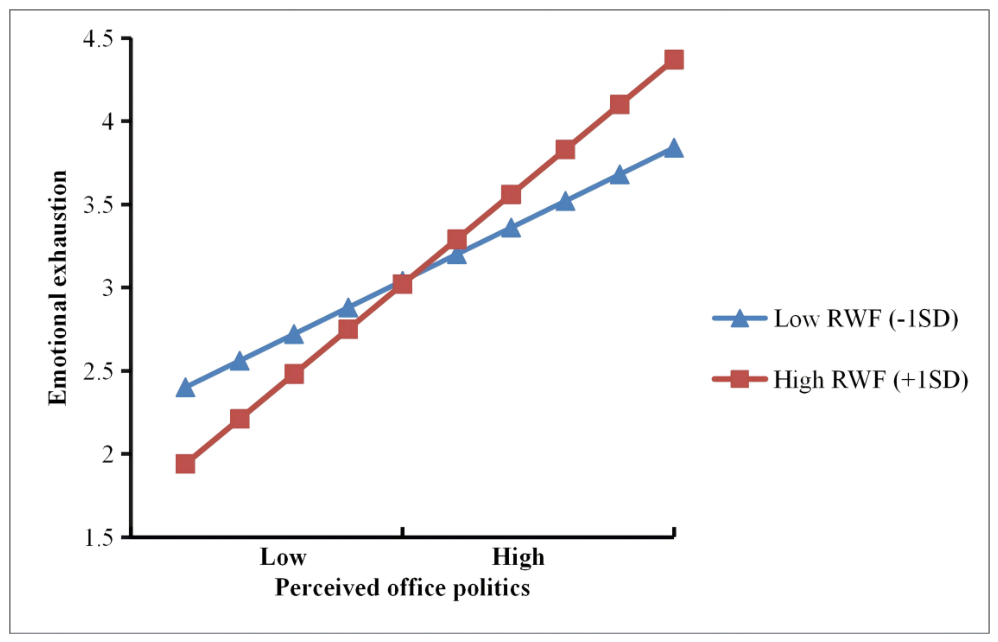

Table 1.
Means, standard deviations, and correlations.
| Variables | M | SD | 1 | 2 | 3 | 4 |
| 1.Perceived Office Politics | 3.12 | 0.89 | (0.86) | |||
| 2.. Emotional Exhaustion | 3.08 | 0.95 | 0.48** | (0.89) | ||
| 3.Work Withdrawal Behavior | 2.65 | 0.82 | 0.39** | 0.52** | (0.84) | |
| 4.Remote Work Frequency | 2.08 | 0.81 | 0.17** | 0.14** | 0.09 | - |
Note: N = 412. Standardized coefficients are reported. Cronbach’s α coefficients are shown on diagonal within parentheses. **p < 0.01.
Table 2.
Hierarchical regression predicting emotional exhaustion and work withdrawal behavior.
| Variables | Emotional Exhaustion | Work Withdrawal Behavior | |||
| Model 1 | Model 2 | Model 3 | Model 4 | Model 5 | |
| Control Variables | |||||
| Gender | -.002 | -0.03 | -0.04 | -0.03 | -0.02 |
| Age | -0.07 | -0.06 | -0.05 | -0.03 | 0.01 |
| Education | -0.01 | 0.02 | -0.05 | 0.03 | 0.02 |
| Tenure | -0.06 | -0.05 | -0.07 | -0.04 | -0.02 |
| Independent Variables | |||||
| Perceived Office Politics | 0.46*** | 0.37*** | 0.09 | ||
| Emotional Exhaustion | 0.42*** | ||||
| R2 | 0.01 | 0.24 | 0.01 | 0.28 | 0.31 |
| ΔR2 | 0.23*** | 0.27*** | 0.03*** | ||
| F | 0.96 | 21.34*** | 0.87 | 26.45*** | 28.12*** |
Note: N = 412. Standardized coefficients are reported. ***p < 0.001.
Table 3.
Moderating effect of remote work frequency on the relationship between perceived office politics and emotional exhaustion.
Table 3.
Moderating effect of remote work frequency on the relationship between perceived office politics and emotional exhaustion.
| Variables | Emotional Exhaustion | ||
| Model 1 | Model 2 | Model 3 | |
| Control Variables | |||
| Gender | -0.03 | -0.02 | -0.02 |
| Age | -0.06 | -0.05 | -0.05 |
| Education | 0.02 | 0.02 | 0.02 |
| Tenure | -0.05 | -0.04 | -0.04 |
| Independent Variables | |||
| Perceived Office Politics(POP) | 0.46*** | 0.43*** | 0.42*** |
| Remote Work Frequency(RWF) | 0.08 | 0.07 | |
| POP × RWF | 0.12** | ||
| R2 | 0.24 | 0.25 | 0.26 |
| ΔR2 | 0.01 | 0.01** | |
| F | 21.34*** | 18.56*** | 17.89*** |
Note: N = 412. Standardized coefficients are reported. *p < 0.05, **p < 0.01, ***p < 0.001.
Table 4.
Conditional indirect effects of perceived office politics on work withdrawal through emotional exhaustion.
Table 4.
Conditional indirect effects of perceived office politics on work withdrawal through emotional exhaustion.
| Remote Work Frequency | Indirect Effect | Boot SE | 95%CI Low | 95%CI High |
| Low (-1 SD) | 0.15 | 0.04 | 0.09 | 0.22 |
| High (+1 SD) | 0.28 | 0.04 | 0.20 | 0.37 |
| Difference (High - Low) | 0.13 | 0.05 | 0.04 | 0.22 |
Note: N = 412. Bootstrap resamples = 5,000. CI = confidence interval.
Disclaimer/Publisher’s Note: The statements, opinions and data contained in all publications are solely those of the individual author(s) and contributor(s) and not of MDPI and/or the editor(s). MDPI and/or the editor(s) disclaim responsibility for any injury to people or property resulting from any ideas, methods, instructions or products referred to in the content. |
© 2026 by the authors. Licensee MDPI, Basel, Switzerland. This article is an open access article distributed under the terms and conditions of the Creative Commons Attribution (CC BY) license.
Copyright: This open access article is published under a Creative Commons CC BY 4.0 license, which permit the free download, distribution, and reuse, provided that the author and preprint are cited in any reuse.