
Submitted:
07 September 2026
Posted:
09 September 2026
You are already at the latest version
Abstract
The rapid scaling of large language models (LLMs) and sparse mixture-of-experts (MoE) architectures reframes a foundational question about intelligence: must intelligent systems rely on large-scale, serial, and explicit computation, or does natural intelligence employ a faster, lower-level response mechanism than neuronal networks and explicit cognition? We introduce the Physical Fast Network Theory (PFNT) as a falsifiable, computational model. PFNT does not assume that consciousness is quantum, nor that a Planck-scale structure exists in the brain. Its central, testable claim is that biological intelligent systems may possess a hidden, fast, sparse, and dynamically routed information-processing network whose response time scale falls below what current macroscopic neuroimaging can directly resolve, with neurons and neural networks acting as an amplified, biological organization of that lower-level physical response. PFNT inherits ideas from brain-as-mixture-of-experts, dynamic neural routing, the freeenergy principle, neural Darwinism, and physical intelligence, but advances the question from how the brain computes to why the brain completes state selection on such a rapid physical time scale. We formulate a hierarchical model from fundamental physical interaction to hidden fast network, biological response, neurons, brain-MoE, intuition/emotion, and explicit consciousness, and propose to estimate the existence probability of such a network through early neural signals, latent-variable modeling, Bayesian model comparison, and accumulation of evidence. We explicitly state that there is currently no evidence of a Planck-scale computational network in the human brain, nor evidence that post-mortem brain tissue preserves usable quantum information. PFNT should therefore be regarded as a hypothesis and research program, not an established physical theory. The central question is not to search for quantum consciousness, but to determine whether a faster, dynamically sparse, behavior-predictive response network exists prior to conventional explicit neural computation. We emphasize the distinction between falsifiability and direct measurability. PFNT is falsifiable in the sense that specific predictions can be tested and potentially refuted, even though the hypothesized fast network is inherently not directly observable. The modelcomparison framework converts this into a well-posed question: whether a latent fast variable improves out-of-sample prediction over a classical baseline. The claim is therefore open to disconfirmation, and we give explicit falsification conditions in Section 7.3.
Keywords:
physical fast network
; PFNT
; brain-as-mixture-of-experts
; sparse routing
; natural intelligence
; fast response
; dynamic routing
; neural computation
; quantum biology
; consciousness
1. Introduction
Artificial intelligence (AI) is shifting from scaling models to changing computational architecture. Conventional transformers achieve general representation and reasoning through large-scale parameter sharing, whereas MoE architectures adopt conditional computation, dynamically selecting subsets of expert networks on a per-input basis, thereby expanding model capacity without proportionally increasing per-input computation [6]. Sparse MoE and its representative Switch Transformer demonstrate that not all parameters need to participate in every computation, a key principle for scaling efficiency [7].
This principle bears a striking structural analogy to natural nervous systems. O'Doherty et al. explicitly proposed viewing the brain as a mixture of experts, in which distinct neural/cognitive systems propose behavioral strategies and the system dynamically allocates behavioral control according to predictive reliability [1]. Earlier neuroscience had already introduced dynamic routing, where the nervous system can route information selectively to different regions by modulating connections and gains [4].
These observations raise a natural question. If AI rediscovered sparse routing as an efficient computational principle through MoE, does natural intelligence possess an even lower-level, faster routing mechanism beneath the neural network itself?
PFNT starts from this question. The hypothesis is deliberately weak and testable rather than strong and speculative: we do not claim that consciousness is quantum, nor that a Planck-scale structure exists in the human brain. Instead, we formulate a computable and falsifiable model in which a hidden, fast, sparsely routed physical network may precede explicit neural computation, and we specify exactly how that network could be evidenced — or refuted — through model comparison on high-temporal-resolution neural data. This framing distinguishes PFNT from the many 'quantum mind' proposals that, while conceptually rich, rarely provide a well-posed falsification protocol.
A reviewer may ask what PFNT adds beyond a large literature on rapid, unconscious processing. Dual-process theories distinguish a fast, automatic System 1 from a slow, deliberate System 2 [17], and global-neuronal-workspace theories characterize conscious access as a late, global broadcast [18,19]. These frameworks describe fast processing at the cognitive or neural-systems level. PFNT is distinct in two ways: it asks about the lower-most physical substrate that makes such fast state selection possible, and it insists that this lower-level hypothesis be tested by explicit model comparison rather than by analogy. We therefore position PFNT as complementary to, rather than competing with, dual-process and workspace accounts of rapid unconscious processing.
2. Background and Related Theories
2.1. Limits of LLM Inference and the Physical-Computation Problem
The core computation of LLMs remains transformer-based. Even with MoE, systems are bounded by digital hardware constraints: arithmetic latency, memory access, data movement, inter-chip communication, network bandwidth, energy consumption, and autoregressive sequence dependency [13]. MoE addresses the tension between parameter scale and effective computation, but does not eliminate the propagation and communication latency inherent to physical computation. We therefore treat the LLM inference limit not as a strictly proven single physical constant, but as a system-level lower bound on latency determined by information propagation, state update, and data movement, given a fixed architecture and hardware. This system-level bound is the concrete anchor for the claim that a physically different implementation could, in principle, be faster. (see Figure 2)
2.2. Brain-as-Mixture-of-Experts
The brain-as-MoE theory posits multiple expert systems that compete or cooperate to control behavior, with control allocated based on factors such as predictive reliability [16]. PFNT does not negate this model but adds a layer below it, asking whether the fast routing observed at the neural level is itself the macroscopic expression of a lower-level physical routing mechanism.
2.3. Physical Intelligence
Sitti's physical intelligence framework [5] argues that biological intelligence is not entirely computational intelligence localized in the brain; the material, mechanical, and sensori-motor properties of the body, together with environmental coupling, can also bear part of the intelligent function. Physical intelligence answers why intelligence can be distributed across body and environment, whereas PFNT asks why a physical system can complete state selection and response so rapidly.
2.4. Free-Energy Principle and Neural Darwinism
Friston's free-energy principle (FEP) [2,15] describes how biological systems maintain adaptation through internal generative models that reduce prediction error or free energy. Edelman's neural Darwinism [3] emphasizes selection, competition, and reentrant signaling among neural populations. PFNT embeds both in a temporal hierarchy: a fast physical response beneath neural-population selection and prediction-error update, such that neural Darwinism explains which neural populations are selected, FEP explains why the system continually predicts and updates, and PFNT adds the question of how fast that state selection can be.
2.5. Empirical Motivation from Ex-vivo Tissue and Small Nervous Systems
Two strands of recent evidence make the PFNT question concrete rather than purely conceptual. First, organotypic cultures of post-mortem adult human brain explants can still record stimulus-evoked field potentials, enhanced by the potassium-channel blocker 4-AP and suppressed by tetrodotoxin, indicating that some ion-channel and electrophysiological function persists after whole-organism death [8]. This cannot be read as evidence for persistent consciousness or for preserved quantum information, but it raises the concrete question of why local biophysical responsiveness survives loss of systemic function. Second, complete connectome reconstructions of the Drosophila brain and ventral nerve cord (BANC, 158,262 neurons, over 3 million neuron pairs) provide whole-network wiring diagrams that support direction-maintenance, attractor dynamics, sensorimotor integration, and context-dependent action selection using a small complement of neurons [9]. Neither finding proves PFNT, but both support the research strategy of starting from physical input, fast response, and behavioral output rather than from consciousness when seeking the minimal unit of intelligence.
3. The Physical Fast Network Theory (PFNT)
3.1. Hierarchical Model
PFNT proposes a hierarchy from fundamental physical interaction, through a hidden physical fast network (PFN), biological response, neurons, brain-MoE, intuition/emotion, to explicit consciousness. In this framework, brain-MoE is the macroscopic manifestation of fast routing at the neural level, while the PFN is the hypothesized physical response layer below it. The key claim is not that the PFN is necessarily quantum, but that neurons may not be the most fundamental computational degree of freedom of biological intelligence; neurons may be the macroscopic realization of a lower-level physical state transition after biological, molecular, and cellular organization. In this view, the hierarchy is not merely descriptive but causal: lower-level physical state selection is hypothesized to propagate upward, and only its macroscopic, amplified residue is observed as the familiar neural and cognitive markers. (see Figure 1).
3.2. Three Hypotheses
We propose three progressive hypotheses.
H1 (Fast Brain Response Hypothesis): the brain possesses a potential response network faster than explicit consciousness and linguistic reasoning, which can partially process input before the subject forms an explicit conscious report and carries predictive information about subsequent behavior, emotion, or judgment. This is testable in principle via EEG, MEG, ECoG, single-cell recording, and behavioral experiments [20]. (see Figure 3).
H2 (Physical Substrate Hypothesis): the full dynamics of such a fast response network may not be fully described by a conventional neuron-synapse-region model, and its physical implementation may involve lower-scale molecular, electromagnetic, or other microscopic degrees of freedom. This requires comparing classical neural dynamics models with models containing hidden fast state variables.
H3 (Quantum-Limit Hypothesis): if the theoretical time and length scales of the fast response continue to approach the explanatory boundary of classical biophysics, its final physical implementation may involve quantum-scale degrees of freedom.
We stress that H3 is not a prerequisite for H1. Only after H1 and H2 acquire evidence does H3 merit further study. In other words, PFNT is deliberately structured as an escalating ladder rather than a single leap, so that the theory can be advanced one falsifiable step at a time. From a purely H1 standpoint, the whole framework reduces to a question of macroscopic neural dynamics and requires no quantum physics at all.
3.3. Relationship to Physical Intelligence
The relationship between PFNT and physical intelligence can be made explicit as physical intelligence -> physical response -> physical fast network. Physical intelligence accounts for the distribution of intelligence across body and environment; physical response accounts for the fact that intelligent behavior requires physical state changes; and PFNT asks how those state selections can be completed so quickly. PFNT therefore does not negate neural computation, but seeks the physical response basis beneath it.
4. A Computable Rather Than Directly Observable Problem
The core methodology of PFNT is that a network that cannot be directly measured is not thereby inaccessible to scientific study. Suppose the real nervous system contains a hidden fast network F, while available devices observe only neural signals D. We construct two competing models.
M0 (classical model): stimulus -> neural network -> conscious decision -> behavior.
M1 (PFNT model): stimulus -> F -> fast routing -> brain-MoE -> behavior.
We then compare P(D|M0) and P(D|M1) and compute the Bayes factor BF10 = P(D|M1)/P(D|M0). If adding a hidden fast network significantly improves prediction on independent experimental data, we obtain statistical evidence for the existence of a fast brain response network. This does not imply direct observation, but that the model containing the network explains the data better than the model without it. This provides a rigorous, computable pathway in which an unobserved latent structure is inferred through model comparison and accumulation of Bayesian evidence. (see Figure 7)
Concretely, M1 embeds a latent variable F that M0 lacks. The two models are fit on training data, and their out-of-sample predictive performance is compared on held-out trials across subjects and tasks. A robustly positive BF10, replicable across independent datasets, is the operational definition of evidence for the hidden fast network. The approach is therefore a latent-variable model-comparison problem, fully consistent with modern state-space and Bayesian-inference methods used in neuroscience and machine learning [14], and requires no assumption about the microscopic nature of F.
To make the model comparison concrete, let the observed data on trial n be D_n = (X_n, Y_n), where X_n is the stimulus-aligned neural/EEG measurement and Y_n is the behavioral response. Let Z denote a hidden fast latent state. Under M0, the likelihood factorizes as P(Y | X) with no latent state beyond the measured channels; under M1, we introduce Z and write P(Y | X) = integral P(Y | Z, X) P(Z | X) dZ, so that M1 is a latent-variable model M0 lacks. We define the log Bayes factor as log BF10 = log P(D | M1) - log P(D | M0), computed as the difference in log marginal likelihood; standard thresholds (e.g. log BF10 > 2 as substantial, > 5 as strong) provide an explicit, pre-registered decision rule. The posterior of Z given data, P(Z | D), yields the inferred fast-latent state, and its predictive utility is assessed out of sample. No assumption about the physical nature of Z is required at this stage, which keeps the test independent of any quantum interpretation.
5. Experimental Design
5.1. Core Design
The first phase of PFNT does not require quantum experiments. The essential aim is to establish a multimodal protocol combining EEG/MEG/ECoG, behavioral measures, and high-temporal-resolution stimuli.
5.2. Stimulus Time Windows
We propose the following stimulus time windows relative to stimulus onset: 1-10 ms (primary perception), 10-50 ms (candidate fast state), 50-150 ms (expert selection), 150-300 ms (intuition/emotion), and >300 ms (explicit cognition). The central question is not whether there is EEG activity, but whether, before the final behavior occurs, there exists an extremely early, sparse, reproducible, task-dependent hidden state that predicts subsequent behavior. (see Figure 4).
5.3. Model-Comparison Basis
Crucially, the design is model-comparison based. One fits both M0 (classical) and M1 (PFNT) to the same data and compares their out-of-sample predictive performance via Bayes factor. This turns the question of whether a hidden fast network exists into a well-posed model-selection problem, which is robust to the fact that the latent structure is itself unobserved.
5.4. Phased and Controlled Protocol
We propose a staged, preregistered protocol. In stage A, one first demonstrates that a classical (M0) model can account for all early neural signals, thereby establishing a baseline; in stage B, one tests whether adding a latent fast variable (M1) improves out-of-sample prediction beyond that baseline. To exclude spurious associations, we specify four control conditions: (i) time shuffle, randomizing the temporal order to test whether the apparent fast structure is an artifact; (ii) cross-task transfer, testing whether the fast state is task-specific; (iii) cross-region control, comparing the predictive advantage across distinct regions of interest; and (iv) random-state substitution, replacing the inferred fast state with a random latent variable to verify that the real variable, not the model flexibility, drives the improvement.
6. Four Criteria for a Genuine Fast Network
For PFNT to qualify as a genuine scientific theory, at least four criteria should be met simultaneously. (see Figure 5)
(C1) Temporal advantage: the fast network must temporally precede explicit cognition, i.e. t_explicit - t_fast > 0.
(C2) Sparse routing: not the whole brain participates at once; only a few network modules are selected.
(C3) Context dependence: identical input can select different experts under different states, i.e. P(E_i|X,C1) differs from P(E_i|X,C2), where C denotes context.
(C4) Predictive information: the fast state must carry predictive information about future behavior, i.e. I(X_fast; Y_future) > 0.
These criteria are deliberately operational: each corresponds to a measurable quantity. C1 is a temporal-lag test; C2 is a sparsity measure; C3 is a context-dependent selection test; and C4 is a mutual-information or prediction-accuracy test. If these four conditions hold simultaneously, one can begin to discuss whether a fast brain response network is a genuine organizing principle of neural computation.
7. Discussion
7.1. Strict Boundary with Quantum Theory
Quantum cognition uses quantum-probability formalisms to describe certain decision phenomena [10] but generally does not require the brain to be a quantum computer. In contrast, theories such as Orch-OR attempt to link consciousness to microscopic quantum processes [11] and have drawn sustained physical and biological criticism [12]. PFNT should therefore not be classified as a quantum-consciousness theory: quantum mechanism is only a candidate lower bound to be studied after H1 and H2 acquire evidence, not a presupposition.
7.2. Position of the Planck Scale
PFNT should not assume that the network in the brain is Planck-scale. The Planck time (~5.39 x 10^-44 s) and Planck length (~1.616 x 10^-35 m) far exceed the current direct measurement capability of neuroscience. A more rigorous statement is: if the theoretical time scale of the PFN continues to break through the explanatory boundary of classical biophysics, the quantum scale can serve as one possible physical lower bound, but this is not a premise of PFNT. This yields an escalatory structure H1 -> H2 -> H3 rather than a leap to Planck-scale brain.
7.3. Falsifiability
A central virtue of PFNT is that it must permit itself to be falsified. If high-temporal-resolution experiments show that (i) all early information can be explained by classical neural conduction, (ii) no independent fast latent variable exists, (iii) adding a PFN does not improve model prediction, or (iv) the fast response lacks a stable sparse routing structure, then the core hypotheses of PFNT should be negated or revised. Conversely, if M1 dominates M0 and this result replicates across experiments, animals, and tasks, PFNT gains cumulative support.
7.4. Relationship to the Broader Theory Landscape
PFNT does not seek to replace existing theories, but to establish a new vertical scale connecting fundamental physical response to high-level neural cognition. Its position can be summarized as: fundamental physics -> physical intelligence -> neural Darwinism -> dynamic neural routing -> active inference and brain-MoE, converging on PFNT and thence to intuition/emotion and explicit cognition. The distinctive contribution of PFNT is to add 'physical response speed' as a basic metric of intelligence alongside accuracy, network structure, information integration, energy consumption, and learning capability.
7.5. A shift of Research Paradigm
Traditional neuroscience generally follows a structure-to-function logic: find a brain region, then study its function. PFNT proposes the inverse route: observed response -> hidden dynamics -> latent network, in which one inverts the most probable underlying dynamics from macroscopic responses rather than requiring direct observation of the network. This paradigm is naturally compatible with latent representation, state-space modeling, and Bayesian model comparison in modern AI, and culminates in the posterior probability P(FBRN|D) of a fast brain response network given data D. (see Figure 6)
To make physical
7.6. Relation to an MRI-Based Measurement Platform and Honest Boundaries
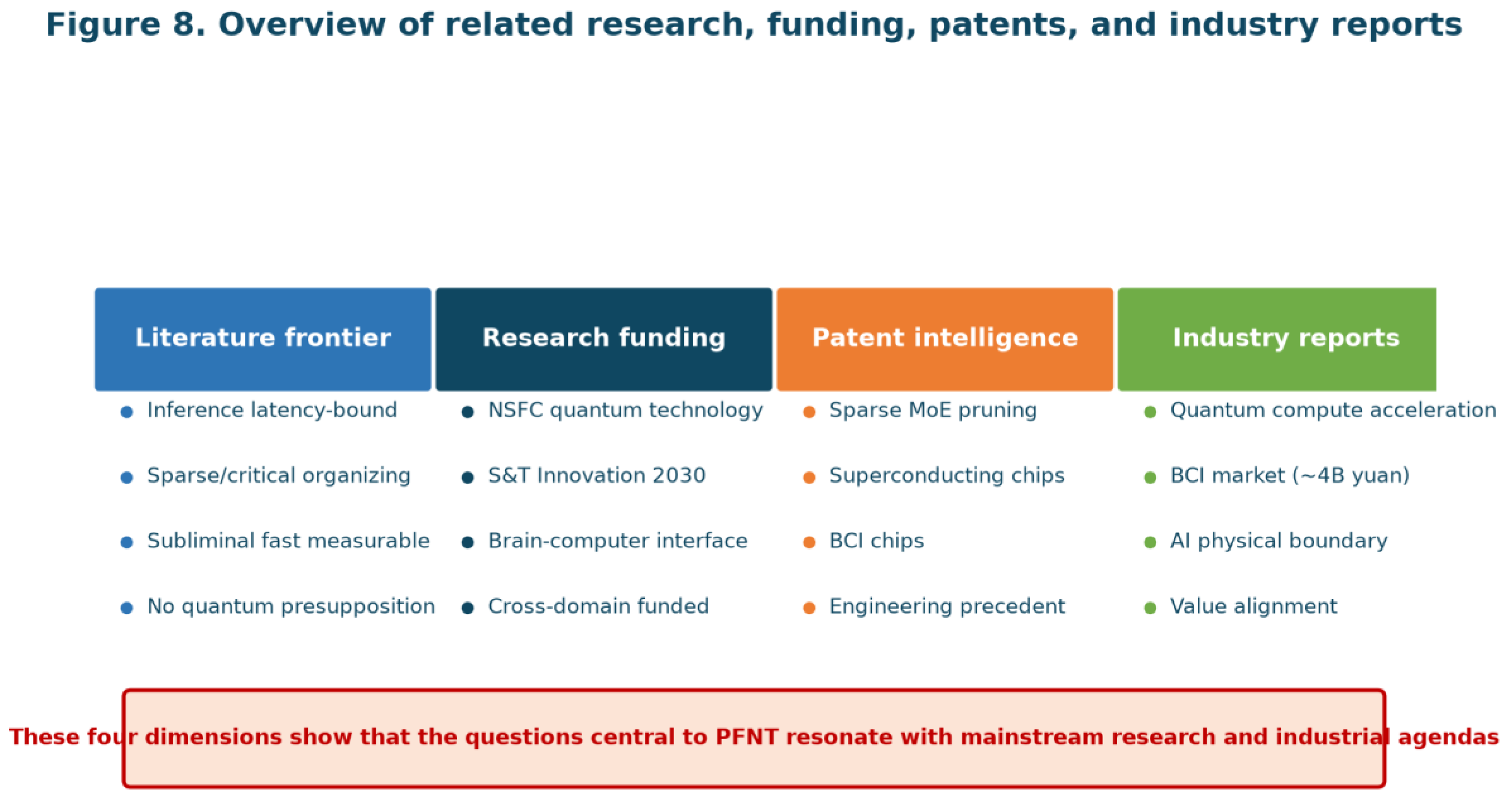
While the present work is a theory paper, PFNT is designed to be compatible with existing MRI platforms. In particular, intermolecular multiple-quantum-coherence (iMQC) and CRAZED sequences probe the 10-500 micrometer mesoscopic scale via long-range dipolar fields, providing contrast independent of T1, T2, and T2*; such sequences could, in principle, supply the physical measurements that a hidden fast network would modulate. However, we state explicitly that the authors' own raw MRI data are single-quantum-coherence protocols, and that iMQC/CRAZED has so far been validated primarily on synthetic data or in the literature. We therefore do not claim any experimental verification of a fast network on an MRI platform. (see Figure 8).
7.7. Limitations and Future Work
The present model is conceptual and does not yet provide a complete microscopic physical mechanism for F. Future work should (i) implement the Bayesian model-comparison pipeline on real high-temporal-resolution EEG/MEG data, (ii) derive quantitative predictions linking the inferred fast-state parameters to behavioral and neural markers, (iii) explore whether specialized MRI sequences such as iMQC/CRAZED can provide the relevant mesoscopic measurements, and (iv) specify the minimal experimental protocol that would conclusively falsify H2 while remaining agnostic about H3.
8. Conclusions
We have presented Physical Fast Network Theory as a falsifiable, computational research program linking AI, neuroscience, biophysics, and fundamental physics. Its central claim is not that consciousness has been shown to be quantum, but that a faster physical response and state-selection network may exist prior to neurons and explicit cognition. If such a network exists, brain-MoE may be its macroscopic neural-level expression, intuition and emotion its fast output, and explicit consciousness and linguistic reasoning a slower, more interpretable higher-level integration.
The most valuable scientific contribution of PFNT is not to pre-specify what the PFN is, but to pose a well-posed computable question: can one invert a fast latent response network, from macroscopic neural data, which cannot be adequately explained by a conventional classical neural network? If the answer is affirmative, the next stage is to study its microscopic physical basis. If that basis exhibits time scales inexplicable by classical biophysical models, quantum mechanisms become a reasonable candidate. Only on stronger evidence can one discuss its relation to fundamental space-time scales.
Given the state of evidence, the most appropriate positioning of PFNT is not as a quantum-consciousness theory, but as a research program that, starting from observable neural responses, seeks the lower-level fast physical mechanism of natural intelligence through latent-variable inversion. Its value lies in its clearly stated, testable hypotheses and its well-posed falsification design.
9. Honest Declaration and Limitations
This manuscript presents a hypothesis and research program, not an established physical theory. It makes no claim that consciousness is quantum, that a Planck-scale computational network exists in the human brain, or that post-mortem brain tissue preserves usable quantum information. It also makes no claim of quantum computation, quantum consciousness phenomena, teleportation, or telepathy.
The authors acknowledge that the CRAZED/iMQC methods referenced in related work have been validated primarily on synthetic data or in the literature, and that the available raw MRI data from the authors' own platform are single-quantum-coherence (SQC) protocols. As a theory paper, the present work does not claim to have experimentally verified a hidden physical fast network, and therefore explicitly refrains from any quantum-consciousness or cross-brain inference. The value of the model resides in its clearly stated, testable hypotheses and its well-posed falsification design, not in unverified claims.
Author: Contributions
Paul (christ.paul90@gmail.com) conceived the theoretical framework, designed the model-comparison methodology, and drafted the manuscript. Sun (595176934@qq.com) contributed to the analysis of the related experimental evidence, prepared the figures, and critically revised the manuscript. Both authors read and approved the final version.
Data Availability Statement
This manuscript is a theoretical paper and does not report new empirical data. The dipolar/connectome dataset referenced in Section 2.5 is publicly available via the BANC FlyWire resource and the cited literature. The authors' own raw MRI data are single-quantum-coherence protocols and are not part of the present theoretical analysis. All figures were generated by the authors from the described framework.
Acknowledgments
The authors thank the developers of the open-source software used in this work. This research received no specific grant from any funding agency in the public, commercial, or not-for-profit sectors.
Conflicts of Interest
The authors declare no competing interests.
References
- O'Doherty, J.P.; Lee, S.W.; Tadayonnejad, R.; et al. Why and how the brain weights contributions from a mixture of experts. Neurosci. Biobehav. Rev. 2021, 123, 14–23. [Google Scholar] [CrossRef] [PubMed]
- Friston, K. The free-energy principle: a unified brain theory? Nat. Rev. Neurosci. 2010, 11, 127–138. [Google Scholar] [CrossRef] [PubMed]
- Edelman, G.M. Neural Darwinism: Selection and reentrant signaling in higher brain function. Neuron 1993, 10, 115–125. [Google Scholar] [CrossRef] [PubMed]
- Olshausen, B.A.; Anderson, C.H.; Van Essen, D.C. A neurobiological model of visual attention and invariant pattern recognition based on dynamic routing of information. J. Neurosci. 1993, 13, 4700–4719. [Google Scholar] [CrossRef] [PubMed]
- Sitti, M. Physical intelligence as a new paradigm. Extrem. Mech. Lett. 2021, 46, 101340. [Google Scholar] [CrossRef]
- Shazeer, N.; Mirhoseini, A.; Maziarz, K.; et al. Outrageously Large Neural Networks: The Sparsely-Gated Mixture-of-Experts Layer. ICLR 2017. [Google Scholar] [CrossRef]
- Fedus, W.; Zoph, B.; Shazeer, N. Switch Transformers: Scaling to Trillion Parameter Models with Simple and Efficient Sparsity. J. Mach. Learn. Res. 2022, 23, 1–39. [Google Scholar]
- Plug, B.C.; Revers, I.M.; Breur, M.; et al. Human post-mortem organotypic brain slice cultures: a tool to study pathomechanisms and test therapies. Acta Neuropathol. Commun. 2024, 12, 83. [Google Scholar] [CrossRef] [PubMed]
- Wolff, T.; Rubin, G.M.; et al. A connectome of the Drosophila central complex reveals network motifs suitable for flexible navigation and context-dependent action selection. eLife 2022. [Google Scholar] [CrossRef] [PubMed]
- Busemeyer, J.R.; Bruza, P.D. Quantum Models of Cognition and Decision; Cambridge University Press, 2012. [Google Scholar]
- Hameroff, S.; Penrose, R. Consciousness in the universe: A review of the 'Orch OR' theory. Phys. Life Rev. 2014, 11, 39–78. [Google Scholar] [CrossRef]
- Reimers, J.R.; McKemmish, L.K.; McKenzie, R.H.; et al. The revised Penrose-Hameroff orchestrated objective-reduction proposal for human consciousness is not scientifically justified. Phys. Life Rev. 2014, 11, 101–103. [Google Scholar] [CrossRef] [PubMed]
- Kang, N.; et al. Block Transformer: Global-to-Local Language Modeling for Fast Inference. NeurIPS 2024, arXiv:2406.02657. [Google Scholar] [CrossRef]
- van der Plas, T.L.; Fagerholm, E.D.; Leech, R.; et al. Neural criticality from effective latent variables. eLife 2024, 12, RP89337. [Google Scholar] [CrossRef] [PubMed]
- Mazzaglia, P.; Verbelen, T.; Catal, O.; Dhoedt, B. The free energy principle for perception and action: a deep learning perspective. Entropy 2022, 24(2), 301. [Google Scholar] [CrossRef] [PubMed]
- BrainMoE: Cognition Joint Embedding via Mixture-of-Expert Towards Robust Brain Foundation Model. NeurIPS 2025. [CrossRef]
- Kahneman, D. Thinking, Fast and Slow; Farrar, Straus and Giroux, 2011. [Google Scholar]
- Dehaene, S.; Changeux, J.P. Experimental and theoretical approaches to conscious processing. Neuron 2011, 70(2), 200–227. [Google Scholar] [CrossRef] [PubMed]
- Dehaene, S.; Lau, H.; Kouider, S. What is consciousness, and could machines have it? Science 2017, 358(6362), 486–492. [Google Scholar] [CrossRef] [PubMed]
- Tsuchiya, N.; Wilke, M.; Frassle, S.; Lamme, V.A.F. No-report paradigms: extracting the true neural correlates of consciousness. Trends Cogn. Sci. 2015, 19(12), 757–770. [Google Scholar] [CrossRef] [PubMed]
Figure 2.
Limits of LLM inference. The schematic illustrates the pipeline from input token through arithmetic, memory access, data movement, inter-chip communication, network bandwidth, autoregressive sequence dependency, to output token. The red annotation marks the system-level latency lower bound determined by digital physical constraints, and emphasizes that MoE resolves the tension between parameter scale and effective computation without eliminating the propagation and communication delay inherent to digital computation.
Figure 2.
Limits of LLM inference. The schematic illustrates the pipeline from input token through arithmetic, memory access, data movement, inter-chip communication, network bandwidth, autoregressive sequence dependency, to output token. The red annotation marks the system-level latency lower bound determined by digital physical constraints, and emphasizes that MoE resolves the tension between parameter scale and effective computation without eliminating the propagation and communication delay inherent to digital computation.
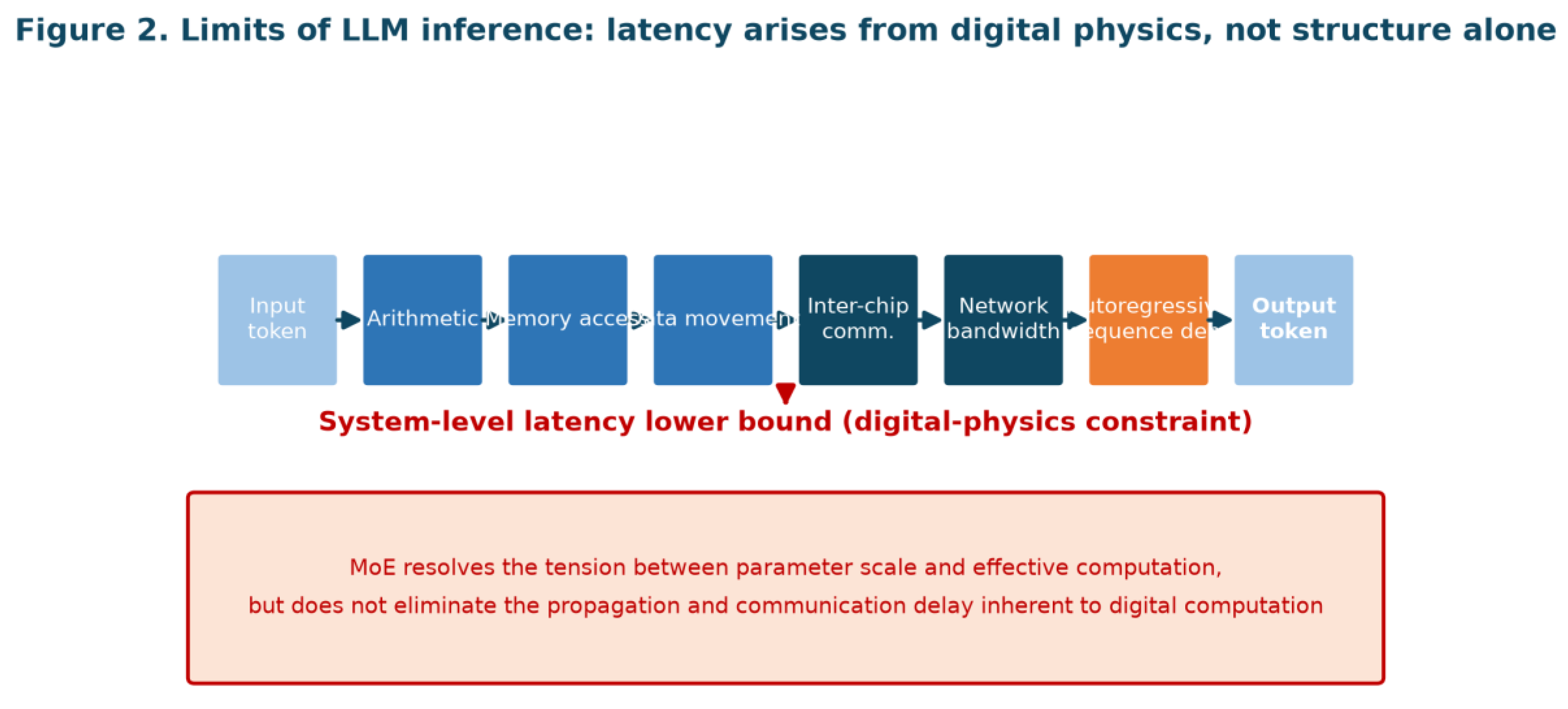
Figure 1.
Hierarchical model of PFNT. The diagram shows the vertical hierarchy from explicit consciousness and linguistic reasoning, through intuition/emotion, brain-MoE, neurons, biological response, the hidden physical fast network (PFN), to fundamental interaction. The upper region is macroscopic and observable, while the lower region represents the hypothesized fast physical layer. PFNT claims that neurons may not be the most fundamental computational degree of freedom; a faster physical response and state-selection network may exist beneath them.
Figure 1.
Hierarchical model of PFNT. The diagram shows the vertical hierarchy from explicit consciousness and linguistic reasoning, through intuition/emotion, brain-MoE, neurons, biological response, the hidden physical fast network (PFN), to fundamental interaction. The upper region is macroscopic and observable, while the lower region represents the hypothesized fast physical layer. PFNT claims that neurons may not be the most fundamental computational degree of freedom; a faster physical response and state-selection network may exist beneath them.
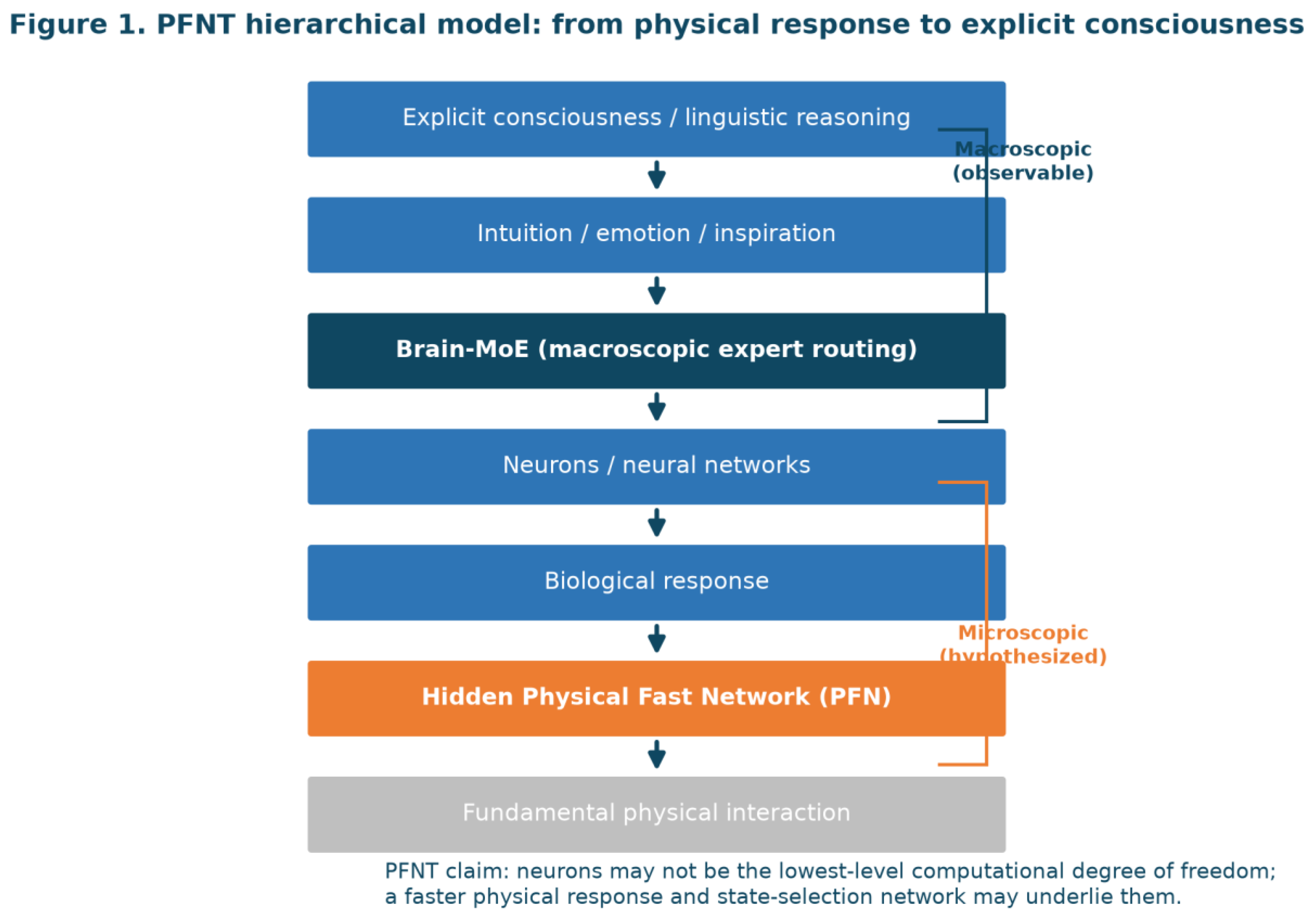
Figure 3.
Three progressive hypotheses H1, H2, H3 and their strict boundary. H1 (fast brain response) is testable via EEG/MEG/ECoG and behavior; H2 (physical substrate) is tested by comparing classical neuron-synapse models with models containing hidden fast state variables; H3 (quantum limit) is triggered only when the time/length scales approach the classical biophysical explanatory boundary. The red box emphasizes that H3 is not a prerequisite for H1.
Figure 3.
Three progressive hypotheses H1, H2, H3 and their strict boundary. H1 (fast brain response) is testable via EEG/MEG/ECoG and behavior; H2 (physical substrate) is tested by comparing classical neuron-synapse models with models containing hidden fast state variables; H3 (quantum limit) is triggered only when the time/length scales approach the classical biophysical explanatory boundary. The red box emphasizes that H3 is not a prerequisite for H1.
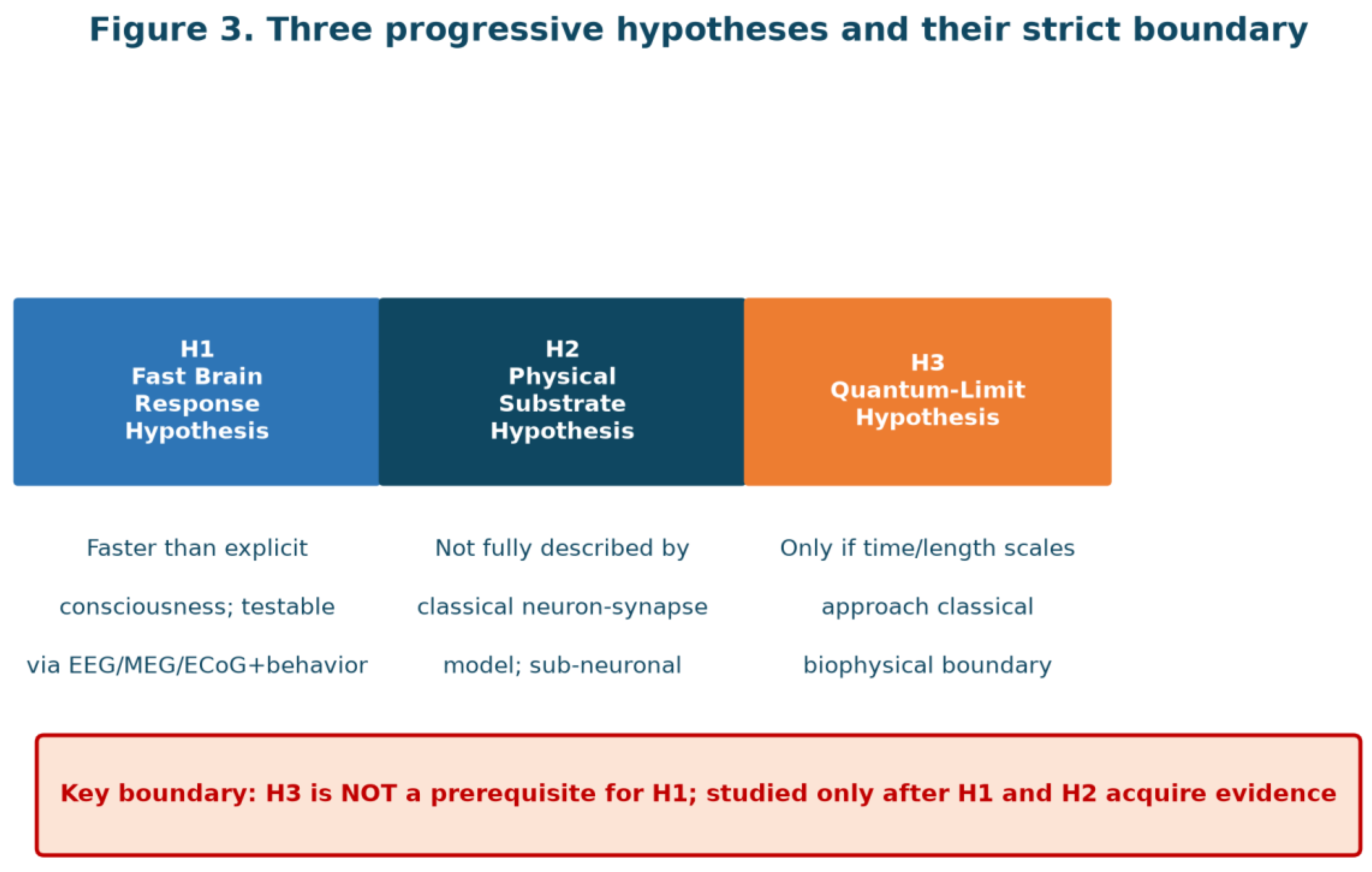
Figure 7.
Computable problem: comparing the classical model M0 and the PFNT model M1 via Bayes factor. M0: stimulus -> neural network -> conscious decision -> behavior. M1: stimulus -> F -> fast routing -> brain-MoE -> behavior. The Bayes factor BF10 = P(D|M1)/P(D|M0) measures the relative predictive improvement from including the hidden fast network.
Figure 7.
Computable problem: comparing the classical model M0 and the PFNT model M1 via Bayes factor. M0: stimulus -> neural network -> conscious decision -> behavior. M1: stimulus -> F -> fast routing -> brain-MoE -> behavior. The Bayes factor BF10 = P(D|M1)/P(D|M0) measures the relative predictive improvement from including the hidden fast network.
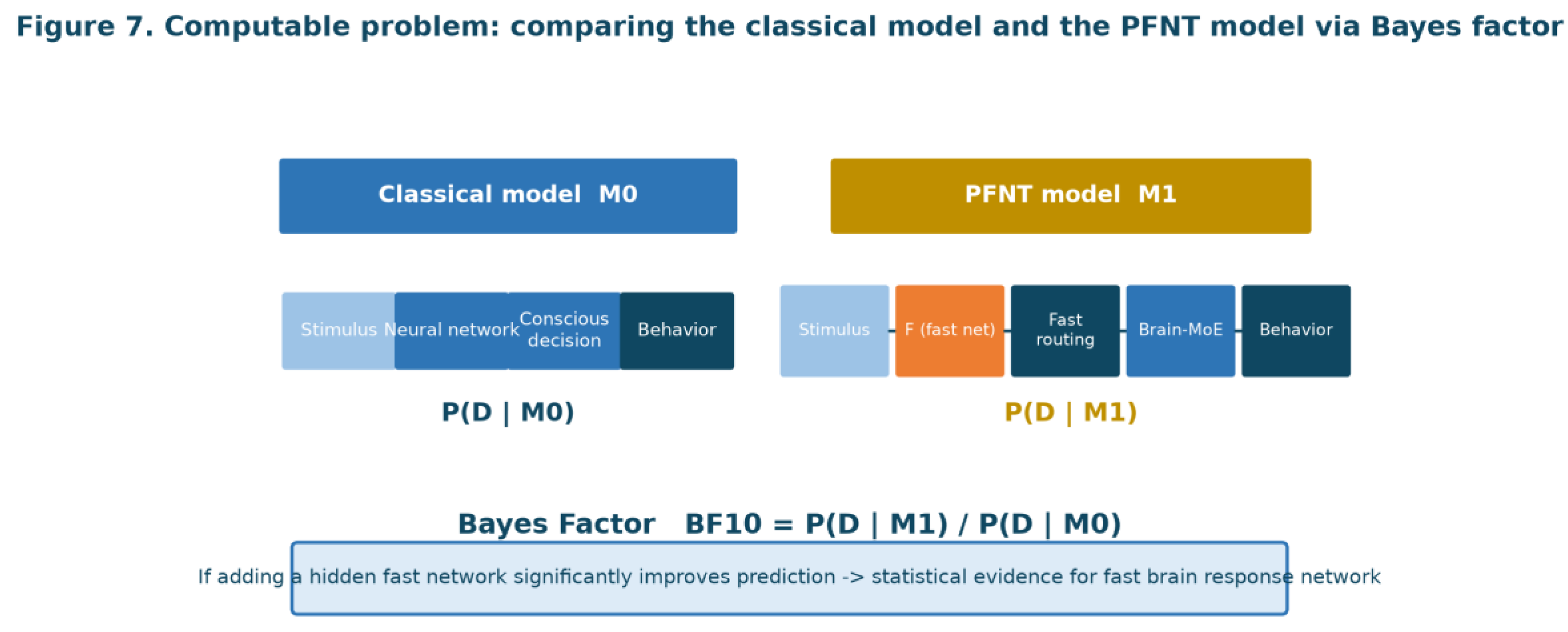
Figure 4.
Experimental verification and high-temporal-resolution stimulus time windows. The time axis from stimulus onset shows 1-10 ms (primary perception), 10-50 ms (candidate fast state), 50-150 ms (expert selection), 150-300 ms (intuition/emotion), and >300 ms (explicit cognition). The central question is whether an extremely early, sparse, reproducible, task-dependent hidden state predicts subsequent behavior.
Figure 4.
Experimental verification and high-temporal-resolution stimulus time windows. The time axis from stimulus onset shows 1-10 ms (primary perception), 10-50 ms (candidate fast state), 50-150 ms (expert selection), 150-300 ms (intuition/emotion), and >300 ms (explicit cognition). The central question is whether an extremely early, sparse, reproducible, task-dependent hidden state predicts subsequent behavior.
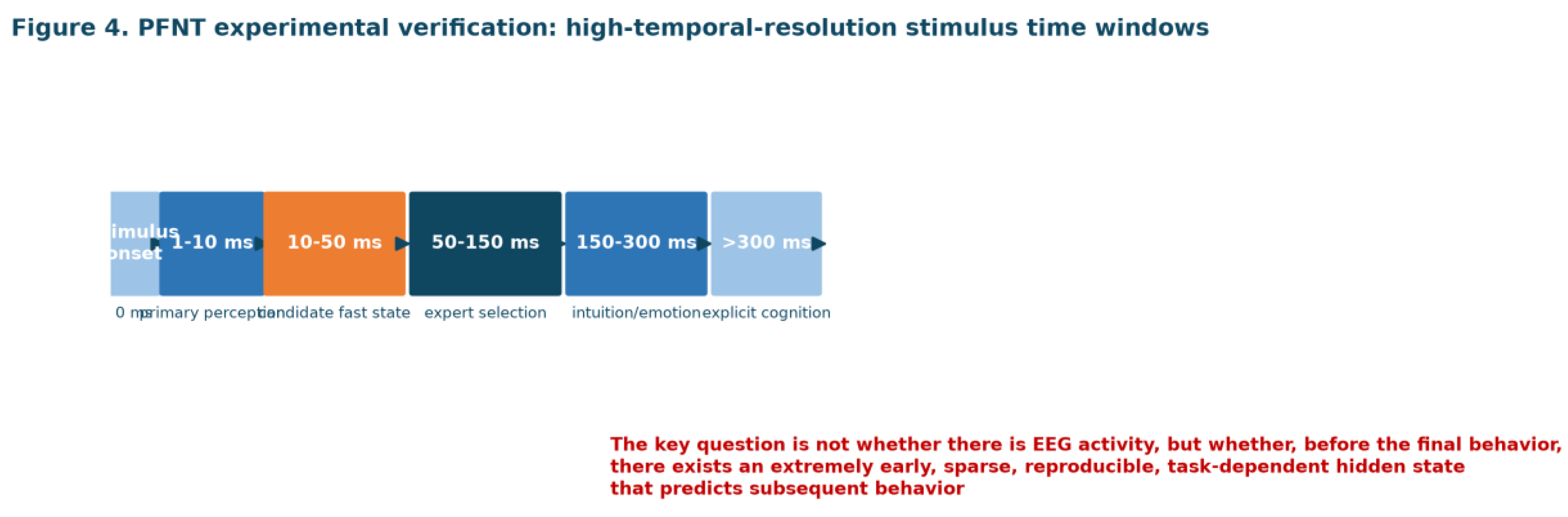
Figure 5.
Four criteria for a genuine fast network: (C1) temporal advantage, (C2) sparse routing, (C3) context dependence, and (C4) predictive information. If all four hold simultaneously, one can discuss whether a fast brain response network is a genuine organizing principle of neural computation.
Figure 5.
Four criteria for a genuine fast network: (C1) temporal advantage, (C2) sparse routing, (C3) context dependence, and (C4) predictive information. If all four hold simultaneously, one can discuss whether a fast brain response network is a genuine organizing principle of neural computation.
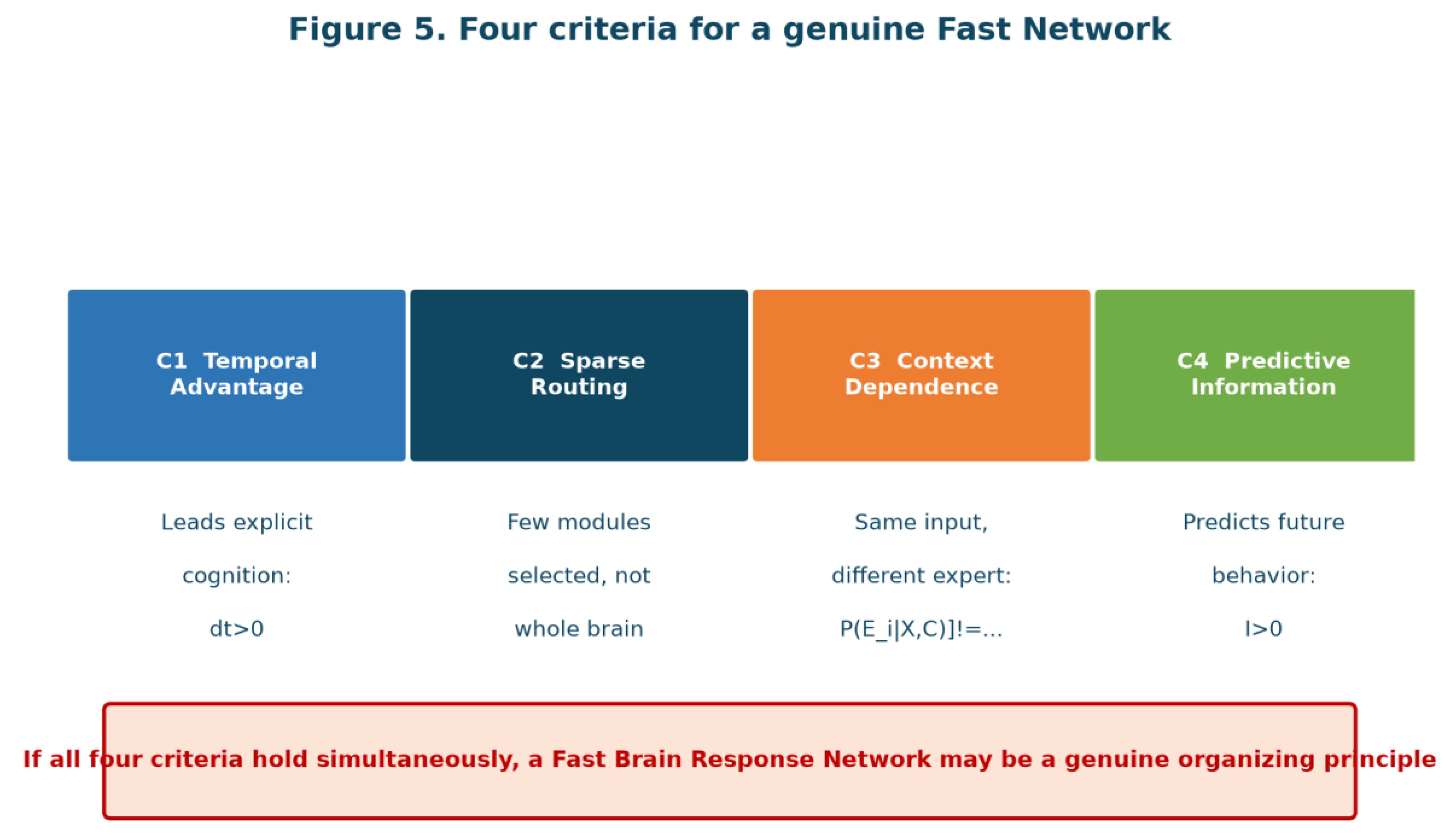
Figure 6.
Theory genealogy. The diagram situates PFNT relative to fundamental physics, quantum/classical physics, physical intelligence, neural Darwinism, dynamic neural routing, active inference, and brain-MoE, showing that PFNT establishes a new vertical scale from fundamental physical response to high-level neural cognition rather than replacing existing theories.
Figure 6.
Theory genealogy. The diagram situates PFNT relative to fundamental physics, quantum/classical physics, physical intelligence, neural Darwinism, dynamic neural routing, active inference, and brain-MoE, showing that PFNT establishes a new vertical scale from fundamental physical response to high-level neural cognition rather than replacing existing theories.
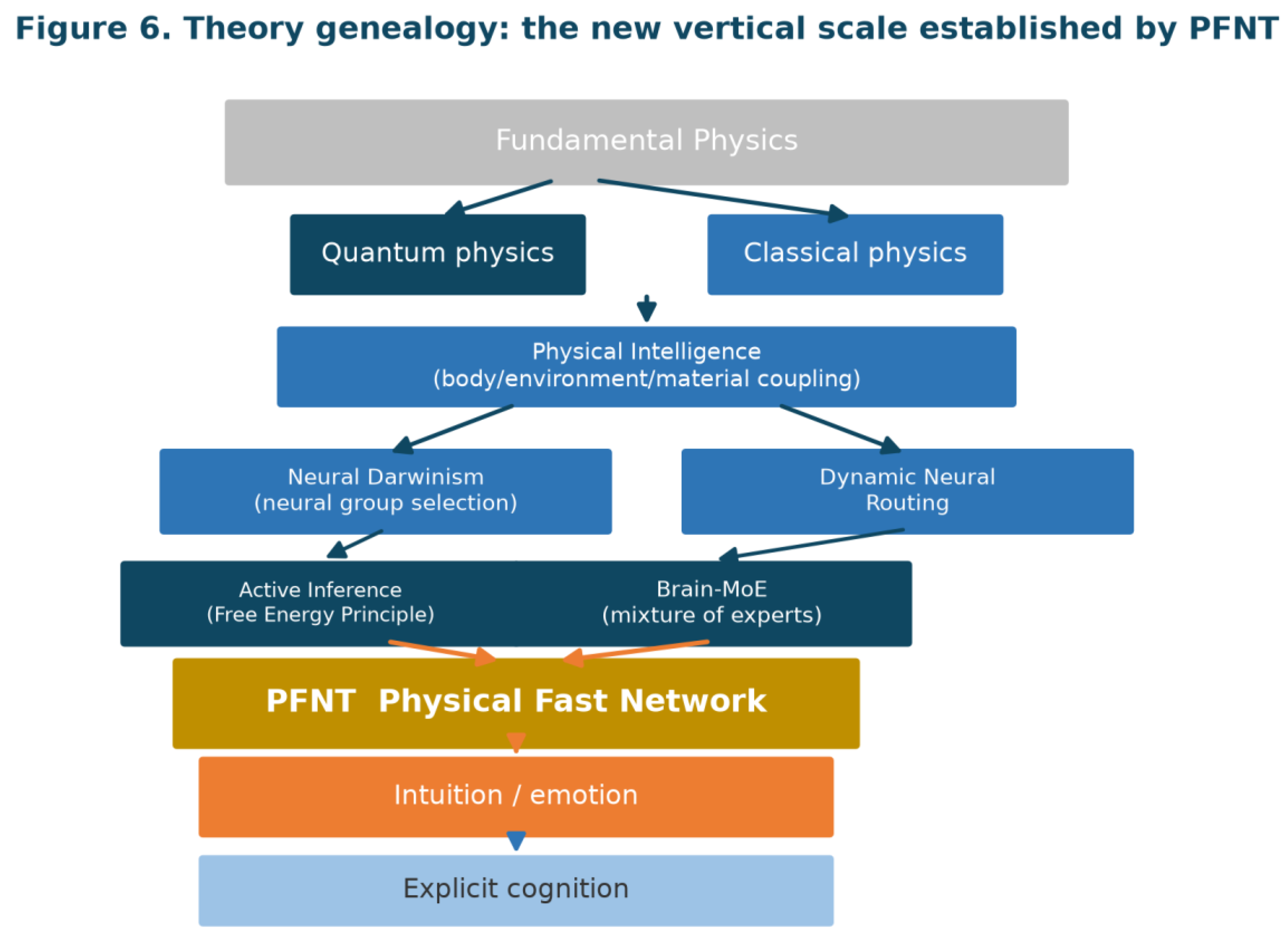
Figure 8.
Overview of related research, funding, patents, and industry reports, organized into four dimensions (literature frontier, research funding, patent intelligence, and industry reports). This figure illustrates that the questions addressed by PFNT are not purely speculative but resonate with mainstream research and industrial agendas.
Figure 8.
Overview of related research, funding, patents, and industry reports, organized into four dimensions (literature frontier, research funding, patent intelligence, and industry reports). This figure illustrates that the questions addressed by PFNT are not purely speculative but resonate with mainstream research and industrial agendas.
Disclaimer/Publisher’s Note: The statements, opinions and data contained in all publications are solely those of the individual author(s) and contributor(s) and not of MDPI and/or the editor(s). MDPI and/or the editor(s) disclaim responsibility for any injury to people or property resulting from any ideas, methods, instructions or products referred to in the content. |
© 2026 by the authors. Licensee MDPI, Basel, Switzerland. This article is an open access article distributed under the terms and conditions of the Creative Commons Attribution (CC BY) license (http://creativecommons.org/licenses/by/4.0/).
Copyright: This open access article is published under a Creative Commons CC BY 4.0 license, which permit the free download, distribution, and reuse, provided that the author and preprint are cited in any reuse.