

Submitted:
07 September 2026
Posted:
08 September 2026
You are already at the latest version
Abstract
Two previously undescribed sulfobetaine zwitterions bearing benzyl ester and amide functionalities were synthesised through a concise three-step sequence starting from benzyl alcohol and either succinic or glutaric anhydride. The route comprised esterification, amidation with N,N-dimethylpropane-1,3-diamine and ring-opening of 1,3-propanesultone by the resulting tertiary amine. Differing only in the length of the diacid-derived spacer, the two compounds constitute a matched pair well suited to probing structure–property relationships in sulfobetaine surfactants and thermoresponsive materials.
Keywords:
sulfobetaine
; esterification
; amidation
; 1
; 3-propanesultone ring opening
1. Introduction
Sulfobetaine-type zwitterions represent a highly versatile class of compounds characterized by the presence of both a positively charged quaternary ammonium group and a negatively charged sulfonate group, typically linked by a short alkyl spacer. [1] This unique headgroup architecture imparts remarkable physicochemical properties, enabling their widespread use as surfactants in diverse fields such as cosmetics, [2] analytical separation, [3] enhanced oil recovery, [4] nanoscience, [5] and wastewater treatment via clay intercalation. [6] Beyond their role as surfactants, polymeric sulfobetaines have attracted significant attention for their exceptional antifouling behavior and biotolerance, [7] applications in ultrafiltration membranes, [8] blood-contacting devices, [9] and drug delivery systems. [10] Notably, sulfobetaines that do not function as classical surfactants also exhibit intriguing features, including thermoresponsive behavior, chemically tunable structures, and the potential to serve as smart materials with lower critical solution temperature (LCST) properties. [11] These attributes highlight the interest of presenting here the two never previously described sulfobeteines presented on Figure 1: 2-((2-(4-(benzyloxy)-4-oxobutanamido)ethyl)dimethylammonio)propane-1-sulfonate (1) and 2-((2-(5-(benzyloxy)-5-oxopentanamido)ethyl)dimethylammonio)ethane-1-sulfonate (2).
2. Results and Discussion
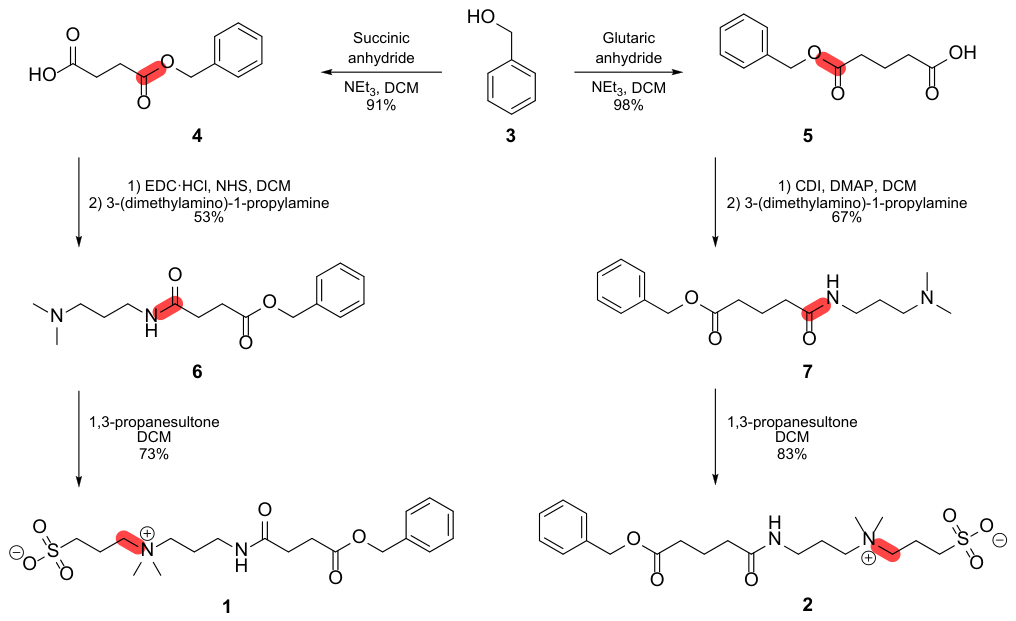
The synthesizes of compounds 1 and 2 was achieved with moderate yields starting from benzylic alcohol and the appropriate anhydride - succinic anhydride for compound 1 and glutaric anhydride for compound 2. The proposed synthetic methodology involves a sequence of three steps: initial esterification, followed by amidation, and finally a ring-opening reaction of 1,3-propane sultone by the resulting tertiary amine, as illustrated in Scheme 1.
The primary difference between compounds 1 and 2 is the number of carbon atoms in the diacid-derived aliphatic chain. Anhydrides were used to introduce this chain and succinic anhydride, proved to be more moisture-sensitive than glutaric anhydride; therefore, succinic anhydride was recrystallized from acetic anhydride prior to the synthesis of 4. Initial attempts to prepare 4 and 5 in diethyl ether were unsuccessful. In contrast, using dichloromethane enabled the isolation of both compounds. Even under analogous conditions, the isolated yield of 4 remained substantially lower than that of 5, which was obtained in quantitative yield. Reaction progress was readily monitored by TLC (ethyl acetate as the mobile phase). Visualization with bromocresol green [12] gave a yellow spot (indicating the presence of free carboxylic acid groups) on a blue background.
Compounds 4 and 5, previously reported in the literature, [13] were converted to the corresponding amides 6 and 7 by first activating the carboxylic acids with coupling reagents, followed by addition of N,N-dimethylpropane-1,3-diamine. [14] For amide 6, N-(3-dimethylaminopropyl)-N′-ethylcarbodiimide hydrochloride (EDC·HCl) and N-hydroxysuccinimide (NHS) were used, whilst for amide 7 a carbonyldiimidazole (CDI)/N,N-dimethylaminopyridine (DMAP)/triethylamine system proved more effective.
Both zwitterionic compounds 1 and 2 were successfully synthesised by direct reaction of compounds 6 and 7 in dichloromethane (DCM) with 1,3-propanesultone without any chromatography purification step in the synthesis of products or intermediates. This allowed the avoidance of excessive use of silica and solvents, thereby reducing the waste generated by this process.
3. Materials and Methods
All used reagents were commercially acquired and used without further purification except for succinic anhydride that was recrystallized from acetic anhydride. Thin-layer chromatography was performed on Merck Kieselgel GF 254 0.2 mm plates supported on aluminum, which were visualized under UV light (254 nm) and stained with ninhydrin, bromocresol green, phosphomolybdic acid or Dragendorff solutions. [12] Infrared spectra were recorded using Perkin Elmer Spectrum Two spectrometer in ATR mode. 1H and 13C NMR spectra were recorded using Bruker Avance III 400 spectrometer and measured at 400 and 101 MHz, respectively. NMR signals are described with chemical shift (δ, in ppm), number of protons and multiplicity with respective coupling constant (J) given in Hertz (Hz). Multiplicity is described as singlet (s), doublet (d), triplet (t), quartet (q), quintet (quint) and multiplet (m). High-resolution mass spectra (HRMS) were obtained at the University of Salamanca (Spain), Elemental Analysis, Chromatography and Mass Spectrometry Service (NUCLEUS), using a Thermo Scientific™ Q Exactive Focus mass spectrometer.
Synthesis of 4-(benzyloxy)-4-oxobutanoic acid (4)
The product was synthesised based on literature [15] with some modifications. In a flask, 16 mL of DCM and 0.96 mL of benzyl alcohol (9.25 mmol) were added. Next, 1.29 mL of triethylamine (9.25 mmol) was added followed by 1.39 g of succinic anhydride (13.9 mmol), dissolved in 5 mL of DCM. After 21 hours at room temperature, the reaction was complete as confirmed by TLC. The mixture was washed with a small volume of HCl 1M, extracted three times with water and washed with brine. The organic phases were then dried with Na₂SO₄, filtered, and evaporated to dryness, affording 1.76 g (9.04 mmol, 91%) of the final product as a white solid.
1H NMR (400 MHz, DMSO-D6) δ 12.29 (1H, br, OH), 7.39 – 7.31 (5H, m, ArH), 5.11 (2H, s, ArCH2), 2.50-2.53 (4H, m, COCH2).
Synthesis of 5-(benzyloxy)-5-oxopentanoic acid (5)
The product was synthesised based on literature [13] with some modifications. In a flask, 8 mL of DCM and 0.96 mL of benzyl alcohol (9.25 mmol) were added. Next, 1.29 mL of triethylamine (9.25 mmol) was added followed by 1.58 g of glutaric anhydride (13.8 mmol), dissolved in 5 mL of DCM. After 1 hour and 30 minutes at RT, the reaction was complete (confirmed by TLC). The mixture was extracted with water (3x10 mL), and the organic phase was dried with Na₂SO₄, filtered, and evaporated to dryness. Once the product (oil) was thoroughly dried (vacuum, 60 ºC), the final product mass was determined to be 2.01 g (9.04 mmol, 98%).
1H NMR (400 MHz, CDCl3) δ 7.36 (5H, m, ArH), 5.13 (2H, s, ArCH2), 2.48-2.42 (4H, m, COCH2), 1.98 (2H, quint, J = 7.3Hz, CH2).
Synthesis of benzyl 4-((3-(dimethylamino)propyl)amino)-4-oxobutanoate (6)
In a round-bottomed flask, 800.2mg of 4-(benzyloxy)-4-oxobutanoic acid (3.84 mmol) was dissolved in 3 mL of DCM and the solution was cooled in an ice-bath. Then, 1.1 g of EDC·HCl (5.76 mmol, in 6 mL of DMC) and 663.3 mg of NHS (5.76 mmol, in 3 mL of DMC) were added dropwise, and the solution was warmed to room temperature. After stirring for 1 hour, 785.2 mg of 3-(dimethylamino)-1-propylamine (7.68 mmol) were added. After 21 hours, the reaction was complete as confirmed by TLC. The crude reaction was washed once with a saturated NaHCO3 solution, five times with water and once with brine. The organic phases were combined, dried with anhydrous Na₂SO₄, filtered, and concentrated in vacuo. After drying, 599.6 mg (2.05 mmol, 53%) was obtained with the appearance of a clear oil.
IR (ATR) νmax (cm-1): 3350, 1695, 1604, 1526. 1H NMR (400 MHz, CDCl3) δ 7.33 (5H, m, ArH), 6.98 (bl, 1H, NH) 5.11 (s, 2H, ArCH2), 3.28 (m, 2H, CH2NCO), 2.69 (t, J = 6.6 Hz, 2H, CH2N(CH3)2), 2.44 (t, J = 7.0 Hz, 2H, CH2COO), 2.32 (t, J = 6.5 Hz, 2H, CH2CON), 2.19 (s, 6H, CH3N), 1.61 (p, J = 6.5 Hz, 2H, CH2). 13C NMR (101 MHz, CDCl3) δ 172.85, 171.16, 135.86, 128.55, 128.23, 128.17, 66.46, 58.33, 45.39, 39.18, 31.04, 29.65, 26.23. ESI-HRMS: m/z calculated for [M+H]+ 293.1859, found 293.1852;
Synthesis of benzyl 5-((3-(dimethylamino)propyl)amino)-5-oxopentanoate (7)
In a flask, 1.59 g of 5-(benzyloxy)-5-oxopentanoic acid (7.15 mmol) was reacted in 6 mL of DCM with 2.32 g of CDI (14.31 mmol, 7 mL of DCM) and 87.46 mg of DMAP (7.15 mmol, 1 mL of DCM). After 30 minutes, the formation of the intermediate was achieved and 1.81 mL of 3-(dimethylamino)-1-propylamine (14.31 mmol) was added. The reaction was left to proceed over 48 h at RT. Four extractions were carried out with 25 mL of water each, with collection of the organic phase. The organic phase was dried with anhydrous Na₂SO₄, filtered and evaporated. After drying, the mass of the final product (oil) was 1.46 g (4.76 mmol, 67%).
IR (ATR) νmax (cm-1): 3278, 1717, 1644, 1531, 1H-NMR (400 MHz, CDCl3), δ (ppm): 7.37-7.29 (5H, m, ArH), 6.97 (1H, s, NH), 5.11 (2H, s, ArCH2), 3.34 (2H, dd, J = 12.0 and 4.0Hz, CH2NCO), 2.41 (2H, t, J = 7.28 Hz, CH2N(CH3)2, 2.34 (2H, d, J = 12.8 Hz, CH2COO), 2.20 (6H, s, CH3N), 2.18 (2H, m, CH2), 1.65 (2H, quint, J = 8 Hz, CH2). 13C NMR (JMOD) (101 MHz, D2O) δ 174.98, 174.69, 135.38, 128.81, 128.48, 127.82, 66.88, 62.20, 50.57, 47.15, 30.15, 29.33, 22.16, 18.07. ESI-HRMS: m/z calculated for [M+H]+ 307.216, found 307.2008;
Synthesis of 3-((3-(4-(benzyloxy)-4-oxobutanamido)propyl)dimethylammonio)propane-1-sulfonate (1)
300 mg of benzyl 4-((3-(dimethylamino)propyl)amino)-4-oxobutanoate (1.03 mmol, in 3 mL of DCM) was reacted with 376 mg of 1,3-propanesultone (1.03 mmol, in 2 mL of DCM). A white precipitate formed following 3 hours of reaction. The product was extracted with water 3x. The aqueous phase was freeze-dried obtaining 309.9 mg (0.75 mmol, 73%) with the appearance of a white foam.
IR (ATR) νmax (cm-1): 3438, 1711, 1626, 1174. 1H NMR (400 MHz, D2O) δ 7.46 – 7.43 (5H, m), 5.19 (2H, s, ArCH2), 3.43 – 3.38i (2H, m, CH2SO3-), 3.30 – 3.22 (4H, m, CH2N+), 3.02 (6H, s, CH3N+), 2.96 (2H, t, J = 7.2 Hz, CH2NCO), 2.75 (2H, t, J = 7.4 Hz, CH2COO), 2.57 (2H, d, J = 7.4, CH2CON), 2.20 – 2.16 (2H, m, CH2), 1.93 (2H, m, CH2). 13C NMR (101 MHz, D2O) δ 174.99, 174.69, 135.74, 128.81, 128.48, 127.82, 66.88, 62.20, 61.76, 50.57, 47.15, 35.85, 30.15, 29.33, 22.16, 18.08. ESI-HRMS: m/z calculated for [M+H]+ 415.1898, found 415.1890; 7.45 (dd, J = 9.1, 3.7 Hz, 5H), 5.19 (s, 2H), 3.44 – 3.37 (m, 2H), 3.31 – 3.25 (m, 2H), 3.23 (t, J = 6.5 Hz, 2H), 3.02 (s, 6H), 2.96 (t, J = 7.2 Hz, 2H), 2.75 (dd, J = 7.4, 5.6 Hz, 2H), 2.57 (dd, J = 7.4, 5.6 Hz, 2H), 2.23 – 2.14 (m, 2H), 1.93 (q, J = 8.6, 7.5 Hz, 2H).
Synthesis of 3-((3-(5-(benzyloxy)-5-oxopentanamido)propyl)dimethylammonio)propane-1-sulfonate (2)
430 mg of 1,3-propanesultone (3.5 mmol, in 2 mL of DCM) was added to 538.5 mg of benzyl 5-((3-(dimethylamino)propyl)amino)-5-oxopentanoate (1.76 mmol, in 6 mL of DCM). The reaction proceeded for 15 h at RT. The organic phase was extracted with water (3x20 mL). The presence of the product was confirmed in the aqueous phase which was freeze-dried. The product has the appearance of a white foam with a final mass of 623.7 mg (1.46 mmol, 83%).
IR (ATR) νmax (cm-1): 3431, 1711, 1652, 1539, 1168, 1032, 701, 697, 602, 520. 1H NMR (400 MHz, D2O) δ 7.59 (5H, m, ArH), 5.19 (2H, s, ArCH2), 3.46 – 3.42 (2H, m, CH2SO3-), 3.34 – 3.25 (4H, m, CH2N+), 3.07 (6H, s, CH3N+), 2.97 (2H, t, J = 7.1 Hz, CH2NCO), 2.46 (2H, t, J = 7.2 Hz, CH2COO), 2.30 (2H, t, J = 7.4 Hz, CH2CON), 2.21 – 2.15 (2H, m, CH2) 2.00 – 1.91 (4H, m, CH2).13C NMR (101 MHz, CDCl3) δ 175.72, 175.48, 135.65, 128.85, 128.64, 128.30, 66.97, 62.25, 61.80, 50.67, 47.16, 35.91, 34.66, 33.02, 22.18, 20.54, 18.07. ESI-HRMS: m/z calculated for [M+H]+ 429.2054, found 429.2050:
Supplementary Materials
The following supporting information can be downloaded at the website of this paper posted on Preprints.org. Figure S1: 4-(benzyloxy)-4-oxobutanoic acid (4) spectral data; Figure S2: 5-(benzyloxy)-5-oxopentanoic acid (5); Figure S3: Benzyl 4-((3-(dimethylamino)propyl)amino)-4-oxobutanoate (6) spectral data; Figure S4: Benzyl 5-((3-(dimethylamino)propyl)amino)-5-oxopentanoate (7) spectral data; Figure S5: 3-((3-(4-(benzyloxy)-4-oxobutanamido)propyl)dimethylammonio)propane-1-sulfonate (1) spectral data; Figure S6: 3-((3-(5-(benzyloxy)-5-oxopentanamido)propyl)dimethylammonio)propane-1-sulfonate (2) spectral data.
Author Contributions
Conceptualization, R.C. and L.M.F.; methodology, R.C. and L.M.F; formal analysis, M.F and J.S.; investigation, M.F and J.S.; data curation, R.C. and L.M.F; writing—original draft preparation, M.F and J.S.; writing—review and editing, R.C. and L.M.F; supervision, R.C. and L.M.F; funding acquisition, R.C. and L.M.F. All authors have read and agreed to the published version of the manuscript.
Funding
This research was funded by FCT - Fundação para a Ciência e a Tecnologia, I.P., under the scope of the projects UID/50006/2025, UID/PRR/50006/2025 and LA/P/0008/2020 of the Associated Laboratory for Green Chemistry - LAQV REQUIMTE (https://doi.org/10.54499/UID/50006/2025, https://doi.org/10.54499/UID/PRR/50006/2025 and https://doi.org/10.54499/LA/P/0008/2020) an also by European Union under grant agreement No.101130895. RC was funded by the researcher contract 2023.09397.CEECIND.
Data Availability Statement
Data is contained within the article or supplementary material.
Acknowledgments
The authors thanks to FCT - Fundação para a Ciência e a Tecnologia, I.P., and EU for the financial support.
Conflicts of Interest
The authors declare no conflict of interest.
References
- Sarkar, R.; Pal, A.; Rakshit, A.; Saha, B. Properties and Applications of Amphoteric Surfactant: A Concise Review. J. Surfact Amp Deterg. 2021, 24, 709–730. [Google Scholar] [CrossRef]
- Zieba, M.; Wieczorek, D.; Klimaszewska, E.; Malysa, A.; Kwasniewska, D. Application of New Synthesized Zwitterionic Surfactants as Hair Shampoo Components. J. Dispers. Sci. Technol. 2019, 40, 1189–1196. [Google Scholar] [CrossRef]
- Umemura, T.; Kamiya, S.; Itoh, A.; Chiba, K.; Haraguchi, H. Evaluation of Sulfobetaine-Type Zwitterionic Stationary Phases for Ion Chromatographic Separation Using Water as a Mobile Phase. Anal. Chim. Acta 1997, 349, 231–238. [Google Scholar] [CrossRef]
- Zhao, J.; Dai, C.; Ding, Q.; Du, M.; Feng, H.; Wei, Z.; Chen, A.; Zhao, M. The Structure Effect on the Surface and Interfacial Properties of Zwitterionic Sulfobetaine Surfactants for Enhanced Oil Recovery. RSC Adv. 2015, 5, 13993–14001. [Google Scholar] [CrossRef]
- Mendonsa, A.A.; Sodia, T.Z.; Cash, K.J. The Impact of Zwitterionic Surfactants on Optode-Based Nanosensors via Different Fabrication Approaches and Sensing Mechanisms. Analyst 2024, 149, 4615–4622. [Google Scholar] [CrossRef] [PubMed]
- Abdel Ghafar, H.H.; Radwan, E.K.; El-Wakeel, S.T. Removal of Hazardous Contaminants from Water by Natural and Zwitterionic Surfactant-Modified Clay. ACS Omega 2020, 5, 6834–6845. [Google Scholar] [CrossRef] [PubMed]
- Moayedi, S.; Xia, W.; Lundergan, L.; Yuan, H.; Xu, J. Zwitterionic Polymers for Biomedical Applications: Antimicrobial and Antifouling Strategies toward Implantable Medical Devices and Drug Delivery. Langmuir 2024, 40, 23125–23145. [Google Scholar] [CrossRef] [PubMed]
- Yang, Z.; Fan, Y.; Ma, X.; Dong, X.; Chang, M.; Zhu, B.; Liu, R. Antifouling Capability of Polyvinylidene Fluoride Ultrafiltration Membranes Prepared with Poly Sulfobetaine Methacrylate-Modified Graphene Oxide. Colloids Surf. A Physicochem. Eng. Asp. 2024, 686, 133270. [Google Scholar] [CrossRef]
- Yuan, J.; Huang, X.; Li, P.; Li, L.; Shen, J. Surface-Initiated RAFT Polymerization of Sulfobetaine from Cellulose Membranes to Improve Hemocompatibility and Antibiofouling Property. Polym. Chem. 2013, 4, 5074. [Google Scholar] [CrossRef]
- Dou, S.; Li, H.; Chen, M.; Li, W.; Ying, B.; Ma, Y.; Zhang, R.; Li, S.; Zhang, H.; Sun, Y.; et al. Zwitterionic Polybetaines: A Versatile Platform for Stealth and Functional Drug Delivery. Eur. Polym. J. 2026, 246, 114562. [Google Scholar] [CrossRef]
- Chu, Y.-H.; Chen, P.-H.; Huang, H.-H. Exploiting α-Benzylated 1,4-Butanesultones to Expedite the Discovery of Small-Molecule, LCST-Type Sulfobetaine Zwitterionic Materials. Mater. Adv. 2023, 4, 1740–1745. [Google Scholar] [CrossRef]
- Waldi, D. Spray Reagents for Thin-Layer Chromatography. In Thin-Layer Chromatography; Stahl, E., Ed.; Springer Berlin Heidelberg: Berlin, Heidelberg, 1965; pp. 483–502. ISBN 978-3-662-01033-4. [Google Scholar]
- Bellany, F.; Tsuchiya, Y.; Tran, T.M.; Chan, A.W.E.; Allan, H.; Gout, I.; Tabor, A.B. Design and Synthesis of Coenzyme A Analogues as Aurora Kinase A Inhibitors: An Exploration of the Roles of the Pyrophosphate and Pantetheine Moieties. Bioorganic Med. Chem. 2020, 28, 115740. [Google Scholar] [CrossRef] [PubMed]
- Albericio, F.; El-Faham, A. Choosing the Right Coupling Reagent for Peptides: A Twenty-Five-Year Journey. Org. Process Res. Dev. 2018, 22, 760–772. [Google Scholar] [CrossRef]
- Ballard, T.E.; Richards, J.J.; Wolfe, A.L.; Melander, C. Synthesis and Antibiofilm Activity of a Second-Generation Reverse-Amide Oroidin Library: A Structure–Activity Relationship Study. Chem. A Eur. J. 2008, 14, 10745–10761. [Google Scholar] [CrossRef] [PubMed]
Figure 1.
Chemical structures of 3-((2-(4-(benzyloxy)-4-oxobutanamido)ethyl)dimethylammonio)propane-1-sulfonate (1) and 3-((2-(5-(benzyloxy)-5-oxopentanamido)ethyl)dimethylammonio)propane-1-sulfonate (2).
Figure 1.
Chemical structures of 3-((2-(4-(benzyloxy)-4-oxobutanamido)ethyl)dimethylammonio)propane-1-sulfonate (1) and 3-((2-(5-(benzyloxy)-5-oxopentanamido)ethyl)dimethylammonio)propane-1-sulfonate (2).

Scheme 1.
Synthetic approach to compounds 1 and 2.
Disclaimer/Publisher’s Note: The statements, opinions and data contained in all publications are solely those of the individual author(s) and contributor(s) and not of MDPI and/or the editor(s). MDPI and/or the editor(s) disclaim responsibility for any injury to people or property resulting from any ideas, methods, instructions or products referred to in the content. |
© 2026 by the authors. Licensee MDPI, Basel, Switzerland. This article is an open access article distributed under the terms and conditions of the Creative Commons Attribution (CC BY) license (http://creativecommons.org/licenses/by/4.0/).
Copyright: This open access article is published under a Creative Commons CC BY 4.0 license, which permit the free download, distribution, and reuse, provided that the author and preprint are cited in any reuse.