
Submitted:
08 September 2026
Posted:
08 September 2026
You are already at the latest version
Abstract
As the penetration of distributed generation (DG) in distribution networks continues to grow, fault currents shift from a conventional unidirectional flow to bidirectional flow, and the accuracy and adaptability of existing fault location methods are severely challenged when feeder terminal units (FTUs) are subject to false alarms and missed detections. To cope with high DG penetration and FTU information uncertainty, this paper proposes a topology-constrained adaptive binary Archimedes optimization algorithm (TCAB-AOA). Fault location is modeled as a discrete combinatorial optimization problem: an expected fault current function accounting for current direction and information uncertainty is constructed; a hybrid hard-intersection–soft-voting strategy exploits network topology and FTU measurements to compress the search space; differential evolution (DE) and Lévy flight are fused as dual perturbation mechanisms to improve convergence stability; and a greedy cleanup step eliminates residual spurious fault sections. Simulations on the IEEE 33-node system under seven DG-integrated fault scenarios show that TCAB-AOA attains an average location accuracy of 90.0% (47.1 percentage points above the standard Archimedes optimization algorithm) and reduces the average number of misjudged sections to 0.20; in the multi-fault false-alarm scenario, it ranks ahead of particle swarm optimization (PSO), genetic algorithm (GA), and DE.
Keywords:
fault location
; Archimedes optimization algorithm
; binary optimization
; topology constraint
; distributed generation
; FTU fault tolerance
1. Introduction
Under the carbon peaking and carbon neutrality (“dual carbon”) policy, the continued growth of distributed generation (DG) is transforming traditional distribution networks into active distribution networks with multiple power sources and bidirectional power flow. This shift undermines the adaptability and raises the misjudgment rate of conventional fault location methods built on the single-source assumption [1,2]. In addition, feeder terminal units (FTUs) may suffer false alarms and missed detections in practical operation, and the resulting uncertainty in fault information further compounds the difficulty of fault location [3,4]. Fault location methods for active distribution networks (ADNs) with high DG penetration can be broadly classified into two categories: fault distance estimation, which pinpoints the exact fault position, and fault section location, which identifies the faulty section. Fault distance estimation methods mainly include the impedance method, the traveling-wave method, the transient-component method, signal-processing-assisted methods, and artificial-intelligence-based methods such as deep learning. However, the impedance method is strongly affected by fault resistance and DG output fluctuations; the traveling-wave method struggles with wavefront identification in multi-branch distribution networks; and although artificial-intelligence methods can fit complex nonlinear mappings, they generally suffer from heavy dependence on training data, limited generalization when the network topology changes, and poor physical interpretability. Consequently, fault distance estimation is of limited applicability in distribution networks with high DG penetration. Fault section location methods for distribution networks mainly include matrix-analysis methods, impedance-analysis methods, artificial-intelligence methods, and intelligent optimization algorithms [3,4,5]. As distribution networks grow in scale and their operating conditions become increasingly complex, the above fault section location methods still have deficiencies in convergence speed, global search capability, and search efficiency in high-dimensional discrete spaces [6].
The Archimedes Optimization Algorithm (AOA) is a novel metaheuristic optimizer introduced by Hashim et al. [7] in 2021. Grounded in Archimedes’ buoyancy principle, the algorithm drives its search by emulating the evolution of the density, volume, and acceleration of objects immersed in a fluid, and it features few tuning parameters, a simple structure, and strong global exploration ability. In recent years, AOA has attracted considerable attention in fields such as engineering optimization, power system dispatch, path planning, and image processing. Nevertheless, the standard AOA still suffers from insufficient population diversity, deteriorating convergence accuracy in the later stages of the search, and premature convergence [8,9].
To address these shortcomings, numerous scholars have enhanced AOA from different perspectives. In terms of population diversity, Bencherqui et al. [10] proposed a chaos-enhanced Archimedes optimization algorithm (C-AOA), in which ten chaotic maps replace pseudo-random sequences to systematically strengthen search diversity across the three stages of population initialization, density–volume updating, and position updating; its effectiveness was verified on 23 benchmark functions and three classical engineering design problems. Meraihi et al. [8] comprehensively reviewed the theory, variants, hybridizations, and applications of AOA since its introduction, covering more than 160 related publications, and reported that AOA outperformed mainstream algorithms such as genetic algorithms, differential evolution, and particle swarm optimization in 72.22% of benchmark tests, while systematically tracing the development of its improved, multi-objective, and hybrid variants; the review further noted that existing improvements are concentrated in continuous optimization, with discretization adaptation and engineering-constraint integration remaining weak points. Regarding convergence performance, Wang et al. [9] proposed a multi-strategy enhanced Archimedes optimization algorithm (MEAOA) that integrates object adaptive evolution, a hybrid density–volume update, and dual opposition-based learning, and demonstrated markedly improved convergence accuracy and robustness on 43 benchmark functions and five engineering design problems. For discretization, Fang et al. [11] developed a binary Archimedes optimization algorithm (BAOA) with a novel V-shaped transfer function that probabilistically maps the continuous search space to the binary space; experimental results on medical data classification, brain lesion segmentation, and the 0–1 knapsack problem show that BAOA outperforms comparable discrete metaheuristics, although its initialization strategy remains fully random and does not exploit the structural prior information of the problem domain to constrain the search space. Reference [12] first introduced AOA into distribution network fault location and verified its feasibility, but it adopted the standard AOA framework without targeted improvements for the topology constraints inherent in fault location. Nevertheless, the above improvement strategies are chiefly oriented toward continuous optimization problems or general benchmark function tests, and the following shortcomings remain in the context of active distribution network (ADN) fault location: (1) the lack of effective modeling tailored to the discrete encoding characteristics of fault sections; (2) insufficient consideration of distribution network topology constraints, which leads to considerable redundancy in the search space; and (3) the robustness of the algorithm under FTU information anomalies and DG bidirectional power flow still requires further improvement.
To address the above problems, this paper proposes a topology-constrained adaptive binary Archimedes optimization algorithm (TCAB-AOA) for active distribution network (ADN) fault location. The main contributions are as follows. First, a fault information representation model is constructed that accounts for fault current direction and information uncertainty. Second, a hybrid topology-constrained initialization strategy based on FTU current-boundary detection is designed, which effectively compresses the search space through hard-intersection and soft-voting schemes. Third, differential evolution and Lévy flight perturbations are integrated with elite preservation and population restart mechanisms to dynamically coordinate global exploration and local exploitation. Finally, greedy cleanup post-processing is introduced to eliminate false-positive sections. The proposed algorithm is validated on the IEEE 33-node system under seven fault scenarios and comprehensively compared with the standard AOA, PSO, GA, and DE.
2. Active Distribution Network Fault Location Model
2.1. Distribution Network Topology Model
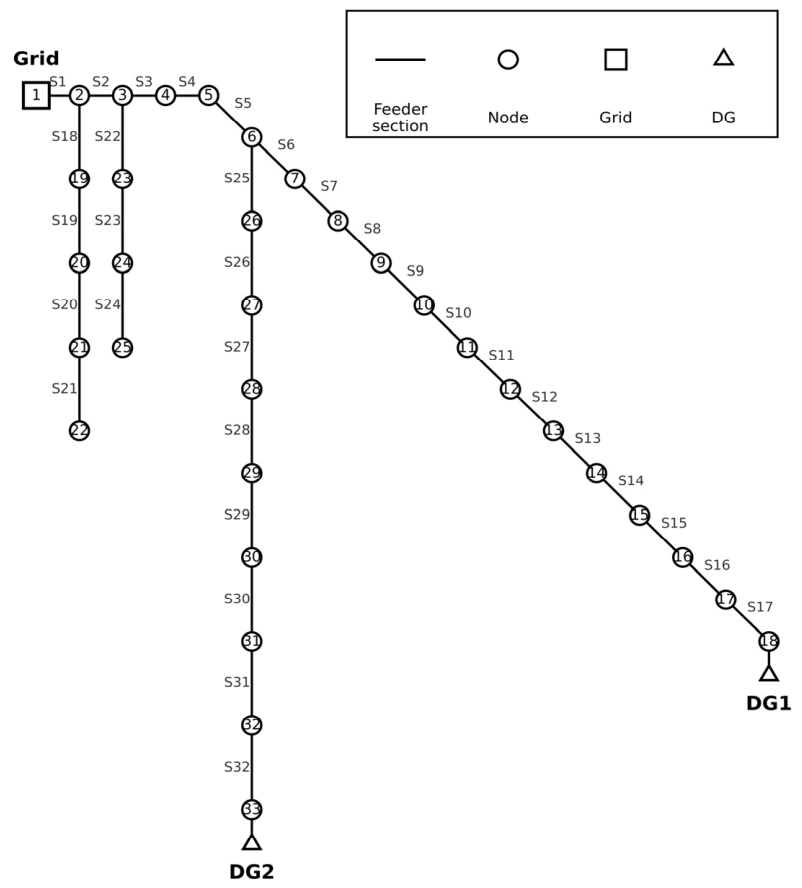
A distribution network can be represented as an undirected graph,in which the node set V represents switching nodes,bus nodes,and DG integration nodes,and the edge set E represents feeder sections.This paper adopts the IEEE 33-node system [13] as the test system, which contains 33 nodes and 32 feeder sections, with DG connected at nodes 18 and 33. The operating state vector of the feeder sections is defined through binary encoding: indicates that the j-th section is faulty, whereas indicates normal operation. A node–branch incidence matrix A is introduced to characterize the structural relationships of the network, and the upstream feeder set of a node (all sections along the path from the main power source to that node) and its downstream feeder set (all sections in the subtree rooted at that node) are defined to determine the fault current path.
2.2. Fault Information Model
In distribution network fault location, fault information is derived from the node current state data collected by FTUs. Since DG integration changes the conventional unidirectional power flow characteristics, the direction and distribution pattern of fault currents change substantially, while problems such as missing information and false alarms also arise. Therefore, it is necessary to construct a unified fault information representation model.
The actual fault current information vector of each node uploaded by FTUs adopts a three-value encoding: indicates that a forward fault current is detected (i.e., in the same direction as the defined positive direction), indicates that a reverse fault current is detected, and indicates that no fault current is detected or the information is unavailable. In a distribution network with DG, the positive current direction is defined as pointing from the main power source toward the DG connection point. Based on the topology, an expected fault information function (switching function) is constructed for each node using OR logic [14], which realizes the mapping from the “topology state” to the “current response”: if at least one downstream section is faulty, the node detects a forward current (+1); if no downstream section is faulty but at least one upstream section is faulty and a DG operates in grid-connected mode downstream, the DG feeds a reverse current (−1) to the upstream fault point. The mathematical expression of the switching function is given as:
where is the fault state of the j-th feeder section (1 = fault, 0 = normal); and are the upstream and downstream section sets of node i,respectively; is the switch state of the k-th DG downstream of node i;and is the expected fault current of node i.
2.3. Formulation of the Fault Location Optimization Model
Based on the above topology model and fault information model, the distribution network fault location problem can be transformed into an optimization problem, whose objective is to find the optimal feeder state vector L that minimizes the discrepancy between the expected information and the actual observed information. The objective function is constructed as follows:
where is the fitness value corresponding to the section state vector L; is the actual FTU measurement of node i; is the expected fault current of node i;N=33 is the total number of system nodes;M=32 is the total number of feeder sections;C=100 is a positive constant that ensures the fitness is non-negative and converts the minimization problem into a maximization problem; and =0.5 is the penalty weight that balances the information matching accuracy and the sparsity of fault sections.
This model is essentially a discrete nonlinear combinatorial optimization problem with three salient features: high dimensionality (the number of decision variables grows linearly with the network size), non-convexity (the solution space contains multiple local optima), and information incompleteness (the data uploaded by FTUs contain noise and distortion). Traditional analytical methods cannot directly solve such problems; therefore, metaheuristic algorithms are introduced in this paper for optimization. The value of C in the objective function serves to convert the minimization problem into a maximization problem and to ensure that the fitness is non-negative, while is used to balance the information matching accuracy and the sparsity of fault sections: when is too small (), the algorithm tends to mark an excessive number of false-positive sections, whereas when is too large (), it suppresses the detection of real faults, especially in multi-fault scenarios. Preliminary sensitivity tests show that the results remain stable within the range .
3. TCAB-AOA Algorithm
3.1. Standard AOA Principle
The Archimedes Optimization Algorithm (AOA) is a physics-inspired metaheuristic algorithm proposed by Hashim et al. [7] in 2021. It describes the state of each individual through three physical parameters—density (den), volume (vol), and acceleration (acc)—and realizes iterative population-based optimization by simulating the force-balance process of objects in a fluid. AOA achieves the dynamic switching between global exploration and local exploitation through a transfer factor () and a density factor (d): when , it enters the global exploration phase and updates positions by simulating collision behavior; when , it enters the local exploitation phase and conducts a refined search around the current best individual. However, the standard AOA is mainly designed for continuous optimization problems and exhibits limited applicability to discrete combinatorial optimization problems; therefore, it needs to be improved through binary discretization.
3.2. Binary Discretization Mechanism
The Archimedes Optimization Algorithm is essentially an optimization method for continuous spaces, and its individual positions are usually defined in the real-number domain. However, in the distribution network fault location problem, the operating state of feeder sections is represented by binary variables; therefore, the standard AOA needs to be discretized. In this paper, a probability-based mapping mechanism is adopted to convert continuous variables into the probability of state flipping, and an S-shaped (Sigmoid) function is selected for the mapping [15]:
where X is the continuous position variable after the AOA update, and is the probability of the corresponding binary bit flipping. Differentiated update mechanisms are adopted in different search stages.
3.2.1. Global Exploration Phase (): Flipping Strategy
This strategy flips each binary bit with probability P, thereby enhancing population diversity through random perturbation and improving the algorithm’s ability to escape local optima.
3.2.2. Local Exploitation Phase (TF > 0.5): Guiding Strategy
In the above two equations, is the binary state of the i-th individual in the j-th dimension; denotes the negation operation (0 → 1, 1 → 0); and is the state of the global best individual in the j-th dimension. The flipping strategy enhances exploration through random perturbation, whereas the guiding strategy accelerates convergence by moving closer to the optimal solution.
3.3. Topology-Constrained Initialization Strategy
In swarm intelligence optimization algorithms, the quality of the initial population has a significant influence on the convergence performance of the algorithm. The standard AOA usually generates the initial population in a completely random manner; however, in the distribution network fault location problem, this approach suffers from problems such as an excessively large search space and low-quality initial solutions. To address these problems and the fault scenarios with FTU false alarms and missed detections, this paper proposes a hybrid topology-constrained initialization strategy based on FTU current boundary detection, which comprises two schemes: the hard-intersection method and the soft-voting method.
3.3.1. Hard-Intersection Method
This scheme is intended for single-fault scenarios. Let denote the set of nodes that register forward current and the set of nodes that register reverse current. The core candidate set is then formed as the intersection of the downstream region of the forward-current nodes and the upstream region of the reverse-current nodes. When the core candidate set is non-empty and its cardinality does not exceed a threshold , a differentiated probability assignment is adopted: core sections receive , neighboring sections , and all remaining sections p=0.05. Across the 32 sections, this threshold yields a search-space compression of at least 6.4×, while still admitting 1–2 sections of boundary ambiguity around the fault point.
3.3.2. Soft-Voting Method
When the core candidate set produced by the hard-intersection method is empty, or its cardinality exceeds the threshold (multi-fault or abnormal-FTU scenarios), the algorithm switches to the soft-voting method. Here, each FTU node casts votes over the sections according to its signal type and reliability: a +1 node casts +1.0 votes for every section in its downstream region ; a −1 node casts +0.5 votes for the sections in its upstream region ; a 0 node imposes a −0.3 penalty on the sections in its downstream region ;and a boundary section linking two nodes with different FTU values receives a bonus of +0.3. Once the scores are aggregated, a ranking-threshold rule maps them to initialization probabilities: the top 10% of sections receive , those in the 10%–30% band receive , and the remainder receive . The vote weights follow from the reliability differences among the FTU signal types and were finalized through preliminary empirical tuning.
How the switching logic between the two schemes responds to the impact of FTU signal quality on the effectiveness of the topology constraints can be explained through two typical anomaly scenarios—false alarms and missed detections.
In the false-alarm scenario, when an FTU node reports a spurious +1 signal, that node’s downstream section set is erroneously pulled into the hard-intersection computation. Because the downstream region of a spurious +1 node is generally topologically disjoint from the true fault region, the core candidate set readily collapses to an empty set after the intersection, causing the hard-intersection method to fail. The system then switches automatically to soft voting: the spurious +1 signal contributes only a single vote (weight 1.0), whereas the cluster of +1 nodes produced by the genuine fault accumulates votes, so the true fault section still holds a relative advantage in the aggregate score. Yet when the genuine +1 nodes are themselves few in number, the spurious and genuine signals become hard to tell apart, and the ranking accuracy of soft voting drops sharply—this is precisely why the single-fault-with-false-alarm scenario constitutes the algorithm’s weak link.
In the missed-detection scenario, when an FTU node fails to report (it should have returned +1 but sent nothing), the number of forward nodes entering the hard-intersection computation decreases by one. For the hard-intersection method the intersection range widens slightly, but the core candidate set still normally contains the true fault section; a missed detection therefore causes “constraint relaxation” rather than “constraint conflict” and does not trip the hard intersection’s failure condition—the essential difference from a false alarm. For soft voting, a missed detection amounts to one fewer vote, but since several FTU nodes naturally cast redundant votes for the same fault section, the loss is naturally diluted in the multi-vote aggregation.
In summary, the hard-intersection method is structurally tolerant of missed detections (the intersection widens without failing) yet acutely sensitive to false alarms (a single false alarm can empty the intersection); the soft-voting method, through multi-vote redundancy and differentiated weighting, provides a measure of robust protection under both anomalies, but its performance hinges on the number of reliable FTU signals—the sparser the signals, the weaker the separation between spurious and genuine ones.
The core idea of the hybrid scheme is as follows: the hard-intersection method achieves precise localization in single-fault scenarios, while the soft-voting method provides robust coverage for multi-fault and abnormal scenarios. Both schemes take the distribution-network topology and FTU measurements as constraints, thereby effectively compressing the search space.
3.4. Adaptive DE–Lévy Search Strategy
Binary discretization and topology-constrained initialization markedly improve the algorithm’s initial search quality. In complex distribution-network fault-location problems, however, the standard AOA still suffers, in the later stage of iteration, from three shortcomings: a declining search capability, reduced population diversity, and an inadequate ability to escape local optima. To address this, this paper introduces differential evolution (DE) [16] and the Lévy flight strategy and, together with an adaptive adjustment factor, constructs an improved search strategy.
3.4.1. Differential Mutation (DE)
After the AOA position update, a DE operation is applied to each individual.
where is the crossover probability. The trial individual is mapped back to binary space via the Sigmoid function, and greedy selection retains the individual with the higher fitness.
The scaling factor decreases linearly with the number of iterations(,):
3.4.2. Lévy Flight Perturbation
Lévy flight is characterized by a heavy-tailed distribution, which enables a dynamic balance between short-distance search and long-distance jumps. The Mantegna algorithm [17] is adopted to generate the Lévy step size:
A Lévy perturbation is applied to the continuous position:
The perturbation strength decays exponentially with the number of iterations:
In the above equations, is the Lévy exponent, which controls the tail heaviness of the step-size distribution; is the standard deviation of the step size, computed through the Gamma function Γ(·); u and v are random variables following a normal distribution; s is the random Lévy step generated by the Mantegna algorithm; is the adaptive perturbation strength, with the initial strength and the decay coefficient; and the perturbed continuous position is mapped back to binary space via the Sigmoid function.
3.4.3. Strategy Selection
DE and Lévy flight are selected dynamically via the adaptive probability p_strategy:
When , a DE operation is performed; otherwise, a Lévy perturbation is applied. In the early stage DE predominates, strengthening global exploration, while in the later stage Lévy flight takes over, using its long-distance jump behavior to improve the ability to escape local optima.
3.5. Elite Preservation and Population Restart
To prevent the best solution from being lost during iteration, the top 10% of individuals by fitness (at least three) are retained each generation as elites and passed directly into the next generation. In addition, a population restart mechanism is introduced: when the global best fitness shows no improvement for 25 consecutive generations, the elite individuals are kept unchanged, while the remaining individuals are randomly perturbed around the current best solution and then re-initialized. This mechanism effectively prevents the algorithm from falling into long-term stagnation.
3.6. Greedy Cleanup Post-Processing
Once the AOA iterations conclude, greedy cleanup is applied to the best solution: each section marked as faulted is tentatively flipped to normal (1→0), and the flip is accepted if the fitness does not decrease. At almost no additional computational cost, this step removes the false-positive sections that are difficult to eradicate during AOA iteration, thereby significantly reducing the number of misjudgments. The rationale underlying greedy cleanup is that flipping a genuine fault section sharply increases the matching error (the fitness plummets), whereas flipping a false-positive section leaves the matching error unchanged while reducing the penalty (the fitness rises); greedy selection can therefore distinguish the two automatically.
3.7. Algorithm Flow
Combining the above improvement strategies, the complete flow of TCAB-AOA is illustrated in Figure 1 and Figure 2. The algorithm mainly comprises the following stages: (1) FTU data acquisition and topology-constrained population initialization, generating a high-quality initial population through the hybrid hard-intersection/soft-voting scheme; (2) AOA iterative optimization, including density/volume updating, TF-based switching between the global and local stages, and Sigmoid binarization; (3) adaptive DE/Lévy perturbation, dynamically selecting the search strategy according to the probability p_strategy; (4) elite preservation and population restart, preventing loss of the best solution and avoiding search stagnation; and (5) greedy cleanup post-processing after the iterations conclude, eliminating residual false-positive sections and outputting the optimal fault-section vector.
4. Simulation Experiments
4.1. Simulation Setup
To verify the fault-location performance of the proposed TCAB-AOA under DG integration and incomplete FTU information, this paper takes the IEEE 33-node distribution system [13] as the test system. The system contains 33 nodes and 32 feeder sections in total, with DGs connected at nodes 18 and 33, respectively, and remaining grid-connected throughout the simulation. FTUs are installed at the main nodes, and the reported information adopts three-value encoding. The algorithm parameters are set as follows: population size , maximum number of iterations ,, , , and ; normalization range and ; DE scaling factors and ; ; Lévy exponent ; initial strength ; decay coefficient ; strategy-selection probability range [0.2,0.8]; topology-initialization probabilities , , and ; hard-intersection threshold ; elite ratio 10%; and restart threshold 25 generations. The comparison algorithms are standard AOA, particle swarm optimization (PSO) [15], genetic algorithm (GA) [18], and differential evolution (DE) [16], all with the same population size and maximum iteration count as TCAB-AOA. Each experiment is run independently 30 times, and the statistical average is reported.
Figure 3.
Standard IEEE 33-node distribution system with distributed generation connected at nodes 18 and 33.
Figure 3.
Standard IEEE 33-node distribution system with distributed generation connected at nodes 18 and 33.
4.2. Fault Scenario Design
To comprehensively validate the algorithm’s performance, seven typical fault scenarios are established, covering different fault locations (near the source, in the middle section, and near the DG), different fault counts (single-point and multi-point), and different types of FTU anomalies (false alarms and missed detections), as shown in Table 1.
4.3. Simulation Results and Analysis
Table 2 presents the localization accuracy of the five algorithms across the seven fault cases. Table 3 presents the comparison of the average number of misjudged sections. Figure 4 presents the fitness convergence curves of the five algorithms for each fault scenario.
Table 2 and Table 3 lead to the following observations. (1) Overall performance: TCAB-AOA attains an average localization accuracy of 90.0% across the seven cases, exceeding the 42.9% of standard AOA by 47.1 percentage points, which amply attests to the effectiveness of the proposed improvements. (2) Baseline cases (Cases 1–3): TCAB-AOA reaches 100% accuracy with no misjudged sections in all three cases, confirming the precise single-fault locking capability of the hard-intersection method. In the missed-detection case (Case 5), the accuracy is 93.3%, indicating strong tolerance to missed FTU signals. (3) False-alarm case (Case 4): the accuracy is 73.3%, on a par with standard AOA yet below PSO (93.3%), GA (90.0%), and DE (100.0%), marking this case as the weak point of the current method. A false +1 node breaks the validity of the hard intersection, and in soft voting the score gap between the faulted section and the runner-up section is too narrow for the algorithm to prevail consistently across all runs. (4) Multi-fault cases (Cases 6–7): the accuracies are 76.7% and 86.7%, respectively. TCAB-AOA performs best in Case 7 (86.7%), demonstrating the advantage of combining topological constraints with multi-strategy fusion under severely incomplete information. (5) Misjudgment and convergence: the average number of misjudged sections of TCAB-AOA is only 0.20, far below the 1.19 of standard AOA, reflecting the effective removal of false positives by the greedy cleanup. Topology-constrained initialization also yields a markedly higher initial-population fitness than the comparison algorithms.
4.4. Ablation Study
To quantify the individual contribution of each improvement strategy, an ablation study was conducted on TCAB-AOA. Starting from standard AOA, the topology-constrained initialization, the DE/Lévy search strategy (including elite restart), and the greedy cleanup post-processing were added incrementally, and the algorithm was run 30 times under each of the seven fault cases; the results are reported in Table 4.
Table 4 reveals the following. (1) Topology-constrained initialization raises the average accuracy from 45.2% to 58.6% (+13.4%), and in the single-fault no-anomaly cases (Cases 1–3) it lifts the accuracy markedly to 93.3%–100.0%, confirming the precise single-fault locking capability of the hard-intersection method. With topology initialization alone, however, the accuracy in Cases 4, 6, and 7 falls below the baseline, because once the hard intersection fails, the early fallback scheme (without DE/Lévy and greedy cleanup) can hardly restore the search direction effectively. (2) After the DE/Lévy search strategy (including elite restart) is introduced, the average accuracy rises to 73.8% (+15.2%); in particular, Cases 6 and 7 are lifted substantially from 3.3% to 43.3% and 30.0%, respectively, confirming the crucial role of the hybrid search mechanism in multi-fault combinatorial search. (3) After the greedy-cleanup post-processing is added, the average accuracy reaches 90.0% (+16.2%), with Cases 6 and 7 jumping to 76.7% and 86.7%, respectively. Greedy cleanup contributes little to the single-fault no-anomaly cases (Cases 1–3), where AOA can already converge to the correct solution, but contributes the most to the multi-fault cases: in combinatorial search, AOA tends to converge to solutions containing a small number of false-positive sections, and greedy cleanup effectively removes these residual false positives. The ablation study clearly demonstrates that topology initialization provides a high-quality search starting point, DE/Lévy strengthens global search and escape capability, and greedy cleanup compensates for AOA’s local-convergence deficiency in discrete space; the three together enable TCAB-AOA to achieve optimal performance.
4.5. Discussion and Analysis
In terms of overall accuracy, DE (93.8%) and PSO (92.4%) slightly outperform TCAB-AOA (90.0%). This is to be expected: after more than two decades of development, DE and PSO have reached a high degree of maturity in parameter tuning and variant design. Nevertheless, TCAB-AOA offers three distinctive advantages.
First, TCAB-AOA exhibits a scenario-specific advantage. In Case 7—the multi-fault + FTU-anomaly scenario closest to actual engineering practice—TCAB-AOA ranks first for first place at an accuracy of 86.7%, while clearly outperforming DE (80.0%) and PSO (76.7%). Case 7 simultaneously involves two fault sections and incomplete FTU information, making it the most complex and realistic scenario among the seven cases. The advantage of TCAB-AOA in this case demonstrates that the fusion of topological constraints and multiple search strategies is better suited to handling complex location problems characterized by highly incomplete information.
Second, the synergy between the physics-inspired mechanism and topological constraints. AOA is founded on Archimedes’ buoyancy principle, in which individuals move toward the equilibrium state (the optimal solution) through physical updates of density, volume, and acceleration, so its search behavior exhibits directional guidance. This physics-inspired nature makes AOA naturally well suited to combining with topological constraints, and the two reinforce each other at the level of structural guidance.
Third, improvement potential and incremental contribution. The headroom for further improving DE and PSO in the field of fault location is already relatively limited, since a large body of literature has investigated their parameter tuning and hybridization strategies. AOA, by contrast, is a young algorithm proposed only in 2020, and its improvement potential has only just begun to be tapped. The ablation experiments in this paper show that, from the standard AOA (45.2%) to the complete TCAB-AOA (90.0%), the improvement reaches 44.8 percentage points, with each component contributing a significant increment: topological initialization +13.4%, DE/Lévy +15.2%, and greedy cleanup +16.2%. This modular improvement framework provides a clear roadmap for future continuous optimization. It should be reiterated that the core contribution of this paper is the improvement of AOA—adapting a young metaheuristic algorithm originally designed for continuous spaces to the discrete fault-location problem through topological-constraint initialization, a hybrid search strategy, and greedy post-processing—rather than claiming that the improved AOA outperforms all existing algorithms in every scenario.
5. Conclusions
To address the problems that active distribution networks with distributed generation face in fault location—uncertain current direction, incomplete FTU information, and high optimization difficulty—this paper proposes a topology-constrained adaptive binary Archimedes optimization algorithm (TCAB-AOA). At the algorithm-design level, an OR-logic-based fault information representation model and a discrete optimization objective function are constructed; a hybrid topology-constrained initialization strategy combining the hard-intersection and soft-voting schemes is designed, effectively compressing the search space; differential evolution (DE) and Lévy flight perturbation mechanisms are fused, achieving a dynamic balance between global exploration and local exploitation; and auxiliary mechanisms such as elite preservation, population restart, and greedy cleanup are introduced, improving the convergence stability and localization accuracy of the algorithm.
Simulation results on the IEEE 33-node system under seven fault scenarios show that: (1) TCAB-AOA attains an average localization accuracy of 90.0%—47.1 percentage points above the standard AOA—with an average of only 0.20 misjudged sections; (2) its accuracy reaches 93.3% in the single-fault missed-detection scenario and 73.3% in the single-fault false-alarm scenario, exhibiting strong fault tolerance; (3) in the multi-fault scenarios its accuracy ranges from 76.7% to 86.7%, confirming the effectiveness of multi-strategy fusion in multi-fault combinatorial search; and (4) although PSO and DE slightly exceed TCAB-AOA in overall average accuracy, TCAB-AOA leads in the most realistic multi-fault false-alarm scenario, underscoring its competitiveness in complex engineering cases. Future research may be pursued in the following directions: (1) scalability validation on larger distribution systems such as the IEEE 69-node system; (2) the introduction of FTU anomaly detection and adaptive voting-weight mechanisms; and (3) the exploration of the algorithm’s adaptability under intermittent DG switching scenarios.
Author Contributions
Conceptualization, JH.Z.; methodology, J.S.; software, JH.Z.; validation, JH.Z.; formal analysis, JH.Z.; investigation, JH.Z.; resources, J.S.; data curation, JH.Z.; writing—original draft preparation, JH.Z.; writing—review and editing, JH.Z.; visualization, J.S.; supervision, J.S.; project administration, J.S. All authors have read and agreed to the published version of the manuscript.
Funding
This research received no external funding.
Data Availability Statement
The original contributions presented in the study are included in the article; further inquiries can be directed to the corresponding author.
Conflicts of Interest
The authors declare no conflicts of interest.
References
- Liu, H.L.; Shao, J.W.; Wang, X.; Han, X.S.; Liu, X.; Liu, S.Q. State evaluation and fault prediction of distribution automation terminal equipment based on digital twins. Power Syst. Technol. 2022, 46, 1605–1613. (In Chinese) [Google Scholar]
- Luo, F.Z.; Yang, W.T.; Zhang, T.Y.; Wang, C.S.; Wei, G.Y.; Yao, L.Z. Influence of distribution automation data transmission errors on power supply reliability of distribution system. Autom. Electr. Power Syst. 2018, 42, 10–17. (In Chinese) [Google Scholar]
- Stefanidou-Voziki, P.; Sapountzoglou, N.; Raison, B.; Dominguez-Garcia, J.L. A review of fault location and classification methods in distribution grids. Electr. Power Syst. Res. 2022, 209, 108031. [Google Scholar] [CrossRef]
- Rezapour, H.; Jamali, S.; Bahmanyar, A. Review on artificial intelligence-based fault location methods in power distribution networks. Energies 2023, 16, 4636. [Google Scholar] [CrossRef]
- Zhan, H.Y.; Liu, K.Y.; Sheng, W.X.; Meng, X.L. Review and prospects of fault diagnosis and location method in active distribution network. High Volt. Eng. 2023, 49, 660–671. (In Chinese) [Google Scholar]
- Gad, A.G. Particle swarm optimization algorithm and its applications: a systematic review. Arch. Comput. Methods Eng. 2022, 29, 2531–2561. [Google Scholar] [CrossRef]
- Hashim, F.A.; Hussain, K.; Houssein, E.H.; Mabrouk, M.S.; Al-Atabany, W. Archimedes optimization algorithm: a new metaheuristic algorithm for solving optimization problems. Appl. Intell. 2021, 51, 1531–1551. [Google Scholar] [CrossRef]
- Meraihi, Y.; Taleb, S.M.; Bhuyan, B.P.; Benayad, A.; Ivanova, G.; Doğan, M.; Yasin, E.T.; Koklu, M.; Ramdane-Cherif, A.; Mirjalili, S.M. A comprehensive review of Archimedes optimization algorithm with its theory, variants, hybridization, and applications. Arch. Comput. Methods Eng. 2026, 33, 5293–5337. [Google Scholar] [CrossRef]
- Wang, B.; Zhu, H.; Yan, J. Multi-strategy enhanced Archimedes algorithm for global optimization and engineering problems. J. Comput. Des. Eng. 2025, 12, 131–162. [Google Scholar] [CrossRef]
- Bencherqui, A.; Tahiri, M.A.; Karmouni, H.; Alfidi, M.; El Afou, Y.; Qjidaa, H.; Sayyouri, M. Chaos-enhanced Archimede algorithm for global optimization of real-world engineering problems and signal feature extraction. Processes 2024, 12, 406. [Google Scholar] [CrossRef]
- Fang, L.; Yao, Y.; Liang, X. New binary Archimedes optimization algorithm and its application. Expert Syst. Appl. 2023, 230, 120639. [Google Scholar] [CrossRef]
- Zhang, J.; Zhang, H.; Lin, R.; Zhou, S.; Yan, J.; Li, J.; Zhang, F. Research on fault location method of distribution network based on Archimedes optimization algorithm. Process. 2025, 13, 3715. [Google Scholar] [CrossRef]
- Baran, M.E.; Wu, F.F. Network reconfiguration in distribution systems for loss reduction and load balancing. IEEE Trans. Power Deliv. 1989, 4, 1401–1407. [Google Scholar] [CrossRef]
- Li, Y.; Wei, X.; Lin, J.; Niu, G. A robust fault location method for active distribution network based on self-adaptive switching function. Int. J. Electr. Power Energy Syst. 2023, 148, 109007. [Google Scholar] [CrossRef]
- Kennedy, J.; Eberhart, R.C. A discrete binary version of the particle swarm algorithm. In Proceedings of the 1997 IEEE International Conference on Systems, Man, and Cybernetics, Orlando, FL, USA, 12–15 October 1997; IEEE: Piscataway, NJ, USA, 1997; Volume 5, pp. 4104–4108. [Google Scholar]
- Storn, R.; Price, K. Differential evolution—a simple and efficient heuristic for global optimization over continuous spaces. J. Glob. Optim. 1997, 11, 341–359. [Google Scholar] [CrossRef]
- Mantegna, R.N. Fast, accurate algorithm for numerical simulation of Lévy stable stochastic processes. Phys. Rev. E 1994, 49, 4677–4683. [Google Scholar] [CrossRef] [PubMed]
- Holland, J.H. Adaptation in Natural and Artificial Systems: An Introductory Analysis with Applications to Biology, Control, and Artificial Intelligence, 2nd ed.; MIT Press: Cambridge, MA, USA, 1992. [Google Scholar]
Figure 1.
Initialization stage.
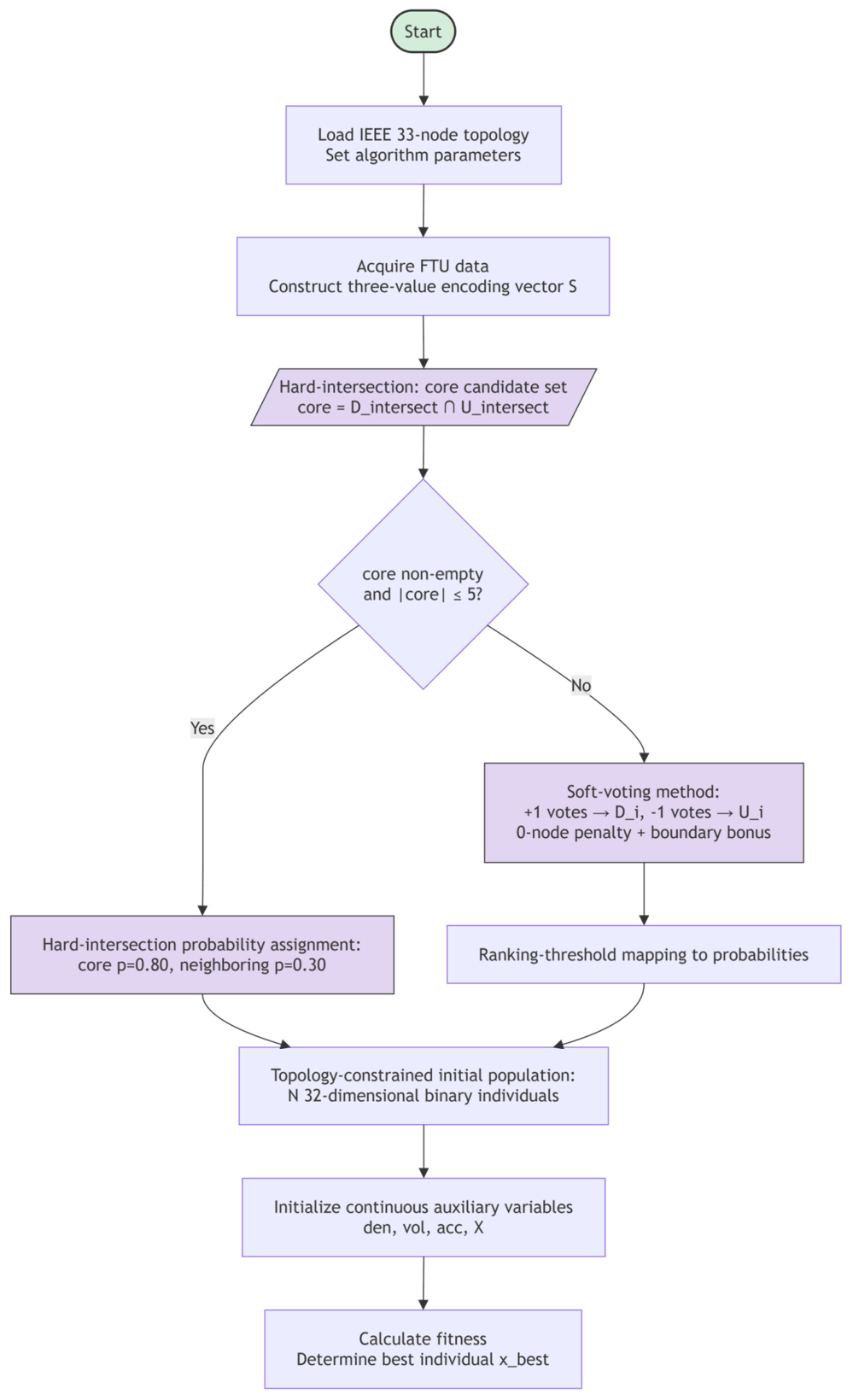
Figure 2.
Flowchart of the topology-constrained initialization stage of TCAB-AOA.
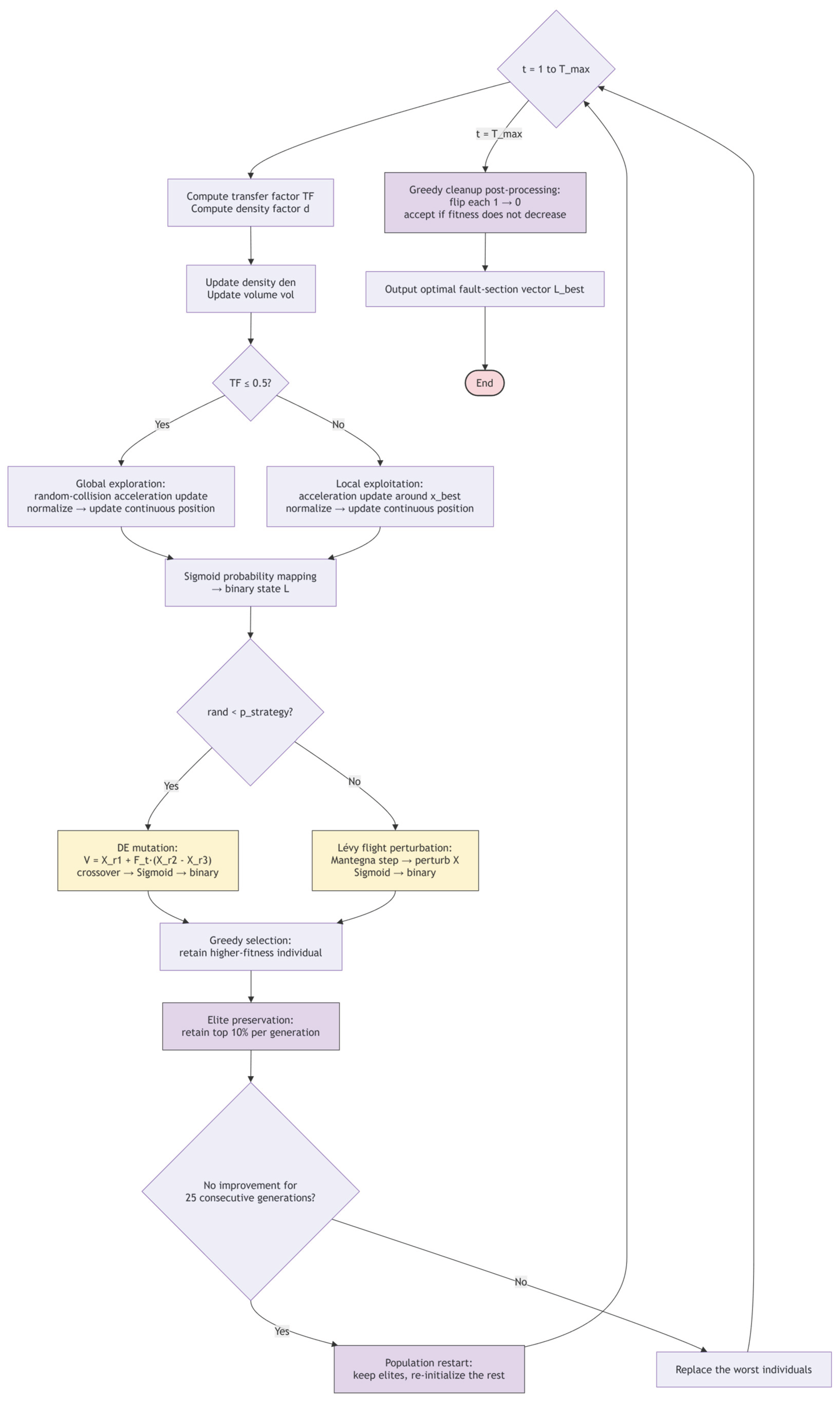
Figure 4.
Comparison of the fitness convergence curves of the five algorithms under the seven fault scenarios.
Figure 4.
Comparison of the fitness convergence curves of the five algorithms under the seven fault scenarios.
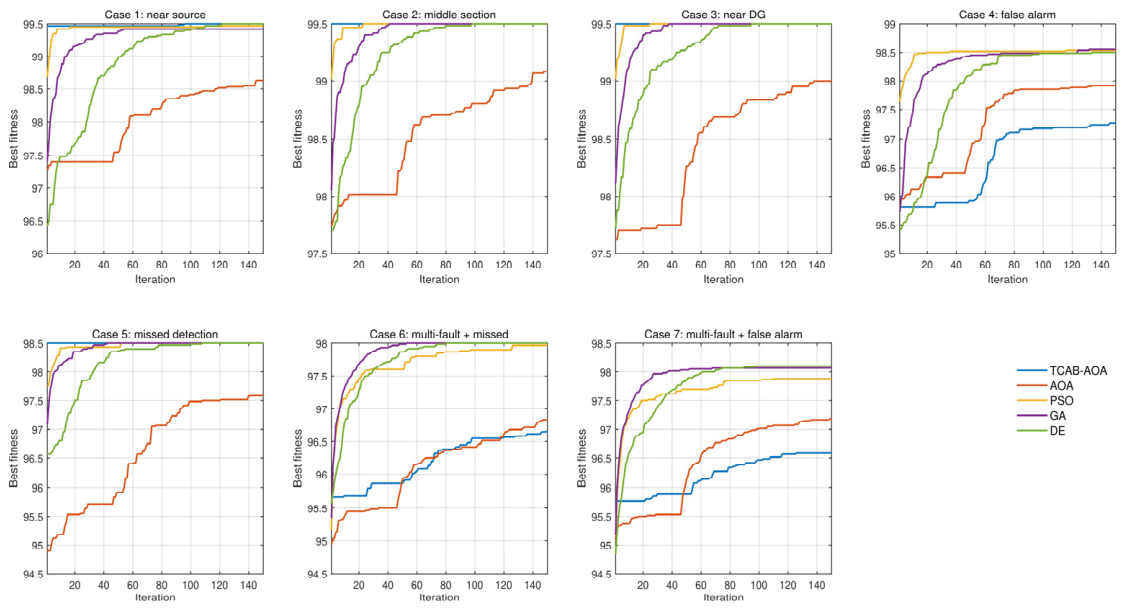

Table 1.
Fault Scenario Design.
| Case | Fault Type | Actual Fault Section | FTU Anomaly | Test Purpose |
|---|---|---|---|---|
| Case1 | Single fault, near source | S3 | None | Baseline test |
| Case2 | Single fault, mid-section | S14 | None | Baseline test |
| Case3 | Single fault, near DG | S17 | None | DG impact test |
| Case4 | Single fault + false alarm | S7 | 1 FTU false alarm | False-alarm tolerance test |
| Case5 | Single fault + missed detection | S26 | 1 FTU missed detection | Missed-detection tolerance test |
| Case6 | Multiple faults + missed detection | S14, S29 | 1 FTU missed detection | Multiple-fault + missed-detection composite test |
| Case7 | Multiple faults + false alarm | S14, S29 | 1 FTU false alarm | Multiple-fault + false-alarm composite test |
Table 2.
Comparison of localization accuracy among the algorithms.
| Case | TCAB-AOA | AOA (standard) | PSO | GA | DE |
|---|---|---|---|---|---|
| Case1 | 100.0% | 50.0% | 93.3% | 83.3% | 100.0% |
| Case2 | 100.0% | 50.0% | 100.0% | 100.0% | 100.0% |
| Case3 | 100.0% | 46.7% | 100.0% | 100.0% | 100.0% |
| Case4 | 73.3% | 73.3% | 93.3% | 90.0% | 100.0% |
| Case5 | 93.3% | 43.3% | 100.0% | 83.3% | 90.0% |
| Case6 | 76.7% | 10.0% | 83.3% | 90.0% | 86.7% |
| Case7 | 86.7% | 26.7% | 76.7% | 79.7% | 80.0% |
| Overall average | 90.0% | 42.9% | 92.4% | 89.5% | 93.8% |
Table 3.
Comparison of the average number of misjudged sections among the algorithms.
| Case | TCAB-AOA | AOA (standard) | PSO | GA | DE |
|---|---|---|---|---|---|
| Case1 | 0.00 | 1.20 | 0.13 | 0.50 | 0.00 |
| Case2 | 0.00 | 0.70 | 0.00 | 0.00 | 0.00 |
| Case3 | 0.00 | 0.80 | 0.00 | 0.00 | 0.00 |
| Case4 | 0.50 | 0.50 | 0.07 | 0.10 | 0.00 |
| Case5 | 0.13 | 1.03 | 0.00 | 0.33 | 0.20 |
| Case6 | 0.53 | 2.47 | 0.33 | 0.20 | 0.27 |
| Case7 | 0.23 | 1.63 | 0.30 | 0.13 | 0.20 |
| Overall average | 0.20 | 1.19 | 0.12 | 0.18 | 0.10 |
Table 4.
Ablation results (localization accuracy of each strategy combination).
| Case | AOA | +Topology initialization | +DE/Lévy | +Greedy cleanup |
|---|---|---|---|---|
| Case1 | 46.7% | 100.0% | 93.3% | 100.0% |
| Case2 | 53.3% | 93.3% | 100.0% | 100.0% |
| Case3 | 70.0% | 100.0% | 100.0% | 100.0% |
| Case4 | 50.0% | 20.0% | 60.0% | 73.3% |
| Case5 | 60.0% | 90.0% | 90.0% | 93.3% |
| Case6 | 20.0% | 3.3% | 43.3% | 76.7% |
| Case7 | 16.7% | 3.3% | 30.0% | 86.7% |
| Overall average | 45.2% | 58.6% | 73.8% | 90.0% |
Disclaimer/Publisher’s Note: The statements, opinions and data contained in all publications are solely those of the individual author(s) and contributor(s) and not of MDPI and/or the editor(s). MDPI and/or the editor(s) disclaim responsibility for any injury to people or property resulting from any ideas, methods, instructions or products referred to in the content. |
© 2026 by the authors. Licensee MDPI, Basel, Switzerland. This article is an open access article distributed under the terms and conditions of the Creative Commons Attribution (CC BY) license (http://creativecommons.org/licenses/by/4.0/).
Copyright: This open access article is published under a Creative Commons CC BY 4.0 license, which permit the free download, distribution, and reuse, provided that the author and preprint are cited in any reuse.