

Submitted:
07 September 2026
Posted:
08 September 2026
You are already at the latest version
Abstract
Frequent innovations in digital technology are driving the need for digital transformation in today’s companies. Although dedicated methods and frameworks exist to support the planning and execution of digital transformation, the corresponding organizational change remains a challenging endeavor. This is particularly true for small and medium-sized enterprises (SMEs), whose core business does not involve digital technology. These companies are often overwhelmed by the plethora of available technologies and struggle to comprehend their economic impact. Their main challenges include limited resources and the complexity of existing digital transformation frameworks. This paper presents a Design Science research project aimed at developing a lightweight approach to address the needs of SMEs initiating a digital transformation. The approach is based on the concept of managed evolution and is extended to include the development of a vision and guardrails. These elements help maintain the balance between fulfilling business needs and introducing digital technology.
Keywords:
digital transformation
; framework
; SME
; managed evolution
1. Introduction
1.1. Digital Transformation
The term Digital Transformation (DT) refers to a phenomenon that presents both opportunities and challenges for an organization. Initially, DT is associated with advancements in digital technology that drive changes in business processes (Morakanyane et al. 2017). For instance, Sebastian et al. introduced the acronym SMACIT (Social, Mobile, Analytics, Cloud, Internet of Things) to describe so-called disruptive technologies enabling digital transformation (Sebastian et al. 2017). Subsequent publications have expanded this list to include technologies such as artificial intelligence and blockchain (Ross et al. 2019). However, technology alone does not address real-world problems; its appropriate application is what matters. Therefore, organizational capabilities are also required (Riera and IIJIMA 2019). In fact, short-term successes in digital transformation can even be achieved using conventional technology (Andriole 2017).
Subsequently, DT is widely perceived as a business transformation enabled by modern digital technology. Digital technology serves as an enabler for business model innovation (Ancillai et al. 2023,Vaska et al. 2021) or the adaptation of existing business models through digital services (Tian et al. 2022). Typical drivers for DT include the expectations of digital customers (Verhoef et al. 2021), innovative (or disruptive) digital technologies (Ancillai et al. 2023,Ross et al. 2019,Sebastian et al. 2017), and digital ecosystems (Ancillai et al. 2023). Furthermore, DT can be used to improve existing business processes or even achieve operational excellence (Colli et al. 2020,Draganic 2023). Addressing various objectives, drivers, characteristics, and aspects, Morakanyane et al. (2017) define DT as follows:
Digital transformation is an evolutionary process that leverages digital capabilities and technologies to enable business models, operational processes, and customer experiences to create value Morakanyane et al. 2017, p. 437].
This definition emphasizes that DT is not an end in itself but must result in tangible benefits (“to create value”). Typical objectives include the introduction of digital business models (Bock and Wiener 2017), improved customer experience (Huseynli 2022), and business process improvement (Fischer et al. 2020). A DT requires digital capabilities (Baiyere et al. 2025,Nicolai Etienne Fabian and Verhoef 2024) to leverage the benefits of digital technology for value creation. Furthermore, DT is not a one-time initiative but an ongoing endeavor with several iterations (“evolutionary process”).
1.2. Problem Statement
Despite its benefits a DT still remains a challenging task. It involves most (if not all) organizational units due to its nature of changing business processes or introducing new business opportunities (Berger et al. 2020,Nambisan et al. 2019). Consequences might even be drastic if disruptive technology is involved, introduced or developed (Vial 2019). Like any kind of change, a DT is associated with risk and uncertainty (Haryanti et al. 2023,Nambisan et al. 2019). There are several barriers for small and medium-sized enterprises (SME) because they do not have the resources or skills to deal with the complexity of a DT, especially when assessing the relevance of new technologies (Kutnjak and Pihir 2019). Furthermore, people are affected and need to collaborate with performing such a change but might not be ready, yet (Haryanti et al. 2023). In the same way, management and corporate culture will have to change in order to cope with a DT (Deszca et al. 2024,Mihu et al. 2023). Benefits are unclear as the value of a new technology is usually hard to assess (Pelletier and Cloutier 2019). A DT never ends and needs to be done in parallel to normal business operations, It is but a continuous endeavor as technology and business opportunities will evolve constantly. Consequently, a structured approach for planning and managing a DT is necessary.
Digital Transformation Frameworks (DTF) are available as a tool for managing a DT (Ciruskabiri and Varnaseri 2023,Torres et al. 2024). Such a framework consists of concepts, practices, guidelines and criteria to focus on DT (Torres et al. 2024). Some frameworks originate from an academic context, like for example the one presented in (Zaoui and Souissi 2020) and several frameworks have bee developed by consultancy firms (Ciruskabiri and Varnaseri 2023). Also Enterprise Architecture Frameworks (EAF) are supposed to provide concepts, principles and tools for carrying out a DT (Bondar et al. 2017,Safitri et al. 2024a,Safitri et al. 2024b). Even though existing frameworks provide relevant concepts and guidance, they are hard to be adapted by SME. Especially documentation on frameworks by consultancy firms is usually not available as a framework is intellectual property of the firm and an asset for providing consultancy services. They are intended to be applied by experienced consultants of these firms. The same holds true for most EAF. The Open Group Architecture Framework (TOGAF) for example is quite extensive and there is dedicated training and consultants available on the market1. Especially in the EA discipline, frameworks are–despite providing guidance–perceived as bureaucratic and complex which might hamper the success of an EA initiative (Gong and Janssen 2023,Jung and Fraunholz 2021). SME often lack knowledge and skills concerning digital technology as well as business innovation based on technology. A simple framework is required that provides relevant concepts and is easy to be implemented in the company.
1.3. Objective
The objective of the paper is to present the design an evaluation of a lightweight framework for DT in SME. The Lightweight Digital Transformation Framework (LDTF) is intended to be used by SME or any kind of organisation aiming at an easy-to-use method for a digital transformation. The framework is characterised by the following criteria:
- quick start: the framework should be able to be adopted easily without extensive training and consultancy
- terminology: business terminology or standard English phrases are preferred rather than (abstract) technical terms
- compact: only a few concepts are introduced instead of a large large picture with concepts and dependencies
- extensible: open to incorporate existing methods and tools from the organisation instead of defining completely new methodology
- agile: timely adjustments of the plan have to be possible during a DT
An overview on the LDTF is provided in Section 3 showing its basic structure and possibilities to include existing methods and tools. It encompasses two major concepts for defining the roadmap towards a DT. Direction is provided by a vision (further developed in Section 4) while the boundaries of the pathway are characterized by guardrails (Section 5). Each of them has been evaluated already in previous research projects so that an overall evaluation of the LDTF is presented in Section 6.
2. Research Method
A Design Science Research (DSR) approach, as outlined by (Hevner et al. 2004), was selected for this research project, as it aims to develop an artifact for use in a corporate environment. [p. 81 Hevner et al. (2004) identify several characteristics of problems suitable for DSR:
- The project faces unstable requirements and constraints due to the diverse needs of companies undergoing digital transformation (DT).
- DT affects the entire organization and is thus characterized by complex interactions among subcomponents.
- As DT is an evolutionary process, it requires inherent flexibility in design processes and artifacts.
- The project has a critical dependence on human cognitive and social abilities to produce effective solutions, as the framework must engage participants across the entire organization.
Action Research (e.g., (Greenwood 2018)) was also considered, as it supports developing and evaluating the framework in a practical environment. However, the research team could not embed itself within an organization to iteratively develop the framework alongside practitioners.
Consequently, a research design based on conceptual models derived from literature reviews was preferred. Additionally, the framework could not be divided into smaller components for iterative development within a reasonable timeframe and scope in a single organization. The basic idea of DSR is illustrated in Figure 1. An artifact is developed and evaluated during the design cycle, based on requirements from the environment in which it (in this case, the DT framework) is intended to be used. Specific evaluation criteria must be defined to assess the artifact according to the environment’s needs. The relevance cycle ensures continuous alignment between the artifact and its intended environment by collecting requirements and evaluating the artifact (or intermediate results) against them. The rigor cycle ensures that the artifact is justified using existing knowledge and proper methods. It also provides feedback from the artifact’s development to the knowledge base.
DSR was configured for the development of the LDTF, as shown in Figure 2. This figure is based on the Information Systems Research Framework by (Hevner et al. 2004, p. 80), with specific details for the DT framework formatted in italics.
2.1. Design Cycle
The artifact to be designed comprises the documentation of the LDTF, along with method guides explaining its application. It is derived from existing research as well as requirements defined by relevant stakeholders (e.g., change managers or enterprise architects). The method guides aim to support stakeholders in a corporate environment in using the framework to perform a DT. These guides include role definitions and activities to assess the current situation and define next steps. The artifact is evaluated against the following criteria:
- Practicality: The LDTF must be easy to adapt and use for a DT in an organization.
- Flexibility: The framework must be flexible so that it can be customized to the needs of different organizations. It should also allow for changes during the implementation of a DT.
- Usefulness: The LDTF must be perceived as a useful method by corporate stakeholders.
- Effectiveness: The LDTF must successfully lead to a DT and the achievement of respective goals.
2.2. Relevance Cycle
The relevance cycle fosters the alignment of the design cycle with the environment, which consists of roles (stakeholders), organizational systems, and technology (Hevner and Chatterjee 2010, pp. 16). Some of the most relevant roles for conducting a change are listed on the left-hand side of Figure 2. Although a DT affects the entire organization and requires the collaboration of all its members, this framework focuses on stakeholders who manage the DT.
Support from corporate management is essential, as they possess the authority to drive the transformation and act as sponsors for those responsible for managing the endeavor. Business development typically analyzes new market and product opportunities to develop business models (Achtenhagen et al. 2017), which is critical for a DT. A change manager is responsible for planning and implementing changes within an organization (Deszca et al. 2024). The enterprise architect serves as a representative who derives technical IT landscape requirements from business needs and capabilities (Jung and Fraunholz 2021, pp. 153).
The framework primarily targets companies seeking a simple approach to perform a DT. While there may be no size restrictions for such a need, large corporations often have the resources to implement more complex approaches with the help of experienced consultants. The LDTF is designed to support companies that wish to initiate a DT early and use a flexible, easy-to-use framework. This may include small and medium-sized companies, though the framework is not necessarily limited to them.
Technology is one of the drivers of a DT, including digital technology (as mentioned in Section 1.1), digital platforms (Zeamari and Laurier 2025) for the technical integration of IT systems, and digital ecosystems. The concept of a digital ecosystem is not limited to a purely technical perspective but also incorporates business and economic aspects (Koch et al. 2022). However, it is included because a digital ecosystem’s foundation is technology.
2.3. Rigor Cycle
The rigor cycle provides input to the design cycle from the (Hevner and Chatterjee 2010, pp. 16, knowledge base). The foundations are defined by the topics and disciplines listed on the right-hand side of Figure 2. In addition, several research methods are applied to evaluate the artifacts and gain insights that are not available in existing publications. The basic idea of the LDTF is derived from existing research and publications through structured literature reviews (Oosterwyk et al. 2019a). Intermediate results are reviewed with domain experts and evaluated during expert interviews. Further evaluation is conducted through scenario workshops, during which the artifact is applied and tested on small-scale scenarios.
3. Framework Overview
The design of the Lightweight Digital Transformation Framework (LDTF) is based on the concept of managed evolution, as it provides a simple structure for long-term changes in a corporate environment.
3.1. Digital Transformation as Managed Evolution
Managed evolution originated as an approach for maintaining and developing large IT architectures (Buckl et al. 2009a,Buckl et al. 2009b,Buckl et al. 2010,Furrer 2019,Murer et al. 2011). Large IT landscapes, consisting of hundreds or thousands of interconnected software applications, tend to be complex, as they support various business capabilities. This is particularly true for IT architectures that have grown in an uncontrolled manner over time, which require a strict management approach to simplify the landscape Buckl et al. (2009b).
Managed evolution follows an iterative approach over a long period by constraining individual changes within two dimensions: Information Technology focuses on improving IT methods and the management of the application landscape, while the Business Benefit dimension fosters business relevance while performing IT changes (Furrer 2019). This evolutionary transformation begins with an assessment of the current state and aims to achieve a defined target state. Each iteration leading to a new intermediate state must improve IT development efficiency and deliver business benefits simultaneously. These boundaries ensure that neither extreme—excessive focus on IT or on business benefits—is pursued. The path from the current state to the target state is not fixed but must be reassessed after each project. New situations or changes in priorities can then be incorporated.
The basic principle of managed evolution can be adopted for digital transformation (DT), as shown in Figure 3. The iterative transformation is framed by a vision and guided by guardrails. The vision does not specify a target state2 but provides direction toward digitization (cf. Section 4). It is akin to a lighthouse, indicating the direction of the transformation rather than a specific target. A similar notion of the vision is introduced by Buckl et al. (2010) for managed evolution. The path from the as-is state toward the vision is flanked by guardrails that should not be crossed. Crossing them might lead to a loss of digitization potential by focusing too much on business value or introducing digital technology with too little business value. The concepts of vision and guardrails will be briefly introduced in the course of this section as part of the LDTF. Section 4 and Section 5 will provide their foundations and methods as part of the research project presented in this paper.
3.2. Applying the Framework
The application of the LDTF is outlined in Figure 4. It begins during the initial phase with an assessment of the current situation of the SME, with a strong emphasis on the company’s capabilities and current technology. Existing artifacts (e.g., work instructions, organizational charts, repositories of IT systems) can be reused or created using established methods for business capability mapping or business and enterprise architecture. A method for creating capability maps is presented in (Van Riel and Poels 2023). Additional methods, such as those by the Business Architecture Guild (Business Architecture Guild 2020) or TOGAF (Safitri et al. 2024a), can also be applied. The assessment of the as-is situation should be complemented by a pain point analysis to identify issues to be addressed during the DT. Furthermore, brainstorming sessions on future opportunities for new products, services, and operational excellence may provide initial ideas for the subsequent phase.
3.3. Vision
A vision represents an idea of a desired objective for digital transformation and is a common concept in change management methods (Cawsey et al. 2016,Kotter 2011,Mooney 2012). Unlike an objective (or goal), a vision does not necessarily have to be achieved but should provide guidance on where the change initiative is heading. According to (Cawsey et al. 2016,Jick and Peiperl 2010), a good vision is:
- 1.
- Clear, concise, and easily understood
- 2.
- Memorable
- 3.
- Exciting and inspiring
- 4.
- Challenging
- 5.
- Excellence-centered
- 6.
- Stable but flexible
- 7.
- Implementable and tangible
Being stable and flexible at the same time may seem contradictory. Stability means that a vision should not change over time; otherwise, it will not provide guidance but cause confusion. However, it must also leave room for creativity so that people can adjust their actions if the environment or requirements change.
3.4. Guardrails
The same holds true for the concept of guardrails, which will be described in more detail in Section 5. They are defined during the initial phase of the DT and should remain stable over time, as they are used for making decisions with long-term impacts. However, both the vision and guardrails may need to be reconsidered in the event of major (so-called disruptive) changes in the business or technological environment. Example guardrails might include:
- Strengthen operational backbone (Sebastian et al. 2017): Strengthen technology and business capabilities for core operations (e.g., standardized software suite, single source of truth).
- Start transformation with quick wins (Kotter 2011,Kotter 2012): People need to see early successes to accept the transformation itself.
- Establish digital services platform (Sebastian et al. 2017): Develop technology and business capabilities for the rapid provision of innovations. Sebastian et al. focus on technology here. Such a platform could also be built using classical technology (e.g., web servers for microservices) and supporting capabilities (e.g., a portal for a microservice catalog, along with a center of excellence).
- No technology without business rationale: New technology should only be introduced if it serves a business need (including a business case). For example, a new integration platform should not be introduced solely for its theoretical potential. There must be a clear understanding of which business capability will be supported and the effort required to implement and provide the solution for those capabilities (including technology, organization, and support).
- Allow for experiments: Support the development of proofs-of-concept but keep them as prototypes rather than final solutions.
- Avoid letting gurus and evangelists lead your digital transformation!
3.5. Iterations
The transformation is conducted through several iterations, each leading to an intermediate state (labeled A, B, C, …in Figure 3). Each iteration must be planned and executed accordingly. Once an iteration is completed, the next one can be planned. The plan for the next iteration must incorporate previous results, changes in context, or new business priorities. This allows flexibility in the digital transformation process, enabling adjustments to changes in the business, available technology, or markets.
However, an iteration should not cross a guardrail, as these help maintain focus on achieving the vision. If a project focuses too heavily on adding more technology, it risks not providing sufficient business value, and technology may become an end in itself. At the same time, a project should not be driven solely by business value; it should also continue to introduce technology for digital transformation. Otherwise, the transformation might lose sight of improving the business by leveraging technology. Each iteration must support both directions: achieving business value and increasing the degree of digitization (i.e., introducing technology).
The application of the LDTF does not require any specific method for conducting iterations. This allows for the flexibility to reuse existing methods already in place in the company or to adapt standard methods like Scrum (Pino et al. 2010) or Kanban (Mohamad et al. 2019). There are only a few requirements for the steps performed by such a method:
- It must support collecting change initiatives, each of which may result in a project to introduce digital technology and change the business.
- These initiatives must be prioritized, as it is not realistic to execute all of them immediately.
- Based on budget, time, and organizational constraints, prioritized initiatives can be selected for the next iteration.
- These changes are then executed, and the results are evaluated upon completion.
The evaluation should consider the completeness of the change, its impact on the business environment, as well as the benefits of the newly introduced technology. These experiences are then incorporated during the preparation of the next iteration.
4. Shaping the Vision
Since the LDTF is based on requirements stated by its intended environment, three systematic literature reviews were conducted to establish the respective knowledge foundation in accordance with the DSR rigor cycle (Figure 2) as part of a master’s thesis (Denzel 2024). The first literature review focuses on digital transformation (DT) elements, as the guideline aims to support the vision development process for DT. The second literature review examines archetypes of transformational visions, while the third explores definitions and attributes of transformational visions.
The process for each systematic literature review is based on the phases for a literature review by (vom Brocke et al. 2009). In total, 61 academic publications on DT elements, 42 publications on the definition and characteristics of a vision, and 23 publications on vision archetypes were analyzed, thereby forming the knowledge base for the guideline. Additional information on the methodological process of the literature review can be found in the appendix.
The guideline to develop and formulate a vision for DT (as one part of the LDTF) is shown in Figure 5 (Denzel 2024). It comprises five consecutive steps. Each step has a label, contains one or more tasks, and has an overall objective, which indicates the knowledge to be achieved upon completion. The content of the guideline is partly based on the extracted information from the literature reviews. Steps 1 and 2 are based on DT elements, Step 3 is based on vision archetypes, and Step 4 is based on vision characteristics. The guideline concludes with Step 5 in the form of a vision statement for DT.
4.1. Step 1 — Situational Analysis: Establishing the Baseline for the Vision
The first step in developing a vision for digital transformation (DT) is a comprehensive analysis of the current organizational situation. This initial phase, referred to as situational analysis, enables decision-makers to assess internal capabilities, identify digital maturity levels, and understand the external conditions shaping the organization’s operating environment. Without a grounded understanding of the present state, any aspirational vision risks misalignment with reality and organizational readiness. The situational analysis captures the organization’s current state and provides key drivers for DT by determining internal and external necessities.
Internal Perspective:
From an internal perspective, situational analysis involves examining the organization’s structure, culture, processes, technological infrastructure, and workforce competencies. Frameworks such as SWOT or McKinsey’s 7S model (Peters and Waterman 2004,Romeike and Hager 2020) are commonly employed to evaluate the alignment between strategic elements and operational capabilities. Particular attention should be paid to digital assets already in place (such as enterprise resource planning systems, cloud platforms, or data analytics capabilities) as well as gaps or inefficiencies in existing workflows that could be addressed through digital solutions (Urs et al. 2023,Warner and Wäger 2019). Additionally, the organization’s experiences with change management and digital initiatives provide valuable context. Resistance to change, legacy systems, or siloed structures can represent significant barriers. These challenges must be identified early to address them in the vision development process (Hafseld et al. 2021,Remane et al. 2017).
External Perspective:
Externally, the analysis should consider competitive dynamics, industry-specific digital trends, regulatory frameworks, and customer expectations in an increasingly digital economy (Bonnet and Westerman 2020,Chen and Tian 2022,Linden et al. 2003). For instance, industries such as finance, healthcare, and manufacturing are undergoing rapid digital disruption, making it critical to benchmark against digital leaders and identify technological developments, such as SMACIT technologies, that shape future business (Lazarenko et al. 2021).
The outcome of the first step should be an understanding of the organization’s current digital and non-digital posture (Berghaus et al. 2017,Remane et al. 2017). This includes a realistic assessment of constraints and enablers, as well as a preliminary identification of areas with the highest transformational potential. Importantly, this baseline serves not only as a foundation for the vision but also as a reference point for measuring progress over time. A rigorous situational analysis anchors the visioning process by ensuring that the DT journey begins with clarity, alignment, and strategic intent (Denzel 2024).
4.2. Step 2: Root Cause Analysis: Understanding the Underlying Drivers
Following the situational analysis, it is essential to identify the underlying causes that have shaped the current organizational state. Root cause analysis plays a critical role in the vision development process by uncovering the fundamental factors contributing to inefficiencies, resistance to change, or stagnation. Addressing these root causes ensures that transformation efforts are not merely reactive but strategically targeted to resolve core issues (Jantz 2017).
This step involves identifying deeper structural, cultural, and technological factors that contribute to inefficiencies. Challenges such as outdated technology or poorly designed processes often mask deeper systemic issues, such as resistance to change or misalignment between strategy and capability. A thorough root cause analysis goes beyond surface-level symptoms, requiring methods such as interviews, data analysis, and reviews of past change efforts to trace issues back to their origins (Hughes et al. 2009,Romeike 2018). This helps uncover gaps, such as technological investments not being effectively implemented due to skill shortages or communication silos.
The second step clarifies the issues that must be addressed to enable transformation, ensuring that the vision is not just a high-level aspiration but a realistic and actionable statement that can lead to sustainable change. In summary, root cause analysis ensures that the vision is built on resolving the identified symptoms from the first step, leading to a desired future state where these issues no longer exist (Denzel 2024).
4.3. Step 3 — From Problems to Vision: Setting the Course for Digital Transformation
The third step marks the transition from recognizing problems to defining a solution and a future-oriented vision. This vision can be classified along two key dimensions: direction (efficiency vs. differentiation) and scope (optimization vs. transformation) (Denzel 2024). Based on insights from the earlier steps, organizations must assess their strategic position along both axes, supported by indicative scenarios.
Direction:
An efficiency-oriented strategy focuses on internal improvements, such as cost reduction or process optimization (Abdullah and Kaliappen 2014,Norling et al. 2022,Shi et al. 2008). It is suited for stable markets, cost-sensitive environments, or cases of internal inefficiencies (Lundberg et al. 2020,Morakanyane et al. 2017,Powers and Hahn 2004,Shi et al. 2008). In contrast, differentiation strategies respond to external factors, such as evolving customer needs or market saturation (Tanwar 2013). These strategies are ideal when customer expectations are shifting, demand is declining, or premium pricing can be justified through enhanced value or superior experiences (Abou-Gabal 2021a,Abubakar 2020,Zhou et al. 2009). The choice of direction depends on whether internal or external stakeholders are expected to benefit the most (Denzel 2024).
Scope:
Scope refers to the extent of change. Optimization entails incremental, evolutionary improvements and is suitable for organizations with viable core structures, low digital maturity, or limited resources (Puia and Yang 2002). Transformation, on the other hand, implies radical, often disruptive change. This may be necessary in highly dynamic or disrupted industries or for firms with strong technological capabilities (Ngo et al. 2022). While startups often pursue transformational strategies, established firms may require them due to legacy systems or changing market dynamics (Denzel 2024,Tekic and Koroteev 2019). Combining direction and scope yields three main vision types, as presented by (Denzel 2024):
- Efficiency Perfectionist
- Focuses on internal process optimization through incremental improvements. Risks include limited ROI, lock-in effects, and fragmented implementation.
- Differentiation Perfectionist
- Aims to incrementally enhance customer value without a full product redesign. Risks involve misaligned innovations, poor cost–benefit balance, and fleeting technology trends.
- Digital Pioneer
-
Pursues radical innovation and transformation endeavors, either in efficiency or differentiation.
- Efficiency-Focused Pioneers aim for disruptive cost leadership through structural re-engineering.
- Differentiation-Focused Pioneers target breakthrough offerings in response to major customer shifts. Risks for both include high failure costs, integration challenges, and potential neglect of the core business.
Step 3 enables organizations to transform identified problems into a strategic scenario, aligning direction and scope with internal capabilities, market context, and stakeholder needs. This forms another layer for a coherent transformation roadmap.
4.4. Step 4 — Adjusting Vision Characteristics: Ensuring Organizational Fit
Before crafting a DT vision, it is crucial to identify and prioritize the various characteristics that will shape it. This step bridges the gap between analytical understanding and the creation of an actionable vision by integrating insights from the organizational context, cultural readiness, and strategic priorities into a cohesive framework. It ensures that the vision is both aspirational and attainable, motivating employees while remaining grounded in the organization’s current capabilities and future aspirations.
The process begins with the prioritization of vision attributes, which fall into two broad categories: universal and context-dependent (Denzel 2024). Universal attributes apply across organizations and initiatives, regardless of the specific organizational context. These include characteristics such as:
- Being motivating and desirable, emotionally compelling, and capable of inspiring all stakeholders;
- Communicable, meaning the vision must be easy to convey and understood by various audiences;
- Goal-oriented and future-focused, with a clear sense of purpose and direction;
- Understandable, ensuring clarity and logical coherence;
- Timeless and strong, abstract enough to be broadly applicable while still making a lasting impact.
Context-dependent attributes, however, depend on the specific dynamics of the organization and its strategic goals. They consider the balance between:
- Feasibility: how realistic the vision is given the organization’s current situation; and
- Ambition: how challenging and aspirational it is (Urs et al. 2023).
These attributes are particularly influenced by the degree of cultural transformation required. For example, startups with a flexible and agile culture may require a vision focused on bold experimentation (Küchenthal 2020), while traditional, hierarchical organizations with a risk-averse culture may need a vision that encourages gradual yet meaningful cultural change (Horvath and Michel 2017,Westerman et al. 2019).
Furthermore, the strategic scope of the DT—whether it aims at optimization (incremental improvement) or full transformation (radical change)—plays a dedicated role in shaping the vision. Transformational initiatives demand ambitious, visionary goals that push boundaries, while optimization efforts may call for more focused, yet still challenging, goals to drive improvement beyond a stable baseline (Denzel 2024).
In summary, this step balances the diverse vision characteristics by aligning both universal attributes and the organization’s specific context attributes. The goal is to clarify the weighting of each attribute before formulating the vision. After the vision is crafted, this step will serve as a reference for revision and evaluation.
4.5. Step 5 — Finalizing the Vision: Transforming Knowledge into a Guiding Star
Finally, the working group should formulate the vision as a concise vision statement, grounding it in the insights derived from the preceding steps. To support this, key elements derived from earlier steps serve as guiding components. Steps 1 and 2 clarify why digital transformation is needed—identifying both the visible symptoms and their underlying causes. The vision should depict a future state in which these causes have been eliminated and the symptoms resolved. This leads to the guiding question: What is meant to change?
Step 3 defines the organization’s strategic positioning regarding the type and scope of DT. The vision should clarify whether change is evolutionary or revolutionary, internally or externally oriented, and whether it targets an efficiency-oriented or differentiation-oriented competitive advantage. This answers: Who should benefit from it, and in what way?
By addressing these three core questions, the vision statement is shaped. The vision attributes prioritized in Step 4 help ensure that the statement fulfills the fundamental idea of a vision. It should be balanced against these attributes and, if necessary, improved and reviewed again (Denzel 2024).
Feedback mechanisms may include facilitated workshops, surveys, town hall meetings, or targeted interviews. These formats allow stakeholders to respond to specific elements of the vision statement, such as its ambition, feasibility, and relevance to their roles. Key questions to explore include:
- Is the vision understandable and inspiring?
- Does it reflect our shared values and aspirations?
- Does it stretch the organization toward meaningful progress without appearing unrealistic?
However, while the vision must reflect diverse perspectives, it should not devolve into compromise-driven ambiguity. If reviews yield no further improvements, the development of the vision is considered finalized.
5. Guiding with Guardrails
To provide a set of generic guardrails for the LDTF, a structured literature review on principles for DT was conducted as part of a master’s thesis (Bayersdörfer 2025). These principles help balance decisions on specific steps during the transformation.
5.1. Method
First, the scope and acceptance criteria were defined and used for the search and analysis of publications (Cooper 1988,Okoli 2015,Oosterwyk et al. 2019b,vom Brocke et al. 2009). The focus was on synthesizing the results from the papers to build a theory from a neutral yet critical perspective. The coverage was representative, and the organization of the results was conceptual. The search was conducted in ACM Digital Library, ScienceDirect, IEEE Xplore, and Semantic Scholar using structured queries on titles, abstracts, keywords, and subjects. A total of 1,152 records were retrieved, filtered through deduplication and relevance criteria. Inclusion was limited to publications from 2013 to 2024 in English or German with an information systems focus and institutional availability. Exclusions applied to unrelated domains, such as medicine or tourism.
Selection proceeded in stages, from title and abstract screening to full-text screening. The analysis followed a qualitative synthesis, structuring results by themes, concepts, and theories. Principle catalogs were examined for strengths and weaknesses, DT challenges were consolidated at a meta-level, and frameworks were compared for their relevance to the study’s objectives. The methodology’s main limitation was the imprecision of ACM queries and limited differentiation in the three-part search structure. Despite this, the systematic literature review (SLR) successfully identified key principles and models, providing a solid foundation for the thesis.
The catalog was derived through a deductive-inductive qualitative content analysis following Mayring’s approach (Mayring and Fenzl 2019). Principles identified through the SLR were consolidated with common frameworks such as TOGAF, ITIL, SAFe, and Managed Evolution (Arraj 2013,Jung and Fraunholz 2021,Putta et al. 2021,Rezaie et al. 2022). These frameworks collectively contribute to strategic alignment, operational stability, scalability, and risk-managed change.
The catalog’s development followed an iterative process. An initial version was derived from the literature and refined through expert interviews with 13 professionals from academia and industry. The interviews were semi-structured and analyzed qualitatively to assess both relevance and practicability on a three-level scale (low, medium, high). The experts confirmed the catalog’s conceptual robustness while adding aspects such as sustainability, demographic considerations, creativity, and continuous integration/deployment (CI/CD) (Bayersdörfer 2025).
The validated catalog revealed that most principles, particularly in the dimensions of strategy and governance, were rated as highly relevant but variably implementable. Challenges such as balancing technological innovation with business value and integrating data-driven processes were emphasized. The outcome was a refined, holistic catalog that integrates strategic governance with agile and competence-oriented principles, providing a structured foundation for DT management in organizations.
5.2. Principles Catalog
The principles catalog represents the practical synthesis of the research findings from the preceding sections. It translates the conceptual and theoretical insights of the systematic literature review (SLR) and expert validation into a structured, actionable framework for managing digital transformation (DT). The catalog encompasses interrelated dimensions. It serves as a normative and operational management tool designed to support organizations in the planning, implementation, and continuous improvement of DT initiatives. Each principle is operationalized through three implementation layers:
- The first layer is the requirement, which defines the specific organizational or technical precondition.
- The second layer is the objective, where the intended state or behavior is articulated.
- The third layer is the key results, which provide measurable indicators for evaluating progress.
This structure follows the logic of Objectives and Key Results (OKRs), ensuring that strategic intent and measurable outcomes are tightly coupled (Doerr 2018,Kudernatsch 2021). Through this approach, the catalog supports both managerial decision-making and continuous organizational learning in line with the concepts of Managed Evolution (Murer et al. 2011).
Strategic Guardrails
Innovation Strategy encourages technological and cultural innovation through targeted resource allocation, promoting organizational creativity and competitive resilience (Davidovski 2018,Kocak and Pawlowski 2024). This guardrail supports focusing on realizing business value while introducing or developing technical innovation.
Digital Business Strategy promotes an enterprise-wide strategy anchored in digital objectives and transparent communication (Bettayeb and Marri 2021,Brown and Brown 2019,Cheng and Wang 2023,Davidovski 2018,Kocak and Pawlowski 2024,Larjovuori et al. 2018,Momand and Vranić 2024,Silva and Mamede 2022). Defining and following such a strategy fosters the alignment of digital resource usage with business benefits. The Digital Business Strategy needs to align with the vision developed in Section 4.
Leadership ensures that executives act as digital role models and advocates for change, supported by continuous leadership development programs (D. Cetindamar et al. 2024,Jarrahi and Eshraghi 2019,Kokot et al. 2021). Leadership is not a specific guardrail but is required to steer the organization through the DT journey.
Human Resources institutionalizes key transformation roles, such as Digital Enabler or Transformation Manager, to sustain knowledge transfer and governance coherence (Brown and Brown 2019,Davidovski 2018,Kocak and Pawlowski 2024,Silva and Mamede 2022). Such roles ensure the transfer of required business benefits toward digital capabilities and vice versa.
Agility
Adaptability and Flexibility address the ability to adapt to new situations. They require continuous monitoring of technological and market changes, supported by modular architectures that enable iterative system evolution (Putta et al. 2021,Turetken et al. 2017). These guardrails go hand in hand with the iterative approach of managed evolution and help create awareness of (unexpected) changes in the environment.
Opportunities: In addition to flexibility and adaptability, the creation of development opportunities is crucial. This ensures that development is not solely reactive to external influences but that employees are offered specific opportunities to develop their skills and acquire new knowledge (Davidovski 2018,Kocak and Pawlowski 2024). Consequently, each technical change needs to be aligned with employee skills, and people should be involved in triggering new developments.
Change Readiness highlights the role of organizational culture in sustaining transformation momentum through a change management framework that includes transparent communication and participation (Abou-Gabal 2021b,Bettayeb and Marri 2021,Brown and Brown 2019,Chen et al. 2024,Davidovski 2018,Höyng and Lau 2023,Kocak and Pawlowski 2024,Larjovuori et al. 2018,Momand and Vranić 2024,Pacolli 2022). As DT affects the organization, technical changes need to be accompanied by method support and facilitation of organizational changes.
Collectively, these principles operationalize agility as a structured and learning-oriented process rather than a reactive one, thereby fostering sustainable transformation capability.
Competencies
The competence dimension focuses on human capital, emphasizing digital literacy, cross-functional collaboration, and innovation culture. By linking capability development to strategic goals, the competence principles align individual growth with organizational maturity.
Digital Soft Skills strengthen employee communication and digital literacy through annual assessments and training cycles (Bettayeb and Marri 2021,Brown and Brown 2019,Chen et al. 2024,Davidovski 2018,Höyng and Lau 2023,Kocak and Pawlowski 2024,Larjovuori et al. 2018,Momand and Vranić 2024,Suprun et al. 2024).
Technology ensures that systems create value while optimizing resource use (Brown and Brown 2019,Chen et al. 2024,D. Pesce 2024,Davidovski 2018,Kocak and Pawlowski 2024,Silva and Mamede 2022,Straub et al. 2021,Suprun et al. 2024,Zapata et al. 2022). Hence, a business case is required for any technological change, indicating business relevance and its contribution to value creation.
Professional Competency promotes interdisciplinary and customer-centric thinking across departments (Kocak and Pawlowski 2024). This guardrail is based on the assumption that value is defined by the customer.
Innovation Culture incentivizes creative problem-solving and internal idea generation through structured feedback and reward mechanisms (Davidovski 2018,Kocak and Pawlowski 2024). Innovation needs to be driven by people who perceive a benefit in improving operational excellence and customer experience.
Governance
Governance principles provide the institutional backbone of DT, ensuring that agility and innovation unfold within a controlled, secure, and transparent framework (Bayersdörfer 2025).
Process Improvement mandates ongoing process analysis and performance reviews for in-depth value creation for the company (Brown and Brown 2019,Chen et al. 2024,Davidovski 2018,Silva and Mamede 2022,Zapata et al. 2022). Process changes might influence the introduction of new technology or be the consequence of IT innovation.
Structures: In addition to processes, the underlying structures are also important. These structures have a significant impact on work efficiency and potential resistance between different business areas, departments, and management levels (Brown and Brown 2019,Chen et al. 2024,Klotins and Peretz-Andersson 2023).
Data Consistency enforces single-source data principles to ensure reliability and compliance (Davidovski 2018,Klotins and Peretz-Andersson 2023,Saihi et al. 2023,Silva and Mamede 2022). New software applications need to be integrated with existing systems in order to share data instead of building isolated data stores.
IT Security ensures role-based access and full auditability (Greefhorst and Proper 2011). It aims to protect personal data (a legal requirement) as well as data protection against external intruders.
5.3. Conclusion (Guardrails)
The principles catalog constitutes a practical and theoretical contribution to DT management with guardrails. It bridges conceptual research and managerial application by defining clear, measurable, and adaptable principles. By aligning strategic direction, agile responsiveness, competence development, and governance integrity, it enables organizations to pursue digital transformation as a continuous, measurable, and value-driven process.
The catalog can thus serve as both an assessment tool for current digital maturity and a blueprint for guiding future transformation initiatives, ensuring that organizations evolve in a structured yet adaptive manner. The catalog’s four dimensions are interdependent and reinforce each other in practice:
- Strategic leadership provides direction;
- Agility ensures responsiveness;
- Competence enables execution;
- Governance safeguards stability.
The integration of these dimensions enables organizations to manage transformation holistically, balancing flexibility with control.
6. Evaluation
Several frameworks are available for conducting digital transformation (DT) in an organization, as indicated by review papers (Ciruskabiri and Varnaseri 2023,Jimmy Bumann,Nicolai Etienne Fabian and Verhoef 2024,Torres et al. 2024). These frameworks may stem from academic research (e.g., (Amini et al. 2022,Zaoui and Souissi 2020)) or be developed by industry (e.g., Open ROADS (TM Forum 2019), initiated by Huawei, or the McKinsey framework (Burkacky et al. 2018)). Some authors aim to apply or adapt enterprise architecture frameworks (e.g., TOGAF 10 (Safitri et al. 2024a)), while others construct frameworks based on existing concepts, such as (Nouri et al. 2019).
The evaluation of the LDTF is documented in the current section. We perform a comparison with existing frameworks in Section 6.1, a review with a business partner (Section 6.2) and expert intervies (Section 6.3). The review with the business partner is conducted as a scenario workshop during which the application of the framework is tested on a real-world scenario and discussed with a company representative.
6.1. Comparison
The design of the LDTF is driven by the criteria presented as part of the design science framework in Section 2. Although these criteria have been frequently assessed as an ongoing task during the framework’s development, we summarize the evaluation against existing frameworks in this section. However, some static properties can be checked against existing framework documentations (e.g., extent or method), while others must be evaluated during the scenario workshop in the subsequent Section 6.2 (e.g., perceived usefulness).
- Practicality
The objective of practicality is to enable the easy use of LDTF by people in small and medium-sized enterprises (SMEs). We assume that a framework with a small number of concepts is easier to learn and apply. In fact, some frameworks introduce many concepts, implying that they are more applicable to large organizations (Ciruskabiri and Varnaseri 2023). For example, the framework proposed by Nouri et al. (Nouri et al. 2019) consists of four dimensions incorporating 278 conceptual elements and 13 categories (cited from (Ciruskabiri and Varnaseri 2023)). The framework developed by Trenerry et al. proposes 11 factors across three levels, such as technology adoption or team adaptability and resilience (Trenerry et al. 2021). The model proposed by the Open ROADS initiative uses three phases for the transformation: Digital Thinking for developing the vision, Business for developing objectives, and Transformation for conducting the change project (Open ROADS community 2018). Various methods and tools are used throughout each phase, such as architecture, Objectives and Key Results (OKR), or maturity models.
The DT framework proposed by McKinsey consists of six steps (also referred to as elements) for digital transformation, covering aspects such as digital strategy, organizational design, talent and capability management, and change management (Burkacky et al. 2018). The LDTF, so far, consists of only two dimensions (business value and degree of digitization) and two core concepts: vision and guardrails. The guiding process encompasses four activities for planning and performing each step. The framework does not prescribe specific tools, as reusing existing tools eases its application. Fewer concepts imply less training effort.
- Flexibility
Some existing approaches define a sequential model or complex procedures for performing a DT. The Digital Mastermind by the Open ROADS initiative proposes a five-step macro process that incorporates existing methods such as maturity models, Design Thinking, OKR, or Customer Journeys (Open ROADS community 2018). A company applying this framework needs to have competencies in using these methods and tools. The Architecture Development Method (ADM) in TOGAF defines several phases (Jung and Fraunholz 2021,Safitri et al. 2024a). These can be executed iteratively, but the extent of each step requires significant effort. The McKinsey model does not specify a particular method but uses a generic test-and-learn approach and emphasizes building an organizational unit for managing the DT (Burkacky et al. 2018).
In contrast, the LDTF fosters an iterative approach by not placing too much emphasis on planning or organizational structures but rather assessing the situation at the beginning of each iteration. Hence, flexibility is supported by having an iterative approach that allows for the reuse of existing agile methods (e.g., Scrum). As the LDTF is conceptualized as a framework, it allows for incorporating dedicated methods and tools, increasing the flexibility of the approach. People in an SME may tailor their own methods or adapt existing, pragmatic methods and tools that suit the purpose of their specific transformation journey.
Conclusion
The comparison conducted in this section provides indicators for the LDTF’s practicality and flexibility. The LDTF introduces fewer concepts compared to other methods and is, therefore, assumed to be less complex in its application. However, the evaluation so far does not prove these properties, as the criteria focus on what is covered and are not adequate for identifying gaps. Furthermore, usefulness and effectiveness cannot be checked by this approach but require practical evaluation. Consequently, further evaluation is conducted by performing a scenario workshop with a partnering SME.
6.2. Scenario Workshop
A scenario workshop was conducted by the authors on May 15, 2026, from 15:00 to 18:00. The objective of the workshop was to apply the methodology to a real-world company owned by the family of one of the authors. The workshop followed the methodology described above, and the participants performed an as-is analysis of the company, followed by the definition of a digital transformation (DT) vision. Guardrails were subsequently evaluated with respect to their applicability in the company.
The company, a wholesale trader for label printers and supplies, is characterized by a patriarchal (with a tendency toward collaborative) management style with mostly female employees. The focus is on maintaining day-to-day business operations, and almost no IT expertise is available. Business processes are relatively simple, as the company only sells devices and supplies and does not offer additional services, such as customization or integration with corporate IT. Although there is no general resistance to change, there is no financial pressure, as the business remains stable. However, some external factors will need to be incorporated in the future:
- The electronic invoice must be adopted, as most customers request it.
- Regulatory requirements concerning packaging will impose future requirements on labels.
- Regulatory requirements from the customers’ industries influence label printing and materials.
- Requirements defined by the Datenschutzgrundverordnung (DSGVO), the German data protection regulation, must be considered for IT systems and business processes.
- Customers expect a fast and transparent response to their requirements.
There was a discussion on potential changes to the business model with respect to digital innovation. However, the company’s focus is on improving the efficiency of existing processes, and there does not seem to be a market for digital services. The revenue is stable, and the current market demands only affordable devices. Consequently, the vision of an Efficiency Perfectionist was chosen—ensuring sustainable company success by improving existing processes with digital technology. This vision will follow a long-term, iterative transformation that continuously incorporates improvements and digital solutions.
Following the definition of the vision, the guardrails provided by the framework were evaluated with respect to their relevance and applicability to the company. Both innovation and digital technology are regarded as relevant and realistic for the company. Leadership will be provided by a dedicated transformation lead3 with experience in digital technologies who is also involved in establishing skills through Human Resources (HR).
Concerning Agility, the principles of Adaptability and Opportunities will serve as guardrails. Opportunities will primarily be driven by simplifying business processes together with the users. Change Readiness is already established and will, therefore, not be explicitly regarded as a guardrail. Principles concerning Competencies were discussed intensively, as there is no radical change, and digital skills can be developed as needed.
Except for Structures, the remaining three Governance principles are adopted as guardrails. Processes will need to evolve alongside digital technology, and Data will need to be monitored to avoid redundancies. The Security principle will play a crucial role as a guardrail, as there is a high risk of data loss or violation of data protection laws.
In summary, the relevance and applicability of the framework were confirmed during the workshop. The guidance provided for developing a vision and defining guardrails led to challenging discussions and a framework for starting the DT in the company. However, it will only serve as a starting point, as specific measures are not yet defined.
6.3. Expert Interviews
Three semi-structured expert interviews were conducted to incorporate feedback from individuals with experience in small and medium-sized enterprises (SMEs). A semi-structured interview provides guidance through pre-formulated questions while also allowing for additional feedback (von Soest 2023). An overview of the three interviewees is provided in Table 1. Each interview lasted between 60 and 90 minutes.
The pre-formulated questions for guiding the interview are listed below, and the experts also provided additional feedback outside the scope of these questions:
- 1.
- Does the method generally address the needs of digital transformation (DT) in SMEs?
- 2.
-
Fit for SMEs
- (a)
- Which parts seem to be suitable for SMEs?
- (b)
- Which aspects are not suitable for SMEs?
- (c)
- What seems to be missing?
- 3.
-
Readiness for DT
- (a)
- Which aspects directly address the needs for a DT?
- (b)
- What is still missing in order to perform a DT?
6.3.1. General Needs of a DT in SMEs
All experts confirmed that the framework addresses the needs of SMEs. Expert A emphasized that she appreciates the idea of focusing either on efficiency or innovation during the definition of the vision. In her experience, companies often struggle with their transformation efforts because they attempt to achieve both simultaneously. She would, furthermore, recommend starting by gaining financial resources through increased efficiency and, at a later stage, aiming for innovation, as it requires significant investments.
Expert B proposed focusing on supporting processes, as core processes often deal with physical products. Nevertheless, applying the framework might spark new ideas.
Expert C likes the idea of defining a framework for initiating a DT but suggests defining some prerequisites that are required to kick off a successful transformation.
6.3.2. Fit for SMEs
Expert A confirmed that the guardrails are relevant and highlighted the need for awareness of governance, data, and security. As these topics are usually not part of companies’ core business, they may not address them properly. For illustration, she mentioned the relevance of cloud computing, as these services already include data security and safety. However, companies must also be aware of vendor lock-in, as the security of their data depends on the external service provider. She recommended that such awareness needs to be driven by the CEO.
However, the expert mentioned that the framework is still lacking specific support for certain activities. She recommends adding guidelines for choosing between cloud computing and on-premise hosting. Furthermore, specific activities on the usage of data are missing. The framework does not provide guidance on how to develop a new business model or analyze existing data. This might be extended with a definition of data ownership and identifying opportunities with data that might be easily available ("data in reach").
Expert B highlighted one of the main benefits: Using the framework is an offer (not a dogma), and it is lightweight. No extensive training is necessary, as existing methods or routines can be used.
Expert C confirmed the relevance of a vision, as it helps with shaping the target picture and can serve as a short, memorable statement. However, the guardrails seem to be too complicated, and the definition of a starting point is missing. SMEs need some guidance on which conditions need to be fulfilled before conducting a DT. This might be a checklist (e.g., "Am I Ready?") or some critical success factors to be met. Furthermore, AI should be incorporated explicitly, as there is some uncertainty about accountability in decision-making. SMEs need to balance the support provided by AI with the accountability of human actors, as AI can only support decision-making and not replace it.
6.3.3. Readiness for DT
Based on the existing documentation, Expert A got the impression that the framework focuses on the initial (i.e., planning or preparatory) stage of a digital transformation (DT). This might be helpful for realizing a proof-of-concept but lacks specific guidance for future stages. To her, it is also unclear whether the framework is only applicable to companies that have not yet started a DT or if it might also be valuable to companies that are already in the midst of a transformation or even struggling to achieve expected results. The framework might help with performing a retrospective on past (potentially unsuccessful) efforts. Another use case not addressed so far is support for applying for funding from government organizations. The framework already provides guidance for documenting information required by external funding organizations.
Expert B noted the lack of a practitioner-oriented manual on how to apply the framework. It is currently presented in a more academic manner and lacks the language and terminology of common workers in SMEs. An external facilitator4 guiding the vision definition and guardrail selection might be helpful. Furthermore, applying the framework will require discipline from management to continuously follow the DT path. Especially in the initial phase, performing a change usually decreases productivity and requires quick wins to demonstrate future potential.
Expert C emphasizes that a DT does not only relate to automation but will enforce changes in business processes. Not only will supporting processes be affected, but in some industries, the work of the typical blue-collar worker will also be subject to changes. In the energy sector, for example, the core business of companies is already digital, and companies need to provide an attractive work environment for digital natives so that they can incorporate innovative ideas. However, the expert suggests providing something like a playbook that defines a starting point and the requirements in terms of resources and skills needed to perform the DT.
6.3.4. Additional Feedback
The experts confirmed the initial assumptions about the need for the framework, as stated in Section 1.2. Typically, there is little innovation or strategy in SMEs because the owner, due to a lack of time, often acts more like a Chief Operating Officer (COO) rather than a Chief Executive Officer (CEO). As a result, they do not define a long-term vision or digitization strategy. Instead, they are primarily focused on keeping the daily business running and do not know how to start with a digital transformation (DT).
This vicious cycle can be broken by a lightweight framework, such as the one presented in this research. The expert illustrated this with the example of a company installing solar panels. The owner does not feel confident due to being confronted with so many buzzwords and a lack of financial resources. The owner hopes for an easy technical solution, such as a digital platform, to make the DT happen.
It is a common phenomenon that people perceive DT as a technology project rather than a business change that implies a shift in competencies. The framework might enable such a company to address a proper strategy or vision for DT and subsequently build the required competencies for aligning technology knowledge with business needs.
7. Discussion
The Lightweight Digital Transformation Framework (LDTF) presented in this paper addresses a gap in the existing body of knowledge: the need for a simple, adaptable, and practical framework tailored to the unique challenges of small and medium-sized enterprises (SMEs) initiating a digital transformation (DT). Unlike many existing frameworks, which are often complex, resource-intensive, or designed for large organizations with dedicated IT departments, the LDTF is specifically designed to be compact (only a few concepts), easy to adopt, and flexible enough to accommodate the constraints and priorities of SMEs.
The development of the LDTF was guided by the principles of DSR, as outlined by Hevner et al. (2004). The framework’s design aligns with the characteristics of DSR problems, including unstable requirements, complex interactions among organizational components, and a critical dependence on human cognitive and social abilities Hevner et al. (2004). The LDTF extends the concept of managed evolution by improving two key elements: a structured approach to develop a DT vision and the use of guardrails to guide the transformation process. These elements ensure that the framework remains grounded in both business needs and technological advancements, addressing the dual challenge of aligning DT with organizational goals while maintaining flexibility.
The evaluation of the LDTF, conducted through a comparison with existing frameworks (Section 6.1) and a scenario workshop with a real-world SME (Section 6.2), confirmed its practicality and adaptability. The framework introduces fewer concepts than many existing approaches, making it less complex and easier to implement in SMEs. For example, while frameworks like those proposed by Nouri et al. (2019) or Trenerry et al. (2021) incorporate hundreds of conceptual elements or multiple phases, the LDTF focuses on two core dimensions (business value and degree of digitization)and two key concepts: vision and guardrails. This simplicity reduces the training effort required and allows SMEs to tailor the framework to their specific needs, as demonstrated in the scenario workshop.
The expert interviews further validated the framework’s relevance and applicability. Experts confirmed that the LDTF addresses the needs of SMEs, particularly in providing a clear frame for DT initiatives. However, they also highlighted areas for improvement, such as the need for additional guidance on prerequisites for starting a DT, methods for assessing the current state of the company, and explicit incorporation of AI-related considerations. These insights align with the working hypotheses that SMEs require a structured yet flexible approach to DT, one that balances simplicity with the ability to adapt to evolving technological and business landscapes.
The LDTF offers several implications for both practitioners and researchers. For practitioners, the framework provides a practical tool for initiating and managing DT in SMEs. Its lightweight nature and focus on actionable concepts make it accessible to organizations with limited resources or expertise in digital technologies. The framework’s emphasis on vision and guardrails ensures that DT efforts are aligned with business objectives and constrained by realistic boundaries, reducing the risk of misalignment or over-investment in technology without clear business benefits.
For researchers, the LDTF contributes to the theoretical understanding of DT in SMEs by demonstrating how a DSR-based approach can be used to develop a framework that is both rigorous and practical. The framework’s integration of managed evolution principles with vision and guardrails offers a novel perspective on how to balance flexibility and structure in DT initiatives. Additionally, the evaluation process (combining static comparisons with practical workshops and expert feedback) provides a model for assessing the applicability of a DT framework in real-world settings.
While the LDTF shows promise, it is not without limitations. The current documentation is still in a preliminary phase, and further evaluation in practical applications is necessary to refine the framework and develop more hands-on guidance. For instance, the scenario workshop revealed that while the framework provides a useful starting point, specific measures and tools for implementation are not yet fully defined. Additionally, the expert interviews identified gaps, such as the need for a practitioner-oriented manual and clearer guidance on integrating AI into DT efforts. These limitations suggest that the LDTF, in its current form, may be best suited for SMEs with some prior experience in DT or those working with external facilitators.
A major limitation is the framework’s focus on the initial stages of DT. While this is valuable for organizations just beginning their transformation journey, it may not fully address the needs of companies already in the midst of a DT or those struggling to achieve expected results. Future iterations of the LDTF could expand to include guidance for later stages of DT, such as scaling initiatives or sustaining momentum over time.
The feedback from expert interviews and the scenario workshop has identified several avenues for future research and development of the LDTF:
- Critical Success Factors and Prerequisites: Develop a checklist or set of critical success factors to help SMEs assess their readiness for DT before embarking on the transformation journey.
- Assessment Methods: Create methods for assessing the current state of a company, including its digital maturity, resource availability, and cultural readiness for change.
- Iteration Guidance: Provide guidance on defining and executing the first iteration of a DT, including prioritization of initiatives and selection of appropriate tools and methods.
- Technology Setup: Develop a guide containing a minimal technology setup for DT, including recommendations for typical technologies and their benefits and limitations.
- AI Integration: Incorporate explicit guidance on using AI in DT, including potential use cases, training requirements, and ethical considerations.
- Practitioner-Oriented Manual: Create a manual that translates the academic language of the framework into practical, actionable steps for SMEs, possibly with the support of organizations like the German Chambers of Commerce and Trade.
These extensions will be explored in future research projects, with an overall evaluation of the LDTF conducted in parallel to ensure its continued relevance and applicability. By addressing these areas, the framework can evolve into a comprehensive tool that supports SMEs throughout the entire DT journey, from initial planning to sustained execution.
Author Contributions
Conceptualization, J.J.; methodology, J.J. and J.D. and M.B.; validation, J.J. and J.D. and M.B.;writing—original draft preparation, J.J.; writing—review and editing, J.J. and J.D. and M.B.; visualization, J.J.; supervision, J.J.; project administration, J.J. All authors have read and agreed to the published version of the manuscript.
Funding
This research received no external funding.
Informed Consent Statement
Informed consent was obtained from all subjects involved in the study.
References
- Abdullah, Haim hilman, and Narentheren Kaliappen. 2014. 04. Do cost leadership strategy and process innovation influence the performance of malaysia hotel industry? Asian Soc. Sci. 10: 134–134. [Google Scholar] [CrossRef]
- Abou-Gabal, Mahmoud. Digital transformation: Practical approach to manage transformation (the change) successfully within the organization. 2021 IEEE Technology & Engineering Management Conference - Europe (TEMSCON-EUR), 2021a; pp. 1–8. [Google Scholar] [CrossRef]
- Abou-Gabal, Mahmoud. Digital transformation: Practical approach to manage transformation (the change) successfully within the organization. 2021 IEEE Technology & Engineering Management Conference, Europe (TEMSCON-EUR), 2021b; pp. 1–8. [Google Scholar] [CrossRef]
- Abubakar, Hussain A. 2020. 7. Effect of differentiation strategy on performance of wacot rice milling industry, kebbi state. J. Glob. Econ. Bus. 1: 133–150. [Google Scholar] [CrossRef]
- Achtenhagen, Leona, Sara Ekberg, and Anders Melander. 2017. Fostering growth through business development: Core activities and challenges for micro-firm entrepreneurs. J. Manag. Organ. 23: 167–185. [Google Scholar] [CrossRef]
- Amini, Mostafa, Mohammad Hassanzadeh, and Mostafa Morshedi. 2022. An improved methodology for digital transformation of business model. Sci. Tech. Inf. Manag. 8: 393–426. [Google Scholar]
- Ancillai, Chiara, Andrea Sabatini, Marco Gatti, and Andrea Perna. 2023. Digital technology and business model innovation: A systematic literature review and future research agenda. Technological Forecasting & Social Change 188. [Google Scholar] [CrossRef]
- Andriole, Stephen J. 2017. Five myths about digital transformation. MIT Sloan Management Review. [Google Scholar] [CrossRef]
- Arraj, Valerie. 2013. ITIL®: the basics. Buckinghampshire, UK. [Google Scholar]
- Baiyere, Abayomi, Hannu Salmela, Harri Nieminen, and Tomi Kankainen. 2025. Assessing digital capabilities for digital transformation: The mind framework. Inf. Syst. J. 35: 6–38. [Google Scholar] [CrossRef]
- Bayersdörfer, Michelle. 2025. 5. Konzeption und Entwicklung eines Prinzipienkatalogs zum Management der digitalen Transformation. master’s thesis, Frankfurt University of Applied Sciecnes, Frankfurt. [Google Scholar]
- Berger, Stephan, Michael Bitzer, Björn Häckel, and Christian Voit. Approaching digital transformation: Developing a multi-dimensional maturity model. Proceedings of the 28th European Conference on Information Systems (ECIS), 2020. [Google Scholar]
- Berghaus, Sabine, Andrea Back, and Bramwell Kaltenrieder. 2017. 01. Digital maturity & transformation report 2017. [Google Scholar] [PubMed]
- Bettayeb, Anissa, and Khalid Al Marri. Does Team Integration Effect the Successful Implementation of Digital Transformation? In The 7th Annual International Conference on Arab Women in Computing in Conjunction with the 2nd Forum of Women in Research. Sharjah, United Arab Emirates, 2021, Association for Computing Machinery: p. Article 25. [CrossRef]
- Bock, Maximilian, and Martin Wiener. Towards a taxonomy of digital business models-conceptual dimensions and empirical illustrations. Thirty Eighth International Conference on Information Systems (ICIS), 2017. [Google Scholar]
- Bondar, Sergej, John C. Hsu, Alain Pfouga, and Josip Stjepandic. 2017. Agile digitale transformation of enterprise architecture models in engineering collaboration. Procedia Manuf. 11, 1343–1350. [Google Scholar] [CrossRef]
- Bonnet, Didier, and George Westerman. 2020. The new elements of digital transformation. MIT Sloan Manag. Rev. 62. [Google Scholar]
- Brown, Nancy, and Irwin Brown. From Digital Business Strategy to Digital Transformation - How: A Systematic Literature Review. Proceedings of the South African Institute of Computer Scientists and Information Technologists 2019, Skukuza, South Africa, 2019; Association for Computing Machinery, p. Article 13. [Google Scholar] [CrossRef]
- Buckl, Sabine, Alexander M. Ernst, Florian Matthes, and Christian M. Schweda. 2009a. An information model capturing the managed evolution of application landscapes. In Lecture Notes in Business Information Processing 34 LNBIP. pp. 85–99. [Google Scholar]
- Buckl, Sabine, Alexander M. Ernst, Florian Matthes, and Christian M. Schweda. Visual roadmaps for managed enterprise architecture evolution. 10th ACIS Conference on Software Engineering, Artificial Intelligence, Networking and Parallel/Distributed Computing, SNPD 2009, In conjunction with IWEA 2009 and WEACR 2009, 2009b; pp. 352–357. [Google Scholar]
- Buckl, Sabine, Florian Matthes, Sascha Roth, Christopher Schulz, and Christian M. Schweda. 2010. A conceptual framework for enterprise architecture design. Proc. Int. Workshop Trends Enterp. Archit. Res. 70 LNBIP: 44–56. [Google Scholar] [CrossRef]
- Burkacky, Ondrej, Johannes Deichmann, Dominik Hepp, and Bernhard Mühlreiter. 2018. A blueprint for successful digital transformations for automotive suppliers. In McKinsey insights. [Google Scholar]
- Guild, Business Architecture, ed. 2020. A Guide to the Business Architecture Body of Knowledge, V 8.5 ed. Business Architecture Guild. [Google Scholar]
- Cawsey, Tupper F., Gene Deszca, and Cynthia Ingols. 2016. Organisational Change: An Action-oriented Toolkit, 3rd edition ed. Sage Publications. [Google Scholar]
- Chen, Hansong, and Zhen Tian. 2022. Environmental uncertainty, resource orchestration and digital transformation: A fuzzy-set qca approach. J. Bus. Res. 139, 184–193. [Google Scholar] [CrossRef]
- Chen, Qingmei, Zishan Feng, and Jingjing Chen. Research on Organizational Inertia Identification of Traditional Manufacturing Enterprises and Its Impact Mechanism on Digital Transformation. Proceedings of the 2024 Guangdong-Hong Kong-Macao Greater Bay Area International Conference on Digital Economy and Artificial Intelligence, Hongkong, China, 2024; Association for Computing Machinery, pp. 138–143. [Google Scholar] [CrossRef]
- Cheng, Eric Chi Keung, and Tianchong Wang. 2023. Leading digital transformation and eliminating barriers for teachers to incorporate artificial intelligence in basic education in Hong Kong. Comput. Educ. Artif. Intell. 5, 100171. [Google Scholar] [CrossRef]
- Ciruskabiri, Sepideh, and Ahmadreza Varnaseri. 2023. Digital transformation planning and frameworks. Int. J. Digit. Content Manag. 4, 7: 397–433. [Google Scholar]
- Colli, Michelle, Sergio Cavaliere, Chiara Cimini, Ole Madsen, and Brian Vejrum Waehrens. Digital transformation strategies for achieving operational excellence: a cross-country evaluation. Proceedings of the 53rd Hawaii International Conference on System Sciences, 2020. [Google Scholar]
- Cooper, Harris M. 1988. Organizing knowledge syntheses: A taxonomy of literature reviews. In Knowledge in society. ISBN: 0897-1986 Publisher: Springer, vol. 1, p. 104. [Google Scholar]
- Cetindamar, D., B. Abedin, and K. Shirahada. 2024. The role of employees in digital transformation: A preliminary study on how employees’ digital literacy impacts use of digital technologies. IEEE Trans. Eng. Manag. 71, 7837–7848. [Google Scholar] [CrossRef]
- Pesce, D. 2024. Digital Transformation and Vertical (Dis-)Integration: The Role of Technological Change and the Importance of the Institutional Context. IEEE Trans. Eng. Manag. 71, 7311–7324. [Google Scholar] [CrossRef]
- Davidovski, Vlatko. Exponential Innovation through Digital Transformation. Proceedings of the 3rd International Conference on Applications in Information Technology, Aizu-Wakamatsu, Japan, 2018; Association for Computing Machinery, pp. 3–5. [Google Scholar] [CrossRef]
- Denzel, Jonas. 2024. Entwurf und evaluierung eines leitfadens zur formulierung einer vision für die digitale transformation. Master’s thesis, Frankfurt University of Applied Sciences, Faculty 3: Business and Law. [Google Scholar]
- Deszca, Gene, Cynthia Ingols, Eveline Atanassova, and Tupper Cawsey. 2024. Organizational Change: An Action-Oriented Toolkit, Fifth edition ed. Thousand Oaks: SAGE Publications. [Google Scholar]
- Doerr, John. 2018. Measure what matters: How Google, Bono, and the Gates Foundation rock the world with OKRs. Penguin. [Google Scholar]
- Draganic, Melita. 2023. Managing the company’s digital capability: A case for operational excellence. J. Inf. Organ. Sci. 47: 223–243. [Google Scholar]
- Fischer, Marcus, Florian Imgrund, Christian Janiesch, and Axel Winkelmann. 2020. Strategy archetypes for digital transformation: Defining meta objectives using business process management. Inf. Manag. 57: 103262. [Google Scholar] [CrossRef]
- Furrer, Frank J. 2019. Future-proof software-systems: A sustainable evolution strategy. Springer. [Google Scholar]
- Gong, Yiwei, and Marijn Janssen. 2023. Why organizations fail in implementing enterprise architecture initiatives? Inf. Syst. Front. 25: 1401–1419. [Google Scholar] [CrossRef]
- Greefhorst, Danny, and Erik Proper. 2011. Architecture Principles: The Cornerstones of Enterprise Architecture of The Enterprise Engineering Series. Berlin, Heidelberg: Springer, Volume 4. [Google Scholar] [CrossRef]
- Greenwood, Davydd J. 2018. Action Research. Cham: Springer International Publishing, pp. 75–98. [Google Scholar]
- Hafseld, Kristin Helene J., Bassam Hussein, and Antoine B. Rauzy. 2021. 10. An attempt to understand complexity in a government digital transformation project. Int. J. Inf. Syst. Proj. Manag. 9: 70–91. [Google Scholar] [CrossRef]
- Haryanti, Tining, Nur Aini Rakhmawati, and Apol Pribadi Subriadi. Driving factors of digital transformation correlation analysis. 2023 8th International Conference on Information Technology and Digital Applications (ICITDA), 2023; pp. 1–6. [Google Scholar]
- Hevner, Alan, and Samir Chatterjee. 2010. Design Research in Information Systems: Theory and Practice. Number 22 in Integrated Series in Information Systems. New York, NY: Springer. [Google Scholar]
- Hevner, Alan, Salvatore March, Jinsoo Park, and Sudha Ram. 2004. Design science in information systems research. MIS Q. 28: 75–105. [Google Scholar] [CrossRef]
- Horvath, Peter, and Uwe Michel. 2017. Unternehmenssteuerung der Zukunft - Innovativ, flexibel, proaktiv, 1 ed. Stuttgart: Schäffer-Poeschel. [Google Scholar]
- Hughes, Brian, Mark Hall, and Dennis Rygaard. 2009. Using root-cause analysis to improve risk management. Prof. Saf. 54: 54. [Google Scholar]
- Huseynli, Bahman. 2022. Digital transformation for improving customer experience. Handb. Res. Interdiscip. Reflect. Contemp. Exp. Mark. Pract., 78–100. [Google Scholar] [CrossRef]
- Höyng, Mona, and Angelika Lau. 2023. Being ready for digital transformation: How to enhance employees’ intentional digital readiness. Comput. Hum. Behav. Rep. 11, 100314. [Google Scholar] [CrossRef]
- Jantz, Ronald C. 2017. Vision, innovation, and leadership in research libraries. Libr. Inf. Sci. Res. 39: 234–241. [Google Scholar] [CrossRef]
- Jarrahi, Mohammad Hossein, and Ali Eshraghi. 2019. Digital natives vs digital immigrants: A multidimensional view on interaction with social technologies in organizations. J. Enterp. Inf. Manag. 32, 6: 1051–1070. [Google Scholar] [CrossRef]
- Jick, Todd D., and Maury A. Peiperl. 2010. Managing Change: Cases and Concepts, 3rd editio ed. McGraw-Hill. [Google Scholar]
- Bumann, Jimmy, and Marc K. Peter. Action fields of digital transformation: A review and comparative analysis of digital transformation maturity models and frameworks. In Digitalisierung und andere Innovationsformen im Management: aktuelle Perspektiven auf die digitale Transformation von Unternehmen und Lebenswelten. Edited by A. H. Verkuil, K. Hinkelmann and M. Aeschbacher. edition gesowip: Volume 2, pp. 13–40.
- Jung, Jürgen, and Bardo Fraunholz. 2021. Masterclass Enterprise Architecture Management. Cham (CH): Springer Nature. [Google Scholar] [CrossRef]
- Klotins, Eriks, and Einav Peretz-Andersson. 2023. The unified perspective of digital transformation and continuous software engineering. In Proceedings of the 5th International Workshop on Software-Intensive Business: Towards Sustainable Software Business. Association for Computing Machinery. [Google Scholar] [CrossRef]
- Kocak, Seyma, and Jan Pawlowski. Digital Transformation in the Craft Sector: Identifying Digital Competencies and Attitudes for Managers and Employees. Proceedings of the 2023 Computers and People Research Conference, Pomona, CA, USA, 2024; Association for Computing Machinery, p. Article 1. [Google Scholar] [CrossRef]
- Koch, Matthias, Daniel Krohmer, Matthias Naab, Dominik Rost, and Marcus Trapp. 2022. A matter of definition: Criteria for digital ecosystems. Digit. Bus. 2: 100027. [Google Scholar] [CrossRef]
- Kokot, Karolina, Ivana Dundek Kokotec, and Marina Klacmer Calopa. Impact of leadership on digital transformation. 2021 IEEE Technology & Engineering Management Conference, Europe (TEMSCON-EUR), 2021; pp. 1–6. [Google Scholar] [CrossRef]
- Kotter, John P. 2011. Leading Change: Why Transformation Efforts Fail. Harvard Business Review Press: pp. 1–16. [Google Scholar]
- Kotter, John P. 2012. Leading Change. [Google Scholar]
- Küchenthal, Christian. 2020. Start-Up-Kultur im Konzern. Berlin, Heidelberg: Springer Berlin Heidelberg, pp. 203–228. [Google Scholar] [CrossRef]
- Kudernatsch, Daniela. 2021. Objectives and key results: die Grundlagen der agilen Managementmethode OKR. Haufe-Lexware: Volume 352. [Google Scholar]
- Kutnjak, Ana, and Igor Pihir. Challenges, issues, barriers and problems in digital transformation: Systematic literature review. Proceedings of the Central European Cinference on Information and Intelligent Systems, 2019. [Google Scholar]
- Larjovuori, Riitta-Liisa, Laura Bordi, and Kirsi Heikkilä-Tammi. Leadership in the digital business transformation. Proceedings of the 22nd International Academic Mindtrek Conference, Tampere, Finland, 2018; Association for Computing Machinery, pp. 212–221. [Google Scholar] [CrossRef]
- Lazarenko, Yuliia, Olga Garafonova, Vyktoriia Marhasova, and Nataliia Tkalenko. 2021. 10. Digital transformation in the mining sector: Exploring global technology trends and managerial issues. E3S Web Conf. 315, 04006. [Google Scholar] [CrossRef]
- Linden, Alexander, Jackie Fenn, and et al. 2003. Understanding gartner’s hype cycles. Gartner, Inc 88. Strategic Analysis Report Nº R-20-1971. p. 1423. [Google Scholar]
- Lundberg, Oscar, Johan Sandberg, and Daniel Nylén. 2020. Cycles of innovation and alignment in digital transformation: investigating the dynamics of resource recombination in a construction firm. 53rd Hawaii International Conference on System Sciences, Maui, Hawaii, January 7–10, 2020; IEEE Computer Society, pp. 4346–4355. [Google Scholar]
- Mayring, Philipp, and Thomas Fenzl. 2019. Qualitative Inhaltsanalyse. Wiesbaden: Springer Fachmedien Wiesbaden, pp. 633–648. [Google Scholar] [CrossRef]
- Mihu, Cantemir, Antoniu Gabriel Pitic, and Dorin Bayraktar. 2023. Drivers of digital transformation and their impact on organizational management. Stud. Bus. Econ. 18: 149–170. [Google Scholar] [CrossRef]
- Mohamad, Effendi, Irfan Ur Rahman, Mohd Rizal Salleh, Muhamad Arfauz A. Rahman, Mohd Amri Sulaiman, Nor Akramin Mohamad, Mohamad Nizam Ayof, Teruaki Ito, and Rashid Nawaz. Developing the framework of kanban system for malaysia’s small medium enterprises. 29th Lecture on Design Engineering and Systems, 2019. [Google Scholar]
- Momand, Mohammad Yusuf, and Valentino Vranić. Identifying and Documenting Best Practices in Digital Transformation. Proceedings of the 28th European Conference on Pattern Languages of Programs, Irsee, Germany, 2024; Association for Computing Machinery, p. Article 20. [Google Scholar] [CrossRef]
- Mooney, Paul. 2012. The Transformation Roadmap: Accelerating Organisation Change. Oak Tree Press. [Google Scholar]
- Morakanyane, Resego, Audrey A. Grace, and Philip O’Reilly. 2017. Conceptualising Digit. Transform. Bus. Organ. A Syst. Rev. Lit., 427–444.
- Murer, Stephan, Bruno Bonati, and Frank J. Furrer. 2011. Managed Evolution: A Strategy for Very Large Information Systems. Springer. [Google Scholar] [CrossRef]
- Nambisan, Satish, Mike Wright, and Maryann Feldman. 2019. 10. The digital transformation of innovation and entrepreneurship: Progress, challenges and key themes. Res. Policy 48. [Google Scholar] [CrossRef]
- Ngo, Vu, Hiep Pham, and Huan Nguyen. 2022. Drivers of digital supply chain transformation in smes and large enterprises–a case of covid-19 disruption risk. Int. J. Emerg. Mark. 18, 07. [Google Scholar] [CrossRef]
- Fabian, Nicolai Etienne, John Qi Dong, Thijs Broekhuizen, and Peter C. Verhoef. 2024. Business value of sme digitalisation: when does it pay off more? Eur. J. Inf. Syst. 33: 383–402. [Google Scholar] [CrossRef]
- Norling, Kristian, Tomas Lindroth, Johan Magnusson, and Jacob Torell. Digital decoupling: A population study of digital transformation strategies in swedish municipalities. Proceedings of the 23rd Annual International Conference on Digital Government Research, dg.o ’22, New York, NY, USA, 2022; Association for Computing Machinery, pp. 356–363. [Google Scholar] [CrossRef]
- Nouri, M., M. Shah hoseini, M. Shami zanjani, and B. Abedin. 2019. Designing a conceptual framework for leading digital transformation in iranian companies. J. Manag. Plan. Educ. Syst. 12: 211–242. [Google Scholar] [CrossRef]
- Okoli, Chitu. 2015. A guide to conducting a standalone systematic literature review. Commun. Assoc. Inf. Syst. 37. [Google Scholar] [CrossRef]
- Oosterwyk, Grant, Irwin Brown, and Sharon Geeling. 2019a. A synthesis of literature review guidelines from information systems journals. In Proceedings of 4th International Conference on the Internet, Cyber Security and Information Systems 2019. Edited by K. Njenga. pp. 250–260. [Google Scholar]
- Oosterwyk, Grant, Irwin Brown, and Sharon Geeling. 2019b. A Synthesis of Literature Review Guidelines from Information Systems Journals. ICICIS, 250–260. [Google Scholar] [CrossRef]
- Open ROADS community. 2018. Digital mastermind: A holistic framework for navigating the digital transformation journey. (accessed on 23 December 2025).
- Pacolli, Melinda. 2022. Importance of Change Management in Digital Transformation Sustainability. 21st IFAC Conf. Technol. Cult. Int. Stab. TECIS 2022 55, 39: 276–280. [Google Scholar] [CrossRef]
- Pelletier, Claudia, and L. Martin Cloutier. Challenges of digital transformation in smes: Exploration of it-related perceptions in a service ecosystem. Proceedings of the 52nd Hawaii International Conference on System Sciences, 2019; pp. 4967–4976. [Google Scholar]
- Peters, Thomas, and Robert Waterman. 2004. In Search of Excellence: Lessons From America’s Best-Run Companies. Volume 6: vol. 03. [Google Scholar] [CrossRef]
- Pino, Francisco J., Oscar Pedreira, Felix Garcia, Miguel Rodriguez Luaces, and Mario Piattini. 2010. Using scrum to guide the execution of software process improvement in small organizations. J. Syst. Softw. 83, 10: 1662–1677. [Google Scholar] [CrossRef]
- Powers, Thomas L., and William Hahn. 2004. Critical competitive methods, generic strategies, and firm performance. Int. J. Bank. Mark. 22: 43–64. [Google Scholar] [CrossRef]
- Puia, Geroge M., and Xiaohua Yang. Designing e-commerce product innovation strategies to disrupt existing industries. ICEB 2002 Proceedings, Taipei, Taiwan, 2002. [Google Scholar]
- Putta, Abheeshta, Ömer Uludag, Shun-Long Hong, Maria Paasivaara, and Casper Lassenius. Why Do Organizations Adopt Agile Scaling Frameworks? A Survey of Practitioners. Proceedings of the 15th ACM / IEEE International Symposium on Empirical Software Engineering and Measurement (ESEM), 2021; pp. 1–12. [Google Scholar]
- Remane, Gerrit, Andre Hanelt, Florian Wiesboeck, and Lutz M Kolbe. 2017. Digital maturity in traditional industries–an exploratory analysis. In ECIS. p. 10. [Google Scholar]
- Rezaie, Mojtaba, Zahra Mirzahosein, and Hatef Rasouli. Developing a digital transformation architecture framework: A business intelligence approach. 2022 6th Iranian Conference on Advances in Enterprise Architecture (ICAEA), 2022; pp. 7–14. [Google Scholar] [CrossRef]
- Riera, Christian, and Junichi IIJIMA. 2019. The role of it and organizational capabilities on digital business value. Pac. Asia J. Assoc. Inf. Syst. 11. [Google Scholar] [CrossRef]
- Romeike, Frank. 2018. Risikomanagement. Springer Gabler Wiesbaden. [Google Scholar]
- Romeike, Frank, and Peter Hager. 2020. Erfolgsfaktor Risiko-Management 4.0: Methoden, Beispiele, Checklisten Praxishandbuch für Industrie und Handel. Springer Fachmedien Wiesbaden: p. 01. [Google Scholar] [CrossRef]
- Ross, Jeanne W., Cynthia Mathis Beath, and Marvin Mocker. 2019. Designed for Digital: How to Architect Your Business for Sustained Success. MIT Press. [Google Scholar]
- Safitri, Shintya Rahma, Rahmat Mulyana, and Asti Amalia Nur Fajrillah. 2024a. Developing enterprise architecture for bpraco smes digital transformation by using togaf 10. J. Inform. Dan Komput. 7: 165–174. [Google Scholar] [CrossRef]
- Safitri, Shintya Rahma, Rahmat Mulyana, and Asti Amalia Nur Fajrillah. 2024b. Enterprise architecture for education: A togaf approach to achieve digital transformation and optimal performance (a case study of shared service function). Syntax Lit. J. Ilm. Indones. 9, 5: 165–174. [Google Scholar] [CrossRef]
- Saihi, Afef, Mohamed Ben-Daya, and Rami As’ad. 2023. Underpinning success factors of maintenance digital transformation: A hybrid reactive delphi approach. Int. J. Prod. Econ. 255 (January): 108701. [Google Scholar] [CrossRef]
- Sebastian, Ina M., Kate G. Moloney, Jeanne W. Ross, Nils O. Fonstad, Cynthia Beath, and Martin Mocker. 2017. How big old companies navigate digital transformation. MIS Q. Exec. 16, 197–213. [Google Scholar]
- Shi, Shenglin, Licheng Ren, Wenwen Pan, and Shiyan Luo. Cost leadership or differentiation? empirical study on dominant competitive strategy of xinhua chemical. 2008 4th International Conference on Wireless Communications, Networking and Mobile Computing, 2008; pp. 1–5. [Google Scholar] [CrossRef]
- Silva, Rui Pedro, and Henrique S. Mamede. The Software Architecture Driving A Successful Digital Transformation within Small and Medium Enterprises. Proceedings of the 5th International Conference on Information Science and Systems, Beijing, China, 2022; Association for Computing Machinery, pp. 1–6. [Google Scholar] [CrossRef]
- Straub, Felix, Jörg Weking, Marek Kowalkiewicz, and Helmut Krcmar. Understanding Digital Transformation from a Holistic Perspective. PACIS 2021 Proceedings, 2021, July. [Google Scholar]
- Suprun, Emiliya, Soheil Roumi, Sherif Mohamed, and Rodney A. Stewart. 2024. Digital transformation maturity assessment framework for large infrastructure asset owners. Digit. Eng. 1, 100003. [Google Scholar] [CrossRef]
- Tanwar, Ritika. 2013. Porter’s generic competitive strategies. IOSR J. Bus. Manag. 15, 11–17. [Google Scholar] [CrossRef]
- Tekic, Zeljko, and Dmitry Koroteev. 2019. From disruptively digital to proudly analog: A holistic typology of digital transformation strategies. Bus. Horiz.;Digit. Transform. Disrupt. 62, 6: 683–693. [Google Scholar] [CrossRef]
- Tian, Jiamian, Wim Coreynen, Paul Matthyssens, and Lei Shen. 2022. Platform-based servitization and business model adaptation by established manufacturers. Technovation 118, 102222. [Google Scholar]
- TM Forum. 2019. Open roads community and tm forum help drive digital business transformation worldwide. InterComms. (accessed on 23 December 2025).
- Torres, Alex A., Cesar A. Collazos, and Alicia Mon. 2024. A review of the literature on models or frameworks for implementation of digital transformation processes. J. Comput. Sci. Technol. 24: 153–167. [Google Scholar]
- Trenerry, Brigid, Samuel Chng, Yang Wang, Zainal Shah Suhaila, Sun Sun Lim, Han Yu Lu, and Peng Ho Oh. 2021. Preparing workplaces for digital transformation: An integrative review and framework of multi-level factors. Front. Psychol. 12. [Google Scholar] [CrossRef] [PubMed]
- Turetken, Oktay, Igor Stojanov, and Jos J. M. Trienekens. 2017. Assessing the adoption level of scaled agile development: a maturity model for Scaled Agile Framework. J. Softw. Evol. Process 29, 6: e1796. [Google Scholar] [CrossRef]
- Urs, Nicolae, Ioana Nisioi, and Alexandru Roja. Leading the way: How leaders facilitate digital transformation in organizations. Proceedings of the Central and Eastern European EDem and EGov Days 2023, CEEeGov ’23, New York, NY, USA, 2023; Association for Computing Machinery, pp. 145–152. [Google Scholar] [CrossRef]
- Van Riel, Jonas, and Geert Poels. 2023. A method for developing generic capability maps: A design science study in the professional sport industry. Business & Information Systems Engineering, 4/2023. [Google Scholar]
- Vaska, Selma, Maurizio Massaro, Ernesto Marco Bagarotto, and Francesca Dal Mas. 2021. The digital transformation of business model innovation: A structured literature review. Front. Psychol. 11. [Google Scholar] [CrossRef] [PubMed]
- Verhoef, Peter C., Thijs Broekhuizen, Yakov Bart, Abhi Bhattacharya, John Qi Dong, Nicolai Fabian, and Michael Haenlein. 2021. Digital transformation: A multidisciplinary reflection and research agenda. J. Bus. Res. 122, 889–901. [Google Scholar] [CrossRef]
- Vial, Gregory. 2019. 6. Understanding digital transformation: A review and a research agenda. J. Strateg. Inf. Syst. 28, 118–144. [Google Scholar] [CrossRef]
- vom Brocke, Jan, Alexander Simons, Bjoern Niehaves, Bjorn Niehaves, Kai Reimer, Ralf Plattfaut, and Anne Cleven. Reconstructing the giant: On the importance of rigour in documenting the literature search process. ECIS 2009 Proceedings, 2009; p. 161. [Google Scholar]
- vom Brocke, Jan, Alexander Simons, Björn Niehaves, Kai Riemer, Ralf Plattfaut, and Anne Cleven. Reconstructing the giant: On the importance of rigour in documenting the literature search process. European Conference on Information Systems, 2009. [Google Scholar]
- von Soest, Christian. 2023. Why do we speak to experts? reviving the strength of the expert interview method. Perspect. Politics 21: 277–287. [Google Scholar] [CrossRef]
- Warner, Karl S.R., and Maximilian Wäger. 2019. Building dynamic capabilities for digital transformation: An ongoing process of strategic renewal. Long. Range Plan. 52: 326–349. [Google Scholar] [CrossRef]
- Westerman, George, Deborah L Soule, and Anand Eswaran. 2019. Building digital-ready culture in traditional organizations. MIT Sloan Manag. Rev. 60. [Google Scholar]
- Zaoui, Fadwa, and Nissrine Souissi. A framework for a strategic digital transformation. 2020 6th IEEE Congress on Information Science and Technology (CiSt), 2020; pp. 502–508. [Google Scholar]
- Zapata, Melissa Liborio, Lamia Berrah, and Laurent Tabourot. Identifying the scope of the implications of a Digital Transformation: A formal approach to define the business dimensions involved. 2022 The 3rd International Conference on Industrial Engineering and Industrial Management, Barcelona, Spain, 2022; Association for Computing Machinery, pp. 59–65. [Google Scholar] [CrossRef]
- Zeamari, Ilyass, and Wim Laurier. 2025. Defining digital platforms: A systematic literature review. In Digital Economy. Emerging Technologies and Business Innovation. Edited by M. A. Bach Tobji, R. Jallouli, H. Sadok, K. Lajfari, D. Mafamane and H. Mahboub. Cham: Springer Nature Switzerland, pp. 59–72. [Google Scholar]
- Zhou, Kevin Zheng, James R. Brown, and Chekitan S. Dev. 2009. Market orientation, competitive advantage, and performance: A demand-based perspective. J. Bus. Res. 62, 11: 1063–1070. [Google Scholar] [CrossRef]
| 1 | A case showing various concepts to be applied is presented in [98]. |
| 2 | Unlike a target state, a vision does not need to be SMART (Specific, Measurable, Achievable, Relevant, Time-bound) in a rigorous way. |
| 3 | This role will be taken by one of the co-authors. |
| 4 | Such a facilitator might be provided by the Chamber of Trade and Commerce. |
Figure 1.
Design science research cycles [45]
Figure 1.
Design science research cycles [45]
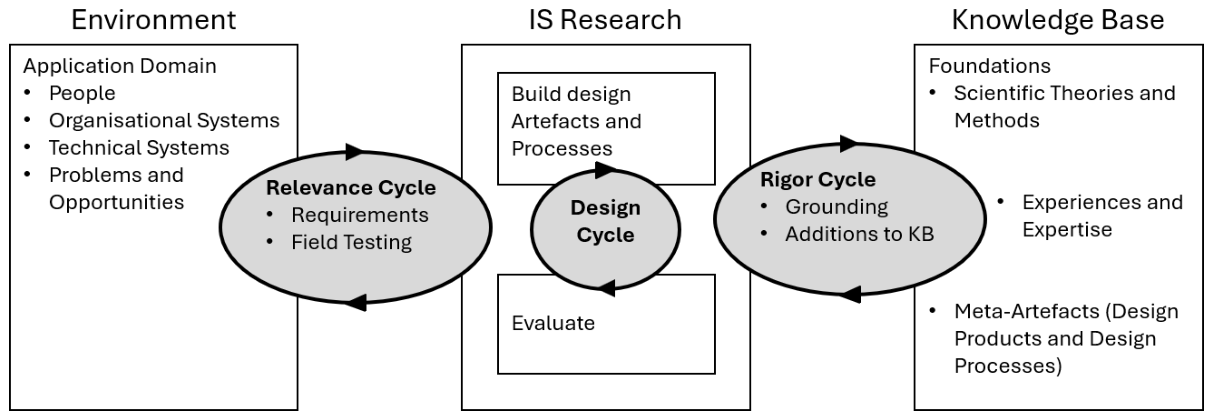
Figure 2.
DSR project customized for developing the DT framework (based on [46]; changes marked in italics)
Figure 2.
DSR project customized for developing the DT framework (based on [46]; changes marked in italics)
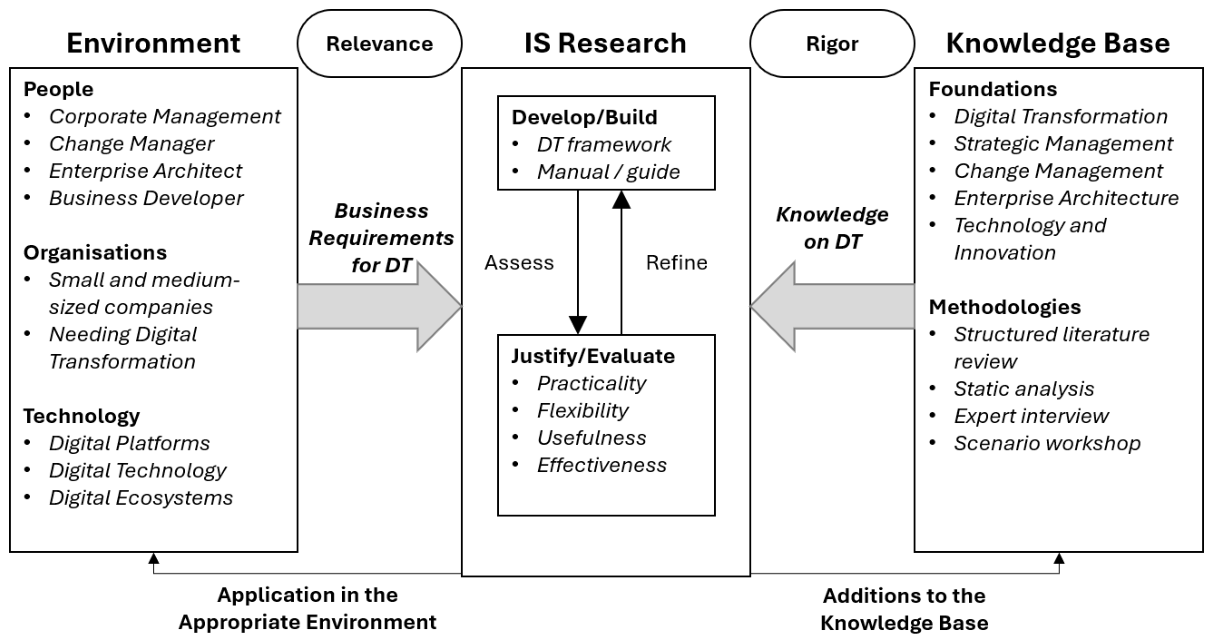
Figure 3.
Managed Evolution for Digital Transformation
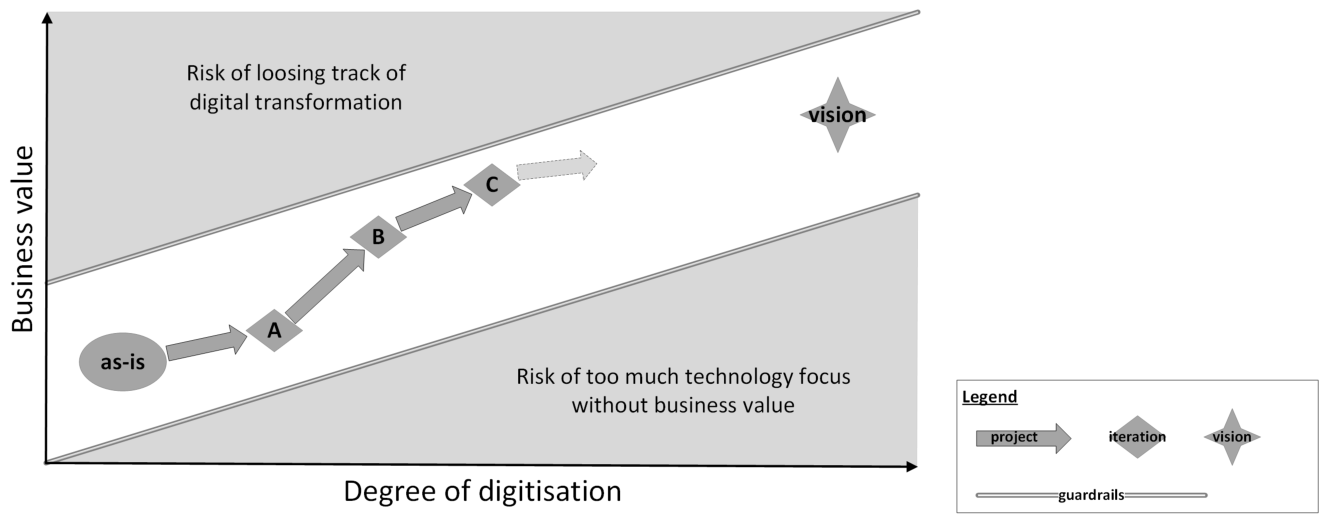
Figure 4.
Applying the Framework
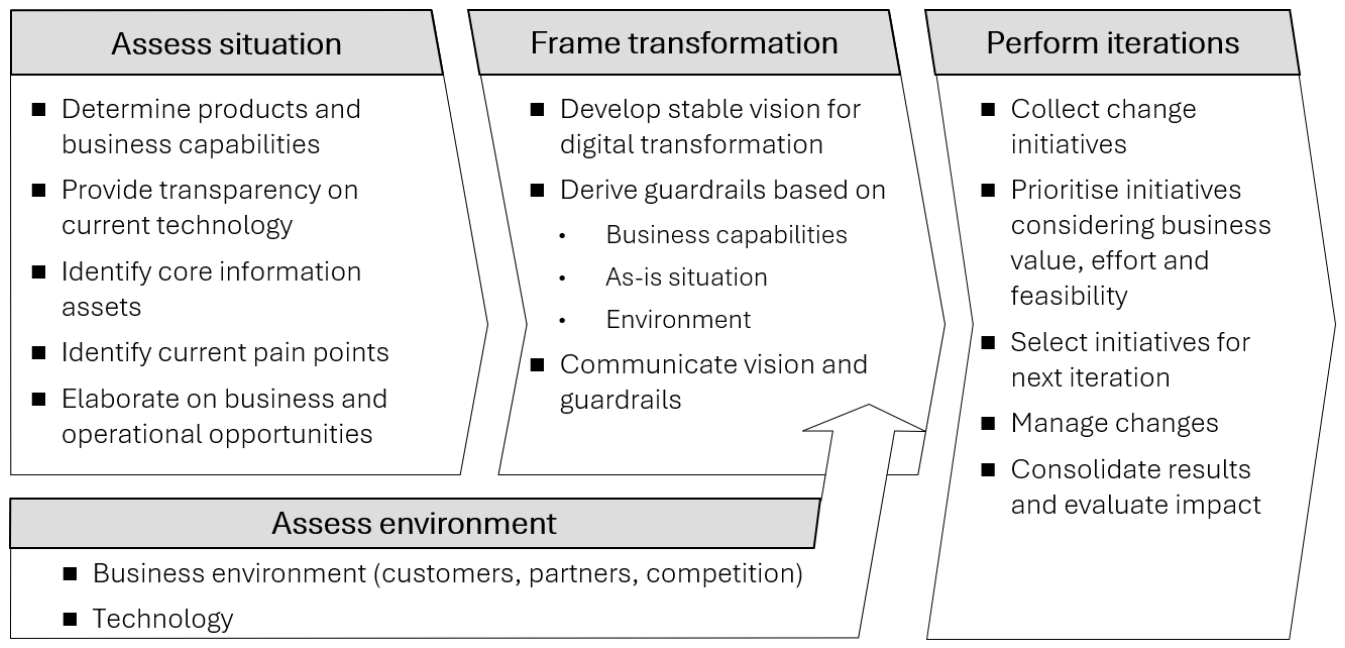
Figure 5.
Guideline on how to create a vision for DT [34]
Figure 5.
Guideline on how to create a vision for DT [34]
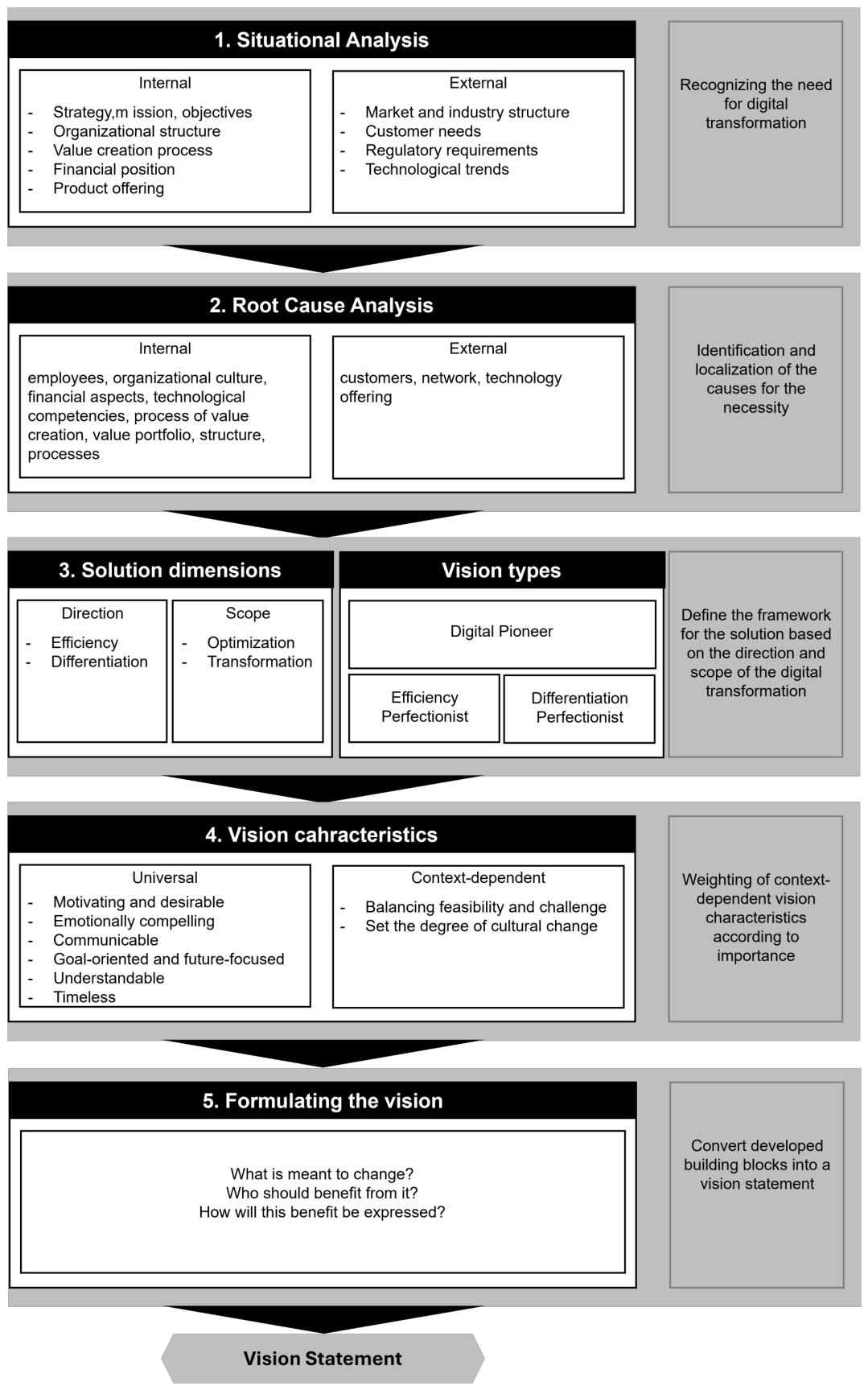

Table 1.
Experts Participating in the Interviews
| Expert | Role | Date |
|---|---|---|
| A | Founder & Consultant | March 3, 2026 |
| B | Owner of an SME | August 5, 2026 |
| C | Consultant | August 28, 2026 |
Disclaimer/Publisher’s Note: The statements, opinions and data contained in all publications are solely those of the individual author(s) and contributor(s) and not of MDPI and/or the editor(s). MDPI and/or the editor(s) disclaim responsibility for any injury to people or property resulting from any ideas, methods, instructions or products referred to in the content. |
© 2026 by the authors. Licensee MDPI, Basel, Switzerland. This article is an open access article distributed under the terms and conditions of the Creative Commons Attribution (CC BY) license (http://creativecommons.org/licenses/by/4.0/).
Copyright: This open access article is published under a Creative Commons CC BY 4.0 license, which permit the free download, distribution, and reuse, provided that the author and preprint are cited in any reuse.