

Submitted:
07 September 2026
Posted:
08 September 2026
You are already at the latest version
Abstract
Sustainable development of the agro-industrial complex (AIC) requires an integrated assessment of investment activity, production performance, financial returns, and resource provision at the district level. This study evaluates the production and economic performance of 13 districts of the North Kazakhstan Region using a composite scoring approach based on seven groups of indicators: investment activity, gross agricultural output, crop yields, livestock productivity, crop-production profitability, livestock-production profitability, and capital intensity. The information base includes official district-level statistics, materials of the regional agricultural authorities, data on fixed production assets for 2021–2023, and national land-use reporting. The results reveal substantial territorial differentiation. Kyzylzhar and Taiynsha districts form the high-performance group, Esil District is classified above average, whereas Ualikhanov District occupies the lowest position in the aggregate ranking. The analysis also identifies a scale-efficiency mismatch: large agricultural territories do not necessarily demonstrate high profitability or productivity, while several medium-sized districts achieve stronger returns on land and production resources. The findings provide a comparative basis for territorially differentiated agricultural policy, targeted investment support, technological modernization, and the development of processing infrastructure in the North Kazakhstan Region.
Keywords:
agro-industrial complex
; regional efficiency
; investment
; profitability
; crop yield
; livestock productivity
; composite scoring
; North Kazakhstan Region
1. Introduction
The agro-industrial complex of the North Kazakhstan Region (NKR) plays a pivotal role in the economy, meeting domestic demand for agricultural products while driving the region’s export potential. Amidst volatile markets, price fluctuations, climate change, and rising production costs, the primary focus shifts from mere production volume to operational efficiency.
The region’s districts exhibit significant disparities in natural and climatic conditions, production structure, technological equipment, and investment activity. While certain areas possess substantial potential, others face constraints such as an underdeveloped material and technical base, high production costs, or a low return on investment. This heterogeneity necessitates a comparative assessment to identify highly efficient districts, pinpoint problem areas, and substantiate strategic directions for the agricultural sector’s development.
Despite positive developments within the region’s agro-industrial complex, significant inter-district imbalances persist. Spatially large territories do not consistently demonstrate high productivity and financial performance, likely due to the extensive nature of their agricultural practices. Conversely, districts characterized by higher investment activity frequently encounter rising costs and capital intensity. The lack of alignment among investment flows, technological provision, production outcomes, and profitability hinders the formulation of an effective regional agricultural policy [1].
The objective of this study is to conduct a comprehensive multidimensional assessment of the production and economic activities of the districts within the North Kazakhstan Region (NKR) and to rank them according to their relative production-economic performance, with the ultimate aim of improving the management of the region’s agricultural sector.
The object of the research comprises 13 administrative districts of the NKR. The methodology is based on a scoring system that facilitates the comparison of districts across a comprehensive set of production, financial, investment, and technical indicators. Rather than being confined to the analysis of isolated parameters, this approach examines the efficiency of the agro-industrial complex (AIC) as the outcome of the interaction among multiple factors.
The study employs seven key indicators. Investment activity is measured by the volume of capital investments per 100 hectares of agricultural land. Production performance is evaluated by the value of gross output per unit of area. The technological level of crop production is determined through an integrated assessment of the yields of grain, oilseeds, potatoes, and vegetables. The efficiency of animal husbandry reflects the productivity of livestock and poultry. Additionally, the study accounts for the profitability of crop production, the profitability of animal husbandry, and capital intensity, which characterizes the provision of fixed production assets [2,3].
The normalized scoring procedure makes it possible to identify disparities among the districts, distinguish industry leaders from underperformers, and compare the observed relationships among investment intensity, production outcomes, and financial returns. The obtained data will serve as a basis for substantiating state support measures, improving the efficiency of resource allocation, and determining the developmental priorities for the region’s AIC.
This research facilitates a transition from the mere comparison of gross output volumes to a more substantive evaluation of the qualitative parameters defining the agricultural development of the districts. Such an approach evaluates efficiency not only in terms of production scale but also through the lens of return on investment, financial stability, technological provision, and the rational utilization of resource potential.
The results establish an analytical foundation for managerial decision-making within regional agricultural policy. These findings can be applied to the distribution of subsidies, the selection of priority areas for state support, the attraction of private investment, and the strategic planning of the technological modernization of the AIC, taking into account the specific characteristics of district-level clusters.
The analysis is organized as a sequential assessment framework in which district-level production, investment, financial, and technical indicators are first standardized and then combined into an aggregate comparative score. The resulting ranking is interpreted together with the spatial position and sectoral specialization of the districts. The contribution of this study is the district-scale integration of heterogeneous AIC indicators into a single territorial assessment for the North Kazakhstan Region. Unlike approaches focused on one production or financial variable, the proposed framework simultaneously considers land-normalized investment and output, crop and livestock performance, profitability, and capital provision. This makes it possible to identify not only the strongest and weakest districts, but also mismatches between production scale, investment intensity, and economic return that are relevant to sustainable regional planning.
2. Literature Review and Research Context
The economic efficiency of the agro-industrial complex (AIC) occupies a prominent place in modern agricultural science, as it reflects not only production volumes but also the quality of resource utilization, the level of financial return, investment activity, and the technological state of the industry. The assessment of the AIC requires a comprehensive approach, given that agriculture is highly dependent on natural and climatic conditions, the structure of land resources, technological provision, market dynamics, and managerial decisions.
The domestic and international literature has developed various approaches to studying the efficiency of agro-industrial systems. In agricultural economics, efficiency is treated as a multidimensional category that may combine production, financial, technological, social, and innovation-related parameters. Kivarina and Yurina propose a methodology for assessing the efficiency of a regional digital platform for the AIC, illustrating the broader shift toward integrated systems of technical, economic, and social indicators [4]. Serebryakova and Zhuravlev likewise develop a scoring-based methodology for assessing innovative development in regional agriculture [5].
Investment activity serves as a primary driver for improving agricultural performance. International studies demonstrate a direct correlation between the volume of capital investments in agricultural machinery and production infrastructure and the growth of agricultural output [6]. Russian authors similarly highlight the impact of investments on labor productivity, the modernization of the material and technical base, and the profitability levels of agricultural enterprises [7].
Production indicators are traditionally used in agricultural statistics as baseline criteria for evaluating sector performance. These include crop yields, gross harvest, livestock numbers, animal productivity, and output per worker. Analyzing the dynamics of these indicators helps identify strengths and constraints in regional agriculture. Kazakhstani researchers also use index-based approaches to compare regional competitiveness, supporting the use of standardized multidimensional indicators in territorial assessment [8].
Comprehensive assessment methods, including scoring indices, multicriteria ratings, and integral indicators, have become widely adopted in the study of regional economic systems. The work of R. A. Vakhrameev proposes a methodology for constructing an integral indicator of agro-industrial complex development, comprising four main blocks: productivity, financial stability, investments, and innovative activity [9,10]. This approach facilitates the examination of AIC efficiency as the outcome of interacting factors, rather than a mere aggregation of isolated production characteristics.
Regional specificity occupies a distinct place in the literature on the agro-industrial complex. Studies in Kazakhstan examine the role of the AIC in sustainable regional development and the ecological and socio-economic modernization of agricultural systems [11,12]. These works underscore the need for a differentiated territorial approach because regions and districts can differ substantially in resource provision, technological conditions, investment activity, and financial performance.
The scientific literature corroborates that the efficiency of the agro-industrial complex is a multifaceted category requiring the analysis of production, investment, financial, and technological parameters. Scoring systems and integral indices enable a more objective comparison of agricultural systems, the identification of leading and lagging territories, and the determination of factors driving developmental disparities. Investment activity, technological equipment, and financial stability act as fundamental prerequisites for enhancing AIC efficiency [13].
Comparative regional assessments also emphasize that production and economic performance should be interpreted in light of territorial heterogeneity, specialization, and resource conditions [14].
Despite a significant number of studies dedicated to grain production in Kazakhstan, comprehensive works that integrate investment, production, financial, and technological factors into a unified system of regional assessment remain underrepresented. Most publications focus on individual aspects of the agricultural sector’s development, such as soil fertility, crop yields, financial results, or macroeconomic indicators. Such an approach does not always yield a holistic understanding of the actual efficiency of the agro-industrial complex at the level of individual districts.
Recent research on the growth of the agro-industrial complex and on digital land management further emphasizes the interaction between production modernization, technological development, and spatial resource management [15,16]. Based on these methodological themes and the available district-level data, the present study operationalizes seven assessment blocks: investment activity, gross agricultural output, crop yield, livestock productivity, crop-production profitability, livestock-production profitability, and capital intensity.
Investment activity is evaluated by the volume of capital investments per 100 hectares of agricultural land. Production performance reflects gross output per unit of area. The crop-production block is based on the yields of grain, oilseeds, potatoes, and vegetables, while the livestock block uses available productivity indicators for livestock and poultry. The financial component is represented by crop- and livestock-production profitability, and capital intensity reflects the value of fixed production assets relative to agro-industrial output.
The proposed approach bridges the existing methodological gap by integrating crop production, animal husbandry, financial, and technical parameters into a unified analytical model. Such a cross-sectoral assessment provides a more objective picture of the development of the agro-industrial complex in the North Kazakhstan Region, enabling the identification of investment-attractive, technologically sustainable, and problematic district clusters.
Recent studies provide a more specific empirical context for Northern Kazakhstan. Research on crop production in the North Kazakhstan Region emphasizes the role of the grain sector, agricultural clustering, and investment in regional food security [17]. Field studies on crop rotations and spring wheat show that production efficiency depends on agronomic structure and cultivation technology [18], while weather variability and hydroclimatic instability remain important determinants of grain yields in the northern steppe zone [19,20]. Land-sustainability research further highlights soil degradation, water retention, and the need for long-term land-resource management in North Kazakhstan [21].
At the national level, recent studies of Kazakhstan complement these findings by examining technical efficiency in wheat production [22] and regional differences in total factor productivity and agricultural support [23]. In parallel, GIS- and remote-sensing-based agricultural mapping is increasingly used in North Kazakhstan to support land monitoring, productivity assessment, and spatial planning [24]. Together, these studies confirm that district performance should be interpreted as the result of interacting production, technological, resource, and institutional conditions rather than through a single output indicator.
Methodologically, the use of composite indicators requires particular attention to normalization, aggregation, and the interpretation of weights. Agricultural sustainability studies show that different normalization and aggregation procedures can materially affect final rankings [25], while regional and farm-level composite-indicator applications demonstrate their usefulness for territorial comparison and policy targeting [26,27,28]. Multicriteria frameworks provide a structured way to integrate heterogeneous indicators [29], and more recent work stresses the sensitivity of composite results to methodological choices and trade-offs [30]. Regional agricultural applications likewise confirm the value of composite measures for diagnosing spatial disparities [31].
General reviews of composite-index methodology emphasize that weighting, aggregation, uncertainty, and robustness analysis should be made explicit because they can substantially influence the ordering of evaluated units [32,33,34,35,36]. In addition, land-use planning and regional sustainability literature provides a complementary spatial framework for interpreting agricultural development and resource management [37,38,39,40]. Recent work on crop diversification in the North Kazakhstan Region further supports the use of integrated economic assessment when considering structural changes in regional crop production [41].
3. Materials and Methods
The study covers 13 administrative districts of the North Kazakhstan Region. Districts are used as the basic spatial units because agricultural management, statistical reporting, investment allocation, and land-resource planning are implemented at this level. The indicator database combines official statistical and administrative sources so that all districts are compared within a common territorial and temporal framework.
The production and economic activities of the agro-industrial complex are evaluated using seven assessment blocks that reflect investment, production, technological, financial, and capital-provision dimensions. The criteria include investment in the AIC, gross agricultural output, yields of major crops, productivity of key livestock species, crop- and livestock-production profitability, and capital intensity.
The scoring assessment is calculated separately for each district in the North Kazakhstan Region. To facilitate inter-district comparison, each raw indicator is transformed into a proportional normalized score, Ipn. For a given indicator p, the district score represents that district’s share of the regional total for the same indicator, expressed as a percentage. This places variables measured in different units on a common relative scale, although the consequences of aggregation and implicit weighting must be considered when interpreting the final ranking [25,32,33,34,35,36].
where Ipn is the normalized score of the p-th assessment indicator in the n-th district, %;
Fpn is the value of the p-th assessment indicator in the n-th district in the corresponding unit of measurement. In Equation (1), the denominator ΣFpn denotes the sum of the p-th indicator across all N districts.
The definitions, calculation bases, and analytical roles of the seven district-level indicators are summarized in Table 1. Investment activity is standardized per 100 hectares of agricultural land so that territorial differences in district size do not dominate the comparison.
The detailed investment calculation is retained in Table 2. Gross-output scores are retained in Table 3, while crop-yield and livestock-productivity patterns are visualized in Figure 1. Crop- and livestock-production profitability and capital intensity are visualized in Figure 2. The underlying district scores remain in Table 3, and the five development classes are retained in Table 4.
A comprehensive scoring analysis serves as the methodological foundation for evaluating the production and economic activities of the districts in the North Kazakhstan Region. Its application enables comparison of indicators expressed in disparate units, including tenge, centners, percentages, and physical quantities. The raw values are converted to proportional normalized scores before aggregation, yielding a comparative district ranking rather than an absolute efficiency measure [25,32,33,34,35,36].
The indicator system encompasses seven groups of metrics that reflect the fundamental elements of the reproductive process within the AIC. The first group characterizes the resource and investment prerequisites for development. This includes investment activity, calculated as the volume of annual capital investments per 100 hectares of agricultural land, and capital intensity, which demonstrates the ratio of the value of fixed production assets to the value of the produced output.
The second group of indicators reflects the production and technological level of the agricultural sector. Crop yield is evaluated through an integrated score across four major crop subindicators: grains, oilseeds, vegetables, and potatoes. Livestock productivity is based on three available subindicators: average milk yield per cow, poultry egg production, and livestock weight gain. Because the crop-yield block sums four normalized subindicator scores and the livestock-productivity block sums three, these two blocks have wider numerical ranges than the single-indicator blocks and therefore exert a larger implicit influence on the aggregate score. This feature is retained to preserve the original scoring scheme and is treated as a methodological limitation when interpreting district ranks.
The third group of indicators characterizes the final outcomes of agro-industrial activities. Gross output is calculated per 100 hectares of agricultural land, allowing production return on land resources to be compared across districts of different sizes. Crop- and livestock-production profitability reflect the financial performance of the respective subsectors. Capital intensity is treated in this study as an indicator of fixed-asset provision per unit of output rather than as a direct measure of return on capital.
The final assessment for each district was generated by aggregating the scores across all seven indicators. The cumulative score reflects the overall level of production and economic efficiency of a district’s agro-industrial complex, determining its relative standing among other administrative territories in the region.
The resulting score is interpreted as a comparative production-economic composite index within the North Kazakhstan Region rather than as an absolute measure of technical or allocative efficiency. The procedure is designed to reveal relative territorial differences and should therefore be used primarily for ranking, grouping, and identifying district-specific development constraints. It should not be read as a complete sustainability index because social and environmental outcomes are not directly included.
For the five-level typology presented in Table 4, the observed aggregate-score range (44.5-148.0 points) was divided into five equal-width intervals of approximately 20.7 points. The class boundaries were rounded to one decimal place for presentation. These thresholds are dataset-specific and are used only for descriptive regional grouping; they should not be interpreted as universal standards.
The information base for the study comprises official district-level statistics and administrative data. The research uses materials from the Department of Agriculture and data on fixed production assets for 2021-2023, data from the Bureau of National Statistics of the Agency for Strategic Planning and Reforms of the Republic of Kazakhstan, and the Consolidated Analytical Report “On the Condition and Use of Lands of the Republic of Kazakhstan for 2024” prepared by the Land Management Committee of the Ministry of Agriculture of the Republic of Kazakhstan [42,43,44].
Such a comprehensive database ensures the comparability of calculations and allows for the evaluation of the districts’ agro-industrial complexes not merely based on isolated production parameters, but through an aggregate of investment, financial, land, and technical characteristics.
Some livestock subindicators are unavailable for districts in which the corresponding production activity is absent or not reported. These values were not artificially imputed. Accordingly, the livestock productivity component reflects both observed productivity and the sectoral specialization of individual districts; this limitation is considered when interpreting the aggregate ranking.
4. Results and Discussion
The production and economic activities of the agro-industrial complex in the districts of the North Kazakhstan Region are evaluated using the seven assessment blocks described above. The analysis incorporates investment intensity, gross agricultural output, crop yield, livestock productivity, crop- and livestock-production profitability, and capital intensity [42,43,44]. The detailed investment calculation is retained below, while selected production, productivity, profitability, and capital-provision patterns are summarized in the two cartographic figures.
The presented data enable the evaluation of the investment attractiveness and development intensity of the agro-industrial complex in the North Kazakhstan Region across individual districts. Of particular significance is not the absolute volume of investments, but rather their ratio to the agricultural land area, as this specific indicator reflects the degree of capitalization of land resources.
A comparative analysis reveals pronounced disparities among the region’s districts. Investment per 100 hectares of agricultural land provides a land-normalized measure of the intensity of capital inflows and allows districts of different sizes to be compared on a common basis. In the present dataset, this indicator identifies territories with relatively high and low investment intensity in agricultural production [42,43,44].
In addition to investment intensity, the gross-output score in Table 3 provides a land-productivity dimension. Because gross output is normalized per 100 hectares, districts of different sizes can be compared on the basis of production return on agricultural land rather than absolute production scale [42,43,44].
This land-normalized gross-output measure complements the investment indicator but is not visualized in Figure 1. Figure 1 is reserved for the two multi-component production blocks: crop-yield and livestock-productivity scores.
Table 2 documents the strongest investment contrast: Kyzylzhar District records 5,004.4 thousand KZT per 100 ha (17.9 points), whereas Ualikhanov District records 684.6 thousand KZT per 100 ha (2.5 points). The gross-output score reported in Table 3 shows a similar contrast: 13.4 points in Kyzylzhar versus 2.3 points in Ualikhanov. Figure 1 then focuses specifically on the spatial distribution of crop-yield and livestock-productivity scores.
Figure 1 expands the assessment of the agro-industrial complex through an analysis of the qualitative parameters of crop production. Crop yield serves as the central indicator here, as it reflects not only the natural and climatic conditions of the districts but also the level of applied agricultural technologies.
A comparison of crop-yield scores helps characterize how land resources and production potential are realized across the districts. The indicator reflects the combined outcome of bioclimatic conditions and the technologies applied in crop production; studies of Northern Kazakhstan likewise show the importance of cultivation systems, sowing conditions, and hydroclimatic variability for grain performance [18,19,20].
Figure 1 characterizes the state of animal husbandry in the districts of the North Kazakhstan Region through livestock productivity indicators. This criterion reflects not only the volume of production output but also the quality of the forage base, the breeding and genetic potential of the herd, the animal housing conditions, and the degree of technological equipment of the farms.
Livestock productivity provides a complementary view of animal-husbandry performance. Differences in observed productivity may be associated with forage conditions, breeding practices, housing, mechanization, and farm organization, but the district-level dataset does not isolate the causal contribution of these factors. Accordingly, the livestock block is interpreted descriptively and in conjunction with the availability of reported subindicators.
The integrated crop-yield score is highest in Akkayin (36.0 points), Mamlyut (35.3), and Kyzylzhar (35.2) districts and lowest in Ualikhanov District (20.0). Livestock productivity is led by Taiynsha (62.0 points) and Kyzylzhar (54.6), whereas Ualikhanov has the lowest observed score (4.7). The cartodiagrams distinguish genuinely low observed values from subindicators that were unavailable or not reported.
Figure 2 summarizes the financial results of crop production in the districts of the North Kazakhstan Region. Profitability indicates the return generated by the production resources used in each district. The comparison shows that a high volume of gross output does not automatically translate into high economic returns: several districts with large production volumes rank lower in profitability. This reflects differences in cost structure, management efficiency, technological organization, and the ability of farms to convert production potential into profit.
Figure 2 details the financial efficiency of animal husbandry in the districts of the North Kazakhstan Region and complements the overall assessment of the region’s agricultural sector. The profitability indicator in this case makes it possible to determine how profitable livestock production is and how economic returns vary across the districts.
The data show that inter-district differences are more pronounced in the livestock-profitability scores than in the crop-profitability scores. Such variation may reflect differences in specialization, cost structures, market access, forage conditions, and management, but these mechanisms are not estimated separately in the present comparative design [42,43,44].
Figure 2 also presents capital intensity, defined as the value of fixed production assets relative to agro-industrial output. In this study, the indicator is interpreted primarily as a measure of capital provision rather than as a direct measure of capital efficiency.
A higher capital-intensity value indicates a larger fixed-asset base per unit of output and may reflect stronger technical provision, but it does not by itself imply a higher return on capital. Conversely, a lower value may reflect either leaner use of fixed assets or under-capitalization. The direction of this indicator in the additive composite score should therefore be interpreted cautiously [32,33,34,35,36].
The financial indicators reveal a configuration that differs from the production ranking. Crop-production profitability is highest in Akzhar (58.2%) and Esil (56.7%) districts, while livestock-production profitability reaches 86.2% in Akzhar and 60.6% in Esil. Capital intensity is highest in Esil (0.713; 12.9 points) and Mamlyut (0.669; 12.1 points) and lowest in Ayirtau (0.235; 4.3 points), illustrating why profitability and capital provision should be interpreted as distinct rather than interchangeable dimensions.
Table 3 forms a comprehensive ranking of the districts of the North Kazakhstan Region based on the level of development of their agro-industrial complex. It combines the main parameters of production and economic activity: investment activity, technical equipment, crop yields, livestock productivity, production profitability, and capital intensity.
The aggregate score evaluates districts through a system of interconnected criteria rather than a single indicator. It provides a descriptive hierarchy of the territories and helps identify districts with stronger or weaker combinations of investment, production, productivity, profitability, and capital provision. Because the multi-component crop and livestock blocks carry greater implicit numerical weight, the ranking should be interpreted together with the individual components and the methodological limitations discussed below [42,43,44].
The distribution of aggregate scores demonstrates a pronounced differentiation among the districts of the North Kazakhstan Region. Kyzylzhar District records the highest overall score (148.0 points), followed by Taiynsha District (136.8 points) and Esil District (125.3 points). Their relatively strong positions result from different combinations of investment intensity, crop and livestock performance, profitability, and capital provision. In contrast, Ualikhanov District has the lowest aggregate score (44.5 points), reflecting comparatively weak values across several components of the assessment. The remaining districts occupy intermediate positions, indicating that similar overall scores may be formed through different combinations of production, financial, and technological characteristics [23,24,25].
This variation confirms that the development of the regional agro-industrial complex cannot be adequately described by production scale alone. Districts with large agricultural areas or substantial gross output do not necessarily achieve the highest composite scores when profitability, investment intensity, livestock productivity, or capital provision remain limited. Conversely, some districts with more moderate production volumes demonstrate stronger overall performance because of relatively favorable results across several efficiency indicators. To facilitate the interpretation of these differences and translate the continuous aggregate scores into a clearer territorial typology, the districts were subsequently divided into five groups ranging from low to high levels of production and economic activity, as presented in Table 4 [42,43,44].
The districts classified in the “High” and “Above average” groups form the upper tier of the composite ranking: Kyzylzhar, Taiynsha, and Esil. Their positions reflect different combinations of investment, gross-output, crop-yield, livestock-productivity, profitability, and capital-provision scores. Regional administrative materials indicate that logistics and processing infrastructure are also relevant contextual factors, although they are not separate components of the composite index [42].
The “Medium Level” group includes the Akzhar, Ayirtau, Mamlyut, and Akkayin districts. These territories possess a fairly stable material and technical base and show balanced results across several areas of agricultural production. The Akzhar district entered this group due to its high profitability, while the Akkayin district stands out with significant yield indicators for grain and vegetable crops. These districts can be considered as promising platforms for expanding existing agro-industrial enterprises and attracting additional investments.
The “Moderate” group includes the G. Musrepov, M. Zhumabayev, Zhambyl, Shal Akyn, and Timiryazev districts. This group is the most numerous and, at the same time, the most heterogeneous. It includes districts that are large in area and possess significant land resources, yet their overall efficiency remains moderate. This situation indicates the prevalence of an extensive development model, in which the scale of the land fund is not always accompanied by high production and financial returns. Increasing the efficiency of these districts to at least a medium level could significantly enhance the contribution of the agro-industrial complex to the region’s economy.
Ualikhanov District occupies a separate place in the “Low” group. Its final score reflects a combined pattern of low investment intensity, low gross-output and crop-yield scores, very low livestock-productivity scores, and relatively low capital provision in the present dataset. These results point to the need for technical renewal, productivity support, and infrastructure development [42,43,44].
The results of the multivariate analysis reveal several stable patterns and internal contradictions in the development of the agricultural sector of the North Kazakhstan Region.
The ranking suggests that high investment intensity can coincide with stronger production and productivity outcomes, but the present design does not establish causality or isolate the effect of proximity to logistics centers. Kyzylzhar District combines the highest aggregate score (148.0) with high investment (17.9 points), livestock productivity (54.6), and substantial capital provision (9.1). Ualikhanov District, by contrast, records the lowest aggregate score (44.5) and low values across several components. These contrasting profiles are descriptive associations within the composite index rather than estimates of causal effects [42,43,44]. Investment intensity is documented in Table 2, while crop and livestock productivity patterns are summarized in Figure 1.
The pattern of extensive growth is particularly noticeable in Gabit Musrepov and Magzhan Zhumabayev districts. Despite significant land resources and large-scale production, these territories fall within the moderate group. This pattern is consistent with a production profile in which scale is not matched by equally strong productivity and financial outcomes. The result underscores the potential importance of technological upgrading, yield improvement, and cost management in large grain-producing territories [42,43,44].
The difference between gross indicators and financial performance also affects the final assessment. A high volume of production is not necessarily accompanied by high profitability because financial outcomes depend on cost structure, specialization, management, and market conditions. Akzhar District, while not among the leaders in investment or capital provision, records the highest livestock-production profitability in the dataset (86.2%). Rather than proving a specific causal mechanism, this result shows that high financial performance can occur under a different combination of production factors and warrants separate firm-level analysis [42,43,44]. These financial contrasts are visualized in Figure 2.
Processing capacity is not included as a separate scoring block and therefore does not directly affect the aggregate score in Table 3. Nevertheless, it remains relevant to the broader interpretation of regional development because local processing can retain value added, strengthen market linkages, and reduce dependence on raw-material sales. Recent research on crop diversification in the North Kazakhstan Region likewise emphasizes the economic importance of structural change in regional crop production [41].
For this reason, processing should be treated here as a contextual policy factor rather than as a component of Figure 2 or the composite index. Future extensions of the methodology could include processing depth, storage capacity, logistics accessibility, and value-added indicators as a separate assessment block if consistent district-level data become available.
The district profiles reveal pronounced polarization in the regional agro-industrial complex. Kyzylzhar, Taiynsha, and Esil form the upper part of the ranking, while several large agricultural territories remain in the moderate group and Ualikhanov occupies the low group. The combined outcome of these contrasts is consolidated in the five-class grouping in Table 4.
A key direction for further regional development is the diffusion of effective technologies and management practices from the stronger districts to large districts with moderate composite scores. Modern agricultural technologies, renewal of the technical base, improvement of management, and expansion of appropriate processing and logistics can support higher productivity without relying solely on the expansion of cultivated area [17,18,19,20,21,22,23,24,41].
The interpretation of the ranking should take into account five methodological limitations. First, the composite score is sensitive to indicator selection and to the larger numerical contribution of the multi-component crop-yield and livestock-productivity blocks. Second, missing livestock subindicators may reflect specialization rather than low performance. Third, capital intensity is treated as a capital-provision indicator, although higher fixed assets per unit of output do not necessarily imply greater capital efficiency. Fourth, the score covers production-economic dimensions and should not be read as a complete sustainability index because social and environmental outcomes are not directly included. Fifth, the five development classes are analytical groupings for this regional dataset rather than universal thresholds. Future work should test alternative normalization and weighting schemes, add social, environmental, and processing indicators, and evaluate rank stability through uncertainty and sensitivity analysis [30,32,33,34,35,36].
5. Policy Implications for Sustainable Regional Planning
For the leading districts, the priority direction should be to maintain productivity and strengthen value-added and export potential while continuing the digitalization of agricultural management. Precision-agriculture tools, automated crop monitoring, digital resource accounting, and modern production-management systems can support more timely land and production decisions [24].
Medium-level districts need to stimulate the deep processing of agricultural raw materials locally. Developing processing capacities will allow for an increase in the added value of products, reduce dependence on the sale of raw materials, and create conditions for these territories to transition to the group of districts with an above-average level of development.
For the moderate group, especially for districts that are large in area, an important direction is land-use auditing and evaluation of agricultural-land performance. A large land fund alone does not ensure a high production-economic result. The transition toward more intensive development should therefore emphasize appropriate agronomic technologies, equipment renewal, yield improvement, and rational management of land and production resources [21,24,37,38,39,40,41].
Districts with a low level of development require targeted support programs adapted to their specific constraints. Possible measures include preferential financing, infrastructure co-financing, advisory and extension support, technical renewal, and investment incentives tied to measurable improvements in productivity and resource use.
The final classification shows uneven district-level development of the agro-industrial complex in the North Kazakhstan Region. The strongest composite scores are concentrated in Kyzylzhar, Taiynsha, and Esil, whereas the peripheral Ualikhanov District records the lowest score. The five-class grouping is presented in Table 4 and should be interpreted as a regional benchmarking result rather than as a universal development scale.
6. Conclusions
The comparative assessment confirms substantial production, financial, investment, and technological differentiation among the 13 districts of the North Kazakhstan Region. Kyzylzhar and Taiynsha districts occupy the highest positions in the aggregate ranking, Esil District forms the above-average group, while Ualikhanov District demonstrates the greatest concentration of development constraints.
The results show that production scale alone is insufficient to characterize production-economic performance. Districts with extensive land resources may remain at a moderate level when productivity, profitability, investment intensity, or capital provision are comparatively weak. Conversely, several medium-sized districts achieve stronger results through different combinations of profitability, productivity, and resource use. The composite score is therefore best interpreted as a production-economic benchmarking tool rather than as a complete sustainability metric.
From a planning perspective, the ranking supports a territorially differentiated policy: technological modernization and export-oriented development for leading districts; expansion of local processing and value-added production for medium and moderate groups; and targeted investment, infrastructure, and technical renewal for low-performing territories. The classification in Table 4 provides an additional basis for prioritizing regional support measures.
The proposed framework can be transferred to other regions of Kazakhstan after adapting the indicator set to local agricultural specialization and data availability. Further research should compare alternative normalization and weighting procedures, incorporate time-series, social, environmental, and processing indicators, and conduct uncertainty and sensitivity analysis to assess the robustness of district rankings [30,32,33,34,35,36].
Author Contributions
Conceptualization, A.Zh.; methodology, B.D.; formal analysis, A.B.; investigation, U.K.; resources, D.M.; data curation, D.M., K.D.; writing—original draft preparation, N.K.; writing—review and editing, A.Zh.; visualization, Y.A.; supervision, S.A., G.K.; project administration, A.B.; funding acquisition, U.K., Zh.A.
Funding
This research was funded by the Science Committee of the Ministry of Science and Higher Education of the Republic of Kazakhstan, grant number BR24993222, within the project “Construction of a decision support system for the natural and economic development of the territory of the North Kazakhstan Region in the context of sustainable development”.
Conflicts of Interest
Authors declare no conflict of interest.
References
- Kassenova, A.Zh.; Bodaukhan, K.; Khapova, A.V. Analysis of the infrastructure and material base of the agro-industrial complex in the northern regions of Kazakhstan. Probl. AgriMarket 2025, 3, 149–157. (In Kazakh) [Google Scholar] [CrossRef]
- Zhumanova, B. Financing of innovative projects in the agro-industrial complex of Kazakhstan. Bull. Taras Shevchenko Natl. Univ. Kyiv. Econ. 2013, 11, 92–96. [Google Scholar] [CrossRef]
- Shaldarov, B.; Syzdikov, B.; Medeni, T.D.; Oralbayeva, Zh. Ways of investment development of the agro-industrial complex of Kazakhstan at the present time. Izdenister Natizheler 2024, 2, 607–615. [Google Scholar] [CrossRef]
- Kivarina, M.V.; Yurina, N.N. Methodology for assessing the efficiency of a regional digital platform of the agro-industrial complex. Agrar. Bull. Ural. 2025, 25, 1443–1455. [Google Scholar] [CrossRef]
- Serebryakova, T.Yu.; Zhuravlev, E.V. Methodology for assessing innovative development of regional agriculture. Agrar. Bull. Ural. 2024, 24, 1748–1762. [Google Scholar] [CrossRef]
- Swarooprani, K. Agricultural investment and economic growth. Int. J. Sci. Res. Sci. Technol. 2022, 9, 472–475. [Google Scholar] [CrossRef]
- Vodyannikov, V.T. Economic Assessment of Investment Projects in Agriculture: Textbook; Russian State Agrarian University—Moscow Timiryazev Agricultural Academy: Moscow, Russia, 2023; 242 p, ISBN 978-5-9675-1997-0. (In Russian) [Google Scholar]
- Dyussembekova, G.S.; Bekniyazova, D.S.; Kenzhin, Zh.B. Assessment of regional competitiveness based on an index approach. Cent. Asian Econ. Rev. 2020, 3, 67–79. (In Russian) [Google Scholar]
- Vakhrameev, R.A. Method of forming an integral indicator for complex evaluation of sustainability in the development of the agro-industrial complex. Vestn. Nauk. Sib. 2018, 4, 82–92. (In Russian) [Google Scholar]
- Sinilo, D. Theoretical aspects of the formation of sustainable development of the agro-industrial complex. Agric. Econ. 2025, 4, 37–54. [Google Scholar] [CrossRef]
- Shaikin, D.N.; Omirzhan, S.M. The role of the AIC in sustainable regional development: Economic assessment. Probl. AgriMarket 2023, 1, 57–63. [Google Scholar] [CrossRef]
- Maknmetova, D.; Korabayev, B.; Zeinullina, A.; Basshieva, Z.; Dauit, Z.; Zhaxalykov, K. Ecologization of the agro-industrial complex: Problems of socio-economic modernization on the example of East Kazakhstan Region. Bull. Natl. Acad. Sci. Repub. Kazakhstan 2022, 4, 331–344. [Google Scholar] [CrossRef]
- Gusev, A.Yu.; Koshkina, I.G.; Klimyuk, L.Ya. Analytical assessment of the economic efficiency of innovations in the field of agro-industrial complex. E3S Web Conf. 2023, 449, 09017. [Google Scholar] [CrossRef]
- Petrova, L.A. Comparative analysis of production and economic activities of the agro-industrial complex. In Strategic Guidelines for the Development of Socio-Economic Systems; Chernov, S.S., Ed.; Center for Development of Scientific Cooperation, 2022; pp. 148–162. [Google Scholar]
- Petrunenko, I.; Dukhnevych, A.V.; Kliutsa, S.O.; Karpinska, N.; Demianyshyna, O. Growth of agro-industrial complex in modern economic conditions. Rev. San. Gregor. 2020, 42, 131–143. [Google Scholar] [CrossRef]
- Volkov, S.N.; Shapovalov, D.A.; Shirokorad, I.I.; Klyushin, P.V.; Khutorova, A.O. Digital land management: Methodological foundations and practices. In Proceedings of the 11th International Conference on Theory and Application of Soft Computing, Computing with Words and Perceptions and Artificial Intelligence—ICSCCW 2021; Aliev, R.A., Kacprzyk, J., Pedrycz, W., Jamshidi, M., Babanli, M., Sadikoglu, F.M., Eds.; Springer: Cham, Switzerland, 2022; pp. 325–331. [Google Scholar] [CrossRef]
- Chistyakova, G.N.; Salykbayeva, G.M.; Dosmakhov, S.M.; Kozhakhmetova, L.T.; Kulmaganbetova, A.O. Crop production of the North Kazakhstan Region as the basis of the agricultural cluster and ensuring food security of the population. Fundam. Exp. Biol. 2022, 106, 168–177. (In Russian) [Google Scholar] [CrossRef]
- Solovyov, O.Y.; Shvidchenko, V.K.; Plyushchenko, Y.A.; Davydenko, M.G. Efficiency of grain-fallow crop rotations and permanent sowing of spring wheat in the conditions of the North Kazakhstan Region. Eurasian Agrotech. J. 2022, 4. (In Russian) [Google Scholar] [CrossRef]
- Nurpeissov, D.N.; Savin, T.V.; Aituganov, A.K.; Shestakova, N.A.; Soloviev, O.Y.; Shvidchenko, V.K. Influence of weather conditions in the steppe zone of Northern Kazakhstan on the productivity of spring soft wheat. Eurasian Agrotech. J. 2023, 2. [Google Scholar] [CrossRef] [PubMed]
- Panyushkina, I.P.; Shayakhmetova, A.; Pashkov, S.; Agafonov, L.I. Unstable state of hydrologic regime and grain yields in Northern Kazakhstan estimated with tree-ring proxies. Agriculture 2024, 14, 790. [Google Scholar] [CrossRef]
- Sarsekova, D.; Sagin, J.; Perzadayeva, A.; Arystanova, R.; Arystanov, A.; Kezheneva, A.; Jumassultanova, S.; Satybaldiyeva, G.; Ospangaliyev, A. Farmers’ land sustainability improvement with soil, geology, and water retention assessment in North Kazakhstan. Sustainability 2026, 18, 1316. [Google Scholar] [CrossRef]
- Tleubayev, A.; Syzdykov, Y. Technical efficiency of wheat production in Central Asia: Empirical evidence from Kazakhstan. J. Asian Afr. Stud. 2026, 61, 1656–1667. [Google Scholar] [CrossRef]
- Seitov, S.K. Total factor productivity and subsidizing the agricultural sector of Kazakhstan. J. New Econ. Assoc. 2025, 3, 188–215. [Google Scholar] [CrossRef]
- Nurpeissova, M.; Kirgizbayeva, D.; Zhildikbayeva, A.; Utesbayev, A.; Azizov, E. Automated agricultural land mapping using Landsat-8, ArcGIS, and NDVI: A case study from North Kazakhstan. Int. J. Des. Nat. Ecodynamics 2026, 21, 685–694. [Google Scholar] [CrossRef]
- Talukder, B.; Hipel, K.W.; van Loon, G.W. Developing composite indicators for agricultural sustainability assessment: Effect of normalization and aggregation techniques. Resources 2017, 6, 66. [Google Scholar] [CrossRef]
- Xavier, A.; Freitas, M.B.C.; Fragoso, R.; Rosário, M.S. A regional composite indicator for analysing agricultural sustainability in Portugal: A goal programming approach. Ecol. Indic. 2018, 89, 84–100. [Google Scholar] [CrossRef]
- Gómez-Limón, J.A.; Sanchez-Fernandez, G. Empirical evaluation of agricultural sustainability using composite indicators. Ecol. Econ. 2010, 69, 1062–1075. [Google Scholar] [CrossRef]
- Reig-Martínez, E.; Gómez-Limón, J.A.; Picazo-Tadeo, A.J. Ranking farms with a composite indicator of sustainability. Agric. Econ. 2011, 42, 561–575. [Google Scholar] [CrossRef]
- Talukder, B.; Hipel, K.W.; van Loon, G.W. Using multi-criteria decision analysis for assessing sustainability of agricultural systems. Sustain. Dev. 2018, 26, 781–799. [Google Scholar] [CrossRef]
- Sinisterra-Solís, N.K.; Sanjuán, N.; Ribal, J.; Estruch-Guitart, V.; Clemente Polo, G.; Rozakis, S. Developing a composite indicator to assess agricultural sustainability: Influence of some critical choices. Ecol. Indic. 2024, 161, 111934. [Google Scholar] [CrossRef]
- Chaplitskaya, A.; Heijman, W.; van Ophem, J. Composite indicators and sustainable development of regional agriculture applied to the Stavropol Territory in Russia. Appl. Stud. Agribus. Commer. 2017, 11, 81–88. [Google Scholar] [CrossRef]
- Greco, S.; Ishizaka, A.; Tasiou, M.; Torrisi, G. On the methodological framework of composite indices: A review of the issues of weighting, aggregation, and robustness. Soc. Indic. Res. 2019, 141, 61–94. [Google Scholar] [CrossRef]
- OECD; European Union; Joint Research Centre. Handbook on Constructing Composite Indicators: Methodology and User Guide; OECD Publishing: Paris, France, 2008. [Google Scholar] [CrossRef]
- Saisana, M.; Saltelli, A.; Tarantola, S. Uncertainty and sensitivity analysis techniques as tools for the quality assessment of composite indicators. J. R. Stat. Soc. Ser. A (Statistics in Society) 2005, 168, 307–323. [Google Scholar] [CrossRef]
- Saltelli, A. Composite indicators between analysis and advocacy. Soc. Indic. Res. 2007, 81, 65–77. [Google Scholar] [CrossRef]
- Nardo, M.; Saisana, M.; Saltelli, A.; Tarantola, S.; Hoffmann, A.; Giovannini, E. Handbook on Constructing Composite Indicators: Methodology and User Guide; OECD Statistics Working Papers No. 2005/03; OECD Publishing: Paris, France, 2005. [Google Scholar] [CrossRef]
- Ivanov, N.I.; Fomkin, I.V.; Ananicheva, E.P.; Solovyev, A.I. Planning of Land Use: Educational and Methodological Guide for Studying the Discipline and Completing Calculation and Graphical Work; State University of Land Use Planning: Moscow, Russia, 2016; p. 176 p. ISBN 978-5-9215-0376-2. (In Russian) [Google Scholar]
- Volkov, S.N. The General Scheme of Land Management of the Territory of the Russian Federation: Content and Methods of Development; State University of Land Use Planning: Moscow, Russia, 2009; p. 369 p. ISBN 978-5-9215-0152-2. (In Russian) [Google Scholar]
- Kartsev, G.A.; Isaev, A.S. Forecasting and Planning of the Use and Protection of Land Resources: Textbook; Moscow State University of Environmental Engineering: Moscow, Russia, 2010; 2 vols. ISBN 978-5-89231-285-1. (In Russian) [Google Scholar]
- Shapovalov, D.A.; Klyushin, P.V.; Khutorova, A.O.; Savinova, S.V.; Shirokorad, I.I. Methodological approaches to the formulation of sustainable development and ecological safety of the regions. In Proceedings of the 12th International Conference on Theory and Application of Soft Computing, Computing with Words and Perceptions and Artificial Intelligence—ICSCCW 2022; Aliev, R.A., Kacprzyk, J., Pedrycz, W., Jamshidi, M., Babanli, M., Sadikoglu, F.M., Eds.; Springer: Cham, Switzerland, 2023; pp. 488–493. [Google Scholar] [CrossRef]
- Solovyov, O.Yu.; Evseenko, I.A.; Kadirov, B.U. Comparative assessment of the effectiveness of crop diversification in the North Kazakhstan Region. Eurasian Agrotech. J. 2025, 3, 288–302. (In Russian) [Google Scholar] [CrossRef] [PubMed]
- Department of Agriculture of the North Kazakhstan Region. Administrative Reporting and Data on Fixed Production Assets for 2021–2023; Department of Agriculture of the North Kazakhstan Region: North Kazakhstan Region, Kazakhstan, 2021–2023; (Administrative data). [Google Scholar]
- Bureau of National Statistics of the Agency for Strategic Planning and Reforms of the Republic of Kazakhstan. Official District-Level Agricultural Statistics; Bureau of National Statistics: Astana, Kazakhstan.
- Committee for Land Management; Ministry of Agriculture of the Republic of Kazakhstan. Consolidated Analytical Report on the State and Use of Lands of the Republic of Kazakhstan for 2024; Ministry of Agriculture of the Republic of Kazakhstan: Astana, Kazakhstan, 2025. (In Russian) [Google Scholar]
Figure 1.
Spatial distribution of crop-yield and livestock-productivity scores in the districts of the North Kazakhstan Region. Source: compiled by the authors.
Figure 1.
Spatial distribution of crop-yield and livestock-productivity scores in the districts of the North Kazakhstan Region. Source: compiled by the authors.
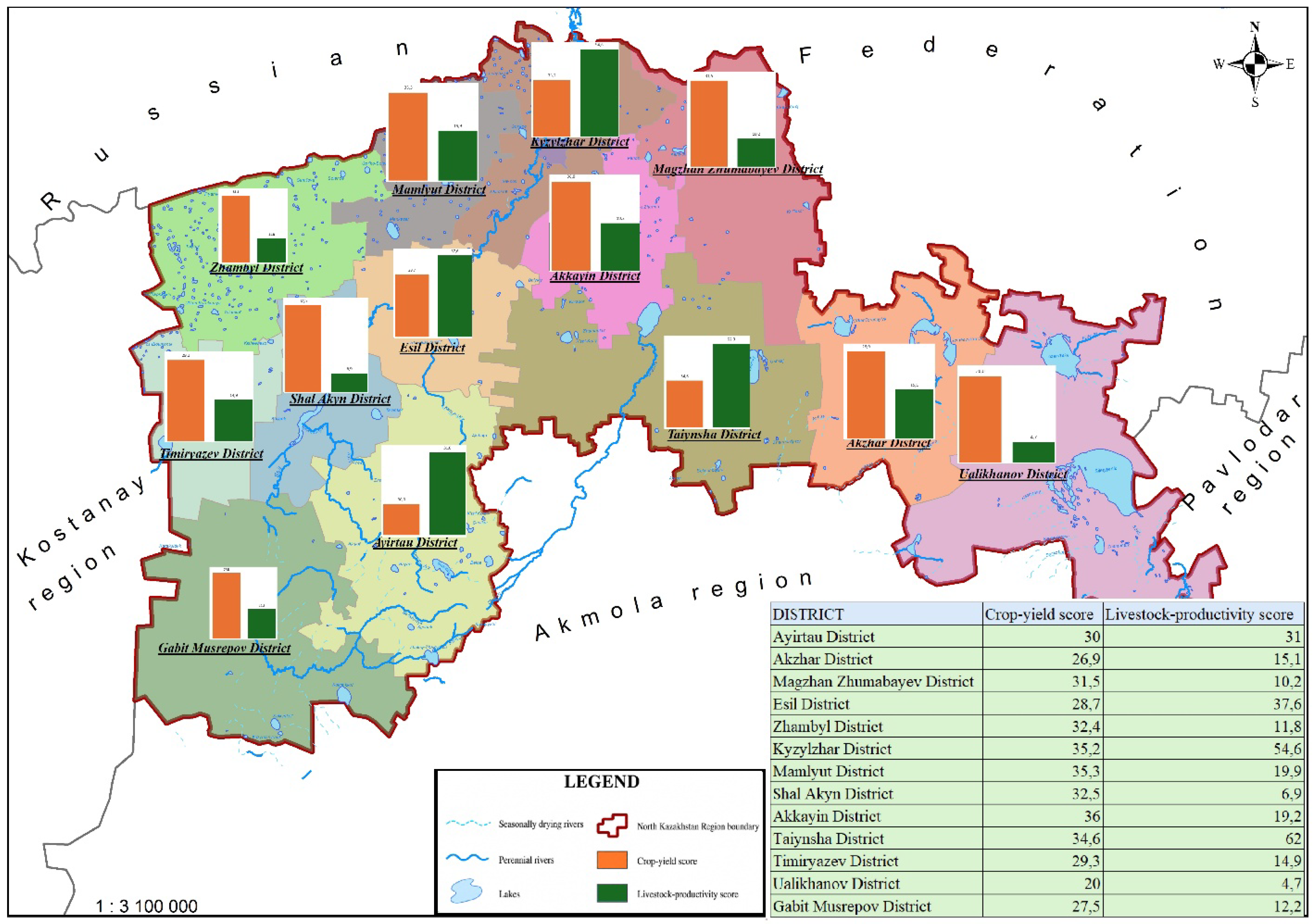
Figure 2.
Spatial patterns of crop and livestock profitability and capital intensity across the North Kazakhstan Region. Source: compiled by the authors.
Figure 2.
Spatial patterns of crop and livestock profitability and capital intensity across the North Kazakhstan Region. Source: compiled by the authors.
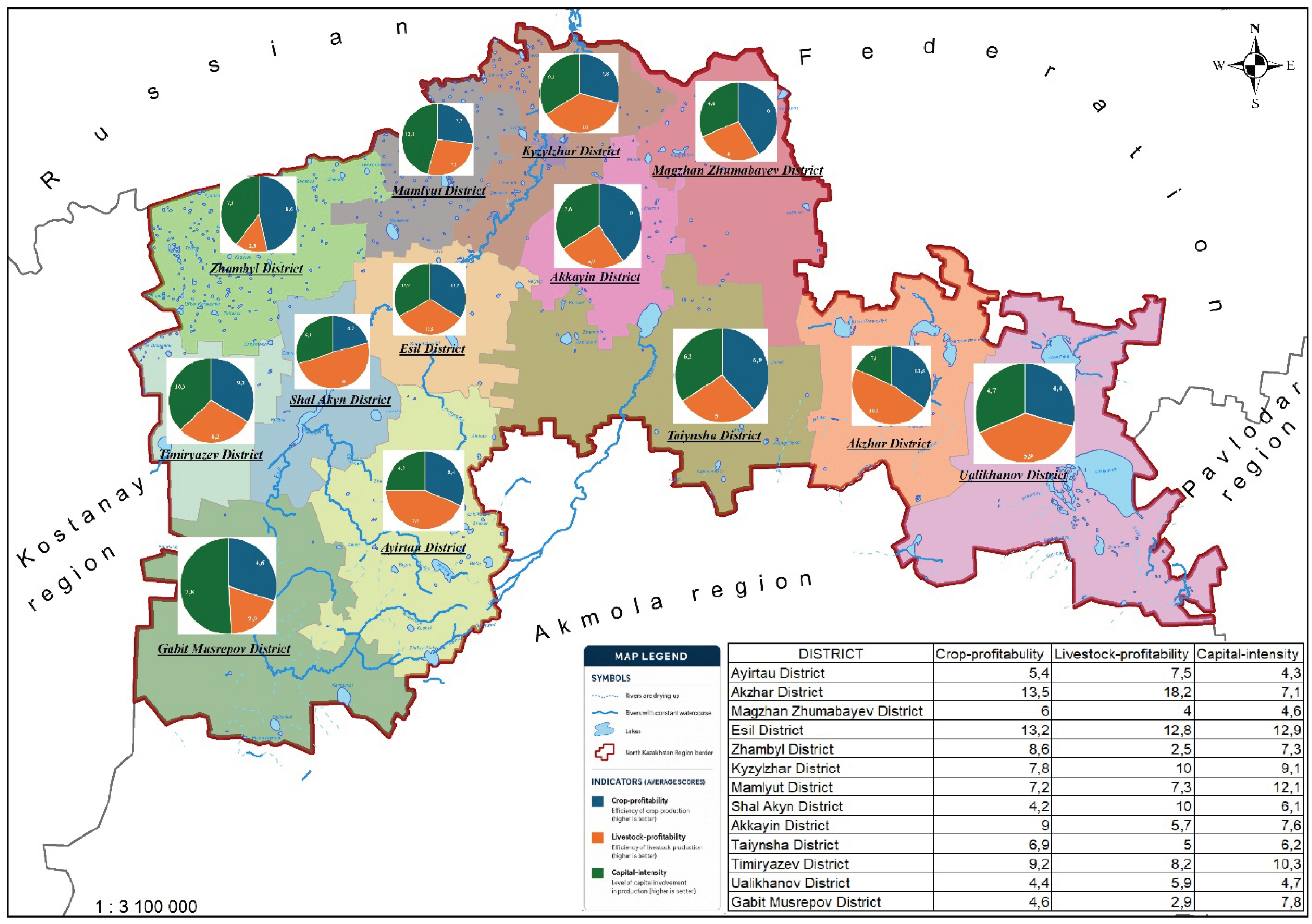

Table 1.
Summary of district-level indicators used in the composite assessment.
| Indicator block | Underlying district-level measure | Calculation basis / unit | Role in the composite assessment |
| Investment activity | Annual capital investment in the AIC | Thousand KZT per 100 ha of agricultural land | Land-normalized investment score |
| Gross agricultural output | Value of gross agricultural output | Thousand KZT per 100 ha of agricultural land | Land-productivity score |
| Crop yield | Yields of potatoes, vegetables, grains, and oilseeds | c/ha; integrated crop-yield score | Production and technological component |
| Livestock productivity | Milk yield per cow, egg yield, and pig weight gain | kg, pcs, and g; integrated livestock-productivity score | Animal-husbandry performance component |
| Crop-production profitability | Gross profit relative to production costs | % | Financial-efficiency component |
| Livestock-production profitability | Gross profit relative to production costs | % | Financial-efficiency component |
| Capital intensity | Fixed production assets relative to the value of agro-industrial production | Ratio, tenge per tenge | Capital-provision component |
Table 2.
Determination of district scores based on annual investments in the AIC across the districts of the North Kazakhstan Region.
Table 2.
Determination of district scores based on annual investments in the AIC across the districts of the North Kazakhstan Region.
| № | District Name | Investments in the AIC, thousand KZT | Agricultural land area of the district, ha | Investments in the AIC per 100 ha of agricultural land, thousand KZT | Ipn |
| 1 | Ayirtau District | 10,394,984.00 | 602,240 | 1,726.1 | 6.2 |
| 2 | Akzhar District | 5,314,268.00 | 504,592 | 1,053.2 | 3.8 |
| 3 | Magzhan Zhumabayev District | 6,626,822.00 | 576,537 | 1,149.4 | 4.1 |
| 4 | Esil District | 12,119,618.00 | 389,176 | 3,114.2 | 11.2 |
| 5 | Zhambyl District | 9,387,356.00 | 502,283 | 1,868.9 | 6.7 |
| 6 | Kyzylzhar District | 17,101,104.00 | 341,718 | 5,004.4 | 17.9 |
| 7 | Mamlyut District | 3,810,094.00 | 275,952 | 1,380.7 | 4.9 |
| 8 | Shal Akyn District | 7,934,975.00 | 342,123 | 2,319.3 | 8.3 |
| 9 | Akkayin District | 9,482,542.00 | 340,958 | 2,781.1 | 10.0 |
| 10 | Taiynsha District | 34,629,769.00 | 915,255 | 3,783.6 | 13.6 |
| 11 | Timiryazev District | 6,212,324.00 | 358,856 | 1,731.1 | 6.2 |
| 12 | Ualikhanov District | 6,388,969.00 | 933,174 | 684.6 | 2.5 |
| 13 | Gabit Musrepov District | 12,379,904.00 | 952,681 | 1,299.4 | 4.7 |
| Total: | 141,782,729.00 | 7,035,545 | 27,896.3 | 100.0 |
Table 3.
Aggregate score assessment of the production and economic activities of the districts of the North Kazakhstan Region in the agro-industrial sector.
Table 3.
Aggregate score assessment of the production and economic activities of the districts of the North Kazakhstan Region in the agro-industrial sector.
| № | District Name | Investments | Gross output | Yield | Productivity | Profitability of crop production | Profitability of livestock production | Capital intensity | Aggregate score |
| 1 | Ayirtau District | 6.2 | 6.1 | 30 | 31 | 5.4 | 7.5 | 4.3 | 90.5 |
| 2 | Akzhar District | 3.8 | 5 | 26.9 | 15.1 | 13.5 | 18.2 | 7.1 | 89.6 |
| 3 | Magzhan Zhumabayev District | 4.1 | 7.7 | 31.5 | 10.2 | 6 | 4 | 4.6 | 68.1 |
| 4 | Esil District | 11.2 | 8.9 | 28.7 | 37.6 | 13.2 | 12.8 | 12.9 | 125.3 |
| 5 | Zhambyl District | 6.7 | 7.1 | 32.4 | 11.8 | 8.6 | 2.5 | 7.3 | 76.4 |
| 6 | Kyzylzhar District | 17.9 | 13.4 | 35.2 | 54.6 | 7.8 | 10 | 9.1 | 148.0 |
| 7 | Mamlyut District | 4.9 | 8.8 | 35.3 | 19.9 | 7.2 | 7.3 | 12.1 | 95.5 |
| 8 | Shal Akyn District | 8.3 | 8.4 | 32.5 | 6.9 | 4.2 | 10 | 6.1 | 76.4 |
| 9 | Akkayin District | 10 | 9.6 | 36 | 19.2 | 9 | 5.7 | 7.6 | 97.1 |
| 10 | Taiynsha District | 13.6 | 8.5 | 34.6 | 62 | 6.9 | 5 | 6.2 | 136.8 |
| 11 | Timiryazev District | 6.2 | 7.6 | 29.3 | 14.9 | 9.2 | 8.2 | 10.3 | 85.7 |
| 12 | Ualikhanov District | 2.5 | 2.3 | 20 | 4.7 | 4.4 | 5.9 | 4.7 | 44.5 |
| 13 | Gabit Musrepov District | 4.7 | 6.6 | 27.5 | 12.2 | 4.6 | 2.9 | 7.8 | 66.3 |
Table 4.
Formation of district groups with different levels of production and economic activity.
| № | Level of production and economic activity | Total score for production and economic activity | Districts |
| 1 | Low | Up to 65.0 | Ualikhanov District |
| 2 | Moderate | 65.1–86.0 | Gabit Musrepov District, Magzhan Zhumabayev District, Zhambyl District, Shal Akyn District, Timiryazev District |
| 3 | Medium | 86.1–107.0 | Akzhar District, Ayirtau District, Mamlyut District, Akkayin District |
| 4 | Above average | 107.1–128.0 | Esil District |
| 5 | High | Over 128.1 | Kyzylzhar District, Taiynsha District |
Disclaimer/Publisher’s Note: The statements, opinions and data contained in all publications are solely those of the individual author(s) and contributor(s) and not of MDPI and/or the editor(s). MDPI and/or the editor(s) disclaim responsibility for any injury to people or property resulting from any ideas, methods, instructions or products referred to in the content. |
© 2026 by the authors. Licensee MDPI, Basel, Switzerland. This article is an open access article distributed under the terms and conditions of the Creative Commons Attribution (CC BY) license (http://creativecommons.org/licenses/by/4.0/).
Copyright: This open access article is published under a Creative Commons CC BY 4.0 license, which permit the free download, distribution, and reuse, provided that the author and preprint are cited in any reuse.