

Submitted:
08 September 2026
Posted:
08 September 2026
You are already at the latest version
Abstract
Microplastics are increasingly detected throughout food-production systems, from agricultural soils and irrigation waters to aquaculture environments, food-processing facilities, and final food products. Beyond their role as contaminants and microbial carriers, plastic particles provide persistent surfaces for biofilm development and may selectively shape the microorganisms and functional traits that persist during environmental transport. This review introduces an ecological-filter framework for understanding the microbiological significance of microplastics across food systems. We examine how polymer properties, conditioning films, weathering, environmental gradients, ecological succession, and colonization history interact to drive plastisphere assembly and microbial community turnover. Particular attention is given to the hypothesis that mature plastisphere biofilms may provide temporary microenvironmental buffering during transitions between physicochemically distinct environments, potentially facilitating microbial acclimation and selective persistence. We further evaluate evidence for the enrichment, expression, and horizontal transfer of antimicrobial resistance determinants within plastisphere communities and distinguish these processes from simple microbial carriage. Analytical approaches are critically examined through an evidence hierarchy spanning taxonomic detection, functional potential, transcriptional and protein expression, phenotype, food occurrence, and demonstrated health outcomes. Although current evidence supports selective microbial and resistome restructuring on microplastics, direct links between environmental plastisphere selection, persistence in food products, dietary exposure, and human-health effects remain limited. We therefore propose that microplastics in food systems should be considered dynamic ecological habitats undergoing sequential filtering rather than passive vectors carrying stable microbial communities. Integrating microbial ecology, multi-omics, spatial analyses, cultivation, and food-chain tracking will be essential to determine when plastisphere-mediated ecological selection translates into meaningful food-safety risk.
Keywords:
microplastics
; plastisphere
; ecological filtering
; food systems
; microbial community assembly
; antimicrobial resistance
; horizontal gene transfer
; biofilms
; food safety
; microbial ecology
; gut microbiome
; human health
1. Introduction—From Carriers to Ecological Filters
Microplastic contamination has become increasingly relevant to food systems because plastic particles occur across all environmental compartments involved in food production, including agricultural soils, aquaculture and even atmospheric environments, and have also been detected in a wide range of food products [1,2,3]. In agricultural soils, for example, polyethylene microplastics can alter both soil physicochemical properties and bacterial community composition [1], while plastic-associated microbial communities have been documented in mariculture environments [2,4] and the atmosphere [5,6,7]. At the consumer end of the food chain, microplastics have been detected in diverse products including salts, sauces, seafood, seaweed, honey, beer, and beverages, confirming dietary exposure as an important interface between environmental plastic contamination and humans [8].
Research on the microbiological dimension of plastic pollution has traditionally emphasized the capacity of plastics to provide surfaces for microbial attachment and to transport microorganisms through the environment. The seminal description of the “plastisphere” demonstrated that floating plastic debris supports microbial assemblages distinct from those occurring in surrounding seawater [9]. Subsequent experimental studies have shown that plastisphere assembly is influenced by environmental conditions and substrate characteristics, indicating that colonization is not simply a random representation of the surrounding microbial pool [10]. Plastic surfaces may therefore create ecological conditions that favor particular microbial taxa, functional traits, and interaction networks.
This observation supports a conceptual shift from considering microplastics exclusively as microbial carriers toward considering them as potential ecological filters. Under this perspective, the central question is no longer simply which microorganisms are transported by microplastics?, but rather which microorganisms are preferentially recruited, retained, or excluded during plastisphere development? Experimental evidence supports this distinction. Microplastic biofilms can selectively enrich particular bacterial groups, including potentially pathogenic taxa [11], while riverine plastisphere communities have been shown to differ taxonomically and functionally from surrounding planktonic communities [12]. Long-term marine experiments further demonstrate selective enrichment of both microbial assemblages and functional genetic traits on plastic surfaces [13]. Microplastics are consumed by aquatic life; thus pathogenic members of the plastisphere can be transmitted to humans in foods from marine and freshwater.
Community turnover within the plastisphere may emerge from the interaction between the available environmental species pool and selective conditions generated by the plastic–biofilm interface. The ecological-filter concept becomes particularly important in relation to antimicrobial resistance (AMR). Many human food pathogens are zoonotic and AMR is one of main threats to public health [14], with the UK government anxious to control the spread of AMR in the animal population. The UK’s Food Standards Agency (FSA) has pointed out the risk of food as a bridge between animal sources and human infection [15]. Plastisphere biofilms provide densely colonized and spatially structured microbial habitats in which microorganisms coexist with mobile genetic elements, resistance determinants, pollutants, and other potential selective agents; metagenomic studies have demonstrated enrichment of antibiotic resistance genes (ARGs) and mobile resistance determinants on microplastics relative to surrounding water [12,13,16]. Experimental evidence further shows that different microplastic types can accumulate ARGs and support their horizontal transfer [17], and metagenomic and metatranscriptomic analyses have demonstrated that ARGs detected within plastisphere communities may be transcriptionally active [18]. More recent risk-ranking approaches also indicate that the antimicrobial-resistance potential of plastisphere communities can vary substantially according to plastic characteristics, including polymer biodegradability [19].
The presence of an ARG, enrichment of an ARG relative to the surrounding environment, transcription of that gene, association with a potentially pathogenic host, horizontal gene transfer, and expression of a phenotypically resistant organism all represent different levels of biological evidence. These outcomes should therefore not be treated as interchangeable indicators of food-safety risk. This distinction is particularly important because studies of microplastic-associated communities frequently rely on taxonomic or gene-based approaches that demonstrate microbial or genetic potential but do not necessarily demonstrate viability, pathogenicity, resistance phenotype, or potential transmission to humans [12,18,19]. An ecological-filter framework should consequently distinguish microbial selection from functional resistance, and both from demonstrated exposure and health effects.
Food-production systems provide a particularly relevant context in which to investigate these distinctions. In mariculture, plastic-associated bacterial communities can differ from those in surrounding water, sometimes being found to contain more potential pathogens [20] or to increase ARG abundance [21]. Different polymers may exhibit different affinities for potentially pathogenic bacterial groups [2,21]. However, even in such systems, enrichment is not universal: one in situ mariculture study found polymer-specific preferences among potential pathogens but did not observe overall pathogen enrichment on microplastics compared with other environmental microbial fractions [2]. This illustrates why the simple detection of microorganisms on plastic surfaces cannot be equated with increased food-safety risk. The critical unresolved question is whether microbial selection occurring on microplastics can influence the microbial communities that subsequently interact with food organisms, food-production environments, or food products. Although dietary exposure to microplastic particles themselves is well established [22,23], direct evidence connecting plastisphere-mediated microbial selection with human exposure through food remains considerably more limited.
A further challenge is that our interpretation of microbial selection strongly depends on the analytical methods used to characterize plastisphere communities. Early studies combining microscopy and marker-gene sequencing established the taxonomic distinctiveness of plastic-associated communities [9], while shotgun metagenomics subsequently expanded analysis toward functional genes and metabolic potential [24,25,26]. Multi-omics strategies integrating community succession, proteomics, and metabolomics have demonstrated how complementary approaches can distinguish predicted functional potential from experimentally supported microbial activity [27,28]. Similarly, combined metagenomic and metatranscriptomic approaches can distinguish the presence of ARGs from their active transcription [18], while fluorescence-based imaging techniques such as CLASI-FISH provide spatial information on microbial organization that cannot be recovered from bulk sequencing alone [29]. Clearly, the apparent magnitude and biological meaning of ecological filtering depend partly on the analytical window through which the plastisphere is observed.
In this review, we propose a framework in which microplastics are considered ecological filters and relays capable of shaping microbial community turnover and functional-trait persistence across food-production systems. We examine the physicochemical and ecological mechanisms driving microbial selection on plastic surfaces, evaluate evidence for the enrichment and mobilization of antimicrobial-resistance traits, and critically assess the analytical approaches used to distinguish microbial presence from functional activity and biological risk. We then follow these processes across environmental, food-production, processing, and gastrointestinal boundaries to evaluate when plastisphere-mediated selection may acquire direct human-health relevance. In particular, we distinguish three partially overlapping pathways of foodborne microplastic exposure: particle-mediated effects arising from physicochemical interactions with the gastrointestinal environment; chemical-mediated effects involving compounds associated with or released from plastic particles; and plastisphere-mediated effects involving environmentally selected microorganisms, pathogens, or transferable genetic determinants. By integrating microbial ecology, food safety, antimicrobial resistance, gastrointestinal microbiology, and human-health evidence, this review moves beyond the conventional view of microplastics as passive microbial carriers and develops a mechanistic framework for determining when their ecological history may influence the biological consequences of human exposure.
2. Microplastics Across Food-Production Systems
Food-production systems provide multiple entry points through which microplastics can interact with microbial communities before reaching the consumer (Figure 1). Unlike a linear contamination pathway, however, the food system comprises interconnected environmental and technological compartments in which plastic particles can be introduced, retained, weathered, recolonized, and redistributed. Agricultural soils receive microplastics from plastic mulch residues, wastewater irrigation, sewage sludge, organic fertilizers, and manure; livestock may encounter them through feed, soil, water, and agricultural materials; aquaculture systems are exposed through surrounding waters, culture infrastructure, and contaminated feeds; and additional particles may be introduced during food processing, handling, storage, and packaging [30,31,32,33,34,35,36,37,38,39,40,41]. These different contamination windows are ecologically important because the history of a particle determines the microbial community that can develop on its surface. A weathered microplastic residing for months in soil or seawater represents a fundamentally different microbial habitat from a particle freshly generated by abrasion of food-contact materials.
2.1. Agricultural Soils, Irrigation, and the Crop Interface
Agricultural soils represent an important convergence zone for microplastic contamination. Long-term application of sewage sludge has been directly associated with increasing microplastic abundance in agricultural soils, demonstrating that soil amendments can act as persistent delivery pathways [30,42]. Microplastics have been identified in recycled wastewater and in soils irrigated with these waters, indicating that agricultural water reuse can transfer plastic particles from wastewater-treatment systems into cultivated environments [31,43]. Manure application creates an additional connection between livestock production and crop agriculture [44]; fields receiving pig manure for 22 years contained significantly more microplastics than untreated control soils, and similarities between polymers recovered from manure and soil supported manure as an important microplastic source [32].
These inputs are particularly relevant from an ecological-filter perspective because agricultural soils provide long residence times during which plastic particles undergo physical weathering, chemical oxidation, interaction with organic matter, and microbial colonization. Consequently, agricultural microplastics should not be regarded merely as contaminants passing through soil but as persistent surfaces embedded within highly diverse microbial environments. Their proximity to rhizosphere communities creates opportunities for repeated microbial recruitment and community succession, potentially producing plastisphere assemblages different from the surrounding bulk soil [45].
The soil–plant interface also represents a possible transition from environmental contamination toward food production. Experimental work with wheat (Triticum aestivum) and lettuce (Lactuca sativa) demonstrated that submicrometre- and micrometre-sized polystyrene and polymethylmethacrylate particles can enter roots through cracks associated with lateral-root emergence and subsequently be transported toward shoots [33]. This finding does not imply that all environmentally occurring microplastics are efficiently incorporated into edible plant tissues; particle size, polymer properties, plant species, soil conditions, and experimental exposure concentrations strongly influence uptake [7,46]. Nevertheless, it demonstrates a physical pathway by which sufficiently small plastic particles may cross the soil–plant boundary, with nanoparticles known to be able to enter roots under controlled conditions [47].
For the present review, an equally important but much less investigated question concerns the microbiological consequences of this interface. Even when entire plastisphere communities are unlikely to accompany particles into internal plant tissues, microplastic-associated microbial selection occurring in the rhizosphere would alter the microorganisms interacting with roots and plant surfaces. Thus, agricultural microplastics may influence food-associated microbiology through at least two distinct pathways: particle transfer toward crops and ecological modification of microbial communities at the soil–plant interface. The second pathway remains substantially less characterized and represents an important research gap.
2.2. Livestock Production and the Feed–Manure–Soil Cycle
Livestock systems create a potentially circular pathway for microplastic movement through food-production environments. Microplastics have been identified in poultry and livestock manure collected from commercial farms, with polyethylene and polypropylene among the commonly detected polymers [34]. Field observations have also detected microplastics in animal feces and surrounding agricultural soils [48], demonstrating that grazing animals can participate in the redistribution of plastic particles within agricultural environments [35,44].
Microplastic exposure within livestock systems may arise through various routes, including contaminated feed, forage containing residues of agricultural plastics, drinking water, airborne deposition, and contact with plastic materials used during animal husbandry. After excretion, particles contained in manure can subsequently return to agricultural soils when manure is applied as fertilizer [32,34]. This produces a potentially recurrent feed–animal–manure–soil–crop cycle, rather than a simple one-way transfer of contamination. This circularity has particular relevance to microbial ecology. Plastic particles entering an animal-production system may already carry environmental biofilms, encounter intestinal microbial communities, pass into manure, undergo composting or storage, and subsequently enter soil ecosystems containing a new microbial species pool. Each transition exposes the particle to different environmental filters and creates opportunities for microbial turnover. The food-production chain may thus contain multiple sequential plastispheres rather than a single stable plastic-associated microbiome. Such sequential colonization is highly relevant to antimicrobial resistance because livestock environments frequently contain antibiotic residues, resistant bacteria, resistance genes, and high-density microbial communities [49]. However, the coexistence of these factors with microplastics should not itself be interpreted as evidence that plastic particles increase antimicrobial-resistance transmission. To establish such a relationship, plastic surfaces must be shown to preferentially enrich resistant populations or resistance determinants in relation to appropriate environmental controls—a distinction examined in detail in Section 5.
2.3. Aquaculture, Fisheries, and Seafood Production
Aquatic food-production systems provide particularly direct opportunities for prolonged interactions between microplastics and microorganisms. In aquaculture, particles can originate from environmental contamination of surrounding waters, degradation of ropes, nets, cages, floats, and other plastic infrastructure [50], as well as from feed. Commercial fish feeds have been shown to contain microplastics, providing a direct pathway by which cultured organisms may be repeatedly exposed during production [36,37,50,51]. Contemporaneously, plastic particles suspended in culture waters provide persistent surfaces for microbial colonization. An in-situ mariculture study showed that bacterial assemblages associated with different microplastic polymers differed from those in surrounding environmental fractions and that certain potentially pathogenic taxa exhibited polymer-associated preferences [2]. Such selective association may occur at the level of individual taxa or microbial groups without producing a generalized increase in pathogen abundance.
Aquatic food-production systems expose microplastics to pronounced physicochemical gradients that can impose additional ecological filtering. In organically enriched aquaculture environments, particularly near the sediment–water interface and beneath culture facilities, microbial decomposition of uneaten feed, fecal material, and other organic matter can promote rapid oxygen consumption and the development of suboxic and anoxic microniches [52]. Microplastics settling from oxygenated surface waters into these environments may cross distinct redox regimes and encounter microbial communities adapted to denitrification, sulfate reduction, sulfur oxidation, fermentation, and other anaerobic or microaerophilic metabolisms. Biofilm development itself can further intensify microscale redox heterogeneity by restricting oxygen diffusion and generating metabolically differentiated zones within the plastisphere [53]. From an ecological-filter perspective, redox conditions represent an underappreciated selective force shaping aquaculture-associated plastisphere communities. A particle colonized in the oxic water column may undergo substantial microbial turnover after sinking into reducing sediments and may subsequently return to more oxygenated environments through resuspension, bioturbation, hydrodynamic disturbance, or transport on/in living organisms. Microplastics may thus cross not only spatial compartments but also biogeochemical regimes, exposing their associated communities to sequential redox filters. Such transitions could favor microbial taxa and functional traits that would not be predicted from polymer identity or surrounding water chemistry alone [54], further reinforcing the view of microplastics as dynamic ecological habitats rather than static microbial carriers.
Cultured and harvested seafood provide another interface between environmental microplastic contamination and consumers. Microplastics have been detected in commercially cultured mussels (Mytilus edulis) and oysters (Crassostrea gigas) [38,55]. Because bivalves are commonly consumed whole, including the gastrointestinal tract, they represent a particularly direct route through which ingested particles are consumed by humans. Quantitative chemical analysis has demonstrated plastic contamination in commercially important seafood including fish, prawns, oysters, squid, and sardines [39,56]. However, the presence of a microplastic particle in seafood and the presence of its original environmental plastisphere are not equivalent [57]. Depuration, digestion, food preparation, storage, microbial turnover, host-associated conditions, and transitions between oxic and reducing environments can substantially modify particle-associated communities. Consequently, determining whether aquaculture-derived plastisphere communities—or particular microbial functions and resistance traits within them—persist until consumption requires direct microbiological investigation of particles recovered at successive stages of the production chain.
2.4. Food Processing, Handling, and Food-Contact Materials
Microplastic contamination of food can originate post-harvest. Food processing and handling can generate additional particles, creating a second major contamination pathway that is mechanistically distinct from environmental exposure. Mechanical abrasion of plastic food-contact surfaces and release from food containers used for storage, or heated in microwaves, are two examples [58,59]. Experiments with polyethylene and polypropylene cutting boards have demonstrated that chopping can release substantial numbers of microplastic particles [40]; a 10 minute chopping cycle can release 2750–7242 microplastics (62–164 μm) and 2.33 × 10⁷–1.12 × 10⁸ nanoparticles (104–200 nm) [60]. Food preparation surfaces are thus potential sources of direct food contamination. Thermal and mechanical conditions can also influence particle release from food containers. Experiments using polypropylene containers and reusable polyethylene food pouches demonstrated release of micro- and nanoplastics under realistic storage and heating conditions, with microwave heating producing substantially greater particle release than room-temperature or refrigerated storage in the tested systems [41]. PE-packaged products were shown to release nanoplastic particles within 1-3 minutes of microwave heating [61], while Liao et al. [62], using argon-assisted internal-tube sampling enhanced microwave plasma ionization linear ion trap mass spectrometry (AIS-EMPI-LTQMS) to measure nanoplastics, found their concentration after 180 seconds of microwave heating of rectangular polypropylene containers to be up to 2.04 ± 0.32 μg/L.
This post-harvest contamination pathway introduces an important distinction for studies linking microplastics to microbial food safety. Not all microplastics occurring in food are ecologically equivalent. A particle that has undergone long-term environmental exposure may carry a mature and selectively assembled plastisphere, whereas a fragment generated immediately before consumption by cutting, friction, or heating may have little or no established biofilm. Combining these particle categories in microbiological analyses could therefore obscure the processes responsible for microbial selection. Food-processing environments may nevertheless provide opportunities for secondary colonization when particles remain on wet surfaces, in process water, drains, storage systems, or equipment for sufficiently long periods. The key variable is therefore not simply whether a particle originated from packaging or processing equipment, but its residence time and ecological history before reaching the food product.
2.5. From Environmental Contamination to the Food Product: A Connected Food-System Perspective
Collectively, current evidence indicates that microplastics can enter the food system at multiple points. These can be broadly organized into three contamination windows:
(1) pre-harvest environmental exposure, including contaminated soil, irrigation water, aquatic environments, and agricultural amendments;
(2) production-associated exposure, including animal and aquaculture feeds, manure recycling, culture infrastructure, contaminated water, and interactions with food-producing organisms; and
(3) post-harvest contamination, arising during processing, preparation, handling, storage, and contact with plastic materials.
Long-residence plastic particles in soils, irrigation systems, aquaculture waters, and manure are likely to experience repeated microbial colonization and ecological succession, whereas freshly generated post-harvest particles may contribute to particle exposure without carrying mature microbial communities. We therefore propose that the food system should be viewed as a sequence of ecological transition zones through which microplastics and their associated microorganisms may pass. At each transition (environment → production system → food-producing organism → processing environment → food product) microbial communities may be retained, replaced, or selectively reorganized. Determining where such turnover occurs, which traits are consistently enriched, and whether selected microorganisms or resistance determinants persist across these boundaries is fundamental to evaluating the real food-safety relevance of the plastisphere. Clearly, detecting microplastics in a food product does not reveal where the particle entered the food chain or at which stage its associated microbial community was selected. Linking particle provenance with microbial composition is necessary to distinguish environmental plastisphere-mediated risk from contamination generated during food processing and handling.
3. Mechanisms of Microbial Filtering on Microplastic Surfaces
Ecological filtering implies that microorganisms from a larger environmental species pool do not have equal probabilities of establishing and persisting on plastic particles. Evidence from marine, freshwater, estuarine, and soil environments increasingly supports the selective assembly process discussed here [10,63,64,65,66,67,68]. Filtering is dynamic rather than fixed. The selective properties of a microplastic particle evolve through adsorption of organic molecules, weathering, biofilm formation, microbial competition and succession, and transfer between environmental compartments.
3.1. Ecological Filtering Begins Before Microbial Attachment
The first selective event on a microplastic surface occurs before the microorganisms attach. When plastic enters an aqueous environment, dissolved organic molecules rapidly adsorb to its surface and form a conditioning film, described as an eco-corona by Nasser and Lynch [69]. This layer alters the chemical environment encountered by approaching microorganisms and can therefore influence the earliest stages of colonization.
Rummel et al. demonstrated experimentally that dissolved organic matter does not adsorb randomly to polymer surfaces [63]. Using polyethylene terephthalate (PET), polystyrene (PS), and glass controls, the authors showed preferential adsorption of particular fractions of dissolved organic matter and demonstrated that the composition of the conditioning film depended on substrate properties. UV-weathered polymers also adsorbed organic matter differently from non-weathered materials [63]. Early microbial attachment showed evidence of substrate specificity, although the different communities subsequently tended to converge during early succession. Microorganisms do not initially encounter chemically pristine polyethylene, polypropylene, PS, or PET. Rather, they encounter a polymer–organic matter interface whose composition has already been selectively modified by the surrounding environment. The ecological-filtering process thus begins with molecular selection of the compounds forming the conditioning layer, which in turn modifies subsequent microbial recruitment. This may be particularly important in food-production environments, where the composition of dissolved and particulate organic matter varies substantially among irrigation water, manure-amended soils, aquaculture waters, animal-associated environments, and food-processing systems. The same polymer entering these different environments could develop different conditioning films and subsequently recruit completely different microbial assemblages.
3.2. Polymer Identity and Surface Properties as Selective Factors
Plastic polymer surface makeup influences interactions with surrounding organic molecules and the physical and chemical conditions experienced by attached microorganisms. Experimental evidence indicates that polymer identity can influence plastisphere composition, although its importance varies with environment and exposure time. Qiang et al. investigated bacterial biofilm development on HDPE, PET, and PS in a freshwater–estuarine gradient and demonstrated differences in community composition associated with both polymer and environmental conditions [65]. Similarly, in a mariculture cage, Hou et al. observed succession and assembly of distinct prokaryotic communities on different types of microplastics over a three-month experiment [67].
The contrast between biodegradable and conventional polymers provides particularly useful evidence for ecological filtering. Sun et al. compared polyethylene (PE) and polylactic acid (PLA) plastispheres in soils and found markedly lower bacterial alpha diversity on microplastic surfaces relative to bulk soil, together with pronounced differences in microbial composition [64]. Community assembly differed between the two polymers; homogeneous selection contributed more strongly to assembly of the PLA plastisphere than to the PE plastisphere; the authors associated this with selective pressures arising from degradation of the former, biodegradable, polymer [64]. This illustrates an important aspect of the ecological-filter concept: plastic surfaces may differ not simply in the number of microorganisms they support, but in the intensity and nature of the selective pressures they impose. A degradable polymer may provide carbon substrates or degradation intermediates that favor organisms capable of exploiting those compounds, whereas recalcitrant polymers select communities through different mechanisms, including attachment characteristics, adsorbed organic matter, or environmental exposure. Polymer identity should not, however, be considered a universal predictor of plastisphere composition. Several studies indicate that its influence frequently interacts with, or may be outweighed by, environmental conditions and colonization time [10,65,66]. Thus, polymer-specific selection is better interpreted as one component of a multidimensional ecological filter rather than as an isolated determinant of microbial community structure.
3.3. Weathering Changes the Ecological Identity of the Particle
Microplastics entering food-production environments may differ substantially in age and environmental history. Rummel et al., for example, showed that UV-weathered polymers adsorbed more polar and hydrophilic organic compounds than corresponding non-weathered materials [63]. Weathering can thus indirectly alter microbial recruitment by changing the chemistry of the interface available for colonization. Biofilm formation further modifies the particle. Microbial colonization can occur rapidly on plastic surfaces following environmental exposure [70], but once an extracellular matrix develops, the surface becomes composed of extracellular polymeric substances, adsorbed compounds, microbial cells, and metabolic products. The ecological properties of the particle thus become progressively decoupled from those of the original manufactured material. A polyethylene fragment that has remained for months in agricultural soil or aquaculture water cannot be considered ecologically equivalent to a polyethylene particle freshly generated from food packaging or a cutting surface. Although both may be analytically classified as PE microplastics, their surface chemistry, conditioning layers, colonization history, and microbial communities will be fundamentally different. We propose the concept of “ecological age” as distinct from polymer identity. Ecological age represents the cumulative history of environmental exposure, surface transformation, and biological colonization experienced by a particle. From a food-safety perspective, ecological age is more informative than polymer identity alone when estimating the likelihood that a microplastic carries a mature and selectively assembled microbial community.
3.4. Environmental Conditions Define the Colonizing Surface
The same polymer can recruit different microbial communities when exposed to different environmental species pools and environmental conditions [71,72]. Particles may move from wastewater into irrigation systems and soils, from freshwater inputs into estuarine aquaculture environments, from sediments into food organisms, or from environmental matrices into processing waters. Each transition changes both the available microbial source pool and the selective conditions acting upon the plastisphere. Thus, transportation of a plastic particle does not imply transportation of an unchanged microbial community. The particle may persist while its microbiome turns over. This distinction fundamentally separates the ecological-filter model from a simple vector model.
3.5. Microbial Succession: From Pioneer Colonizers to Mature Plastisphere Communities
Time represents another major ecological filter. Early marine observations demonstrated rapid microbial biofilm development on plastic debris [70], while subsequent, longer, experiments showed temporal changes in both bacterial and fungal communities. De Tender et al., using plastic debris exposed in the North Sea, documented dynamic bacterial and fungal colonization and demonstrated that community composition changed substantially with time [68]. Similar temporal patterns have been observed in mariculture systems, where prokaryotic communities on different polymers undergo succession during prolonged environmental exposure [67], while Zhang et al. examined prokaryotic and eukaryotic succession on different polymers in lake environments and demonstrated that plastisphere assembly reflected interactions among site, incubation time, and polymer type [66].
Succession also involves a changing balance between deterministic and stochastic ecological processes. In soil plastispheres, Sun et al. found evidence for substantial contributions from stochastic assembly while simultaneously demonstrating non-negligible deterministic selection [64]. This is important because an ecological-filter model should not imply that plastisphere composition is completely predictable. The plastisphere can be conceptualized as a selectively constrained but historically contingent microbial habitat. Polymer properties and environmental conditions define the boundaries of possible community assembly, while arrival order, microbial interactions, and stochastic colonization influence the community that ultimately develops.
3.6. From Community Assembly to Microbial Community Turnover (Figure 2)
The combined effects of conditioning-film formation, polymer properties, weathering, environmental gradients, and ecological succession provide a mechanistic basis for microbial community turnover on microplastic surfaces [63,64,65,66,67,68,70,73]. Rather than simply concentrating microorganisms already abundant in the surrounding environment, microplastics may progressively modify the relative abundance, persistence, and functional composition of microbial populations during environmental transport. This distinction is fundamental to the hypothesis developed in this review: carriage describes movement; ecological filtering describes change. A carrier can transport the microbial community that initially colonized its surface. An ecological filter, in contrast, modifies the probability that particular microorganisms or functional traits will persist as the particle moves between environments. Ecological filtering can involve, for example, extracellular polymeric substances creating hydrated microenvironments and increasing microbial tolerance to environmental stress [74,75]. Thus the plastisphere can partially buffer the environmental transitions experienced by its resident microorganisms.
We suggest that a mature plastisphere may function as a temporary microenvironmental buffer when a mobile microplastic crosses physicochemically distinct environments. The ecological advantage conferred by the plastisphere may not be limited to physically transporting microorganisms across environmental boundaries; it may also increase the probability that some residents cross those boundaries while acclimating to the new environment. This ecological filtering involves two complementary processes: direct environmental selection that progressively removes organisms unable to persist under the new physicochemical conditions, and buffered ecological transition that allows other organisms sufficient time to acclimate before experiencing the full intensity of the change. Community turnover therefore reflects not only pre-existing environmental tolerance but also the capacity of plastisphere residents to respond physiologically during the transition. This suggests a refined sequence of plastisphere development and turnover:
Environmental recruitment → biofilm development → microenvironmental buffering → physiological acclimation → selective retention and turnover → restructured plastisphere
The resulting plastisphere will represent neither the original environmental microbiome nor a random subset of it, but a community shaped by sequential recruitment, buffering, acclimation, selection, and ecological succession. This could be especially important in food-production systems, where microplastics can repeatedly cross strong environmental boundaries. A particle originating in wastewater may first develop a wastewater-associated plastisphere, enter irrigation water, encounter agricultural soil and rhizosphere communities, and eventually interact with crop surfaces or processing environments. Similarly, an aquaculture-associated particle may move from an oxygenated water column through suboxic interfaces into reducing sediments, be resuspended, ingested by a food organism, pass through gastrointestinal conditions, and subsequently encounter depuration and food-processing environments. At each transition, the particle may remain physically continuous while its microbial community is progressively reorganized.
We propose that microplastics moving through food systems should be regarded as dynamic microbial habitats undergoing sequential and potentially buffered ecological filtering, rather than as static vehicles carrying a fixed microbial cargo. This distinction has direct implications for antimicrobial resistance and food safety. Functional traits—including resistance determinants, stress-tolerance mechanisms, anaerobic or microaerophilic metabolism, biofilm-forming capacity, or pathogenic potential—may persist across environmental boundaries not only because their microbial hosts were intrinsically tolerant before transport, but also because plastisphere-associated buffering provided sufficient time for physiological adjustment. The critical question is therefore no longer only which microbial traits survive ecological filtering across the food-production chain, but also whether the plastisphere modifies the rate at which environmental change is experienced by its microbial residents, thereby increasing their capacity to cross ecological boundaries and acclimate to new conditions. This mechanism expands the ecological role of the plastisphere from a selective habitat to a transitional microenvironment that mediates microbial exposure to environmental change (Fig. 2).
4. Analytical Approaches for Assessing Plastisphere Function and Risk
Understanding the ecological and food-safety significance of plastisphere communities requires analytical approaches able to distinguish microbial presence from biological activity and functional relevance. Microscopy and culture-based methods remain valuable for characterizing biofilm architecture, microbial viability, and cultivable phenotypes, whereas amplicon sequencing provides broader information on community composition and succession. However, taxonomic detection alone cannot determine whether microorganisms are metabolically active or functionally relevant. Molecular approaches provide progressively deeper resolution. Quantitative PCR can target specific functional genes, including antimicrobial resistance genes (ARGs), while metagenomics enables simultaneous characterization of microbial community composition and functional potential. Nevertheless, the detection or enrichment of a gene does not demonstrate its expression or ecological activity. Metatranscriptomics and metaproteomics therefore provide stronger evidence by identifying actively expressed genes and proteins, while metabolomic analyses can reveal biochemical products associated with microbial activity and polymer–microbe interactions [76,77] . This distinction is particularly important when evaluating antimicrobial resistance and potential food-safety implications. Demonstrating ARG enrichment on microplastics is fundamentally different from demonstrating expression, resistant phenotypes, horizontal transfer, persistence in food products, or human exposure. Evidence should be interpreted according to the biological level demonstrated by each analytical approach, avoiding extrapolation from molecular detection directly to ecological or health risk. Future studies could combine complementary methods across successive stages of the food-production chain. Integrating community profiling with functional omics, cultivation, phenotypic assays, and longitudinal sampling could help determine whether selected microbial traits remain active during transport, processing, and eventual incorporation into food products.
5. Selection and Enrichment of Antimicrobial Resistance in the Plastisphere
The ecological significance of the plastisphere is more relevant when functional traits rather than taxonomic composition alone are considered. Microplastic-associated biofilms can contain antibiotic-resistant bacteria (ARB), antibiotic resistance genes (ARGs), and mobile genetic elements (MGEs) at abundances that differ from those of surrounding microbial communities [12,13,16,18,78,79]. Elevated ARG abundance may result from selective recruitment or proliferation of resistant taxa, horizontal gene transfer (HGT), or simply the concentration of microorganisms within dense surface-associated biofilms. The question is whether resistance traits become disproportionately represented during plastisphere development relative to appropriate environmental and surface-associated controls.
5.1. Ecological Selection and Resistome Development
Ecological filtering provides a direct mechanism for resistome restructuring. If plastic surfaces preferentially recruit or retain particular microbial populations, resistance traits carried by those organisms may become enriched through host selection, even without direct selection for individual ARGs. Soil and aquatic plastisphere studies have demonstrated distinct resistance profiles associated with changes in microbial community composition and probable ARG hosts [12,79]. Long-term marine observations indicate that ARG profiles change during plastisphere maturation, suggesting that the resistome develops alongside microbial succession rather than representing a static property of the initially colonizing community [13,78]. Plastisphere-associated antimicrobial resistance (AMR) should be regarded as a dynamic ecological property, influenced by microbial recruitment, succession, environmental conditions, and the ecological age of the particle.
An important limitation is that resistance enrichment may reflect properties of biofilms generally rather than plastics specifically. High cell density, extracellular polymeric substances, localized chemical gradients, and retention of extracellular DNA create conditions favorable to persistence and genetic exchange in many surface-associated communities. Consequently, comparisons between plastisphere and surrounding water alone cannot establish plastic-specific selection. Appropriate controls involving natural or inert colonizable surfaces are needed to distinguish general biofilm effects from those attributable specifically to microplastics.
5.2. Horizontal Gene Transfer (HGT) and Functional Restructuring
Selection of resistant hosts is only one mechanism through which plastisphere development may alter environmental resistomes. HGT can redistribute resistance determinants among microbial populations through conjugation, transformation, and transduction. Experimental studies have demonstrated enhanced accumulation and horizontal transfer of ARGs within microplastic biofilms [17], while biofilm microniches and extracellular DNA may facilitate natural transformation [80]. Evidence from estuarine environments further indicates that plastisphere formation can promote ARG transfer under environmentally realistic conditions [81]. Phages carrying ARGs and virulence-associated genes may provide an additional route for genetic redistribution through transduction [82]. Together, these observations suggest that microplastics may influence not only which resistant organisms persist, but also how resistance determinants move among hosts. Microbial communication may contribute to this process. Quorum-sensing mechanisms associated with plastisphere development regulate biofilm formation, EPS production, stress responses, and microbial interactions, and experimental evidence suggests that they can also influence ARG transformation and mobility [83,84]. Thus, resistance dynamics may emerge from interactions among ecological filtering, biofilm organization, microbial communication, and gene exchange rather than from physical cell proximity alone.
5.3. Environmental Context Determines Resistance Selection
Resistance enrichment is context dependent and methods used for detection of ARGs are strongly dependent on the food matrix [85]. Polymer chemistry, degradability, surface properties, additives, weathering, and ecological age can influence community assembly and consequently the associated resistome. Biodegradable microplastics, for example, have been associated with greater AMR-related effects than some conventional polymers, potentially because degradation products provide microbial resources that alter biomass and community interactions [19,86]. At the same time, microplastics frequently coexist with antibiotics, metals, pharmaceuticals, pesticides, and other contaminants capable of imposing direct or co-selective pressures. Plastisphere-associated resistance should therefore be interpreted as the product of interactions among particle properties, microbial source communities, contaminants, environmental conditions, and exposure history, rather than as an intrinsic characteristic of a particular polymer. Notably, resistance enrichment is not universal. Studies reporting little or no microplastic-associated amplification of AMR demonstrate that ecological outcomes depend on local environmental conditions [87]. Such observations do not contradict ecological filtering; rather, they emphasize that filters do not select the same traits under all circumstances. Microplastics may provide an ecological opportunity for AMR selection and exchange, but the surrounding environment determines whether that opportunity is realized.
5.4. Relevance to Food-Production Systems
Aquaculture and mariculture represent particularly relevant interfaces between plastisphere-associated resistance and food production because here plastic infrastructure, high microbial biomass, environmental contaminants, and farmed organisms coexist within connected aquatic environments. Experimental evidence from mariculture sediments indicates that microplastics can increase ARG abundance through both enrichment of bacterial hosts and enhanced potential for HGT [21]. More broadly, recent observations of resistance-determinant transfer into microbial communities associated with aquaculture organisms [88,89] strengthen the plausibility of functional transmission across environmental–host boundaries. Nevertheless, ARG enrichment in sediment or water does not establish persistence in edible tissues, survival during processing, dietary exposure, or human-health effects.
The food-safety significance of plastisphere-associated AMR therefore currently lies primarily in hazard identification and mechanistic plausibility, rather than demonstrated quantitative human-health risk. Evidence is comparatively strong for ARG enrichment, host association, HGT, and ecological restructuring [90,91,92], but becomes progressively weaker as the pathway approaches food products and consumers. Thus future studies should track microbial strains, ARGs, plasmids, and other mobile genetic elements across environmental and food-associated compartments to determine whether resistance selected within environmental plastispheres persists through production and processing.
Overall, three processes should remain conceptually distinct: Carriage moves resistance. Selection changes its abundance. Horizontal transfer changes its distribution among hosts. Understanding when and where these processes converge is essential for determining whether plastisphere-associated AMR remains primarily an environmental ecological phenomenon or develops into a meaningful food-safety concern.
6. From Food-Production Environments to Food Products
The boundary between the production environment and the food product represents one of the least resolved steps in current plastisphere research - particle transfer and microbial transfer are not equivalent processes. A microplastic particle may be ingested by a food organism while losing part, or all, of its original biofilm; conversely, microorganisms originating from the plastisphere may colonize the host even if the particle itself is subsequently eliminated. Similarly, resistance determinants may move from plastic-associated microorganisms to host-associated bacteria through horizontal gene transfer without requiring long-term persistence of the original plastic-associated donor [93,94]. Food-system risk must therefore be evaluated by tracking three potentially independent entities: the microplastic particle, the associated microbial community, and the functional genes carried by that community.
Evidence that these three components can cross environmental–host boundaries is beginning to emerge, particularly in aquatic food-production systems [95,96].
6.1. Aquatic Food Organisms as Environmental–Food Interfaces
Aquatic organisms represent particularly important interfaces, since microplastics suspended in the water column or incorporated into sediments can be directly encountered through filtration, feeding, ventilation, or contact with external surfaces. Microplastics have been documented in numerous commercially important aquatic organisms, including mussels, oysters, fish, and shrimp [38,39,97,98]. These observations establish that particles present in production environments can enter organisms subsequently harvested as food. However, the microbial relevance of such exposure depends on whether microorganisms associated with the environmental microplastics remain attached during and after ingestion.
Early evidence supporting this possibility came from the identification of the fish pathogen Aeromonas salmonicida on environmental microplastics collected from the northern Adriatic Sea [99]. A. salmonicida is associated with disease in fish, and its occurrence on floating plastic surfaces demonstrated that microplastics can provide substrates for microorganisms directly relevant to aquaculture health. However, mere detection on environmental plastic establishes vector potential and not transmission to fish. A stronger connection was demonstrated by Garcés-Ordóñez et al., who characterized microplastic-associated bacteria from water, sediments, and commercial fish within a tropical coastal lagoon. Potentially pathogenic bacteria were identified on microplastics recovered from all three compartments. Several bacterial groups occurred across environmental matrices and fish-associated microplastics, including Aeromonas, Acinetobacter, and other potentially pathogenic taxa [100].
This type of field evidence is particularly important because it shifts plastisphere research from the demonstration of pathogens on environmental plastics to their presence on plastics recovered directly from commercial food chains. However, such co-occurrence does not establish the direction of transfer. The same bacterial taxon may independently colonize microplastics in water, sediment, and fish rather than being transported sequentially from one compartment to another. Demonstrating environment-to-food microbial transfer requires experimental or strain-resolved evidence to show microbial continuity across compartments.
6.2. Direct Evidence of Plastisphere-to-Host Microbial Transfer
Experimental evidence now demonstrates that at least some plastisphere microorganisms can cross the particle–host boundary. Cheng et al. exposed the filter-feeding amphioxus (lancelet) to environmentally weathered polystyrene microplastics carrying mature plastisphere biofilms in natural seawater. By comparing the plastisphere and host gut microbiota, the authors identified 12 bacterial amplicon sequence variants potentially transferred from the plastisphere to the intestinal microbial community [101]. Although the overall effect on gut microbiota composition was limited, the experiment provided mechanistic evidence that microorganisms associated with weathered microplastics can enter the host-associated microbiome. This finding is conceptually important for food-system ecology. Microplastics do not necessarily need to remain permanently within an organism to modify its microbiological exposure. The particle may function as a temporary microbial delivery platform, introducing microorganisms into a new ecological compartment where subsequent persistence is determined by host-associated selection.
The sequence can be represented as:
environmental microbial pool → plastisphere selection → particle ingestion → microbial release → host-associated selection.
This introduces an additional ecological-filtering event. Organisms selected within the environmental plastisphere must subsequently survive the physicochemical and biological conditions encountered within the host. The microbiome ultimately associated with a food organism may therefore represent the product of nested ecological filters, rather than simple transfer of the original environmental community.
6.3. Microplastics Can Facilitate Pathogen Entry into Shellfish
Experimental evidence provides more direct connections between microplastics, pathogen transport, and seafood contamination. Zhang et al. demonstrated that the zoonotic protozoan parasites Toxoplasma gondii, Cryptosporidium parvum, and Giardia enterica could associate with polyethylene microbeads and polyester microfibers in seawater [102]. The association was influenced by particle characteristics, with polyester microfibers generally supporting greater parasite attachment than polyethylene microbeads. These experiments established a potential mechanism through which microplastics could concentrate and transport biological hazards to filter-feeding organisms. The next step was demonstrated experimentally in oysters. Live oysters were exposed to Cryptosporidium, Giardia, and Toxoplasma, either as free protozoan stages or together with preconditioned polyester microfibers [103]. Oysters that were exposed simultaneously to protozoa and microfibers contained significantly greater numbers of protozoan pathogens over the experimental period than oysters exposed to the parasites without microfibers and the parasites resisted depuration for 6 days, as opposed to only 2 days for oysters from the tank with no microplastics. This provides particularly compelling evidence for the food-safety framework developed in the current review, demonstrating more than an environmental association. It established the sequence:
pathogen/microplastic association → uptake by food organism → increased pathogen contamination of food organism.
The experiment also illustrates why the biological significance of a microplastic cannot be evaluated exclusively by measuring particle abundance. Two oysters containing similar numbers of particles could theoretically differ in microbiological risk depending on the ecological history and microbial cargo of those particles.
Shellfish represent a particularly important case because bivalves are filter feeders and are commonly consumed with the gastrointestinal tissues intact. Some species, especially oysters, may also be consumed raw or minimally processed, reducing opportunities for thermal inactivation of associated microorganisms. Nevertheless, even these experiments should not be interpreted as demonstrating human infection. Pathogen accumulation in oysters establishes food contamination, just an important intermediate stage between environmental exposure and demonstrated human-health risk.
6.4. Microplastics May Transfer Functional Genes Without Persistent Transfer of the Original Microbiome
An important extension of the ecological-filter concept is that the food organism may receive microbial traits even when the original plastisphere organisms do not persist. This possibility is particularly relevant to antimicrobial resistance, where horizontal gene transfer can uncouple the fate of a resistance determinant from that of its original microbial host. An example is given by the demonstration of microplastics as transmitters of a tetracycline-resistance gene from resistant bacteria to microbial communities in the whiteleg shrimp Litopenaeus vannamei [104]. This finding considerably strengthens the food-system relevance of plastisphere-associated AMR, demonstrating that resistance-gene mobility can cross the boundary between environmental microorganisms and a food animal. The result indicates that the conventional vector model may need to be refined. The relevant sequence may not necessarily be: plastic carries resistant bacterium → resistant bacterium remains on food, but rather: plastic carries resistant bacterium → increased contact with host microbiota → horizontal gene transfer → resistance determinant persists in new microbial host.
Thus, the microbiological legacy of a plastisphere may persist even after the original microplastic-associated microorganism—or potentially the microplastic particle itself—is no longer present. We therefore distinguish microbial continuity from functional continuity. Microbial continuity occurs when the same microbial organism(s) persist across environmental and food-associated compartments. Functional continuity occurs when a genetic or metabolic trait persists despite replacement of the original microbial host. For antimicrobial resistance, functional continuity may ultimately be the more relevant process.
6.5. Host-Associated Selection May Restructure the Incoming Plastisphere
Microbial transfer into a food organism does not imply preservation of the plastisphere: the gastrointestinal tract represents a strongly selective environment characterized by host immunity, digestive enzymes, pH gradients, nutrient availability, established resident microbiota, and microbial competition. Experimental exposure studies demonstrate that microplastics can alter host-associated microbiota. The gut microbial community of the mussel Mytilus edulis changed following microplastic exposure [105]; similarly, microplastic exposure can modify gut microbial composition even when changes in overall richness or diversity are comparatively modest [106,107]. Identifying a microbial taxon in both plastisphere and host microbiota is, however, not sufficient to demonstrate direct transfer. Strain-resolved sequencing, source-tracking approaches, genomic comparisons, and controlled exposure experiments are required to establish microbial provenance. This methodological issue becomes especially important when evaluating pathogens or ARG hosts. Mere genus-level detection of Vibrio, Aeromonas, Pseudomonas, or Acinetobacter in both environmental and food-associated samples, as is quite often reported [108,109,110,111], does not establish that the microorganism has crossed the production chain.
6.6. Agricultural Food Systems: A Much Less Resolved Microbial Pathway
The transition from plastisphere to food is considerably less understood in terrestrial agriculture than in aquatic systems. As discussed in Section 2, sufficiently small plastic particles can enter crop roots and, under experimental conditions, be transported toward above-ground plant tissues [33,47]. This establishes a particle pathway across the soil–plant interface. However, there is no direct evidence of the transfer of an intact plastisphere community from agricultural microplastics into food plant tissues, although there is correlational evidence for the transfer of resistance genes from the plastisphere to the rhizosphere [112]. Plastisphere microbes release extracellular vesicles that contain genetic material and these vesicles can contain ARGs that can be transferred to pathogenic bacteria [113]. The distinction between transfer of genes and transfer of the intact plastisphere community is fundamental. Internalization of a micrometre- or submicrometre-sized particle does not imply that its original surface biofilm remains structurally intact during root uptake or vascular transport. Indeed, the biological constraints on microbial entry into plant tissues differ substantially from those governing abiotic particle transport. A more plausible microbiological pathway may occur at external plant interfaces. Microplastics present in irrigation water, soil splash, manure, compost, or agricultural dust may reach root surfaces, leaves, fruits, or vegetables and expose these surfaces to selected microbial populations without requiring particle internalization [47,114]. Alternatively, the plastisphere may react with and modify the rhizosphere, changing the microbial source pool that interacts with crop roots, even when the plastic particles themselves never enter the plant.
Thus, for terrestrial crops we propose two conceptually distinct pathways:
particle pathway:
soil/water → microplastic uptake or surface deposition → food product, and
microbial ecological pathway:
soil plastisphere selection → altered environmental microbial pool → crop-associated microbiome.
There is no direct experimental evidence connecting either pathway to foodborne pathogens or AMR transfer. This represents one of the highest-priority knowledge gaps in the field.
6.7. Depuration and Processing Can Interrupt—but May Also Restructure—the Pathway
The microbiological history of a microplastic does not end when the food organisms are harvested. Depuration, washing, processing, storage, preparation, and cooking create additional ecological boundaries that may either interrupt or modify particle-associated microbial transfer. Bivalve depuration provides a useful example. Paul et al. confirmed Kim et al.’s finding that extended depuration can reduce microplastic burdens in commercial oyster species [103,115], while more recent analyses in commercially harvested mollusks found that standard depuration reduced microplastic levels by varying degrees depending on species [116]. Removal of microplastic particles may simultaneously remove some of the microorganisms associated with them, but most current depuration studies consider the particles themselves rather than their plastisphere communities.
Food processing creates another complication. As discussed in Section 2, cutting boards, containers, packaging materials, and other food-contact surfaces can generate new microplastics [40,41]. These newly generated particles have a different ecological history from environmental particles. Unless sufficient time exists for colonization, they are unlikely to carry mature plastispheres. Thus, a microplastic detected in a final food product may represent at least two microbiologically distinct categories, environmentally-aged particles, potentially carrying communities selected during prolonged environmental exposure, and processing-generated particles, potentially having little previous microbial colonization but capable of becoming newly colonized within processing environments. Distinguishing these sources is essential for microbial food-safety assessment.
6.8. The Missing Evidence: Tracking the Same Biological Signal Across the Complete Food Chain
Current research provides increasingly convincing evidence for the individual steps connecting plastisphere ecology with food organisms. Microplastics can harbor fish pathogens [99], plastisphere-associated bacteria can enter host microbiota [101], potentially pathogenic bacteria occur on microplastics recovered directly from commercial fish [100], microplastics can associate with zoonotic parasites [102], they can facilitate pathogen contamination in oysters [103], and mediate transfer of antimicrobial-resistance determinants to aquaculture species [104] (Figure 3).
Ideally, future studies should track a uniquely identifiable biological signal through this sequence. Such signals could include strain-resolved bacterial genomes, specific plasmids, ARG-containing mobile genetic elements, tagged microorganisms, or genomic variants capable of distinguishing source and recipient populations. This would permit differentiation of four fundamentally different scenarios:
(1) Particle continuity: the same particle persists through the food chain.
(2) Microbial continuity: the same microbial strain remains associated across compartments.
(3) Functional continuity: a gene or functional trait persists after transfer to a new microbial host.
(4) Ecological legacy: the original particle and microorganism disappear, but their interaction has altered the composition or function of the recipient microbial community.
These scenarios have very different implications for food safety but are currently often treated under the broad concept of microplastics acting as “vectors.”
6.9. From Vector to Ecological Relay
A simple vector metaphor may be insufficient to describe microplastic-associated microbial movement through food systems, implying that an organism or particle transports a biological agent. However, microplastics may undergo repeated colonization, microbial release, community turnover, gene exchange, ingestion, excretion, and recolonization as they cross environmental and biological compartments. We therefore propose that microplastics within food systems function as ecological relays, the particle receiving microorganisms from one community, selectively retaining certain members or traits, transporting them across an environmental boundary, and subsequently releasing microorganisms or genetic material into a new community. The sequence can be represented as:
environmental selection→ plastisphere formation→ transport→ host exposure→ microbial or genetic transfer→ host-associated selection→ processing-associated selection→ food-associated microbiome.
Under this framework, the question is not simply whether the original environmental plastisphere survives intact until consumption; it probably often does not. The more important question is: “Does ecological selection occurring on microplastics leave a detectable microbial or functional legacy in the final food product?” Answering this question is essential to determine whether the environmental phenomenon of plastisphere formation translates into a measurable food-safety hazard.
7. Dietary Exposure and Human Health Implications
The transition from food-associated microplastics to human exposure represents a critical stage in determining whether the ecological processes described throughout this review acquire direct health relevance. Microplastics have been detected in numerous foods and beverages [22,38,39,117,118], dietary intake has been estimated across different populations [119,120,121], and their repeated detection in human feces confirms that ingested particles reach and transit through the gastrointestinal tract [122,123,124,125]. However, particle ingestion alone does not define health risk. The biological consequences of dietary exposure depend on particle characteristics, ecological history, associated microorganisms and functional genes, food processing, gastrointestinal persistence, and interactions with the host intestinal environment.
From the perspective developed in this review, human exposure should therefore be separated into at least three conceptually distinct dimensions: particle exposure, referring to the direct physicochemical interaction of micro- and nanoplastics with host tissues; chemical exposure, involving compounds associated with or released from plastic particles; and plastisphere-mediated exposure, involving microorganisms, pathogens, resistance determinants, or other biologically active components associated with particle surfaces. These pathways may occur simultaneously, but they should not be treated as mechanistically equivalent. Their relative importance is likely to vary according to particle size, polymer type, ecological age, food matrix, processing history, and mode of consumption [126,127,128,129].
7.1. The Gastrointestinal Tract as an Additional Ecological Filter
Dietary exposure to microplastics is increasingly well documented, although the magnitude, dominant sources, and individual contribution of different foods remain uncertain. Human fecal biomonitoring studies consistently demonstrate gastrointestinal exposure [122,123,124,125], while food, beverages, packaging materials, food preparation surfaces, atmospheric deposition, and other non-dietary sources can all contribute to the particles eventually detected in humans [59,126,127,128,129]. Consequently, the presence of microplastics in feces cannot normally be traced to a specific food item or environmental source.
This limitation is particularly relevant to the plastisphere concept. Even when an ingested particle originally developed a mature environmental biofilm, its microbial community may already have been reorganized during harvesting, washing, depuration, storage, processing, or preparation. Conversely, microorganisms or genetic determinants initially selected within a plastisphere may have been transferred to food-associated or host-associated microbial communities before the original particle reaches the consumer. Human exposure therefore cannot be reconstructed solely from particle detection.
Following ingestion, the gastrointestinal tract introduces another strong ecological filter. Plastisphere-associated microorganisms encounter gastric acidity, bile salts, digestive enzymes, mucus, host immune defenses, resident microbiota, and intense microbial competition. Experimental observations indicate that microplastic-associated communities may persist differently from corresponding free-living microorganisms, demonstrating that particle association can modify microbial survival during host exposure [130]. Nevertheless, persistence within animal gastrointestinal environments does not establish equivalent persistence or pathogenicity in humans.
The same reasoning applies to antimicrobial resistance. For a resistance determinant originating in an environmental plastisphere to acquire direct human-health significance, a series of biological steps must occur: the determinant must persist within a viable microbial host or transferable genetic element, survive food production and processing, reach the gastrointestinal tract, encounter a compatible recipient population, and subsequently be maintained or expressed. Current evidence supports several individual components of this pathway, but not the entire sequence from environmental plastisphere selection to human infection or clinically relevant resistance.
7.2. Particle-Mediated Effects on the Intestinal Environment
Microplastic particles themselves can influence gastrointestinal biology independently of their microbial communities. Experimental studies using polystyrene microplastics have demonstrated changes in gut microbial composition, intestinal mucus, barrier-related properties, and host metabolism [131,132]. These observations indicate that the particle can modify the intestinal ecological environment even in the absence of an environmentally acquired plastisphere.
This distinction is fundamental. In a particle-mediated pathway, microplastics act primarily through their physicochemical interaction with the gastrointestinal environment and may alter the conditions experienced by resident microbial communities. In a plastisphere-mediated pathway, the biological effect arises partly from microorganisms or functional traits that were previously selected, retained, or exchanged on the particle surface. The two mechanisms can potentially interact because alterations in intestinal conditions produced by the particle may influence the establishment or activity of microorganisms introduced with the plastisphere.
Gut microbial alteration consequently provides an important mechanistic interface between microplastic exposure and host responses. Experimental studies have demonstrated microplastic-associated microbiome changes in animals [131,132], while recent investigations and reviews increasingly identify the gut microbiota as a potentially important mediator of microplastic-related health effects [139,140,141,142]. Importantly, microbiome alteration should not automatically be interpreted as disease. Changes in microbial composition may represent transient ecological responses, functional adaptation, or biologically relevant dysbiosis, and these possibilities require different levels of evidence.
7.3. Intestinal Barrier, Microbiome, and Inflammatory–Metabolic Interactions
The intestinal interface represents a particularly plausible point at which particle-mediated and microbiome-mediated mechanisms may converge. Experimental evidence indicates that microplastic exposure can modify intestinal barrier properties, mucus production, microbial composition, and metabolic responses [131,132]. Recent work further suggests that intestinal retention of microplastics can influence gut microbial ecology through interactions occurring directly at the particle surface as well as through the release of plastic-associated compounds [141].
Such findings support a mechanistic sequence in which dietary exposure may alter the intestinal microenvironment, producing changes in microbial community structure and host–microbiome interactions. These changes may subsequently influence metabolic and inflammatory processes. However, the strength of evidence decreases as interpretation moves from experimentally observed intestinal alterations toward chronic human disease. Mechanistic plausibility therefore needs to be distinguished from demonstrated clinical causation.
Human observational studies illustrate this distinction. Associations have been reported between fecal microplastic concentrations and inflammatory bowel disease [133,134,135], including possible relationships with gut microbial and metabolic characteristics. These observations establish an important human-health signal, but they do not demonstrate that microplastics caused the disease or that plastisphere-associated microorganisms were involved. Reverse causation, altered gastrointestinal physiology, dietary patterns, medication, and other exposure pathways may also contribute to the observed relationships.
The gastrointestinal microbiome should therefore be considered a potential biological mediator rather than a confirmed causal endpoint. From the ecological-filter perspective, this represents a particularly important extension of the framework: the final microbial community interacting with the host may reflect not only the original environmental plastisphere, but successive selection during environmental transport, food production, processing, gastrointestinal exposure, and interaction with the resident human microbiota.
7.4. Chemical Contributions to Microplastic-Associated Health Effects
Microplastics may also influence biological systems through compounds associated with the particles themselves. Food-contact plastics can generate micro- and nanoplastics during preparation, storage, and heating [40,41,58,59,60,61,62], and recent work has emphasized that particle retention within the gastrointestinal environment may be accompanied by additive leaching [141]. Thus, particle-mediated and chemical-mediated effects may coexist at the intestinal interface.
This mechanism is relevant to the ecological-history concept proposed in this review. Environmentally aged particles and particles generated immediately before consumption are unlikely to be chemically or biologically equivalent. Environmental particles may have undergone weathering, adsorption of external compounds, microbial colonization, and surface transformation, whereas recently generated food-contact particles may retain characteristics more closely related to the original material. Consequently, polymer identification or particle abundance alone provides incomplete information about the biological properties of ingested microplastics.
Chemical effects are not the primary focus of the present review and should therefore be interpreted here principally as one component of a broader exposure framework. Their importance lies in demonstrating that biological responses attributed to a “microplastic particle” may arise from several interacting properties of that particle rather than from physical presence alone.
7.5. Plastisphere-Mediated Risks: Pathogens, Virulence, and Antimicrobial Resistance
The most distinctive health-related mechanism considered in this review is the possibility that ecological selection within the plastisphere modifies human microbial exposure. Environmental microplastics can selectively enrich potentially pathogenic microorganisms [11], develop distinctive resistance profiles [12,13,16,18], facilitate horizontal gene transfer [17,80,81], and interact with microbial communities associated with food-producing organisms.
Evidence from aquatic food systems demonstrates several steps required for such a pathway. Microplastic-associated microorganisms can enter host-associated microbiomes [101], zoonotic protozoan parasites can associate with microplastics [102], and experimental exposure has demonstrated that microfibers can increase protozoan contamination and persistence in oysters [103]. Microplastics have also been shown to mediate transfer of a tetracycline-resistance determinant from resistant bacteria into microbial communities associated with Litopenaeus vannamei [104].
These findings establish more than simple environmental co-occurrence. They demonstrate that microplastics can participate in biological transfer across environmental–host boundaries. However, they still do not establish human infection. Even the experimental increase in protozoan contamination of shellfish represents an intermediate stage between environmental exposure and demonstrated human disease. Similarly, transfer of an antimicrobial-resistance determinant to an aquaculture organism does not demonstrate subsequent transfer to the human microbiome or expression in a clinically relevant pathogen.
Three mechanisms should therefore remain explicitly distinguished:
carriage moves microorganisms or resistance determinants; selection changes their relative abundance; and horizontal transfer changes their distribution among microbial hosts.
Human-health relevance becomes progressively stronger when evidence demonstrates not only environmental enrichment but persistence through food processing, gastrointestinal survival, transfer to human-associated microorganisms, expression of functional traits, and ultimately a measurable health outcome.
7.6. Human Evidence and Systemic Health Implications
Human evidence for microplastic exposure has increased substantially, but evidence for specific disease mechanisms remains heterogeneous. Detection of microplastics in feces demonstrates gastrointestinal exposure [122,123,124,125], while associations with inflammatory bowel disease suggest possible links between particle exposure, intestinal physiology, microbiome alteration, and disease status [133,134,135].
Evidence outside the gastrointestinal system indicates that micro- and nanoplastics may also reach human tissues. Micro- and nanoplastics have been identified in carotid atherosclerotic plaques, and their presence has been associated with subsequent cardiovascular events [136]. Cardiovascular mechanisms potentially related to micro- and nanoplastic exposure have consequently received increasing attention [137]. These findings substantially strengthen the evidence that human exposure is not restricted to gastrointestinal transit.
Nevertheless, they should not be interpreted as evidence for a food-derived plastisphere pathway. Detection within human tissues does not establish the original exposure route, and associations with clinical outcomes do not demonstrate that microorganisms associated with plastics contributed to those outcomes. Current human evidence is therefore substantially stronger for particle exposure and potential particle-associated health effects than for plastisphere-mediated human disease.
This distinction is central to avoiding overinterpretation. Environmental studies may demonstrate pathogen enrichment or antimicrobial-resistance selection, food-system studies may demonstrate transfer toward edible organisms, and human studies may demonstrate particle exposure or associations with disease. Connecting these observations into a single causal chain requires evidence that the same biological signal persists across these boundaries.
7.7. Food Processing as a Determinant of Human Microbial Exposure
The probability that plastisphere-associated microorganisms reach the consumer is strongly modified by food processing. Raw or minimally processed foods provide comparatively few microbiological barriers between environmental exposure and consumption, whereas washing, depuration, fermentation, refrigeration, and especially adequate thermal processing can substantially alter or eliminate microbial communities.
Shellfish provide an informative example because bivalves can accumulate environmental particles and are sometimes consumed whole and raw or minimally processed. Experimental studies demonstrating increased protozoan persistence in oysters in the presence of microfibers [103] therefore have direct food-safety relevance. However, cooking or other effective antimicrobial processing may eliminate viable microorganisms even when microplastic particles themselves remain in the food.
Two foods containing equivalent numbers of microplastic particles may consequently represent very different biological exposures. The relevant variables include particle ecological age, associated microbial community, microbial viability, processing history, storage conditions, and mode of consumption. Particle concentration alone is therefore insufficient to characterize potential microbiological health risk.
7.8. Integrating Particle-, Chemical-, and Plastisphere-Mediated Health Mechanisms
The available evidence supports a conceptual framework in which dietary microplastic exposure can influence human health through three partially overlapping pathways (Figure 4).
These pathways are not mutually exclusive. A single environmentally aged microplastic particle may simultaneously interact physically with intestinal tissues, release associated compounds, and carry microbial cells or functional genes. Conversely, a freshly generated food-contact particle may contribute mainly to particle- and chemical-mediated exposure while having little prior microbial history.
This distinction provides an important basis for human-health risk assessment. A sterile particle, an environmentally weathered particle carrying a mature biofilm, and a newly generated packaging fragment should not automatically be considered biologically equivalent simply because they share the same polymer identity and size. Their ecological and chemical histories determine the information and biological functions that accompany exposure.
The evidence currently supports several components of this framework, including dietary exposure, gastrointestinal interaction, microbiome alteration, environmental enrichment of pathogens and resistance genes, transfer of microbial hazards into food organisms, and associations between human microplastic exposure and selected disease outcomes. Nevertheless, the complete sequence linking an environmentally selected plastisphere to a demonstrated human-health outcome has not yet been established.
Accordingly, the human-health relevance of the ecological-filter framework lies not in assuming that every microplastic constitutes a microbial hazard, but in identifying the conditions under which ecological selection occurring before consumption may alter the biological properties of human exposure. The critical question is therefore no longer simply how many microplastic particles are ingested, but which biological, chemical, and ecological characteristics reach the consumer with those particles and which remain functional after gastrointestinal exposure.
8. An Integrated Ecological Framework: Microplastics as Ecological Filters and Relays Across Food Systems
Microplastics are commonly described as vectors capable of transporting microorganisms and resistance determinants between environmental compartments [91,138]. Although this concept captures their capacity for movement, it does not account for the ecological changes occurring on particle surfaces during transport. Conditioning-film formation, weathering, microbial recruitment, succession, environmental selection, and gene exchange can progressively restructure plastisphere communities [12,17,63,64,79,101,103,104]. Microplastics should therefore be considered not simply as passive carriers, but as dynamic ecological interfaces capable of filtering microbial communities and relaying selected microorganisms or functional traits across food-production boundaries. This process begins with the development of what we define as the particle's ecological identity. Polymer composition establishes the initial substrate, but environmental exposure progressively modifies its physicochemical and biological properties through weathering, organic-matter adsorption, contaminant exposure, and microbial colonization [63]. The ecological age (cumulative environmental and biological history) of the particle describes how the environment has altered its surface.
Particle colonization is selective rather than a random representation of the source community. Polymer properties, conditioning-film composition, environmental conditions, microbial interactions, and colonization history influence which organisms attach, persist, or disappear [9,10,63,64,65,66,79]. This distinction is central to the proposed framework: carriage describes movement, whereas ecological filtering describes change. The resulting plastisphere is therefore neither a simple representation of the surrounding microbiome nor necessarily a stable endpoint, as environmental transitions may initiate new rounds of recruitment, selection, and succession. Ecological filtering may also operate at the functional level. Preferential retention of microorganisms carrying antimicrobial resistance, stress-tolerance, virulence-associated, metabolic, or biofilm-related traits can modify the functional structure of the plastisphere, while horizontal gene transfer may redistribute these traits among microbial hosts [12,13,16,17,79,80,81]. Antimicrobial resistance illustrates this distinction particularly well: carriage moves resistance, selection changes its abundance, and horizontal transfer changes its distribution among hosts. These mechanisms may occur simultaneously but should not be treated as biologically equivalent. The functional properties of a mature plastisphere can consequently emerge from interactions among microbial recruitment, environmental selection, biofilm development, and genetic exchange.
As microplastics move across environmental and food-production boundaries, they encounter new microbial source pools and selective conditions. Evidence from experimental systems indicates that plastisphere-associated microorganisms can enter host-associated microbiomes, while microplastics may also facilitate the transfer of pathogens or resistance determinants into food-producing organisms [101,103,104]. Microplastics function as ecological relays, acquiring microorganisms or genes in one compartment, selectively retaining them, transporting them across a boundary, and subsequently undergoing further recolonization and selection. This process does not require the original plastisphere to remain intact.
Functional continuity may be particularly important for antimicrobial resistance. Microplastic biofilms can facilitate horizontal transfer of ARGs [17,80,81], and recent observations suggest that resistance determinants may cross environmental–host boundaries even when the original microbial donor does not subsequently dominate the recipient microbiome [104]. Thus, the ecological influence of a microplastic may persist after its original particle-associated community has been reorganized or lost. This represents a fundamentally different mechanism from simple pathogen carriage and emphasizes that tracking the particle alone may be insufficient to reconstruct microbial or functional transmission through food systems.
Food processing introduces further ecological filtering. Depuration, washing, storage, refrigeration, salting, fermentation, packaging, and cooking may remove particles, eliminate microorganisms, select particular populations, or reorganize plastisphere communities [91]. Consequently, detecting a microplastic in a final food product does not demonstrate persistence of its original microbiome. Environmentally aged particles carrying mature or partially retained biofilms, particles whose biofilms were substantially altered during processing, and newly generated particles originating from food-contact materials may coexist in the same product while representing very different ecological histories. Particle provenance and ecological history are therefore critical to interpreting microbiological significance.
Dietary exposure introduces another major ecological barrier. Microorganisms reaching the gastrointestinal tract must survive gastric acidity, bile salts, digestive enzymes, host immunity, and competition with the resident microbiota. Thus, environmental enrichment does not equal human exposure, and human exposure does not equal health effect. Moreover, biological effects at the intestinal interface may arise through three distinct but potentially interacting mechanisms: a particle-mediated pathway, in which physicochemical interactions of microplastics modify the intestinal environment and resident microbiome [139,140]; a chemical-mediated pathway, involving the release or exchange of particle-associated compounds during gastrointestinal exposure [141]; and a plastisphere-mediated pathway, in which environmentally selected microorganisms or genetic determinants are delivered through food and interact with host-associated microbial communities [141,142]. Distinguishing these pathways is essential because similar particle burdens may represent substantially different biological exposures depending on particle composition, ecological history, associated chemicals, and microbial colonization.
8.1. Integrating Ecological Processes and Evidence
Taken together, these processes describe a trajectory in which the particle may persist while its microbial community and functional properties continuously change (Figure 4). Polymer identity and ecological age influence initial selection; environmental transitions drive further community turnover; gene mobility may preserve functional traits despite microbial replacement; food processing introduces additional selection; and the gastrointestinal environment represents a final biological filter. This trajectory should not be interpreted as a deterministic pathway from environmental microplastic contamination to human-health effects. Rather, it identifies the ecological transitions at which microbial composition, function, and exposure may be modified.
How far current studies can draw conclusions along this trajectory depends on the analytical approaches and the level of evidence generated. Amplicon sequencing can reveal community turnover but provides limited evidence of functional activity; qPCR can quantify specific genes but generally provides little information about their microbial hosts; metagenomics reveals functional potential and may provide gene–host associations; and metatranscriptomics, metaproteomics, and metabolomics progressively provide evidence of transcription, protein production, and metabolic activity. Cultivation and susceptibility testing further establish viability and phenotype. Evidence may therefore progress from detection to health outcome levels (Figure 5). These levels are not sequential requirements, but increasingly demanding levels of evidence required to support increasingly consequential interpretations.
This distinction is particularly important for antimicrobial resistance. Detection of an ARG on a microplastic particle does not demonstrate its expression, the presence of a viable resistant pathogen, transfer through the food chain, or human exposure. Each transition represents a separate biological question requiring independent evidence. Figure 3 therefore represents the ecological process, whereas Figure 4 indicates how far along that process the available evidence actually allows interpretation.
8.2. Testable Predictions
The proposed framework generates several testable predictions. Microplastics of identical polymer composition but different ecological ages should support distinct microbial communities and functional profiles, while plastic-associated communities should differ from those developing on comparable non-plastic surfaces when plastic-specific filtering occurs. Functional enrichment should not necessarily parallel taxonomic enrichment, and environmental transitions should produce measurable microbial turnover. Conversely, functional traits carried by mobile genetic elements may persist across food-system boundaries even after the original microbial hosts disappear. Environmentally aged particles carrying mature biofilms should also produce different biological effects from pristine or sterile particles, while raw or minimally processed foods are expected to provide fewer ecological barriers to plastisphere-associated microbial exposure than effectively processed foods. Testing these predictions would move plastisphere research beyond descriptive characterization toward mechanistic evaluation of microbial selection, persistence, and transmission.
Ultimately, the proposed framework shifts the central question from which microorganisms occur on microplastics to which microorganisms and functional traits are selected, how do they change while moving through food systems, and which components of that ecological history remain relevant at the point of human exposure. Microplastics should not be interpreted as universal microbial hazards: their consequences are context dependent and emerge from interactions among particle properties, ecological age, environmental conditions, microbial source pools, and production and processing of foods. The central hypothesis is therefore that microplastics can modify microbial exposure by acting sequentially as ecological filters and ecological relays across food-production systems. When microbiological risk emerges, it is not simply carried by the particle but reflects the ecological history of the particle and the microbial communities with which it has interacted.
9. Future Research Priorities and Conclusions
The ecological-filter perspective developed in this review shifts the central research question from whether microorganisms occur on microplastics to how microbial communities and functional traits are selected, reorganized, and potentially transferred, as particles move through food-production systems. Although current evidence demonstrates distinct plastisphere communities, enrichment of antimicrobial resistance determinants, and opportunities for microbial and genetic exchange, most studies remain restricted to individual environmental compartments. Consequently, continuity between environmental selection, food contamination, dietary exposure, and biological consequences remains poorly resolved.
A first priority is therefore to determine what is actually selected by microplastics and under which conditions. Experimental studies should increasingly reproduce environmental complexity rather than relying exclusively on pristine, uniform particles. Weathering state, conditioning films, polymer identity, particle morphology, surface chemistry, additives, and mixtures of different microplastics can all modify microbial recruitment and community assembly. Appropriate natural or inert surface controls are equally important to distinguish plastic-specific selection from the general ecological consequences of surface-associated growth. Environmentally realistic experiments should therefore consider not only polymer identity, but also the ecological age and environmental history of the particle.
A second priority is to establish whether selected microorganisms and functional traits persist during environmental transitions. Rather than analyzing agricultural soils, irrigation waters, aquaculture systems, seafood, or food products independently, future studies should connect these compartments experimentally and follow identifiable biological signals across them. Strain-resolved genomes, plasmids, integrons, ARG-containing mobile genetic elements, phages, or characteristic community signatures may provide more informative tracers than the particle itself. Such approaches would allow researchers to distinguish particle continuity, microbial continuity, and functional continuity, which should not be assumed to occur simultaneously.
The third challenge is to determine whether plastisphere-associated microorganisms or functions actually cross food-system boundaries. This requires greater attention to food-producing organisms and to processing stages such as depuration, washing, refrigeration, fermentation, cooking, packaging, and storage. These processes may independently remove (or add) particles, eliminate viable microorganisms, modify microbial communities, or leave resistance determinants behind. Experimental designs should therefore quantify particle burden and microbial or functional persistence in parallel. Raw and minimally processed foods, particularly shellfish, fresh vegetables, and seafood, provide especially relevant systems because relatively few barriers separate environmental exposure from consumption.
Finally, research must move from association toward demonstrated biological consequence. Detection or relative enrichment of an ARG does not establish expression, phenotypic resistance, transfer, or health relevance. Future studies should increasingly combine absolute quantification, host identification, functional omics, cultivation, susceptibility testing, and approaches capable of resolving mobile genetic elements and horizontal gene transfer. Similarly, experiments examining human-health implications should distinguish effects caused by the particle itself from those caused by its weathered surface, associated contaminants, or plastisphere microbiota. The human gastrointestinal system should therefore be investigated not only as a toxicological target of microplastics, but also as a potential recipient and additional ecological filter for microorganisms and mobile genetic elements arriving through food.
Together, these priorities define a progression from selection → persistence → transfer → consequence. Current evidence is strongest for the first two stages, while direct demonstrations of transfer across food-system boundaries remain comparatively limited and measurable health consequences are largely unresolved. Future research should therefore focus less on repeatedly demonstrating that microplastics harbor distinctive microbial communities and more on establishing the continuity and biological significance of the ecological processes they initiate or facilitate. Ultimately, the key challenge can be expressed simply: follow the ecological history, not merely the particle. Tracking how microorganisms and functional traits are selected, retained, exchanged, and lost across environmental, food-production, and biological compartments will be essential to determine when plastisphere dynamics remain an ecological phenomenon and when they become a meaningful food-safety concern.
Author Contributions
Both authors participated in conceptualization, investigation, editing, figures, first and final drafts. Both authors have read and agreed to the final version of the manuscript.
Funding
This research received no external funding.
Acknowledgments
EMdaF gratefully acknowledges Prof Juan Nogales for his academic support and for an inspiring research environment during his sabbatical period in Spain, which contributed to the development of the ideas presented in this work. EMdaF also acknowledges the Brazilian Ministry of Education (MEC) and the Department of Geology and Geophysics, Fluminense Federal University (UFF), for supporting his sabbatical leave.
Conflicts of interest
The authors declare no conflicts of interest.
References
- Palansooriya, K.N.; Sang, M.K.; El-Naggar, A.; Shi, L.; Chang, S.X.; Sung, J.; Zhang, W.; Ok, Y.S. Low-density polyethylene microplastics alter chemical properties and microbial communities in agricultural soil. Sci. Rep. 2023, 13, 16276. [Google Scholar] [CrossRef]
- Hou, D.; Hong, M.; Wang, Y.; Dong, P.; Cheng, H.; Yan, H.; Yao, Z.; Li, D.; Wang, K.; Zhang, D. Assessing the risks of potential bacterial pathogens attaching to different microplastics during the summer–autumn period in a mariculture cage. Microorganisms 2021, 9, 1909. [Google Scholar] [CrossRef]
- Thakar, K.; Sarvaiya, J.; Zala, Y. Microplastics in food and food packaging: Recent evidence, analytical advances, regulatory gaps, and forensic perspectives-a narrative review. Microchem. J. 2026, 119263. [Google Scholar] [CrossRef]
- Zhang, L.; Fang, F.; Wang, Y.; Liu, S.; Shi, G.; Lu, H. (Eds.) Marine plastisphere: Microbial ecology and health impacts. In Handbook of Microplastics and Associated Chemicals; CRC Press: Boca Raton, 2027; pp. 244–274. [Google Scholar] [CrossRef]
- Baker-Austin, C.; Walker, D.I. Data gaps in assessing the risks of microplastics into the food chain; Plastisphere, Ed.; CRC Press: Boca Raton, 2025; pp. 352–360. [Google Scholar] [CrossRef]
- Rao, W.; Fan, Y.; Chen, M.; Qian, X.; Zhang, L. New insights into the microbial succession and health risks of atmospheric plastispheres. Environ. Res. 2026, 124011. [Google Scholar] [CrossRef]
- Bhargava, H.; Chauhan, M.S.; Singh, Y. Food safety risks from soil-borne microplastics and antibiotic resistance across vegetable production and consumption pathways. Int. J. Phytoremediation 2026, 28(6), 1139–1149. [Google Scholar] [CrossRef]
- Shafi, Z.; Bose, I.; Husain, S.; Sharma, S.; Singh, R. Microplastics in food safety: Current knowledge on sources, detection technologies, and human health impacts: A Narrative review. In Food Bioscience; 2026; p. 109113. [Google Scholar] [CrossRef]
- Zettler, E.R.; Mincer, T.J.; Amaral-Zettler, L.A. Life in the “Plastisphere”: Microbial communities on plastic marine debris. Environ. Sci. Technol. 2013, 47, 7137–7146. [Google Scholar] [CrossRef]
- Oberbeckmann, S.; Kreikemeyer, B.; Labrenz, M. Environmental factors support the formation of specific bacterial assemblages on microplastics. Front. Microbiol. 2018, 8, 2709. [Google Scholar] [CrossRef]
- Wu, X.; Pan, J.; Li, M.; Li, Y.; Bartlam, M.; Wang, Y. Selective enrichment of bacterial pathogens by microplastic biofilm. Water Res. 2019, 165, 114979. [Google Scholar] [CrossRef]
- Zadjelovic, V.; Wright, R.J.; Borsetto, C.; Quartey, J.; Cairns, T.N.; Langille, M.G.I.; Wellington, E.M.H.; Christie-Oleza, J.A. Microbial hitchhikers harbouring antimicrobial-resistance genes in the riverine plastisphere. Microbiome 2023, 11, 225. [Google Scholar] [CrossRef]
- Kim, H.; Yoo, K. Marine plastisphere selectively enriches microbial assemblages and antibiotic resistance genes during long-term cultivation periods. Environ. Pollut. 2024, 344, 123450. [Google Scholar] [CrossRef]
- Elbehiry, A.; Marzouk, E.; Abalkhail, A.; Edrees, H.M.; Ellethy, A.T.; Almuzaini, A.M.; Ibrahem, M.; Almujaidel, A.; Alzaben, F.; Alqrni, A.; Abu-Okail, A. Microbial food safety and antimicrobial resistance in foods: a dual threat to public health. Microorganisms 2025, 13(7), 1592. [Google Scholar] [CrossRef]
- Jorgensen, F.; Kesby, M.; Aranega-Bou, P.; Willis, C.; Aird, H.; Lai, S.; Fearnley, C.; Abu Oun, M.; Puddicombe-Coles, B.; Swift, C.; Douglas, A. A survey of microbiological and antimicrobial resistance (AMR) contamination found in raw dog and cat food on retail sale in the UK. FSA Res. Evid. 2026. [Google Scholar] [CrossRef]
- Guruge, K.S.; Goswami, P.; Kanda, K.; Abeynayaka, A.; Kumagai, M.; Watanabe, M.; Tamamura-Andoh, Y. Plastiome: Plastisphere-enriched mobile resistome in aquatic environments. J. Hazard. Mater. 2024, 471, 134353. [Google Scholar] [CrossRef]
- Feng, Y.; Sun, J.-W.; Shi, W.-W.; Duan, J.-L.; Sun, X.-D.; Feng, L.-J.; Wang, Q.; Gan, Y.-D.; Yuan, X.-Z. Microplastics exhibit accumulation and horizontal transfer of antibiotic resistance genes. J. Environ. Manag. 2023, 336, 117632. [Google Scholar] [CrossRef]
- Wu, X.; Liu, Z.; Li, M.; Bartlam, M.; Wang, Y. Integrated metagenomic and metatranscriptomic analysis reveals actively expressed antibiotic resistomes in the plastisphere. J. Hazard. Mater. 2022, 430, 128418. [Google Scholar] [CrossRef]
- Luo, G.; Fan, L.; Liang, B.; Guo, J.; Gao, S.-H. Determining antimicrobial resistance in the plastisphere: Lower risks of nonbiodegradable vs higher risks of biodegradable microplastics. Environ. Sci. Technol. 2025, 59, 7722–7735. [Google Scholar] [CrossRef]
- Mohsen, M.; Lin, C.; Hamouda, H.I.; Al-Zayat, A.M.; Yang, H. Plastic-associated microbial communities in aquaculture areas. Front. Mar. Sci. 2022, 9, 895611. [Google Scholar] [CrossRef]
- Liu, Y.; Liu, L.; Wang, X.; Shao, M.; Wei, Z.; Wang, L.; Li, B.; Li, C.; Luo, X.; Li, F.; Zheng, H. Microplastics enhance the prevalence of antibiotic resistance genes in mariculture sediments by enriching host bacteria and promoting horizontal gene transfer. Eco-Environ. Health 2025, 4, 100136. [Google Scholar] [CrossRef]
- Pham, D.T.; Kim, J.; Lee, S.-H.; Kim, J.; Kim, D.; Hong, S.; Jung, J.; Kwon, J.-H. Analysis of microplastics in various foods and assessment of aggregate human exposure via food consumption in Korea. Environ. Pollut. 2023, 322, 121153. [Google Scholar] [CrossRef]
- Muñoz-Lapeira, M.; Balcázar, J.L. Uncovering the hidden risks of microplastics in the food chain. Trends Microbiol. 2026. [Google Scholar] [CrossRef]
- Bryant, J.A.; Clemente, T.M.; Viviani, D.A.; Fong, A.A.; Thomas, K.A.; Kemp, P.; Karl, D.M.; White, A.E.; DeLong, E.F. Diversity and activity of communities inhabiting plastic debris in the North Pacific Gyre. mSystems 2016, 1, e00024-16. [Google Scholar] [CrossRef]
- Zhu, T.; Li, S.; Tao, C.; Chen, W.; Chen, M.; Zong, Z.; Wang, Y.; Li, Y.; Yan, B. Understanding the mechanism of microplastic-associated antibiotic resistance genes in aquatic ecosystems: Insights from metagenomic analyses and machine learning. Water Res. 2025, 268, 122570. [Google Scholar] [CrossRef]
- Peruzzo, A.; Asnicar, D.; Moschino, V.; Baggio, G.; Toscan Massignam, E.; Fabbri, G.; Marčeta, T.; Marin, M.G.; Losasso, C. Microplastics host distinct microbial communities enriched in potentially pathogenic taxa and antibiotic resistance genes: evidence from environmental and experimentally aged plastics in a coastal marine environment. Environ. Microbiome 2026. [Google Scholar] [CrossRef]
- Wright, R.J.; Bosch, R.; Langille, M.G.I.; Gibson, M.I.; Christie-Oleza, J.A. A multi-OMIC characterisation of biodegradation and microbial community succession within the PET plastisphere. Microbiome 2021, 9, 141. [Google Scholar] [CrossRef]
- Junior, W.J.L.; Moreno-Arribas, M.V. Micro-and nanoplastics, metagenomics, and food systems: Toward an integrated perspective. Curr. Opin. Food Sci. 2026, 101379. [Google Scholar] [CrossRef]
- Schlundt, C.; Mark Welch, J.L.; Knochel, A.M.; Zettler, E.R.; Amaral-Zettler, L.A. Spatial structure in the “Plastisphere”: Molecular resources for imaging microscopic communities on plastic marine debris. Mol. Ecol. Resour. 2020, 20, 620–634. [Google Scholar] [CrossRef]
- van den Berg, P.; Huerta-Lwanga, E.; Corradini, F.; Geissen, V. Sewage sludge application as a vehicle for microplastics in eastern Spanish agricultural soils. Environ. Pollut. 2020, 261, 114198. [Google Scholar] [CrossRef]
- Pérez-Reverón, R.; González-Sálamo, J.; Hernández-Sánchez, C.; González-Pleiter, M.; Hernández-Borges, J.; Díaz-Peña, F.J. Recycled wastewater as a potential source of microplastics in irrigated soils from an arid-insular territory (Fuerteventura, Spain). Sci. Total Environ. 2022, 817, 152830. [Google Scholar] [CrossRef]
- Yang, J.; Li, R.; Zhou, Q.; Li, L.; Li, Y.; Tu, C.; Zhao, X.; Xiong, K.; Christie, P.; Luo, Y. Abundance and morphology of microplastics in an agricultural soil following long-term repeated application of pig manure. Environ. Pollut. 2021, 272, 116028. [Google Scholar] [CrossRef]
- Li, L.; Luo, Y.; Li, R.; Zhou, Q.; Peijnenburg, W.J.G.M.; Yin, N.; Yang, J.; Tu, C.; Zhang, Y. Effective uptake of submicrometre plastics by crop plants via a crack-entry mode. Nat. Sustain. 2020, 3, 929–937. [Google Scholar] [CrossRef]
- Wu, R.-T.; Cai, Y.-F.; Chen, Y.-X.; Yang, Y.-W.; Xing, S.-C.; Liao, X.-D. Occurrence of microplastic in livestock and poultry manure in South China. Environ. Pollut. 2021, 277, 116790. [Google Scholar] [CrossRef]
- Beriot, N.; Peek, J.; Zornoza, R.; Geissen, V.; Huerta Lwanga, E. Low density-microplastics detected in sheep faeces and soil: A case study from the intensive vegetable farming in Southeast Spain. Sci. Total Environ. 2021, 755, 142653. [Google Scholar] [CrossRef]
- Muhib, M.I.; Rahman, M.M. Microplastics contamination in fish feeds: Characterization and potential exposure risk assessment for cultivated fish of Bangladesh. Heliyon 2023, 9, e19789. [Google Scholar] [CrossRef]
- Jeyasanta, I.; Sathish, M.N.; Patterson, J.; Esmeralda, V.G.; Laju, R.L. Microplastics contamination in commercial fish meal and feed: A major concern in the cultured organisms. Chemosphere 2024, 363, 142832. [Google Scholar] [CrossRef]
- Van Cauwenberghe, L.; Janssen, C.R. Microplastics in bivalves cultured for human consumption. Environ. Pollut. 2014, 193, 65–70. [Google Scholar] [CrossRef]
- Ribeiro, F.; Okoffo, E.D.; O’Brien, J.W.; Fraissinet-Tachet, S.; O’Brien, S.; Gallen, M.; Samanipour, S.; Kaserzon, S.; Mueller, J.F.; Galloway, T.; Thomas, K.V. Quantitative analysis of selected plastics in high-commercial-value Australian seafood by pyrolysis gas chromatography mass spectrometry. Environ. Sci. Technol. 2020, 54, 9408–9417. [Google Scholar] [CrossRef]
- Yadav, H.; Khan, M.R.H.; Quadir, M.; Rusch, K.A.; Mondal, P.P.; Orr, M.; Xu, E.G.; Iskander, S.M. Cutting boards: An overlooked source of microplastics in human food? Environ. Sci. Technol. 2023, 57, 8225–8235. [Google Scholar] [CrossRef]
- Hussain, K.A.; Romanova, S.; Okur, I.; Zhang, D.; Kuebler, J.; Huang, X.; Wang, B.; Fernandez-Ballester, L.; Lu, Y.; Schubert, M.; Li, Y. Assessing the release of microplastics and nanoplastics from plastic containers and reusable food pouches: Implications for human health. Environ. Sci. Technol. 2023, 57, 9782–9792. [Google Scholar] [CrossRef]
- Hayat, M.K.; Arif, M.; Turan, F.; Mahmud, M.N.; Batool, R.; Cengiz, R.; Tasnim, N.; Shrabonti, R.M.; Billah, J. Assessing microplastic translocation from contaminated agricultural soils to food crops. Discov. Soil 2026, 3(1), 124. [Google Scholar] [CrossRef]
- Singh, R.; Hazarika, S.; Kabir, F.; Rashedin, M.; Tiwari, A.; Singh, J.; Dev, S.; Singh, A.; Aggarwal, S. Microplastics in agricultural soils: Transport pathways, environmental fate, soil-microbe interactions, and ecological implications. Water Air Soil Pollut. 2026, 237(16), 907. [Google Scholar] [CrossRef]
- Madonsela, N.; Munyai, L.F.; Dalu, M.T.; Cuthbert, R.N.; Dalu, T. Plastics in the pasture: tracing microplastics in livestock dung from rural communities. Microplastics Nanoplastics 2026. [Google Scholar] [CrossRef]
- Mehdizadeh, M.; Omidi, A.; Abideen, Z.; Morya, S.; Al-Taey, D.K. Impacts of microplastics on rhizosphere microbiome structure and function: a systematic review. Environ. Monit. Assess. 2026, 198(7), 707. [Google Scholar] [CrossRef]
- D’Angelo, S. Micro-and nanoplastics in agroecosystems: Plant uptake, food safety, and implications for human health. Sustainability 2026, 18(6), 2817. [Google Scholar] [CrossRef]
- Sarfraz, U.; Alam, S.; Qian, Y.; Ma, Q.; Zhu, M.; Ding, J.; Li, C.; Guo, W.; Zhu, X. Microplastics in agroecosystems: Pathways, plant uptake mechanisms, and advanced scanning techniques for detection in plant tissues. Microplastics 2026, 5(2), 120. [Google Scholar] [CrossRef]
- Sun, S.; Deng, J.; Li, J.; Song, G.; Ye, S.; Niu, Q. New contaminants in aquaculture and livestock waste: from environmental fate to mitigation technologies. New Contam. 2026, 2(1). [Google Scholar] [CrossRef]
- Omotoso, R.O.; Odetokun, I.A.; Shittu, A.; Elthoth, M.; Adejumo, A.O. Spatial distribution and determinants of antimicrobial resistance in livestock across pathogen types, animal species and antimicrobial classes. BMC Vet. Res. 2026. [Google Scholar] [CrossRef]
- Jeyachandran, S.; Vibhute, P.; Dahms, H.U.; Mudigonda, S.; Manavalan, A.; Heese, K. Microplastic pollution in aquaculture: challenges and mitigation. Water Environ. J. 2026, 40(1), 3–20. [Google Scholar] [CrossRef]
- Rahman, M.A.; Hasan, M.R.; Riya, K.K.; Bhuyain, M.A.B.; Semme, S.A.; Ngah, N.; Arai, T.; Hossain, M.B. Characteristics and risks of microplastic contamination in marine trash fish from the northern Bay of Bengal: implications for human health and local aquaculture industry. Eng. Environ. 2026, 20(8), 121. [Google Scholar] [CrossRef]
- Han, L.; Shi, R.; Zhu, Q.; Han, T.; Huang, H.; Qi, Z. Implications of aquaculture-derived organic matter enrichment for sustainable mariculture density management in coastal waters. Mar. Pollut. Bull. 2026, 225, 119321. [Google Scholar] [CrossRef]
- Li, C.; Wang, Y.; Zhou, A.S.K.; Pan, X.; Zhu, Y.; Zhang, X.; Chen, T.; Xiong, A.; Ho, Y.W.; Liu, J.; Zhou, Z. Unraveling the coastal marine plastisphere archaeome. Nat. Commun. 2026. [Google Scholar] [CrossRef]
- Dong, X.; He, Y.; Li, C.; Wu, R.; Chen, L. Microplastics form a dispersal-limited artificial niche that selectively enriches potential plastic-degrading bacteria and pathogens in coastal aquaculture systems. Mar. Pollut. Bull. 2026, 227, 119466. [Google Scholar] [CrossRef]
- Liang, H.; Yu, M.; Tang, Y.; Sun, S.; Zhang, L. Seasonal dynamics of microplastic contamination in farmed oysters: Ecological risk and human dietary exposure. Food Control 2026, 112553. [Google Scholar] [CrossRef]
- Singh, T.; Kangujam, N.; Sanabam, S.C.; Phyllei, S.W.E.; Sundarapandian, S.M.; Sivakumar, K.; Chatterjee, S. Microplastic contamination across different feeding guilds of commercially important fishes from the Southeast Coast of India. Environ. Monit. Assess. 2026, 198(8), 821. [Google Scholar] [CrossRef]
- Naya-Català, F.; Domingo-Bretón, R.; Matias, R.S.; Calduch-Giner, J.À.; Belenguer, Á.; Gomes, S.; Guilhermino, L.; Moroni, F.; Valente, L.M.; Pérez-Sánchez, J. Dietary rayon microfibers differentially reshape rearing water and host associated microbiomes of farmed European sea bass (Dicentrarchus labrax). Environ. Microbiome 2026, 21(1), 30. [Google Scholar] [CrossRef]
- Khorsandi, J.; Blank, L.; Thatcher, S.; Ahmed, A.B.; Batra, K.; DeAndrea, G.; Merchant, A. Hidden danger in everyday cooking: microplastic release from plastic cutting boards and impact on health and the environment. In Toxicology and Environmental Health Sciences; 2026; pp. 1–15. [Google Scholar] [CrossRef]
- Corpus, B.; Flores-Miranda, W.E.; Dobaradaran, S.; Okoffo, E.D.; De-la-Torre, G.E. A review of kitchenware as a source of microplastics in food. J. Food Sci. Technol. 2026, 1–24. [Google Scholar] [CrossRef]
- Wang, M.; Jia, L.; Xu, Y.; Meng, X.; Jiang, Y.; Chen, J.; Li, H.; Xu, B. Oligomer self-assembly is a major source of nanoplastic release from household plastic cutting boards. Commun. Mater. 2026. [Google Scholar] [CrossRef]
- Lin, P.Y.; Hsieh, S.L.; Wu, I.H.; Hsieh, Y.C.; Hsieh, S. Invisible plastic release from overlooked usage practices in microwaved food packaging. Food Chem. 2026, 149912. [Google Scholar] [CrossRef]
- Liao, X.; Liu, J.; Jia, B.; Zhao, G.; Xu, L.; Cheng, P. The invisible threat from your microwave: Real-time warning of VOCs emissions and rapid detection of nanoplastics from polypropylene food containers. Anal. Chem. 2026, 98(15), 11179–11185. [Google Scholar] [CrossRef]
- Rummel, C.D.; Lechtenfeld, O.J.; Kallies, R.; Benke, A.; Herzsprung, P.; Rynek, R.; Wagner, S.; Potthoff, A.; Jahnke, A.; Schmitt-Jansen, M. Conditioning film and early biofilm succession on plastic surfaces. Environ. Sci. Technol. 2021, 55, 11006–11018. [Google Scholar] [CrossRef]
- Sun, Y.; Shi, J.; Wang, X.; Ding, C.; Wang, J. Deciphering the mechanisms shaping the plastisphere microbiota in soil. mSystems 2022, 7, e00352-22. [Google Scholar] [CrossRef]
- Qiang, L.; Cheng, J.; Mirzoyan, S.; Kerkhof, L.J.; Häggblom, M.M. Characterization of microplastic-associated biofilm development along a freshwater-estuarine gradient. Environ. Sci. Technol. 2021, 55, 16402–16412. [Google Scholar] [CrossRef]
- Zhang, W.; Bhagwat, G.; Palanisami, T.; Liang, S.; Wan, W.; Yang, Y. Lacustrine plastisphere: Distinct succession and assembly processes of prokaryotic and eukaryotic communities and role of site, time, and polymer types. Water Res. 2024, 248, 120875. [Google Scholar] [CrossRef]
- Hou, D.; Hong, M.; Wang, K.; Yan, H.; Wang, Y.; Dong, P.; Li, D.; Liu, K.; Zhou, Z.; Zhang, D. Prokaryotic community succession and assembly on different types of microplastics in a mariculture cage. Environ. Pollut. 2021, 268, 115756. [Google Scholar] [CrossRef]
- De Tender, C.; Devriese, L.I.; Haegeman, A.; Maes, S.; Vangeyte, J.; Cattrijsse, A.; Dawyndt, P.; Ruttink, T. Temporal dynamics of bacterial and fungal colonization on plastic debris in the North Sea. Environ. Sci. Technol. 2017, 51, 7350–7360. [Google Scholar] [CrossRef]
- Nasser, F.; Lynch, I. Secreted protein eco-corona mediates uptake and impacts of polystyrene nanoparticles on Daphnia magna. J. Proteom. 2016, 137, 45–51. [Google Scholar] [CrossRef]
- Lobelle, D.; Cunliffe, M. Early microbial biofilm formation on marine plastic debris. Mar. Pollut. Bull. 2011, 62, 197–200. [Google Scholar] [CrossRef]
- Long, Y.; Ding, H.; Su, L.; Shen, D.; Zheng, X.; Hui, C. Degradation of microplastics and the plastisphere bacteria in the acidogenic phase of simulated municipal solid waste landfilling. Environ. Res. 2026, 123705. [Google Scholar] [CrossRef]
- Shim, K.Y.; Yeo, I.C.; Lee, E.; Kim, H.J.; Kim, K.E.; Mo, J.; Kim, Y.J.; Jeong, C.B. Polymer type drives successional structural and functional organization of plastisphere microbial networks. Mar. Environ. Res. 2026, 108271. [Google Scholar] [CrossRef]
- Philip, L.; Chapron, L.; Barbe, V.; Burgaud, G.; Calvès, I.; Paul-Pont, I.; Thiébeauld, O.; Sperandio, B.; Navarro, L.; ter Halle, A.; et al. A Pan-European study of the bacterial plastisphere diversity along river-to-sea continuums. Environ. Sci. Pollut. Res. 2025, 32, 10164–10180. [Google Scholar] [CrossRef]
- Hwang, G.; Liu, Y.; Kim, D.; Sun, V.; Aviles-Reyes, A.; Kajfasz, J.K.; Lemos, J.A.; Koo, H. Simultaneous spatiotemporal mapping of in situ pH and bacterial activity within an intact 3D microcolony structure. Sci. Rep. 2016, 6, 32841. [Google Scholar] [CrossRef]
- Chang, W.-S.; van de Mortel, M.; Nielsen, L.; Nino de Guzman, G.; Li, X.; Halverson, L.J. Alginate production by Pseudomonas putida creates a hydrated microenvironment and contributes to biofilm architecture and stress tolerance under water-limiting conditions. J. Bacteriol. 2007, 189, 8290–8299. [Google Scholar] [CrossRef]
- Messer, L.F.; Lee, C.E.; Wattiez, R.; et al. Novel functional insights into the microbiome inhabiting marine plastic debris: Critical considerations to counteract the challenges of thin biofilms using multi-omics and comparative metaproteomics. Microbiome 2024, 12, 36. [Google Scholar] [CrossRef]
- Iqbal, G.; Mushtaq, S.; Singh, A.; Singh, L.S.; Piyushbhai, M.K.; Qazi, D.; Malik, M.A. Transcriptomics in aquaculture: decoding gene expression for improved Food security. In Aquatic genomics and food security: integrative approaches and future prospects; Springer Nature Switzerland: Cham, 2026a; pp. 307–327. [Google Scholar] [CrossRef]
- Yang, K.; Chen, Q.-L.; Chen, M.-L.; Li, H.-Z.; Liao, H.; Pu, Q.; Zhu, Y.-G.; Cui, L. Temporal dynamics of antibiotic resistome in the plastisphere during microbial colonization. Environ. Sci. Technol. 2020, 54, 11322–11332. [Google Scholar] [CrossRef]
- Zhu, D.; Ma, J.; Li, G.; et al. Soil plastispheres as hotspots of antibiotic resistance genes and potential pathogens. ISME J. 2022, 16, 521–532. [Google Scholar] [CrossRef]
- Wang, H.; Xu, K.; Wang, J.; Feng, C.; Chen, Y.; Shi, J.; Ding, Y.; Deng, C.; Liu, X. Microplastic biofilm: An important microniche that may accelerate the spread of antibiotic resistance genes via natural transformation. J. Hazard. Mater. 2023, 459, 132085. [Google Scholar] [CrossRef]
- Zhou, Y.; Zhang, G.; Zhang, D.; Zhu, N.; Bo, J.; Meng, X.; Chen, Y.; Qin, Y.; Liu, H.; Li, W.; et al. Microplastic biofilms promote the horizontal transfer of antibiotic resistance genes in estuarine environments. Mar. Environ. Res. 2024, 202, 106777. [Google Scholar] [CrossRef]
- Xia, R.; Yin, X.; Balcázar, J.L.; Huang, D.; Liao, J.; et al. Bacterium-phage symbiosis facilitates the enrichment of bacterial pathogens and antibiotic-resistant bacteria in the plastisphere. Environ. Sci. Technol. 2025, 59. [Google Scholar] [CrossRef]
- Wang, J.; Lu, L.; Sun, Y.; Messer, L.F.; et al. AHL-mediated quorum sensing drives plastisphere formation and elevates pathogenic potential. ISME J. 2026. [Google Scholar] [CrossRef]
- Liu, X.; Huang, C.; Yu, H.; Yang, Y.; Ma, L.; Zhao, B.; Zhong, T.; Zhang, L.; Peng, W.; Gong, W.; Ding, Y. Quorum sensing regulating the heterogeneous transformation of antibiotic resistance genes in microplastic biofilms. J. Environ. Chem. Eng. 2024, 12, 113698. [Google Scholar] [CrossRef]
- Elbarbary, N.K.; Ali, M.A. Measurement and characterization of the foodborne resistome across the food matrices: current technologies, challenges, and food safety implications. J. Food Meas. Charact. 2026, 1–23. [Google Scholar] [CrossRef]
- Yang, Y.; Pan, X.; Sun, M.; Zhang, W.; Lin, L. Biodegradable Microplastics Increase the Health Risks of Antibiotic Resistance Genes in Eutrophic Urban Lake. In Emerging Contaminants; 2026; p. 100625. [Google Scholar] [CrossRef]
- Golwala, H.; Saldana, M.A.; Talwalkar, A.; Philo, S.E.; Smith, A.L. Microplastics may not proliferate antibiotic resistance during mainstream anaerobic treatment. ACS ES&T Engg 2024, 4, 2787–2798. [Google Scholar] [CrossRef]
- Song, W.; Ding, J.; Ma, J.; Liu, H.; Zhang, R.; Zhou, Y.; Zhao, S.; Feng, Z. Comparative impacts of microplastics types on enrichment and transfer of antibiotic resistance genes in aquaculture: In situ evidence. Mar. Pollut. Bull. 2026, 223, 119052. [Google Scholar] [CrossRef]
- Xu, H.; Cai, N.; Xiang, T.; Yu, Z.; Xie, Y. Microplastic-mediated antibiotic migration and bioaccumulation in aquaculture: Implications for seafood safety. Food Chem. 2026, 148609. [Google Scholar] [CrossRef]
- Huang, C.; Wu, R.; Yin, R. Microplastic pollution decouples soil food web structure-function cascades in plastic-mulched arid agroecosystems: Northwest China as a global testbed. J. Hazard. Mater. 2026, 143178. [Google Scholar] [CrossRef]
- Öztürk, F.Y.; Özdemir, F. Biofilms on microplastics across ecological systems: Formation mechanisms, community composition, environmental impacts, and ecotoxicity. World J. Microbiol. Biotechnol. 2026, 42(8), 447. [Google Scholar] [CrossRef]
- Liang, Y.; Zhang, M.; Guan, M.; Liu, S.; Chen, J.; Yang, R.; Zhang, Y. Microplastics reshape rhizosphere microbial communities and nutrient cycling in tomato agroecosystems. BMC Biol. 2026. [Google Scholar] [CrossRef]
- Zhen, J.; Wei, W.; Duan, H.; Hou, Y.; Chen, X.; Liu, Y.; Ni, S.Q.; Ni, B.J. Micro-and nanoplastics facilitate the propagation of antimicrobial resistance in mixed microbial consortia. Cell Rep. 2026, 45(2). [Google Scholar] [CrossRef]
- Zhao, Y.; Zheng, N.; Wei, Y.; Zhao, W.; Qin, Y.; Yang, F.; Chen, C. The effects of different types of micro/nano-plastics on the spread of antibiotic resistance genes in soil-lettuce systems. Ecotoxicol. Environ. Saf. 2026, 323, 120639. [Google Scholar] [CrossRef]
- Jaffer, Y.D.; Monikh, F.A.; Nguyen, N.H.; Sevcu, A.; Abdulkadir, N.; Raha, J.; Katsumiti, A.; Bilbao, A.; Altman, K.; Grossart, H.P. Bio-based microplastics increase the horizontal transfer of antibiotic resistance genes in aquatic environments. NanoImpact 2026, 100613. [Google Scholar] [CrossRef]
- Jangid, H.; Karnwal, A.; Aseri, G.K.; Singh, R.; Kumar, G. Microplastic-mediated dissemination of antibiotic resistance genes in marine environments: Mechanisms, environmental modulators, and emerging risks. Microplastics 2026, 5(1), 27. [Google Scholar] [CrossRef]
- Wu, F.; Wang, Y.; Leung, J.Y.S.; et al. Accumulation of microplastics in typical commercial aquatic species: A case study at a productive aquaculture site in China. Sci. Total Environ. 2020, 708, 135432. [Google Scholar] [CrossRef]
- Valencia-Castañeda, G.; Ruiz-Fernández, A.C.; Frías-Espericueta, M.G.; et al. Microplastics in the tissues of commercial semi-intensive shrimp pond-farmed Litopenaeus vannamei from the Gulf of California ecoregion. Chemosphere 2022, 297, 134194. [Google Scholar] [CrossRef]
- Viršek, M.K.; Lovšin, M.N.; Koren, Š.; Kržan, A.; Peterlin, M. Microplastics as a vector for the transport of the bacterial fish pathogen species Aeromonas salmonicida. Mar. Pollut. Bull. 2017, 125, 301–309. [Google Scholar] [CrossRef]
- Garcés-Ordóñez, O.; Córdoba-Meza, T.; Sáenz-Arias, S.; Blandón, L.M.; Espinosa-Díaz, L.F.; Pérez-Duque, A.; Thiel, M.; Canals, M.; et al. Potentially pathogenic bacteria in the plastisphere from water, sediments, and commercial fish in a tropical coastal lagoon: An assessment and management proposal. J. Hazard. Mater. 2024, 479, 135638. [Google Scholar] [CrossRef]
- Cheng, J.; Meistertzheim, A.-L.; Leistenschneider, D.; Philip, L.; Jacquin, J.; Escande, M.-L.; Barbe, V.; Ter Halle, A.; Chapron, L.; Lartaud, F.; et al. Impacts of microplastics and the associated plastisphere on physiological, biochemical, genetic expression and gut microbiota of the filter-feeder amphioxus. Environ. Int. 2023, 172, 107750. [Google Scholar] [CrossRef]
- Zhang, E.; Kim, M.; Rueda, L.; Rochman, C.; VanWormer, E.; Moore, J.; et al. Association of zoonotic protozoan parasites with microplastics in seawater and implications for human and wildlife health. Sci. Rep. 2022, 12, 6532. [Google Scholar] [CrossRef]
- Kim, M.; Burge, C.A.; Rochman, C.M.; VanWormer, E.; Resngit, C.; Rueda, L.; Marshman, B.C.; Moore, J.D.; Williams, D.; Shapiro, K. Microplastics facilitate protozoan pathogen contamination in shellfish. Microorganisms 2026, 14, 468. [Google Scholar] [CrossRef]
- Fang, X.; Gong, H.; Zhong, R.; Liu, Z.; Wang, Y.; Yan, M. Role of microplastics in mediating the transmission of antibiotic resistance gene tet from antibiotic-resistant bacteria to Litopenaeus vannamei. J. Environ. Manag. 2026, 400, 128775. [Google Scholar] [CrossRef]
- Li, L.-L.; Amara, R.; Souissi, S.; Dehaut, A.; Duflos, G.; Monchy, S. Impacts of microplastics exposure on mussel (Mytilus edulis) gut microbiota. Sci. Total Environ. 2020, 745, 141018. [Google Scholar] [CrossRef]
- Park, J.K.; Lee, J.E.; Kim, J.S.; Kim, M.S.; Do, Y. Microplastics selectively modify ranavirus-driven physiological disruption and gut microbiome restructuring in amphibians. Comp. Biochem. Physiol. Part C Toxicol. Pharmacol. 2026, 110610. [Google Scholar] [CrossRef]
- Liebgott, C.; Malaisé, Y.; Beaufrand, C.; Bézirard, V.; Fissier, E.; Dages, R.; Cartier, C.; Houdeau, E.; Thomas, M.; Lamas, B.; Robert, H. Oral exposure to polyethylene microplastics exacerbates the effects of a Western-style diet on the digestive tract of adult male mice. Microplastics Nanoplastics 2026, 6(1), 20. [Google Scholar] [CrossRef]
- de W Blackburn, C. (Ed.) Food spoilage microorganisms; CRC Press: Boca Raton, 2006; ISBN IBSN-10: 0-8493-9156-3. [Google Scholar]
- Liu, X.; Yao, H.; Zhao, X.; Ge, C. Biofilm formation and control of foodborne pathogenic bacteria. Molecules 2023, 28(6), 2432. [Google Scholar] [CrossRef]
- Aladhadh, M. A review of modern methods for the detection of foodborne pathogens. Microorganisms 2023, 11(5), 1111. [Google Scholar] [CrossRef]
- Lee, H.J.; Song, S.H.; Lee, E.S.; Lee, E.B. How viable but non-culturable (VBNC) bacteria persist in aquaculture and endanger fish health and water safety. Rev. Environ. Sci. Bio/Technology 2026, 25(1), 2. [Google Scholar] [CrossRef]
- Gao, S.S.; Wang, M.; Luo, X.L.; Chen, Y.; Li, B.L.; Han, X.M.; Han, H.; Liu, L.; Chen, Z.J. Combined microplastic and cadmium pollution reshapes plastisphere–rhizosphere bacterial microbiomes and regulates the growth of sorghum plants for bioenergy. Ind. Crops Prod. 2026, 251, 124106. [Google Scholar] [CrossRef]
- Qin, Y.F.; Avellán-Llaguno, R.D.; Lin, D.; Xu, X.L.; Wang, L.; Huang, Q.S.; Liu, Y.; Shan, X.; Liu, X.H.; O'Connor, P.; Zhu, Y.G. Extracellular vesicles in the plastisphere emerge as hotspots to spread antibiotic resistance and virulence genes. One Earth 2026, 9(5). [Google Scholar] [CrossRef]
- Garfansa, M.P.; Bakhtiar, A.; Ramadani, S.D.; Zalizar, L.; Husen, S.; Triwanto, J.; Iswahyudi, I.; Lasaksi, P.; Ekalaturrahmah, Y.A.C. Microplastics in irrigation systems: A growing threat to agriculture soil and crop plant. Environ. Qual. Manag. 2025, 34(4), e70099. [Google Scholar] [CrossRef]
- Paul, A.T.; Hannon, C.; Švonja, M.; Connellan, I.; Frias, J. Efficacy of microplastic depuration on two commercial oyster species from the west coast of Ireland. J. World Aquac. Soc. 2023, 54, 1217–1234. [Google Scholar] [CrossRef]
- Expósito, N.; et al. Microplastics levels in cultured or harvested mollusks non-depurated and commercially depurated at different times. Mar. Pollut. Bull. 2025, 212, 117568. [Google Scholar] [CrossRef]
- Rahman, S.; Saha, W.; Maysha, T.I.; Sarker, P.; Datta, T.R.; Rahman, S.; Chacrabati, R. Prevalence and health risks of microplastics in bottled water and beverages: A food safety concern. J. Hazard. Mater. Plast. 2025, 100024. [Google Scholar] [CrossRef]
- Kadac-Czapska, K.; Grembecka, M. (Eds.) Microplastics in food: From containers to consumption. In Handbook of Microplastics and Associated Chemicals; CRC Press: Boca Raton, 2027; pp. 152–171. [Google Scholar] [CrossRef]
- Cox, K.D.; Covernton, G.A.; Davies, H.L.; Dower, J.F.; Juanes, F.; Dudas, S.E. Human consumption of microplastics. Environ. Sci. Technol. 2019, 53, 7068–7074. [Google Scholar] [CrossRef]
- Liu, C.; Zhen, H.; Hu, Y.; Li, R.; Tong, J.; Gao, G.; Wu, X.; Gan, H.; Du, S.; Yan, S.; Tao, F. Microplastic exposure and the role of dietary patterns in school-aged children. Environ. Int. 2026, 110164. [Google Scholar] [CrossRef]
- Meccariello, R.; Tafuri, M.G.; D’Angelo, S. Dietary microplastic exposure in athletes: Implications for metabolism, gut health, and performance. Nutrients 2026, 18(14), 2398. [Google Scholar] [CrossRef]
- Schwabl, P.; Köppel, S.; Königshofer, P.; Bucsics, T.; Trauner, M.; Reiberger, T.; Liebmann, B. Detection of various microplastics in human stool: A prospective case series. Ann. Intern. Med. 2019, 171, 453–457. [Google Scholar] [CrossRef]
- Hartmann, C.; Lomako, I.; Schachner, C.; El Said, E.; Abert, J.; Satrapa, V.; Kaiser, A.-M.; Walch, H.; Köppel, S. Assessment of microplastics in human stool: A pilot study investigating the potential impact of diet-associated scenarios on oral microplastics exposure. Sci. Total Environ. 2024, 951, 175825. [Google Scholar] [CrossRef]
- Refosco, A.; Dierkes, J.; Kögel, T.; Nitter Dankel, S.; Laupsa-Borge, J.; Gomiero, A.; et al. Microplastics in human feces: A pilot study exploring links with dietary habits. Microplast. Nanoplast. 2025. [Google Scholar] [CrossRef]
- Ghasemi, F.F.; Dehghani, M.; Dobaradaran, S.; Hoseini, M.; KalantarHormozi, M.R.; Samaei, M.R. Detection and characterization of MPs in the human stool: an observational study in Bushehr, Iran. Sci. Rep. 2026, 16(1), 9609. [Google Scholar] [CrossRef]
- Pironti, C.; Ricciardi, M.; Motta, O.; Miele, Y.; Proto, A.; Montano, L. Microplastics in the environment: Intake through the food web, human exposure and toxicological effects. Toxics 2021, 9, 224. [Google Scholar] [CrossRef]
- Al Mamun, A.; Prasetya, T.A.E.; Dewi, I.R.; Ahmad, M. Microplastics in human food chains: Food becoming a threat to health safety. Sci. Total Environ. 2023, 858, 159834. [Google Scholar] [CrossRef]
- Matondo, J.D.; Issa-Zacharia, A.; Chacha, J.S. Microplastics and nanoplastics from food packages: Linking contamination and exposure to potential health impacts and mitigation strategies. Trends Food Sci. Technol. 2026, 174, 105836. [Google Scholar] [CrossRef]
- Fernandes, L.; Guimarães, J.C.; Fernandes, J.R.; Tavares, P.B. Micro-and nanoplastics: Pathways of food contamination and human exposure along the farm-to-table chain. Microplastics 2026, 5(3), 156. [Google Scholar] [CrossRef]
- Luo, Z.; Liu, Y.; Wu, H.; Xiao, Y.; Li, Y.; Liu, M.; Li, C.; Zhu, D.; Jin, L.N.; Dong, T.; Yan, W. Zoo gut plastispheres enable pathogen escape and adaptation. ISME J. 2026, wrag207. [Google Scholar] [CrossRef]
- Lu, L.; Wan, Z.; Luo, T.; Fu, Z.; Jin, Y. Polystyrene microplastics induce gut microbiota dysbiosis and hepatic lipid metabolism disorder in mice. Sci. Total Environ. 2018, 631–632, 449–458. [Google Scholar] [CrossRef]
- Jin, Y.; Lu, L.; Tu, W.; Luo, T.; Fu, Z. Impacts of polystyrene microplastic on the gut barrier, microbiota and metabolism of mice. Sci. Total Environ. 2019, 649, 308–317. [Google Scholar] [CrossRef]
- Yan, Z.; Liu, Y.; Zhang, T.; Zhang, F.; Ren, H.; Zhang, Y. Analysis of microplastics in human feces reveals a correlation between fecal microplastics and inflammatory bowel disease status. Environ. Sci. Technol. 2022, 56, 414–421. [Google Scholar] [CrossRef]
- Tan, Y.H.; Mokhtar, N.; Raja Ali, R.A.; Gew, L.T. Microplastics in the Gastrointestinal Tract: A Systematic Review. J. Gastroenterol. Hepatol. 2026, 41(2), 465–476. [Google Scholar] [CrossRef]
- Zheng, H.; Yi, C.; Lin, D.; Yang, L.; Zheng, B.; Yang, Z.; Wu, T.; Dong, R.; Xiao, J.; Liu, S. Associations between microplastics exposure in feces and pediatric inflammatory bowel disease: their potential effects on gut microbiota and metabolites. J. Hazard. Mater. Adv. 2026, 101502. [Google Scholar] [CrossRef]
- Marfella, R.; Prattichizzo, F.; Sardu, C.; et al. Microplastics and nanoplastics in atheromas and cardiovascular events. N. Engl. J. Med. 2024, 390, 900–910. [Google Scholar] [CrossRef]
- Aimo, A.; Panichella, G.; Tommasi, E.; Revuelta-López, E.; Berastegui, E.; Bayes-Genis, A. The effects of microplastics and nanoplastics on cardiovascular disease: mechanisms and perspectives. In Nature Reviews Cardiology; 2026; pp. 1–13. [Google Scholar] [CrossRef]
- Zhou, R.; Ma, Z.; Kou, S.; Ni, Y.; Huang, X.; Wei, H.; Jin, Q.; Xu, H.; Ding, Z. Microplastics as vectors for microbial pollutants: Biofilm-associated transfer of pathogens and antibiotic resistance genes in zebrafish intestine. J. Hazard. Mater. 2026, 143329. [Google Scholar] [CrossRef]
- Chen, J.; Lei, C.; Xiao, Y.; Zhang, Q.; Shi, S. Impact of microplastics on human health: A critical role of gut microbiota. Ecotoxicol. Environ. Saf. 2026, 316, 120184. [Google Scholar] [CrossRef]
- Yang, X.Y.; Zhang, Z.W.; Chen, G.D.; Yuan, S. Gut microbiome remodeling induced by microplastic exposure in humans. Gut Microbes 2026, 18(1), 2617696. [Google Scholar] [CrossRef]
- Yan, Z.; Liu, R.; Zhang, Z.A.; Dai, T.; Zhu, D.; Zhang, Y. Intestinal microplastic retention reshapes gut microbial ecology through surface-associated colonization and additive leaching. Environ. Sci. Technol. 2026, 60(5), 3974–3986. [Google Scholar] [CrossRef]
- Iqbal, M.Z.; Sharma, P.; Shafi, Z.; Shahid, M.; Debnath, A.; Rasool, A.; Ali, S. The gut microbiome in foodborne microplastic toxicity: Mechanistic insights and human health risk assessment. J. Appl. Toxicol. 2026b. [Google Scholar] [CrossRef]
Figure 1.
Conceptual representation of microplastic pathways in aquaculture systems, highlighting sources, plastisphere formation, redox filtering across the water–sediment interface, resuspension, biological uptake, and transfer toward seafood products.
Figure 1.
Conceptual representation of microplastic pathways in aquaculture systems, highlighting sources, plastisphere formation, redox filtering across the water–sediment interface, resuspension, biological uptake, and transfer toward seafood products.
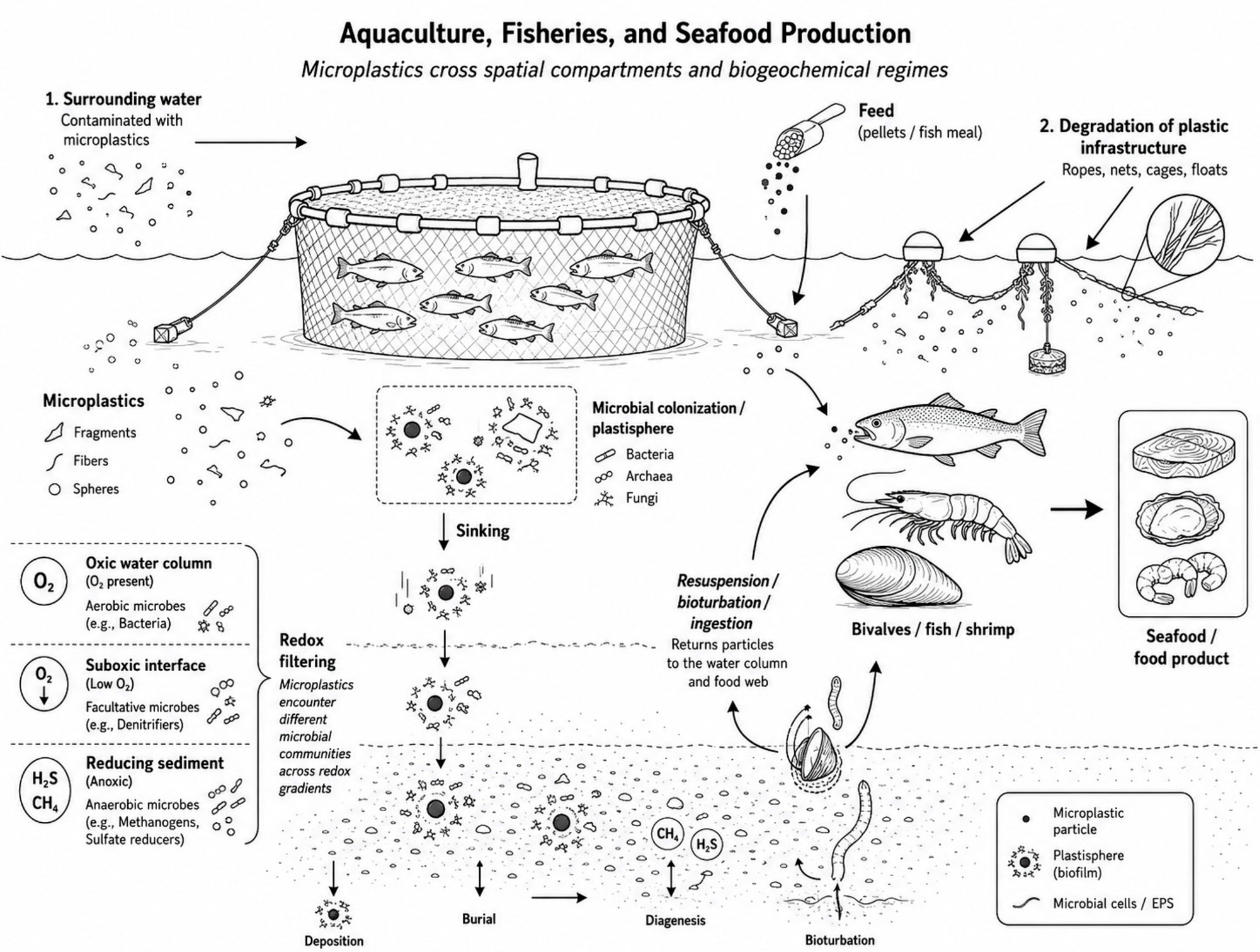
Figure 2.
Conceptual model of plastisphere-mediated microenvironmental buffering during environmental transitions, illustrating how gradual exposure to changing conditions may allow microbial acclimation, selective retention, and community turnover.
Figure 2.
Conceptual model of plastisphere-mediated microenvironmental buffering during environmental transitions, illustrating how gradual exposure to changing conditions may allow microbial acclimation, selective retention, and community turnover.
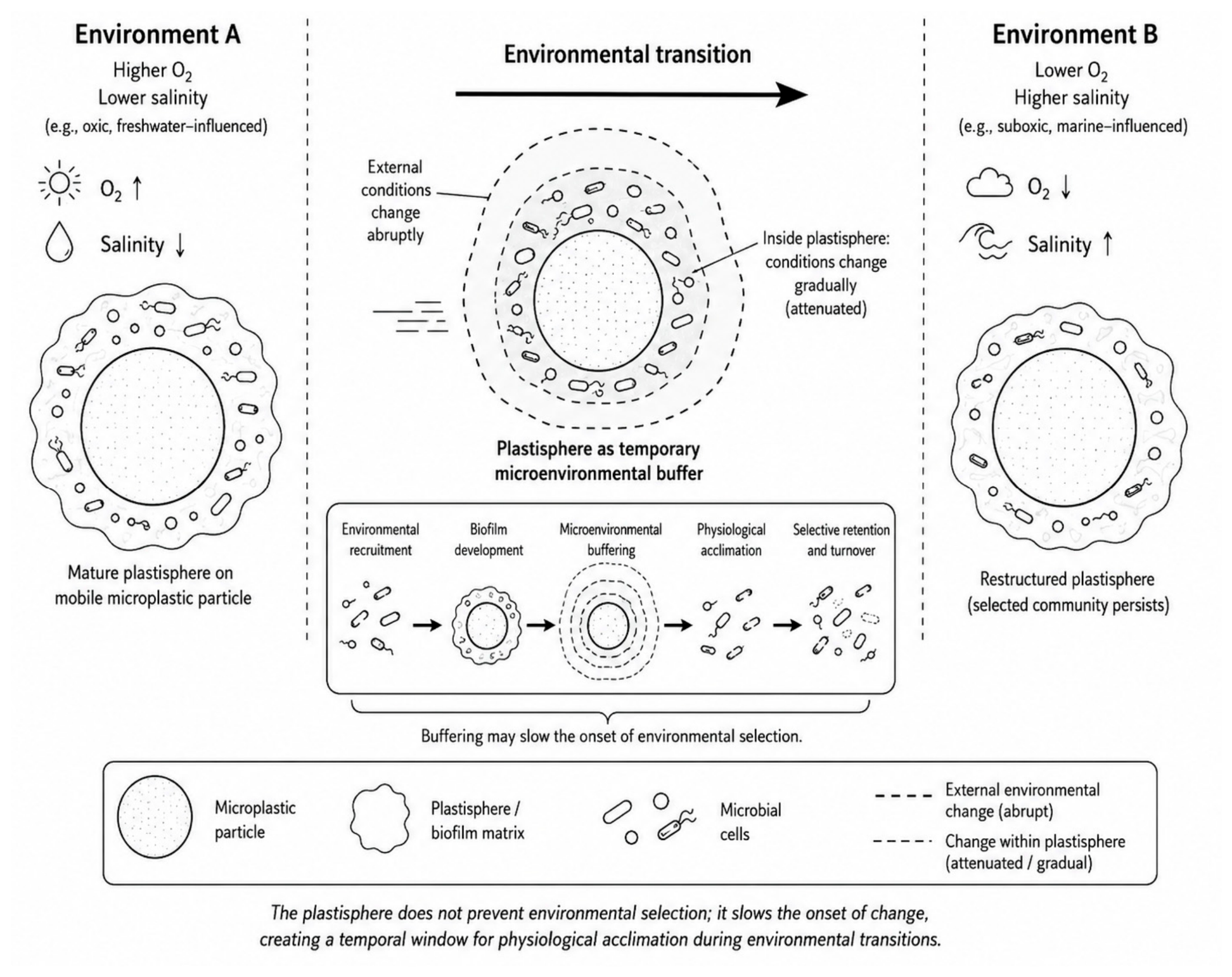
Figure 3.
Conceptual pathway of microplastics and plastisphere-associated microorganisms across food systems, from the environmental plastisphere to food at the point of consumption. Each stage represents a potential ecological filtering event capable of modifying microbial composition and functional traits.
Figure 3.
Conceptual pathway of microplastics and plastisphere-associated microorganisms across food systems, from the environmental plastisphere to food at the point of consumption. Each stage represents a potential ecological filtering event capable of modifying microbial composition and functional traits.
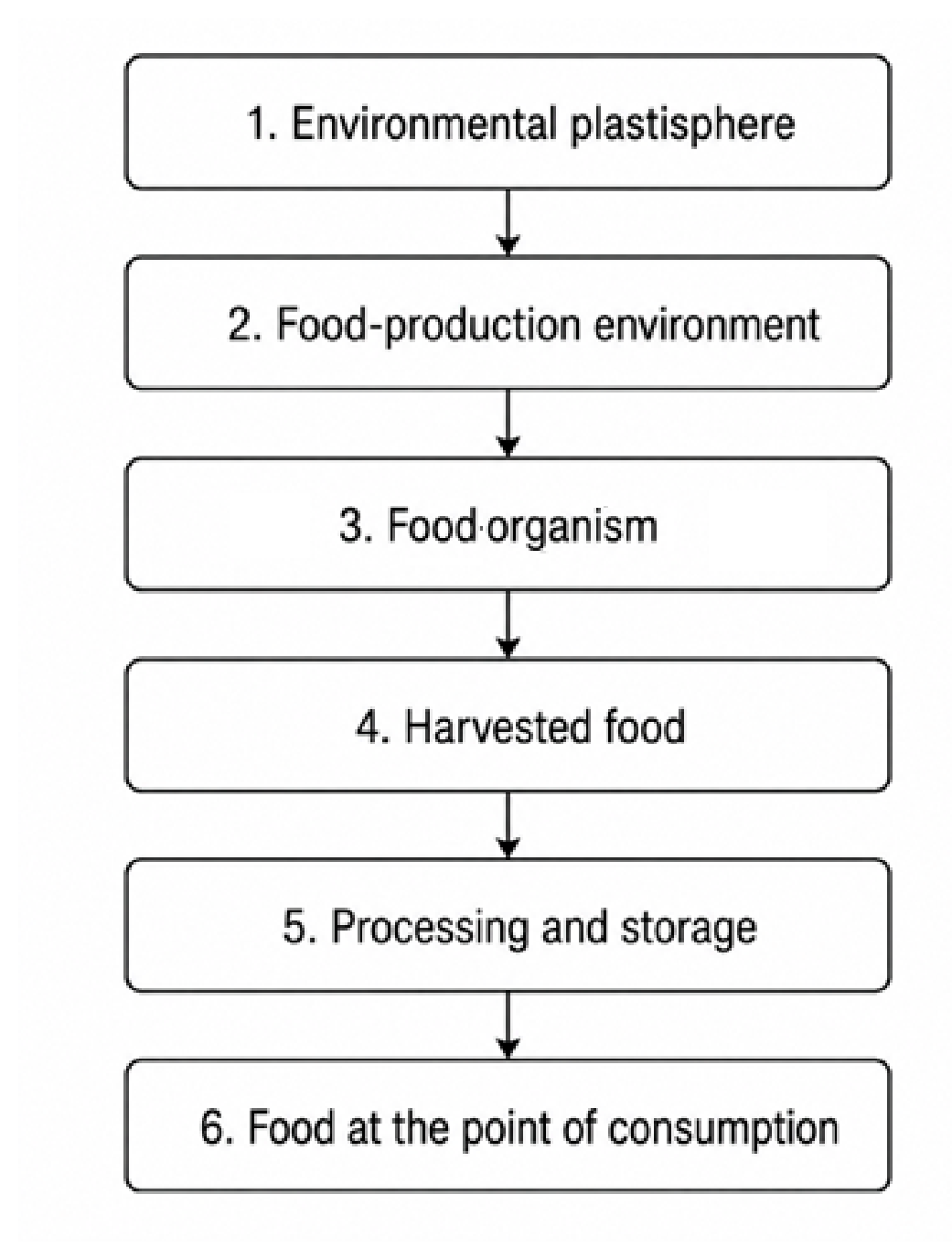
Figure 4.
Conceptual pathways linking foodborne microplastics to potential human-health effects.
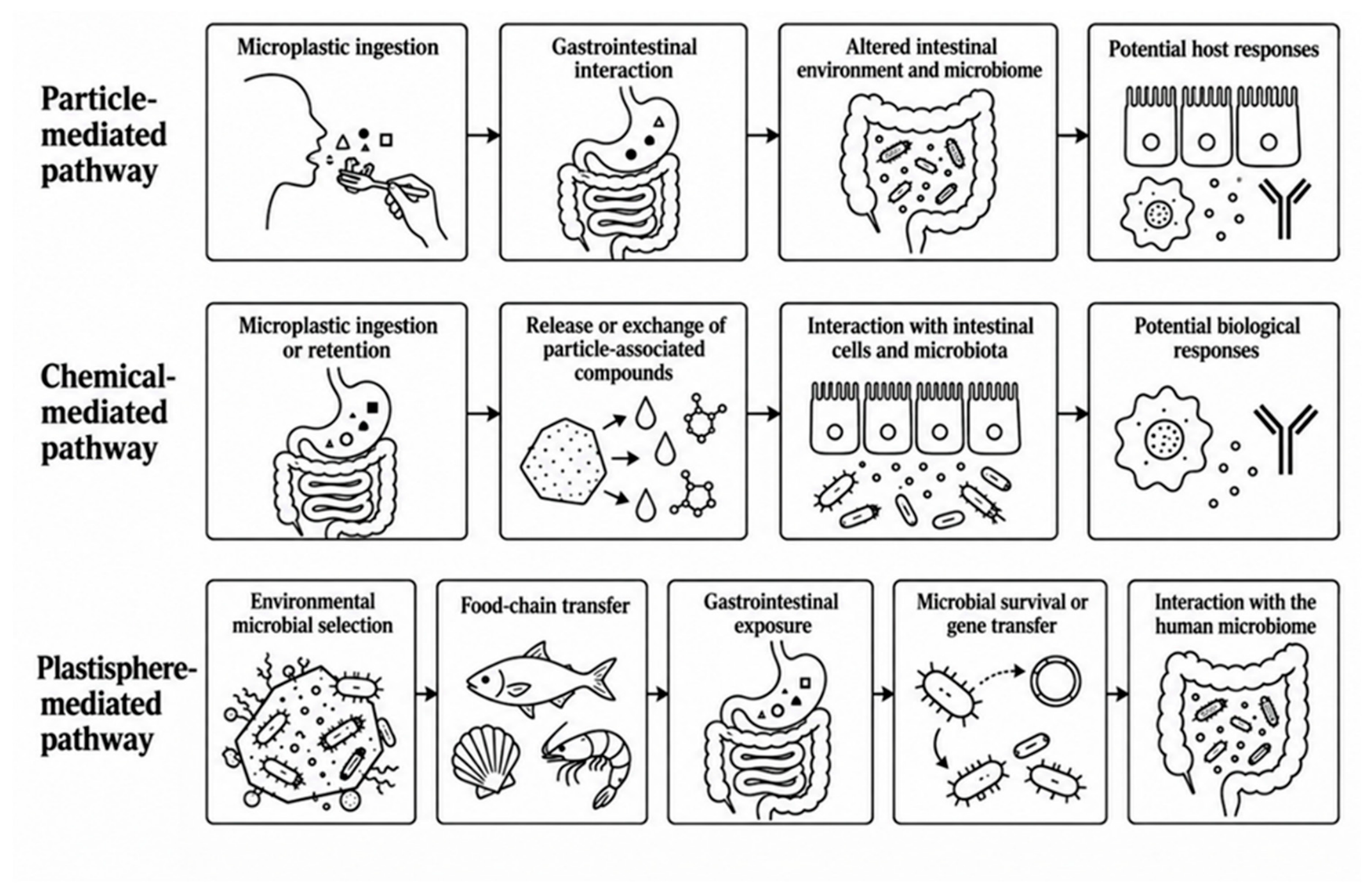
Figure 4.
Conceptual representation of microplastics as ecological filters across food systems, illustrating microbial selection, functional changes, transfer through the food chain, and potential human exposure.
Figure 4.
Conceptual representation of microplastics as ecological filters across food systems, illustrating microbial selection, functional changes, transfer through the food chain, and potential human exposure.
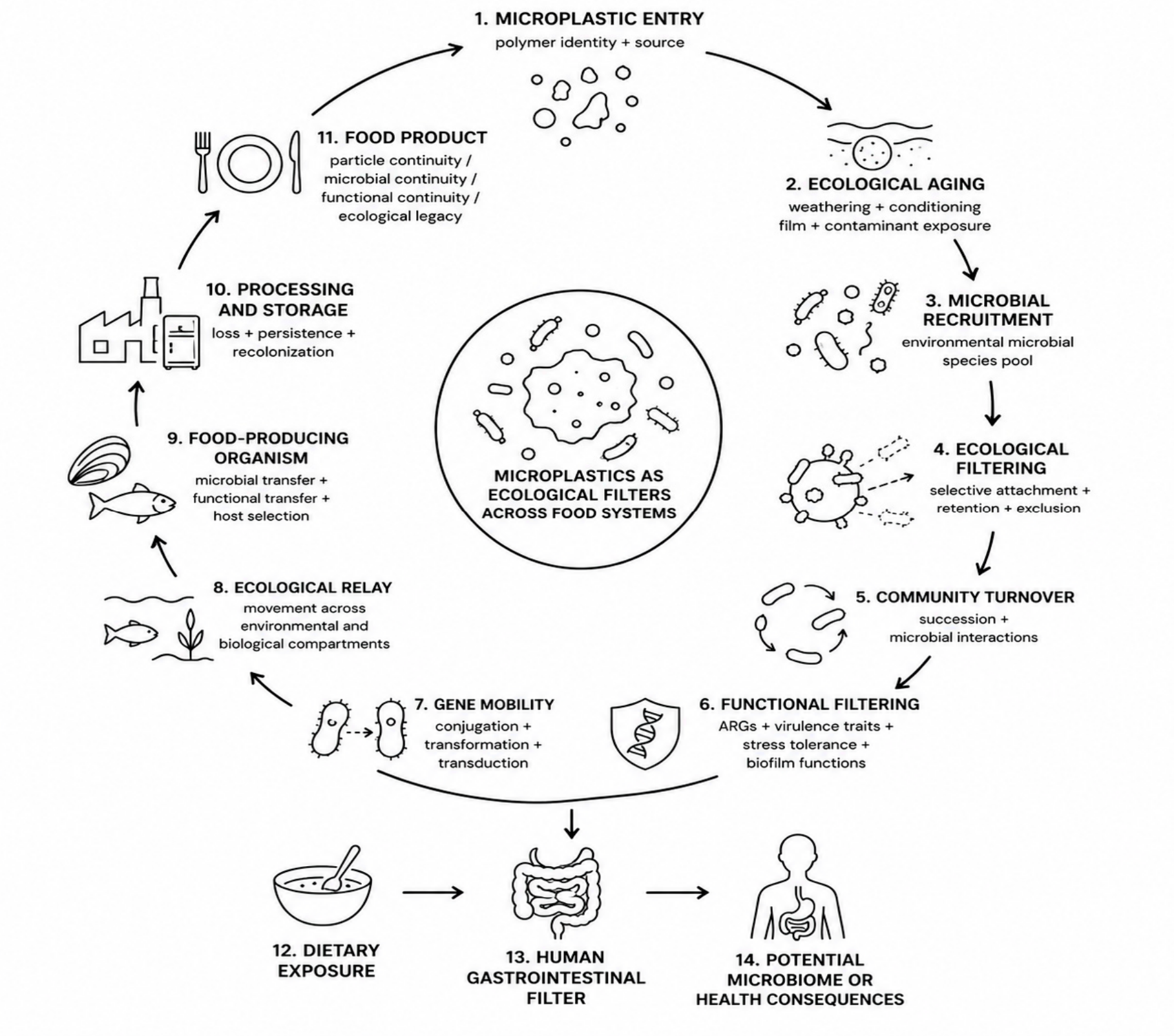
Figure 5.
Progressive levels of evidence linking plastisphere-associated microbial detection to potential human-health outcomes. Each successive step requires additional independent evidence, emphasizing that detection alone does not imply functional activity, food-chain transfer, human exposure, or health risk.
Figure 5.
Progressive levels of evidence linking plastisphere-associated microbial detection to potential human-health outcomes. Each successive step requires additional independent evidence, emphasizing that detection alone does not imply functional activity, food-chain transfer, human exposure, or health risk.
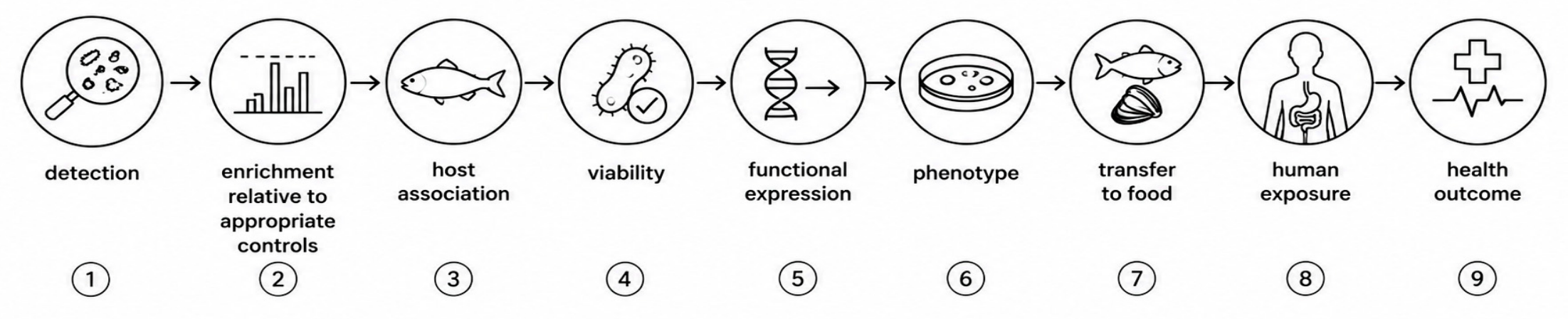
Disclaimer/Publisher’s Note: The statements, opinions and data contained in all publications are solely those of the individual author(s) and contributor(s) and not of MDPI and/or the editor(s). MDPI and/or the editor(s) disclaim responsibility for any injury to people or property resulting from any ideas, methods, instructions or products referred to in the content. |
© 2026 by the authors. Licensee MDPI, Basel, Switzerland. This article is an open access article distributed under the terms and conditions of the Creative Commons Attribution (CC BY) license.
Copyright: This open access article is published under a Creative Commons CC BY 4.0 license, which permit the free download, distribution, and reuse, provided that the author and preprint are cited in any reuse.