

Submitted:
07 September 2026
Posted:
08 September 2026
You are already at the latest version
Abstract
Two nickel coatings—with pH values of 3.8 and 4.8 and thicknesses of 9.38 μm and 4.88 μm, respectively—were chemically deposited onto ABS (acrylonitrile butadiene styrene) substrates with a thickness of 2040 μm. ABS is a plastic widely used as a structural material. Various types of components—formerly made of metal but now produced from ABS plastic to save metal and reduce structural weight—can be easily extruded or, in certain cases, molded. Nanoindentation experiments were conducted on the two nickel coatings and the ABS substrate using the XP head and CSM module of a G200 nanoindenter (KLA Corporation, Milpitas, CA, USA), alongside an “Express test” on the substrate. The substrate’s influence on the film’s indentation modulus was eliminated using the Hay-Crawford analytical model. Moreover, wear resistance tests were performed on the coatings, with the sample surfaces scanned using the NanoVision module both before and after the tests. The influence of pH on the mechanical properties of the investigated coatings was evaluated. It was found that with increasing pH of films, their indentation hardness and indentation modulus decrease.
Keywords:
electroless deposition
; Ni
; ABS
; mechanical properties
; nanoindentation
; hardness
; wear resistance
1. Introduction
ABS is a plastic with an extremely wide range of applications as a construction material. It is very easy to extrude and, in certain cases, cast various types of parts that were previously made of metal, but are now made of ABS plastic to save metal and make the structure lighter. For example, most of the parts in a bathroom (decorative rings around faucets, shower sprayers, sink accessories - stoppers, soap dishes, chains, etc.) and everything that looks like chrome-plated metal are actually made of ABS plastic, on which a nickel coating is chemically deposited (for electrical purposes), after which copper, nickel and chrome coatings are electrochemically deposited on it, which are much thicker and give the necessary decorative and protective effect. In addition, almost all accessories on the outside and inside of a car (emblems, inscriptions, etc.) are made of ABS plastic and then metallized. Other areas of application are microelectronics, household mechanical engineering, jewelry, etc. Among currently available plastics, ABS is becoming an obvious choice for deposition substrate due to its very good adhesion to metals, low cost, low coefficient of thermal expansion, ease of molding, and good appearance after coating [1].
Electroless nickel plating (ENP) is the deposition of a nickel coating by chemical reduction, as opposed to the electric current used in electroplating processes. The advantages of electroless nickel plating are uniformity of the coating[2], high corrosion resistance and wear protection, uniform thickness, hardness and durability, that it can be deposited on both metallic and non-metallic substrates, including plastics and ceramics, protection from harsh environmental conditions, etc. ENP has a wide range of applications in aerospace, oil and gas, and automotive manufacturing.
The pH level of the bath is one of the factors that have the greatest influence on the deposition rate, phosphorus content, surface morphology, and mechanical properties of electroless nickel coatings on ABS plastics. To initiate chemical deposition on ABS, the surface must be pretreated with etching and palladium activation, since ABS is a non-conductive polymer. Baths with a pH in the range of 4.0–5.5 lead to higher phosphorus content and smoother structures, while baths with a pH of 7.5–11.0 lead to increased deposition rate and gloss. At a pH range from 3.0–5.5, the plating speed is relatively slow [3]; moreover, high phosphorus incorporation (10%-15% wt. P) occurs [4], which leads to an amorphous structure [5]. Electroless deposition at pH between 3 and 5.5 results in Ni coatings with excellent corrosion resistance due to the absence of grain boundaries. However, their microhardness and adhesion to the ABS substrate are lower than alkaline coatings due to slower initial nucleation [3].
There aren’t many investigations of the influence of the pH of the bath on the mechanical properties of electroless deposited metal coatings on ABS substrates. Such attempts are made in works [6,7,8,9] with electroless deposited copper coatings on ABS substrates, Ni–P alloy/MWCNT coatings [10], or Cu/MWCNT coatings [11]. In paper [12], the authors investigated peeling strength and adhesive strength of electroless deposited nickel coatings on ABS substrates, and in paper [13], tensile tests were made, and the tensile strength of the nickel coatings on ABS substrate was determined. We found only one article in the literature that investigated the influence of the same pH as ours (3.8 and 4.8) on the hardness of the coating. This is publication [3]. In paper [3], the authors deposited nickel-phosphorus coatings onto an ABS substrate by electroless deposition at the same pH of the bath, 3.8 and 4.8, like us, and obtained microhardness of the coatings, which is smaller than ours, probably because of the different electrolyte composition and different thickness of the coatings. Moreover, the authors did not obtain the elastic modulus and wear resistance of the films. In our case, we have obtained both the elastic modulus and the hardness by nanoindentation experiments and wear resistance by means of wear test. Moreover, we have used our own method to obtain the substrate-independent elastic modulus, which has not been done in any other publication on the subject in the literature. The different composition of the electrolyte and the different pH lead to a difference in the microstructure and, accordingly, in the mechanical properties of the coatings, practically resulting in a new material. This and the study of an elastic modulus independent of the properties of the substrate also constitute the novelty of the present study. In paper [14], the authors tried to improve the mechanical properties of the ABS substrate by electrodepositing a Ni coating. They found an improvement in the wear resistance and hardness after coating.
In work [15], nanoindentations and nanoscratch experiments were performed on the as-deposited and annealed electroless nickel-phosphorus coating, deposited on a steel substrate. The authors found an improvement of 32% in hardness and 31% in elastic modulus upon annealing the coating at 600 °C. They did not investigate the influence of the pH of the bath (the pH in this work was 4.5-5.5) on the mechanical properties of the film and did not remove the influence of the substrate on the elastic modulus of the film. Similar investigations of microstructure, hardness, corrosion, and wear behaviors of electroless NiP-TiC-SiC coating on ABS substrate were also made in work [16], where the authors found that to achieve the best hardness value for the film, the short deposition period (30 min) and high deposition rate (95 °C) are necessary. They also did not investigate the influence of the pH of the bath on the indentation hardness and modulus of the film.
Changes in the pH of an electroless nickel plating bath affect the composition, deposition rate, and structure of the nickel-phosphorus layer on an ABS plastic substrate, leading to changes in the layer’s mechanical properties. That is why the present work aimed to investigate the influence of pH on the mechanical properties of electroless deposited nickel coatings on an ABS substrate.
2. Materials and Methods
The investigated chemically deposited nickel layers were deposited on ABS-polymer substrates with dimensions of 10 x 10 mm, cut from sheet material with a thickness of 2 mm.
The pre-treatment of the ABS-substrates was carried out according to the following technological scheme:
• pickling in a solution of bichrome mixture for 15 min at 65 ˚С and treatment in 3M HCl for 3 min at room temperature;
• activation in a colloidal solution of PdCl2 at room temperature for 5 min;
• acceleration in an alkaline solution at room temperature for 5 min
Chemical nickel plating was carried out in a base solution containing the following components - Table 1.
Chemical deposition was performed in a 250 ml bath under air agitation with an air flow – (100 ml/min/250 ml electrolyte).
Nanoindentation experiments were performed on the two nickel coatings with different pH, as well as on the ABS substrate with a G200 nanoindenter (KLA Corporation, Milpitas, CA, USA) equipped with an XP-head (with a Berkovich indenter with an angle of 136º and a 20nm tip rounding) and a CSM module, using the “G-Series CSM Standard Hardness, Modulus, and Tip Cal” indentation method. In this method, the hardness and indentation modulus are obtained as a continuous function of the penetration into the surface of the tested material. In addition, the substrate was also tested using the Express test attachment of the NanoIndenter G200. The Express test allows for a high-speed nanoindentation experiment (100 indentations in 100 seconds), which allows avoiding the influence of time-dependent factors such as temperature, creep, etc.
Table 2 provides the input data for the nanoindentation experiments on the ABS substrate using the Express test attachment of the NanoIndenter G200.
Table 3 shows the input data for the nanoindentation experiments on the nickel coatings with pH=4.8 and pH=3.8, and the ABS substrate.
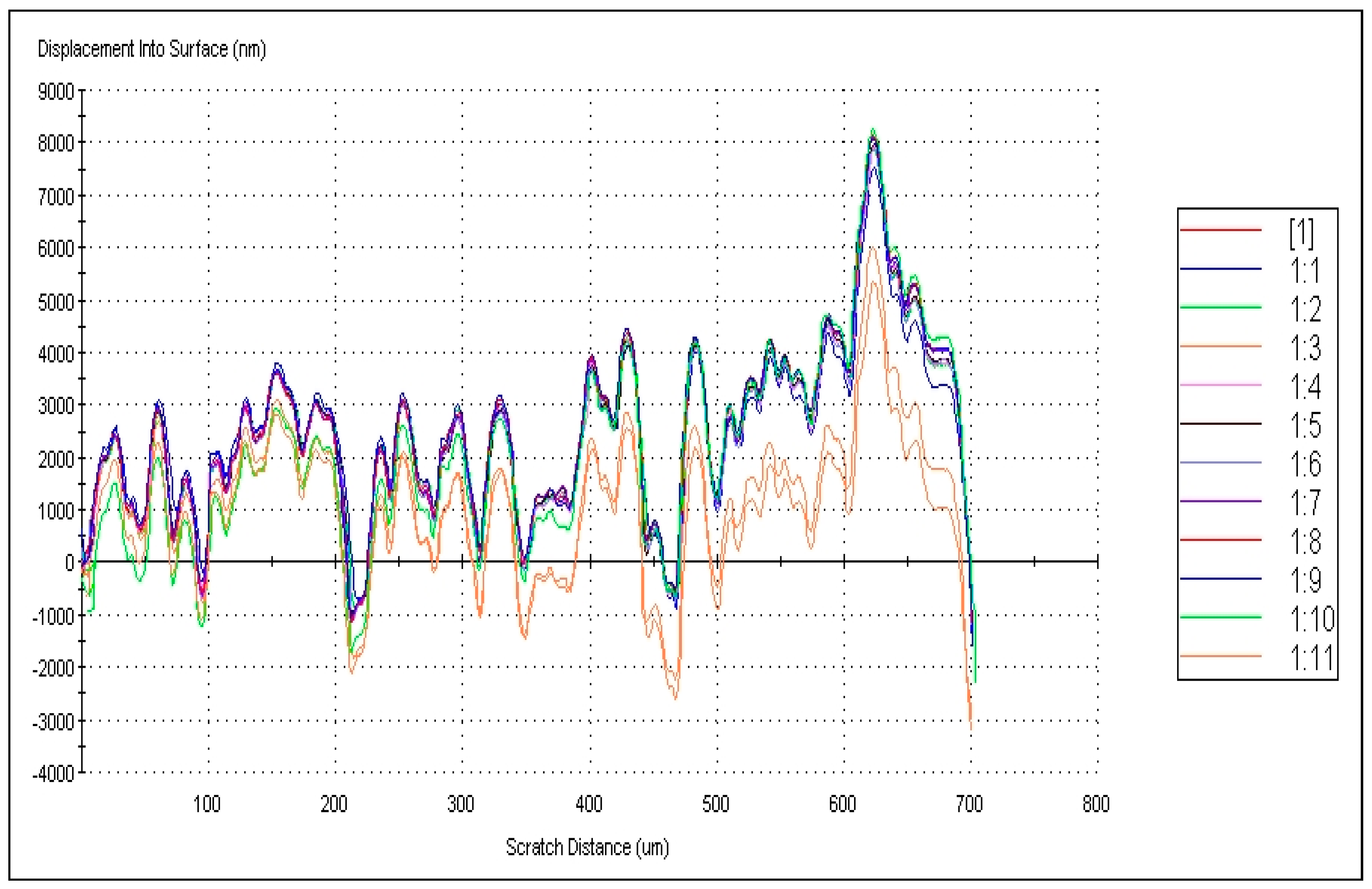
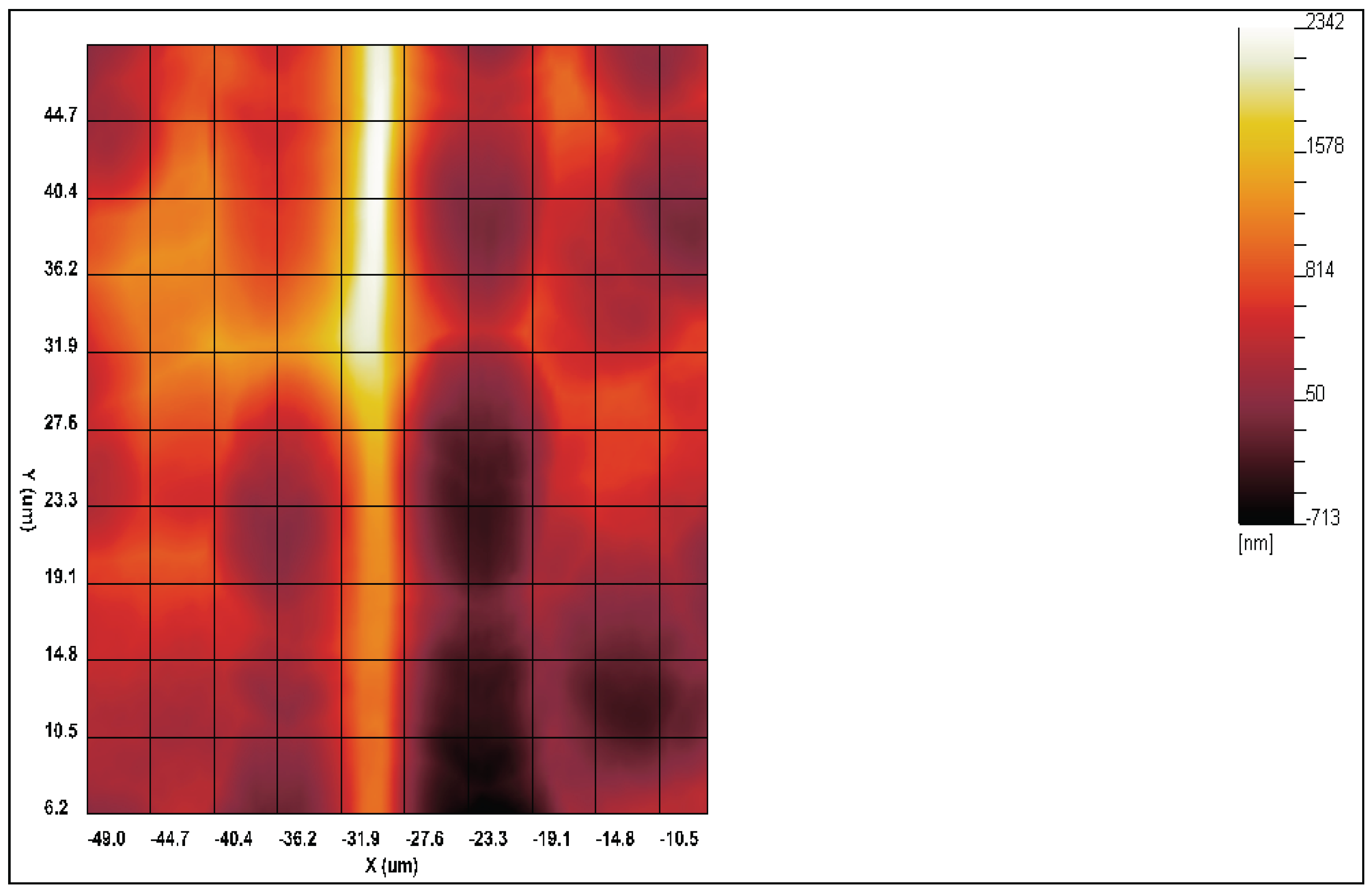
Then, the data obtained from the nanoindentation experiments for the nickel coatings were processed using the “G-Series CSM Hardness, Modulus for Thin Films” method, which separates the coating properties from the substrate properties, and the results are given in Figure 1 and Figure 2 and 3, and the input data for the nickel coatings with pH=4.8 and pH=3.8 are given in Table 4 and Table 5, respectively. It yields the Young’s modulus and the hardness of the coating as a continuous function of displacement [17]. The Young’s modulus is corrected for the influence of the substrate using an analytical model, which is described in detail in [18,19,20]. To use this method, it is necessary to know the coating thickness, Young’s modulus, and Poisson’s ratio of the substrate. In addition, wear resistance tests were carried out on both nickel coatings using the G-Series Multi-Cycle Wear Test method, and before and after the tests, the surfaces of the samples were scanned by the NanoVision module (Figure 8 and Figure 9). The G-Series Multi-Cycle Wear Test Method is used to provide wear track deformation and per-cycle displacement averages for pass and return segments. Data are only recorded for the residual deformation of the wear track after each set of wear cycles. The Cross profile topography is also calculated (Figure 6 and Figure 7). This method is intended for tests requiring 100 or more cycles (in our case, 100 wear cycles). The input data for the wear resistance experiments of the nickel coatings with pH=4.8 and pH=3.8, respectively, are given in Table 6 and Table 7, and the obtained results are shown in Figure 4 and Figure 5 and Table 8 and Table 9.
Figure 1.
Young’s modulus of the ABS substrate and the nickel coatings before application of the thin film model.
Figure 1.
Young’s modulus of the ABS substrate and the nickel coatings before application of the thin film model.
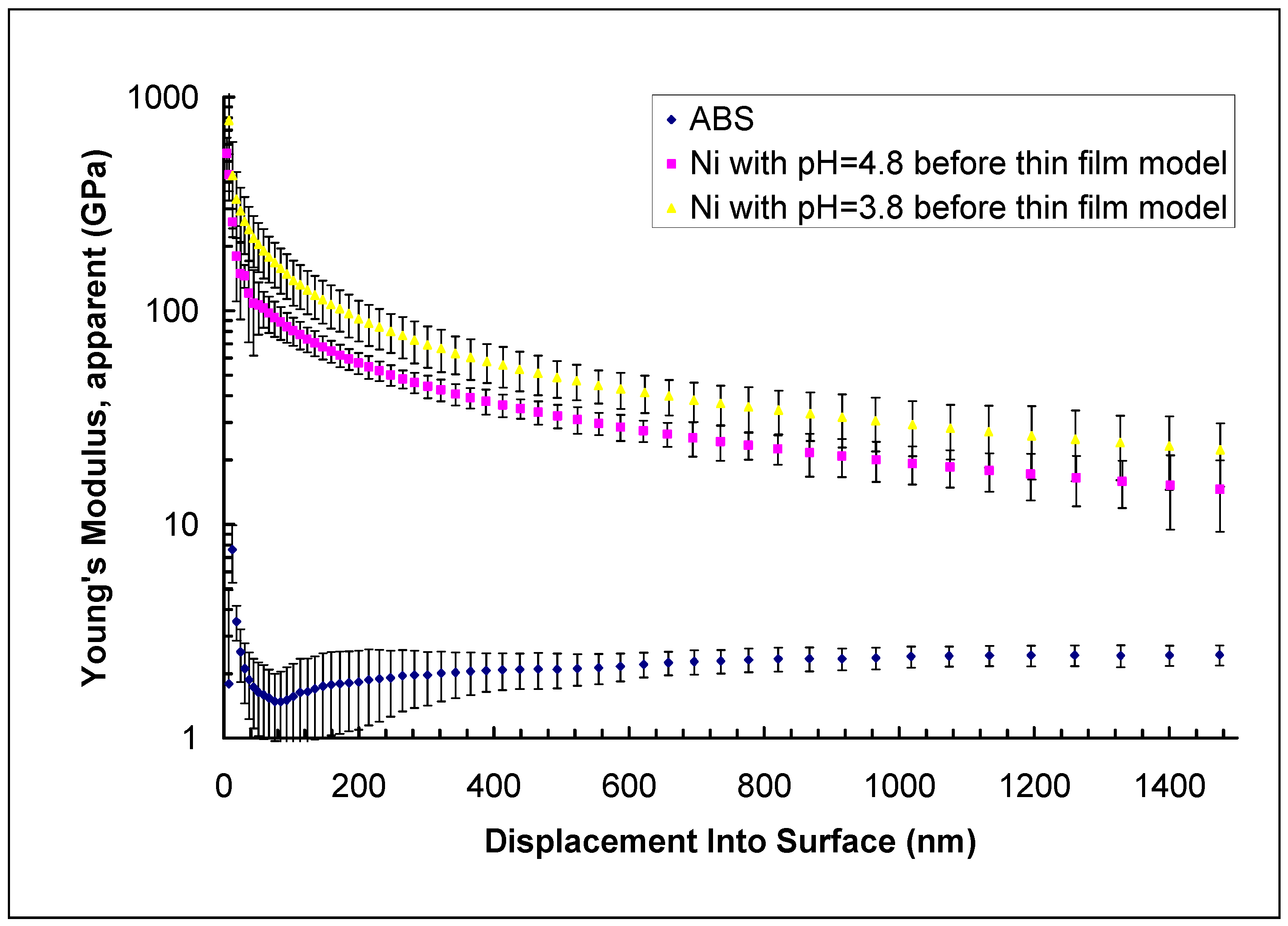
Figure 2.
Young’s modulus of the ABS substrate and the nickel coatings after application of the thin film model.
Figure 2.
Young’s modulus of the ABS substrate and the nickel coatings after application of the thin film model.
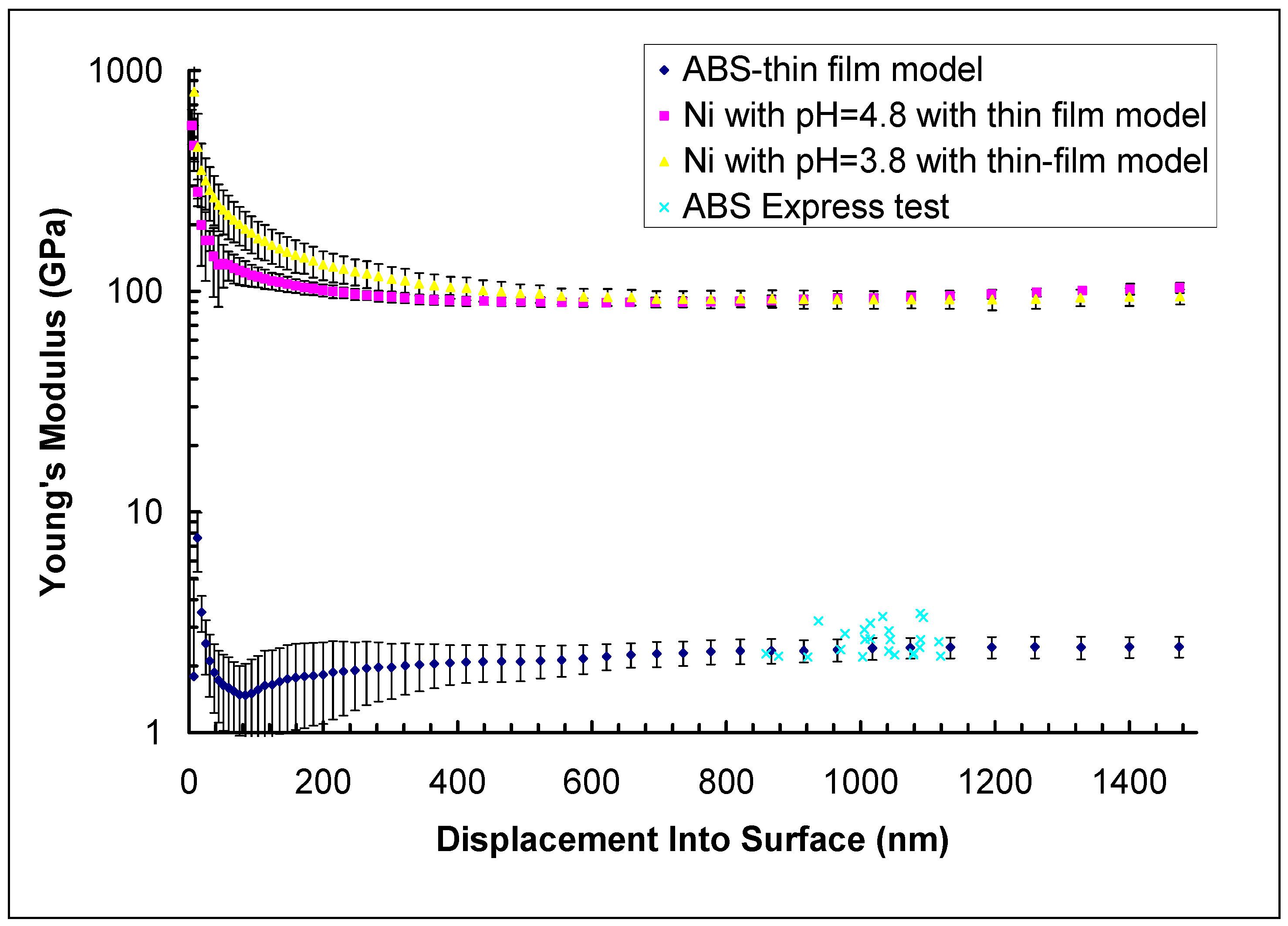
Figure 3.
Results for the indentation hardness of coatings and the substrate.
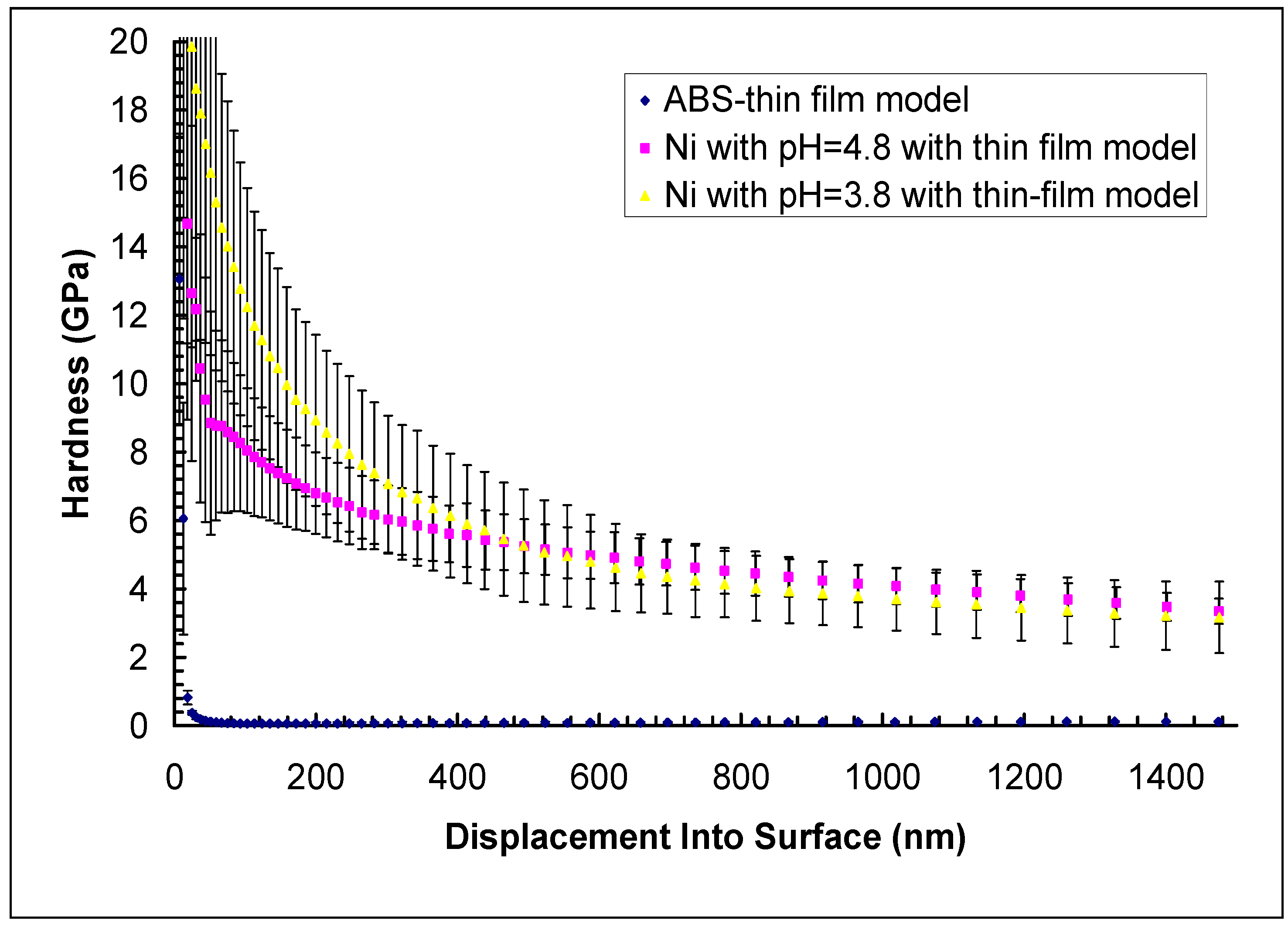
Figure 4.
Results of wear resistance test of Ni coating with pH= 4.8.
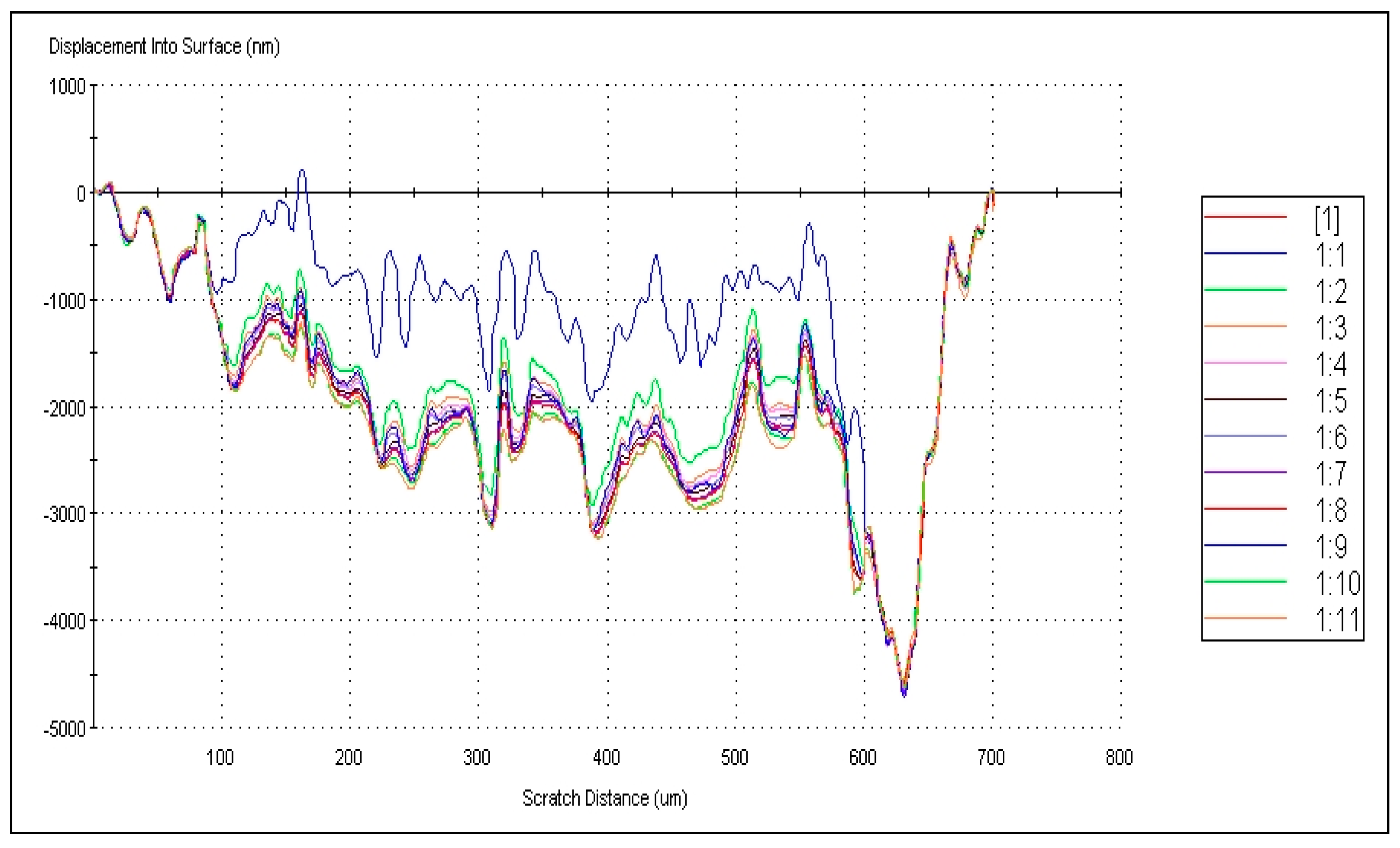
Figure 5.
Results of wear resistance test of Ni coating with pH= 3.8.
3. Results and Discussion
We selected electroless nickel plating because of the following advantages: it produces uniform coatings that cover complex shapes and secures good adhesion to the substrate; it imparts a metallic appearance, enhanced wear resistance, and electrical conductivity to the plastic. Furthermore, electroless nickel plating is widely used in mechanical engineering and the automotive industry, in electronics and precision mechanics, and in the oil and gas sector for components exposed to aggressive environments, among other applications.
Usually, the Oliver and Pharr approximation method [21] is used to extract the indentation modulus and hardness of the films after nanoindentation experiments. In cases where the elastic modulus of the coating is more than twice that of the substrate, the Oliver-Pharr method does not work well. In such instances, it is highly appropriate to apply the Hay-Crawford method, which decouples the properties of the coating from those of the substrate. The results obtained before and after its application are presented in Figure 1, Figure 2 and Figure 3.
Because ABS is a soft polymer substrate (with low modulus), accurate measurement of the thin nickel coatings true elastic modulus requires ultra-shallow nanoindentation, acoustic methods, or analytical methods to eliminate underlying plastic deformation effects. In our case, we used a 2000 nm depth limit during the nanoindentation experiment, and then we used the analytical method of Hay-Crawford in order to extract the substrate-independent elastic modulus of the nickel films. The model works well for stiff films on soft substrates and also for soft films on stiff substrates. In our case, we have a much harder coating on a softer substrate. Typically, with hard films on soft substrates—as is the case here—excessive sinking-in is observed; this can lead to an artificially low Young’s modulus due to the calculation of overly large contact areas[19].
Figure 1 shows that before using the Hay-Crawford model to obtain a substrate-independent elastic modulus of the coating, the modulus of the two nickel coatings obtained at different pH values decreases with increasing indenter penetration depth, due to the influence of the ABS substrate, which, as can be seen from the same figure, has a much smaller elastic modulus than that of the coatings.
Applying the Hay-Crawford model eliminates the influence of the substrate on the coating’s elastic modulus; as shown in Figure 2, the elastic modulus becomes constant (91.88 GPa for the nickel film with pH=3.8 and 89.61 GPa for the nickel film with pH=4.8)—and higher than the value obtained experimentally. The model cannot eliminate the influence of the substrate on the hardness, and the hardness decreases as the indentation depth increases, as shown in Figure 3. From Figure 2, it can be seen that the results for the indentation modulus of the substrate obtained by the so-called Express test, which allows avoiding the influence of time-dependent factors such as temperature, creep, etc., are similar to those from the thin-film model.
From Figure 2 and Figure 3, it can be seen that the indentation hardness and modulus of the ABS substrate coated with nickel coatings with different pH are much higher than those of the uncoated substrate. Moreover, increasing the pH of the electrolyte leads to a decrease in the indentation hardness and indentation modulus. One possible reason for decreasing of the indentation modulus is that as bath pH increases, the phosphorus co-deposition rate changes, lowering the elastic modulus for high-phosphorus amorphous films. The decreasing of the indentation hardness can be explained by the well-known inverse Hall-Petch effect – below a critical grain size, hardness decreases with decreasing grain size [22]. Another possible reason for the obtained result is the co-deposition of hydroxides. The results obtained by us for the Young’s modulus and hardness of the uncoated ABS substrate are in good agreement with those obtained from Saroha and coauthors in their work [14]. They used electrochemical deposition of Ni coatings, not electroless deposition, and also different pH of the bath (3.6, 4.5 and 5.5); that is why we couldn’t compare their results for the indentation hardness and modulus of the nickel coatings with our results. Czagany and coauthors [23] also investigated the influence of the pH on the mechanical properties of Ni-P coatings, but on a different substrate (W302 steel substrate) and different pH rates (4.2, 5.2, 6.2, 7.2, 8.2, 9.2). In paper [3], the authors deposited nickel-phosphorus coatings onto an ABS substrate by electroless deposition at the same pH of the bath 3.8 and 4.8, like us, and obtained microhardness of the coatings, which is smaller than ours, probably because of the different electrolyte composition and different thickness of the coatings, which leads to different microstructure and mechanical properties of the coatings. The authors of work [3] did not obtain the elastic modulus and wear resistance of the coatings. We obtained that the maximum wear track deformation of the Ni coating with pH=4.8 was smaller than this of the Ni coating with pH=3.8(tables 8 and 9), probably because the displacements into surface during the wear cycles were higher than 400nm (see Figure 4 and Figure 5), where as we can see from Figure 3 there is influence of the substrate and because of this influence the hardness of the Ni coating with pH=4.8 became higher than the hardness of the Ni coating with pH=3.8. We see from Figure 4 and Figure 5 that after 100 wear cycles the ABS substrate is reached and both nickel coatings—with pH values of 3.8 and 4.8—likely delaminated from the substrate.
The cross- profile topography of the Ni coatings with pH=3.8 and 4.8 is shown in Figure 6 and Figure 7. We see that the pile-up height of the Ni coating with pH=4.8 is significantly greater than that of the nickel coating deposited at pH = 3.8.
Scanning with the Nanovision nanoindenter attachment before and after the wear resistance test, shown in Figure 8 and Figure 9, provides information about the surface topography of the coatings.
Figure 6.
Cross profile topography for the Ni coating with pH=3.8.
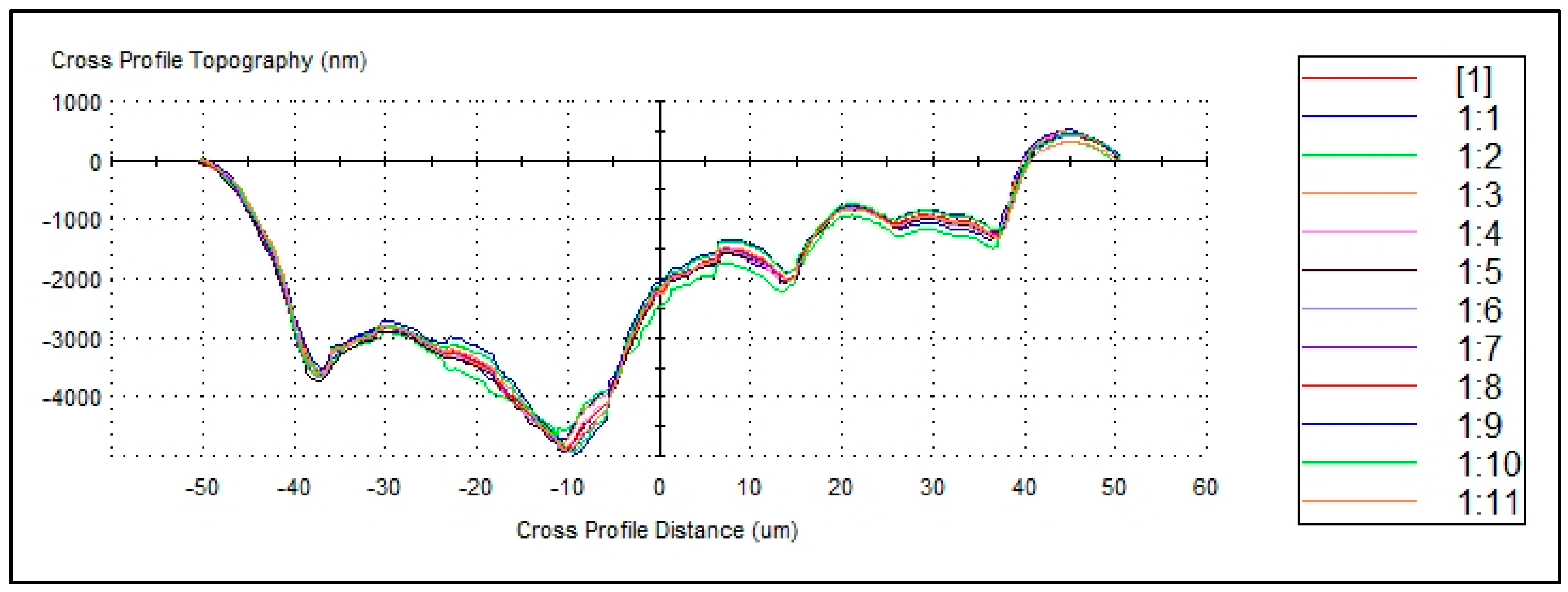
Figure 7.
Cross profile topography for the Ni coating with pH=4.8.
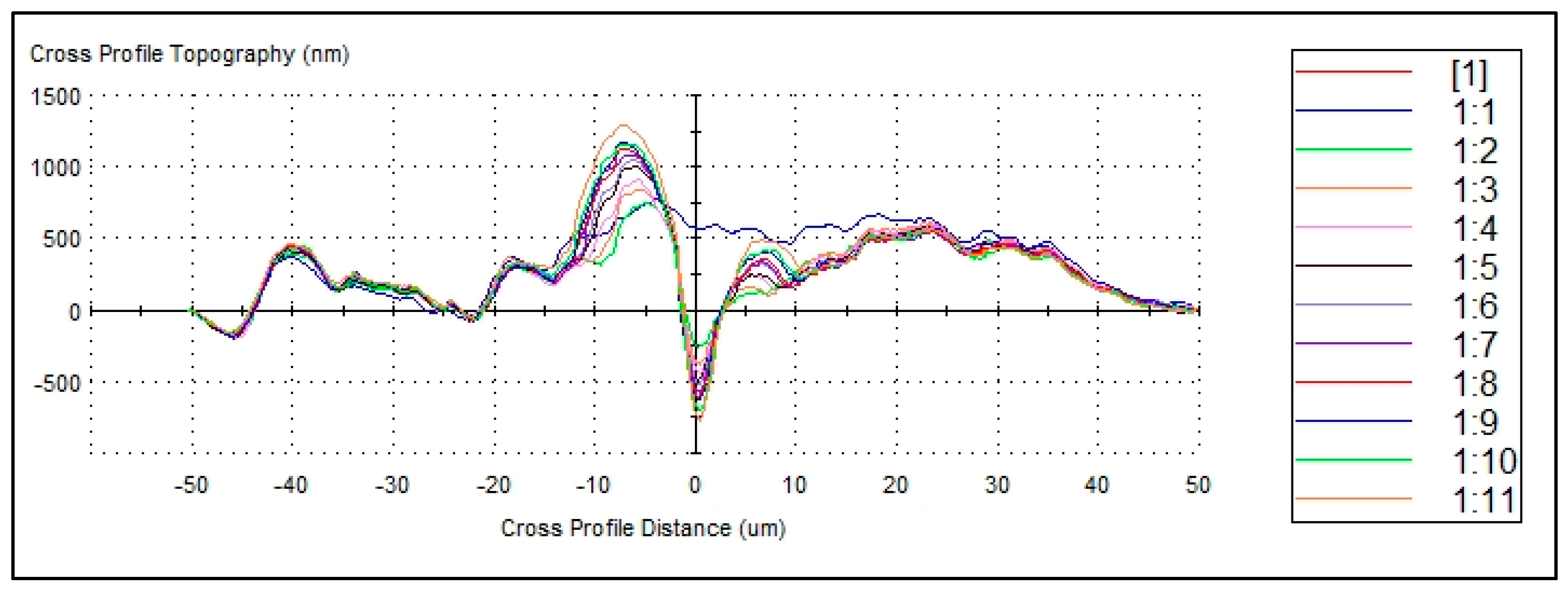
Figure 8.
NanoVision scanned surface of Ni coating with pH=4.8 before wear resistance test.
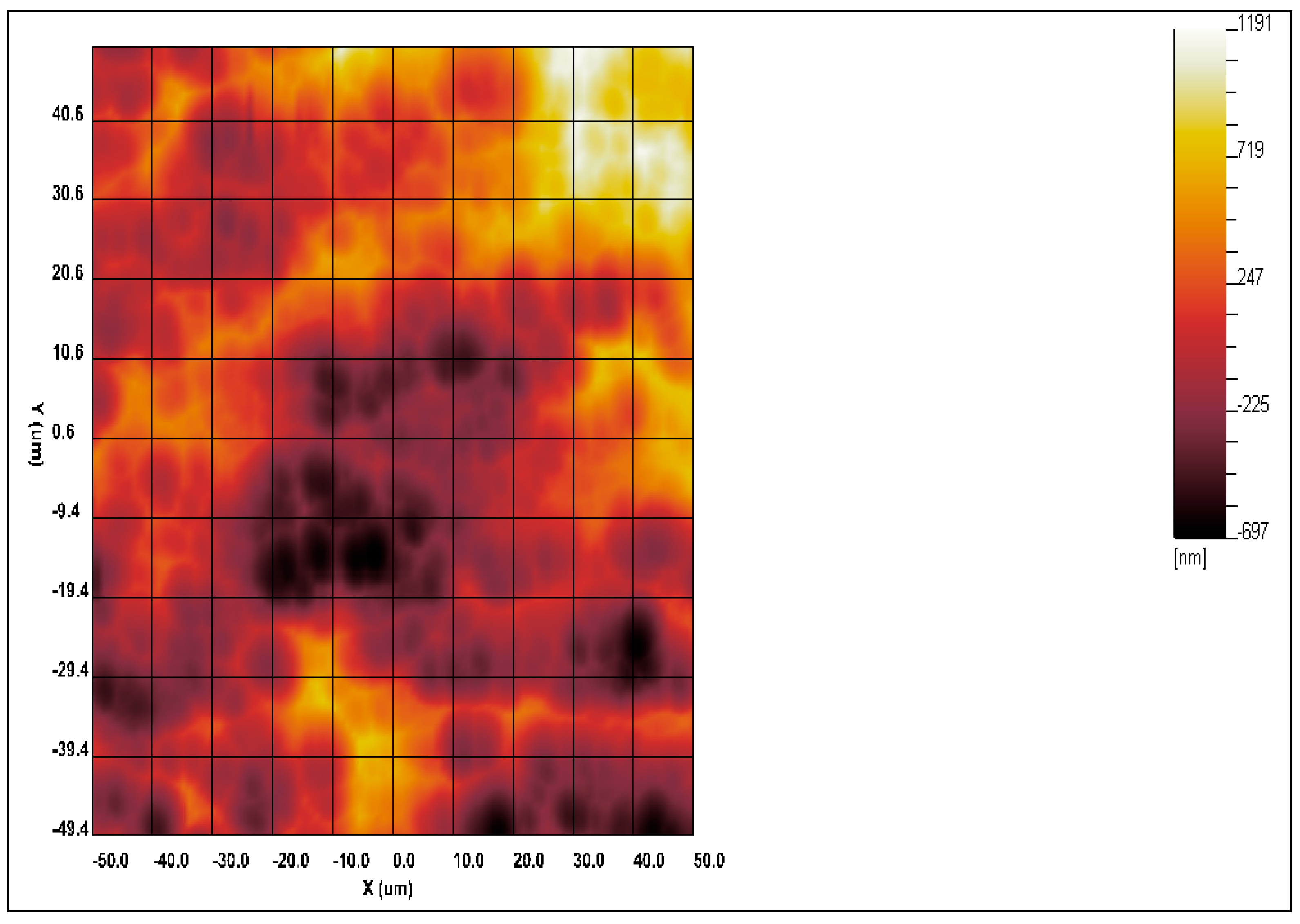
Figure 9.
NanoVision scanned surface of Ni coating with pH=4.8 after wear resistance test.
4. Conclusions
In the present work, nickel coatings with pH 3.8 and 4.8 were chemically deposited on an ABS substrate. The mechanical properties of the coatings and the substrate were obtained using nanoindentation and wear experiments. The influence of the bath pH on the mechanical properties of the obtained coatings was studied. Using the Hay-Crawford method, the substrate-independent indentation modulus of the two nickel coatings was obtained. The results showed that both nickel coatings significantly improved the mechanical properties of the ABS substrate. Furthermore, we found that as the pH of the coating increases, indentation hardness and modulus decrease, while wear resistance increases. This result is of great importance for many applications, such as in the automotive industry, electronics and household appliances, sanitary ware and fittings, modeling and 3D printing, etc.
Author Contributions
Conceptualization, S.C. and D.S.; methodology, J.H.; software, J.H.; validation, S.C., D.S. and J.H.; formal analysis, S.C.; investigation, S.C.; resources, D.S and J.H.; data curation, S.C.; writing—original draft preparation, S.C.; writing—review and editing, D.S. and J.H; visualization, S.C.; supervision, D.S.; project administration,S.C.; funding acquisition, S.C. All authors have read and agreed to the published version of the manuscript.
Funding
This work was supported by European Regional Development Fund under “Research Innovation and Digitization for Smart Transformation” program 2021-2027 under the Project BG16RFPR002-1.014-0006 “National Centre of Excellence Mechatronics and Clean Technologies”. This research was also supported by the National Science Fund under Grant No.КП-06-H83/8 from 6.12.2024.
Institutional Review Board Statement
Not applicable.
Informed Consent Statement
Not applicable.
Data Availability Statement
The original contributions presented in this study are included in thearticle. Further inquiries can be directed to the corresponding author.
Conflicts of Interest
The authors declare no conflicts of interest.
Abbreviations
The following abbreviations are used in this manuscript:
| ABS CSM |
Acrylonitrile butadiene styrene Continuous Stiffness Measurement |
| ENP | Electroless nickel plating |
| pH | Potential of hydrogen |
References
- Olivera, S.; Muralidhara, H.B.; Venkatesh, K.; Gopalakrishna, K.; Vivek, .S. Plating on acrylonitrile–butadiene–styrene (ABS) plastic: a review. J Mater Sci 2016, 51, 3657–3674. [CrossRef]
- Chintada, V.B.; Koona, R.; Raju Bahubalendruni, M.V.A. State of the Art Review on Nickel-Based Electroless Coatings and Materials. J Bio Tribo Corros 2021, 7, 134. [CrossRef]
- Chakarova, V.; Georgieva, M.; Petrova, M. Corrosion resistance of electroless deposited Ni-P coatings on polymer (ABS) substrate. Bulg. Chem. Commun. 2017, 49, Special Issue F, 30-36.
- Azli, N.N.A.; Mohd Amin, N.F.; Oluhende, S.T.; Mohamad, S.N.A.; Fadil, N.A. Electroless deposited black nickel-phosphorus solar absorber coatings on carbon steel: Effect of plating bath pH. Mater. Today: Proc. 2021, 39, 1071-1076. [CrossRef]
- Shaikh, M.S.N.M.; Ahuja, B.B. Optimization of Electroless Nickel Tungsten Composite Coating on 3D-Printed ABS Substrate for Maximum Tungsten Content. J. Inst. Eng. India Ser. 2022, C103, 69–82. [CrossRef]
- Yang, Z.; He, Y.; Li, Z.; Li, N.; Wang, Z. Adhesion improvement of ABS resin to electroless copper by H2SO4–MnO2 colloid with ultrasound-assisted treatment. J. Adhes. Sci. Technol. 2011, 25, 1211-1221. [CrossRef]
- Li, Z.; Li, N.; Yin, L.; He, Y.; Wang, Z. An environment-friendly surface pretreatment of ABS resin prior to electroless plating. Electrochem. Solid-State Lett. 2009, 12, D92–D95. DOI: 10.1149/1.3231137.
- Ma, Q.;, Zhao, W.; Li, X.; Li, L.; Wang, Z. Study of an environment-friendly surface pretreatment of ABS-polycarbonate surface for adhesion improvement. Int. J. Adhes. Adhes. 2013, 44, 243-249. [CrossRef]
- Shu, Z.; Wang, X. Environment-friendly Pd-free surface activation techniques for ABS surface. Appl. Surf. Sci. 2012, 258, 5328-5331. [CrossRef]
- Arai, S.; Sato, T.; Endo, M. Fabrication of various electroless Ni–P alloy/multiwalled carbon nanotube composite films on an acrylonitrile butadiene styrene resin. Surf. Coat. Technol. 2011, 205, 3175-3181. [CrossRef]
- Arai, S.; Kanazawa, T. Electroless deposition and evaluation of Cu/multiwalled carbon nanotube composite films on acrylonitrile butadiene styrene resin. Surf. Coat. Technol. 2014, 254, 224–229. [CrossRef]
- Tsuru, Y.; Mochinaga, K.; Ooyagi, Y.; Foulkes, F.R. Application of vapor-deposited carbon and zinc as a substitute for palladium catalyst in the electroless plating of nickel. Surf. Coat. Technol. 2003, 169, 116-119. [CrossRef]
- Tengsuwan, S.; Ohshima, M. Environmentally benign electroless nickel plating using supercritical carbon-dioxide on hydrophilically modified acrylonitrile–butadiene–styrene. Appl. Surf. Sci. 2014, 311, 189–200. 10.1016/j.apsusc.2014.05.040.
- Saroha, V.; Pabla, B. S.; Bhogal, S. S. Characterization of ABS for enhancement of mechanical properties. Int. J. Innov. Technol. Explor. Eng. 2019, 8.10, 2164-2167. DOI: 10.35940/ijitee.J9379.0881019.
- Sribalaji, M.; Asiq Rahman, O.S.; Laha, T.; Keshri, A.K. Nanoindentation and nanoscratch behavior of electroless deposited nickel-phosphorus coating. Mater. Chem. Phys. 2016, 177, 220-228. [CrossRef]
- Alhamad, R.K.; Hussein, A.K.; Abbas, L.K. Microstructure, Corrosion and Wear Behaviors of Electroless (NiP-TiC-SiC) Nanocomposite Coating on Acrylonitrile Butadiene Styrene Substrate. Surfaces 2024, 7, 1029-1051. [CrossRef]
- Hay, J.L.; Agee, P.; Herbert, E.G. Continuous stiffness measurements during instrumented indentation testing. Exp. Tech. 2010, 34, 86-94. [CrossRef]
- Hay, J. L. A new model for measuring substrate-independent Young’s modulus of thin films by instrumented indentation. Agilent Technologies Application Note 2010.
- Hay, J.; Crawford, B. Measuring substrate-independent modulus of thin films. J. Mater. Res. 2011, 26, 727–738. [CrossRef]
- Hay, J. Measuring Substrate-Independent Young’s Modulus of Thin Films. In: MEMS and Nanotechnology; Proulx, T., Eds.; Conference Proceedings of the Society for Experimental Mechanics Series. Springer: New York, USA, 2011; Volume 4, pp. [CrossRef]
- Oliver, W.C.; Pharr, G.M. An improved technique for determining hardness and elastic modulus using load and displacement sensing experiments. J. Mater. Res. 1992, 7, 1564- 1583. DOI: . [CrossRef]
- Carlton, C.E.; Ferreira, P.J. What is behind the inverse Hall–Petch effect in nanocrystalline materials? Acta Mater. 2007, 55, 3749–3756. [CrossRef]
- Czagany, M.; Baumli, P. Effect of Ph on the characteristics of electroless Ni-P coatings. J. Min. Metall. Sect. B-Metall. 2017, 53, 327-332. [CrossRef]

Table 1.
Electrolyte composition and conditions for electroless nickel plating.
| Electrolyte composition | Working concentrations |
|---|---|
| NiSO4 .7H2O, g/l | 10-30 |
| NaH2PO2 .H2O, g/l | 10-40 |
| Complexing agents, g/l | 5-50 |
| Stabilizers, mg/l | 0.5-20 |
| Surfactants, g/l | 0.01-0.6 |
| pH | 3-5.5 |
| Temperature, ˚С | 50-87 |
Table 2.
Input data for the nanoindentation experiments on the ABS substrate using the Express test attachment of the NanoIndenter G200.
Table 2.
Input data for the nanoindentation experiments on the ABS substrate using the Express test attachment of the NanoIndenter G200.
| Panel Inputs | Value | Units |
|---|---|---|
| Poisson’s Ratio | 0.3 | - |
| Prescribed Displaement | 1000 | nm |
| Surface Approach Distance | 5.000000e-002 | - |
| X Data Dimension | 5 | - |
| X Start Position | -50.000 | µm |
| X Stop Position | 50.000 | µm |
| Y Data Dimension | 5 | - |
| Y Start Position | -50.000 | µm |
| Y Stop Position | 50.000 | µm |
Table 3.
Input data for the nanoindentation experiments on the nickel coatings and the ABS substrate.
Table 3.
Input data for the nanoindentation experiments on the nickel coatings and the ABS substrate.
| Test | Surface Approach Velocity | Depth Limit | Strain Rate Target | Harmonic Displacement Target | Frequency Target | Surface Approach Distance | Poisson’s Ratio |
|---|---|---|---|---|---|---|---|
| nm/s | nm | 1/s | nm | Hz | nm | ||
| 1 | 100 | 2000 | 0.05 | 2 | 45 | 10000 | 0.3 |
| 2 | 100 | 2000 | 0.05 | 2 | 45 | 10000 | 0.3 |
| 3 | 100 | 2000 | 0.05 | 2 | 45 | 10000 | 0.3 |
| 4 | 100 | 2000 | 0.05 | 2 | 45 | 10000 | 0.3 |
| 5 | 100 | 2000 | 0.05 | 2 | 45 | 10000 | 0.3 |
| 6 | 100 | 2000 | 0.05 | 2 | 45 | 10000 | 0.3 |
| 7 | 100 | 2000 | 0.05 | 2 | 45 | 10000 | 0.3 |
| 8 | 100 | 2000 | 0.05 | 2 | 45 | 10000 | 0.3 |
| 9 | 100 | 2000 | 0.05 | 2 | 45 | 10000 | 0.3 |
| 10 | 100 | 2000 | 0.05 | 2 | 45 | 10000 | 0.3 |
| 11 | 100 | 2000 | 0.05 | 2 | 45 | 10000 | 0.3 |
| 12 | 100 | 2000 | 0.05 | 2 | 45 | 10000 | 0.3 |
Table 4.
Input data for the “G-Series CSM Hardness, Modulus for Thin Films” method, which separates the coating properties from the substrate properties, used for the nickel coating with pH=4.8.
Table 4.
Input data for the “G-Series CSM Hardness, Modulus for Thin Films” method, which separates the coating properties from the substrate properties, used for the nickel coating with pH=4.8.
| Panel Inputs | Value | Units |
|---|---|---|
| Depth Limit | 500 | nm |
| Film or bulk(1 for film;0 for bulk) | 1 | - |
| Film Thickness | 4880 | nm |
| Frequency Target | 45 | Hz |
| Harmonic Displacement Target | 2 | nm |
| Poisson’s Ratio, film | 0.3 | - |
| Poisson’s Ratio, substrate | 0.3 | - |
| Strain Rate Target | 0.05 | 1/s |
| Surface Approach Detection Stiffness Criteria | 100 | N/m |
| Surface Approach Distance | 1000 | nm |
| Surface Approach Velocity | 10 | nm/s |
| Young’s modulus, substrate | 2.640 | GPa |
Table 5.
Input data for the “G-Series CSM Hardness, Modulus for Thin Films” method, which separates the coating properties from the substrate properties, used for the nickel coating with pH=3.8.
Table 5.
Input data for the “G-Series CSM Hardness, Modulus for Thin Films” method, which separates the coating properties from the substrate properties, used for the nickel coating with pH=3.8.
| Panel Inputs | Value | Units |
|---|---|---|
| Depth Limit | 500 | nm |
| Film or bulk(1 for film;0 for bulk) | 1 | - |
| Film Thickness | 9380 | nm |
| Frequency Target | 45 | Hz |
| Harmonic Displacement Target | 2 | nm |
| Poisson’s Ratio, film | 0.3 | - |
| Poisson’s Ratio, substrate | 0.3 | - |
| Strain Rate Target | 0.05 | 1/s |
| Surface Approach Detection Stiffness Criteria | 100 | N/m |
| Surface Approach Distance | 1000 | nm |
| Surface Approach Velocity | 10 | nm/s |
| Young’s modulus, substrate | 2.640 | GPa |
Table 6.
Input data for the wear resistance experiment for Ni coating with pH=4.8.
| Required Inputs | Value | Units |
|---|---|---|
| Wear Path Orientation | 0 | deg |
| Perform Cross Profile | 1 | (Integer) |
| Profiling Data Density (pts/µm) | 1 | (Integer) |
| Wear Track Data Density (points/ µm) | 1 | (Integer) |
| Number of Wear Cycles (per Wear set) | 10 | (Integer) |
| Number of Wear Sets | 10 | (Integer) |
| Pre and Post Profile Lengths | 20 | % |
| Profiling Load | 50 | µN |
| Profiling Velocity | 50 | µm/s |
| Wear Test Velocity | 50 | µm/s |
| Wear Load | 100 | mN |
| Cross Profile Length | 100 | µm |
| Wear Path Length | 500 | µm |
Table 7.
Input data for the wear resistance experiment for Ni coating with pH=3.8.
| Required Inputs | Value | Units |
|---|---|---|
| Perform Cross Profile | 1 | (Integer) |
| Profiling Data Density(pts/µm) | 1 | (Integer) |
| Wear Track Data Density(points/ µm) | 1 | (Integer) |
| Wear Load | 5 | mN |
| Number of Wear Cycles(per Wear Set) | 10 | (Integer) |
| Number of Wear Sets | 10 | (Integer) |
| Pre and Post Profile Lengths | 20 | % |
| Profiling Load | 50 | µN |
| Profiling Velocity | 50 | µm/s |
| Wear Test Velocity | 50 | µm/s |
| Wear Path Orientation | 90 | deg |
| Cross Profile Length | 100 | µm |
| Wear Path Length | 500 | µm |
Table 8.
Results of wear resistance test of Ni coating with pH= 4.8.
| Test | Cycle Comment | Completed Number Of Wear Cycles | Wear Track Deformation | Maximum Wear Track Deformation | Per Cycle Average Displacement Into Surface | Position For Cross Profile | Wear Track Width | Residual Groove Depth | Total Groove Height | Pile Up Height |
|---|---|---|---|---|---|---|---|---|---|---|
| micron^2 | micron^2 | nm | µm | µm | nm | nm | nm | |||
| 1 | 666.468 | 350 | ||||||||
| 1-1 | Original Topography | 0 | 0 | -1125.73 |
- |
- |
- |
- |
||
| 1-2 | Wear Cycle | 10 | 453.568 | -2092.71 | 28.6 | 255 | 918 | 662 | ||
| 1-3 | Wear Cycle | 20 | 529.782 | -2262.11 | 28.8 | 376 | 1097 | 722 | ||
| 1-4 | Wear Cycle | 30 | 555.231 | -2317.71 | 29.3 | 437 | 1187 | 750 | ||
| 1-5 | Wear Cycle | 40 | 585.521 | -2378.38 | 29.4 | 493 | 1286 | 793 | ||
| 1-6 | Wear Cycle | 50 | 563.357 | -2337.8 | 29.7 | 521 | 1335 | 814 | ||
| 1-7 | Wear Cycle | 60 | 609.636 | -2423.81 | 29.9 | 570 | 1385 | 815 | ||
| 1-8 | Wear Cycle | 70 | 618.505 | -2444.47 | 30.3 | 607 | 1449 | 842 | ||
| 1-9 | Wear Cycle | 80 | 560.827 | -2336.17 | 30.4 | 631 | 1501 | 870 | ||
| 1-10 | Wear Cycle | 90 | 658.352 | -2511.79 | 30.3 | 705 | 1565 | 860 | ||
| 1-11 | Wear Cycle | 100 | 666.468 | -2528.4 | 30.4 | 774 | 1699 | 925 |
Table 9.
Results of wear resistance test of Ni coating with pH= 3.8.
| Test | Cycle Comment | Completed Number Of Wear Cycles | Wear Track Deformation | Maximum Wear Track Deformation | Per Cycle Average Displacement Into Surface | Position For Cross Profile | Wear Track Width | Residual Groove Depth | Total Groove Height | Pile Up Height |
|---|---|---|---|---|---|---|---|---|---|---|
| micron^2 | micron^2 | nm | µm | µm | nm | nm | nm | |||
| 1 | 693.768 | 350 | ||||||||
| 1-1 | Original Topography | 0 | 0 |
1757.456 |
- |
- |
- |
- |
||
| 1-2 | Wear Cycle | 10 | -31.102 | 1799.073 | 95.6 | 4637 | 4796 | 159 | ||
| 1-3 | Wear Cycle | 20 | 693.768 | 360.009 | 94.3 | 4785 | 5029 | 243 | ||
| 1-4 | Wear Cycle | 30 | 14.887 | 1742.096 | 95.5 | 4878 | 5110 | 232 | ||
| 1-5 | Wear Cycle | 40 | -4.098 | 1710.437 | 95.5 | 4916 | 5132 | 215 | ||
| 1-6 | Wear Cycle | 50 | 30.97 | 1662.087 | 95.3 | 4933 | 5146 | 212 | ||
| 1-7 | Wear Cycle | 60 | -14.996 | 1768.847 | 95.4 | 4930 | 5166 | 236 | ||
| 1-8 | Wear Cycle | 70 | -37.577 | 1774.634 | 94.9 | 4858 | 5078 | 220 | ||
| 1-9 | Wear Cycle | 80 | -52.196 | 1870.823 | 95.3 | 4960 | 5191 | 232 | ||
| 1-10 | Wear Cycle | 90 | 170.227 | 1450.864 | 94.8 | 4933 | 5155 | 222 | ||
| 1-11 | Wear Cycle | 100 | 644.485 | 444.002 | 95 | 4919 | 5084 | 164 |
Disclaimer/Publisher’s Note: The statements, opinions and data contained in all publications are solely those of the individual author(s) and contributor(s) and not of MDPI and/or the editor(s). MDPI and/or the editor(s) disclaim responsibility for any injury to people or property resulting from any ideas, methods, instructions or products referred to in the content. |
© 2026 by the authors. Licensee MDPI, Basel, Switzerland. This article is an open access article distributed under the terms and conditions of the Creative Commons Attribution (CC BY) license.
Copyright: This open access article is published under a Creative Commons CC BY 4.0 license, which permit the free download, distribution, and reuse, provided that the author and preprint are cited in any reuse.