

Submitted:
07 September 2026
Posted:
08 September 2026
You are already at the latest version
Abstract
Population ageing has increased the need for accessible and effective interventions to support cognitive functioning in older adults. This study examined the effects of virtual reality-based cognitive stimulation (VR-CS), paper-and-pencil cognitive stimulation (PP-CS), and socioemotional skills training (SEST) in community-dwelling older adults, while exploring whether baseline cognitive reserve moderated intervention outcomes. Sixty-five older adults attending a community program were allocated to one of three intervention groups: VR-CS, PP-CS, or SEST. Participants completed pre- and post-intervention assessments of global cognitive functioning, subjective memory complaints, depressive symptoms, life satisfaction, and functional ability. Cognitive reserve was assessed at baseline using the Cognitive Reserve Questionnaire. Linear mixed-effects models showed a significant improvement in global cognitive functioning over time, with cognitive reserve moderating intervention effects across groups. Participants with lower and average cognitive reserve improved across all intervention modalities, whereas those with higher cognitive reserve showed cognitive gains mainly in the VR-CS and PP-CS groups. Subjective memory complaints increased in the SEST group, possibly reflecting enhanced self-awareness or metacognitive monitoring. No significant effects were observed for depressive symptoms or life satisfaction. These findings suggest that cognitive reserve may help identify which older adults benefit most from different intervention formats, supporting more personalized approaches to cognitive and socioemotional stimulation in community settings.
Keywords:
cognitive reserve
; virtual reality
; cognitive stimulation
; older adults
; socioemotional skills training
1. Introduction
Population ageing is a major demographic challenge for contemporary health systems, with particularly marked implications in Portugal, one of the oldest countries in the European Union [1,2]. In Portugal, the population aged 65 years and older exceeds 2.5 million, and a substantial proportion of older adults live alone, which may increase exposure to social isolation and reduced cognitive stimulation according to Fundação Francisco Manuel dos Santos [3]. These demographic shifts are especially relevant because loneliness and social isolation have been associated with adverse health outcomes in later life, including an increased risk of cognitive decline and dementia [4].
Cognitive impairment represents an important public health burden in ageing populations. In a representative Portuguese cohort aged 65–85 years, the prevalence of cognitive impairment was 15.5%, with an incidence rate of 26.97 per 1,000 person-years [5]. In addition, national census data indicate that 3.4% of residents reported cognitive or memory difficulties [6]. Mild cognitive impairment (MCI) is of particular interest because it is considered a transitional state between cognitively healthy ageing and dementia, characterized by objective cognitive decline with preserved functional independence [7,8]. This stage may provide a critical opportunity for early intervention aimed at delaying progression and reducing the long-term burden of dementia.
A growing body of research has highlighted cognitive reserve as a key explanatory concept in cognitive ageing. Cognitive reserve refers to the capacity to maintain cognitive functioning despite age-related or pathological brain changes, and it is commonly linked to educational attainment, occupational complexity, and cognitively stimulating activities across the lifespan [8]. Although higher cognitive reserve has been associated with delayed clinical expression of dementia, its role as a predictor or moderator of response to cognitive interventions remains unclear. Evidence in this area is mixed, with studies reporting inconsistent associations between cognitive reserve and responsiveness to cognitive training interventions [e.g., 9]. These divergent findings suggest that the moderating role of cognitive reserve may depend on both the characteristics of the population studied and the nature of the intervention implemented.
Within the framework of healthy ageing and ageing in place, community-based interventions are increasingly viewed as essential for supporting functional ability and social participation in older adults. Day care centers provide a valuable setting for such interventions because they allow older adults to remain in the community while receiving structured cognitive and social stimulation. In this context, virtual reality (VR) may enhance conventional cognitive stimulation by offering immersive, ecologically valid, and engaging tasks that more closely resemble everyday activities. Previous evidence suggests that VR-based cognitive training can be effective in older adults with cognitive impairment, including those with MCI and dementia, although effects may vary depending on intervention characteristics [10]. However, the extent to which baseline cognitive reserve influences the benefits of VR-supported cognitive stimulation in community settings remains insufficiently understood.
The present study therefore aimed to evaluate the efficacy of a VR-based cognitive stimulation program delivered in a Portuguese community facility for older adults in Portugal and to examine baseline cognitive reserve, assessed with the Cognitive Reserve Questionnaire (CRQ) as a potential moderator of intervention outcomes. The study hypothesized that participants would show improvements in global and/or domain-specific cognitive performance after the intervention. Given the inconsistent literature on the moderating role of cognitive reserve, this variable was examined in an exploratory manner.
2. Materials and Methods
2.1. Study Design
The study employed a three-arm design comprising one experimental group receiving VR–based cognitive stimulation (VR-CS) and two active comparison groups: one receiving traditional paper-and-pencil cognitive stimulation (PP-CS) and another receiving socioemotional skills training (SEST).
2.2. Participants
The participants for this study were recruited from a public institution providing care to older participants in Lisbon, Portugal. The participants were enrolled in a community multidomain program that consists in a group-based intervention for active and healthy ageing by enhancing cognitive functioning, socioemotional skills and digital literacy through integrated activities such as cognitive stimulation (including VR) and socioemotional skills training.
The inclusion criteria for this study were: 1) being enrolled in the community program; 2) being able to read or speak fluently in Portuguese and 3) without language deficits. As for exclusion criteria, it was set that participants with severe depressive symptoms or prior neurological conditions confirmed with scores below the threshold for cognitive functioning would be excluded from the study.
The final sample for the study included 65 participants (57 female), most were from Portuguese nationality (95.5%), with a mean age of M = 75 years-old (SD = 5.20). Most participants (15%) had 4 years of schooling corresponding to complete 1st Cycle of studies, while 13.5% had 9 years of schooling corresponding to the 3rd Cycle of studies. Two participants were excluded due to previous diagnosis of neurological conditions. The number of participants for each group was different with the larger group being the PP-CS group (n = 33) followed by the VR-CS group (n = 18) and the SEST group (n = 14). Regarding the sociodemographic data, there were no statistically significant differences between schooling, measured as a categorical variable, across groups (p > .05) according to a Chi-Square test comparing variable distributions between groups. A statistically significant difference was found for age, measured as an interval variable, according to a one-way ANOVA (p = .021), indicating that participants in the VR-CS group are younger (M = 72.61, SD = 3.82) than participants in the PP-CS group (M = 76.39, SD = 5.10), not differing from the SEST group (M = 76.93, SD = 6.03).
2.3. Measures
A comprehensive neuropsychological assessment battery was administered to evaluate multiple domains of functioning. The selected measures were intended to capture the effects of the intervention across different levels, including objective cognitive functioning, subjective cognitive functioning, and broader psychological and emotional dimensions, such as depressive symptoms and life satisfaction. Additionally, a measure of functional ability was included to assess the potential impact of the intervention on independence in everyday activities. Cognitive reserve was used as a moderator variable of intervention outcomes. Cognitive reserve was assessed using the Cognitive Reserve Questionnaire (CRQ), originally developed by Rami and colleagues [11], which is a measure of self-administration consisting of eight items evaluating life experiences that contribute to neural resilience—specifically education (individual and parental), occupational complexity, musical training, foreign languages, reading habits, and intellectual activities. The Portuguese version of CRQ [12], was used in this study, classifying the individual’s reserve as low (scores < 6), intermediate, or superior (scores ≥ 15).
Global cognitive functioning was assessed using the Addenbrooke’s Cognitive Examination (ACE-III) [13], which provides a total score and subdomain scores for dimensions as attention, memory, verbal fluency, language, and visuospatial abilities. The Portuguese version of the ACE-III was used in this study [14]. Subjective memory complaints were evaluated using the Subjective Memory Complaints Questionnaire (SMC), a self-report measure assessing perceived difficulties in everyday memory functioning [15,16]. Depressive symptoms were assessed with the Geriatric Depression Scale—short form (GDS-15), a widely used screening instrument for depression in older adults (Portuguese version [17]). Life satisfaction was measured using the Satisfaction With Life Scale (SWLS), which captures individuals’ global cognitive judgments of their quality of life [18]. Functional ability in daily living was assessed using the Instrumental Activities of Daily Living scale (IADL) [19], which evaluates independence in complex everyday tasks such as managing finances, medication, and transportation (Portuguese version [20]).
2.3. Procedures
This study was approved by an ethics committee of the host institution of this study. After providing informed consent, participants were involved in a one-hour neuropsychological assessment session during the first week of study for the baseline assessment. In the second week of study, they were divided in three different groups. Participants were allocated to intervention groups based on personal preference after receiving information about the available modalities. Therefore, the study used a non-randomized preference-based design, which may have introduced selection bias and limits the interpretation of differences between these groups. The session plan was similar across the experimental and control conditions in terms of weekly frequency, duration and total intervention dosage. Sessions were conducted once a week, with a duration of one and a half hour, over a three-month period. Each intervention targeted different dimensions: the cognitive stimulation groups (traditional and virtual reality) focused on direct improvement of cognitive processes, whereas socioemotional skills training involved exercises aiming at emotional regulation, social engagement and self-efficacy. In more detail, the VR-CS group used the Systemic Lisbon Battery (SLB), which consists of a set of tests designed to train different cognitive domains. The SLB focus on tasks with high ecological validity resembling daily living tasks with cognitive and functional demands (see Gamito and colleages’ study [21], for more information). These tasks were conducted in a non-immersive setup using a desktop computer screen for overcoming cybersickness issues of immersive VR sessions. The PP-CS intervention was conducted using traditional paper-and-pencil materials for cognitive stimulation involving the major cognitive domains as attention, memory, language, and executive functions. On the other hand, the SEST group consisted of a structured group-based intervention aimed at promoting socioemotional skills, including self-awareness, interpersonal communication, assertiveness, emotional regulation, and problem-solving, through experiential and interactive activities designed to enhance psychosocial adjustment and well-being [20]. The initial session in the VR-CS groups was preceded by a short period training with the computer mouse. Interaction in the SLB was done with the mouse and keyboard. Two different teams of trained psychologists have conducted the sessions. One team performed the cognitive intervention in VR-CS and PP-CS groups, while the other team for SEST group. After the completion of the intervention sessions, the participants were evaluated using the same neuropsychological tests than the baseline assessment. Figure 1 describes the procedure in this study.
2.4. Statistical Analyses
The analysis was based in descriptive and inference statistics. Descriptive statistics were conducted to describe the dependent variables across intervention groups at baseline assessment. These were presented to describe central tendency of distributions, variance and confidence intervals at 95%. The differences between groups were tested using ANOVAs.
To examine the effects of the interventions and the moderating role of cognitive reserve, linear mixed-effects models (LMMs) were conducted using repeated measures. Outcome variables included objective cognitive functioning (ACE-III), subjective memory complaints (SMC), depressive symptoms (GDS-15) and life satisfaction (SWLS). Functional ability through IADL was not tested due to limited variance in the model.
For each outcome, a model was specified with TimePoint (pre-intervention, post-intervention) as a within-subject factor, and Group (VR-CS, PP-CS, and SEST) as a between-subject factor. Cognitive reserve through CRQ, was assessed at baseline and was included as a continuous predictor. The full model included all main effects and interaction terms.
Models were estimated using maximum likelihood and statistical significance was evaluated using Type III analyses of variance with Satterthwaite’s approximation for degrees of freedom. The primary effect of interest was the 3-way interaction: TimePoint * Group * CRQ, which tested whether cognitive reserve moderates the effects of the interventions over time.
For outcomes showing significant interaction effects, follow-up analyses were conducted using estimated marginal means to test simple effects. Specifically, pre vs. post changes were examined within each intervention group at levels of cognitive reserve −1 SD vs. Mean vs. +1 SD to depict the effects of the dependent variable at different levels of cognitive reserve. For outcomes showing significant 2-way interactions (without moderation by cognitive reserve) pairwise comparisons between pre vs. post were conducted within each group.
The descriptive analyses were conducted using SPSS (Version 31.0.2.0 (126)). Inference analyses were conducted in R using the lme4, lmerTest, and emmeans packages. Statistical significance was set at p < .05 for the inference statistical procedures.
3. Results
The results are presented according to the statistical analyses performed. First a descriptive analysis was conducted to provide the descriptive data for the dependent variables. The differences per group were tested using inference statistics with ANOVAs. Following this first step, a further analysis was conducted with LMMs to understand the moderating role of cognitive reserve in the outcomes of the intervention in each group.
3.1. Descriptive Statistics
The following table (Table 1) describes the descriptive statistics for the dependent variables in the study at baseline assessment. To compare the mean values across the different groups, One-Way ANOVAs were conducted to test whether the differences between groups are significant. This analysis showed that only the ACE total score is significantly different between groups (F(2, 62) = 6.495; η2p = .173; p = .003). Post hoc comparisons using Bonferroni correction revealed that the SEST group at baseline had lower mean scores compared to the VR-CS and PP-CS groups (p < .05). No statistically significant differences were observed for the remaining variables (p > .05).
3.2. Inference Statistics
The analysis for determining the effects on global cognitive functioning (ACE-III) as a function of TimePoint, Group and cognitive reserve (CRQ) was performed using an LMM. The results revealed a significant main effect of TimePoint (F(1, 65) = 31.57, p < .001), indicating an overall improvement in ACE scores from pre- to post-intervention. Significant main effects of Group (F(2, 65) = 5.01, p = .010) and cognitive reserve (F(1, 65) = 11.40, p = .001) were also observed, indicating differences in cognitive performance across intervention groups and higher ACE scores among individuals with greater cognitive reserve.
Importantly, a significant TimePoint * Group * CRQ interaction was found (F(2, 65) = 5.92, p = .004), indicating that changes in cognitive functioning over time differed across intervention groups as a function of cognitive reserve. The 2-way interactions for TimePoint * Group or TimePoint * CRQ did not reached statistical significance (p > .05).
The 3-way interaction (TimePoint * Group * CRQ) was tested using estimated marginal means indicating that participants with lower and average levels of cognitive reserve showed improvements in ACE scores across all intervention groups. In contrast, at higher levels of cognitive reserve, improvements were attenuated in the social skills training group, where no significant change was observed over time, whereas participants in the VR-CS and PP-CS groups continued to show significant gains (Figure 2).
The same analysis on subjective memory complaints, revealed a significant main effect of cognitive reserve (F(1, 65) = 4.76, p = .033), indicating that higher levels of cognitive reserve were associated with lower subjective memory complaints. Also, a significant TimePoint * Group interaction was observed (F(2, 65) = 5.75, p = .005), indicating that changes in subjective memory complaints differed across intervention groups. No significant main effects of TimePoint or Group were found (p > .05), nor for the remaining interactions (p > .05).
Post hoc comparisons with Bonferroni correction to test the TimePoint * Group interaction, showed that the social skills training group exhibited a significant increase in subjective memory complaints from pre- to post-intervention (p = .007), whereas no significant changes were observed in the VR-CS or PP-CS groups (p > .05). These results are depicted in Figure 3.
As regards depressive symptomatology, the LMM to GDS scores was conducted to test if changes in depressive symptoms varied as a function of TimePoint, Group and cognitive reserve. The results revealed no significant main effect of TimePoint (F(1, 65) = 1.21, p = .275), indicating that depressive symptoms did not change from pre- to post-intervention. No significant main effects of Group (F(2, 65) = 0.61, p = .545) or cognitive reserve (F(1, 65) = 1.11, p = .296) were observed. Also, none of the interaction effects were statistically significant, including the TimePoint * Group interaction (F(2, 65) = 1.83, p = .169), the TimePoint * CRQ (F(1, 65) = 0.18, p = .671), and the TimePoint * Group * CRQ (F(2, 65) = 0.01, p = .993), indicating that changes in depressive symptoms did not differ between intervention groups or as a function of cognitive reserve.
For SWLS, the same LMM was conducted to test whether changes in life satisfaction vary as a function of TimePoint, Group and cognitive reserve. The results revealed no significant main effect of TimePoint (F(1, 65) = 0.03, p = .863), indicating that life satisfaction did not change from pre- to post-intervention. No significant main effects of Group (F(2, 65) = 1.72, p = .187) or cognitive reserve (F(1, 65) = 1.16, p = .286) were observed, nor were any of the interaction effects statistically significant, including the TimePoint * Group (F(2, 65) = 0.99, p = .378), TimePoint * CRQ (F(1, 65) = 0.03, p = .873), and TimePoint * Group * CRQ (F(2, 65) = 1.95, p = .151), indicating that changes in life satisfaction did not differ across intervention groups or as a function of cognitive reserve (p > .05).
The LMM analysis was not possible to perform on IADL data. Descriptive analyses indicated that most scores are grouped at the lower end of the scale around 8 which corresponds to moderate functional dependence. Due to the limited variability in IADL scores, inferential analyses using LMM were not appropriate, and no further statistical tests were conducted for this outcome.
4. Discussion
The present study examined the effects of three community-based intervention modalities: VR-based cognitive stimulation, paper-and-pencil cognitive stimulation, and socioemotional skills training. These effects were explored on cognitive and psychosocial outcomes in older adults, with a specific focus on the moderating role of cognitive reserve. Overall, the findings suggest that cognitive reserve is an important individual difference variable shaping intervention responsiveness. Although participants showed a general improvement in global cognitive functioning from pre to post-intervention, the magnitude and pattern of these gains varied according to both intervention type and baseline cognitive reserve.
In more detail, the results indicated that CR significantly moderates the efficacy of cognitive and socioemotional interventions in community-dwelling older adults. While an overall improvement in global cognitive functioning was observed from pre- to post-intervention according to the ACE scores, the effects of group revealed that these gains were differentially distributed across intervention modalities. Specifically, while participants with lower and average CR levels demonstrated cognitive improvements across all groups, these benefits were attenuated for high-CR individuals in the socioemotional skills training group.
In this sample, lower CR, which is characterized by modest schooling and limited occupational complexity, typically implies less efficient or flexible cognitive strategies. These individuals are disproportionately vulnerable to the negative impacts of stress, loneliness, and low mood on cognition because they lack the “buffer” to compensate for such risk factors [9]. While traditional cognitive stimulation (VR-CS and PP-CS) utilizes a “direct route” by training specific cognitive processes through repeated practice, individuals with limited reserve may find these structured tasks more effortful and reach performance ceilings quickly. In contrast, the SEST intervention targets “contextual” factors, which include emotional regulation, social engagement and self-efficacy, possibly involving a broad, indirect influence on global cognition. These mechanisms may be especially relevant for older adults with fewer compensatory cognitive resources, for whom contextual and emotional support could play a protective role in everyday cognitive functioning.
For participants with higher CR, the lack of significant improvement in the SEST group suggests a possible “ceiling effect” for socioemotional benefits. These individuals likely already possessed efficient cognitive strategies and robust social networks, meaning the additional socioemotional boost did not translate into further observable cognitive change. For these high-reserve individuals, the more direct and high-intensity challenge provided by VR-based or traditional cognitive stimulation appears necessary to drive continued cognitive gains [23,24].
Nevertheless, these findings should be interpreted cautiously given the non-randomized preference-based allocation design adopted in this study. Pre-existing differences between participants, including motivation for participation, technological affinity, familiarity with digital tools, expectations regarding intervention efficacy, or other unmeasured psychosocial characteristics, may have influenced intervention adherence and outcomes. Although baseline analyses suggested limited differences across groups in most variables, the possibility of residual selection bias cannot be excluded and should be addressed in future randomized controlled trials.
Finally, the study found a significant increase in subjective memory complaints in the SEST group, a pattern not observed in the cognitive stimulation groups. This finding is noteworthy because it occurred despite the objective cognitive gains seen in low-CR participants within that same group. This divergence suggests that the SEST intervention’s focus on self-awareness and emotional regulation may have heightened participants’ metacognitive monitoring [23,25] rather than actual cognitive deterioration. Rather than indicating a decline in actual memory, these increased complaints likely reflect a more vigilant and honest appraisal of daily cognitive lapses, which is an essential prerequisite for developing effective compensatory strategies and self-management processes in daily life. The overall findings highlight the importance of personalizing interventions: socioemotional programs offer an accessible and functionally beneficial pathway for those with lower reserve, while technology-supported cognitive stimulation remains critical for providing the necessary level of challenge for individuals with higher reserve.
Future studies should further explore the mechanisms through which cognitive reserve influences responsiveness to different intervention modalities in older adults. In particular, randomized controlled trials with larger and more balanced samples are needed to clarify whether the observed effects are maintained over time and to reduce potential selection biases associated with preference-based allocation. Additionally, future research should investigate the contribution of variables such as motivation, digital literacy, social engagement, and technological affinity, which may interact with cognitive reserve and influence intervention adherence and efficacy. Longitudinal studies incorporating ecological and functional outcome measures, as well as neurophysiological or behavioral markers, may also help to better understand the processes underlying cognitive and psychosocial changes following intervention. Finally, the development of adaptive and personalized intervention protocols combining cognitive stimulation and socioemotional support may represent a promising direction for promoting healthy cognitive ageing in community settings.
5. Conclusions
This study suggests that cognitive reserve plays an important moderating role in the efficacy of community-based cognitive and socioemotional interventions in older adults. In general, participants showed improvements in global cognitive functioning following intervention, although the magnitude of these gains varied according to both intervention modality and baseline cognitive reserve. Individuals with lower and average cognitive reserve appeared to benefit from all intervention approaches, whereas participants with higher reserve showed greater responsiveness to cognitively demanding interventions, particularly VR-based and traditional cognitive stimulation. In contrast, socioemotional skills training appeared to provide indirect cognitive benefits, especially for individuals with lower reserve, possibly through mechanisms related to emotional regulation and social engagement. These results may be also supported by the observed increases in subjective memory complaints following socioemotional intervention, which may reflect enhanced metacognitive awareness rather than cognitive decline for this group. In sum, these results highlight the importance of personalized and multidimensional intervention strategies tailored to individual cognitive reserve profiles to support healthy ageing and cognitive functioning in later life.
Author Contributions
Conceptualization, P.G.; J.O.; T.S; N.S; C.C. and CA; methodology, J.O.; P.G..; software, P.G.; J.O.; validation, P.G.; J.O.; N.S.; formal analysis, J.T.; J.O.; P.G.; investigation, C.C.; N.S.; resources, P.G.; data curation, N.S.; J.T.; writing—original draft preparation, J.O.; T.S.; R.C.; M.I.J.; R.P.; writing—review and editing, T.S.; J.O.; P.G; N.S.; C.A.; C.C.; N.S.; R.P; S.F.;V.S.; R.P.; visualization, J.O.; R.P.; S.F.; V.S; supervision, J.O.; project administration, P.G.; C.A.; funding acquisition, P.G. All authors have read and agreed to the published version of the manuscript.
Funding
This study was funded by the Foundation for Science and Technology—FCT (Portuguese Ministry of Science, Technology and Higher Education), under the grant UIDB/05380/2020 https://doi.org/10.54499/UIDB/05380/2020.
Institutional Review Board Statement
The study was conducted in accordance with the Declaration of Helsinki and approved by the Ethics Committee of CEDIC- Committee on Ethics and Deontology of Scientific Research (reference CEDIC-2024-04-18, date of approval 16 April 2024).
Informed Consent Statement
Informed consent was obtained from all subjects involved in the study.
Data Availability Statement
The data used for this study is available upon request.
Conflicts of Interest
The authors declare no conflicts of interest. The funders had no role in the design of the study; in the collection, analyses, or interpretation of data; in the writing of the manuscript; or in the decision to publish the results.
Abbreviations
The following abbreviations are used in this manuscript:
| ACE-III | Addenbrooke’s Cognitive Examination-III |
| CR | Cognitive Reserve |
| CRQ | Cognitive Reserve Questionnaire |
| GDS-15 | Geriatric Depression Scale—15-item version |
| IADL | Instrumental Activities of Daily Living |
| LMM | Linear Mixed-Effects Model |
| MCI | Mild Cognitive Impairment |
| PP-CS | Paper-and-Pencil Cognitive Stimulation |
| SEST | Socioemotional Skills Training |
| SLB | Systemic Lisbon Battery |
| SMC | Subjective Memory Complaints |
| SWLS | Satisfaction With Life Scale |
| VR | Virtual Reality |
| VR-CS | Virtual Reality-Based Cognitive Stimulation |
References
- World Health Organization (2015). World report on aging and health. Genève: World Health Organization. https://www.who.int/publications/i/item/9789241565042.
- World Health Organization. (2020). Decade of healthy ageing: Plan of action 2021–2030. https://www.who.int/publications/m/item/decade-of-healthy-ageing-plan-of-action.
- Fundação Francisco Manuel dos Santos. (2024, 11 de julho). PORDATA retrata perfil da população portuguesa—Relatório [PORDATA portrays the profile of the Portuguese population—Report]. Fundação Francisco Manuel dos Santos. https://ffms.pt/sites/default/files/2024-07/PR%20DIA%20POPULAÇÃO%202024_VF.pdf.
- Luchetti, M., Aschwanden, D., Sesker, A. A., Zhu, X., O’Súilleabháin, P. S., Stephan, Y., Terracciano, A., & Sutin, A. R. (2024). A Meta-analysis of Loneliness and Risk of Dementia using Longitudinal Data from >600,000 Individuals. Nature. Mental health, 2(11), 1350–1361. [CrossRef]
- Pais, R., Ruano, L., Moreira, C., Carvalho, O. P., & Barros, H. (2020). Prevalence and incidence of cognitive impairment in an elder Portuguese population (65-85 years old). BMC geriatrics, 20(1), 470. [CrossRef]
- Instituto Nacional de Estatística. (2022). Censos 2021: XVI Recenseamento Geral da População. VI Recenseamento Geral da Habitação: Resultados definitivos [2021 Census: XVI General Population Census. VI General Housing Census: Final Results]. INE. https://www.ine.pt/xurl/pub/65586079.
- Lo R. Y. (2017). The borderland between normal aging and dementia. Tzu chi medical journal, 29(2), 65-71. [CrossRef]
- Pappalettera, C., Carrarini, C., Miraglia, F., Vecchio, F., & Rossini, P. M. (2024). Cognitive resilience/reserve: Myth or reality? A review of definitions and measurement methods. Alzheimer’s & dementia : the journal of the Alzheimer’s Association, 20(5), 3567-3586. [CrossRef]
- Mondini, S., Madella, I., Zangrossi, A., Bigolin, A., Tomasi, C., Michieletto, M., Villani, D., Di Giovanni, G., & Mapelli, D. (2016). Cognitive Reserve in Dementia: Implications for Cognitive Training. Frontiers in aging neuroscience, 8, 84. [CrossRef]
- Papaioannou, T., Voinescu, A., Petrini, K., & Stanton Fraser, D. (2022). Efficacy and Moderators of Virtual Reality for Cognitive Training in People with Dementia and Mild Cognitive Impairment: A Systematic Review and Meta-Analysis. Journal of Alzheimer’s disease : JAD, 88(4), 1341-1370. [CrossRef]
- Rami, L., Valls-Pedret, C., Bartrés-Faz, D., Caprile, C., Solé-Padullés, C., Castellvi, M., Olives, J., Bosch, B., & Molinuevo, J. L. (2011). Cuestionario de reserva cognitiva. Valores obtenidos en poblacion anciana sana y con enfermedad de Alzheimer [Cognitive reserve questionnaire. Scores obtained in a healthy elderly population and in one with Alzheimer’s disease]. Revista de neurologia, 52(4), 195–201.
- Sobral, M., Pestana, M. H., & Paúl, C. (2014). Measures of cognitive reserve in Alzheimer’s disease. Trends in psychiatry and psychotherapy, 36(3), 160–168. [CrossRef]
- Peixoto, B., Machado, M., Rocha, P., Macedo, C., Machado, A., Baeta, É., Gonçalves, G., Pimentel, P., Lopes, E., & Monteiro, L. (2018). Validation of the Portuguese version of Addenbrooke’s Cognitive Examination III in mild cognitive impairment and dementia. Advances in clinical and experimental medicine : official organ Wroclaw Medical University, 27(6), 781–786. [CrossRef]
- Peixoto B, Baeta E & Pimentel P. (2013). ACE-III Português [Portuguese ACE-III]. CESPU-IUCS, Centro Hospitalar do Alto Minho, Centro Hospitalar de Trás-os-Montes e Alto Douro.
- Ginó, S., Mendes, T., Ribeiro, F., Mendonça, A., Guerreiro, M., & Garcia, C. (2007). Escala de Queixas de Memória. In A. Mendonça & M. Guerreiro (Eds.), Escalas e testes na demência (pp. 117–120). Lisboa: GEECD.
- Ginó, S., Mendes, T., Maroco, J., Ribeiro, F., Schmand, B. A., de Mendonça, A., & Guerreiro, M. (2010). Memory complaints are frequent but qualitatively different in young and elderly healthy people. Gerontology, 56(3), 272–277. [CrossRef]
- Barreto, J., Leuschner, A., Santos, F., & Sobral, M. (2008). Escala de depressão geriátrica: Tradução portuguesa da Geriatric Depression Scale. In A. Mendonça, M. Guerreiro & Grupo de Estudos de Envelhecimento Cerebral e Demência (Eds.), Escalas e testes na demência (2.ª ed.; pp. 37-43) [Scales and Test in Dementia, 2nd ed]. GEECD/Novartis.
- Diener, E., Emmons, R. A., Larsen, R. J., & Griffin, S. (1985). The Satisfaction With Life Scale. Journal of personality assessment, 49(1), 71-75. [CrossRef]
- Lawton MP, Brody EM. Assessment of older people: Self-maintaining and instrumental activities of daily living. Gerontologist 1969; 9:179-186.
- Araújo F, Pais-Ribeiro J, Oliveira A, Pinto C, Martins T (2008). Validação da escala de Lawton e Brody numa amostra de idosos não institucionalizados. [Validation of the Lawton and Brody scale in a sample of non-institutionalized elderly] In I. Leal, J. Pais-Ribeiro, I. Silva & S. Marques (Eds.), Actas do 7º Congresso Nacional de Psicologia da Saúde (pp. 217-220). Lisboa: ISPA.
- Gamito, P., Oliveira, J., Alves, C., Santos, N., Coelho, C., & Brito, R. (2020). Virtual Reality-Based Cognitive Stimulation to Improve Cognitive Functioning in Community Elderly: A Controlled Study. Cyberpsychology, behavior and social networking, 23(3), 150-156. [CrossRef]
- Gaspar, T., Garcia, C. & Cerqueira, A. (2018). CAPACITAR—Desenvolvimento de Competências SocioEmocionais em Contexto Comunitário. Aventura Social Associação & Nuclisol Jean Piaget.
- Kang, H., Ihara, E. S., Tompkins, C. J., & Lauber, M. S. (2025). Boosting Cognitive Training through Social Engagement: Impacts on Older Adults With Subjective Cognitive Decline. Sage open aging, 11, 30495334251366575. [CrossRef]
- Yang, Q., Lin, S., Zhang, Z., Du, S., & Zhou, D. (2025). Relationship between social activities and cognitive impairment in Chinese older adults: the mediating effect of depressive symptoms. Frontiers in public health, 12, 1506484. [CrossRef]
- Wei, C. C., Hsieh, M. J., & Chuang, Y. F. (2024). The Effects of Social Interaction Intervention on Cognitive Functions Among Older Adults Without Dementia: A Systematic Review and Meta-Analysis. Innovation in aging, 8(10), igae084. [CrossRef]
Figure 1.
Participants flow in the study.
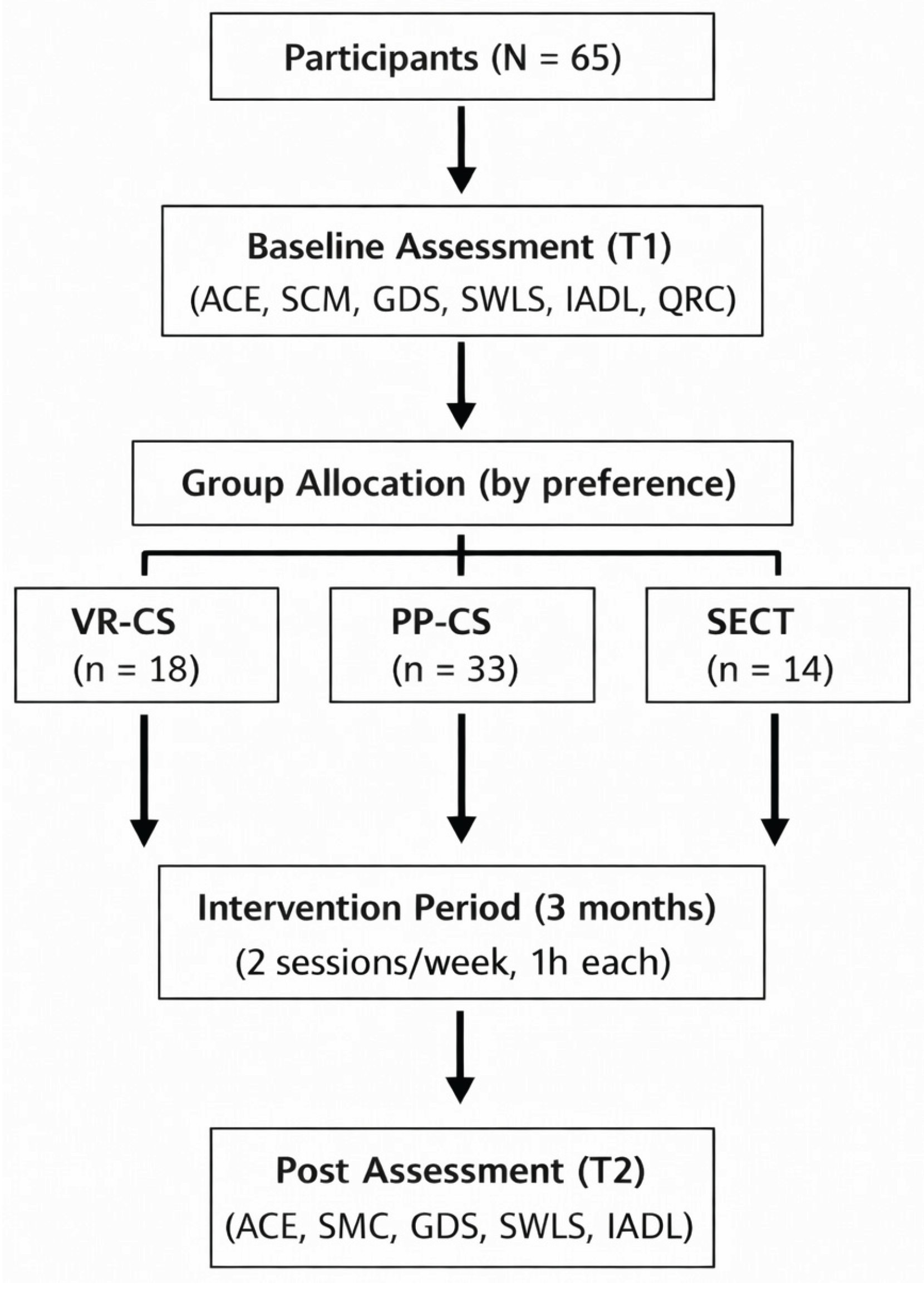
Figure 2.
Differences between pre-post on objective cognitive functioning (ACE-III) per group.
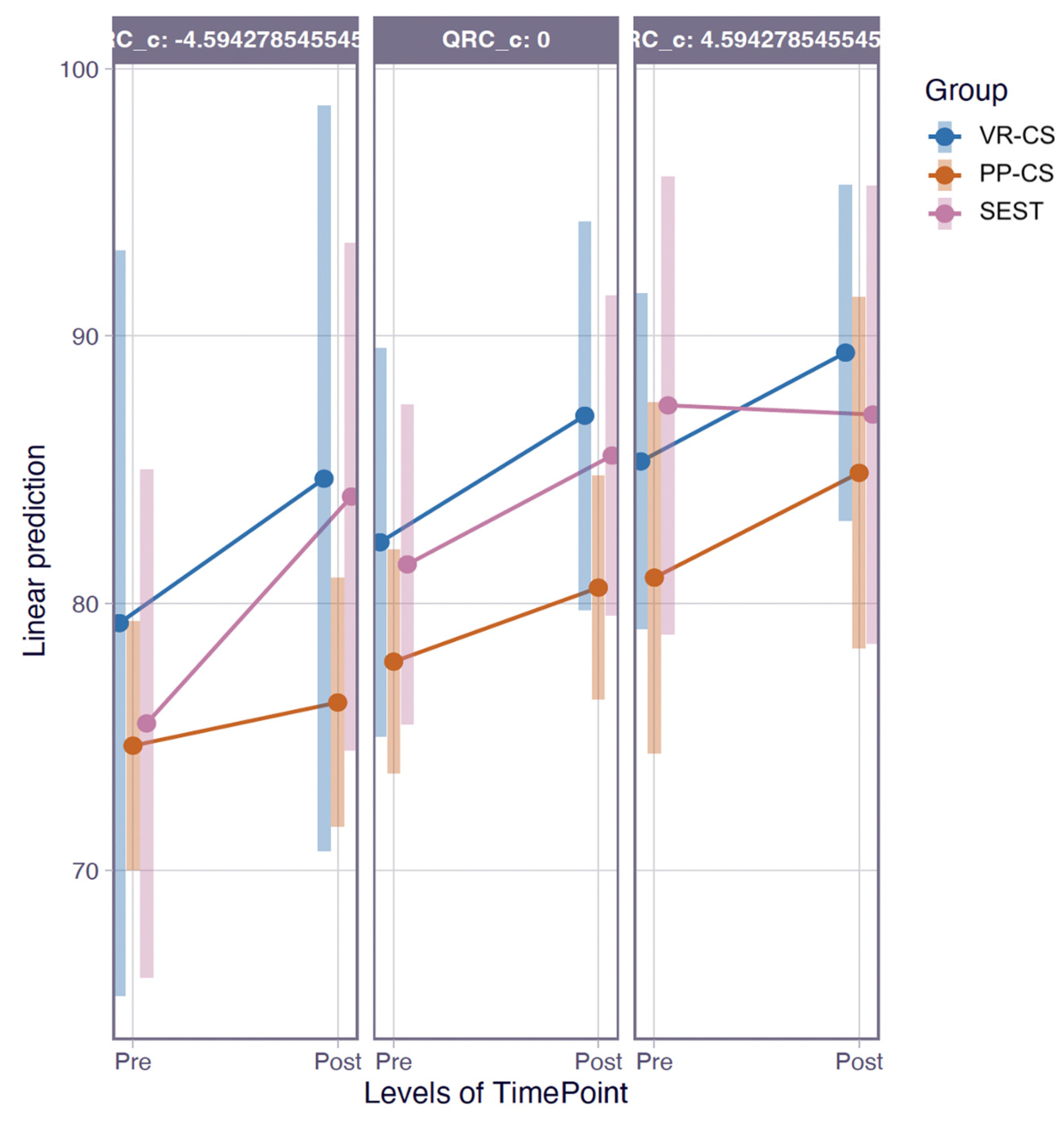
Figure 3.
Differences between pre-post on subjective memory complaints (SMC) per group.
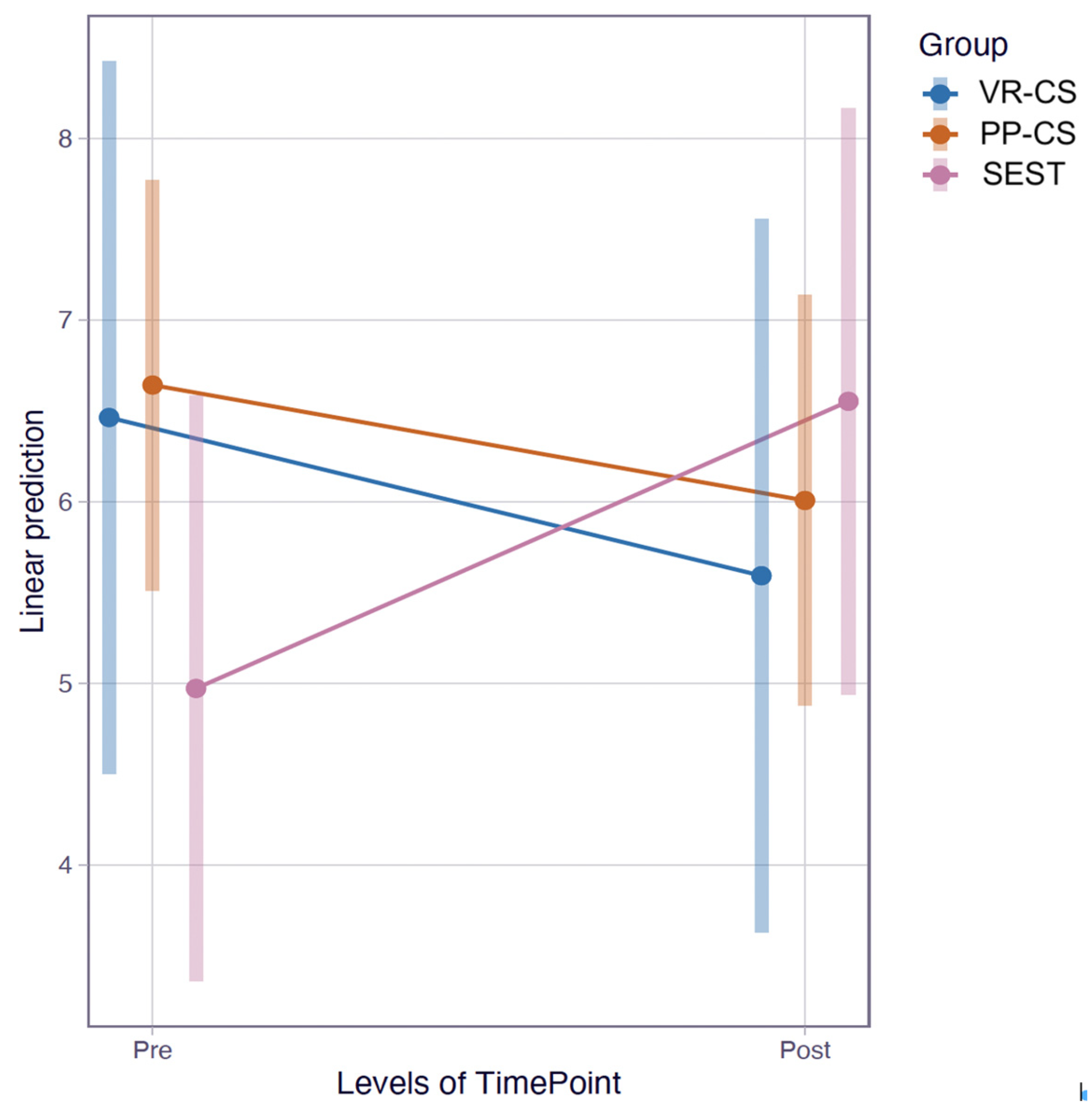

Table 1.
Descriptive statistics for the dependent variables.
| N | M | SD | 95% CI LL | 95% CI UL | Min | Max | ||
|---|---|---|---|---|---|---|---|---|
| SMC | VR-CS | 18 | 6.06 | 2.817 | 4.65 | 7.46 | 1 | 14 |
| PP-CS | 33 | 6.79 | 3.11 | 5.69 | 7.89 | 2 | 13 | |
| SEST | 14 | 4.79 | 3.309 | 2.88 | 6.7 | 1 | 13 | |
| Total | 65 | 6.15 | 3.129 | 5.38 | 6.93 | 1 | 14 | |
| ACE-III | VR-CS | 18 | 84.11 | 7.259 | 80.5 | 87.72 | 65 | 94 |
| PP-CS | 33 | 77.7 | 8.446 | 74.7 | 80.69 | 57 | 93 | |
| SEST | 14 | 85.64 | 7.851 | 81.11 | 90.18 | 69 | 95 | |
| Total | 65 | 81.18 | 8.673 | 79.04 | 83.33 | 57 | 95 | |
| GDS | VR-CS | 18 | 2.94 | 1.697 | 2.1 | 3.79 | 0 | 6 |
| PP-CS | 33 | 3.09 | 2.708 | 2.13 | 4.05 | 0 | 10 | |
| SEST | 14 | 4.29 | 3.561 | 2.23 | 6.34 | 0 | 11 | |
| Total | 65 | 3.31 | 2.698 | 2.64 | 3.98 | 0 | 11 | |
| SWLS | VR-CS | 18 | 24.5 | 5.762 | 21.63 | 27.37 | 14 | 35 |
| PP-CS | 33 | 25.24 | 6.394 | 22.98 | 27.51 | 13 | 35 | |
| SEST | 14 | 22.57 | 5.473 | 19.41 | 25.73 | 14 | 33 | |
| Total | 65 | 24.46 | 6.037 | 22.97 | 25.96 | 13 | 35 | |
| IADL | VR-CS | 18 | 8.17 | 0.383 | 7.98 | 8.36 | 8 | 9 |
| PP-CS | 33 | 8.94 | 1.56 | 8.39 | 9.49 | 8 | 14 | |
| SEST | 14 | 8.43 | 1.604 | 7.5 | 9.35 | 8 | 14 | |
| Total | 65 | 8.62 | 1.377 | 8.27 | 8.96 | 8 | 14 |
Legend: n—number of cases, M—Mean value, SD—Standard Deviation, 95% CI LL—95% Confidence Level—Lower limit, 95% CI UL—95% Confidence Level—Upper limit, Min—Minimum value, Max—Maximum value.
Disclaimer/Publisher’s Note: The statements, opinions and data contained in all publications are solely those of the individual author(s) and contributor(s) and not of MDPI and/or the editor(s). MDPI and/or the editor(s) disclaim responsibility for any injury to people or property resulting from any ideas, methods, instructions or products referred to in the content. |
© 2026 by the authors. Licensee MDPI, Basel, Switzerland. This article is an open access article distributed under the terms and conditions of the Creative Commons Attribution (CC BY) license.
Copyright: This open access article is published under a Creative Commons CC BY 4.0 license, which permit the free download, distribution, and reuse, provided that the author and preprint are cited in any reuse.